Fatigue in Aero
Structures
BY: SHOAIB FARID
REG NO: 200512006
1
Contents
 Introduction
 Aircraft Materials
 Types of Loading on Aircraft Structures
 Causes of Fatigue Failures
 Typical Fatigue in Aero structures
 Testing of structures under fatigue loading
2
Introduction
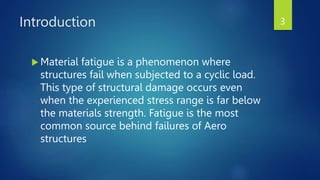
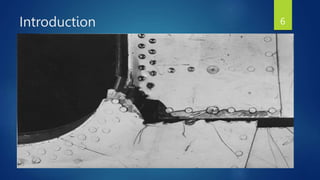
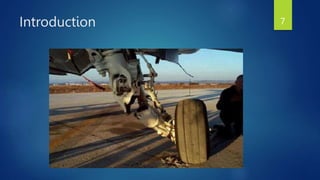
 Material fatigue is a phenomenon where
structures fail when subjected to a cyclic load.
This type of structural damage occurs even
when the experienced stress range is far below
the materials strength. Fatigue is the most
common source behind failures of Aero
structures
3
Introduction
 Some cyclic loads on aircrafts
• Push back (on landing gear)
• Turning (high stresses on landing gear)
• Taxy
• Take off
• Cabin pressurization
• Landing impact
• Undercarriage loading
• Turbulence
• Gust and maneuvers
4
Introduction
 Often, machine members are found to have failed under the action of
repeated or fluctuating stresses
 The most distinguishing characteristic of these failures is that the stresses
have been repeated a very large number of times. Hence the failure is
called a fatigue failure.
5
Introduction 6
Introduction 7
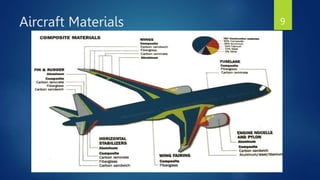
Aircraft Materials
 Steel
 Titanium
 Aluminum
 Laminate Composites
 Sandwich honeycomb Structures
8
Aircraft Materials 9
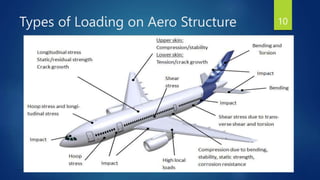
Types of Loading on Aero Structure 10
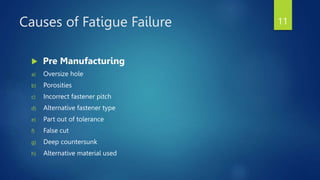
Causes of Fatigue Failure
 Pre Manufacturing
a) Oversize hole
b) Porosities
c) Incorrect fastener pitch
d) Alternative fastener type
e) Part out of tolerance
f) False cut
g) Deep countersunk
h) Alternative material used
11
Causes of Fatigue Failure
 Post manufacturing
a) Corrosion damages
b) Cracks , Dents, Nicks & Scratches
c) Temperature Variations
d) Sonic or Acoustic effects
e) Debonding between skin and core (sandwich)
f) Free edge damages (Delamination's, notches etc.)
g) Impact damages
h) Fretting
12
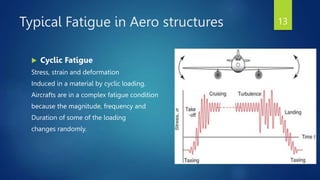
Typical Fatigue in Aero structures
 Cyclic Fatigue
Stress, strain and deformation
Induced in a material by cyclic loading.
Aircrafts are in a complex fatigue condition
because the magnitude, frequency and
Duration of some of the loading
changes randomly.
13
Typical Fatigue in Aero structures
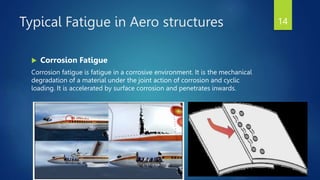
 Corrosion Fatigue
Corrosion fatigue is fatigue in a corrosive environment. It is the mechanical
degradation of a material under the joint action of corrosion and cyclic
loading. It is accelerated by surface corrosion and penetrates inwards.
14
Typical Fatigue in Aero structures
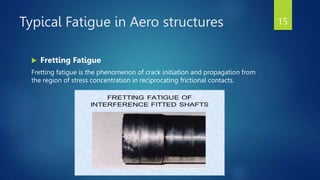
 Fretting Fatigue
Fretting fatigue is the phenomenon of crack initiation and propagation from
the region of stress concentration in reciprocating frictional contacts.
15
Typical Fatigue in Aero structures
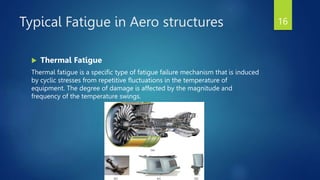
 Thermal Fatigue
Thermal fatigue is a specific type of fatigue failure mechanism that is induced
by cyclic stresses from repetitive fluctuations in the temperature of
equipment. The degree of damage is affected by the magnitude and
frequency of the temperature swings.
16
Typical Fatigue in Aero structures
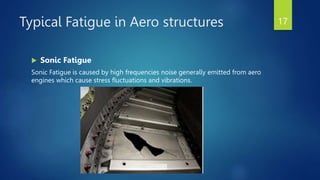
 Sonic Fatigue
Sonic Fatigue is caused by high frequencies noise generally emitted from aero
engines which cause stress fluctuations and vibrations.
17
Testing of Fatigue loaded structures
 Visual Testing with aids (Borescope)
18
Testing of Fatigue loaded structures
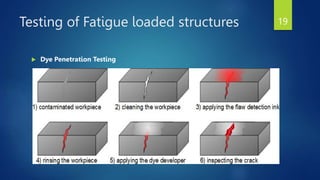
 Dye Penetration Testing
19
Testing of Fatigue loaded structures
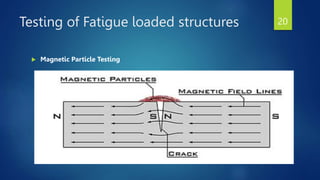
 Magnetic Particle Testing
20
Testing of Fatigue loaded structures
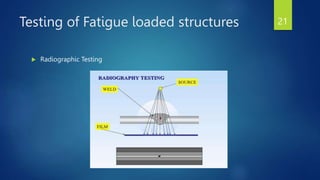
 Radiographic Testing
21
Testing of Fatigue loaded structures
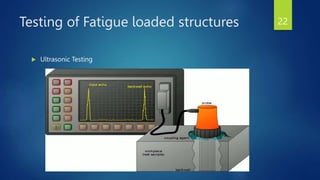
 Ultrasonic Testing
22
Testing of Fatigue loaded structures
 Tap Testing
23
Thank You
24

Fatigue in Aircraft Structures.pptx

  • 1.
    Fatigue in Aero Structures BY:SHOAIB FARID REG NO: 200512006 1
  • 2.
    Contents  Introduction  AircraftMaterials  Types of Loading on Aircraft Structures  Causes of Fatigue Failures  Typical Fatigue in Aero structures  Testing of structures under fatigue loading 2
  • 3.
    Introduction  Material fatigueis a phenomenon where structures fail when subjected to a cyclic load. This type of structural damage occurs even when the experienced stress range is far below the materials strength. Fatigue is the most common source behind failures of Aero structures 3
  • 4.
    Introduction  Some cyclicloads on aircrafts • Push back (on landing gear) • Turning (high stresses on landing gear) • Taxy • Take off • Cabin pressurization • Landing impact • Undercarriage loading • Turbulence • Gust and maneuvers 4
  • 5.
    Introduction  Often, machinemembers are found to have failed under the action of repeated or fluctuating stresses  The most distinguishing characteristic of these failures is that the stresses have been repeated a very large number of times. Hence the failure is called a fatigue failure. 5
  • 6.
  • 7.
  • 8.
    Aircraft Materials  Steel Titanium  Aluminum  Laminate Composites  Sandwich honeycomb Structures 8
  • 9.
  • 10.
    Types of Loadingon Aero Structure 10
  • 11.
    Causes of FatigueFailure  Pre Manufacturing a) Oversize hole b) Porosities c) Incorrect fastener pitch d) Alternative fastener type e) Part out of tolerance f) False cut g) Deep countersunk h) Alternative material used 11
  • 12.
    Causes of FatigueFailure  Post manufacturing a) Corrosion damages b) Cracks , Dents, Nicks & Scratches c) Temperature Variations d) Sonic or Acoustic effects e) Debonding between skin and core (sandwich) f) Free edge damages (Delamination's, notches etc.) g) Impact damages h) Fretting 12
  • 13.
    Typical Fatigue inAero structures  Cyclic Fatigue Stress, strain and deformation Induced in a material by cyclic loading. Aircrafts are in a complex fatigue condition because the magnitude, frequency and Duration of some of the loading changes randomly. 13
  • 14.
    Typical Fatigue inAero structures  Corrosion Fatigue Corrosion fatigue is fatigue in a corrosive environment. It is the mechanical degradation of a material under the joint action of corrosion and cyclic loading. It is accelerated by surface corrosion and penetrates inwards. 14
  • 15.
    Typical Fatigue inAero structures  Fretting Fatigue Fretting fatigue is the phenomenon of crack initiation and propagation from the region of stress concentration in reciprocating frictional contacts. 15
  • 16.
    Typical Fatigue inAero structures  Thermal Fatigue Thermal fatigue is a specific type of fatigue failure mechanism that is induced by cyclic stresses from repetitive fluctuations in the temperature of equipment. The degree of damage is affected by the magnitude and frequency of the temperature swings. 16
  • 17.
    Typical Fatigue inAero structures  Sonic Fatigue Sonic Fatigue is caused by high frequencies noise generally emitted from aero engines which cause stress fluctuations and vibrations. 17
  • 18.
    Testing of Fatigueloaded structures  Visual Testing with aids (Borescope) 18
  • 19.
    Testing of Fatigueloaded structures  Dye Penetration Testing 19
  • 20.
    Testing of Fatigueloaded structures  Magnetic Particle Testing 20
  • 21.
    Testing of Fatigueloaded structures  Radiographic Testing 21
  • 22.
    Testing of Fatigueloaded structures  Ultrasonic Testing 22
  • 23.
    Testing of Fatigueloaded structures  Tap Testing 23
  • 24.