Compression  For sending and storing information Text, audio, images, videos
Common Applications Text compression loss-less, gzip uses Lempel-Ziv coding, 3:1 compression  better than Huffman Audio compression lossy, mpeg 3:1 to 24:1 compression MPEG = motion picture expert group Image compression lossy, jpeg 3:1 compression JPEG = Joint photographic expert group Video compression lossy, mpeg  27:1 compression
Text Compression Prefix code: one, of many, approaches no code is prefix of any other code constraint: loss-less tasks encode:  text (string) -> code decode:  code --> text main goal: maximally reduce storage, measured by  compression ratio minor goals: simplicity efficiency: time and space some require code dictionary or 2 passes of data
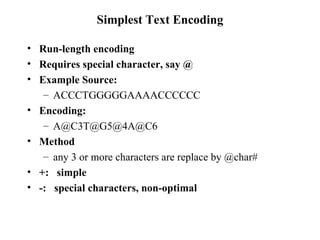
Simplest Text Encoding Run-length encoding Requires special character, say @ Example Source: ACCCTGGGGGAAAACCCCCC Encoding: A@C3T@G5@4A@C6 Method any 3 or more characters are replace by @char# +:  simple -:  special characters, non-optimal
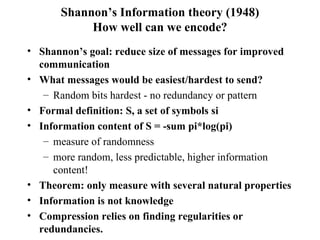
Shannon’s Information theory (1948) How well can we encode? Shannon’s goal: reduce size of messages for improved communication What messages would be easiest/hardest to send? Random bits hardest - no redundancy or pattern Formal definition: S, a set of symbols si Information content of S = -sum pi*log(pi) measure of randomness more random, less predictable, higher information content! Theorem: only measure with several natural properties Information is not knowledge Compression relies on finding regularities or redundancies.
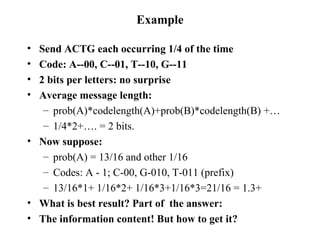
Example Send ACTG each occurring 1/4 of the time Code: A--00, C--01, T--10, G--11 2 bits per letters: no surprise Average message length: prob(A)*codelength(A)+prob(B)*codelength(B) +… 1/4*2+…. = 2 bits. Now suppose: prob(A) = 13/16 and other 1/16 Codes: A - 1; C-00, G-010, T-011 (prefix) 13/16*1+ 1/16*2+ 1/16*3+1/16*3=21/16 = 1.3+ What is best result? Part of  the answer: The information content! But how to get it?
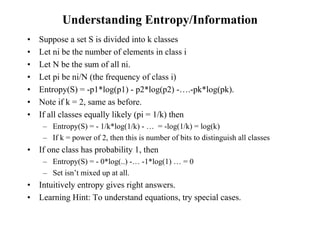
Understanding Entropy/Information
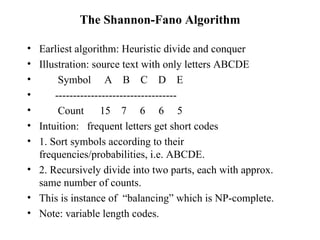
The Shannon-Fano Algorithm Earliest algorithm: Heuristic divide and conquer Illustration: source text with only letters ABCDE Symbol  A  B  C  D  E  ---------------------------------- Count  15  7  6  6  5 Intuition:  frequent letters get short codes 1. Sort symbols according to their frequencies/probabilities, i.e. ABCDE.  2. Recursively divide into two parts, each with approx. same number of counts.  This is instance of  “balancing” which is NP-complete. Note: variable length codes.
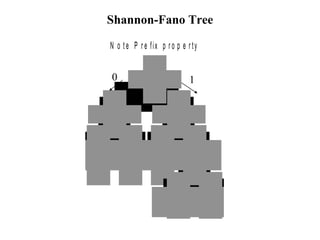
Shannon-Fano Tree 0 1
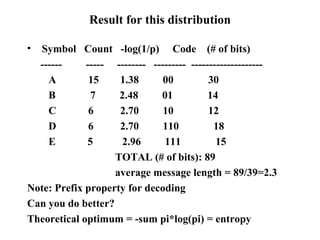
Result for this distribution Symbol  Count  -log(1/p)  Code  (# of bits) ------  -----  --------  ---------  -------------------- A  15  1.38  00  30 B  7  2.48  01  14 C  6  2.70  10  12 D  6  2.70  110  18 E  5  2.96  111  15 TOTAL (# of bits): 89 average message length = 89/39=2.3 Note: Prefix property for decoding Can you do better?  Theoretical optimum = -sum pi*log(pi) = entropy
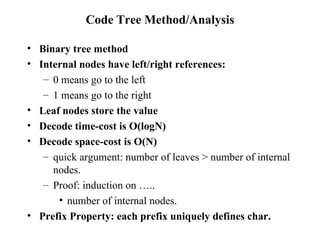
Code Tree Method/Analysis Binary tree method  Internal nodes have left/right references: 0 means go to the left 1 means go to the right Leaf nodes store the value Decode time-cost is O(logN) Decode space-cost is O(N) quick argument: number of leaves > number of internal nodes.  Proof: induction on ….. number of internal nodes. Prefix Property: each prefix uniquely defines char.
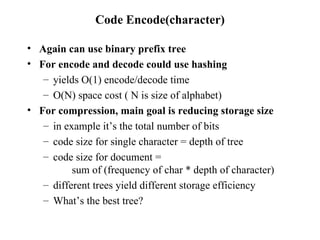
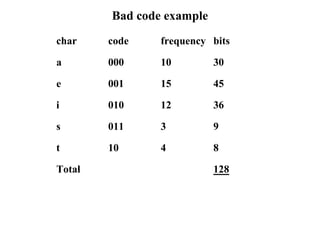
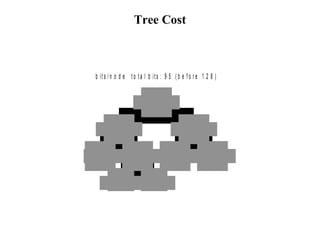
Code Encode(character) Again can use binary prefix tree For encode and decode could use hashing yields O(1) encode/decode time O(N) space cost ( N is size of alphabet) For compression, main goal is reducing storage size in example it’s the total number of bits code size for single character = depth of tree code size for document =  sum of (frequency of char * depth of character) different trees yield different storage efficiency What’s the best tree?
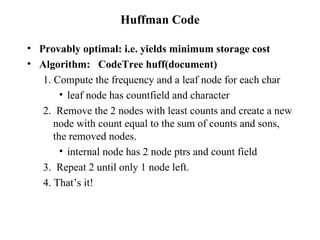
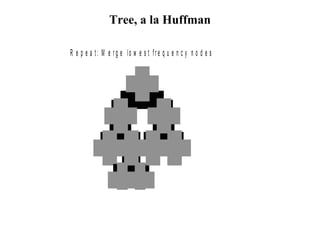
Huffman Code Provably optimal: i.e. yields minimum storage cost Algorithm:  CodeTree huff(document) 1. Compute the frequency and a leaf node for each char leaf node has countfield and character 2.  Remove the 2 nodes with least counts and create a new node with count equal to the sum of counts and sons, the removed nodes. internal node has 2 node ptrs and count field 3.  Repeat 2 until only 1 node left. 4. That’s it!
Bad code example
Tree, a la Huffman
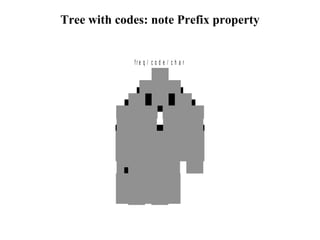
Tree with codes: note Prefix property
Tree Cost
Analysis Intuition:  least frequent chars get longest codes or most frequent chars get shortest codes. Let T be a minimal code tree. (Induction) All nodes have 2 sons.  (by construction) Lemma: if c1 and c2 be least frequently used then they are at the deepest depth Proof: if not deepest nodes, exchange and total cost (number of bits) goes down
Analysis (continued) Sk : Huffman algorithm on k chars produces optimal code. S2:  obvious Sk => Sk+1 Let T be optimal code on k+1 chars By lemma, two least freq chars are deepest Replace two least freq char by new char with freq equal to sum Now have tree with k nodes By induction, Huffman yields optimal tree.
Lempel-Ziv Input: string of characters Internal: dictionary of (codewords, words) Output: string of codewords and characters. Codewords are distinct from characters. In algorithm, w is a string, c is character and w+c means concatenation. When adding a new word to the dictionary, a new code word needs to be assigned.
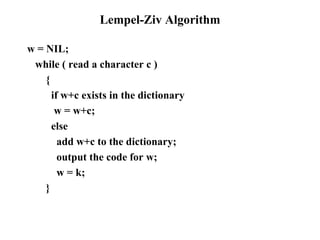
Lempel-Ziv Algorithm w = NIL;  while ( read a character c ) {  if w+c exists in the dictionary w = w+c; else add w+c to the dictionary; output the code for w; w = k; }
Adaptive Encoding Webster has 157,000 entries: could encode in X bits but only works for this document Don’t want to do two passes Adaptive Huffman modify model on the fly Zempel-Liv  1977 ZLW  Zempel-Liv Welsh 1984  used in compress (UNIX) uses dictionary method variable number of symbols to fixed length code better with large documents- finds repetitive patterns
Audio Compression Sounds can be represented as a vector valued function At any point in time, a sound is a combination of different frequencies of different strengths For example, each note on a piano yields a specific frequency. Also, our ears, like pianos, have cilia that responds to specific frequencies.  Just like sin(x) can be approximated by small number of terms, e.g.  x -x^3/3+x^5/120…, so can sound. Transforming a sound into its “spectrum”  is done mathematically by a fourier transform. The spectrum can be played back, as on computer with sound cards.
Audio Using many frequencies, as in CDs, yields a good approximation Using few frequenices, as in telephones, a poor approximation Sampling frequencies yields compresssion ratios between 6 to 24, depending on sound and quality High-priced electronic pianos store  and reuse “samples” of concert pianos  High filter: removes/reduces high frequencies, a common problem with aging Low filter: removes/reduces low frequencies Can use differential methods: only report change in sounds
Image Compression with or without loss, mostly with who cares about what the eye can’t see Black and white images can regarded as functions from the plane (R^2) into the reals (R), as in old TVs positions vary continuous, but our eyes can’t see the discreteness around 100 pixels per inch.  Color images can be regarded as functions from the plane into R^3, the RGB space.  Colors are vary continuous, but our eyes sample colors with only 3 difference receptors (RGB) Mathematical theories yields close approximation there are spatial analogues to fourier transforms
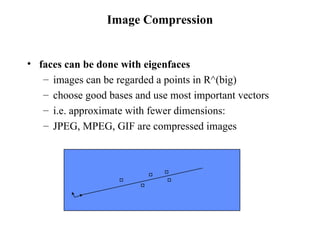
Image Compression faces can be done with eigenfaces  images can be regarded a points in R^(big) choose good bases and use most important vectors i.e. approximate with fewer dimensions: JPEG, MPEG, GIF are compressed images
Video Compression Uses DCT (discrete cosine transform) Note: Nice functions can be approximated by sum of x, x^2,… with appropriate coefficients sum of  sin(x), sin(2x),… with right coefficients almost any infinite sum of functions DCT is good because few terms give good results on images.  Differential methods used: only report changes in video
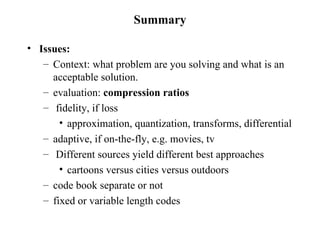
Summary Issues: Context: what problem are you solving and what is an acceptable solution. evaluation:  compression ratios fidelity, if loss approximation, quantization, transforms, differential adaptive, if on-the-fly, e.g. movies, tv Different sources yield different best approaches cartoons versus cities versus outdoors code book separate or not fixed or variable length codes

Lec5 Compression

  • 1.
    Compression Forsending and storing information Text, audio, images, videos
  • 2.
    Common Applications Textcompression loss-less, gzip uses Lempel-Ziv coding, 3:1 compression better than Huffman Audio compression lossy, mpeg 3:1 to 24:1 compression MPEG = motion picture expert group Image compression lossy, jpeg 3:1 compression JPEG = Joint photographic expert group Video compression lossy, mpeg 27:1 compression
  • 3.
    Text Compression Prefixcode: one, of many, approaches no code is prefix of any other code constraint: loss-less tasks encode: text (string) -> code decode: code --> text main goal: maximally reduce storage, measured by compression ratio minor goals: simplicity efficiency: time and space some require code dictionary or 2 passes of data
  • 4.
    Simplest Text EncodingRun-length encoding Requires special character, say @ Example Source: ACCCTGGGGGAAAACCCCCC Encoding: A@C3T@G5@4A@C6 Method any 3 or more characters are replace by @char# +: simple -: special characters, non-optimal
  • 5.
    Shannon’s Information theory(1948) How well can we encode? Shannon’s goal: reduce size of messages for improved communication What messages would be easiest/hardest to send? Random bits hardest - no redundancy or pattern Formal definition: S, a set of symbols si Information content of S = -sum pi*log(pi) measure of randomness more random, less predictable, higher information content! Theorem: only measure with several natural properties Information is not knowledge Compression relies on finding regularities or redundancies.
  • 6.
    Example Send ACTGeach occurring 1/4 of the time Code: A--00, C--01, T--10, G--11 2 bits per letters: no surprise Average message length: prob(A)*codelength(A)+prob(B)*codelength(B) +… 1/4*2+…. = 2 bits. Now suppose: prob(A) = 13/16 and other 1/16 Codes: A - 1; C-00, G-010, T-011 (prefix) 13/16*1+ 1/16*2+ 1/16*3+1/16*3=21/16 = 1.3+ What is best result? Part of the answer: The information content! But how to get it?
  • 7.
  • 8.
    The Shannon-Fano AlgorithmEarliest algorithm: Heuristic divide and conquer Illustration: source text with only letters ABCDE Symbol A B C D E ---------------------------------- Count 15 7 6 6 5 Intuition: frequent letters get short codes 1. Sort symbols according to their frequencies/probabilities, i.e. ABCDE. 2. Recursively divide into two parts, each with approx. same number of counts. This is instance of “balancing” which is NP-complete. Note: variable length codes.
  • 9.
  • 10.
    Result for thisdistribution Symbol Count -log(1/p) Code (# of bits) ------ ----- -------- --------- -------------------- A 15 1.38 00 30 B 7 2.48 01 14 C 6 2.70 10 12 D 6 2.70 110 18 E 5 2.96 111 15 TOTAL (# of bits): 89 average message length = 89/39=2.3 Note: Prefix property for decoding Can you do better? Theoretical optimum = -sum pi*log(pi) = entropy
  • 11.
    Code Tree Method/AnalysisBinary tree method Internal nodes have left/right references: 0 means go to the left 1 means go to the right Leaf nodes store the value Decode time-cost is O(logN) Decode space-cost is O(N) quick argument: number of leaves > number of internal nodes. Proof: induction on ….. number of internal nodes. Prefix Property: each prefix uniquely defines char.
  • 12.
    Code Encode(character) Againcan use binary prefix tree For encode and decode could use hashing yields O(1) encode/decode time O(N) space cost ( N is size of alphabet) For compression, main goal is reducing storage size in example it’s the total number of bits code size for single character = depth of tree code size for document = sum of (frequency of char * depth of character) different trees yield different storage efficiency What’s the best tree?
  • 13.
    Huffman Code Provablyoptimal: i.e. yields minimum storage cost Algorithm: CodeTree huff(document) 1. Compute the frequency and a leaf node for each char leaf node has countfield and character 2. Remove the 2 nodes with least counts and create a new node with count equal to the sum of counts and sons, the removed nodes. internal node has 2 node ptrs and count field 3. Repeat 2 until only 1 node left. 4. That’s it!
  • 14.
  • 15.
    Tree, a laHuffman
  • 16.
    Tree with codes:note Prefix property
  • 17.
  • 18.
    Analysis Intuition: least frequent chars get longest codes or most frequent chars get shortest codes. Let T be a minimal code tree. (Induction) All nodes have 2 sons. (by construction) Lemma: if c1 and c2 be least frequently used then they are at the deepest depth Proof: if not deepest nodes, exchange and total cost (number of bits) goes down
  • 19.
    Analysis (continued) Sk: Huffman algorithm on k chars produces optimal code. S2: obvious Sk => Sk+1 Let T be optimal code on k+1 chars By lemma, two least freq chars are deepest Replace two least freq char by new char with freq equal to sum Now have tree with k nodes By induction, Huffman yields optimal tree.
  • 20.
    Lempel-Ziv Input: stringof characters Internal: dictionary of (codewords, words) Output: string of codewords and characters. Codewords are distinct from characters. In algorithm, w is a string, c is character and w+c means concatenation. When adding a new word to the dictionary, a new code word needs to be assigned.
  • 21.
    Lempel-Ziv Algorithm w= NIL; while ( read a character c ) { if w+c exists in the dictionary w = w+c; else add w+c to the dictionary; output the code for w; w = k; }
  • 22.
    Adaptive Encoding Websterhas 157,000 entries: could encode in X bits but only works for this document Don’t want to do two passes Adaptive Huffman modify model on the fly Zempel-Liv 1977 ZLW Zempel-Liv Welsh 1984 used in compress (UNIX) uses dictionary method variable number of symbols to fixed length code better with large documents- finds repetitive patterns
  • 23.
    Audio Compression Soundscan be represented as a vector valued function At any point in time, a sound is a combination of different frequencies of different strengths For example, each note on a piano yields a specific frequency. Also, our ears, like pianos, have cilia that responds to specific frequencies. Just like sin(x) can be approximated by small number of terms, e.g. x -x^3/3+x^5/120…, so can sound. Transforming a sound into its “spectrum” is done mathematically by a fourier transform. The spectrum can be played back, as on computer with sound cards.
  • 24.
    Audio Using manyfrequencies, as in CDs, yields a good approximation Using few frequenices, as in telephones, a poor approximation Sampling frequencies yields compresssion ratios between 6 to 24, depending on sound and quality High-priced electronic pianos store and reuse “samples” of concert pianos High filter: removes/reduces high frequencies, a common problem with aging Low filter: removes/reduces low frequencies Can use differential methods: only report change in sounds
  • 25.
    Image Compression withor without loss, mostly with who cares about what the eye can’t see Black and white images can regarded as functions from the plane (R^2) into the reals (R), as in old TVs positions vary continuous, but our eyes can’t see the discreteness around 100 pixels per inch. Color images can be regarded as functions from the plane into R^3, the RGB space. Colors are vary continuous, but our eyes sample colors with only 3 difference receptors (RGB) Mathematical theories yields close approximation there are spatial analogues to fourier transforms
  • 26.
    Image Compression facescan be done with eigenfaces images can be regarded a points in R^(big) choose good bases and use most important vectors i.e. approximate with fewer dimensions: JPEG, MPEG, GIF are compressed images
  • 27.
    Video Compression UsesDCT (discrete cosine transform) Note: Nice functions can be approximated by sum of x, x^2,… with appropriate coefficients sum of sin(x), sin(2x),… with right coefficients almost any infinite sum of functions DCT is good because few terms give good results on images. Differential methods used: only report changes in video
  • 28.
    Summary Issues: Context:what problem are you solving and what is an acceptable solution. evaluation: compression ratios fidelity, if loss approximation, quantization, transforms, differential adaptive, if on-the-fly, e.g. movies, tv Different sources yield different best approaches cartoons versus cities versus outdoors code book separate or not fixed or variable length codes