ENSC 424 - Multimedia
Communications Engineering
Topic 6: Arithmetic Coding 1

                                         Jie Liang
                              Engineering Science
                           Simon Fraser University
                                     JieL@sfu.ca


  J. Liang: SFU ENSC 424                9/20/2005    1
Outline
 Introduction
 Basic Encoding and Decoding
 Scaling and Incremental Coding
 Integer Implementation
 Adaptive Arithmetic Coding
 Binary Arithmetic Coding
 Applications
     JBIG, H.264, JPEG 2000


 J. Liang: SFU ENSC 424           9/20/2005   2
Huffman Coding: The Retired Champion
 Replacing an input symbol with a codeword
 Need a probability distribution
 Hard to adapt to changing statistics
 Need to store the codeword table
 Minimum codeword length is 1 bit
Arithmetic Coding: The Rising Star
 Replace the entire input with a single floating-point
 number
 Does not need the probability distribution
 Adaptive coding is very easy
 No need to keep and send codeword table
 Fractional codeword length
 J. Liang: SFU ENSC 424                        9/20/2005   3
History of Arithmetic Coding
Claude Shannon: 1916-2001
   A distant relative of Thomas Edison
   1932: Went to University of Michigan.
   1937: Master thesis at MIT became the foundation of digital circuit design:
       “The most important, and also the most famous, master's thesis of the century“
   1940: PhD, MIT
   1940-1956: Bell Lab (back to MIT after that)
   1948: The birth of Information Theory
       A mathematical theory of communication, Bell System Technical Journal.
       Earliest idea of arithmetic coding
Robert Fano: 1917-
   Shannon-Fano code: proved to be sub-optimal by Huffman
   1952: First Information Theory class. Students included:
       David Huffman: Huffman Coding
       Peter Elias: Recursive implementation of arithmetic coding
Frederick Jelinek
   Also Fano’s student: PhD MIT 1962 (now at Johns Hopkins)
   1968: Further development of arithmetic coding
1976: Rediscovered by Pasco and Rissanen
Practical implementation: since 1980’s
                                Bell Lab for Sale: http://www.spectrum.ieee.org/sep05/1683
 J. Liang: SFU ENSC 424                                                     9/20/2005   4
Introduction
 Recall table look-up decoding of Huffman code
     N: alphabet size
                                                                      1
     L: Max codeword length
                                            00
     Divide [0, 2^L] into N intervals
     One interval for one symbol
                                                 010 011
     Interval size is roughly
     proportional to symbol prob.        000     010 011 100

 Arithmetic coding applies this idea recursively
     Normalizes the range [0, 2^L] to [0, 1].
     Map an input sequence to a unique tag in [0, 1).

                      abcd…..
                      dcba…..           0                                     1
 J. Liang: SFU ENSC 424                                   9/20/2005       5
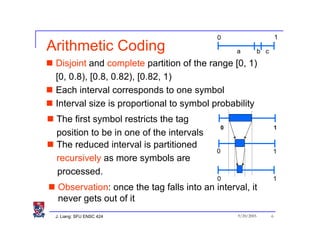
0                             1
Arithmetic Coding                                  a           b c
 Disjoint and complete partition of the range [0, 1)
 [0, 0.8), [0.8, 0.82), [0.82, 1)
 Each interval corresponds to one symbol
 Interval size is proportional to symbol probability
 The first symbol restricts the tag
                                               0                         1
 position to be in one of the intervals
 The reduced interval is partitioned
                                           0                         1
 recursively as more symbols are
 processed.
                                           0                         1
  Observation: once the tag falls into an interval, it
  never gets out of it
 J. Liang: SFU ENSC 424                            9/20/2005         6
Some Questions to think about:
 Why compression is achieved this way?
 How to implement it efficiently?
 How to decode the sequence?
 Why is it better than Huffman code?


 J. Liang: SFU ENSC 424             9/20/2005   7
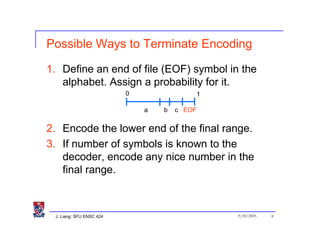
Possible Ways to Terminate Encoding

1. Define an end of file (EOF) symbol in the
   alphabet. Assign a probability for it.
                          0               1

                              a   b   c EOF


2. Encode the lower end of the final range.
3. If number of symbols is known to the
   decoder, encode any nice number in the
   final range.


 J. Liang: SFU ENSC 424                       9/20/2005   8
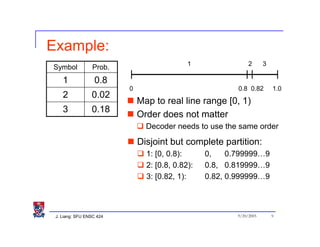
Example:
                                             1                 2      3
Symbol            Prob.
    1             0.8
                          0                               0.8 0.82        1.0
    2            0.02
                              Map to real line range [0, 1)
    3            0.18
                              Order does not matter
                                Decoder needs to use the same order

                              Disjoint but complete partition:
                                1: [0, 0.8):      0,    0.799999…9
                                2: [0.8, 0.82):   0.8, 0.819999…9
                                3: [0.82, 1):     0.82, 0.999999…9


 J. Liang: SFU ENSC 424                                   9/20/2005       9
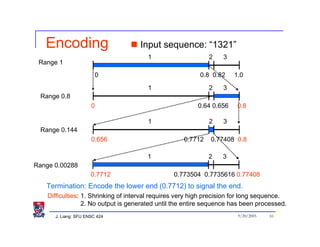
Encoding                          Input sequence: “1321”
                                        1                     2    3
 Range 1
                          0                               0.8 0.82     1.0
                                        1                     2    3
 Range 0.8
                      0                                   0.64 0.656    0.8

                                        1                     2    3
 Range 0.144
                      0.656                          0.7712   0.77408 0.8

                                        1                     2    3
Range 0.00288
                      0.7712                     0.773504 0.7735616 0.77408
   Termination: Encode the lower end (0.7712) to signal the end.
    Difficulties: 1. Shrinking of interval requires very high precision for long sequence.
                  2. No output is generated until the entire sequence has been processed.
      J. Liang: SFU ENSC 424                                            9/20/2005   10
Encoder Pseudo Code
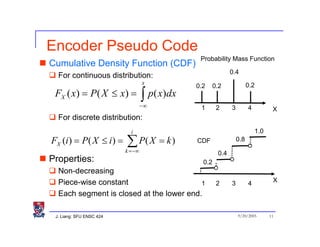
                                                Probability Mass Function
Cumulative Density Function (CDF)
                                                              0.4
  For continuous distribution:
                                   x                                    0.2
                                               0.2     0.2
 FX ( x) = P ( X ≤ x) =
                                −∞
                                   ∫ p( x)dx
                                                1       2     3         4            X
  For discrete distribution:
                            i                                                 1.0
FX (i ) = P( X ≤ i ) =    ∑ P( X = k )
                          k = −∞
                                               CDF                0.8

                                                        0.4
Properties:                                      0.2
  Non-decreasing
  Piece-wise constant                                                                X
                                          1             2     3         4
  Each segment is closed at the lower end.

 J. Liang: SFU ENSC 424                                           9/20/2005         11
Encoder Pseudo Code
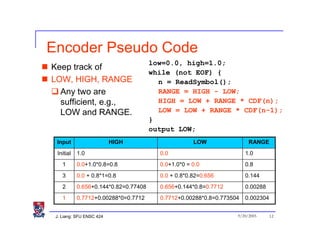
                                      low=0.0, high=1.0;
Keep track of
                                      while (not EOF) {
LOW, HIGH, RANGE                        n = ReadSymbol();
  Any two are                           RANGE = HIGH - LOW;
  sufficient, e.g.,                     HIGH = LOW + RANGE * CDF(n);
  LOW and RANGE.                        LOW = LOW + RANGE * CDF(n-1);
                                      }
                                      output LOW;
 Input                    HIGH                      LOW                RANGE
 Initial   1.0                          0.0                           1.0
    1      0.0+1.0*0.8=0.8              0.0+1.0*0 = 0.0               0.8
    3      0.0 + 0.8*1=0.8              0.0 + 0.8*0.82=0.656          0.144
    2      0.656+0.144*0.82=0.77408     0.656+0.144*0.8=0.7712        0.00288
    1      0.7712+0.00288*0=0.7712      0.7712+0.00288*0.8=0.773504   0.002304


 J. Liang: SFU ENSC 424                                           9/20/2005      12
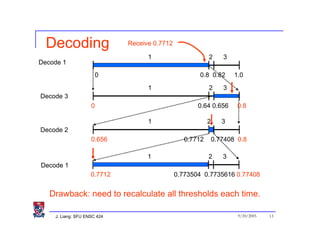
Decoding                   Receive 0.7712

                                   1                      2      3
Decode 1
                        0                            0.8 0.82        1.0
                                   1                      2      3
Decode 3
                    0                                0.64 0.656       0.8

                                   1                      2      3
Decode 2
                    0.656                        0.7712       0.77408 0.8

                                   1                      2      3
Decode 1
                    0.7712                    0.773504 0.7735616 0.77408


   Drawback: need to recalculate all thresholds each time.

    J. Liang: SFU ENSC 424                                            9/20/2005   13
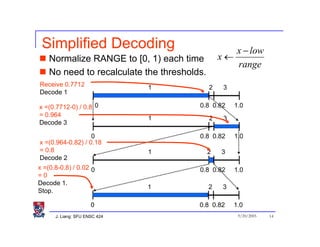
Simplified Decoding                                x − low
    Normalize RANGE to [0, 1) each time          x←
                                                    range
    No need to recalculate the thresholds.
Receive 0.7712                 1             2    3
Decode 1

x =(0.7712-0) / 0.8 0                   0.8 0.82      1.0
= 0.964
                               1             2    3
Decode 3

                   0                    0.8 0.82      1.0
x =(0.964-0.82) / 0.18
= 0.8                          1             2   3
Decode 2
x =(0.8-0.8) / 0.02 0                   0.8 0.82      1.0
=0
Decode 1.
                               1             2    3
Stop.

                      0                 0.8 0.82      1.0
      J. Liang: SFU ENSC 424                           9/20/2005   14
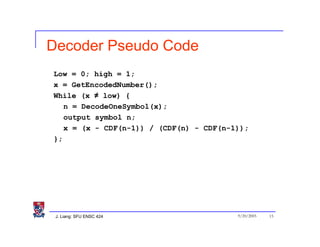
Decoder Pseudo Code
Low = 0; high = 1;
x = GetEncodedNumber();
While (x ≠ low) {
   n = DecodeOneSymbol(x);
   output symbol n;
   x = (x - CDF(n-1)) / (CDF(n) - CDF(n-1));
};


 J. Liang: SFU ENSC 424                  9/20/2005   15
Outline
 Introduction
 Basic Encoding and Decoding
 Scaling and Incremental Coding
 Integer Implementation
 Adaptive Arithmetic Coding
 Binary Arithmetic Coding
 Applications
     JBIG, H.264, JPEG 2000


 J. Liang: SFU ENSC 424           9/20/2005   16
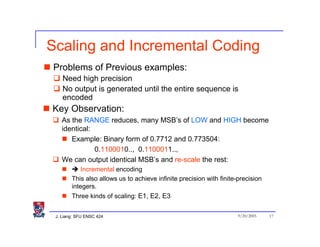
Scaling and Incremental Coding
Problems of Previous examples:
    Need high precision
    No output is generated until the entire sequence is
    encoded
Key Observation:
   As the RANGE reduces, many MSB’s of LOW and HIGH become
   identical:
      Example: Binary form of 0.7712 and 0.773504:
              0.1100010.., 0.1100011..,
   We can output identical MSB’s and re-scale the rest:
            Incremental encoding
        This also allows us to achieve infinite precision with finite-precision
        integers.
        Three kinds of scaling: E1, E2, E3


 J. Liang: SFU ENSC 424                                               9/20/2005   17
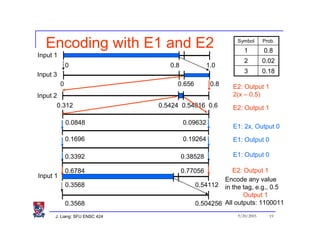
E1 and E2 Scaling
 E1: [LOW HIGH) in [0, 0.5)                      0       0.5                 1.0
     LOW: 0.0xxxxxxx (binary),
     HIGH: 0.0xxxxxxx.
                                                     0   0.5                 1.0
 Output 0, then shift left by 1 bit
     [0, 0.5)       [0, 1): E1(x) = 2 x


 E2: [LOW HIGH) in [0.5, 1)                      0       0.5                1.0
     LOW: 0.1xxxxxxx,
     HIGH: 0.1xxxxxxx.
                                                 0       0.5               1.0
 Output 1, subtract 0.5,
 shift left by 1 bit
     [0.5, 1)       [0, 1): E2(x) = 2(x - 0.5)

 J. Liang: SFU ENSC 424                                        9/20/2005         18
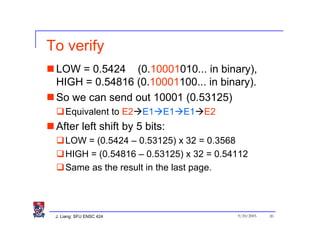
Encoding with E1 and E2                                Symbol
                                                             1
                                                                      Prob.
                                                                      0.8
Input 1
                                                             2        0.02
              0                   0.8             1.0
                                                             3        0.18
Input 3
          0                         0.656          0.8   E2: Output 1
Input 2                                                  2(x – 0.5)
      0.312                    0.5424 0.54816 0.6        E2: Output 1

              0.0848                    0.09632
                                                         E1: 2x, Output 0
              0.1696                    0.19264          E1: Output 0

              0.3392                    0.38528          E1: Output 0

              0.6784                    0.77056         E2: Output 1
Input 1
                                                     Encode any value
              0.3568                        0.54112 in the tag, e.g., 0.5
                                                            Output 1
              0.3568                        0.504256 All outputs: 1100011
      J. Liang: SFU ENSC 424                              9/20/2005     19
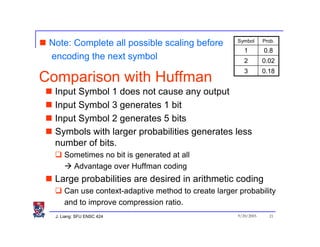
To verify
 LOW = 0.5424 (0.10001010... in binary),
 HIGH = 0.54816 (0.10001100... in binary).
 So we can send out 10001 (0.53125)
     Equivalent to E2 E1 E1 E1 E2
 After left shift by 5 bits:
     LOW = (0.5424 – 0.53125) x 32 = 0.3568
     HIGH = (0.54816 – 0.53125) x 32 = 0.54112
     Same as the result in the last page.


 J. Liang: SFU ENSC 424                    9/20/2005   20
Symbol      Prob.
 Note: Complete all possible scaling before
                                                          1        0.8
 encoding the next symbol                                 2        0.02
                                                          3        0.18
Comparison with Huffman
  Input Symbol 1 does not cause any output
  Input Symbol 3 generates 1 bit
  Input Symbol 2 generates 5 bits
  Symbols with larger probabilities generates less
  number of bits.
      Sometimes no bit is generated at all
        Advantage over Huffman coding
  Large probabilities are desired in arithmetic coding
      Can use context-adaptive method to create larger probability
      and to improve compression ratio.
  J. Liang: SFU ENSC 424                               9/20/2005     21
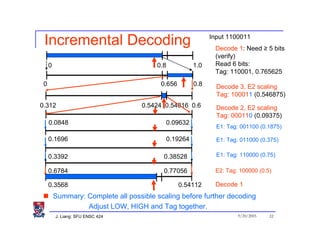
Incremental Decoding                                         Input 1100011
                                                               Decode 1: Need ≥ 5 bits
                                                               (verify)
     0                                  0.8             1.0    Read 6 bits:
                                                               Tag: 110001, 0.765625
 0                                        0.656         0.8     Decode 3, E2 scaling
                                                                Tag: 100011 (0.546875)
0.312                               0.5424 0.54816 0.6          Decode 2, E2 scaling
                                                                Tag: 000110 (0.09375)
     0.0848                                0.09632
                                                                E1: Tag: 001100 (0.1875)

     0.1696                                   0.19264           E1: Tag: 011000 (0.375)

     0.3392                               0.38528               E1: Tag: 110000 (0.75)

     0.6784                               0.77056              E2: Tag: 100000 (0.5)

     0.3568                                       0.54112      Decode 1
         Summary: Complete all possible scaling before further decoding
                  Adjust LOW, HIGH and Tag together.
         J. Liang: SFU ENSC 424                                         9/20/2005   22
Summary
 Introduction
 Encoding and Decoding
 Scaling and Incremental Coding
    E1, E2
 Next:
    Integer Implementation
         E3 scaling
    Adaptive Arithmetic Coding
    Binary Arithmetic Coding
    Applications
         JBIG, H.264, JPEG 2000
J. Liang: SFU ENSC 424            9/20/2005   23

06 Arithmetic 1

  • 1.
    ENSC 424 -Multimedia Communications Engineering Topic 6: Arithmetic Coding 1 Jie Liang Engineering Science Simon Fraser University JieL@sfu.ca J. Liang: SFU ENSC 424 9/20/2005 1
  • 2.
    Outline Introduction BasicEncoding and Decoding Scaling and Incremental Coding Integer Implementation Adaptive Arithmetic Coding Binary Arithmetic Coding Applications JBIG, H.264, JPEG 2000 J. Liang: SFU ENSC 424 9/20/2005 2
  • 3.
    Huffman Coding: TheRetired Champion Replacing an input symbol with a codeword Need a probability distribution Hard to adapt to changing statistics Need to store the codeword table Minimum codeword length is 1 bit Arithmetic Coding: The Rising Star Replace the entire input with a single floating-point number Does not need the probability distribution Adaptive coding is very easy No need to keep and send codeword table Fractional codeword length J. Liang: SFU ENSC 424 9/20/2005 3
  • 4.
    History of ArithmeticCoding Claude Shannon: 1916-2001 A distant relative of Thomas Edison 1932: Went to University of Michigan. 1937: Master thesis at MIT became the foundation of digital circuit design: “The most important, and also the most famous, master's thesis of the century“ 1940: PhD, MIT 1940-1956: Bell Lab (back to MIT after that) 1948: The birth of Information Theory A mathematical theory of communication, Bell System Technical Journal. Earliest idea of arithmetic coding Robert Fano: 1917- Shannon-Fano code: proved to be sub-optimal by Huffman 1952: First Information Theory class. Students included: David Huffman: Huffman Coding Peter Elias: Recursive implementation of arithmetic coding Frederick Jelinek Also Fano’s student: PhD MIT 1962 (now at Johns Hopkins) 1968: Further development of arithmetic coding 1976: Rediscovered by Pasco and Rissanen Practical implementation: since 1980’s Bell Lab for Sale: http://www.spectrum.ieee.org/sep05/1683 J. Liang: SFU ENSC 424 9/20/2005 4
  • 5.
    Introduction Recall tablelook-up decoding of Huffman code N: alphabet size 1 L: Max codeword length 00 Divide [0, 2^L] into N intervals One interval for one symbol 010 011 Interval size is roughly proportional to symbol prob. 000 010 011 100 Arithmetic coding applies this idea recursively Normalizes the range [0, 2^L] to [0, 1]. Map an input sequence to a unique tag in [0, 1). abcd….. dcba….. 0 1 J. Liang: SFU ENSC 424 9/20/2005 5
  • 6.
    0 1 Arithmetic Coding a b c Disjoint and complete partition of the range [0, 1) [0, 0.8), [0.8, 0.82), [0.82, 1) Each interval corresponds to one symbol Interval size is proportional to symbol probability The first symbol restricts the tag 0 1 position to be in one of the intervals The reduced interval is partitioned 0 1 recursively as more symbols are processed. 0 1 Observation: once the tag falls into an interval, it never gets out of it J. Liang: SFU ENSC 424 9/20/2005 6
  • 7.
    Some Questions tothink about: Why compression is achieved this way? How to implement it efficiently? How to decode the sequence? Why is it better than Huffman code? J. Liang: SFU ENSC 424 9/20/2005 7
  • 8.
    Possible Ways toTerminate Encoding 1. Define an end of file (EOF) symbol in the alphabet. Assign a probability for it. 0 1 a b c EOF 2. Encode the lower end of the final range. 3. If number of symbols is known to the decoder, encode any nice number in the final range. J. Liang: SFU ENSC 424 9/20/2005 8
  • 9.
    Example: 1 2 3 Symbol Prob. 1 0.8 0 0.8 0.82 1.0 2 0.02 Map to real line range [0, 1) 3 0.18 Order does not matter Decoder needs to use the same order Disjoint but complete partition: 1: [0, 0.8): 0, 0.799999…9 2: [0.8, 0.82): 0.8, 0.819999…9 3: [0.82, 1): 0.82, 0.999999…9 J. Liang: SFU ENSC 424 9/20/2005 9
  • 10.
    Encoding Input sequence: “1321” 1 2 3 Range 1 0 0.8 0.82 1.0 1 2 3 Range 0.8 0 0.64 0.656 0.8 1 2 3 Range 0.144 0.656 0.7712 0.77408 0.8 1 2 3 Range 0.00288 0.7712 0.773504 0.7735616 0.77408 Termination: Encode the lower end (0.7712) to signal the end. Difficulties: 1. Shrinking of interval requires very high precision for long sequence. 2. No output is generated until the entire sequence has been processed. J. Liang: SFU ENSC 424 9/20/2005 10
  • 11.
    Encoder Pseudo Code Probability Mass Function Cumulative Density Function (CDF) 0.4 For continuous distribution: x 0.2 0.2 0.2 FX ( x) = P ( X ≤ x) = −∞ ∫ p( x)dx 1 2 3 4 X For discrete distribution: i 1.0 FX (i ) = P( X ≤ i ) = ∑ P( X = k ) k = −∞ CDF 0.8 0.4 Properties: 0.2 Non-decreasing Piece-wise constant X 1 2 3 4 Each segment is closed at the lower end. J. Liang: SFU ENSC 424 9/20/2005 11
  • 12.
    Encoder Pseudo Code low=0.0, high=1.0; Keep track of while (not EOF) { LOW, HIGH, RANGE n = ReadSymbol(); Any two are RANGE = HIGH - LOW; sufficient, e.g., HIGH = LOW + RANGE * CDF(n); LOW and RANGE. LOW = LOW + RANGE * CDF(n-1); } output LOW; Input HIGH LOW RANGE Initial 1.0 0.0 1.0 1 0.0+1.0*0.8=0.8 0.0+1.0*0 = 0.0 0.8 3 0.0 + 0.8*1=0.8 0.0 + 0.8*0.82=0.656 0.144 2 0.656+0.144*0.82=0.77408 0.656+0.144*0.8=0.7712 0.00288 1 0.7712+0.00288*0=0.7712 0.7712+0.00288*0.8=0.773504 0.002304 J. Liang: SFU ENSC 424 9/20/2005 12
  • 13.
    Decoding Receive 0.7712 1 2 3 Decode 1 0 0.8 0.82 1.0 1 2 3 Decode 3 0 0.64 0.656 0.8 1 2 3 Decode 2 0.656 0.7712 0.77408 0.8 1 2 3 Decode 1 0.7712 0.773504 0.7735616 0.77408 Drawback: need to recalculate all thresholds each time. J. Liang: SFU ENSC 424 9/20/2005 13
  • 14.
    Simplified Decoding x − low Normalize RANGE to [0, 1) each time x← range No need to recalculate the thresholds. Receive 0.7712 1 2 3 Decode 1 x =(0.7712-0) / 0.8 0 0.8 0.82 1.0 = 0.964 1 2 3 Decode 3 0 0.8 0.82 1.0 x =(0.964-0.82) / 0.18 = 0.8 1 2 3 Decode 2 x =(0.8-0.8) / 0.02 0 0.8 0.82 1.0 =0 Decode 1. 1 2 3 Stop. 0 0.8 0.82 1.0 J. Liang: SFU ENSC 424 9/20/2005 14
  • 15.
    Decoder Pseudo Code Low= 0; high = 1; x = GetEncodedNumber(); While (x ≠ low) { n = DecodeOneSymbol(x); output symbol n; x = (x - CDF(n-1)) / (CDF(n) - CDF(n-1)); }; J. Liang: SFU ENSC 424 9/20/2005 15
  • 16.
    Outline Introduction BasicEncoding and Decoding Scaling and Incremental Coding Integer Implementation Adaptive Arithmetic Coding Binary Arithmetic Coding Applications JBIG, H.264, JPEG 2000 J. Liang: SFU ENSC 424 9/20/2005 16
  • 17.
    Scaling and IncrementalCoding Problems of Previous examples: Need high precision No output is generated until the entire sequence is encoded Key Observation: As the RANGE reduces, many MSB’s of LOW and HIGH become identical: Example: Binary form of 0.7712 and 0.773504: 0.1100010.., 0.1100011.., We can output identical MSB’s and re-scale the rest: Incremental encoding This also allows us to achieve infinite precision with finite-precision integers. Three kinds of scaling: E1, E2, E3 J. Liang: SFU ENSC 424 9/20/2005 17
  • 18.
    E1 and E2Scaling E1: [LOW HIGH) in [0, 0.5) 0 0.5 1.0 LOW: 0.0xxxxxxx (binary), HIGH: 0.0xxxxxxx. 0 0.5 1.0 Output 0, then shift left by 1 bit [0, 0.5) [0, 1): E1(x) = 2 x E2: [LOW HIGH) in [0.5, 1) 0 0.5 1.0 LOW: 0.1xxxxxxx, HIGH: 0.1xxxxxxx. 0 0.5 1.0 Output 1, subtract 0.5, shift left by 1 bit [0.5, 1) [0, 1): E2(x) = 2(x - 0.5) J. Liang: SFU ENSC 424 9/20/2005 18
  • 19.
    Encoding with E1and E2 Symbol 1 Prob. 0.8 Input 1 2 0.02 0 0.8 1.0 3 0.18 Input 3 0 0.656 0.8 E2: Output 1 Input 2 2(x – 0.5) 0.312 0.5424 0.54816 0.6 E2: Output 1 0.0848 0.09632 E1: 2x, Output 0 0.1696 0.19264 E1: Output 0 0.3392 0.38528 E1: Output 0 0.6784 0.77056 E2: Output 1 Input 1 Encode any value 0.3568 0.54112 in the tag, e.g., 0.5 Output 1 0.3568 0.504256 All outputs: 1100011 J. Liang: SFU ENSC 424 9/20/2005 19
  • 20.
    To verify LOW= 0.5424 (0.10001010... in binary), HIGH = 0.54816 (0.10001100... in binary). So we can send out 10001 (0.53125) Equivalent to E2 E1 E1 E1 E2 After left shift by 5 bits: LOW = (0.5424 – 0.53125) x 32 = 0.3568 HIGH = (0.54816 – 0.53125) x 32 = 0.54112 Same as the result in the last page. J. Liang: SFU ENSC 424 9/20/2005 20
  • 21.
    Symbol Prob. Note: Complete all possible scaling before 1 0.8 encoding the next symbol 2 0.02 3 0.18 Comparison with Huffman Input Symbol 1 does not cause any output Input Symbol 3 generates 1 bit Input Symbol 2 generates 5 bits Symbols with larger probabilities generates less number of bits. Sometimes no bit is generated at all Advantage over Huffman coding Large probabilities are desired in arithmetic coding Can use context-adaptive method to create larger probability and to improve compression ratio. J. Liang: SFU ENSC 424 9/20/2005 21
  • 22.
    Incremental Decoding Input 1100011 Decode 1: Need ≥ 5 bits (verify) 0 0.8 1.0 Read 6 bits: Tag: 110001, 0.765625 0 0.656 0.8 Decode 3, E2 scaling Tag: 100011 (0.546875) 0.312 0.5424 0.54816 0.6 Decode 2, E2 scaling Tag: 000110 (0.09375) 0.0848 0.09632 E1: Tag: 001100 (0.1875) 0.1696 0.19264 E1: Tag: 011000 (0.375) 0.3392 0.38528 E1: Tag: 110000 (0.75) 0.6784 0.77056 E2: Tag: 100000 (0.5) 0.3568 0.54112 Decode 1 Summary: Complete all possible scaling before further decoding Adjust LOW, HIGH and Tag together. J. Liang: SFU ENSC 424 9/20/2005 22
  • 23.
    Summary Introduction Encodingand Decoding Scaling and Incremental Coding E1, E2 Next: Integer Implementation E3 scaling Adaptive Arithmetic Coding Binary Arithmetic Coding Applications JBIG, H.264, JPEG 2000 J. Liang: SFU ENSC 424 9/20/2005 23