Data Compression
7/14/2024 BY =VIKAS SINGH BHADOURIA
Why Data Compression?
 Make optimal use of limited storage
space
 Save time and help to optimize
resources
 If compression and decompression are done in I/O processor, less time
is required to move data to or from storage subsystem, freeing I/O bus
for other work
 In sending data over communication line: less time to transmit and less
storage to host
7/14/2024 BY =VIKAS SINGH BHADOURIA
Data Compression- Entropy
 Entropy is the measure of information
content in a message.
 Messages with higher entropy carry more information
than messages with lower entropy.
 How to determine the entropy
 Find the probability p(x) of symbol x in the message
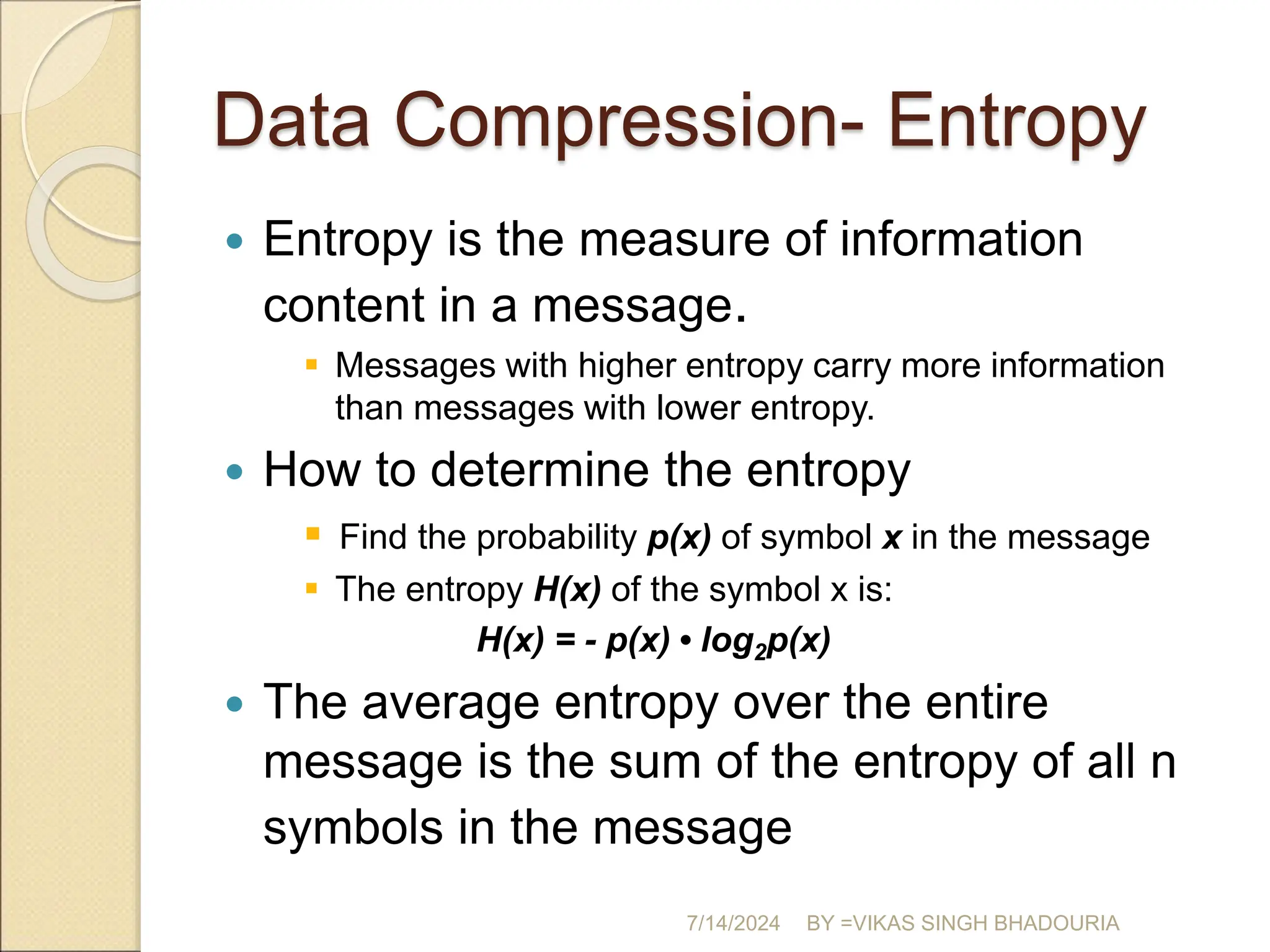
 The entropy H(x) of the symbol x is:
H(x) = - p(x) • log2p(x)
 The average entropy over the entire
message is the sum of the entropy of all n
symbols in the message
7/14/2024 BY =VIKAS SINGH BHADOURIA
Data Compression Methods
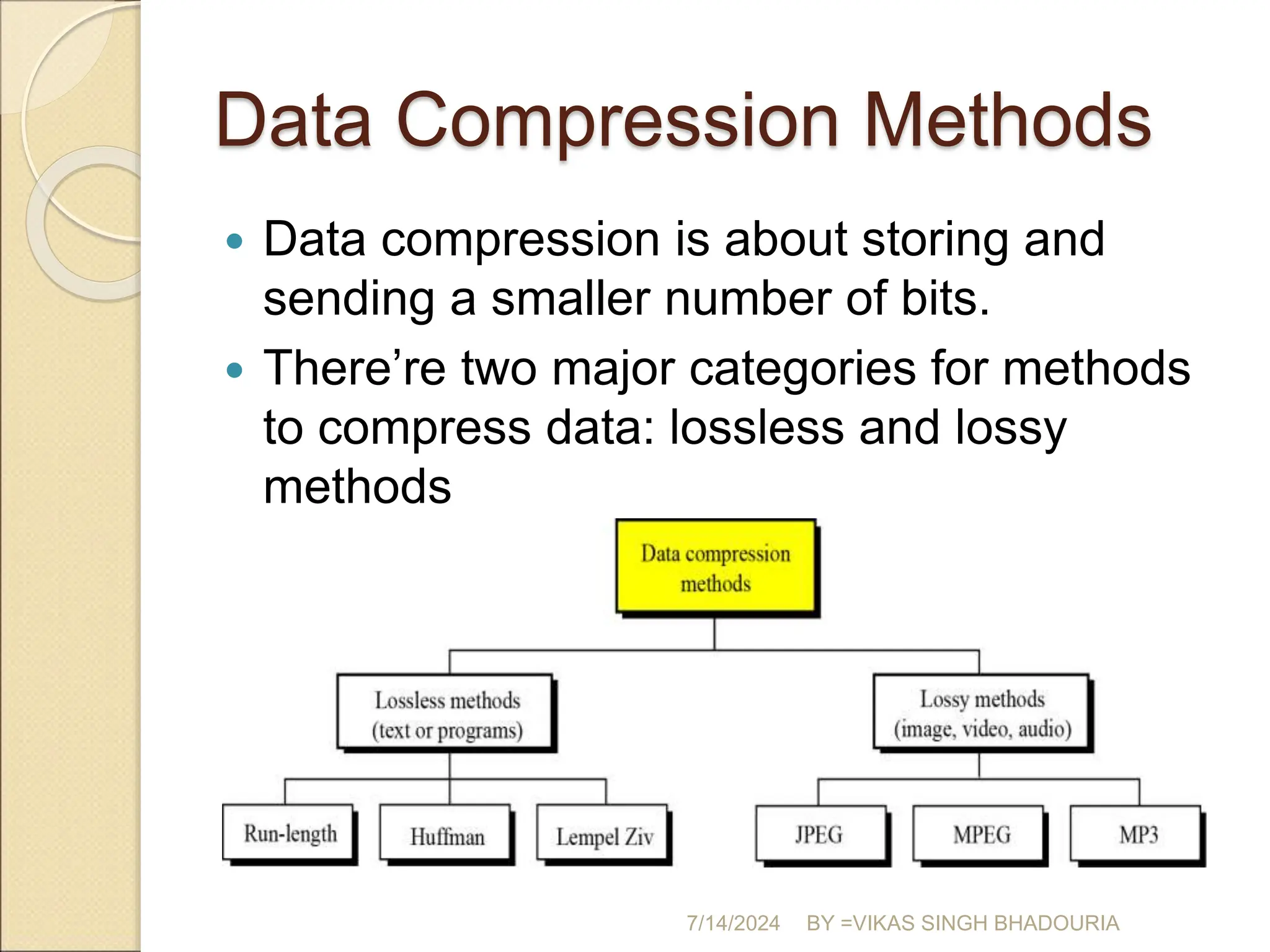
 Data compression is about storing and
sending a smaller number of bits.
 There’re two major categories for methods
to compress data: lossless and lossy
methods
7/14/2024 BY =VIKAS SINGH BHADOURIA
Lossless Compression Methods
 In lossless methods, original data and the
data after compression and decompression
are exactly the same.
 Redundant data is removed in compression
and added during decompression.
 Lossless methods are used when we can’t
afford to lose any data: legal and medical
documents, computer programs.
7/14/2024 BY =VIKAS SINGH BHADOURIA
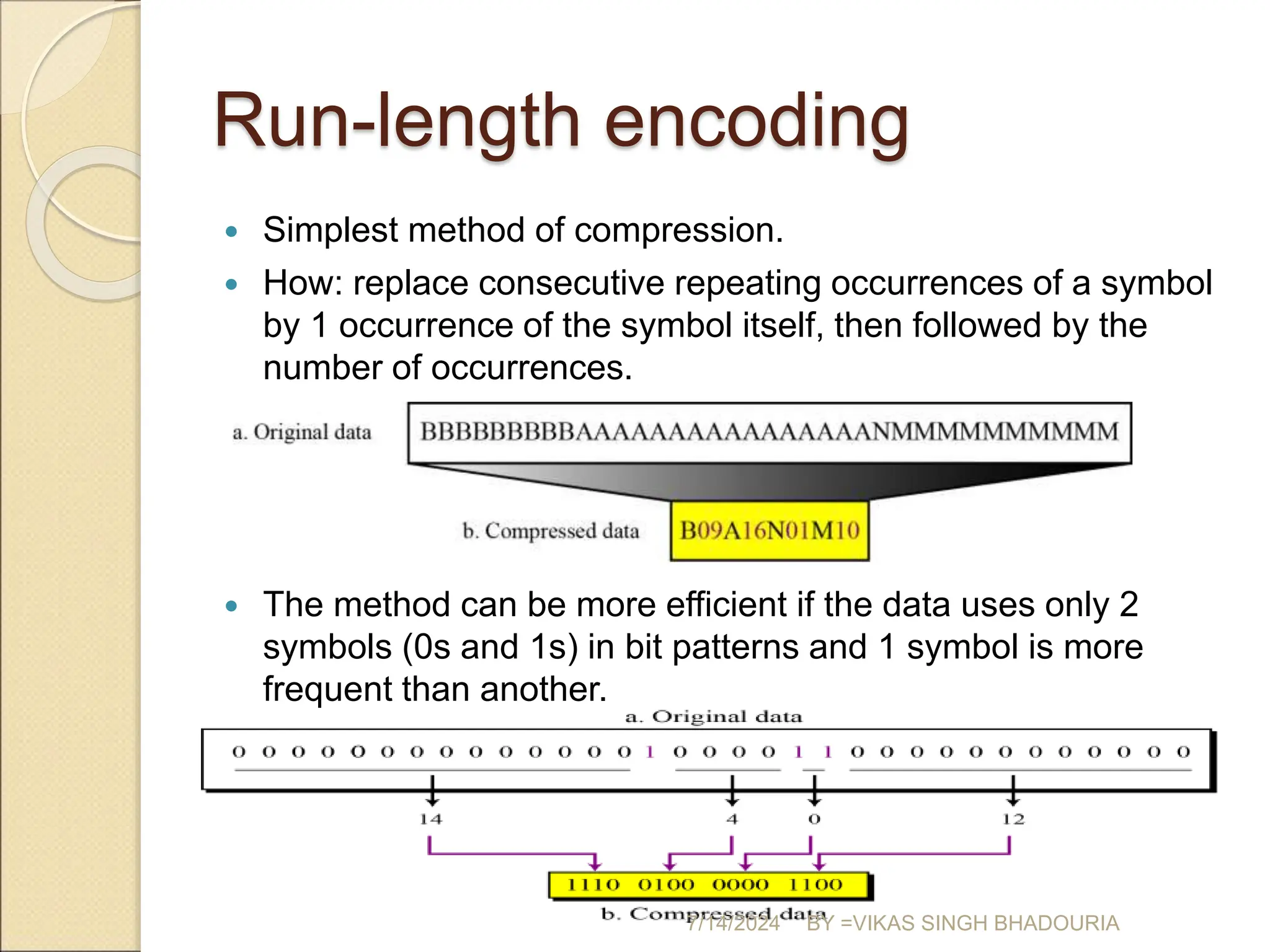
Run-length encoding
 Simplest method of compression.
 How: replace consecutive repeating occurrences of a symbol
by 1 occurrence of the symbol itself, then followed by the
number of occurrences.
 The method can be more efficient if the data uses only 2
symbols (0s and 1s) in bit patterns and 1 symbol is more
frequent than another.
7/14/2024 BY =VIKAS SINGH BHADOURIA
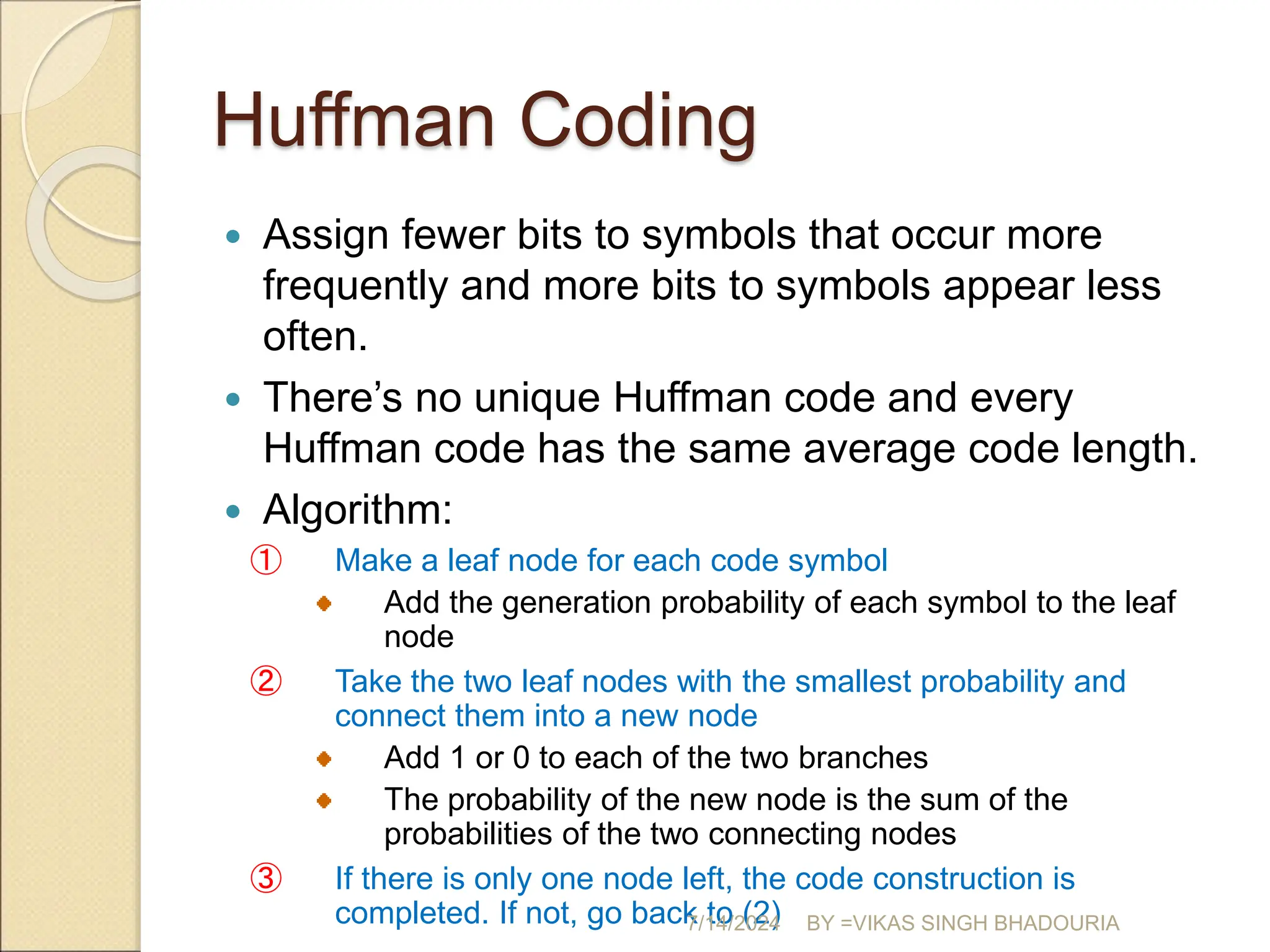
Huffman Coding
 Assign fewer bits to symbols that occur more
frequently and more bits to symbols appear less
often.
 There’s no unique Huffman code and every
Huffman code has the same average code length.
 Algorithm:
① Make a leaf node for each code symbol
Add the generation probability of each symbol to the leaf
node
② Take the two leaf nodes with the smallest probability and
connect them into a new node
Add 1 or 0 to each of the two branches
The probability of the new node is the sum of the
probabilities of the two connecting nodes
③ If there is only one node left, the code construction is
completed. If not, go back to (2)
7/14/2024 BY =VIKAS SINGH BHADOURIA
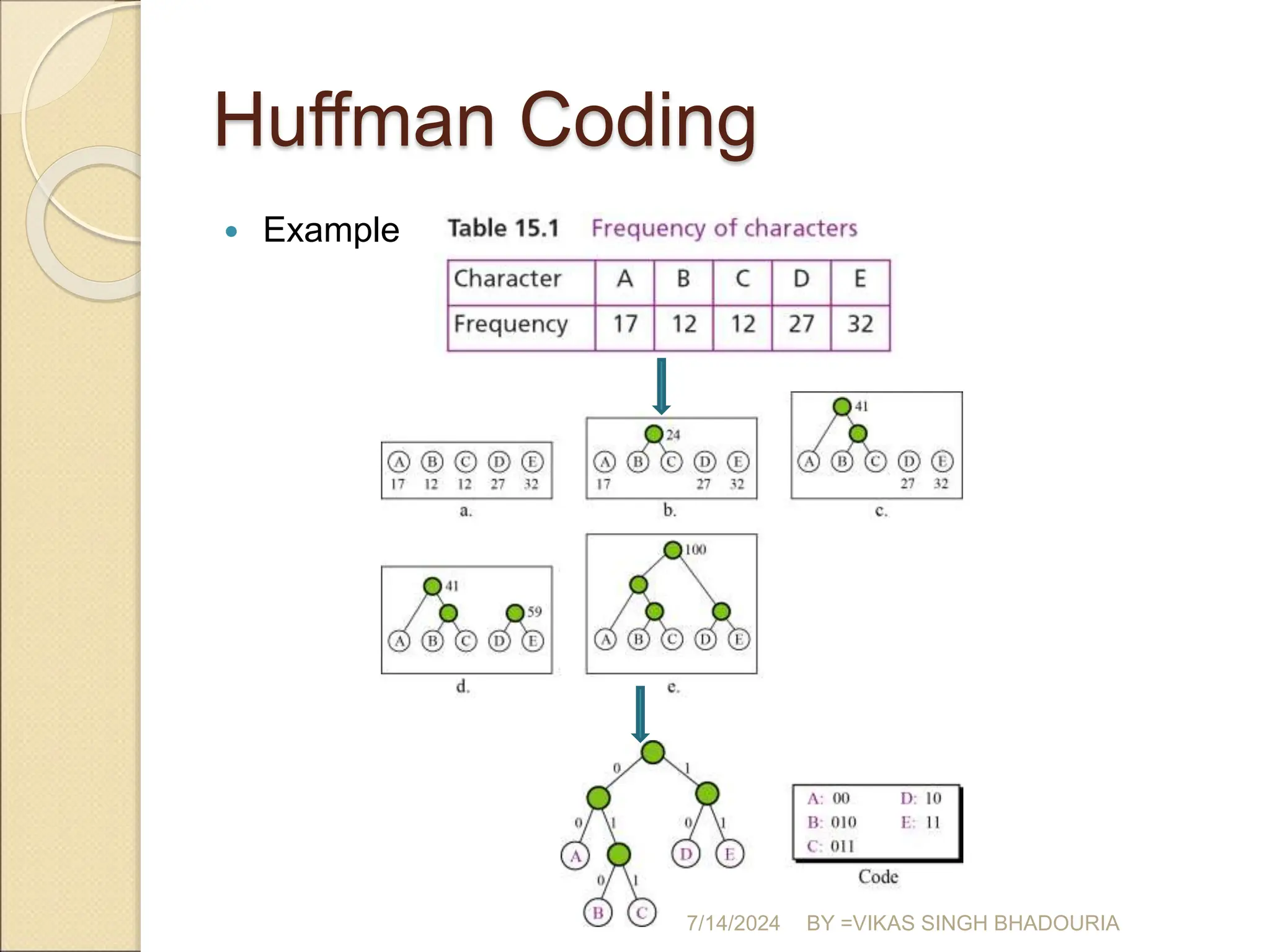
Huffman Coding
 Example
7/14/2024 BY =VIKAS SINGH BHADOURIA
Huffman Coding
 Encoding
 Decoding
7/14/2024 BY =VIKAS SINGH BHADOURIA
Lempel Ziv Encoding
 It is dictionary-based encoding
 Basic idea:
 Create a dictionary(a table) of strings used
during communication.
 If both sender and receiver have a copy of the
dictionary, then previously-encountered strings
can be substituted by their index in the
dictionary.
7/14/2024 BY =VIKAS SINGH BHADOURIA
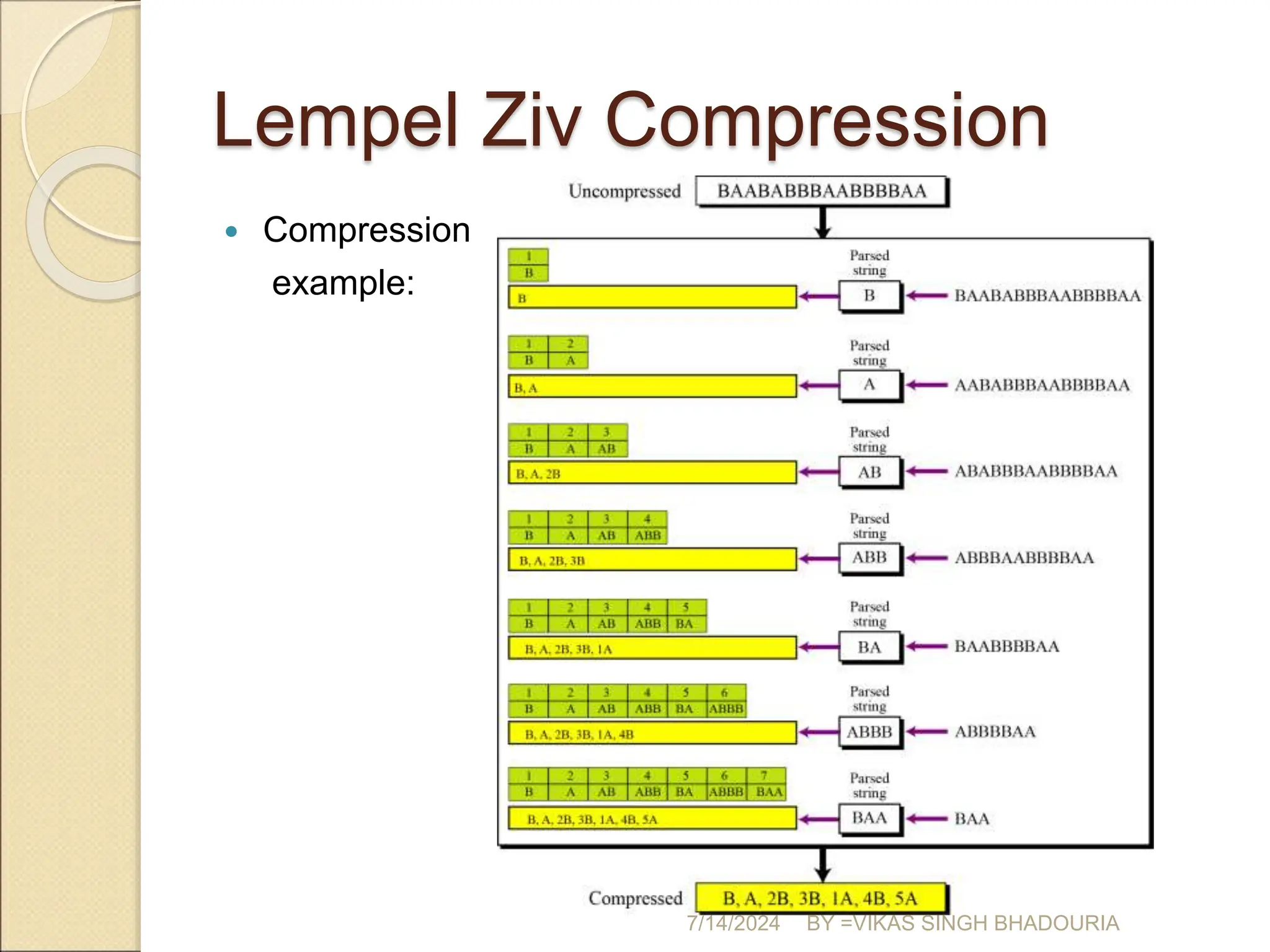
Lempel Ziv Compression
 Have 2 phases:
 Building an indexed dictionary
 Compressing a string of symbols
• Algorithm:
 Extract the smallest substring that cannot be
found in the remaining uncompressed string.
 Store that substring in the dictionary as a new
entry and assign it an index value
 Substring is replaced with the index found in
the dictionary
 Insert the index and the last character of the
substring into the compressed string
7/14/2024 BY =VIKAS SINGH BHADOURIA
Lempel Ziv Compression
 Compression
example:
7/14/2024 BY =VIKAS SINGH BHADOURIA
Audio Encoding
 Predictive encoding
 Only the differences
7/14/2024 BY =VIKAS SINGH BHADOURIA
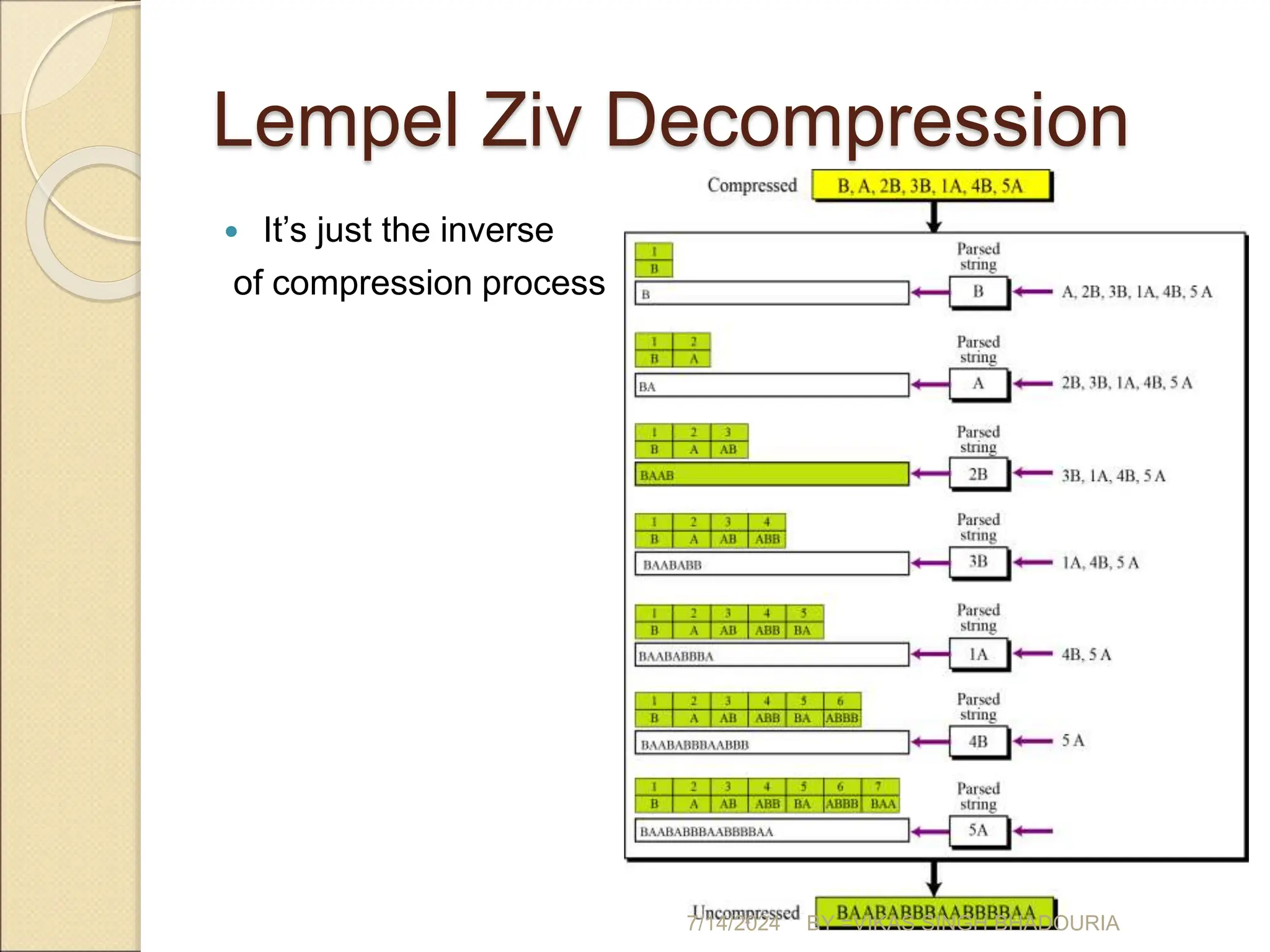
Lempel Ziv Decompression
 It’s just the inverse
of compression process
7/14/2024 BY =VIKAS SINGH BHADOURIA
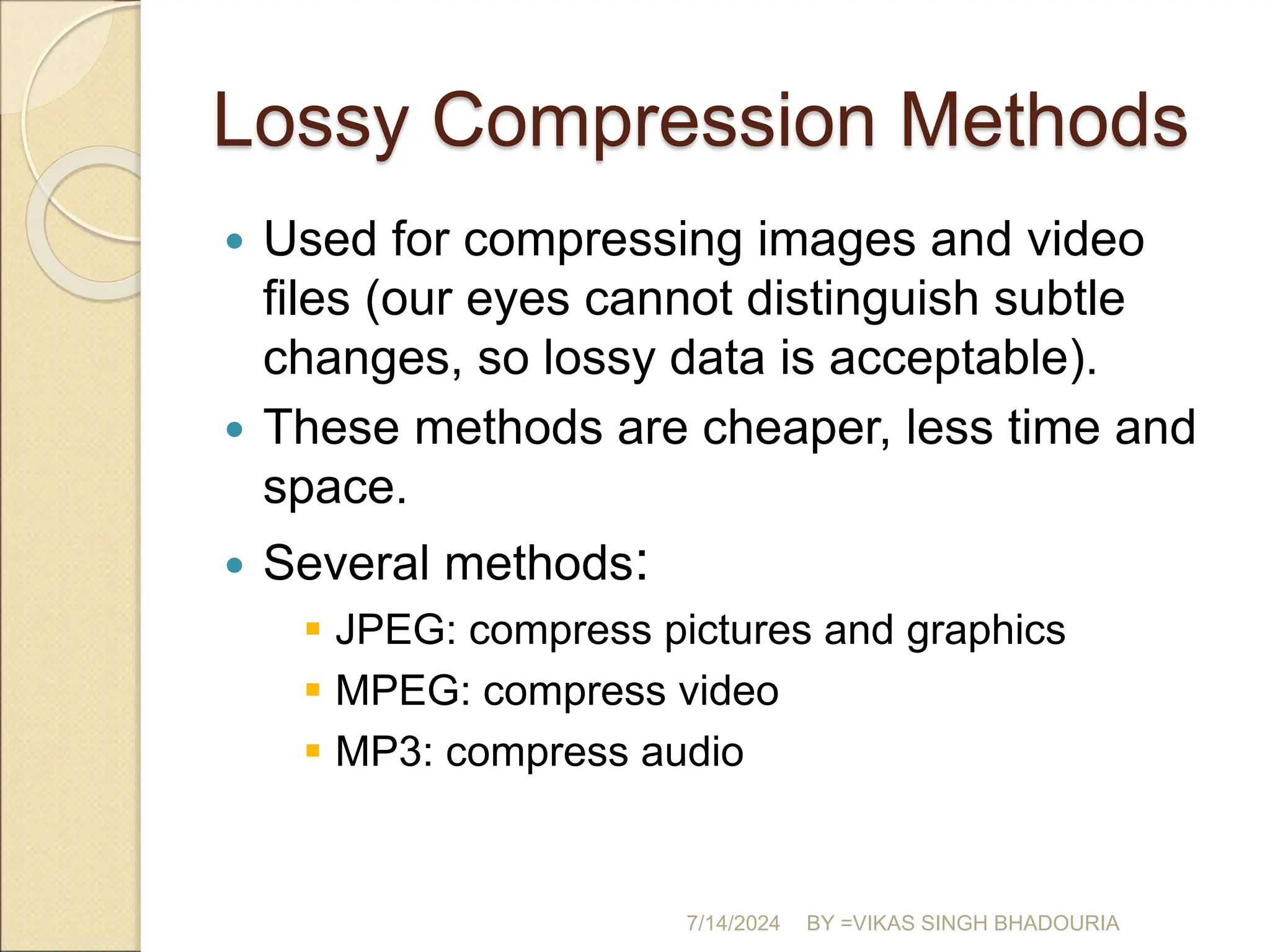
Lossy Compression Methods
 Used for compressing images and video
files (our eyes cannot distinguish subtle
changes, so lossy data is acceptable).
 These methods are cheaper, less time and
space.
 Several methods:
 JPEG: compress pictures and graphics
 MPEG: compress video
 MP3: compress audio
7/14/2024 BY =VIKAS SINGH BHADOURIA
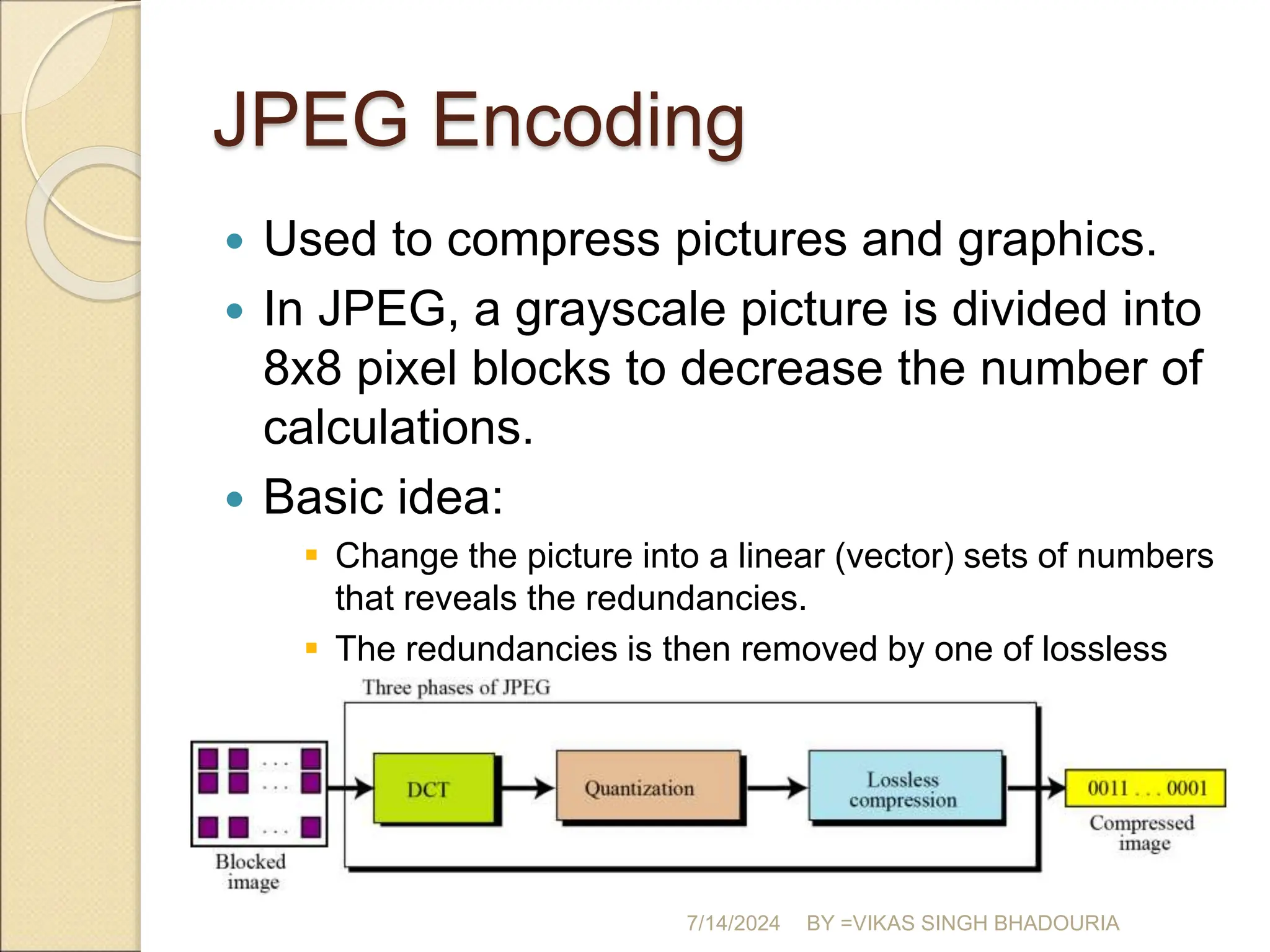
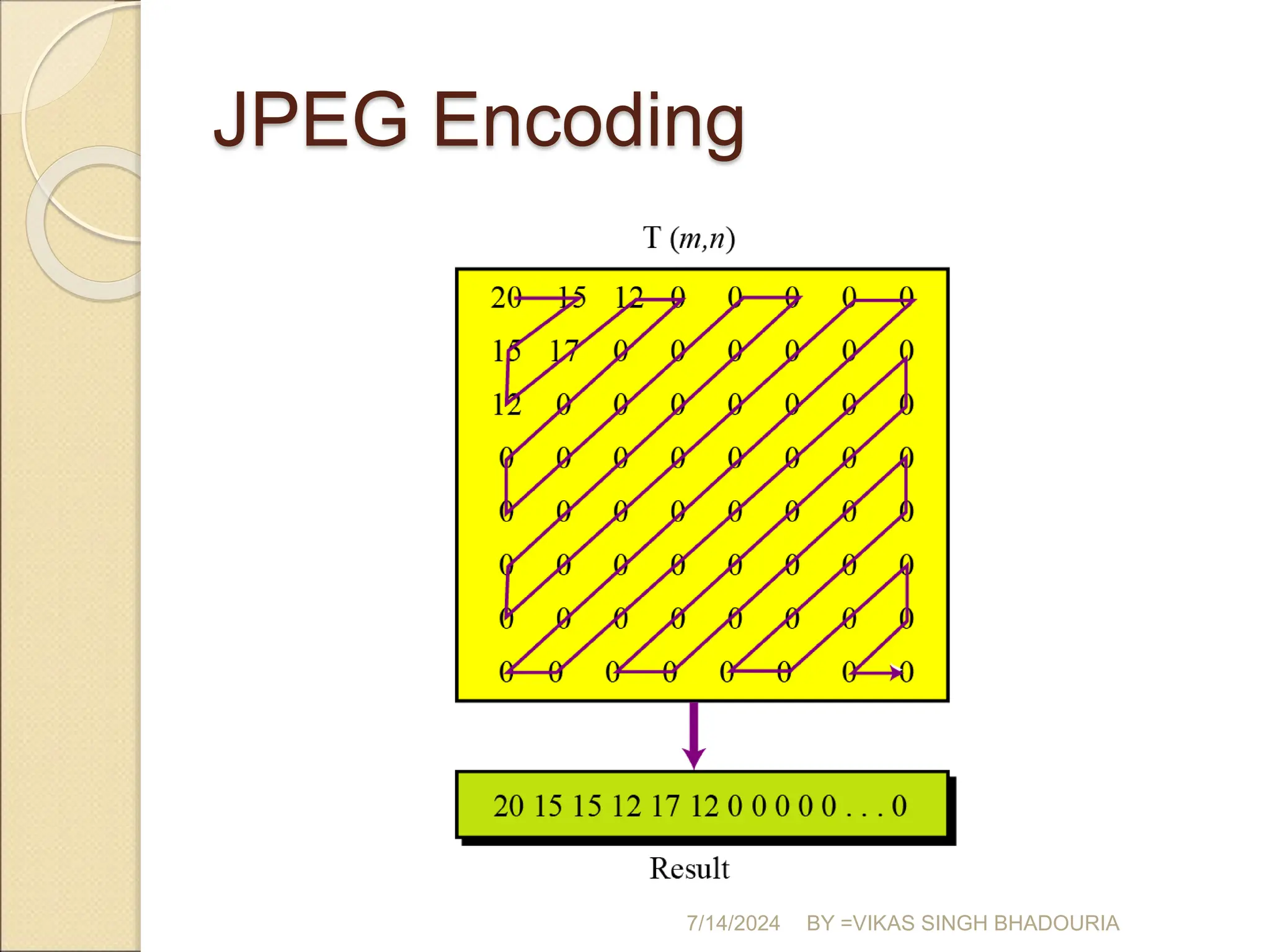
JPEG Encoding
 Used to compress pictures and graphics.
 In JPEG, a grayscale picture is divided into
8x8 pixel blocks to decrease the number of
calculations.
 Basic idea:
 Change the picture into a linear (vector) sets of numbers
that reveals the redundancies.
 The redundancies is then removed by one of lossless
compression methods.
7/14/2024 BY =VIKAS SINGH BHADOURIA
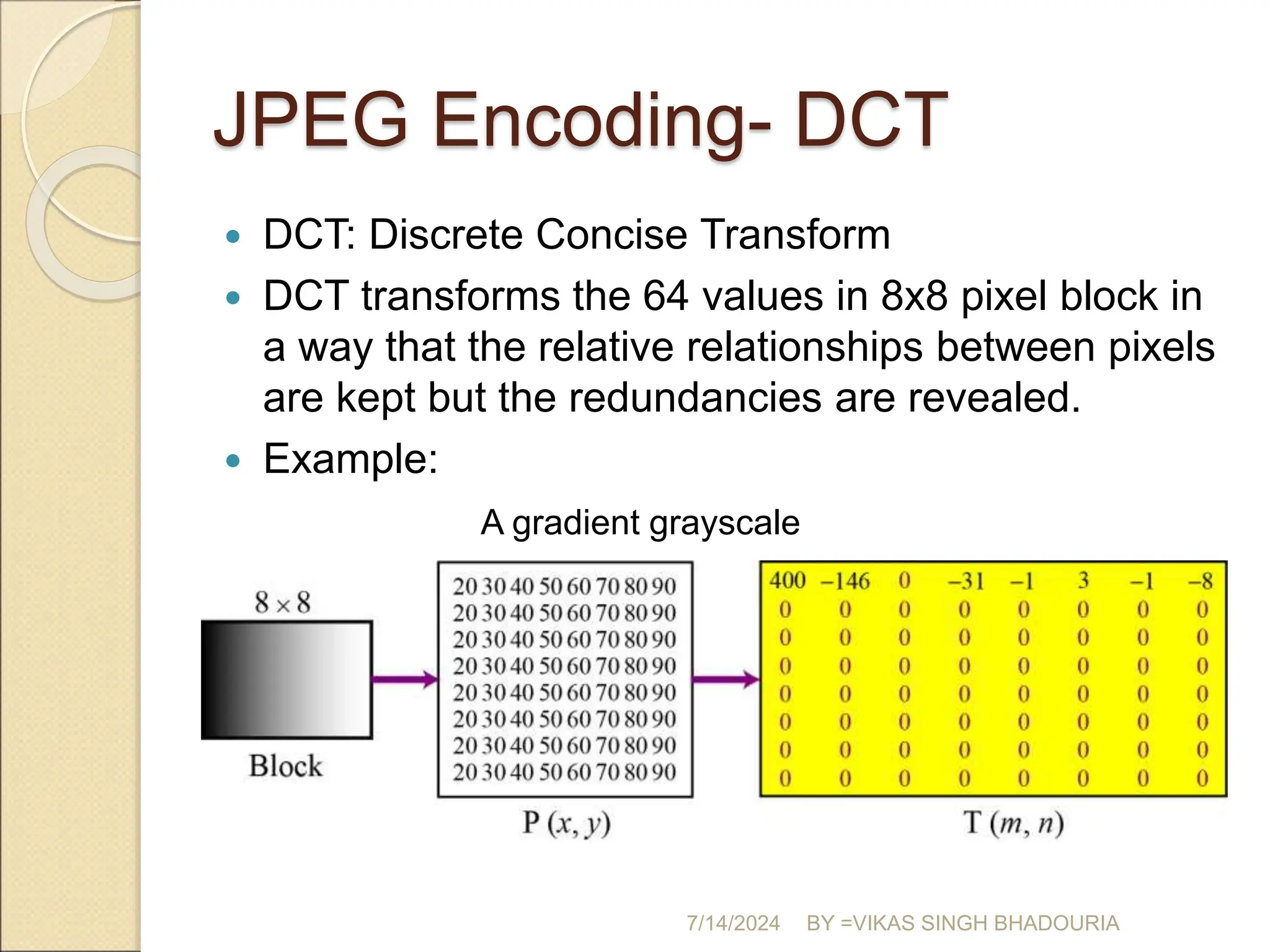
JPEG Encoding- DCT
 DCT: Discrete Concise Transform
 DCT transforms the 64 values in 8x8 pixel block in
a way that the relative relationships between pixels
are kept but the redundancies are revealed.
 Example:
A gradient grayscale
7/14/2024 BY =VIKAS SINGH BHADOURIA
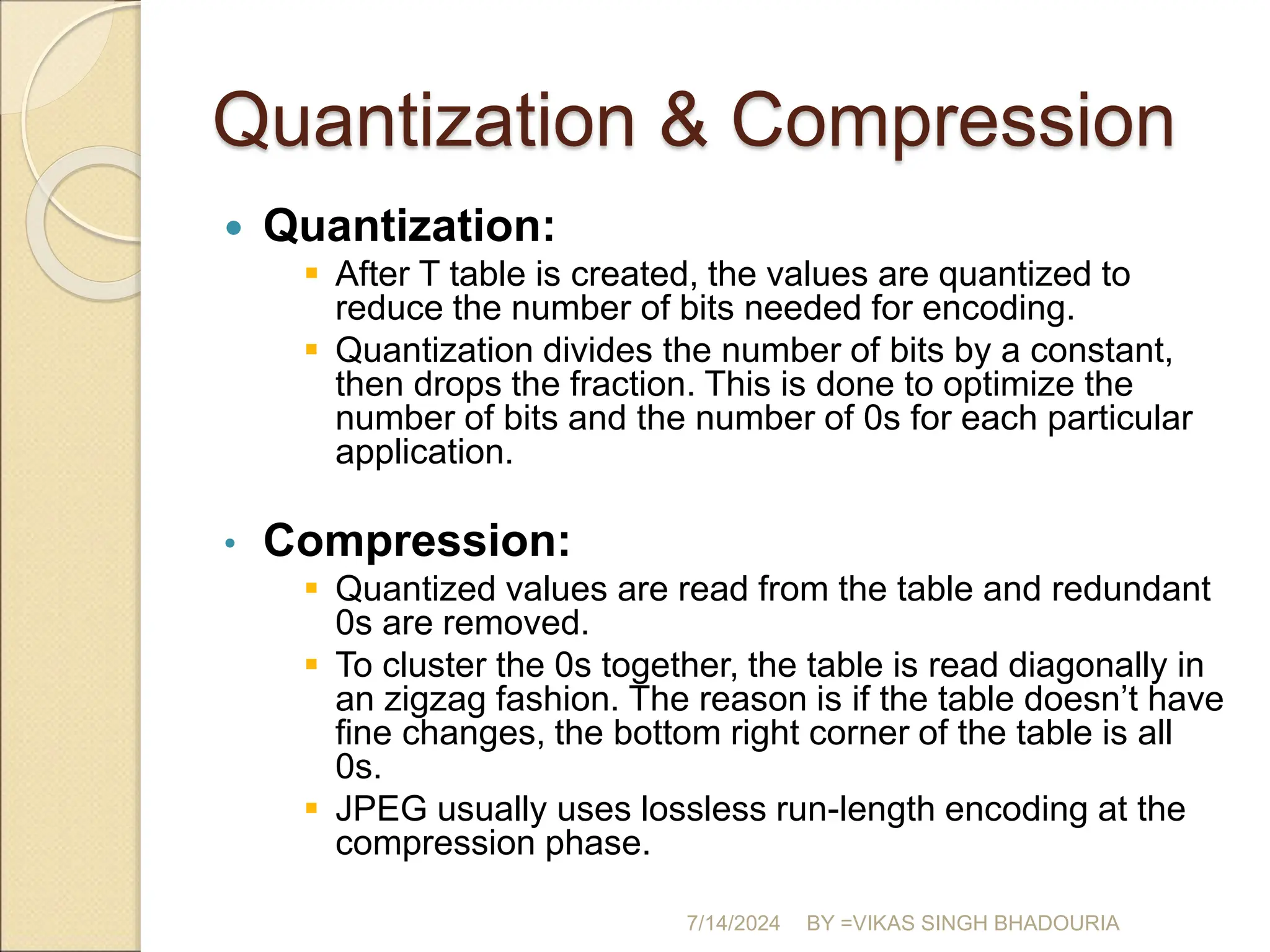
Quantization & Compression
 Quantization:
 After T table is created, the values are quantized to
reduce the number of bits needed for encoding.
 Quantization divides the number of bits by a constant,
then drops the fraction. This is done to optimize the
number of bits and the number of 0s for each particular
application.
• Compression:
 Quantized values are read from the table and redundant
0s are removed.
 To cluster the 0s together, the table is read diagonally in
an zigzag fashion. The reason is if the table doesn’t have
fine changes, the bottom right corner of the table is all
0s.
 JPEG usually uses lossless run-length encoding at the
compression phase.
7/14/2024 BY =VIKAS SINGH BHADOURIA
JPEG Encoding
7/14/2024 BY =VIKAS SINGH BHADOURIA
MPEG Encoding
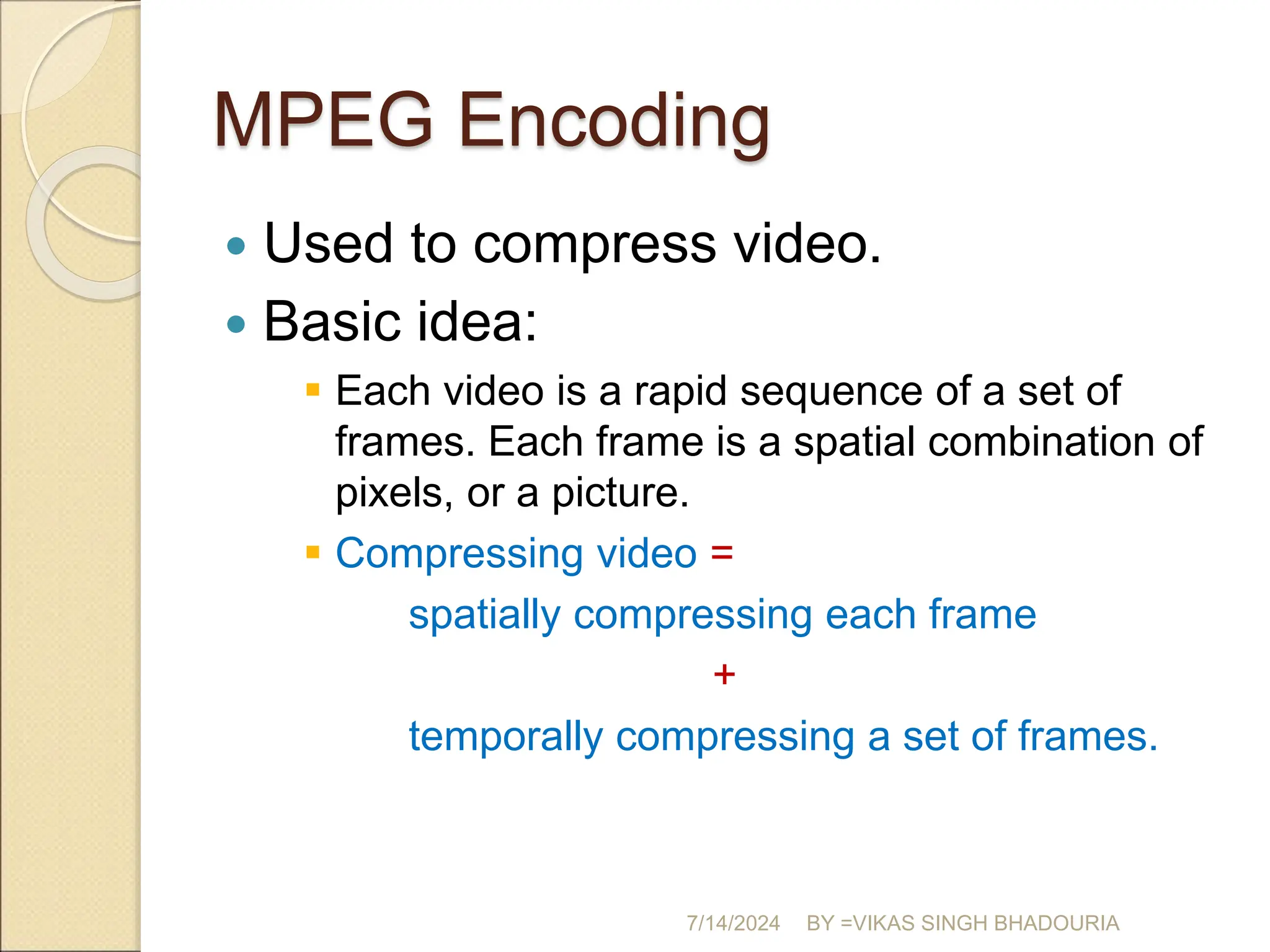
 Used to compress video.
 Basic idea:
 Each video is a rapid sequence of a set of
frames. Each frame is a spatial combination of
pixels, or a picture.
 Compressing video =
spatially compressing each frame
+
temporally compressing a set of frames.
7/14/2024 BY =VIKAS SINGH BHADOURIA
MPEG Encoding
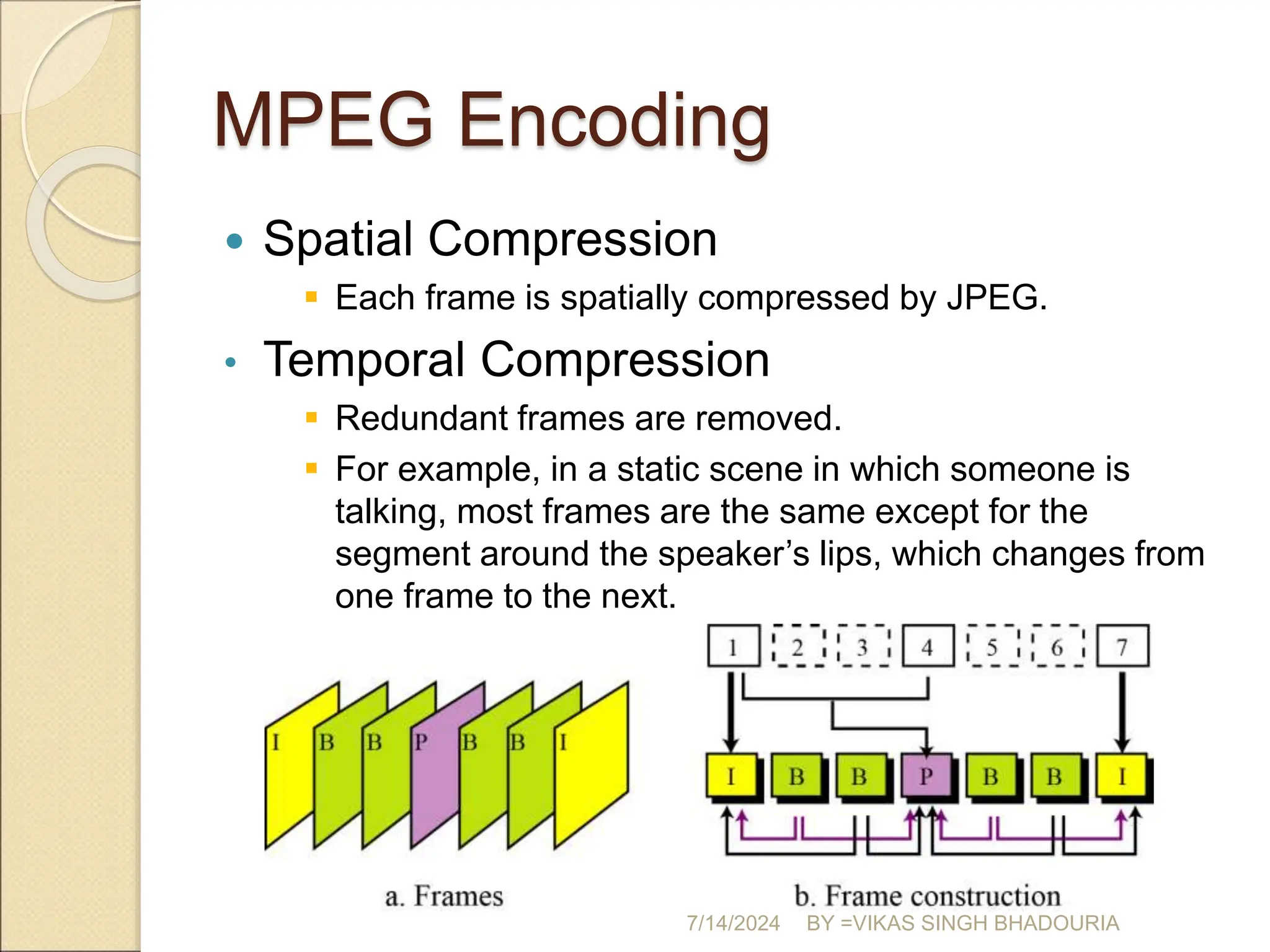
 Spatial Compression
 Each frame is spatially compressed by JPEG.
• Temporal Compression
 Redundant frames are removed.
 For example, in a static scene in which someone is
talking, most frames are the same except for the
segment around the speaker’s lips, which changes from
one frame to the next.
7/14/2024 BY =VIKAS SINGH BHADOURIA
Audio Compression
 Used for speech or music
 Speech: compress a 64 kHz digitized signal
 Music: compress a 1.411 MHz signal
• Two categories of techniques:
 Predictive encoding
 Perceptual encoding
7/14/2024 BY =VIKAS SINGH BHADOURIA
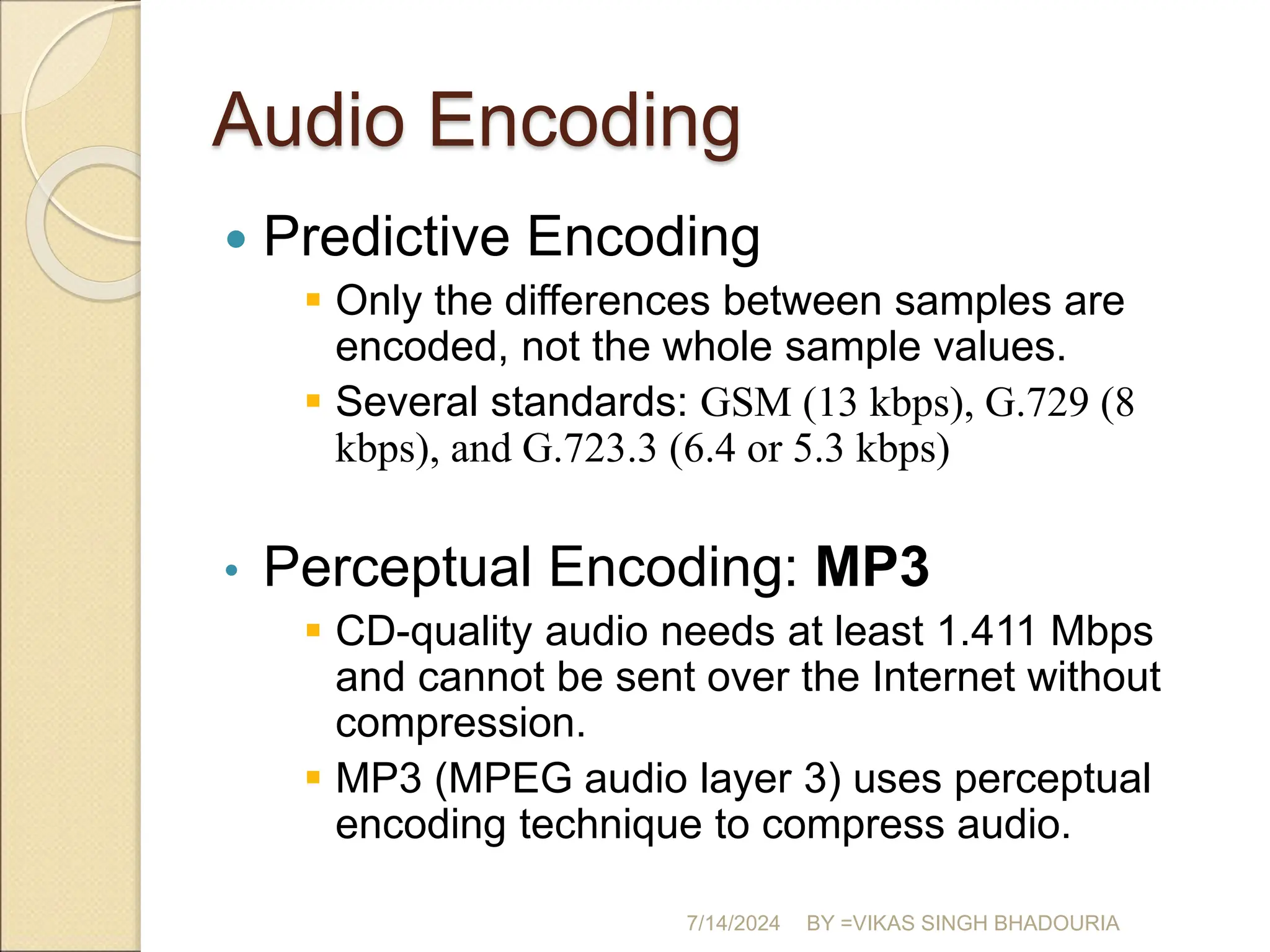
Audio Encoding
 Predictive Encoding
 Only the differences between samples are
encoded, not the whole sample values.
 Several standards: GSM (13 kbps), G.729 (8
kbps), and G.723.3 (6.4 or 5.3 kbps)
• Perceptual Encoding: MP3
 CD-quality audio needs at least 1.411 Mbps
and cannot be sent over the Internet without
compression.
 MP3 (MPEG audio layer 3) uses perceptual
encoding technique to compress audio.
7/14/2024 BY =VIKAS SINGH BHADOURIA
References
 http://www.csie.kuas.edu.tw/course/cs/engli
sh/ch-15.ppt
 CS157B-Lecture 19 by Professor Lee
http://cs.sjsu.edu/~lee/cs157b/cs157b.html
 “The essentials of computer
organization and architecture” by Linda
Null and Julia Nobur.
7/14/2024 BY =VIKAS SINGH BHADOURIA
Data Compression
QUESTION?
7/14/2024 BY =VIKAS SINGH BHADOURIA

datacompression-150127035138-conversion-gate01.ppt

  • 1.
    Data Compression 7/14/2024 BY=VIKAS SINGH BHADOURIA
  • 2.
    Why Data Compression? Make optimal use of limited storage space  Save time and help to optimize resources  If compression and decompression are done in I/O processor, less time is required to move data to or from storage subsystem, freeing I/O bus for other work  In sending data over communication line: less time to transmit and less storage to host 7/14/2024 BY =VIKAS SINGH BHADOURIA
  • 3.
    Data Compression- Entropy Entropy is the measure of information content in a message.  Messages with higher entropy carry more information than messages with lower entropy.  How to determine the entropy  Find the probability p(x) of symbol x in the message  The entropy H(x) of the symbol x is: H(x) = - p(x) • log2p(x)  The average entropy over the entire message is the sum of the entropy of all n symbols in the message 7/14/2024 BY =VIKAS SINGH BHADOURIA
  • 4.
    Data Compression Methods Data compression is about storing and sending a smaller number of bits.  There’re two major categories for methods to compress data: lossless and lossy methods 7/14/2024 BY =VIKAS SINGH BHADOURIA
  • 5.
    Lossless Compression Methods In lossless methods, original data and the data after compression and decompression are exactly the same.  Redundant data is removed in compression and added during decompression.  Lossless methods are used when we can’t afford to lose any data: legal and medical documents, computer programs. 7/14/2024 BY =VIKAS SINGH BHADOURIA
  • 6.
    Run-length encoding  Simplestmethod of compression.  How: replace consecutive repeating occurrences of a symbol by 1 occurrence of the symbol itself, then followed by the number of occurrences.  The method can be more efficient if the data uses only 2 symbols (0s and 1s) in bit patterns and 1 symbol is more frequent than another. 7/14/2024 BY =VIKAS SINGH BHADOURIA
  • 7.
    Huffman Coding  Assignfewer bits to symbols that occur more frequently and more bits to symbols appear less often.  There’s no unique Huffman code and every Huffman code has the same average code length.  Algorithm: ① Make a leaf node for each code symbol Add the generation probability of each symbol to the leaf node ② Take the two leaf nodes with the smallest probability and connect them into a new node Add 1 or 0 to each of the two branches The probability of the new node is the sum of the probabilities of the two connecting nodes ③ If there is only one node left, the code construction is completed. If not, go back to (2) 7/14/2024 BY =VIKAS SINGH BHADOURIA
  • 8.
    Huffman Coding  Example 7/14/2024BY =VIKAS SINGH BHADOURIA
  • 9.
    Huffman Coding  Encoding Decoding 7/14/2024 BY =VIKAS SINGH BHADOURIA
  • 10.
    Lempel Ziv Encoding It is dictionary-based encoding  Basic idea:  Create a dictionary(a table) of strings used during communication.  If both sender and receiver have a copy of the dictionary, then previously-encountered strings can be substituted by their index in the dictionary. 7/14/2024 BY =VIKAS SINGH BHADOURIA
  • 11.
    Lempel Ziv Compression Have 2 phases:  Building an indexed dictionary  Compressing a string of symbols • Algorithm:  Extract the smallest substring that cannot be found in the remaining uncompressed string.  Store that substring in the dictionary as a new entry and assign it an index value  Substring is replaced with the index found in the dictionary  Insert the index and the last character of the substring into the compressed string 7/14/2024 BY =VIKAS SINGH BHADOURIA
  • 12.
    Lempel Ziv Compression Compression example: 7/14/2024 BY =VIKAS SINGH BHADOURIA
  • 13.
    Audio Encoding  Predictiveencoding  Only the differences 7/14/2024 BY =VIKAS SINGH BHADOURIA
  • 14.
    Lempel Ziv Decompression It’s just the inverse of compression process 7/14/2024 BY =VIKAS SINGH BHADOURIA
  • 15.
    Lossy Compression Methods Used for compressing images and video files (our eyes cannot distinguish subtle changes, so lossy data is acceptable).  These methods are cheaper, less time and space.  Several methods:  JPEG: compress pictures and graphics  MPEG: compress video  MP3: compress audio 7/14/2024 BY =VIKAS SINGH BHADOURIA
  • 16.
    JPEG Encoding  Usedto compress pictures and graphics.  In JPEG, a grayscale picture is divided into 8x8 pixel blocks to decrease the number of calculations.  Basic idea:  Change the picture into a linear (vector) sets of numbers that reveals the redundancies.  The redundancies is then removed by one of lossless compression methods. 7/14/2024 BY =VIKAS SINGH BHADOURIA
  • 17.
    JPEG Encoding- DCT DCT: Discrete Concise Transform  DCT transforms the 64 values in 8x8 pixel block in a way that the relative relationships between pixels are kept but the redundancies are revealed.  Example: A gradient grayscale 7/14/2024 BY =VIKAS SINGH BHADOURIA
  • 18.
    Quantization & Compression Quantization:  After T table is created, the values are quantized to reduce the number of bits needed for encoding.  Quantization divides the number of bits by a constant, then drops the fraction. This is done to optimize the number of bits and the number of 0s for each particular application. • Compression:  Quantized values are read from the table and redundant 0s are removed.  To cluster the 0s together, the table is read diagonally in an zigzag fashion. The reason is if the table doesn’t have fine changes, the bottom right corner of the table is all 0s.  JPEG usually uses lossless run-length encoding at the compression phase. 7/14/2024 BY =VIKAS SINGH BHADOURIA
  • 19.
    JPEG Encoding 7/14/2024 BY=VIKAS SINGH BHADOURIA
  • 20.
    MPEG Encoding  Usedto compress video.  Basic idea:  Each video is a rapid sequence of a set of frames. Each frame is a spatial combination of pixels, or a picture.  Compressing video = spatially compressing each frame + temporally compressing a set of frames. 7/14/2024 BY =VIKAS SINGH BHADOURIA
  • 21.
    MPEG Encoding  SpatialCompression  Each frame is spatially compressed by JPEG. • Temporal Compression  Redundant frames are removed.  For example, in a static scene in which someone is talking, most frames are the same except for the segment around the speaker’s lips, which changes from one frame to the next. 7/14/2024 BY =VIKAS SINGH BHADOURIA
  • 22.
    Audio Compression  Usedfor speech or music  Speech: compress a 64 kHz digitized signal  Music: compress a 1.411 MHz signal • Two categories of techniques:  Predictive encoding  Perceptual encoding 7/14/2024 BY =VIKAS SINGH BHADOURIA
  • 23.
    Audio Encoding  PredictiveEncoding  Only the differences between samples are encoded, not the whole sample values.  Several standards: GSM (13 kbps), G.729 (8 kbps), and G.723.3 (6.4 or 5.3 kbps) • Perceptual Encoding: MP3  CD-quality audio needs at least 1.411 Mbps and cannot be sent over the Internet without compression.  MP3 (MPEG audio layer 3) uses perceptual encoding technique to compress audio. 7/14/2024 BY =VIKAS SINGH BHADOURIA
  • 24.
    References  http://www.csie.kuas.edu.tw/course/cs/engli sh/ch-15.ppt  CS157B-Lecture19 by Professor Lee http://cs.sjsu.edu/~lee/cs157b/cs157b.html  “The essentials of computer organization and architecture” by Linda Null and Julia Nobur. 7/14/2024 BY =VIKAS SINGH BHADOURIA
  • 25.