ECE2030
Introduction to Computer Engineering
Lecture 1: Overview
Prof. Hsien-Hsin Sean LeeProf. Hsien-Hsin Sean Lee
School of Electrical and Computer EngineeringSchool of Electrical and Computer Engineering
Georgia TechGeorgia Tech
• Instructor: Prof. Hsien-Hsin “Sean” Lee
• Email: leehs@gatech.edu
• Course web: http://www.ece.gatech.edu/~leehs/ECE2030
• My office: Klaus 2318
• Teaching Materials:
– Morris Mano and Charles Kime, “Logic and Computer Design
Fundamentals,” the 3rd
edition
– Course notes and handouts (check out course web)
– TA: to be announced later
• Attending classes is important !!
ECE2030 Syllabus
ECE2030 Syllabus
• Grading policy
– 3 Homework assignment: 5% each
– 1 Programming assignment: 10%
– 3 in-class exams: 15% each
– 1 final exam: 30%
– [100,90]=A; (90,80]=B; (80,70]=C,(70,55]=D,(55,0]=F
• All homework: turn-in in the first 5 minutes “in
class” of the due day
• All exams: closed books, closed notes, no calculator
• Honor code
• Use webct (http://webct.gatech.edu) for your
homework and exam grades
Objective: Digital Design Principle
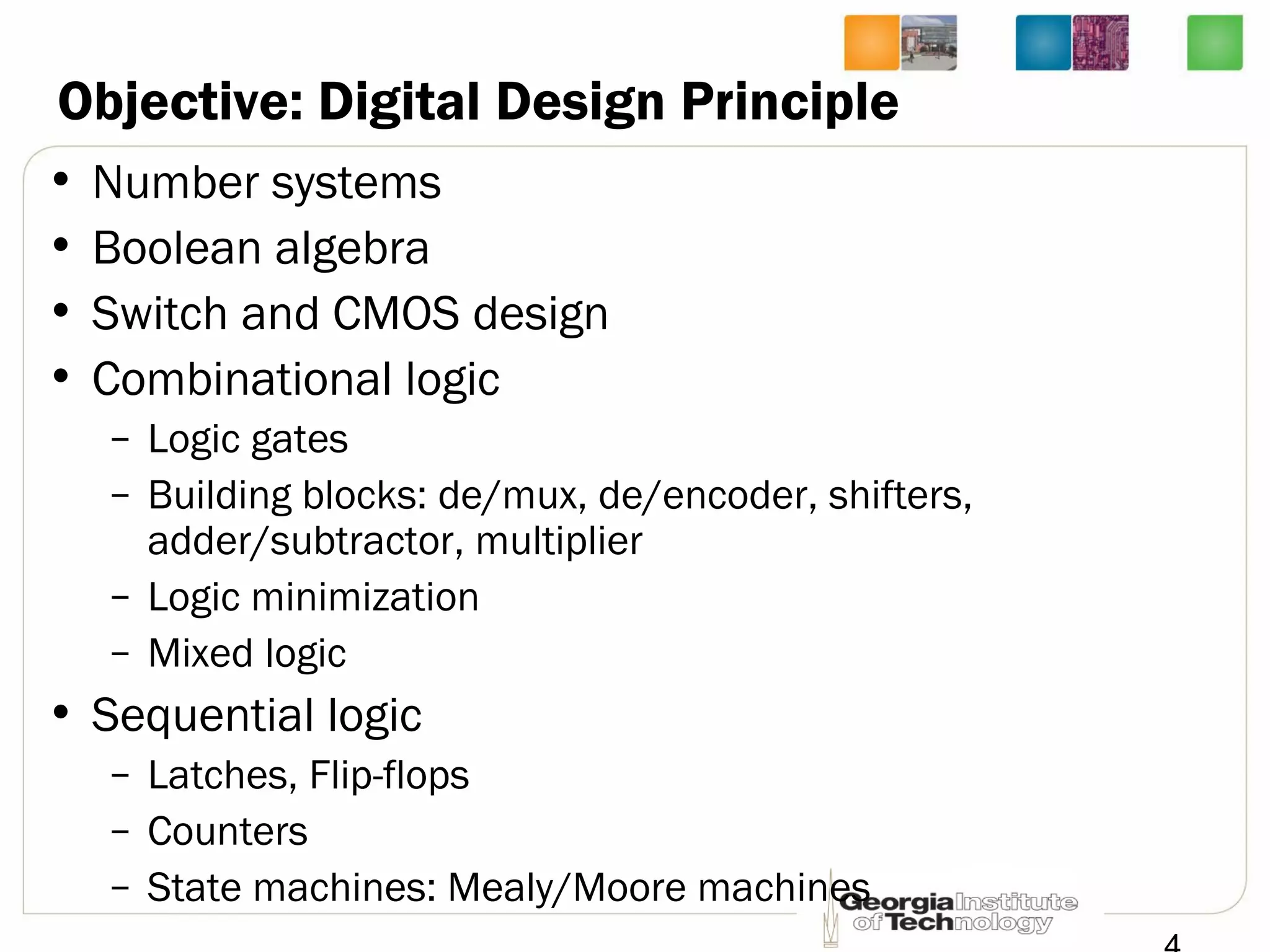
• Number systems
• Boolean algebra
• Switch and CMOS design
• Combinational logic
– Logic gates
– Building blocks: de/mux, de/encoder, shifters,
adder/subtractor, multiplier
– Logic minimization
– Mixed logic
• Sequential logic
– Latches, Flip-flops
– Counters
– State machines: Mealy/Moore machines
Objective: Digital Design Principle
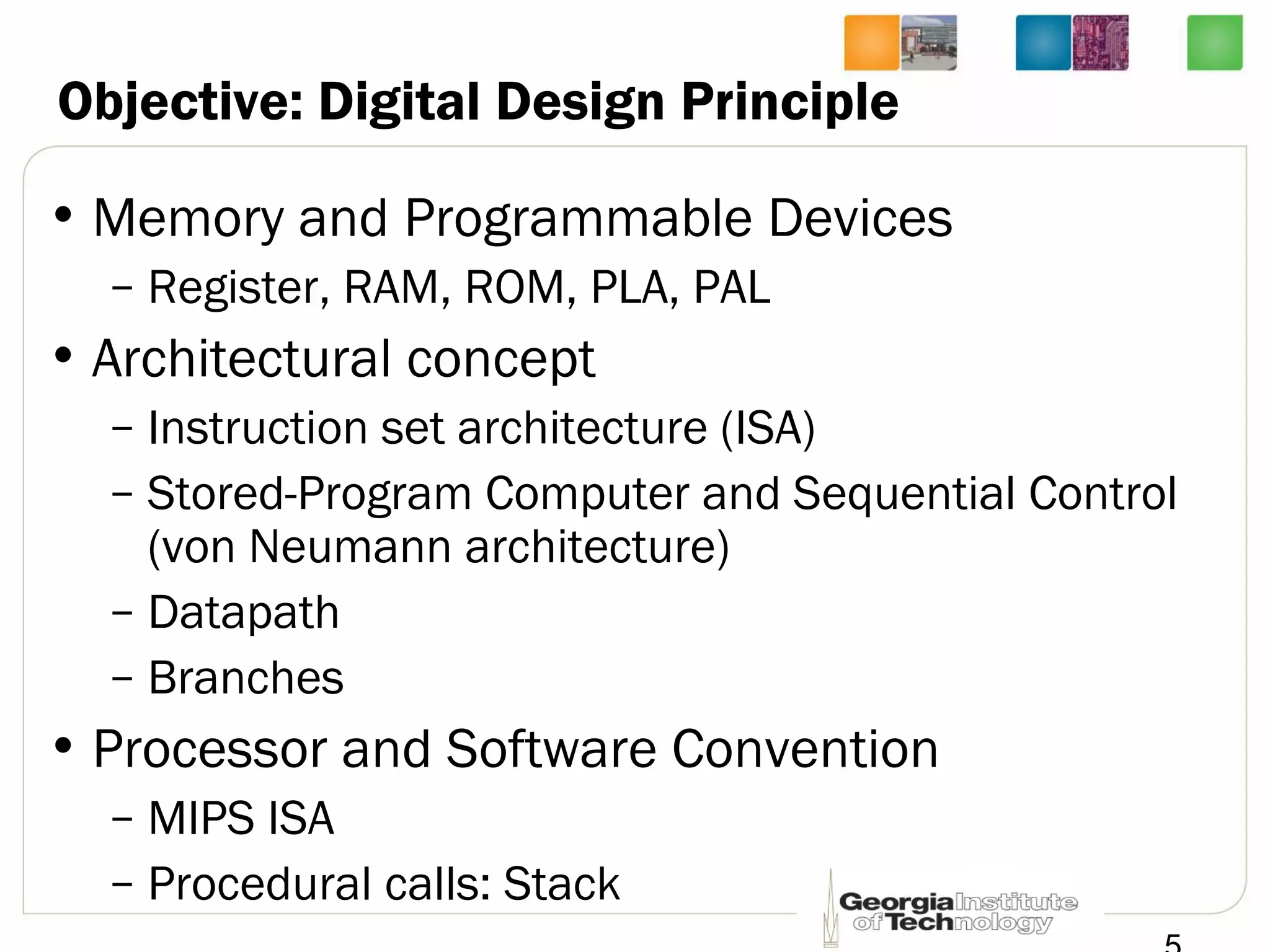
• Memory and Programmable Devices
– Register, RAM, ROM, PLA, PAL
• Architectural concept
– Instruction set architecture (ISA)
– Stored-Program Computer and Sequential Control
(von Neumann architecture)
– Datapath
– Branches
• Processor and Software Convention
– MIPS ISA
– Procedural calls: Stack
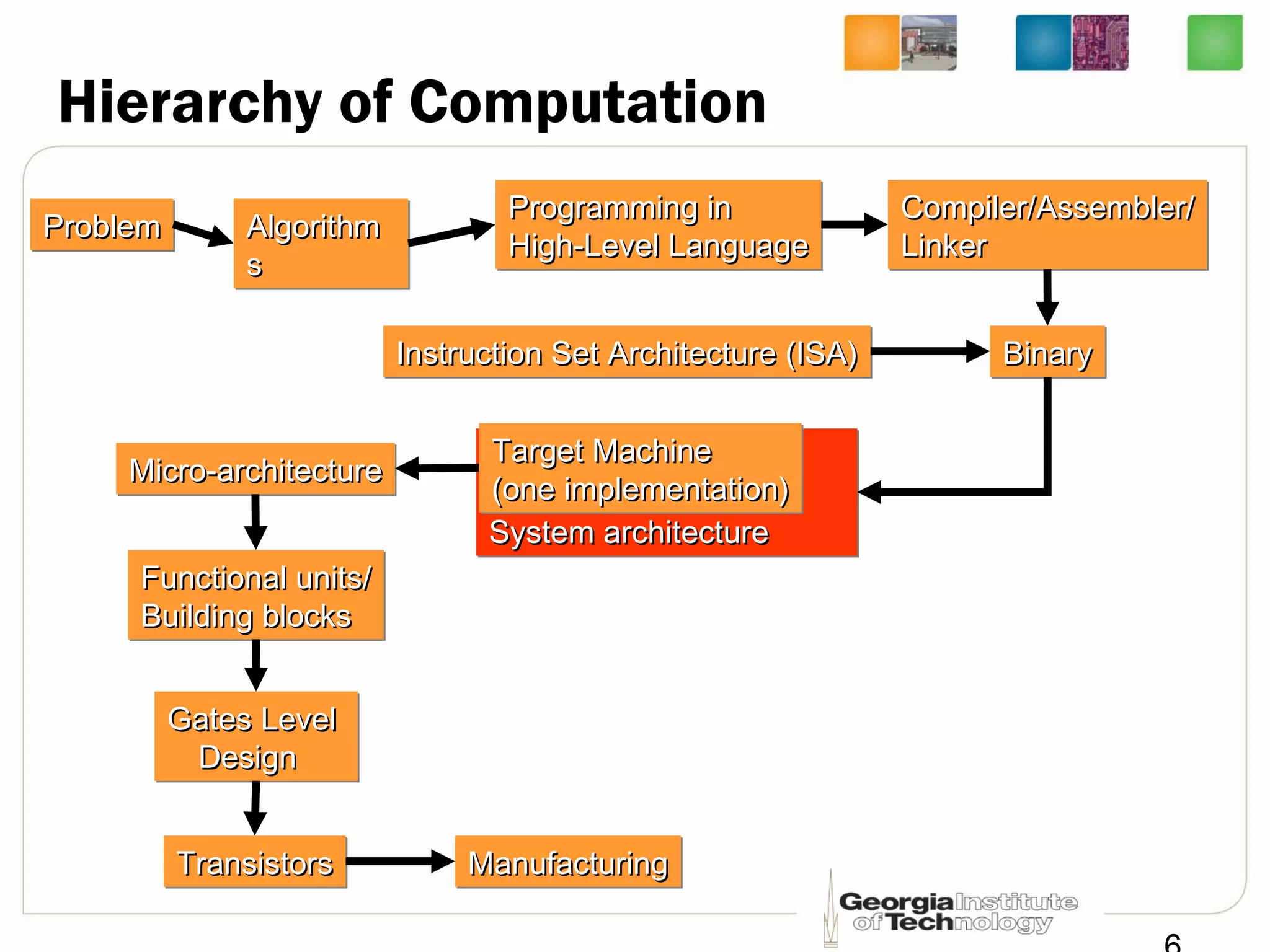
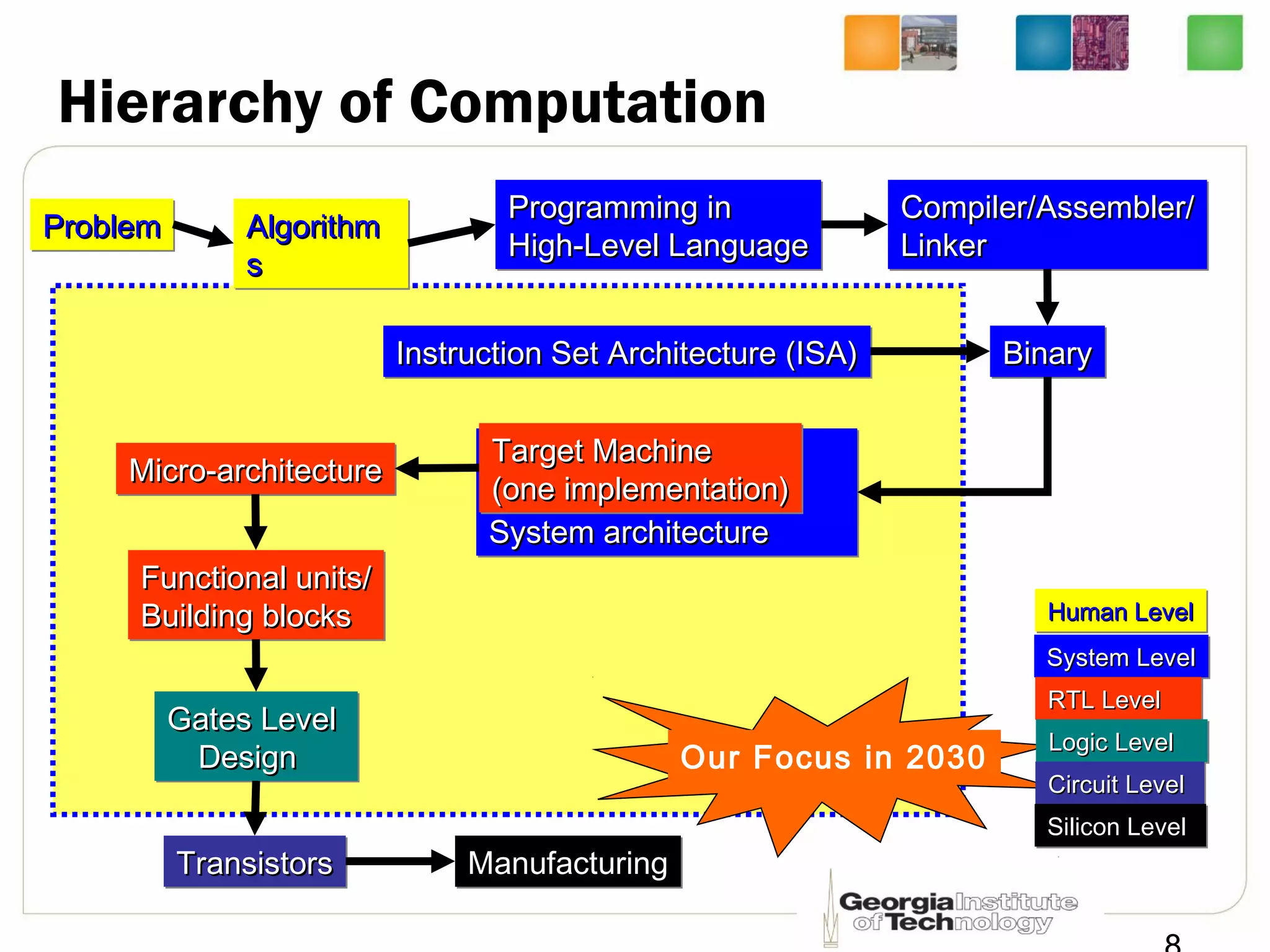
Hierarchy of Computation
ProblemProblemProblemProblem AlgorithmAlgorithm
ss
AlgorithmAlgorithm
ss
Programming inProgramming in
High-Level LanguageHigh-Level Language
Programming inProgramming in
High-Level LanguageHigh-Level Language
Compiler/Assembler/Compiler/Assembler/
LinkerLinker
Compiler/Assembler/Compiler/Assembler/
LinkerLinker
Instruction Set Architecture (ISA)Instruction Set Architecture (ISA)Instruction Set Architecture (ISA)Instruction Set Architecture (ISA) BinaryBinaryBinaryBinary
System architectureSystem architectureSystem architectureSystem architecture
Target MachineTarget Machine
(one implementation)(one implementation)
Target MachineTarget Machine
(one implementation)(one implementation)Micro-architectureMicro-architectureMicro-architectureMicro-architecture
Functional units/Functional units/
Building blocksBuilding blocks
Functional units/Functional units/
Building blocksBuilding blocks
Gates LevelGates Level
DesignDesign
Gates LevelGates Level
DesignDesign
TransistorsTransistorsTransistorsTransistors ManufacturingManufacturingManufacturingManufacturing
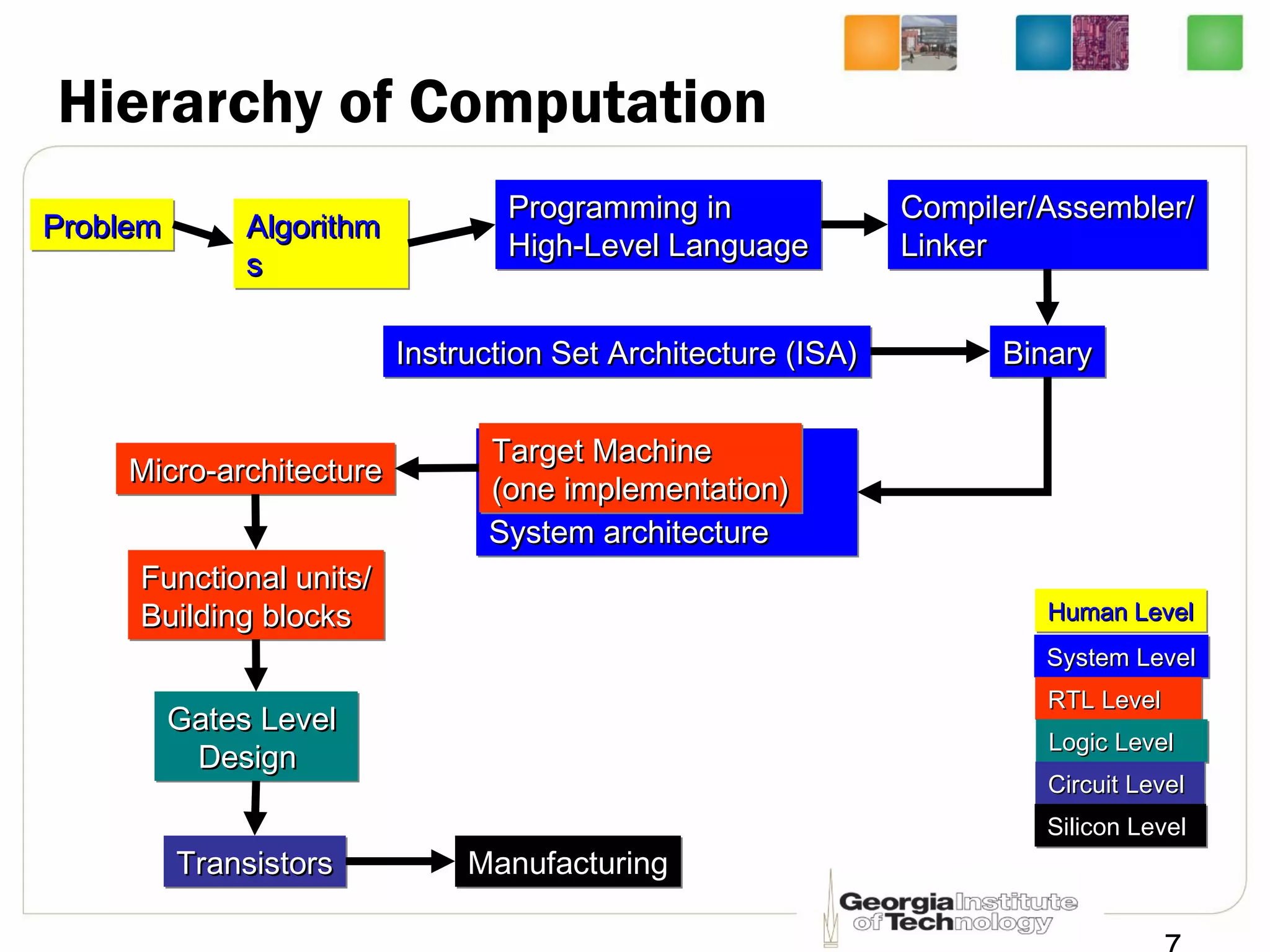
Hierarchy of Computation
ProblemProblemProblemProblem AlgorithmAlgorithm
ss
AlgorithmAlgorithm
ss
Programming inProgramming in
High-Level LanguageHigh-Level Language
Programming inProgramming in
High-Level LanguageHigh-Level Language
Compiler/Assembler/Compiler/Assembler/
LinkerLinker
Compiler/Assembler/Compiler/Assembler/
LinkerLinker
Instruction Set Architecture (ISA)Instruction Set Architecture (ISA)Instruction Set Architecture (ISA)Instruction Set Architecture (ISA) BinaryBinaryBinaryBinary
System architectureSystem architectureSystem architectureSystem architecture
Target MachineTarget Machine
(one implementation)(one implementation)
Target MachineTarget Machine
(one implementation)(one implementation)Micro-architectureMicro-architectureMicro-architectureMicro-architecture
Functional units/Functional units/
Building blocksBuilding blocks
Functional units/Functional units/
Building blocksBuilding blocks
Gates LevelGates Level
DesignDesign
Gates LevelGates Level
DesignDesign
TransistorsTransistorsTransistorsTransistors ManufacturingManufacturingManufacturingManufacturing
System LevelSystem LevelSystem LevelSystem Level
Human LevelHuman LevelHuman LevelHuman Level
RTL LevelRTL LevelRTL LevelRTL Level
Logic LevelLogic LevelLogic LevelLogic Level
Circuit LevelCircuit LevelCircuit LevelCircuit Level
Silicon LevelSilicon LevelSilicon LevelSilicon Level
Our Focus in 2030
Hierarchy of Computation
ProblemProblemProblemProblem AlgorithmAlgorithm
ss
AlgorithmAlgorithm
ss
Programming inProgramming in
High-Level LanguageHigh-Level Language
Programming inProgramming in
High-Level LanguageHigh-Level Language
Compiler/Assembler/Compiler/Assembler/
LinkerLinker
Compiler/Assembler/Compiler/Assembler/
LinkerLinker
Instruction Set Architecture (ISA)Instruction Set Architecture (ISA)Instruction Set Architecture (ISA)Instruction Set Architecture (ISA) BinaryBinaryBinaryBinary
System architectureSystem architectureSystem architectureSystem architecture
Target MachineTarget Machine
(one implementation)(one implementation)
Target MachineTarget Machine
(one implementation)(one implementation)Micro-architectureMicro-architectureMicro-architectureMicro-architecture
Functional units/Functional units/
Building blocksBuilding blocks
Functional units/Functional units/
Building blocksBuilding blocks
Gates LevelGates Level
DesignDesign
Gates LevelGates Level
DesignDesign
TransistorsTransistorsTransistorsTransistors ManufacturingManufacturingManufacturingManufacturing
System LevelSystem LevelSystem LevelSystem Level
Human LevelHuman LevelHuman LevelHuman Level
RTL LevelRTL LevelRTL LevelRTL Level
Logic LevelLogic LevelLogic LevelLogic Level
Circuit LevelCircuit LevelCircuit LevelCircuit Level
Silicon LevelSilicon LevelSilicon LevelSilicon Level
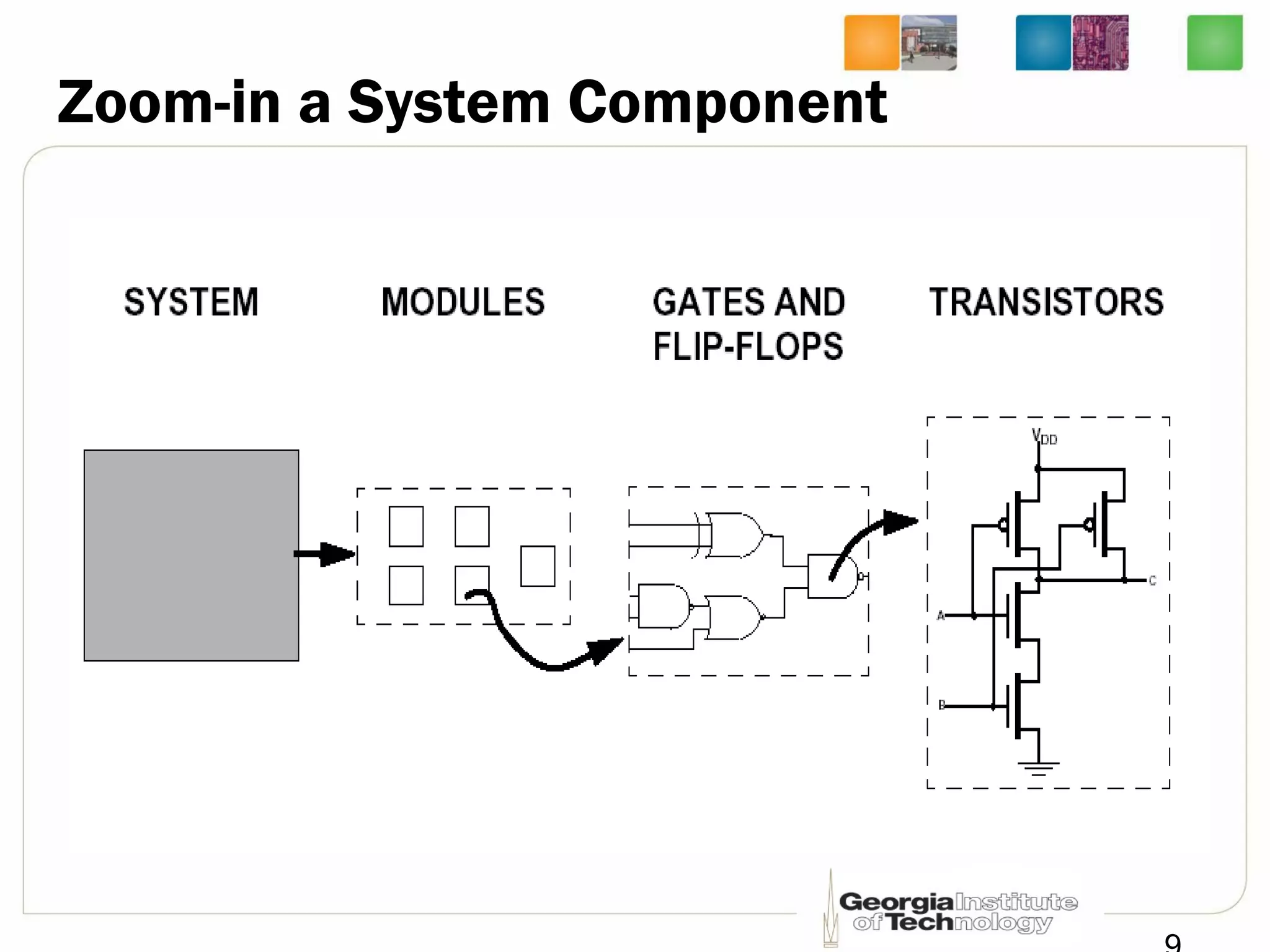
Zoom-in a System Component
0
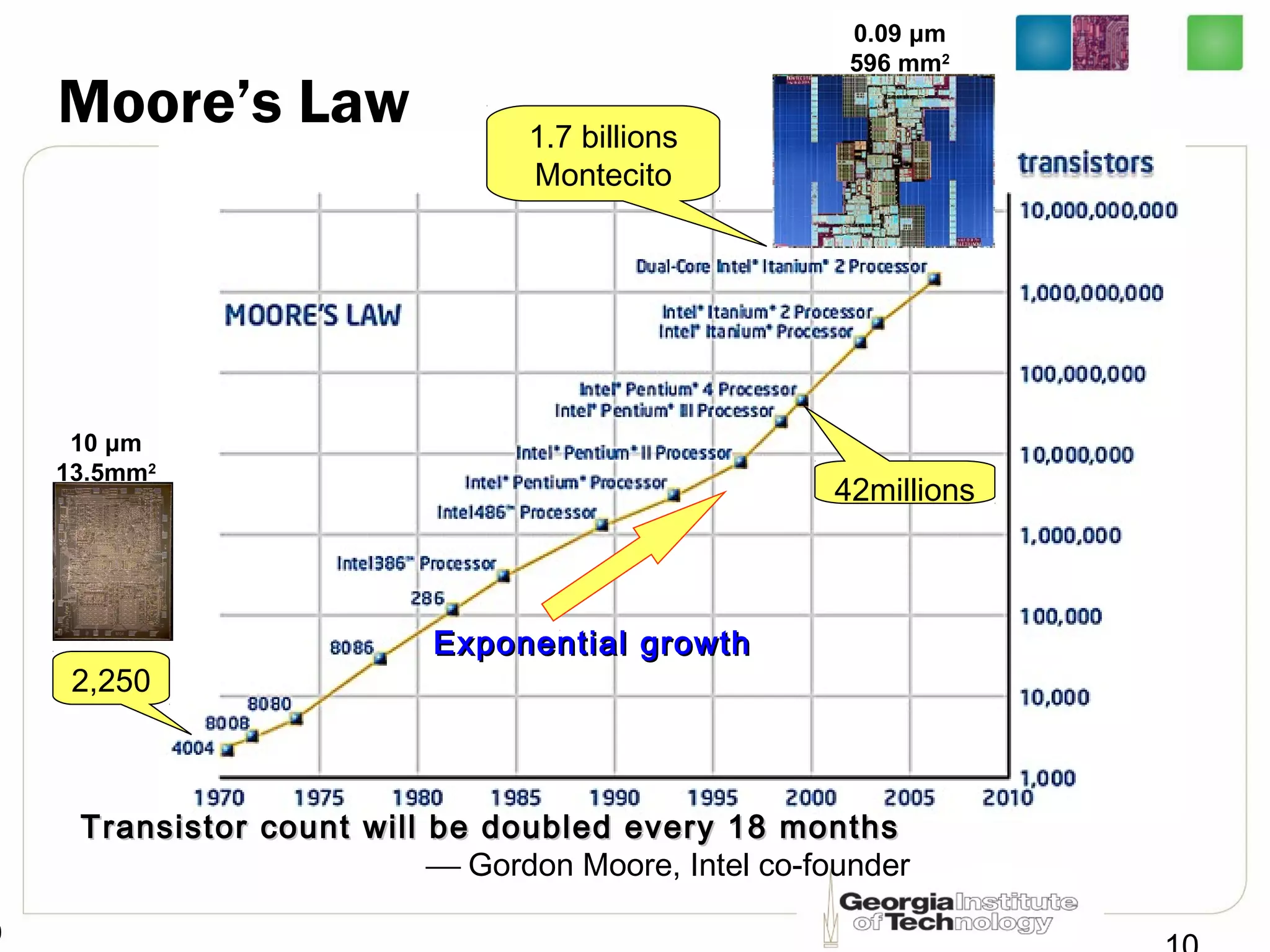
Moore’s Law
Exponential growthExponential growth
2,250
Transistor count will be doubled every 18 monthsTransistor count will be doubled every 18 months
 Gordon Moore, Intel co-founder
42millions
1.7 billions
Montecito
10 μm
13.5mm2
0.09 μm
596 mm2
1
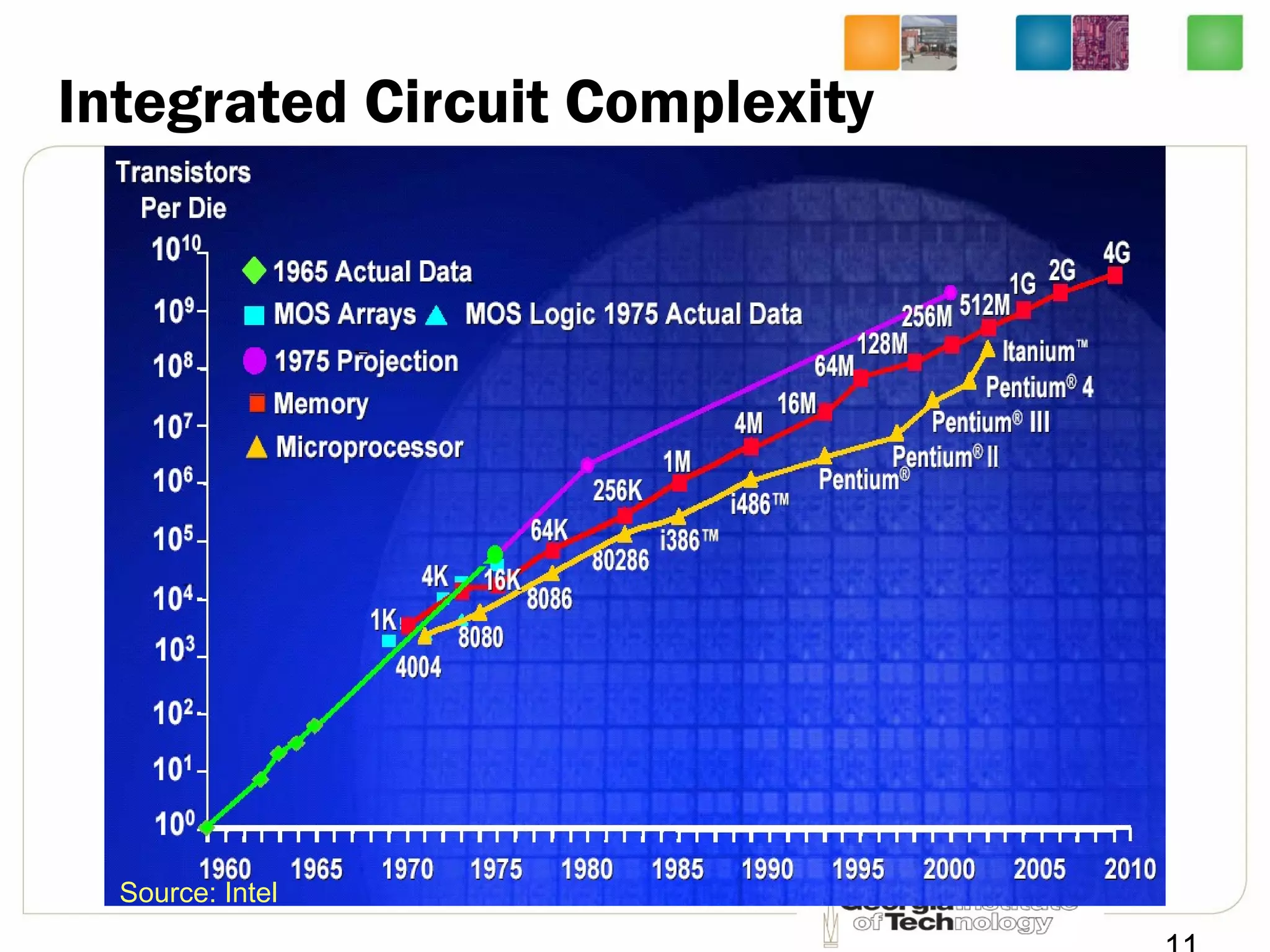
Integrated Circuit Complexity
Source: Intel
2
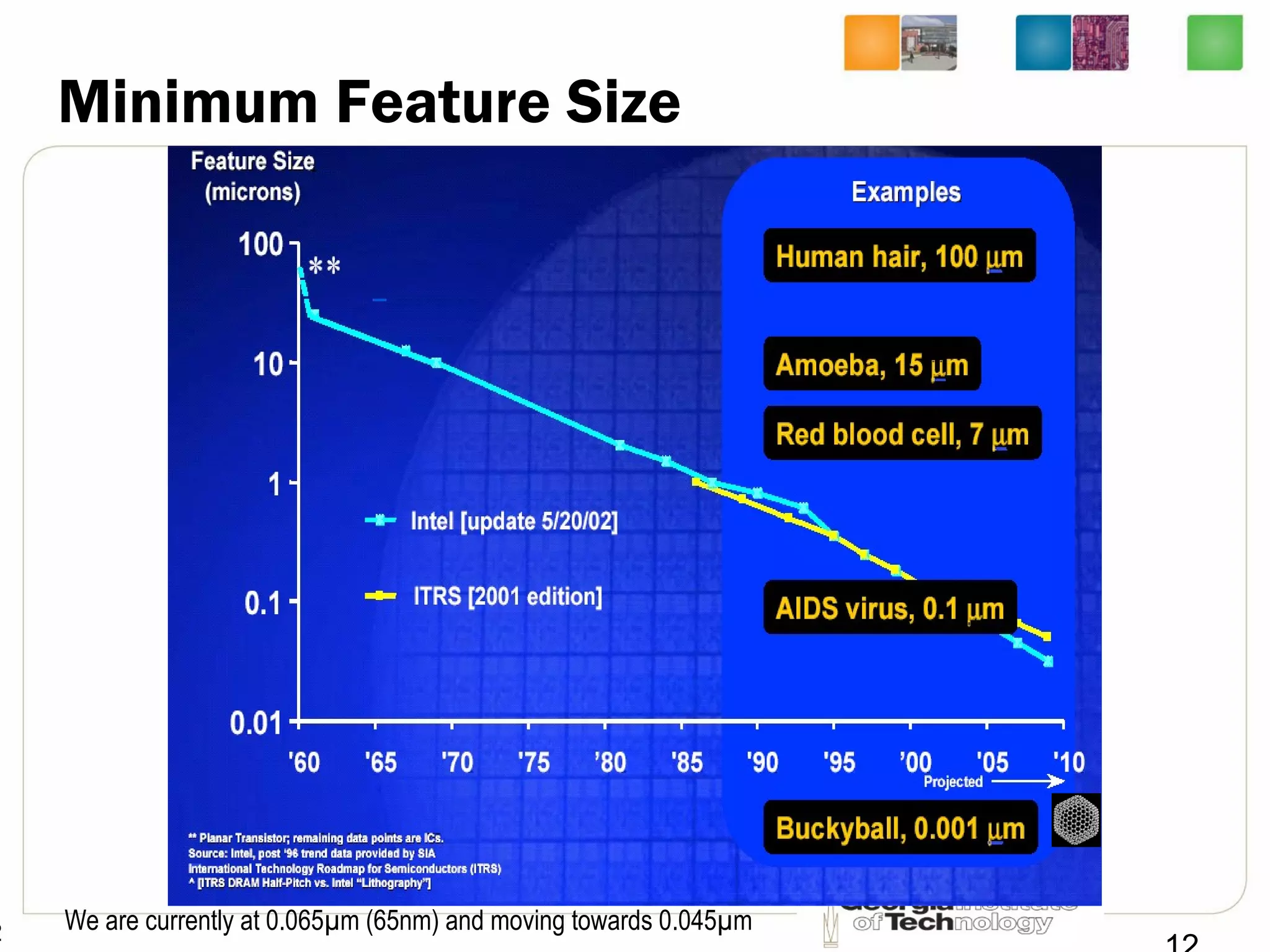
Minimum Feature Size
We are currently at 0.065µm (65nm) and moving towards 0.045µm
3
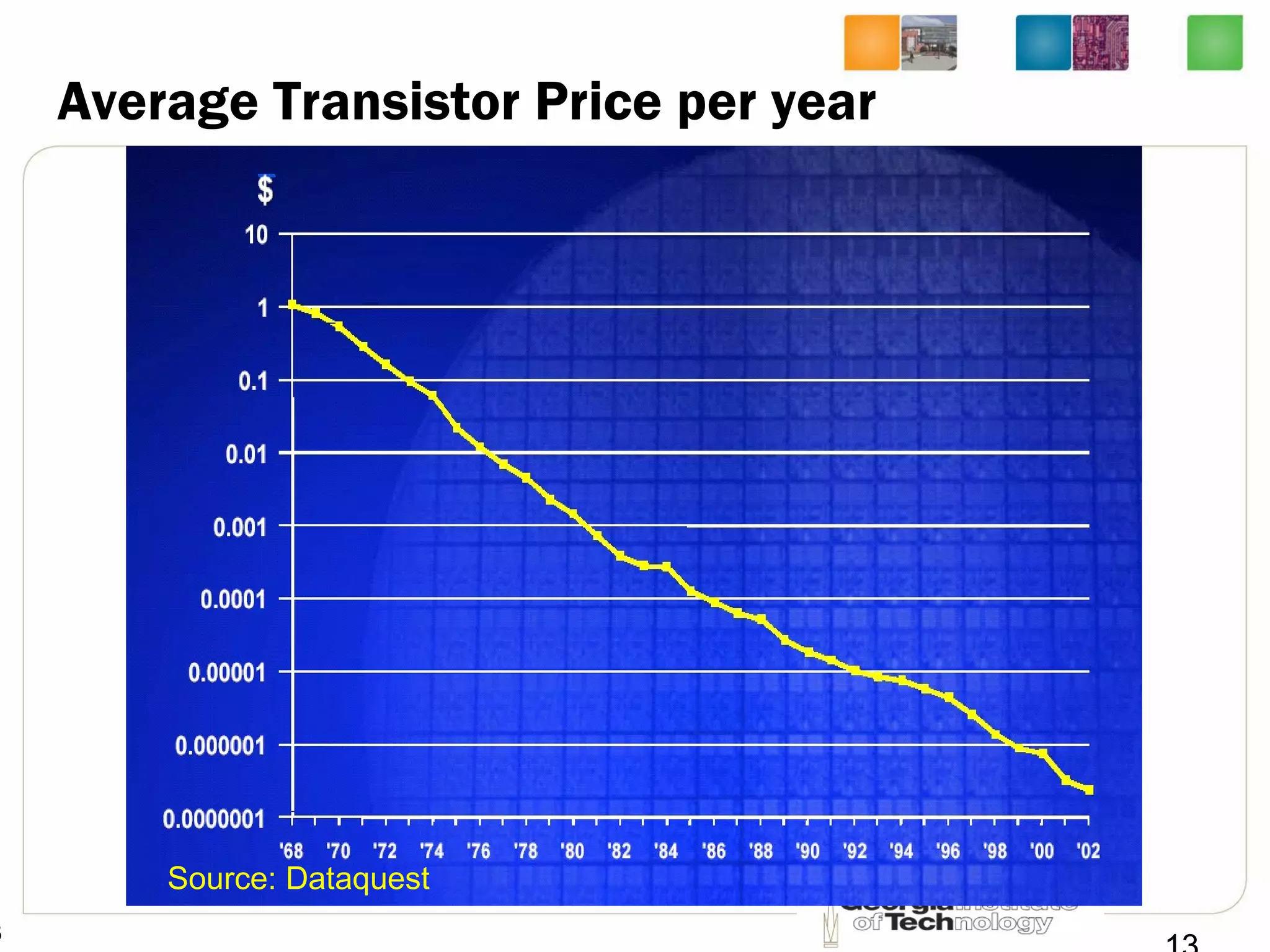
Average Transistor Price per year
Source: Dataquest
4
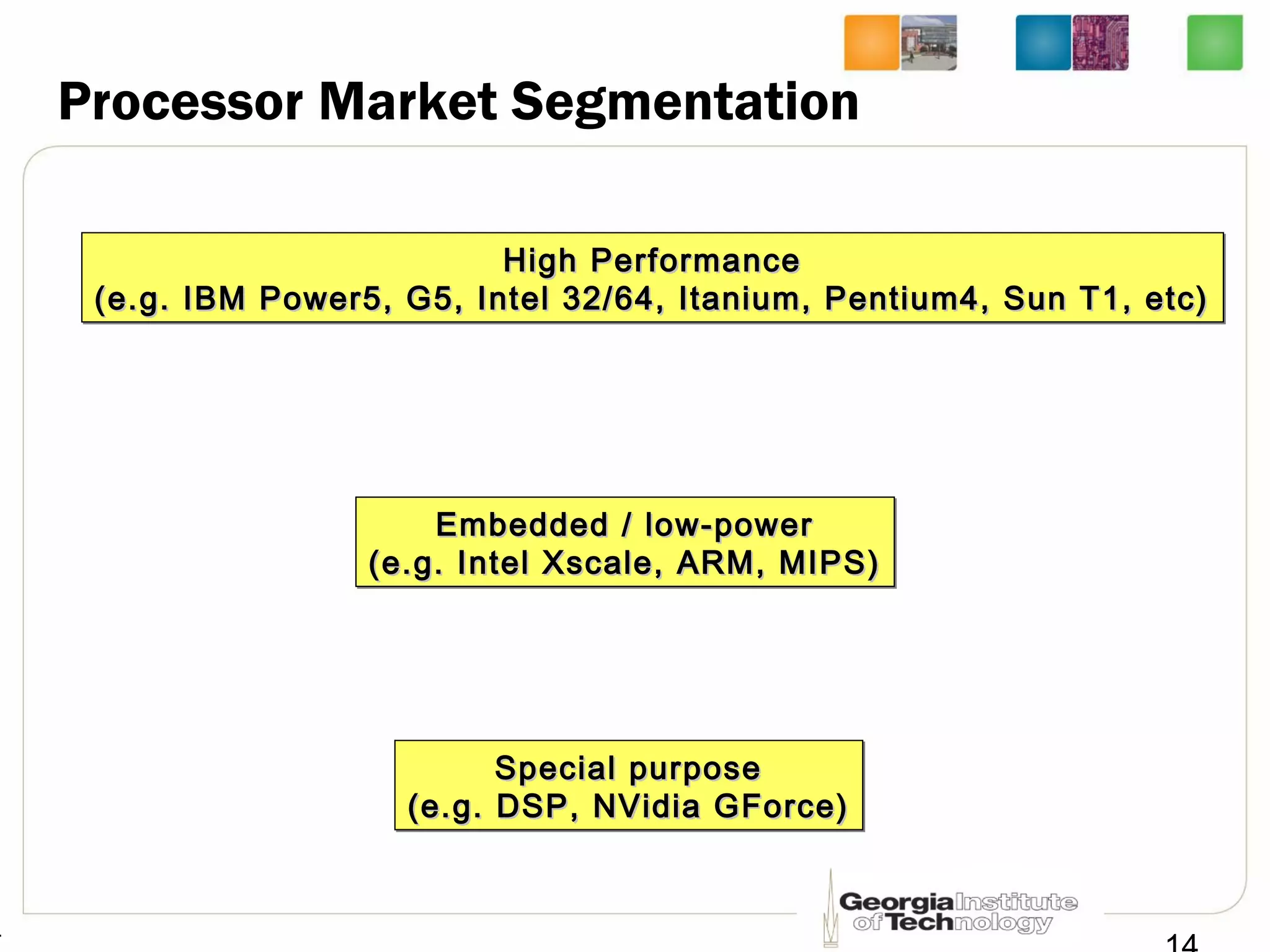
Processor Market Segmentation
High PerformanceHigh Performance
(e.g. IBM Power5, G5, Intel 32/64, Itanium, Pentium4, Sun T1, etc)(e.g. IBM Power5, G5, Intel 32/64, Itanium, Pentium4, Sun T1, etc)
High PerformanceHigh Performance
(e.g. IBM Power5, G5, Intel 32/64, Itanium, Pentium4, Sun T1, etc)(e.g. IBM Power5, G5, Intel 32/64, Itanium, Pentium4, Sun T1, etc)
Embedded / low-powerEmbedded / low-power
(e.g. Intel Xscale, ARM, MIPS)(e.g. Intel Xscale, ARM, MIPS)
Embedded / low-powerEmbedded / low-power
(e.g. Intel Xscale, ARM, MIPS)(e.g. Intel Xscale, ARM, MIPS)
Special purposeSpecial purpose
(e.g. DSP, NVidia GForce)(e.g. DSP, NVidia GForce)
Special purposeSpecial purpose
(e.g. DSP, NVidia GForce)(e.g. DSP, NVidia GForce)
5
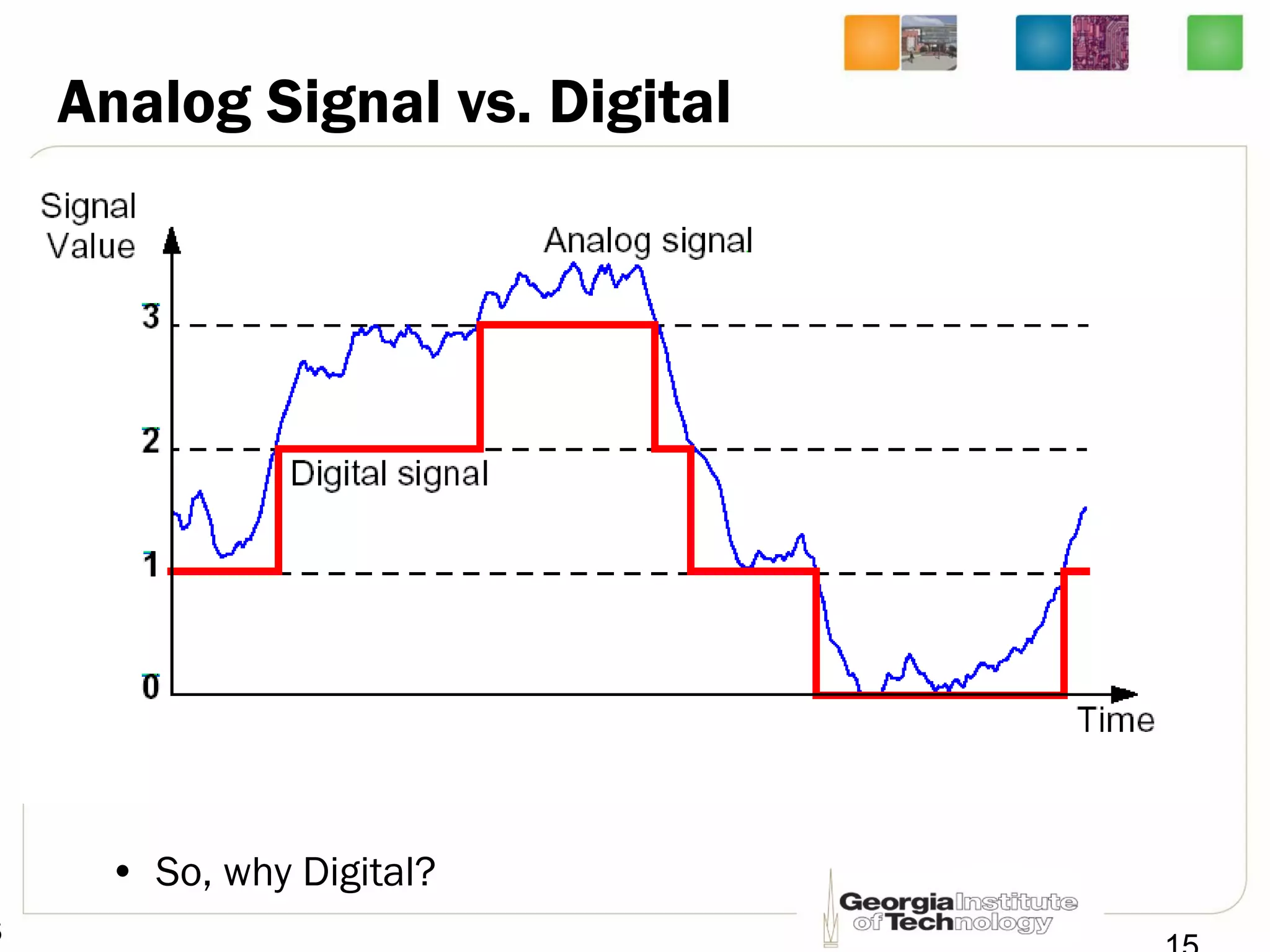
Analog Signal vs. Digital
• So, why Digital?
6
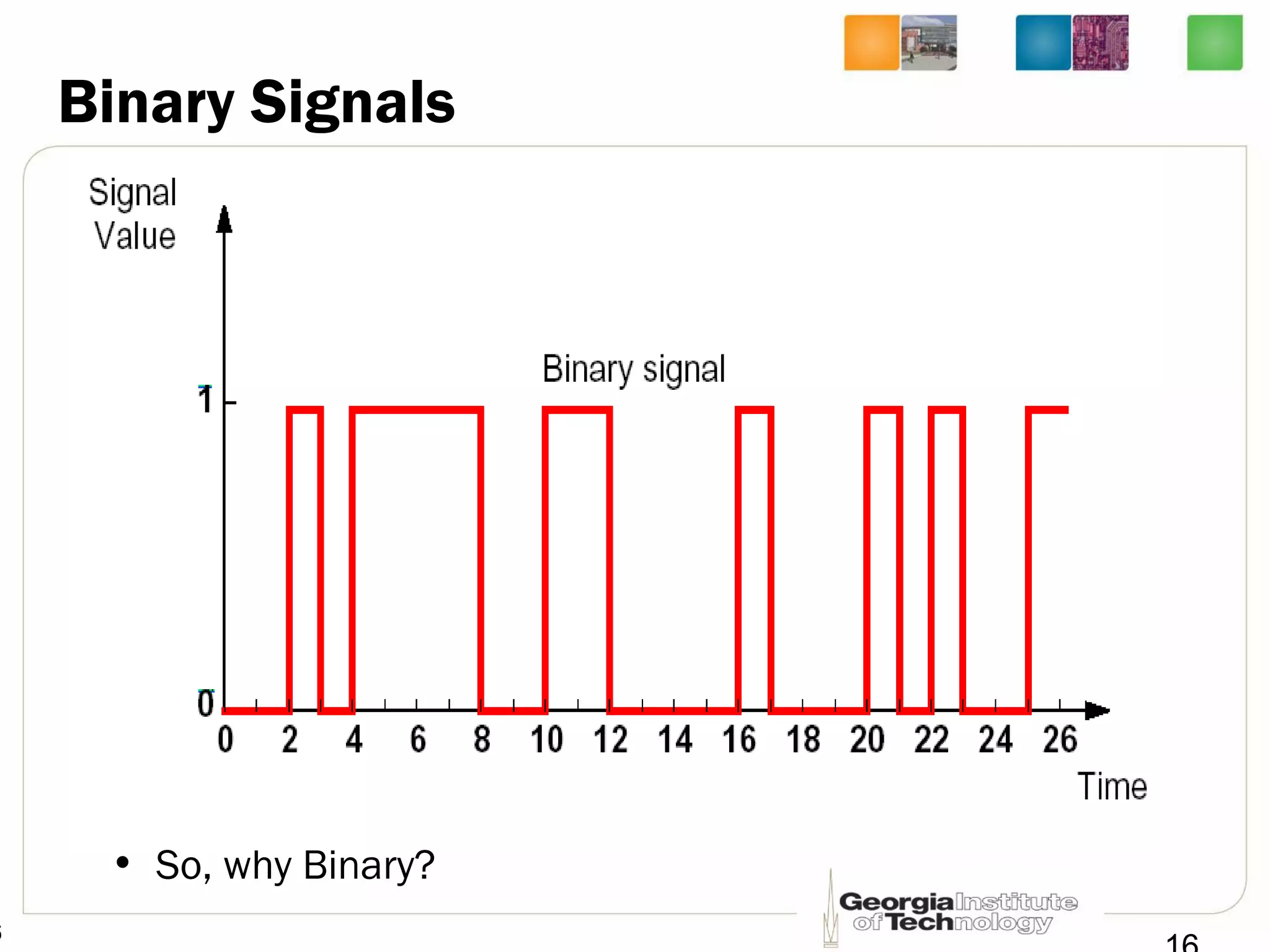
Binary Signals
• So, why Binary?
7
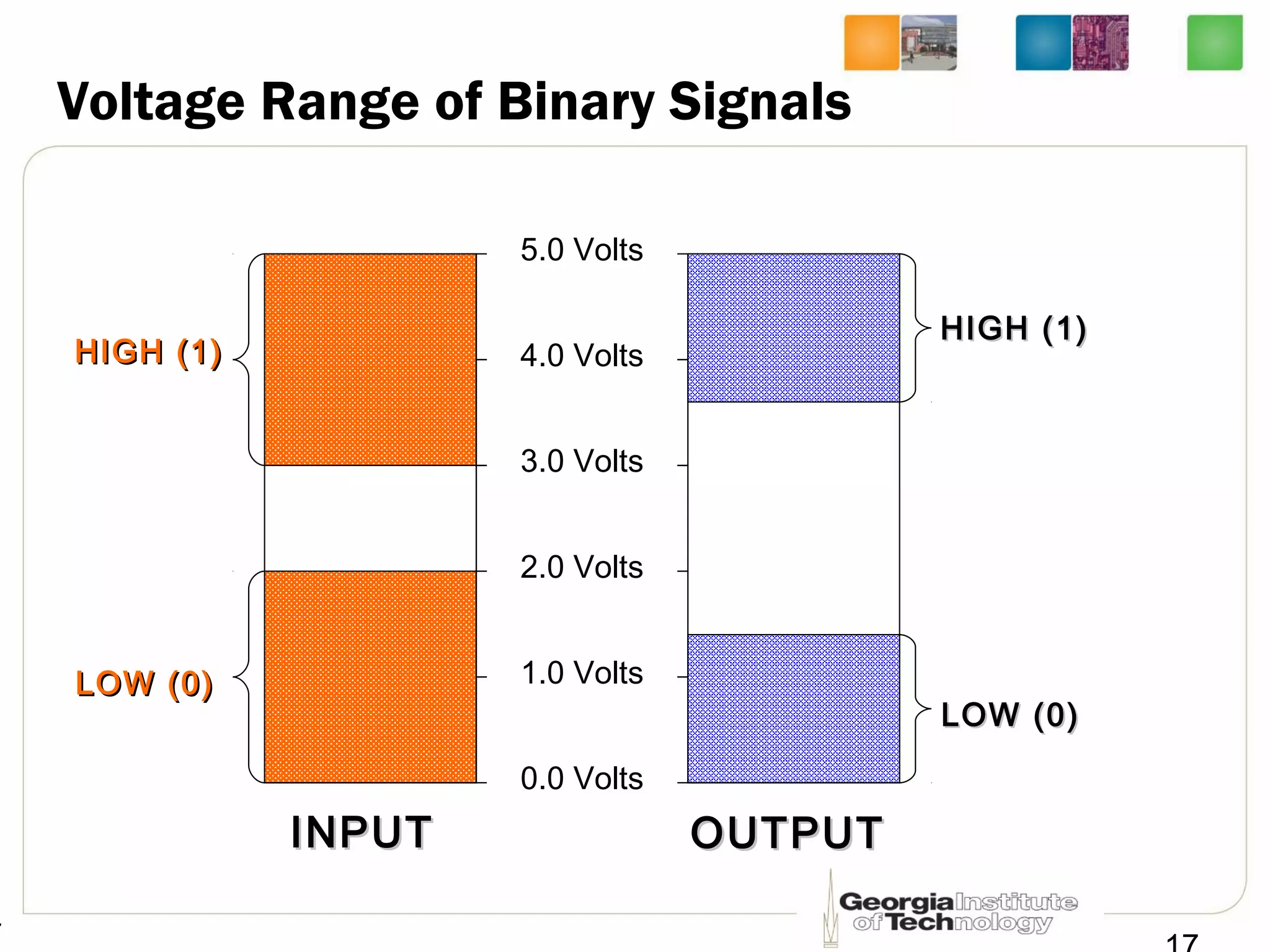
Voltage Range of Binary Signals
0.0 Volts
1.0 Volts
2.0 Volts
3.0 Volts
4.0 Volts
5.0 Volts
INPUTINPUT OUTPUTOUTPUT
HIGH (1)HIGH (1)
LOW (0)LOW (0)
HIGH (1)HIGH (1)
LOW (0)LOW (0)
BACKUP
9
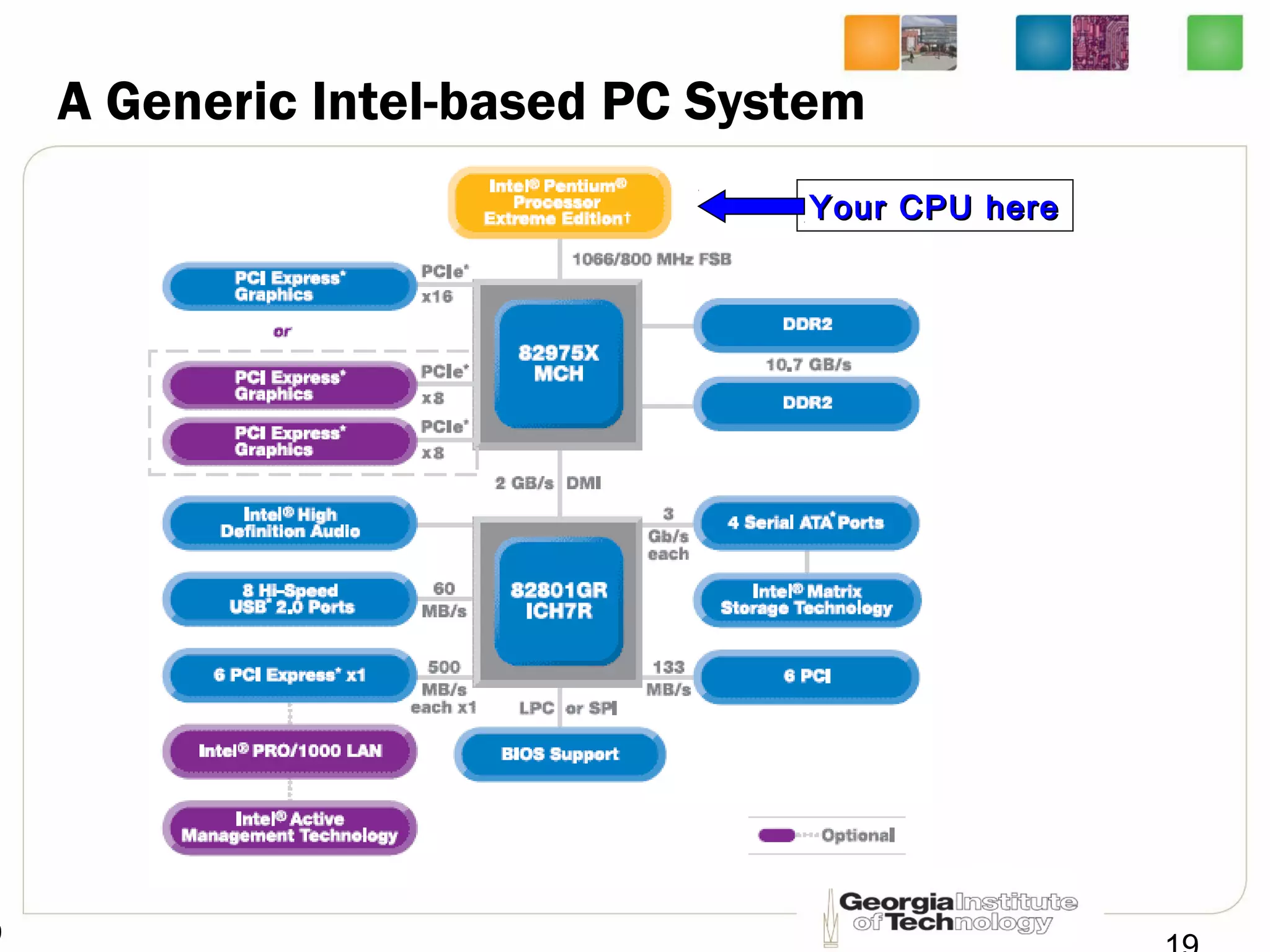
A Generic Intel-based PC System
Your CPU hereYour CPU here
0
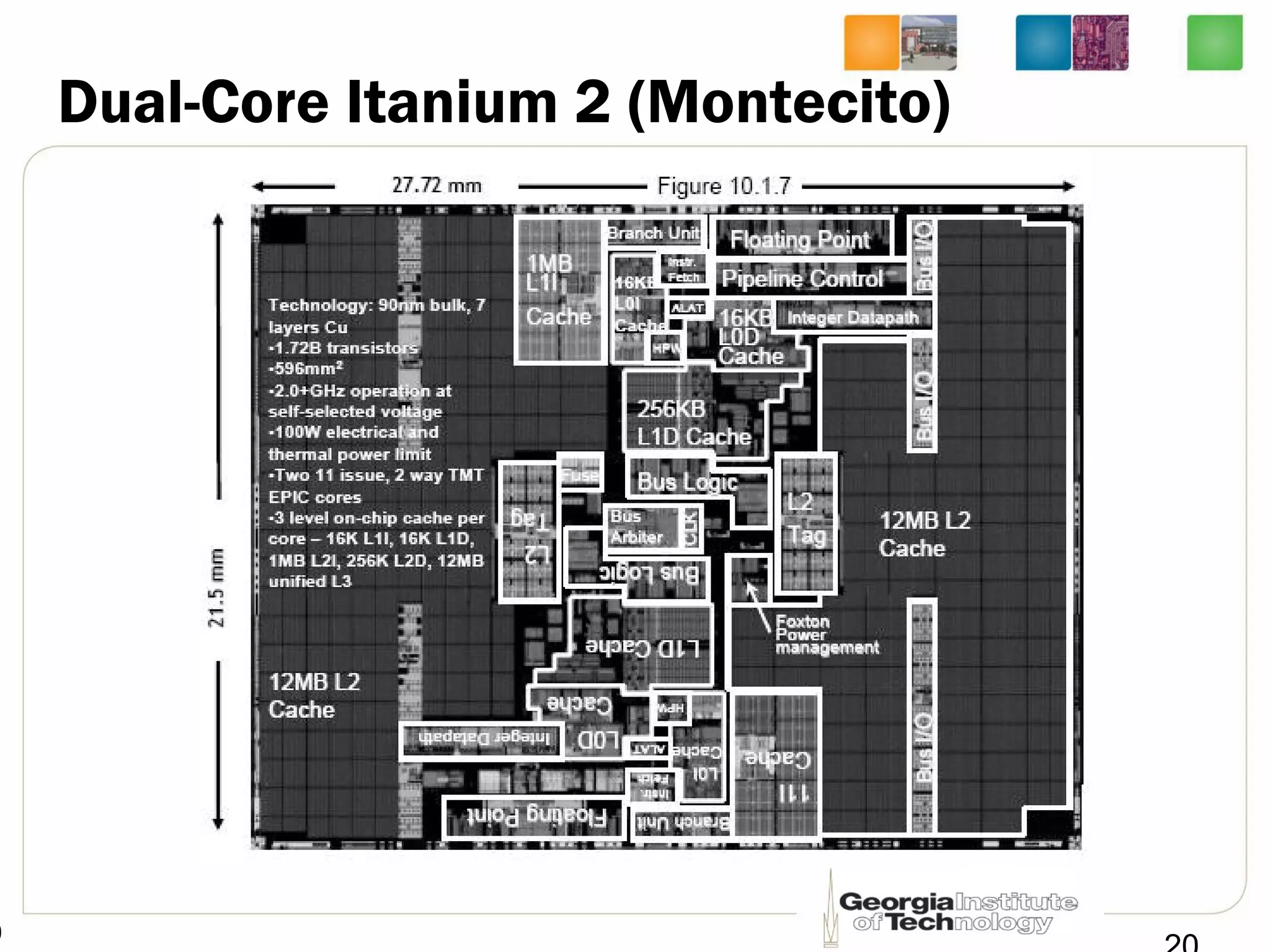
Dual-Core Itanium 2 (Montecito)

Lec1 Intro to Computer Engineering by Hsien-Hsin Sean Lee Georgia Tech -- Intro

  • 1.
    ECE2030 Introduction to ComputerEngineering Lecture 1: Overview Prof. Hsien-Hsin Sean LeeProf. Hsien-Hsin Sean Lee School of Electrical and Computer EngineeringSchool of Electrical and Computer Engineering Georgia TechGeorgia Tech
  • 2.
    • Instructor: Prof.Hsien-Hsin “Sean” Lee • Email: leehs@gatech.edu • Course web: http://www.ece.gatech.edu/~leehs/ECE2030 • My office: Klaus 2318 • Teaching Materials: – Morris Mano and Charles Kime, “Logic and Computer Design Fundamentals,” the 3rd edition – Course notes and handouts (check out course web) – TA: to be announced later • Attending classes is important !! ECE2030 Syllabus
  • 3.
    ECE2030 Syllabus • Gradingpolicy – 3 Homework assignment: 5% each – 1 Programming assignment: 10% – 3 in-class exams: 15% each – 1 final exam: 30% – [100,90]=A; (90,80]=B; (80,70]=C,(70,55]=D,(55,0]=F • All homework: turn-in in the first 5 minutes “in class” of the due day • All exams: closed books, closed notes, no calculator • Honor code • Use webct (http://webct.gatech.edu) for your homework and exam grades
  • 4.
    Objective: Digital DesignPrinciple • Number systems • Boolean algebra • Switch and CMOS design • Combinational logic – Logic gates – Building blocks: de/mux, de/encoder, shifters, adder/subtractor, multiplier – Logic minimization – Mixed logic • Sequential logic – Latches, Flip-flops – Counters – State machines: Mealy/Moore machines
  • 5.
    Objective: Digital DesignPrinciple • Memory and Programmable Devices – Register, RAM, ROM, PLA, PAL • Architectural concept – Instruction set architecture (ISA) – Stored-Program Computer and Sequential Control (von Neumann architecture) – Datapath – Branches • Processor and Software Convention – MIPS ISA – Procedural calls: Stack
  • 6.
    Hierarchy of Computation ProblemProblemProblemProblemAlgorithmAlgorithm ss AlgorithmAlgorithm ss Programming inProgramming in High-Level LanguageHigh-Level Language Programming inProgramming in High-Level LanguageHigh-Level Language Compiler/Assembler/Compiler/Assembler/ LinkerLinker Compiler/Assembler/Compiler/Assembler/ LinkerLinker Instruction Set Architecture (ISA)Instruction Set Architecture (ISA)Instruction Set Architecture (ISA)Instruction Set Architecture (ISA) BinaryBinaryBinaryBinary System architectureSystem architectureSystem architectureSystem architecture Target MachineTarget Machine (one implementation)(one implementation) Target MachineTarget Machine (one implementation)(one implementation)Micro-architectureMicro-architectureMicro-architectureMicro-architecture Functional units/Functional units/ Building blocksBuilding blocks Functional units/Functional units/ Building blocksBuilding blocks Gates LevelGates Level DesignDesign Gates LevelGates Level DesignDesign TransistorsTransistorsTransistorsTransistors ManufacturingManufacturingManufacturingManufacturing
  • 7.
    Hierarchy of Computation ProblemProblemProblemProblemAlgorithmAlgorithm ss AlgorithmAlgorithm ss Programming inProgramming in High-Level LanguageHigh-Level Language Programming inProgramming in High-Level LanguageHigh-Level Language Compiler/Assembler/Compiler/Assembler/ LinkerLinker Compiler/Assembler/Compiler/Assembler/ LinkerLinker Instruction Set Architecture (ISA)Instruction Set Architecture (ISA)Instruction Set Architecture (ISA)Instruction Set Architecture (ISA) BinaryBinaryBinaryBinary System architectureSystem architectureSystem architectureSystem architecture Target MachineTarget Machine (one implementation)(one implementation) Target MachineTarget Machine (one implementation)(one implementation)Micro-architectureMicro-architectureMicro-architectureMicro-architecture Functional units/Functional units/ Building blocksBuilding blocks Functional units/Functional units/ Building blocksBuilding blocks Gates LevelGates Level DesignDesign Gates LevelGates Level DesignDesign TransistorsTransistorsTransistorsTransistors ManufacturingManufacturingManufacturingManufacturing System LevelSystem LevelSystem LevelSystem Level Human LevelHuman LevelHuman LevelHuman Level RTL LevelRTL LevelRTL LevelRTL Level Logic LevelLogic LevelLogic LevelLogic Level Circuit LevelCircuit LevelCircuit LevelCircuit Level Silicon LevelSilicon LevelSilicon LevelSilicon Level
  • 8.
    Our Focus in2030 Hierarchy of Computation ProblemProblemProblemProblem AlgorithmAlgorithm ss AlgorithmAlgorithm ss Programming inProgramming in High-Level LanguageHigh-Level Language Programming inProgramming in High-Level LanguageHigh-Level Language Compiler/Assembler/Compiler/Assembler/ LinkerLinker Compiler/Assembler/Compiler/Assembler/ LinkerLinker Instruction Set Architecture (ISA)Instruction Set Architecture (ISA)Instruction Set Architecture (ISA)Instruction Set Architecture (ISA) BinaryBinaryBinaryBinary System architectureSystem architectureSystem architectureSystem architecture Target MachineTarget Machine (one implementation)(one implementation) Target MachineTarget Machine (one implementation)(one implementation)Micro-architectureMicro-architectureMicro-architectureMicro-architecture Functional units/Functional units/ Building blocksBuilding blocks Functional units/Functional units/ Building blocksBuilding blocks Gates LevelGates Level DesignDesign Gates LevelGates Level DesignDesign TransistorsTransistorsTransistorsTransistors ManufacturingManufacturingManufacturingManufacturing System LevelSystem LevelSystem LevelSystem Level Human LevelHuman LevelHuman LevelHuman Level RTL LevelRTL LevelRTL LevelRTL Level Logic LevelLogic LevelLogic LevelLogic Level Circuit LevelCircuit LevelCircuit LevelCircuit Level Silicon LevelSilicon LevelSilicon LevelSilicon Level
  • 9.
  • 10.
    0 Moore’s Law Exponential growthExponentialgrowth 2,250 Transistor count will be doubled every 18 monthsTransistor count will be doubled every 18 months  Gordon Moore, Intel co-founder 42millions 1.7 billions Montecito 10 μm 13.5mm2 0.09 μm 596 mm2
  • 11.
  • 12.
    2 Minimum Feature Size Weare currently at 0.065µm (65nm) and moving towards 0.045µm
  • 13.
    3 Average Transistor Priceper year Source: Dataquest
  • 14.
    4 Processor Market Segmentation HighPerformanceHigh Performance (e.g. IBM Power5, G5, Intel 32/64, Itanium, Pentium4, Sun T1, etc)(e.g. IBM Power5, G5, Intel 32/64, Itanium, Pentium4, Sun T1, etc) High PerformanceHigh Performance (e.g. IBM Power5, G5, Intel 32/64, Itanium, Pentium4, Sun T1, etc)(e.g. IBM Power5, G5, Intel 32/64, Itanium, Pentium4, Sun T1, etc) Embedded / low-powerEmbedded / low-power (e.g. Intel Xscale, ARM, MIPS)(e.g. Intel Xscale, ARM, MIPS) Embedded / low-powerEmbedded / low-power (e.g. Intel Xscale, ARM, MIPS)(e.g. Intel Xscale, ARM, MIPS) Special purposeSpecial purpose (e.g. DSP, NVidia GForce)(e.g. DSP, NVidia GForce) Special purposeSpecial purpose (e.g. DSP, NVidia GForce)(e.g. DSP, NVidia GForce)
  • 15.
    5 Analog Signal vs.Digital • So, why Digital?
  • 16.
  • 17.
    7 Voltage Range ofBinary Signals 0.0 Volts 1.0 Volts 2.0 Volts 3.0 Volts 4.0 Volts 5.0 Volts INPUTINPUT OUTPUTOUTPUT HIGH (1)HIGH (1) LOW (0)LOW (0) HIGH (1)HIGH (1) LOW (0)LOW (0)
  • 18.
  • 19.
    9 A Generic Intel-basedPC System Your CPU hereYour CPU here
  • 20.