ECE 4100/6100
Advanced Computer Architecture
Lecture 7 Dynamic Scheduling (I)
Prof. Hsien-Hsin Sean Lee
School of Electrical and Computer Engineering
Georgia Institute of Technology
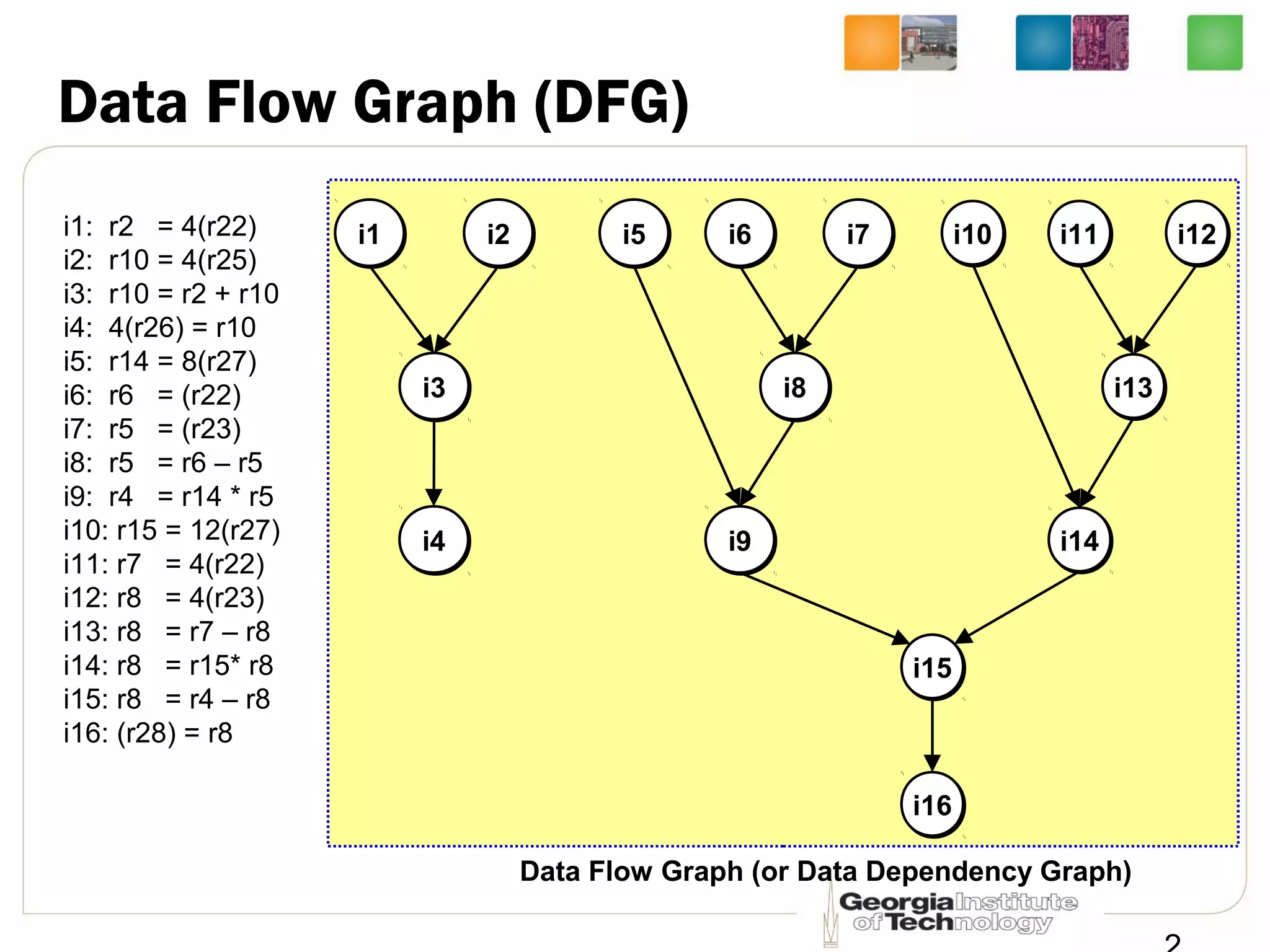
Data Flow Graph (DFG)
i1: r2 = 4(r22)
i2: r10 = 4(r25)
i3: r10 = r2 + r10
i4: 4(r26) = r10
i5: r14 = 8(r27)
i6: r6 = (r22)
i7: r5 = (r23)
i8: r5 = r6 – r5
i9: r4 = r14 * r5
i10: r15 = 12(r27)
i11: r7 = 4(r22)
i12: r8 = 4(r23)
i13: r8 = r7 – r8
i14: r8 = r15* r8
i15: r8 = r4 – r8
i16: (r28) = r8
i1i1 i2i2
i3i3
i4i4
i6i6 i7i7
i8i8
i5i5
i9i9
i11i11 i12i12
i13i13
i10i10
i14i14
i15i15
i16i16
Data Flow Graph (or Data Dependency Graph)
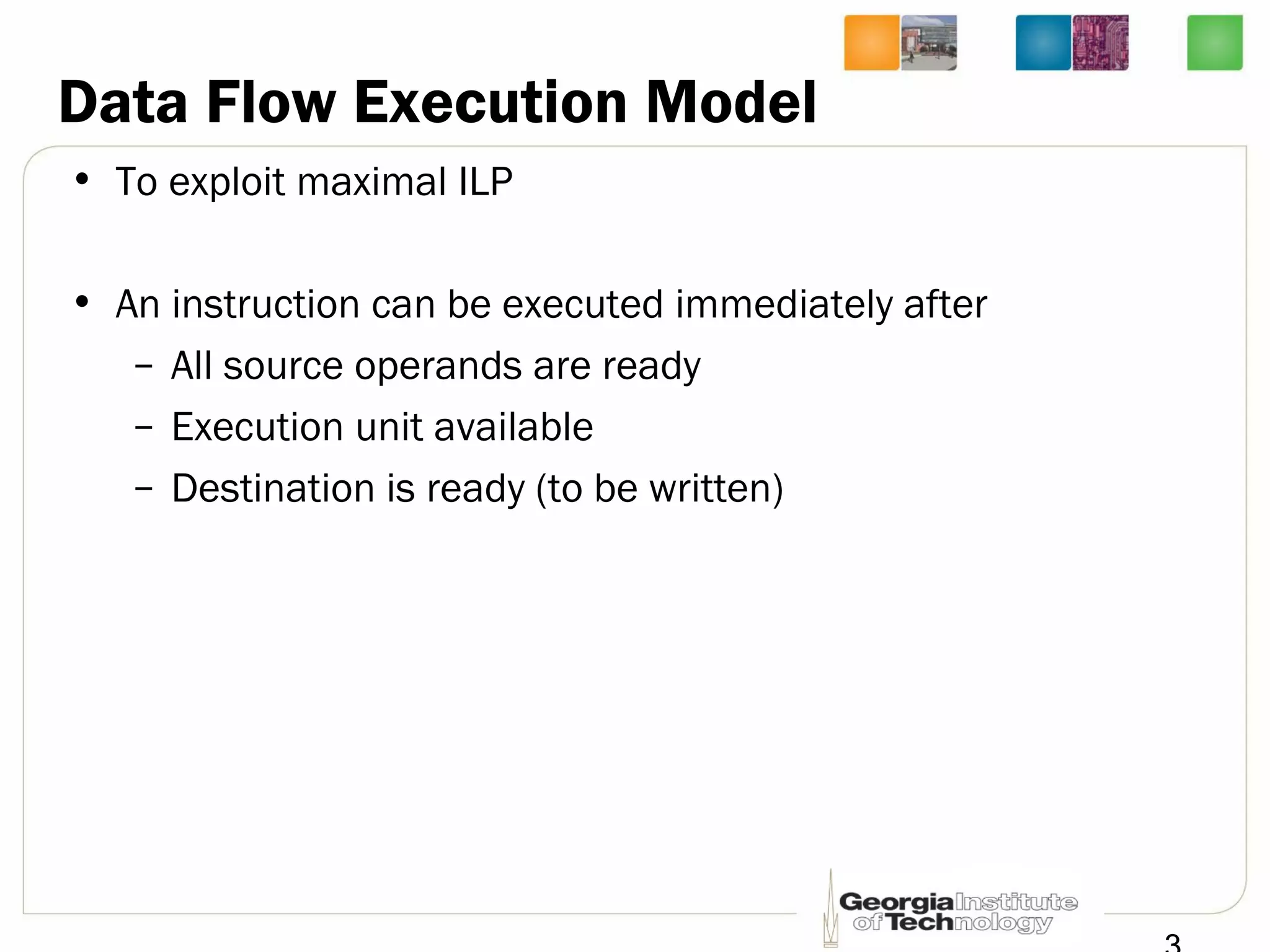
Data Flow Execution Model
• To exploit maximal ILP
• An instruction can be executed immediately after
– All source operands are ready
– Execution unit available
– Destination is ready (to be written)
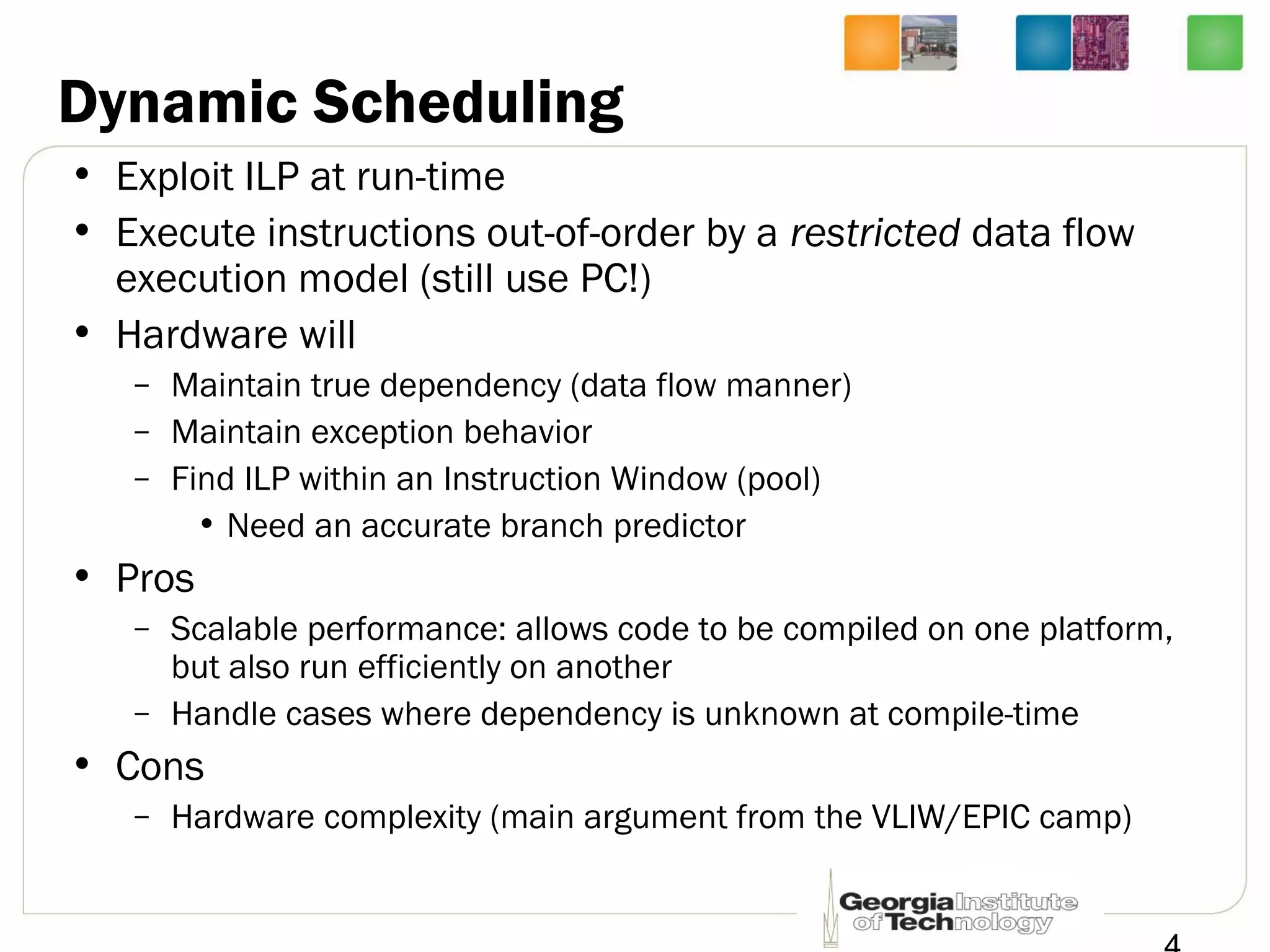
Dynamic Scheduling
• Exploit ILP at run-time
• Execute instructions out-of-order by a restricted data flow
execution model (still use PC!)
• Hardware will
– Maintain true dependency (data flow manner)
– Maintain exception behavior
– Find ILP within an Instruction Window (pool)
• Need an accurate branch predictor
• Pros
– Scalable performance: allows code to be compiled on one platform,
but also run efficiently on another
– Handle cases where dependency is unknown at compile-time
• Cons
– Hardware complexity (main argument from the VLIW/EPIC camp)
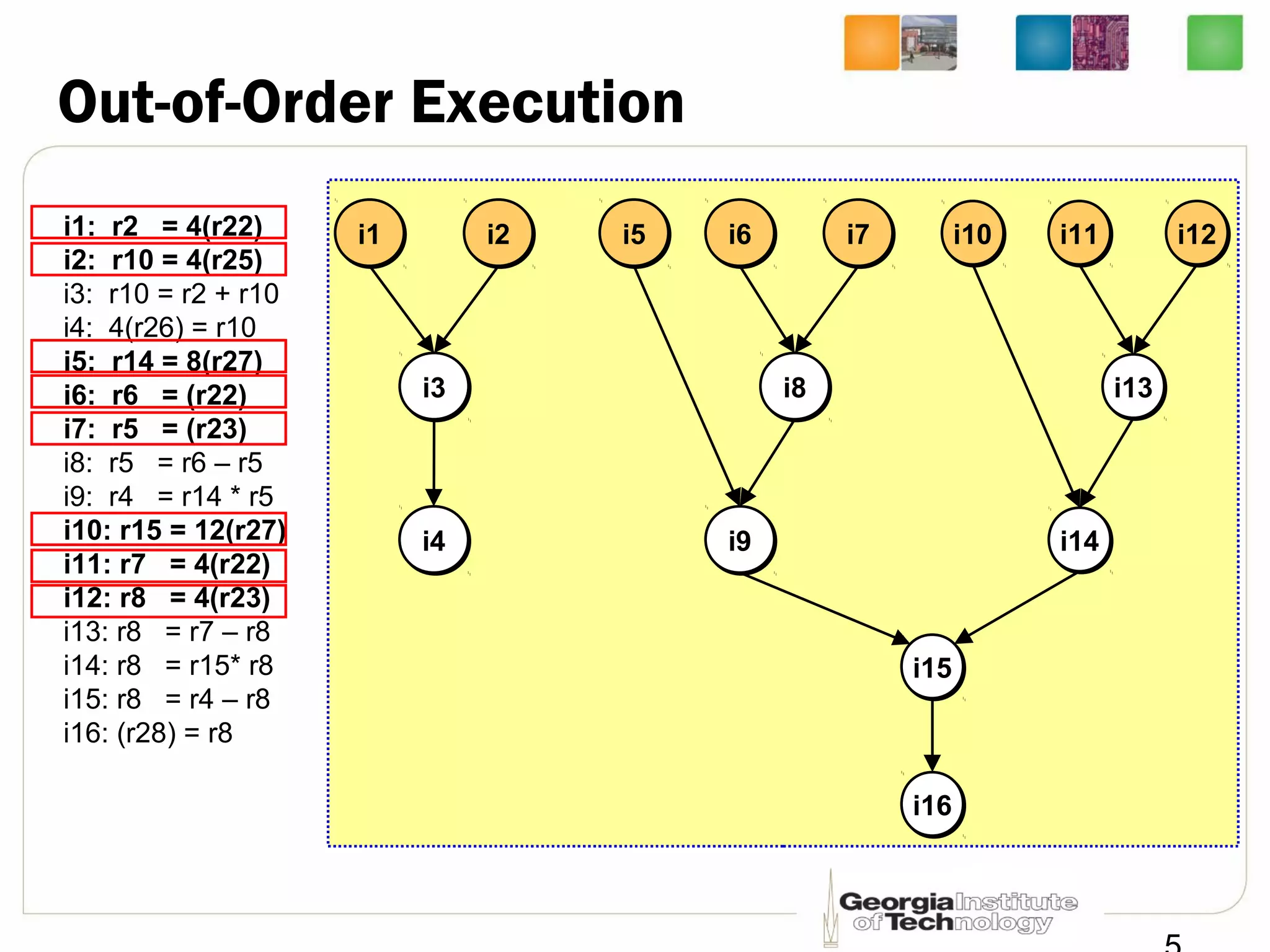
Out-of-Order Execution
i1: r2 = 4(r22)
i2: r10 = 4(r25)
i3: r10 = r2 + r10
i4: 4(r26) = r10
i5: r14 = 8(r27)
i6: r6 = (r22)
i7: r5 = (r23)
i8: r5 = r6 – r5
i9: r4 = r14 * r5
i10: r15 = 12(r27)
i11: r7 = 4(r22)
i12: r8 = 4(r23)
i13: r8 = r7 – r8
i14: r8 = r15* r8
i15: r8 = r4 – r8
i16: (r28) = r8
i1i1 i2i2
i3i3
i4i4
i6i6 i7i7
i8i8
i5i5
i9i9
i11i11 i12i12
i13i13
i10i10
i14i14
i15i15
i16i16
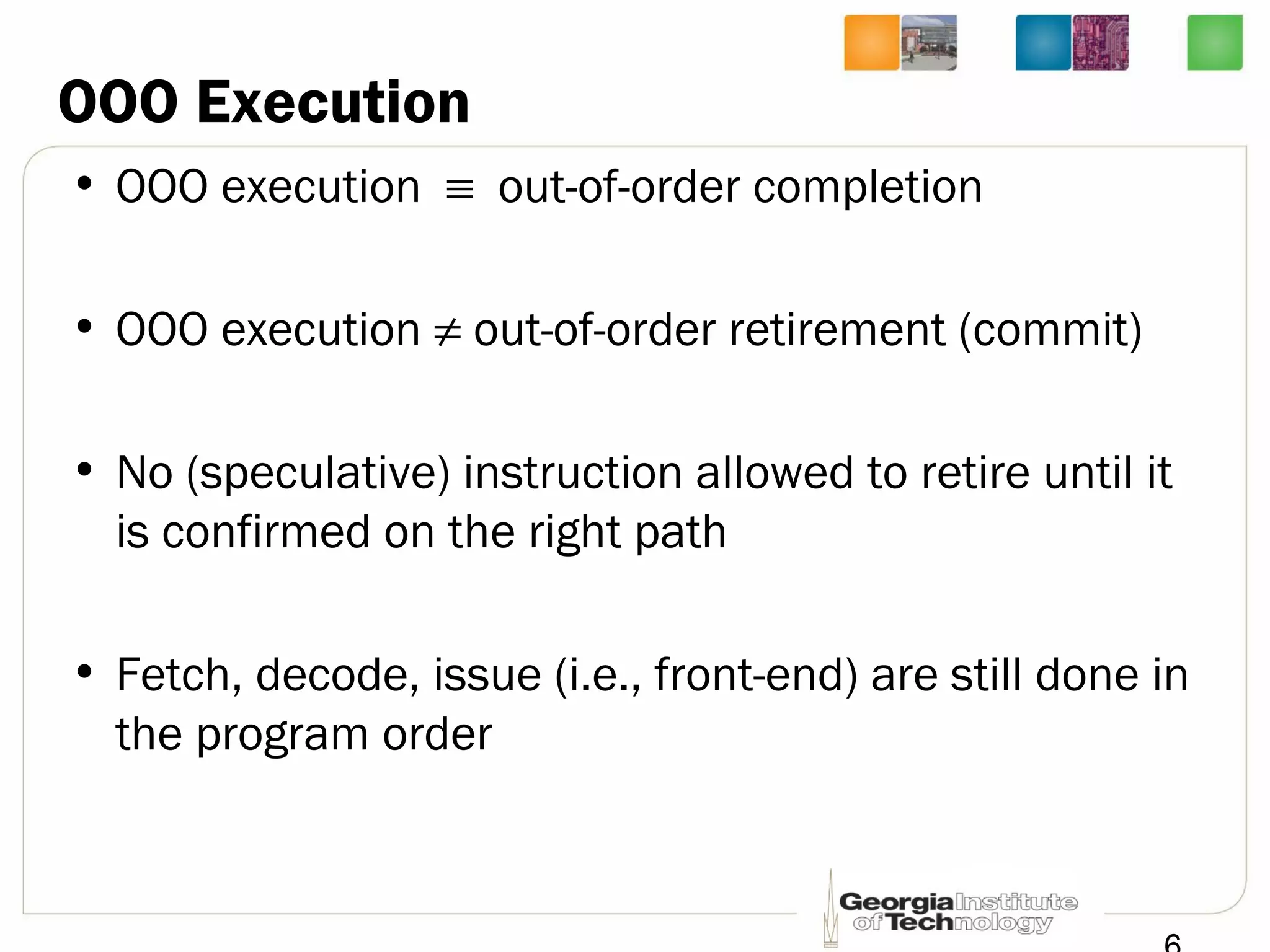
OOO Execution
• OOO execution ≡ out-of-order completion
• OOO execution ≠ out-of-order retirement (commit)
• No (speculative) instruction allowed to retire until it
is confirmed on the right path
• Fetch, decode, issue (i.e., front-end) are still done in
the program order
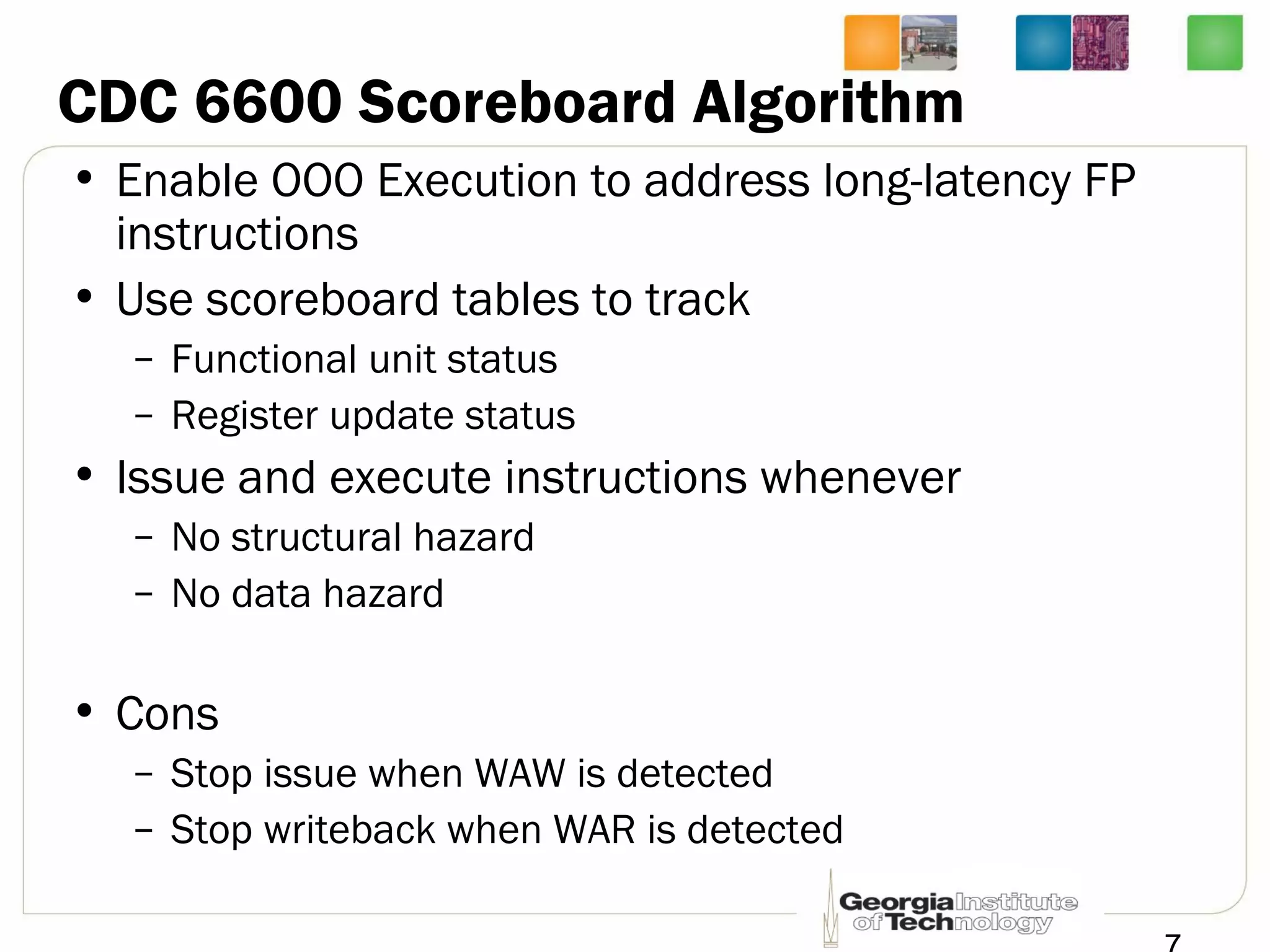
CDC 6600 Scoreboard Algorithm
• Enable OOO Execution to address long-latency FP
instructions
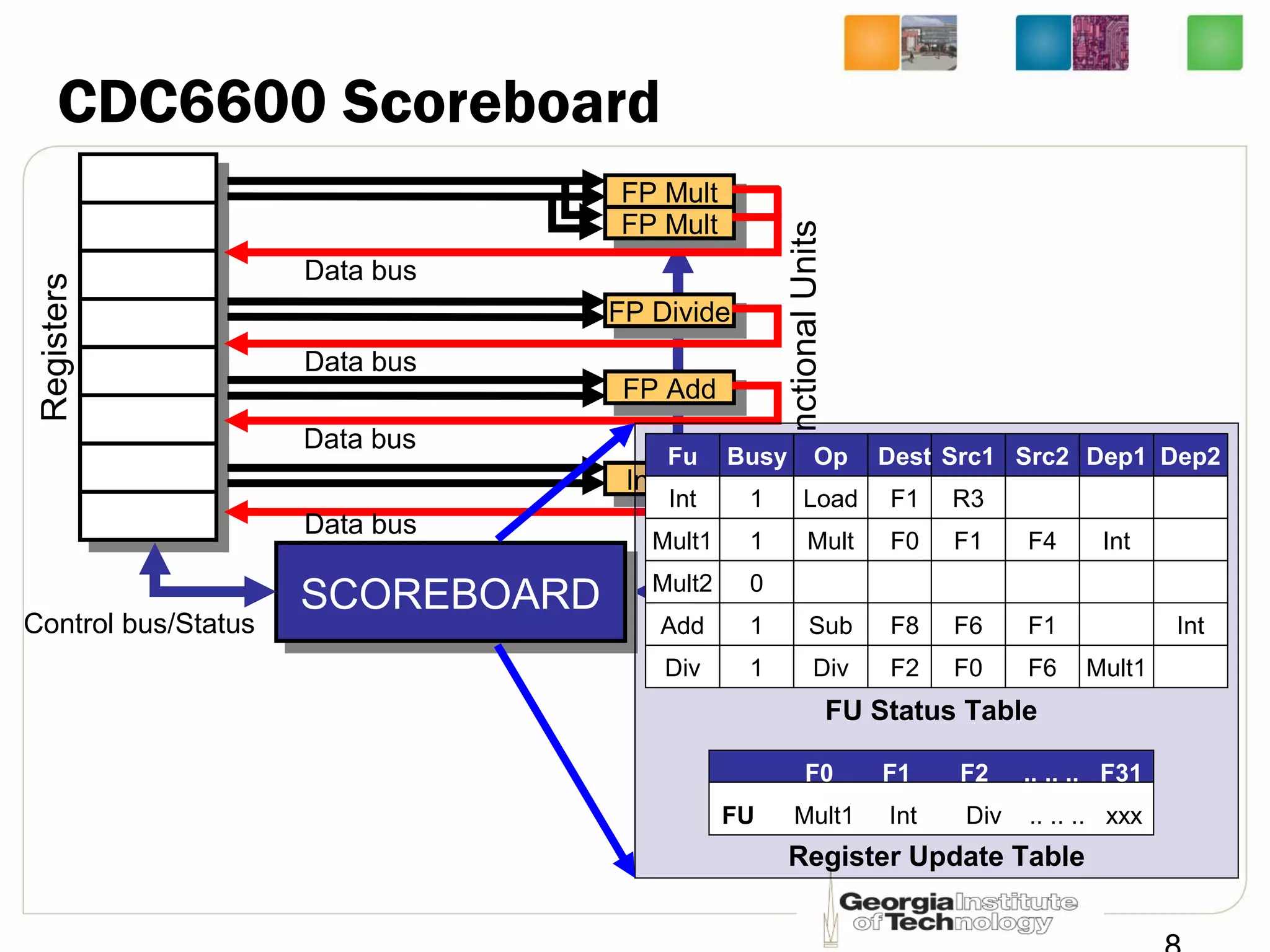
• Use scoreboard tables to track
– Functional unit status
– Register update status
• Issue and execute instructions whenever
– No structural hazard
– No data hazard
• Cons
– Stop issue when WAW is detected
– Stop writeback when WAR is detected
CDC6600 Scoreboard
FunctionalUnits
Registers
FP MultFP Mult
FP MultFP Mult
FP DivideFP Divide
FP AddFP Add
IntegerInteger
Memory
SCOREBOARDSCOREBOARD
Data bus
Data bus
Data bus
Data bus
Control bus/Status
Int
Mult1
Mult2
Add
Div
Fu
1
1
0
1
1
Busy
Load
Mult
Sub
Div
Op
F1
F0
F8
F2
Dest
R3
F1
F6
F0
Src1
F4
F1
F6
Src2
Int
Mult1
Dep1
Int
Dep2
F0 F1 F2 .. .. .. F31
Mult1 Int Div .. .. .. xxxFU
FU Status Table
Register Update Table
IBM 360
• IBM 360 introduced
– 8-bit = 1 byte
– 32-bit = 1 word
– Byte-addressable memory
– Differentiate an “architecture” from an “implementation”
• IBM 360/91 FPU about 3 years after CDC 6600 (1966-7)
• Tomasulo algorithm
– Dynamic scheduling
– Register renaming
Tomasulo Algorithm
• Goal: High Performance without special compilers
– Dynamic scheduling done completely by HW
– We generally use “supercalar processor” for such category as
opposed to “VLIW” or “EPIC”
• Differences between IBM 360 and CDC 6600 ISA
– IBM has only 2 register specifiers per inst vs. 3 in CDC 6600
• Make WAW and WAR much worse
– IBM has 4 FP registers vs. 8 in CDC 6600
• Smaller number of architectural register, compiler is incapable of
exploiting better register allocation
– IBM has memory-to-register operations
• Why study? Lead to Pentium Pro/II/III/4, Core, Alpha 21264, MIPS
R10000, HP 8000, PowerPC 604
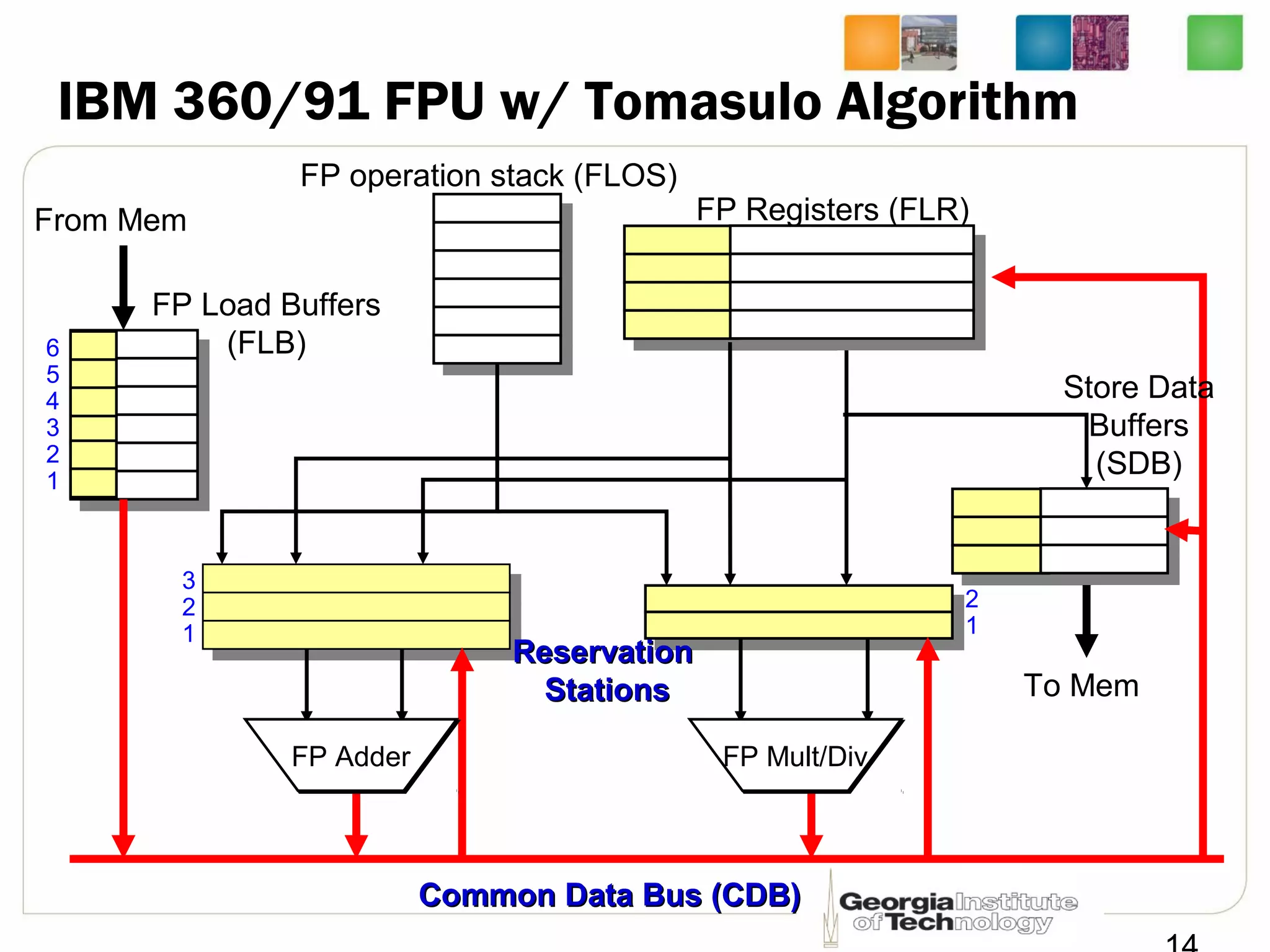
IBM 360/91 FPU w/ Tomasulo Algorithm
• To not stall floating point instructions due to long latency
– Two function units  FP Add + FP Mult/Div
– 360/91 FPU is not pipelined
• Three new Mechanisms
– Reservation StationsReservation Stations (RS)
• 3 in FP Add, 2 in FP mult/div
• Register name is discarded when issue to reservation station
– TagsTags
• 4-bit tag for one of the 11 possible sources (5 RSs + 6 FLB for loads)
• Written for unavailable sources whose results are being generated by
one of the sources (5 RS or 6 FLB)
• New tag assignment eliminates false dependency
– Common Data BusCommon Data Bus (CDB), driven by
• 11 Sources: 5 RS + 6 FLB
• 17 Destinations: 2*5 RS + 3 SDB + 4 FLR
Basic Principles
• Do not rely on a centralized register file !
• RS fetches and buffers an operand as soon as it is
available via CDB
– Eliminating the need to get it from a register (No WAR)
– Data Flow execution model
• Pending instructions designate the RS that will
provide their input (renaming and maintain RAW)
• Due to in-order issue, the register status table
always keeps the latest write (No WAW issue)
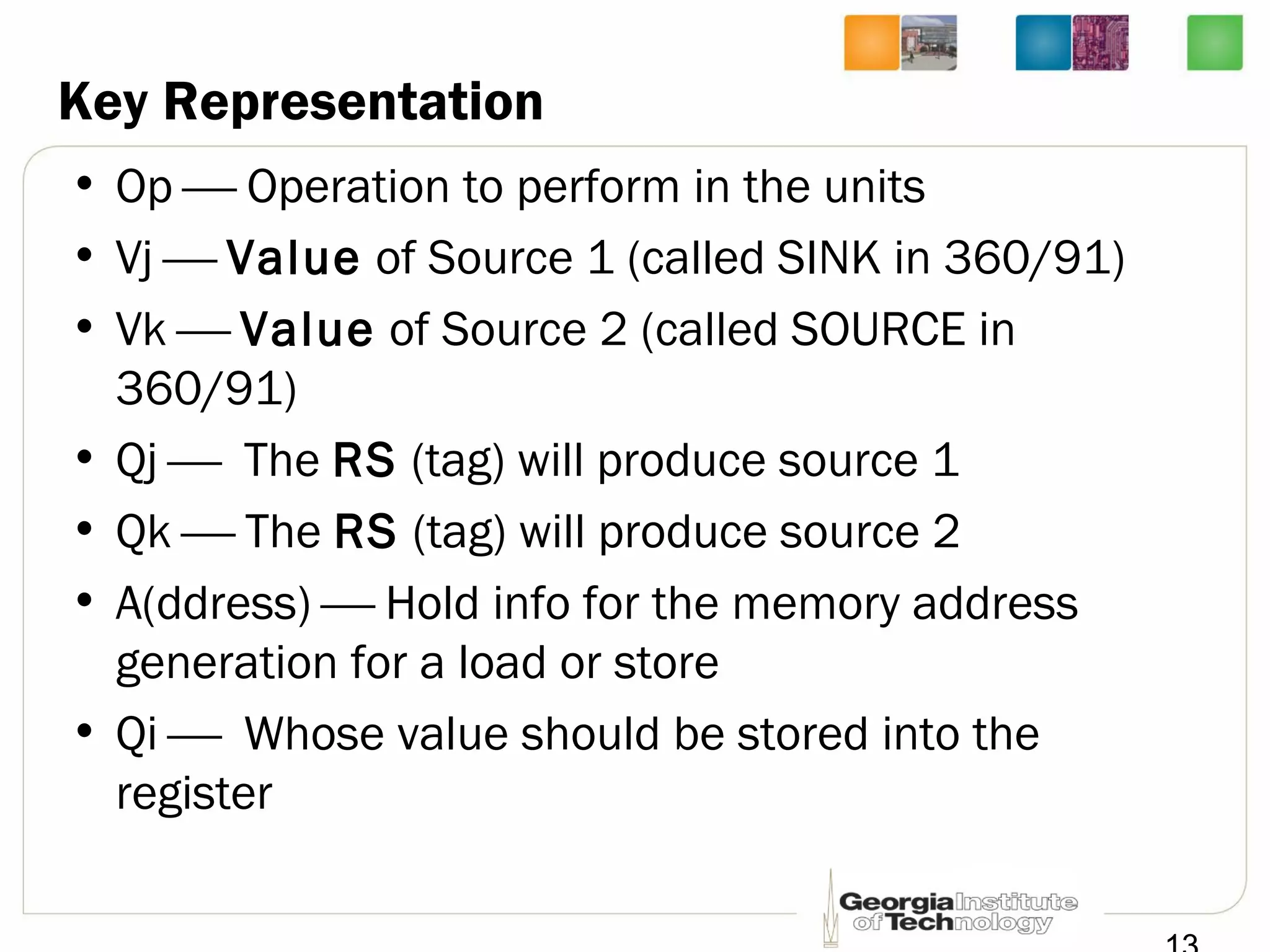
Key Representation
• Op  Operation to perform in the units
• Vj  Value of Source 1 (called SINK in 360/91)
• Vk  Value of Source 2 (called SOURCE in
360/91)
• Qj  The RS (tag) will produce source 1
• Qk  The RS (tag) will produce source 2
• A(ddress)  Hold info for the memory address
generation for a load or store
• Qi  Whose value should be stored into the
register
IBM 360/91 FPU w/ Tomasulo Algorithm
From Mem FP Registers (FLR)
ReservationReservation
StationsStations
Common Data Bus (CDB)Common Data Bus (CDB)
To Mem
FP operation stack (FLOS)
FP Load Buffers
(FLB)
Store Data
Buffers
(SDB)
6
5
4
3
2
1
FP AdderFP Adder FP Mult/DivFP Mult/Div
3
2
1
2
1
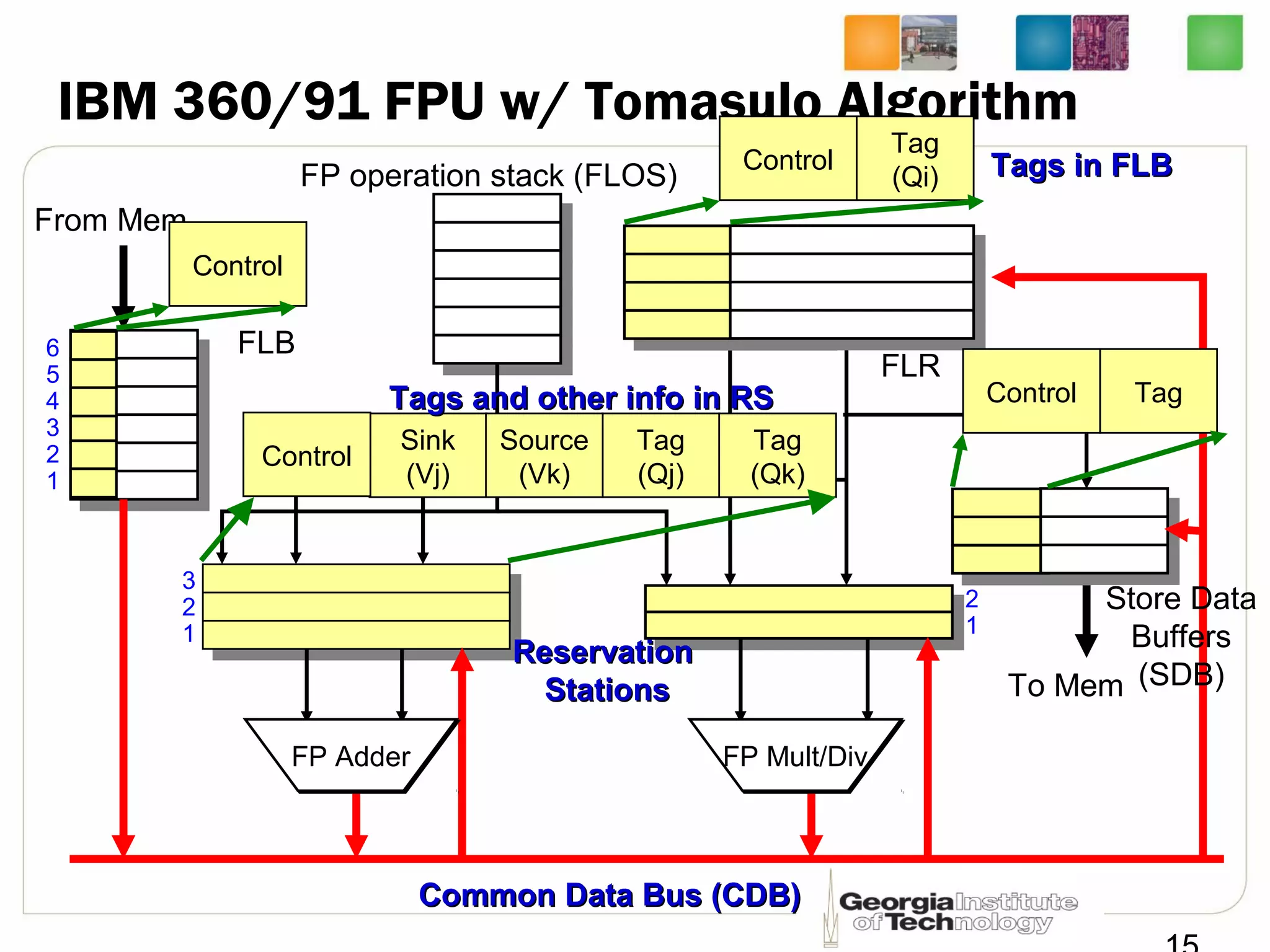
IBM 360/91 FPU w/ Tomasulo Algorithm
From Mem
FLR
ReservationReservation
StationsStations
Common Data Bus (CDB)Common Data Bus (CDB)
To Mem
FP operation stack (FLOS)
FLB
Store Data
Buffers
(SDB)
6
5
4
3
2
1
FP AdderFP Adder FP Mult/DivFP Mult/Div
3
2
1
2
1
Tag
(Qj)
Tag
(Qk)
Sink
(Vj)
Source
(Vk)
Control
Tags and other info in RSTags and other info in RS
Control
Tag
(Qi) Tags in FLBTags in FLB
Control Tag
Control
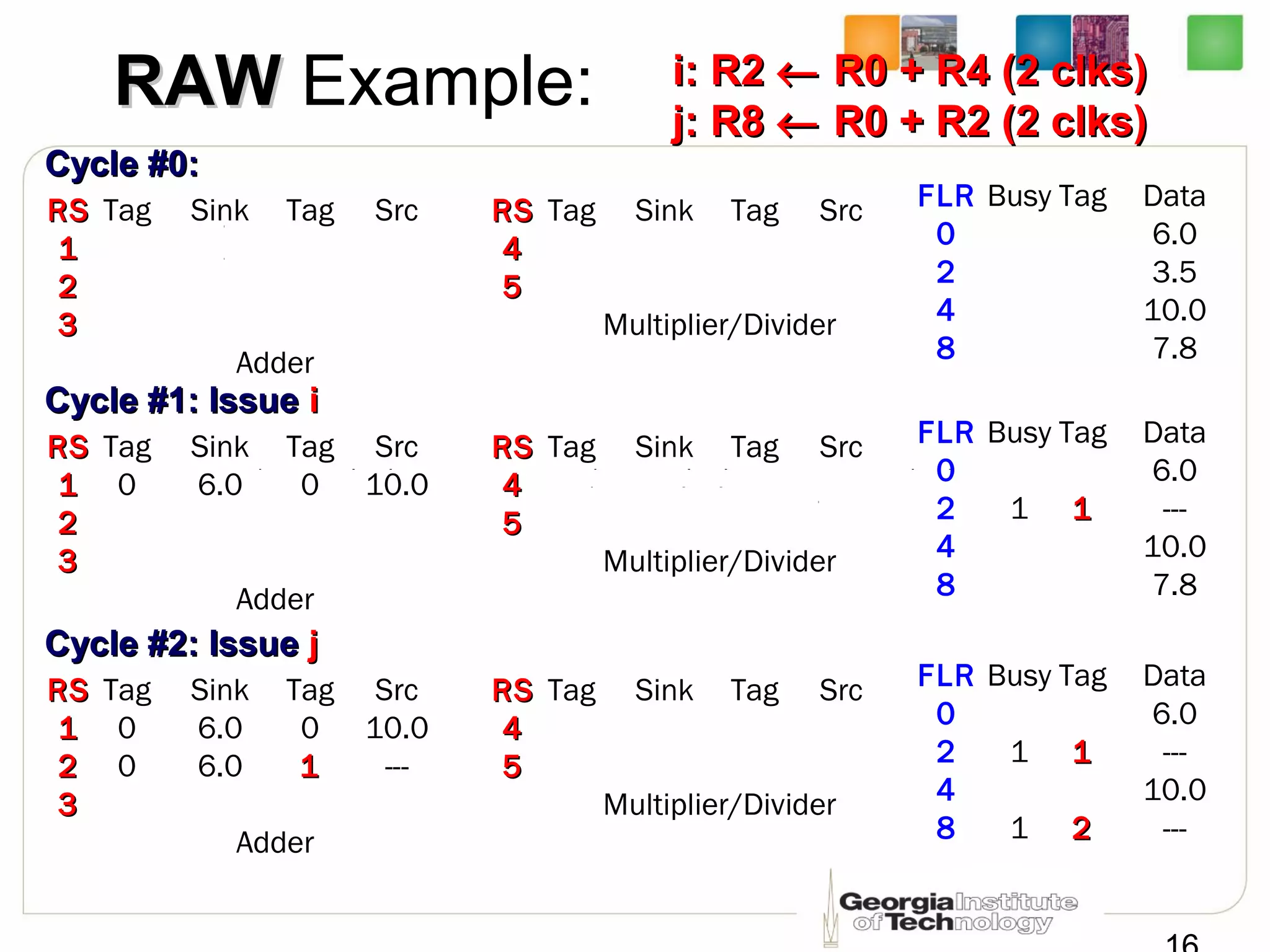
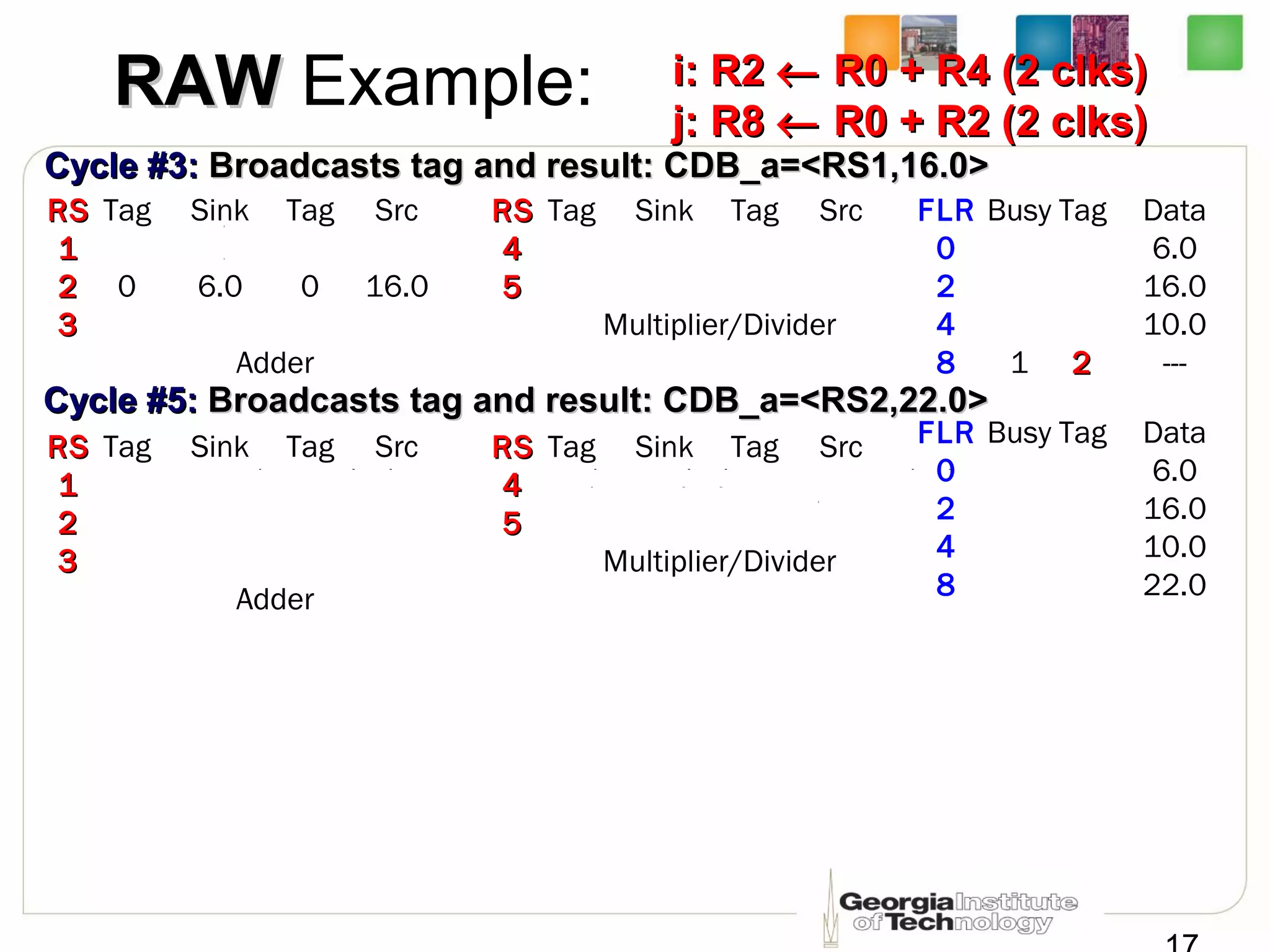
RAWRAW Example: i: R2i: R2 ←← R0 + R4 (2 clks)R0 + R4 (2 clks)
j: R8j: R8 ←← R0 + R2 (2 clks)R0 + R2 (2 clks)
RSRS Tag Sink Tag Src
11
22
33
Adder
FLR Busy Tag Data
0 6.0
2 3.5
4 10.0
8 7.8
Cycle #0:Cycle #0:
RSRS Tag Sink Tag Src
44
55
Multiplier/Divider
RSRS Tag Sink Tag Src
11 0 6.0 0 10.0
22
33
Adder
FLR Busy Tag Data
0 6.0
2 1 11 ---
4 10.0
8 7.8
Cycle #1: IssueCycle #1: Issue ii
RSRS Tag Sink Tag Src
44
55
Multiplier/Divider
RSRS Tag Sink Tag Src
11 0 6.0 0 10.0
22 0 6.0 11 ---
33
Adder
FLR Busy Tag Data
0 6.0
2 1 11 ---
4 10.0
8 1 22 ---
Cycle #2: IssueCycle #2: Issue jj
RSRS Tag Sink Tag Src
44
55
Multiplier/Divider
RAWRAW Example: i: R2i: R2 ←← R0 + R4 (2 clks)R0 + R4 (2 clks)
j: R8j: R8 ←← R0 + R2 (2 clks)R0 + R2 (2 clks)
RSRS Tag Sink Tag Src
11
22 0 6.0 0 16.0
33
Adder
FLR Busy Tag Data
0 6.0
2 16.0
4 10.0
8 1 22 ---
Cycle #3:Cycle #3: Broadcasts tag and result: CDB_a=<RS1,16.0>Broadcasts tag and result: CDB_a=<RS1,16.0>
RSRS Tag Sink Tag Src
44
55
Multiplier/Divider
RSRS Tag Sink Tag Src
11
22
33
Adder
FLR Busy Tag Data
0 6.0
2 16.0
4 10.0
8 22.0
Cycle #5:Cycle #5: Broadcasts tag and result: CDB_a=<RS2,22.0>Broadcasts tag and result: CDB_a=<RS2,22.0>
RSRS Tag Sink Tag Src
44
55
Multiplier/Divider
RSRS Tag Sink Tag Src
11
22
33
Adder
FLR Busy Tag Data
0 6.0
2 3.5
4 10.0
8 7.8
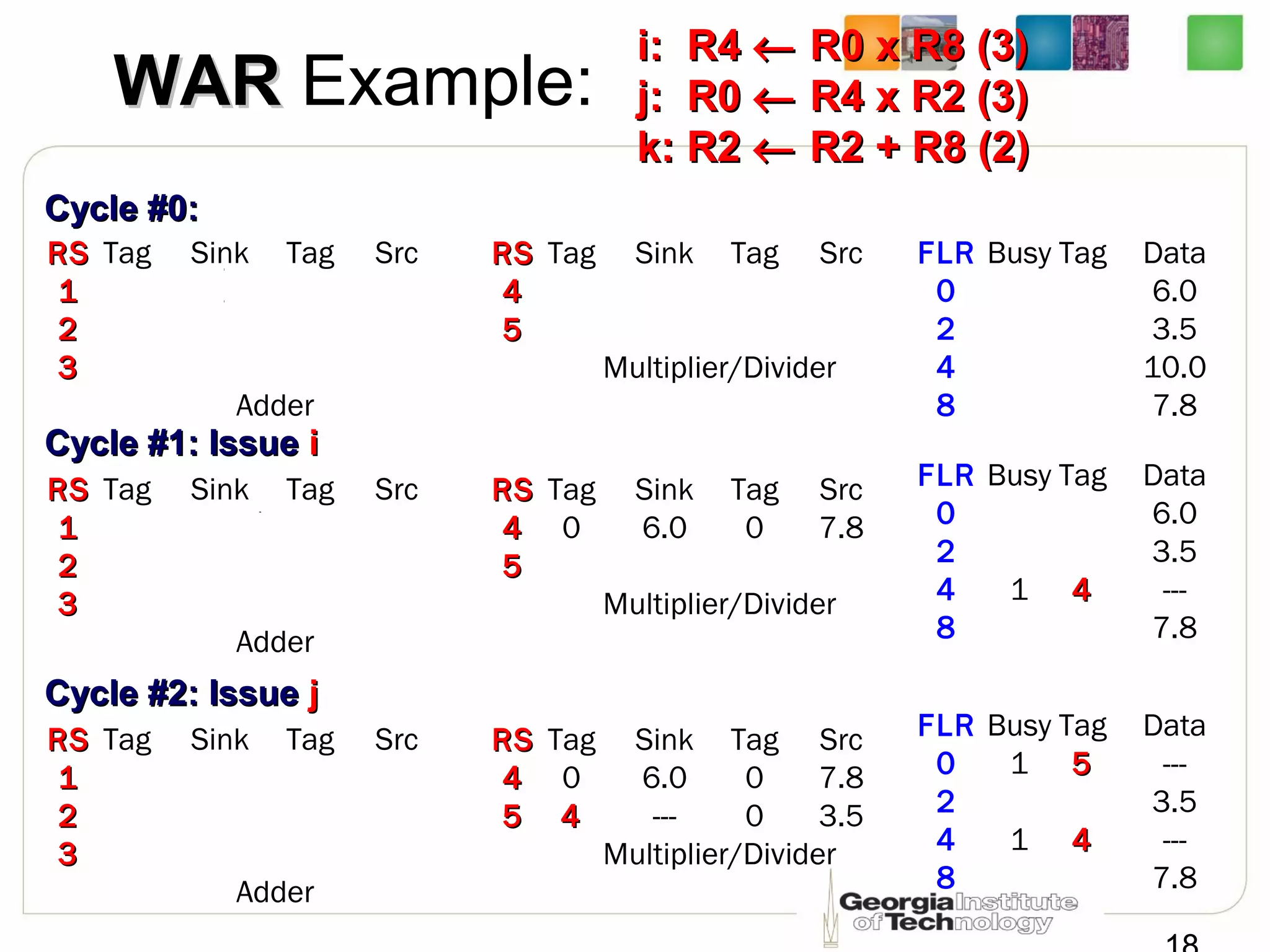
Cycle #0:Cycle #0:
RSRS Tag Sink Tag Src
44
55
Multiplier/Divider
RSRS Tag Sink Tag Src
11
22
33
Adder
FLR Busy Tag Data
0 6.0
2 3.5
4 1 44 ---
8 7.8
Cycle #1: IssueCycle #1: Issue ii
RSRS Tag Sink Tag Src
44 0 6.0 0 7.8
55
Multiplier/Divider
RSRS Tag Sink Tag Src
11
22
33
Adder
FLR Busy Tag Data
0 1 55 ---
2 3.5
4 1 44 ---
8 7.8
Cycle #2: IssueCycle #2: Issue jj
RSRS Tag Sink Tag Src
44 0 6.0 0 7.8
55 44 --- 0 3.5
Multiplier/Divider
WARWAR Example:
i: R4i: R4 ←← R0 x R8 (3)R0 x R8 (3)
j: R0j: R0 ←← R4 x R2 (3)R4 x R2 (3)
k: R2k: R2 ←← R2 + R8 (2)R2 + R8 (2)
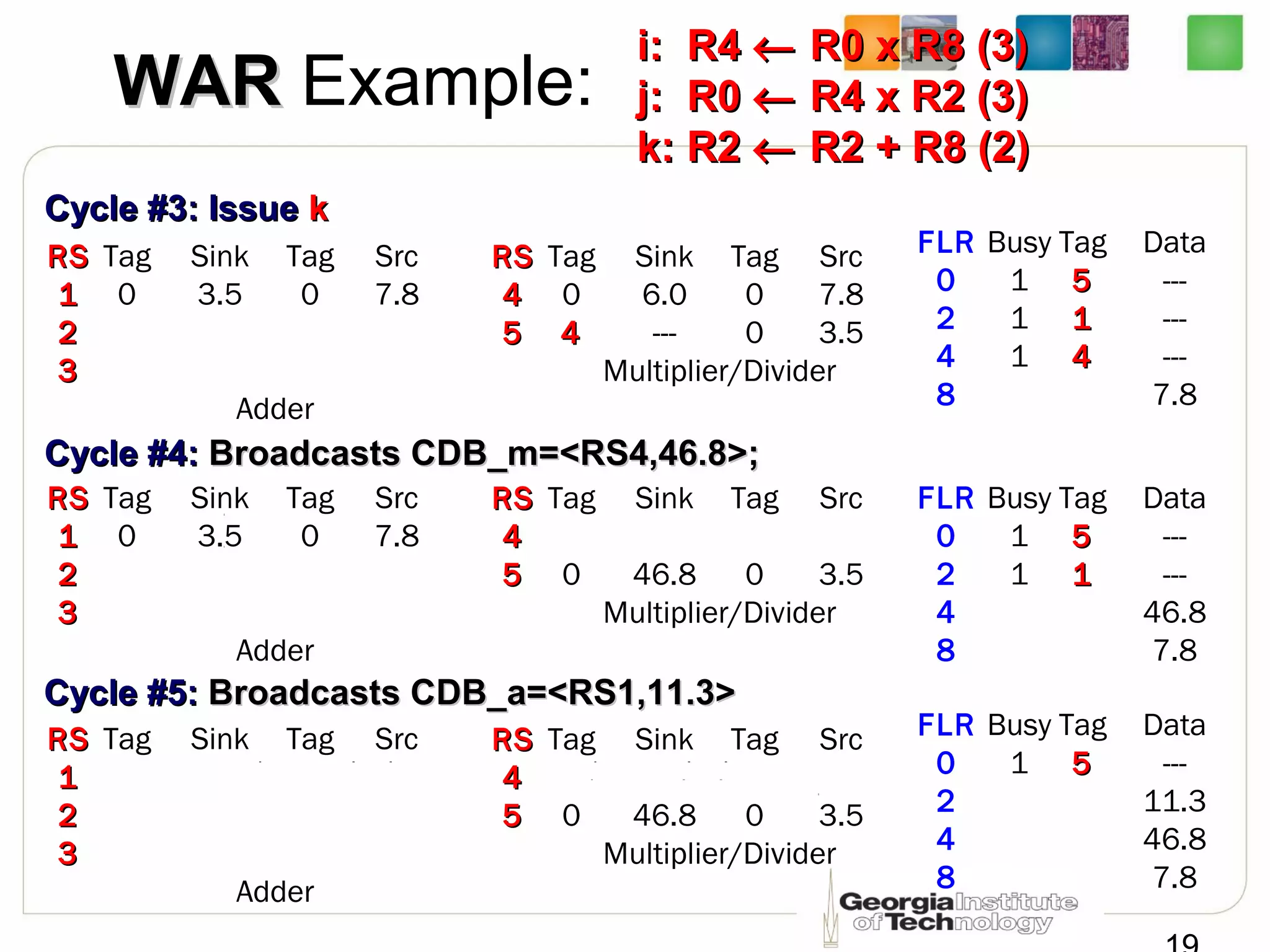
Cycle #3: IssueCycle #3: Issue kk
WARWAR Example:
i: R4i: R4 ←← R0 x R8 (3)R0 x R8 (3)
j: R0j: R0 ←← R4 x R2 (3)R4 x R2 (3)
k: R2k: R2 ←← R2 + R8 (2)R2 + R8 (2)
RSRS Tag Sink Tag Src
11 0 3.5 0 7.8
22
33
Adder
FLR Busy Tag Data
0 1 55 ---
2 1 11 ---
4 1 44 ---
8 7.8
RSRS Tag Sink Tag Src
44 0 6.0 0 7.8
55 44 --- 0 3.5
Multiplier/Divider
RSRS Tag Sink Tag Src
11 0 3.5 0 7.8
22
33
Adder
FLR Busy Tag Data
0 1 55 ---
2 1 11 ---
4 46.8
8 7.8
Cycle #4:Cycle #4: Broadcasts CDB_m=<RS4,46.8>;Broadcasts CDB_m=<RS4,46.8>;
RSRS Tag Sink Tag Src
44
55 0 46.8 0 3.5
Multiplier/Divider
RSRS Tag Sink Tag Src
11
22
33
Adder
FLR Busy Tag Data
0 1 55 ---
2 11.3
4 46.8
8 7.8
Cycle #5:Cycle #5: Broadcasts CDB_a=<RS1,11.3>Broadcasts CDB_a=<RS1,11.3>
RSRS Tag Sink Tag Src
44
55 0 46.8 0 3.5
Multiplier/Divider
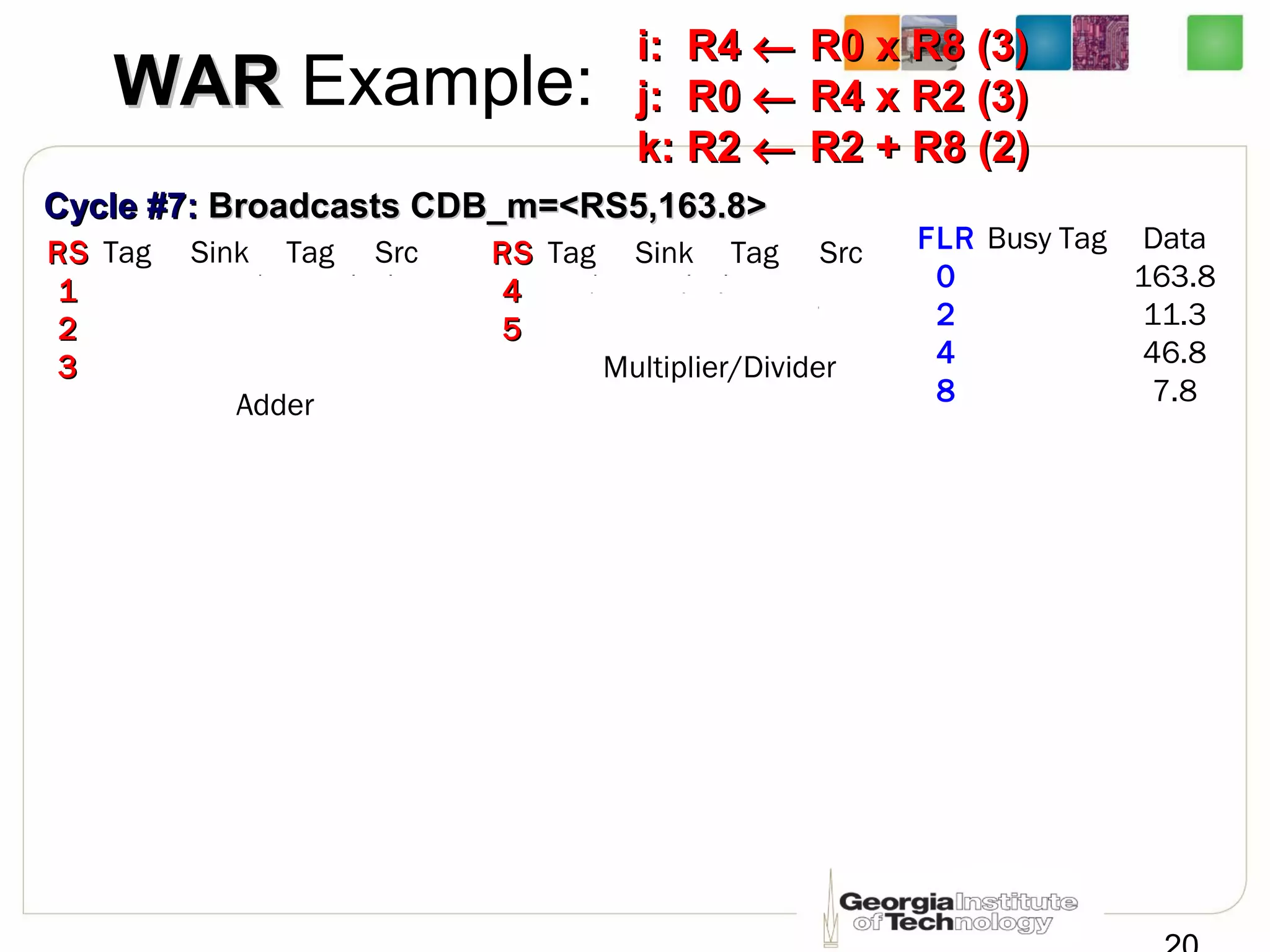
WARWAR Example:
i: R4i: R4 ←← R0 x R8 (3)R0 x R8 (3)
j: R0j: R0 ←← R4 x R2 (3)R4 x R2 (3)
k: R2k: R2 ←← R2 + R8 (2)R2 + R8 (2)
RSRS Tag Sink Tag Src
11
22
33
Adder
FLR Busy Tag Data
0 163.8
2 11.3
4 46.8
8 7.8
Cycle #7:Cycle #7: Broadcasts CDB_m=<RS5,163.8>Broadcasts CDB_m=<RS5,163.8>
RSRS Tag Sink Tag Src
44
55
Multiplier/Divider
RSRS Tag Sink Tag Src
11 0 6.0 44 ---
22
33
Adder
FLR Busy Tag Data
0 6.0
2 1 11 ---
4 1 44 ---
8 7.8
Cycle #2: IssueCycle #2: Issue jj
RSRS Tag Sink Tag Src
44 0 6.0 0 7.8
55
Multiplier/Divider
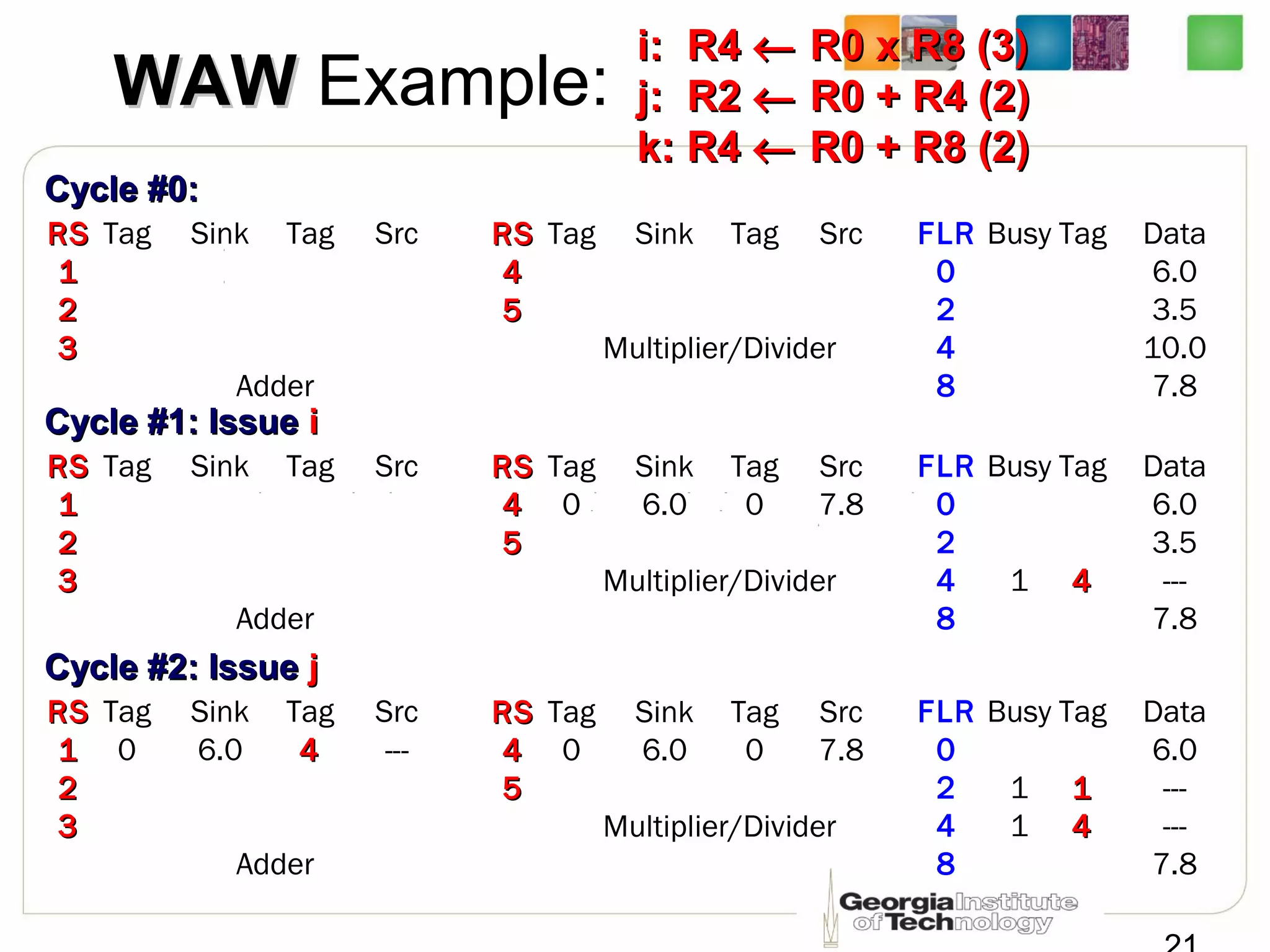
WAWWAW Example:
RSRS Tag Sink Tag Src
11
22
33
Adder
FLR Busy Tag Data
0 6.0
2 3.5
4 10.0
8 7.8
Cycle #0:Cycle #0:
RSRS Tag Sink Tag Src
44
55
Multiplier/Divider
RSRS Tag Sink Tag Src
11
22
33
Adder
FLR Busy Tag Data
0 6.0
2 3.5
4 1 44 ---
8 7.8
Cycle #1: IssueCycle #1: Issue ii
RSRS Tag Sink Tag Src
44 0 6.0 0 7.8
55
Multiplier/Divider
i: R4i: R4 ←← R0 x R8 (3)R0 x R8 (3)
j: R2j: R2 ←← R0 + R4 (2)R0 + R4 (2)
k: R4k: R4 ←← R0 + R8 (2)R0 + R8 (2)
RSRS Tag Sink Tag Src
11 0 6.0 44 ---
22 0 6.0 0 7.8
33
Adder
FLR Busy Tag Data
0 6.0
2 1 11 ---
4 1 22 ---
8 7.8
Cycle #3: IssueCycle #3: Issue kk
RSRS Tag Sink Tag Src
44 0 6.0 0 7.8
55
Multiplier/Divider
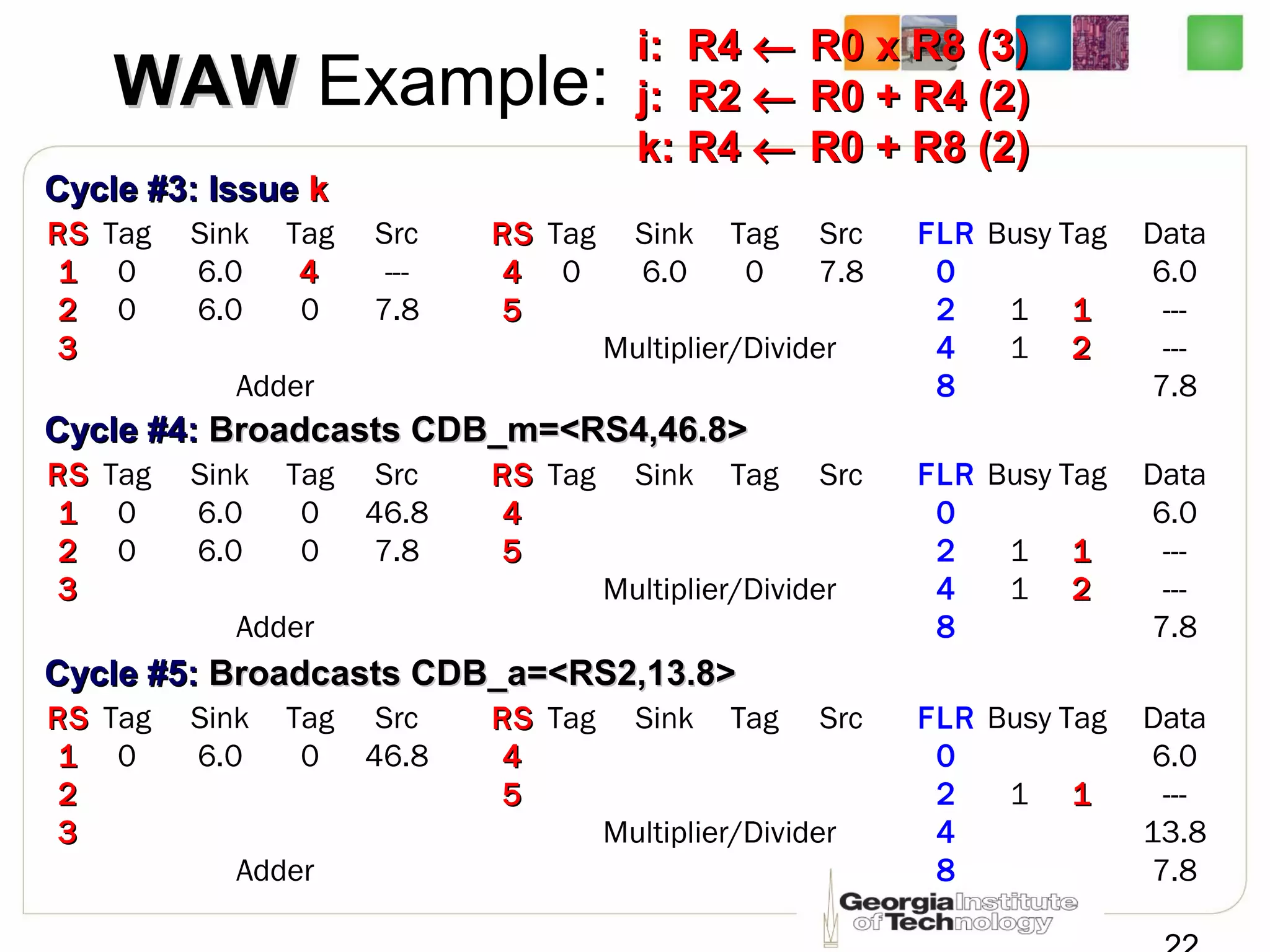
WAWWAW Example:
i: R4i: R4 ←← R0 x R8 (3)R0 x R8 (3)
j: R2j: R2 ←← R0 + R4 (2)R0 + R4 (2)
k: R4k: R4 ←← R0 + R8 (2)R0 + R8 (2)
RSRS Tag Sink Tag Src
11 0 6.0 0 46.8
22 0 6.0 0 7.8
33
Adder
FLR Busy Tag Data
0 6.0
2 1 11 ---
4 1 22 ---
8 7.8
Cycle #4:Cycle #4: Broadcasts CDB_m=<RS4,46.8>Broadcasts CDB_m=<RS4,46.8>
RSRS Tag Sink Tag Src
44
55
Multiplier/Divider
RSRS Tag Sink Tag Src
11 0 6.0 0 46.8
22
33
Adder
FLR Busy Tag Data
0 6.0
2 1 11 ---
4 13.8
8 7.8
Cycle #5:Cycle #5: Broadcasts CDB_a=<RS2,13.8>Broadcasts CDB_a=<RS2,13.8>
RSRS Tag Sink Tag Src
44
55
Multiplier/Divider
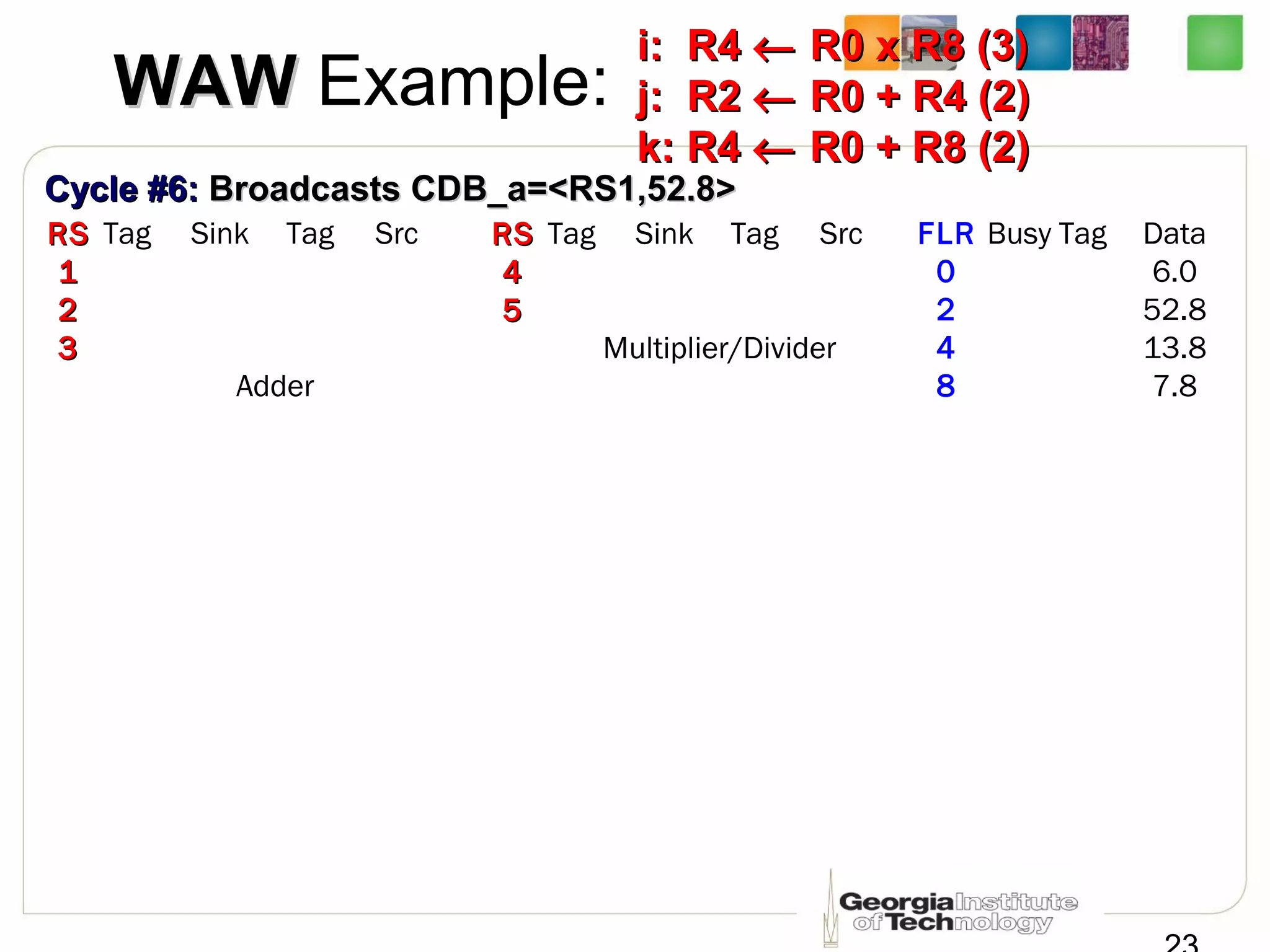
WAWWAW Example:
RSRS Tag Sink Tag Src
11
22
33
Adder
FLR Busy Tag Data
0 6.0
2 52.8
4 13.8
8 7.8
Cycle #6:Cycle #6: Broadcasts CDB_a=<RS1,52.8>Broadcasts CDB_a=<RS1,52.8>
RSRS Tag Sink Tag Src
44
55
Multiplier/Divider
i: R4i: R4 ←← R0 x R8 (3)R0 x R8 (3)
j: R2j: R2 ←← R0 + R4 (2)R0 + R4 (2)
k: R4k: R4 ←← R0 + R8 (2)R0 + R8 (2)
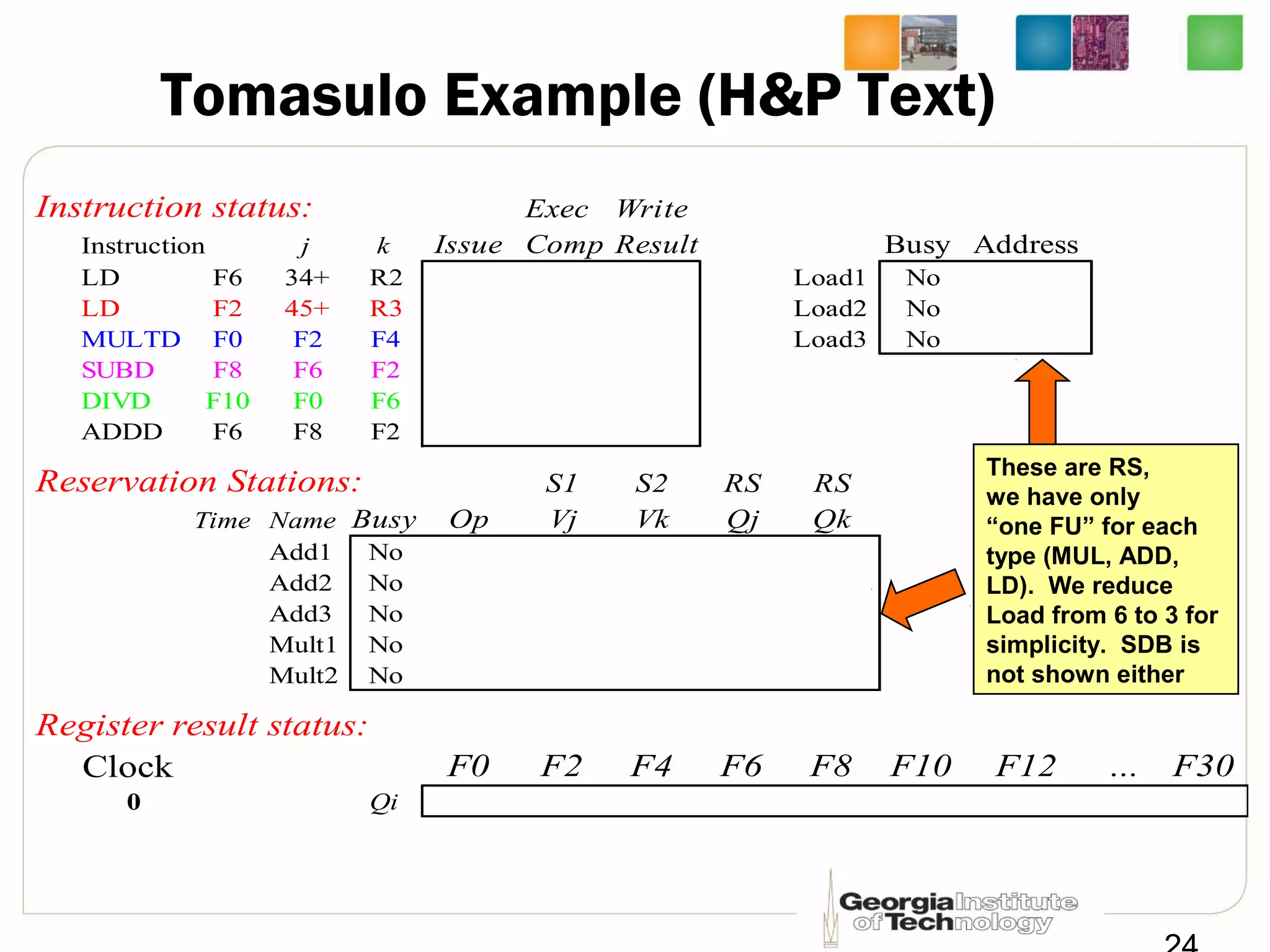
Tomasulo Example (H&P Text)
Instruction status: Exec Write
Instruction j k Issue Comp Result Busy Address
LD F6 34+ R2 Load1 No
LD F2 45+ R3 Load2 No
MULTD F0 F2 F4 Load3 No
SUBD F8 F6 F2
DIVD F10 F0 F6
ADDD F6 F8 F2
Reservation Stations: S1 S2 RS RS
Time Name Busy Op Vj Vk Qj Qk
Add1 No
Add2 No
Add3 No
Mult1 No
Mult2 No
Register result status:
Clock F0 F2 F4 F6 F8 F10 F12 ... F30
0 Qi
These are RS,
we have only
“one FU” for each
type (MUL, ADD,
LD). We reduce
Load from 6 to 3 for
simplicity. SDB is
not shown either
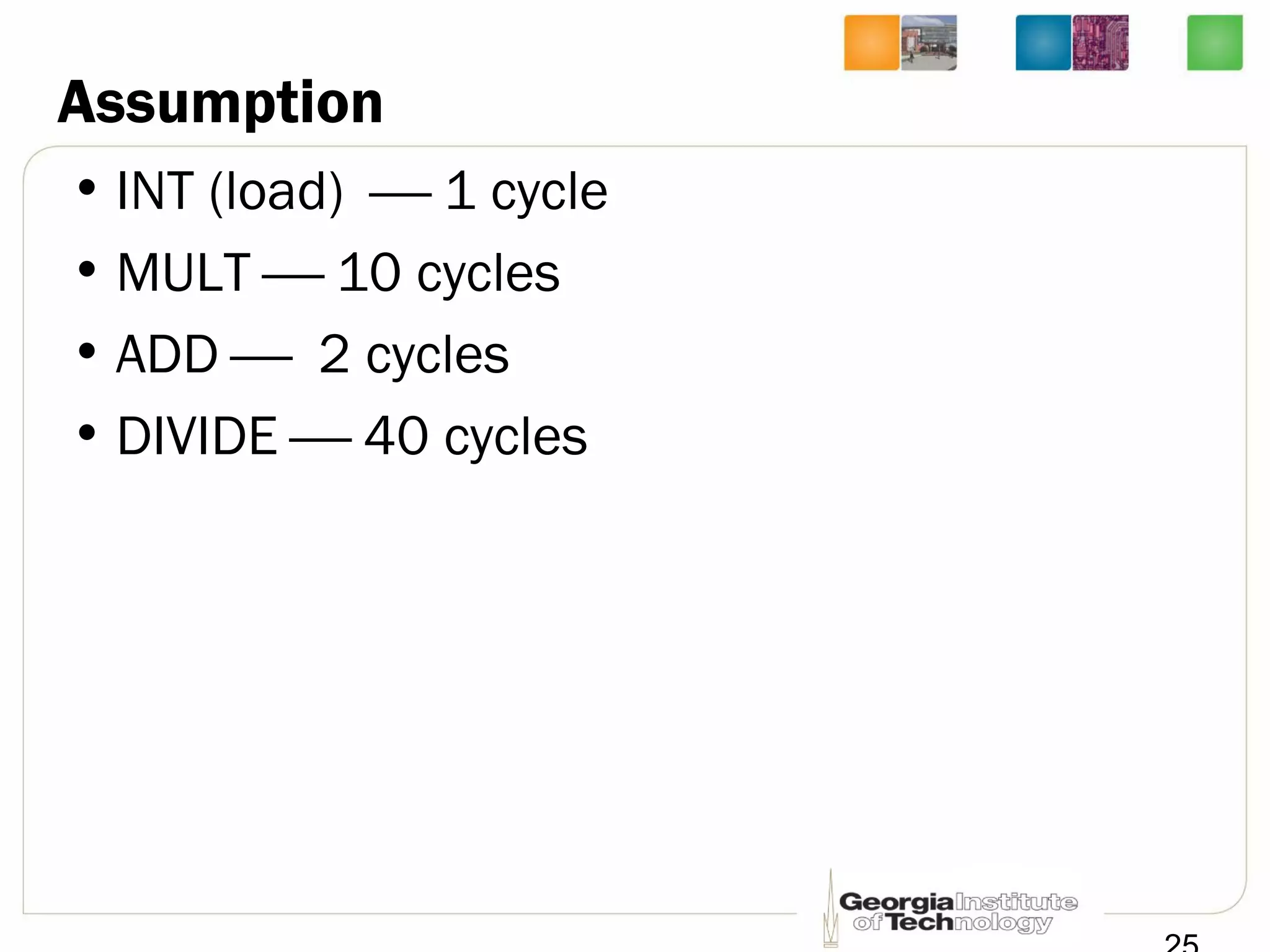
Assumption
• INT (load)  1 cycle
• MULT  10 cycles
• ADD  2 cycles
• DIVIDE  40 cycles
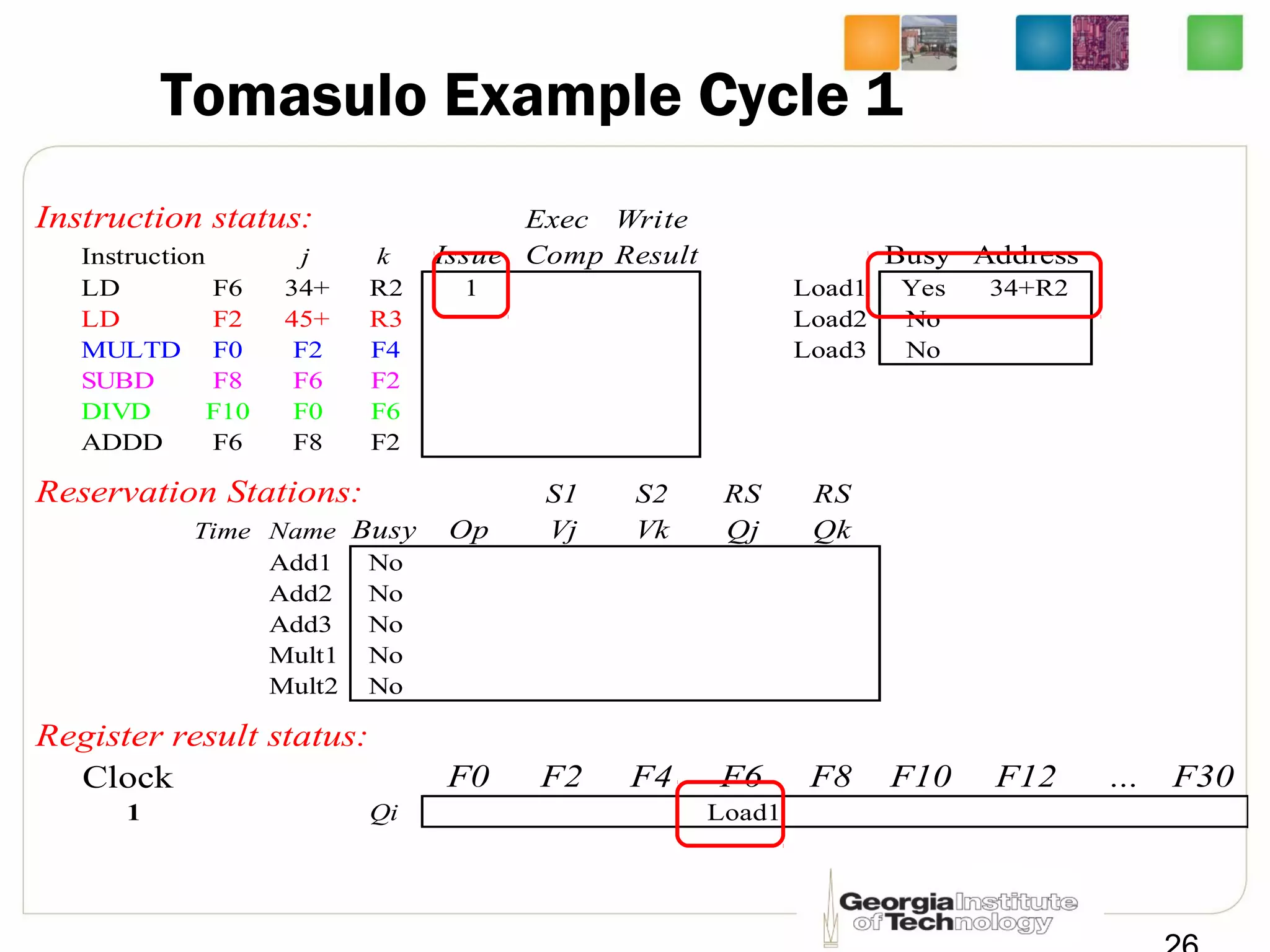
Tomasulo Example Cycle 1
Instruction status: Exec Write
Instruction j k Issue Comp Result Busy Address
LD F6 34+ R2 1 Load1 Yes 34+R2
LD F2 45+ R3 Load2 No
MULTD F0 F2 F4 Load3 No
SUBD F8 F6 F2
DIVD F10 F0 F6
ADDD F6 F8 F2
Reservation Stations: S1 S2 RS RS
Time Name Busy Op Vj Vk Qj Qk
Add1 No
Add2 No
Add3 No
Mult1 No
Mult2 No
Register result status:
Clock F0 F2 F4 F6 F8 F10 F12 ... F30
1 Qi Load1
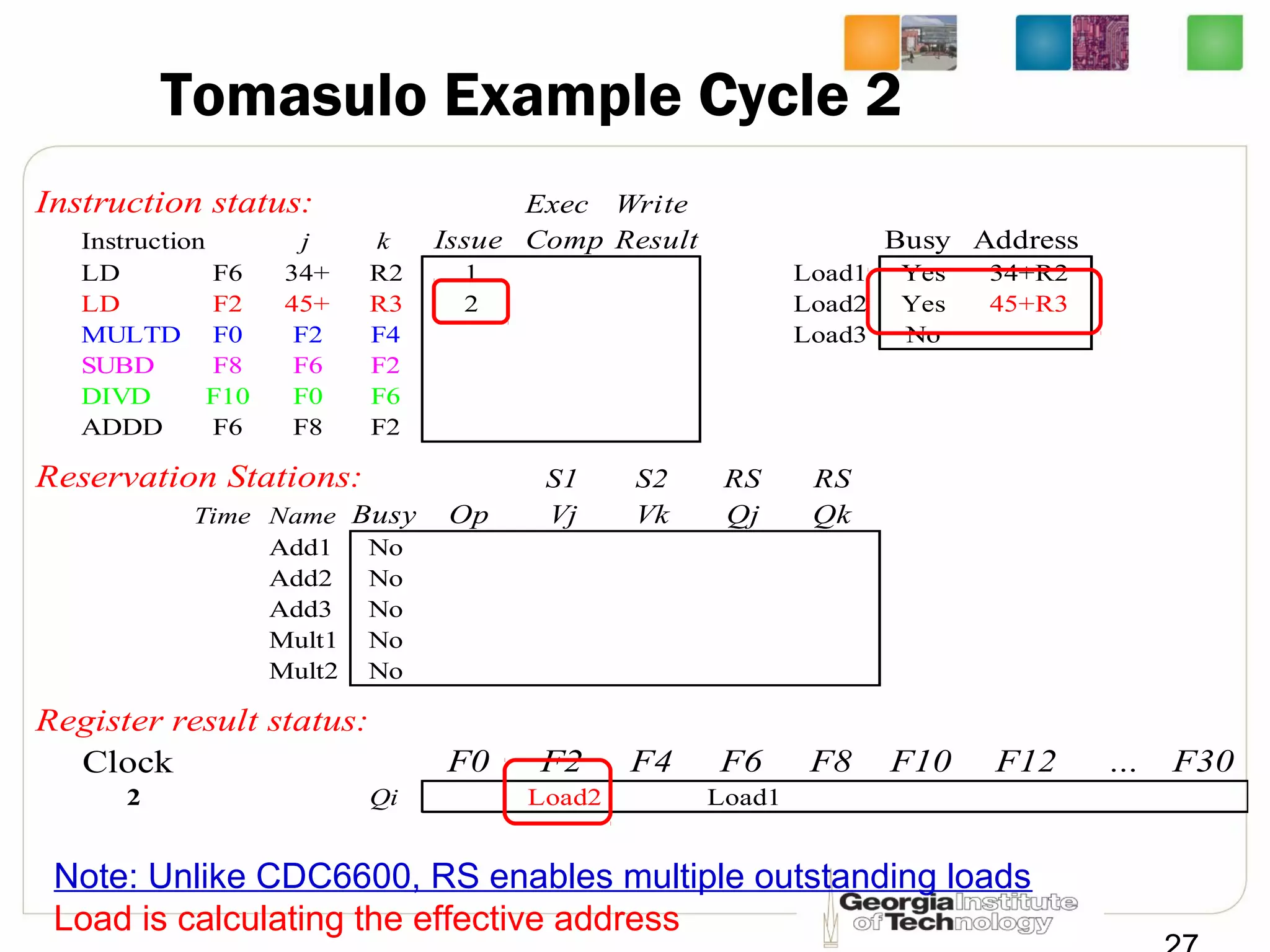
Tomasulo Example Cycle 2
Instruction status: Exec Write
Instruction j k Issue Comp Result Busy Address
LD F6 34+ R2 1 Load1 Yes 34+R2
LD F2 45+ R3 2 Load2 Yes 45+R3
MULTD F0 F2 F4 Load3 No
SUBD F8 F6 F2
DIVD F10 F0 F6
ADDD F6 F8 F2
Reservation Stations: S1 S2 RS RS
Time Name Busy Op Vj Vk Qj Qk
Add1 No
Add2 No
Add3 No
Mult1 No
Mult2 No
Register result status:
Clock F0 F2 F4 F6 F8 F10 F12 ... F30
2 Qi Load2 Load1
Note: Unlike CDC6600, RS enables multiple outstanding loads
Load is calculating the effective address
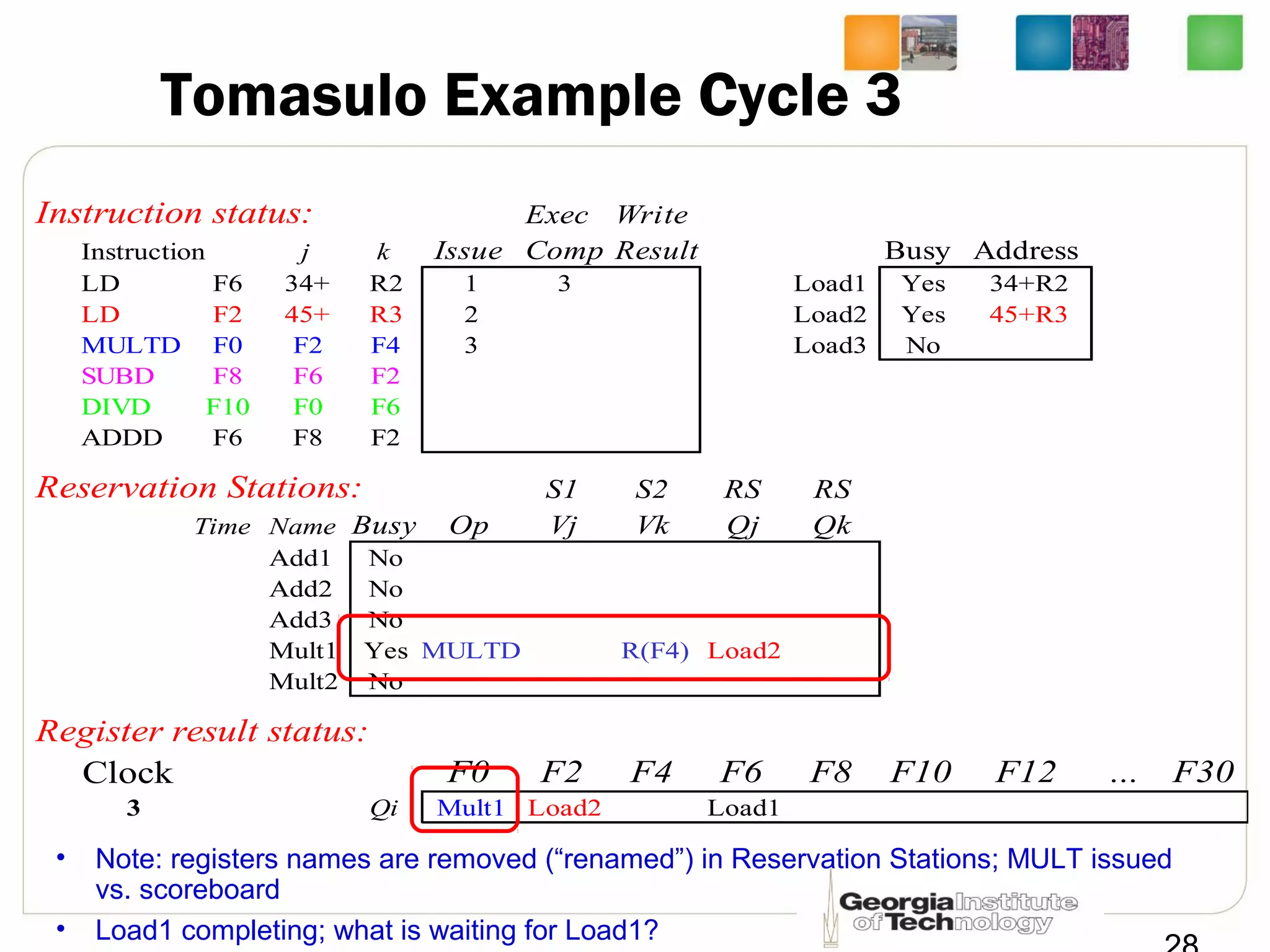
Tomasulo Example Cycle 3
Instruction status: Exec Write
Instruction j k Issue Comp Result Busy Address
LD F6 34+ R2 1 3 Load1 Yes 34+R2
LD F2 45+ R3 2 Load2 Yes 45+R3
MULTD F0 F2 F4 3 Load3 No
SUBD F8 F6 F2
DIVD F10 F0 F6
ADDD F6 F8 F2
Reservation Stations: S1 S2 RS RS
Time Name Busy Op Vj Vk Qj Qk
Add1 No
Add2 No
Add3 No
Mult1 Yes MULTD R(F4) Load2
Mult2 No
Register result status:
Clock F0 F2 F4 F6 F8 F10 F12 ... F30
3 Qi Mult1 Load2 Load1
• Note: registers names are removed (“renamed”) in Reservation Stations; MULT issued
vs. scoreboard
• Load1 completing; what is waiting for Load1?
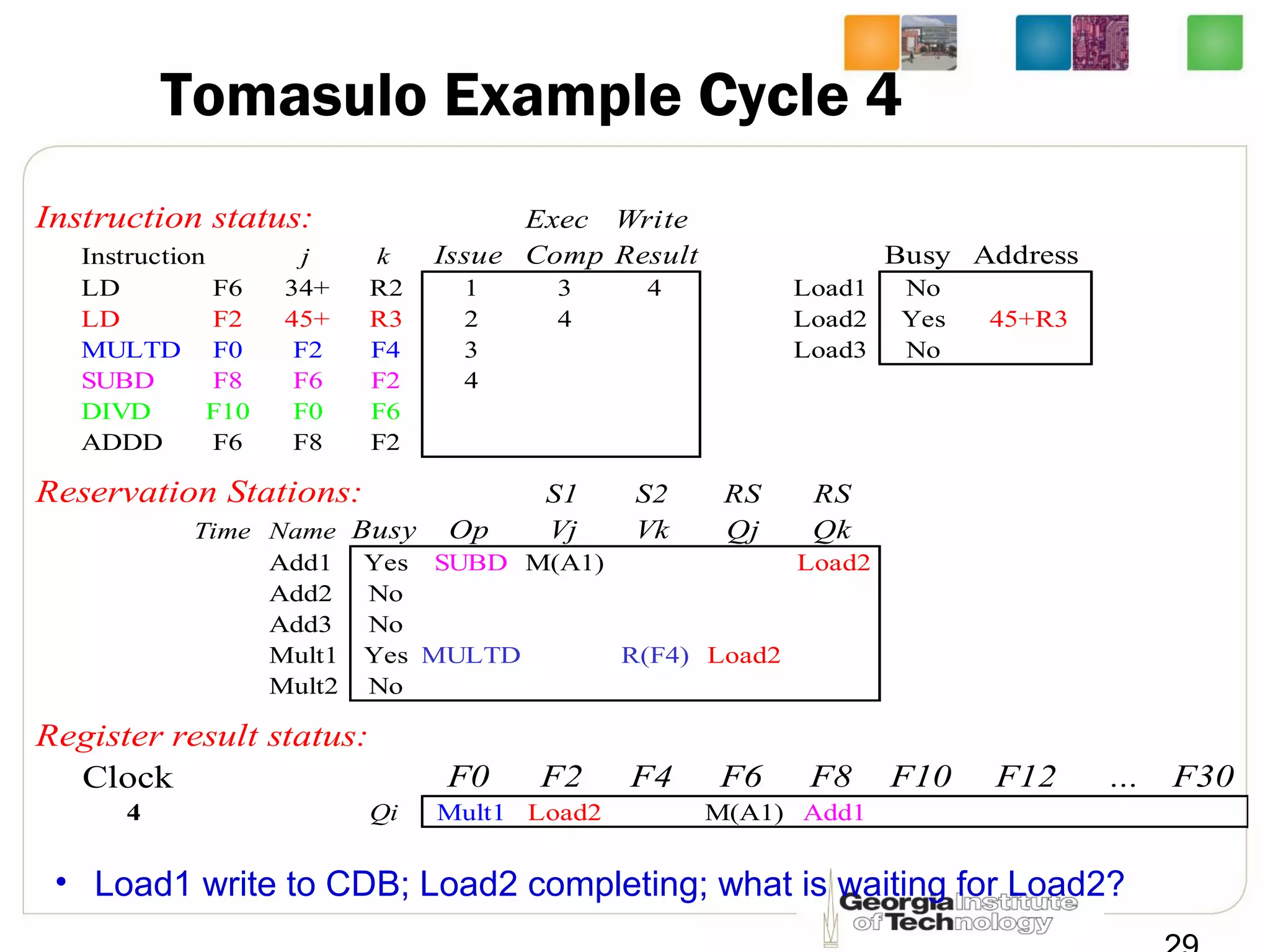
Tomasulo Example Cycle 4
Instruction status: Exec Write
Instruction j k Issue Comp Result Busy Address
LD F6 34+ R2 1 3 4 Load1 No
LD F2 45+ R3 2 4 Load2 Yes 45+R3
MULTD F0 F2 F4 3 Load3 No
SUBD F8 F6 F2 4
DIVD F10 F0 F6
ADDD F6 F8 F2
Reservation Stations: S1 S2 RS RS
Time Name Busy Op Vj Vk Qj Qk
Add1 Yes SUBD M(A1) Load2
Add2 No
Add3 No
Mult1 Yes MULTD R(F4) Load2
Mult2 No
Register result status:
Clock F0 F2 F4 F6 F8 F10 F12 ... F30
4 Qi Mult1 Load2 M(A1) Add1
• Load1 write to CDB; Load2 completing; what is waiting for Load2?
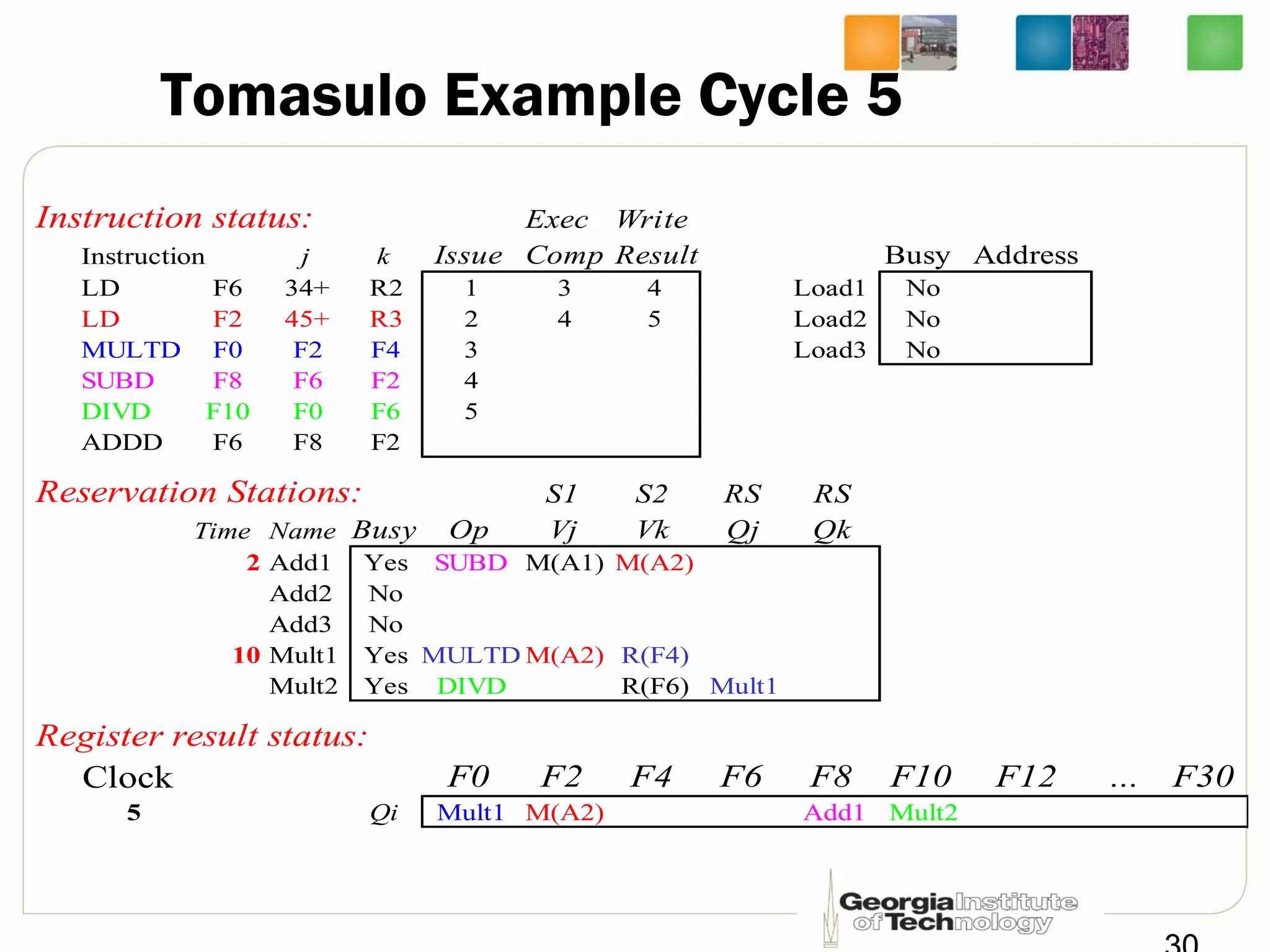
Tomasulo Example Cycle 5
Instruction status: Exec Write
Instruction j k Issue Comp Result Busy Address
LD F6 34+ R2 1 3 4 Load1 No
LD F2 45+ R3 2 4 5 Load2 No
MULTD F0 F2 F4 3 Load3 No
SUBD F8 F6 F2 4
DIVD F10 F0 F6 5
ADDD F6 F8 F2
Reservation Stations: S1 S2 RS RS
Time Name Busy Op Vj Vk Qj Qk
2 Add1 Yes SUBD M(A1) M(A2)
Add2 No
Add3 No
10 Mult1 Yes MULTD M(A2) R(F4)
Mult2 Yes DIVD R(F6) Mult1
Register result status:
Clock F0 F2 F4 F6 F8 F10 F12 ... F30
5 Qi Mult1 M(A2) Add1 Mult2
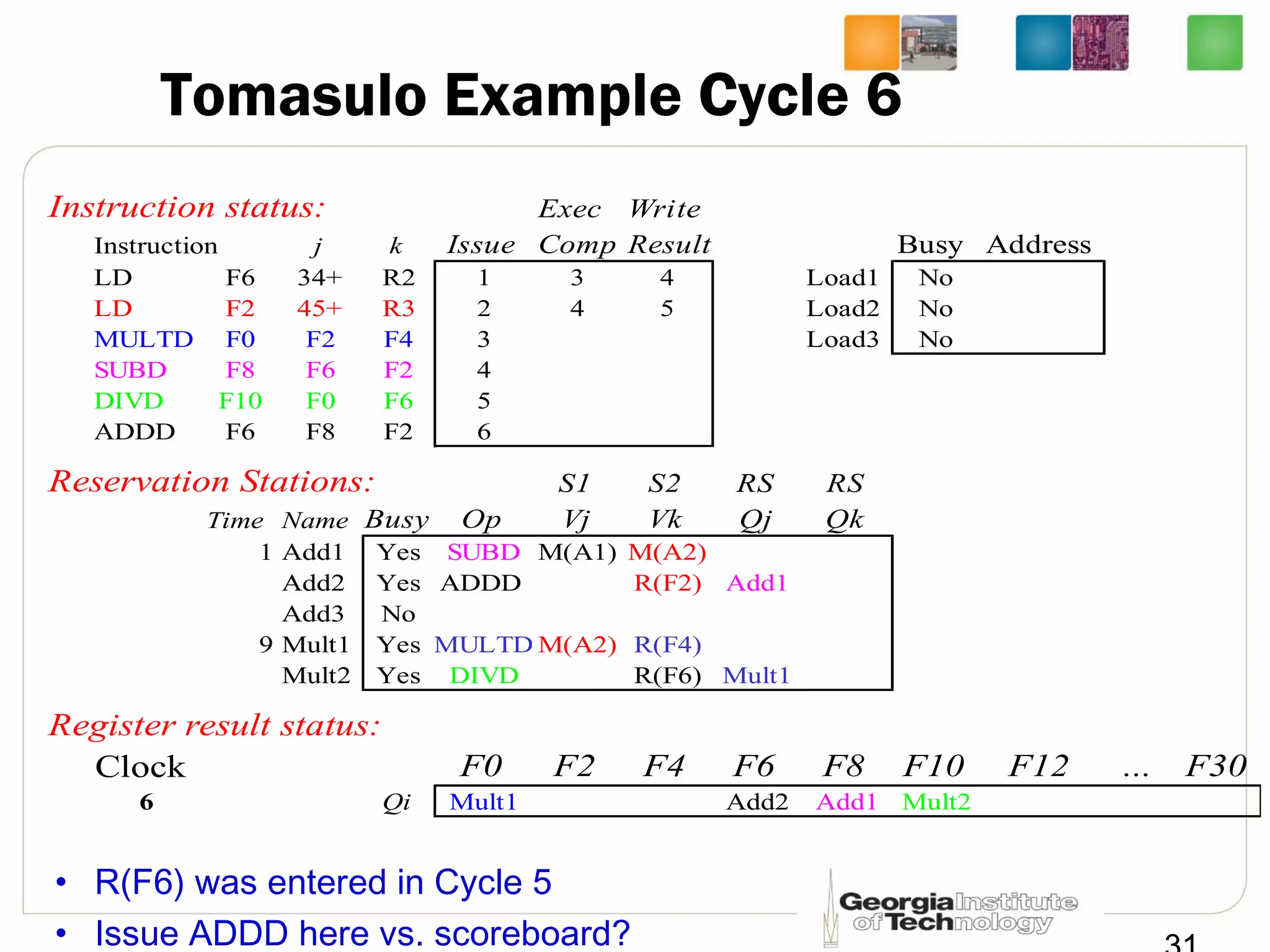
Tomasulo Example Cycle 6
Instruction status: Exec Write
Instruction j k Issue Comp Result Busy Address
LD F6 34+ R2 1 3 4 Load1 No
LD F2 45+ R3 2 4 5 Load2 No
MULTD F0 F2 F4 3 Load3 No
SUBD F8 F6 F2 4
DIVD F10 F0 F6 5
ADDD F6 F8 F2 6
Reservation Stations: S1 S2 RS RS
Time Name Busy Op Vj Vk Qj Qk
1 Add1 Yes SUBD M(A1) M(A2)
Add2 Yes ADDD R(F2) Add1
Add3 No
9 Mult1 Yes MULTD M(A2) R(F4)
Mult2 Yes DIVD R(F6) Mult1
Register result status:
Clock F0 F2 F4 F6 F8 F10 F12 ... F30
6 Qi Mult1 Add2 Add1 Mult2
• R(F6) was entered in Cycle 5
• Issue ADDD here vs. scoreboard?
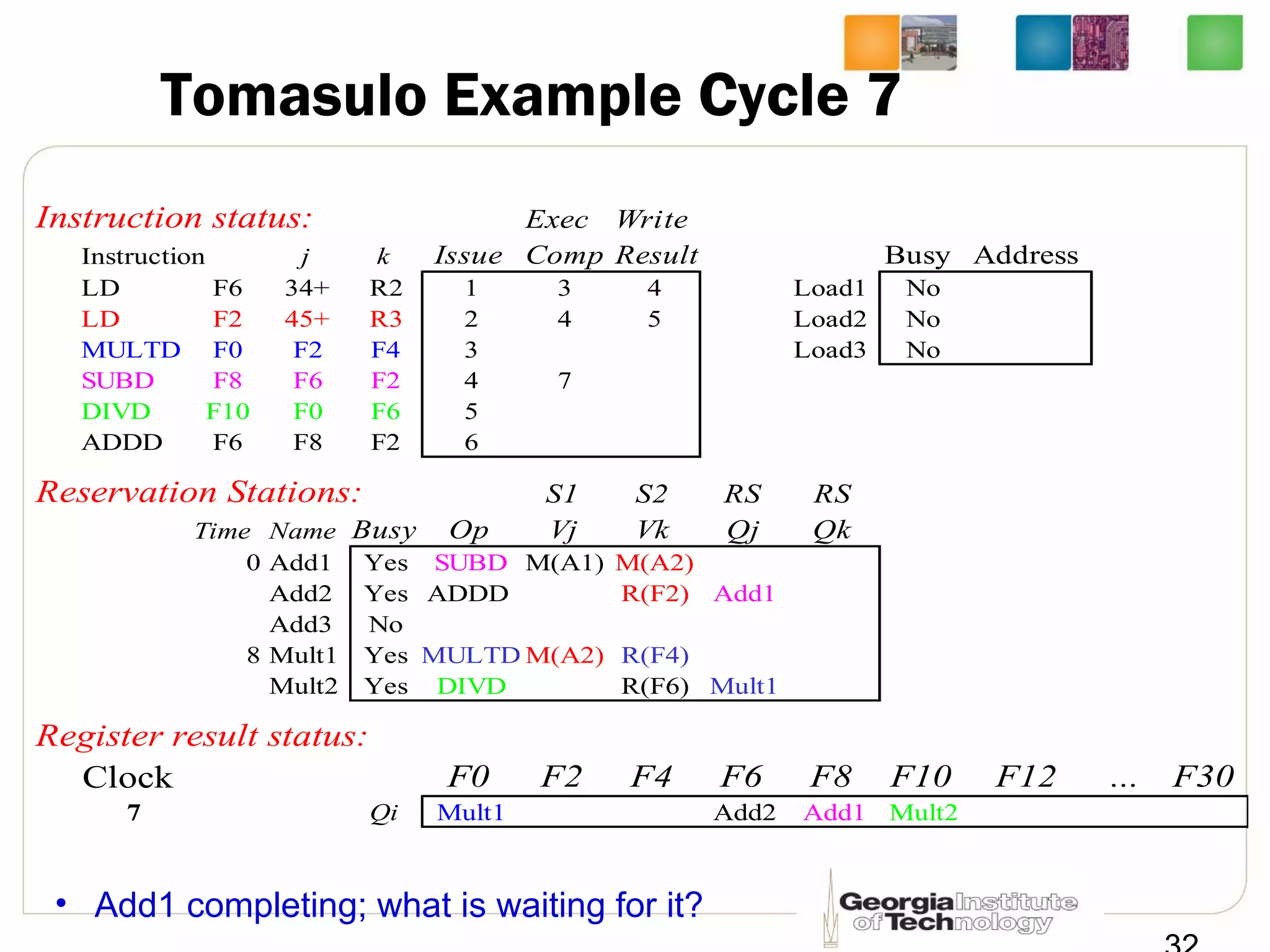
Tomasulo Example Cycle 7
Instruction status: Exec Write
Instruction j k Issue Comp Result Busy Address
LD F6 34+ R2 1 3 4 Load1 No
LD F2 45+ R3 2 4 5 Load2 No
MULTD F0 F2 F4 3 Load3 No
SUBD F8 F6 F2 4 7
DIVD F10 F0 F6 5
ADDD F6 F8 F2 6
Reservation Stations: S1 S2 RS RS
Time Name Busy Op Vj Vk Qj Qk
0 Add1 Yes SUBD M(A1) M(A2)
Add2 Yes ADDD R(F2) Add1
Add3 No
8 Mult1 Yes MULTD M(A2) R(F4)
Mult2 Yes DIVD R(F6) Mult1
Register result status:
Clock F0 F2 F4 F6 F8 F10 F12 ... F30
7 Qi Mult1 Add2 Add1 Mult2
• Add1 completing; what is waiting for it?
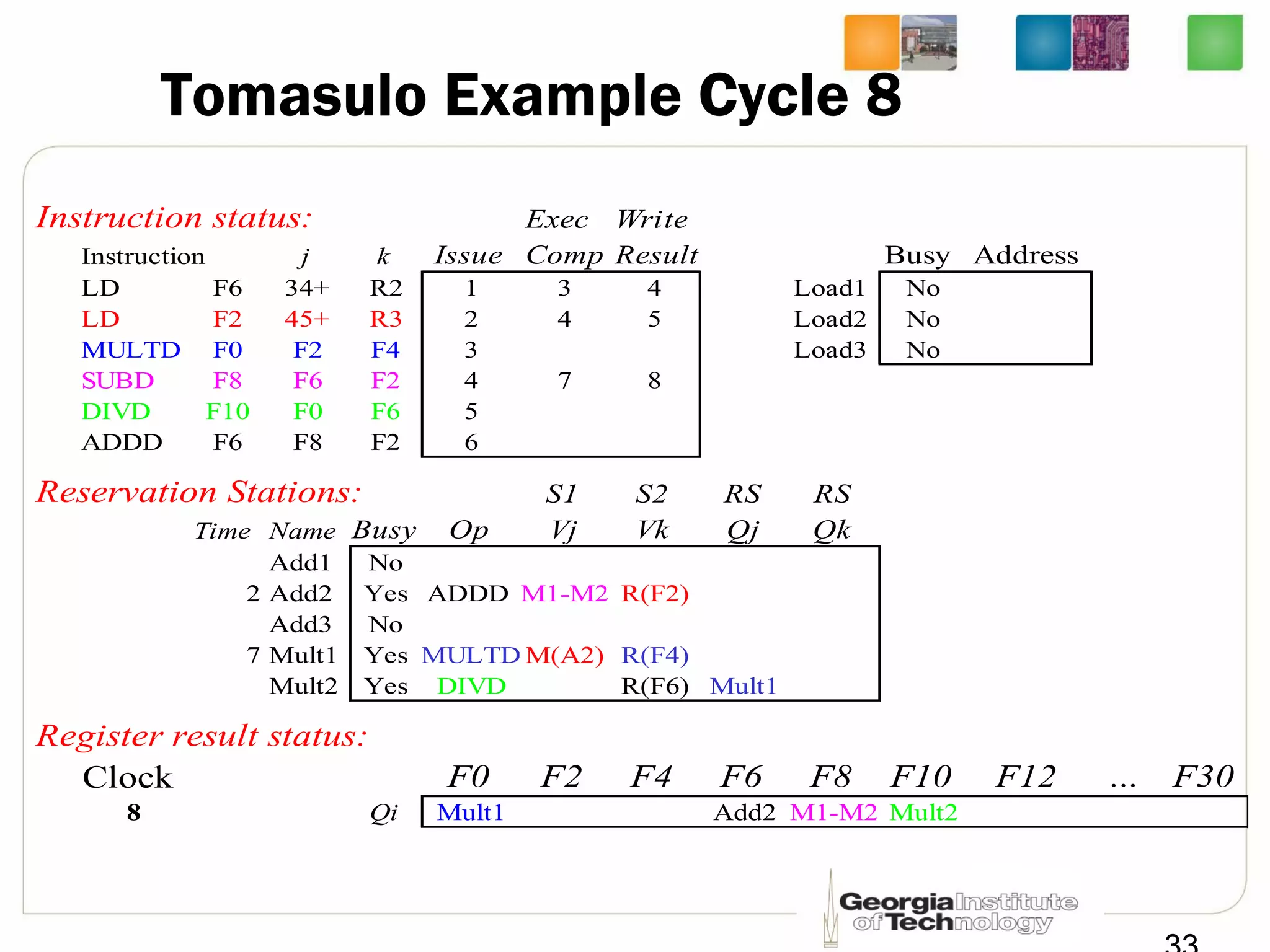
Tomasulo Example Cycle 8
Instruction status: Exec Write
Instruction j k Issue Comp Result Busy Address
LD F6 34+ R2 1 3 4 Load1 No
LD F2 45+ R3 2 4 5 Load2 No
MULTD F0 F2 F4 3 Load3 No
SUBD F8 F6 F2 4 7 8
DIVD F10 F0 F6 5
ADDD F6 F8 F2 6
Reservation Stations: S1 S2 RS RS
Time Name Busy Op Vj Vk Qj Qk
Add1 No
2 Add2 Yes ADDD(M1-M2)R(F2)
Add3 No
7 Mult1 Yes MULTD M(A2) R(F4)
Mult2 Yes DIVD R(F6) Mult1
Register result status:
Clock F0 F2 F4 F6 F8 F10 F12 ... F30
8 Qi Mult1 Add2 (M1-M2)Mult2
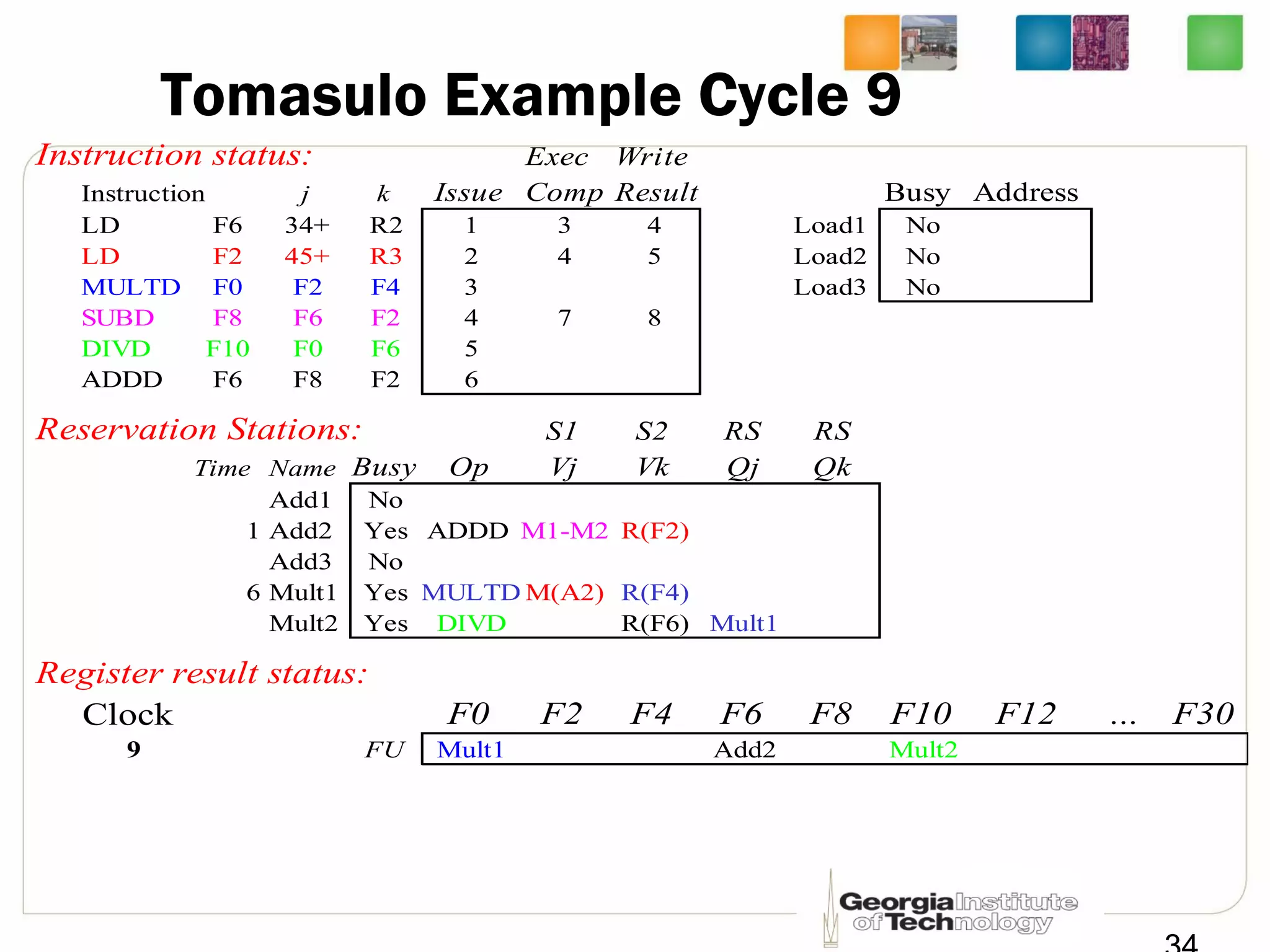
Tomasulo Example Cycle 9
Instruction status: Exec Write
Instruction j k Issue Comp Result Busy Address
LD F6 34+ R2 1 3 4 Load1 No
LD F2 45+ R3 2 4 5 Load2 No
MULTD F0 F2 F4 3 Load3 No
SUBD F8 F6 F2 4 7 8
DIVD F10 F0 F6 5
ADDD F6 F8 F2 6
Reservation Stations: S1 S2 RS RS
Time Name Busy Op Vj Vk Qj Qk
Add1 No
1 Add2 Yes ADDD(M1-M2)R(F2)
Add3 No
6 Mult1 Yes MULTD M(A2) R(F4)
Mult2 Yes DIVD R(F6) Mult1
Register result status:
Clock F0 F2 F4 F6 F8 F10 F12 ... F30
9 FU Mult1 Add2 Mult2
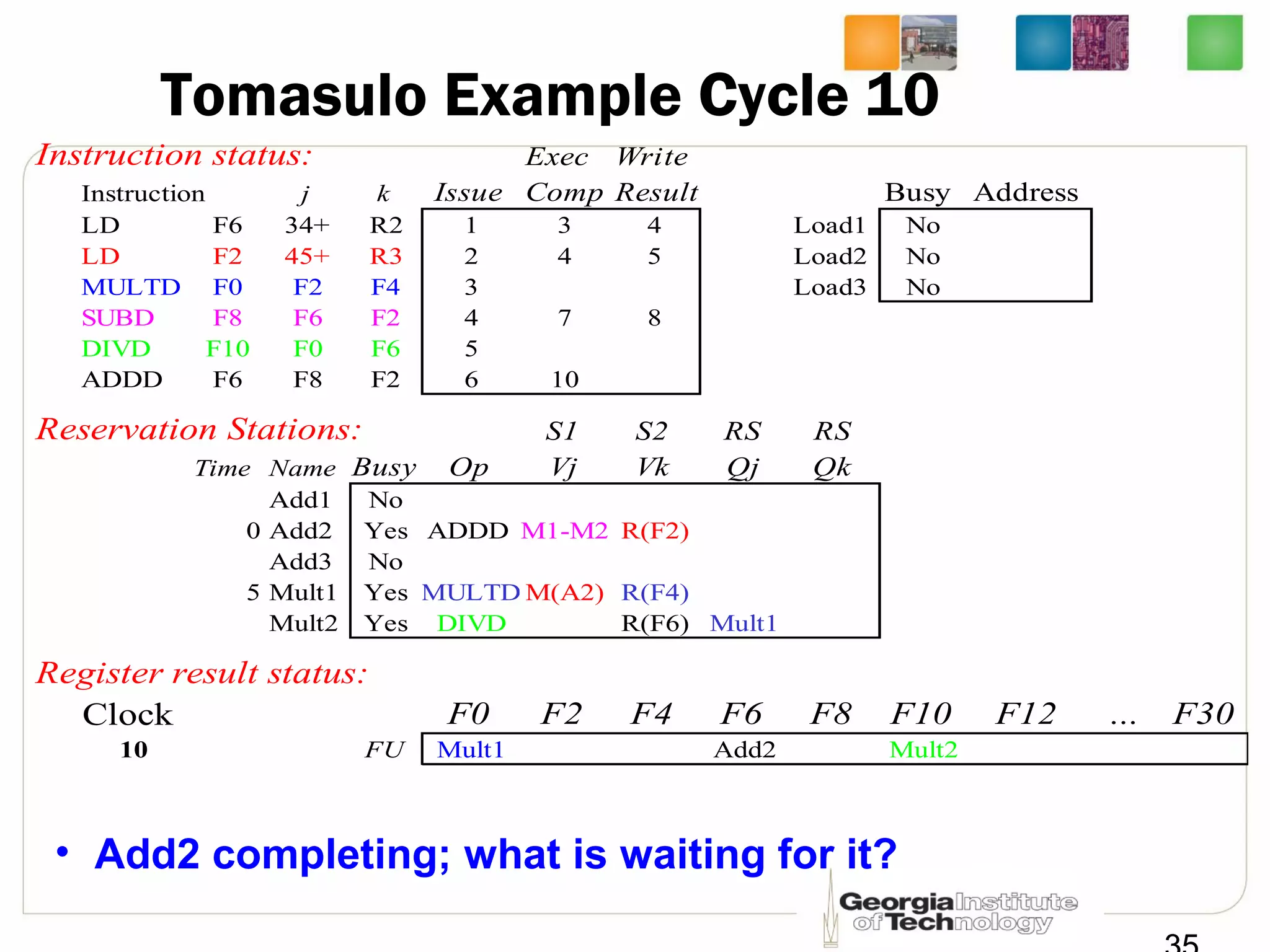
Tomasulo Example Cycle 10
Instruction status: Exec Write
Instruction j k Issue Comp Result Busy Address
LD F6 34+ R2 1 3 4 Load1 No
LD F2 45+ R3 2 4 5 Load2 No
MULTD F0 F2 F4 3 Load3 No
SUBD F8 F6 F2 4 7 8
DIVD F10 F0 F6 5
ADDD F6 F8 F2 6 10
Reservation Stations: S1 S2 RS RS
Time Name Busy Op Vj Vk Qj Qk
Add1 No
0 Add2 Yes ADDD(M1-M2)R(F2)
Add3 No
5 Mult1 Yes MULTD M(A2) R(F4)
Mult2 Yes DIVD R(F6) Mult1
Register result status:
Clock F0 F2 F4 F6 F8 F10 F12 ... F30
10 FU Mult1 Add2 Mult2
• Add2 completing; what is waiting for it?
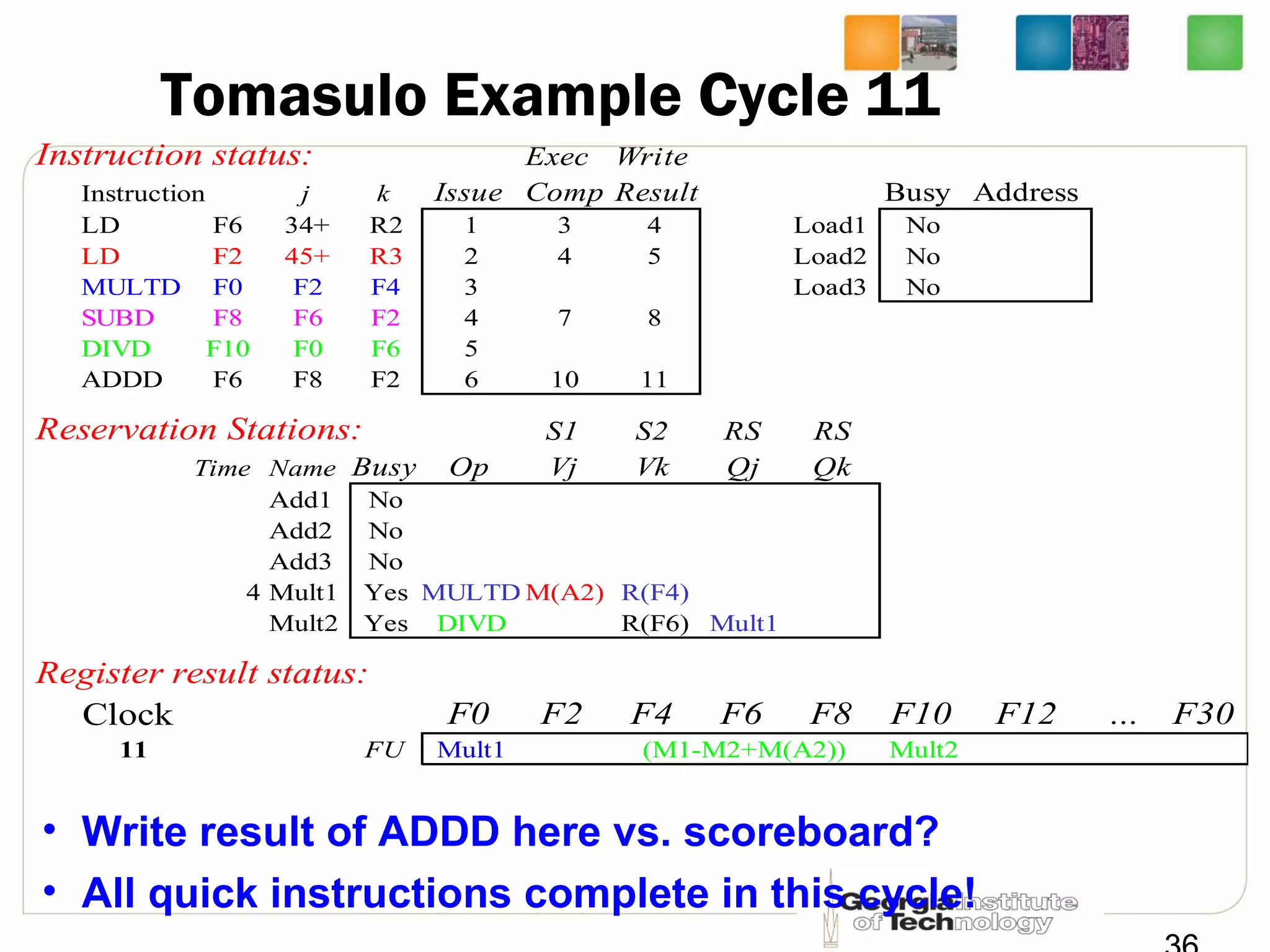
Tomasulo Example Cycle 11
Instruction status: Exec Write
Instruction j k Issue Comp Result Busy Address
LD F6 34+ R2 1 3 4 Load1 No
LD F2 45+ R3 2 4 5 Load2 No
MULTD F0 F2 F4 3 Load3 No
SUBD F8 F6 F2 4 7 8
DIVD F10 F0 F6 5
ADDD F6 F8 F2 6 10 11
Reservation Stations: S1 S2 RS RS
Time Name Busy Op Vj Vk Qj Qk
Add1 No
Add2 No
Add3 No
4 Mult1 Yes MULTD M(A2) R(F4)
Mult2 Yes DIVD R(F6) Mult1
Register result status:
Clock F0 F2 F4 F6 F8 F10 F12 ... F30
11 FU Mult1 (M1-M2+M(A2)) Mult2
• Write result of ADDD here vs. scoreboard?
• All quick instructions complete in this cycle!
Tomasulo Example Cycle 12
Instruction status: Exec Write
Instruction j k Issue Comp Result Busy Address
LD F6 34+ R2 1 3 4 Load1 No
LD F2 45+ R3 2 4 5 Load2 No
MULTD F0 F2 F4 3 Load3 No
SUBD F8 F6 F2 4 7 8
DIVD F10 F0 F6 5
ADDD F6 F8 F2 6 10 11
Reservation Stations: S1 S2 RS RS
Time Name Busy Op Vj Vk Qj Qk
Add1 No
Add2 No
Add3 No
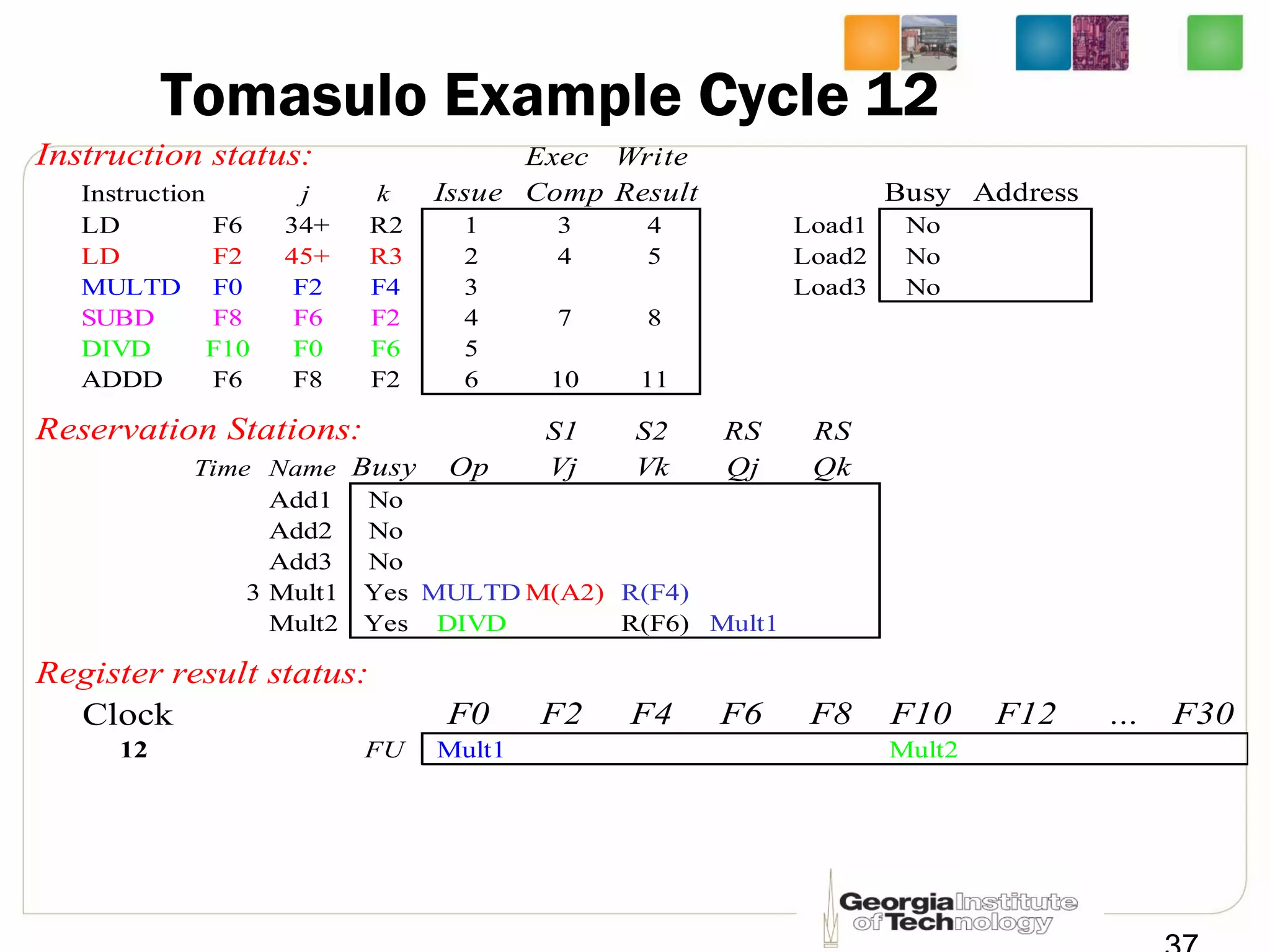
3 Mult1 Yes MULTD M(A2) R(F4)
Mult2 Yes DIVD R(F6) Mult1
Register result status:
Clock F0 F2 F4 F6 F8 F10 F12 ... F30
12 FU Mult1 Mult2
Tomasulo Example Cycle 13
Instruction status: Exec Write
Instruction j k Issue Comp Result Busy Address
LD F6 34+ R2 1 3 4 Load1 No
LD F2 45+ R3 2 4 5 Load2 No
MULTD F0 F2 F4 3 Load3 No
SUBD F8 F6 F2 4 7 8
DIVD F10 F0 F6 5
ADDD F6 F8 F2 6 10 11
Reservation Stations: S1 S2 RS RS
Time Name Busy Op Vj Vk Qj Qk
Add1 No
Add2 No
Add3 No
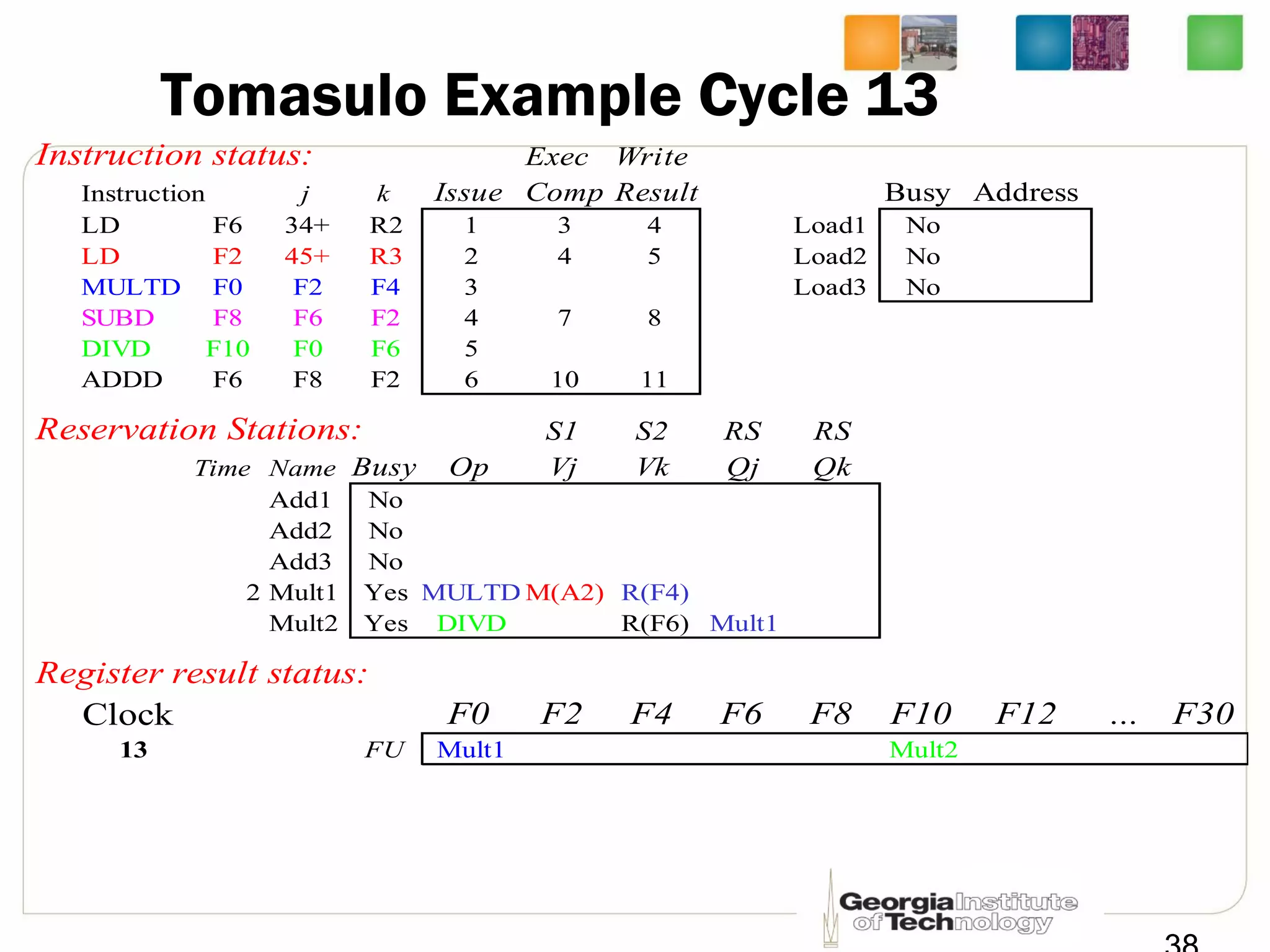
2 Mult1 Yes MULTD M(A2) R(F4)
Mult2 Yes DIVD R(F6) Mult1
Register result status:
Clock F0 F2 F4 F6 F8 F10 F12 ... F30
13 FU Mult1 Mult2
Tomasulo Example Cycle 14
Instruction status: Exec Write
Instruction j k Issue Comp Result Busy Address
LD F6 34+ R2 1 3 4 Load1 No
LD F2 45+ R3 2 4 5 Load2 No
MULTD F0 F2 F4 3 Load3 No
SUBD F8 F6 F2 4 7 8
DIVD F10 F0 F6 5
ADDD F6 F8 F2 6 10 11
Reservation Stations: S1 S2 RS RS
Time Name Busy Op Vj Vk Qj Qk
Add1 No
Add2 No
Add3 No
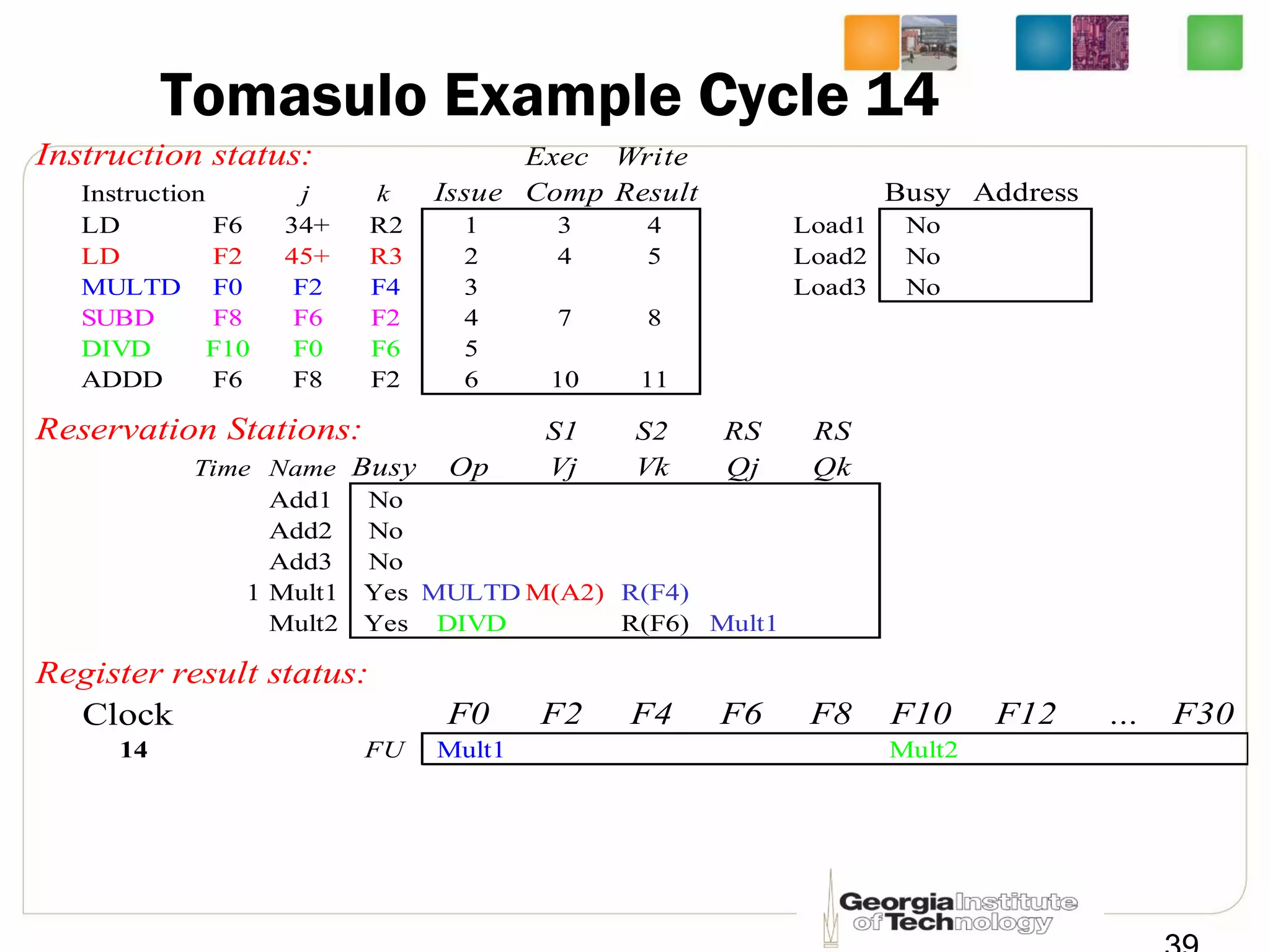
1 Mult1 Yes MULTD M(A2) R(F4)
Mult2 Yes DIVD R(F6) Mult1
Register result status:
Clock F0 F2 F4 F6 F8 F10 F12 ... F30
14 FU Mult1 Mult2
Tomasulo Example Cycle 15
Instruction status: Exec Write
Instruction j k Issue Comp Result Busy Address
LD F6 34+ R2 1 3 4 Load1 No
LD F2 45+ R3 2 4 5 Load2 No
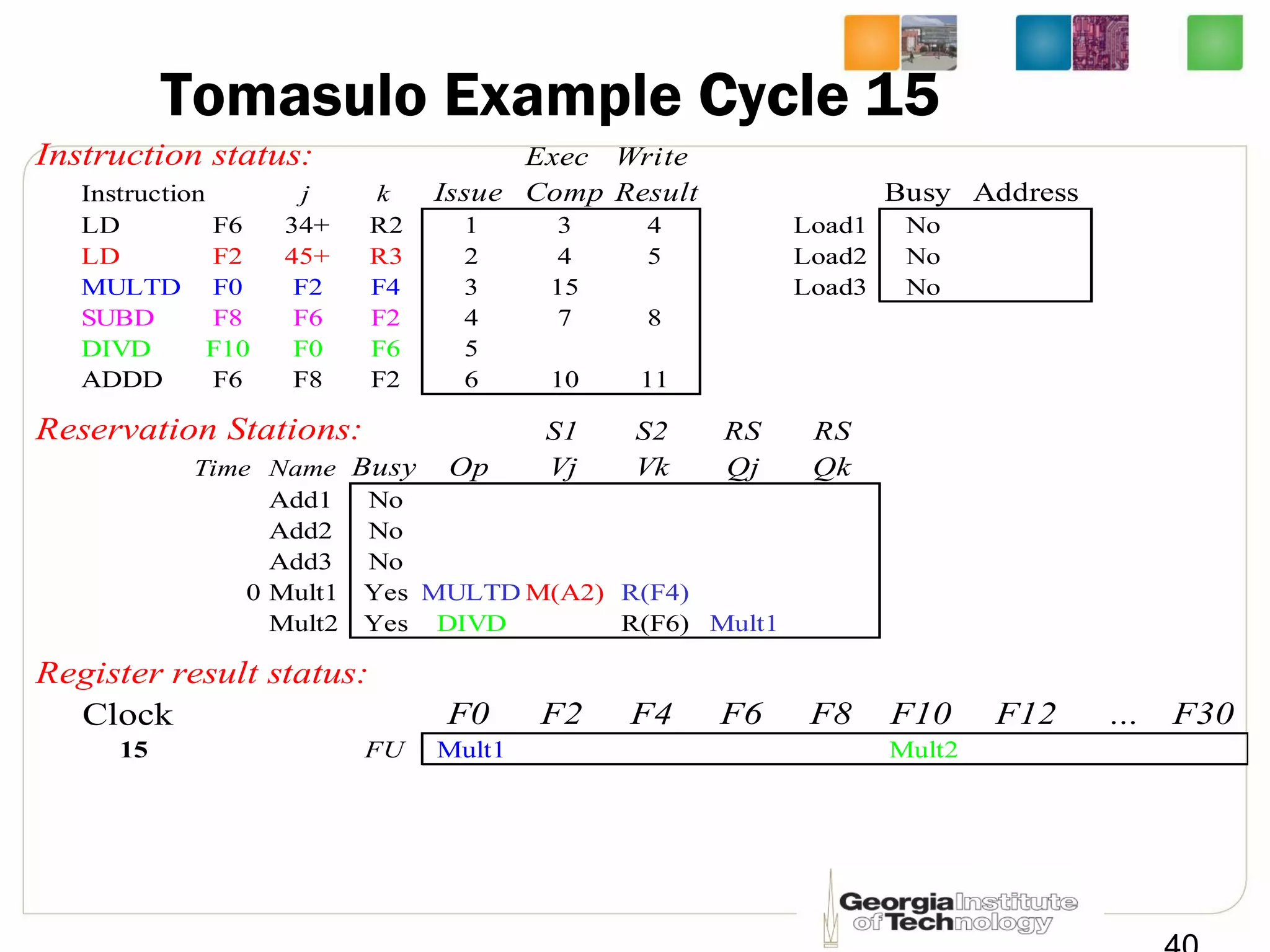
MULTD F0 F2 F4 3 15 Load3 No
SUBD F8 F6 F2 4 7 8
DIVD F10 F0 F6 5
ADDD F6 F8 F2 6 10 11
Reservation Stations: S1 S2 RS RS
Time Name Busy Op Vj Vk Qj Qk
Add1 No
Add2 No
Add3 No
0 Mult1 Yes MULTD M(A2) R(F4)
Mult2 Yes DIVD R(F6) Mult1
Register result status:
Clock F0 F2 F4 F6 F8 F10 F12 ... F30
15 FU Mult1 Mult2
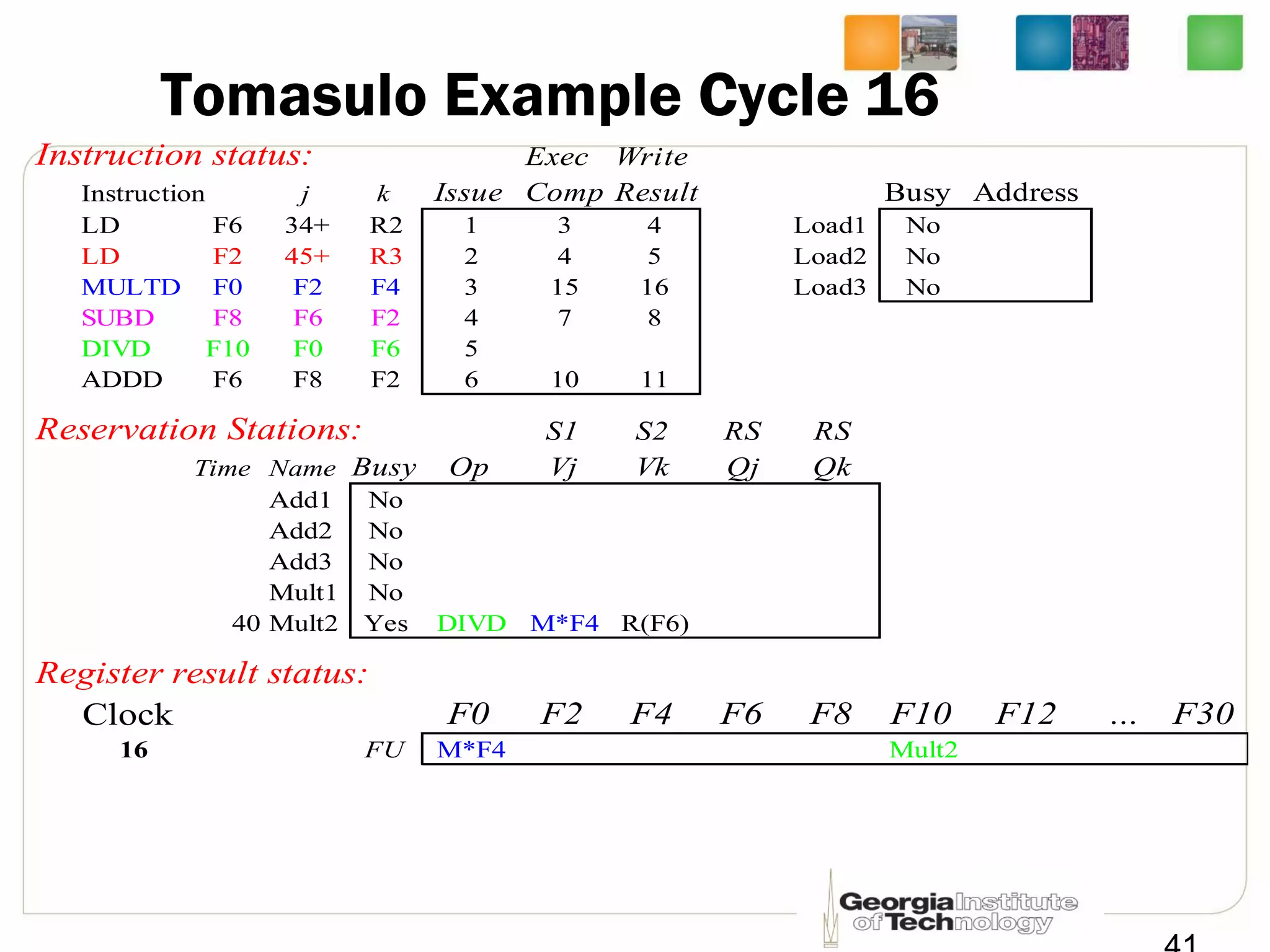
Tomasulo Example Cycle 16
Instruction status: Exec Write
Instruction j k Issue Comp Result Busy Address
LD F6 34+ R2 1 3 4 Load1 No
LD F2 45+ R3 2 4 5 Load2 No
MULTD F0 F2 F4 3 15 16 Load3 No
SUBD F8 F6 F2 4 7 8
DIVD F10 F0 F6 5
ADDD F6 F8 F2 6 10 11
Reservation Stations: S1 S2 RS RS
Time Name Busy Op Vj Vk Qj Qk
Add1 No
Add2 No
Add3 No
Mult1 No
40 Mult2 Yes DIVD M*F4 R(F6)
Register result status:
Clock F0 F2 F4 F6 F8 F10 F12 ... F30
16 FU M*F4 Mult2
Faster than light computation
(skip a couple of cycles)
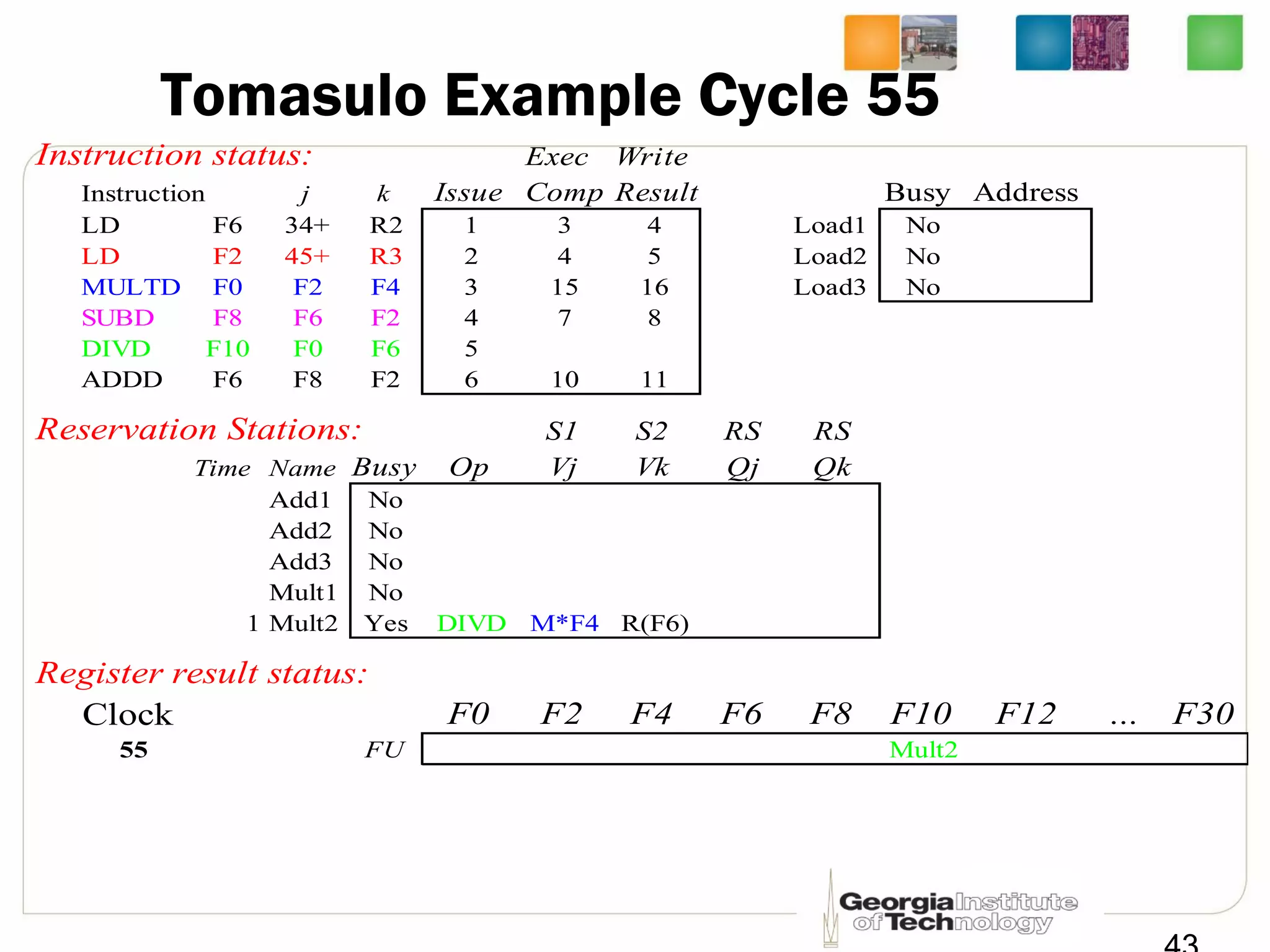
Tomasulo Example Cycle 55
Instruction status: Exec Write
Instruction j k Issue Comp Result Busy Address
LD F6 34+ R2 1 3 4 Load1 No
LD F2 45+ R3 2 4 5 Load2 No
MULTD F0 F2 F4 3 15 16 Load3 No
SUBD F8 F6 F2 4 7 8
DIVD F10 F0 F6 5
ADDD F6 F8 F2 6 10 11
Reservation Stations: S1 S2 RS RS
Time Name Busy Op Vj Vk Qj Qk
Add1 No
Add2 No
Add3 No
Mult1 No
1 Mult2 Yes DIVD M*F4 R(F6)
Register result status:
Clock F0 F2 F4 F6 F8 F10 F12 ... F30
55 FU Mult2
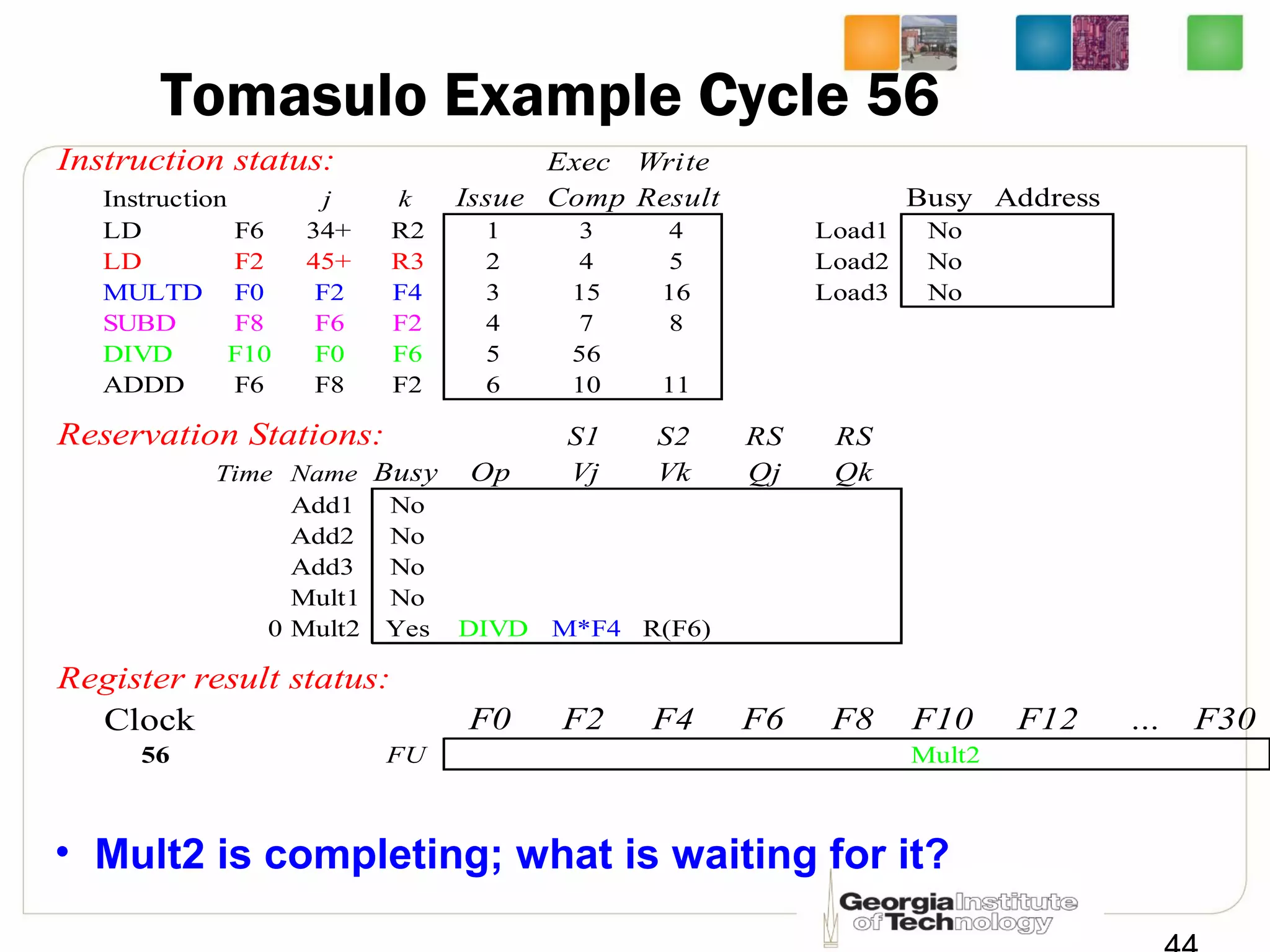
Tomasulo Example Cycle 56
Instruction status: Exec Write
Instruction j k Issue Comp Result Busy Address
LD F6 34+ R2 1 3 4 Load1 No
LD F2 45+ R3 2 4 5 Load2 No
MULTD F0 F2 F4 3 15 16 Load3 No
SUBD F8 F6 F2 4 7 8
DIVD F10 F0 F6 5 56
ADDD F6 F8 F2 6 10 11
Reservation Stations: S1 S2 RS RS
Time Name Busy Op Vj Vk Qj Qk
Add1 No
Add2 No
Add3 No
Mult1 No
0 Mult2 Yes DIVD M*F4 R(F6)
Register result status:
Clock F0 F2 F4 F6 F8 F10 F12 ... F30
56 FU Mult2
• Mult2 is completing; what is waiting for it?
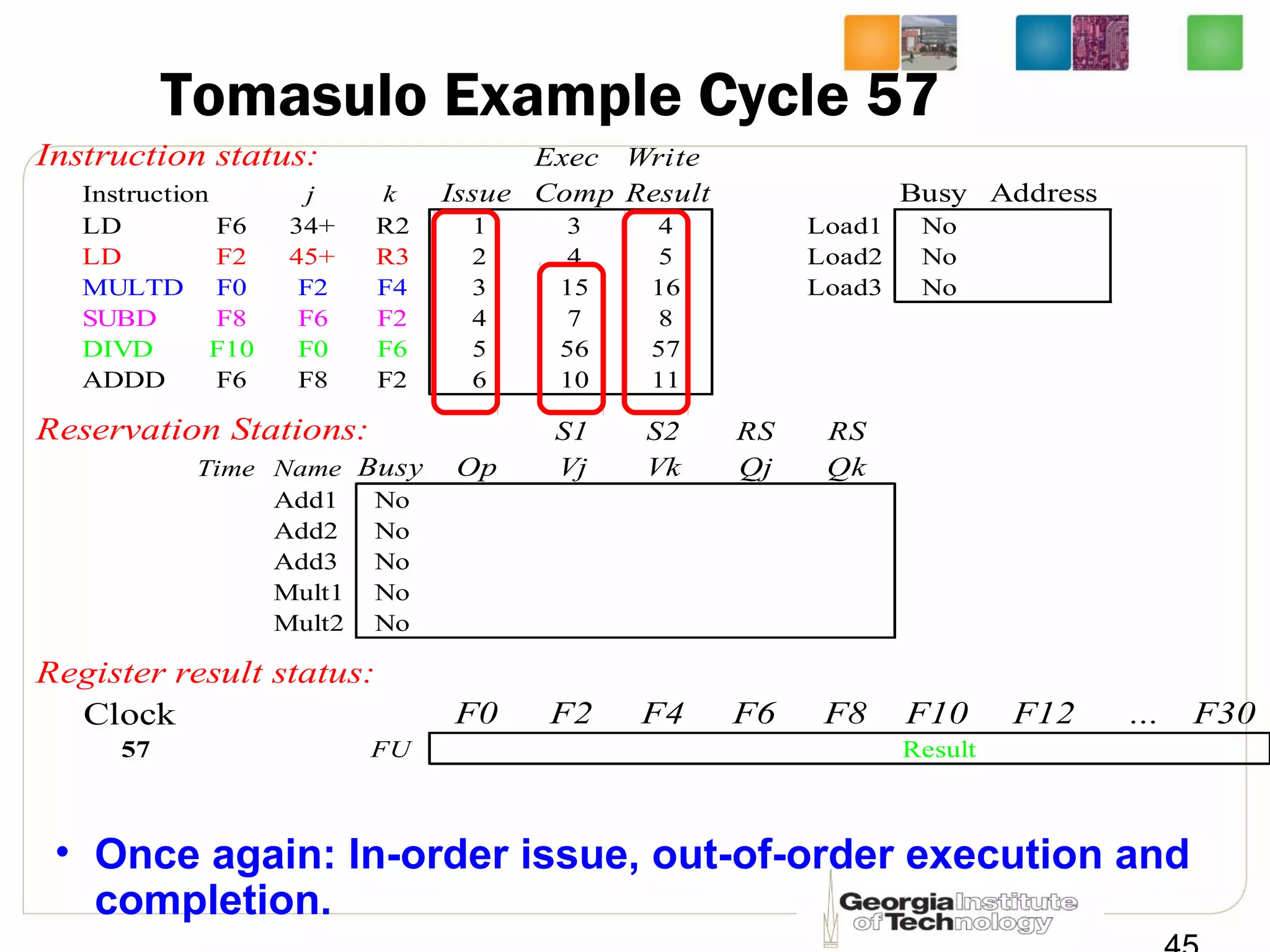
Tomasulo Example Cycle 57
Instruction status: Exec Write
Instruction j k Issue Comp Result Busy Address
LD F6 34+ R2 1 3 4 Load1 No
LD F2 45+ R3 2 4 5 Load2 No
MULTD F0 F2 F4 3 15 16 Load3 No
SUBD F8 F6 F2 4 7 8
DIVD F10 F0 F6 5 56 57
ADDD F6 F8 F2 6 10 11
Reservation Stations: S1 S2 RS RS
Time Name Busy Op Vj Vk Qj Qk
Add1 No
Add2 No
Add3 No
Mult1 No
Mult2 No
Register result status:
Clock F0 F2 F4 F6 F8 F10 F12 ... F30
57 FU Result
• Once again: In-order issue, out-of-order execution and
completion.
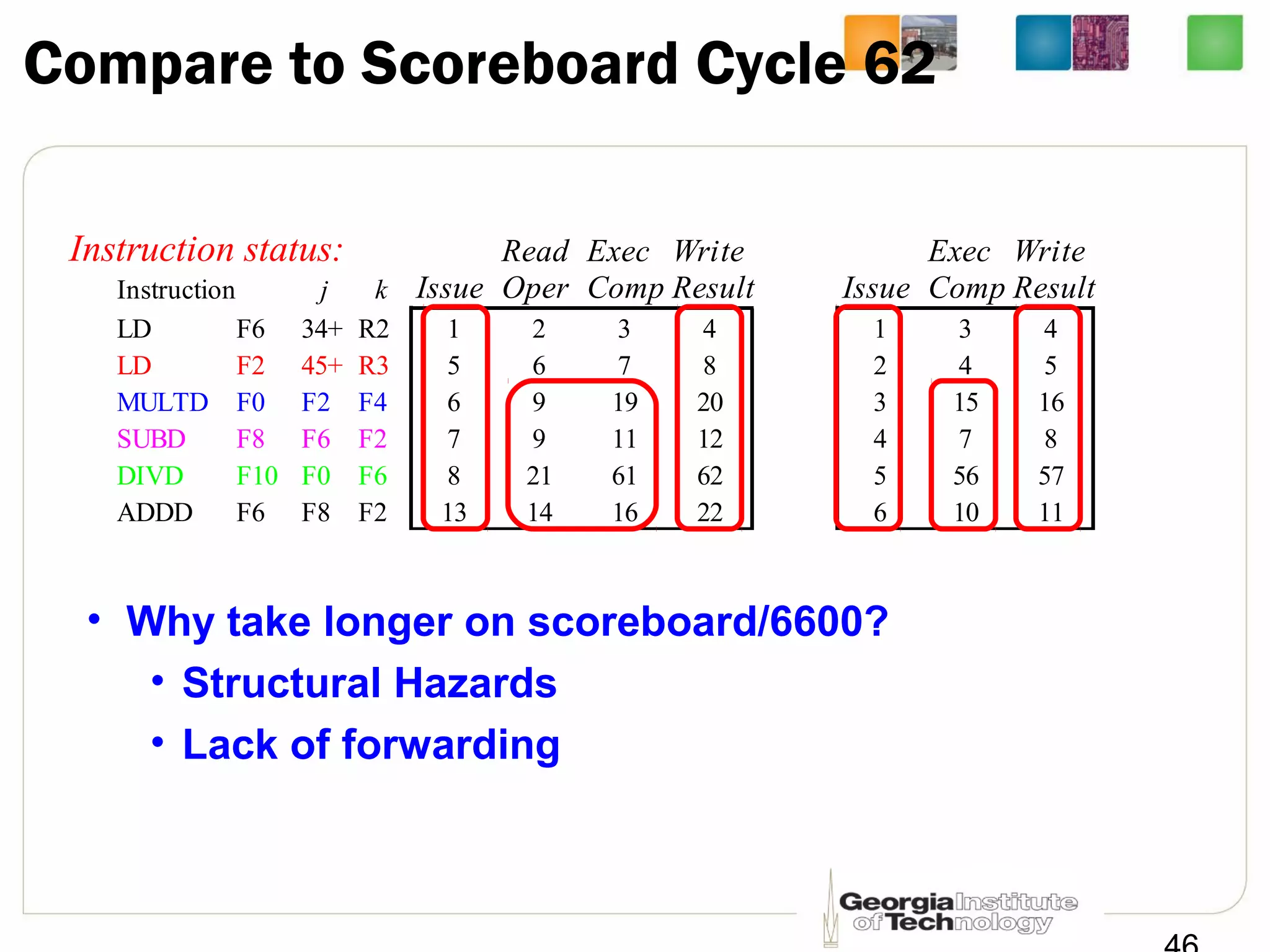
Compare to Scoreboard Cycle 62
Instruction status: Read Exec Write Exec Write
Instruction j k Issue Oper Comp Result Issue ComplResult
LD F6 34+ R2 1 2 3 4 1 3 4
LD F2 45+ R3 5 6 7 8 2 4 5
MULTD F0 F2 F4 6 9 19 20 3 15 16
SUBD F8 F6 F2 7 9 11 12 4 7 8
DIVD F10 F0 F6 8 21 61 62 5 56 57
ADDD F6 F8 F2 13 14 16 22 6 10 11
• Why take longer on scoreboard/6600?
• Structural Hazards
• Lack of forwarding
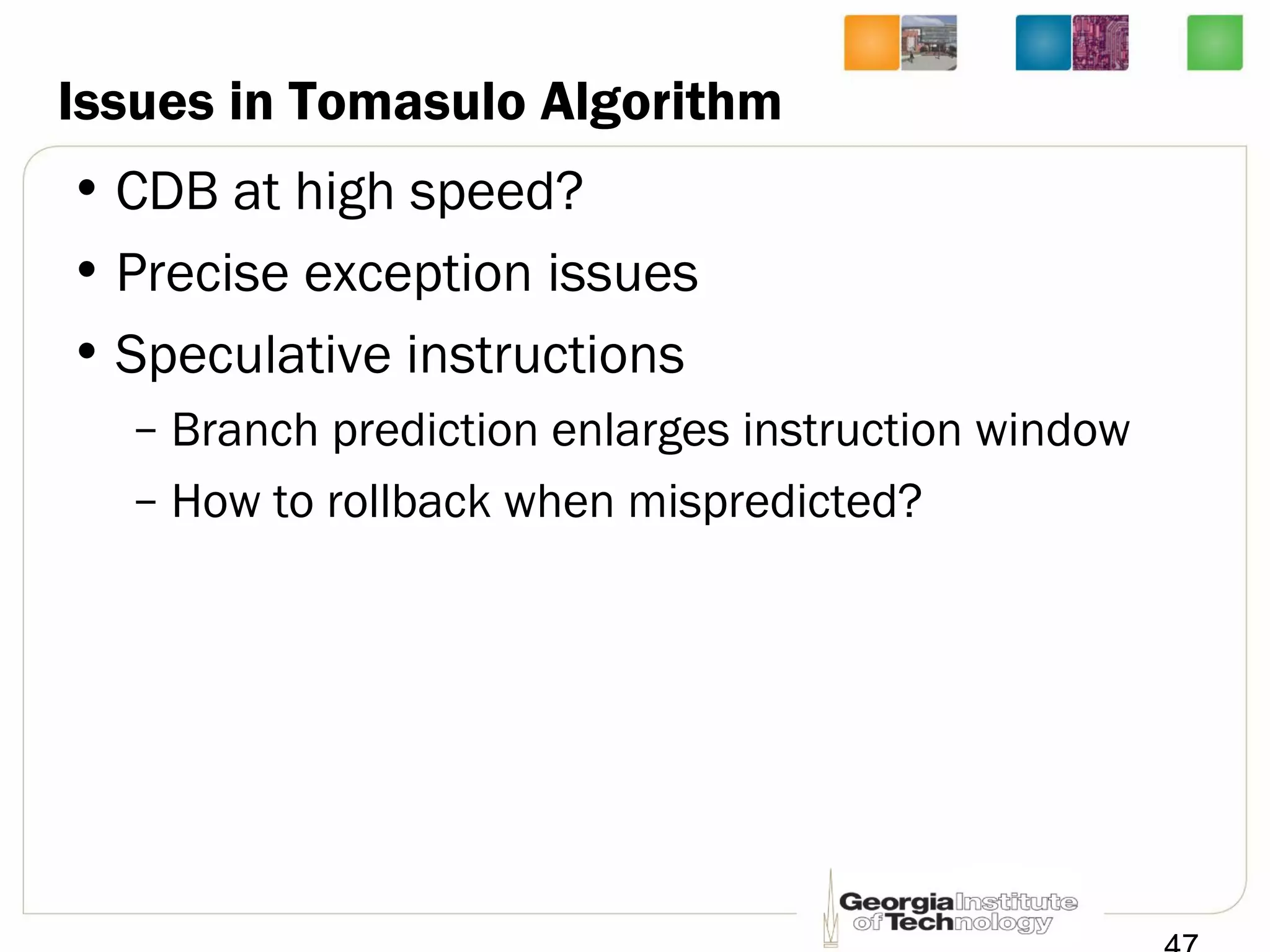
Issues in Tomasulo Algorithm
• CDB at high speed?
• Precise exception issues
• Speculative instructions
– Branch prediction enlarges instruction window
– How to rollback when mispredicted?

Lec7 Computer Architecture by Hsien-Hsin Sean Lee Georgia Tech -- Dynamic Scheduling part 1

  • 1.
    ECE 4100/6100 Advanced ComputerArchitecture Lecture 7 Dynamic Scheduling (I) Prof. Hsien-Hsin Sean Lee School of Electrical and Computer Engineering Georgia Institute of Technology
  • 2.
    Data Flow Graph(DFG) i1: r2 = 4(r22) i2: r10 = 4(r25) i3: r10 = r2 + r10 i4: 4(r26) = r10 i5: r14 = 8(r27) i6: r6 = (r22) i7: r5 = (r23) i8: r5 = r6 – r5 i9: r4 = r14 * r5 i10: r15 = 12(r27) i11: r7 = 4(r22) i12: r8 = 4(r23) i13: r8 = r7 – r8 i14: r8 = r15* r8 i15: r8 = r4 – r8 i16: (r28) = r8 i1i1 i2i2 i3i3 i4i4 i6i6 i7i7 i8i8 i5i5 i9i9 i11i11 i12i12 i13i13 i10i10 i14i14 i15i15 i16i16 Data Flow Graph (or Data Dependency Graph)
  • 3.
    Data Flow ExecutionModel • To exploit maximal ILP • An instruction can be executed immediately after – All source operands are ready – Execution unit available – Destination is ready (to be written)
  • 4.
    Dynamic Scheduling • ExploitILP at run-time • Execute instructions out-of-order by a restricted data flow execution model (still use PC!) • Hardware will – Maintain true dependency (data flow manner) – Maintain exception behavior – Find ILP within an Instruction Window (pool) • Need an accurate branch predictor • Pros – Scalable performance: allows code to be compiled on one platform, but also run efficiently on another – Handle cases where dependency is unknown at compile-time • Cons – Hardware complexity (main argument from the VLIW/EPIC camp)
  • 5.
    Out-of-Order Execution i1: r2= 4(r22) i2: r10 = 4(r25) i3: r10 = r2 + r10 i4: 4(r26) = r10 i5: r14 = 8(r27) i6: r6 = (r22) i7: r5 = (r23) i8: r5 = r6 – r5 i9: r4 = r14 * r5 i10: r15 = 12(r27) i11: r7 = 4(r22) i12: r8 = 4(r23) i13: r8 = r7 – r8 i14: r8 = r15* r8 i15: r8 = r4 – r8 i16: (r28) = r8 i1i1 i2i2 i3i3 i4i4 i6i6 i7i7 i8i8 i5i5 i9i9 i11i11 i12i12 i13i13 i10i10 i14i14 i15i15 i16i16
  • 6.
    OOO Execution • OOOexecution ≡ out-of-order completion • OOO execution ≠ out-of-order retirement (commit) • No (speculative) instruction allowed to retire until it is confirmed on the right path • Fetch, decode, issue (i.e., front-end) are still done in the program order
  • 7.
    CDC 6600 ScoreboardAlgorithm • Enable OOO Execution to address long-latency FP instructions • Use scoreboard tables to track – Functional unit status – Register update status • Issue and execute instructions whenever – No structural hazard – No data hazard • Cons – Stop issue when WAW is detected – Stop writeback when WAR is detected
  • 8.
    CDC6600 Scoreboard FunctionalUnits Registers FP MultFPMult FP MultFP Mult FP DivideFP Divide FP AddFP Add IntegerInteger Memory SCOREBOARDSCOREBOARD Data bus Data bus Data bus Data bus Control bus/Status Int Mult1 Mult2 Add Div Fu 1 1 0 1 1 Busy Load Mult Sub Div Op F1 F0 F8 F2 Dest R3 F1 F6 F0 Src1 F4 F1 F6 Src2 Int Mult1 Dep1 Int Dep2 F0 F1 F2 .. .. .. F31 Mult1 Int Div .. .. .. xxxFU FU Status Table Register Update Table
  • 9.
    IBM 360 • IBM360 introduced – 8-bit = 1 byte – 32-bit = 1 word – Byte-addressable memory – Differentiate an “architecture” from an “implementation” • IBM 360/91 FPU about 3 years after CDC 6600 (1966-7) • Tomasulo algorithm – Dynamic scheduling – Register renaming
  • 10.
    Tomasulo Algorithm • Goal:High Performance without special compilers – Dynamic scheduling done completely by HW – We generally use “supercalar processor” for such category as opposed to “VLIW” or “EPIC” • Differences between IBM 360 and CDC 6600 ISA – IBM has only 2 register specifiers per inst vs. 3 in CDC 6600 • Make WAW and WAR much worse – IBM has 4 FP registers vs. 8 in CDC 6600 • Smaller number of architectural register, compiler is incapable of exploiting better register allocation – IBM has memory-to-register operations • Why study? Lead to Pentium Pro/II/III/4, Core, Alpha 21264, MIPS R10000, HP 8000, PowerPC 604
  • 11.
    IBM 360/91 FPUw/ Tomasulo Algorithm • To not stall floating point instructions due to long latency – Two function units  FP Add + FP Mult/Div – 360/91 FPU is not pipelined • Three new Mechanisms – Reservation StationsReservation Stations (RS) • 3 in FP Add, 2 in FP mult/div • Register name is discarded when issue to reservation station – TagsTags • 4-bit tag for one of the 11 possible sources (5 RSs + 6 FLB for loads) • Written for unavailable sources whose results are being generated by one of the sources (5 RS or 6 FLB) • New tag assignment eliminates false dependency – Common Data BusCommon Data Bus (CDB), driven by • 11 Sources: 5 RS + 6 FLB • 17 Destinations: 2*5 RS + 3 SDB + 4 FLR
  • 12.
    Basic Principles • Donot rely on a centralized register file ! • RS fetches and buffers an operand as soon as it is available via CDB – Eliminating the need to get it from a register (No WAR) – Data Flow execution model • Pending instructions designate the RS that will provide their input (renaming and maintain RAW) • Due to in-order issue, the register status table always keeps the latest write (No WAW issue)
  • 13.
    Key Representation • Op Operation to perform in the units • Vj  Value of Source 1 (called SINK in 360/91) • Vk  Value of Source 2 (called SOURCE in 360/91) • Qj  The RS (tag) will produce source 1 • Qk  The RS (tag) will produce source 2 • A(ddress)  Hold info for the memory address generation for a load or store • Qi  Whose value should be stored into the register
  • 14.
    IBM 360/91 FPUw/ Tomasulo Algorithm From Mem FP Registers (FLR) ReservationReservation StationsStations Common Data Bus (CDB)Common Data Bus (CDB) To Mem FP operation stack (FLOS) FP Load Buffers (FLB) Store Data Buffers (SDB) 6 5 4 3 2 1 FP AdderFP Adder FP Mult/DivFP Mult/Div 3 2 1 2 1
  • 15.
    IBM 360/91 FPUw/ Tomasulo Algorithm From Mem FLR ReservationReservation StationsStations Common Data Bus (CDB)Common Data Bus (CDB) To Mem FP operation stack (FLOS) FLB Store Data Buffers (SDB) 6 5 4 3 2 1 FP AdderFP Adder FP Mult/DivFP Mult/Div 3 2 1 2 1 Tag (Qj) Tag (Qk) Sink (Vj) Source (Vk) Control Tags and other info in RSTags and other info in RS Control Tag (Qi) Tags in FLBTags in FLB Control Tag Control
  • 16.
    RAWRAW Example: i:R2i: R2 ←← R0 + R4 (2 clks)R0 + R4 (2 clks) j: R8j: R8 ←← R0 + R2 (2 clks)R0 + R2 (2 clks) RSRS Tag Sink Tag Src 11 22 33 Adder FLR Busy Tag Data 0 6.0 2 3.5 4 10.0 8 7.8 Cycle #0:Cycle #0: RSRS Tag Sink Tag Src 44 55 Multiplier/Divider RSRS Tag Sink Tag Src 11 0 6.0 0 10.0 22 33 Adder FLR Busy Tag Data 0 6.0 2 1 11 --- 4 10.0 8 7.8 Cycle #1: IssueCycle #1: Issue ii RSRS Tag Sink Tag Src 44 55 Multiplier/Divider RSRS Tag Sink Tag Src 11 0 6.0 0 10.0 22 0 6.0 11 --- 33 Adder FLR Busy Tag Data 0 6.0 2 1 11 --- 4 10.0 8 1 22 --- Cycle #2: IssueCycle #2: Issue jj RSRS Tag Sink Tag Src 44 55 Multiplier/Divider
  • 17.
    RAWRAW Example: i:R2i: R2 ←← R0 + R4 (2 clks)R0 + R4 (2 clks) j: R8j: R8 ←← R0 + R2 (2 clks)R0 + R2 (2 clks) RSRS Tag Sink Tag Src 11 22 0 6.0 0 16.0 33 Adder FLR Busy Tag Data 0 6.0 2 16.0 4 10.0 8 1 22 --- Cycle #3:Cycle #3: Broadcasts tag and result: CDB_a=<RS1,16.0>Broadcasts tag and result: CDB_a=<RS1,16.0> RSRS Tag Sink Tag Src 44 55 Multiplier/Divider RSRS Tag Sink Tag Src 11 22 33 Adder FLR Busy Tag Data 0 6.0 2 16.0 4 10.0 8 22.0 Cycle #5:Cycle #5: Broadcasts tag and result: CDB_a=<RS2,22.0>Broadcasts tag and result: CDB_a=<RS2,22.0> RSRS Tag Sink Tag Src 44 55 Multiplier/Divider
  • 18.
    RSRS Tag SinkTag Src 11 22 33 Adder FLR Busy Tag Data 0 6.0 2 3.5 4 10.0 8 7.8 Cycle #0:Cycle #0: RSRS Tag Sink Tag Src 44 55 Multiplier/Divider RSRS Tag Sink Tag Src 11 22 33 Adder FLR Busy Tag Data 0 6.0 2 3.5 4 1 44 --- 8 7.8 Cycle #1: IssueCycle #1: Issue ii RSRS Tag Sink Tag Src 44 0 6.0 0 7.8 55 Multiplier/Divider RSRS Tag Sink Tag Src 11 22 33 Adder FLR Busy Tag Data 0 1 55 --- 2 3.5 4 1 44 --- 8 7.8 Cycle #2: IssueCycle #2: Issue jj RSRS Tag Sink Tag Src 44 0 6.0 0 7.8 55 44 --- 0 3.5 Multiplier/Divider WARWAR Example: i: R4i: R4 ←← R0 x R8 (3)R0 x R8 (3) j: R0j: R0 ←← R4 x R2 (3)R4 x R2 (3) k: R2k: R2 ←← R2 + R8 (2)R2 + R8 (2)
  • 19.
    Cycle #3: IssueCycle#3: Issue kk WARWAR Example: i: R4i: R4 ←← R0 x R8 (3)R0 x R8 (3) j: R0j: R0 ←← R4 x R2 (3)R4 x R2 (3) k: R2k: R2 ←← R2 + R8 (2)R2 + R8 (2) RSRS Tag Sink Tag Src 11 0 3.5 0 7.8 22 33 Adder FLR Busy Tag Data 0 1 55 --- 2 1 11 --- 4 1 44 --- 8 7.8 RSRS Tag Sink Tag Src 44 0 6.0 0 7.8 55 44 --- 0 3.5 Multiplier/Divider RSRS Tag Sink Tag Src 11 0 3.5 0 7.8 22 33 Adder FLR Busy Tag Data 0 1 55 --- 2 1 11 --- 4 46.8 8 7.8 Cycle #4:Cycle #4: Broadcasts CDB_m=<RS4,46.8>;Broadcasts CDB_m=<RS4,46.8>; RSRS Tag Sink Tag Src 44 55 0 46.8 0 3.5 Multiplier/Divider RSRS Tag Sink Tag Src 11 22 33 Adder FLR Busy Tag Data 0 1 55 --- 2 11.3 4 46.8 8 7.8 Cycle #5:Cycle #5: Broadcasts CDB_a=<RS1,11.3>Broadcasts CDB_a=<RS1,11.3> RSRS Tag Sink Tag Src 44 55 0 46.8 0 3.5 Multiplier/Divider
  • 20.
    WARWAR Example: i: R4i:R4 ←← R0 x R8 (3)R0 x R8 (3) j: R0j: R0 ←← R4 x R2 (3)R4 x R2 (3) k: R2k: R2 ←← R2 + R8 (2)R2 + R8 (2) RSRS Tag Sink Tag Src 11 22 33 Adder FLR Busy Tag Data 0 163.8 2 11.3 4 46.8 8 7.8 Cycle #7:Cycle #7: Broadcasts CDB_m=<RS5,163.8>Broadcasts CDB_m=<RS5,163.8> RSRS Tag Sink Tag Src 44 55 Multiplier/Divider
  • 21.
    RSRS Tag SinkTag Src 11 0 6.0 44 --- 22 33 Adder FLR Busy Tag Data 0 6.0 2 1 11 --- 4 1 44 --- 8 7.8 Cycle #2: IssueCycle #2: Issue jj RSRS Tag Sink Tag Src 44 0 6.0 0 7.8 55 Multiplier/Divider WAWWAW Example: RSRS Tag Sink Tag Src 11 22 33 Adder FLR Busy Tag Data 0 6.0 2 3.5 4 10.0 8 7.8 Cycle #0:Cycle #0: RSRS Tag Sink Tag Src 44 55 Multiplier/Divider RSRS Tag Sink Tag Src 11 22 33 Adder FLR Busy Tag Data 0 6.0 2 3.5 4 1 44 --- 8 7.8 Cycle #1: IssueCycle #1: Issue ii RSRS Tag Sink Tag Src 44 0 6.0 0 7.8 55 Multiplier/Divider i: R4i: R4 ←← R0 x R8 (3)R0 x R8 (3) j: R2j: R2 ←← R0 + R4 (2)R0 + R4 (2) k: R4k: R4 ←← R0 + R8 (2)R0 + R8 (2)
  • 22.
    RSRS Tag SinkTag Src 11 0 6.0 44 --- 22 0 6.0 0 7.8 33 Adder FLR Busy Tag Data 0 6.0 2 1 11 --- 4 1 22 --- 8 7.8 Cycle #3: IssueCycle #3: Issue kk RSRS Tag Sink Tag Src 44 0 6.0 0 7.8 55 Multiplier/Divider WAWWAW Example: i: R4i: R4 ←← R0 x R8 (3)R0 x R8 (3) j: R2j: R2 ←← R0 + R4 (2)R0 + R4 (2) k: R4k: R4 ←← R0 + R8 (2)R0 + R8 (2) RSRS Tag Sink Tag Src 11 0 6.0 0 46.8 22 0 6.0 0 7.8 33 Adder FLR Busy Tag Data 0 6.0 2 1 11 --- 4 1 22 --- 8 7.8 Cycle #4:Cycle #4: Broadcasts CDB_m=<RS4,46.8>Broadcasts CDB_m=<RS4,46.8> RSRS Tag Sink Tag Src 44 55 Multiplier/Divider RSRS Tag Sink Tag Src 11 0 6.0 0 46.8 22 33 Adder FLR Busy Tag Data 0 6.0 2 1 11 --- 4 13.8 8 7.8 Cycle #5:Cycle #5: Broadcasts CDB_a=<RS2,13.8>Broadcasts CDB_a=<RS2,13.8> RSRS Tag Sink Tag Src 44 55 Multiplier/Divider
  • 23.
    WAWWAW Example: RSRS TagSink Tag Src 11 22 33 Adder FLR Busy Tag Data 0 6.0 2 52.8 4 13.8 8 7.8 Cycle #6:Cycle #6: Broadcasts CDB_a=<RS1,52.8>Broadcasts CDB_a=<RS1,52.8> RSRS Tag Sink Tag Src 44 55 Multiplier/Divider i: R4i: R4 ←← R0 x R8 (3)R0 x R8 (3) j: R2j: R2 ←← R0 + R4 (2)R0 + R4 (2) k: R4k: R4 ←← R0 + R8 (2)R0 + R8 (2)
  • 24.
    Tomasulo Example (H&PText) Instruction status: Exec Write Instruction j k Issue Comp Result Busy Address LD F6 34+ R2 Load1 No LD F2 45+ R3 Load2 No MULTD F0 F2 F4 Load3 No SUBD F8 F6 F2 DIVD F10 F0 F6 ADDD F6 F8 F2 Reservation Stations: S1 S2 RS RS Time Name Busy Op Vj Vk Qj Qk Add1 No Add2 No Add3 No Mult1 No Mult2 No Register result status: Clock F0 F2 F4 F6 F8 F10 F12 ... F30 0 Qi These are RS, we have only “one FU” for each type (MUL, ADD, LD). We reduce Load from 6 to 3 for simplicity. SDB is not shown either
  • 25.
    Assumption • INT (load) 1 cycle • MULT  10 cycles • ADD  2 cycles • DIVIDE  40 cycles
  • 26.
    Tomasulo Example Cycle1 Instruction status: Exec Write Instruction j k Issue Comp Result Busy Address LD F6 34+ R2 1 Load1 Yes 34+R2 LD F2 45+ R3 Load2 No MULTD F0 F2 F4 Load3 No SUBD F8 F6 F2 DIVD F10 F0 F6 ADDD F6 F8 F2 Reservation Stations: S1 S2 RS RS Time Name Busy Op Vj Vk Qj Qk Add1 No Add2 No Add3 No Mult1 No Mult2 No Register result status: Clock F0 F2 F4 F6 F8 F10 F12 ... F30 1 Qi Load1
  • 27.
    Tomasulo Example Cycle2 Instruction status: Exec Write Instruction j k Issue Comp Result Busy Address LD F6 34+ R2 1 Load1 Yes 34+R2 LD F2 45+ R3 2 Load2 Yes 45+R3 MULTD F0 F2 F4 Load3 No SUBD F8 F6 F2 DIVD F10 F0 F6 ADDD F6 F8 F2 Reservation Stations: S1 S2 RS RS Time Name Busy Op Vj Vk Qj Qk Add1 No Add2 No Add3 No Mult1 No Mult2 No Register result status: Clock F0 F2 F4 F6 F8 F10 F12 ... F30 2 Qi Load2 Load1 Note: Unlike CDC6600, RS enables multiple outstanding loads Load is calculating the effective address
  • 28.
    Tomasulo Example Cycle3 Instruction status: Exec Write Instruction j k Issue Comp Result Busy Address LD F6 34+ R2 1 3 Load1 Yes 34+R2 LD F2 45+ R3 2 Load2 Yes 45+R3 MULTD F0 F2 F4 3 Load3 No SUBD F8 F6 F2 DIVD F10 F0 F6 ADDD F6 F8 F2 Reservation Stations: S1 S2 RS RS Time Name Busy Op Vj Vk Qj Qk Add1 No Add2 No Add3 No Mult1 Yes MULTD R(F4) Load2 Mult2 No Register result status: Clock F0 F2 F4 F6 F8 F10 F12 ... F30 3 Qi Mult1 Load2 Load1 • Note: registers names are removed (“renamed”) in Reservation Stations; MULT issued vs. scoreboard • Load1 completing; what is waiting for Load1?
  • 29.
    Tomasulo Example Cycle4 Instruction status: Exec Write Instruction j k Issue Comp Result Busy Address LD F6 34+ R2 1 3 4 Load1 No LD F2 45+ R3 2 4 Load2 Yes 45+R3 MULTD F0 F2 F4 3 Load3 No SUBD F8 F6 F2 4 DIVD F10 F0 F6 ADDD F6 F8 F2 Reservation Stations: S1 S2 RS RS Time Name Busy Op Vj Vk Qj Qk Add1 Yes SUBD M(A1) Load2 Add2 No Add3 No Mult1 Yes MULTD R(F4) Load2 Mult2 No Register result status: Clock F0 F2 F4 F6 F8 F10 F12 ... F30 4 Qi Mult1 Load2 M(A1) Add1 • Load1 write to CDB; Load2 completing; what is waiting for Load2?
  • 30.
    Tomasulo Example Cycle5 Instruction status: Exec Write Instruction j k Issue Comp Result Busy Address LD F6 34+ R2 1 3 4 Load1 No LD F2 45+ R3 2 4 5 Load2 No MULTD F0 F2 F4 3 Load3 No SUBD F8 F6 F2 4 DIVD F10 F0 F6 5 ADDD F6 F8 F2 Reservation Stations: S1 S2 RS RS Time Name Busy Op Vj Vk Qj Qk 2 Add1 Yes SUBD M(A1) M(A2) Add2 No Add3 No 10 Mult1 Yes MULTD M(A2) R(F4) Mult2 Yes DIVD R(F6) Mult1 Register result status: Clock F0 F2 F4 F6 F8 F10 F12 ... F30 5 Qi Mult1 M(A2) Add1 Mult2
  • 31.
    Tomasulo Example Cycle6 Instruction status: Exec Write Instruction j k Issue Comp Result Busy Address LD F6 34+ R2 1 3 4 Load1 No LD F2 45+ R3 2 4 5 Load2 No MULTD F0 F2 F4 3 Load3 No SUBD F8 F6 F2 4 DIVD F10 F0 F6 5 ADDD F6 F8 F2 6 Reservation Stations: S1 S2 RS RS Time Name Busy Op Vj Vk Qj Qk 1 Add1 Yes SUBD M(A1) M(A2) Add2 Yes ADDD R(F2) Add1 Add3 No 9 Mult1 Yes MULTD M(A2) R(F4) Mult2 Yes DIVD R(F6) Mult1 Register result status: Clock F0 F2 F4 F6 F8 F10 F12 ... F30 6 Qi Mult1 Add2 Add1 Mult2 • R(F6) was entered in Cycle 5 • Issue ADDD here vs. scoreboard?
  • 32.
    Tomasulo Example Cycle7 Instruction status: Exec Write Instruction j k Issue Comp Result Busy Address LD F6 34+ R2 1 3 4 Load1 No LD F2 45+ R3 2 4 5 Load2 No MULTD F0 F2 F4 3 Load3 No SUBD F8 F6 F2 4 7 DIVD F10 F0 F6 5 ADDD F6 F8 F2 6 Reservation Stations: S1 S2 RS RS Time Name Busy Op Vj Vk Qj Qk 0 Add1 Yes SUBD M(A1) M(A2) Add2 Yes ADDD R(F2) Add1 Add3 No 8 Mult1 Yes MULTD M(A2) R(F4) Mult2 Yes DIVD R(F6) Mult1 Register result status: Clock F0 F2 F4 F6 F8 F10 F12 ... F30 7 Qi Mult1 Add2 Add1 Mult2 • Add1 completing; what is waiting for it?
  • 33.
    Tomasulo Example Cycle8 Instruction status: Exec Write Instruction j k Issue Comp Result Busy Address LD F6 34+ R2 1 3 4 Load1 No LD F2 45+ R3 2 4 5 Load2 No MULTD F0 F2 F4 3 Load3 No SUBD F8 F6 F2 4 7 8 DIVD F10 F0 F6 5 ADDD F6 F8 F2 6 Reservation Stations: S1 S2 RS RS Time Name Busy Op Vj Vk Qj Qk Add1 No 2 Add2 Yes ADDD(M1-M2)R(F2) Add3 No 7 Mult1 Yes MULTD M(A2) R(F4) Mult2 Yes DIVD R(F6) Mult1 Register result status: Clock F0 F2 F4 F6 F8 F10 F12 ... F30 8 Qi Mult1 Add2 (M1-M2)Mult2
  • 34.
    Tomasulo Example Cycle9 Instruction status: Exec Write Instruction j k Issue Comp Result Busy Address LD F6 34+ R2 1 3 4 Load1 No LD F2 45+ R3 2 4 5 Load2 No MULTD F0 F2 F4 3 Load3 No SUBD F8 F6 F2 4 7 8 DIVD F10 F0 F6 5 ADDD F6 F8 F2 6 Reservation Stations: S1 S2 RS RS Time Name Busy Op Vj Vk Qj Qk Add1 No 1 Add2 Yes ADDD(M1-M2)R(F2) Add3 No 6 Mult1 Yes MULTD M(A2) R(F4) Mult2 Yes DIVD R(F6) Mult1 Register result status: Clock F0 F2 F4 F6 F8 F10 F12 ... F30 9 FU Mult1 Add2 Mult2
  • 35.
    Tomasulo Example Cycle10 Instruction status: Exec Write Instruction j k Issue Comp Result Busy Address LD F6 34+ R2 1 3 4 Load1 No LD F2 45+ R3 2 4 5 Load2 No MULTD F0 F2 F4 3 Load3 No SUBD F8 F6 F2 4 7 8 DIVD F10 F0 F6 5 ADDD F6 F8 F2 6 10 Reservation Stations: S1 S2 RS RS Time Name Busy Op Vj Vk Qj Qk Add1 No 0 Add2 Yes ADDD(M1-M2)R(F2) Add3 No 5 Mult1 Yes MULTD M(A2) R(F4) Mult2 Yes DIVD R(F6) Mult1 Register result status: Clock F0 F2 F4 F6 F8 F10 F12 ... F30 10 FU Mult1 Add2 Mult2 • Add2 completing; what is waiting for it?
  • 36.
    Tomasulo Example Cycle11 Instruction status: Exec Write Instruction j k Issue Comp Result Busy Address LD F6 34+ R2 1 3 4 Load1 No LD F2 45+ R3 2 4 5 Load2 No MULTD F0 F2 F4 3 Load3 No SUBD F8 F6 F2 4 7 8 DIVD F10 F0 F6 5 ADDD F6 F8 F2 6 10 11 Reservation Stations: S1 S2 RS RS Time Name Busy Op Vj Vk Qj Qk Add1 No Add2 No Add3 No 4 Mult1 Yes MULTD M(A2) R(F4) Mult2 Yes DIVD R(F6) Mult1 Register result status: Clock F0 F2 F4 F6 F8 F10 F12 ... F30 11 FU Mult1 (M1-M2+M(A2)) Mult2 • Write result of ADDD here vs. scoreboard? • All quick instructions complete in this cycle!
  • 37.
    Tomasulo Example Cycle12 Instruction status: Exec Write Instruction j k Issue Comp Result Busy Address LD F6 34+ R2 1 3 4 Load1 No LD F2 45+ R3 2 4 5 Load2 No MULTD F0 F2 F4 3 Load3 No SUBD F8 F6 F2 4 7 8 DIVD F10 F0 F6 5 ADDD F6 F8 F2 6 10 11 Reservation Stations: S1 S2 RS RS Time Name Busy Op Vj Vk Qj Qk Add1 No Add2 No Add3 No 3 Mult1 Yes MULTD M(A2) R(F4) Mult2 Yes DIVD R(F6) Mult1 Register result status: Clock F0 F2 F4 F6 F8 F10 F12 ... F30 12 FU Mult1 Mult2
  • 38.
    Tomasulo Example Cycle13 Instruction status: Exec Write Instruction j k Issue Comp Result Busy Address LD F6 34+ R2 1 3 4 Load1 No LD F2 45+ R3 2 4 5 Load2 No MULTD F0 F2 F4 3 Load3 No SUBD F8 F6 F2 4 7 8 DIVD F10 F0 F6 5 ADDD F6 F8 F2 6 10 11 Reservation Stations: S1 S2 RS RS Time Name Busy Op Vj Vk Qj Qk Add1 No Add2 No Add3 No 2 Mult1 Yes MULTD M(A2) R(F4) Mult2 Yes DIVD R(F6) Mult1 Register result status: Clock F0 F2 F4 F6 F8 F10 F12 ... F30 13 FU Mult1 Mult2
  • 39.
    Tomasulo Example Cycle14 Instruction status: Exec Write Instruction j k Issue Comp Result Busy Address LD F6 34+ R2 1 3 4 Load1 No LD F2 45+ R3 2 4 5 Load2 No MULTD F0 F2 F4 3 Load3 No SUBD F8 F6 F2 4 7 8 DIVD F10 F0 F6 5 ADDD F6 F8 F2 6 10 11 Reservation Stations: S1 S2 RS RS Time Name Busy Op Vj Vk Qj Qk Add1 No Add2 No Add3 No 1 Mult1 Yes MULTD M(A2) R(F4) Mult2 Yes DIVD R(F6) Mult1 Register result status: Clock F0 F2 F4 F6 F8 F10 F12 ... F30 14 FU Mult1 Mult2
  • 40.
    Tomasulo Example Cycle15 Instruction status: Exec Write Instruction j k Issue Comp Result Busy Address LD F6 34+ R2 1 3 4 Load1 No LD F2 45+ R3 2 4 5 Load2 No MULTD F0 F2 F4 3 15 Load3 No SUBD F8 F6 F2 4 7 8 DIVD F10 F0 F6 5 ADDD F6 F8 F2 6 10 11 Reservation Stations: S1 S2 RS RS Time Name Busy Op Vj Vk Qj Qk Add1 No Add2 No Add3 No 0 Mult1 Yes MULTD M(A2) R(F4) Mult2 Yes DIVD R(F6) Mult1 Register result status: Clock F0 F2 F4 F6 F8 F10 F12 ... F30 15 FU Mult1 Mult2
  • 41.
    Tomasulo Example Cycle16 Instruction status: Exec Write Instruction j k Issue Comp Result Busy Address LD F6 34+ R2 1 3 4 Load1 No LD F2 45+ R3 2 4 5 Load2 No MULTD F0 F2 F4 3 15 16 Load3 No SUBD F8 F6 F2 4 7 8 DIVD F10 F0 F6 5 ADDD F6 F8 F2 6 10 11 Reservation Stations: S1 S2 RS RS Time Name Busy Op Vj Vk Qj Qk Add1 No Add2 No Add3 No Mult1 No 40 Mult2 Yes DIVD M*F4 R(F6) Register result status: Clock F0 F2 F4 F6 F8 F10 F12 ... F30 16 FU M*F4 Mult2
  • 42.
    Faster than lightcomputation (skip a couple of cycles)
  • 43.
    Tomasulo Example Cycle55 Instruction status: Exec Write Instruction j k Issue Comp Result Busy Address LD F6 34+ R2 1 3 4 Load1 No LD F2 45+ R3 2 4 5 Load2 No MULTD F0 F2 F4 3 15 16 Load3 No SUBD F8 F6 F2 4 7 8 DIVD F10 F0 F6 5 ADDD F6 F8 F2 6 10 11 Reservation Stations: S1 S2 RS RS Time Name Busy Op Vj Vk Qj Qk Add1 No Add2 No Add3 No Mult1 No 1 Mult2 Yes DIVD M*F4 R(F6) Register result status: Clock F0 F2 F4 F6 F8 F10 F12 ... F30 55 FU Mult2
  • 44.
    Tomasulo Example Cycle56 Instruction status: Exec Write Instruction j k Issue Comp Result Busy Address LD F6 34+ R2 1 3 4 Load1 No LD F2 45+ R3 2 4 5 Load2 No MULTD F0 F2 F4 3 15 16 Load3 No SUBD F8 F6 F2 4 7 8 DIVD F10 F0 F6 5 56 ADDD F6 F8 F2 6 10 11 Reservation Stations: S1 S2 RS RS Time Name Busy Op Vj Vk Qj Qk Add1 No Add2 No Add3 No Mult1 No 0 Mult2 Yes DIVD M*F4 R(F6) Register result status: Clock F0 F2 F4 F6 F8 F10 F12 ... F30 56 FU Mult2 • Mult2 is completing; what is waiting for it?
  • 45.
    Tomasulo Example Cycle57 Instruction status: Exec Write Instruction j k Issue Comp Result Busy Address LD F6 34+ R2 1 3 4 Load1 No LD F2 45+ R3 2 4 5 Load2 No MULTD F0 F2 F4 3 15 16 Load3 No SUBD F8 F6 F2 4 7 8 DIVD F10 F0 F6 5 56 57 ADDD F6 F8 F2 6 10 11 Reservation Stations: S1 S2 RS RS Time Name Busy Op Vj Vk Qj Qk Add1 No Add2 No Add3 No Mult1 No Mult2 No Register result status: Clock F0 F2 F4 F6 F8 F10 F12 ... F30 57 FU Result • Once again: In-order issue, out-of-order execution and completion.
  • 46.
    Compare to ScoreboardCycle 62 Instruction status: Read Exec Write Exec Write Instruction j k Issue Oper Comp Result Issue ComplResult LD F6 34+ R2 1 2 3 4 1 3 4 LD F2 45+ R3 5 6 7 8 2 4 5 MULTD F0 F2 F4 6 9 19 20 3 15 16 SUBD F8 F6 F2 7 9 11 12 4 7 8 DIVD F10 F0 F6 8 21 61 62 5 56 57 ADDD F6 F8 F2 13 14 16 22 6 10 11 • Why take longer on scoreboard/6600? • Structural Hazards • Lack of forwarding
  • 47.
    Issues in TomasuloAlgorithm • CDB at high speed? • Precise exception issues • Speculative instructions – Branch prediction enlarges instruction window – How to rollback when mispredicted?

Editor's Notes

  • #17 &amp;lt;number&amp;gt;
  • #18 &amp;lt;number&amp;gt;
  • #19 &amp;lt;number&amp;gt;
  • #20 &amp;lt;number&amp;gt;
  • #21 &amp;lt;number&amp;gt;
  • #22 &amp;lt;number&amp;gt;
  • #23 &amp;lt;number&amp;gt;
  • #24 &amp;lt;number&amp;gt;
  • #29 Cycle 2 of LD is “Read Operand” which is not shown.