ANDROID
Submitted To: Subashini mam
Submitted By: Sudhakar Shastri
Reg No: 14MCE1009
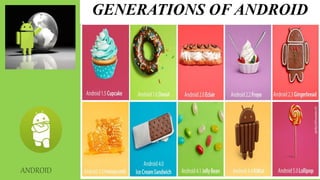
GENERATIONS OF ANDROID
ANDROID
What I am going to Discuss . . .
1. Foundation Of Android
2. What is Android ?
3. Architecture
4. What is OHA ?
5. Versions History Of Android
6. Features Of Android
7. Android Devices
8. Smart Phone OS Market Share-2014
9. Limitations
10. Conclusion and future scope
11. Reference
FOUNDATION OF ANDROID
Android, found in Palo Alto in California, United States
by Andy Rubin. - October 2003
Google acquired Android, Inc. – August 2005
The Open Handset Alliance, a group of several
companies was formed - 5 November 2007
Android Released–Initial released September 23, 2008.
What is Android?
Android is an operating system for
mobile devices such as smart phones
and tablet computers.
Based on the Linux kernel
Android specially developed for
applications. 1.3+ million apps(as of August 2014)
The Android is an open source.
ANDROID ARCHITECTURE
The software stack is split into Four Layers::
• The application layer
• The application framework
• The libraries and runtime
• The kernel
LINUX KERNEL
•The architecture is based on the Linux2.6 kernel.
• This layer is core of android architecture. It provides service like power
management, memory management, security etc.
• It helps in software or hardware binding for better communication.
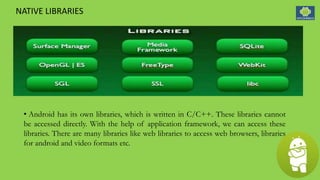
NATIVE LIBRARIES
• Android has its own libraries, which is written in C/C++. These libraries cannot
be accessed directly. With the help of application framework, we can access these
libraries. There are many libraries like web libraries to access web browsers, libraries
for android and video formats etc.
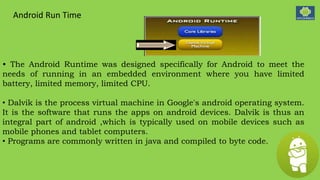
Android Run Time
• The Android Runtime was designed specifically for Android to meet the
needs of running in an embedded environment where you have limited
battery, limited memory, limited CPU.
• Dalvik is the process virtual machine in Google's android operating system.
It is the software that runs the apps on android devices. Dalvik is thus an
integral part of android ,which is typically used on mobile devices such as
mobile phones and tablet computers.
• Programs are commonly written in java and compiled to byte code.
Android Run Time
•This is in blue, meaning that it's written in the Java
programming language.
•The core library contains all of the collection classes, utilities,
IO, all the utilities and tools that you’ve come to expected to
use.
Application Framework
•This is all written in a Java programming language and the application
framework is the toolkit that all applications use.
•These applications include the ones that come with a phone like the home
applications, or the phone application.
•It includes applications written by Google, and it includes apps that will be
written by you.
•So, all apps use the same framework and the same APIs.
These are as follows:-
• Activity manager:-It manages the lifecycle of applications. It enable proper management of all the
activities. All the activities are controlled by activity manager.
•Resource manager:-It provides access to non-code resources such as graphics etc.
•Notification manager:-It enables all applications to display custom alerts in status bar.
•Location manager:- It fires alerts when user enters or leaves a specified geographical location.
• Package manager:-It is use to retrieve the data about installed packages on device.
• Window manager:-It is use to create views and layouts.
•Telephony manager:-It is use to handle settings of network connection and all information about
services on device.
CONTD…
APPLICATION LAYER
•the final layer on top is Applications.
•It includes the home application the contacts application , the browser,
and apps.
•It is the most upper layer in android architecture.
•All the applications like camera, Google maps, browser, sms , calendars ,
contacts are native applications. These applications works with end user
with the help of application framework to operate.
OHA (Open Handset Alliance)
What is the Open Handset Alliance (OHA)?
In 2007, a group of manufacturers,
wireless carriers & software developers
formed the “Open Handset Alliance”
OPEN HANDSET ALLIANCE cont.
Aim is to develop open standards for mobile devices
Members have promised not to lock their Android
phones
Members T-Mobile, HTC, LG, Motorola, Samsung,
Sony and many more . .
Nokia, Microsoft, RIM (BlackBerry) are only major
companies to not align with OHA
OPEN HANDSET ALLIANCE cont.
Members are:
 First full version of android.
 Released on September 23, 2008.
 Wi-Fi and Bluetooth support.
 Quite slow in operating.
 copy and paste feature in the web browser is
not present.
 First Version of Android.
 The focus of Android beta is testing incorporating usability.
 Android beta will generally have many more problems on speed and
performance.
 Released on April 30, 2009.
 Added auto-rotation option.
 Copy and Paste feature added in the web browser.
 Increased speed and performance but not upto
required level.
 Released on September 15, 2009.
 Voice search and Search box were added.
 Faster OS boot times and fast web browsing
experience.
 Typing is quite slower.
 Released on October 26, 2009.
 Bluetooth 2.1 support.
 Improved typing speed on virtual
keyboard, with smarter dictionary.
 no Adobe flash media support.
 Released on May 20, 2010.
 Support for Adobe Flash 10.1
 Improved Application launcher with better browser
 No internet calling.
 Released on December 6, 2010.
 Updated User Interface with high efficiency and speed
 Internet calling
 One touch word selection and copy/paste.
 New keyboard for faster word input.
 More successful version of Android than previous
versions.
 not supports multi-core processors.
 Released on February 22, 2011.
 Support for multi-core processors
 Ability to encrypt all user data.
 This version of android is only available for
tablets.
 Released on November 14, 2011.
 Virtual button in the UI.
 A new typeface family for the UI, Roboto.
 Ability to shut down apps that are using data in the
background.
 Released on June 27, 2012.
 Latest version of Android.
 Smoother user interface.
 Smarter and more simple.
 More polished design.
 Improved performance and new features
 Android 5.0 Lollipop
 A sweet new take on android .
 Getting the smarts of android on screens big and small with the right
information at right moment
Android kit-kat 4.4
FEATURES
Current features and specifications:
•Handset layouts
The platform is adaptable to larger, VGA, 2D graphics library,
3D graphics library based on OpenGL ES 3.0 specifications,
and traditional smart phone layouts.
•Connectivity
Android supports connectivity technologies including
GSM/EDGE, IDEN, CDMA, EV-DO, UMTS, Bluetooth, Wi-Fi,
LTE, NFC and WiMAX.
•Multiple language support
Android supports multiple languages.
•Media support
Android supports the following audio/video/still media
formats: MP3,MPEG-4, WMV,AVI,AAC, WAV, JPEG, PNG,
GIF, BMP etc.
•Screen capture
Android supports capturing a screenshot by pressing the
power and volume-down buttons at the same time.
FEATURES cont.
Current features and specifications:
•External storage
Most Android devices include micro SD slot and can read
micro SD cards formatted with FAT32, Ext3 or Ext4 file
system.
•Tethering
Android supports tethering, which allows a phone to be used
as a wireless Wi-Fi hotspot. Before Android 2.2 this was
supported by third-party applications or customizations
SMART PNONE OS
MARKET SHARE - 2014
ONLY FOR SMART PHONE ??
Manufacturers are making many devices not
limited only to Cell Phones.
Android OS is now running in :
• Cell Phones,
• Tablets,
• Android cars,
• HDTV,
• Desktop phones,
• Microwave oven,
• Washing machine,
• Set-top boxes for satellite and CableTV.
A Desktop Home or
Office phone running Android
ANDRIOD DEVICES cont.
World’s First HDTV that
runs on the Android
operating system
ANDRIOD DEVICES cont.
India's first Android based
Micro Oven.
World’s First Android Car
Roewe 350
 Making source code available to everyone inevitably invites the attention
of hackers.
 Android operating system uses more amount of battery as compared to
normal mobile phones.
 As there are so many user sometimes it becomes difficult to connect all the
users.
 As we call Android is world of applications we continuously need to
connected with the internet which is not possible for all the users.
LIMITATIONS
 Android is now stepping up in next level of mobile internet.
 There are chances of Android Mobile sales becomes more than
iPhone in next two years.
 Google may launch another version of android that starts “M”
because Google is launching all the android versions in the
alphabetical order.
 There are chances of Android may become the widely used
operating system in world.
REFERENCE :
http://en.wikipedia.org/wiki/Android_%28operating_system%29
http://www.slideshare.net/search/slideshow?searchfrom=header
&q=android+tutorial
http://readwrite.com/2013/04/08/the-developers-guide-to-
android-history-infographic#awesm=~ocx3EhN3rqzNc4s
http://collaboratemeetings.com/2013/04/09/tech-androids-rise/
http://androidcompare.com/devices.html
Android

Android

  • 1.
    ANDROID Submitted To: Subashinimam Submitted By: Sudhakar Shastri Reg No: 14MCE1009
  • 2.
  • 3.
    What I amgoing to Discuss . . . 1. Foundation Of Android 2. What is Android ? 3. Architecture 4. What is OHA ? 5. Versions History Of Android 6. Features Of Android 7. Android Devices 8. Smart Phone OS Market Share-2014 9. Limitations 10. Conclusion and future scope 11. Reference
  • 4.
    FOUNDATION OF ANDROID Android,found in Palo Alto in California, United States by Andy Rubin. - October 2003 Google acquired Android, Inc. – August 2005 The Open Handset Alliance, a group of several companies was formed - 5 November 2007 Android Released–Initial released September 23, 2008.
  • 5.
    What is Android? Androidis an operating system for mobile devices such as smart phones and tablet computers. Based on the Linux kernel Android specially developed for applications. 1.3+ million apps(as of August 2014) The Android is an open source.
  • 6.
    ANDROID ARCHITECTURE The softwarestack is split into Four Layers:: • The application layer • The application framework • The libraries and runtime • The kernel
  • 8.
    LINUX KERNEL •The architectureis based on the Linux2.6 kernel. • This layer is core of android architecture. It provides service like power management, memory management, security etc. • It helps in software or hardware binding for better communication.
  • 9.
    NATIVE LIBRARIES • Androidhas its own libraries, which is written in C/C++. These libraries cannot be accessed directly. With the help of application framework, we can access these libraries. There are many libraries like web libraries to access web browsers, libraries for android and video formats etc.
  • 10.
    Android Run Time •The Android Runtime was designed specifically for Android to meet the needs of running in an embedded environment where you have limited battery, limited memory, limited CPU. • Dalvik is the process virtual machine in Google's android operating system. It is the software that runs the apps on android devices. Dalvik is thus an integral part of android ,which is typically used on mobile devices such as mobile phones and tablet computers. • Programs are commonly written in java and compiled to byte code.
  • 11.
    Android Run Time •Thisis in blue, meaning that it's written in the Java programming language. •The core library contains all of the collection classes, utilities, IO, all the utilities and tools that you’ve come to expected to use.
  • 12.
    Application Framework •This isall written in a Java programming language and the application framework is the toolkit that all applications use. •These applications include the ones that come with a phone like the home applications, or the phone application. •It includes applications written by Google, and it includes apps that will be written by you. •So, all apps use the same framework and the same APIs.
  • 13.
    These are asfollows:- • Activity manager:-It manages the lifecycle of applications. It enable proper management of all the activities. All the activities are controlled by activity manager. •Resource manager:-It provides access to non-code resources such as graphics etc. •Notification manager:-It enables all applications to display custom alerts in status bar. •Location manager:- It fires alerts when user enters or leaves a specified geographical location. • Package manager:-It is use to retrieve the data about installed packages on device. • Window manager:-It is use to create views and layouts. •Telephony manager:-It is use to handle settings of network connection and all information about services on device. CONTD…
  • 14.
    APPLICATION LAYER •the finallayer on top is Applications. •It includes the home application the contacts application , the browser, and apps. •It is the most upper layer in android architecture. •All the applications like camera, Google maps, browser, sms , calendars , contacts are native applications. These applications works with end user with the help of application framework to operate.
  • 15.
    OHA (Open HandsetAlliance) What is the Open Handset Alliance (OHA)? In 2007, a group of manufacturers, wireless carriers & software developers formed the “Open Handset Alliance”
  • 16.
    OPEN HANDSET ALLIANCEcont. Aim is to develop open standards for mobile devices Members have promised not to lock their Android phones Members T-Mobile, HTC, LG, Motorola, Samsung, Sony and many more . . Nokia, Microsoft, RIM (BlackBerry) are only major companies to not align with OHA
  • 17.
    OPEN HANDSET ALLIANCEcont. Members are:
  • 18.
     First fullversion of android.  Released on September 23, 2008.  Wi-Fi and Bluetooth support.  Quite slow in operating.  copy and paste feature in the web browser is not present.  First Version of Android.  The focus of Android beta is testing incorporating usability.  Android beta will generally have many more problems on speed and performance.
  • 19.
     Released onApril 30, 2009.  Added auto-rotation option.  Copy and Paste feature added in the web browser.  Increased speed and performance but not upto required level.  Released on September 15, 2009.  Voice search and Search box were added.  Faster OS boot times and fast web browsing experience.  Typing is quite slower.  Released on October 26, 2009.  Bluetooth 2.1 support.  Improved typing speed on virtual keyboard, with smarter dictionary.  no Adobe flash media support.
  • 20.
     Released onMay 20, 2010.  Support for Adobe Flash 10.1  Improved Application launcher with better browser  No internet calling.  Released on December 6, 2010.  Updated User Interface with high efficiency and speed  Internet calling  One touch word selection and copy/paste.  New keyboard for faster word input.  More successful version of Android than previous versions.  not supports multi-core processors.  Released on February 22, 2011.  Support for multi-core processors  Ability to encrypt all user data.  This version of android is only available for tablets.
  • 21.
     Released onNovember 14, 2011.  Virtual button in the UI.  A new typeface family for the UI, Roboto.  Ability to shut down apps that are using data in the background.  Released on June 27, 2012.  Latest version of Android.  Smoother user interface.
  • 22.
     Smarter andmore simple.  More polished design.  Improved performance and new features  Android 5.0 Lollipop  A sweet new take on android .  Getting the smarts of android on screens big and small with the right information at right moment Android kit-kat 4.4
  • 23.
    FEATURES Current features andspecifications: •Handset layouts The platform is adaptable to larger, VGA, 2D graphics library, 3D graphics library based on OpenGL ES 3.0 specifications, and traditional smart phone layouts. •Connectivity Android supports connectivity technologies including GSM/EDGE, IDEN, CDMA, EV-DO, UMTS, Bluetooth, Wi-Fi, LTE, NFC and WiMAX. •Multiple language support Android supports multiple languages. •Media support Android supports the following audio/video/still media formats: MP3,MPEG-4, WMV,AVI,AAC, WAV, JPEG, PNG, GIF, BMP etc.
  • 24.
    •Screen capture Android supportscapturing a screenshot by pressing the power and volume-down buttons at the same time. FEATURES cont. Current features and specifications: •External storage Most Android devices include micro SD slot and can read micro SD cards formatted with FAT32, Ext3 or Ext4 file system. •Tethering Android supports tethering, which allows a phone to be used as a wireless Wi-Fi hotspot. Before Android 2.2 this was supported by third-party applications or customizations
  • 25.
  • 26.
    ONLY FOR SMARTPHONE ?? Manufacturers are making many devices not limited only to Cell Phones. Android OS is now running in : • Cell Phones, • Tablets, • Android cars, • HDTV, • Desktop phones, • Microwave oven, • Washing machine, • Set-top boxes for satellite and CableTV.
  • 27.
    A Desktop Homeor Office phone running Android ANDRIOD DEVICES cont. World’s First HDTV that runs on the Android operating system
  • 28.
    ANDRIOD DEVICES cont. India'sfirst Android based Micro Oven. World’s First Android Car Roewe 350
  • 29.
     Making sourcecode available to everyone inevitably invites the attention of hackers.  Android operating system uses more amount of battery as compared to normal mobile phones.  As there are so many user sometimes it becomes difficult to connect all the users.  As we call Android is world of applications we continuously need to connected with the internet which is not possible for all the users. LIMITATIONS
  • 30.
     Android isnow stepping up in next level of mobile internet.  There are chances of Android Mobile sales becomes more than iPhone in next two years.  Google may launch another version of android that starts “M” because Google is launching all the android versions in the alphabetical order.  There are chances of Android may become the widely used operating system in world.
  • 31.