TEACHER -- SALIMOV VAGIF
PREPARED BY -- MIRZEZADE ORKHAN
FACULTY -- ITIF
SPECIALITY -- INFORMATION TECHNOLOGY
GROUP -- 682.23E
ANDROID OS
Content
02. Origin of Android
07. Comparisons with
other OS
05. Architecture
01. Introduction
03. Open Handset
Alliance (OHA) 04. Features and Versions
08. Limitations
06. Application
Development
?
 Android is Linux based operating system
designed primarily for mobile devices such
as smartphones and tablets.
 Android was first developed as a ADVANCE
OPERATING SYSTEM for digital cameras.
 There are more than 4,00,000 apps in
android market
 And, android is an open source.
INTRODUCTION
What is android
?
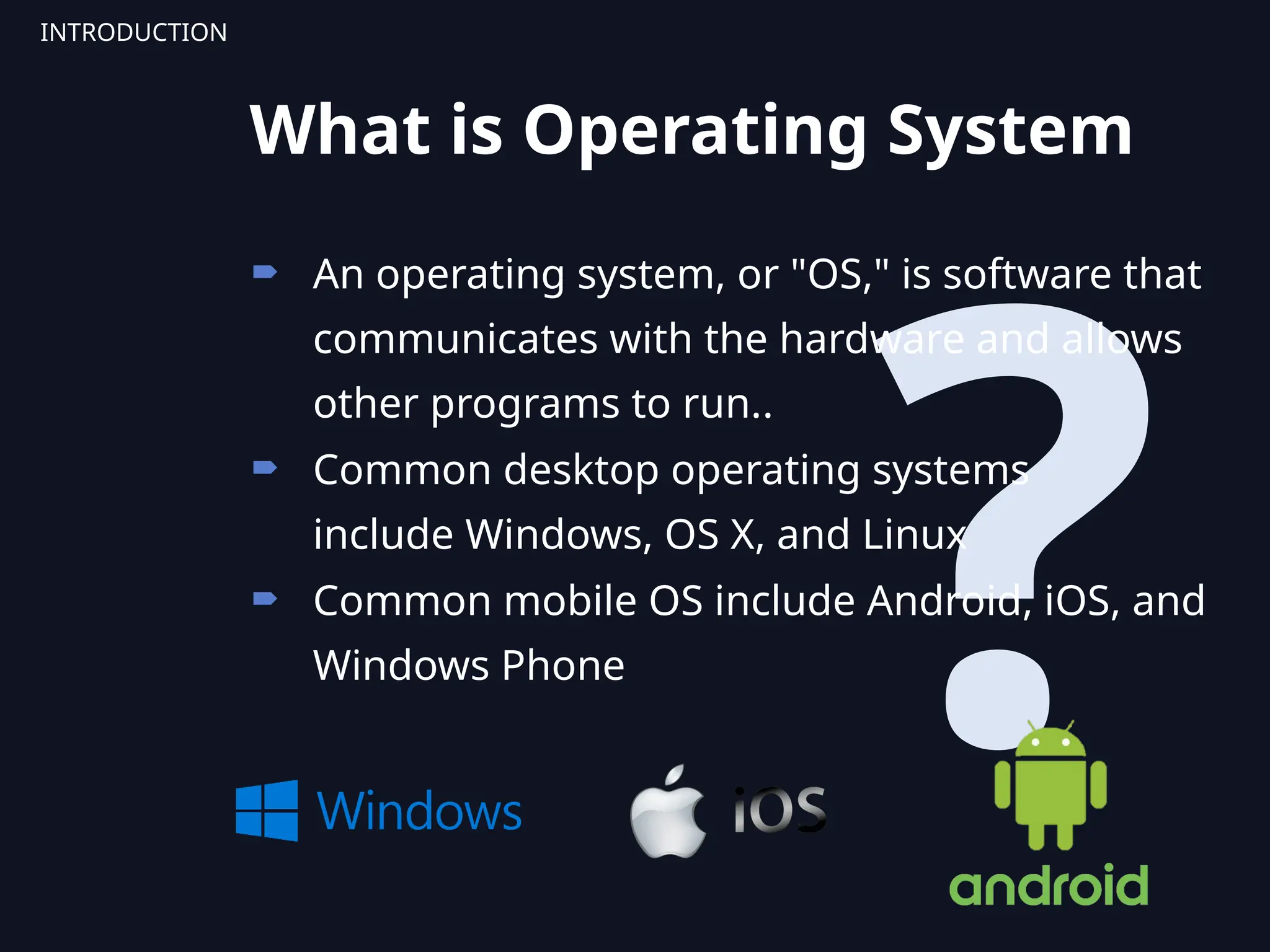
 An operating system, or "OS," is software that
communicates with the hardware and allows
other programs to run..
 Common desktop operating systems
include Windows, OS X, and Linux
 Common mobile OS include Android, iOS, and
Windows Phone
INTRODUCTION
What is Operating System
An operating system, or "OS," is software that
communicates with the hardware and allows
other programs to run..
Common desktop operating systems
include Windows, OS X, and Linux
Common mobile OS include Android, iOS, and
Windows Phone
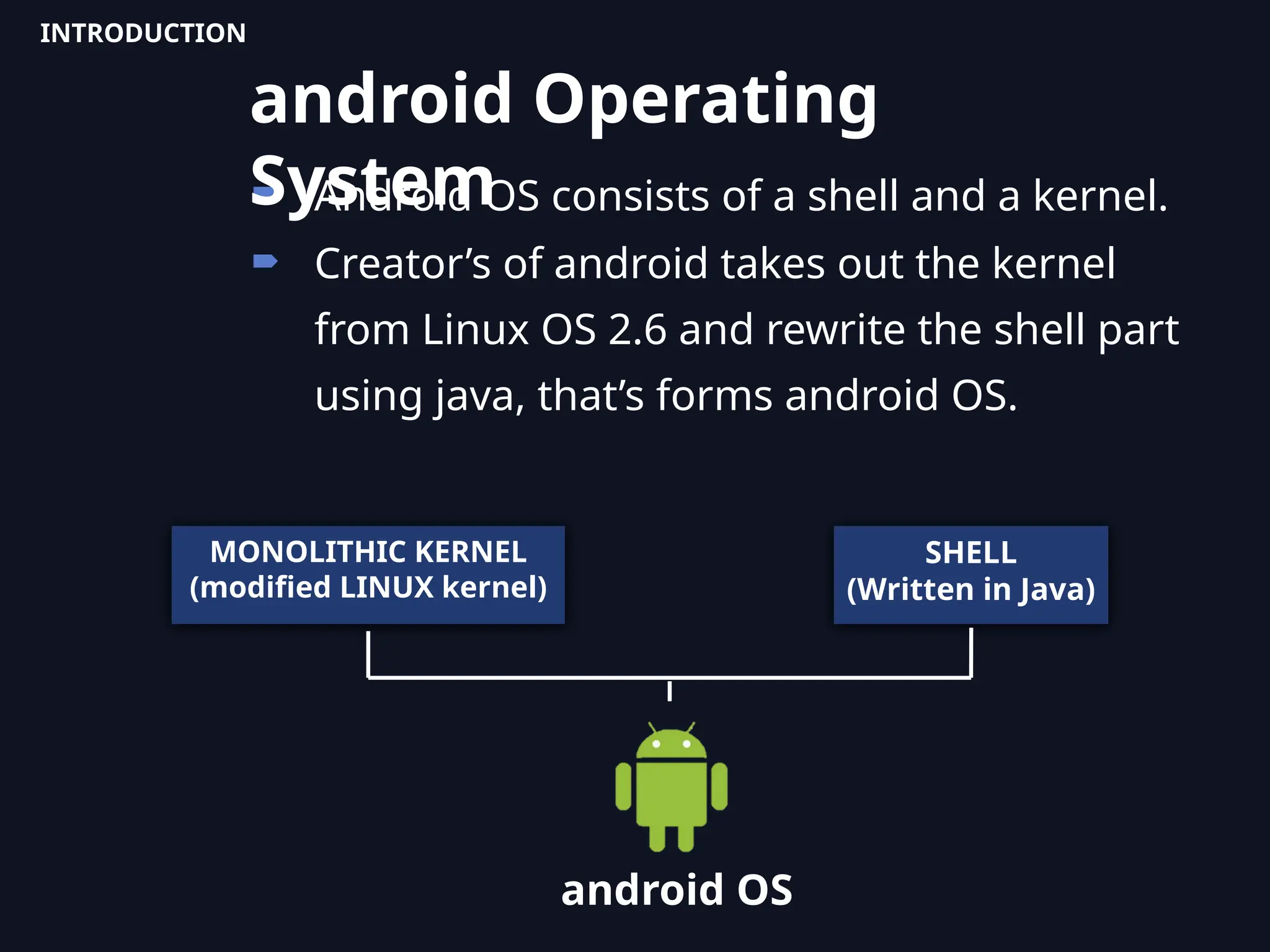
 Android OS consists of a shell and a kernel.
 Creator’s of android takes out the kernel
from Linux OS 2.6 and rewrite the shell part
using java, that’s forms android OS.
MONOLITHIC KERNEL
(modified LINUX kernel)
SHELL
(Written in Java)
android OS
android Operating
System
INTRODUCTION
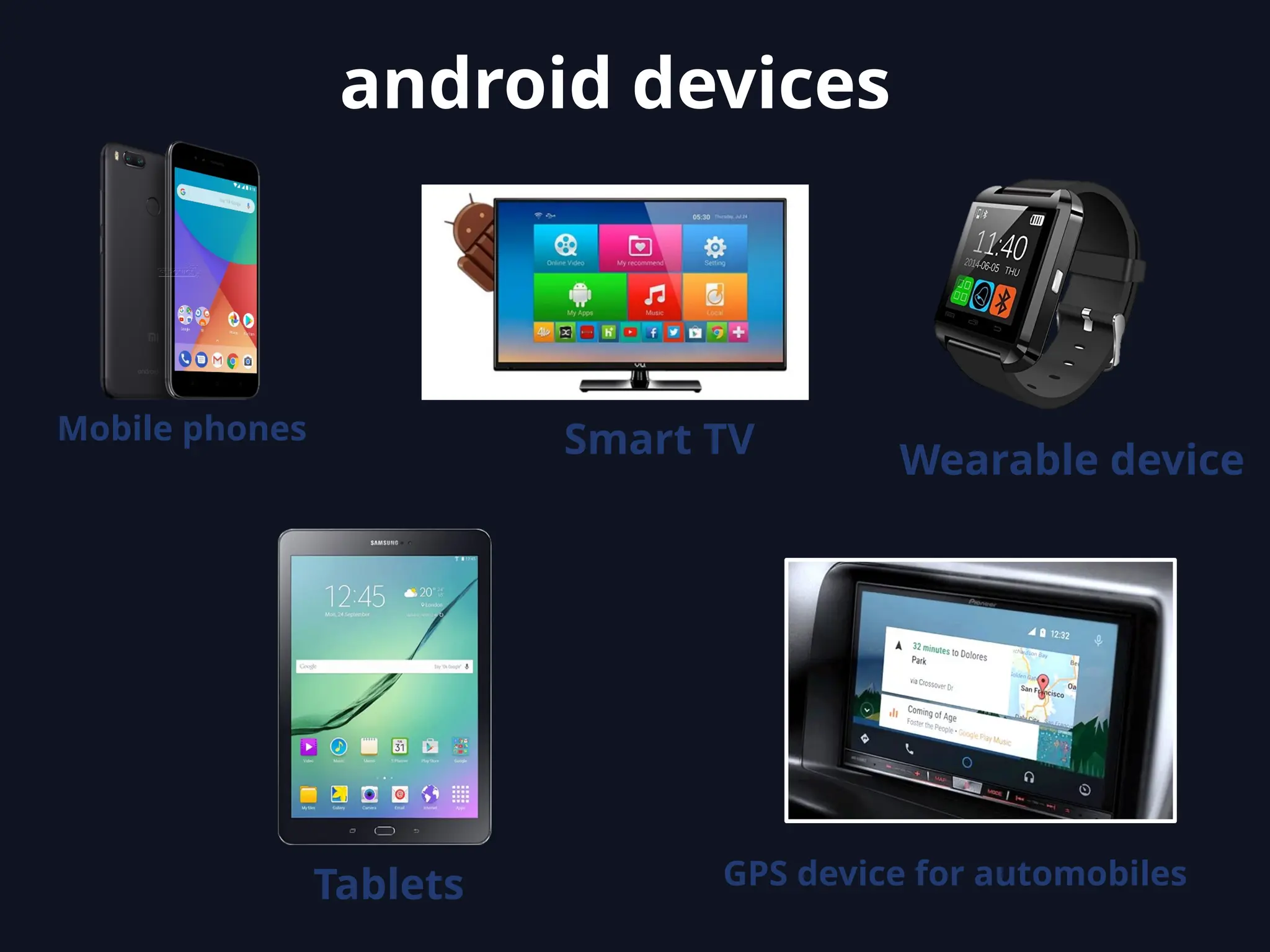
Mobile phones Smart TV Wearable device
Tablets GPS device for automobiles
android devices
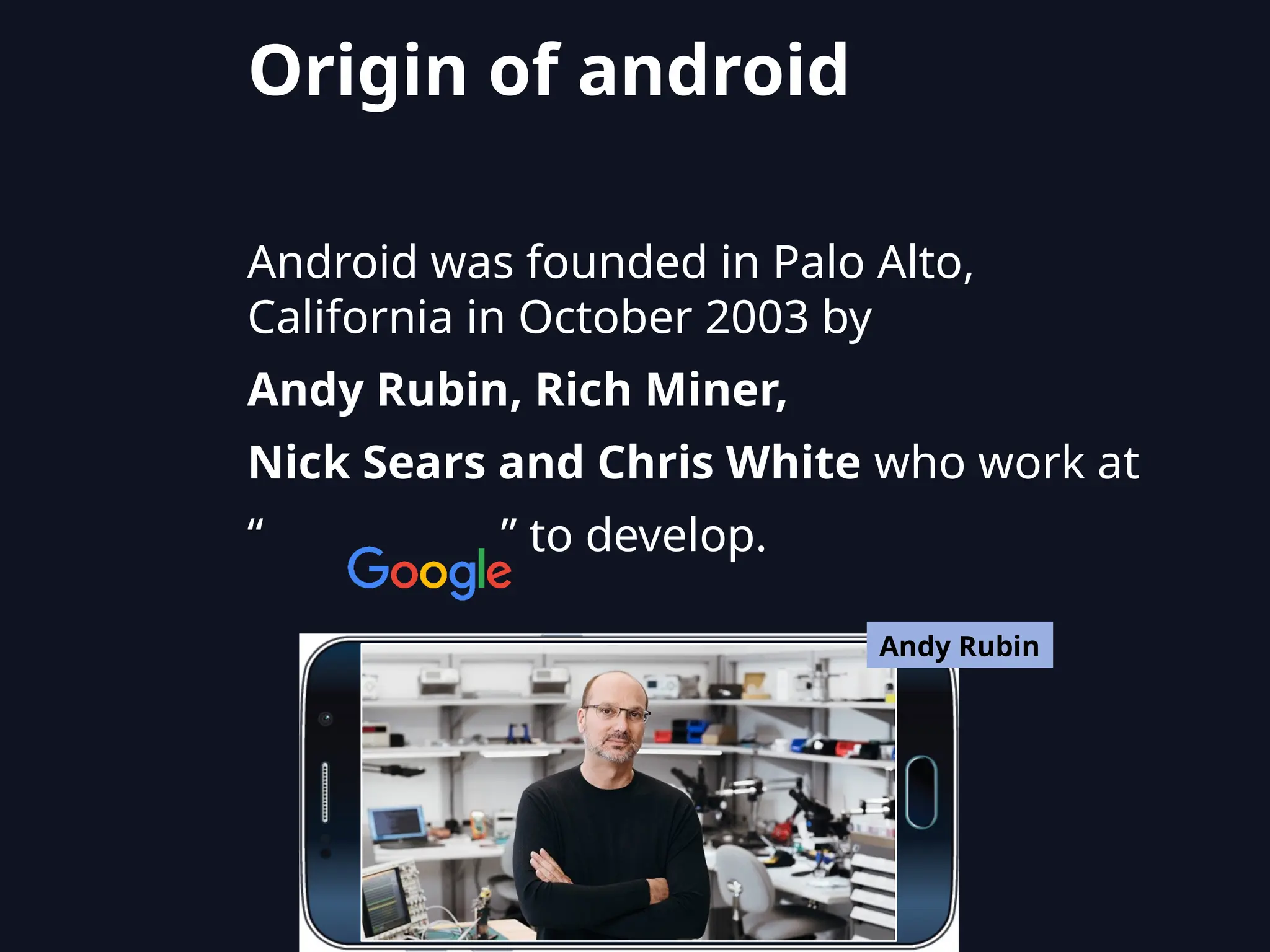
Android was founded in Palo Alto,
California in October 2003 by
Andy Rubin, Rich Miner,
Nick Sears and Chris White who work at
“ ” to develop.
Andy Rubin
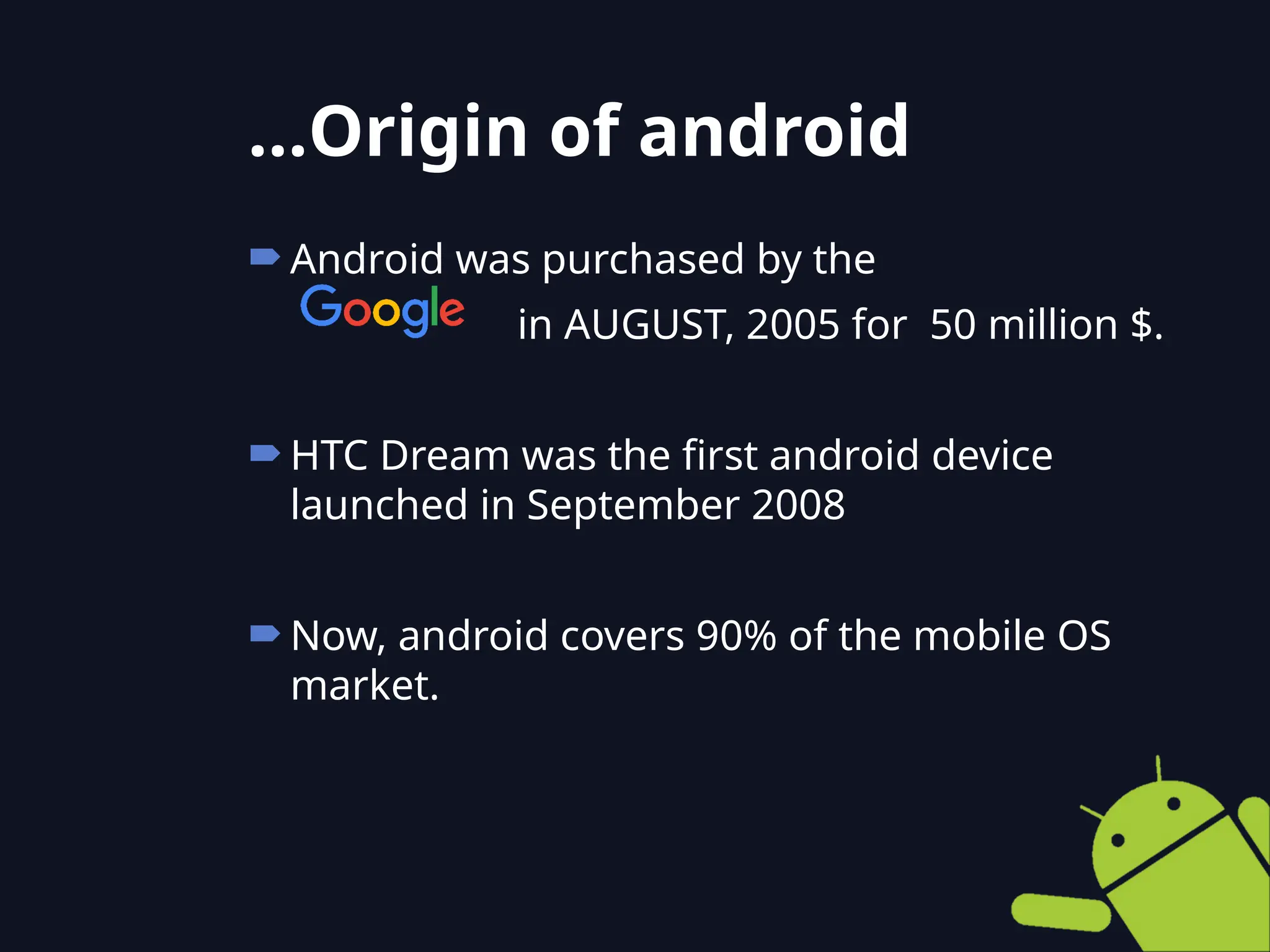
Origin of android
Android was purchased by the
in AUGUST, 2005 for 50 million $.
HTC Dream was the first android device
launched in September 2008
Now, android covers 90% of the mobile OS
market.
…Origin of android
It’s consortium of several companies.
 OHA is a business alliance of firm to develop
open standard for mobile device.
OHA includes 84 firms to develop open
standard for mobile devices, i.e.
HTC, Sony, Dell, Intel, Motorola, QUALCOMM, G
oogle, Samsung Electronics, LG Electronics, T-
Mobile, NVidias
Reason for Nokia not to develop Android
Mobiles is Nokia is not part of OHA
Open Handset Alliance (OHA)
Android supports wireless communication
using:-
3G Networks, 4G Networks, 802.11 Wi-Fi
Networks, Bluetooth Connectivity
Developing an android application is not
tough ,using SDK and java emulator we can
easily develop applications that we want.
Open source – Free development platform
Built in services like GPS,SQL Database,
browser and maps
Portability across current and future
hardware
Features
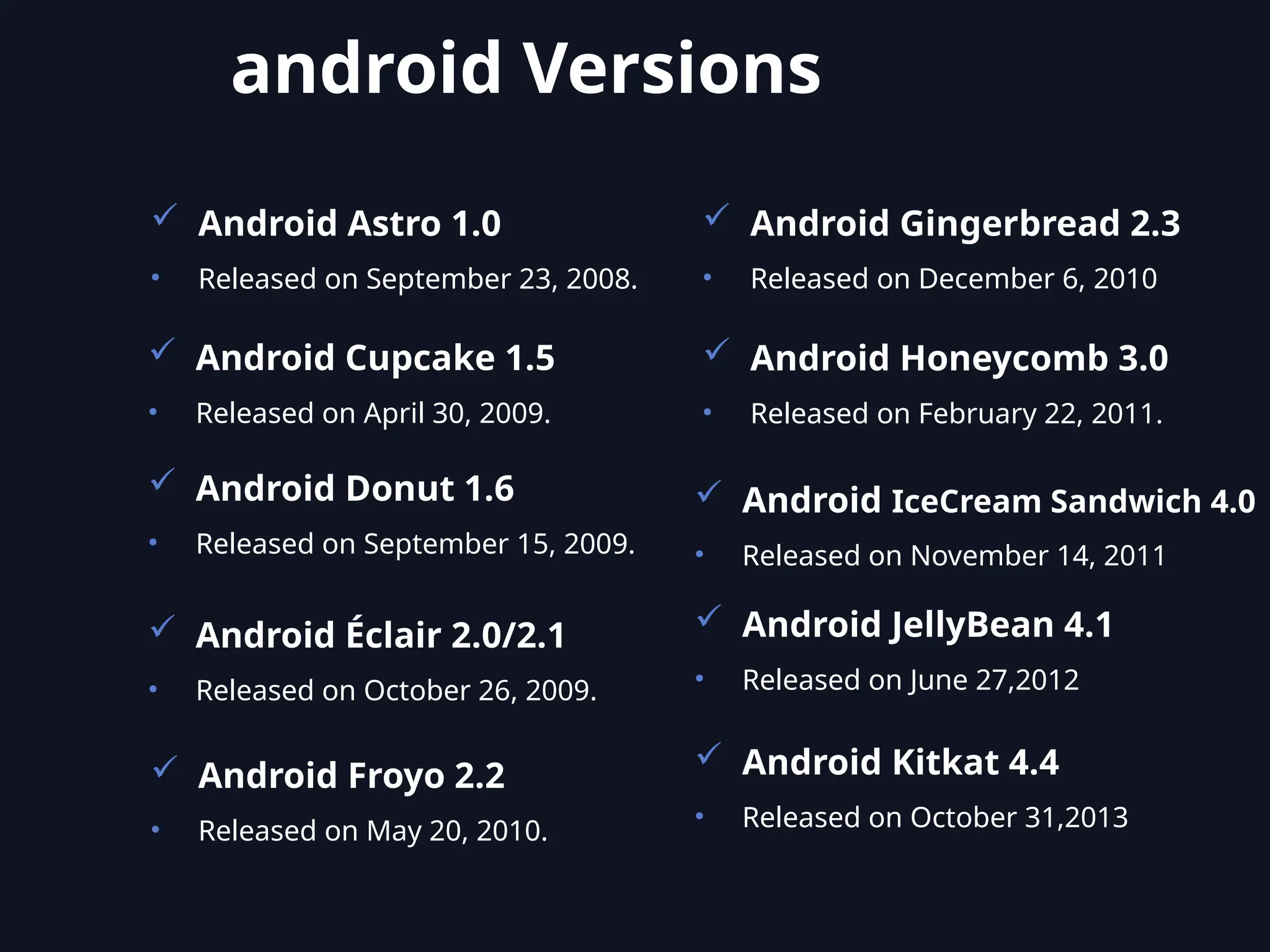
 Android Astro 1.0
• Released on September 23, 2008.
 Android Cupcake 1.5
• Released on April 30, 2009.
 Android Donut 1.6
• Released on September 15, 2009.
 Android Éclair 2.0/2.1
• Released on October 26, 2009.
 Android Froyo 2.2
• Released on May 20, 2010.
 Android Honeycomb 3.0
• Released on February 22, 2011.
 Android IceCream Sandwich 4.0
• Released on November 14, 2011
 Android JellyBean 4.1
• Released on June 27,2012
 Android Kitkat 4.4
• Released on October 31,2013
 Android Gingerbread 2.3
• Released on December 6, 2010
android Versions
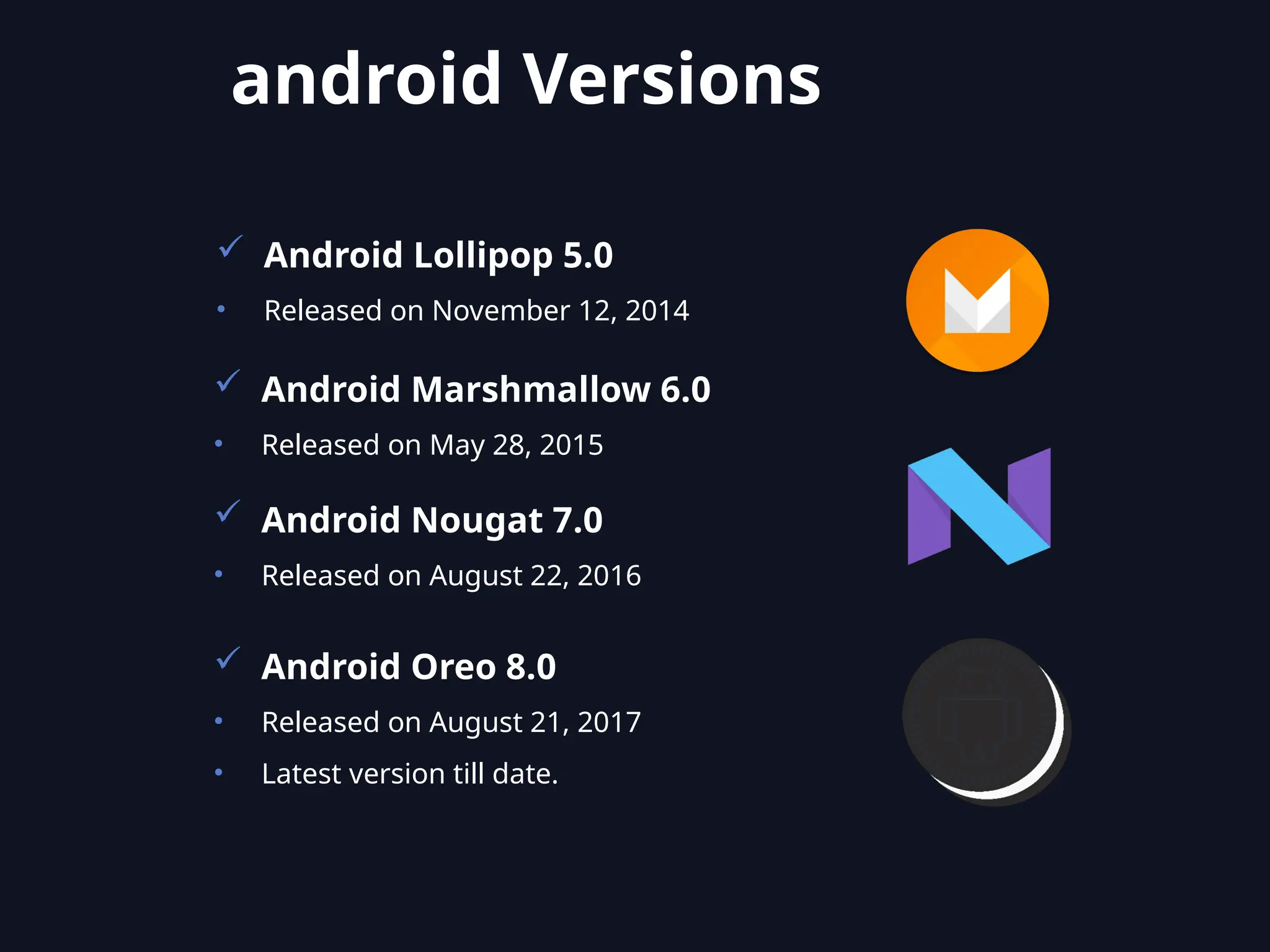
 Android Lollipop 5.0
• Released on November 12, 2014
 Android Marshmallow 6.0
• Released on May 28, 2015
 Android Nougat 7.0
• Released on August 22, 2016
 Android Oreo 8.0
• Released on August 21, 2017
• Latest version till date.
android Versions
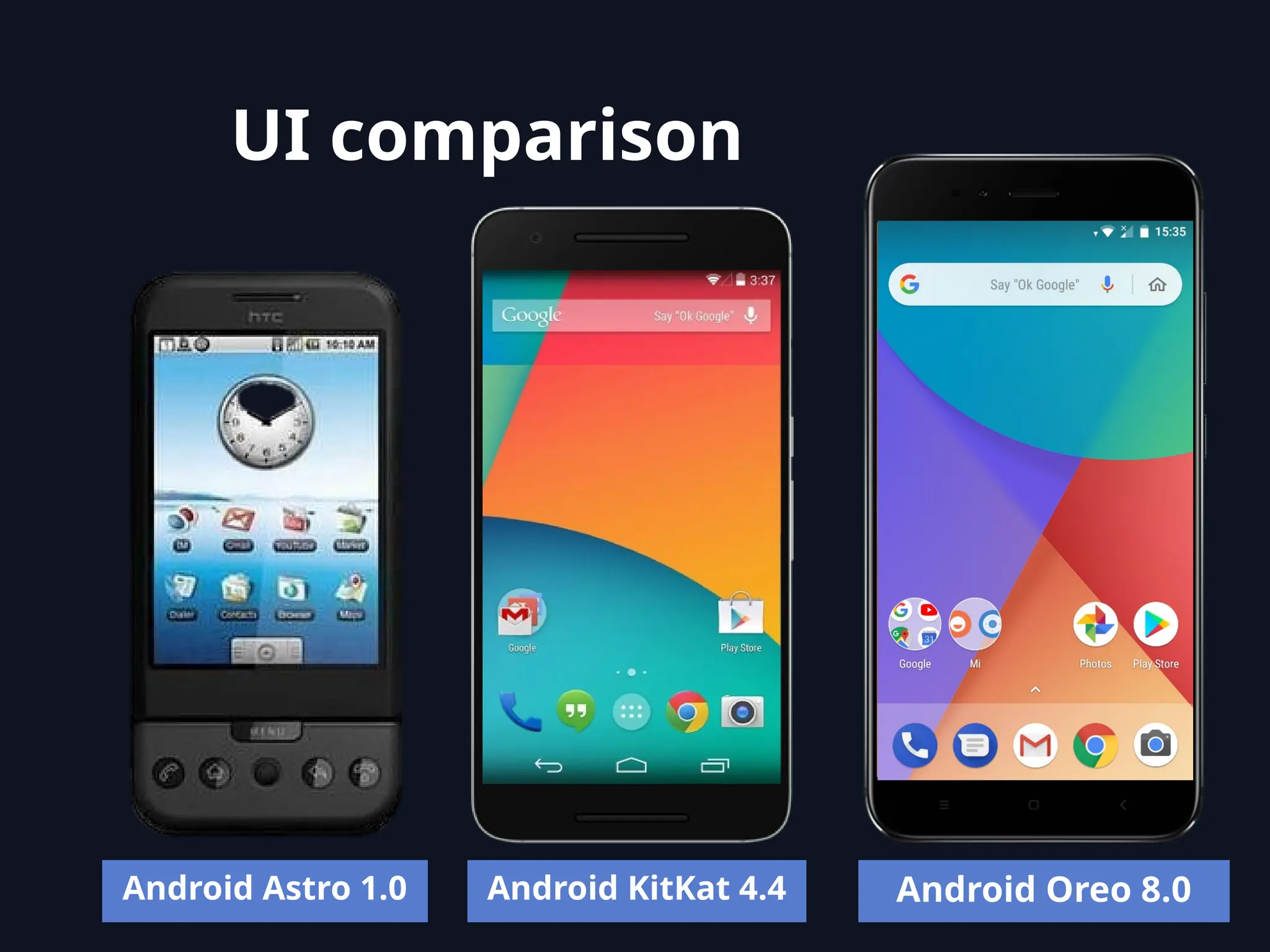
Android Oreo 8.0
Android Astro 1.0 Android KitKat 4.4
UI comparison
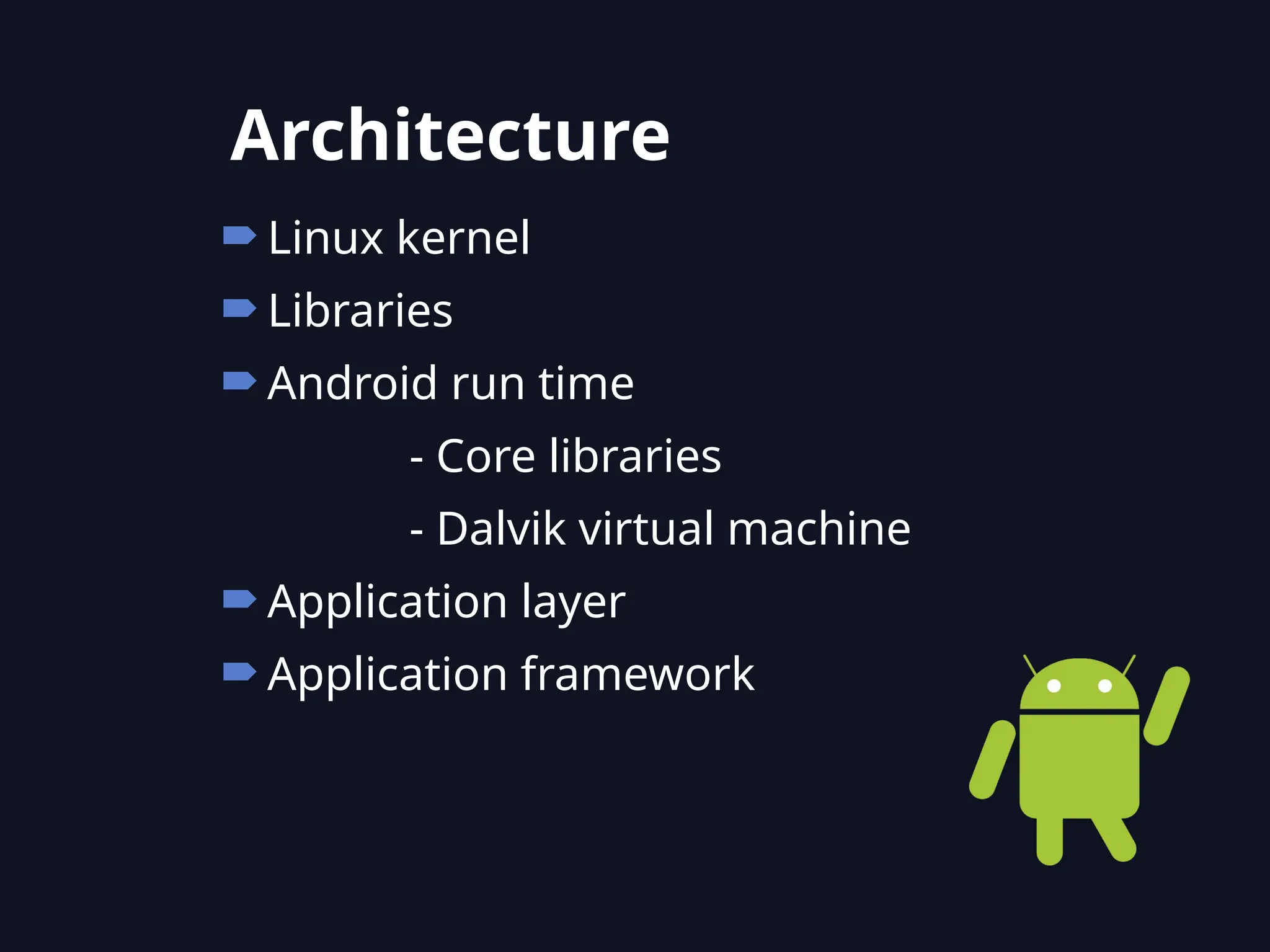
Linux kernel
Libraries
Android run time
- Core libraries
- Dalvik virtual machine
Application layer
Application framework
Architecture
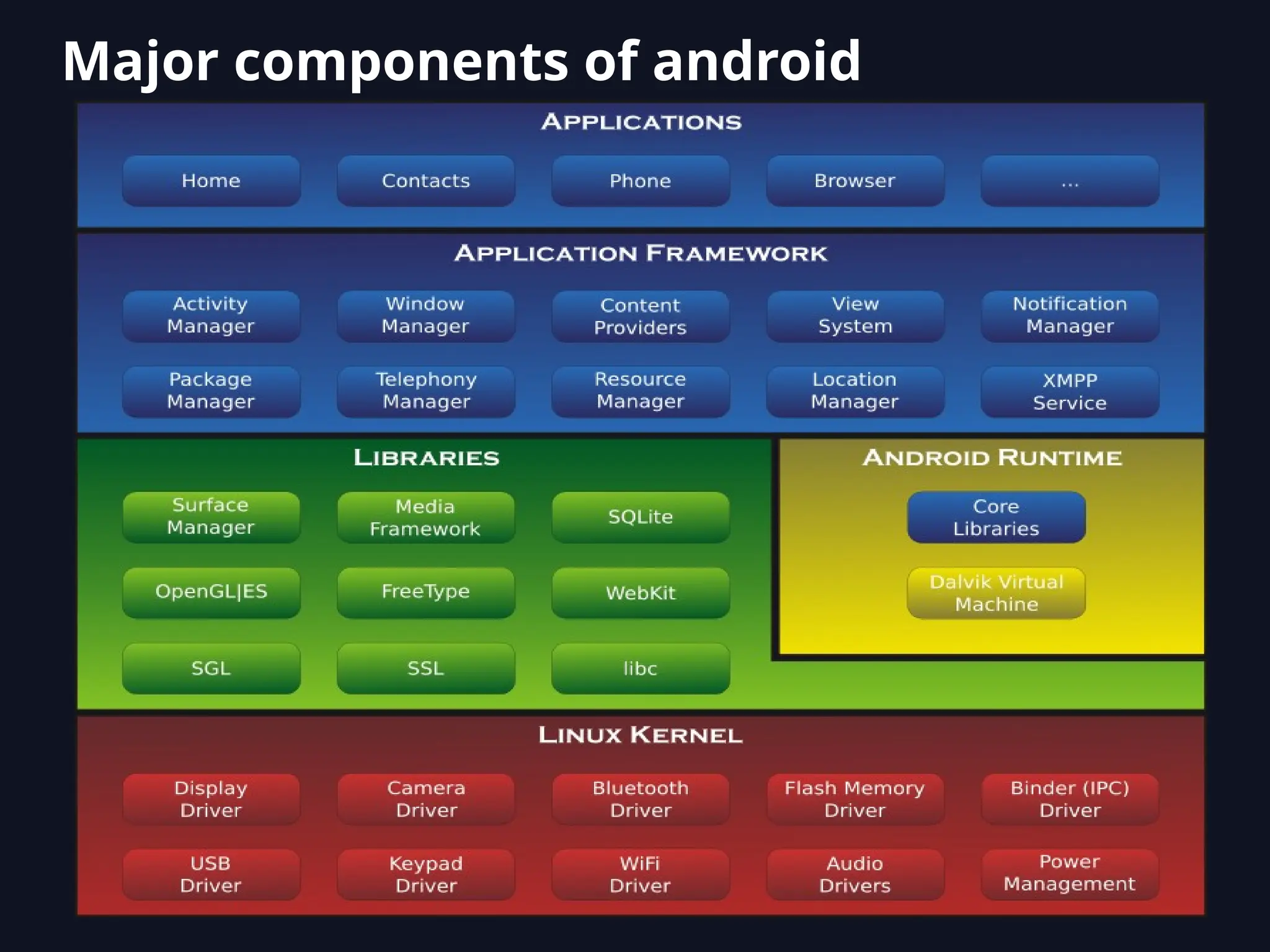
Major components of android
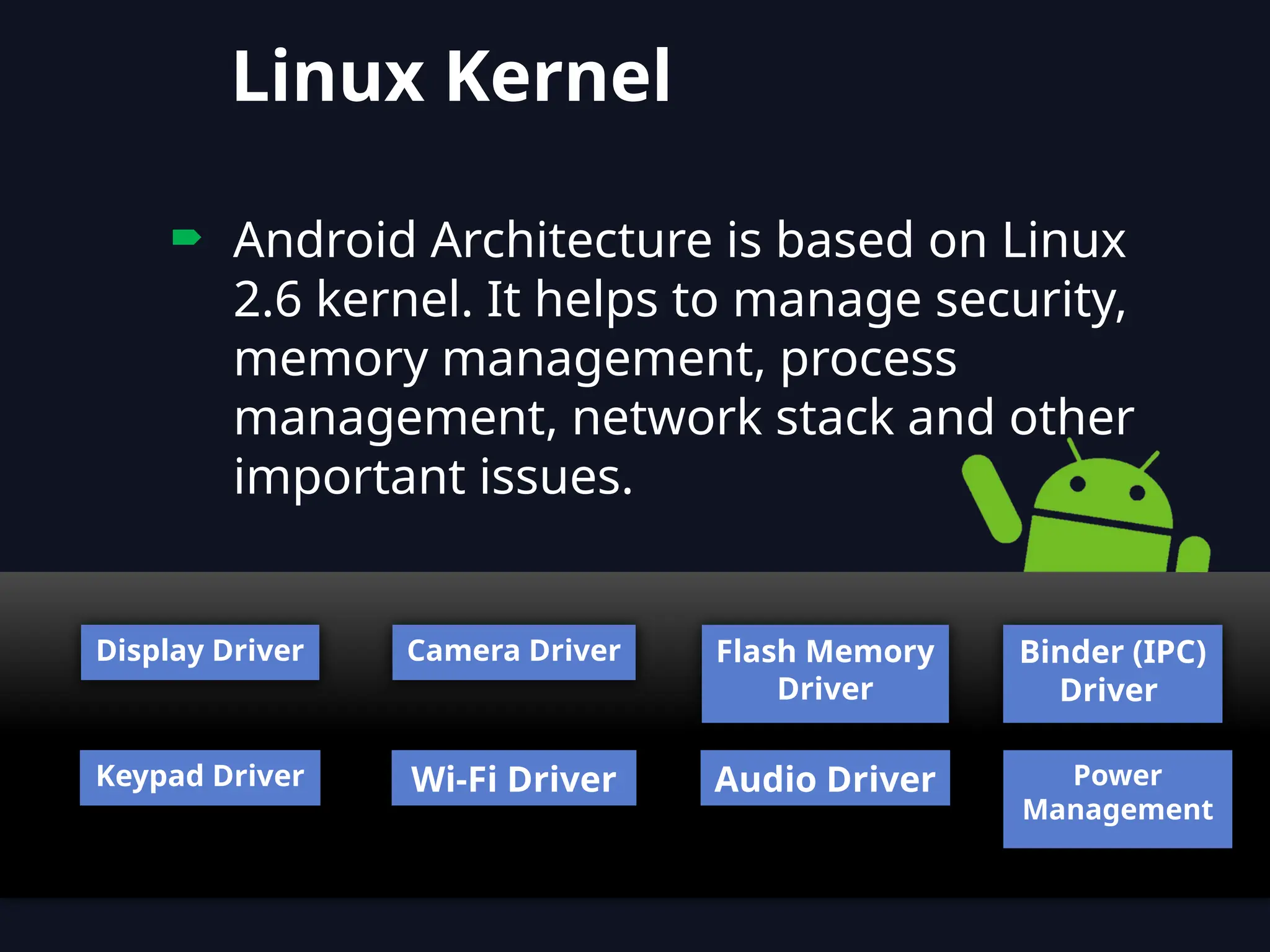
 Android Architecture is based on Linux
2.6 kernel. It helps to manage security,
memory management, process
management, network stack and other
important issues.
Display Driver
Keypad Driver
Camera Driver
Wi-Fi Driver
Flash Memory
Driver
Audio Driver
Binder (IPC)
Driver
Power
Management
Linux Kernel
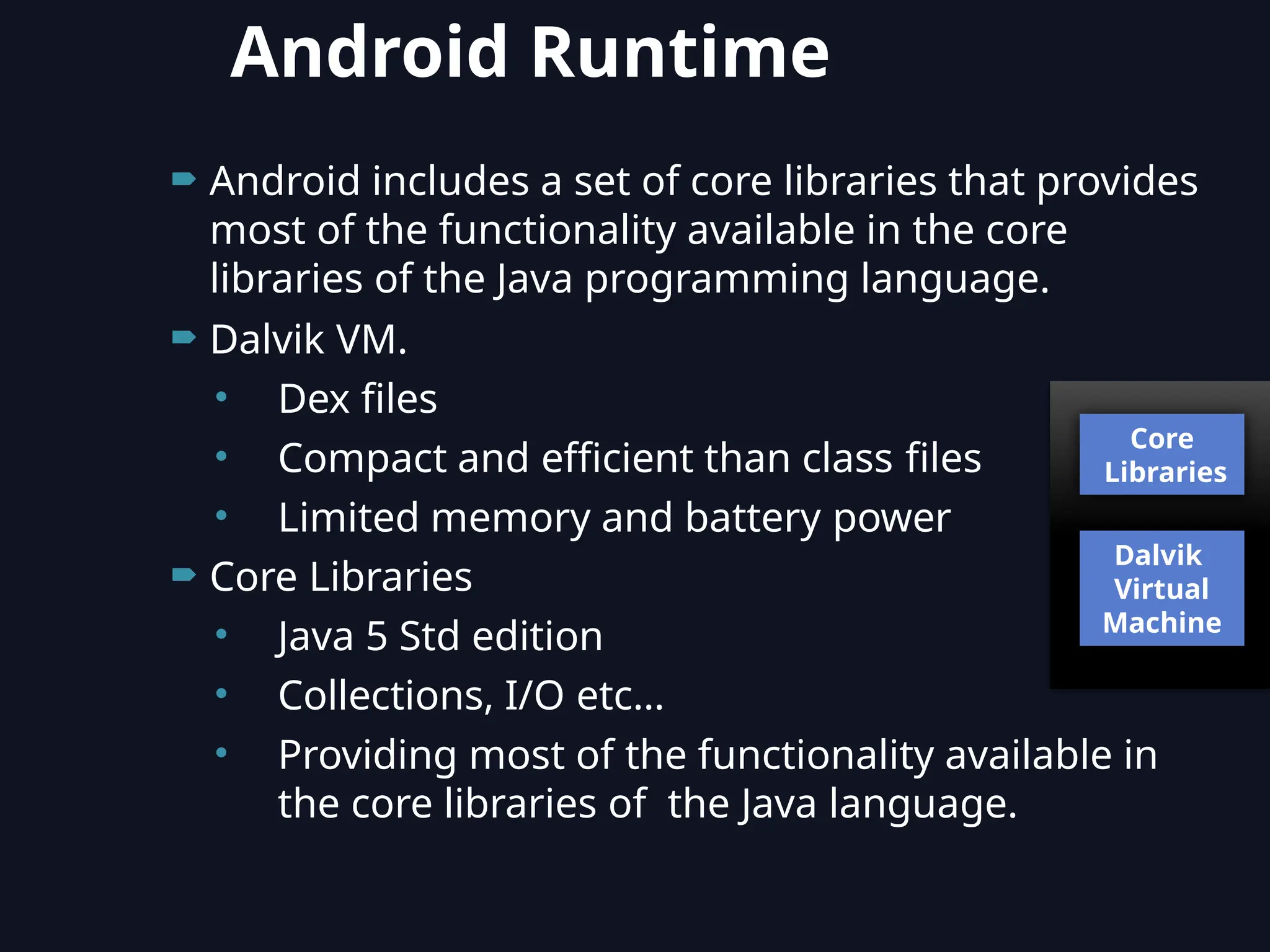
 Android includes a set of core libraries that provides
most of the functionality available in the core
libraries of the Java programming language.
 Dalvik VM.
• Dex files
• Compact and efficient than class files
• Limited memory and battery power
 Core Libraries
• Java 5 Std edition
• Collections, I/O etc…
• Providing most of the functionality available in
the core libraries of the Java language.
Core
Libraries
Dalvik
Virtual
Machine
Android Runtime
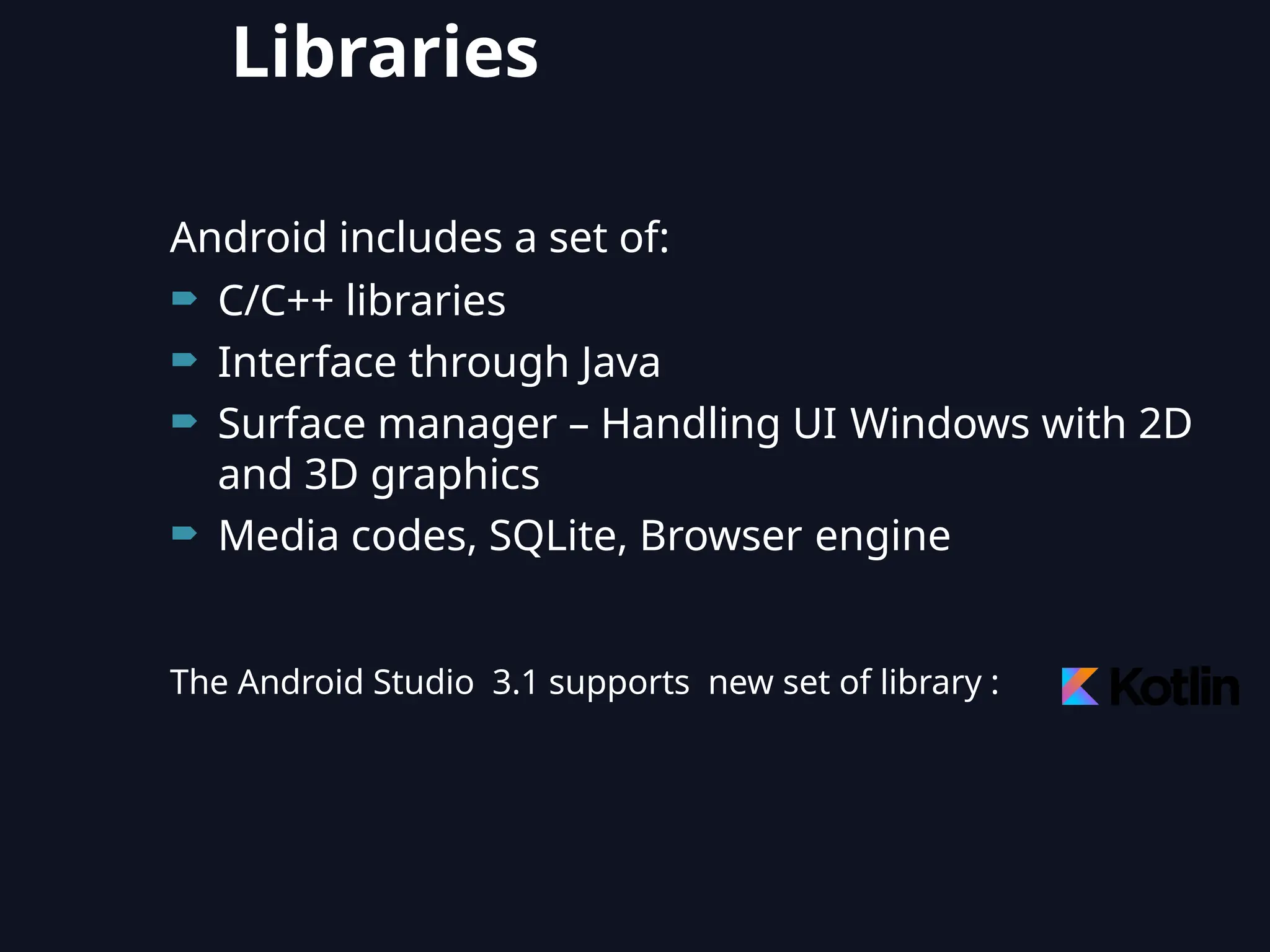
Android includes a set of:
 C/C++ libraries
 Interface through Java
 Surface manager – Handling UI Windows with 2D
and 3D graphics
 Media codes, SQLite, Browser engine
The Android Studio 3.1 supports new set of library :
Libraries
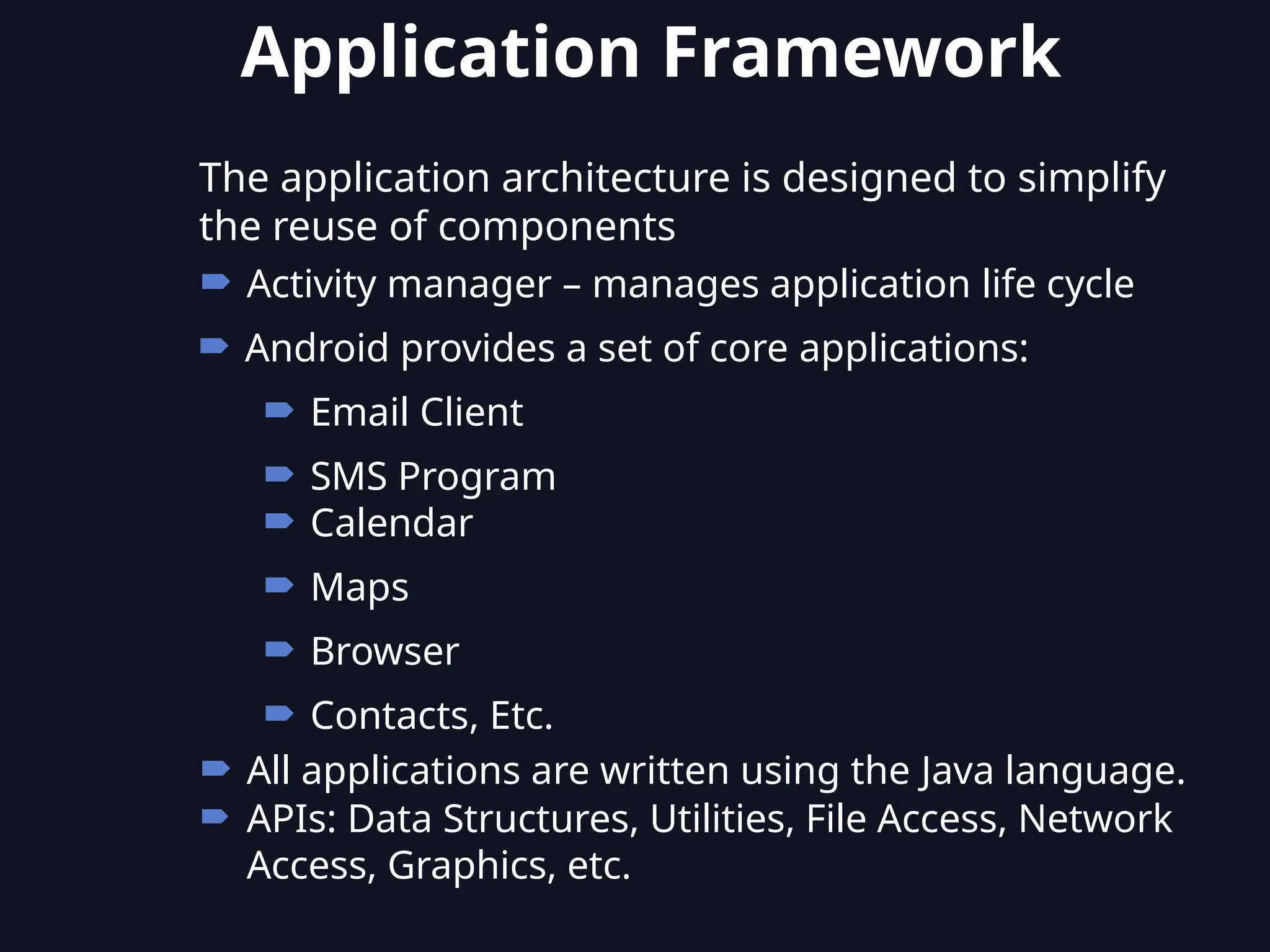
The application architecture is designed to simplify
the reuse of components
 Activity manager – manages application life cycle
 Android provides a set of core applications:
 Email Client
 SMS Program
 Calendar
 Maps
 Browser
 Contacts, Etc.
 All applications are written using the Java language.
 APIs: Data Structures, Utilities, File Access, Network
Access, Graphics, etc.
Application Framework
Android
Emulator
Android
Mobile
Device
Android
SDK
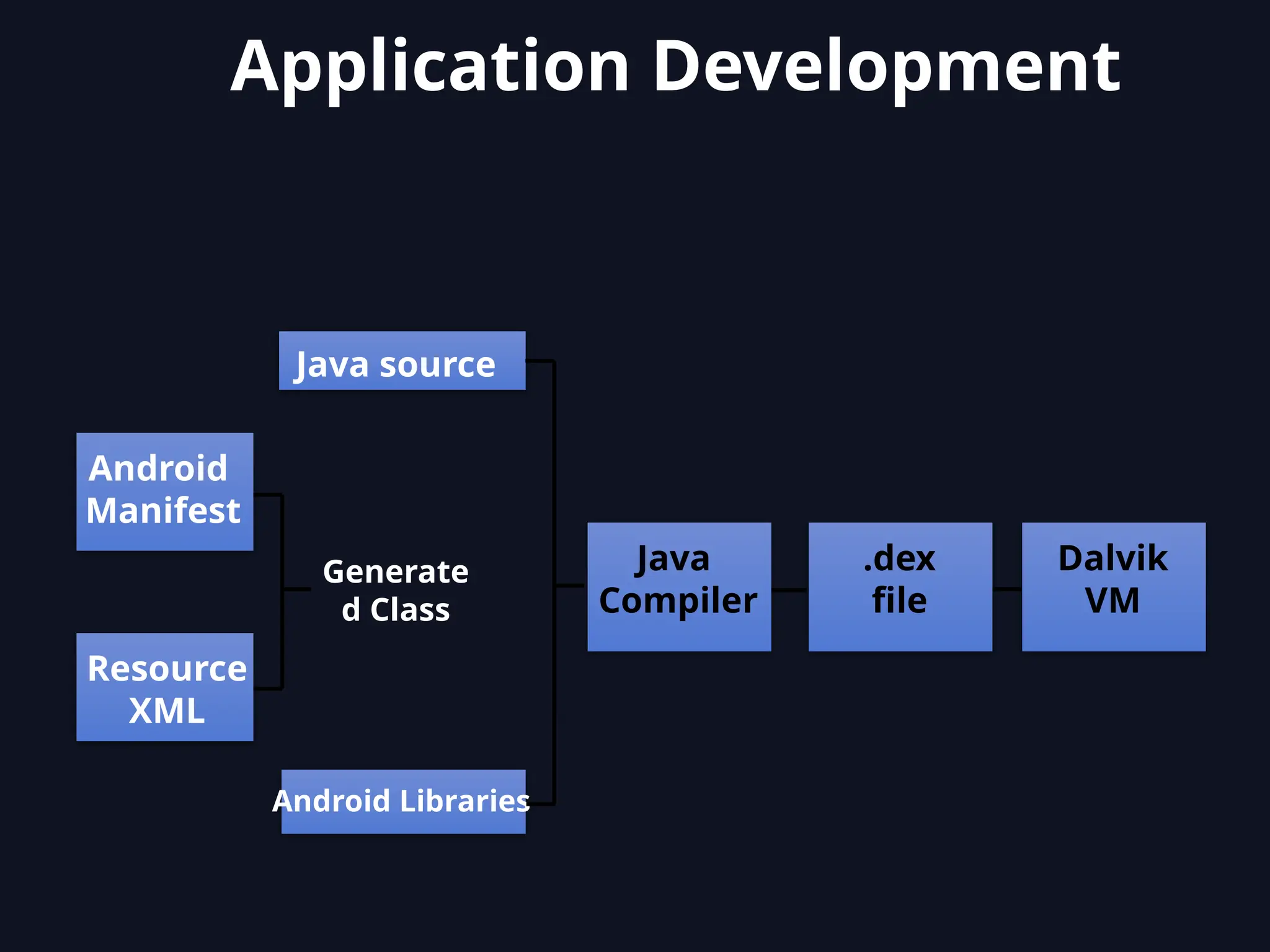
Application Development
Android
Manifest
Java source
Java
Compiler
Resource
XML
Android Libraries
.dex
file
Dalvik
VM
Generate
d Class
Application Development
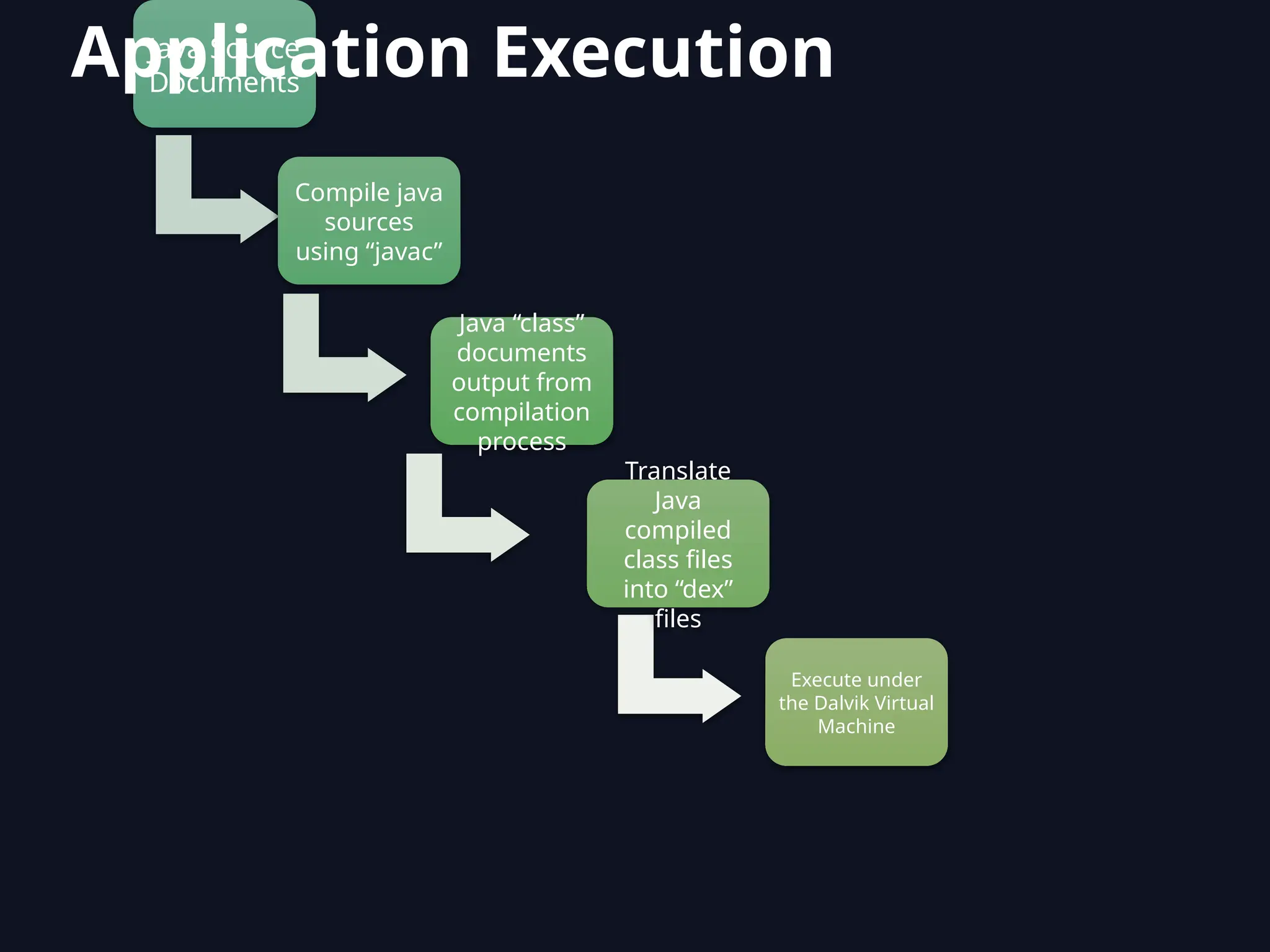
Java Source
Documents
Compile java
sources
using “javac”
Java “class”
documents
output from
compilation
process
Translate
Java
compiled
class files
into “dex”
files
Execute under
the Dalvik Virtual
Machine
Application Execution
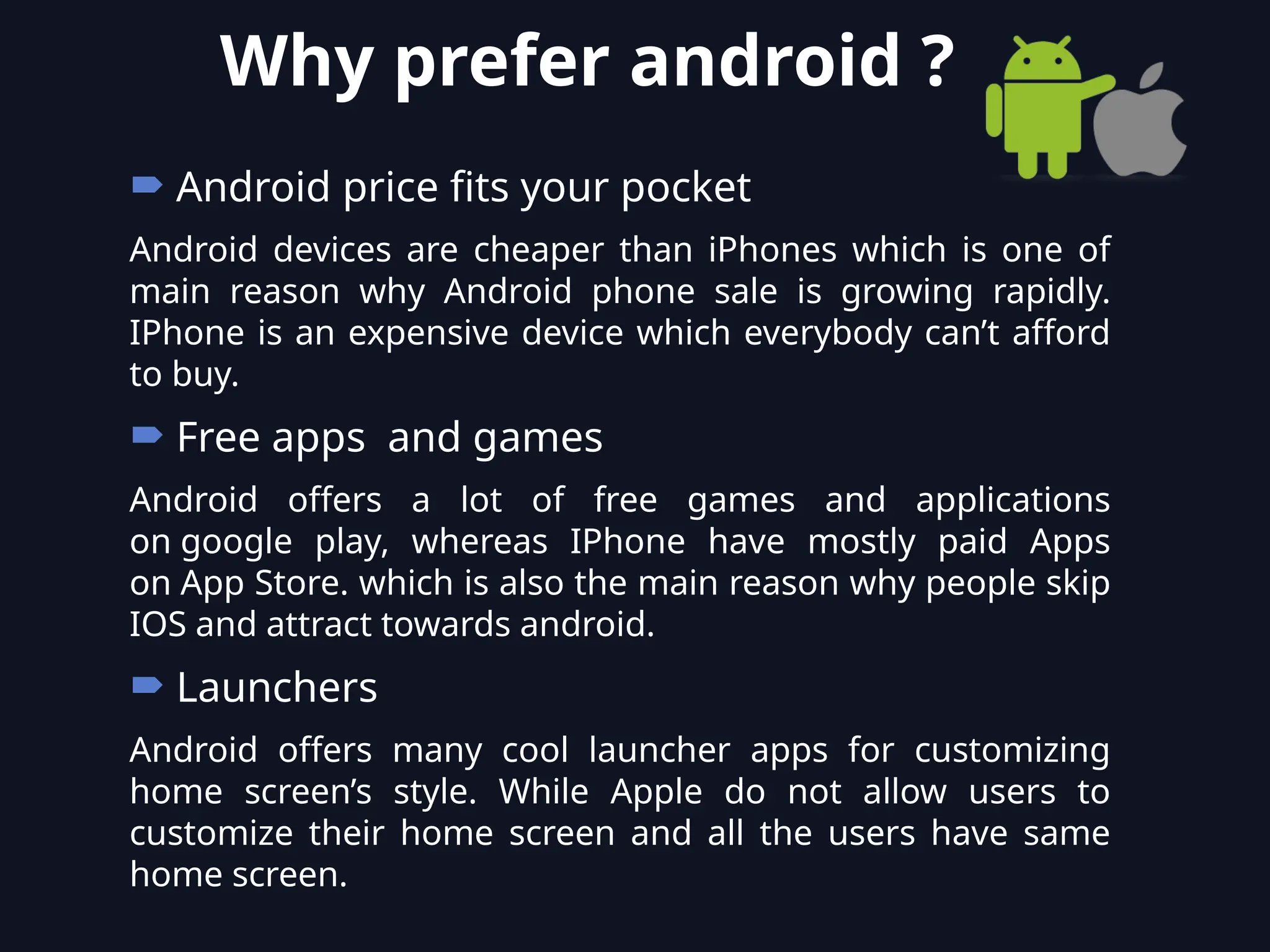
 Android price fits your pocket
Android devices are cheaper than iPhones which is one of
main reason why Android phone sale is growing rapidly.
IPhone is an expensive device which everybody can’t afford
to buy.
 Free apps and games
Android offers a lot of free games and applications
on google play, whereas IPhone have mostly paid Apps
on App Store. which is also the main reason why people skip
IOS and attract towards android.
 Launchers
Android offers many cool launcher apps for customizing
home screen’s style. While Apple do not allow users to
customize their home screen and all the users have same
home screen.
Why prefer android ?
 Custom ROMs
Android users can install custom Rom on their smart phone,
which allows them to replace original software comes with
their smart phone. Some of the android users want to use
some tools and apps which do not work on their original OS,
that’s why they Root their phone and install custom ROMS.
 Google Integration
Google integration is very useful service provided by google to
it’s users. unarguably google dominates the web with it’s
awesome services like Google drive, Google Music, Google
Map, Google Docs, Google mail, Google plus, Google hangout..
and the list goes on,
but IOS do not provide these apps integration.
 Expandable Memory
Android allows you to put a memory card to increase your
phone memory. What does Apple do? Well, they've never
offered expandable memory for the iPhone. Instead, they
would rather you pay another $100 to upgrade one of their
devices from a 16 GB memory to a 32 GB or 64 GB
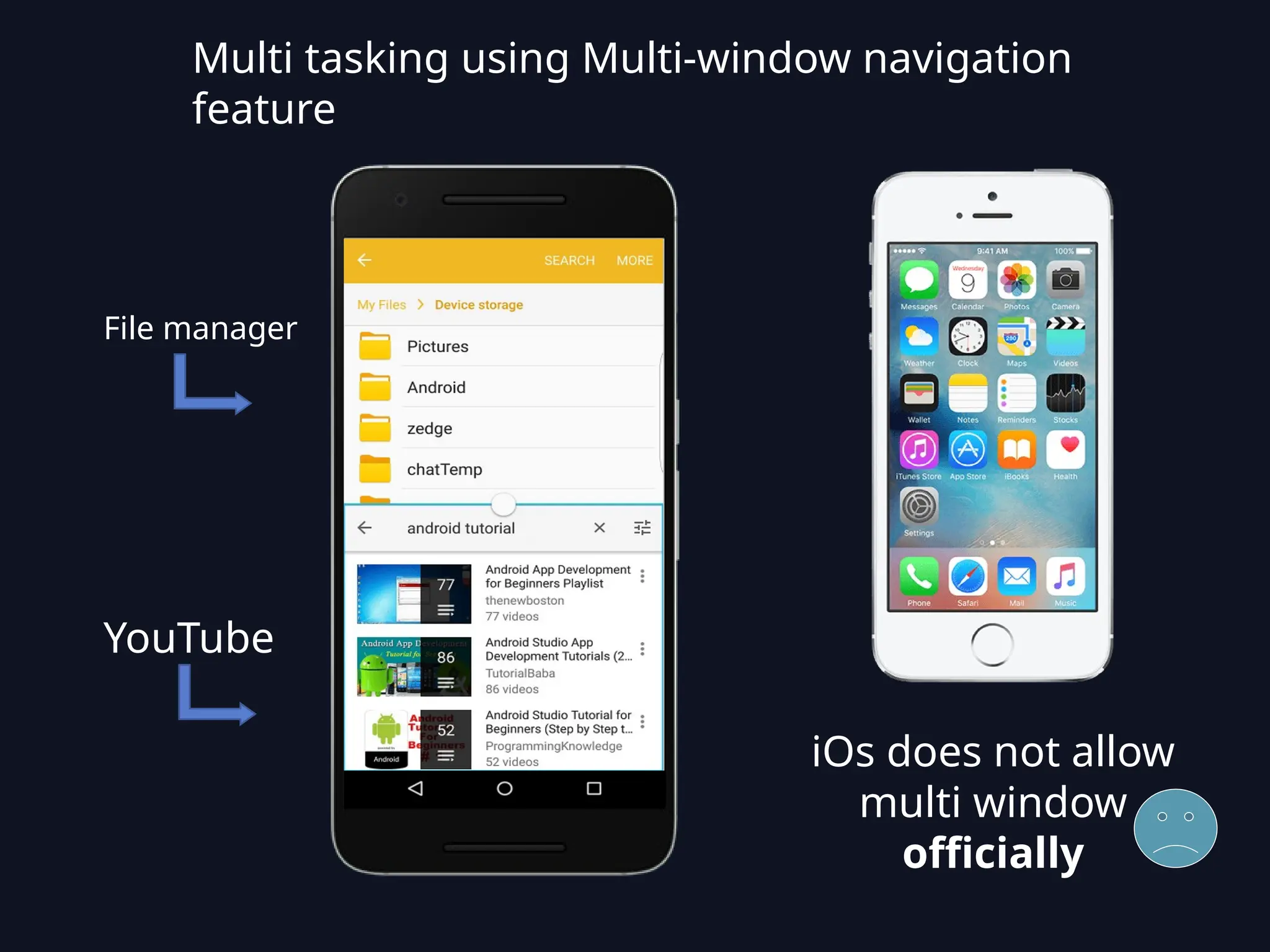
Multi tasking using Multi-window navigation
feature
File manager
YouTube
iOs does not allow
multi window
officially
 Making source code available to everyone
inevitably invites the attention of hackers.
 Android operating system uses more amount
of battery as compared to normal mobile
phones.
 It has been seen that it has security related
issues.
 As we call Android is world of applications we
continuously need to connected with the
internet which is not possible for all the users.
Limitations
Android is a truly open, free development
platform based on Linux and open
source. Handset makers can use and
customize the platform without paying a
royalty.
Android is now stepping up in next level
of mobile internet.
 Android is open to all: industry,
developers and users
Google Android is stepping into the next
level of Mobile Internet & that is the
reason that android covers 90% of mobile
OS market
Conclusion
https://en.wikipedia.org/wiki/Android_(op
erating_system)
https://www.android.com/
https://www.androidauthority.com/
https://techterms.com
http://www.openhandsetalliance.com/
Images and Clipart:
https://images.google.com/
References
Thank you.
Any Questions ?

androidos.pptxnnnnnnnnnnnnnnnnnnnnnnnnnnnnnnnnnnnnnnnnnnnnnnnnnnn

  • 1.
    TEACHER -- SALIMOVVAGIF PREPARED BY -- MIRZEZADE ORKHAN FACULTY -- ITIF SPECIALITY -- INFORMATION TECHNOLOGY GROUP -- 682.23E ANDROID OS
  • 2.
    Content 02. Origin ofAndroid 07. Comparisons with other OS 05. Architecture 01. Introduction 03. Open Handset Alliance (OHA) 04. Features and Versions 08. Limitations 06. Application Development
  • 3.
    ?  Android isLinux based operating system designed primarily for mobile devices such as smartphones and tablets.  Android was first developed as a ADVANCE OPERATING SYSTEM for digital cameras.  There are more than 4,00,000 apps in android market  And, android is an open source. INTRODUCTION What is android
  • 4.
    ?  An operatingsystem, or "OS," is software that communicates with the hardware and allows other programs to run..  Common desktop operating systems include Windows, OS X, and Linux  Common mobile OS include Android, iOS, and Windows Phone INTRODUCTION What is Operating System
  • 5.
    What is OperatingSystem An operating system, or "OS," is software that communicates with the hardware and allows other programs to run.. Common desktop operating systems include Windows, OS X, and Linux Common mobile OS include Android, iOS, and Windows Phone
  • 6.
     Android OSconsists of a shell and a kernel.  Creator’s of android takes out the kernel from Linux OS 2.6 and rewrite the shell part using java, that’s forms android OS. MONOLITHIC KERNEL (modified LINUX kernel) SHELL (Written in Java) android OS android Operating System INTRODUCTION
  • 7.
    Mobile phones SmartTV Wearable device Tablets GPS device for automobiles android devices
  • 8.
    Android was foundedin Palo Alto, California in October 2003 by Andy Rubin, Rich Miner, Nick Sears and Chris White who work at “ ” to develop. Andy Rubin Origin of android
  • 9.
    Android was purchasedby the in AUGUST, 2005 for 50 million $. HTC Dream was the first android device launched in September 2008 Now, android covers 90% of the mobile OS market. …Origin of android
  • 10.
    It’s consortium ofseveral companies.  OHA is a business alliance of firm to develop open standard for mobile device. OHA includes 84 firms to develop open standard for mobile devices, i.e. HTC, Sony, Dell, Intel, Motorola, QUALCOMM, G oogle, Samsung Electronics, LG Electronics, T- Mobile, NVidias Reason for Nokia not to develop Android Mobiles is Nokia is not part of OHA Open Handset Alliance (OHA)
  • 11.
    Android supports wirelesscommunication using:- 3G Networks, 4G Networks, 802.11 Wi-Fi Networks, Bluetooth Connectivity Developing an android application is not tough ,using SDK and java emulator we can easily develop applications that we want. Open source – Free development platform Built in services like GPS,SQL Database, browser and maps Portability across current and future hardware Features
  • 12.
     Android Astro1.0 • Released on September 23, 2008.  Android Cupcake 1.5 • Released on April 30, 2009.  Android Donut 1.6 • Released on September 15, 2009.  Android Éclair 2.0/2.1 • Released on October 26, 2009.  Android Froyo 2.2 • Released on May 20, 2010.  Android Honeycomb 3.0 • Released on February 22, 2011.  Android IceCream Sandwich 4.0 • Released on November 14, 2011  Android JellyBean 4.1 • Released on June 27,2012  Android Kitkat 4.4 • Released on October 31,2013  Android Gingerbread 2.3 • Released on December 6, 2010 android Versions
  • 13.
     Android Lollipop5.0 • Released on November 12, 2014  Android Marshmallow 6.0 • Released on May 28, 2015  Android Nougat 7.0 • Released on August 22, 2016  Android Oreo 8.0 • Released on August 21, 2017 • Latest version till date. android Versions
  • 14.
    Android Oreo 8.0 AndroidAstro 1.0 Android KitKat 4.4 UI comparison
  • 15.
    Linux kernel Libraries Android runtime - Core libraries - Dalvik virtual machine Application layer Application framework Architecture
  • 16.
  • 17.
     Android Architectureis based on Linux 2.6 kernel. It helps to manage security, memory management, process management, network stack and other important issues. Display Driver Keypad Driver Camera Driver Wi-Fi Driver Flash Memory Driver Audio Driver Binder (IPC) Driver Power Management Linux Kernel
  • 18.
     Android includesa set of core libraries that provides most of the functionality available in the core libraries of the Java programming language.  Dalvik VM. • Dex files • Compact and efficient than class files • Limited memory and battery power  Core Libraries • Java 5 Std edition • Collections, I/O etc… • Providing most of the functionality available in the core libraries of the Java language. Core Libraries Dalvik Virtual Machine Android Runtime
  • 19.
    Android includes aset of:  C/C++ libraries  Interface through Java  Surface manager – Handling UI Windows with 2D and 3D graphics  Media codes, SQLite, Browser engine The Android Studio 3.1 supports new set of library : Libraries
  • 20.
    The application architectureis designed to simplify the reuse of components  Activity manager – manages application life cycle  Android provides a set of core applications:  Email Client  SMS Program  Calendar  Maps  Browser  Contacts, Etc.  All applications are written using the Java language.  APIs: Data Structures, Utilities, File Access, Network Access, Graphics, etc. Application Framework
  • 21.
  • 22.
  • 23.
    Java Source Documents Compile java sources using“javac” Java “class” documents output from compilation process Translate Java compiled class files into “dex” files Execute under the Dalvik Virtual Machine Application Execution
  • 24.
     Android pricefits your pocket Android devices are cheaper than iPhones which is one of main reason why Android phone sale is growing rapidly. IPhone is an expensive device which everybody can’t afford to buy.  Free apps and games Android offers a lot of free games and applications on google play, whereas IPhone have mostly paid Apps on App Store. which is also the main reason why people skip IOS and attract towards android.  Launchers Android offers many cool launcher apps for customizing home screen’s style. While Apple do not allow users to customize their home screen and all the users have same home screen. Why prefer android ?
  • 25.
     Custom ROMs Androidusers can install custom Rom on their smart phone, which allows them to replace original software comes with their smart phone. Some of the android users want to use some tools and apps which do not work on their original OS, that’s why they Root their phone and install custom ROMS.  Google Integration Google integration is very useful service provided by google to it’s users. unarguably google dominates the web with it’s awesome services like Google drive, Google Music, Google Map, Google Docs, Google mail, Google plus, Google hangout.. and the list goes on, but IOS do not provide these apps integration.  Expandable Memory Android allows you to put a memory card to increase your phone memory. What does Apple do? Well, they've never offered expandable memory for the iPhone. Instead, they would rather you pay another $100 to upgrade one of their devices from a 16 GB memory to a 32 GB or 64 GB
  • 26.
    Multi tasking usingMulti-window navigation feature File manager YouTube iOs does not allow multi window officially
  • 27.
     Making sourcecode available to everyone inevitably invites the attention of hackers.  Android operating system uses more amount of battery as compared to normal mobile phones.  It has been seen that it has security related issues.  As we call Android is world of applications we continuously need to connected with the internet which is not possible for all the users. Limitations
  • 28.
    Android is atruly open, free development platform based on Linux and open source. Handset makers can use and customize the platform without paying a royalty. Android is now stepping up in next level of mobile internet.  Android is open to all: industry, developers and users Google Android is stepping into the next level of Mobile Internet & that is the reason that android covers 90% of mobile OS market Conclusion
  • 29.
  • 30.

Editor's Notes

  • #10 CONSORTIUM means Group
  • #11 CONSORTIUM means Group
  • #12 CONSORTIUM means Group
  • #13 CONSORTIUM means Group
  • #14 CONSORTIUM means Group
  • #15 CONSORTIUM means Group
  • #16 CONSORTIUM means Group
  • #17 CONSORTIUM means Group
  • #18 CONSORTIUM means Group
  • #19 CONSORTIUM means Group
  • #20 CONSORTIUM means Group
  • #21 CONSORTIUM means Group
  • #22 CONSORTIUM means Group
  • #23 CONSORTIUM means Group
  • #24 CONSORTIUM means Group
  • #25 CONSORTIUM means Group
  • #26 CONSORTIUM means Group
  • #27 CONSORTIUM means Group
  • #28 CONSORTIUM means Group
  • #29 CONSORTIUM means Group