- Ankita Karia


Ankita R Karia   1 February 2012   1
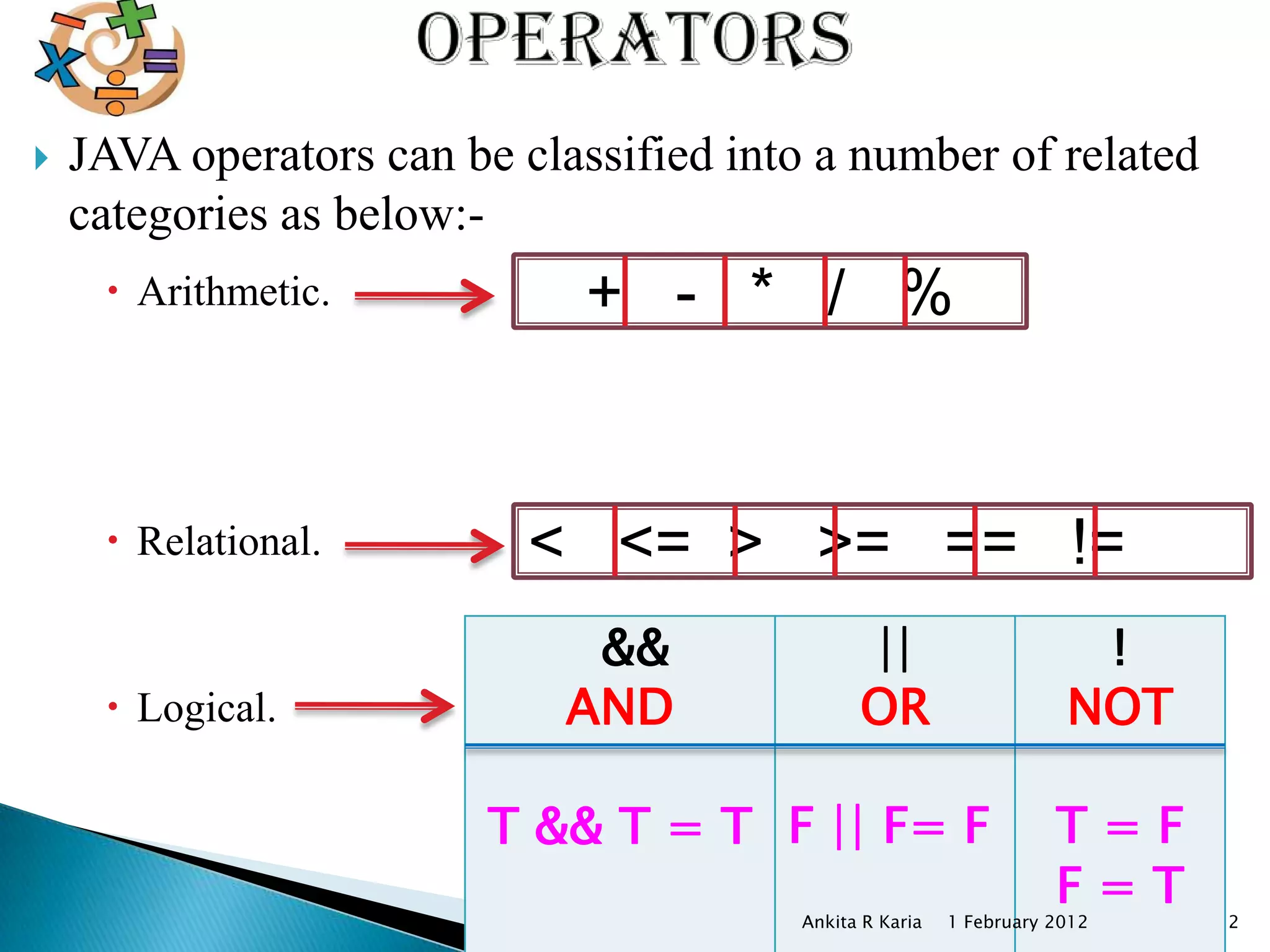
   JAVA operators can be classified into a number of related
    categories as below:-
      Arithmetic.            + - * / %


      Relational.         < <= > >= == !=
                              &&              ||                      !
      Logical.              AND              OR                     NOT

                         T && T = T F || F= F                       T=F
                                                                    F=T
                                        Ankita R Karia   1 February 2012   2
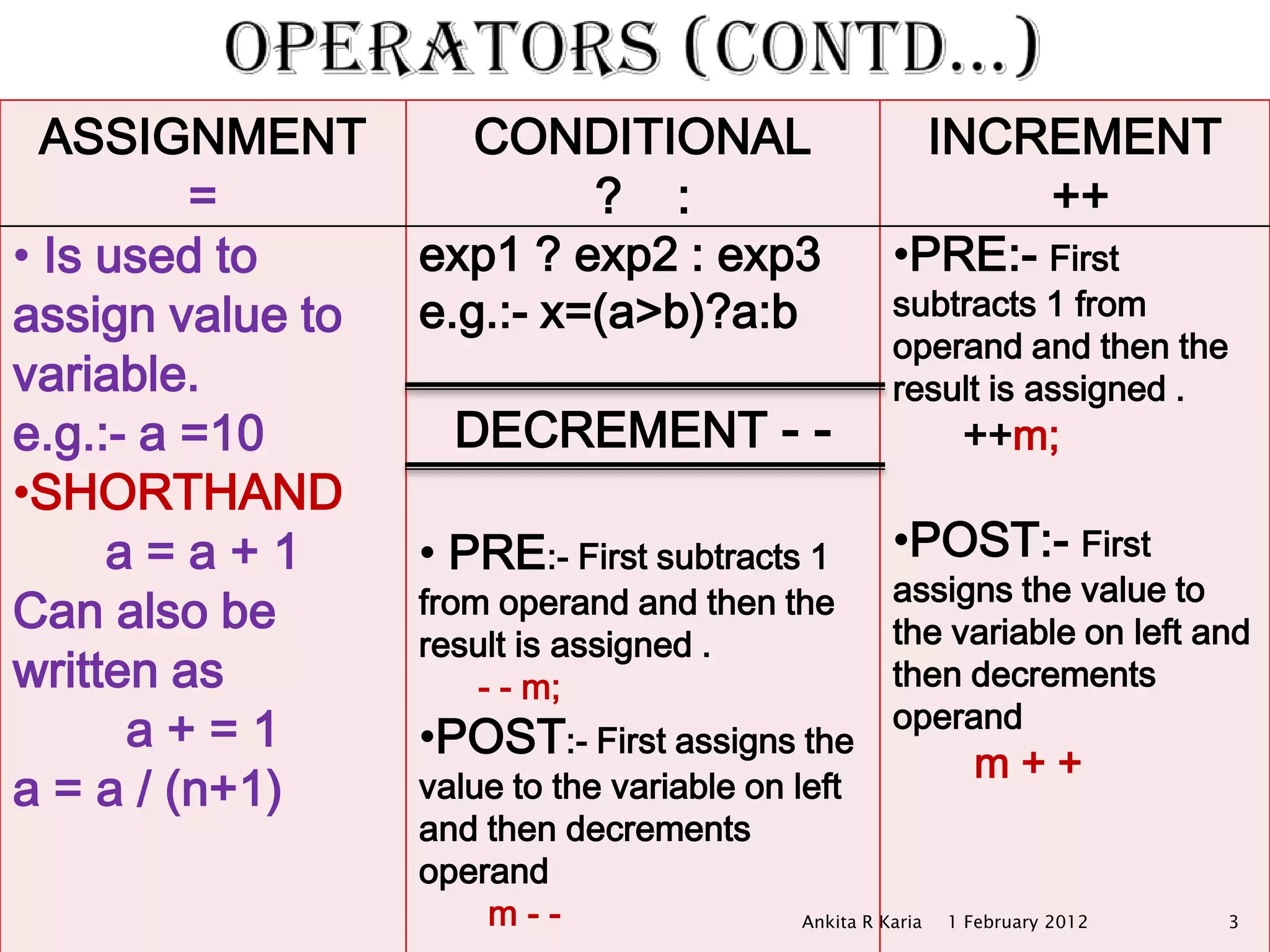
ASSIGNMENT         CONDITIONAL                         INCREMENT
         =                 ? :                                ++
• Is used to      exp1 ? exp2 : exp3                   •PRE:- First
assign value to   e.g.:- x=(a>b)?a:b                   subtracts 1 from
                                                       operand and then the
variable.                                              result is assigned .
e.g.:- a =10        DECREMENT - -                             ++m;
•SHORTHAND
     a=a+1        • PRE:- First subtracts 1            •POST:- First
                                                       assigns the value to
Can also be       from operand and then the
                                                       the variable on left and
                  result is assigned .
written as            - - m;                           then decrements
      a+=1                                             operand
                  •POST:- First assigns the
                                                               m++
a = a / (n+1)     value to the variable on left
                  and then decrements
                  operand
                      m--                   Ankita R Karia   1 February 2012   3
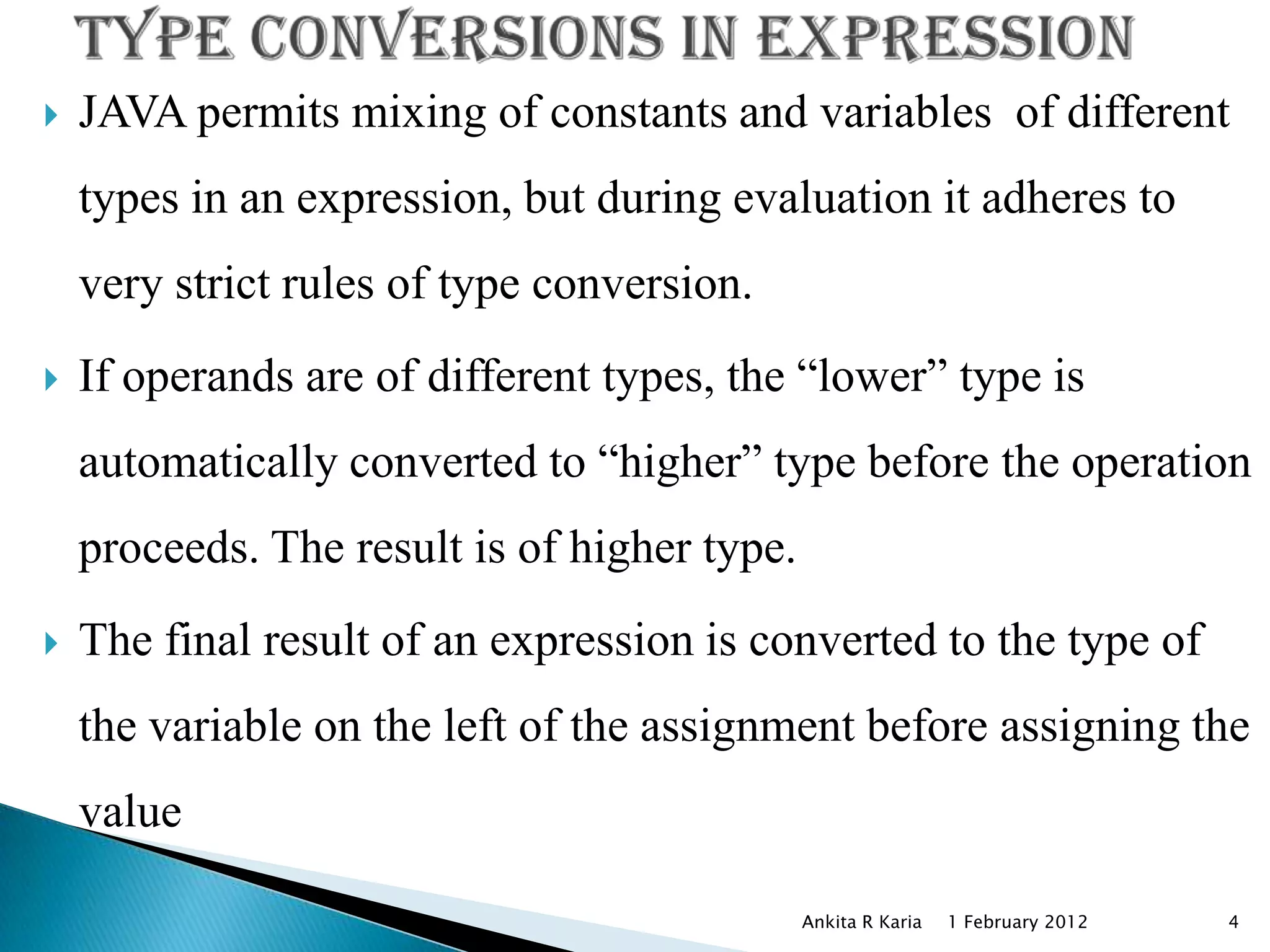
   JAVA permits mixing of constants and variables of different
    types in an expression, but during evaluation it adheres to
    very strict rules of type conversion.
   If operands are of different types, the “lower” type is
    automatically converted to “higher” type before the operation
    proceeds. The result is of higher type.
   The final result of an expression is converted to the type of
    the variable on the left of the assignment before assigning the
    value

                                              Ankita R Karia   1 February 2012   4
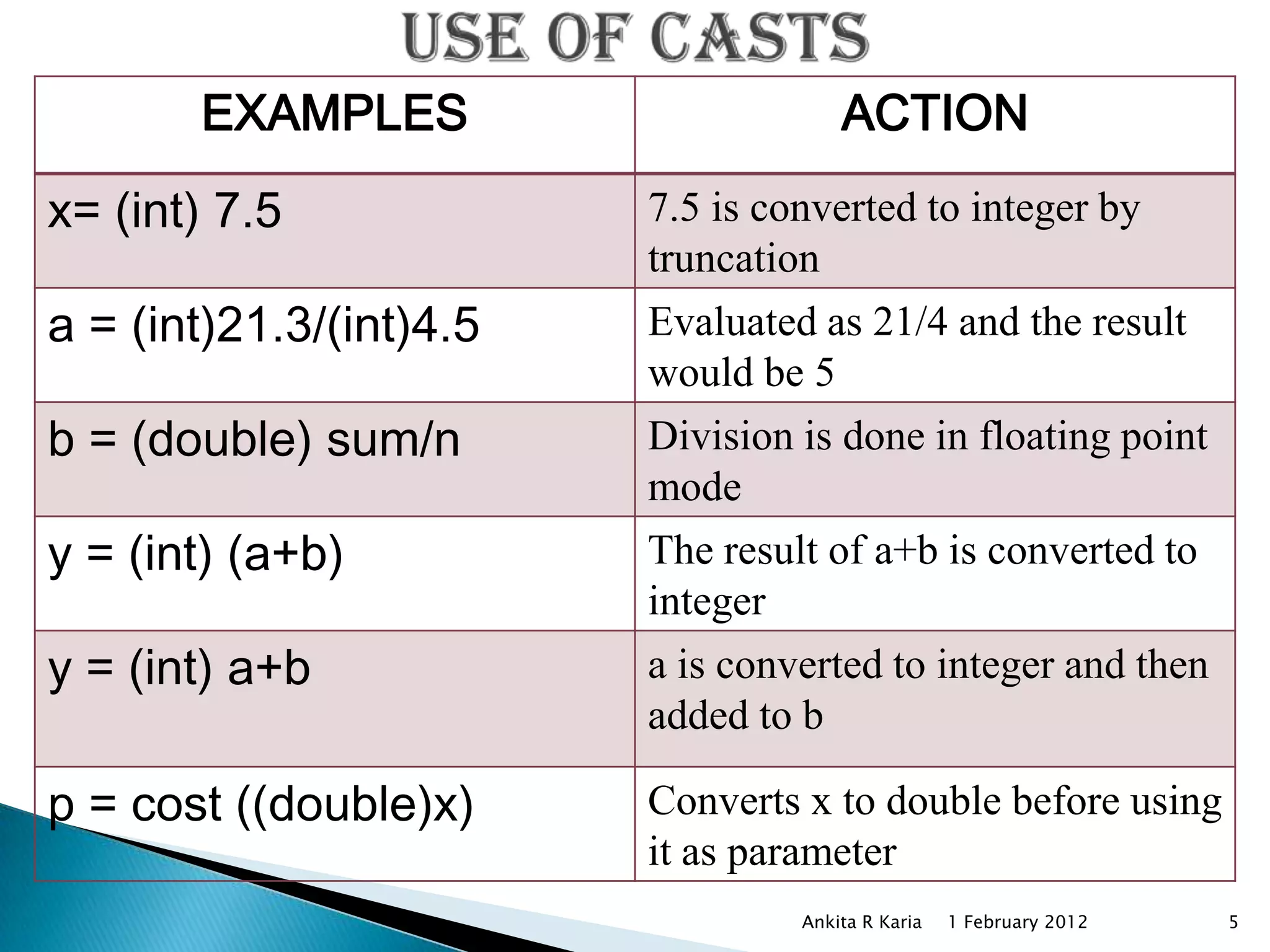
EXAMPLES                       ACTION
x= (int) 7.5             7.5 is converted to integer by
                         truncation
a = (int)21.3/(int)4.5   Evaluated as 21/4 and the result
                         would be 5
b = (double) sum/n       Division is done in floating point
                         mode
y = (int) (a+b)          The result of a+b is converted to
                         integer
y = (int) a+b            a is converted to integer and then
                         added to b

p = cost ((double)x)     Converts x to double before using
                         it as parameter
                                  Ankita R Karia   1 February 2012   5
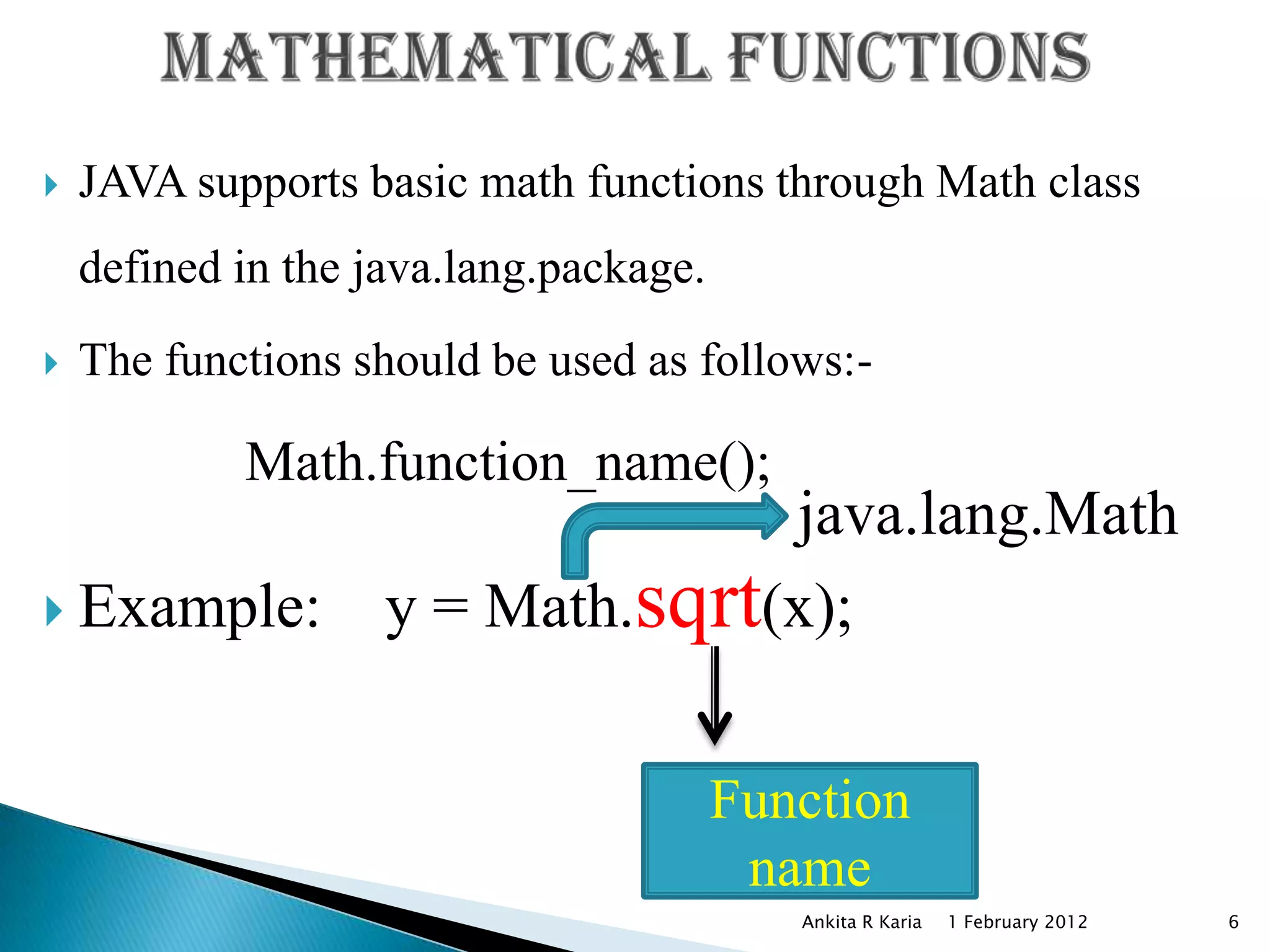
   JAVA supports basic math functions through Math class
    defined in the java.lang.package.
   The functions should be used as follows:-

            Math.function_name();
                         java.lang.Math
 Example: y = Math.sqrt(x);


                                        Function
                                         name
                                           Ankita R Karia   1 February 2012   6
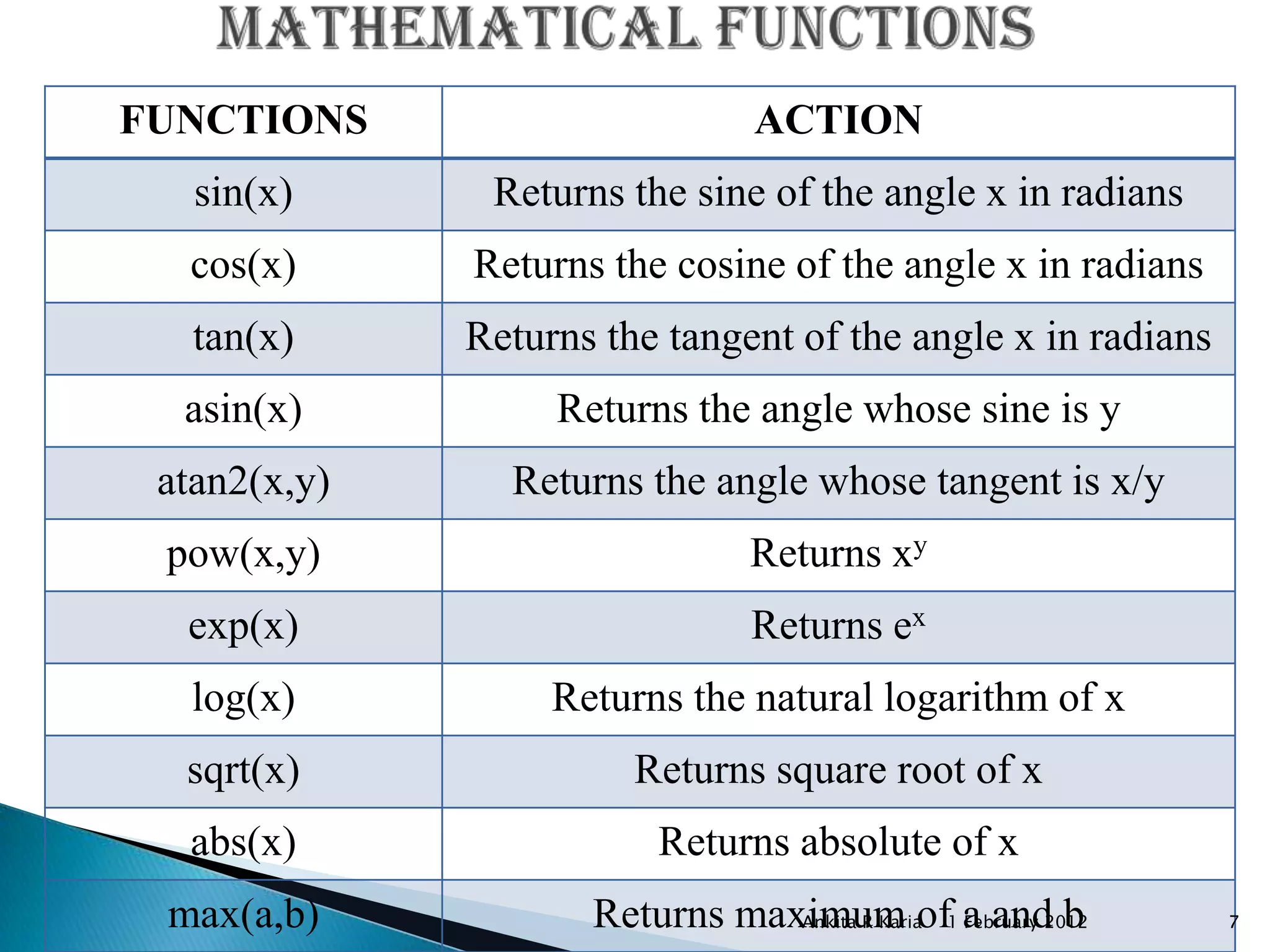
FUNCTIONS                        ACTION
   sin(x)      Returns the sine of the angle x in radians
  cos(x)      Returns the cosine of the angle x in radians
   tan(x)     Returns the tangent of the angle x in radians
  asin(x)          Returns the angle whose sine is y
 atan2(x,y)     Returns the angle whose tangent is x/y
 pow(x,y)                        Returns xy
  exp(x)                         Returns ex
   log(x)          Returns the natural logarithm of x
  sqrt(x)               Returns square root of x
  abs(x)                  Returns absolute of x
 max(a,b)            Returns maximum of1 a and b
                                Ankita R Karia February 2012   7
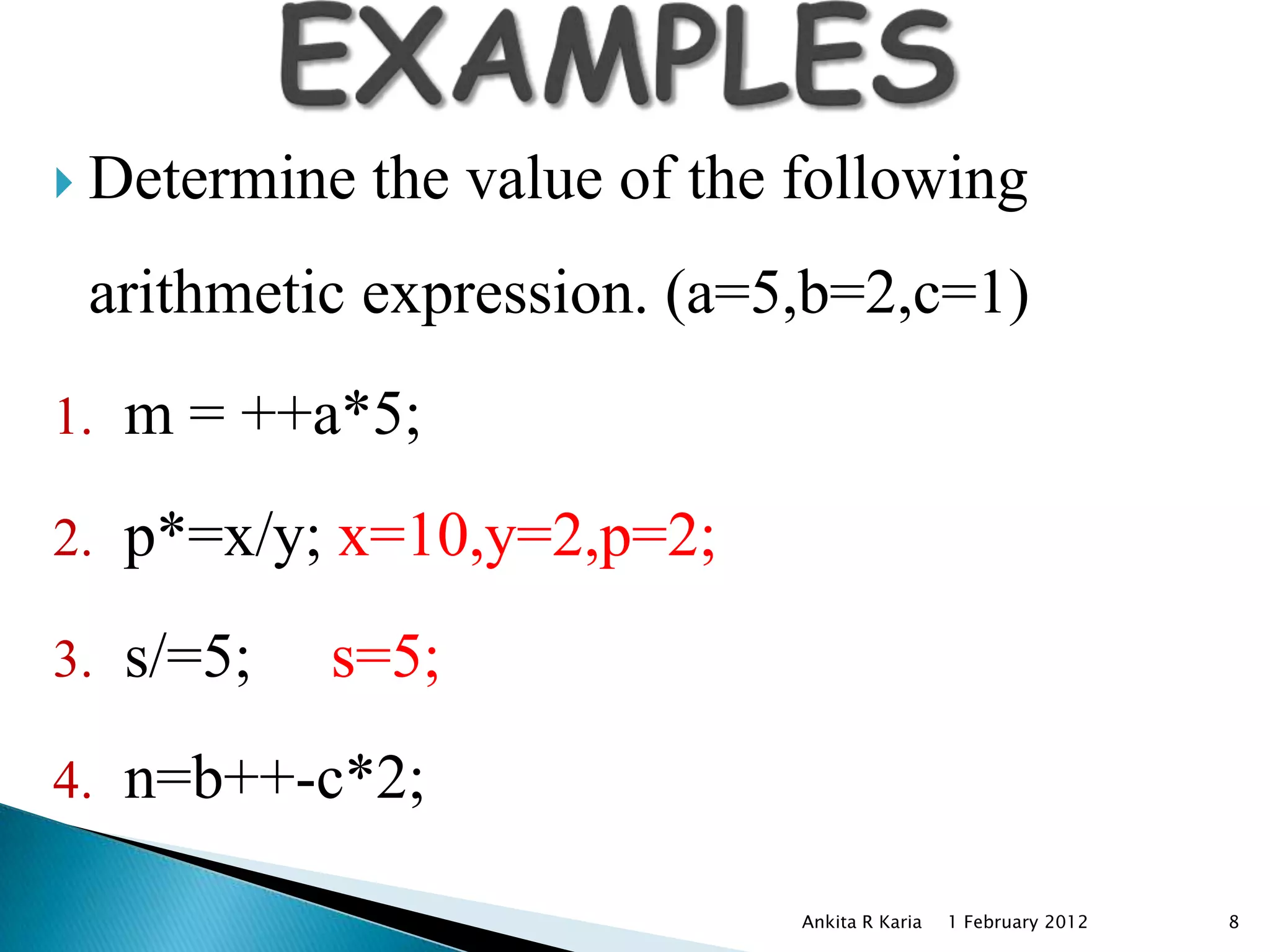
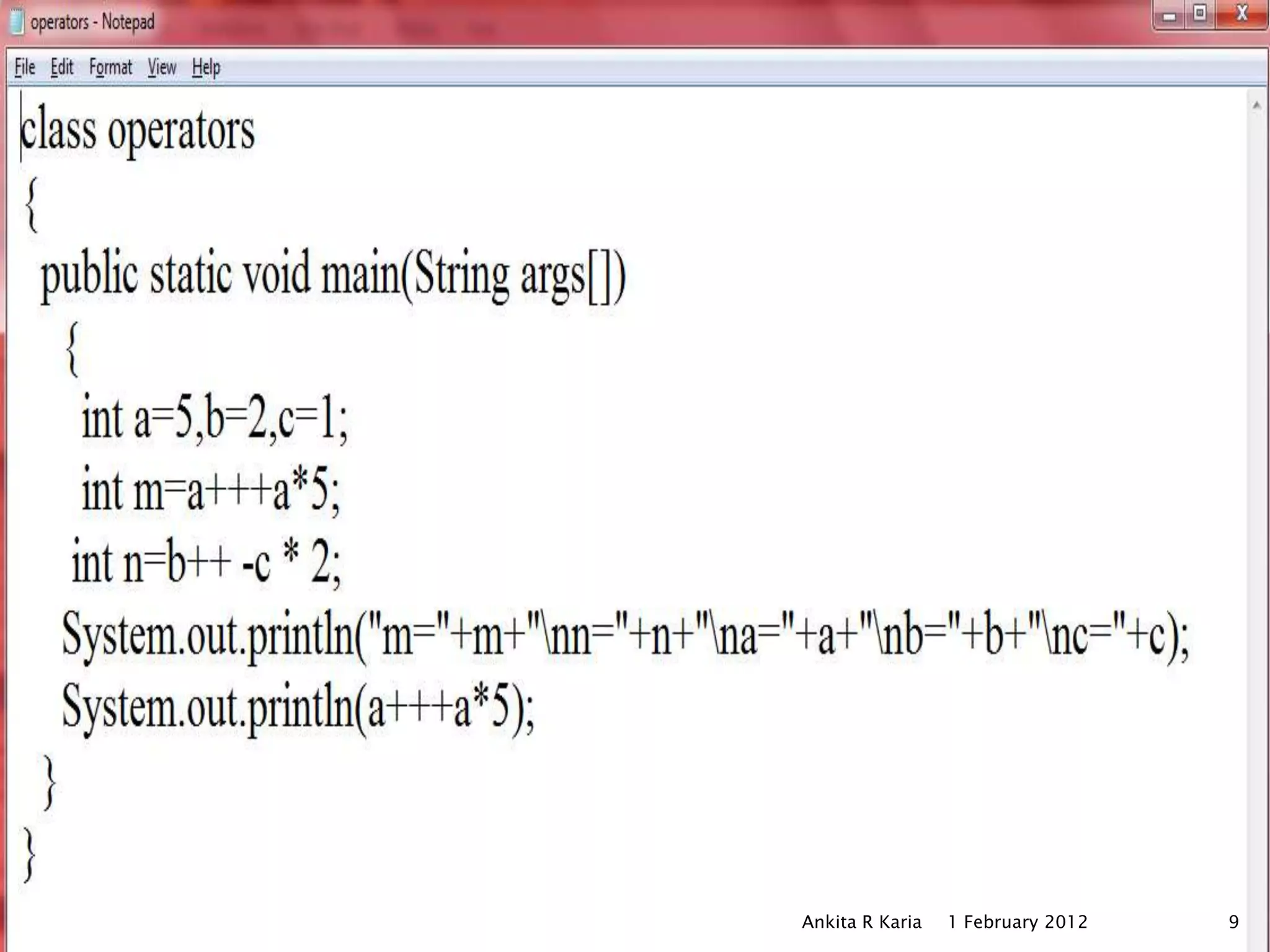
 Determine   the value of the following
 arithmetic expression. (a=5,b=2,c=1)
1. m = ++a*5;

2. p*=x/y; x=10,y=2,p=2;

3. s/=5;   s=5;
4. n=b++-c*2;

                               Ankita R Karia   1 February 2012   8
Ankita R Karia   1 February 2012   9
Ankita R Karia   1 February 2012   10
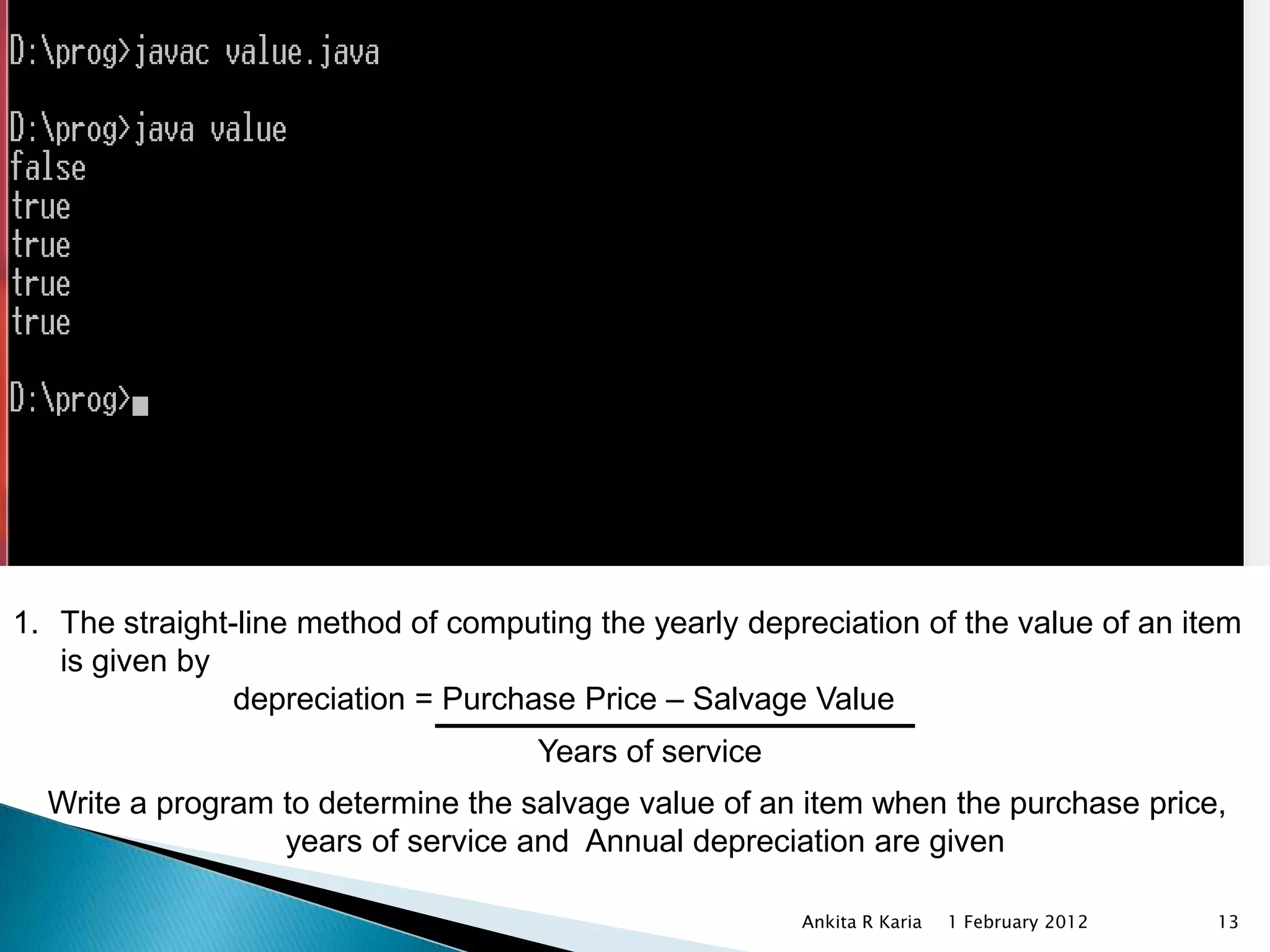
   Determine the value of the following logical
    expression. (a=5,b=10,c=-6)
1. a<b && a<c;

2. a<b && a>c;

3. a= = c || b>a;

4. b>15 && c<0 || a>0;

5. (a/2.0==0.0&&b/2.0!=0.0)||c<0.0

                                  Ankita R Karia   1 February 2012   11
Ankita R Karia   1 February 2012   12
1. The straight-line method of computing the yearly depreciation of the value of an item
   is given by
                depreciation = Purchase Price – Salvage Value
                                     Years of service
  Write a program to determine the salvage value of an item when the purchase price,
                  years of service and Annual depreciation are given

                                                        Ankita R Karia   1 February 2012   13

Operators and Expressions in Java

  • 1.
    - Ankita Karia AnkitaR Karia 1 February 2012 1
  • 2.
    JAVA operators can be classified into a number of related categories as below:-  Arithmetic. + - * / %  Relational. < <= > >= == != && || !  Logical. AND OR NOT T && T = T F || F= F T=F F=T Ankita R Karia 1 February 2012 2
  • 3.
    ASSIGNMENT CONDITIONAL INCREMENT = ? : ++ • Is used to exp1 ? exp2 : exp3 •PRE:- First assign value to e.g.:- x=(a>b)?a:b subtracts 1 from operand and then the variable. result is assigned . e.g.:- a =10 DECREMENT - - ++m; •SHORTHAND a=a+1 • PRE:- First subtracts 1 •POST:- First assigns the value to Can also be from operand and then the the variable on left and result is assigned . written as - - m; then decrements a+=1 operand •POST:- First assigns the m++ a = a / (n+1) value to the variable on left and then decrements operand m-- Ankita R Karia 1 February 2012 3
  • 4.
    JAVA permits mixing of constants and variables of different types in an expression, but during evaluation it adheres to very strict rules of type conversion.  If operands are of different types, the “lower” type is automatically converted to “higher” type before the operation proceeds. The result is of higher type.  The final result of an expression is converted to the type of the variable on the left of the assignment before assigning the value Ankita R Karia 1 February 2012 4
  • 5.
    EXAMPLES ACTION x= (int) 7.5 7.5 is converted to integer by truncation a = (int)21.3/(int)4.5 Evaluated as 21/4 and the result would be 5 b = (double) sum/n Division is done in floating point mode y = (int) (a+b) The result of a+b is converted to integer y = (int) a+b a is converted to integer and then added to b p = cost ((double)x) Converts x to double before using it as parameter Ankita R Karia 1 February 2012 5
  • 6.
    JAVA supports basic math functions through Math class defined in the java.lang.package.  The functions should be used as follows:- Math.function_name(); java.lang.Math  Example: y = Math.sqrt(x); Function name Ankita R Karia 1 February 2012 6
  • 7.
    FUNCTIONS ACTION sin(x) Returns the sine of the angle x in radians cos(x) Returns the cosine of the angle x in radians tan(x) Returns the tangent of the angle x in radians asin(x) Returns the angle whose sine is y atan2(x,y) Returns the angle whose tangent is x/y pow(x,y) Returns xy exp(x) Returns ex log(x) Returns the natural logarithm of x sqrt(x) Returns square root of x abs(x) Returns absolute of x max(a,b) Returns maximum of1 a and b Ankita R Karia February 2012 7
  • 8.
     Determine the value of the following arithmetic expression. (a=5,b=2,c=1) 1. m = ++a*5; 2. p*=x/y; x=10,y=2,p=2; 3. s/=5; s=5; 4. n=b++-c*2; Ankita R Karia 1 February 2012 8
  • 9.
    Ankita R Karia 1 February 2012 9
  • 10.
    Ankita R Karia 1 February 2012 10
  • 11.
    Determine the value of the following logical expression. (a=5,b=10,c=-6) 1. a<b && a<c; 2. a<b && a>c; 3. a= = c || b>a; 4. b>15 && c<0 || a>0; 5. (a/2.0==0.0&&b/2.0!=0.0)||c<0.0 Ankita R Karia 1 February 2012 11
  • 12.
    Ankita R Karia 1 February 2012 12
  • 13.
    1. The straight-linemethod of computing the yearly depreciation of the value of an item is given by depreciation = Purchase Price – Salvage Value Years of service Write a program to determine the salvage value of an item when the purchase price, years of service and Annual depreciation are given Ankita R Karia 1 February 2012 13