e-mail: mrdevilbynature@gmail.com
ď‚— a Regular Expression (abbreviated as RegEx) is

a sequence of characters that forms a search
pattern, mainly for use in string matching.

ď‚— RegEx is kind of a language within a language.
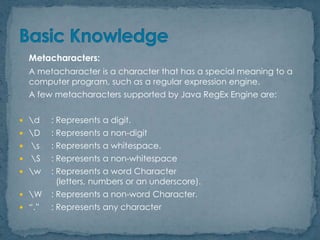
Metacharacters:
A metacharacter is a character that has a special meaning to a
computer program, such as a regular expression engine.
A few metacharacters supported by Java RegEx Engine are:
ď‚— d

: Represents a digit.

ď‚— D

: Represents a non-digit

ď‚—

s

: Represents a whitespace.

ď‚—

S

: Represents a non-whitespace

ď‚— w

: Represents a word Character
(letters, numbers or an underscore).

ď‚— W

: Represents a non-word Character.

 “.”

: Represents any character
The basic structure of a RegEx is bounded by the below
mentioned classes.
ď‚—
ď‚—
ď‚—

ď‚—
ď‚—

Literal escape
Grouping
Range
Union
Intersection

x
[...]
a-z
[a-e][i-u]
[a-z&&[aeiou]]

The union operator denotes a class that contains every
character that is in at least one of its operand classes.
The intersection operator denotes a class that contains
every character that is in both of its operand classes.
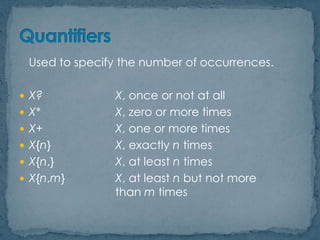
Used to specify the number of occurrences.
ď‚— X?
ď‚— X*
ď‚— X+
ď‚— X{n}
ď‚— X{n,}
ď‚— X{n,m}

X, once or not at all
X, zero or more times
X, one or more times
X, exactly n times
X, at least n times
X, at least n but not more
than m times
ď‚— [abc]

Searches for a‟s or b‟s or
c‟s.
ď‚— d+
Searches for a Number.
ď‚— 0[xX]([0-9a-fA-F])+ Searches for a
Hexadecimal Number.
ď‚— [a-fn-s]
Searches for a character
between a to f OR n to s.
ď‚— The Classes that help in implementing RegEx in

Java are:

Pattern class
2. Matcher class
(Both the classes are present in the java.util.regex
package)
1.
A regular expression, specified as a string, must first
be compiled into an instance of this class.
The resulting pattern can then be used to create a
Matcher object that can match arbitrary character
sequences against the regular expression.
All of the state involved in performing a match
resides in the matcher, so many matchers can share
the same pattern.
An engine that performs match operations on a character
sequence by interpreting a Pattern.
A Matcher object is created from a pattern by invoking the
pattern's matcher method.
Once created, a matcher can be used to perform three
different kinds of match operations:
ď‚— The matches method attempts to match the entire input
sequence against the pattern.
ď‚— The lookingAt method attempts to match the input sequence,
starting at the beginning, against the pattern.
ď‚— The find method scans the input sequence looking for the next
subsequence that matches the pattern.
This method starts at the beginning of this matcher's region, or,
if a previous invocation of the method was successful and the
matcher has not since been reset, at the first character not
matched by the previous match.
Each of these methods returns a boolean indicating success or
failure.
Pattern p = Pattern.compile("a*b");
Matcher m = p.matcher("aaaaababaab");
The compile method in the Pattern class is a
static method which takes a Regular Expression
in the form of a String as the argument
A Matcher object is created by invoking the
matcher method of the Pattern class

[The matcher method is a Non-static method, so
it requires a Pattern object for its invocation]
Once a match has been found by using one of the
matches, lookingAt and find method, the following
Matcher class methods can be used to display the
results:
ď‚— public int start()

Returns the start index of the
previous match.

ď‚— public int end()

Returns the offset after the
character matched.

ď‚— public String group()

Returns the input
subsequence matched by
the previous match.

last
import java.util.regex.*;
public class Regex
{
public static void main(String[] arg)
{
Pattern p = Pattern.compile("a*b");
Matcher m = p.matcher("aaaaab");
if(m.matches())
System.out.println(m.start()+" "+m.end()+" "+m.group());
}
}
Output:
0 6 aaaaab
import java.util.regex.*;
public class Regex
{
public static void main(String[] arg)
{
Pattern p = Pattern.compile("a*b");
Matcher m = p.matcher("b aab");
if(m.lookingAt())
System.out.println(m.start()+" "+m.end()+" "+m.group());
}
}
Output:
0 1 b
import java.util.regex.*;
public class Regex
{
public static void main(String[] arg)
{
Pattern p = Pattern.compile("a*b");
Matcher m = p.matcher("ab aabcba");
while(m.find())
System.out.println(m.start()+" "+m.end()+" "+m.group());
}
}
Output:
0 2 ab
3 6 aab
7 8 b
Writing the statement:
String regex=“d”;
would produce a COMPILER ERROR!
Whenever the compiler sees a „‟ inside a String, it expects
the next character to be an escape sequence.
The way to satisfy the compiler is to use double backslashes.
The statement:
String regex=“d”;
is a valid RegEx metacharacter in the form of a String.
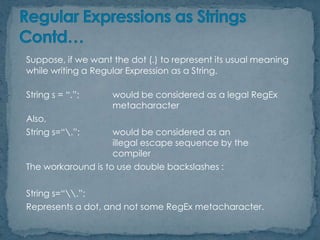
Suppose, if we want the dot (.) to represent its usual meaning
while writing a Regular Expression as a String.
String s = “.”;

would be considered as a legal RegEx
metacharacter

Also,
String s=“.”;

would be considered as an
illegal escape sequence by the
compiler
The workaround is to use double backslashes :

String s=“.”;
Represents a dot, and not some RegEx metacharacter.
ď‚— Java api documentation SE6
 SCJP – Kathy Sierra and Bert Bates
ď‚— Wikipedia
Regular Expressions in Java

Regular Expressions in Java

  • 1.
  • 2.
    ď‚— a RegularExpression (abbreviated as RegEx) is a sequence of characters that forms a search pattern, mainly for use in string matching. ď‚— RegEx is kind of a language within a language.
  • 3.
    Metacharacters: A metacharacter isa character that has a special meaning to a computer program, such as a regular expression engine. A few metacharacters supported by Java RegEx Engine are:  d : Represents a digit.  D : Represents a non-digit  s : Represents a whitespace.  S : Represents a non-whitespace  w : Represents a word Character (letters, numbers or an underscore).  W : Represents a non-word Character.  “.” : Represents any character
  • 4.
    The basic structureof a RegEx is bounded by the below mentioned classes. ď‚— ď‚— ď‚— ď‚— ď‚— Literal escape Grouping Range Union Intersection x [...] a-z [a-e][i-u] [a-z&&[aeiou]] The union operator denotes a class that contains every character that is in at least one of its operand classes. The intersection operator denotes a class that contains every character that is in both of its operand classes.
  • 5.
    Used to specifythe number of occurrences. ď‚— X? ď‚— X* ď‚— X+ ď‚— X{n} ď‚— X{n,} ď‚— X{n,m} X, once or not at all X, zero or more times X, one or more times X, exactly n times X, at least n times X, at least n but not more than m times
  • 6.
     [abc] Searches fora‟s or b‟s or c‟s.  d+ Searches for a Number.  0[xX]([0-9a-fA-F])+ Searches for a Hexadecimal Number.  [a-fn-s] Searches for a character between a to f OR n to s.
  • 7.
    ď‚— The Classesthat help in implementing RegEx in Java are: Pattern class 2. Matcher class (Both the classes are present in the java.util.regex package) 1.
  • 8.
    A regular expression,specified as a string, must first be compiled into an instance of this class. The resulting pattern can then be used to create a Matcher object that can match arbitrary character sequences against the regular expression. All of the state involved in performing a match resides in the matcher, so many matchers can share the same pattern.
  • 9.
    An engine thatperforms match operations on a character sequence by interpreting a Pattern. A Matcher object is created from a pattern by invoking the pattern's matcher method. Once created, a matcher can be used to perform three different kinds of match operations: ď‚— The matches method attempts to match the entire input sequence against the pattern. ď‚— The lookingAt method attempts to match the input sequence, starting at the beginning, against the pattern. ď‚— The find method scans the input sequence looking for the next subsequence that matches the pattern. This method starts at the beginning of this matcher's region, or, if a previous invocation of the method was successful and the matcher has not since been reset, at the first character not matched by the previous match. Each of these methods returns a boolean indicating success or failure.
  • 10.
    Pattern p =Pattern.compile("a*b"); Matcher m = p.matcher("aaaaababaab"); The compile method in the Pattern class is a static method which takes a Regular Expression in the form of a String as the argument A Matcher object is created by invoking the matcher method of the Pattern class [The matcher method is a Non-static method, so it requires a Pattern object for its invocation]
  • 11.
    Once a matchhas been found by using one of the matches, lookingAt and find method, the following Matcher class methods can be used to display the results: ď‚— public int start() Returns the start index of the previous match. ď‚— public int end() Returns the offset after the character matched. ď‚— public String group() Returns the input subsequence matched by the previous match. last
  • 12.
    import java.util.regex.*; public classRegex { public static void main(String[] arg) { Pattern p = Pattern.compile("a*b"); Matcher m = p.matcher("aaaaab"); if(m.matches()) System.out.println(m.start()+" "+m.end()+" "+m.group()); } } Output: 0 6 aaaaab
  • 13.
    import java.util.regex.*; public classRegex { public static void main(String[] arg) { Pattern p = Pattern.compile("a*b"); Matcher m = p.matcher("b aab"); if(m.lookingAt()) System.out.println(m.start()+" "+m.end()+" "+m.group()); } } Output: 0 1 b
  • 14.
    import java.util.regex.*; public classRegex { public static void main(String[] arg) { Pattern p = Pattern.compile("a*b"); Matcher m = p.matcher("ab aabcba"); while(m.find()) System.out.println(m.start()+" "+m.end()+" "+m.group()); } } Output: 0 2 ab 3 6 aab 7 8 b
  • 15.
    Writing the statement: Stringregex=“d”; would produce a COMPILER ERROR! Whenever the compiler sees a „‟ inside a String, it expects the next character to be an escape sequence. The way to satisfy the compiler is to use double backslashes. The statement: String regex=“d”; is a valid RegEx metacharacter in the form of a String.
  • 16.
    Suppose, if wewant the dot (.) to represent its usual meaning while writing a Regular Expression as a String. String s = “.”; would be considered as a legal RegEx metacharacter Also, String s=“.”; would be considered as an illegal escape sequence by the compiler The workaround is to use double backslashes : String s=“.”; Represents a dot, and not some RegEx metacharacter.
  • 17.
     Java apidocumentation SE6  SCJP – Kathy Sierra and Bert Bates  Wikipedia