1
RecSys ’13, Hong Kong, China, Oct. 12, 2013
Learning to Rank
for Recommender Systems
Alexandros Karatzogloua , Linas Baltrunasa, Yue Shib
aTelefonica Research, Spain
bDelft University of Technology, Netherlands
2
RecSys ’13, Hong Kong, China, Oct. 12, 2013
Who are we?
Alexandros,
Linas
Yue
•  Machine Learning
•  Recommender Systems
•  Data Mining, Social Networks
•  Multimedia Indexing & Analysis
•  HCI
•  System & Networking
•  We are looking for interns!
•  Multimedia
•  Recommender Systems
•  Data Mining, Social Networks
•  System & Networking
3
RecSys ’13, Hong Kong, China, Oct. 12, 2013
Recommendations in Telefonica
4
RecSys ’13, Hong Kong, China, Oct. 12, 2013
Recommendations in Telefonica
5
RecSys ’13, Hong Kong, China, Oct. 12, 2013
Recommendations in Telefonica
6
RecSys ’13, Hong Kong, China, Oct. 12, 2013
Previous Contributions in Ranking
CIKM 2013: GAPfm: Optimal Top-N Recommendations for Graded Relevance Domains
RecSys 2013: xCLiMF: Optimizing Expected Reciprocal Rank for Data with
Multiple Levels of Relevance
RecSys 2012: CLiMF: Learning to Maximize Reciprocal Rank with Collaborative
Less-is-More Filtering * Best Paper Award
SIGIR 2012: TFMAP: Optimizing MAP for Top-N Context-aware Recommendation
Machine Learning Journal, 2008: Improving Maximum Margin Matrix Factorization
* Best Machine Learning Paper Award at ECML PKDD 2008
RecSys 2010: List-wise Learning to Rank with Matrix Factorization for Collaborative Filtering
NIPS 2007: CoFiRank - Maximum Margin Matrix Factorization for Collaborative Ranking
7
RecSys ’13, Hong Kong, China, Oct. 12, 2013
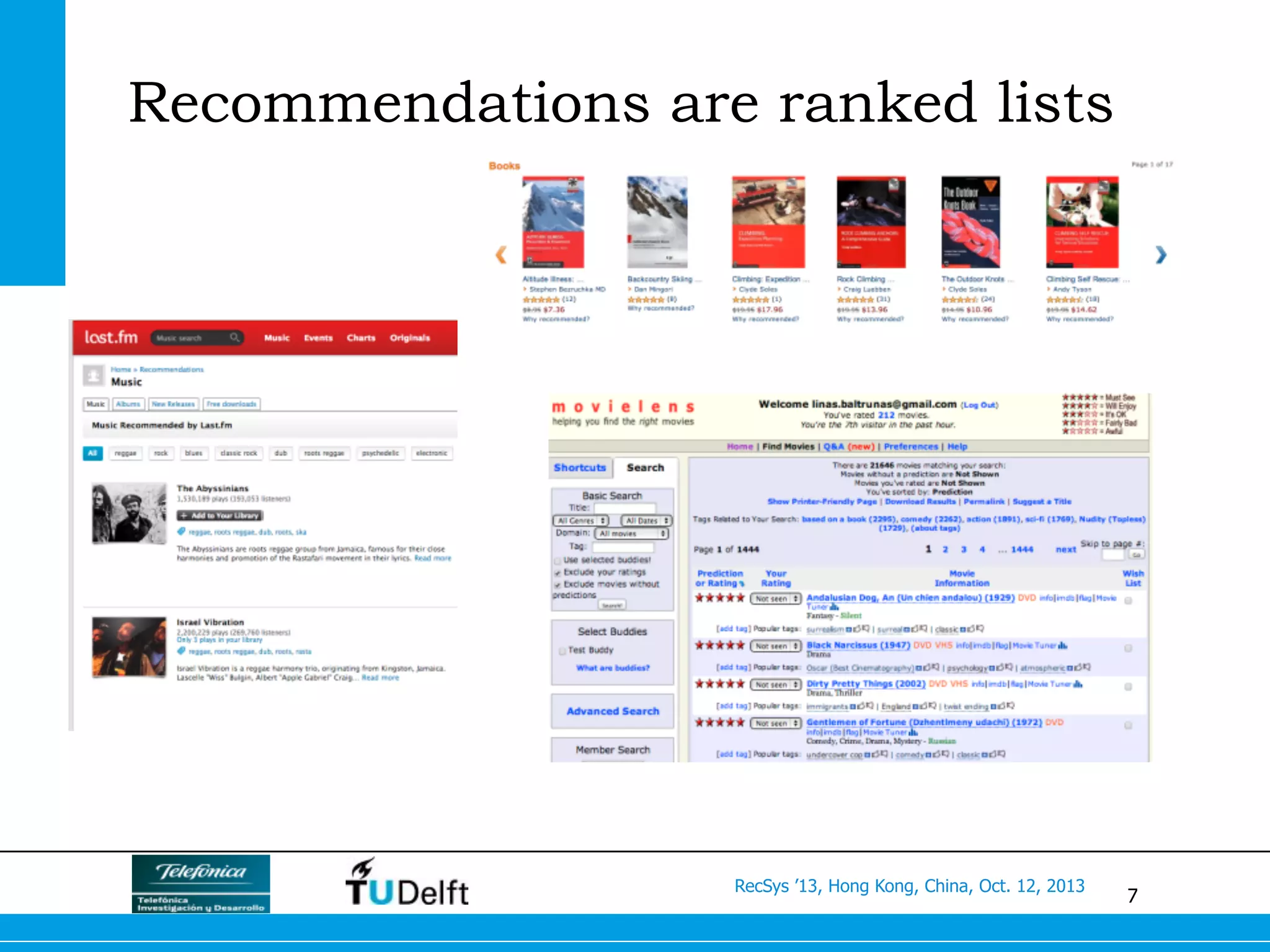
Recommendations are ranked lists
8
RecSys ’13, Hong Kong, China, Oct. 12, 2013
INTRO TO RANKING
•  Intro to in Ranking
•  Ranking measures
•  Learning to Rank for Recommender Systems
•  Classification of approaches
•  Trends and Challenges
9
RecSys ’13, Hong Kong, China, Oct. 12, 2013
Popular Ranking Methods
•  In order to generate the ranked item list, we need some
relative utility score for each item
•  Popularity is the obvious baseline
•  Score could depend on the user (personalized)
•  Score could also depend on the other items in the list (list-wise)
•  One popular way to rank the items in RS is to sort the items
according to the rating prediction
•  Works for the domains with ratings
•  Wastes the modeling power for the irrelevant items
10
RecSys ’13, Hong Kong, China, Oct. 12, 2013
Model
+
+
++
+
+
+
+
+
fij = hUi, Vji
11
RecSys ’13, Hong Kong, China, Oct. 12, 2013
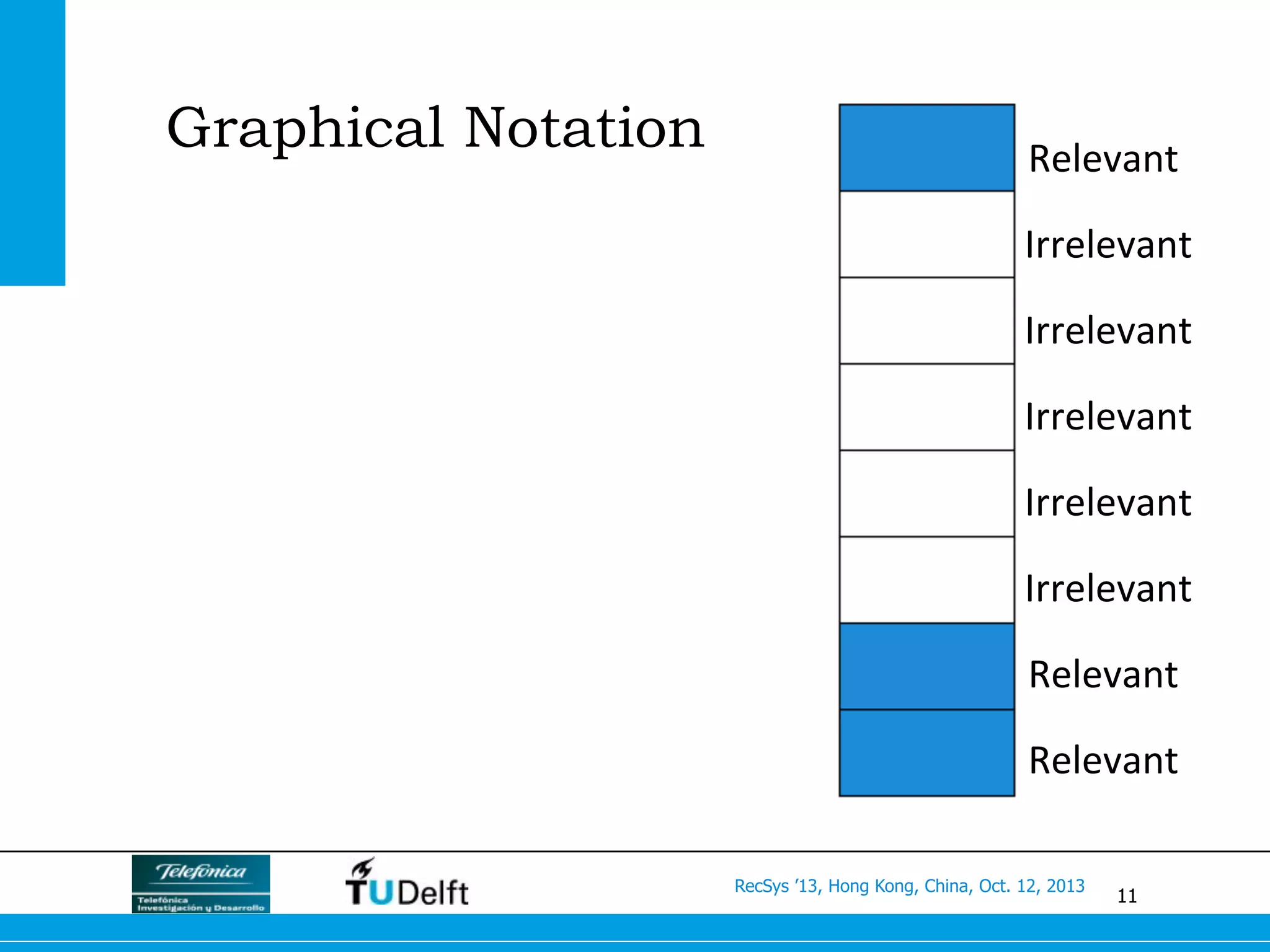
Graphical Notation
Relevant	
  
Irrelevant	
  
Irrelevant	
  
Irrelevant	
  
Irrelevant	
  
Irrelevant	
  
Relevant	
  
Relevant	
  
12
RecSys ’13, Hong Kong, China, Oct. 12, 2013
Ranking using latent
representation
•  If user = [-100, -100]
•  2d latent factor
•  We get the corresponding ranking
13
RecSys ’13, Hong Kong, China, Oct. 12, 2013
Matrix Factorization
(for ranking)
•  Randomly initialize item vectors
•  Randomly initialize user vectors
•  While not converged
•  Compute rating prediction error
•  Update user factors
•  Update item factors
•  Lets say user is [-100, -100]
•  Compute the square error
•  (5-<[-100, -100], [0.180, 0.19]>)2=1764
•  Update the user and item to the direction
where the error is reduced
(according to the gradient of the loss)
8 items with ratings
and random factors
14
RecSys ’13, Hong Kong, China, Oct. 12, 2013
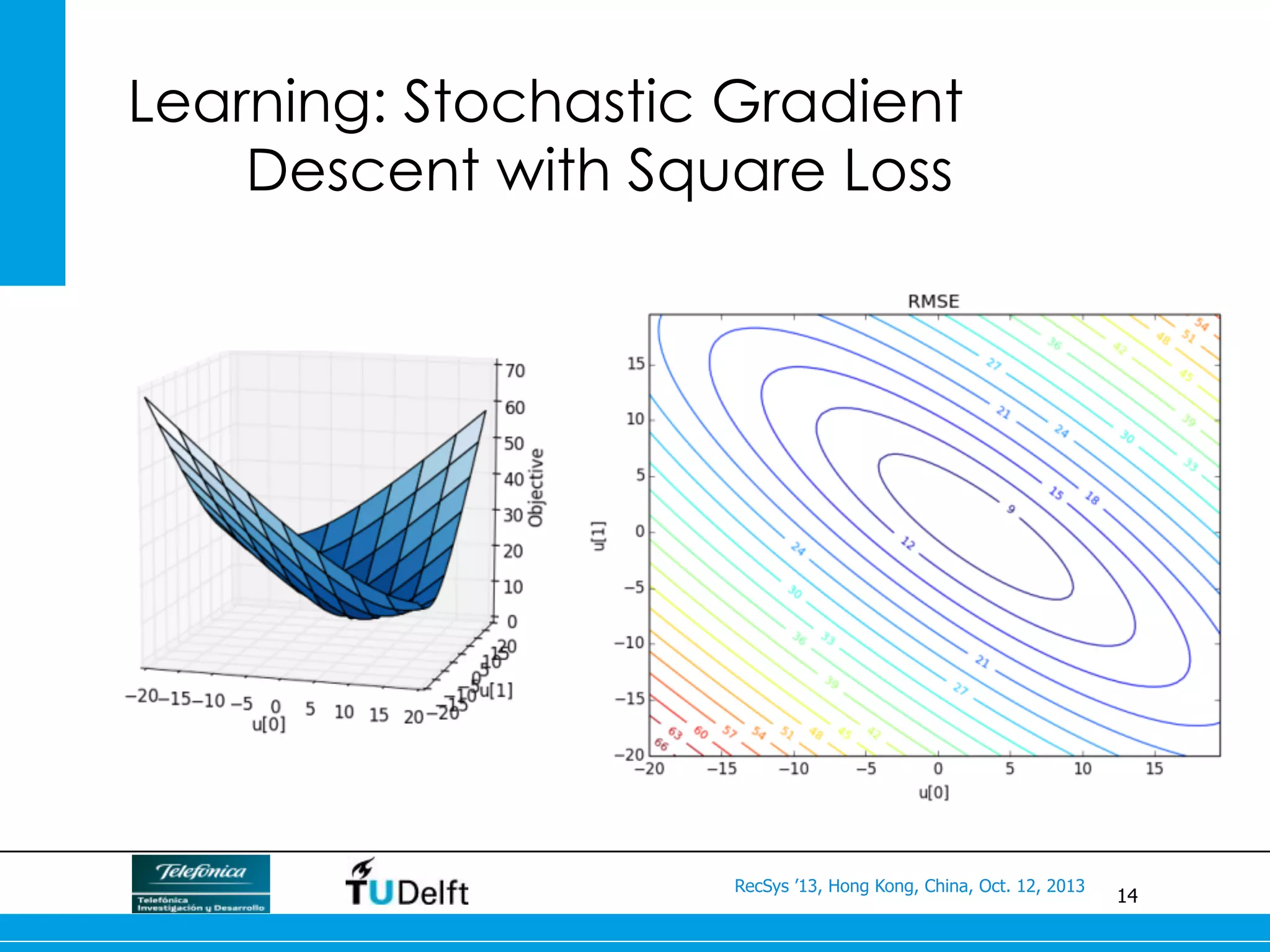
Learning: Stochastic Gradient
Descent with Square Loss
15
RecSys ’13, Hong Kong, China, Oct. 12, 2013
Square Loss
User: [3, 1], RMSE=6.7
16
RecSys ’13, Hong Kong, China, Oct. 12, 2013
Learning	
  to	
  Rank	
  for	
  Top-­‐k	
  RecSys	
  
• Usually	
  we	
  care	
  to	
  make	
  accurate	
  ranking	
  and	
  not	
  ra>ng	
  predic>on	
  
•  Square	
  loss	
  op>mizes	
  to	
  accurately	
  predict	
  1s	
  and	
  5s.	
  
• RS	
  should	
  get	
  the	
  top	
  items	
  right	
  -­‐>	
  Ranking	
  problem	
  
• Why	
  not	
  to	
  learn	
  how	
  to	
  rank	
  directly?	
  
•  Learning	
  to	
  Rank	
  methods	
  provide	
  up	
  to	
  30%	
  performance	
  
improvements	
  in	
  off-­‐line	
  evalua>ons	
  
•  It	
  is	
  possible,	
  but	
  a	
  more	
  complex	
  task	
  
17
RecSys ’13, Hong Kong, China, Oct. 12, 2013
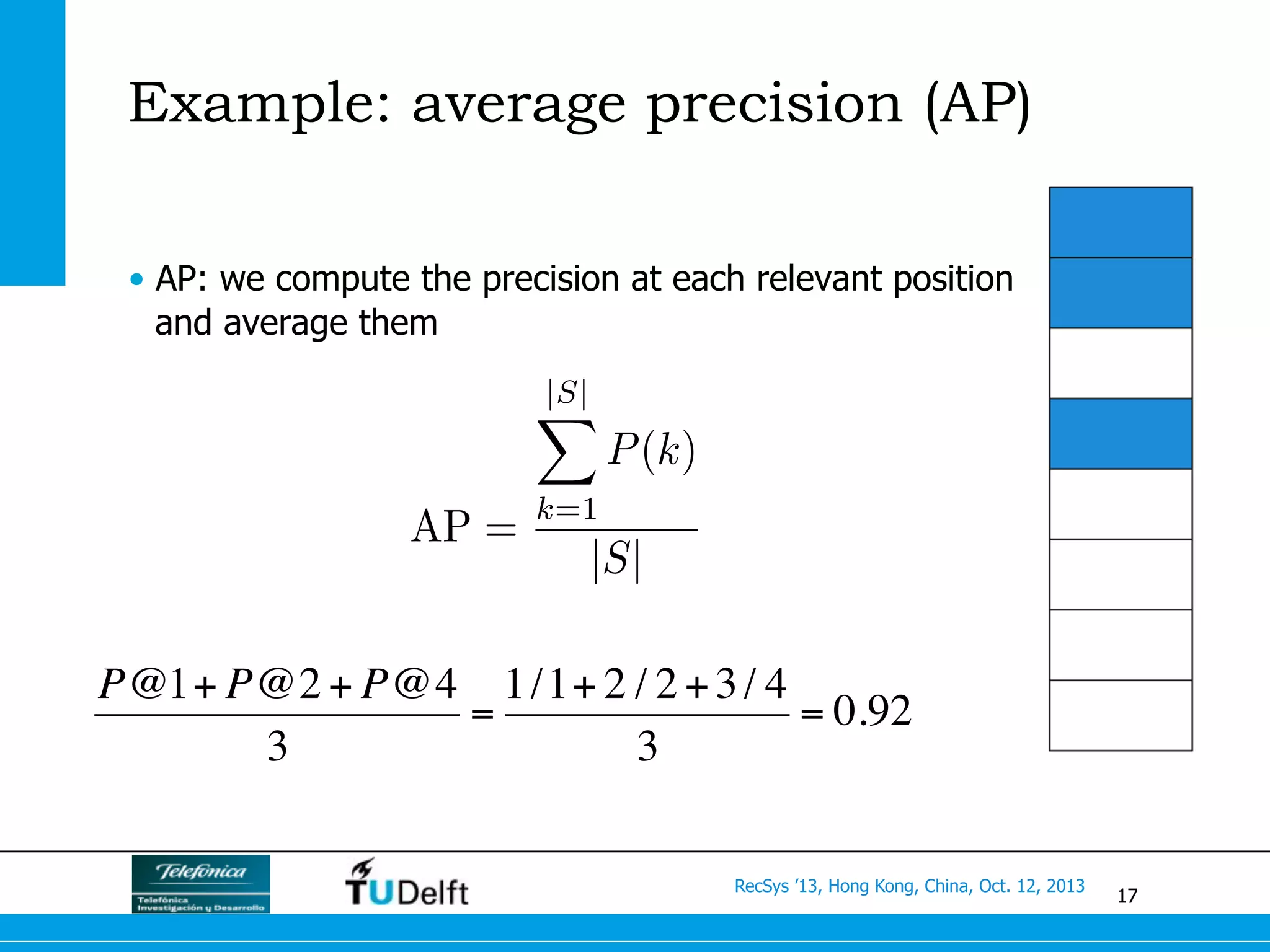
Example: average precision (AP)
AP =
|S|
X
k=1
P(k)
|S|
•  AP: we compute the precision at each relevant position
and average them
P@1+ P@2 + P@4
3
=
1/1+ 2 / 2 +3/ 4
3
= 0.92
18
RecSys ’13, Hong Kong, China, Oct. 12, 2013
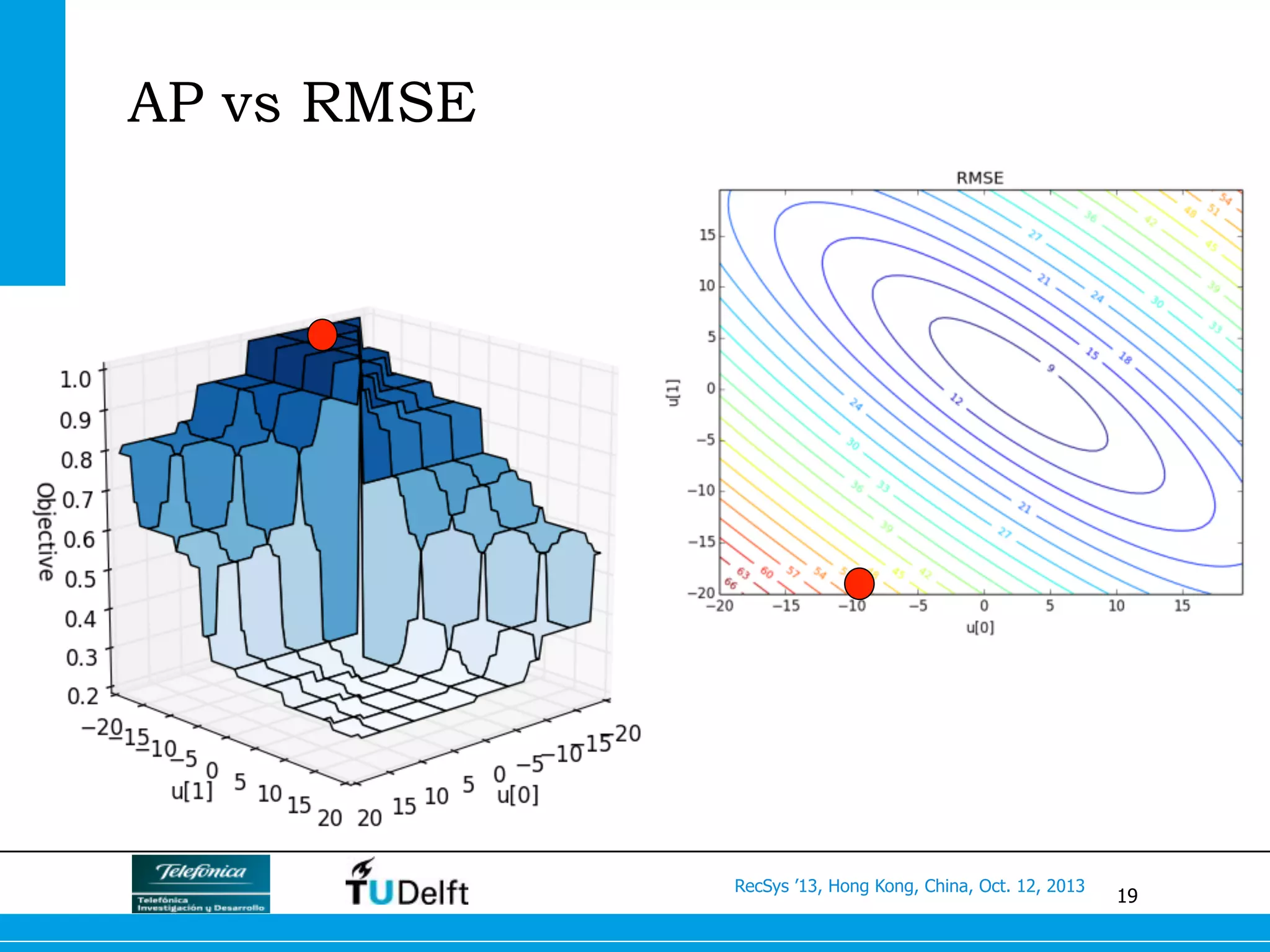
Why is hard? Non Smoothness
Example: AP
u:[-20,-20]
u:[20,20]
19
RecSys ’13, Hong Kong, China, Oct. 12, 2013
AP vs RMSE
20
RecSys ’13, Hong Kong, China, Oct. 12, 2013
The Non-smoothness of
Average Precision
APm =
1
PN
i=1 ymi
NX
i=1
ymi
rmi
NX
j=1
ymjI(rmj  rmi)
AP =
|S|
X
k=1
P(k)
|S|
ymi
rmi
I(·)
is 1 if item i is relevant for user m and 0 otherwise
indicator function (1 if it is true, 0 otherwise)
Rank of item i for user m
21
RecSys ’13, Hong Kong, China, Oct. 12, 2013
How can we get a smooth-AP?
• We	
  replace	
  non	
  smooth	
  places	
  of	
  MAP	
  with	
  smooth	
  approxima>on	
  
g(x) = 1/(1 + e x
)
1
rmi
⇡ g(fmi) = g(hUm, Vii)
22
RecSys ’13, Hong Kong, China, Oct. 12, 2013
How can we get a smooth-MAP?
• We	
  replace	
  non	
  smooth	
  places	
  of	
  MAP	
  with	
  smooth	
  approxima>on	
  
g(x) = 1/(1 + e x
)
I(rmj  rmi) ⇡ g(fmj fmi) = g(hUm, Vj Vii)
23
RecSys ’13, Hong Kong, China, Oct. 12, 2013
u:[-20,-20]
u:[20,20]
Smooth version of MAP
24
RecSys ’13, Hong Kong, China, Oct. 12, 2013
Not always the case:
only sometimes approximation
is very good…
25
RecSys ’13, Hong Kong, China, Oct. 12, 2013
Ranking Inconsistencies
•  Achieving a perfect ranking for all users is not possible
•  Two Sources of Inconsistencies:
•  1) Factor Models (all models) have limited expressive power
and cannot learn the perfect ranking for all users
•  2) Ranking functions approximations are inconsistent e.g.
A >B & B>C but C > A
26
RecSys ’13, Hong Kong, China, Oct. 12, 2013
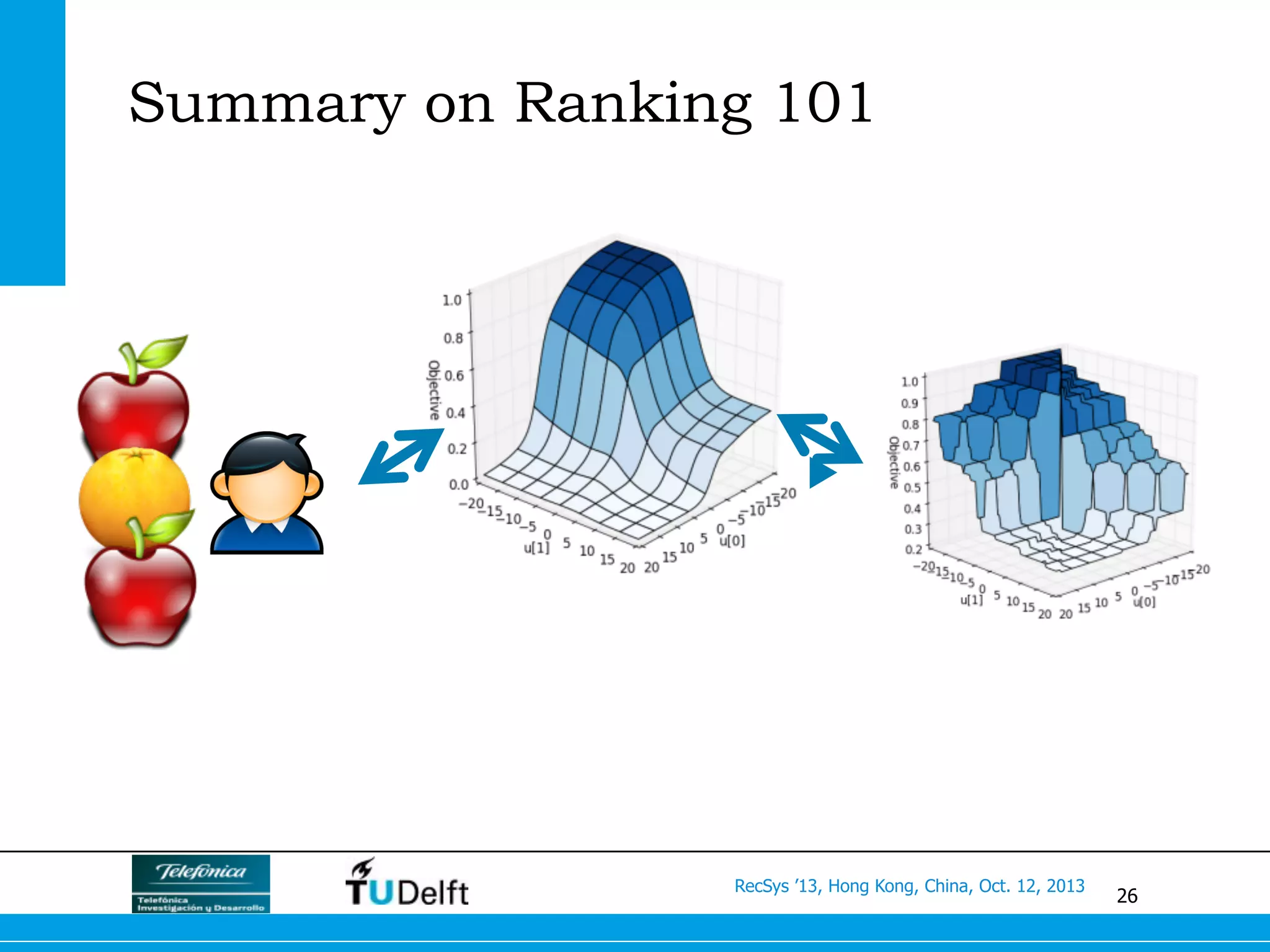
Summary on Ranking 101
27
RecSys ’13, Hong Kong, China, Oct. 12, 2013
RANKING METRICS
•  Intro to in Ranking
•  Ranking measures
•  Learning to Rank for Recommender Systems
•  Classification of approaches
•  Trends and Challenges
28
RecSys ’13, Hong Kong, China, Oct. 12, 2013
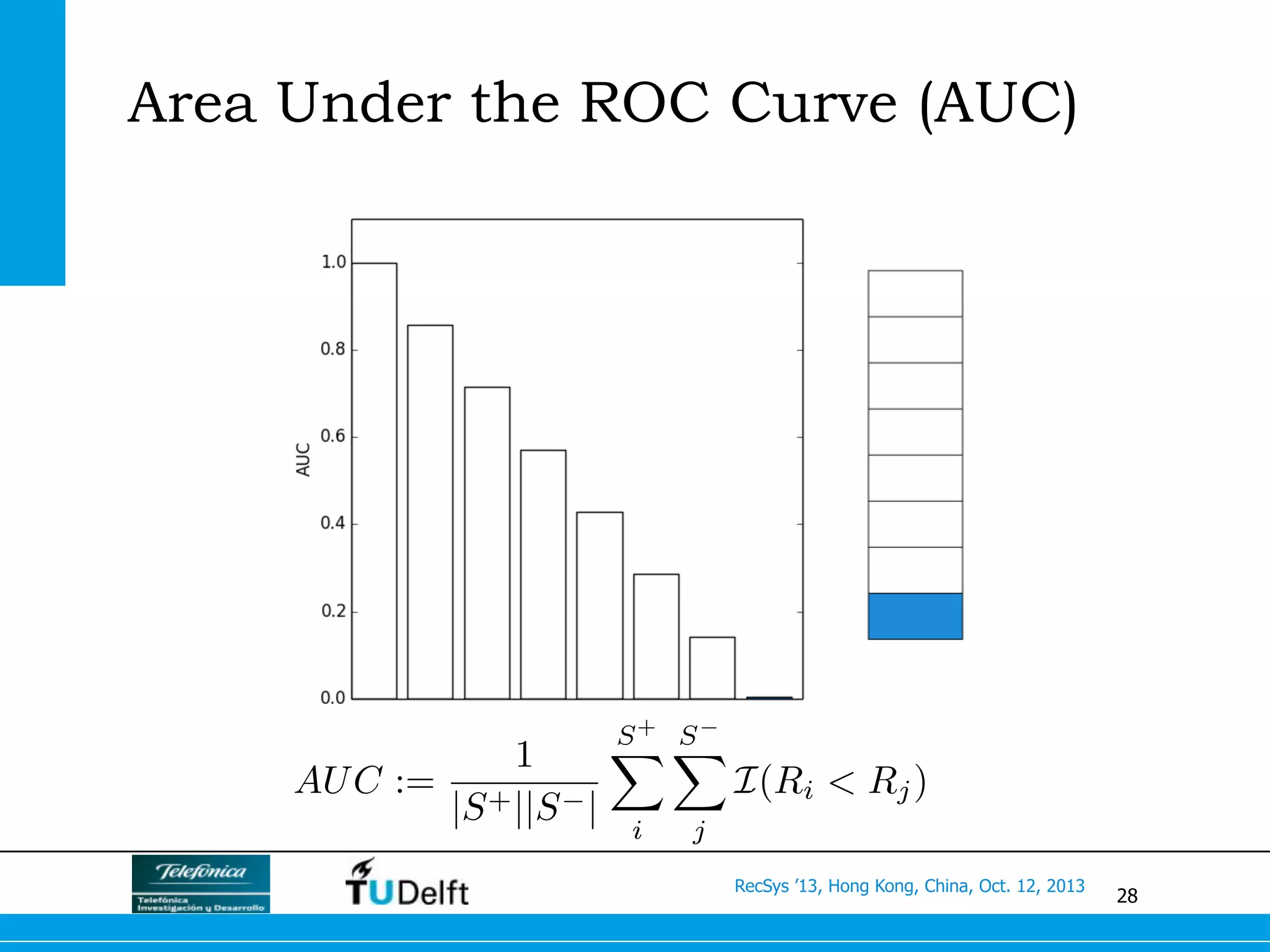
Area Under the ROC Curve (AUC)
AUC :=
1
|S+||S |
S+
X
i
SX
j
I(Ri < Rj)
29
RecSys ’13, Hong Kong, China, Oct. 12, 2013
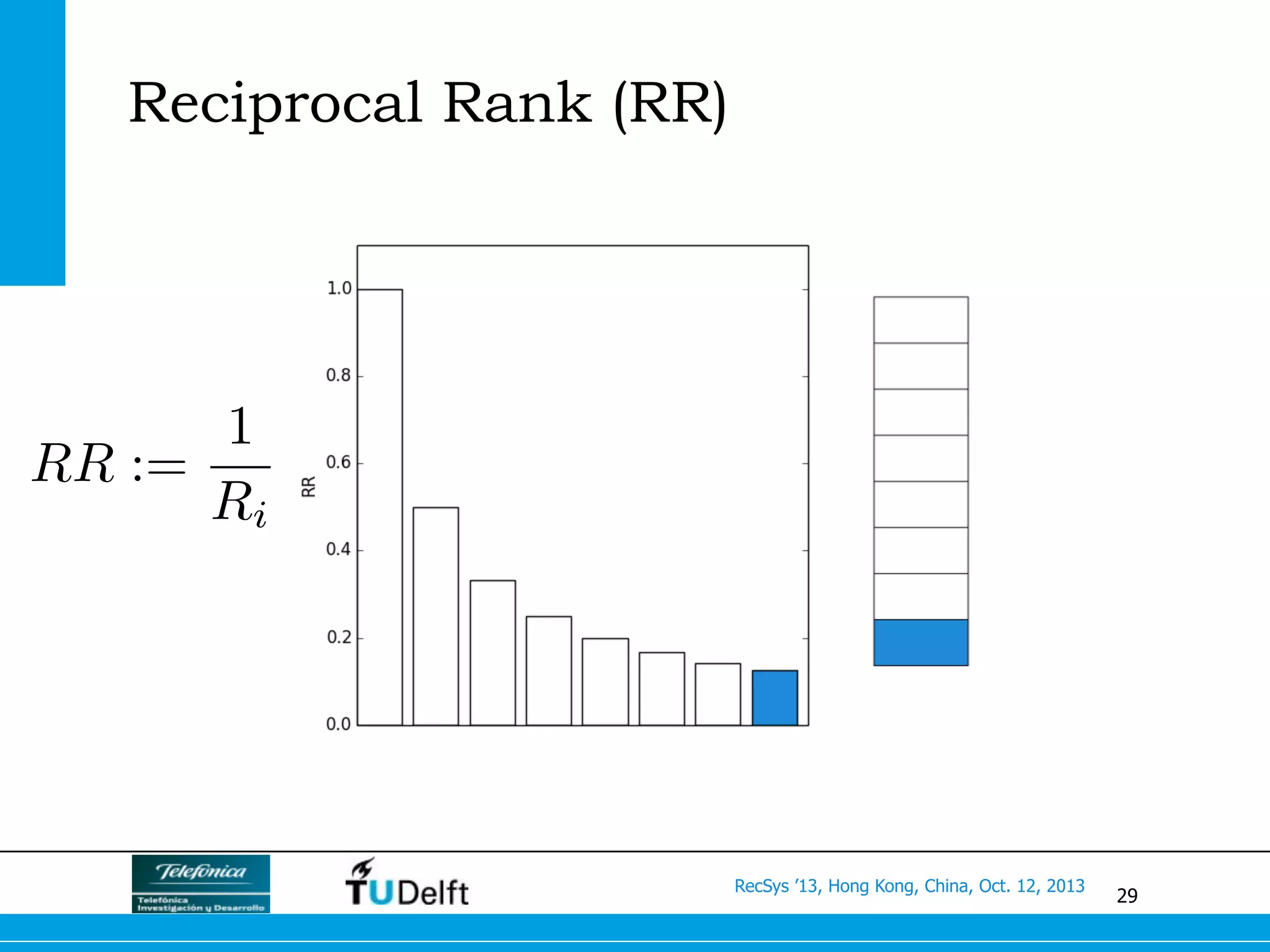
Reciprocal Rank (RR)
RR :=
1
Ri
30
RecSys ’13, Hong Kong, China, Oct. 12, 2013
Average Precision (AP)
AP =
|S|
X
k=1
P(k)
|S|
31
RecSys ’13, Hong Kong, China, Oct. 12, 2013
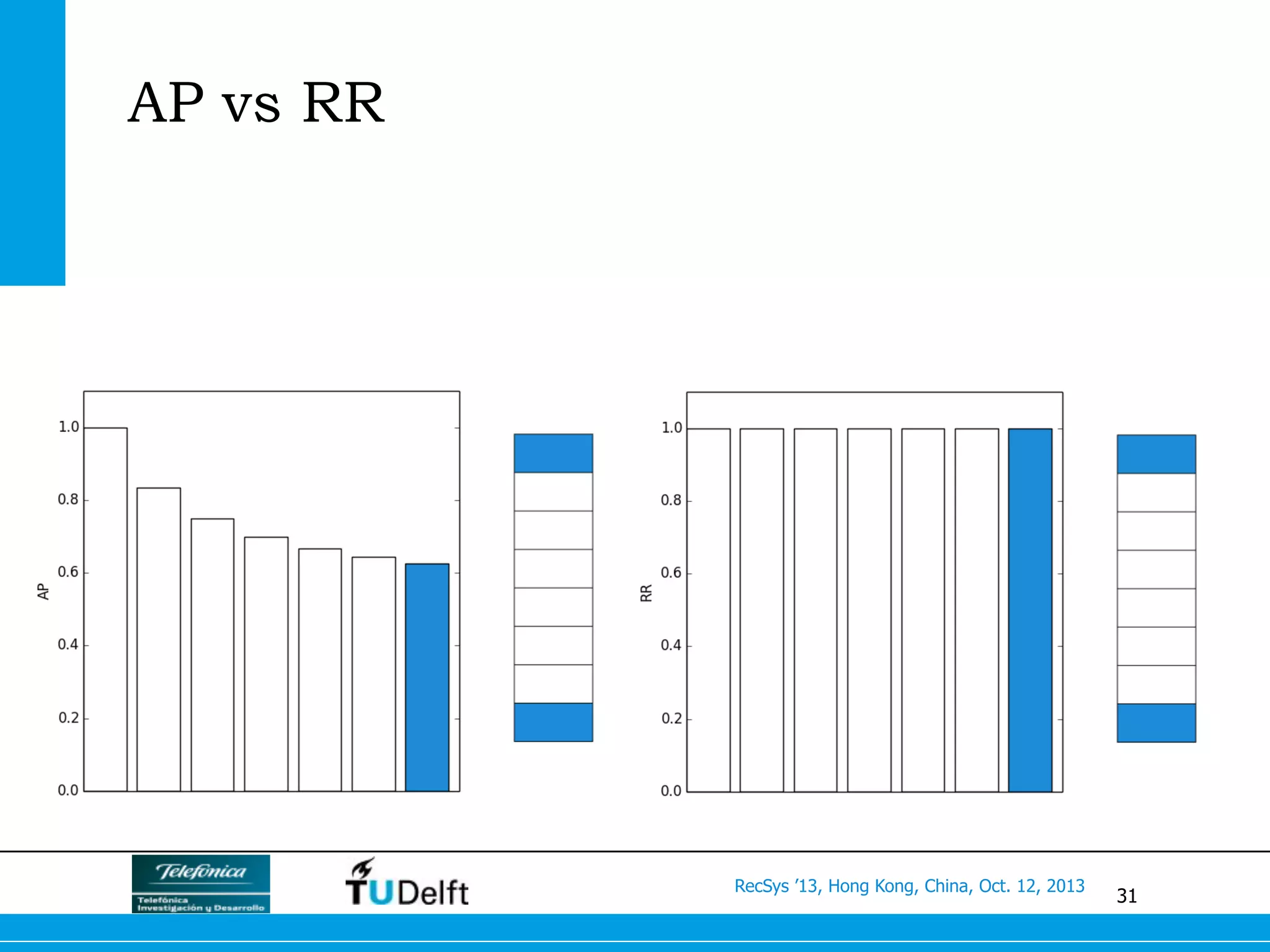
AP vs RR
32
RecSys ’13, Hong Kong, China, Oct. 12, 2013
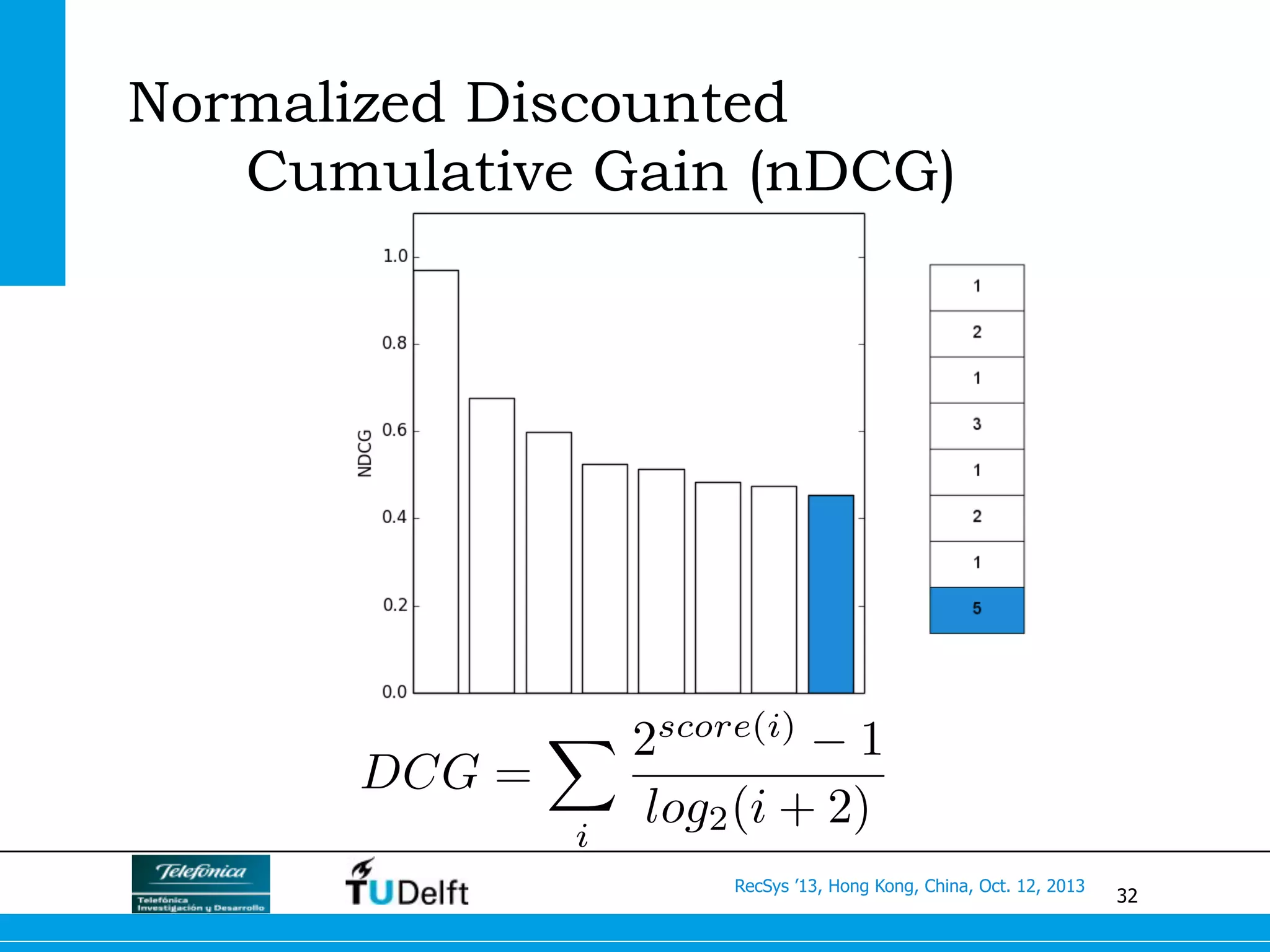
DCG =
X
i
2score(i)
1
log2(i + 2)
Normalized Discounted
Cumulative Gain (nDCG)
33
RecSys ’13, Hong Kong, China, Oct. 12, 2013
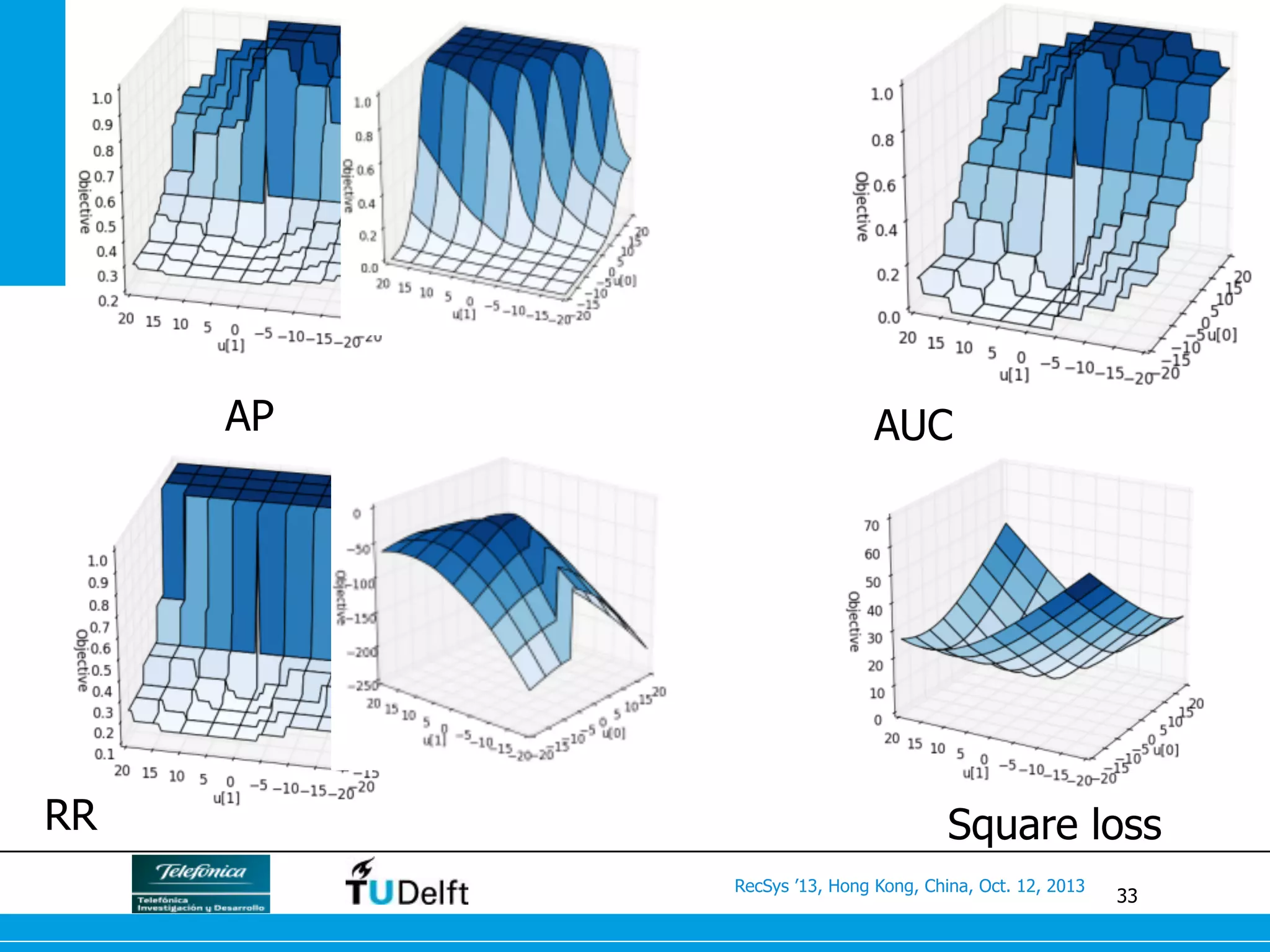
AP AUC
RR Square loss
34
RecSys ’13, Hong Kong, China, Oct. 12, 2013
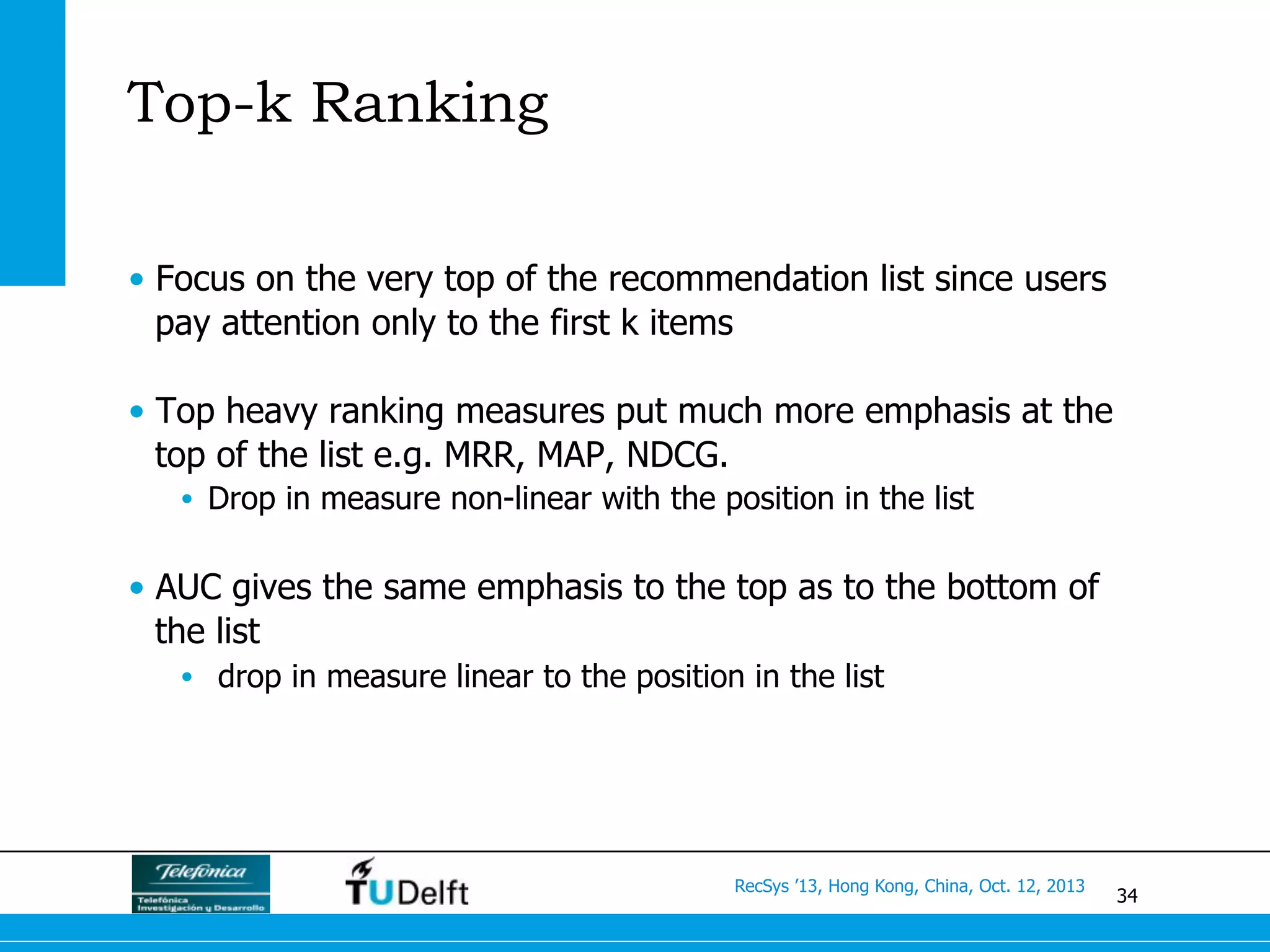
Top-k Ranking
•  Focus on the very top of the recommendation list since users
pay attention only to the first k items
•  Top heavy ranking measures put much more emphasis at the
top of the list e.g. MRR, MAP, NDCG.
•  Drop in measure non-linear with the position in the list
•  AUC gives the same emphasis to the top as to the bottom of
the list
•  drop in measure linear to the position in the list
35
RecSys ’13, Hong Kong, China, Oct. 12, 2013
LEARNING TO RANK
FOR RECSYS
•  Intro to in Ranking
•  Ranking measures
•  Learning to Rank for Recommender Systems
•  Classification of approaches
•  Trends and Challenges
36
RecSys ’13, Hong Kong, China, Oct. 12, 2013
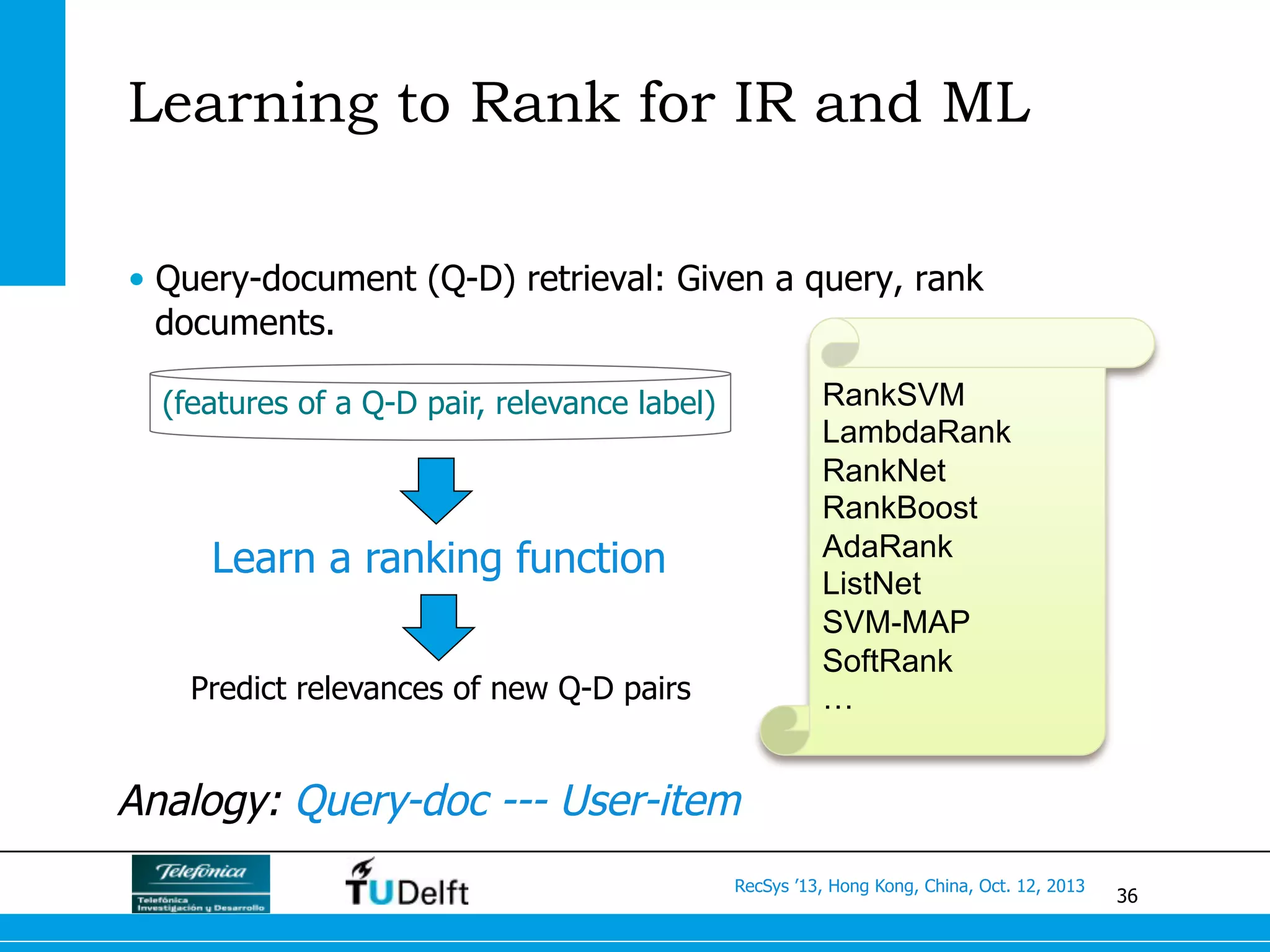
Learning to Rank for IR and ML
•  Query-document (Q-D) retrieval: Given a query, rank
documents.
(features of a Q-D pair, relevance label)
Learn a ranking function
Predict relevances of new Q-D pairs
RankSVM
LambdaRank
RankNet
RankBoost
AdaRank
ListNet
SVM-MAP
SoftRank
…
Analogy: Query-doc --- User-item
37
RecSys ’13, Hong Kong, China, Oct. 12, 2013
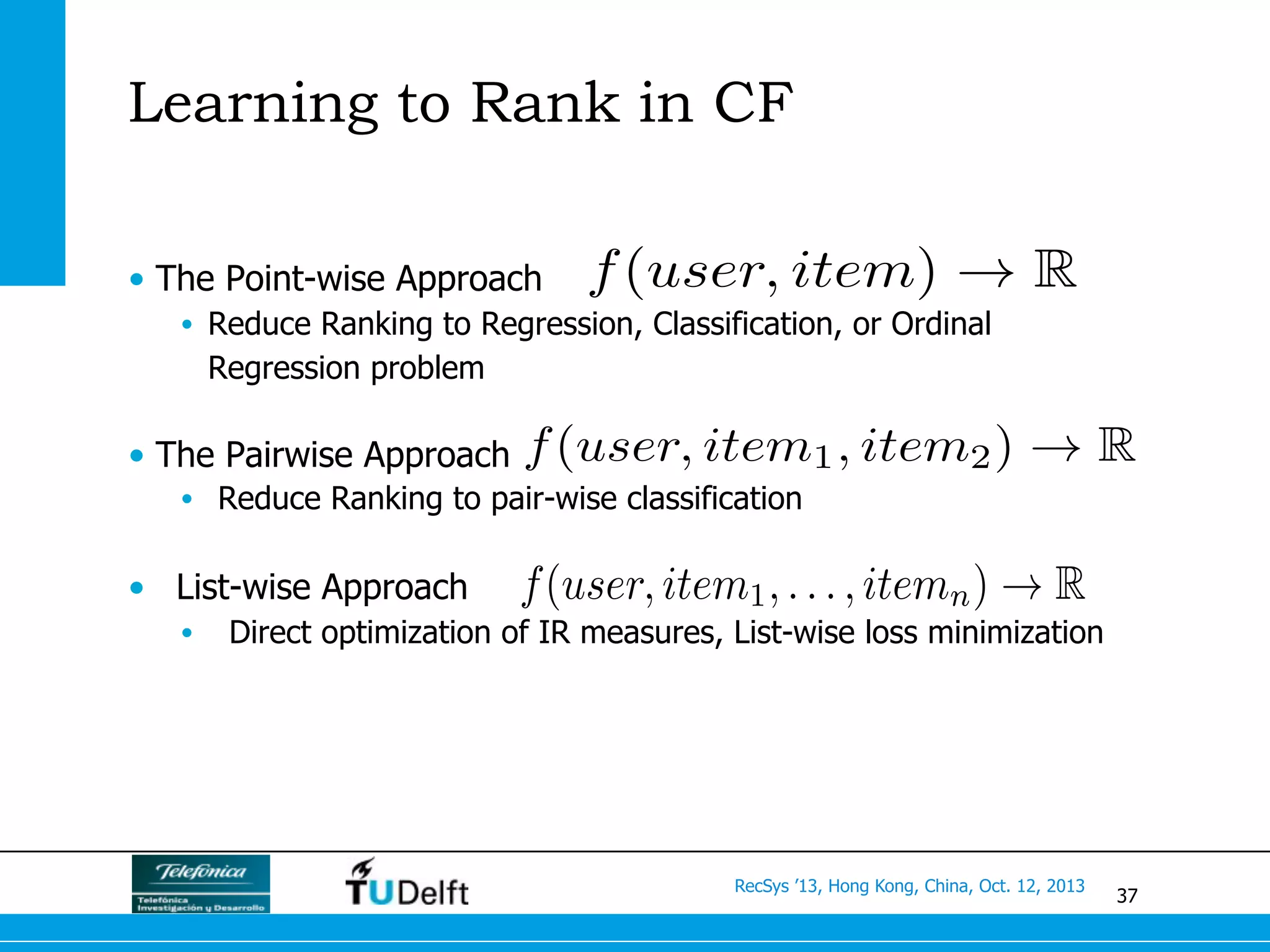
•  The Point-wise Approach
•  Reduce Ranking to Regression, Classification, or Ordinal
Regression problem
•  The Pairwise Approach
•  Reduce Ranking to pair-wise classification
•  List-wise Approach
•  Direct optimization of IR measures, List-wise loss minimization
Learning to Rank in CF
f(user, item) ! R
f(user, item1, item2) ! R
f(user, item1, . . . , itemn) ! R
38
RecSys ’13, Hong Kong, China, Oct. 12, 2013
Overview
Classification by What to Model
Pointwise Pairwise Listwise
Matrix factorization
[Koren 2009]
BPR [Rendle 2009] CofiRank [Weimer 2007]
SVD++ [Koren 2008] EigenRank [Liu 2008] ListRank [Shi 2010]
OrdRec [Koren 2011] pLPA [Liu 2009] WLT [Volkovs 2012]
Factorization machines
[Rendle 2012]
CR [Balakrishnan 2012] TFMAP [Shi 2012a]
(All rating prediction
methods)
CLiMF [Shi 2012b]
GAPfm [Shi 2013a]
xCLiMF [Shi 2013b]
39
RecSys ’13, Hong Kong, China, Oct. 12, 2013
Overview
Classification by How to Model
Proxy of
rankings
Structured
estimation
Non-smooth
optimization
Smoothing
ranking
measures
(All the rating
prediction methods)
CofiRank [Weimer
2007]
WLT [Volkovs 2012] BPR [Rendle 2009]
EigenRank [Liu
2008]
TFMAP [Shi 2012a]
pLPA [Liu 2009] CLiMF [Shi 2012b]
ListRank [Shi 2010] GAPfm [Shi 2013a]
CR [Balakrishnan
2012]
xCLiMF [Shi 2013b]
40
RecSys ’13, Hong Kong, China, Oct. 12, 2013
Pointwise
Standard Matrix Factorization [Koren 2009]
12355111u4
33334233u3
41155334u2
25532111u1
i8i7i6i5i4i3i2i1
12355111u4
33334233u3
41155334u2
25532111u1
i8i7i6i5i4i3i2i1
?
?
?
?
?
?
?
?
U
(4×D)
V
(D×8)
×~
Learn latent factors of users (U) and latent factors of
items (V), so that the product of U and V can fit the
known data.
The ratings of unseen items predicted
by corresponding inner products
Each user represented by
a D-dim vector
Each item represented by
a D-dim vector
41
RecSys ’13, Hong Kong, China, Oct. 12, 2013
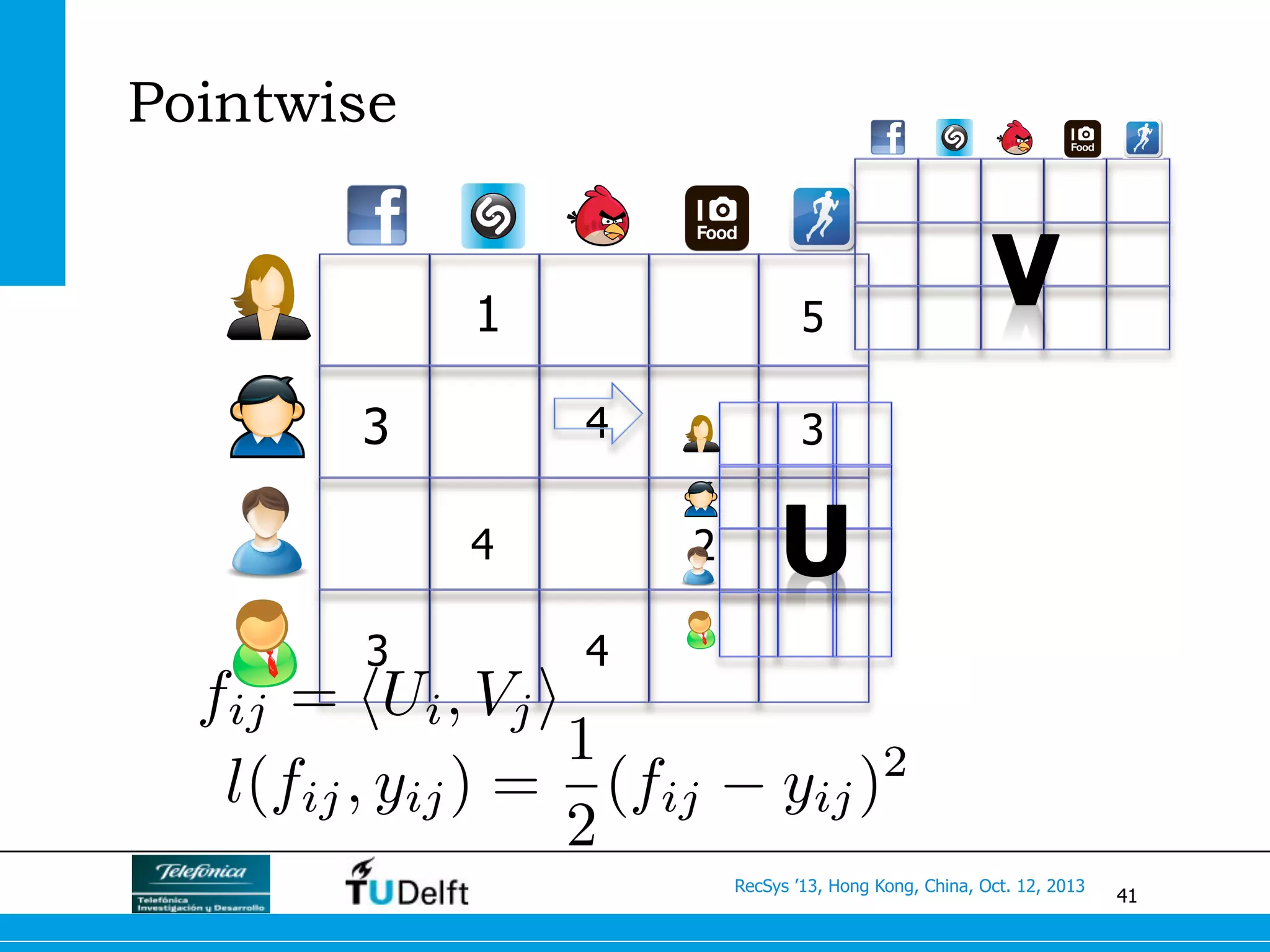
Pointwise
1
4
24
3
3
5
4
3
fij = hUi, Vji
l(fij, yij) =
1
2
(fij yij)2
42
RecSys ’13, Hong Kong, China, Oct. 12, 2013
Ordrec [Koren 2011]
Ratings are not numeric, but ordinal.
Ordinal modeling by learning the thresholds
1
2
3
4
5
Rating
Item with rating 4 should be more
similar to that with rating 5
Item with rating 4 should be less
similar to that with rating 1
43
RecSys ’13, Hong Kong, China, Oct. 12, 2013
OrdRec [Koren 2011]
Pointwise, proxy
1 2 3 4 5
t1
t2
t3
t4
log(
s
1 s
) = ts hUi, Mji P( s) = s
44
RecSys ’13, Hong Kong, China, Oct. 12, 2013
OrdRec [Koren 2011]
1 2 3 4 5
Parameterize the threshold into:
User factor, item factor and
previous threshold
Full distribution
estimation
45
RecSys ’13, Hong Kong, China, Oct. 12, 2013
BPR [Rendle 2009]
Pairwise, smoothing
Main idea: learn by comparing items that the user likes with items
that he does not.
+ -
>
Optimize the AUC, use a smooth version for Optimization purposes
When dealing with implicit data sample the unseen data as negative
46
RecSys ’13, Hong Kong, China, Oct. 12, 2013
Representation of pairwise preference data
Transformers (T) ?
Inception (I) ?
Scent of a woman (S) 1
Forrest Gump (F) 1
Zombieland (Z) ?
What Alice watched
What Alice’s pairwise preferences
(Row to Column)
T I S F Z
T ? - - ?
I ? - - ?
S + + ? +
F + + ? +
Z ? ? - -
BPR [Rendle 2009]
Pairwise, smoothing
47
RecSys ’13, Hong Kong, China, Oct. 12, 2013
EigenRank [Liu 2008]
Pairwise, proxy
Ranking-based similarity instead of rating based similarity
i1 i2 i3
u1 2 3 4
u2 4 2 5
User-user similarity
based on Kendall Rank
Correlation
Neighbour selection for
a user and item
preference estimation
Random walk with
restart over pairwise
item preference graph
48
RecSys ’13, Hong Kong, China, Oct. 12, 2013
Listwise
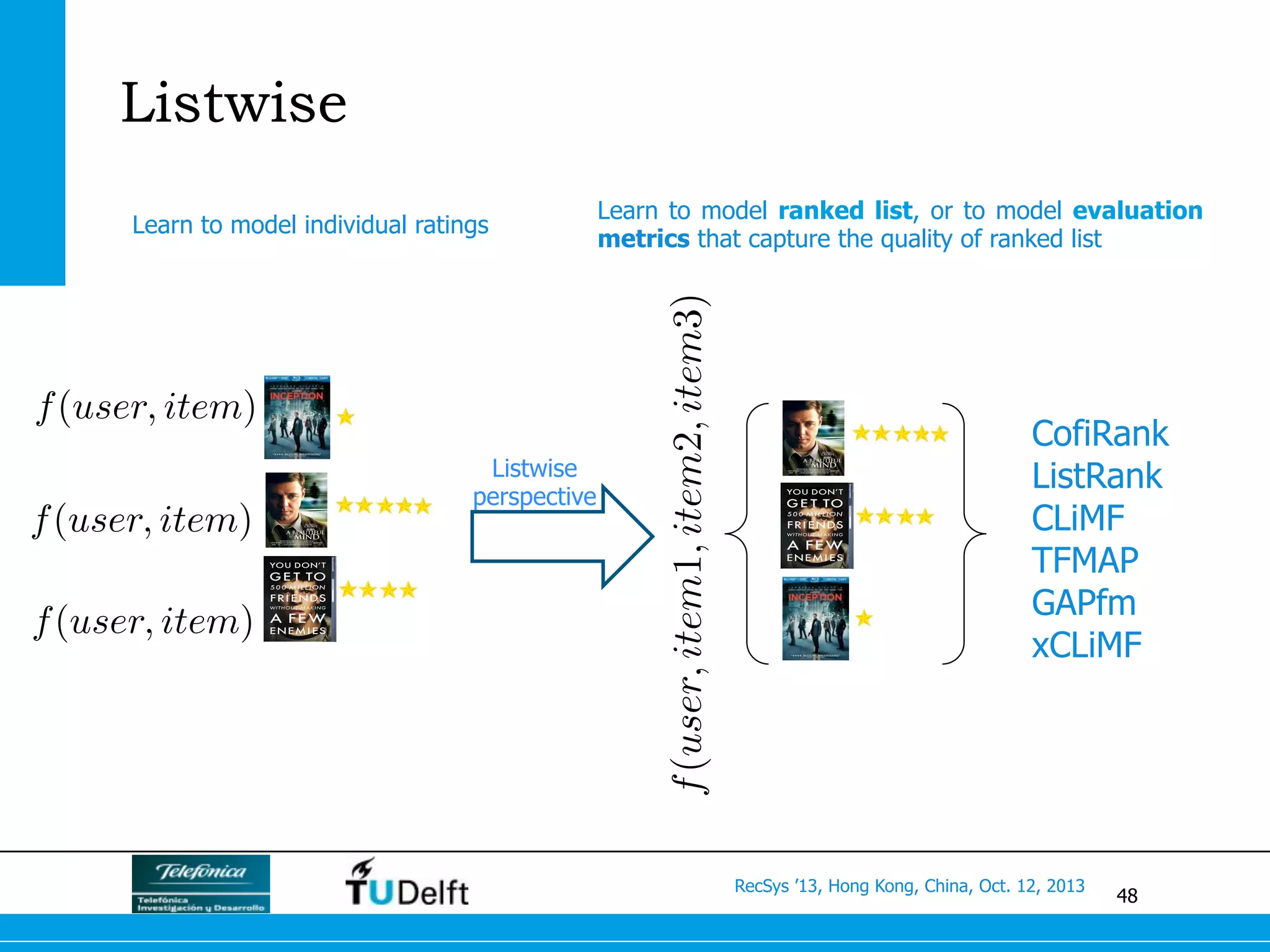
Learn to model individual ratings
Learn to model ranked list, or to model evaluation
metrics that capture the quality of ranked list
Listwise
perspective
CofiRank
ListRank
CLiMF
TFMAP
GAPfm
xCLiMF
f(user, item)
f(user, item)
f(user, item)
f(user,item1,item2,item3)
49
RecSys ’13, Hong Kong, China, Oct. 12, 2013
CoFiRank [Weimer 2007]
Listwise, structured est.
•  Based on Structured estimation i.e. Machine Learning
methods for complex output domains (graphs, sequences,
etc.)
•  Cast the Ranking problem as a Structured estimation problem
•  i.e. Learn a function that is maximized for the best possible
ranking with respect to a ranking measure e.g. NDCG
50
RecSys ’13, Hong Kong, China, Oct. 12, 2013
CoFiRank [Weimer 2007]
Listwise, structured est.
•  Step 1:
•  Instead of maximizing
•  Minimize
DCG@k(⇡, y) =
kX
i=1
(2yi
1)
log(⇡i + 1)
(⇡, y) := 1 NDCG(⇡, y)
51
RecSys ’13, Hong Kong, China, Oct. 12, 2013
CoFiRank [Weimer 2007]
Listwise, structured est.
•  Step 2:
•  Use the
•  Create a linear mapping
•  that is maximized for
•  denote by a decreasing nonnegative sequence
ha, bi  hsort(a), sort(b)i 8a, b 2 Rn
(⇡, f) := hc, f⇡i
⇡ = argsort(f)
52
RecSys ’13, Hong Kong, China, Oct. 12, 2013
CoFiRank [Weimer 2007]
Listwise, structured est.
•  Step 3:
•  Find convex upper on non-convex optimization problems: Let
Maximization by solving a Linear Assignment Problem to get
an estimate for the worst case loss (maximum margin)
l(f, y) := max
⇡
h
(⇡, y) + hc, f⇡ fi
i
53
RecSys ’13, Hong Kong, China, Oct. 12, 2013
CoFiRank [Weimer 2007]
1.6 2.6 2.9 1.9f
l(f, y) := max
⇡
h
(⇡, y) + hc, f⇡ fi
i
c := (i + 1) 0.5
:= [1, 0.7 ,0.57 ,0.5]
⇡ := [3, 2 ,4 ,1] ⇡ 1
:= [4, 2 ,1 ,3]
@f l(f, y) = [c c⇡ 1 ] := [-0.5, 0.0 ,0.42 ,0.1]
2.9 2.6 1.9 1.6f⇡
54
RecSys ’13, Hong Kong, China, Oct. 12, 2013
CoFiRank [Weimer 2007]
55
RecSys ’13, Hong Kong, China, Oct. 12, 2013
CLiMF [Shi 2012b]
Listwise, Smoothing Ranking Metrics
•  Why optimize mean reciprocal rank (MRR)?
•  Focus at the very top of the list
•  Try to get at least one interesting item at the top of the list
•  How to optimize MRR?
•  Find a smooth version of MRR
•  Find a lower bound of the smoothed MRR
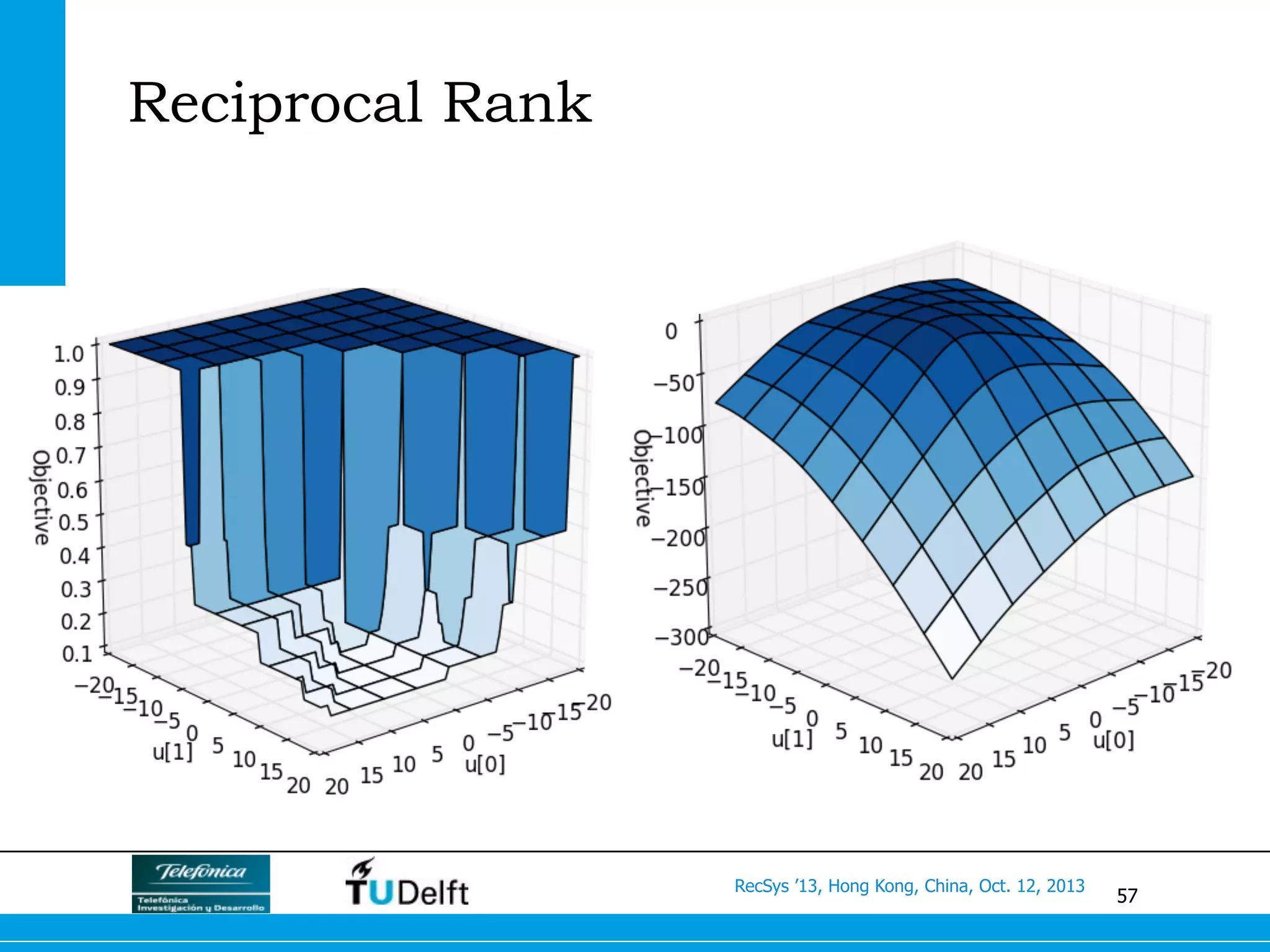
56
RecSys ’13, Hong Kong, China, Oct. 12, 2013
The Non-smoothness of Reciprocal
Rank
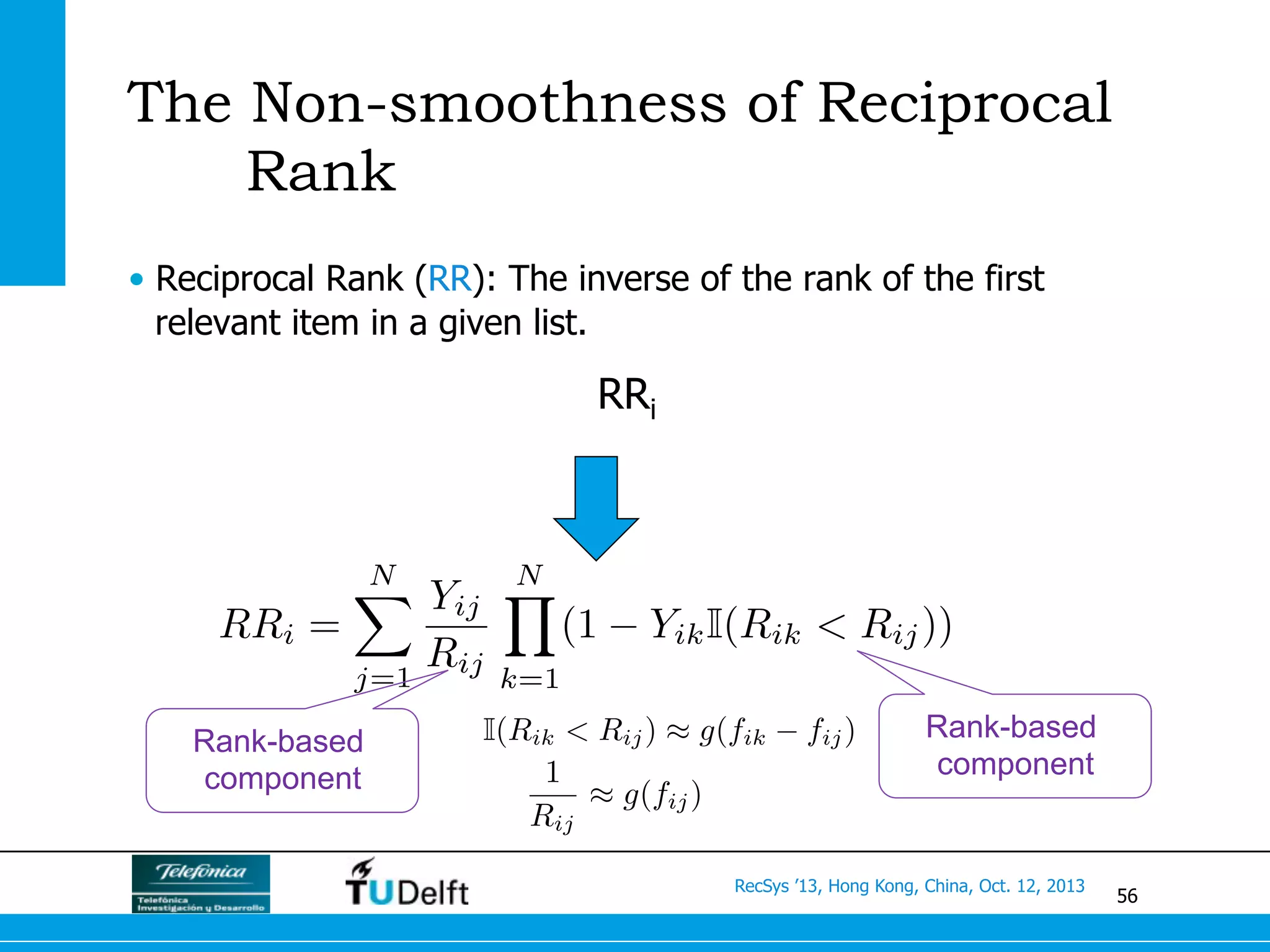
•  Reciprocal Rank (RR): The inverse of the rank of the first
relevant item in a given list.
RRi =
NX
j=1
Yij
Rij
NY
k=1
(1 YikI(Rik < Rij))
RRi
Rank-based
component
Rank-based
component
I(Rik < Rij) ⇡ g(fik fij)
1
Rij
⇡ g(fij)
57
RecSys ’13, Hong Kong, China, Oct. 12, 2013
Reciprocal Rank
58
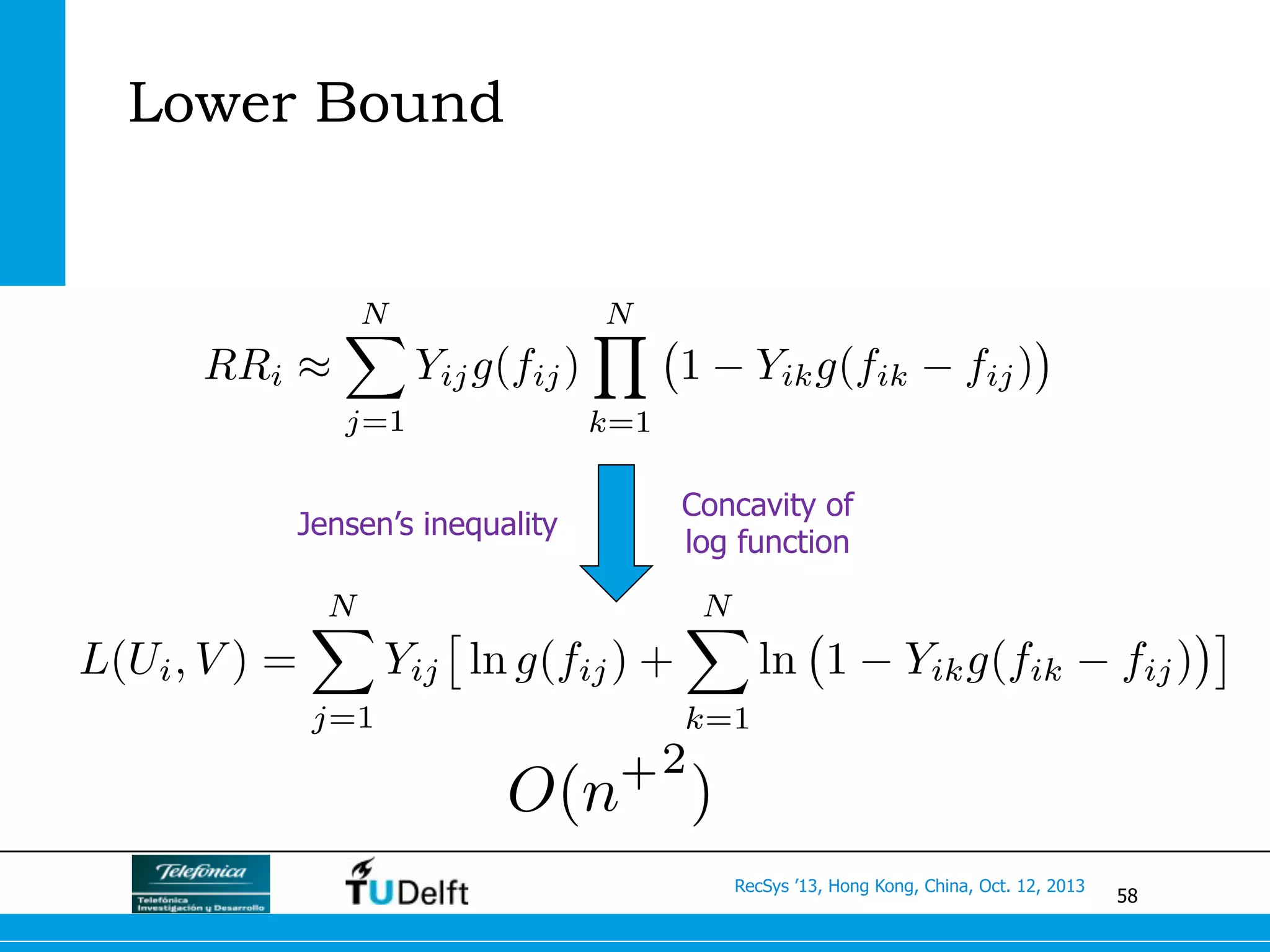
RecSys ’13, Hong Kong, China, Oct. 12, 2013
Lower Bound
RRi ⇡
NX
j=1
Yijg(fij)
NY
k=1
1 Yikg(fik fij)
L(Ui, V ) =
NX
j=1
Yij
⇥
ln g(fij) +
NX
k=1
ln 1 Yikg(fik fij)
⇤
O(n+2
)
Jensen’s inequality
Concavity of
log function
59
RecSys ’13, Hong Kong, China, Oct. 12, 2013
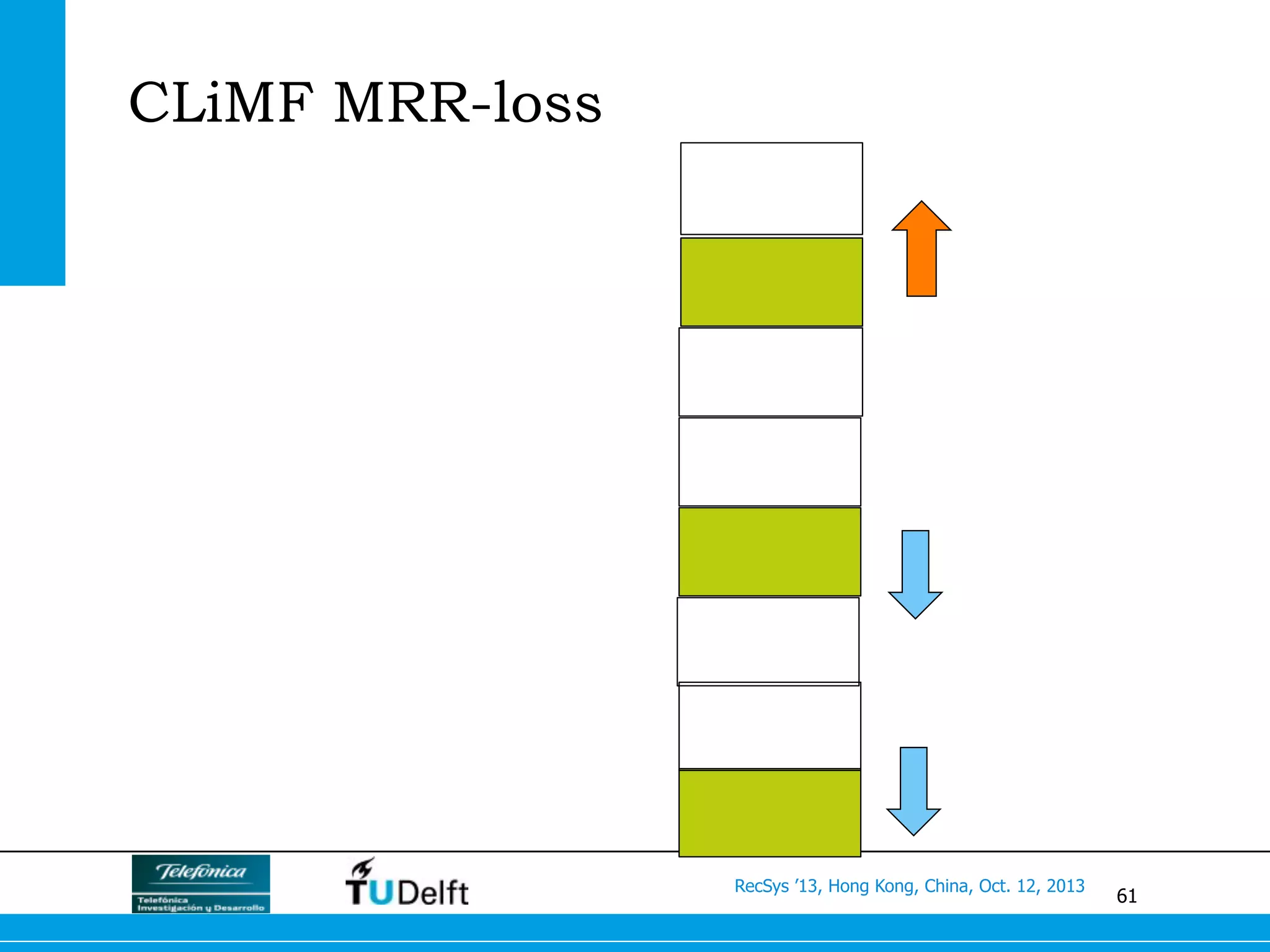
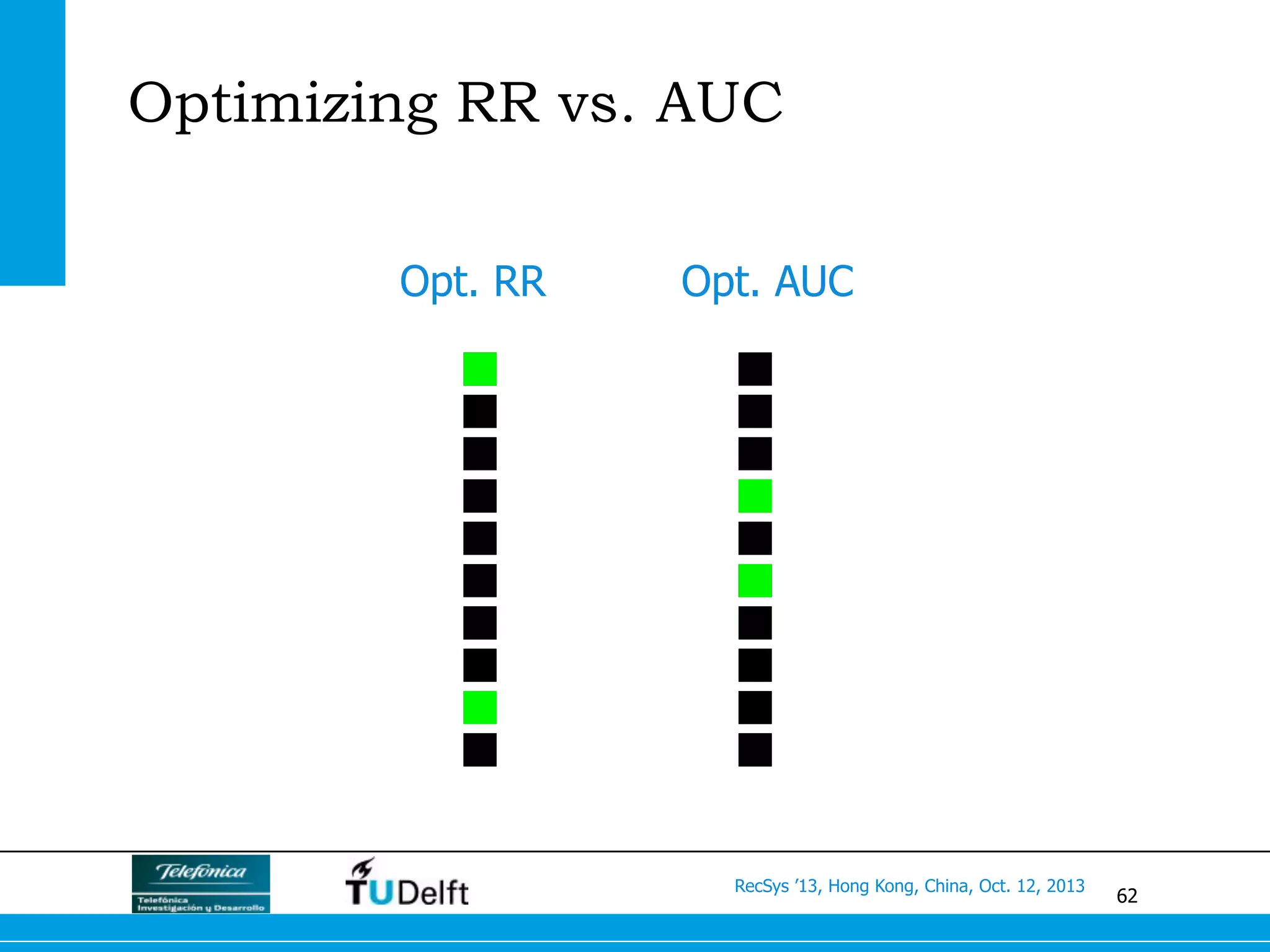
What’s the Key?
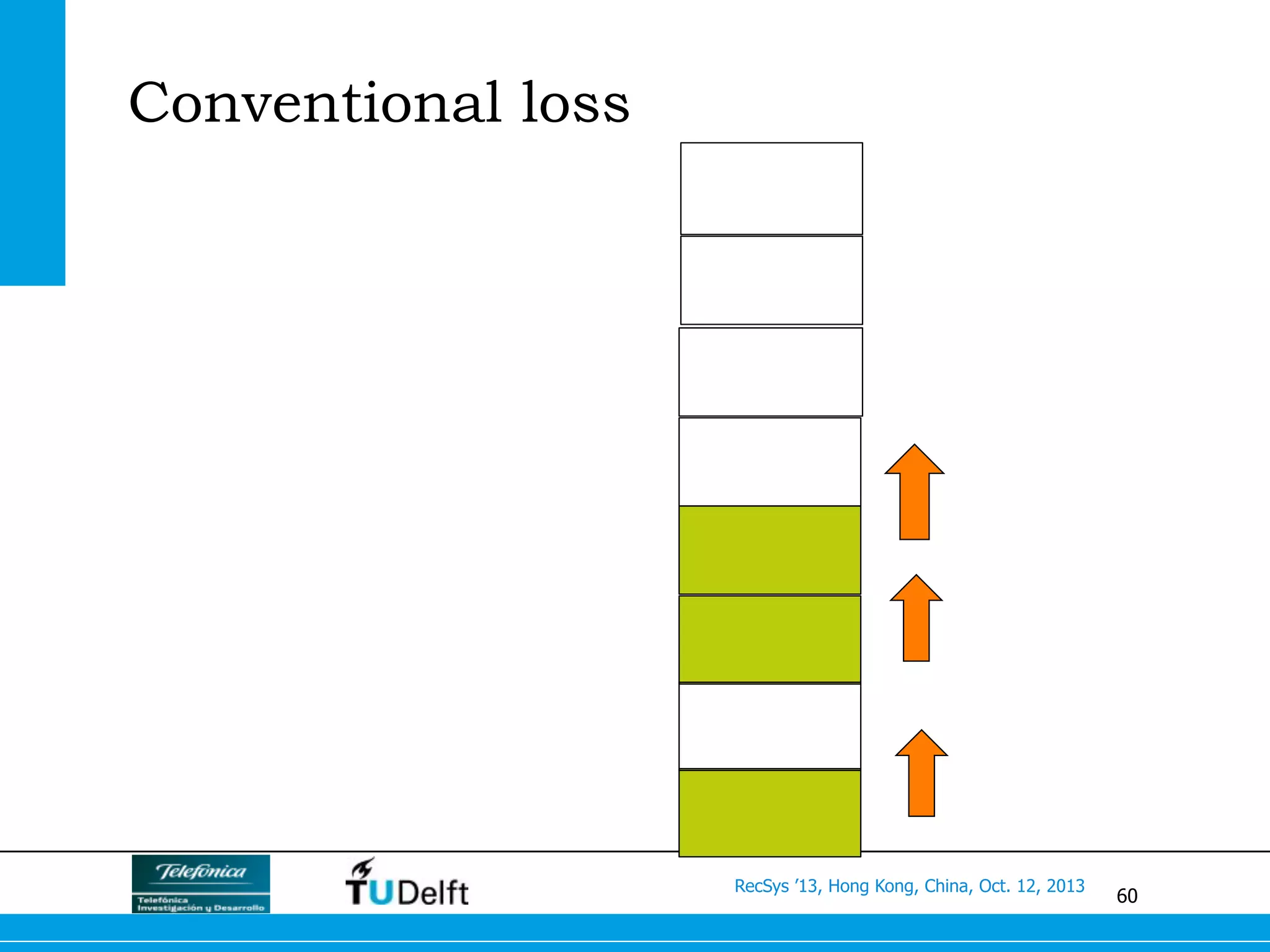
•  CLiMF reciprocal rank loss essentially pushes relevant items
apart
•  In the process at least one items ends up high-up in the list
60
RecSys ’13, Hong Kong, China, Oct. 12, 2013
Conventional loss
61
RecSys ’13, Hong Kong, China, Oct. 12, 2013
CLiMF MRR-loss
62
RecSys ’13, Hong Kong, China, Oct. 12, 2013
Optimizing RR vs. AUC
Opt. RR Opt. AUC
63
RecSys ’13, Hong Kong, China, Oct. 12, 2013
Listwise
xCLiMF [Shi 2013b] – Generalization to Ratings
•  Expected reciprocal rank (ERR) [Chapelle 2009]
•  A generalization of RR to graded relevance data
•  Cascade nature compared to NDCG
0
5
0
3
0
0
1
0
3
0
0
5
0
3
0
0
1
0
3
0
NDCG ERR
Equal contribution
independent of the
items ranked above
Different contributions
relative to the items
ranked above
= <
64
RecSys ’13, Hong Kong, China, Oct. 12, 2013
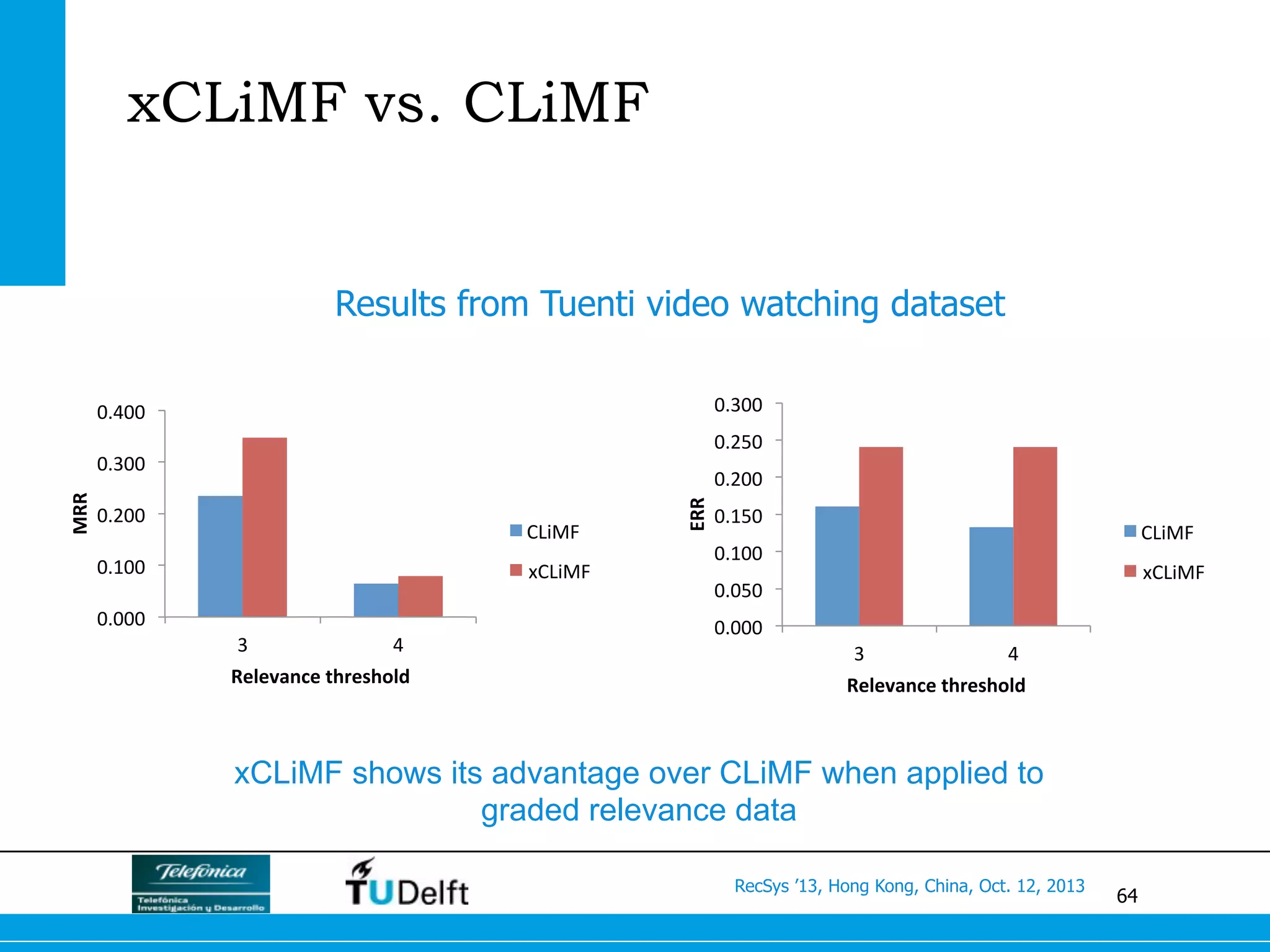
xCLiMF vs. CLiMF
0.000	
  
0.100	
  
0.200	
  
0.300	
  
0.400	
  
3	
   4	
  
MRR	
  
Relevance	
  threshold	
  
CLiMF	
  
xCLiMF	
  
0.000	
  
0.050	
  
0.100	
  
0.150	
  
0.200	
  
0.250	
  
0.300	
  
3	
   4	
  
ERR	
  
Relevance	
  threshold	
  
CLiMF	
  
xCLiMF	
  
Results from Tuenti video watching dataset
xCLiMF shows its advantage over CLiMF when applied to
graded relevance data
65
RecSys ’13, Hong Kong, China, Oct. 12, 2013
Listwise
TFMAP [Shi 2012a] – Generalization to Context
Context-aware
Recommendation
66
RecSys ’13, Hong Kong, China, Oct. 12, 2013
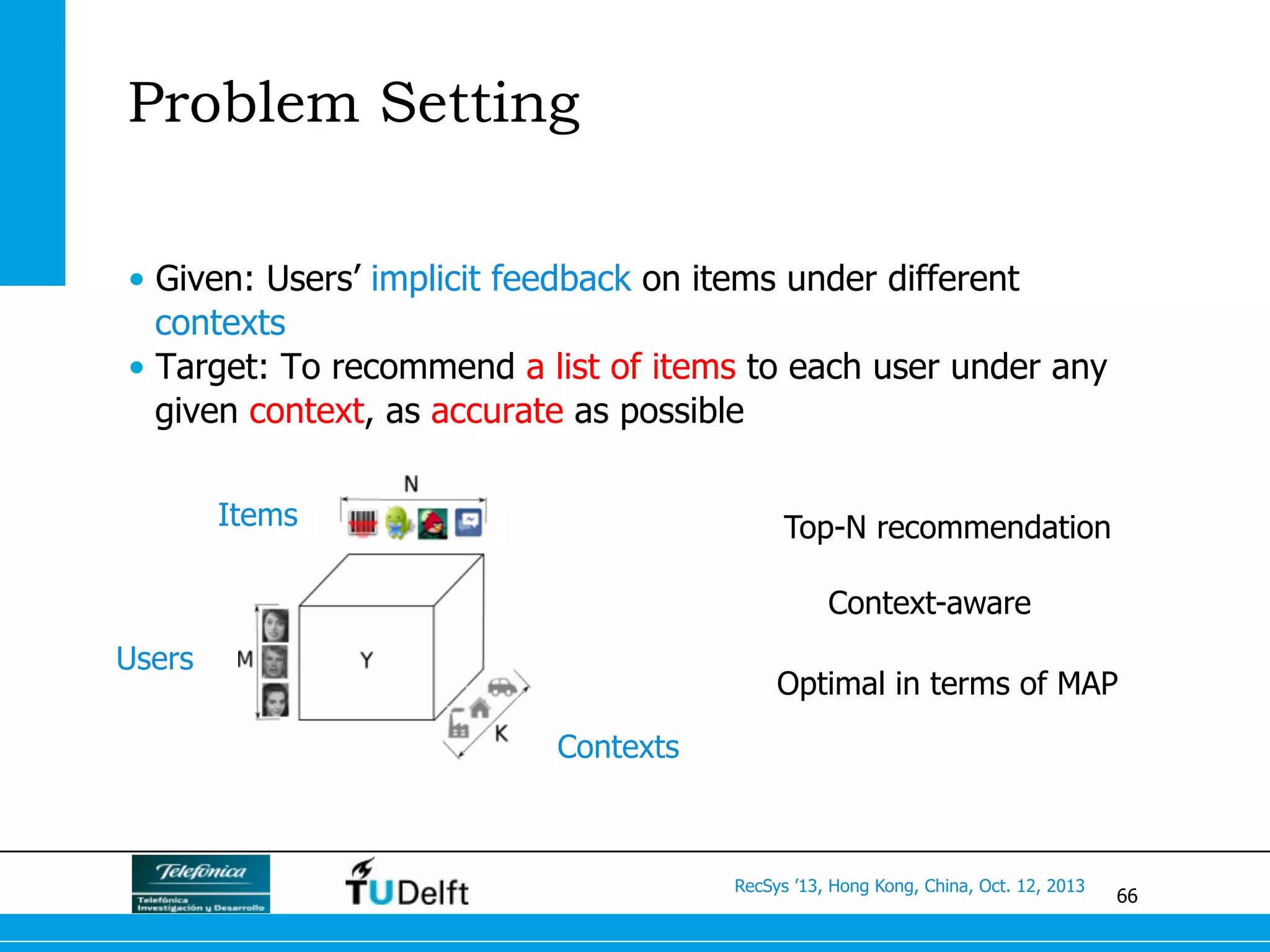
Problem Setting
•  Given: Users’ implicit feedback on items under different
contexts
•  Target: To recommend a list of items to each user under any
given context, as accurate as possible
Users
Contexts
Items Top-N recommendation
Context-aware
Optimal in terms of MAP
67
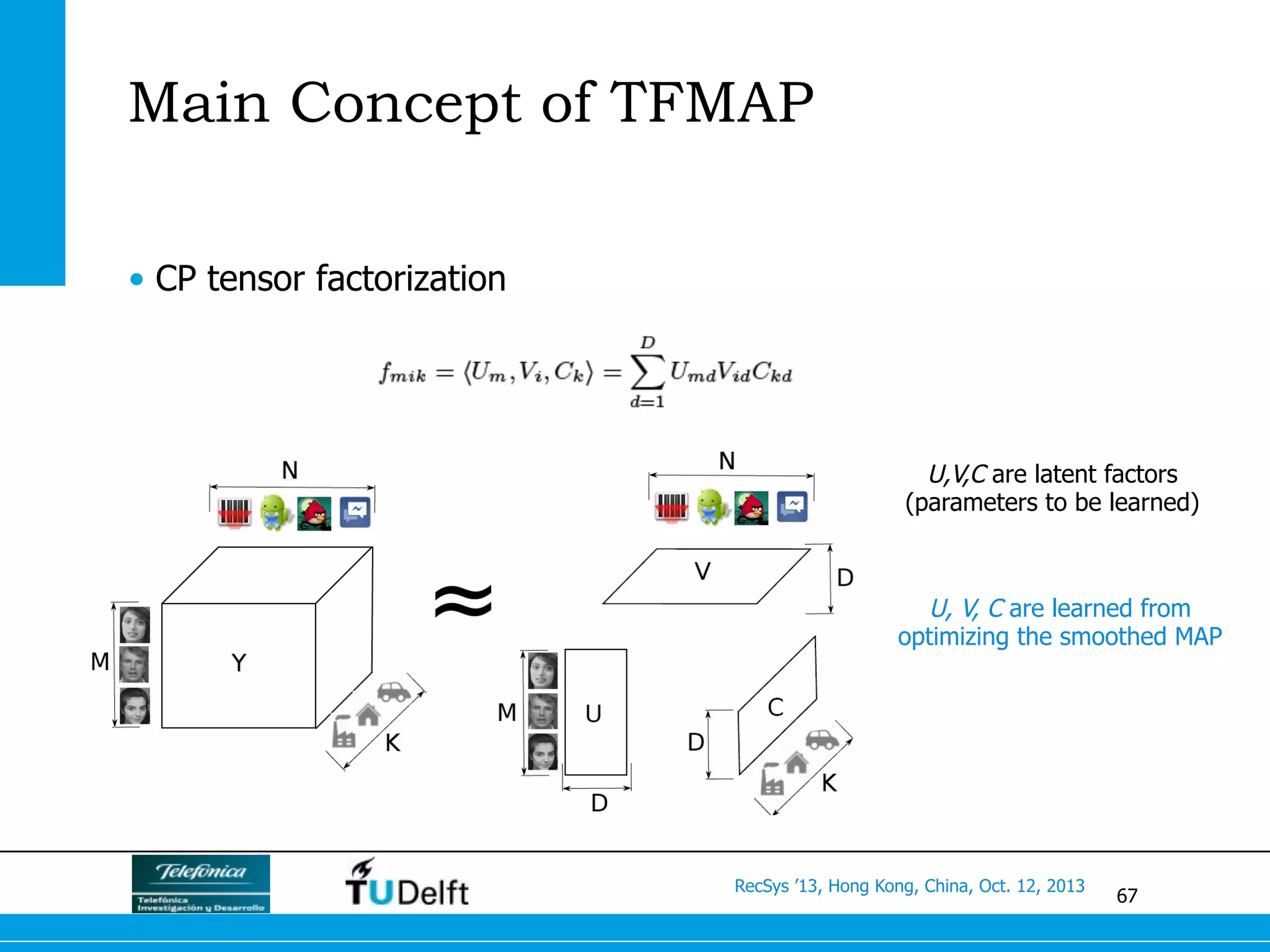
RecSys ’13, Hong Kong, China, Oct. 12, 2013
Main Concept of TFMAP
•  CP tensor factorization
U,V,C are latent factors
(parameters to be learned)
U, V, C are learned from
optimizing the smoothed MAP
68
RecSys ’13, Hong Kong, China, Oct. 12, 2013
TRENDS AND CHALLENGES
•  Intro to in Ranking
•  Ranking measures
•  Learning to Rank for Recommender Systems
•  Classification of approaches
•  Trends and Challenges
69
RecSys ’13, Hong Kong, China, Oct. 12, 2013
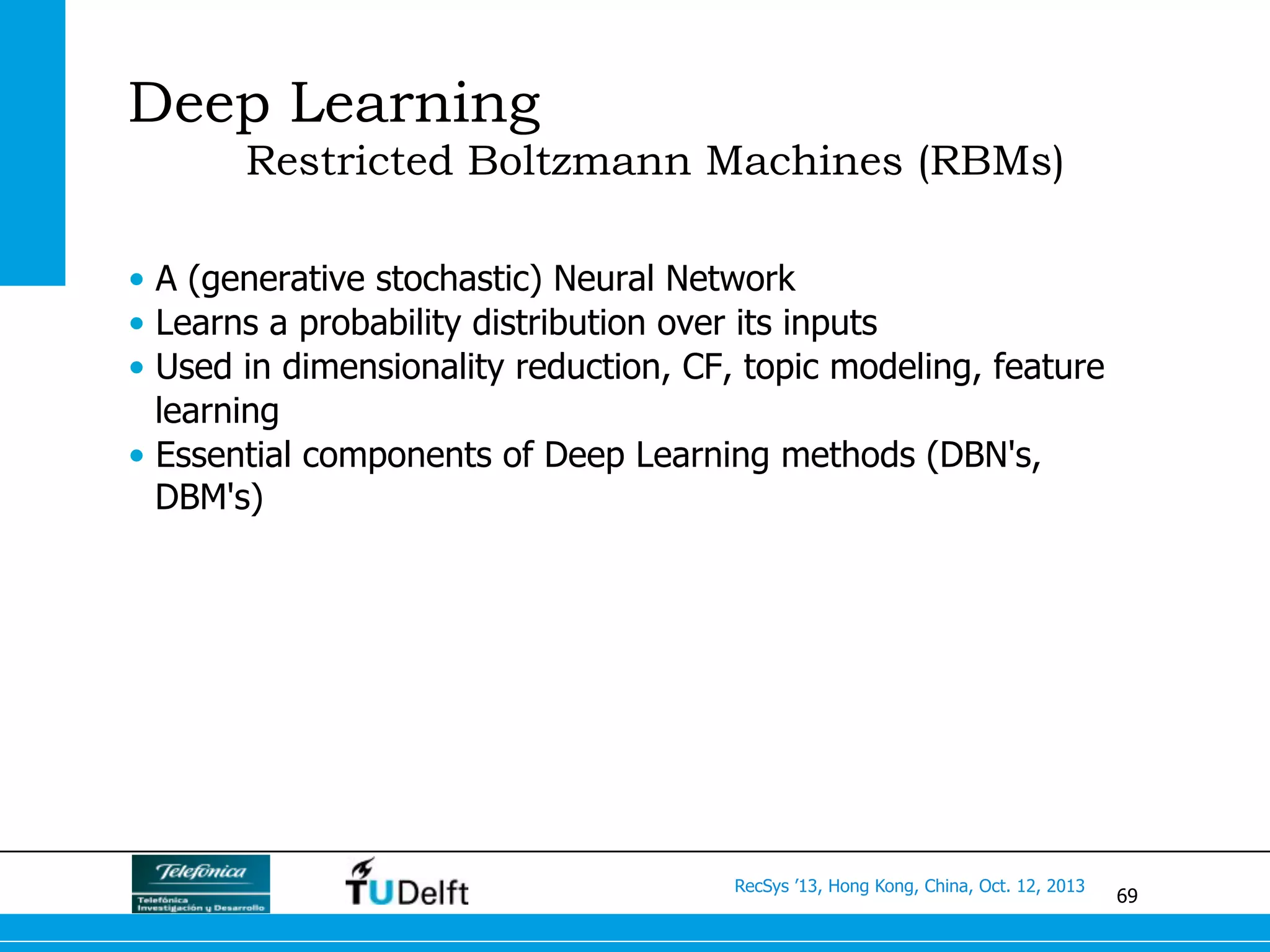
Deep Learning
Restricted Boltzmann Machines (RBMs)
•  A (generative stochastic) Neural Network
•  Learns a probability distribution over its inputs
•  Used in dimensionality reduction, CF, topic modeling, feature
learning
•  Essential components of Deep Learning methods (DBN's,
DBM's)
70
RecSys ’13, Hong Kong, China, Oct. 12, 2013
RBMs for CF
[Salakhutdinov 2007]
?
?
?
?
?
1
2
3
4
5
h
v
W
Learning hidden
variables for each user
Learning weight matrix
shared by all the users
Known data
71
RecSys ’13, Hong Kong, China, Oct. 12, 2013
Bandits
•  In many domains items are constantly new (e.g. news
recommendation, computational advertisement)
•  Contextual Bandits are on-line learning algorithms that work
by “exploring” the user preference space and “exploiting” the
resulting models in serving recommendations
•  There has been little work in finding optimal strategies in
terms of the ranking of items
72
RecSys ’13, Hong Kong, China, Oct. 12, 2013
Ranking aggregation
•  Ensemble methods and Hybrid methods are commonly used
in industry
•  Aggregating the resulting rankings provided by different
recommendations methods is not trivial
•  Currently an open research field
73
RecSys ’13, Hong Kong, China, Oct. 12, 2013
Modelling Dependencies in
Rankings
•  Most ranking methods are oblivious to the other items in the
recommended ranked list.
•  For example Diversity is not taken into account in most
ranking methods
•  Basket recommendation or next item recommendation cannot
be handled by most current methods
74
RecSys ’13, Hong Kong, China, Oct. 12, 2013
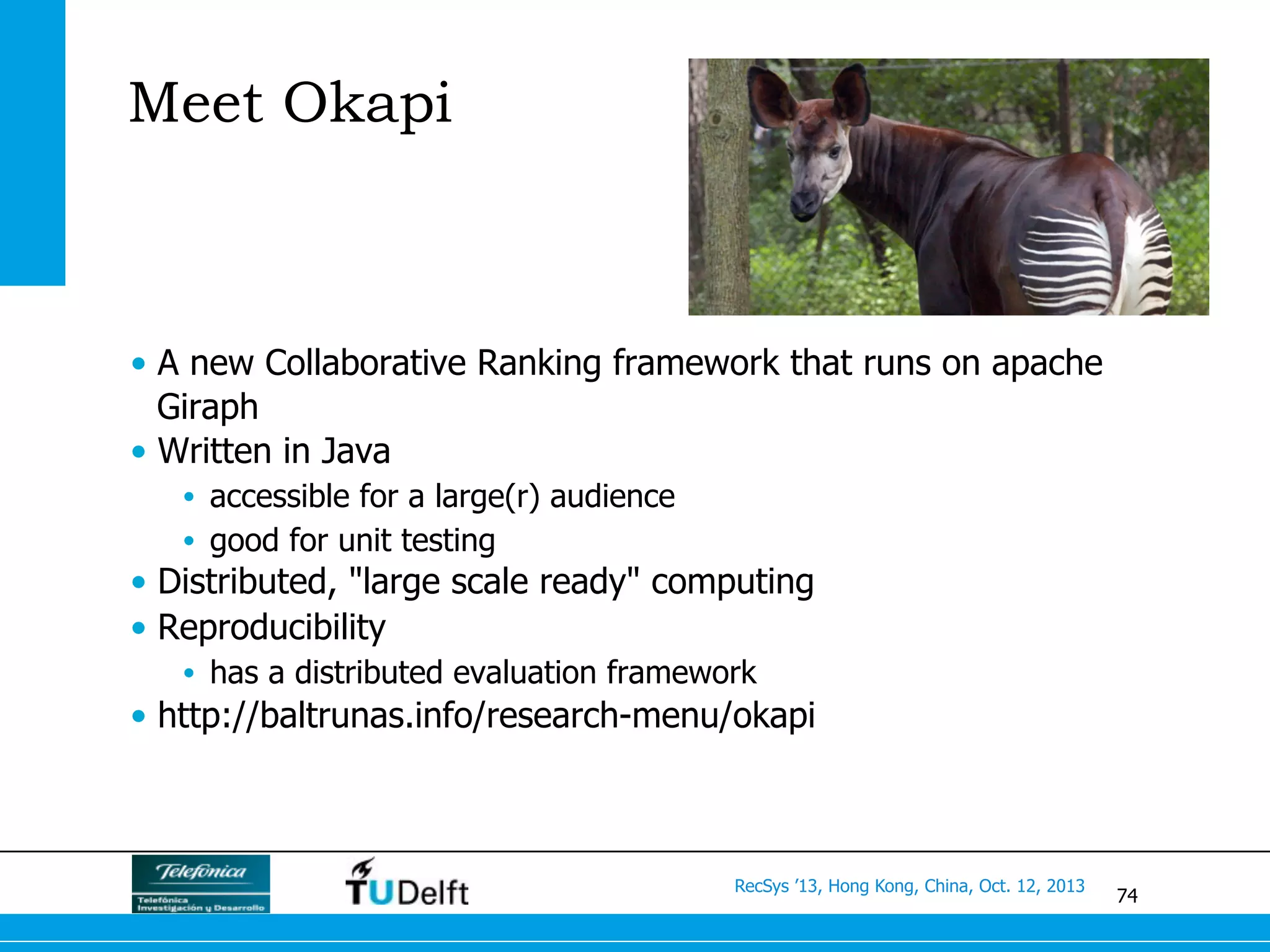
Meet Okapi
•  A new Collaborative Ranking framework that runs on apache
Giraph
•  Written in Java
•  accessible for a large(r) audience
•  good for unit testing
•  Distributed, "large scale ready" computing
•  Reproducibility
•  has a distributed evaluation framework
•  http://baltrunas.info/research-menu/okapi
75
RecSys ’13, Hong Kong, China, Oct. 12, 2013
Thank you !
Telefonica Research is looking for interns!
Contact: alexk@tid.es or linas@tid.es
76
RecSys ’13, Hong Kong, China, Oct. 12, 2013
References
q  Balakrishnan, S., & Chopra, S. (2012, February). Collaborative ranking. In Proceedings of the fifth ACM
international conference on Web search and data mining (pp. 143-152). ACM.
q  Burges, C., Shaked, T., Renshaw, E., Lazier, A., Deeds, M., Hamilton, N., & Hullender, G. (2005,
August). Learning to rank using gradient descent. In Proceedings of the 22nd international conference
on Machine learning (pp. 89-96). ACM.
q  Cao, Z., Qin, T., Liu, T. Y., Tsai, M. F., & Li, H. (2007, June). Learning to rank: from pairwise approach
to listwise approach. In Proceedings of the 24th international conference on Machine learning (pp.
129-136). ACM.
q  Chapelle, O., Metlzer, D., Zhang, Y., & Grinspan, P. (2009, November). Expected reciprocal rank for
graded relevance. In Proceedings of the 18th ACM conference on Information and knowledge
management (pp. 621-630). ACM.
q  Joachims, T. (2002, July). Optimizing search engines using clickthrough data. In Proceedings of the
eighth ACM SIGKDD international conference on Knowledge discovery and data mining (pp. 133-142).
ACM.
q  Koren, Y. (2008, August). Factorization meets the neighborhood: a multifaceted collaborative filtering
model. In Proceedings of the 14th ACM SIGKDD international conference on Knowledge discovery and
data mining (pp. 426-434). ACM.
q  Koren, Y., Bell, R., & Volinsky, C. (2009). Matrix factorization techniques for recommender systems.
Computer, 42(8), 30-37.
q  Koren, Y., & Sill, J. (2011, October). OrdRec: an ordinal model for predicting personalized item rating
distributions. In Proceedings of the fifth ACM conference on Recommender systems (pp. 117-124).
ACM.
q  Liu, N. N., & Yang, Q. (2008, July). Eigenrank: a ranking-oriented approach to collaborative filtering. In
Proceedings of the 31st annual international ACM SIGIR conference on Research and development in
information retrieval (pp. 83-90). ACM.
77
RecSys ’13, Hong Kong, China, Oct. 12, 2013
q  Liu, N. N., Zhao, M., & Yang, Q. (2009, November). Probabilistic latent preference analysis for
collaborative filtering. In Proceedings of the 18th ACM conference on Information and knowledge
management (pp. 759-766). ACM.
q  Quoc, C., & Le, V. (2007). Learning to rank with nonsmooth cost functions. Proceedings of the
Advances in Neural Information Processing Systems, 19, 193-200.
q  Rendle, S., Freudenthaler, C., Gantner, Z., & Schmidt-Thieme, L. (2009, June). BPR: Bayesian
personalized ranking from implicit feedback. In Proceedings of the Twenty-Fifth Conference on
Uncertainty in Artificial Intelligence (pp. 452-461). AUAI Press.
q  Rendle, S. (2012). Factorization machines with libFM. ACM Transactions on Intelligent Systems and
Technology (TIST), 3(3), 57.
q  Salakhutdinov, R., Mnih, A., & Hinton, G. (2007, June). Restricted Boltzmann machines for
collaborative filtering. In Proceedings of the 24th international conference on Machine learning (pp.
791-798). ACM.
q  Shi, Y., Larson, M., & Hanjalic, A. (2010, September). List-wise learning to rank with matrix
factorization for collaborative filtering. In Proceedings of the fourth ACM conference on Recommender
systems (pp. 269-272). ACM.
q  Shi, Y., Karatzoglou, A., Baltrunas, L., Larson, M., Hanjalic, A., & Oliver, N. (2012a, August). TFMAP:
Optimizing MAP for top-n context-aware recommendation. In Proceedings of the 35th international
ACM SIGIR conference on Research and development in information retrieval (pp. 155-164). ACM.
q  Shi, Y., Karatzoglou, A., Baltrunas, L., Larson, M., Oliver, N., & Hanjalic, A. (2012b, September).
CLiMF: learning to maximize reciprocal rank with collaborative less-is-more filtering. In Proceedings of
the sixth ACM conference on Recommender systems (pp. 139-146). ACM.
q  Taylor, M., Guiver, J., Robertson, S., & Minka, T. (2008, February). Softrank: optimizing non-smooth
rank metrics. In Proceedings of the international conference on Web search and web data mining (pp.
77-86). ACM.
78
RecSys ’13, Hong Kong, China, Oct. 12, 2013
q  Volkovs, M., & Zemel, R. S. (2012). Collaborative ranking with 17 parameters. In Advances in Neural
Information Processing Systems (pp. 2303-2311).
q  Weimer, M., Karatzoglou, A., Le, Q. V., & Smola, A. J. (2007). Cofi rank-maximum margin matrix
factorization for collaborative ranking. In Advances in neural information processing systems (pp.
1593-1600).
q  Xu, J., & Li, H. (2007, July). Adarank: a boosting algorithm for information retrieval. In Proceedings of
the 30th annual international ACM SIGIR conference on Research and development in information
retrieval (pp. 391-398). ACM.
q  Yue, Y., Finley, T., Radlinski, F., & Joachims, T. (2007, July). A support vector method for optimizing
average precision. In Proceedings of the 30th annual international ACM SIGIR conference on Research
and development in information retrieval (pp. 271-278). ACM.

Learning to Rank for Recommender Systems - ACM RecSys 2013 tutorial

  • 1.
    1 RecSys ’13, HongKong, China, Oct. 12, 2013 Learning to Rank for Recommender Systems Alexandros Karatzogloua , Linas Baltrunasa, Yue Shib aTelefonica Research, Spain bDelft University of Technology, Netherlands
  • 2.
    2 RecSys ’13, HongKong, China, Oct. 12, 2013 Who are we? Alexandros, Linas Yue •  Machine Learning •  Recommender Systems •  Data Mining, Social Networks •  Multimedia Indexing & Analysis •  HCI •  System & Networking •  We are looking for interns! •  Multimedia •  Recommender Systems •  Data Mining, Social Networks •  System & Networking
  • 3.
    3 RecSys ’13, HongKong, China, Oct. 12, 2013 Recommendations in Telefonica
  • 4.
    4 RecSys ’13, HongKong, China, Oct. 12, 2013 Recommendations in Telefonica
  • 5.
    5 RecSys ’13, HongKong, China, Oct. 12, 2013 Recommendations in Telefonica
  • 6.
    6 RecSys ’13, HongKong, China, Oct. 12, 2013 Previous Contributions in Ranking CIKM 2013: GAPfm: Optimal Top-N Recommendations for Graded Relevance Domains RecSys 2013: xCLiMF: Optimizing Expected Reciprocal Rank for Data with Multiple Levels of Relevance RecSys 2012: CLiMF: Learning to Maximize Reciprocal Rank with Collaborative Less-is-More Filtering * Best Paper Award SIGIR 2012: TFMAP: Optimizing MAP for Top-N Context-aware Recommendation Machine Learning Journal, 2008: Improving Maximum Margin Matrix Factorization * Best Machine Learning Paper Award at ECML PKDD 2008 RecSys 2010: List-wise Learning to Rank with Matrix Factorization for Collaborative Filtering NIPS 2007: CoFiRank - Maximum Margin Matrix Factorization for Collaborative Ranking
  • 7.
    7 RecSys ’13, HongKong, China, Oct. 12, 2013 Recommendations are ranked lists
  • 8.
    8 RecSys ’13, HongKong, China, Oct. 12, 2013 INTRO TO RANKING •  Intro to in Ranking •  Ranking measures •  Learning to Rank for Recommender Systems •  Classification of approaches •  Trends and Challenges
  • 9.
    9 RecSys ’13, HongKong, China, Oct. 12, 2013 Popular Ranking Methods •  In order to generate the ranked item list, we need some relative utility score for each item •  Popularity is the obvious baseline •  Score could depend on the user (personalized) •  Score could also depend on the other items in the list (list-wise) •  One popular way to rank the items in RS is to sort the items according to the rating prediction •  Works for the domains with ratings •  Wastes the modeling power for the irrelevant items
  • 10.
    10 RecSys ’13, HongKong, China, Oct. 12, 2013 Model + + ++ + + + + + fij = hUi, Vji
  • 11.
    11 RecSys ’13, HongKong, China, Oct. 12, 2013 Graphical Notation Relevant   Irrelevant   Irrelevant   Irrelevant   Irrelevant   Irrelevant   Relevant   Relevant  
  • 12.
    12 RecSys ’13, HongKong, China, Oct. 12, 2013 Ranking using latent representation •  If user = [-100, -100] •  2d latent factor •  We get the corresponding ranking
  • 13.
    13 RecSys ’13, HongKong, China, Oct. 12, 2013 Matrix Factorization (for ranking) •  Randomly initialize item vectors •  Randomly initialize user vectors •  While not converged •  Compute rating prediction error •  Update user factors •  Update item factors •  Lets say user is [-100, -100] •  Compute the square error •  (5-<[-100, -100], [0.180, 0.19]>)2=1764 •  Update the user and item to the direction where the error is reduced (according to the gradient of the loss) 8 items with ratings and random factors
  • 14.
    14 RecSys ’13, HongKong, China, Oct. 12, 2013 Learning: Stochastic Gradient Descent with Square Loss
  • 15.
    15 RecSys ’13, HongKong, China, Oct. 12, 2013 Square Loss User: [3, 1], RMSE=6.7
  • 16.
    16 RecSys ’13, HongKong, China, Oct. 12, 2013 Learning  to  Rank  for  Top-­‐k  RecSys   • Usually  we  care  to  make  accurate  ranking  and  not  ra>ng  predic>on   •  Square  loss  op>mizes  to  accurately  predict  1s  and  5s.   • RS  should  get  the  top  items  right  -­‐>  Ranking  problem   • Why  not  to  learn  how  to  rank  directly?   •  Learning  to  Rank  methods  provide  up  to  30%  performance   improvements  in  off-­‐line  evalua>ons   •  It  is  possible,  but  a  more  complex  task  
  • 17.
    17 RecSys ’13, HongKong, China, Oct. 12, 2013 Example: average precision (AP) AP = |S| X k=1 P(k) |S| •  AP: we compute the precision at each relevant position and average them P@1+ P@2 + P@4 3 = 1/1+ 2 / 2 +3/ 4 3 = 0.92
  • 18.
    18 RecSys ’13, HongKong, China, Oct. 12, 2013 Why is hard? Non Smoothness Example: AP u:[-20,-20] u:[20,20]
  • 19.
    19 RecSys ’13, HongKong, China, Oct. 12, 2013 AP vs RMSE
  • 20.
    20 RecSys ’13, HongKong, China, Oct. 12, 2013 The Non-smoothness of Average Precision APm = 1 PN i=1 ymi NX i=1 ymi rmi NX j=1 ymjI(rmj  rmi) AP = |S| X k=1 P(k) |S| ymi rmi I(·) is 1 if item i is relevant for user m and 0 otherwise indicator function (1 if it is true, 0 otherwise) Rank of item i for user m
  • 21.
    21 RecSys ’13, HongKong, China, Oct. 12, 2013 How can we get a smooth-AP? • We  replace  non  smooth  places  of  MAP  with  smooth  approxima>on   g(x) = 1/(1 + e x ) 1 rmi ⇡ g(fmi) = g(hUm, Vii)
  • 22.
    22 RecSys ’13, HongKong, China, Oct. 12, 2013 How can we get a smooth-MAP? • We  replace  non  smooth  places  of  MAP  with  smooth  approxima>on   g(x) = 1/(1 + e x ) I(rmj  rmi) ⇡ g(fmj fmi) = g(hUm, Vj Vii)
  • 23.
    23 RecSys ’13, HongKong, China, Oct. 12, 2013 u:[-20,-20] u:[20,20] Smooth version of MAP
  • 24.
    24 RecSys ’13, HongKong, China, Oct. 12, 2013 Not always the case: only sometimes approximation is very good…
  • 25.
    25 RecSys ’13, HongKong, China, Oct. 12, 2013 Ranking Inconsistencies •  Achieving a perfect ranking for all users is not possible •  Two Sources of Inconsistencies: •  1) Factor Models (all models) have limited expressive power and cannot learn the perfect ranking for all users •  2) Ranking functions approximations are inconsistent e.g. A >B & B>C but C > A
  • 26.
    26 RecSys ’13, HongKong, China, Oct. 12, 2013 Summary on Ranking 101
  • 27.
    27 RecSys ’13, HongKong, China, Oct. 12, 2013 RANKING METRICS •  Intro to in Ranking •  Ranking measures •  Learning to Rank for Recommender Systems •  Classification of approaches •  Trends and Challenges
  • 28.
    28 RecSys ’13, HongKong, China, Oct. 12, 2013 Area Under the ROC Curve (AUC) AUC := 1 |S+||S | S+ X i SX j I(Ri < Rj)
  • 29.
    29 RecSys ’13, HongKong, China, Oct. 12, 2013 Reciprocal Rank (RR) RR := 1 Ri
  • 30.
    30 RecSys ’13, HongKong, China, Oct. 12, 2013 Average Precision (AP) AP = |S| X k=1 P(k) |S|
  • 31.
    31 RecSys ’13, HongKong, China, Oct. 12, 2013 AP vs RR
  • 32.
    32 RecSys ’13, HongKong, China, Oct. 12, 2013 DCG = X i 2score(i) 1 log2(i + 2) Normalized Discounted Cumulative Gain (nDCG)
  • 33.
    33 RecSys ’13, HongKong, China, Oct. 12, 2013 AP AUC RR Square loss
  • 34.
    34 RecSys ’13, HongKong, China, Oct. 12, 2013 Top-k Ranking •  Focus on the very top of the recommendation list since users pay attention only to the first k items •  Top heavy ranking measures put much more emphasis at the top of the list e.g. MRR, MAP, NDCG. •  Drop in measure non-linear with the position in the list •  AUC gives the same emphasis to the top as to the bottom of the list •  drop in measure linear to the position in the list
  • 35.
    35 RecSys ’13, HongKong, China, Oct. 12, 2013 LEARNING TO RANK FOR RECSYS •  Intro to in Ranking •  Ranking measures •  Learning to Rank for Recommender Systems •  Classification of approaches •  Trends and Challenges
  • 36.
    36 RecSys ’13, HongKong, China, Oct. 12, 2013 Learning to Rank for IR and ML •  Query-document (Q-D) retrieval: Given a query, rank documents. (features of a Q-D pair, relevance label) Learn a ranking function Predict relevances of new Q-D pairs RankSVM LambdaRank RankNet RankBoost AdaRank ListNet SVM-MAP SoftRank … Analogy: Query-doc --- User-item
  • 37.
    37 RecSys ’13, HongKong, China, Oct. 12, 2013 •  The Point-wise Approach •  Reduce Ranking to Regression, Classification, or Ordinal Regression problem •  The Pairwise Approach •  Reduce Ranking to pair-wise classification •  List-wise Approach •  Direct optimization of IR measures, List-wise loss minimization Learning to Rank in CF f(user, item) ! R f(user, item1, item2) ! R f(user, item1, . . . , itemn) ! R
  • 38.
    38 RecSys ’13, HongKong, China, Oct. 12, 2013 Overview Classification by What to Model Pointwise Pairwise Listwise Matrix factorization [Koren 2009] BPR [Rendle 2009] CofiRank [Weimer 2007] SVD++ [Koren 2008] EigenRank [Liu 2008] ListRank [Shi 2010] OrdRec [Koren 2011] pLPA [Liu 2009] WLT [Volkovs 2012] Factorization machines [Rendle 2012] CR [Balakrishnan 2012] TFMAP [Shi 2012a] (All rating prediction methods) CLiMF [Shi 2012b] GAPfm [Shi 2013a] xCLiMF [Shi 2013b]
  • 39.
    39 RecSys ’13, HongKong, China, Oct. 12, 2013 Overview Classification by How to Model Proxy of rankings Structured estimation Non-smooth optimization Smoothing ranking measures (All the rating prediction methods) CofiRank [Weimer 2007] WLT [Volkovs 2012] BPR [Rendle 2009] EigenRank [Liu 2008] TFMAP [Shi 2012a] pLPA [Liu 2009] CLiMF [Shi 2012b] ListRank [Shi 2010] GAPfm [Shi 2013a] CR [Balakrishnan 2012] xCLiMF [Shi 2013b]
  • 40.
    40 RecSys ’13, HongKong, China, Oct. 12, 2013 Pointwise Standard Matrix Factorization [Koren 2009] 12355111u4 33334233u3 41155334u2 25532111u1 i8i7i6i5i4i3i2i1 12355111u4 33334233u3 41155334u2 25532111u1 i8i7i6i5i4i3i2i1 ? ? ? ? ? ? ? ? U (4×D) V (D×8) ×~ Learn latent factors of users (U) and latent factors of items (V), so that the product of U and V can fit the known data. The ratings of unseen items predicted by corresponding inner products Each user represented by a D-dim vector Each item represented by a D-dim vector
  • 41.
    41 RecSys ’13, HongKong, China, Oct. 12, 2013 Pointwise 1 4 24 3 3 5 4 3 fij = hUi, Vji l(fij, yij) = 1 2 (fij yij)2
  • 42.
    42 RecSys ’13, HongKong, China, Oct. 12, 2013 Ordrec [Koren 2011] Ratings are not numeric, but ordinal. Ordinal modeling by learning the thresholds 1 2 3 4 5 Rating Item with rating 4 should be more similar to that with rating 5 Item with rating 4 should be less similar to that with rating 1
  • 43.
    43 RecSys ’13, HongKong, China, Oct. 12, 2013 OrdRec [Koren 2011] Pointwise, proxy 1 2 3 4 5 t1 t2 t3 t4 log( s 1 s ) = ts hUi, Mji P( s) = s
  • 44.
    44 RecSys ’13, HongKong, China, Oct. 12, 2013 OrdRec [Koren 2011] 1 2 3 4 5 Parameterize the threshold into: User factor, item factor and previous threshold Full distribution estimation
  • 45.
    45 RecSys ’13, HongKong, China, Oct. 12, 2013 BPR [Rendle 2009] Pairwise, smoothing Main idea: learn by comparing items that the user likes with items that he does not. + - > Optimize the AUC, use a smooth version for Optimization purposes When dealing with implicit data sample the unseen data as negative
  • 46.
    46 RecSys ’13, HongKong, China, Oct. 12, 2013 Representation of pairwise preference data Transformers (T) ? Inception (I) ? Scent of a woman (S) 1 Forrest Gump (F) 1 Zombieland (Z) ? What Alice watched What Alice’s pairwise preferences (Row to Column) T I S F Z T ? - - ? I ? - - ? S + + ? + F + + ? + Z ? ? - - BPR [Rendle 2009] Pairwise, smoothing
  • 47.
    47 RecSys ’13, HongKong, China, Oct. 12, 2013 EigenRank [Liu 2008] Pairwise, proxy Ranking-based similarity instead of rating based similarity i1 i2 i3 u1 2 3 4 u2 4 2 5 User-user similarity based on Kendall Rank Correlation Neighbour selection for a user and item preference estimation Random walk with restart over pairwise item preference graph
  • 48.
    48 RecSys ’13, HongKong, China, Oct. 12, 2013 Listwise Learn to model individual ratings Learn to model ranked list, or to model evaluation metrics that capture the quality of ranked list Listwise perspective CofiRank ListRank CLiMF TFMAP GAPfm xCLiMF f(user, item) f(user, item) f(user, item) f(user,item1,item2,item3)
  • 49.
    49 RecSys ’13, HongKong, China, Oct. 12, 2013 CoFiRank [Weimer 2007] Listwise, structured est. •  Based on Structured estimation i.e. Machine Learning methods for complex output domains (graphs, sequences, etc.) •  Cast the Ranking problem as a Structured estimation problem •  i.e. Learn a function that is maximized for the best possible ranking with respect to a ranking measure e.g. NDCG
  • 50.
    50 RecSys ’13, HongKong, China, Oct. 12, 2013 CoFiRank [Weimer 2007] Listwise, structured est. •  Step 1: •  Instead of maximizing •  Minimize DCG@k(⇡, y) = kX i=1 (2yi 1) log(⇡i + 1) (⇡, y) := 1 NDCG(⇡, y)
  • 51.
    51 RecSys ’13, HongKong, China, Oct. 12, 2013 CoFiRank [Weimer 2007] Listwise, structured est. •  Step 2: •  Use the •  Create a linear mapping •  that is maximized for •  denote by a decreasing nonnegative sequence ha, bi  hsort(a), sort(b)i 8a, b 2 Rn (⇡, f) := hc, f⇡i ⇡ = argsort(f)
  • 52.
    52 RecSys ’13, HongKong, China, Oct. 12, 2013 CoFiRank [Weimer 2007] Listwise, structured est. •  Step 3: •  Find convex upper on non-convex optimization problems: Let Maximization by solving a Linear Assignment Problem to get an estimate for the worst case loss (maximum margin) l(f, y) := max ⇡ h (⇡, y) + hc, f⇡ fi i
  • 53.
    53 RecSys ’13, HongKong, China, Oct. 12, 2013 CoFiRank [Weimer 2007] 1.6 2.6 2.9 1.9f l(f, y) := max ⇡ h (⇡, y) + hc, f⇡ fi i c := (i + 1) 0.5 := [1, 0.7 ,0.57 ,0.5] ⇡ := [3, 2 ,4 ,1] ⇡ 1 := [4, 2 ,1 ,3] @f l(f, y) = [c c⇡ 1 ] := [-0.5, 0.0 ,0.42 ,0.1] 2.9 2.6 1.9 1.6f⇡
  • 54.
    54 RecSys ’13, HongKong, China, Oct. 12, 2013 CoFiRank [Weimer 2007]
  • 55.
    55 RecSys ’13, HongKong, China, Oct. 12, 2013 CLiMF [Shi 2012b] Listwise, Smoothing Ranking Metrics •  Why optimize mean reciprocal rank (MRR)? •  Focus at the very top of the list •  Try to get at least one interesting item at the top of the list •  How to optimize MRR? •  Find a smooth version of MRR •  Find a lower bound of the smoothed MRR
  • 56.
    56 RecSys ’13, HongKong, China, Oct. 12, 2013 The Non-smoothness of Reciprocal Rank •  Reciprocal Rank (RR): The inverse of the rank of the first relevant item in a given list. RRi = NX j=1 Yij Rij NY k=1 (1 YikI(Rik < Rij)) RRi Rank-based component Rank-based component I(Rik < Rij) ⇡ g(fik fij) 1 Rij ⇡ g(fij)
  • 57.
    57 RecSys ’13, HongKong, China, Oct. 12, 2013 Reciprocal Rank
  • 58.
    58 RecSys ’13, HongKong, China, Oct. 12, 2013 Lower Bound RRi ⇡ NX j=1 Yijg(fij) NY k=1 1 Yikg(fik fij) L(Ui, V ) = NX j=1 Yij ⇥ ln g(fij) + NX k=1 ln 1 Yikg(fik fij) ⇤ O(n+2 ) Jensen’s inequality Concavity of log function
  • 59.
    59 RecSys ’13, HongKong, China, Oct. 12, 2013 What’s the Key? •  CLiMF reciprocal rank loss essentially pushes relevant items apart •  In the process at least one items ends up high-up in the list
  • 60.
    60 RecSys ’13, HongKong, China, Oct. 12, 2013 Conventional loss
  • 61.
    61 RecSys ’13, HongKong, China, Oct. 12, 2013 CLiMF MRR-loss
  • 62.
    62 RecSys ’13, HongKong, China, Oct. 12, 2013 Optimizing RR vs. AUC Opt. RR Opt. AUC
  • 63.
    63 RecSys ’13, HongKong, China, Oct. 12, 2013 Listwise xCLiMF [Shi 2013b] – Generalization to Ratings •  Expected reciprocal rank (ERR) [Chapelle 2009] •  A generalization of RR to graded relevance data •  Cascade nature compared to NDCG 0 5 0 3 0 0 1 0 3 0 0 5 0 3 0 0 1 0 3 0 NDCG ERR Equal contribution independent of the items ranked above Different contributions relative to the items ranked above = <
  • 64.
    64 RecSys ’13, HongKong, China, Oct. 12, 2013 xCLiMF vs. CLiMF 0.000   0.100   0.200   0.300   0.400   3   4   MRR   Relevance  threshold   CLiMF   xCLiMF   0.000   0.050   0.100   0.150   0.200   0.250   0.300   3   4   ERR   Relevance  threshold   CLiMF   xCLiMF   Results from Tuenti video watching dataset xCLiMF shows its advantage over CLiMF when applied to graded relevance data
  • 65.
    65 RecSys ’13, HongKong, China, Oct. 12, 2013 Listwise TFMAP [Shi 2012a] – Generalization to Context Context-aware Recommendation
  • 66.
    66 RecSys ’13, HongKong, China, Oct. 12, 2013 Problem Setting •  Given: Users’ implicit feedback on items under different contexts •  Target: To recommend a list of items to each user under any given context, as accurate as possible Users Contexts Items Top-N recommendation Context-aware Optimal in terms of MAP
  • 67.
    67 RecSys ’13, HongKong, China, Oct. 12, 2013 Main Concept of TFMAP •  CP tensor factorization U,V,C are latent factors (parameters to be learned) U, V, C are learned from optimizing the smoothed MAP
  • 68.
    68 RecSys ’13, HongKong, China, Oct. 12, 2013 TRENDS AND CHALLENGES •  Intro to in Ranking •  Ranking measures •  Learning to Rank for Recommender Systems •  Classification of approaches •  Trends and Challenges
  • 69.
    69 RecSys ’13, HongKong, China, Oct. 12, 2013 Deep Learning Restricted Boltzmann Machines (RBMs) •  A (generative stochastic) Neural Network •  Learns a probability distribution over its inputs •  Used in dimensionality reduction, CF, topic modeling, feature learning •  Essential components of Deep Learning methods (DBN's, DBM's)
  • 70.
    70 RecSys ’13, HongKong, China, Oct. 12, 2013 RBMs for CF [Salakhutdinov 2007] ? ? ? ? ? 1 2 3 4 5 h v W Learning hidden variables for each user Learning weight matrix shared by all the users Known data
  • 71.
    71 RecSys ’13, HongKong, China, Oct. 12, 2013 Bandits •  In many domains items are constantly new (e.g. news recommendation, computational advertisement) •  Contextual Bandits are on-line learning algorithms that work by “exploring” the user preference space and “exploiting” the resulting models in serving recommendations •  There has been little work in finding optimal strategies in terms of the ranking of items
  • 72.
    72 RecSys ’13, HongKong, China, Oct. 12, 2013 Ranking aggregation •  Ensemble methods and Hybrid methods are commonly used in industry •  Aggregating the resulting rankings provided by different recommendations methods is not trivial •  Currently an open research field
  • 73.
    73 RecSys ’13, HongKong, China, Oct. 12, 2013 Modelling Dependencies in Rankings •  Most ranking methods are oblivious to the other items in the recommended ranked list. •  For example Diversity is not taken into account in most ranking methods •  Basket recommendation or next item recommendation cannot be handled by most current methods
  • 74.
    74 RecSys ’13, HongKong, China, Oct. 12, 2013 Meet Okapi •  A new Collaborative Ranking framework that runs on apache Giraph •  Written in Java •  accessible for a large(r) audience •  good for unit testing •  Distributed, "large scale ready" computing •  Reproducibility •  has a distributed evaluation framework •  http://baltrunas.info/research-menu/okapi
  • 75.
    75 RecSys ’13, HongKong, China, Oct. 12, 2013 Thank you ! Telefonica Research is looking for interns! Contact: alexk@tid.es or linas@tid.es
  • 76.
    76 RecSys ’13, HongKong, China, Oct. 12, 2013 References q  Balakrishnan, S., & Chopra, S. (2012, February). Collaborative ranking. In Proceedings of the fifth ACM international conference on Web search and data mining (pp. 143-152). ACM. q  Burges, C., Shaked, T., Renshaw, E., Lazier, A., Deeds, M., Hamilton, N., & Hullender, G. (2005, August). Learning to rank using gradient descent. In Proceedings of the 22nd international conference on Machine learning (pp. 89-96). ACM. q  Cao, Z., Qin, T., Liu, T. Y., Tsai, M. F., & Li, H. (2007, June). Learning to rank: from pairwise approach to listwise approach. In Proceedings of the 24th international conference on Machine learning (pp. 129-136). ACM. q  Chapelle, O., Metlzer, D., Zhang, Y., & Grinspan, P. (2009, November). Expected reciprocal rank for graded relevance. In Proceedings of the 18th ACM conference on Information and knowledge management (pp. 621-630). ACM. q  Joachims, T. (2002, July). Optimizing search engines using clickthrough data. In Proceedings of the eighth ACM SIGKDD international conference on Knowledge discovery and data mining (pp. 133-142). ACM. q  Koren, Y. (2008, August). Factorization meets the neighborhood: a multifaceted collaborative filtering model. In Proceedings of the 14th ACM SIGKDD international conference on Knowledge discovery and data mining (pp. 426-434). ACM. q  Koren, Y., Bell, R., & Volinsky, C. (2009). Matrix factorization techniques for recommender systems. Computer, 42(8), 30-37. q  Koren, Y., & Sill, J. (2011, October). OrdRec: an ordinal model for predicting personalized item rating distributions. In Proceedings of the fifth ACM conference on Recommender systems (pp. 117-124). ACM. q  Liu, N. N., & Yang, Q. (2008, July). Eigenrank: a ranking-oriented approach to collaborative filtering. In Proceedings of the 31st annual international ACM SIGIR conference on Research and development in information retrieval (pp. 83-90). ACM.
  • 77.
    77 RecSys ’13, HongKong, China, Oct. 12, 2013 q  Liu, N. N., Zhao, M., & Yang, Q. (2009, November). Probabilistic latent preference analysis for collaborative filtering. In Proceedings of the 18th ACM conference on Information and knowledge management (pp. 759-766). ACM. q  Quoc, C., & Le, V. (2007). Learning to rank with nonsmooth cost functions. Proceedings of the Advances in Neural Information Processing Systems, 19, 193-200. q  Rendle, S., Freudenthaler, C., Gantner, Z., & Schmidt-Thieme, L. (2009, June). BPR: Bayesian personalized ranking from implicit feedback. In Proceedings of the Twenty-Fifth Conference on Uncertainty in Artificial Intelligence (pp. 452-461). AUAI Press. q  Rendle, S. (2012). Factorization machines with libFM. ACM Transactions on Intelligent Systems and Technology (TIST), 3(3), 57. q  Salakhutdinov, R., Mnih, A., & Hinton, G. (2007, June). Restricted Boltzmann machines for collaborative filtering. In Proceedings of the 24th international conference on Machine learning (pp. 791-798). ACM. q  Shi, Y., Larson, M., & Hanjalic, A. (2010, September). List-wise learning to rank with matrix factorization for collaborative filtering. In Proceedings of the fourth ACM conference on Recommender systems (pp. 269-272). ACM. q  Shi, Y., Karatzoglou, A., Baltrunas, L., Larson, M., Hanjalic, A., & Oliver, N. (2012a, August). TFMAP: Optimizing MAP for top-n context-aware recommendation. In Proceedings of the 35th international ACM SIGIR conference on Research and development in information retrieval (pp. 155-164). ACM. q  Shi, Y., Karatzoglou, A., Baltrunas, L., Larson, M., Oliver, N., & Hanjalic, A. (2012b, September). CLiMF: learning to maximize reciprocal rank with collaborative less-is-more filtering. In Proceedings of the sixth ACM conference on Recommender systems (pp. 139-146). ACM. q  Taylor, M., Guiver, J., Robertson, S., & Minka, T. (2008, February). Softrank: optimizing non-smooth rank metrics. In Proceedings of the international conference on Web search and web data mining (pp. 77-86). ACM.
  • 78.
    78 RecSys ’13, HongKong, China, Oct. 12, 2013 q  Volkovs, M., & Zemel, R. S. (2012). Collaborative ranking with 17 parameters. In Advances in Neural Information Processing Systems (pp. 2303-2311). q  Weimer, M., Karatzoglou, A., Le, Q. V., & Smola, A. J. (2007). Cofi rank-maximum margin matrix factorization for collaborative ranking. In Advances in neural information processing systems (pp. 1593-1600). q  Xu, J., & Li, H. (2007, July). Adarank: a boosting algorithm for information retrieval. In Proceedings of the 30th annual international ACM SIGIR conference on Research and development in information retrieval (pp. 391-398). ACM. q  Yue, Y., Finley, T., Radlinski, F., & Joachims, T. (2007, July). A support vector method for optimizing average precision. In Proceedings of the 30th annual international ACM SIGIR conference on Research and development in information retrieval (pp. 271-278). ACM.