By Jilliyn Geremonte
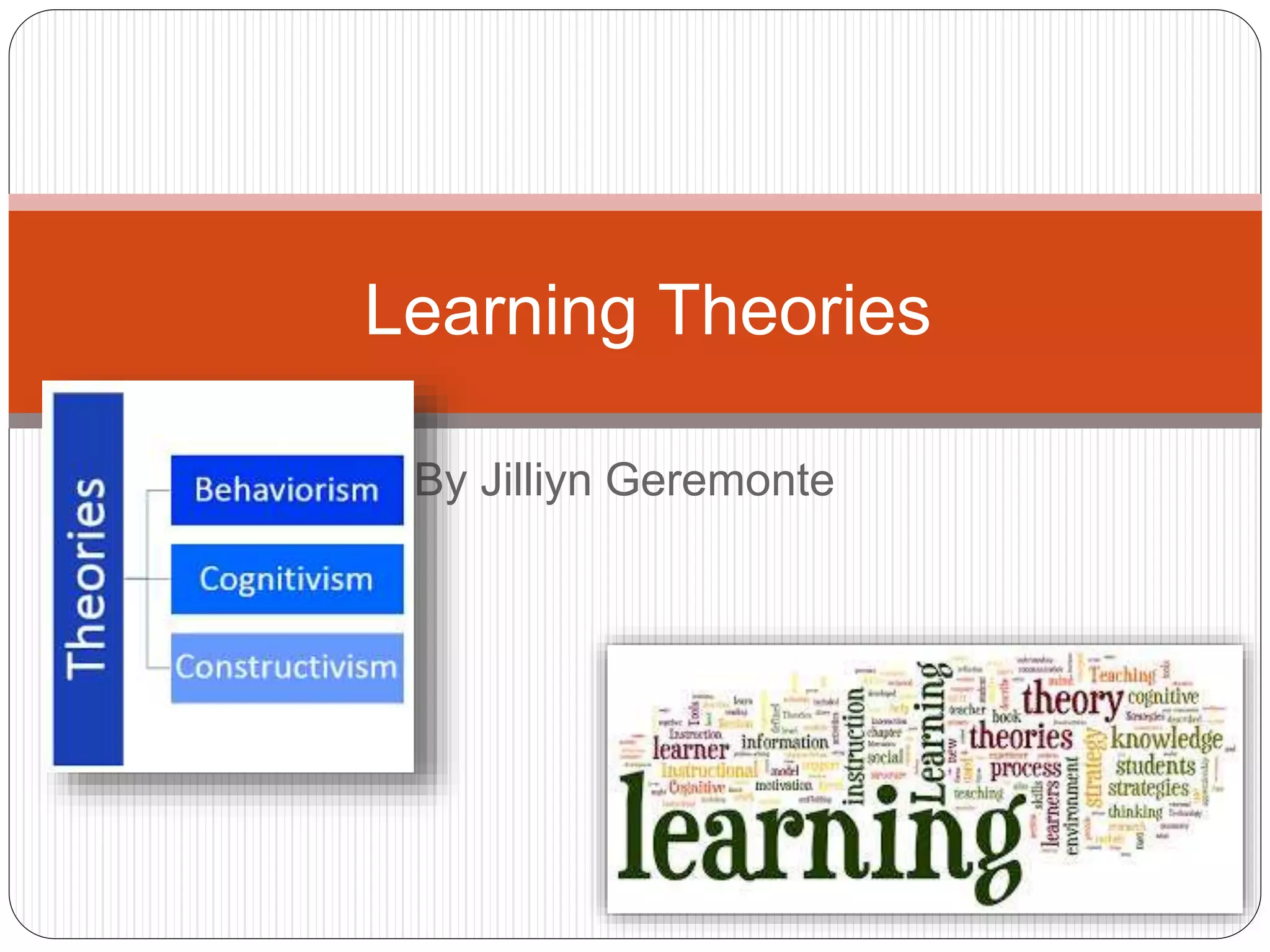
Learning Theories
Different Types of Theories: Behaviorism
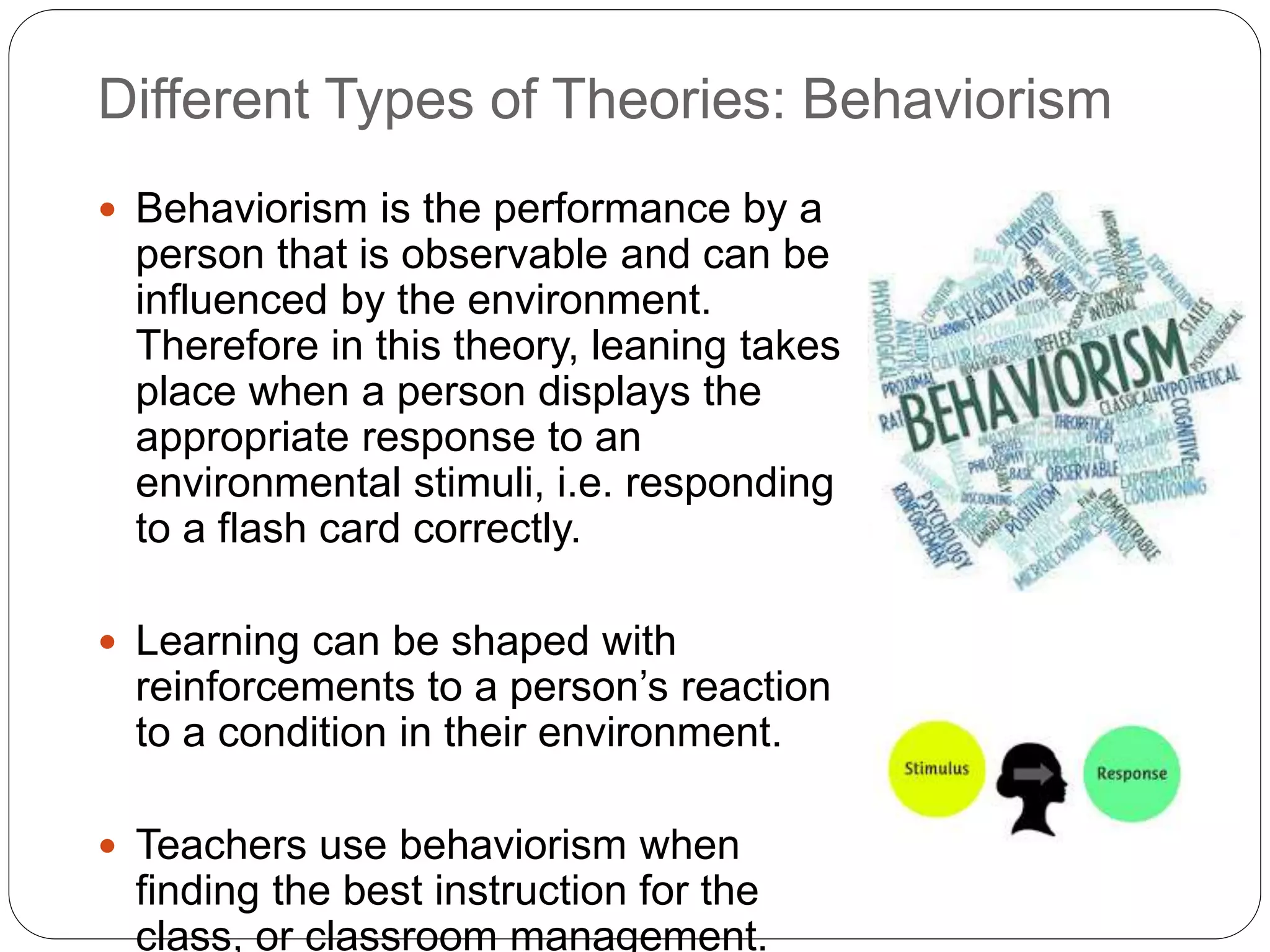
 Behaviorism is the performance by a
person that is observable and can be
influenced by the environment.
Therefore in this theory, leaning takes
place when a person displays the
appropriate response to an
environmental stimuli, i.e. responding
to a flash card correctly.
 Learning can be shaped with
reinforcements to a person’s reaction
to a condition in their environment.
 Teachers use behaviorism when
finding the best instruction for the
class, or classroom management.
Different Types of Theories:
Constructivism
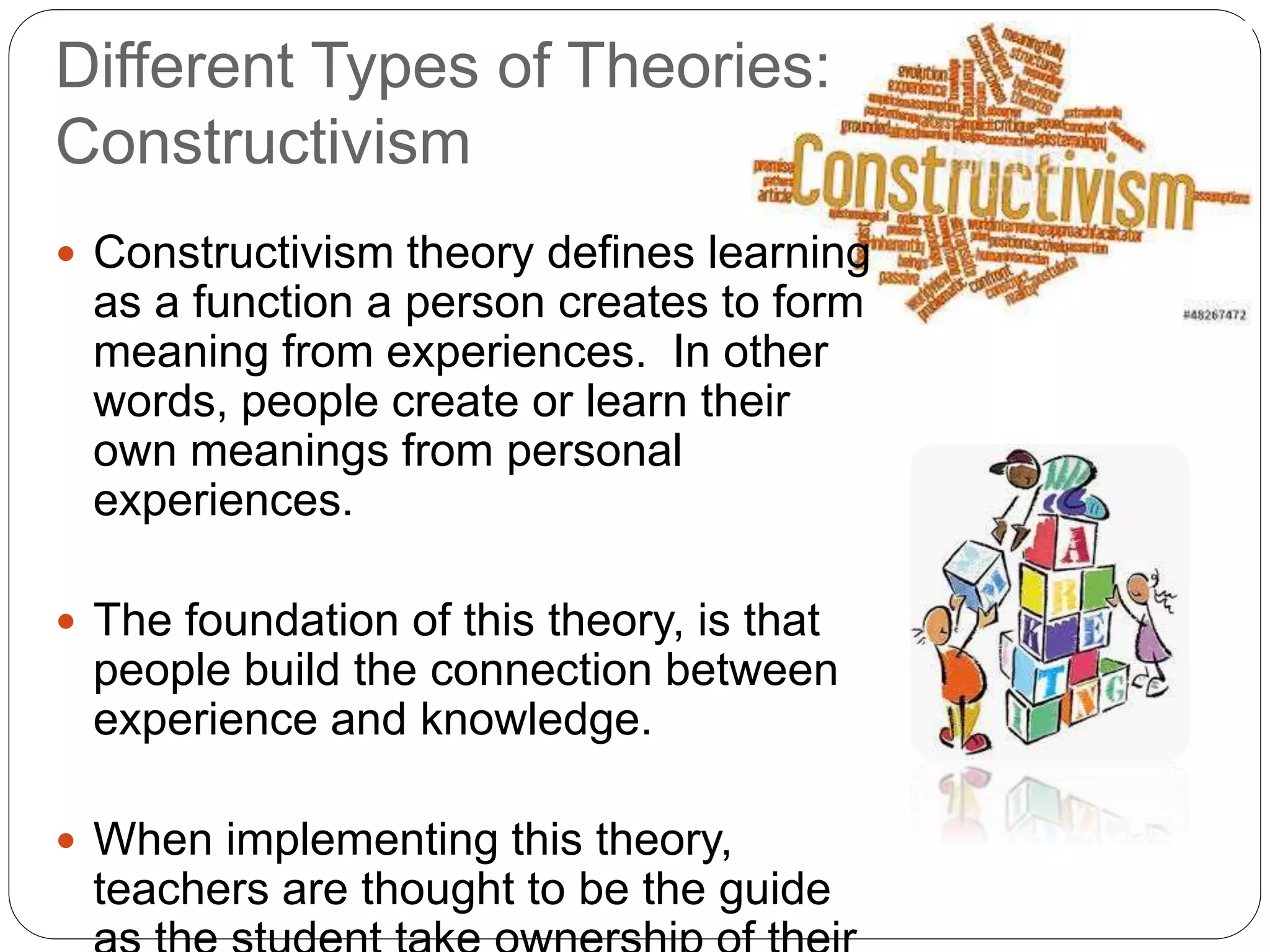
 Constructivism theory defines learning
as a function a person creates to form
meaning from experiences. In other
words, people create or learn their
own meanings from personal
experiences.
 The foundation of this theory, is that
people build the connection between
experience and knowledge.
 When implementing this theory,
teachers are thought to be the guide
Different Types of Theories:
Cognitivism
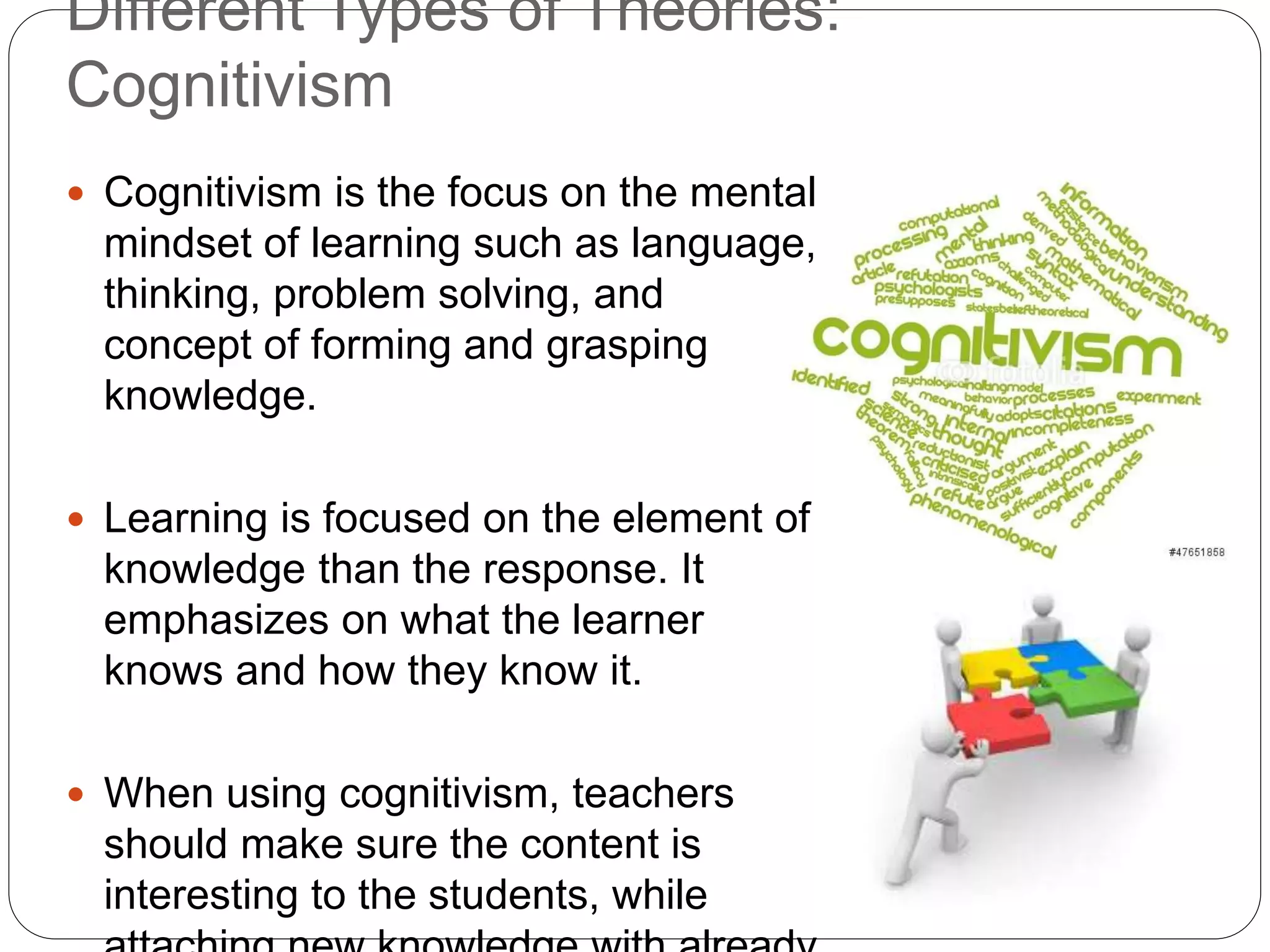
 Cognitivism is the focus on the mental
mindset of learning such as language,
thinking, problem solving, and
concept of forming and grasping
knowledge.
 Learning is focused on the element of
knowledge than the response. It
emphasizes on what the learner
knows and how they know it.
 When using cognitivism, teachers
should make sure the content is
interesting to the students, while
Different Types of Theories:
Andragogy
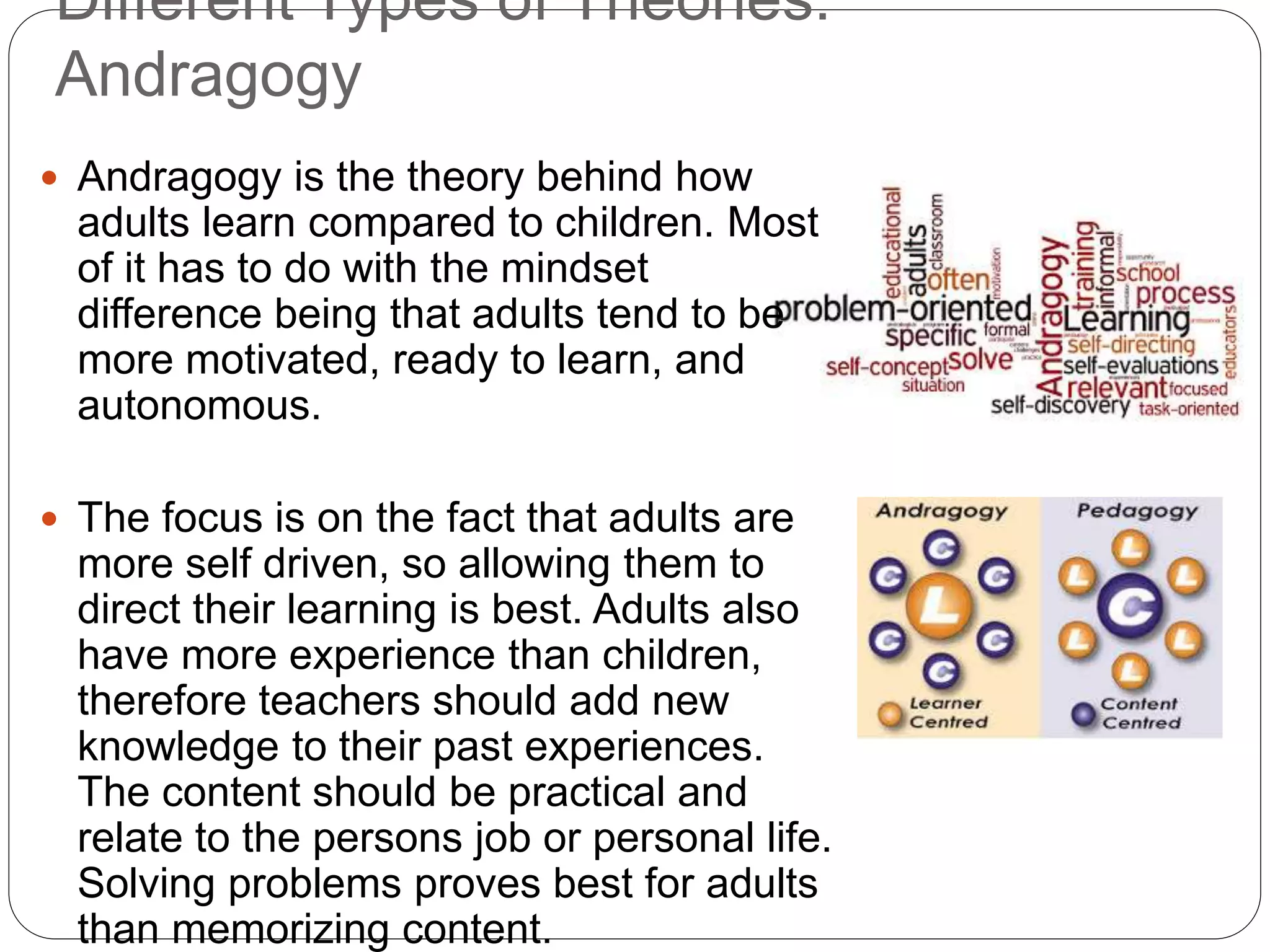
 Andragogy is the theory behind how
adults learn compared to children. Most
of it has to do with the mindset
difference being that adults tend to be
more motivated, ready to learn, and
autonomous.
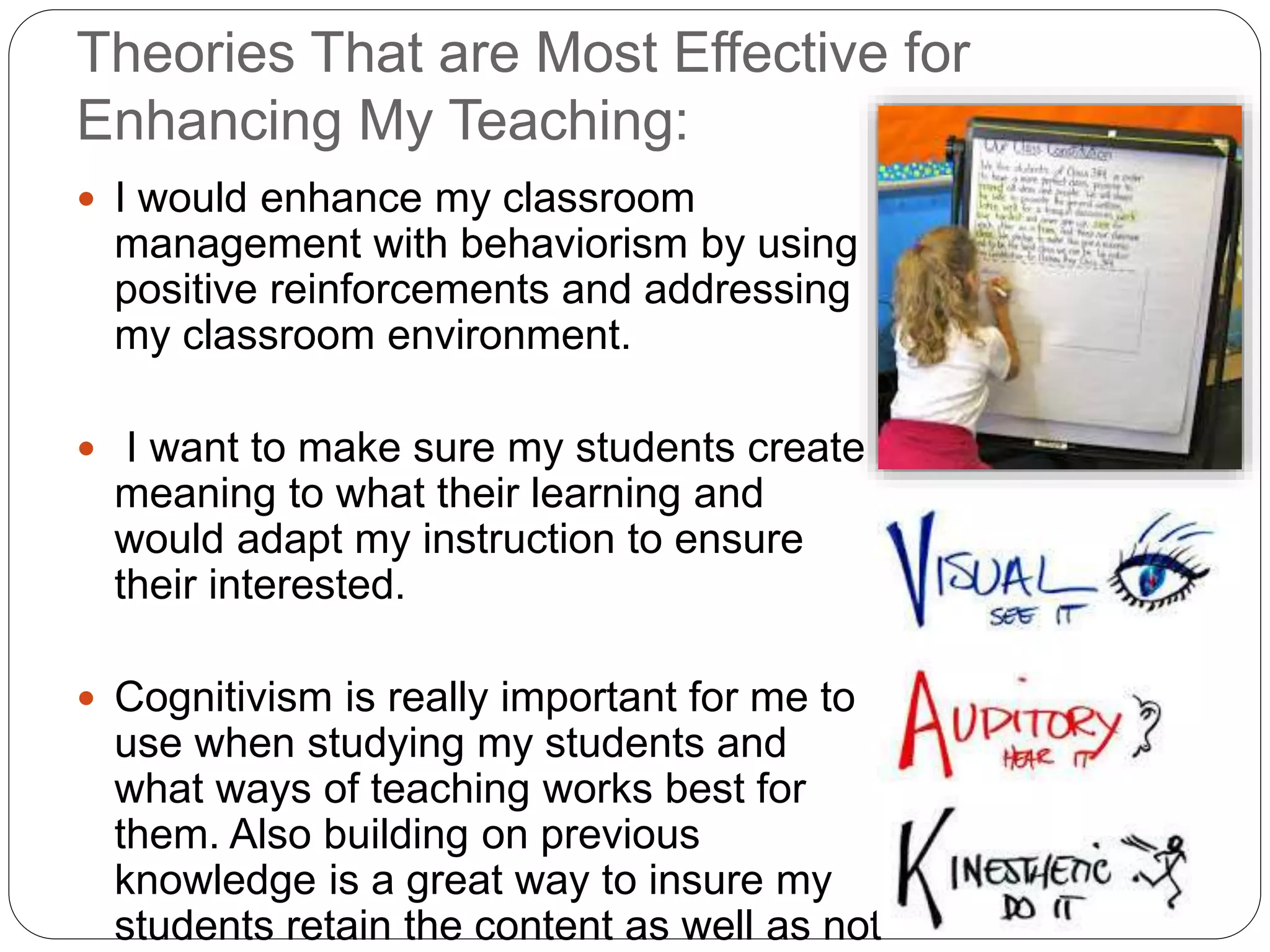
 The focus is on the fact that adults are
more self driven, so allowing them to
direct their learning is best. Adults also
have more experience than children,
therefore teachers should add new
knowledge to their past experiences.
The content should be practical and
relate to the persons job or personal life.
Solving problems proves best for adults
than memorizing content.
Theories that Align Most with my Teaching
Philosophy:
 I feel that a combination of all three theories align
with my teaching philosophy. I also believe that
andragogy is important when teaching adults,
because the mind is wired differently.
 I would definitely use behaviorism as a way to
manage my classroom as well as making sure
students understand the content through
performance.
 With constructivism, I strongly believe in connecting
meaning and knowledge to ensure the content is
understood as well as retained.
 Cognitivism is something I need to use when
making sure my students are learning the content in
Theories That are Most Effective for
Enhancing My Teaching:
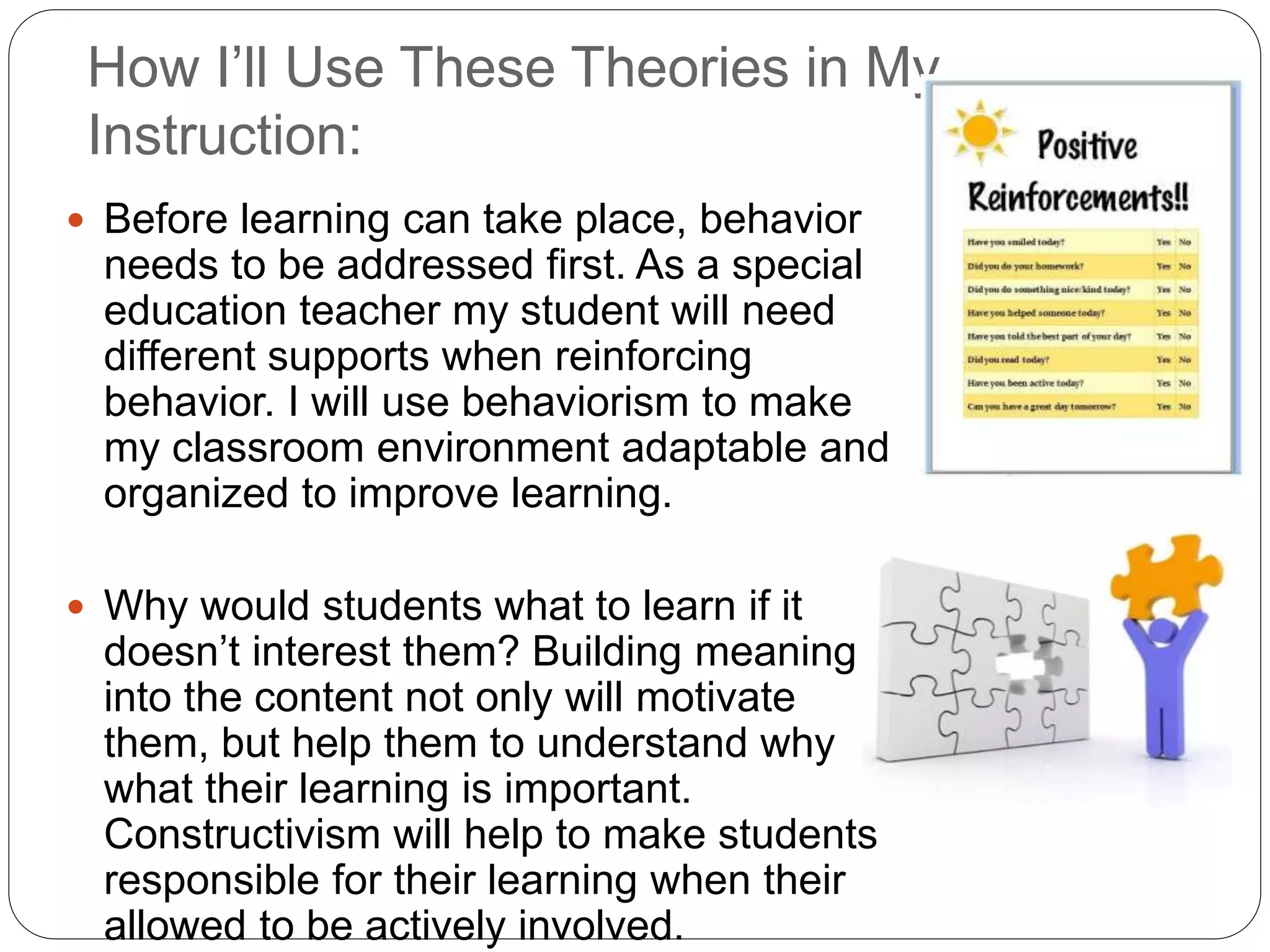
 I would enhance my classroom
management with behaviorism by using
positive reinforcements and addressing
my classroom environment.
 I want to make sure my students create
meaning to what their learning and
would adapt my instruction to ensure
their interested.
 Cognitivism is really important for me to
use when studying my students and
what ways of teaching works best for
them. Also building on previous
knowledge is a great way to insure my
students retain the content as well as not
How I’ll Use These Theories in My
Instruction:
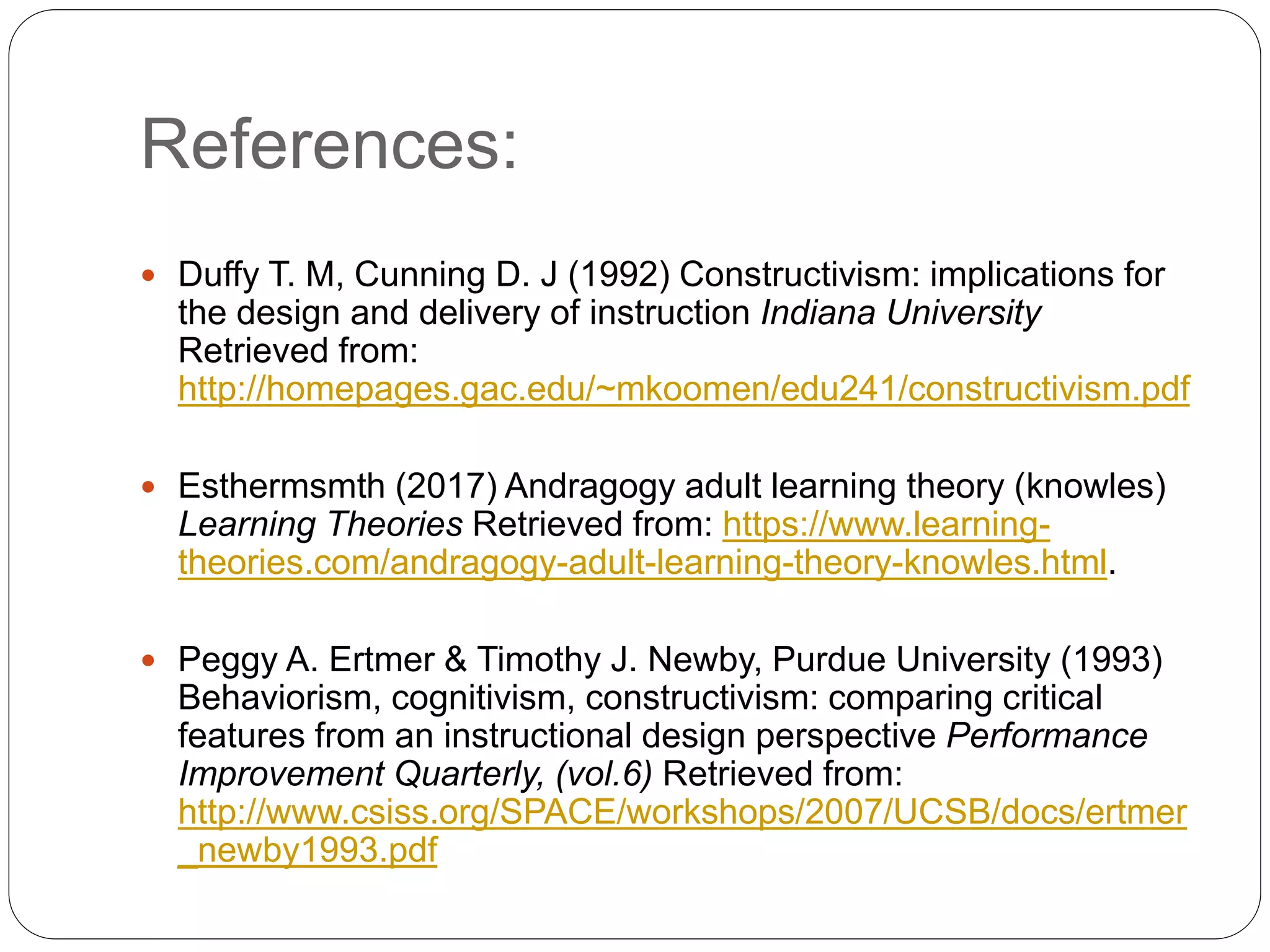
 Before learning can take place, behavior
needs to be addressed first. As a special
education teacher my student will need
different supports when reinforcing
behavior. I will use behaviorism to make
my classroom environment adaptable and
organized to improve learning.
 Why would students what to learn if it
doesn’t interest them? Building meaning
into the content not only will motivate
them, but help them to understand why
what their learning is important.
Constructivism will help to make students
responsible for their learning when their
allowed to be actively involved.
How I’ll Use These Theories in My
Instruction (Continued):
 When teachers already feel like they’re
pressured to make sure the student know all
of the content before the state test or moving
on to the next grade, we don’t want to waste
time re-teaching already known information.
As a special education I need to make sure
my students know the basic foundations
before building up new knowledge.
Cognitivism helps by attaching the new to the
old allowing students to understand why
content matters as well as to retain the
information. I also need to analyze how my
students learn best. Every student learns
differently, so I need to be able to adjust to
each student’s need.
Conclusion:
 I have heard of all three theories
before, but this assignment helped
me to look deeper into each of them
as well as learning about andragogy.
 Equipped with understanding these
three theories will help me become a
better educator and be able to
answer questions administration or
parents have regarding them.
 I hope to use these theories when
teaching as well as further my
knowledge about them.
References:
 Duffy T. M, Cunning D. J (1992) Constructivism: implications for
the design and delivery of instruction Indiana University
Retrieved from:
http://homepages.gac.edu/~mkoomen/edu241/constructivism.pdf
 Esthermsmth (2017) Andragogy adult learning theory (knowles)
Learning Theories Retrieved from: https://www.learning-
theories.com/andragogy-adult-learning-theory-knowles.html.
 Peggy A. Ertmer & Timothy J. Newby, Purdue University (1993)
Behaviorism, cognitivism, constructivism: comparing critical
features from an instructional design perspective Performance
Improvement Quarterly, (vol.6) Retrieved from:
http://www.csiss.org/SPACE/workshops/2007/UCSB/docs/ertmer
_newby1993.pdf

Learning theories

  • 1.
  • 2.
    Different Types ofTheories: Behaviorism  Behaviorism is the performance by a person that is observable and can be influenced by the environment. Therefore in this theory, leaning takes place when a person displays the appropriate response to an environmental stimuli, i.e. responding to a flash card correctly.  Learning can be shaped with reinforcements to a person’s reaction to a condition in their environment.  Teachers use behaviorism when finding the best instruction for the class, or classroom management.
  • 3.
    Different Types ofTheories: Constructivism  Constructivism theory defines learning as a function a person creates to form meaning from experiences. In other words, people create or learn their own meanings from personal experiences.  The foundation of this theory, is that people build the connection between experience and knowledge.  When implementing this theory, teachers are thought to be the guide
  • 4.
    Different Types ofTheories: Cognitivism  Cognitivism is the focus on the mental mindset of learning such as language, thinking, problem solving, and concept of forming and grasping knowledge.  Learning is focused on the element of knowledge than the response. It emphasizes on what the learner knows and how they know it.  When using cognitivism, teachers should make sure the content is interesting to the students, while
  • 5.
    Different Types ofTheories: Andragogy  Andragogy is the theory behind how adults learn compared to children. Most of it has to do with the mindset difference being that adults tend to be more motivated, ready to learn, and autonomous.  The focus is on the fact that adults are more self driven, so allowing them to direct their learning is best. Adults also have more experience than children, therefore teachers should add new knowledge to their past experiences. The content should be practical and relate to the persons job or personal life. Solving problems proves best for adults than memorizing content.
  • 6.
    Theories that AlignMost with my Teaching Philosophy:  I feel that a combination of all three theories align with my teaching philosophy. I also believe that andragogy is important when teaching adults, because the mind is wired differently.  I would definitely use behaviorism as a way to manage my classroom as well as making sure students understand the content through performance.  With constructivism, I strongly believe in connecting meaning and knowledge to ensure the content is understood as well as retained.  Cognitivism is something I need to use when making sure my students are learning the content in
  • 7.
    Theories That areMost Effective for Enhancing My Teaching:  I would enhance my classroom management with behaviorism by using positive reinforcements and addressing my classroom environment.  I want to make sure my students create meaning to what their learning and would adapt my instruction to ensure their interested.  Cognitivism is really important for me to use when studying my students and what ways of teaching works best for them. Also building on previous knowledge is a great way to insure my students retain the content as well as not
  • 8.
    How I’ll UseThese Theories in My Instruction:  Before learning can take place, behavior needs to be addressed first. As a special education teacher my student will need different supports when reinforcing behavior. I will use behaviorism to make my classroom environment adaptable and organized to improve learning.  Why would students what to learn if it doesn’t interest them? Building meaning into the content not only will motivate them, but help them to understand why what their learning is important. Constructivism will help to make students responsible for their learning when their allowed to be actively involved.
  • 9.
    How I’ll UseThese Theories in My Instruction (Continued):  When teachers already feel like they’re pressured to make sure the student know all of the content before the state test or moving on to the next grade, we don’t want to waste time re-teaching already known information. As a special education I need to make sure my students know the basic foundations before building up new knowledge. Cognitivism helps by attaching the new to the old allowing students to understand why content matters as well as to retain the information. I also need to analyze how my students learn best. Every student learns differently, so I need to be able to adjust to each student’s need.
  • 10.
    Conclusion:  I haveheard of all three theories before, but this assignment helped me to look deeper into each of them as well as learning about andragogy.  Equipped with understanding these three theories will help me become a better educator and be able to answer questions administration or parents have regarding them.  I hope to use these theories when teaching as well as further my knowledge about them.
  • 11.
    References:  Duffy T.M, Cunning D. J (1992) Constructivism: implications for the design and delivery of instruction Indiana University Retrieved from: http://homepages.gac.edu/~mkoomen/edu241/constructivism.pdf  Esthermsmth (2017) Andragogy adult learning theory (knowles) Learning Theories Retrieved from: https://www.learning- theories.com/andragogy-adult-learning-theory-knowles.html.  Peggy A. Ertmer & Timothy J. Newby, Purdue University (1993) Behaviorism, cognitivism, constructivism: comparing critical features from an instructional design perspective Performance Improvement Quarterly, (vol.6) Retrieved from: http://www.csiss.org/SPACE/workshops/2007/UCSB/docs/ertmer _newby1993.pdf