Active Learning
Active Learning
and Classroom Applications
By:
By: Mekuria
Mekuria M. (
M. (BSc
BSc,
, MSc
MSc, BA, MA,
, BA, MA, PDEdLA
PDEdLA)
)
February, 2024

 Activity
Activity

 What is your
What is your expectation
expectation from this training?
from this training?

 Write your answer on the paper provided and keep it.
Write your answer on the paper provided and keep it.

 What do you think should be observed as
What do you think should be observed as ground
ground
rules
rules during this training?
during this training?

 Punctuality
Punctuality

 Warm participation
Warm participation

 Respect the opinion of others
Respect the opinion of others

 Limited discussion time (
Limited discussion time (1 to 3 minutes
1 to 3 minutes)
)

 Learning, learning theories and learning styles
Learning, learning theories and learning styles

 The concept of active learning
The concept of active learning

 Active learning methods
Active learning methods

 The teacher’s role in active learning
The teacher’s role in active learning

 Activities to supplement lectures
Activities to supplement lectures

 By the end of this training, trainees will be able
By the end of this training, trainees will be able
to:
to:

 Define the term learning.
Define the term learning.

 Differentiate different learning theories and styles.
Differentiate different learning theories and styles.

 Apply learning theories and styles effectively in the
Apply learning theories and styles effectively in the
classroom.
classroom.

 By the end of this training, trainees will be able
By the end of this training, trainees will be able
to:
to:

 Define the term active learning.
Define the term active learning.

 Explain the reasons why we use active learning
Explain the reasons why we use active learning
instead of passive learning.

 Distinguish surface learning from deep learning.
Distinguish surface learning from deep learning.

 By the end of this training, trainees will be able
By the end of this training, trainees will be able
to:
to:

 Describe different active learning methods.
Describe different active learning methods.

 Effectively apply a variety of active learning
Effectively apply a variety of active learning
methods in and out of the classroom.

 Describe activities to supplement lectures.
Describe activities to supplement lectures.

 Mode of training delivery
Mode of training delivery

 Interactive
Interactive

 Practicable
Practicable

 Bilingual
Bilingual
The mind is not a vessel
to be filled, but a fire to
be kindled.
be kindled.
Plutarch

 Activity
Activity

 What is learning?
What is learning?

 What are common
What are common learning theories
learning theories?What
?What
differentiate them from one another?

 Discuss in pairs and share your ideas with others.
Discuss in pairs and share your ideas with others.
(
(2 minute
2 minute)
)

 Learning is a
Learning is a relatively
relatively permanent
permanent change in
change in
behavior due to
behavior due to experience
experience.
.

 It is
It is the acquisition of
the acquisition of knowledge
knowledge,
, skills
skills or
or

 It is
It is the acquisition of
the acquisition of knowledge
knowledge,
, skills
skills or
or
formation of
formation of value
value system through
system through study
study,
,
experience
experience, or being
, or being taught
taught.
.

 Learning is explained by different
Learning is explained by different learning
learning
theories
theories.
.

 What are learning theories?
What are learning theories?

 Theories of learning are ideas about the ways
Theories of learning are ideas about the ways
students
students learn
learn and
and retain
retain information.
information.
students
students learn
learn and
and retain
retain information.
information.

 The theories provide different
The theories provide different frameworks
frameworks
that teachers can use to
that teachers can use to adapt
adapt to students’
to students’
diverse
diverse learning styles and academic needs.
learning styles and academic needs.

 1)
1) Behavioral learning theory
Behavioral learning theory

 Emphasizes
Emphasizes observable
observable changes in behavior
changes in behavior
that result from
that result from stimulus
stimulus-
-response
response.
.
that result from
that result from stimulus
stimulus-
-response
response.
.

 Here,
Here, motivation
motivation and
and rewards
rewards are important
are important
components of learning.

 1)
1) Behavioral learning theory…
Behavioral learning theory…

 According to Pavlov's classical conditioning
According to Pavlov's classical conditioning
of association and Skinner's operant
conditioning of
conditioning of positive
positive and
and negative
negative
reinforcement
reinforcement, learning is determined by the
, learning is determined by the
external environment (stimulus
external environment (stimulus-
-response).
response).

 1)
1) Behavioral learning theory…
Behavioral learning theory…

 In education,
In education, positive reinforcement
positive reinforcement is
is a type
a type
of
of behavior management
behavior management that focuses on
that focuses on
rewarding
rewarding what students do well.
what students do well.

 Examples
Examples of positive reinforcement in the
of positive reinforcement in the
classroom:
classroom:

 Verbal praise, applause, prize box, stickers,
Verbal praise, applause, prize box, stickers,
positive note, etc
positive note, etc

 1)
1) Behavioral learning theory…
Behavioral learning theory…

 Negative reinforcement
Negative reinforcement is taking away an
is taking away an
unwanted stimulus in order to encourage good
behavior.
behavior.
behavior.
behavior.

 For example,
For example,

 A teacher reduces some or all homework for students
A teacher reduces some or all homework for students
who hand in their homework on time.

 Removing the code of silence in the classroom once
Removing the code of silence in the classroom once
everyone completes their tasks

 1
1) Behavioral learning theory…
) Behavioral learning theory…

 Activity
Activity
Give a few
Give a few examples
examples of
of positive
positive and
and negative
negative

 Give a few
Give a few examples
examples of
of positive
positive and
and negative
negative
reinforcement that you have previously used in
your classroom. (
your classroom. (1 minute
1 minute)
)

 2) Cognitive learning theory
2) Cognitive learning theory

 Cognitive learning is a learning process that
Cognitive learning is a learning process that
results from the
results from the effective
effective use
use and
and application
application
of brain
of brain.
.

 The theory assumes that students learn
The theory assumes that students learn
better when they use their own
better when they use their own thinking skills
thinking skills
rather than being taught facts and
procedures.
procedures.

 2) Cognitive learning theory…
2) Cognitive learning theory…

 Cognitivists
Cognitivists focus on
focus on cognitive development or
cognitive development or
cognitive processes involving
cognitive processes involving internal mental
internal mental
cognitive processes involving
cognitive processes involving internal mental
internal mental
processes
processes.
.

 When students receive
When students receive thought
thought-
-provoking
provoking
questions, it guides their brains to look deeper
into their present knowledge to find solutions.

 2) Cognitive learning theory ….
2) Cognitive learning theory ….

 Cognitive learning in the classroom:
Cognitive learning in the classroom:

 Giving students
Giving students hands
hands-
-on problems
on problems

 Giving students
Giving students hands
hands-
-on problems
on problems

 Asking them to
Asking them to demonstrate
demonstrate a concept
a concept

 Interactive discussions
Interactive discussions about what being taught
about what being taught

 Helping students explore and understand how
Helping students explore and understand how
ideas are
ideas are connected
connected

 Encouraging
Encouraging problem
problem-
-solving
solving in the classroom
in the classroom

 2
2) Cognitive learning theory ….
) Cognitive learning theory ….

 For example:
For example:

 አንድ
አንድ ቁጥር
ቁጥር ይያዙ
ይያዙ፡፡
፡፡

 የያዙትን
የያዙትን ቁጥር
ቁጥር በ
በ2
2 ይጠፉት
ይጠፉት፡፡
፡፡

 ያጠፉት
ያጠፉት ላይ
ላይ 60
60 ይጨምሩ
ይጨምሩ፡፡
፡፡

 ጨምረው
ጨምረው ያገኙትን
ያገኙትን ለ
ለ2
2 ያካፋሉት
ያካፋሉት፡፡
፡፡

 አካፍለው
አካፍለው ካገኙት
ካገኙት ውጤት
ውጤት ላይ
ላይ መጀመሪያ
መጀመሪያ የያዙትን
የያዙትን ቁጥር
ቁጥር ይቀንሱ
ይቀንሱ፡፡
፡፡

 ቀሪው
ቀሪው ነው
ነው፡፡
፡፡

 2) Cognitive learning theory ….
2) Cognitive learning theory ….

 Activity
Activity

 How have you implemented cognitive
How have you implemented cognitive

 How have you implemented cognitive
How have you implemented cognitive
learning theory in your classroom? Share your
experience with others.(
experience with others.(1 minute
1 minute)
)

 3) Constructivist learning theory
3) Constructivist learning theory

 Constructivism is the theory that says learns
Constructivism is the theory that says learns
construct
construct knowledge
knowledge than just passively
than just passively
construct
construct knowledge
knowledge than just passively
than just passively
receive or copy input from teachers or
textbooks.
textbooks.

 Knowledge
Knowledge is constructed from
is constructed from experience
experience.

 3) Constructivist learning theory…
3) Constructivist learning theory…

 Constructivism includes
Constructivism includes advanced skills
advanced skills such
such
as critical thinking, analysis, evaluation and
creativity (Bloom’sTaxonomy) .

 3) Constructivist learning theory…
3) Constructivist learning theory…

 Applying constructivism in the classroom
Applying constructivism in the classroom

 Utilize prior knowledge and practice skills.
Utilize prior knowledge and practice skills.

 Create collaborative learning environment.
Create collaborative learning environment.

 Allows pairs of students to teach each other.
Allows pairs of students to teach each other.

 Evaluate how learning relates to the objectives.
Evaluate how learning relates to the objectives.

 In general, use
In general, use active learning methods
active learning methods.
.

 Activity
Activity

 What is a learning style?
What is a learning style?
What types of learning styles are there?

 What types of learning styles are there?
What types of learning styles are there?

 Discuss and share your ideas. (
Discuss and share your ideas. (1 minute
1 minute)
)

 What is a learning style?
What is a learning style?

 A
A learning style
learning style is a student’s preferred method
is a student’s preferred method
of acquiring information.

 It is a style of learning in which a student
It is a style of learning in which a student
perceives, conceptualizes, organizes and recalls
information.
information.

 Types of learning styles
Types of learning styles

 There are 4 predominant learning styles
There are 4 predominant learning styles
(Fleming, 2014)
(Fleming, 2014)
(Fleming, 2014)
(Fleming, 2014)

 Auditory learning
Auditory learning

 Visual learning
Visual learning

 Reading/writing learning
Reading/writing learning

 Kinesthetic/tactile learning
Kinesthetic/tactile learning

 Auditory learners
Auditory learners

 Auditory learners learn through
Auditory learners learn through listening
listening or
or
through
through verbal communication
verbal communication.
.
through
through verbal communication
verbal communication.
.

 Group discussion, work in groups, question and
Group discussion, work in groups, question and
answer, reward class participation and read
aloud are
aloud are strategies
strategies for these learners.
for these learners.

 Visual learners
Visual learners

 Visual learning is the assimilation of information
Visual learning is the assimilation of information
from
from visual
visual formats.
formats.
from
from visual
visual formats.
formats.

 Learners understand information better in the
Learners understand information better in the
classroom when they
classroom when they see
see it.
it.

 These learners are easily distracted in lecture with
These learners are easily distracted in lecture with
no
no visual aids.
visual aids.

 Visual learners…
Visual learners…

 Strategies to support visual learners in the classroom
Strategies to support visual learners in the classroom

 Use visual aids
Use visual aids: such as PowerPoint slides, diagrams,
: such as PowerPoint slides, diagrams,
flowcharts, video, graphs, concept maps, highlight
key words, games, demonstrations, and flash cards

 Avoid
Avoid activities that rely on rote
activities that rely on rote memorization
memorization

 Group
Group visual learners together for collaborative
visual learners together for collaborative
learning activities.

Reading/writing learners
Reading/writing learners

 Reading/writing learners learn through
Reading/writing learners learn through
reading and writing
reading and writing the information.
the information.

 Reading/writing learners …
Reading/writing learners …

 Strategies for reading/writing learners
Strategies for reading/writing learners

 Read/write notes everyday, write
Read/write notes everyday, write ideas in
ideas in
other words, organize diagrams/graphs into
statements, turn reactions and actions
charts into words, etc

 Reading/writing learners …
Reading/writing learners …

 Strategies for reading/writing learners…
Strategies for reading/writing learners…

 Set aside time for groups to read and
Set aside time for groups to read and
assign books to students to share their
understanding with the class.

 Kinesthetic/tactile learning
Kinesthetic/tactile learning

 Kinesthetic/tactile
Kinesthetic/tactile learners
learners learn
learn through
through
doing
doing,
, touching
touching,
, and
and moving
moving.
.
doing
doing,
, touching
touching,
, and
and moving
moving.
.

 They
They learn
learn through
through active
active exploration
exploration of
of the
the
world,
world, science
science projects,
projects, experiments,
experiments, role
role play
play
etc
etc.
.

 Kinesthetic/tactile learning…
Kinesthetic/tactile learning…

 They
They prefer
prefer practical
practical learning
learning over
over theoretical
theoretical
concepts
concepts.
.
concepts
concepts.
.

 They
They favor
favor active
active participation
participation over
over passive
passive
observation
observation.
.

 Kinesthetic/tactile learning…
Kinesthetic/tactile learning…

 Strategies
Strategies for
for kinesthetic/tactile
kinesthetic/tactile learning
learning in
in the
the
classroom
classroom

 Allow
Allow for
for movement
movement (to
(to stand,
stand, to
to jump
jump in
in place,
place,
offer
offer quick
quick breaks)
breaks)

 Move
Move the
the classroom
classroom outside
outside

 Include
Include practical
practical components
components (modeling
(modeling clays,
clays,
puzzles,
puzzles, maps
maps and
and crafts)
crafts)

 Kinesthetic/tactile learning…
Kinesthetic/tactile learning…

 Strategies
Strategies for
for kinesthetic/tactile
kinesthetic/tactile learning
learning in
in the
the
classroom
classroom…
…
classroom
classroom…
…

 Encourage
Encourage active
active note
note-
-taking
taking

 Encourage
Encourage students
students to
to use
use colored
colored pencils,
pencils, pens,
pens,
markers
markers and
and highlighters
highlighters.
.

 You
You may
may put
put different
different information
information around
around the
the
room
room and
and ask
ask students
students to
to move
move

 Kinesthetic/tactile learning…
Kinesthetic/tactile learning…

 Strategies
Strategies for
for kinesthetic/tactile
kinesthetic/tactile learning
learning in
in the
the
classroom
classroom…
…
classroom
classroom…
…
 Incorporate different activities

 Hands
Hands-
-on
on projects,
projects, demonstrations,
demonstrations, etc
etc
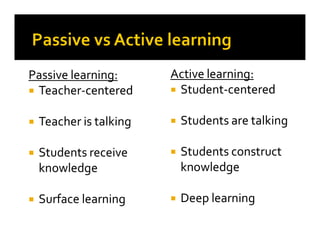
Passive learning:
Passive learning:

 Teacher
Teacher-
-centered
centered

 Teacher is talking
Teacher is talking
Active learning:
Active learning:

 Student
Student-
-centered
centered

 Students are talking
Students are talking

 Teacher is talking
Teacher is talking

 Students receive
Students receive
knowledge
knowledge

 Surface learning
Surface learning

 Students are talking
Students are talking

 Students construct
Students construct
knowledge
knowledge

 Deep learning
Deep learning

 Activity
Activity

 What is surface learning and deep learning?
What is surface learning and deep learning?
What is the difference between the two?

 What is the difference between the two?
What is the difference between the two?

 Discuss and share your opinions (
Discuss and share your opinions ( 1 minute
1 minute)
)

 Surface learning
Surface learning

 Surface learning is the more
Surface learning is the more factual
factual
information or
information or surface
surface knowledge that is
knowledge that is
information or
information or surface
surface knowledge that is
knowledge that is
often a prerequisite for deep learning.

 Learning based on fact memorization and
Learning based on fact memorization and lower
lower
level cognitive abilities
level cognitive abilities-
- remembering,
remembering,
understanding
understanding

 Surface learning…
Surface learning…

 Short
Short-
-term retention of contents
term retention of contents
Focus on coverage rather than depth

 Focus on coverage rather than depth
Focus on coverage rather than depth

 Accepts information and ideas passively
Accepts information and ideas passively

 Memorization of unlinked facts
Memorization of unlinked facts

 Employ an anxiety provoking assessment system
Employ an anxiety provoking assessment system

 Deep learning
Deep learning

 Deep learning is the process by which
Deep learning is the process by which
students gain a
students gain a broader
broader and
and deeper
deeper
students gain a
students gain a broader
broader and
and deeper
deeper
understanding of concepts and practices.

 It is the way students find out different
It is the way students find out different
solutions by their own with little guide.

 Deep learning…
Deep learning…

 In deep learning, the biggest effect on students
In deep learning, the biggest effect on students
learning occur when
learning occur when teachers become learners
teachers become learners of
of
learning occur when
learning occur when teachers become learners
teachers become learners of
of
their own teaching and when
their own teaching and when students become
students become
their own teachers
their own teachers.
.

 Learning that involves
Learning that involves higher
higher-
-order thinking
order thinking—
—
applying, analyzing, evaluating, and creating.

 Deep learning …
Deep learning …

 Leads to long term
Leads to long term-
-retention
retention

 Critical analysis of new ideas
Critical analysis of new ideas

 Critical analysis of new ideas
Critical analysis of new ideas

 Links previous knowledge to new one
Links previous knowledge to new one

 Encourage interaction with others
Encourage interaction with others

 Integrate ideas using organized principles
Integrate ideas using organized principles

 Promotes understanding and application for life
Promotes understanding and application for life

 Activity
Activity

 What is active learning?
What is active learning?

 When do teachers do active learning in the
When do teachers do active learning in the
classroom?When not?
classroom?When not?

 Discuss and share your ideas (
Discuss and share your ideas (2 minute
2 minute)
)

 Active learning is instructional activities
Active learning is instructional activities
involving students in
involving students in doing
doing things
things and
and thinking
thinking
about what they are doing.

 It is a process whereby
It is a process whereby students engage in
students engage in
activities
activities, such as reading, writing, discussion, or
, such as reading, writing, discussion, or
problem solving that promote
problem solving that promote analysis
analysis,
,
synthesis
synthesis, and
, and evaluation
evaluation of class content.
of class content.

 Students do
Students do not
not learn much just by sitting in
learn much just by sitting in
class listening to teachers
class listening to teachers (
(lecture
lecture),
),
memorizing pre
memorizing pre-
-packed assignments, and
packed assignments, and
spitting out answers (
spitting out answers (passive learning
passive learning).
).

 But they must
But they must talk
talk about what they are
about what they are
learning,
learning, write
write about it,
about it, relate
relate it to the past
it to the past
experiences,
experiences, apply
apply it their daily life (
it their daily life (active
active
learning
learning).
).

 Teacher is
Teacher is doing
doing active learning in the classroom
active learning in the classroom
when he/she:
when he/she:

 asks a question, pose a problem, or issue some other
asks a question, pose a problem, or issue some other
type of challenge
type of challenge
type of challenge
type of challenge

 tells students to work individually or in small groups to
tells students to work individually or in small groups to
come up with a response

 gives students some time to do activities and stops them,
gives students some time to do activities and stops them,
and call on one or more individuals or groups to share
their responses
their responses

 Teacher is
Teacher is not
not doing active learning when
doing active learning when
he/she:
he/she:

 lectures
lectures

 lectures
lectures

 asks questions that the
asks questions that the same few
same few students
students always
always
answer, or
answer, or

 conducts discussions that engage only a
conducts discussions that engage only a small
small fraction
fraction
of the class
of the class

 Research proves that active learning has
Research proves that active learning has
greater
greater retention
retention,
, comprehension
comprehension,
,
satisfaction
satisfaction, and
, and application
application in learners than
in learners than
other non
other non-
-active methods.
active methods.
Source
Source: National
: National
training laboratory:
Average student
Average student
retention rate
retention rate
training laboratory:
Bethel, Maine
Bethel, Maine

 What
What mistakes
mistakes do teachers make when they
do teachers make when they
implement active learning?

 Making
Making exercise
exercise too long (
too long (more than
more than 3
3 minutes
minutes)
)
▪
▪ If you give students
If you give students ten
ten minutes to solve a problem, some
minutes to solve a problem, some
groups will finish in
groups will finish in two
two and waste
and waste eight
eight minutes of valuable
minutes of valuable
class time, while others will struggle for the
class time, while others will struggle for the entire
entire ten
ten
minutes, which is very frustrating and wastes class time.

 What mistakes …
What mistakes …

 Calling for
Calling for volunteers
volunteers to respond after every activity
to respond after every activity
▪
▪ If you always call volunteers, other students will
If you always call volunteers, other students will ignore
ignore
▪
▪ If you always call volunteers, other students will
If you always call volunteers, other students will ignore
ignore
doing
doing the questions and start talking about other things
the questions and start talking about other things
(such as
(such as soccer game
soccer game).
).
▪
▪ If students know that
If students know that any
any of them will be called upon for a
of them will be called upon for a
response in a minute or two,
response in a minute or two, most or all
most or all of them will do
of them will do
their best to be
their best to be ready
ready.

 Activity
Activity

 Why does active learning need to be implemented in
Why does active learning need to be implemented in
the classroom?
the classroom?
the classroom?
the classroom?

 Discuss in pairs and share your ideas with others. (
Discuss in pairs and share your ideas with others. (1
1
minute
minute)
)

 Research shows
Research shows

 Higher
Higher student
student achievement
achievement and engagement
and engagement
are associated with instructional methods
involving active learning.

 No active learning
No active learning –
– 34%
34% failure rate
failure rate

 Active learning
Active learning –
– 21%
21% failure rate
failure rate

 6%
6% better on examination (
better on examination (Freeman et. al. 2014
Freeman et. al. 2014)
)

 Research shows…
Research shows…

 Learning is more
Learning is more durable
durable and
and lasting
lasting when
when
students are cognitively
students are cognitively engaged
engaged in the process.
in the process.
students are cognitively
students are cognitively engaged
engaged in the process.
in the process.
After 2 weeks,
After 2 weeks,
we tend to
we tend to
remember …
remember …

 Learning is more effective when students are
Learning is more effective when students are
guided to construct meaningful connections
between ideas (
between ideas (constructivist learning theory
constructivist learning theory).
).

 Think about Bloom’sTaxonomy
Think about Bloom’sTaxonomy

 Activity
Activity

 What is active learning methods?
What is active learning methods?

 Name some common active learning methods
Name some common active learning methods
and describe their application in the classroom.

 Discuss as a group and share your ideas. (
Discuss as a group and share your ideas. (2 minutes
2 minutes)
)

 Active learning methods
Active learning methods require students to
require students to
participate in their learning by thinking,
discussing, investigating, and creating.

 In the classroom, students practice skills,
In the classroom, students practice skills,
solve problems, struggle with complex
questions, make decisions, propose solutions,
and explain ideas in their
and explain ideas in their own
own words
words through
through
writing and discussion.

 Think
Think-
-Pair
Pair-
-Share (TPS)
Share (TPS)

 Activity
Activity

 Have you ever heard the term
Have you ever heard the termThink
Think-
-Pair
Pair-
-Share
Share

 Have you ever heard the term
Have you ever heard the termThink
Think-
-Pair
Pair-
-Share
Share
before?
before?

 How do we implement it as an active learning
How do we implement it as an active learning
method?
method?

 Discuss in pairs and share your ideas. (
Discuss in pairs and share your ideas. (1 minute
1 minute)
)

 Think
Think-
-Pair
Pair-
-Share …
Share …

 The teacher gives students a question (topic),
The teacher gives students a question (topic),
the students
the students think
think independently about a topic,
independently about a topic,
the students
the students think
think independently about a topic,
independently about a topic,
discuss it with one or more
discuss it with one or more pairs
pairs and finally
and finally
share
share the results with the entire class as part of
the results with the entire class as part of
a formal discussion.

 Think
Think-
-Pair
Pair-
-Share…
Share…

 Think
Think-
-Pair
Pair-
-Share…
Share…

 Step 1: Think
Step 1: Think

 Teacher asks a specific question about a
Teacher asks a specific question about a

 Teacher asks a specific question about a
Teacher asks a specific question about a
topic.
topic.

 Students
Students think
think independently
independently about the
about the
question that has been posed, forming
ideas their own and write them down.

 Think
Think-
-Pair
Pair-
-Share…
Share…

 Step
Step 2
2: Pair
: Pair

 Students grouped in pairs to discuss
Students grouped in pairs to discuss

 Students grouped in pairs to discuss
Students grouped in pairs to discuss
their thought.
their thought.

 This step allows students to articulate
This step allows students to articulate
their ideas and to consider those of
others.
others.

 Think
Think-
-Pair
Pair-
-Share…
Share…

 Step 3: Share
Step 3: Share

 Students
Students share
share their thinking with the
their thinking with the

 Students
Students share
share their thinking with the
their thinking with the
entire class.
entire class.

 Teacher moderates the discussion and
Teacher moderates the discussion and
highlights important points.

 Think
Think-
-Pair
Pair-
-Share …
Share …

 Implementation strategies in the
Implementation strategies in the
classroom
classroom
classroom
classroom

 DescribeTPS to students.
DescribeTPS to students.
 Pose an open-ended question for students to
answer and ask them to think to themselves for
about a minute and write down their thoughts.

 Think
Think-
-Pair
Pair-
-Share …
Share …

 Implementation strategies…
Implementation strategies…

 Ask them to turn to the person next to them
Ask them to turn to the person next to them

 Ask them to turn to the person next to them
Ask them to turn to the person next to them
and
and share their thought process/answer with each
share their thought process/answer with each
other.
other.

 Prompt students to report out on “behalf” of their
Prompt students to report out on “behalf” of their
group to the entire class.

 Think
Think-
-Pair
Pair-
-Share …
Share …

 For example
For example,
,

 Why is generosity important in society? (G
Why is generosity important in society? (G-
-8
8
Citizenship
Citizenship-
- P28)
P28)

 Make a list of organic and inorganic compounds
Make a list of organic and inorganic compounds
and discuss their importance (G
and discuss their importance (G-
-8 GS, P39).
8 GS, P39).

 Brainstorming
Brainstorming

 Activity
Activity

 Activity
Activity

 What is brainstorming
What is brainstorming?

 How can we apply it as an active learning method?
How can we apply it as an active learning method?

 Think and discuss with the friend next to you (
Think and discuss with the friend next to you (1
1
minute)
minute).
.

 Brainstorming…
Brainstorming…

 According to oxford dictionary:
According to oxford dictionary:

 A spontaneous large
A spontaneous large-
-or small
or small-
-group
group discussion
discussion to
to

 A spontaneous large
A spontaneous large-
-or small
or small-
-group
group discussion
discussion to
to
produce ideas and ways of solving problems.

 In the classroom, the teacher begin a brainstorming
In the classroom, the teacher begin a brainstorming
by asking a
by asking a question
question or a
or a problem
problem, or by
, or by
introducing a
introducing a topic
topic.
.

 Brainstorming…
Brainstorming…

 Students then freely
Students then freely generate
generate numerous
numerous ideas
ideas
within a specified time limit and find a solutions.

 No
No criticism
criticism or
or judgment
judgment or
or commentary
commentary is
is
allowed.
allowed.

 Brainstorming…
Brainstorming…

 Strategies for implementing brainstorming in the
Strategies for implementing brainstorming in the
classroom
classroom

 The teacher starts brainstorming by asking a
The teacher starts brainstorming by asking a question
question or
or
introducing a subject
introducing a subject topic
topic

 Then students give their
Then students give their ideas
ideas to the teacher in a short
to the teacher in a short
statement with a set
statement with a set time limit
time limit.
.

 The teacher
The teacher records
records students' ideas on the board or chart.
students' ideas on the board or chart.

 The teacher removes bad ideas.
The teacher removes bad ideas.

 Brainstorming…
Brainstorming…

 For example,
For example,

 የአየር ንብረት በአኗኗር ላይ የሚያሳድረውን ተዕፅኖ ዘርዝሩ
የአየር ንብረት በአኗኗር ላይ የሚያሳድረውን ተዕፅኖ ዘርዝሩ፡፡
፡፡ (
(አካ
አካ
ሳይ
ሳይ 2
2፣
፣ 53
53)
)

 What is the commonly spread skin disease in
What is the commonly spread skin disease in
Ethiopia? (GS
Ethiopia? (GS-
-8
8, P
, P80
80).
).

 Demonstration
Demonstration

 Activity
Activity

 What is demonstration as a method of teaching? Why
What is demonstration as a method of teaching? Why
this method?
this method?

 Think and discuss with the friend next to you (
Think and discuss with the friend next to you (1
1
minute)
minute).
.

 Demonstration…
Demonstration…

 The demonstration teaching method is a
The demonstration teaching method is a
method in which the teacher demonstrates how
to do something to the students.

 This can be accomplished using
This can be accomplished using actual
actual objects,
objects,
models
models, or
, or photographs
photographs.
.

 Demonstration…
Demonstration…

 Implementation strategies in the classroom
Implementation strategies in the classroom

 Establishes clear
Establishes clear learning objectives
learning objectives,
,

 Prepares the necessary
Prepares the necessary materials
materials and
and equipment
equipment,
,

 Practices
Practices the demonstration
the demonstration

 Demonstration…
Demonstration…

 Briefly
Briefly introduce
introduce the topic,
the topic,

 Encourage students to actively
Encourage students to actively observe
observe, take
, take notes
notes,
,
and
and ask
ask questions during the demonstration,
questions during the demonstration,

 After the demonstration, the teacher asks students to
After the demonstration, the teacher asks students to
discuss
discuss the observed results.
the observed results.

 Demonstration…
Demonstration…

 Types of Demonstratio
Types of Demonstration
n –
– 3 types
3 types

 Pure demonstration
Pure demonstration

 Pure demonstration
Pure demonstration

 Purely
Purely visual
visual method of instruction
method of instruction

 Demonstration with commentary
Demonstration with commentary

 Harmonious blend of
Harmonious blend of visual and verbal
visual and verbal modes of instruction
modes of instruction

 Participative demonstration
Participative demonstration

 Allows students to attempt either to replicate all or parts of
Allows students to attempt either to replicate all or parts of
demonstrations
demonstrations

 Demonstration…
Demonstration…

 For example
For example,
,

 ቋሚ
ቋሚ (longitude)
(longitude) እና አግዳሚ
እና አግዳሚ (latitude)
(latitude) መስመሮችን
መስመሮችን በ
በሁለት
ሁለት

 ቋሚ
ቋሚ (longitude)
(longitude) እና አግዳሚ
እና አግዳሚ (latitude)
(latitude) መስመሮችን
መስመሮችን በ
በሁለት
ሁለት
ብርቱካኖች
ብርቱካኖች ማሳየት
ማሳየት (
(አካ
አካ ሳይ
ሳይ ክ
ክ6
6 ገ
ገ8
8)
)

 ስለ
ስለ ዋህድ
ዋህድ-
-ዘር ድብልቆች
ዘር ድብልቆች (
(homogeneous mixtures)
homogeneous mixtures) እና
እና ልይ
ልይ-
-ዘር
ዘር
ድብልቆች
ድብልቆች (
(heterogeneous mixtures)
heterogeneous mixtures) ምንነት
ምንነት ማሳየት
ማሳየት (
(አካ
አካ ሳይ
ሳይ ክ
ክ6
6
ገ
ገ49
49)
)

 ስለሟሚ
ስለሟሚ እና
እና ሟሚ
ሟሚ ያልሆኑ
ያልሆኑ ነገሮች
ነገሮች በክፍል
በክፍል ውስጥ
ውስጥ ማሳየት
ማሳየት፡፡
፡፡

 Learning cell
Learning cell

 Activity
Activity

 What is learning cell?
What is learning cell?

 How can we implement it in the classroom?
How can we implement it in the classroom?

 Discuss in pairs and share your ideas with others.
Discuss in pairs and share your ideas with others.
(
(1 minute
1 minute)
)

 Learning cell…
Learning cell…

 Learning strategy for a
Learning strategy for a pair
pair of students
of students to
to
learn together.
learn together.

 A pair of students alternate asking and
A pair of students alternate asking and
answering questions on
answering questions on commonly
commonly read
read
materials
materials

 Learning cell…
Learning cell…

 Implementation strategies in the classroom
Implementation strategies in the classroom

 First, an
First, an assignment
assignment is chosen which needs to be
is chosen which needs to be

 First, an
First, an assignment
assignment is chosen which needs to be
is chosen which needs to be
prepared by the students,

 The students read the assignment and
The students read the assignment and write down
write down
questions
questions about the assignment,
about the assignment,

 At the next class meeting, the teacher
At the next class meeting, the teacher randomly
randomly pairs
pairs
the
the students,
students,

 Learning cell…
Learning cell…

 From each pair, one student begins
From each pair, one student begins asking
asking one of
one of
their questions to the other,

 The two students start discussing the question,
The two students start discussing the question,

 The other student ask a question and they
The other student ask a question and they
alternate
alternate accordingly.
accordingly.

 Learning cell…
Learning cell…

 During this time, the
During this time, the teacher
teacher goes
goes
from pair to pair to give
from pair to pair to give feedback
feedback and
and
from pair to pair to give
from pair to pair to give feedback
feedback and
and
answering
answering questions.
questions.

 For example
For example,
,

 Differentiate between internal and external forces
Differentiate between internal and external forces
shaping the surface of the earth (SS, G
shaping the surface of the earth (SS, G-
-8, P1
8, P1-
-12)
12)

 Learning cell…
Learning cell…

 During this time, the
During this time, the teacher
teacher goes
goes
from pair to pair to give
from pair to pair to give feedback
feedback and
and
from pair to pair to give
from pair to pair to give feedback
feedback and
and
answering
answering questions.
questions.

 For example
For example,
,

 Differentiate between internal and external forces
Differentiate between internal and external forces
shaping the surface of the earth (SS, G
shaping the surface of the earth (SS, G-
-8
8, P
, P1
1-
-12
12)
)

 Jigsaw discussion
Jigsaw discussion

 Jigsaw is a cooperative learning strategy that
Jigsaw is a cooperative learning strategy that
enables each student to become an
enables each student to become an expert
expert
enables each student to become an
enables each student to become an expert
expert
on a
on a certain topic
certain topic, through discussion with
, through discussion with
others of the same topic or unit, and then
share their findings to their original “
share their findings to their original “home
home
group
group”.
”.

 Jigsaw discussion …
Jigsaw discussion …

 Students divide into
Students divide into smaller group
smaller group and each
and each
member becomes an “
member becomes an “expert
expert” in subtopic given
” in subtopic given
member becomes an “
member becomes an “expert
expert” in subtopic given
” in subtopic given
to them.
to them.

 Once they master specific subtopic, they meet
Once they master specific subtopic, they meet
with members from other home groups in class
who are experts in that same subtopic.

 Jigsaw discussion …
Jigsaw discussion …

 The experts return back to “home group” to
The experts return back to “home group” to
teach the findings to all members of the
group.
group.

 Jigsaw discussion …
Jigsaw discussion …

 Jigsaw discussion …
Jigsaw discussion …

 Implementation strategies in the classroom
Implementation strategies in the classroom

 Group students heterogeneously into “home
Group students heterogeneously into “home
groups”.
groups”.

 Divide the topic into segments (subtopics) as
Divide the topic into segments (subtopics) as
needed.
needed.

 Jigsaw discussion …
Jigsaw discussion …

 Implementation strategies in the classroom…
Implementation strategies in the classroom…

 Assign each student to learn one segment (subtopic).
Assign each student to learn one segment (subtopic).

 Assign each student to learn one segment (subtopic).
Assign each student to learn one segment (subtopic).
▪
▪ For example
For example,
,
▪
▪ Parts of plants and their benefits,
Parts of plants and their benefits,
▪
▪ Group
Group 1
1: root and its benefit
: root and its benefit
▪
▪ Group
Group 2
2: stem and its benefit
: stem and its benefit
▪
▪ Group
Group 3
3: leaf and its benefit
: leaf and its benefit
▪
▪ Group
Group 4
4: flower and its benefit
: flower and its benefit

 Jigsaw discussion …
Jigsaw discussion …

 Implementation strategies in the classroom…
Implementation strategies in the classroom…

 Give students time to read over their subtopic and
Give students time to read over their subtopic and

 Give students time to read over their subtopic and
Give students time to read over their subtopic and
become familiar with it.

 Create “
Create “expert groups
expert groups” by having one student
” by having one student
from each “
from each “home group
home group” who are reading the
” who are reading the
same subtopic.
same subtopic.

 Jigsaw discussion …
Jigsaw discussion …

 Implementation strategies in the classroom…
Implementation strategies in the classroom…

 Bring the students back into their “home groups”
Bring the students back into their “home groups”
to present their subtopic to the group.

 Jigsaw discussion …
Jigsaw discussion …

 Implementation strategies in the classroom…
Implementation strategies in the classroom…

 Teacher moves from group to group, facilitate the
Teacher moves from group to group, facilitate the

 Teacher moves from group to group, facilitate the
Teacher moves from group to group, facilitate the
process.
process.

 Each “home group” will share their findings with
Each “home group” will share their findings with
class.
class.

 At the end of the session, give a quiz on the
At the end of the session, give a quiz on the
material.
material.

 Jigsaw discussion …
Jigsaw discussion …

 For example
For example,
,

 የካርታ መፈለጊያ መተግበሪያንና ጎግል ኧርዝ
የካርታ መፈለጊያ መተግበሪያንና ጎግል ኧርዝ (
(አካ
አካ ሳይ
ሳይ ክ
ክ6
6 ገ
ገ 21
21-
-22
22)
)

 የካርታ መፈለጊያ መተግበሪያንና ጎግል ኧርዝ
የካርታ መፈለጊያ መተግበሪያንና ጎግል ኧርዝ (
(አካ
አካ ሳይ
ሳይ ክ
ክ6
6 ገ
ገ 21
21-
-22
22)
)

 One group will discuss
One group will discuss ጎግል ካርታ
ጎግል ካርታ (
(Google map),
Google map), ጎግል ኧርዝ
ጎግል ኧርዝ
(
(Google earth), and
Google earth), and ጂፒኤስ
ጂፒኤስ (
(GPS)
GPS)

 Tenses
Tenses

 Present tense, present continuous tense, present perfect
Present tense, present continuous tense, present perfect
tense, past tense, past continuous tense, past perfect tense

 Project
Project-
-based learning (PBL)
based learning (PBL)

 Activity
Activity

 What do we already know about project
What do we already know about project-
-based
based

 What do we already know about project
What do we already know about project-
-based
based
learning?
learning?

 How does it connect with real
How does it connect with real-
-life?
life?

 Discuss in pair and share your ideas. (
Discuss in pair and share your ideas. (1 minute
1 minute)
)

 Project
Project-
-based learning (PBL)…
based learning (PBL)…

 PBL
PBL is an active learning approach in which
is an active learning approach in which
students actively explore
students actively explore real
real-
-world
world problems
problems
students actively explore
students actively explore real
real-
-world
world problems
problems
and challenges and acquire a
and challenges and acquire a deeper
deeper knowledge.
knowledge.

 It
It integrates the
integrates the 21
21st
st century skills:
century skills:

 Communication
Communication,
, collaboration
collaboration,
, critical thinking
critical thinking and
and
creativity
creativity

 Project
Project-
-based learning (PBL)…
based learning (PBL)…

 Students work on a project over an extended
Students work on a project over an extended
period of time
period of time –
– from
from a week
a week up to
up to a quarter
a quarter –
–
period of time
period of time –
– from
from a week
a week up to
up to a quarter
a quarter –
–
that engage them in solving a real
that engage them in solving a real-
-world
world
problem or answering a complex questions.

 Project
Project-
-based learning (PBL)…
based learning (PBL)…

 PBL activities can be done in the
PBL activities can be done in the classroom
classroom or
or
at
at home
home.
.
at
at home
home.
.

 Parents provides support for their children.
Parents provides support for their children.

 They can be done
They can be done individually
individually, in
, in pairs
pairs, or in
, or in
small groups
small groups.
.

 Project
Project-
-based learning (PBL)…
based learning (PBL)…

 Essential project design elements
Essential project design elements
1
1) A challenging problem or question
) A challenging problem or question

 1
1) A challenging problem or question
) A challenging problem or question

 The project is framed by a meaningful problem to
The project is framed by a meaningful problem to
be solved a question to answer, at the appropriate
level of challenge
level of challenge

 Project
Project-
-based learning (PBL)…
based learning (PBL)…

 2
2) Sustained inquiry
) Sustained inquiry
Students engage in rigorous, extended process of

 Students engage in rigorous, extended process of
Students engage in rigorous, extended process of
poising questions, finding resources, and applying
information.
information.

 Project
Project-
-based learning (PBL)…
based learning (PBL)…

 3) Authenticity
3) Authenticity
An authentic project involves
An authentic project involves real
real-
-world context
world context,
,

 An authentic project involves
An authentic project involves real
real-
-world context
world context,
,
addresses
addresses 21
21st
st century skills
century skills, and speaks to relevant
, and speaks to relevant
concerns, interests, and issues in the students’
lives
lives.

 Project
Project-
-based learning (PBL)…
based learning (PBL)…

 4
4) Student voice and choice
) Student voice and choice
Students make some decision about the project,

 Students make some decision about the project,
Students make some decision about the project,
including how they work and what they create and
express their own ideas in their own voice.

 Project
Project-
-based learning (PBL)…
based learning (PBL)…

 5) Reflection
5) Reflection
Students and teachers
Students and teachers reflect
reflect on the learning, the
on the learning, the

 Students and teachers
Students and teachers reflect
reflect on the learning, the
on the learning, the
effectiveness of their project activities, the quality
of student work, obstacle that arise and strategies
for overcoming them.

 Project
Project-
-based learning (PBL)…
based learning (PBL)…

 6) Critique and revision
6) Critique and revision
Students give, receive, and apply
Students give, receive, and apply feedback
feedback to
to

 Students give, receive, and apply
Students give, receive, and apply feedback
feedback to
to
improve their processes and products.

 Project
Project-
-based learning (PBL)…
based learning (PBL)…

 7
7) Public products
) Public products
Students make their project work
Students make their project work public
public by sharing
by sharing

 Students make their project work
Students make their project work public
public by sharing
by sharing
it with and explaining or
it with and explaining or presenting
presenting it people
it people
beyond the classroom.

 Project
Project-
-based learning (PBL)…
based learning (PBL)…

 Teacher’s role:
Teacher’s role:
Works with students to
Works with students to frame questions
frame questions (may be
(may be

 Works with students to
Works with students to frame questions
frame questions (may be
(may be
teacher uses brainstorming method)

 Structures
Structures meaningful tasks
meaningful tasks

 Coaches
Coaches knowledge development and social skills
knowledge development and social skills

 Assesses
Assesses students’ learning
students’ learning

 Project
Project-
-based learning (PBL)…
based learning (PBL)…

 Assessment of students
Assessment of students
Performance is assessed on an
Performance is assessed on an individual
individual basis
basis, and
, and

 Performance is assessed on an
Performance is assessed on an individual
individual basis
basis, and
, and
takes into account the
takes into account the quality
quality of the
of the product
product
produced, the
produced, the depth
depth of content understanding
of content understanding
demonstrated, and
demonstrated, and contributions
contributions made to the
made to the
ongoing project realization.

 Project
Project-
-based learning (PBL)…
based learning (PBL)…

 For examples
For examples

 Students make a map of their school
Students make a map of their school

 Students make a map of their school
Students make a map of their school

 Students apply their geometry concepts to measure
Students apply their geometry concepts to measure
play ground of the school

 Allow students research and argue what caused
Allow students research and argue what caused
dinosaurs’ extinction, crafting visual display to
illustrate findings.

 Concept mapping
Concept mapping

 Activity
Activity

 What is a concept mapping?
What is a concept mapping?

 How can we apply in classroom?
How can we apply in classroom?

 Discuss in pairs and forward your answers (
Discuss in pairs and forward your answers (1
1
minute
minute)
)

 Concept mapping …
Concept mapping …

 Concept map is a visual illustration displaying the
Concept map is a visual illustration displaying the
organization
organization of concepts and outline the
of concepts and outline the relationship
relationship
organization
organization of concepts and outline the
of concepts and outline the relationship
relationship
among or between these concepts.

 It a
It allows students working together in groups a way of
llows students working together in groups a way of
illustrating the connections that exist between
illustrating the connections that exist between terms
terms
or
or concepts
concepts covered in the lesson.
covered in the lesson.

 Concept mapping…
Concept mapping…

 Concept mapping help students
Concept mapping help students manage
manage
concepts into sub
concepts into sub-
-concepts,
concepts, synthesize
synthesize
information,
information, see
see a larger picture and
a larger picture and develop
develop
higher
higher-
-order thinking skills and strategies.
order thinking skills and strategies.
Matter
Matter
Pure substance
Pure substance Mixture
Mixture
Example of concept mapping
Element
Element Compound
Compound Homogeno
Homogeno
us
us
Heterogen
Heterogen
eous
eous
Solution
Solution Suspension
Suspension

 Concept mapping…
Concept mapping…

 Concept mapping…
Concept mapping…

 How to use concept mapping in the classroom
How to use concept mapping in the classroom
Identify and list the key concepts (using brainstorming)

 Identify and list the key concepts (using brainstorming)
Identify and list the key concepts (using brainstorming)

 Group the concepts
Group the concepts

 Organize the concepts into a hierarchy
Organize the concepts into a hierarchy

 Connect the ideas
Connect the ideas

 Revise the concept map as necessary
Revise the concept map as necessary

 Student
Student-
-generated questions
generated questions

 Activity
Activity

 What are student
What are student-
-generated questions as an active
generated questions as an active

 What are student
What are student-
-generated questions as an active
generated questions as an active
learning method?
learning method?

 How can we implement student
How can we implement student-
-generated questions
generated questions
in the classroom?
in the classroom?

 Discuss as a group and share your ideas. (
Discuss as a group and share your ideas. (1
1 minute
minute)
)

 Student
Student-
-generated questions …
generated questions …

 Student
Student-
-generated questions are
generated questions are questions that
questions that
students
students write
write before, during, or after engaging in a
before, during, or after engaging in a
students
students write
write before, during, or after engaging in a
before, during, or after engaging in a
lesson or reading a text.

 Students use content from the lesson to generate
Students use content from the lesson to generate
questions for their
questions for their peers
peers to
to answer
answer, for their own
, for their own
study
study purposes, and/or to
purposes, and/or to inspire
inspire future learning.
future learning.

 Student
Student-
-generated questions…
generated questions…
 Student
Student-
-Generated Questions are
Generated Questions are intended to
intended to
allow students to display a
allow students to display a deeper
deeper
allow students to display a
allow students to display a deeper
deeper
understanding
understanding of the objectives and develop
of the objectives and develop
independent learners.

 Asking students to create their own questions
Asking students to create their own questions
has a powerful impact on learning.

 Student
Student-
-generated questions…
generated questions…

 The incorporation of student
The incorporation of student-
-generated
generated
The incorporation of student
The incorporation of student-
-generated
generated
questions into classroom

 Teach students how to ask good questions
Teach students how to ask good questions

 Have students create their own test and quiz
Have students create their own test and quiz
questions (
questions (Velarde
Velarde,
, 2014
2014)
)

 Student
Student-
-generated questions…
generated questions…

 The incorporation of student
The incorporation of student-
-generated
generated
The incorporation of student
The incorporation of student-
-generated
generated
questions into classroom…

 Improve class
Improve class-
-wide discussions (
wide discussions (Teplitski
Teplitski,
, 2018
2018)
)

 Get at ‘driving questions’
Get at ‘driving questions’

 Student
Student-
-generated questions…
generated questions…

 Advantage
Advantage (
(Aflalo
Aflalo, 2021)
, 2021)
Advantage
Advantage (
(Aflalo
Aflalo, 2021)
, 2021)

 reduction of test anxiety
reduction of test anxiety

 productive group learning
productive group learning

 students study the questions for the examination
students study the questions for the examination

 Role playing
Role playing

 Activity
Activity

 What is role playing?
What is role playing?

 How can we use it as an active learning method?
How can we use it as an active learning method?

 Discuss in pairs and share your answers. (
Discuss in pairs and share your answers. (1
1 minute)
minute)

 Role playing…
Role playing…

 Role play is a discussion techniques that make it
Role play is a discussion techniques that make it
possible get maximum participation of a group
through
through acting
acting out.
out.

 In role playing, students
In role playing, students act
act out characters in a
out characters in a
predefined “situations”.

 Role playing…
Role playing…

 Implementation strategies into classroom
Implementation strategies into classroom

 Define the objective
Define the objective

 Chose context and roles
Chose context and roles

 Introducing the exercise
Introducing the exercise

 Student preparation
Student preparation

 The role
The role-
-play
play

 Assessment
Assessment

 Learning by teaching/peer teaching
Learning by teaching/peer teaching
Tell me and I forget.Teach me and I
remember. Involve me and I learn.
Benjamin Franklin
Benjamin Franklin

 Learning by teaching/peer teaching…
Learning by teaching/peer teaching…

 Learning by teaching
Learning by teaching is a method of teaching
is a method of teaching
in which
in which students
students are made to
are made to learn material
learn material
and
and prepare lessons
prepare lessons to
to teach
teach it to the other
it to the other
students.
students.

 Learning by teaching/peer teaching
Learning by teaching/peer teaching

 According to
According to Mangope
Mangope, 2014, peer teaching is the
, 2014, peer teaching is the
process by which a
process by which a capable student teaches
capable student teaches a skill
a skill
process by which a
process by which a capable student teaches
capable student teaches a skill
a skill
or concept to
or concept to one
one or
or more
more students in the
students in the same
same
grade level with little preparation and under the
guidance
guidance of the teacher (
of the teacher (Mangope
Mangope, 2014).
, 2014).

 Learning by teaching/peer teaching…
Learning by teaching/peer teaching…

 This helps students learn better their own topic
This helps students learn better their own topic
even better and sometimes students learn and
communicate better with their peers than their
teachers.
teachers.

 Learning by teaching/peer teaching…
Learning by teaching/peer teaching…

 Strategy
Strategy

 Divide content into sections and assign sections
Divide content into sections and assign sections
to small groups for discussion

 The One
The One-
-Minute paper
Minute paper

 Activity
Activity

 What is the One
What is the One-
-Minute Paper as an active learning
Minute Paper as an active learning
method?
method?

 Discuss in pairs and give your answers. (
Discuss in pairs and give your answers. (1 minute
1 minute)
)

 The One
The One-
-Minute paper…
Minute paper…

 It is
It is a classroom
a classroom assessment
assessment technique and
technique and active
active
learning strategy
learning strategy that is used to collect student feedback
that is used to collect student feedback
learning strategy
learning strategy that is used to collect student feedback
that is used to collect student feedback
and assess student learning about a topic.

 Students are given
Students are given 1 minute
1 minute (may be more) at the end of
(may be more) at the end of
class to jot down on paper some points from that day's
class session.
class session.

 The One
The One-
-Minute paper…
Minute paper…

 The teacher collects the papers and reads them in the office
The teacher collects the papers and reads them in the office
to understand what the students have learned, where there
may be gaps in their knowledge, what teaching practice they
are responding to, etc.

 The one
The one-
-minute paper allows students an opportunity to
minute paper allows students an opportunity to
reflect on their learning (
reflect on their learning (write
write-
-to
to-
-learn activity
learn activity) while also
) while also
providing the teacher with
providing the teacher with feedback
feedback (formative assessment)
(formative assessment)
on student understanding.

 The One
The One-
-Minute paper…
Minute paper…

 The teacher may ask students to write:
The teacher may ask students to write:

 What was the most useful idea discussed in today’s class?
What was the most useful idea discussed in today’s class?

 In your own words, tell me what you understand about.
In your own words, tell me what you understand about.

 Write down the three key things you learned in today's
Write down the three key things you learned in today's
class.
class.

 What was the most confusing point in today's class?
What was the most confusing point in today's class?

 Other active learning methods
Other active learning methods

 Experimental methods
Experimental methods

 Conducting experiments
Conducting experiments

 Field trips
Field trips

 Field trips
Field trips

 Narratives
Narratives

 Games
Games

 Story telling
Story telling

 Field observation
Field observation

 Surveys
Surveys

 Activity
Activity

 What is the most effective learning method?Why?
What is the most effective learning method?Why?

 What is the most effective method of teaching?
What is the most effective method of teaching?

 Which of the methods we’ve covered would you like
Which of the methods we’ve covered would you like
to try in your own classes?

 Discuss in group and share your ideas. (
Discuss in group and share your ideas. (2 minutes
2 minutes).
).

 The most effective
The most effective learning
learning method is
method is
learning via a
learning via a mixture
mixture of delivery methods. In
of delivery methods. In
other words,
other words, blended learning
blended learning.
.

 The most effective method of teaching is
The most effective method of teaching is
students teaching other students
students teaching other students.
.

 In active learning, the teacher moves from
In active learning, the teacher moves from
being the “
being the “sage on the stage
sage on the stage” to the “
” to the “guide
guide
on the side
on the side”.
”.

 Teachers become facilitators, coaches,
Teachers become facilitators, coaches,
guides, source of information, experience and
encouragement.
encouragement.
“There were much more productive
ways of learning everything than
sitting in lectures.”
Sal Khan
Sal Khan

 Activities to supplement lectures
Activities to supplement lectures

 Gapped lecture
Gapped lecture

 Divide the lecture into small sections and give an
Divide the lecture into small sections and give an

 Divide the lecture into small sections and give an
Divide the lecture into small sections and give an
activities for students to complete between each
section
section

 Interactive lecture
Interactive lecture

 Students respond to or ask questions during the
Students respond to or ask questions during the
lecture
lecture

 Activities to supplement lectures…
Activities to supplement lectures…

 Buzz group
Buzz group

 Lecture 10 to 15 minutes and give students in
Lecture 10 to 15 minutes and give students in

 Lecture 10 to 15 minutes and give students in
Lecture 10 to 15 minutes and give students in
pairs or small groups about
pairs or small groups about 2 minutes
2 minutes to discuss
to discuss
what they learnt or do specific questions to
discuss on the topic covered.

 Have students summarize main points
Have students summarize main points

 Activities to supplement lectures…
Activities to supplement lectures…

 Think
Think-
-pair
pair-
-share activities
share activities

 Students work individually on an active learning
Students work individually on an active learning

 Students work individually on an active learning
Students work individually on an active learning
assignment or formative assessment activity

 They then compare their responses with a partner
They then compare their responses with a partner
and synthesize a joint solution, and then share
with the entire class.

 Activities to supplement lectures…
Activities to supplement lectures…

 Demonstrations
Demonstrations

 Students predict the outcomes of a
Students predict the outcomes of a

 Students predict the outcomes of a
Students predict the outcomes of a
demonstration.
demonstration.

 After the demonstration, the teacher asks them
After the demonstration, the teacher asks them
to discuss the observed result and how it may
have differed from their prediction.

 Activities to supplement lectures…
Activities to supplement lectures…

 Concept mapping
Concept mapping

 Brainstorming
Brainstorming

 Brainstorming
Brainstorming

 Role playing
Role playing

 Jigsaw discussion etc.
Jigsaw discussion etc.
 Felder, R. M., and Brent, R. (2009).An active learning:An Introduction.
ASQ Higher Education Brief, 2(4): 2009.
 Bloom, B.S. (1956).Taxonomy of EducationalObjectives, Handbook:The
Cognitive Domain. David McKay, NewYork
 Ordu, U.B (2021).The Role ofTeaching and LearningAids/Methods in a
ChangingWorld. NewChallenges to Education: Lessons from Around the
World, 9: 11-16.
 Weigel, F. K and Bonica, M. (2014).An Active LearningApproach to
Bloom'sTaxonomy.
 Powell, R.A., Symbaluk, D.G., and Honey, P.L (2009). Introduction to
Learning and Behavior. Wadsworth, Cengale Learning, 3rd Ed.
 Aflalo, E. (2021). Students generating questions as a way of learning.
Active Learning in Higher Education 22(1):2021
 Fleming, N.D. (2014).TheVARK modalities. vark-learn.com.
“Learning is not the product of
teaching. Learning is the product
of the activity of learners.”
John Holt
John Holt

 Active learning begins with serious
Active learning begins with serious planning
planning
that maximizes student activity and well
that maximizes student activity and well-
-
organized
organized lesson notes
lesson notes.
.
organized
organized lesson notes
lesson notes.
.

 Plan
Plan proactively and
proactively and implement
implement as per your
as per your
plan.
plan.
Thank you so much for
your attention and time!

Active learning & classroom applications.pdf

  • 1.
    Active Learning Active Learning andClassroom Applications and Classroom Applications and Classroom Applications and Classroom Applications By: By: Mekuria Mekuria M. ( M. (BSc BSc, , MSc MSc, BA, MA, , BA, MA, PDEdLA PDEdLA) ) February, 2024
  • 2.
      Activity Activity   Whatis your What is your expectation expectation from this training? from this training?   Write your answer on the paper provided and keep it. Write your answer on the paper provided and keep it.   What do you think should be observed as What do you think should be observed as ground ground rules rules during this training? during this training?
  • 3.
      Punctuality Punctuality   Warmparticipation Warm participation   Respect the opinion of others Respect the opinion of others   Limited discussion time ( Limited discussion time (1 to 3 minutes 1 to 3 minutes) )
  • 4.
      Learning, learningtheories and learning styles Learning, learning theories and learning styles   The concept of active learning The concept of active learning   Active learning methods Active learning methods   The teacher’s role in active learning The teacher’s role in active learning   Activities to supplement lectures Activities to supplement lectures
  • 5.
      By theend of this training, trainees will be able By the end of this training, trainees will be able to: to:   Define the term learning. Define the term learning.   Differentiate different learning theories and styles. Differentiate different learning theories and styles.   Apply learning theories and styles effectively in the Apply learning theories and styles effectively in the classroom. classroom.
  • 6.
      By theend of this training, trainees will be able By the end of this training, trainees will be able to: to:   Define the term active learning. Define the term active learning.   Explain the reasons why we use active learning Explain the reasons why we use active learning instead of passive learning. instead of passive learning.   Distinguish surface learning from deep learning. Distinguish surface learning from deep learning.
  • 7.
      By theend of this training, trainees will be able By the end of this training, trainees will be able to: to:   Describe different active learning methods. Describe different active learning methods.   Effectively apply a variety of active learning Effectively apply a variety of active learning methods in and out of the classroom. methods in and out of the classroom.   Describe activities to supplement lectures. Describe activities to supplement lectures.
  • 8.
      Mode oftraining delivery Mode of training delivery   Interactive Interactive   Practicable Practicable   Bilingual Bilingual
  • 9.
    The mind isnot a vessel The mind is not a vessel to be filled, but a fire to to be filled, but a fire to to be filled, but a fire to to be filled, but a fire to be kindled. be kindled. Plutarch
  • 10.
      Activity Activity   Whatis learning? What is learning?   What are common What are common learning theories learning theories?What ?What differentiate them from one another? differentiate them from one another?   Discuss in pairs and share your ideas with others. Discuss in pairs and share your ideas with others. ( (2 minute 2 minute) )
  • 11.
      Learning isa Learning is a relatively relatively permanent permanent change in change in behavior due to behavior due to experience experience. .   It is It is the acquisition of the acquisition of knowledge knowledge, , skills skills or or   It is It is the acquisition of the acquisition of knowledge knowledge, , skills skills or or formation of formation of value value system through system through study study, , experience experience, or being , or being taught taught. .   Learning is explained by different Learning is explained by different learning learning theories theories. .
  • 12.
      What arelearning theories? What are learning theories?   Theories of learning are ideas about the ways Theories of learning are ideas about the ways students students learn learn and and retain retain information. information. students students learn learn and and retain retain information. information.   The theories provide different The theories provide different frameworks frameworks that teachers can use to that teachers can use to adapt adapt to students’ to students’ diverse diverse learning styles and academic needs. learning styles and academic needs.
  • 13.
      1) 1) Behaviorallearning theory Behavioral learning theory   Emphasizes Emphasizes observable observable changes in behavior changes in behavior that result from that result from stimulus stimulus- -response response. . that result from that result from stimulus stimulus- -response response. .   Here, Here, motivation motivation and and rewards rewards are important are important components of learning. components of learning.
  • 14.
      1) 1) Behaviorallearning theory… Behavioral learning theory…   According to Pavlov's classical conditioning According to Pavlov's classical conditioning of association and Skinner's operant of association and Skinner's operant of association and Skinner's operant of association and Skinner's operant conditioning of conditioning of positive positive and and negative negative reinforcement reinforcement, learning is determined by the , learning is determined by the external environment (stimulus external environment (stimulus- -response). response).
  • 15.
      1) 1) Behaviorallearning theory… Behavioral learning theory…   In education, In education, positive reinforcement positive reinforcement is is a type a type of of behavior management behavior management that focuses on that focuses on rewarding rewarding what students do well. what students do well.   Examples Examples of positive reinforcement in the of positive reinforcement in the classroom: classroom:   Verbal praise, applause, prize box, stickers, Verbal praise, applause, prize box, stickers, positive note, etc positive note, etc
  • 16.
      1) 1) Behaviorallearning theory… Behavioral learning theory…   Negative reinforcement Negative reinforcement is taking away an is taking away an unwanted stimulus in order to encourage good unwanted stimulus in order to encourage good behavior. behavior. behavior. behavior.   For example, For example,   A teacher reduces some or all homework for students A teacher reduces some or all homework for students who hand in their homework on time. who hand in their homework on time.   Removing the code of silence in the classroom once Removing the code of silence in the classroom once everyone completes their tasks everyone completes their tasks
  • 17.
      1 1) Behaviorallearning theory… ) Behavioral learning theory…   Activity Activity Give a few Give a few examples examples of of positive positive and and negative negative   Give a few Give a few examples examples of of positive positive and and negative negative reinforcement that you have previously used in reinforcement that you have previously used in your classroom. ( your classroom. (1 minute 1 minute) )
  • 18.
      2) Cognitivelearning theory 2) Cognitive learning theory   Cognitive learning is a learning process that Cognitive learning is a learning process that results from the results from the effective effective use use and and application application of brain of brain. .   The theory assumes that students learn The theory assumes that students learn better when they use their own better when they use their own thinking skills thinking skills rather than being taught facts and rather than being taught facts and procedures. procedures.
  • 19.
      2) Cognitivelearning theory… 2) Cognitive learning theory…   Cognitivists Cognitivists focus on focus on cognitive development or cognitive development or cognitive processes involving cognitive processes involving internal mental internal mental cognitive processes involving cognitive processes involving internal mental internal mental processes processes. .   When students receive When students receive thought thought- -provoking provoking questions, it guides their brains to look deeper questions, it guides their brains to look deeper into their present knowledge to find solutions. into their present knowledge to find solutions.
  • 20.
      2) Cognitivelearning theory …. 2) Cognitive learning theory ….   Cognitive learning in the classroom: Cognitive learning in the classroom:   Giving students Giving students hands hands- -on problems on problems   Giving students Giving students hands hands- -on problems on problems   Asking them to Asking them to demonstrate demonstrate a concept a concept   Interactive discussions Interactive discussions about what being taught about what being taught   Helping students explore and understand how Helping students explore and understand how ideas are ideas are connected connected   Encouraging Encouraging problem problem- -solving solving in the classroom in the classroom
  • 21.
      2 2) Cognitivelearning theory …. ) Cognitive learning theory ….   For example: For example:   አንድ አንድ ቁጥር ቁጥር ይያዙ ይያዙ፡፡ ፡፡   የያዙትን የያዙትን ቁጥር ቁጥር በ በ2 2 ይጠፉት ይጠፉት፡፡ ፡፡   ያጠፉት ያጠፉት ላይ ላይ 60 60 ይጨምሩ ይጨምሩ፡፡ ፡፡   ጨምረው ጨምረው ያገኙትን ያገኙትን ለ ለ2 2 ያካፋሉት ያካፋሉት፡፡ ፡፡   አካፍለው አካፍለው ካገኙት ካገኙት ውጤት ውጤት ላይ ላይ መጀመሪያ መጀመሪያ የያዙትን የያዙትን ቁጥር ቁጥር ይቀንሱ ይቀንሱ፡፡ ፡፡   ቀሪው ቀሪው ነው ነው፡፡ ፡፡
  • 22.
      2) Cognitivelearning theory …. 2) Cognitive learning theory ….   Activity Activity   How have you implemented cognitive How have you implemented cognitive   How have you implemented cognitive How have you implemented cognitive learning theory in your classroom? Share your learning theory in your classroom? Share your experience with others.( experience with others.(1 minute 1 minute) )
  • 23.
      3) Constructivistlearning theory 3) Constructivist learning theory   Constructivism is the theory that says learns Constructivism is the theory that says learns construct construct knowledge knowledge than just passively than just passively construct construct knowledge knowledge than just passively than just passively receive or copy input from teachers or receive or copy input from teachers or textbooks. textbooks.   Knowledge Knowledge is constructed from is constructed from experience experience.
  • 24.
      3) Constructivistlearning theory… 3) Constructivist learning theory…   Constructivism includes Constructivism includes advanced skills advanced skills such such as critical thinking, analysis, evaluation and as critical thinking, analysis, evaluation and as critical thinking, analysis, evaluation and as critical thinking, analysis, evaluation and creativity (Bloom’sTaxonomy) . creativity (Bloom’sTaxonomy) .
  • 25.
      3) Constructivistlearning theory… 3) Constructivist learning theory…   Applying constructivism in the classroom Applying constructivism in the classroom   Utilize prior knowledge and practice skills. Utilize prior knowledge and practice skills. Utilize prior knowledge and practice skills. Utilize prior knowledge and practice skills.   Create collaborative learning environment. Create collaborative learning environment.   Allows pairs of students to teach each other. Allows pairs of students to teach each other.   Evaluate how learning relates to the objectives. Evaluate how learning relates to the objectives.   In general, use In general, use active learning methods active learning methods. .
  • 26.
      Activity Activity   Whatis a learning style? What is a learning style? What types of learning styles are there? What types of learning styles are there?   What types of learning styles are there? What types of learning styles are there?   Discuss and share your ideas. ( Discuss and share your ideas. (1 minute 1 minute) )
  • 27.
      What isa learning style? What is a learning style?   A A learning style learning style is a student’s preferred method is a student’s preferred method of acquiring information. of acquiring information. of acquiring information. of acquiring information.   It is a style of learning in which a student It is a style of learning in which a student perceives, conceptualizes, organizes and recalls perceives, conceptualizes, organizes and recalls information. information.
  • 28.
      Types oflearning styles Types of learning styles   There are 4 predominant learning styles There are 4 predominant learning styles (Fleming, 2014) (Fleming, 2014) (Fleming, 2014) (Fleming, 2014)   Auditory learning Auditory learning   Visual learning Visual learning   Reading/writing learning Reading/writing learning   Kinesthetic/tactile learning Kinesthetic/tactile learning
  • 29.
      Auditory learners Auditorylearners   Auditory learners learn through Auditory learners learn through listening listening or or through through verbal communication verbal communication. . through through verbal communication verbal communication. .   Group discussion, work in groups, question and Group discussion, work in groups, question and answer, reward class participation and read answer, reward class participation and read aloud are aloud are strategies strategies for these learners. for these learners.
  • 30.
      Visual learners Visuallearners   Visual learning is the assimilation of information Visual learning is the assimilation of information from from visual visual formats. formats. from from visual visual formats. formats.   Learners understand information better in the Learners understand information better in the classroom when they classroom when they see see it. it.   These learners are easily distracted in lecture with These learners are easily distracted in lecture with no no visual aids. visual aids.
  • 31.
      Visual learners… Visuallearners…   Strategies to support visual learners in the classroom Strategies to support visual learners in the classroom   Use visual aids Use visual aids: such as PowerPoint slides, diagrams, : such as PowerPoint slides, diagrams, flowcharts, video, graphs, concept maps, highlight flowcharts, video, graphs, concept maps, highlight flowcharts, video, graphs, concept maps, highlight flowcharts, video, graphs, concept maps, highlight key words, games, demonstrations, and flash cards key words, games, demonstrations, and flash cards   Avoid Avoid activities that rely on rote activities that rely on rote memorization memorization   Group Group visual learners together for collaborative visual learners together for collaborative learning activities. learning activities.
  • 32.
     Reading/writing learners Reading/writing learners  Reading/writing learners learn through Reading/writing learners learn through reading and writing reading and writing the information. the information.
  • 33.
      Reading/writing learners… Reading/writing learners …   Strategies for reading/writing learners Strategies for reading/writing learners   Read/write notes everyday, write Read/write notes everyday, write ideas in ideas in other words, organize diagrams/graphs into other words, organize diagrams/graphs into statements, turn reactions and actions statements, turn reactions and actions charts into words, etc charts into words, etc
  • 34.
      Reading/writing learners… Reading/writing learners …   Strategies for reading/writing learners… Strategies for reading/writing learners…   Set aside time for groups to read and Set aside time for groups to read and assign books to students to share their assign books to students to share their understanding with the class. understanding with the class.
  • 35.
      Kinesthetic/tactile learning Kinesthetic/tactilelearning   Kinesthetic/tactile Kinesthetic/tactile learners learners learn learn through through doing doing, , touching touching, , and and moving moving. . doing doing, , touching touching, , and and moving moving. .   They They learn learn through through active active exploration exploration of of the the world, world, science science projects, projects, experiments, experiments, role role play play etc etc. .
  • 36.
      Kinesthetic/tactile learning… Kinesthetic/tactilelearning…   They They prefer prefer practical practical learning learning over over theoretical theoretical concepts concepts. . concepts concepts. .   They They favor favor active active participation participation over over passive passive observation observation. .
  • 37.
      Kinesthetic/tactile learning… Kinesthetic/tactilelearning…   Strategies Strategies for for kinesthetic/tactile kinesthetic/tactile learning learning in in the the classroom classroom   Allow Allow for for movement movement (to (to stand, stand, to to jump jump in in place, place, offer offer quick quick breaks) breaks)   Move Move the the classroom classroom outside outside   Include Include practical practical components components (modeling (modeling clays, clays, puzzles, puzzles, maps maps and and crafts) crafts)
  • 38.
      Kinesthetic/tactile learning… Kinesthetic/tactilelearning…   Strategies Strategies for for kinesthetic/tactile kinesthetic/tactile learning learning in in the the classroom classroom… … classroom classroom… …   Encourage Encourage active active note note- -taking taking   Encourage Encourage students students to to use use colored colored pencils, pencils, pens, pens, markers markers and and highlighters highlighters. .   You You may may put put different different information information around around the the room room and and ask ask students students to to move move
  • 39.
      Kinesthetic/tactile learning… Kinesthetic/tactilelearning…   Strategies Strategies for for kinesthetic/tactile kinesthetic/tactile learning learning in in the the classroom classroom… … classroom classroom… …  Incorporate different activities   Hands Hands- -on on projects, projects, demonstrations, demonstrations, etc etc
  • 40.
    Passive learning: Passive learning:  Teacher Teacher- -centered centered   Teacher is talking Teacher is talking Active learning: Active learning:   Student Student- -centered centered   Students are talking Students are talking   Teacher is talking Teacher is talking   Students receive Students receive knowledge knowledge   Surface learning Surface learning   Students are talking Students are talking   Students construct Students construct knowledge knowledge   Deep learning Deep learning
  • 41.
      Activity Activity   Whatis surface learning and deep learning? What is surface learning and deep learning? What is the difference between the two? What is the difference between the two?   What is the difference between the two? What is the difference between the two?   Discuss and share your opinions ( Discuss and share your opinions ( 1 minute 1 minute) )
  • 42.
      Surface learning Surfacelearning   Surface learning is the more Surface learning is the more factual factual information or information or surface surface knowledge that is knowledge that is information or information or surface surface knowledge that is knowledge that is often a prerequisite for deep learning. often a prerequisite for deep learning.   Learning based on fact memorization and Learning based on fact memorization and lower lower level cognitive abilities level cognitive abilities- - remembering, remembering, understanding understanding
  • 43.
      Surface learning… Surfacelearning…   Short Short- -term retention of contents term retention of contents Focus on coverage rather than depth Focus on coverage rather than depth   Focus on coverage rather than depth Focus on coverage rather than depth   Accepts information and ideas passively Accepts information and ideas passively   Memorization of unlinked facts Memorization of unlinked facts   Employ an anxiety provoking assessment system Employ an anxiety provoking assessment system
  • 44.
      Deep learning Deeplearning   Deep learning is the process by which Deep learning is the process by which students gain a students gain a broader broader and and deeper deeper students gain a students gain a broader broader and and deeper deeper understanding of concepts and practices. understanding of concepts and practices.   It is the way students find out different It is the way students find out different solutions by their own with little guide. solutions by their own with little guide.
  • 45.
      Deep learning… Deeplearning…   In deep learning, the biggest effect on students In deep learning, the biggest effect on students learning occur when learning occur when teachers become learners teachers become learners of of learning occur when learning occur when teachers become learners teachers become learners of of their own teaching and when their own teaching and when students become students become their own teachers their own teachers. .   Learning that involves Learning that involves higher higher- -order thinking order thinking— — applying, analyzing, evaluating, and creating. applying, analyzing, evaluating, and creating.
  • 46.
      Deep learning… Deep learning …   Leads to long term Leads to long term- -retention retention   Critical analysis of new ideas Critical analysis of new ideas   Critical analysis of new ideas Critical analysis of new ideas   Links previous knowledge to new one Links previous knowledge to new one   Encourage interaction with others Encourage interaction with others   Integrate ideas using organized principles Integrate ideas using organized principles   Promotes understanding and application for life Promotes understanding and application for life
  • 48.
      Activity Activity   Whatis active learning? What is active learning?   When do teachers do active learning in the When do teachers do active learning in the classroom?When not? classroom?When not?   Discuss and share your ideas ( Discuss and share your ideas (2 minute 2 minute) )
  • 49.
      Active learningis instructional activities Active learning is instructional activities involving students in involving students in doing doing things things and and thinking thinking about what they are doing. about what they are doing. about what they are doing. about what they are doing.   It is a process whereby It is a process whereby students engage in students engage in activities activities, such as reading, writing, discussion, or , such as reading, writing, discussion, or problem solving that promote problem solving that promote analysis analysis, , synthesis synthesis, and , and evaluation evaluation of class content. of class content.
  • 50.
      Students do Studentsdo not not learn much just by sitting in learn much just by sitting in class listening to teachers class listening to teachers ( (lecture lecture), ), memorizing pre memorizing pre- -packed assignments, and packed assignments, and spitting out answers ( spitting out answers (passive learning passive learning). ).
  • 51.
      But theymust But they must talk talk about what they are about what they are learning, learning, write write about it, about it, relate relate it to the past it to the past experiences, experiences, apply apply it their daily life ( it their daily life (active active learning learning). ).
  • 52.
      Teacher is Teacheris doing doing active learning in the classroom active learning in the classroom when he/she: when he/she:   asks a question, pose a problem, or issue some other asks a question, pose a problem, or issue some other type of challenge type of challenge type of challenge type of challenge   tells students to work individually or in small groups to tells students to work individually or in small groups to come up with a response come up with a response   gives students some time to do activities and stops them, gives students some time to do activities and stops them, and call on one or more individuals or groups to share and call on one or more individuals or groups to share their responses their responses
  • 53.
      Teacher is Teacheris not not doing active learning when doing active learning when he/she: he/she:   lectures lectures   lectures lectures   asks questions that the asks questions that the same few same few students students always always answer, or answer, or   conducts discussions that engage only a conducts discussions that engage only a small small fraction fraction of the class of the class
  • 54.
      Research provesthat active learning has Research proves that active learning has greater greater retention retention, , comprehension comprehension, , satisfaction satisfaction, and , and application application in learners than in learners than other non other non- -active methods. active methods.
  • 55.
    Source Source: National : National traininglaboratory: training laboratory: Average student Average student retention rate retention rate training laboratory: training laboratory: Bethel, Maine Bethel, Maine
  • 56.
      What What mistakes mistakesdo teachers make when they do teachers make when they implement active learning? implement active learning?   Making Making exercise exercise too long ( too long (more than more than 3 3 minutes minutes) ) ▪ ▪ If you give students If you give students ten ten minutes to solve a problem, some minutes to solve a problem, some groups will finish in groups will finish in two two and waste and waste eight eight minutes of valuable minutes of valuable class time, while others will struggle for the class time, while others will struggle for the entire entire ten ten minutes, which is very frustrating and wastes class time. minutes, which is very frustrating and wastes class time.
  • 57.
      What mistakes… What mistakes …   Calling for Calling for volunteers volunteers to respond after every activity to respond after every activity ▪ ▪ If you always call volunteers, other students will If you always call volunteers, other students will ignore ignore ▪ ▪ If you always call volunteers, other students will If you always call volunteers, other students will ignore ignore doing doing the questions and start talking about other things the questions and start talking about other things (such as (such as soccer game soccer game). ). ▪ ▪ If students know that If students know that any any of them will be called upon for a of them will be called upon for a response in a minute or two, response in a minute or two, most or all most or all of them will do of them will do their best to be their best to be ready ready.
  • 58.
      Activity Activity   Whydoes active learning need to be implemented in Why does active learning need to be implemented in the classroom? the classroom? the classroom? the classroom?   Discuss in pairs and share your ideas with others. ( Discuss in pairs and share your ideas with others. (1 1 minute minute) )
  • 59.
      Research shows Researchshows   Higher Higher student student achievement achievement and engagement and engagement are associated with instructional methods are associated with instructional methods are associated with instructional methods are associated with instructional methods involving active learning. involving active learning.   No active learning No active learning – – 34% 34% failure rate failure rate   Active learning Active learning – – 21% 21% failure rate failure rate   6% 6% better on examination ( better on examination (Freeman et. al. 2014 Freeman et. al. 2014) )
  • 60.
      Research shows… Researchshows…   Learning is more Learning is more durable durable and and lasting lasting when when students are cognitively students are cognitively engaged engaged in the process. in the process. students are cognitively students are cognitively engaged engaged in the process. in the process.
  • 61.
    After 2 weeks, After2 weeks, we tend to we tend to remember … remember …
  • 63.
      Learning ismore effective when students are Learning is more effective when students are guided to construct meaningful connections guided to construct meaningful connections between ideas ( between ideas (constructivist learning theory constructivist learning theory). ).
  • 64.
      Think aboutBloom’sTaxonomy Think about Bloom’sTaxonomy
  • 65.
      Activity Activity   Whatis active learning methods? What is active learning methods?   Name some common active learning methods Name some common active learning methods and describe their application in the classroom. and describe their application in the classroom.   Discuss as a group and share your ideas. ( Discuss as a group and share your ideas. (2 minutes 2 minutes) )
  • 66.
      Active learningmethods Active learning methods require students to require students to participate in their learning by thinking, participate in their learning by thinking, discussing, investigating, and creating. discussing, investigating, and creating.
  • 67.
      In theclassroom, students practice skills, In the classroom, students practice skills, solve problems, struggle with complex solve problems, struggle with complex questions, make decisions, propose solutions, questions, make decisions, propose solutions, and explain ideas in their and explain ideas in their own own words words through through writing and discussion. writing and discussion.
  • 68.
      Think Think- -Pair Pair- -Share (TPS) Share(TPS)   Activity Activity   Have you ever heard the term Have you ever heard the termThink Think- -Pair Pair- -Share Share   Have you ever heard the term Have you ever heard the termThink Think- -Pair Pair- -Share Share before? before?   How do we implement it as an active learning How do we implement it as an active learning method? method?   Discuss in pairs and share your ideas. ( Discuss in pairs and share your ideas. (1 minute 1 minute) )
  • 69.
      Think Think- -Pair Pair- -Share … Share…   The teacher gives students a question (topic), The teacher gives students a question (topic), the students the students think think independently about a topic, independently about a topic, the students the students think think independently about a topic, independently about a topic, discuss it with one or more discuss it with one or more pairs pairs and finally and finally share share the results with the entire class as part of the results with the entire class as part of a formal discussion. a formal discussion.
  • 70.
  • 71.
      Think Think- -Pair Pair- -Share… Share…   Step1: Think Step 1: Think   Teacher asks a specific question about a Teacher asks a specific question about a   Teacher asks a specific question about a Teacher asks a specific question about a topic. topic.   Students Students think think independently independently about the about the question that has been posed, forming question that has been posed, forming ideas their own and write them down. ideas their own and write them down.
  • 72.
      Think Think- -Pair Pair- -Share… Share…   Step Step2 2: Pair : Pair   Students grouped in pairs to discuss Students grouped in pairs to discuss   Students grouped in pairs to discuss Students grouped in pairs to discuss their thought. their thought.   This step allows students to articulate This step allows students to articulate their ideas and to consider those of their ideas and to consider those of others. others.
  • 73.
      Think Think- -Pair Pair- -Share… Share…   Step3: Share Step 3: Share   Students Students share share their thinking with the their thinking with the   Students Students share share their thinking with the their thinking with the entire class. entire class.   Teacher moderates the discussion and Teacher moderates the discussion and highlights important points. highlights important points.
  • 74.
      Think Think- -Pair Pair- -Share … Share…   Implementation strategies in the Implementation strategies in the classroom classroom classroom classroom   DescribeTPS to students. DescribeTPS to students.  Pose an open-ended question for students to answer and ask them to think to themselves for about a minute and write down their thoughts.
  • 75.
      Think Think- -Pair Pair- -Share … Share…   Implementation strategies… Implementation strategies…   Ask them to turn to the person next to them Ask them to turn to the person next to them   Ask them to turn to the person next to them Ask them to turn to the person next to them and and share their thought process/answer with each share their thought process/answer with each other. other.   Prompt students to report out on “behalf” of their Prompt students to report out on “behalf” of their group to the entire class. group to the entire class.
  • 76.
      Think Think- -Pair Pair- -Share … Share…   For example For example, ,   Why is generosity important in society? (G Why is generosity important in society? (G- -8 8 Citizenship Citizenship- - P28) P28)   Make a list of organic and inorganic compounds Make a list of organic and inorganic compounds and discuss their importance (G and discuss their importance (G- -8 GS, P39). 8 GS, P39).
  • 77.
      Brainstorming Brainstorming   Activity Activity  Activity Activity   What is brainstorming What is brainstorming?   How can we apply it as an active learning method? How can we apply it as an active learning method?   Think and discuss with the friend next to you ( Think and discuss with the friend next to you (1 1 minute) minute). .
  • 78.
      Brainstorming… Brainstorming…   Accordingto oxford dictionary: According to oxford dictionary:   A spontaneous large A spontaneous large- -or small or small- -group group discussion discussion to to   A spontaneous large A spontaneous large- -or small or small- -group group discussion discussion to to produce ideas and ways of solving problems. produce ideas and ways of solving problems.   In the classroom, the teacher begin a brainstorming In the classroom, the teacher begin a brainstorming by asking a by asking a question question or a or a problem problem, or by , or by introducing a introducing a topic topic. .
  • 79.
      Brainstorming… Brainstorming…   Studentsthen freely Students then freely generate generate numerous numerous ideas ideas within a specified time limit and find a solutions. within a specified time limit and find a solutions.   No No criticism criticism or or judgment judgment or or commentary commentary is is allowed. allowed.
  • 80.
      Brainstorming… Brainstorming…   Strategiesfor implementing brainstorming in the Strategies for implementing brainstorming in the classroom classroom   The teacher starts brainstorming by asking a The teacher starts brainstorming by asking a question question or or introducing a subject introducing a subject topic topic   Then students give their Then students give their ideas ideas to the teacher in a short to the teacher in a short statement with a set statement with a set time limit time limit. .   The teacher The teacher records records students' ideas on the board or chart. students' ideas on the board or chart.   The teacher removes bad ideas. The teacher removes bad ideas.
  • 81.
      Brainstorming… Brainstorming…   Forexample, For example,   የአየር ንብረት በአኗኗር ላይ የሚያሳድረውን ተዕፅኖ ዘርዝሩ የአየር ንብረት በአኗኗር ላይ የሚያሳድረውን ተዕፅኖ ዘርዝሩ፡፡ ፡፡ ( (አካ አካ ሳይ ሳይ 2 2፣ ፣ 53 53) )   What is the commonly spread skin disease in What is the commonly spread skin disease in Ethiopia? (GS Ethiopia? (GS- -8 8, P , P80 80). ).
  • 82.
      Demonstration Demonstration   Activity Activity  What is demonstration as a method of teaching? Why What is demonstration as a method of teaching? Why this method? this method?   Think and discuss with the friend next to you ( Think and discuss with the friend next to you (1 1 minute) minute). .
  • 83.
      Demonstration… Demonstration…   Thedemonstration teaching method is a The demonstration teaching method is a method in which the teacher demonstrates how method in which the teacher demonstrates how to do something to the students. to do something to the students.   This can be accomplished using This can be accomplished using actual actual objects, objects, models models, or , or photographs photographs. .
  • 84.
      Demonstration… Demonstration…   Implementationstrategies in the classroom Implementation strategies in the classroom   Establishes clear Establishes clear learning objectives learning objectives, ,   Prepares the necessary Prepares the necessary materials materials and and equipment equipment, ,   Practices Practices the demonstration the demonstration
  • 85.
      Demonstration… Demonstration…   Briefly Brieflyintroduce introduce the topic, the topic,   Encourage students to actively Encourage students to actively observe observe, take , take notes notes, , and and ask ask questions during the demonstration, questions during the demonstration,   After the demonstration, the teacher asks students to After the demonstration, the teacher asks students to discuss discuss the observed results. the observed results.
  • 86.
      Demonstration… Demonstration…   Typesof Demonstratio Types of Demonstration n – – 3 types 3 types   Pure demonstration Pure demonstration   Pure demonstration Pure demonstration   Purely Purely visual visual method of instruction method of instruction   Demonstration with commentary Demonstration with commentary   Harmonious blend of Harmonious blend of visual and verbal visual and verbal modes of instruction modes of instruction   Participative demonstration Participative demonstration   Allows students to attempt either to replicate all or parts of Allows students to attempt either to replicate all or parts of demonstrations demonstrations
  • 87.
      Demonstration… Demonstration…   Forexample For example, ,   ቋሚ ቋሚ (longitude) (longitude) እና አግዳሚ እና አግዳሚ (latitude) (latitude) መስመሮችን መስመሮችን በ በሁለት ሁለት   ቋሚ ቋሚ (longitude) (longitude) እና አግዳሚ እና አግዳሚ (latitude) (latitude) መስመሮችን መስመሮችን በ በሁለት ሁለት ብርቱካኖች ብርቱካኖች ማሳየት ማሳየት ( (አካ አካ ሳይ ሳይ ክ ክ6 6 ገ ገ8 8) )   ስለ ስለ ዋህድ ዋህድ- -ዘር ድብልቆች ዘር ድብልቆች ( (homogeneous mixtures) homogeneous mixtures) እና እና ልይ ልይ- -ዘር ዘር ድብልቆች ድብልቆች ( (heterogeneous mixtures) heterogeneous mixtures) ምንነት ምንነት ማሳየት ማሳየት ( (አካ አካ ሳይ ሳይ ክ ክ6 6 ገ ገ49 49) )   ስለሟሚ ስለሟሚ እና እና ሟሚ ሟሚ ያልሆኑ ያልሆኑ ነገሮች ነገሮች በክፍል በክፍል ውስጥ ውስጥ ማሳየት ማሳየት፡፡ ፡፡
  • 88.
      Learning cell Learningcell   Activity Activity   What is learning cell? What is learning cell?   How can we implement it in the classroom? How can we implement it in the classroom?   Discuss in pairs and share your ideas with others. Discuss in pairs and share your ideas with others. ( (1 minute 1 minute) )
  • 89.
      Learning cell… Learningcell…   Learning strategy for a Learning strategy for a pair pair of students of students to to learn together. learn together.   A pair of students alternate asking and A pair of students alternate asking and answering questions on answering questions on commonly commonly read read materials materials
  • 90.
      Learning cell… Learningcell…   Implementation strategies in the classroom Implementation strategies in the classroom   First, an First, an assignment assignment is chosen which needs to be is chosen which needs to be   First, an First, an assignment assignment is chosen which needs to be is chosen which needs to be prepared by the students, prepared by the students,   The students read the assignment and The students read the assignment and write down write down questions questions about the assignment, about the assignment,   At the next class meeting, the teacher At the next class meeting, the teacher randomly randomly pairs pairs the the students, students,
  • 91.
      Learning cell… Learningcell…   From each pair, one student begins From each pair, one student begins asking asking one of one of their questions to the other, their questions to the other, their questions to the other, their questions to the other,   The two students start discussing the question, The two students start discussing the question,   The other student ask a question and they The other student ask a question and they alternate alternate accordingly. accordingly.
  • 92.
      Learning cell… Learningcell…   During this time, the During this time, the teacher teacher goes goes from pair to pair to give from pair to pair to give feedback feedback and and from pair to pair to give from pair to pair to give feedback feedback and and answering answering questions. questions.   For example For example, ,   Differentiate between internal and external forces Differentiate between internal and external forces shaping the surface of the earth (SS, G shaping the surface of the earth (SS, G- -8, P1 8, P1- -12) 12)
  • 93.
      Learning cell… Learningcell…   During this time, the During this time, the teacher teacher goes goes from pair to pair to give from pair to pair to give feedback feedback and and from pair to pair to give from pair to pair to give feedback feedback and and answering answering questions. questions.   For example For example, ,   Differentiate between internal and external forces Differentiate between internal and external forces shaping the surface of the earth (SS, G shaping the surface of the earth (SS, G- -8 8, P , P1 1- -12 12) )
  • 94.
      Jigsaw discussion Jigsawdiscussion   Jigsaw is a cooperative learning strategy that Jigsaw is a cooperative learning strategy that enables each student to become an enables each student to become an expert expert enables each student to become an enables each student to become an expert expert on a on a certain topic certain topic, through discussion with , through discussion with others of the same topic or unit, and then others of the same topic or unit, and then share their findings to their original “ share their findings to their original “home home group group”. ”.
  • 95.
      Jigsaw discussion… Jigsaw discussion …   Students divide into Students divide into smaller group smaller group and each and each member becomes an “ member becomes an “expert expert” in subtopic given ” in subtopic given member becomes an “ member becomes an “expert expert” in subtopic given ” in subtopic given to them. to them.   Once they master specific subtopic, they meet Once they master specific subtopic, they meet with members from other home groups in class with members from other home groups in class who are experts in that same subtopic. who are experts in that same subtopic.
  • 96.
      Jigsaw discussion… Jigsaw discussion …   The experts return back to “home group” to The experts return back to “home group” to teach the findings to all members of the teach the findings to all members of the teach the findings to all members of the teach the findings to all members of the group. group.
  • 97.
      Jigsaw discussion… Jigsaw discussion …
  • 98.
      Jigsaw discussion… Jigsaw discussion …   Implementation strategies in the classroom Implementation strategies in the classroom   Group students heterogeneously into “home Group students heterogeneously into “home groups”. groups”.   Divide the topic into segments (subtopics) as Divide the topic into segments (subtopics) as needed. needed.
  • 99.
      Jigsaw discussion… Jigsaw discussion …   Implementation strategies in the classroom… Implementation strategies in the classroom…   Assign each student to learn one segment (subtopic). Assign each student to learn one segment (subtopic).   Assign each student to learn one segment (subtopic). Assign each student to learn one segment (subtopic). ▪ ▪ For example For example, , ▪ ▪ Parts of plants and their benefits, Parts of plants and their benefits, ▪ ▪ Group Group 1 1: root and its benefit : root and its benefit ▪ ▪ Group Group 2 2: stem and its benefit : stem and its benefit ▪ ▪ Group Group 3 3: leaf and its benefit : leaf and its benefit ▪ ▪ Group Group 4 4: flower and its benefit : flower and its benefit
  • 100.
      Jigsaw discussion… Jigsaw discussion …   Implementation strategies in the classroom… Implementation strategies in the classroom…   Give students time to read over their subtopic and Give students time to read over their subtopic and   Give students time to read over their subtopic and Give students time to read over their subtopic and become familiar with it. become familiar with it.   Create “ Create “expert groups expert groups” by having one student ” by having one student from each “ from each “home group home group” who are reading the ” who are reading the same subtopic. same subtopic.
  • 101.
      Jigsaw discussion… Jigsaw discussion …   Implementation strategies in the classroom… Implementation strategies in the classroom…   Bring the students back into their “home groups” Bring the students back into their “home groups” to present their subtopic to the group. to present their subtopic to the group.
  • 102.
      Jigsaw discussion… Jigsaw discussion …   Implementation strategies in the classroom… Implementation strategies in the classroom…   Teacher moves from group to group, facilitate the Teacher moves from group to group, facilitate the   Teacher moves from group to group, facilitate the Teacher moves from group to group, facilitate the process. process.   Each “home group” will share their findings with Each “home group” will share their findings with class. class.   At the end of the session, give a quiz on the At the end of the session, give a quiz on the material. material.
  • 103.
      Jigsaw discussion… Jigsaw discussion …   For example For example, ,   የካርታ መፈለጊያ መተግበሪያንና ጎግል ኧርዝ የካርታ መፈለጊያ መተግበሪያንና ጎግል ኧርዝ ( (አካ አካ ሳይ ሳይ ክ ክ6 6 ገ ገ 21 21- -22 22) )   የካርታ መፈለጊያ መተግበሪያንና ጎግል ኧርዝ የካርታ መፈለጊያ መተግበሪያንና ጎግል ኧርዝ ( (አካ አካ ሳይ ሳይ ክ ክ6 6 ገ ገ 21 21- -22 22) )   One group will discuss One group will discuss ጎግል ካርታ ጎግል ካርታ ( (Google map), Google map), ጎግል ኧርዝ ጎግል ኧርዝ ( (Google earth), and Google earth), and ጂፒኤስ ጂፒኤስ ( (GPS) GPS)   Tenses Tenses   Present tense, present continuous tense, present perfect Present tense, present continuous tense, present perfect tense, past tense, past continuous tense, past perfect tense tense, past tense, past continuous tense, past perfect tense
  • 104.
      Project Project- -based learning(PBL) based learning (PBL)   Activity Activity   What do we already know about project What do we already know about project- -based based   What do we already know about project What do we already know about project- -based based learning? learning?   How does it connect with real How does it connect with real- -life? life?   Discuss in pair and share your ideas. ( Discuss in pair and share your ideas. (1 minute 1 minute) )
  • 105.
      Project Project- -based learning(PBL)… based learning (PBL)…   PBL PBL is an active learning approach in which is an active learning approach in which students actively explore students actively explore real real- -world world problems problems students actively explore students actively explore real real- -world world problems problems and challenges and acquire a and challenges and acquire a deeper deeper knowledge. knowledge.   It It integrates the integrates the 21 21st st century skills: century skills:   Communication Communication, , collaboration collaboration, , critical thinking critical thinking and and creativity creativity
  • 106.
      Project Project- -based learning(PBL)… based learning (PBL)…   Students work on a project over an extended Students work on a project over an extended period of time period of time – – from from a week a week up to up to a quarter a quarter – – period of time period of time – – from from a week a week up to up to a quarter a quarter – – that engage them in solving a real that engage them in solving a real- -world world problem or answering a complex questions. problem or answering a complex questions.
  • 107.
      Project Project- -based learning(PBL)… based learning (PBL)…   PBL activities can be done in the PBL activities can be done in the classroom classroom or or at at home home. . at at home home. .   Parents provides support for their children. Parents provides support for their children.   They can be done They can be done individually individually, in , in pairs pairs, or in , or in small groups small groups. .
  • 108.
      Project Project- -based learning(PBL)… based learning (PBL)…   Essential project design elements Essential project design elements 1 1) A challenging problem or question ) A challenging problem or question   1 1) A challenging problem or question ) A challenging problem or question   The project is framed by a meaningful problem to The project is framed by a meaningful problem to be solved a question to answer, at the appropriate be solved a question to answer, at the appropriate level of challenge level of challenge
  • 109.
      Project Project- -based learning(PBL)… based learning (PBL)…   2 2) Sustained inquiry ) Sustained inquiry Students engage in rigorous, extended process of Students engage in rigorous, extended process of   Students engage in rigorous, extended process of Students engage in rigorous, extended process of poising questions, finding resources, and applying poising questions, finding resources, and applying information. information.
  • 110.
      Project Project- -based learning(PBL)… based learning (PBL)…   3) Authenticity 3) Authenticity An authentic project involves An authentic project involves real real- -world context world context, ,   An authentic project involves An authentic project involves real real- -world context world context, , addresses addresses 21 21st st century skills century skills, and speaks to relevant , and speaks to relevant concerns, interests, and issues in the students’ concerns, interests, and issues in the students’ lives lives.
  • 111.
      Project Project- -based learning(PBL)… based learning (PBL)…   4 4) Student voice and choice ) Student voice and choice Students make some decision about the project, Students make some decision about the project,   Students make some decision about the project, Students make some decision about the project, including how they work and what they create and including how they work and what they create and express their own ideas in their own voice. express their own ideas in their own voice.
  • 112.
      Project Project- -based learning(PBL)… based learning (PBL)…   5) Reflection 5) Reflection Students and teachers Students and teachers reflect reflect on the learning, the on the learning, the   Students and teachers Students and teachers reflect reflect on the learning, the on the learning, the effectiveness of their project activities, the quality effectiveness of their project activities, the quality of student work, obstacle that arise and strategies of student work, obstacle that arise and strategies for overcoming them. for overcoming them.
  • 113.
      Project Project- -based learning(PBL)… based learning (PBL)…   6) Critique and revision 6) Critique and revision Students give, receive, and apply Students give, receive, and apply feedback feedback to to   Students give, receive, and apply Students give, receive, and apply feedback feedback to to improve their processes and products. improve their processes and products.
  • 114.
      Project Project- -based learning(PBL)… based learning (PBL)…   7 7) Public products ) Public products Students make their project work Students make their project work public public by sharing by sharing   Students make their project work Students make their project work public public by sharing by sharing it with and explaining or it with and explaining or presenting presenting it people it people beyond the classroom. beyond the classroom.
  • 115.
      Project Project- -based learning(PBL)… based learning (PBL)…   Teacher’s role: Teacher’s role: Works with students to Works with students to frame questions frame questions (may be (may be   Works with students to Works with students to frame questions frame questions (may be (may be teacher uses brainstorming method) teacher uses brainstorming method)   Structures Structures meaningful tasks meaningful tasks   Coaches Coaches knowledge development and social skills knowledge development and social skills   Assesses Assesses students’ learning students’ learning
  • 116.
      Project Project- -based learning(PBL)… based learning (PBL)…   Assessment of students Assessment of students Performance is assessed on an Performance is assessed on an individual individual basis basis, and , and   Performance is assessed on an Performance is assessed on an individual individual basis basis, and , and takes into account the takes into account the quality quality of the of the product product produced, the produced, the depth depth of content understanding of content understanding demonstrated, and demonstrated, and contributions contributions made to the made to the ongoing project realization. ongoing project realization.
  • 117.
      Project Project- -based learning(PBL)… based learning (PBL)…   For examples For examples   Students make a map of their school Students make a map of their school   Students make a map of their school Students make a map of their school   Students apply their geometry concepts to measure Students apply their geometry concepts to measure play ground of the school play ground of the school   Allow students research and argue what caused Allow students research and argue what caused dinosaurs’ extinction, crafting visual display to dinosaurs’ extinction, crafting visual display to illustrate findings. illustrate findings.
  • 118.
      Concept mapping Conceptmapping   Activity Activity   What is a concept mapping? What is a concept mapping?   How can we apply in classroom? How can we apply in classroom?   Discuss in pairs and forward your answers ( Discuss in pairs and forward your answers (1 1 minute minute) )
  • 119.
      Concept mapping… Concept mapping …   Concept map is a visual illustration displaying the Concept map is a visual illustration displaying the organization organization of concepts and outline the of concepts and outline the relationship relationship organization organization of concepts and outline the of concepts and outline the relationship relationship among or between these concepts. among or between these concepts.   It a It allows students working together in groups a way of llows students working together in groups a way of illustrating the connections that exist between illustrating the connections that exist between terms terms or or concepts concepts covered in the lesson. covered in the lesson.
  • 120.
      Concept mapping… Conceptmapping…   Concept mapping help students Concept mapping help students manage manage concepts into sub concepts into sub- -concepts, concepts, synthesize synthesize information, information, see see a larger picture and a larger picture and develop develop higher higher- -order thinking skills and strategies. order thinking skills and strategies.
  • 121.
    Matter Matter Pure substance Pure substanceMixture Mixture Example of concept mapping Example of concept mapping Element Element Compound Compound Homogeno Homogeno us us Heterogen Heterogen eous eous Solution Solution Suspension Suspension
  • 122.
  • 123.
      Concept mapping… Conceptmapping…   How to use concept mapping in the classroom How to use concept mapping in the classroom Identify and list the key concepts (using brainstorming) Identify and list the key concepts (using brainstorming)   Identify and list the key concepts (using brainstorming) Identify and list the key concepts (using brainstorming)   Group the concepts Group the concepts   Organize the concepts into a hierarchy Organize the concepts into a hierarchy   Connect the ideas Connect the ideas   Revise the concept map as necessary Revise the concept map as necessary
  • 124.
      Student Student- -generated questions generatedquestions   Activity Activity   What are student What are student- -generated questions as an active generated questions as an active   What are student What are student- -generated questions as an active generated questions as an active learning method? learning method?   How can we implement student How can we implement student- -generated questions generated questions in the classroom? in the classroom?   Discuss as a group and share your ideas. ( Discuss as a group and share your ideas. (1 1 minute minute) )
  • 125.
      Student Student- -generated questions… generated questions …   Student Student- -generated questions are generated questions are questions that questions that students students write write before, during, or after engaging in a before, during, or after engaging in a students students write write before, during, or after engaging in a before, during, or after engaging in a lesson or reading a text. lesson or reading a text.   Students use content from the lesson to generate Students use content from the lesson to generate questions for their questions for their peers peers to to answer answer, for their own , for their own study study purposes, and/or to purposes, and/or to inspire inspire future learning. future learning.
  • 126.
      Student Student- -generated questions… generatedquestions…  Student Student- -Generated Questions are Generated Questions are intended to intended to allow students to display a allow students to display a deeper deeper allow students to display a allow students to display a deeper deeper understanding understanding of the objectives and develop of the objectives and develop independent learners. independent learners.   Asking students to create their own questions Asking students to create their own questions has a powerful impact on learning. has a powerful impact on learning.
  • 127.
      Student Student- -generated questions… generatedquestions…   The incorporation of student The incorporation of student- -generated generated The incorporation of student The incorporation of student- -generated generated questions into classroom questions into classroom   Teach students how to ask good questions Teach students how to ask good questions   Have students create their own test and quiz Have students create their own test and quiz questions ( questions (Velarde Velarde, , 2014 2014) )
  • 128.
      Student Student- -generated questions… generatedquestions…   The incorporation of student The incorporation of student- -generated generated The incorporation of student The incorporation of student- -generated generated questions into classroom… questions into classroom…   Improve class Improve class- -wide discussions ( wide discussions (Teplitski Teplitski, , 2018 2018) )   Get at ‘driving questions’ Get at ‘driving questions’
  • 129.
      Student Student- -generated questions… generatedquestions…   Advantage Advantage ( (Aflalo Aflalo, 2021) , 2021) Advantage Advantage ( (Aflalo Aflalo, 2021) , 2021)   reduction of test anxiety reduction of test anxiety   productive group learning productive group learning   students study the questions for the examination students study the questions for the examination
  • 130.
      Role playing Roleplaying   Activity Activity   What is role playing? What is role playing?   How can we use it as an active learning method? How can we use it as an active learning method?   Discuss in pairs and share your answers. ( Discuss in pairs and share your answers. (1 1 minute) minute)
  • 131.
      Role playing… Roleplaying…   Role play is a discussion techniques that make it Role play is a discussion techniques that make it possible get maximum participation of a group possible get maximum participation of a group possible get maximum participation of a group possible get maximum participation of a group through through acting acting out. out.   In role playing, students In role playing, students act act out characters in a out characters in a predefined “situations”. predefined “situations”.
  • 132.
      Role playing… Roleplaying…   Implementation strategies into classroom Implementation strategies into classroom   Define the objective Define the objective   Chose context and roles Chose context and roles   Introducing the exercise Introducing the exercise   Student preparation Student preparation   The role The role- -play play   Assessment Assessment
  • 133.
      Learning byteaching/peer teaching Learning by teaching/peer teaching Tell me and I forget.Teach me and I Tell me and I forget.Teach me and I Tell me and I forget.Teach me and I Tell me and I forget.Teach me and I remember. Involve me and I learn. remember. Involve me and I learn. Benjamin Franklin Benjamin Franklin
  • 134.
      Learning byteaching/peer teaching… Learning by teaching/peer teaching…   Learning by teaching Learning by teaching is a method of teaching is a method of teaching in which in which students students are made to are made to learn material learn material and and prepare lessons prepare lessons to to teach teach it to the other it to the other students. students.
  • 135.
      Learning byteaching/peer teaching Learning by teaching/peer teaching   According to According to Mangope Mangope, 2014, peer teaching is the , 2014, peer teaching is the process by which a process by which a capable student teaches capable student teaches a skill a skill process by which a process by which a capable student teaches capable student teaches a skill a skill or concept to or concept to one one or or more more students in the students in the same same grade level with little preparation and under the grade level with little preparation and under the guidance guidance of the teacher ( of the teacher (Mangope Mangope, 2014). , 2014).
  • 136.
      Learning byteaching/peer teaching… Learning by teaching/peer teaching…   This helps students learn better their own topic This helps students learn better their own topic even better and sometimes students learn and even better and sometimes students learn and communicate better with their peers than their communicate better with their peers than their teachers. teachers.
  • 137.
      Learning byteaching/peer teaching… Learning by teaching/peer teaching…   Strategy Strategy   Divide content into sections and assign sections Divide content into sections and assign sections to small groups for discussion to small groups for discussion
  • 138.
      The One TheOne- -Minute paper Minute paper   Activity Activity   What is the One What is the One- -Minute Paper as an active learning Minute Paper as an active learning method? method?   Discuss in pairs and give your answers. ( Discuss in pairs and give your answers. (1 minute 1 minute) )
  • 139.
      The One TheOne- -Minute paper… Minute paper…   It is It is a classroom a classroom assessment assessment technique and technique and active active learning strategy learning strategy that is used to collect student feedback that is used to collect student feedback learning strategy learning strategy that is used to collect student feedback that is used to collect student feedback and assess student learning about a topic. and assess student learning about a topic.   Students are given Students are given 1 minute 1 minute (may be more) at the end of (may be more) at the end of class to jot down on paper some points from that day's class to jot down on paper some points from that day's class session. class session.
  • 140.
      The One TheOne- -Minute paper… Minute paper…   The teacher collects the papers and reads them in the office The teacher collects the papers and reads them in the office to understand what the students have learned, where there to understand what the students have learned, where there may be gaps in their knowledge, what teaching practice they may be gaps in their knowledge, what teaching practice they may be gaps in their knowledge, what teaching practice they may be gaps in their knowledge, what teaching practice they are responding to, etc. are responding to, etc.   The one The one- -minute paper allows students an opportunity to minute paper allows students an opportunity to reflect on their learning ( reflect on their learning (write write- -to to- -learn activity learn activity) while also ) while also providing the teacher with providing the teacher with feedback feedback (formative assessment) (formative assessment) on student understanding. on student understanding.
  • 141.
      The One TheOne- -Minute paper… Minute paper…   The teacher may ask students to write: The teacher may ask students to write:   What was the most useful idea discussed in today’s class? What was the most useful idea discussed in today’s class?   In your own words, tell me what you understand about. In your own words, tell me what you understand about.   Write down the three key things you learned in today's Write down the three key things you learned in today's class. class.   What was the most confusing point in today's class? What was the most confusing point in today's class?
  • 142.
      Other activelearning methods Other active learning methods   Experimental methods Experimental methods   Conducting experiments Conducting experiments   Field trips Field trips   Field trips Field trips   Narratives Narratives   Games Games   Story telling Story telling   Field observation Field observation   Surveys Surveys
  • 143.
      Activity Activity   Whatis the most effective learning method?Why? What is the most effective learning method?Why?   What is the most effective method of teaching? What is the most effective method of teaching?   Which of the methods we’ve covered would you like Which of the methods we’ve covered would you like to try in your own classes? to try in your own classes?   Discuss in group and share your ideas. ( Discuss in group and share your ideas. (2 minutes 2 minutes). ).
  • 144.
      The mosteffective The most effective learning learning method is method is learning via a learning via a mixture mixture of delivery methods. In of delivery methods. In other words, other words, blended learning blended learning. .   The most effective method of teaching is The most effective method of teaching is students teaching other students students teaching other students. .
  • 145.
      In activelearning, the teacher moves from In active learning, the teacher moves from being the “ being the “sage on the stage sage on the stage” to the “ ” to the “guide guide on the side on the side”. ”.   Teachers become facilitators, coaches, Teachers become facilitators, coaches, guides, source of information, experience and guides, source of information, experience and encouragement. encouragement.
  • 146.
    “There were muchmore productive “There were much more productive ways of learning everything than ways of learning everything than ways of learning everything than ways of learning everything than sitting in lectures.” sitting in lectures.” Sal Khan Sal Khan
  • 147.
      Activities tosupplement lectures Activities to supplement lectures   Gapped lecture Gapped lecture   Divide the lecture into small sections and give an Divide the lecture into small sections and give an   Divide the lecture into small sections and give an Divide the lecture into small sections and give an activities for students to complete between each activities for students to complete between each section section   Interactive lecture Interactive lecture   Students respond to or ask questions during the Students respond to or ask questions during the lecture lecture
  • 148.
      Activities tosupplement lectures… Activities to supplement lectures…   Buzz group Buzz group   Lecture 10 to 15 minutes and give students in Lecture 10 to 15 minutes and give students in   Lecture 10 to 15 minutes and give students in Lecture 10 to 15 minutes and give students in pairs or small groups about pairs or small groups about 2 minutes 2 minutes to discuss to discuss what they learnt or do specific questions to what they learnt or do specific questions to discuss on the topic covered. discuss on the topic covered.   Have students summarize main points Have students summarize main points
  • 149.
      Activities tosupplement lectures… Activities to supplement lectures…   Think Think- -pair pair- -share activities share activities   Students work individually on an active learning Students work individually on an active learning   Students work individually on an active learning Students work individually on an active learning assignment or formative assessment activity assignment or formative assessment activity   They then compare their responses with a partner They then compare their responses with a partner and synthesize a joint solution, and then share and synthesize a joint solution, and then share with the entire class. with the entire class.
  • 150.
      Activities tosupplement lectures… Activities to supplement lectures…   Demonstrations Demonstrations   Students predict the outcomes of a Students predict the outcomes of a   Students predict the outcomes of a Students predict the outcomes of a demonstration. demonstration.   After the demonstration, the teacher asks them After the demonstration, the teacher asks them to discuss the observed result and how it may to discuss the observed result and how it may have differed from their prediction. have differed from their prediction.
  • 151.
      Activities tosupplement lectures… Activities to supplement lectures…   Concept mapping Concept mapping   Brainstorming Brainstorming   Brainstorming Brainstorming   Role playing Role playing   Jigsaw discussion etc. Jigsaw discussion etc.
  • 152.
     Felder, R.M., and Brent, R. (2009).An active learning:An Introduction. ASQ Higher Education Brief, 2(4): 2009.  Bloom, B.S. (1956).Taxonomy of EducationalObjectives, Handbook:The Cognitive Domain. David McKay, NewYork  Ordu, U.B (2021).The Role ofTeaching and LearningAids/Methods in a ChangingWorld. NewChallenges to Education: Lessons from Around the ChangingWorld. NewChallenges to Education: Lessons from Around the World, 9: 11-16.  Weigel, F. K and Bonica, M. (2014).An Active LearningApproach to Bloom'sTaxonomy.  Powell, R.A., Symbaluk, D.G., and Honey, P.L (2009). Introduction to Learning and Behavior. Wadsworth, Cengale Learning, 3rd Ed.  Aflalo, E. (2021). Students generating questions as a way of learning. Active Learning in Higher Education 22(1):2021  Fleming, N.D. (2014).TheVARK modalities. vark-learn.com.
  • 153.
    “Learning is notthe product of “Learning is not the product of teaching. Learning is the product teaching. Learning is the product of the activity of learners.” of the activity of learners.” John Holt John Holt
  • 154.
      Active learningbegins with serious Active learning begins with serious planning planning that maximizes student activity and well that maximizes student activity and well- - organized organized lesson notes lesson notes. . organized organized lesson notes lesson notes. .   Plan Plan proactively and proactively and implement implement as per your as per your plan. plan.
  • 155.
    Thank you somuch for Thank you so much for your attention and time! your attention and time! your attention and time! your attention and time!