Educational Learning Theories
Irram Fida
Objectives
By the end of this lecture, learners will be able
to
• Define learning theory
• Describe how learning theories influence the
teacher-learning process
• Enlist different types of learning theories
• Describe the utilization of learning theories for
teaching-learning process
Learning Theory
Learning theory describes the conditions and
processes through which learning occurs,
providing teachers with models to develop
instruction sessions that lead to better learning.
Influence of Learning Theories
Educational theories influence learning in a variety
of ways by
• Providing students with structure and a comfortable,
steady environment.
• Helping educators and students align on goals and
outcomes
• Allowing students a voice in determining how the
class will be managed
• Deciding if instruction will be mostly teacher-led or
student-led.
• Determining how much collaboration will happen in
a classroom.
Types of Learning Theories
There are 5 main types of learning theories
1. Cognitivism
2. Behaviorism
3. Constructivism
4. Humanism
5. Connectivism
1. Cognitivism
• Cognitive learning theory says that mental
processes are an important part in understanding
how we learn. The cognitive theory understands
that learners can be influenced by both internal
and external elements.
• Plato and Descartes are two of the first
philosophers that focused on cognition however
Jean Piaget is the eminent for his work
Piaget’s Cognitive Development Theory
This theory says that children move through four
stages of learning which are;
• Sensorimotor
• Pre-operation
• Concrete operational
• Formal operational
Cognitive Process
Cognitivism in Classroom
In reference to this theory
• Teacher provides positive learning
environment
• Students are encourages to be aware of their
self cognitive proses of learning
• Students are encourage to ask questions and
are proposed with different question to
ponder upon, reflect back, make and share
their understanding.
2. Behaviorism
Behaviorism learning theory is the idea that how
a student behaves is based on their interaction
with their environment. It suggests that
behaviors are influenced and learned from
external forces rather than internal forces.
Cont..
Three main types of behavioral learning theories
are;
• Classical Conditioning
• Operant Conditioning
• Observational/Social Learning
Classical Conditioning
• Given By Ivan Pavlove, Classical conditioning is
a behavioral procedure in which a biologically
potent physiological stimulus (e.g. food) is
paired with a neutral stimulus.
• Classical conditioning theory states
that behaviors are learned by connecting a
neutral stimulus with a positive one
Operant Conditioning
• Operant conditioning/Instrumental
Conditioning occurs when an association is
made between a particular behavior and a
consequence for that behavior
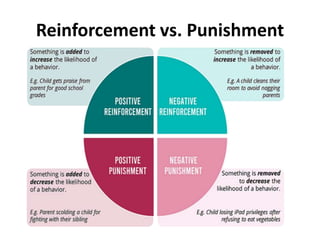
• This theory by B. F. Skinner says that rewards
and punishment to modify behavior. Through
operant conditioning, behavior that is
rewarded is likely to be repeated, and
behavior that is punished will rarely occur.
Reinforcement vs. Punishment
Behaviorism In Classroom
In reference to this learning theory teacher help
students learn through
• Positive reinforcement
• Drills
• Guided practices
• Regular reviews and acknowledge
3. Constructivism
Constructivism is based on the idea that
students actually create their own learning
based on their previous experiences. Hence
• Learning is an active process
• Learning is contextual
• Learning is unique for each student
• Motivation is the key to learning
Constructivism in Classroom
Constructivist classrooms rely on four key areas
to be successful:
• Shared knowledge between teachers and
students.
• Shared authority between teachers and
students.
• Teachers act as a guide or facilitator.
• Learning groups consist of small numbers of
students.
4. Humanism
Humanism is very closely related to constructivism.
Humanism directly focuses on the idea of self-
actualization. Everyone functions under a hierarchy of
needs. Self-actualization is at the top of the hierarchy
of needs.
Everyone is striving for this, and learning environments
can either move toward meeting needs or away from it.
This theory was developed by Abraham Maslow, Carl
Rogers, and James F. T. Bugenta.
Carl Roger’s Theory of Self
Development
Humanism In Classroom
According to humanism the role of the teacher
includes:
• Teach learning skills
• Provide motivation
• Provide choices in tasks
• Create opportunities for group interaction
• Acknowledge students’ participation
• Provide safe learning environment
5. Connectivism
Connectivism is one of the newest educational
learning theories. It focuses on the idea that
people learn and grow when they form
connections. This can be connections with each
other or connections with their roles and
obligations in their lives. Hobbies, goals, and
people can all be connections that influence
learning.
Cont..
• Connectivism was first introduced in 2005 by
two theorists, George Siemens and Stephen
Downes.
• Siemens tends to focus on the social aspects
of connectivism.
• Downes focuses on non-human appliances
and machine-based learning.
Connectivism in Classroom
Connectivism relies heavily on technology, so
the first step to creating a connectivist
classroom is to introduce more opportunities for
digital learning.
It empowers both the teacher and the student
Focus is on collaborative learning hence
introducing fun activities, gamification and
simulation etc.
Other Learning Theories
A few other popular learning theories are;
• Transformative learning theory
• Social Learning Theory
• Experiential Learning Theory
Transformative Learning Theory
Transformative learning theory focuses on the
idea that learners can adjust their thinking
based on new information.
Proposed by Jack Mezirow, this theory states
that our worldview is changed the more we
learn, which helps us grasp new concepts and
ideas.
Hence it basically focuses on adult learners.
Transformative Learning In Classroom
• Teacher motivates students and give them
chances to learn the new perspectives
• Teacher helps learner to question their
assumptions or set viewpoints about the
subject
• Teachers creates opportunities for critical
discourse
Social Learning Theory
Social Learning Theory, proposed by Albert
Bandura, describes that people learn through observing,
imitating, and modeling others' behavior.
Bandura and Jeffrey (1973) described four processes that
account for learning from observation:
• Attention
• Retention
• Motor reproduction
• Motivation
Experiential Learning Theory
This theory focuses on learning by doing. Using
this theory, students are encouraged to learn
through experiences that can help them retain
information and recall facts.
It was identified by David Kolb in 1984. Though
his influence came from other theorists such as
John Dewey, Kurt Lewin, and Jean Piaget, Kolb
was able to identify four stages of ELT.
Kolb’s Learning Cycle
Experiential Learning in Classroom
With reference to this theory
• Teachers creates opportunities for hand on
practice, field trip, arts and science projects,
presentation etc
• Teachers facilitates learning through reflective
journaling and interactive games.
What we have Learnt?
• Define learning theory
• Describe how learning theories influence the
teacher-learning process
• Enlist different types of learning theories
• Describe the utilization of learning theories for
teaching-learning process
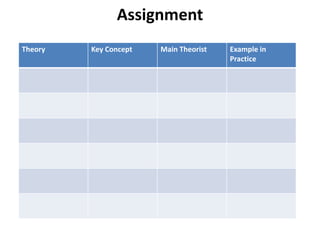
Assignment
Theory Key Concept Main Theorist Example in
Practice
Thank You!

Educational Theories.pptx

  • 1.
  • 2.
    Objectives By the endof this lecture, learners will be able to • Define learning theory • Describe how learning theories influence the teacher-learning process • Enlist different types of learning theories • Describe the utilization of learning theories for teaching-learning process
  • 3.
    Learning Theory Learning theorydescribes the conditions and processes through which learning occurs, providing teachers with models to develop instruction sessions that lead to better learning.
  • 4.
    Influence of LearningTheories Educational theories influence learning in a variety of ways by • Providing students with structure and a comfortable, steady environment. • Helping educators and students align on goals and outcomes • Allowing students a voice in determining how the class will be managed • Deciding if instruction will be mostly teacher-led or student-led. • Determining how much collaboration will happen in a classroom.
  • 5.
    Types of LearningTheories There are 5 main types of learning theories 1. Cognitivism 2. Behaviorism 3. Constructivism 4. Humanism 5. Connectivism
  • 6.
    1. Cognitivism • Cognitivelearning theory says that mental processes are an important part in understanding how we learn. The cognitive theory understands that learners can be influenced by both internal and external elements. • Plato and Descartes are two of the first philosophers that focused on cognition however Jean Piaget is the eminent for his work
  • 7.
    Piaget’s Cognitive DevelopmentTheory This theory says that children move through four stages of learning which are; • Sensorimotor • Pre-operation • Concrete operational • Formal operational
  • 10.
  • 11.
    Cognitivism in Classroom Inreference to this theory • Teacher provides positive learning environment • Students are encourages to be aware of their self cognitive proses of learning • Students are encourage to ask questions and are proposed with different question to ponder upon, reflect back, make and share their understanding.
  • 12.
    2. Behaviorism Behaviorism learningtheory is the idea that how a student behaves is based on their interaction with their environment. It suggests that behaviors are influenced and learned from external forces rather than internal forces.
  • 13.
    Cont.. Three main typesof behavioral learning theories are; • Classical Conditioning • Operant Conditioning • Observational/Social Learning
  • 14.
    Classical Conditioning • GivenBy Ivan Pavlove, Classical conditioning is a behavioral procedure in which a biologically potent physiological stimulus (e.g. food) is paired with a neutral stimulus. • Classical conditioning theory states that behaviors are learned by connecting a neutral stimulus with a positive one
  • 16.
    Operant Conditioning • Operantconditioning/Instrumental Conditioning occurs when an association is made between a particular behavior and a consequence for that behavior • This theory by B. F. Skinner says that rewards and punishment to modify behavior. Through operant conditioning, behavior that is rewarded is likely to be repeated, and behavior that is punished will rarely occur.
  • 17.
  • 18.
    Behaviorism In Classroom Inreference to this learning theory teacher help students learn through • Positive reinforcement • Drills • Guided practices • Regular reviews and acknowledge
  • 19.
    3. Constructivism Constructivism isbased on the idea that students actually create their own learning based on their previous experiences. Hence • Learning is an active process • Learning is contextual • Learning is unique for each student • Motivation is the key to learning
  • 20.
    Constructivism in Classroom Constructivistclassrooms rely on four key areas to be successful: • Shared knowledge between teachers and students. • Shared authority between teachers and students. • Teachers act as a guide or facilitator. • Learning groups consist of small numbers of students.
  • 21.
    4. Humanism Humanism isvery closely related to constructivism. Humanism directly focuses on the idea of self- actualization. Everyone functions under a hierarchy of needs. Self-actualization is at the top of the hierarchy of needs. Everyone is striving for this, and learning environments can either move toward meeting needs or away from it. This theory was developed by Abraham Maslow, Carl Rogers, and James F. T. Bugenta.
  • 23.
    Carl Roger’s Theoryof Self Development
  • 24.
    Humanism In Classroom Accordingto humanism the role of the teacher includes: • Teach learning skills • Provide motivation • Provide choices in tasks • Create opportunities for group interaction • Acknowledge students’ participation • Provide safe learning environment
  • 25.
    5. Connectivism Connectivism isone of the newest educational learning theories. It focuses on the idea that people learn and grow when they form connections. This can be connections with each other or connections with their roles and obligations in their lives. Hobbies, goals, and people can all be connections that influence learning.
  • 26.
    Cont.. • Connectivism wasfirst introduced in 2005 by two theorists, George Siemens and Stephen Downes. • Siemens tends to focus on the social aspects of connectivism. • Downes focuses on non-human appliances and machine-based learning.
  • 27.
    Connectivism in Classroom Connectivismrelies heavily on technology, so the first step to creating a connectivist classroom is to introduce more opportunities for digital learning. It empowers both the teacher and the student Focus is on collaborative learning hence introducing fun activities, gamification and simulation etc.
  • 28.
    Other Learning Theories Afew other popular learning theories are; • Transformative learning theory • Social Learning Theory • Experiential Learning Theory
  • 29.
    Transformative Learning Theory Transformativelearning theory focuses on the idea that learners can adjust their thinking based on new information. Proposed by Jack Mezirow, this theory states that our worldview is changed the more we learn, which helps us grasp new concepts and ideas. Hence it basically focuses on adult learners.
  • 31.
    Transformative Learning InClassroom • Teacher motivates students and give them chances to learn the new perspectives • Teacher helps learner to question their assumptions or set viewpoints about the subject • Teachers creates opportunities for critical discourse
  • 32.
    Social Learning Theory SocialLearning Theory, proposed by Albert Bandura, describes that people learn through observing, imitating, and modeling others' behavior. Bandura and Jeffrey (1973) described four processes that account for learning from observation: • Attention • Retention • Motor reproduction • Motivation
  • 34.
    Experiential Learning Theory Thistheory focuses on learning by doing. Using this theory, students are encouraged to learn through experiences that can help them retain information and recall facts. It was identified by David Kolb in 1984. Though his influence came from other theorists such as John Dewey, Kurt Lewin, and Jean Piaget, Kolb was able to identify four stages of ELT.
  • 35.
  • 36.
    Experiential Learning inClassroom With reference to this theory • Teachers creates opportunities for hand on practice, field trip, arts and science projects, presentation etc • Teachers facilitates learning through reflective journaling and interactive games.
  • 37.
    What we haveLearnt? • Define learning theory • Describe how learning theories influence the teacher-learning process • Enlist different types of learning theories • Describe the utilization of learning theories for teaching-learning process
  • 38.
    Assignment Theory Key ConceptMain Theorist Example in Practice
  • 39.