SYLLABUS AND CURRICULUM.
DESIGN FOR SECOND LANGUAGE
TEACHING.
Instructor:Ibrohimbek Soatov
OUTLINE
 Historical background
 What is an approach
 What is a method?
 What is a curriculum?
 What is a syllabus?
 The difference between curriculum and syllabus
 Ways of organising:Syllabus
 The modification view of syllabus by McKay
 Ways of presenting:Techniques
 Ways of practicing the language:Excercises
HISTORICAL BACKGROUND
 Language curriculum development
 Starts with the notion of syllabus design.
 A major factor in language teaching
 Content of a course
 Really begin in 1960s.
 The key of stimulus is teaching methods’
change—for better methods.
HISTORICAL BACKGROUND
 Language curriculum development includes more
issues than syllabus design
 The needs of learners
 Objectives for a program
 Appropriate syllabus, course structure, teaching
methods, and materials.
 Carry out an evaluation of the language program
WHAT IS AN APPROACH?
(EDWARD ANTHONY 1963)
 A set of correlative assumptions dealing with the
nature of language teaching and learning
 The theories about the nature of language and
language learning (Richards & Rodgers,1986: 16)
 A set of assumptions dealing with the nature of
language, learning and teaching(Richards &
Renandya)
WHAT IS A METHOD?
 Overall plan for systematic presentation of
language based on selected approach
 Method is the level which theory put into practice
and which choices are made about the particular
skill to be taught, the content to be taught, and the
order in which the content will be presented.
WHAT IS A TECHNIQUE?
 Specific classroom activities
 Dealing with implementation
 The level at which classroom procedures are
described
BROWN (1995) SUGGESTED FOUR DIFFERENT
CATEGORIES:
 1. ways of defining what the students need to learn
(approaches)
 2. ways of organizing the instruction to meet those
needs (curriculum/ syllabus)
 3. ways of actually presenting the lessons
(techniques)
 4. ways of practicing what has been taught
(exercises)
WHAT IS A CURRICULUM? (1/2)
 Curriculum refers to all those activities in which
children engage under the auspices of the
school. This includes not only what pupils learn,
but how they learn it, how teachers help them
learn, using what supporting materials, styles and
methods of assessment, and in what kind of
facilities.
 Curriculum is a theoretical document & refers to
the programme of studies in an educational
system or institution.
WHAT IS A CURRICULUM? (2/2)
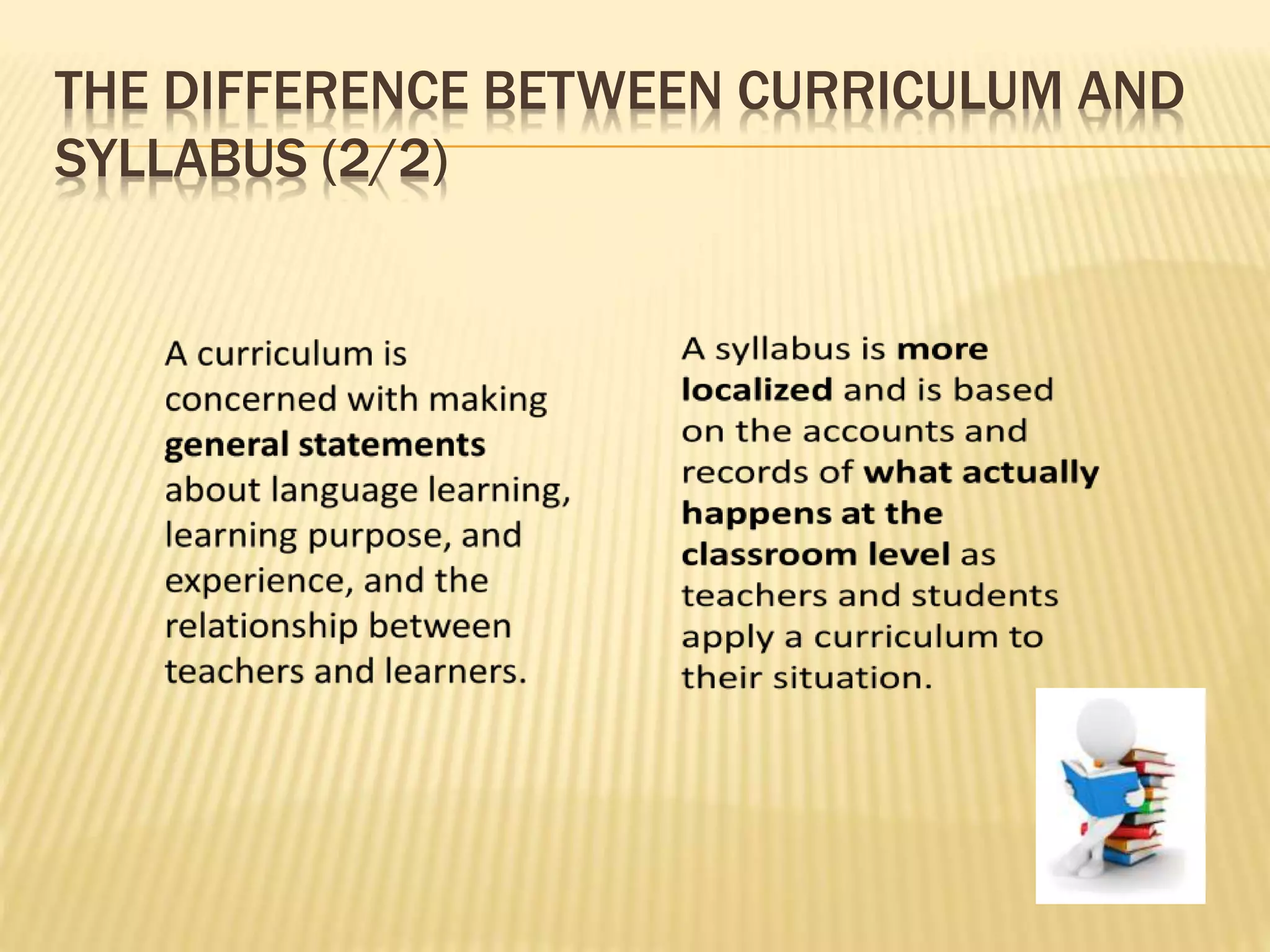
 Curriculum deals with the abstract general goals
of education which reflect the overall educational
and cultural philosophy of a country, national and
political trends as well as a theoretical orientation
to language and language learning.
 A curriculum provides the overall
rationale for educating students.
WHAT IS A SYLLABUS?
 At its simplest level a syllabus can be described as
a statement of what is to be learnt. Syllabus
refers to the content or subject matter of an
individual subject .
 It is a detailed and operational document which
specifies the content of a particular subject. It is a
kind of plan which translates the abstract goals of
the curriculum into concrete learning objectives.
THE DIFFERENCE BETWEEN CURRICULUM AND
SYLLABUS (1/2)
 Curriculum is for a course.
 Curriculum is the superset.
 Curriculum is a consideration of the
objectives, the contents, methods chosen to
achieve the objective.
 Syllabus is for a subject.
 Syllabus is the subset of the curriculum.
 Syllabus is the concepts to be taught.
THE DIFFERENCE BETWEEN CURRICULUM AND
SYLLABUS (2/2)
WAYS OF DEFINING NEEDS: APPROACHES
APPROACES
WAYS OF DEFINING WHAT THE STUDENTS NEED TO
LEARN
Grammar translation
approach
Students need to learn with economy of time and effort
Direct approach Students need to learn communication so they should use
only second language in class
Audio-lingual
approach
Students need operant conditioning and behavior
modification to learn language
Communicative
approach
Students must be able to express their intentions, that is,
they must learn the meanings that are important to them
WAYS OF ORGANIZING: SYLLABUS (MCKAY:
1978)
 “A syllabus provides a focus for what should be
studied, along with a rationale for how that content
should be selected and ordered. Currently, the
literature reflects three major types of syllabuses:
structural, situational, and notional.”
WAYS OF ORGANIZING: SYLLABUS (NUNAN:
1989)
 Turning more specifically to language teaching, the
distinction traditionally drawn between syllabus design
and methodology suggests that syllabus design deals
with the selection and grading of content, while
methodology is concerned with the selection and
sequencing of learning activities. If one sticks to the
traditional distinction, the task design would seem to
belong to the realm of methodology. However, with the
development of communicative language teaching, the
distinction between syllabus design and methodology
become difficult to sustain: one needs not only to
specify both the content and the task, but to integrate
them.
THE MODIFICATION VIEW OF SYLLABUS BY
MCKAY
 Structural Syllabus
 Situational Syllabus
 Topical Syllabus
 Functional Syllabus
 Notional Syllabus
 Skill-Based Syllabus
 Task-Based Syllabus
 Mixed Syllabus
 Layered Syllabus
WAYS OF PRESENTING: TECHNIQUES
For instance: a teacher chosen to use Jazz Chants to
begin the class, the shift to the lecturing about
language, do a dictocomp for listening and writing
fluency, and carry on the term project involving
drama.
WAYS OF PRACTICING THE LANGUAGE:
EXERCISES
 Exercise is the activities that could probably be
used to test or assess the students after the lesson.
 Technique would probably not be usable in
assessment.

SYLLABUS AND CURRICULUM.pptx

  • 1.
    SYLLABUS AND CURRICULUM. DESIGNFOR SECOND LANGUAGE TEACHING. Instructor:Ibrohimbek Soatov
  • 2.
    OUTLINE  Historical background What is an approach  What is a method?  What is a curriculum?  What is a syllabus?  The difference between curriculum and syllabus  Ways of organising:Syllabus  The modification view of syllabus by McKay  Ways of presenting:Techniques  Ways of practicing the language:Excercises
  • 3.
    HISTORICAL BACKGROUND  Languagecurriculum development  Starts with the notion of syllabus design.  A major factor in language teaching  Content of a course  Really begin in 1960s.  The key of stimulus is teaching methods’ change—for better methods.
  • 4.
    HISTORICAL BACKGROUND  Languagecurriculum development includes more issues than syllabus design  The needs of learners  Objectives for a program  Appropriate syllabus, course structure, teaching methods, and materials.  Carry out an evaluation of the language program
  • 5.
    WHAT IS ANAPPROACH? (EDWARD ANTHONY 1963)  A set of correlative assumptions dealing with the nature of language teaching and learning  The theories about the nature of language and language learning (Richards & Rodgers,1986: 16)  A set of assumptions dealing with the nature of language, learning and teaching(Richards & Renandya)
  • 6.
    WHAT IS AMETHOD?  Overall plan for systematic presentation of language based on selected approach  Method is the level which theory put into practice and which choices are made about the particular skill to be taught, the content to be taught, and the order in which the content will be presented.
  • 7.
    WHAT IS ATECHNIQUE?  Specific classroom activities  Dealing with implementation  The level at which classroom procedures are described
  • 8.
    BROWN (1995) SUGGESTEDFOUR DIFFERENT CATEGORIES:  1. ways of defining what the students need to learn (approaches)  2. ways of organizing the instruction to meet those needs (curriculum/ syllabus)  3. ways of actually presenting the lessons (techniques)  4. ways of practicing what has been taught (exercises)
  • 9.
    WHAT IS ACURRICULUM? (1/2)  Curriculum refers to all those activities in which children engage under the auspices of the school. This includes not only what pupils learn, but how they learn it, how teachers help them learn, using what supporting materials, styles and methods of assessment, and in what kind of facilities.  Curriculum is a theoretical document & refers to the programme of studies in an educational system or institution.
  • 10.
    WHAT IS ACURRICULUM? (2/2)  Curriculum deals with the abstract general goals of education which reflect the overall educational and cultural philosophy of a country, national and political trends as well as a theoretical orientation to language and language learning.  A curriculum provides the overall rationale for educating students.
  • 11.
    WHAT IS ASYLLABUS?  At its simplest level a syllabus can be described as a statement of what is to be learnt. Syllabus refers to the content or subject matter of an individual subject .  It is a detailed and operational document which specifies the content of a particular subject. It is a kind of plan which translates the abstract goals of the curriculum into concrete learning objectives.
  • 12.
    THE DIFFERENCE BETWEENCURRICULUM AND SYLLABUS (1/2)  Curriculum is for a course.  Curriculum is the superset.  Curriculum is a consideration of the objectives, the contents, methods chosen to achieve the objective.  Syllabus is for a subject.  Syllabus is the subset of the curriculum.  Syllabus is the concepts to be taught.
  • 13.
    THE DIFFERENCE BETWEENCURRICULUM AND SYLLABUS (2/2)
  • 14.
    WAYS OF DEFININGNEEDS: APPROACHES APPROACES WAYS OF DEFINING WHAT THE STUDENTS NEED TO LEARN Grammar translation approach Students need to learn with economy of time and effort Direct approach Students need to learn communication so they should use only second language in class Audio-lingual approach Students need operant conditioning and behavior modification to learn language Communicative approach Students must be able to express their intentions, that is, they must learn the meanings that are important to them
  • 15.
    WAYS OF ORGANIZING:SYLLABUS (MCKAY: 1978)  “A syllabus provides a focus for what should be studied, along with a rationale for how that content should be selected and ordered. Currently, the literature reflects three major types of syllabuses: structural, situational, and notional.”
  • 16.
    WAYS OF ORGANIZING:SYLLABUS (NUNAN: 1989)  Turning more specifically to language teaching, the distinction traditionally drawn between syllabus design and methodology suggests that syllabus design deals with the selection and grading of content, while methodology is concerned with the selection and sequencing of learning activities. If one sticks to the traditional distinction, the task design would seem to belong to the realm of methodology. However, with the development of communicative language teaching, the distinction between syllabus design and methodology become difficult to sustain: one needs not only to specify both the content and the task, but to integrate them.
  • 17.
    THE MODIFICATION VIEWOF SYLLABUS BY MCKAY  Structural Syllabus  Situational Syllabus  Topical Syllabus  Functional Syllabus  Notional Syllabus  Skill-Based Syllabus  Task-Based Syllabus  Mixed Syllabus  Layered Syllabus
  • 18.
    WAYS OF PRESENTING:TECHNIQUES For instance: a teacher chosen to use Jazz Chants to begin the class, the shift to the lecturing about language, do a dictocomp for listening and writing fluency, and carry on the term project involving drama.
  • 19.
    WAYS OF PRACTICINGTHE LANGUAGE: EXERCISES  Exercise is the activities that could probably be used to test or assess the students after the lesson.  Technique would probably not be usable in assessment.