PRESENTED BY:
DR.MUHAMMAD NADEEM
Introduction to Learning
Process
Definition: Learning is…
A change in behavior as a result of experience or practice.
The acquisition of knowledge.
Knowledge gained through study.
To gain knowledge of, or skill in, something through study,
teaching, instruction or experience.
The process of gaining knowledge.
A process by which behavior is changed, shaped or
controlled.
The individual process of constructing understanding based
on experience from a wide range of sources.
Some First Principles
Learning is something all humans do
 Fetuses learn
 Infants learn
 Children learn
 Adults learn
Learning is not uniquely human – all living things
learn
Learning evolved as an adaptation for promoting
survival
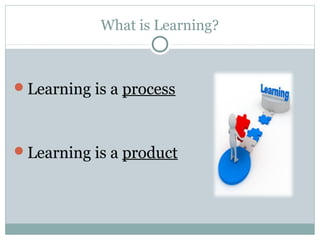
What is Learning?
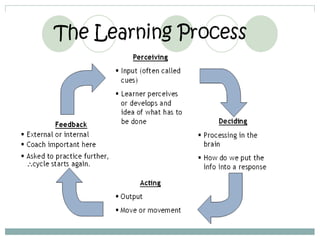
Learning is a process
Learning is a product
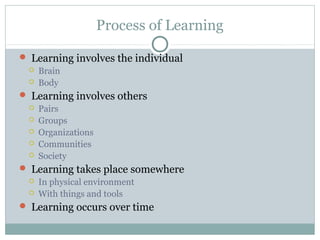
Process of Learning
 Learning involves the individual
 Brain
 Body
 Learning involves others
 Pairs
 Groups
 Organizations
 Communities
 Society
 Learning takes place somewhere
 In physical environment
 With things and tools
 Learning occurs over time
Products of Learning
 Learning is about ideas and concepts
 Learning is about behaviors and skills
 Learning is about attitudes and values
Five Principles of Learning
 Participation: involve trainees, learn by doing
 Repetition: repeat ideas & concepts to help
people learn
 Relevance: learn better when material is
meaningful and related
 Transference: to real world using simulations
 Feedback: ask for it and adjust training
methods to audience.
Domains Of Learning
Benjamin Bloom has suggested three domains of
learning:
•
Cognitive – To recall, calculate, discuss, analyze,
problem solve, etc.
•
Psychomotor – To dance, swim, ski, dive, drive a
car, ride a bike, etc.
•
Affective – To like something or someone, love,
appreciate, fear, hate, worship, etc.
Basic Learning Principles
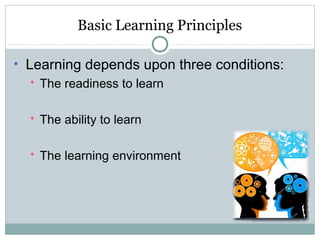
• Learning depends upon three conditions:
 The readiness to learn
 The ability to learn
 The learning environment
Definition: Theories are…
What is a theory?
 A theory provides a general explanation for observations made
over time.
 A theory explains and predicts behavior.
 A theory can never be established beyond all doubt.
 A theory may be modified.
 Theories seldom have to be thrown out completely if
thoroughly tested but sometimes a theory may be widely
accepted for a long time and later disproved.
Broad domains of theories
 Behaviorism
 Cognitivism
 Social Learning Theory
 Social Constructivism
 Multiple Intelligences
 Brain-Based Learning
Behaviorism
Confined to observable and measurable behavior
 Classical Conditioning - Pavlov
 Operant Conditioning - Skinner
Behaviorism
S R
Classical Conditioning - Pavlov
Behaviorism
Operant Conditioning - Skinner
The response is made first,
then reinforcement follows.
Behaviorism in the Classroom
Rewards and
punishments
Responsibility for
student learning rests
squarely with the
teacher
Lecture-based, highly
structured
Cognitivism
Grew in response to Behaviorism
Knowledge is stored cognitively as symbols
Learning is the process of connecting symbols in a
meaningful & memorable way
Studies focused on the mental processes that
facilitate symbol connection
Cognitive Learning Theory
Discovery Learning -
Jerome Bruner
Meaningful Verbal
Learning -
David Ausubel
Cognitivism in the Classroom
Inquiry-oriented projects
Opportunities for the
testing of hypotheses
Curiosity encouraged
Staged scaffolding
Social Learning Theory (SLT)
Grew out of Cognitivism
A. Bandura (1973)
Learning takes place through observation and
sensorial experiences
Imitation is the sincerest form of flattery
SLT is the basis of the movement against violence in
media & video games
Social Learning Theory
Learning From Models -
Albert Bandura
1. Attend to pertinent clues
2. Code for memory (store a visual
image)
3. Retain in memory
4. Accurately reproduce the
observed activity
5. Possess sufficient motivation to
apply new learning
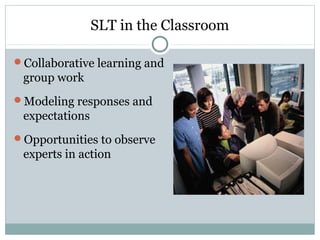
SLT in the Classroom
Collaborative learning and
group work
Modeling responses and
expectations
Opportunities to observe
experts in action
Social Constructivism
Grew out of and in response to Cognitivism, framed
around metacognition
Knowledge is actively constructed
Learning is…
 A search for meaning by the learner
 Contextualized
 An inherently social activity
 Dialogic and recursive
 The responsibility of the learner
Lev Vygotsky
 Social Learning
 Zone of Proximal Development
Social Constructivism in the Classroom
Journaling
Experiential activities
Personal focus
Collaborative &
cooperative learning
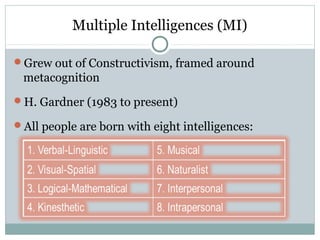
Multiple Intelligences (MI)
Grew out of Constructivism, framed around
metacognition
H. Gardner (1983 to present)
All people are born with eight intelligences:
MI in the Classroom
Delivery of instruction via
multiple mediums
Student-centered
classroom
Authentic Assessment
Self-directed learning
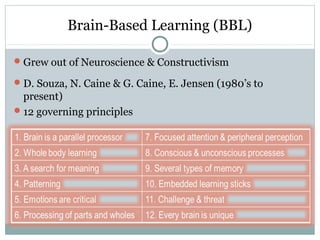
Brain-Based Learning (BBL)
Grew out of Neuroscience & Constructivism
D. Souza, N. Caine & G. Caine, E. Jensen (1980’s to
present)
12 governing principles
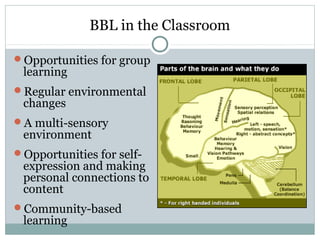
BBL in the Classroom
Opportunities for group
learning
Regular environmental
changes
A multi-sensory
environment
Opportunities for self-
expression and making
personal connections to
content
Community-based
learning
Classroom Learning Activities:
Entry/Exit Tickets
Free Writing/Minute Paper/Question of the Day
Exercise
Ice Breakers
Think–Pair–Share
Case Studies and Problem-Based Learning
Case studies
Problem-based learning
Debate
Interview or Role Play
Interactive Demonstrations
Jigsaw
REFRENCES:
 Bitterman; et al. (1983). "Classical Conditioning of
Proboscis Extension in Honeybees (Apis
mellifera)". J. Comp. Psych.
J. Scott Armstrong (2012). "Natural Learning in
Higher Education". Encyclopedia of the Sciences of
Learning.
http://www.dynamicflight.com/avcfibook/learning_
process/
http://www.authorstream.com/Presentation/tchisiri
-1567544-learning-process/

Learning process

  • 1.
  • 2.
    Definition: Learning is… Achange in behavior as a result of experience or practice. The acquisition of knowledge. Knowledge gained through study. To gain knowledge of, or skill in, something through study, teaching, instruction or experience. The process of gaining knowledge. A process by which behavior is changed, shaped or controlled. The individual process of constructing understanding based on experience from a wide range of sources.
  • 3.
    Some First Principles Learningis something all humans do  Fetuses learn  Infants learn  Children learn  Adults learn Learning is not uniquely human – all living things learn Learning evolved as an adaptation for promoting survival
  • 5.
    What is Learning? Learningis a process Learning is a product
  • 6.
    Process of Learning Learning involves the individual  Brain  Body  Learning involves others  Pairs  Groups  Organizations  Communities  Society  Learning takes place somewhere  In physical environment  With things and tools  Learning occurs over time
  • 7.
    Products of Learning Learning is about ideas and concepts  Learning is about behaviors and skills  Learning is about attitudes and values
  • 9.
    Five Principles ofLearning  Participation: involve trainees, learn by doing  Repetition: repeat ideas & concepts to help people learn  Relevance: learn better when material is meaningful and related  Transference: to real world using simulations  Feedback: ask for it and adjust training methods to audience.
  • 10.
    Domains Of Learning BenjaminBloom has suggested three domains of learning: • Cognitive – To recall, calculate, discuss, analyze, problem solve, etc. • Psychomotor – To dance, swim, ski, dive, drive a car, ride a bike, etc. • Affective – To like something or someone, love, appreciate, fear, hate, worship, etc.
  • 11.
    Basic Learning Principles •Learning depends upon three conditions:  The readiness to learn  The ability to learn  The learning environment
  • 12.
    Definition: Theories are… Whatis a theory?  A theory provides a general explanation for observations made over time.  A theory explains and predicts behavior.  A theory can never be established beyond all doubt.  A theory may be modified.  Theories seldom have to be thrown out completely if thoroughly tested but sometimes a theory may be widely accepted for a long time and later disproved.
  • 13.
    Broad domains oftheories  Behaviorism  Cognitivism  Social Learning Theory  Social Constructivism  Multiple Intelligences  Brain-Based Learning
  • 14.
    Behaviorism Confined to observableand measurable behavior  Classical Conditioning - Pavlov  Operant Conditioning - Skinner
  • 15.
  • 16.
    Behaviorism Operant Conditioning -Skinner The response is made first, then reinforcement follows.
  • 17.
    Behaviorism in theClassroom Rewards and punishments Responsibility for student learning rests squarely with the teacher Lecture-based, highly structured
  • 18.
    Cognitivism Grew in responseto Behaviorism Knowledge is stored cognitively as symbols Learning is the process of connecting symbols in a meaningful & memorable way Studies focused on the mental processes that facilitate symbol connection
  • 19.
    Cognitive Learning Theory DiscoveryLearning - Jerome Bruner Meaningful Verbal Learning - David Ausubel
  • 20.
    Cognitivism in theClassroom Inquiry-oriented projects Opportunities for the testing of hypotheses Curiosity encouraged Staged scaffolding
  • 21.
    Social Learning Theory(SLT) Grew out of Cognitivism A. Bandura (1973) Learning takes place through observation and sensorial experiences Imitation is the sincerest form of flattery SLT is the basis of the movement against violence in media & video games
  • 22.
    Social Learning Theory LearningFrom Models - Albert Bandura 1. Attend to pertinent clues 2. Code for memory (store a visual image) 3. Retain in memory 4. Accurately reproduce the observed activity 5. Possess sufficient motivation to apply new learning
  • 23.
    SLT in theClassroom Collaborative learning and group work Modeling responses and expectations Opportunities to observe experts in action
  • 24.
    Social Constructivism Grew outof and in response to Cognitivism, framed around metacognition Knowledge is actively constructed Learning is…  A search for meaning by the learner  Contextualized  An inherently social activity  Dialogic and recursive  The responsibility of the learner Lev Vygotsky  Social Learning  Zone of Proximal Development
  • 25.
    Social Constructivism inthe Classroom Journaling Experiential activities Personal focus Collaborative & cooperative learning
  • 26.
    Multiple Intelligences (MI) Grewout of Constructivism, framed around metacognition H. Gardner (1983 to present) All people are born with eight intelligences:
  • 27.
    MI in theClassroom Delivery of instruction via multiple mediums Student-centered classroom Authentic Assessment Self-directed learning
  • 28.
    Brain-Based Learning (BBL) Grewout of Neuroscience & Constructivism D. Souza, N. Caine & G. Caine, E. Jensen (1980’s to present) 12 governing principles
  • 29.
    BBL in theClassroom Opportunities for group learning Regular environmental changes A multi-sensory environment Opportunities for self- expression and making personal connections to content Community-based learning
  • 30.
    Classroom Learning Activities: Entry/ExitTickets Free Writing/Minute Paper/Question of the Day Exercise Ice Breakers Think–Pair–Share Case Studies and Problem-Based Learning Case studies Problem-based learning Debate Interview or Role Play Interactive Demonstrations Jigsaw
  • 31.
    REFRENCES:  Bitterman; etal. (1983). "Classical Conditioning of Proboscis Extension in Honeybees (Apis mellifera)". J. Comp. Psych. J. Scott Armstrong (2012). "Natural Learning in Higher Education". Encyclopedia of the Sciences of Learning. http://www.dynamicflight.com/avcfibook/learning_ process/ http://www.authorstream.com/Presentation/tchisiri -1567544-learning-process/