
Learning Presence

Peter Shea
Senior Researcher – SUNY Learning Network &
Associate Professor
University at Albany
State University of New York
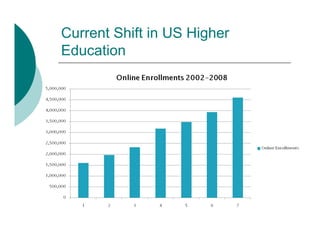
Current Shift in US Higher
Education
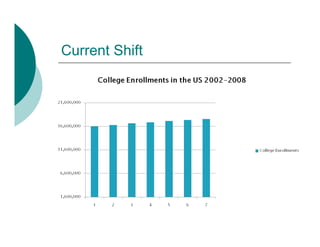
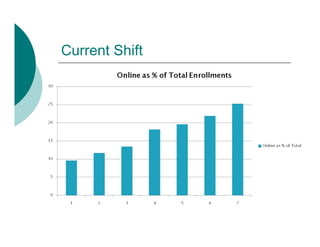
Current Shift
Current Shift
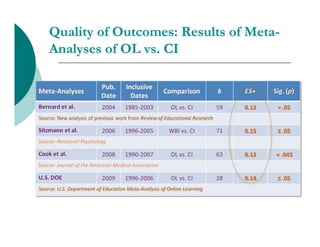
Quality of Outcomes: Results of Meta-
Analyses of OL vs. CI


                                        5
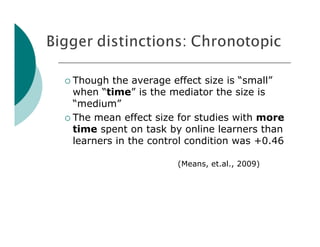
 Though  the average effect size is “small”
  when “time” is the mediator the size is
  “medium”
 The mean effect size for studies with more
  time spent on task by online learners than
  learners in the control condition was +0.46

                       (Means, et.al., 2009)
Need for new theories…

   Need a new theory of learning
    online…
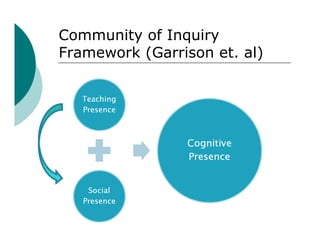
Community of Inquiry
Framework (Garrison et. al)
Still missing the “learner”

   What do effective learners do with
    their time in the online space?
 Good   (online) learners are
  Strategic

  Active

  Reflective

 Missingthis focus in Community of
 Inquiry Framework
 Overall,the available research evidence
 suggests that promoting self-reflection,
 self-regulation and self-monitoring leads to
 more positive online learning outcomes.

 Features such as prompts for reflection,
 self-explanation and self-monitoring
 strategies have shown promise for
 improving online learning outcomes.
                      Means, et. al. (2009)
What to regulate though?

   Current theories of self regulated
    learning tied to earlier oral
    epistemology of “knowing” as
    memorizing
   Learning online requires different
    self regulation
   Difficult and increasingly irrelevant
    to document “memorization”
 Planning  and time management
 Organizing and transforming course materials
  (e.g. sorting/printing discussions)
 Environmental structuring (e.g. working from
  fast internet connections)
 Self-monitoring/record keeping (#
  posts/grades)
 Help seeking (professor and other students)

 Reflection (on performance/effort)
    Self-efficacy/attributions for success (predicts
     effort)
                                   Whipp, 2004
 Used   the Online Self-regulated Learning
  Questionnaire (OSLQ) in Spring 2010
Consists of six subscales
   environment structuring

   goal setting

   time management

   help seeking

   task strategies

   self-evaluation

 More than 2200 online learner
  respondents…
Learner Difficulties in Current
Chronotopic Shift

   Initial results suggesting learners
    are struggling in some areas of the
    transition to virtual learning
    environments
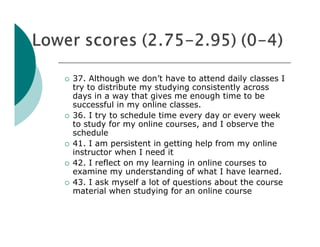
   37. Although we don’t have to attend daily classes I
    try to distribute my studying consistently across
    days in a way that gives me enough time to be
    successful in my online classes.
   36. I try to schedule time every day or every week
    to study for my online courses, and I observe the
    schedule
   41. I am persistent in getting help from my online
    instructor when I need it
   42. I reflect on my learning in online courses to
    examine my understanding of what I have learned.
   43. I ask myself a lot of questions about the course
    material when studying for an online course
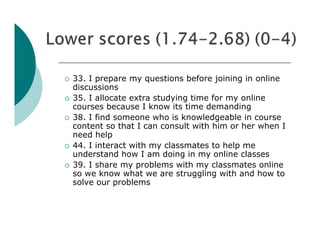
   33. I prepare my questions before joining in online
    discussions
   35. I allocate extra studying time for my online
    courses because I know its time demanding
   38. I find someone who is knowledgeable in course
    content so that I can consult with him or her when I
    need help
   44. I interact with my classmates to help me
    understand how I am doing in my online classes
   39. I share my problems with my classmates online
    so we know what we are struggling with and how to
    solve our problems
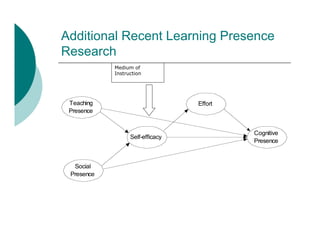
Additional Recent Learning Presence
Research
            Medium of
            Instruction


 Teaching                         Effort
 Presence


                                           Cognitive
                  Self-efficacy
                                           Presence


  Social
 Presence
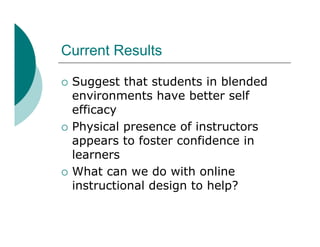
Current Results

   Suggest that students in blended
    environments have better self
    efficacy
   Physical presence of instructors
    appears to foster confidence in
    learners
   What can we do with online
    instructional design to help?
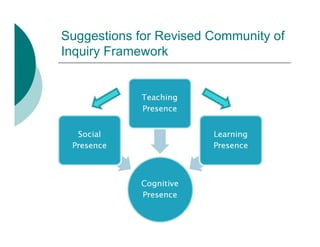
Suggestions for Revised Community of
Inquiry Framework
Thank You

   Peter Shea
   University at Albany, SUNY
   pshea@uamail.albany.edu
   518-442-4009

Learning Presence

  • 1.
    Learning Presence Peter Shea SeniorResearcher – SUNY Learning Network & Associate Professor University at Albany State University of New York
  • 2.
    Current Shift inUS Higher Education
  • 3.
  • 4.
  • 5.
    Quality of Outcomes:Results of Meta- Analyses of OL vs. CI 5
  • 6.
     Though the average effect size is “small” when “time” is the mediator the size is “medium”  The mean effect size for studies with more time spent on task by online learners than learners in the control condition was +0.46 (Means, et.al., 2009)
  • 7.
    Need for newtheories…  Need a new theory of learning online…
  • 8.
  • 9.
    Still missing the“learner”  What do effective learners do with their time in the online space?
  • 10.
     Good (online) learners are  Strategic  Active  Reflective  Missingthis focus in Community of Inquiry Framework
  • 12.
     Overall,the availableresearch evidence suggests that promoting self-reflection, self-regulation and self-monitoring leads to more positive online learning outcomes.  Features such as prompts for reflection, self-explanation and self-monitoring strategies have shown promise for improving online learning outcomes. Means, et. al. (2009)
  • 13.
    What to regulatethough?  Current theories of self regulated learning tied to earlier oral epistemology of “knowing” as memorizing  Learning online requires different self regulation  Difficult and increasingly irrelevant to document “memorization”
  • 14.
     Planning and time management  Organizing and transforming course materials (e.g. sorting/printing discussions)  Environmental structuring (e.g. working from fast internet connections)  Self-monitoring/record keeping (# posts/grades)  Help seeking (professor and other students)  Reflection (on performance/effort)  Self-efficacy/attributions for success (predicts effort) Whipp, 2004
  • 15.
     Used the Online Self-regulated Learning Questionnaire (OSLQ) in Spring 2010 Consists of six subscales  environment structuring  goal setting  time management  help seeking  task strategies  self-evaluation  More than 2200 online learner respondents…
  • 16.
    Learner Difficulties inCurrent Chronotopic Shift  Initial results suggesting learners are struggling in some areas of the transition to virtual learning environments
  • 17.
    37. Although we don’t have to attend daily classes I try to distribute my studying consistently across days in a way that gives me enough time to be successful in my online classes.  36. I try to schedule time every day or every week to study for my online courses, and I observe the schedule  41. I am persistent in getting help from my online instructor when I need it  42. I reflect on my learning in online courses to examine my understanding of what I have learned.  43. I ask myself a lot of questions about the course material when studying for an online course
  • 18.
    33. I prepare my questions before joining in online discussions  35. I allocate extra studying time for my online courses because I know its time demanding  38. I find someone who is knowledgeable in course content so that I can consult with him or her when I need help  44. I interact with my classmates to help me understand how I am doing in my online classes  39. I share my problems with my classmates online so we know what we are struggling with and how to solve our problems
  • 19.
    Additional Recent LearningPresence Research Medium of Instruction Teaching Effort Presence Cognitive Self-efficacy Presence Social Presence
  • 20.
    Current Results  Suggest that students in blended environments have better self efficacy  Physical presence of instructors appears to foster confidence in learners  What can we do with online instructional design to help?
  • 21.
    Suggestions for RevisedCommunity of Inquiry Framework
  • 22.
    Thank You  Peter Shea  University at Albany, SUNY  pshea@uamail.albany.edu  518-442-4009