Self-Regulated Online Learning & Reflective Journaling  Liza Cope University at Albany, State University of New York
Introduction
Self-Regulated Learning
Motivation for Research Study A U.S. Department of Education meta-analysis and review of online learning studies concludes:  “ Online learning can be enhanced by  giving learners control  of their interactions and  prompting learner reflection . Studies indicate that manipulations that trigger learner activity or learner reflection and self-monitoring of understanding are effective when students pursue online learning as individuals”  (Means, Toyama, Murphy, Bakia, & Jones, 2009, p.xvi).
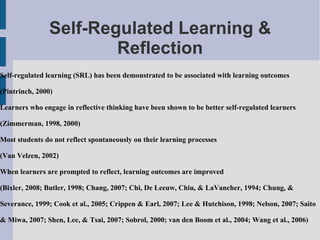
Self-Regulated Learning & Reflection Self-regulated learning (SRL) has been demonstrated to be associated with learning outcomes (Pintrinch, 2000)  Learners who engage in reflective thinking have been shown to be better self-regulated learners (Zimmerman, 1998, 2000) Most students do not reflect spontaneously on their learning processes  (Van Velzen, 2002) When learners are prompted to reflect, learning outcomes are improved  (Bixler, 2008; Butler, 1998; Chang, 2007; Chi, De Leeuw, Chiu, & LaVancher, 1994; Chung, & Severance, 1999; Cook et al., 2005; Crippen & Earl, 2007; Lee & Hutchison, 1998; Nelson, 2007; Saito & Miwa, 2007; Shen, Lee, & Tsai, 2007; Sobrol, 2000; van den Boom et al., 2004; Wang et al., 2006)
SRL continued... SRL involves meta-cognitive processing
Self-monitoring and self-assessment are two components
These skills are critical for online learners
These skills can be fostered with prompts
Online Learning
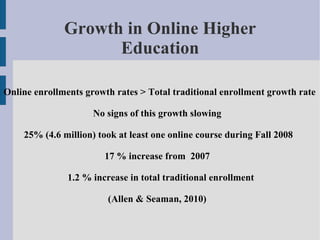
Growth in Online Higher Education Online enrollments growth rates > Total traditional enrollment growth rate No signs of this growth slowing  25% (4.6 million) took at least one online course during Fall 2008  17 % increase from  2007  1.2 % increase in total traditional enrollment (Allen & Seaman, 2010)
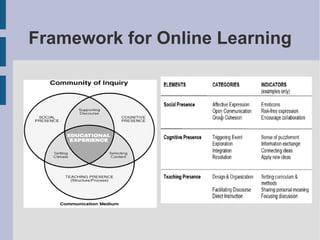
Framework for Online Learning
10 Years and Still Going Strong *  Akyol , Z. & Garrison, D.R. (In press). Community of Inquiry in Adult Online Learning: Collaborative-Constructivist Approaches. In Terry Kidd (Ed.) Online Education and Adult Learning: New Frontiers for Teaching, IGI Global * Akyol, Z. & Garrison, D.R. (2008). The Development of a Community of Inquiry over Time in an Online Course: Understanding the Progression and Integration of Social, Cognitive and Teaching Presence. Journal of Asynchronous Learning Networks, 12 (2-3). * Anderson, T., Rourke, L., Garrison, D. R., & Archer, W. (2001). Assessing teaching presence in a computer conferencing environment. Journal of Asynchronous Learning Networks ,5 (2). * Arbaugh, J. B., & Hwang, A. (2006). Does "teaching presence" exist in online MBA courses? The Internet and Higher Education, 9(1), 9-21. * Arbaugh, J.B., Cleveland-Innes, M., Diaz, S.R., Garrison, D.R., Ice, P., Richardson, & Swan, K.P. (2008). Developing a community of inquiry instrument: Testing a measure of the Community of Inquiry framework using a multi-institutional sample. The Internet and higher Education, 11(3-4), 133-136. * Cleveland-Innes, M., Garrison, D.R. & Kinsel, E. (2007). Role Adjustment for Learners in an Online Community of Inquiry: Identifying the Challenges of Incoming Online Learners. International Journal of Web-Based Learning and Teaching Technologies, 2(1), 1-16. * Conrad, D. (2005). Building and Maintaining Community in Cohort-Based Online Learning. Journal of Distance Education, 20(1), 1-20. * Delfino, M. & Manca, S. (2007). The expression of social presence through the use of figurative language in a web based learning environment. Computers in Human Behavior, 23, 2190-2211. * De Leng, B.A., Dolmans,D.H.J.M., Jöbsis, B., Muijtjens, A.M.M. & van der Vleuten, C.P.M. (In press). Exploration of an e-learning model to foster critical thinking on basic science concepts during work placements. Computers & Education, * Garrison, D. R. (in press). Communities of Inquiry in Online Learning: Social, Teaching and Cognitive Presence. In C. Howard et al. (Eds.), Encyclopedia of distance and online learning. Hershey, PA: IGI Global. * Garrison, D. R. & Cleveland-Innes, M. (2005). Facilitating Cognitive Presence in Online Learning: Interaction Is Not Enough. American Journal of Distance Education, 19(3), pp. 133-148. * Garrison, D. R. (2003). Cognitive presence for effective asynchronous online learning: The role of reflective inquiry, self-direction and metacognition. In J. Bourne & J. C. Moore (Eds.), Elements of quality online education: Practice and direction. Volume 4 in the Sloan C Series, Needham, MA: The Sloan Consortium. * Garrison, D. R., Anderson, T., & Archer, W. (2000). Critical inquiry in a text-based environment: Computer conferencing in higher education. Internet and Higher Education, 2(2-3), 87 - 105. * Garrison, D. R., Anderson, T., Archer, W. (2001). Critical thinking, cognitive presence, and computer conferencing in distance education. American Journal of Distance Education, 15(1). * Garrison, D. R., Cleveland-Innes, M., Koole, M., & Kappelman, J. (2006). Revisting methodological issues in the analysis of transcripts: Negotiated coding and reliability. The Internet and Higher Education, 9(1), 1-8. * Garrison, D.R. & Arbaugh, J.B. (2007). Researching the community of Inquiry Framework: Review, Issues, and Future Directions. The Internet and Higher Education, 10(3), 157-172. * Garrison, D.R., Cleveland-Innes, M. & Fung, T. (2004). Student Role adjustment in online communities of inquiry. Model and instrument validation. Journal of Asynchronous Learning Network, 8(2), 61 - 74. * Heckman, R., Annabi, H. (2002). A Content Analytic Comparison of FTF and ALN Case-Study Discussions. Paper presented at the 36th Hawai International Conference on System Sciences, 2002. * Ice, P., Curtis, R., Phillips, P. & Wells, J. (2007). Using Asynchronous Audio Feedback to Enhance Teaching Presence and Students’ Sense of Community. Journal of Asynchronous Learning Networks, 11(2), 3-25. * Kanuka, H., Garrison, D.R. (2004). Cognitive Presence in Online Learning. Journal of Computing in Higher Education, 15(2), 30-48. * Kanuka, H., Liam, R. & Laflamme, E. (2007). The influence of instructional methods on the quality of online discussion. British Journal of Educational Technology, 38(2), 260 - 271. * Ling, L.H. (2007). Community of Inquiry in an Online Undergraduate Information Technology Course. Journal of Information Technology Education, 6,153-168. * Lomicka, L. & Lord, G. (2007). Social presence in virtual communities of foreign language (FL) teachers. System, 35, 208 - 228. * McKerlich, R., Anderson, T. (2007). Community of Inquiry and Learning in Immersive Environments. Journal of Asynchronous Learning Networks. 11(4). * McKlin, T., Harmon, S.W., Evans, W., Jone, MG. (2002). Cognitive Presence in Web-Based Learning: A Content Analysis of Students' Online Discussions. American Journal of Distance Education, 15(1) 7-23. * Meyer, K. (2003). Face-to-Face Versus Threaded Discussions: The Role of Time and Higher-Order Thinking. Journal of Asynchronous Learning Networks, 7(3), 55-65. * Meyer, K. (2004). Evaluating Online Discussions: Four Difference Frames of Analysis. Journal of Asynchronous Learning Networks, 8(2), 101-114. * Murphy, E. (2004). Identifying and Measuring Ill-Structured Problem Formulation and Resolution in Online Asynchronous Discussions. Canadian Journal of Learning and Technology, 30(1). * Nippard, E. & Murphy, E. (2007). Social Presence in the Web-based Synchronous Secondary Classroom. Canadian Journal of Learning and Technology, 33(1). * Pawan, F., Paulus, T., Yalcin, S.,Chang, C. (2003). Online Learning: Patterns of Engagement And Interaction Among In-Service Teachers. Language Learning & Technology, 7(3), 119-140 * Redmond, P. & Lock, J.V. (2006). A flexible Framework for online collaborative learning. The Internet and Higher Education, 9, 267 - 276. * Rogers, P. & Lea. M (2005). Social presence in distributed group environments: the role of social identity. Behavior & Information Technology, 24(2), 151 - 158. * Rourke, L., & Anderson, T. (2002). Exploring social interaction in computer conferencing. Journal of Interactive Learning Research, 13(3), 257-273. * Rourke, L., & Anderson, T. (2002). Using peer teams to lead online discussion. Journal of Interactive Media in Education, (1). * Rourke, L., Anderson, T. Garrison, D. R., & Archer, W. (1999). Assessing social presence in asynchronous, text-based computer conferencing. Journal of Distance Education, 14(3), 51-70. * Rourke, L., Anderson, T., Garrison, D. R., & Archer, W. (2001). Methodological issues in the content analysis of computer conference transcripts. International Journal of Artificial Intelligence in Education, 12. * Rovai, A.P. (2002). Sense of community, perceived cognitive learning, and persistence in asynchronous learning networks. The Internet and Higher Education, 5(4), 319-332. * Shea, P., Li, C. S., & Pickett, A. (2006). A study of teaching presence and student sense of learning community in fully online and web-enhanced college courses. The Internet and Higher Education, 9(3), 175-190. * Shea, P.J., Pickett, A.M., and Pelz, W.E. (2004). Enhancing student satisfaction through faculty development: The importance of teaching presence. In J. Bourne and J.C. Moore (Eds), Elements of quality online education: Into the mainstream - Volume 5 in the Sloan-C Series (p. 39-59). Needham, MA.: Sloan Center for Online Education. * Shea, P., Pickett, A., & Pelt, W. (2003). A follow-up investigation of teaching presence in the SUNY Learning Network. Journal of the Asychronous Learning Network, 7(2). * Shea, P.J. (2006). A study of students' sense of community in online learning environments. Journal of Asynchronous Learning Network, 10(1), 35-44. * Shea, P. & Bidjerano, T. (2009). Community of inquiry as a theoretical framework to foster “epistemic engagement” and “cognitive presence” in online education. Computers & Education,52(3),543-553. * Stein, D.S., Wanstreet, C.E., Glazer, H.R., Engle, C.L., Harris, R.T., Johnston, S.M., Simons, M.R. & Trinko, L.A. (2007). Creating shared understanding through chats in a community of inquiry. The Internet and Higher Education, 10, 103 - 115. * Stodel, E.J., Thompson, T.L. & MacDonald, C. J. (2006). Learner’s Perspectives on What is Missing from Online Learning: Interpretations through the Community of Inquiry. International Review of Research in Open and distance Learning, 7(3), Available Online: http://www.irrodl.org/index.php/irrodl/article/view/325/743 * Swan, K. & Shih, L.F. (2005). On the Nature and Development of Social Presence in Online course Discussions. Journal of Asynchronous Learning Networks, 9 (3), 115-136. * Swan, K., Shea, P., Richardson, J., Ice, P., Garrison, D. R., Cleveland-Innes, M., & Arbaugh, J. B. (2008). Validating a measurement tool of presence in online communities of inquiry. /E-Mentor/, 2(24), 1-12. * Vaughan, N., & Garrison, D. R. (2005). Creating cognitive presence in a blended faculty development community. Internet and Higher Education, 8, 1-12. * Wever, B.D., Schellens, T., Valcke, M. & Keer, H.V. (2006). Content Analysis schemes to analyze transcripts of online asynchronous discussion groups: A review. Computers & Education, 46(1), 6 - 28.
Teaching Mathematics for Understanding
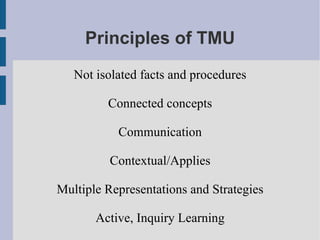
Principles of TMU Not isolated facts and procedures
Connected concepts
Communication
Contextual/Applies
Multiple Representations and Strategies
Active, Inquiry Learning
Purpose
Caveats in Research What type of prompts are ideal?
How does SRL tie into the CoI framework?
How does SRL tie into TMU?
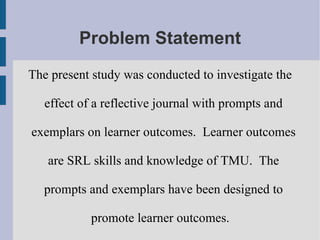
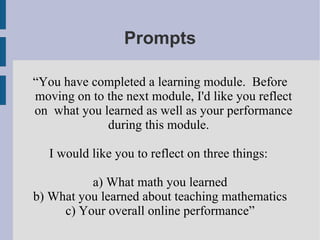
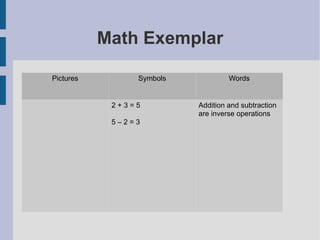
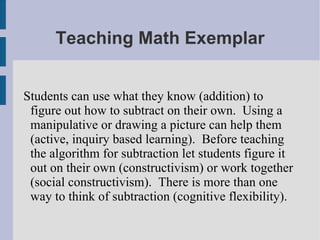
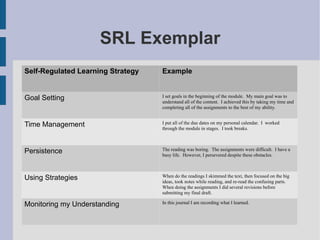
Problem Statement The present study was conducted to investigate the effect of a reflective journal with prompts and exemplars on learner outcomes.  Learner outcomes are SRL skills and knowledge of TMU.  The prompts and exemplars have been designed to promote learner outcomes.
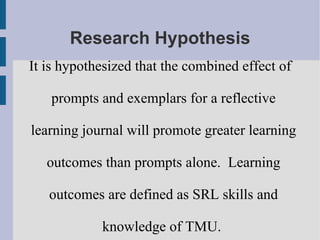
Research Hypothesis It is hypothesized that the combined effect of prompts and exemplars for a reflective learning journal will promote greater learning outcomes than prompts alone.  Learning outcomes are defined as SRL skills and knowledge of TMU .
Method

Tcetc2010

  • 1.
    Self-Regulated Online Learning& Reflective Journaling Liza Cope University at Albany, State University of New York
  • 2.
  • 3.
  • 4.
    Motivation for ResearchStudy A U.S. Department of Education meta-analysis and review of online learning studies concludes: “ Online learning can be enhanced by giving learners control of their interactions and prompting learner reflection . Studies indicate that manipulations that trigger learner activity or learner reflection and self-monitoring of understanding are effective when students pursue online learning as individuals” (Means, Toyama, Murphy, Bakia, & Jones, 2009, p.xvi).
  • 5.
    Self-Regulated Learning &Reflection Self-regulated learning (SRL) has been demonstrated to be associated with learning outcomes (Pintrinch, 2000) Learners who engage in reflective thinking have been shown to be better self-regulated learners (Zimmerman, 1998, 2000) Most students do not reflect spontaneously on their learning processes (Van Velzen, 2002) When learners are prompted to reflect, learning outcomes are improved (Bixler, 2008; Butler, 1998; Chang, 2007; Chi, De Leeuw, Chiu, & LaVancher, 1994; Chung, & Severance, 1999; Cook et al., 2005; Crippen & Earl, 2007; Lee & Hutchison, 1998; Nelson, 2007; Saito & Miwa, 2007; Shen, Lee, & Tsai, 2007; Sobrol, 2000; van den Boom et al., 2004; Wang et al., 2006)
  • 6.
    SRL continued... SRLinvolves meta-cognitive processing
  • 7.
  • 8.
    These skills arecritical for online learners
  • 9.
    These skills canbe fostered with prompts
  • 10.
  • 11.
    Growth in OnlineHigher Education Online enrollments growth rates > Total traditional enrollment growth rate No signs of this growth slowing 25% (4.6 million) took at least one online course during Fall 2008 17 % increase from 2007 1.2 % increase in total traditional enrollment (Allen & Seaman, 2010)
  • 12.
  • 13.
    10 Years andStill Going Strong * Akyol , Z. & Garrison, D.R. (In press). Community of Inquiry in Adult Online Learning: Collaborative-Constructivist Approaches. In Terry Kidd (Ed.) Online Education and Adult Learning: New Frontiers for Teaching, IGI Global * Akyol, Z. & Garrison, D.R. (2008). The Development of a Community of Inquiry over Time in an Online Course: Understanding the Progression and Integration of Social, Cognitive and Teaching Presence. Journal of Asynchronous Learning Networks, 12 (2-3). * Anderson, T., Rourke, L., Garrison, D. R., & Archer, W. (2001). Assessing teaching presence in a computer conferencing environment. Journal of Asynchronous Learning Networks ,5 (2). * Arbaugh, J. B., & Hwang, A. (2006). Does "teaching presence" exist in online MBA courses? The Internet and Higher Education, 9(1), 9-21. * Arbaugh, J.B., Cleveland-Innes, M., Diaz, S.R., Garrison, D.R., Ice, P., Richardson, & Swan, K.P. (2008). Developing a community of inquiry instrument: Testing a measure of the Community of Inquiry framework using a multi-institutional sample. The Internet and higher Education, 11(3-4), 133-136. * Cleveland-Innes, M., Garrison, D.R. & Kinsel, E. (2007). Role Adjustment for Learners in an Online Community of Inquiry: Identifying the Challenges of Incoming Online Learners. International Journal of Web-Based Learning and Teaching Technologies, 2(1), 1-16. * Conrad, D. (2005). Building and Maintaining Community in Cohort-Based Online Learning. Journal of Distance Education, 20(1), 1-20. * Delfino, M. & Manca, S. (2007). The expression of social presence through the use of figurative language in a web based learning environment. Computers in Human Behavior, 23, 2190-2211. * De Leng, B.A., Dolmans,D.H.J.M., Jöbsis, B., Muijtjens, A.M.M. & van der Vleuten, C.P.M. (In press). Exploration of an e-learning model to foster critical thinking on basic science concepts during work placements. Computers & Education, * Garrison, D. R. (in press). Communities of Inquiry in Online Learning: Social, Teaching and Cognitive Presence. In C. Howard et al. (Eds.), Encyclopedia of distance and online learning. Hershey, PA: IGI Global. * Garrison, D. R. & Cleveland-Innes, M. (2005). Facilitating Cognitive Presence in Online Learning: Interaction Is Not Enough. American Journal of Distance Education, 19(3), pp. 133-148. * Garrison, D. R. (2003). Cognitive presence for effective asynchronous online learning: The role of reflective inquiry, self-direction and metacognition. In J. Bourne & J. C. Moore (Eds.), Elements of quality online education: Practice and direction. Volume 4 in the Sloan C Series, Needham, MA: The Sloan Consortium. * Garrison, D. R., Anderson, T., & Archer, W. (2000). Critical inquiry in a text-based environment: Computer conferencing in higher education. Internet and Higher Education, 2(2-3), 87 - 105. * Garrison, D. R., Anderson, T., Archer, W. (2001). Critical thinking, cognitive presence, and computer conferencing in distance education. American Journal of Distance Education, 15(1). * Garrison, D. R., Cleveland-Innes, M., Koole, M., & Kappelman, J. (2006). Revisting methodological issues in the analysis of transcripts: Negotiated coding and reliability. The Internet and Higher Education, 9(1), 1-8. * Garrison, D.R. & Arbaugh, J.B. (2007). Researching the community of Inquiry Framework: Review, Issues, and Future Directions. The Internet and Higher Education, 10(3), 157-172. * Garrison, D.R., Cleveland-Innes, M. & Fung, T. (2004). Student Role adjustment in online communities of inquiry. Model and instrument validation. Journal of Asynchronous Learning Network, 8(2), 61 - 74. * Heckman, R., Annabi, H. (2002). A Content Analytic Comparison of FTF and ALN Case-Study Discussions. Paper presented at the 36th Hawai International Conference on System Sciences, 2002. * Ice, P., Curtis, R., Phillips, P. & Wells, J. (2007). Using Asynchronous Audio Feedback to Enhance Teaching Presence and Students’ Sense of Community. Journal of Asynchronous Learning Networks, 11(2), 3-25. * Kanuka, H., Garrison, D.R. (2004). Cognitive Presence in Online Learning. Journal of Computing in Higher Education, 15(2), 30-48. * Kanuka, H., Liam, R. & Laflamme, E. (2007). The influence of instructional methods on the quality of online discussion. British Journal of Educational Technology, 38(2), 260 - 271. * Ling, L.H. (2007). Community of Inquiry in an Online Undergraduate Information Technology Course. Journal of Information Technology Education, 6,153-168. * Lomicka, L. & Lord, G. (2007). Social presence in virtual communities of foreign language (FL) teachers. System, 35, 208 - 228. * McKerlich, R., Anderson, T. (2007). Community of Inquiry and Learning in Immersive Environments. Journal of Asynchronous Learning Networks. 11(4). * McKlin, T., Harmon, S.W., Evans, W., Jone, MG. (2002). Cognitive Presence in Web-Based Learning: A Content Analysis of Students' Online Discussions. American Journal of Distance Education, 15(1) 7-23. * Meyer, K. (2003). Face-to-Face Versus Threaded Discussions: The Role of Time and Higher-Order Thinking. Journal of Asynchronous Learning Networks, 7(3), 55-65. * Meyer, K. (2004). Evaluating Online Discussions: Four Difference Frames of Analysis. Journal of Asynchronous Learning Networks, 8(2), 101-114. * Murphy, E. (2004). Identifying and Measuring Ill-Structured Problem Formulation and Resolution in Online Asynchronous Discussions. Canadian Journal of Learning and Technology, 30(1). * Nippard, E. & Murphy, E. (2007). Social Presence in the Web-based Synchronous Secondary Classroom. Canadian Journal of Learning and Technology, 33(1). * Pawan, F., Paulus, T., Yalcin, S.,Chang, C. (2003). Online Learning: Patterns of Engagement And Interaction Among In-Service Teachers. Language Learning & Technology, 7(3), 119-140 * Redmond, P. & Lock, J.V. (2006). A flexible Framework for online collaborative learning. The Internet and Higher Education, 9, 267 - 276. * Rogers, P. & Lea. M (2005). Social presence in distributed group environments: the role of social identity. Behavior & Information Technology, 24(2), 151 - 158. * Rourke, L., & Anderson, T. (2002). Exploring social interaction in computer conferencing. Journal of Interactive Learning Research, 13(3), 257-273. * Rourke, L., & Anderson, T. (2002). Using peer teams to lead online discussion. Journal of Interactive Media in Education, (1). * Rourke, L., Anderson, T. Garrison, D. R., & Archer, W. (1999). Assessing social presence in asynchronous, text-based computer conferencing. Journal of Distance Education, 14(3), 51-70. * Rourke, L., Anderson, T., Garrison, D. R., & Archer, W. (2001). Methodological issues in the content analysis of computer conference transcripts. International Journal of Artificial Intelligence in Education, 12. * Rovai, A.P. (2002). Sense of community, perceived cognitive learning, and persistence in asynchronous learning networks. The Internet and Higher Education, 5(4), 319-332. * Shea, P., Li, C. S., & Pickett, A. (2006). A study of teaching presence and student sense of learning community in fully online and web-enhanced college courses. The Internet and Higher Education, 9(3), 175-190. * Shea, P.J., Pickett, A.M., and Pelz, W.E. (2004). Enhancing student satisfaction through faculty development: The importance of teaching presence. In J. Bourne and J.C. Moore (Eds), Elements of quality online education: Into the mainstream - Volume 5 in the Sloan-C Series (p. 39-59). Needham, MA.: Sloan Center for Online Education. * Shea, P., Pickett, A., & Pelt, W. (2003). A follow-up investigation of teaching presence in the SUNY Learning Network. Journal of the Asychronous Learning Network, 7(2). * Shea, P.J. (2006). A study of students' sense of community in online learning environments. Journal of Asynchronous Learning Network, 10(1), 35-44. * Shea, P. & Bidjerano, T. (2009). Community of inquiry as a theoretical framework to foster “epistemic engagement” and “cognitive presence” in online education. Computers & Education,52(3),543-553. * Stein, D.S., Wanstreet, C.E., Glazer, H.R., Engle, C.L., Harris, R.T., Johnston, S.M., Simons, M.R. & Trinko, L.A. (2007). Creating shared understanding through chats in a community of inquiry. The Internet and Higher Education, 10, 103 - 115. * Stodel, E.J., Thompson, T.L. & MacDonald, C. J. (2006). Learner’s Perspectives on What is Missing from Online Learning: Interpretations through the Community of Inquiry. International Review of Research in Open and distance Learning, 7(3), Available Online: http://www.irrodl.org/index.php/irrodl/article/view/325/743 * Swan, K. & Shih, L.F. (2005). On the Nature and Development of Social Presence in Online course Discussions. Journal of Asynchronous Learning Networks, 9 (3), 115-136. * Swan, K., Shea, P., Richardson, J., Ice, P., Garrison, D. R., Cleveland-Innes, M., & Arbaugh, J. B. (2008). Validating a measurement tool of presence in online communities of inquiry. /E-Mentor/, 2(24), 1-12. * Vaughan, N., & Garrison, D. R. (2005). Creating cognitive presence in a blended faculty development community. Internet and Higher Education, 8, 1-12. * Wever, B.D., Schellens, T., Valcke, M. & Keer, H.V. (2006). Content Analysis schemes to analyze transcripts of online asynchronous discussion groups: A review. Computers & Education, 46(1), 6 - 28.
  • 14.
  • 15.
    Principles of TMUNot isolated facts and procedures
  • 16.
  • 17.
  • 18.
  • 19.
  • 20.
  • 21.
  • 22.
    Caveats in ResearchWhat type of prompts are ideal?
  • 23.
    How does SRLtie into the CoI framework?
  • 24.
    How does SRLtie into TMU?
  • 25.
    Problem Statement Thepresent study was conducted to investigate the effect of a reflective journal with prompts and exemplars on learner outcomes. Learner outcomes are SRL skills and knowledge of TMU. The prompts and exemplars have been designed to promote learner outcomes.
  • 26.
    Research Hypothesis Itis hypothesized that the combined effect of prompts and exemplars for a reflective learning journal will promote greater learning outcomes than prompts alone. Learning outcomes are defined as SRL skills and knowledge of TMU .
  • 27.