






Community of Inquiry Framework: Informing Instructional Design and Teaching in Online Courses Jennifer Richardson Phil Ice Marti Cleveland-Innes Karen Swan Peter Shea Sebastian Diaz
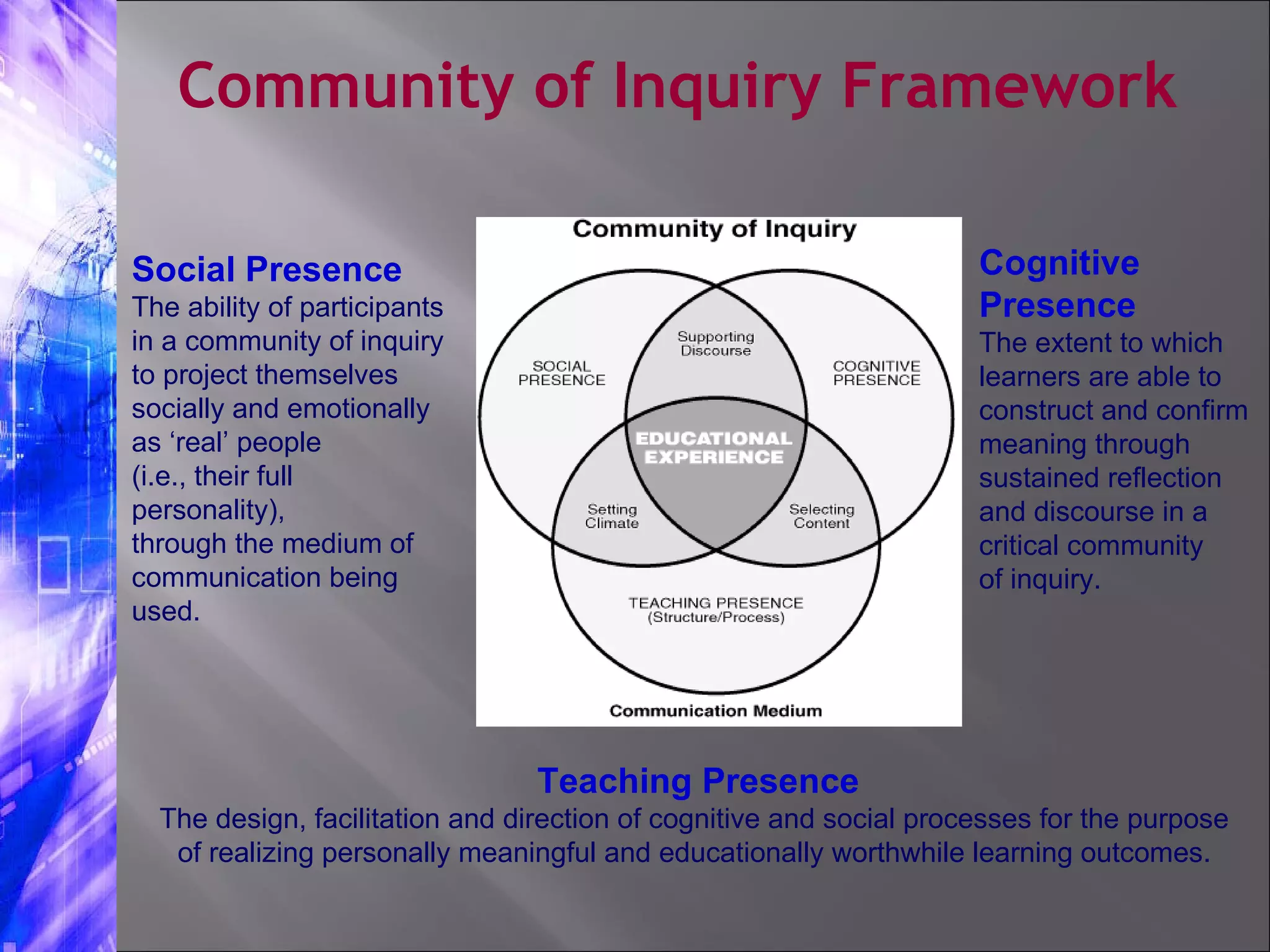
The importance of a community of inquiry is that, while the objective of critical reflection is  intellectual  autonomy, in reality, critical reflection is “thoroughly  social  and communal”. --Lipman, 1991 Community of Inquiry
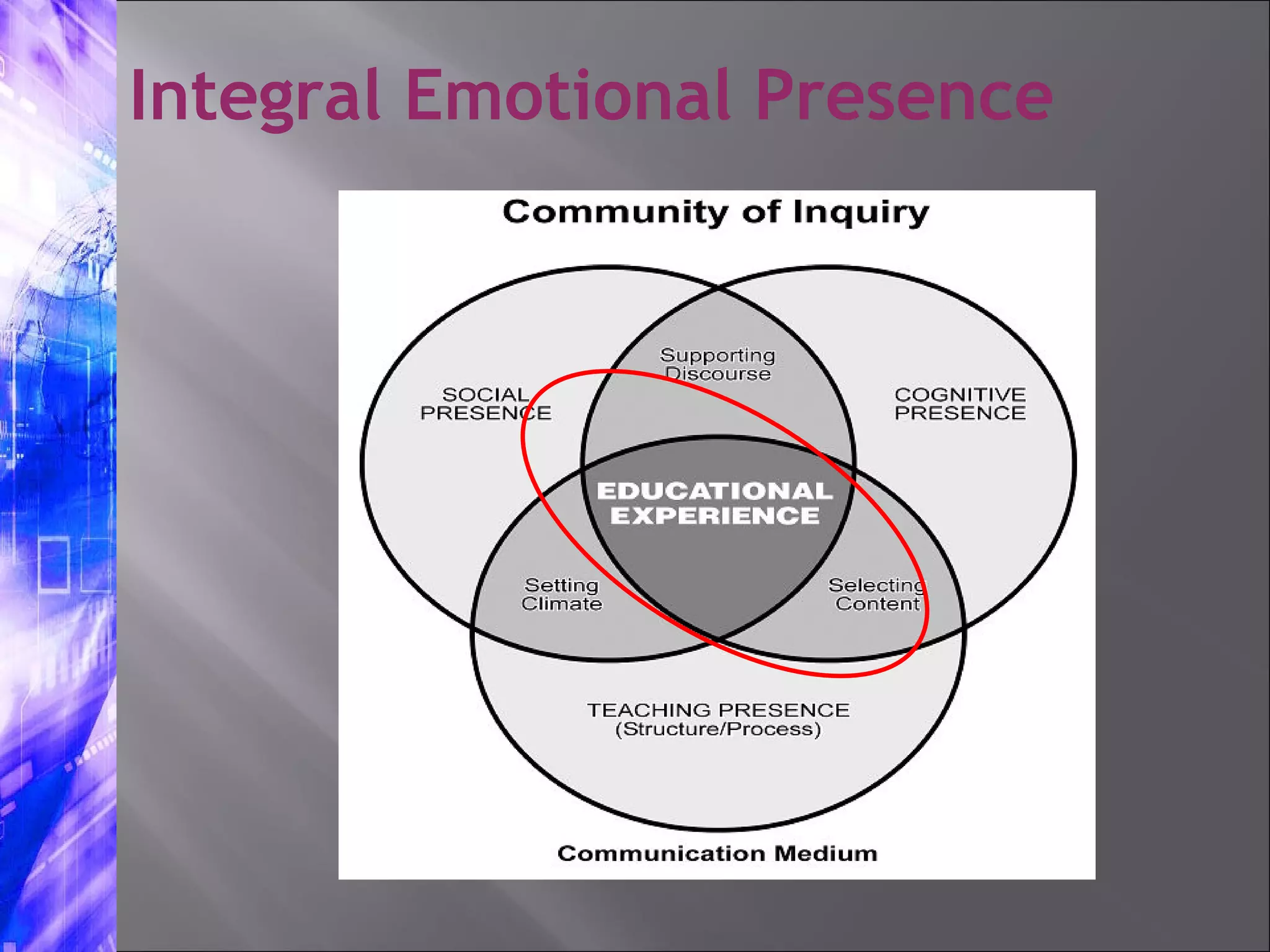
Social Presence The ability of participants  in a community of inquiry  to project themselves  socially and emotionally  as ‘real’ people  (i.e., their full personality),  through the medium of  communication being  used.   Cognitive Presence The extent to which  learners are able to  construct and confirm  meaning through  sustained reflection  and discourse in a  critical community  of inquiry.   Teaching Presence The design, facilitation and direction of cognitive and social processes for the purpose  of realizing personally meaningful and educationally worthwhile learning outcomes.   Community of Inquiry Framework
social presence the ability of participants in a community of inquiry to project themselves socially and emotionally  --  as ‘real’ people; the degree to which participants in computer mediated communication feel socially and emotionally connected   SP Elements  –   affective expression, open communication (cohesiveness), group cohesion (interactivity)
 
affective expression:   self-projection, paralanguage, self-disclosure, humor, expressing emotion, values open communication:  establishing trust, greetings & salutations, vocatives, group reference, social sharing group cohesion:   group interaction, collaboration, acknowledgement, approval, agreement/disagreement, invitation Elements of Social Presence
social presence can be (strongly) felt by participants in computer-mediated communication  (Walther, 1994; Gunawardena, 1995; Tu & McIsaac, 2002; Richardson & Swan, 2003) and projected into text-based asynchronous discussion using verbal immediacy indicators alone (Rourke, Anderson, Garrison & Archer, 2001; Swan, 2002; 2003) Research Findings
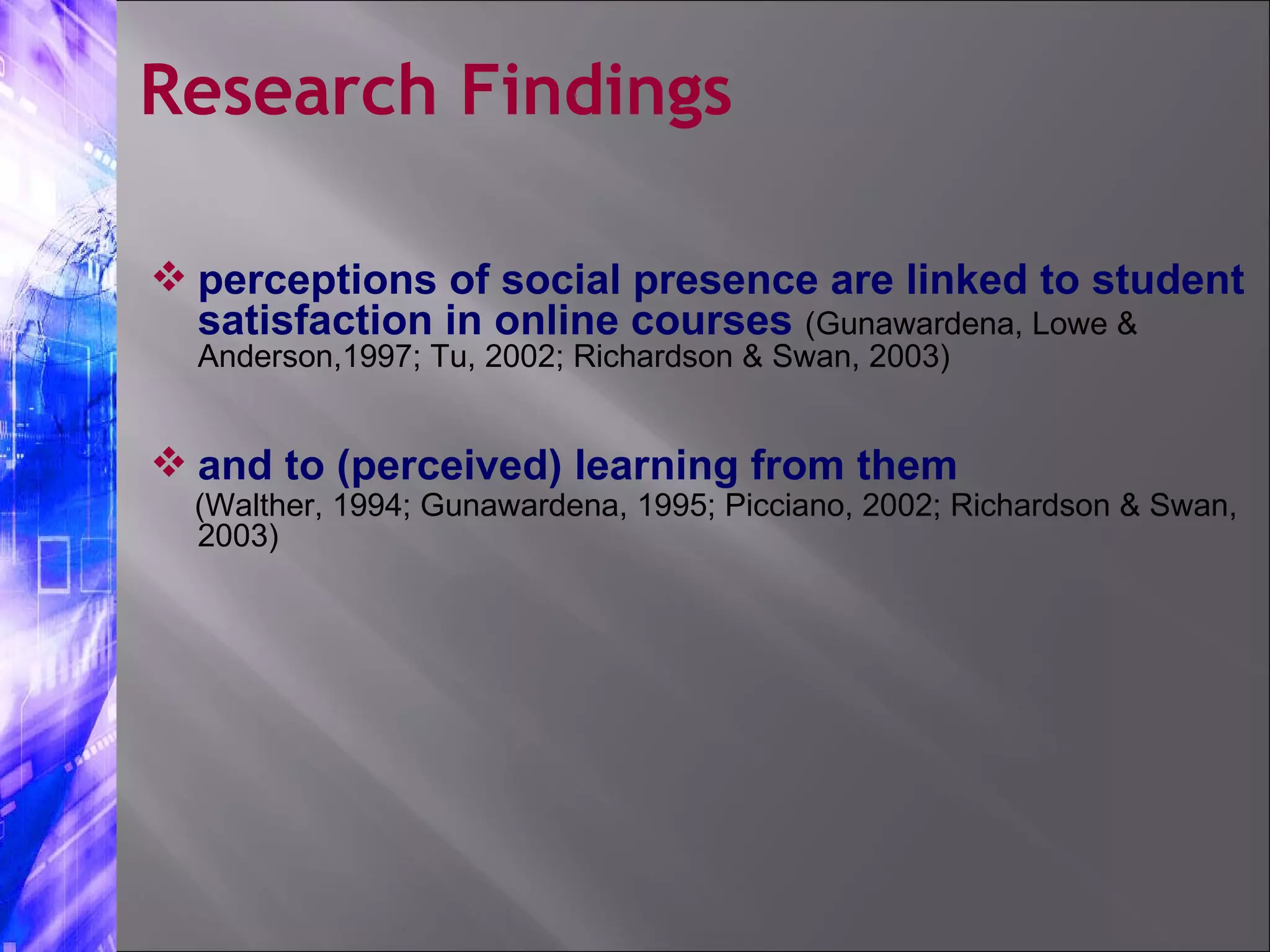
perceptions of social presence are linked to student satisfaction in online courses  (Gunawardena, Lowe & Anderson,1997; Tu, 2002; Richardson & Swan, 2003) and to (perceived) learning from them  (Walther, 1994; Gunawardena, 1995; Picciano, 2002; Richardson & Swan, 2003) Research Findings
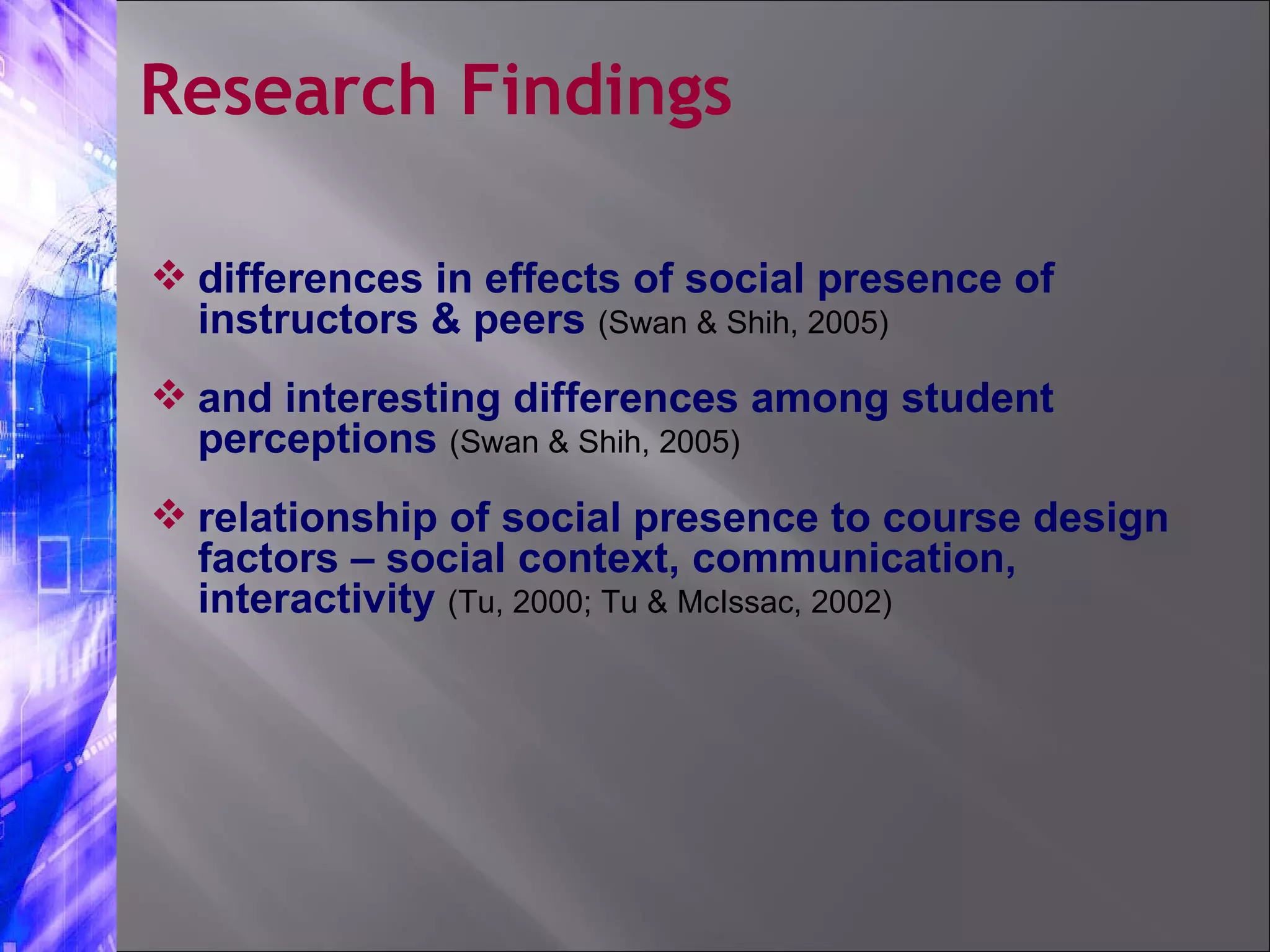
differences in effects of social presence of instructors & peers  (Swan & Shih, 2005) and interesting differences among student perceptions  (Swan & Shih, 2005) relationship of social presence to course design factors – social context, communication, interactivity  (Tu, 2000; Tu & McIssac, 2002) Research Findings
when multiple presences explored, social presence is associated with student satisfaction but not perceived learning   (Akyol & Garrison, in press) social presence is needed to create cognitive presence, but contingent on the establishment of teaching presence  (Shea & Bidjeramo, in press) Research Findings
Create a “Meet Your Classmates” section of your course where you and students introduce yourselves to one another. Explicitly introduce students to the unique nature and learning potential of online discussion Establish rules of Netiquette for your course. Develop initial course activities (e.g. ice breakers) to encourage the development of swift trust. Model & encourage the use of verbal immediacy behaviors in interactions with students. Encourage students to share experiences & beliefs in online discussion. Implications for Practice: Tips and Techniques
Make participation in discussion a significant part of course grades. Require discussion participants to respond to their classmates postings &/or to respond to all responses to their own postings. Make students responsible for sustaining discussion threads. Make students summarize discussion threads. Require students to incorporate materials from the discussions in their assignments. Encourage & support vicarious interaction.  Use tracking mechanisms to reward reading as well as responding to messages. Use short videos of yourself to introduce the course and particular topics. Tips and Techniques
Journal or otherwise interact with your students on an individual and personal basis. Use audio to embed feedback on assignments within them. Design community building activities. Design collaborative activities – problem solving tasks, projects, small group discussion. Consider including real time communications using applications such as chat, collaborative whiteboards, interactive video. Consider incorporating Web 2.0 applications in course activities, especially social software such as blogs, wikis,  YouTube, Flickr, MySpace ,  Second Life , etc. Tips and Techniques
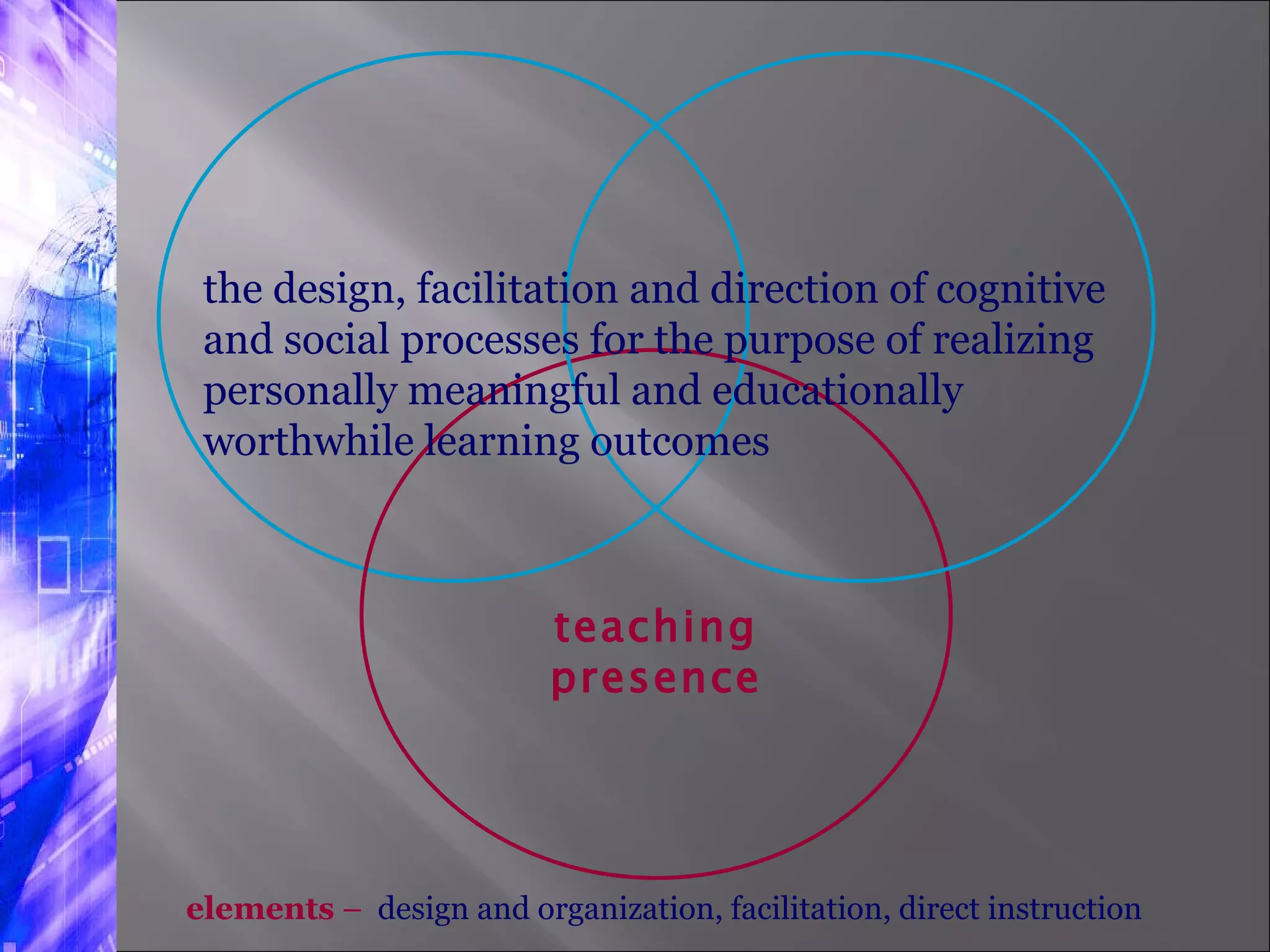
teaching presence the design, facilitation and direction of cognitive and social processes for the purpose of realizing personally meaningful and educationally worthwhile learning outcomes elements  –   design and organization, facilitation, direct instruction
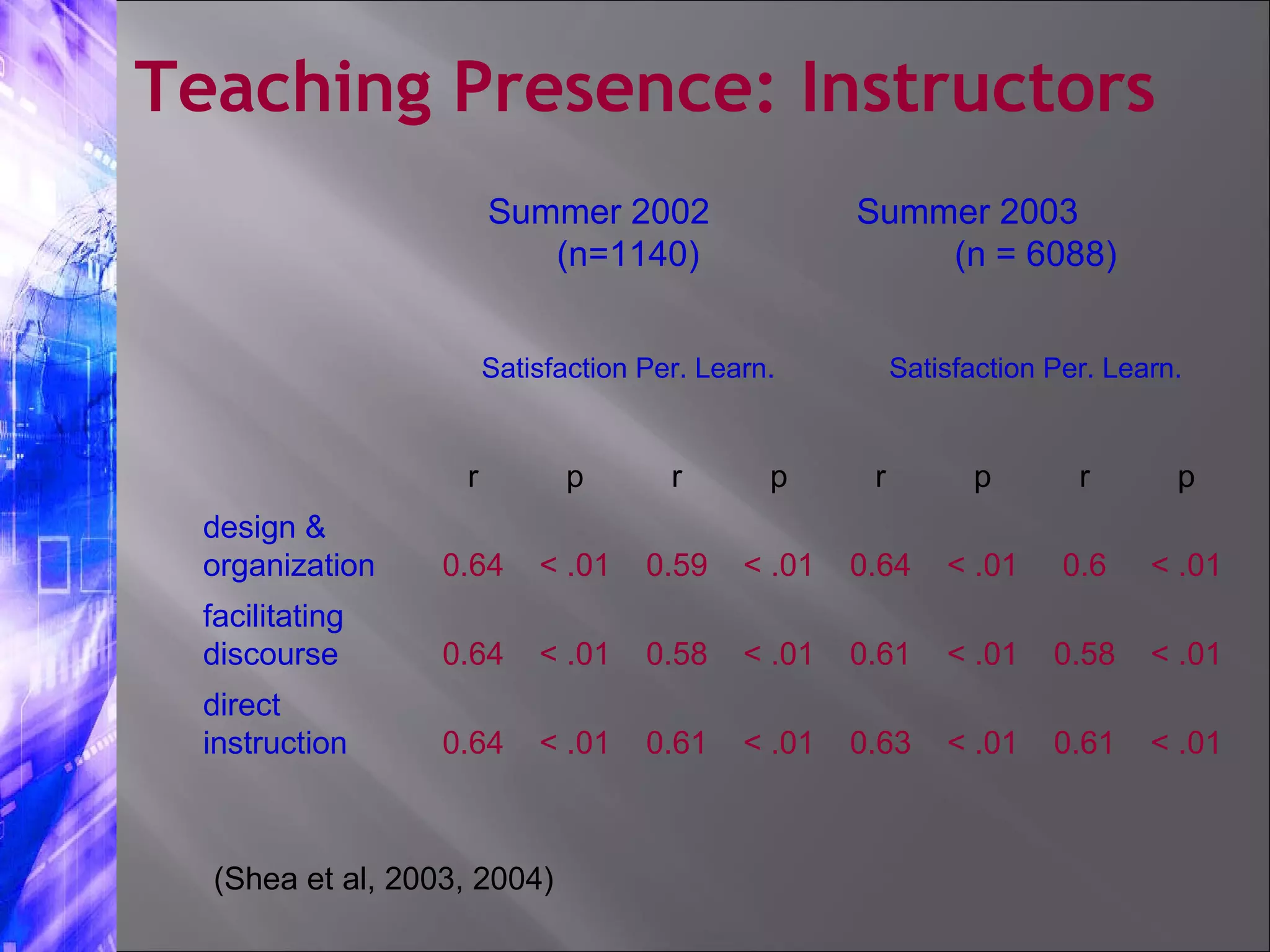
strong correlations between learner’s perceived & actual interactions w/ instructors and their perceived learning  (Swan, Shea, Fredericksen, Pickett, Pelz & Maher, 2000; Jiang & Ting, 2000; Richardson & Swan, 2003) strong correlations between all three elements of teaching presence and student satisfaction and perceived learning in online courses   (Shea, Frederickson, Pickett & Pelz, 2003; Shea, Pickett & Pelz, 2004) Research Findings
Teaching Presence: Instructors (Shea et al, 2003, 2004) < .01 0.61 < .01 0.63 < .01 0.61 < .01 0.64 direct instruction < .01 0.58 < .01 0.61 < .01 0.58 < .01 0.64 facilitating discourse < .01 0.6 < .01 0.64 < .01 0.59 < .01 0.64 design & organization p r p r p r p r Satisfaction Per. Learn. Satisfaction Per. Learn. Summer 2003  (n = 6088) Summer 2002  (n=1140)
Teaching Presence: Students (Shea et al, 2003, 2004) < .01 .43 < .01 .40 < .01 .39 < .01 .39 direct instruction < .01 .43 < .01 .41 < .01 .37 < .01 .36 facilitating discourse design & organization p r p r p r p r Satisfaction Per. Learn. Satisfaction Per. Learn. Summer 2003  (n = 6088) Summer 2002  (n = 1140)
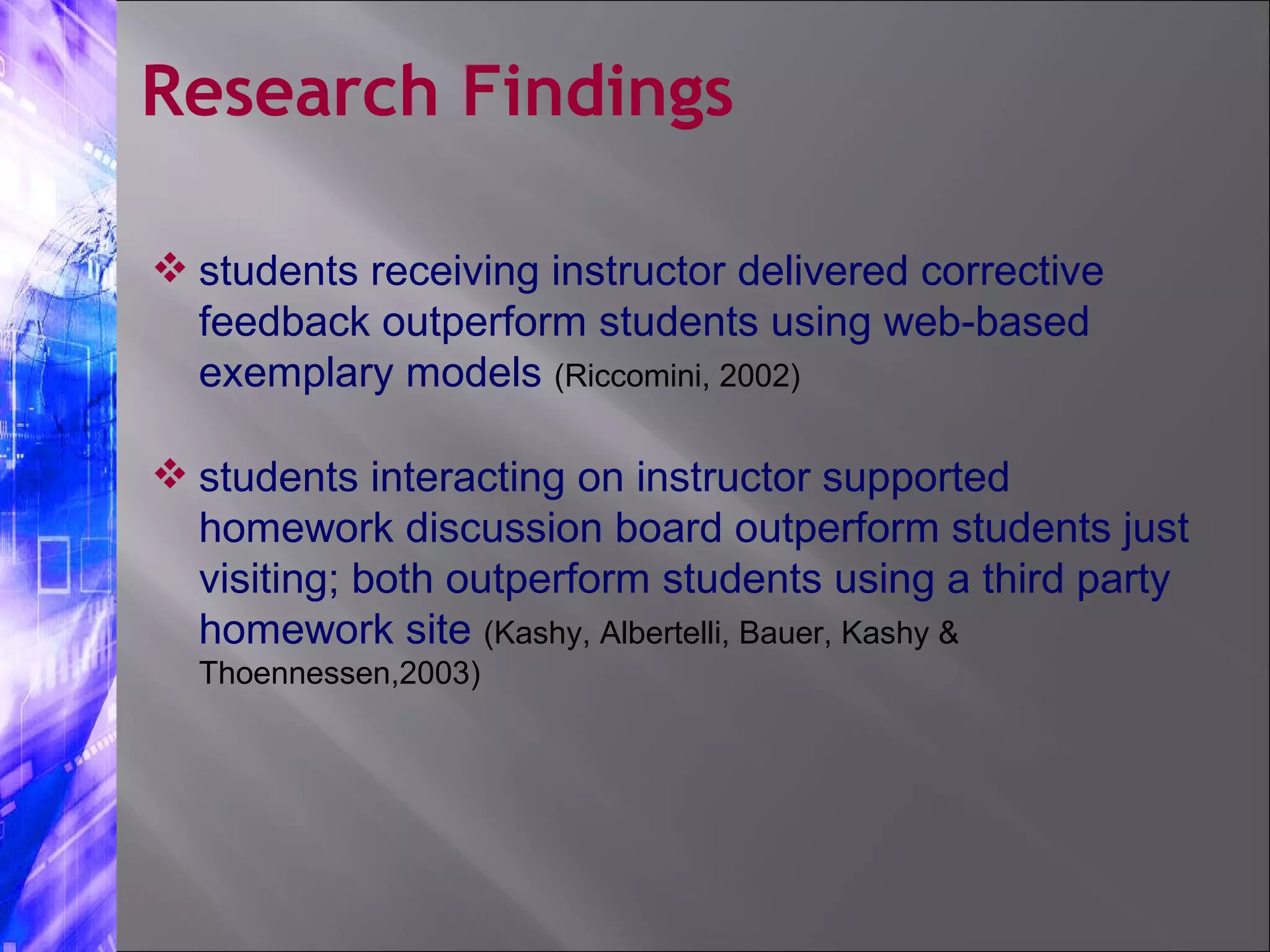
students receiving instructor delivered corrective feedback outperform students using web-based exemplary models  (Riccomini, 2002)  students interacting on instructor supported homework discussion board outperform students just visiting; both outperform students using a third party homework site  (Kashy, Albertelli, Bauer, Kashy & Thoennessen,2003) Research Findings
importance of instructors restraining themselves in online discussion to encourage student voices  (Vandergrift, 2002) importance of applying principles of collaborative learning to online discussion & small group activities -- structuring interaction in authentic tasks, applying questioning strategies, role assignment, interdependence, reflection  (Wu, 2003) Restrained Presence & Collaborative Principals
clear structure navigational transparency consistency communication potential active learning (Romiszowski & Cheng, 1991; Eastmond, 1995; Irani, 1998;  Swan, Shea, Frederickson, Pickett, Pelz & Maher, 2000;  Picciano, 2002) Research Findings: Course Design
Provide frequent opportunities for both public and private interactions with students. Provide students with timely & supportive feedback. Restrain from being overly “present” in online discussions, rather facilitate student interaction. Apply collaborative learning principles to support small group discussion and collaborative projects. Design diverse, graded activities to be completed every week. Implications for Practice: Tips & Techniques
Design courses for learner choice, flexibility & control. Design and review courses for clarity & consistency. Ensure courses are well organized and that the organization is clear to students & easy to navigate. Clearly state course goals and instructional expectations. Provide a detailed course schedule including due dates for all assignments. Provide students with explicit and redundant instructions for all course activities. Tips & Techniques
Provide clear grading guidelines including rubrics for complex assignments. Review changing faculty roles and reflect on your own cognitive, affective & managerial behaviors. Develop forums or learning communities for online faculty to share experiences & support one another. Tips & Techniques
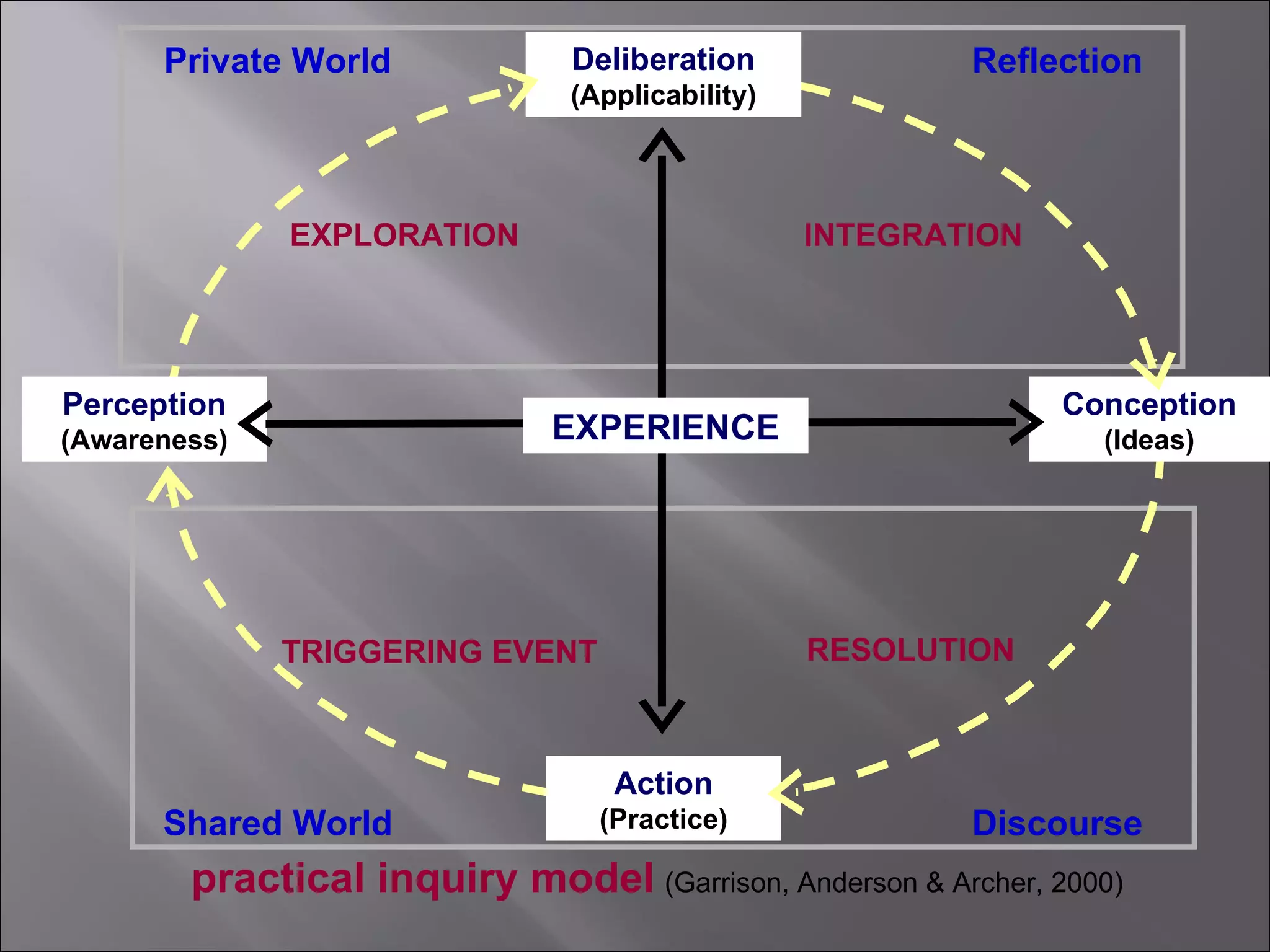
cognitive presence the extent to which learners are able to construct and confirm meaning through sustained reflection and discourse in a critical community of inquiry   elements  –   triggering event, exploration, integration, resolution
practical inquiry model   (Garrison, Anderson & Archer, 2000) Shared World Discourse Private World Reflection Deliberation (Applicability) Perception (Awareness) Action (Practice) Conception (Ideas) EXPERIENCE EXPLORATION TRIGGERING EVENT RESOLUTION INTEGRATION
When questions specifically asked students to engage in practical applications, discussions did progress to the synthesis and resolution phase  (Arnold & Ducate, 2006)  Again, where learners specifically were tasked to formulate and resolve a problem, “participants engaged more in problem resolution than in problem formulation”  (Murphy, 2003)   A recent study supports this finding where the frequency of integration contributions were considerably higher than exploration due largely to the task (assignment requiring resolution)  (Akyol & Garrison, in press) Cognitive Presence and Tasks
Cognitive presence was significantly associated with teaching presence, perceived learning and satisfaction  (Akyol & Garrison, 2008; Shea et al. 2004, 2005) The lowest cognitive presence scores … were reported by students who rated their instructors’ skills in this area of teaching presence as weak  (Shea & Bidjeramo, 2007) Cognitive Presence & Teaching Presence
concept & process scaffolds  (Wong-Busby, 2006) peer review -- Bloom’s taxonomy  (Ertmer, Richardson, Belland, Coulthard, Camin & Mong, 2006) subject line  (Pelz, 2004) assessment  (Swan, Schenker, Arnold & Kuo, 2007) Scaffolding Online Discussion
learning concepts vs. learning techniques  (Parker & Gemino, 2001; Picciano, 2002) multiple perspectives  (Picciano, 2002) disciplined inquiry – reflection and interaction  (Benbunan-Fich & Hiltz, 1999; Garrison, 2003) automated mastery learning  (Twigg, 2003) Research Findings: Content
multimedia learning   (Mayer, 2001) MODALITY  better transfer from animation and narration than from animation and text  CONTIGUITY  better transfer when narration and animation are presented simultaneously rather than sequentially  MULTIMEDIA  better transfer from animation and narration rather than from narration alone  PERSONALIZATION  better transfer when narration is conversational rather than formal  COHERENCE  better transfer when irrelevant video, narration, and/or sounds are excluded  REDUNDANCY  better transfer from animation and narration than from animation, narration and on-screen text  PRETRAINING  better transfer when explanations of system components precedes rather than follows a narrated animation SIGNALING  better transfer when different parts of a narration are signaled  PACING  better transfer when the pace of presentation is learner controlled
Identify big ideas you want students to take away from your course and develop major course activities around their assessment. Identify important knowledge, skills & attitudes students should learn and develop additional course activities around their assessment. Provide multiple representations of the knowledge you want students to learn and multiple activities for practicing desired skills. Applications for Practice: Tips & Techniques
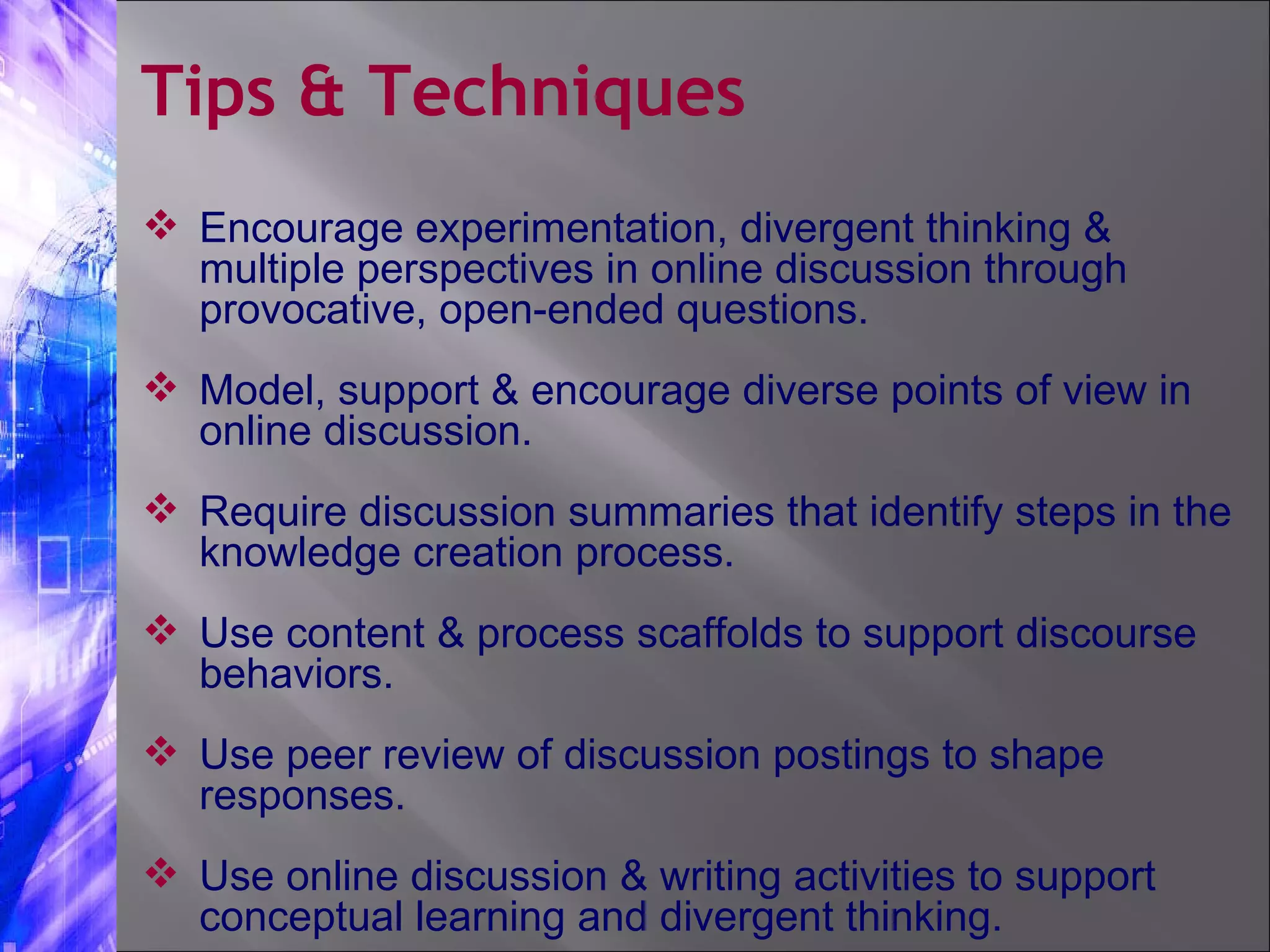
Encourage experimentation, divergent thinking & multiple perspectives in online discussion through provocative, open-ended questions.  Model, support & encourage diverse points of view in online discussion. Require discussion summaries that identify steps in the knowledge creation process. Use content & process scaffolds to support discourse behaviors. Use peer review of discussion postings to shape responses. Use online discussion & writing activities to support conceptual learning and divergent thinking. Tips & Techniques
Use self-testing, practice assignments, simulations & other interactive activities to support skill development & convergent thinking. Develop grading rubrics for discussion & course activities that reward desired cognitive behaviors. Provide frequent opportunities for testing & feedback.  Automate testing & feedback when possible. Develop general learning modules with opportunities for active learning, assessment & feedback that can be shared among courses &/or accessed by students for remediation or enrichment.  Tips & Techniques
Present words in spoken form, use words and pictures simultaneously to explain concepts. Avoid extraneous video & audio, do not add redundant on-screen text. Begin presentations with descriptions of components & organization. Allow learners to control the pace of presentations. Tips & Techniques
Emotion and Learning Barry Kort, Rob Reilly, Rosalind W. Picard, &quot;An Affective Model of Interplay between Emotions and Learning: Reengineering Educational Pedagogy-Building a Learning Companion,&quot;  icalt , p. 0043,   Second IEEE International Conference on Advanced Learning Technologies (ICALT'01),   2001
Integral Emotional Presence
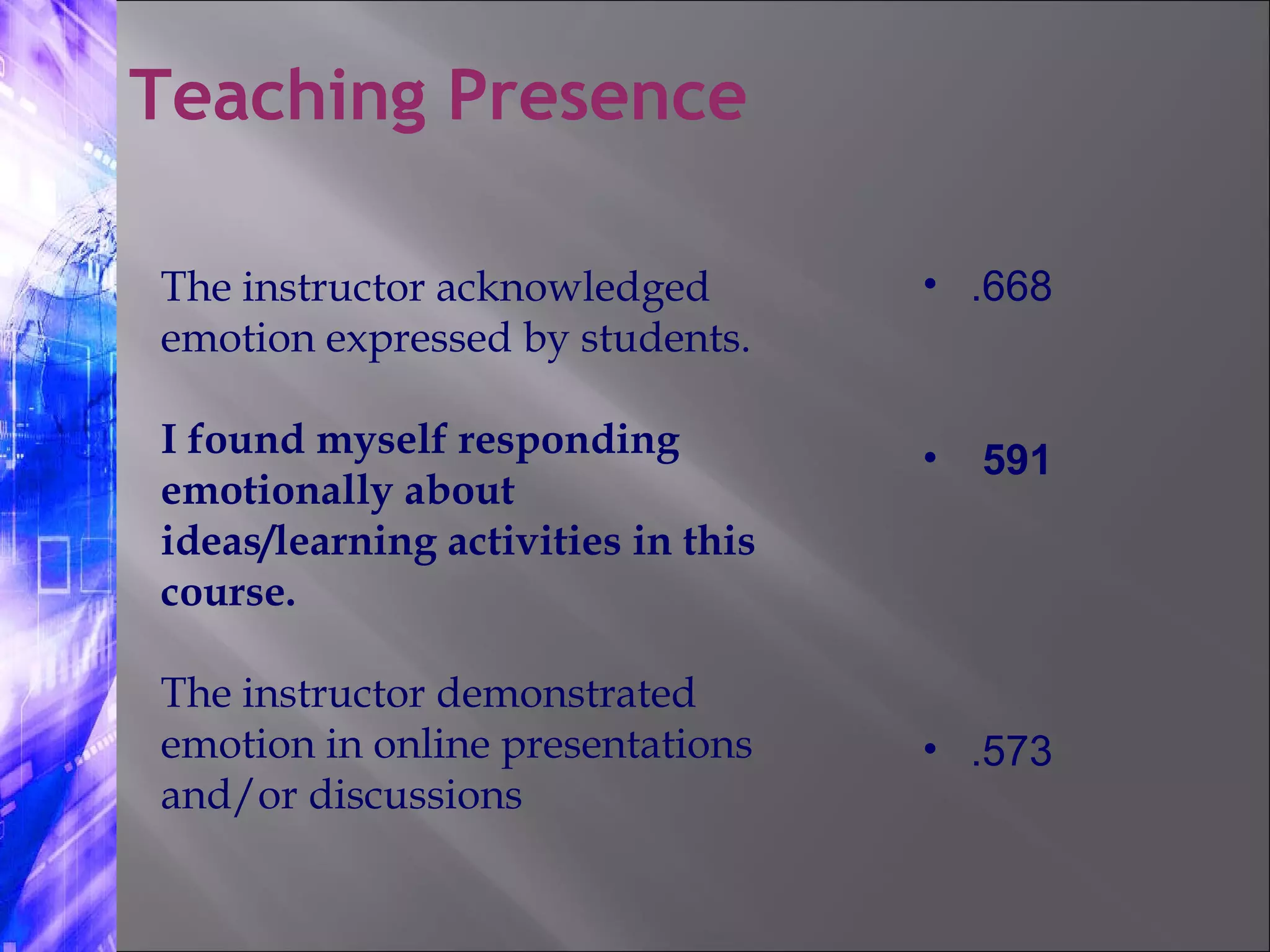
Emotional Presence Emotion was expressed when connecting with other students.  (EP in SP) The instructor acknowledged emotion expressed online by students.  (EP in TP)  Expressing emotion in relation to expressing ideas was acceptable in this course. (EP in CP) I felt comfortable expressing emotion through the online medium. (EP in SP) The instructor demonstrated emotion in online presentations and/or discussions. (EP in TP) I found myself responding emotionally about ideas or learning activities in this course.  (EP in CP).
Emotion was expressed when connecting with other students.  I felt comfortable expressing emotion through the online medium.  .665 .645 Social Presence
The instructor acknowledged emotion expressed by students.  I found myself responding emotionally about ideas/learning activities in this course.  The instructor demonstrated emotion in online presentations and/or discussions .668 591 .573  Teaching Presence
Expressing emotion in relation to discussing ideas was acceptable in this course.   .420 Cognitive Presence
Designing for Social, Teaching and Cognitive Presence ACTIVITY 1
COMMUNITY OF INQUIRY Instrument Development and Recent Research
December 2006   – Development of a unified Community of Inquiry Survey instrument Review of previous research and commonality of items Common survey items agreed upon where existing items were worded differently; New items developed where needed Spring 2007   - Beta testing of common instrument Factor analysis reviewed, select items revised and new items added Summer 2007   - Data collected across spectrum of courses at 4 institutions in the USA and Canada Items randomized to reduce order-related biases Instrument Development
n = 287 Principal Component Procedure Oblique rotation utilized (which, in contrast to Orthogonal, does NOT assume factors are uncorrelated to one another). SPSS version 15 utilized Confirmatory Factor Analysis
Teaching Presence Items 1 2 3 1. The instructor clearly communicated important course topics. 0.826 0.088 0.067 2. The instructor clearly communicated important course goals. 0.877 -0.021 0.046 3. The instructor provided clear instructions on how to participate in course learning activities. 0.592 0.246 -0.035 4. The instructor clearly communicated important due dates/time frames for learning activities. 0.611 0.078 0.040 5. The instructor was helpful in identifying areas of agreement and disagreement on course topics that helped me to learn. 0.579 0.162 -0.138 6. The instructor was helpful in guiding the class towards understanding course topics in a way that helped me clarify my thinking. 0.575 0.091 -0.281 7. The instructor helped to keep course participants engaged and participating in productive dialogue. 0.633 0.149 -0.160 8. The instructor helped keep the course participants on task in a way that helped me to learn. 0.579 0.042 -0.285 9. The instructor encouraged course participants to explore new concepts in this course. 0.523 0.099 -0.233 10. Instructor actions reinforced the development of a sense of community among course participants.  0.569 0.174 -0.176 11. The instructor helped to focus discussion on relevant issues in a way that helped me to learn. 0.425 0.146 -0.374 12. The instructor provided feedback that helped me understand my strengths and weaknesses relative to the course’s goals and objectives.  0.649 -0.123 -0.201 13. The instructor provided feedback in a timely fashion. 0.513 -0.025 -0.103
SOCIAL PRESENCE ITEMS 1 2 3 14. Getting to know other course participants gave me a sense of belonging in the course. 0.050 0.619 -0.233 15. I was able to form distinct impressions of some course participants. 0.172 0.473 0.013 16. Online or web-based communication is an excellent medium for social interaction.  -0.181 0.674 -0.226 17. I felt comfortable conversing through the online medium. -0.039 0.814 0.015 18. I felt comfortable participating in the course discussions. 0.109 0.788 0.005 19. I felt comfortable interacting with other course participants. 0.286 0.701 0.038 20. I felt comfortable disagreeing with other course participants while still maintaining a sense of trust. 0.103 0.620 -0.034 21. I felt that my point of view was acknowledged by other course participants. 0.319 0.556 0.025 22. Online discussions help me to develop a sense of collaboration. 0.047 0.561 -0.340
COGNITIVE PRESENCE ITEMS 1 2 3 23. Problems posed increased my interest in course issues. -0.099 0.172 -0.785 24. Course activities piqued my curiosity.  0.064 0.070 -0.712 25. I felt motivated to explore content related questions. 0.082 -0.031 -0.770 26. I utilized a variety of information sources to explore problems posed in this course.  0.078 -0.158 -0.759 27. Brainstorming and finding relevant information helped me resolve content related questions. -0.106 0.130 -0.794 28. Online discussions were valuable in helping me appreciate different perspectives. -0.096 0.286 -0.699 29. Combining new information helped me answer questions raised in course activities. 0.101 0.043 -0.716 30. Learning activities helped me construct explanations/solutions. 0.128 0.030 -0.732 31. Reflection on course content and discussions helped me understand fundamental concepts in this class. 0.008 0.237 -0.640 32. I can describe ways to test and apply the knowledge created in this course. 0.239 -0.097 -0.619 33. I have developed solutions to course problems that can be applied in practice. 0.147 0.026 -0.653 34. I can apply the knowledge created in this course to my work or other non-class related activities. 0.171 -0.041 -0.687
n=413 Students Completed the CoI from 2 perspectives: Students use CoI items used to describe the course Students rate the relative importance of each of the CoI items Ordinal Scale Utilized: Unimportant; Somewhat Important; Important; Very Important; Extremely Important Ordinal Scale designed more so for amplifying the variance as opposed to measuring definitively the students’ perceptions of importance Example of Further Research
Course Evaluations and  Importance Ratings Compared
Implementing the CoI  Framework and Survey ACTIVITY 2A
Current CoI Research and  Best Practices
Reflective learning/co-construction of knowledge not “inevitable consequence” of allowing students to interact  Cognitive Presence in Online Education
Study Survey of online college students US online higher education system 35 colleges, 2 yr, 4yr, grad 100,000 enrollments per year 2000 online faculty 4000 online course per year Random sample 2159 respondents  Hypotheses…
Teaching Presence Instructor: clearly communicates important course topics clearly communicates important course goals provides clear instructions on how to participate in course learning activities clearly communicates important due dates/time frames for learning activities identifies areas of agreement and disagreement  guides the class towards understanding course topics  Teaching Presence leads to…
Social Presence Getting to know other course participants provides a sense of belonging Ability to form distinct impressions of some course participants Perception that online or web-based communication is good medium for social interaction Comfort conversing through the online medium Comfort participating in the course discussions Social Presence combines with teaching presence to foster…
Cognitive Presence Online discussions were valuable in helping  appreciate   different perspectives Combining new information helps  answer  questions raised in course activities Learning activities help  construct   explanations/solutions Reflection on course content and discussions help  understand  fundamental concepts  I can describe ways  to  test and apply  the knowledge created in this course I can  develop solutions  to course problems that can be applied in practice I can  apply the knowledge  created in the course to work or other non-class related activities
 
 
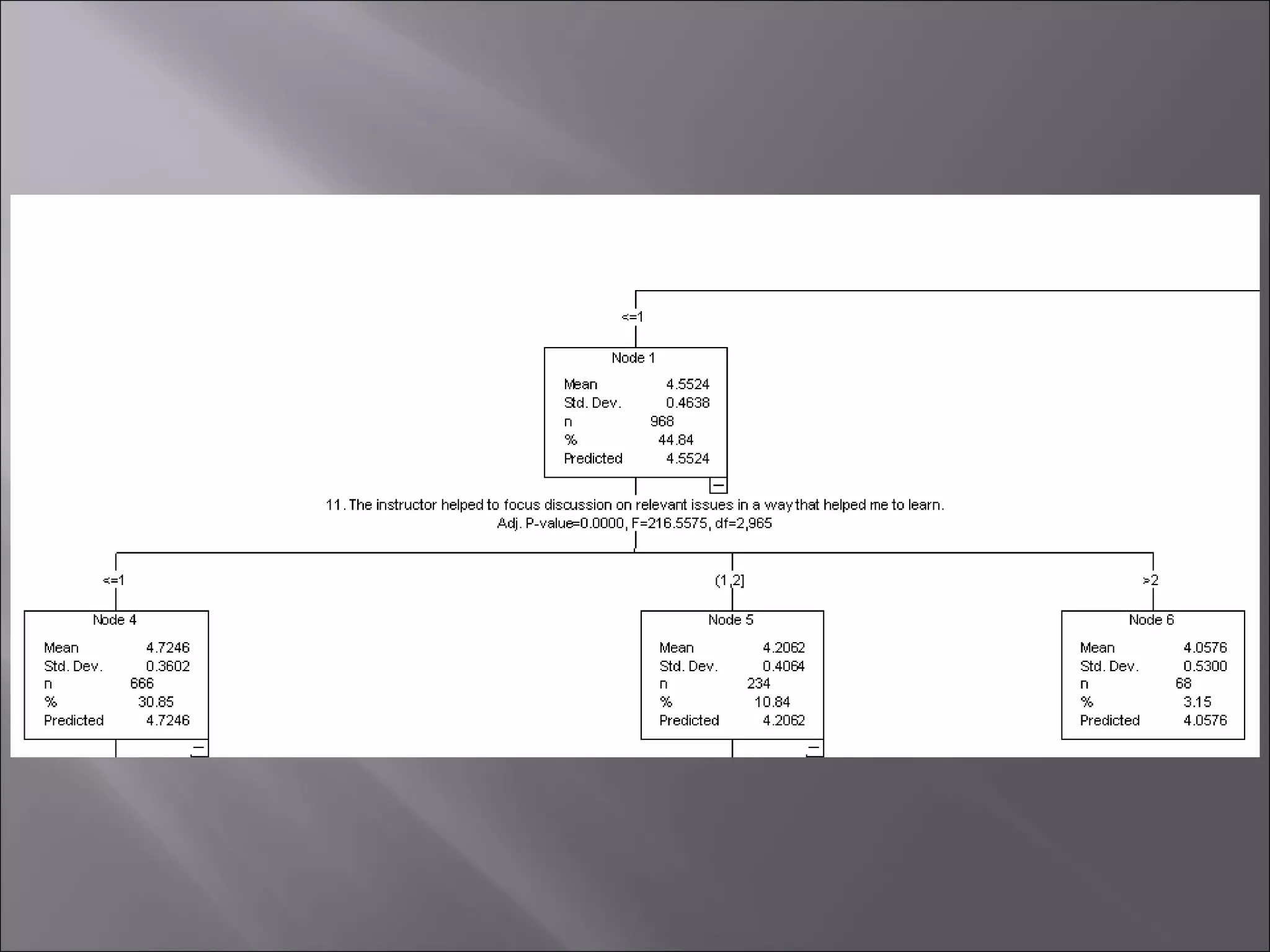
CHAID Analysis What item level responses predict the most variance in cognitive presence?
CHAID
 
 
Conclusions Lower level of comfort with online discussion = lower levels of cognitive presence  Active instructor role focusing online discussions = higher cognitive presence
Recommendations Using the model as a lens through which to make instructional design choices is one option  CoI can serve as a conceptual touchstone for online instructional design Focus on teaching and social presence can guide the integration of new technologies in online education Before adopting new technologies for online instruction consider how these innovations support the development of teaching and social presence
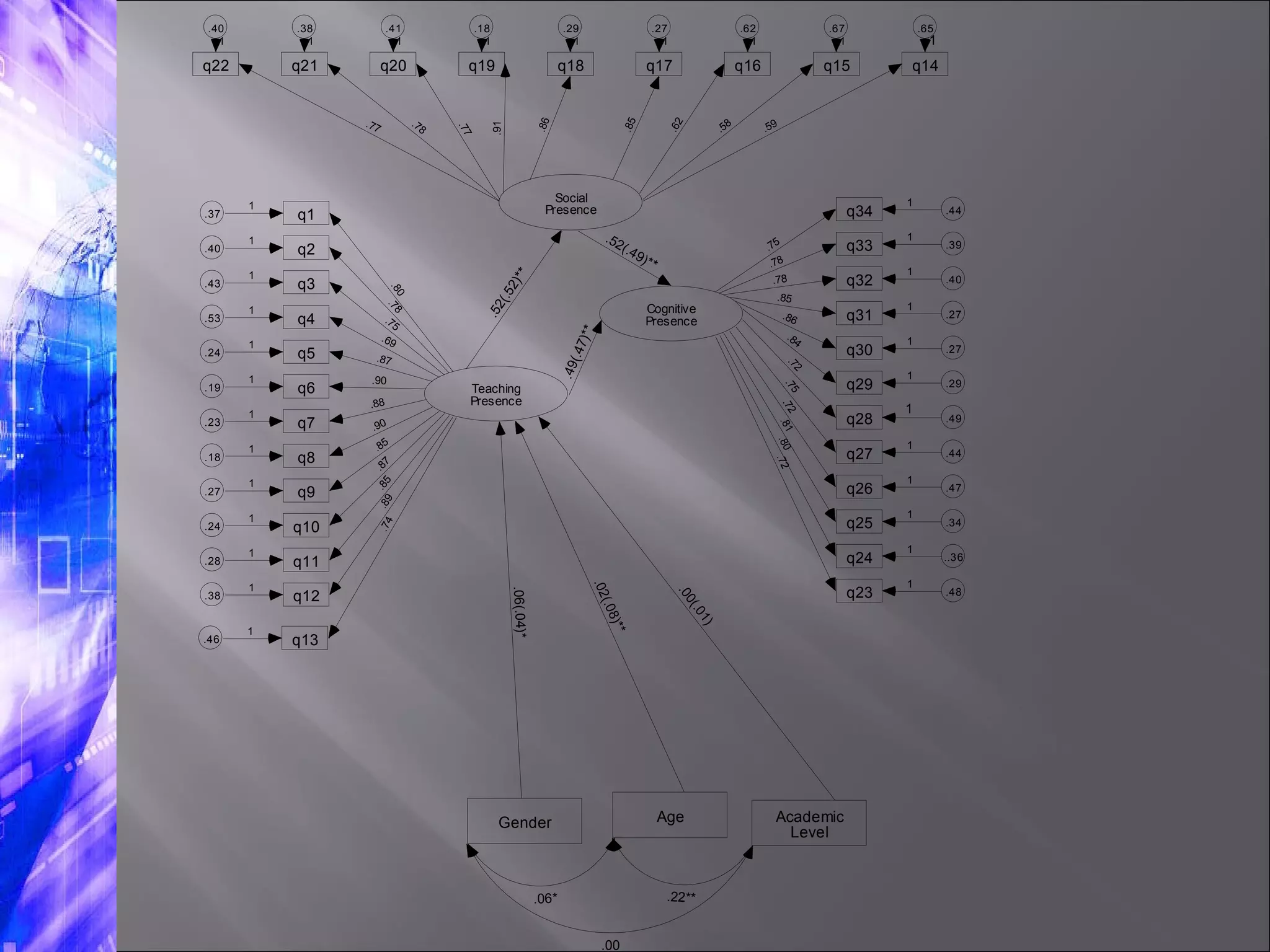
Exploring Causal Relationships Among Teaching, Cognitive and Social Presence
Teaching Online Despite the considerable, growing interest in online education, most studies have focused only on the students’ perspective. Merely a handful of studies have attempted to address the teachers’ perspectives and little has been published on the online teaching experience itself. Gudea, 2008
Findings
 
Next Steps Further research is called for in exploring the dynamic relationships among the presences across disciplines and institutions. Moreover, each of the presences represent complex concepts consisting of sub-elements (i.e., categories) that need further study to confirm the existence of these categories and explore the dynamic relationships of specific categories across the presences.  Garrison, Cleveland-Innes & Fung, in press
Using the CoI to Assess the Impact of New Technologies
Audio Feedback The following slides compare the findings of a multi-institutional CoI instrument validation (n = 1041) and responses from the aforementioned study (n = 1138) that received audio feedback In the items addressed there was a significant difference (p > .05) in responses
Teaching Presence 1 The instructor was helpful in identifying areas of agreement and disagreement on course topics that helped me to learn. Summer 2007 / mean = 4.12 Audio group / mean = 4.43
Teaching Presence 2 The instructor encouraged course participants to explore new concepts in this course. Summer 2007 / mean = 4.44 Audio group / mean = 4.58
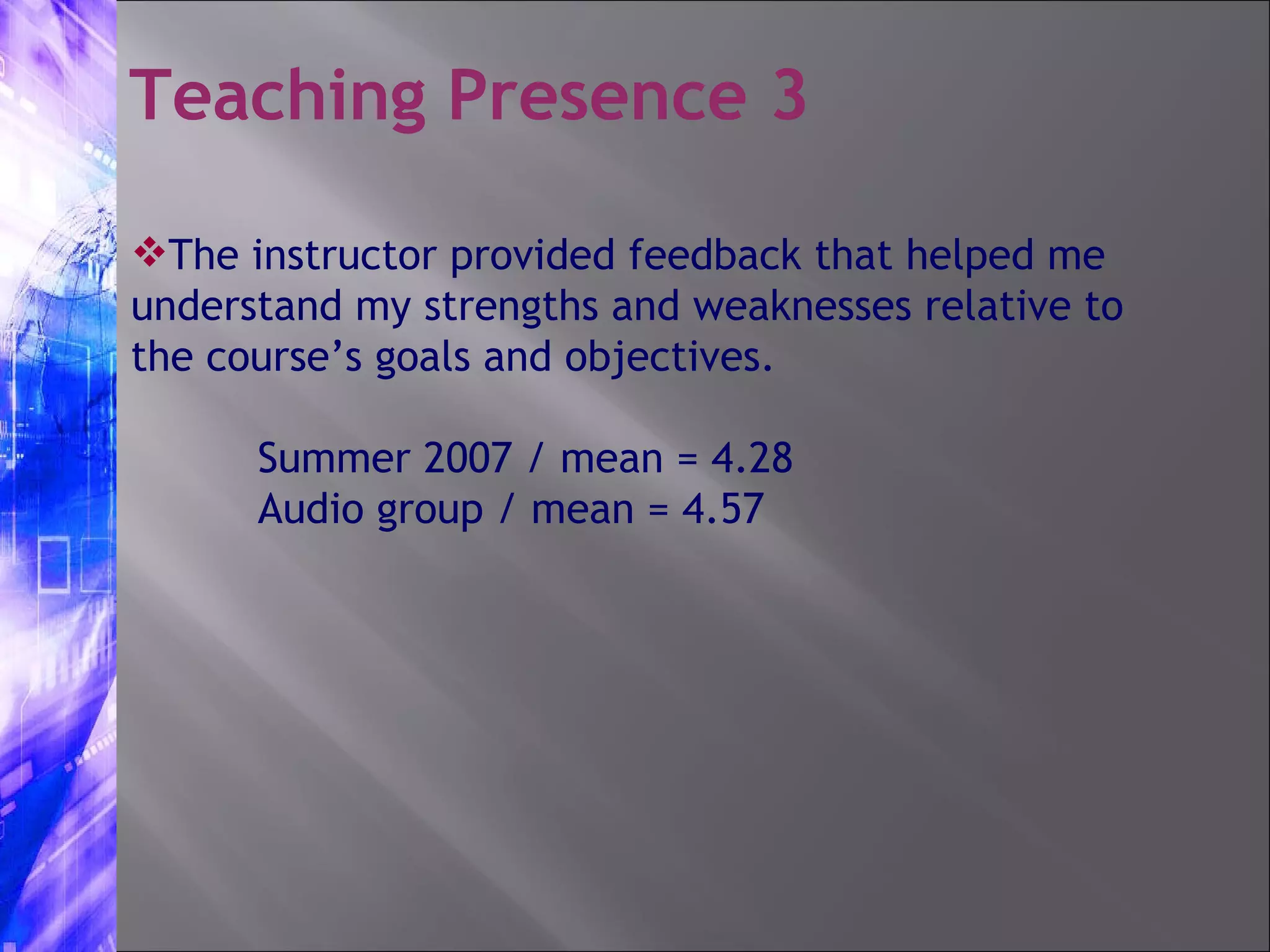
Teaching Presence 3 The instructor provided feedback that helped me understand my strengths and weaknesses relative to the course’s goals and objectives.  Summer 2007 / mean = 4.28 Audio group / mean = 4.57
Social Presence Online or web-based communication is an excellent medium for social interaction. Summer 2007 / mean = 3.90 Audio group / mean = 4.27
Cognitive Presence 1 I felt motivated to explore content related questions. Summer 2007 / mean = 4.31 Audio group / mean = 4.55
Cognitive Presence 2 Reflection on course content and discussions helped me understand fundamental concepts in this class. Summer 2007 / mean = 4.37 Audio group / mean = 4.49
Collaborative Technologies Two online, graduate level education courses (combined n=78) students were asked to complete assignments (mean page count = 9.75 pages), alternating Word and Buzzword as the creation and submission mechanism.  Buzzword is an online document editor that is a part of Acrobat.com
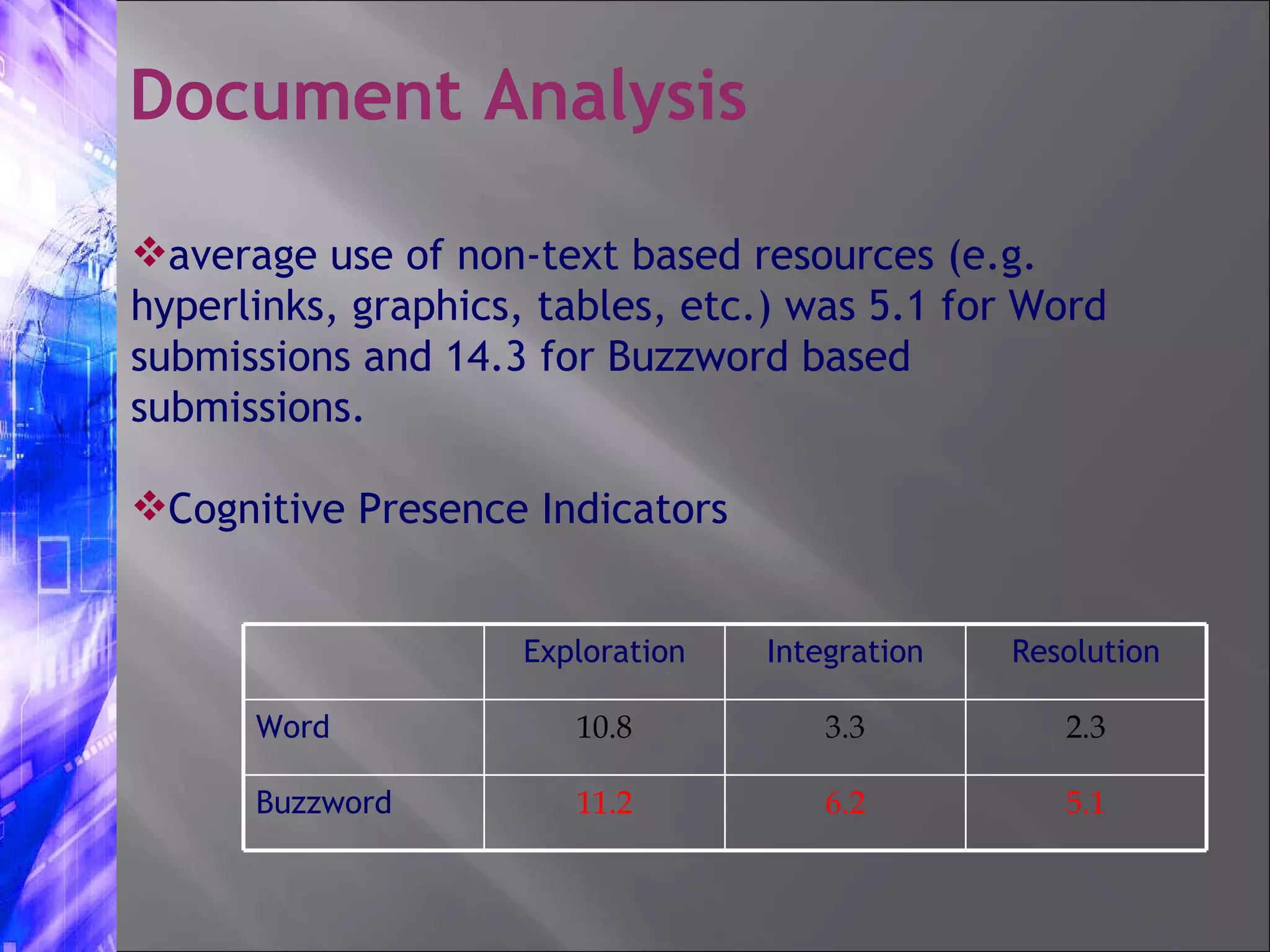
Document Analysis average use of non-text based resources (e.g. hyperlinks, graphics, tables, etc.) was 5.1 for Word submissions and 14.3 for Buzzword based submissions.  Cognitive Presence Indicators 5.1 6.2 11.2 Buzzword 2.3 3.3 10.8 Word Resolution Integration Exploration
Improving Teaching Presence in a Virtual Classroom at Lawrence Technological University
Lawrence Technological University: Located 5 miles North of Detroit in Southfield, Michigan Four Colleges: Architecture  Engineering  Management Arts and Sciences 4,500 Students Over 60 degree programs  Offering Associate, Bachelor, Master and Doctoral degrees About Lawrence Tech
Results: Course Satisfaction & Knowledge Amount of teaching presence is significantly related to the level of course satisfaction and course knowledge.   Students who are satisfied with the course and the knowledge acquired perceive high teaching presence.
Results: Learning Context Amount of teaching presence is significantly related to the type of learning context. Students who prefer online learning context perceive low teaching presence.
Results: Probability of Future Online Course   Amount of teaching presence is significantly related to the probability of future behavior.   Students who are likely to take an online course in the future perceive low teaching presence.
The research showed that teaching presence is most important to student satisfaction. Students who were dissatisfied (more than half) indicated that instructors need to do more to improve teaching presence to promote interest and increase effort by ensuring student satisfaction of the learning experience. General Recommendations: Required versus optional instructor training  Focus on improving teaching performance Include specific education and training as they relate to Social, Cognitive and Teaching Presences Implications
Social Presence:   The ability of participants to identify with the community (e.g. course of study), communicate purposefully in a trusting environment, and develop interpersonal relationships by way of projecting their individual personalities. The instructor must provide a learning environment based on trust at the onset of the course and continue to promote an ongoing ‘safe atmosphere’ for learning Students are shown respect and treated as equals Everyone’s opinions are welcomed and valued Students feel their point of view is acknowledged The instructor sets the pace by inviting collaboration and healthy debate Students feel comfortable conversing online and interacting with others Students feel safe to disagree with others and healthy conflict is encouraged   Applications
Cognitive Presence: The extent to which learners are able to construct and confirm meaning through sustained reflection and discourse in a critical community of inquiry. The instructor maintains a learning environment that captures the learners attention and promotes their curiosity for learning Instructor finds creative ways to peak the students interest and attention Instructor encourages creativity in problem solving and brainstorming activities Instructor finds novel ways to motivate students to explore course content The instructor encourages understanding through reflection Instructor provides feedback to ensure an understanding of concepts Varied activities and discussions help students learn from other perspectives and construct viable solutions Applications
Teaching Presence:   The design, facilitation, and direction of cognitive and social processes for the purpose of realizing personally meaningful and educationally worthwhile learning outcomes. The instructor leads the course experience Effectively communicates course objectives, goals and topics Provides instructions for assignments, due dates and expectations Sets the climate, structures and process for the course  Provides feedback in a timely manner The instructor finds meaningful ways to ensure satisfaction with the learning experience by engaging students Students see relevance in the learning to their profession Discussions are focused on current and relevant issues Instructor helps students to further develop their strengths and improve their weaknesses Instructor encourages students to explore and think ‘outside the box’ Hawaii International Conference on Business – May 2008 Applications
Revisiting Activity 2a: Implementing the CoI Framework and Survey ACTIVITY 2b
Learning space or social space? “ Their use of the medium was functional, organized, time-driven, and carefully evaluated.” (Conrad, 2002) Manage “pathological politeness” Build community “judiciously” (takes time) Nature of a CoI?
Purpose can be the basis of shared social identity (SP?). If the purpose of SP is to communicate and collaborate, salient group identity will increase group cohesion. A “salient personal identity could in fact undermine the shared group identity” (p. 153) Rogers & Lea, 2005 Social Presence and  Group Identity
What is the role of teaching presence? How essential is TP? Can we over-emphasize teaching presence? CoI Framework
The body of evidence is growing rapidly attesting to the importance of teaching presence for successful online learning … The consensus is that teaching presence is a significant determinate of student satisfaction, perceived learning, and sense of community.  How Essential?
What’s Next for the CoI Model? Be sure to visit the website: http:// www.communitiesofinquiry.com /
Jennifer Richardson    [email_address] Phil Ice  [email_address] Marti Cleveland-Innes  [email_address] Karen Swan  [email_address] Peter Shea  [email_address] Sebastian Diaz  [email_address] Contact Information

CoI Workshop Sloan-C 2008

  • 1.
    Community of InquiryFramework: Informing Instructional Design and Teaching in Online Courses Jennifer Richardson Phil Ice Marti Cleveland-Innes Karen Swan Peter Shea Sebastian Diaz
  • 2.
    The importance ofa community of inquiry is that, while the objective of critical reflection is intellectual autonomy, in reality, critical reflection is “thoroughly social and communal”. --Lipman, 1991 Community of Inquiry
  • 3.
    Social Presence Theability of participants in a community of inquiry to project themselves socially and emotionally as ‘real’ people (i.e., their full personality), through the medium of communication being used. Cognitive Presence The extent to which learners are able to construct and confirm meaning through sustained reflection and discourse in a critical community of inquiry. Teaching Presence The design, facilitation and direction of cognitive and social processes for the purpose of realizing personally meaningful and educationally worthwhile learning outcomes. Community of Inquiry Framework
  • 4.
    social presence theability of participants in a community of inquiry to project themselves socially and emotionally -- as ‘real’ people; the degree to which participants in computer mediated communication feel socially and emotionally connected SP Elements – affective expression, open communication (cohesiveness), group cohesion (interactivity)
  • 5.
  • 6.
    affective expression: self-projection, paralanguage, self-disclosure, humor, expressing emotion, values open communication: establishing trust, greetings & salutations, vocatives, group reference, social sharing group cohesion: group interaction, collaboration, acknowledgement, approval, agreement/disagreement, invitation Elements of Social Presence
  • 7.
    social presence canbe (strongly) felt by participants in computer-mediated communication (Walther, 1994; Gunawardena, 1995; Tu & McIsaac, 2002; Richardson & Swan, 2003) and projected into text-based asynchronous discussion using verbal immediacy indicators alone (Rourke, Anderson, Garrison & Archer, 2001; Swan, 2002; 2003) Research Findings
  • 8.
    perceptions of socialpresence are linked to student satisfaction in online courses (Gunawardena, Lowe & Anderson,1997; Tu, 2002; Richardson & Swan, 2003) and to (perceived) learning from them (Walther, 1994; Gunawardena, 1995; Picciano, 2002; Richardson & Swan, 2003) Research Findings
  • 9.
    differences in effectsof social presence of instructors & peers (Swan & Shih, 2005) and interesting differences among student perceptions (Swan & Shih, 2005) relationship of social presence to course design factors – social context, communication, interactivity (Tu, 2000; Tu & McIssac, 2002) Research Findings
  • 10.
    when multiple presencesexplored, social presence is associated with student satisfaction but not perceived learning (Akyol & Garrison, in press) social presence is needed to create cognitive presence, but contingent on the establishment of teaching presence (Shea & Bidjeramo, in press) Research Findings
  • 11.
    Create a “MeetYour Classmates” section of your course where you and students introduce yourselves to one another. Explicitly introduce students to the unique nature and learning potential of online discussion Establish rules of Netiquette for your course. Develop initial course activities (e.g. ice breakers) to encourage the development of swift trust. Model & encourage the use of verbal immediacy behaviors in interactions with students. Encourage students to share experiences & beliefs in online discussion. Implications for Practice: Tips and Techniques
  • 12.
    Make participation indiscussion a significant part of course grades. Require discussion participants to respond to their classmates postings &/or to respond to all responses to their own postings. Make students responsible for sustaining discussion threads. Make students summarize discussion threads. Require students to incorporate materials from the discussions in their assignments. Encourage & support vicarious interaction. Use tracking mechanisms to reward reading as well as responding to messages. Use short videos of yourself to introduce the course and particular topics. Tips and Techniques
  • 13.
    Journal or otherwiseinteract with your students on an individual and personal basis. Use audio to embed feedback on assignments within them. Design community building activities. Design collaborative activities – problem solving tasks, projects, small group discussion. Consider including real time communications using applications such as chat, collaborative whiteboards, interactive video. Consider incorporating Web 2.0 applications in course activities, especially social software such as blogs, wikis, YouTube, Flickr, MySpace , Second Life , etc. Tips and Techniques
  • 14.
    teaching presence thedesign, facilitation and direction of cognitive and social processes for the purpose of realizing personally meaningful and educationally worthwhile learning outcomes elements – design and organization, facilitation, direct instruction
  • 15.
    strong correlations betweenlearner’s perceived & actual interactions w/ instructors and their perceived learning (Swan, Shea, Fredericksen, Pickett, Pelz & Maher, 2000; Jiang & Ting, 2000; Richardson & Swan, 2003) strong correlations between all three elements of teaching presence and student satisfaction and perceived learning in online courses (Shea, Frederickson, Pickett & Pelz, 2003; Shea, Pickett & Pelz, 2004) Research Findings
  • 16.
    Teaching Presence: Instructors(Shea et al, 2003, 2004) < .01 0.61 < .01 0.63 < .01 0.61 < .01 0.64 direct instruction < .01 0.58 < .01 0.61 < .01 0.58 < .01 0.64 facilitating discourse < .01 0.6 < .01 0.64 < .01 0.59 < .01 0.64 design & organization p r p r p r p r Satisfaction Per. Learn. Satisfaction Per. Learn. Summer 2003 (n = 6088) Summer 2002 (n=1140)
  • 17.
    Teaching Presence: Students(Shea et al, 2003, 2004) < .01 .43 < .01 .40 < .01 .39 < .01 .39 direct instruction < .01 .43 < .01 .41 < .01 .37 < .01 .36 facilitating discourse design & organization p r p r p r p r Satisfaction Per. Learn. Satisfaction Per. Learn. Summer 2003 (n = 6088) Summer 2002 (n = 1140)
  • 18.
    students receiving instructordelivered corrective feedback outperform students using web-based exemplary models (Riccomini, 2002) students interacting on instructor supported homework discussion board outperform students just visiting; both outperform students using a third party homework site (Kashy, Albertelli, Bauer, Kashy & Thoennessen,2003) Research Findings
  • 19.
    importance of instructorsrestraining themselves in online discussion to encourage student voices (Vandergrift, 2002) importance of applying principles of collaborative learning to online discussion & small group activities -- structuring interaction in authentic tasks, applying questioning strategies, role assignment, interdependence, reflection (Wu, 2003) Restrained Presence & Collaborative Principals
  • 20.
    clear structure navigationaltransparency consistency communication potential active learning (Romiszowski & Cheng, 1991; Eastmond, 1995; Irani, 1998; Swan, Shea, Frederickson, Pickett, Pelz & Maher, 2000; Picciano, 2002) Research Findings: Course Design
  • 21.
    Provide frequent opportunitiesfor both public and private interactions with students. Provide students with timely & supportive feedback. Restrain from being overly “present” in online discussions, rather facilitate student interaction. Apply collaborative learning principles to support small group discussion and collaborative projects. Design diverse, graded activities to be completed every week. Implications for Practice: Tips & Techniques
  • 22.
    Design courses forlearner choice, flexibility & control. Design and review courses for clarity & consistency. Ensure courses are well organized and that the organization is clear to students & easy to navigate. Clearly state course goals and instructional expectations. Provide a detailed course schedule including due dates for all assignments. Provide students with explicit and redundant instructions for all course activities. Tips & Techniques
  • 23.
    Provide clear gradingguidelines including rubrics for complex assignments. Review changing faculty roles and reflect on your own cognitive, affective & managerial behaviors. Develop forums or learning communities for online faculty to share experiences & support one another. Tips & Techniques
  • 24.
    cognitive presence theextent to which learners are able to construct and confirm meaning through sustained reflection and discourse in a critical community of inquiry elements – triggering event, exploration, integration, resolution
  • 25.
    practical inquiry model (Garrison, Anderson & Archer, 2000) Shared World Discourse Private World Reflection Deliberation (Applicability) Perception (Awareness) Action (Practice) Conception (Ideas) EXPERIENCE EXPLORATION TRIGGERING EVENT RESOLUTION INTEGRATION
  • 26.
    When questions specificallyasked students to engage in practical applications, discussions did progress to the synthesis and resolution phase (Arnold & Ducate, 2006) Again, where learners specifically were tasked to formulate and resolve a problem, “participants engaged more in problem resolution than in problem formulation” (Murphy, 2003) A recent study supports this finding where the frequency of integration contributions were considerably higher than exploration due largely to the task (assignment requiring resolution) (Akyol & Garrison, in press) Cognitive Presence and Tasks
  • 27.
    Cognitive presence wassignificantly associated with teaching presence, perceived learning and satisfaction (Akyol & Garrison, 2008; Shea et al. 2004, 2005) The lowest cognitive presence scores … were reported by students who rated their instructors’ skills in this area of teaching presence as weak (Shea & Bidjeramo, 2007) Cognitive Presence & Teaching Presence
  • 28.
    concept & processscaffolds (Wong-Busby, 2006) peer review -- Bloom’s taxonomy (Ertmer, Richardson, Belland, Coulthard, Camin & Mong, 2006) subject line (Pelz, 2004) assessment (Swan, Schenker, Arnold & Kuo, 2007) Scaffolding Online Discussion
  • 29.
    learning concepts vs.learning techniques (Parker & Gemino, 2001; Picciano, 2002) multiple perspectives (Picciano, 2002) disciplined inquiry – reflection and interaction (Benbunan-Fich & Hiltz, 1999; Garrison, 2003) automated mastery learning (Twigg, 2003) Research Findings: Content
  • 30.
    multimedia learning (Mayer, 2001) MODALITY better transfer from animation and narration than from animation and text CONTIGUITY better transfer when narration and animation are presented simultaneously rather than sequentially MULTIMEDIA better transfer from animation and narration rather than from narration alone PERSONALIZATION better transfer when narration is conversational rather than formal COHERENCE better transfer when irrelevant video, narration, and/or sounds are excluded REDUNDANCY better transfer from animation and narration than from animation, narration and on-screen text PRETRAINING better transfer when explanations of system components precedes rather than follows a narrated animation SIGNALING better transfer when different parts of a narration are signaled PACING better transfer when the pace of presentation is learner controlled
  • 31.
    Identify big ideasyou want students to take away from your course and develop major course activities around their assessment. Identify important knowledge, skills & attitudes students should learn and develop additional course activities around their assessment. Provide multiple representations of the knowledge you want students to learn and multiple activities for practicing desired skills. Applications for Practice: Tips & Techniques
  • 32.
    Encourage experimentation, divergentthinking & multiple perspectives in online discussion through provocative, open-ended questions. Model, support & encourage diverse points of view in online discussion. Require discussion summaries that identify steps in the knowledge creation process. Use content & process scaffolds to support discourse behaviors. Use peer review of discussion postings to shape responses. Use online discussion & writing activities to support conceptual learning and divergent thinking. Tips & Techniques
  • 33.
    Use self-testing, practiceassignments, simulations & other interactive activities to support skill development & convergent thinking. Develop grading rubrics for discussion & course activities that reward desired cognitive behaviors. Provide frequent opportunities for testing & feedback. Automate testing & feedback when possible. Develop general learning modules with opportunities for active learning, assessment & feedback that can be shared among courses &/or accessed by students for remediation or enrichment. Tips & Techniques
  • 34.
    Present words inspoken form, use words and pictures simultaneously to explain concepts. Avoid extraneous video & audio, do not add redundant on-screen text. Begin presentations with descriptions of components & organization. Allow learners to control the pace of presentations. Tips & Techniques
  • 35.
    Emotion and LearningBarry Kort, Rob Reilly, Rosalind W. Picard, &quot;An Affective Model of Interplay between Emotions and Learning: Reengineering Educational Pedagogy-Building a Learning Companion,&quot; icalt , p. 0043,  Second IEEE International Conference on Advanced Learning Technologies (ICALT'01),   2001
  • 36.
  • 37.
    Emotional Presence Emotionwas expressed when connecting with other students. (EP in SP) The instructor acknowledged emotion expressed online by students. (EP in TP) Expressing emotion in relation to expressing ideas was acceptable in this course. (EP in CP) I felt comfortable expressing emotion through the online medium. (EP in SP) The instructor demonstrated emotion in online presentations and/or discussions. (EP in TP) I found myself responding emotionally about ideas or learning activities in this course. (EP in CP).
  • 38.
    Emotion was expressedwhen connecting with other students. I felt comfortable expressing emotion through the online medium. .665 .645 Social Presence
  • 39.
    The instructor acknowledgedemotion expressed by students. I found myself responding emotionally about ideas/learning activities in this course. The instructor demonstrated emotion in online presentations and/or discussions .668 591 .573 Teaching Presence
  • 40.
    Expressing emotion inrelation to discussing ideas was acceptable in this course. .420 Cognitive Presence
  • 41.
    Designing for Social,Teaching and Cognitive Presence ACTIVITY 1
  • 42.
    COMMUNITY OF INQUIRYInstrument Development and Recent Research
  • 43.
    December 2006 – Development of a unified Community of Inquiry Survey instrument Review of previous research and commonality of items Common survey items agreed upon where existing items were worded differently; New items developed where needed Spring 2007 - Beta testing of common instrument Factor analysis reviewed, select items revised and new items added Summer 2007 - Data collected across spectrum of courses at 4 institutions in the USA and Canada Items randomized to reduce order-related biases Instrument Development
  • 44.
    n = 287Principal Component Procedure Oblique rotation utilized (which, in contrast to Orthogonal, does NOT assume factors are uncorrelated to one another). SPSS version 15 utilized Confirmatory Factor Analysis
  • 45.
    Teaching Presence Items1 2 3 1. The instructor clearly communicated important course topics. 0.826 0.088 0.067 2. The instructor clearly communicated important course goals. 0.877 -0.021 0.046 3. The instructor provided clear instructions on how to participate in course learning activities. 0.592 0.246 -0.035 4. The instructor clearly communicated important due dates/time frames for learning activities. 0.611 0.078 0.040 5. The instructor was helpful in identifying areas of agreement and disagreement on course topics that helped me to learn. 0.579 0.162 -0.138 6. The instructor was helpful in guiding the class towards understanding course topics in a way that helped me clarify my thinking. 0.575 0.091 -0.281 7. The instructor helped to keep course participants engaged and participating in productive dialogue. 0.633 0.149 -0.160 8. The instructor helped keep the course participants on task in a way that helped me to learn. 0.579 0.042 -0.285 9. The instructor encouraged course participants to explore new concepts in this course. 0.523 0.099 -0.233 10. Instructor actions reinforced the development of a sense of community among course participants. 0.569 0.174 -0.176 11. The instructor helped to focus discussion on relevant issues in a way that helped me to learn. 0.425 0.146 -0.374 12. The instructor provided feedback that helped me understand my strengths and weaknesses relative to the course’s goals and objectives. 0.649 -0.123 -0.201 13. The instructor provided feedback in a timely fashion. 0.513 -0.025 -0.103
  • 46.
    SOCIAL PRESENCE ITEMS1 2 3 14. Getting to know other course participants gave me a sense of belonging in the course. 0.050 0.619 -0.233 15. I was able to form distinct impressions of some course participants. 0.172 0.473 0.013 16. Online or web-based communication is an excellent medium for social interaction. -0.181 0.674 -0.226 17. I felt comfortable conversing through the online medium. -0.039 0.814 0.015 18. I felt comfortable participating in the course discussions. 0.109 0.788 0.005 19. I felt comfortable interacting with other course participants. 0.286 0.701 0.038 20. I felt comfortable disagreeing with other course participants while still maintaining a sense of trust. 0.103 0.620 -0.034 21. I felt that my point of view was acknowledged by other course participants. 0.319 0.556 0.025 22. Online discussions help me to develop a sense of collaboration. 0.047 0.561 -0.340
  • 47.
    COGNITIVE PRESENCE ITEMS1 2 3 23. Problems posed increased my interest in course issues. -0.099 0.172 -0.785 24. Course activities piqued my curiosity. 0.064 0.070 -0.712 25. I felt motivated to explore content related questions. 0.082 -0.031 -0.770 26. I utilized a variety of information sources to explore problems posed in this course. 0.078 -0.158 -0.759 27. Brainstorming and finding relevant information helped me resolve content related questions. -0.106 0.130 -0.794 28. Online discussions were valuable in helping me appreciate different perspectives. -0.096 0.286 -0.699 29. Combining new information helped me answer questions raised in course activities. 0.101 0.043 -0.716 30. Learning activities helped me construct explanations/solutions. 0.128 0.030 -0.732 31. Reflection on course content and discussions helped me understand fundamental concepts in this class. 0.008 0.237 -0.640 32. I can describe ways to test and apply the knowledge created in this course. 0.239 -0.097 -0.619 33. I have developed solutions to course problems that can be applied in practice. 0.147 0.026 -0.653 34. I can apply the knowledge created in this course to my work or other non-class related activities. 0.171 -0.041 -0.687
  • 48.
    n=413 Students Completedthe CoI from 2 perspectives: Students use CoI items used to describe the course Students rate the relative importance of each of the CoI items Ordinal Scale Utilized: Unimportant; Somewhat Important; Important; Very Important; Extremely Important Ordinal Scale designed more so for amplifying the variance as opposed to measuring definitively the students’ perceptions of importance Example of Further Research
  • 49.
    Course Evaluations and Importance Ratings Compared
  • 50.
    Implementing the CoI Framework and Survey ACTIVITY 2A
  • 51.
    Current CoI Researchand Best Practices
  • 52.
    Reflective learning/co-construction ofknowledge not “inevitable consequence” of allowing students to interact Cognitive Presence in Online Education
  • 53.
    Study Survey ofonline college students US online higher education system 35 colleges, 2 yr, 4yr, grad 100,000 enrollments per year 2000 online faculty 4000 online course per year Random sample 2159 respondents Hypotheses…
  • 54.
    Teaching Presence Instructor:clearly communicates important course topics clearly communicates important course goals provides clear instructions on how to participate in course learning activities clearly communicates important due dates/time frames for learning activities identifies areas of agreement and disagreement guides the class towards understanding course topics Teaching Presence leads to…
  • 55.
    Social Presence Gettingto know other course participants provides a sense of belonging Ability to form distinct impressions of some course participants Perception that online or web-based communication is good medium for social interaction Comfort conversing through the online medium Comfort participating in the course discussions Social Presence combines with teaching presence to foster…
  • 56.
    Cognitive Presence Onlinediscussions were valuable in helping appreciate different perspectives Combining new information helps answer questions raised in course activities Learning activities help construct explanations/solutions Reflection on course content and discussions help understand fundamental concepts I can describe ways to test and apply the knowledge created in this course I can develop solutions to course problems that can be applied in practice I can apply the knowledge created in the course to work or other non-class related activities
  • 57.
  • 58.
  • 59.
    CHAID Analysis Whatitem level responses predict the most variance in cognitive presence?
  • 60.
  • 61.
  • 62.
  • 63.
    Conclusions Lower levelof comfort with online discussion = lower levels of cognitive presence Active instructor role focusing online discussions = higher cognitive presence
  • 64.
    Recommendations Using themodel as a lens through which to make instructional design choices is one option CoI can serve as a conceptual touchstone for online instructional design Focus on teaching and social presence can guide the integration of new technologies in online education Before adopting new technologies for online instruction consider how these innovations support the development of teaching and social presence
  • 65.
    Exploring Causal RelationshipsAmong Teaching, Cognitive and Social Presence
  • 66.
    Teaching Online Despitethe considerable, growing interest in online education, most studies have focused only on the students’ perspective. Merely a handful of studies have attempted to address the teachers’ perspectives and little has been published on the online teaching experience itself. Gudea, 2008
  • 67.
  • 68.
  • 69.
    Next Steps Furtherresearch is called for in exploring the dynamic relationships among the presences across disciplines and institutions. Moreover, each of the presences represent complex concepts consisting of sub-elements (i.e., categories) that need further study to confirm the existence of these categories and explore the dynamic relationships of specific categories across the presences. Garrison, Cleveland-Innes & Fung, in press
  • 70.
    Using the CoIto Assess the Impact of New Technologies
  • 71.
    Audio Feedback Thefollowing slides compare the findings of a multi-institutional CoI instrument validation (n = 1041) and responses from the aforementioned study (n = 1138) that received audio feedback In the items addressed there was a significant difference (p > .05) in responses
  • 72.
    Teaching Presence 1The instructor was helpful in identifying areas of agreement and disagreement on course topics that helped me to learn. Summer 2007 / mean = 4.12 Audio group / mean = 4.43
  • 73.
    Teaching Presence 2The instructor encouraged course participants to explore new concepts in this course. Summer 2007 / mean = 4.44 Audio group / mean = 4.58
  • 74.
    Teaching Presence 3The instructor provided feedback that helped me understand my strengths and weaknesses relative to the course’s goals and objectives. Summer 2007 / mean = 4.28 Audio group / mean = 4.57
  • 75.
    Social Presence Onlineor web-based communication is an excellent medium for social interaction. Summer 2007 / mean = 3.90 Audio group / mean = 4.27
  • 76.
    Cognitive Presence 1I felt motivated to explore content related questions. Summer 2007 / mean = 4.31 Audio group / mean = 4.55
  • 77.
    Cognitive Presence 2Reflection on course content and discussions helped me understand fundamental concepts in this class. Summer 2007 / mean = 4.37 Audio group / mean = 4.49
  • 78.
    Collaborative Technologies Twoonline, graduate level education courses (combined n=78) students were asked to complete assignments (mean page count = 9.75 pages), alternating Word and Buzzword as the creation and submission mechanism. Buzzword is an online document editor that is a part of Acrobat.com
  • 79.
    Document Analysis averageuse of non-text based resources (e.g. hyperlinks, graphics, tables, etc.) was 5.1 for Word submissions and 14.3 for Buzzword based submissions. Cognitive Presence Indicators 5.1 6.2 11.2 Buzzword 2.3 3.3 10.8 Word Resolution Integration Exploration
  • 80.
    Improving Teaching Presencein a Virtual Classroom at Lawrence Technological University
  • 81.
    Lawrence Technological University:Located 5 miles North of Detroit in Southfield, Michigan Four Colleges: Architecture Engineering Management Arts and Sciences 4,500 Students Over 60 degree programs Offering Associate, Bachelor, Master and Doctoral degrees About Lawrence Tech
  • 82.
    Results: Course Satisfaction& Knowledge Amount of teaching presence is significantly related to the level of course satisfaction and course knowledge. Students who are satisfied with the course and the knowledge acquired perceive high teaching presence.
  • 83.
    Results: Learning ContextAmount of teaching presence is significantly related to the type of learning context. Students who prefer online learning context perceive low teaching presence.
  • 84.
    Results: Probability ofFuture Online Course Amount of teaching presence is significantly related to the probability of future behavior. Students who are likely to take an online course in the future perceive low teaching presence.
  • 85.
    The research showedthat teaching presence is most important to student satisfaction. Students who were dissatisfied (more than half) indicated that instructors need to do more to improve teaching presence to promote interest and increase effort by ensuring student satisfaction of the learning experience. General Recommendations: Required versus optional instructor training Focus on improving teaching performance Include specific education and training as they relate to Social, Cognitive and Teaching Presences Implications
  • 86.
    Social Presence: The ability of participants to identify with the community (e.g. course of study), communicate purposefully in a trusting environment, and develop interpersonal relationships by way of projecting their individual personalities. The instructor must provide a learning environment based on trust at the onset of the course and continue to promote an ongoing ‘safe atmosphere’ for learning Students are shown respect and treated as equals Everyone’s opinions are welcomed and valued Students feel their point of view is acknowledged The instructor sets the pace by inviting collaboration and healthy debate Students feel comfortable conversing online and interacting with others Students feel safe to disagree with others and healthy conflict is encouraged Applications
  • 87.
    Cognitive Presence: Theextent to which learners are able to construct and confirm meaning through sustained reflection and discourse in a critical community of inquiry. The instructor maintains a learning environment that captures the learners attention and promotes their curiosity for learning Instructor finds creative ways to peak the students interest and attention Instructor encourages creativity in problem solving and brainstorming activities Instructor finds novel ways to motivate students to explore course content The instructor encourages understanding through reflection Instructor provides feedback to ensure an understanding of concepts Varied activities and discussions help students learn from other perspectives and construct viable solutions Applications
  • 88.
    Teaching Presence: The design, facilitation, and direction of cognitive and social processes for the purpose of realizing personally meaningful and educationally worthwhile learning outcomes. The instructor leads the course experience Effectively communicates course objectives, goals and topics Provides instructions for assignments, due dates and expectations Sets the climate, structures and process for the course Provides feedback in a timely manner The instructor finds meaningful ways to ensure satisfaction with the learning experience by engaging students Students see relevance in the learning to their profession Discussions are focused on current and relevant issues Instructor helps students to further develop their strengths and improve their weaknesses Instructor encourages students to explore and think ‘outside the box’ Hawaii International Conference on Business – May 2008 Applications
  • 89.
    Revisiting Activity 2a:Implementing the CoI Framework and Survey ACTIVITY 2b
  • 90.
    Learning space orsocial space? “ Their use of the medium was functional, organized, time-driven, and carefully evaluated.” (Conrad, 2002) Manage “pathological politeness” Build community “judiciously” (takes time) Nature of a CoI?
  • 91.
    Purpose can bethe basis of shared social identity (SP?). If the purpose of SP is to communicate and collaborate, salient group identity will increase group cohesion. A “salient personal identity could in fact undermine the shared group identity” (p. 153) Rogers & Lea, 2005 Social Presence and Group Identity
  • 92.
    What is therole of teaching presence? How essential is TP? Can we over-emphasize teaching presence? CoI Framework
  • 93.
    The body ofevidence is growing rapidly attesting to the importance of teaching presence for successful online learning … The consensus is that teaching presence is a significant determinate of student satisfaction, perceived learning, and sense of community. How Essential?
  • 94.
    What’s Next forthe CoI Model? Be sure to visit the website: http:// www.communitiesofinquiry.com /
  • 95.
    Jennifer Richardson [email_address] Phil Ice [email_address] Marti Cleveland-Innes [email_address] Karen Swan [email_address] Peter Shea [email_address] Sebastian Diaz [email_address] Contact Information