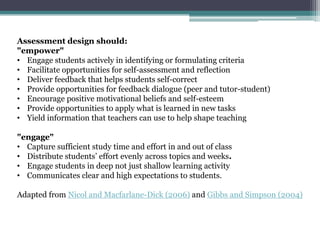
Assessment design should: "empower" Engage students actively in identifying or formulating criteria
Facilitate opportunities for self-assessment and reflection
Deliver feedback that helps students self-correct
Provide opportunities for feedback dialogue (peer and tutor-student)
Encourage positive motivational beliefs and self-esteem
Provide opportunities to apply what is learned in new tasks
Yield information that teachers can use to help shape teaching "engage"Capture sufficient study time and effort in and out of class
Distribute students’ effort evenly across topics and weeks.
Engage students in deep not just shallow learning activity
Communicates clear and high expectations to students. Adapted from Nicol and Macfarlane-Dick (2006) and Gibbs and Simpson (2004)
it is important that students understand that feedback is an evaluation, not of the person but of the performance in context
Use of Online Quizzes and Homework - LanguagesStrathclyde Unihttp://www.reap.ac.ukMichele Dickson - 2007
Department: Department of Modern Languages Class/Course: French 1A Students: 200
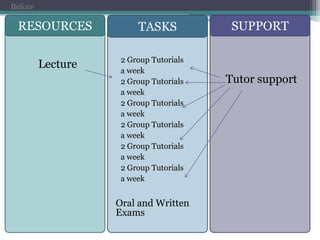
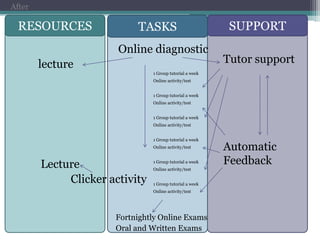
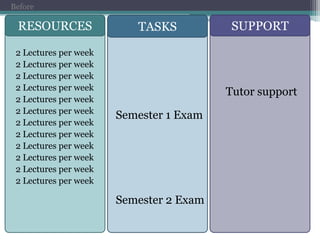
BeforeSUPPORTRESOURCESTASKsLecture2 Group Tutorialsa week2 Group Tutorialsa week2 Group Tutorialsa week2 Group Tutorialsa week2 Group Tutorialsa week2 Group Tutorialsa weekTutor supportOral and Written Exams
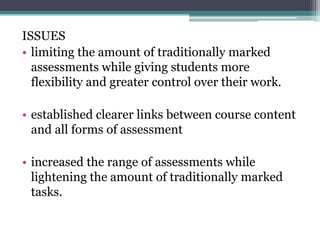
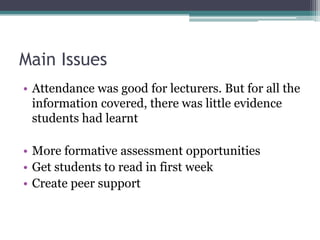
ISSUESlimiting the amount of traditionally marked assessments while giving students more flexibility and greater control over their work.established clearer links between course content and all forms of assessmentincreased the range of assessments while lightening the amount of traditionally marked tasks.
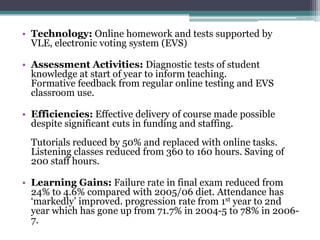
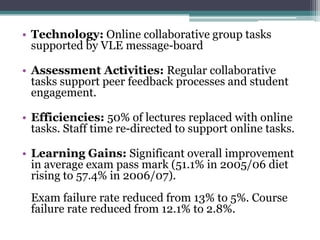
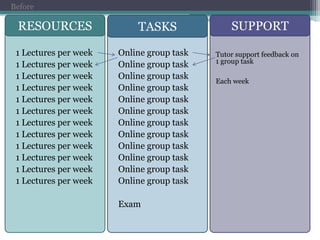
Technology: Online homework and tests supported by VLE, electronic voting system (EVS) Assessment Activities: Diagnostic tests of student knowledge at start of year to inform teaching.Formative feedback from regular online testing and EVS classroom use. Efficiencies: Effective delivery of course made possible despite significant cuts in funding and staffing. Tutorials reduced by 50% and replaced with online tasks. Listening classes reduced from 360 to 160 hours. Saving of 200 staff hours. Learning Gains: Failure rate in final exam reduced from 24% to 4.6% compared with 2005/06 diet. Attendance has ‘markedly’ improved. progression rate from 1st year to 2nd year which has gone up from 71.7% in 2004-5 to 78% in 2006-7.

Pg cert lthe jim turner

  • 1.
    Assessment design should:"empower" Engage students actively in identifying or formulating criteria
  • 2.
    Facilitate opportunities forself-assessment and reflection
  • 3.
    Deliver feedback thathelps students self-correct
  • 4.
    Provide opportunities forfeedback dialogue (peer and tutor-student)
  • 5.
    Encourage positive motivationalbeliefs and self-esteem
  • 6.
    Provide opportunities toapply what is learned in new tasks
  • 7.
    Yield information thatteachers can use to help shape teaching "engage"Capture sufficient study time and effort in and out of class
  • 8.
    Distribute students’ effortevenly across topics and weeks.
  • 9.
    Engage students indeep not just shallow learning activity
  • 10.
    Communicates clear andhigh expectations to students. Adapted from Nicol and Macfarlane-Dick (2006) and Gibbs and Simpson (2004)
  • 11.
    it is importantthat students understand that feedback is an evaluation, not of the person but of the performance in context
  • 12.
    Use of OnlineQuizzes and Homework - LanguagesStrathclyde Unihttp://www.reap.ac.ukMichele Dickson - 2007
  • 13.
    Department: Department ofModern Languages Class/Course: French 1A Students: 200
  • 14.
    BeforeSUPPORTRESOURCESTASKsLecture2 Group Tutorialsaweek2 Group Tutorialsa week2 Group Tutorialsa week2 Group Tutorialsa week2 Group Tutorialsa week2 Group Tutorialsa weekTutor supportOral and Written Exams
  • 15.
    ISSUESlimiting the amountof traditionally marked assessments while giving students more flexibility and greater control over their work.established clearer links between course content and all forms of assessmentincreased the range of assessments while lightening the amount of traditionally marked tasks.
  • 16.
    Technology: Online homeworkand tests supported by VLE, electronic voting system (EVS) Assessment Activities: Diagnostic tests of student knowledge at start of year to inform teaching.Formative feedback from regular online testing and EVS classroom use. Efficiencies: Effective delivery of course made possible despite significant cuts in funding and staffing. Tutorials reduced by 50% and replaced with online tasks. Listening classes reduced from 360 to 160 hours. Saving of 200 staff hours. Learning Gains: Failure rate in final exam reduced from 24% to 4.6% compared with 2005/06 diet. Attendance has ‘markedly’ improved. progression rate from 1st year to 2nd year which has gone up from 71.7% in 2004-5 to 78% in 2006-7.

Editor's Notes

  • #8 subject phamancylevel - 3numbers - 240issue - don't get much practice with particular key learning outcome. this was supported by lab practice, but is now supported with onlin simulation with automated feedback.
  • #14 subject phamancylevel - 3numbers - 240issue - don't get much practice with particular key learning outcome. this was supported by lab practice, but is now supported with onlin simulation with automated feedback.