










•

Roles of a Trainer
What a Trainer Should Do Well
Feedback & Evaluation

•

Vaidehi Suryavanshi

•
•

1
2
3


Your training goals should support the goals of
your organization overall purpose(s) long
range visions broad

4












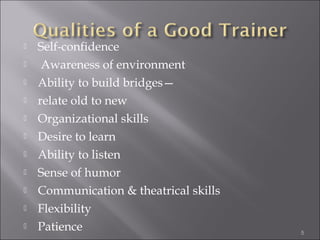
Self-confidence
Awareness of environment
Ability to build bridges—
relate old to new
Organizational skills
Desire to learn
Ability to listen
Sense of humor
Communication & theatrical skills
Flexibility
Patience

5



Cool head &
warm heart

6







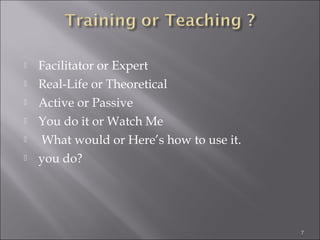
Facilitator or Expert
Real-Life or Theoretical
Active or Passive
You do it or Watch Me
What would or Here’s how to use it.
you do?

7
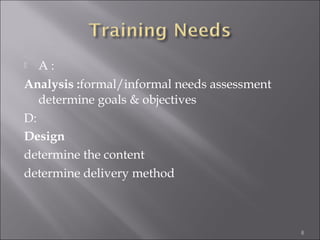
A:
Analysis :formal/informal needs assessment
determine goals & objectives
D:
Design
determine the content
determine delivery method


8
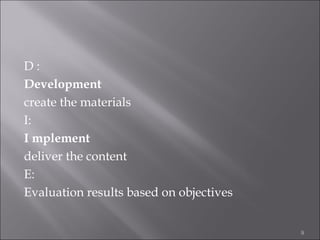
D:
Development
create the materials
I:
I mplement
deliver the content
E:
Evaluation results based on objectives
9






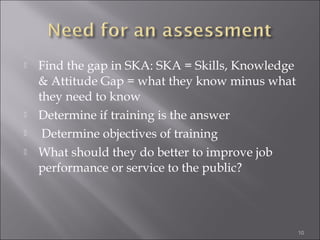
Find the gap in SKA: SKA = Skills, Knowledge
& Attitude Gap = what they know minus what
they need to know
Determine if training is the answer
Determine objectives of training
What should they do better to improve job
performance or service to the public?

10









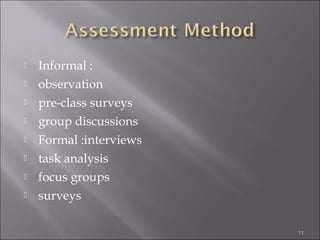
Informal :
observation
pre-class surveys
group discussions
Formal :interviews
task analysis
focus groups
surveys
11
12
13
14
15
16
17


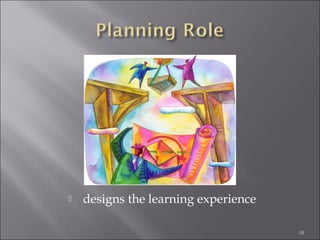
designs the learning experience
18


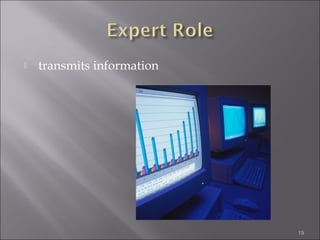
transmits information

19


directs the learning situation
20


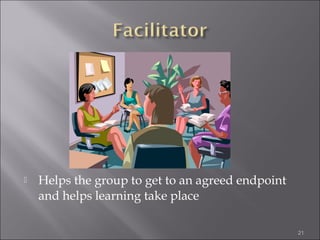
Helps the group to get to an agreed endpoint
and helps learning take place
21


Provides materials & information
22


Models or influences
behavior & values

23


learns along side the
trainee

24
•
•
•
•

Understands basic teaching methods and
applies this knowledge
Communicating
Facilitating
Presenting (separate sessions)

25
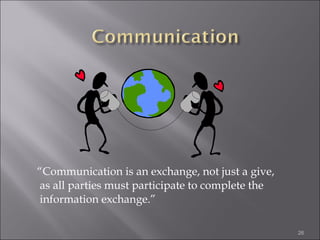
“Communication is an exchange, not just a give,
as all parties must participate to complete the
information exchange.”
26
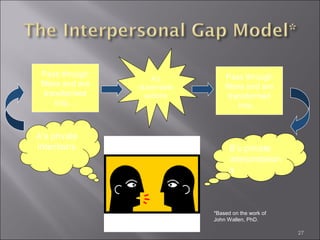
Pass through
filters and are
transformed
Into…

A’s private
intentions

A’s
observable
actions

Pass through
filters and are
transformed
Into…

B’s private
interpretation
s

*Based on the work of
John Wallen, PhD.
27
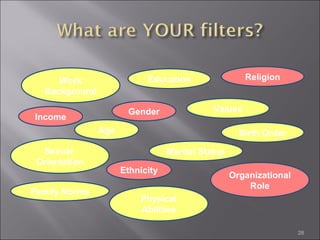
Religion

Education

Work
Background

Values

Gender

Income
Age
Sexual
Orientation
Family Norms

Birth Order
Marital Status
Ethnicity

Organizational
Role

Physical
Abilities
28


exercise

29









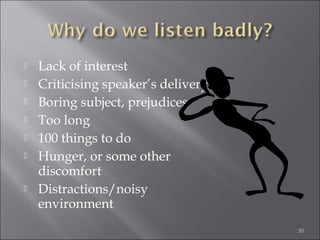
Lack of interest
Criticising speaker’s delivery
Boring subject, prejudices
Too long
100 things to do
Hunger, or some other
discomfort
Distractions/noisy
environment
30
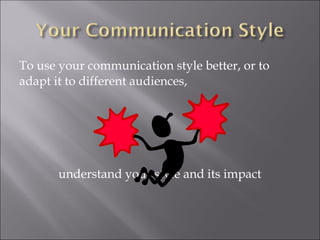
To use your communication style better, or to
adapt it to different audiences,

understand your style and its impact




A person who helps a group
to work together in a
collaborative way, by focusing
on the process of how the
group members work
together
Helps the group to get to an
agreed endpoint and helps
learning take place (both for
the group and for
individuals within it)
32
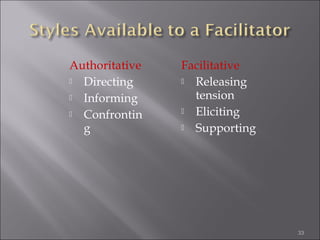
Authoritative
 Directing
 Informing
 Confrontin
g

Facilitative
 Releasing
tension
 Eliciting
 Supporting

33


Facilitator uses questions to
help a group identify,
explore, clarify and develop
their understanding, and
also help them decide what
to do

34
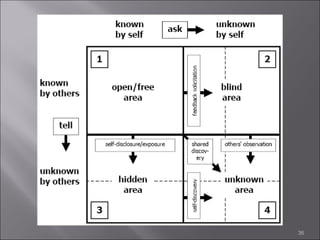
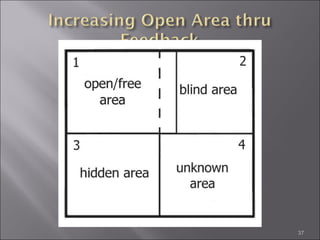
Johari’s Window

35
36
37
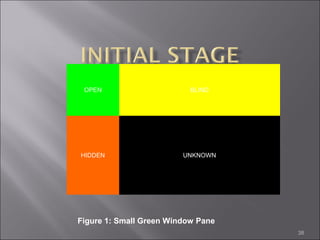
OPEN

BLIND

HIDDEN

UNKNOWN

Figure 1: Small Green Window Pane
38






To expand Leadership (Green area) you have
the Red and Yellow Pills to offer
The Red Pill is disclosure and the Yellow pill
is willingness to take in feedback.
Leaders who do not disclose and do not take
feedback, do not make very effective leaders.

39
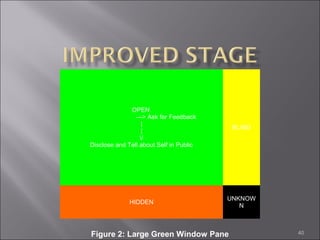
OPEN
---> Ask for Feedback
|
|
/
Disclose and Tell about Self in Public

BLIND

HIDDEN

UNKNOW
N

Figure 2: Large Green Window Pane

40
41




Takes up all the time
with their own issues,
making it difficult for
others to participate
Interrupts, fails to listen
and generally dominates
discussions

42




Continually finds
fault with
everything
Is not a problem
solver, but a
problem seeker

43


Reluctant to participate

44




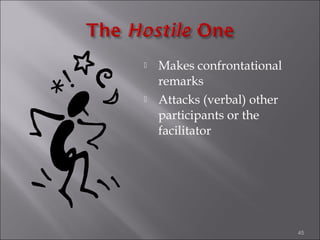
Makes confrontational
remarks
Attacks (verbal) other
participants or the
facilitator

45




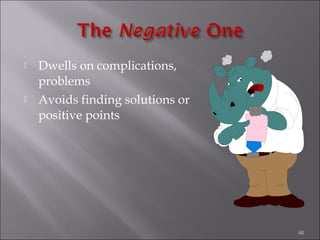
Dwells on complications,
problems
Avoids finding solutions or
positive points

46




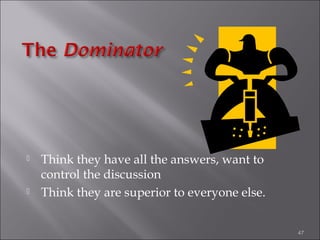
Think they have all the answers, want to
control the discussion
Think they are superior to everyone else.
47


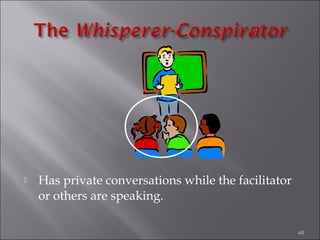
Has private conversations while the facilitator
or others are speaking.
48


Uses humour to
distract or put down
others

49




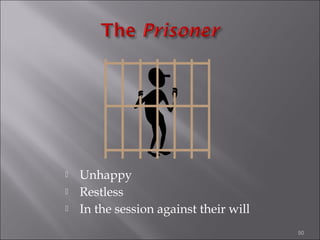
Unhappy
Restless
In the session against their will
50
51
Feedback

52
53
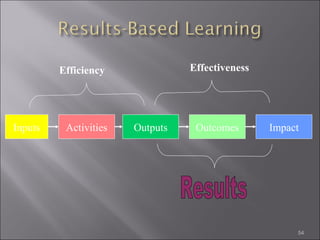
Effectiveness

Efficiency

Inputs

Activities

Outputs

Outcomes

Impact

54
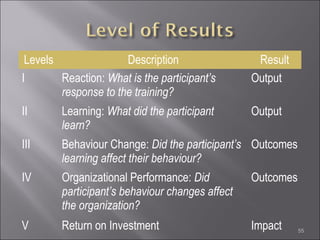
Levels
Description
I
Reaction: What is the participant’s
response to the training?

Result
Output

II

Learning: What did the participant
learn?

Output

III

Behaviour Change: Did the participant’s Outcomes
learning affect their behaviour?

IV

Organizational Performance: Did
participant’s behaviour changes affect
the organization?

Outcomes

V

Return on Investment

Impact

55
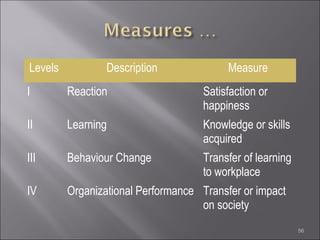
Levels

Description

Measure

I

Reaction

Satisfaction or
happiness

II

Learning

Knowledge or skills
acquired

III

Behaviour Change

Transfer of learning
to workplace

IV

Organizational Performance Transfer or impact
on society
56






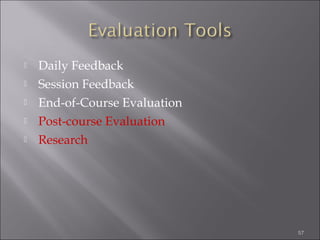
Daily Feedback
Session Feedback
End-of-Course Evaluation
Post-course Evaluation
Research

57


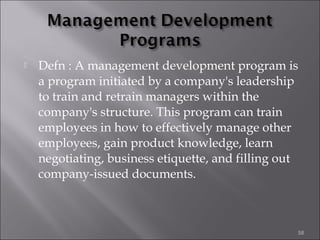
Defn : A management development program is
a program initiated by a company's leadership
to train and retrain managers within the
company's structure. This program can train
employees in how to effectively manage other
employees, gain product knowledge, learn
negotiating, business etiquette, and filling out
company-issued documents. 

58






Management development programs differ among
companies.
It was earlier also known as “Management Training
programme “
Management training was developed to help
supervisors who were subject-matter experts in
their field improve their people skills.

59


Human relations became an area that
companies recognized needed improvement
when unionization became prevalent.
Employees did not feel appreciated and many
managers were at a loss to motivate the
workers they supervised. The imbalance in
manager/employee relations was found to
have a direct impact on company profitability.

60


Managers needed a broader scope of abilities,
including handling people issues, delegating
responsibilities and coaching employees. In
response,companies and universities began
teaching management training programs.
These incorporated real-world experience as
ideas with classroom instruction, which was
then tried out in the field.

61


The principles that worked, such as strategic
operations management, were kept and those
that were not, such as the authoritarian model
of managing, were abandoned, because these
methods were proved to be ineffective ways to
oversee employees.

62


There are many types of management training
programs available in in the workplace today,
including the authoritarian model, the
paternalistic model and the egalitarian model.
This egalitarian model has several names and
variations, but basically it incorporates a
holistic view of training both supervisory as
well as nonsupervisory employees.

63


Education is its basic principle, since it became
apparent that people who understood how the
company worked, what its product lines were
and how they were used, and how earnings
and profits were calculated were more
productive and happy in their jobs. This is the
dominant model in today's business climate.

64


In the 1980s and 1990s, this management training
programs became even more prolific and varied
after the successes of Japanese techniques like
Juran became prevalent. The marketplace
demanded that U.S. companies fall in line with
initiatives like Total Quality Management and
ISO 9000 to remain competitive at home and
abroad.



65


These programs now incorporate quantitative
measurements as their backbone. They espouse
the need for tying everyone's earnings into the
company's productivity numbers. Managers
are trained in encouraging a democratic and
participative work environment where
employee ideas are solicited and initiated when
appropriate.



66


Companies rain new managers extensively on
these techniques before promoting them to
oversee the business, though much on-the-job
training is typical. Today, some laws even
require supervisors to receive certain
instruction like sexual harassment training.
Lawsuits and union grievances have
necessitated that even small companies
embrace management training programs to
avoid legal entanglements with litigious
employees.
67




Management training programs continue to
thrive. As management gurus repackage and
reformulate their philosophies, programs are
further streamlined and in some cases, improved.
Not all companies are up to speed with
management training programs, but many will
eventually support them, or else risk being
eliminated by competition in the global
marketplace that treats their employees with
respect and gains the best result in the form of
profits.
68


Management training programs will continue
to thrive in the future. They are being
introduced developing countries are gradually
improving the caliber of management and
quality of life for employees



69


Britannia Case study

70


The Management Development Program
prepares you to become a better leader of your
unit, department or college, as well as a more
valuable contributor to broader institutional
goals.

71


As a middle manager in organisation, you face
a distinctive set of leadership challenges. You
are responsible for leading your administrative
units, crafting strategy, motivating staff and
allocating financial resources, but are also
expected to enact the vision of senior
leadership and mobilize support for broader
institutional goals. To be successful, you must
be able to effectively manage both “up” and
“down” the organizational hierarchy.
72


Through real-world case studies, small group
discussions and interactive presentations, MDP
teaches you to think beyond your own
discipline and lead in ways that support larger
institutional objectives. You will gain a deeper
understanding of how different units function
and will be able to incorporate broader
strategic considerations into your management
decisions.

73




MDP provides the tools and insight to think
more strategically, balance the competing
demands of colleagues and spend more time
providing forward-thinking leadership.
Management Development Programs are
designed to foster a pipeline of creative talent
that will rotate through multiple departments
in a structured process.

74




These programs, which often last between 18
months and 3 years, provide individuals with
the knowledge and skills necessary to fast track
their careers (often resulting in placement in a
managerial position at the end of the program)
and provide the organization with a new
generation of talented leaders.
Management Development Programs are also
referred to as Leadership Development
Programs, Rotation(al) Programs, Management
Trainee Programs, and Trainee Programs.
75









Programs provide a better understanding of
the overall working of the organization and the
operations involved inside the
organization.
• Exposure to all the important activities and
operations of the business.
• First hand experience of the functioning of
the organization, from the very top to the
bottom of the management ladder.
• Become more effective and efficient
managers and leaders.
76








Those in the program are recognized as
potential candidates for top positions in the
future.
• Able to understand the routine work and
communication within the organization
• Broad exposure: Project rotations provide
valuable networking opportunities, including
division, plant and corporate contacts
• In-class learning in addition to on-the-job
experience while promoting leadership skill
development and professional growth.

77









Provides valuable experience in many facets of
business.
• Since most Management Development
Programs spend short stints in many different
areas, these programs provide a good
amount of diversity and variety for its trainees.
• Often results in placement in a preferred
area or field.
•
78




Provides the transferable skills, knowledge,
and entrepreneurial mindset for various other
careers/opportunities
Considered one of, if not the, fastest track to
management for entry-level positions after
college.

79


he difference between training and
management development tends to lie in
timing. Typically, training is the process by
which people are taught critical skills.
Participants gain knowledge to carry out their
current responsibilities. To goal is to improve
performance in the short term. Development
activities, on the other hand, tend to prepare
people for additional job roles for the long
term..
80


Training usually refers to organized group
events, such as workshops, classes or seminars
that have a beginning and end date.
Development tends to refer to more
personalized, individualized experiences, such
as a certification process, job rotation period,
coaching or mentoring. Small-business owners
can take advantage of the Small Business
Administration Training Network for both
training and management development needs
81


Training professionals develop and deliver
instructional programs to produce performance
changes in participants. Training courses
usually include detailed agendas, explicit
learning objectives and a clearly defined formal
curriculum.

82


Less formally, human resources professionals
coordinate management development
programs to motivate, inspire and generate
personal growth. These programs enable
succession planning and ensure that qualified
personnel have the skills, knowledge and
experience to take over company leadership
when older executives retire or reduce their
role in the company. Small-business owners
can guide employees to use Internet websites
that provide free training resources, such as
MindTools, for career development.

83


Companies typically offer both training and
management-development programs to their
staff to foster growth, provide opportunities
and build employee morale. Employees
appreciate these programs because enrichment
opportunities allow these workers to improve
operations and accept greater challenges,
possibly resulting in higher pay.

84


Training programs usually address remedial
problems and improve on-the-job performance,
making it possible for employees to work
safely and effectively. Management
development programs enable employees to
progress in their careers. Small-business
owners can utilize free resources, such as the
Massachusetts Institute of Technology's free
online course materials website, to provide
enrichment opportunities to themselves and
their employees.
85


Providing training and managementdevelopment programs to employees benefits
employers by developing the team skills
required to achieve organizational goals.
Training programs motivate employees to
reach higher standards, improve operational
efficiency and increase customer satisfaction.

86


Longer term, management-development
programs prepare employees for promotional
opportunities and tend to decrease employee
turnover, increase morale and spark innovation
and creativity. Successful small-business
owners use training and management
development to grow and expand their
business by developing their staff.

87


Determining training needs involves assessing
employee performance to develop a skills-gap
analysis. Employees may request training
themselves, when presented with a new
assignment or task, changes in technology or
process and procedure updates. Changes in the
company’s mission or value statements often
dictate the need for management development
to match the new direction.

88


Additionally, performance reviews may
demonstrate the need for both remedial
training and management development
opportunities, depending on the individual.

89


Training programs usually include traditional
instructor-led courses, workshops and
seminars as well as newer options, such as
web-based training, video-based courses and
distance-learning alternatives. Training topics
typically include how to use software
applications, follow procedures or use
hardware products and services.

90


Management development programs typically
provide resources for personnel to increase
their skills in communication, business
acumen, project management or customer
service. Training tends to include formal
events, such as orientation training, diversity
workshop or work/life balance seminars.
Management development activities tend to
occur on an informal, flexible schedule, based
on the individual employee’s needs
assessment.
91


Effective small-business owners plan for both
training and management development
activities that fit their budget and strategy.

92

Train the trainer (1)

  • 1.
    • Roles of aTrainer What a Trainer Should Do Well Feedback & Evaluation • Vaidehi Suryavanshi • • 1
  • 2.
  • 3.
  • 4.
     Your training goalsshould support the goals of your organization overall purpose(s) long range visions broad 4
  • 5.
               Self-confidence Awareness of environment Abilityto build bridges— relate old to new Organizational skills Desire to learn Ability to listen Sense of humor Communication & theatrical skills Flexibility Patience 5
  • 6.
  • 7.
          Facilitator or Expert Real-Lifeor Theoretical Active or Passive You do it or Watch Me What would or Here’s how to use it. you do? 7
  • 8.
    A: Analysis :formal/informal needsassessment determine goals & objectives D: Design determine the content determine delivery method  8
  • 9.
    D: Development create the materials I: Implement deliver the content E: Evaluation results based on objectives 9
  • 10.
        Find the gapin SKA: SKA = Skills, Knowledge & Attitude Gap = what they know minus what they need to know Determine if training is the answer Determine objectives of training What should they do better to improve job performance or service to the public? 10
  • 11.
            Informal : observation pre-class surveys groupdiscussions Formal :interviews task analysis focus groups surveys 11
  • 12.
  • 13.
  • 14.
  • 15.
  • 16.
  • 17.
  • 18.
  • 19.
  • 20.
  • 21.
     Helps the groupto get to an agreed endpoint and helps learning take place 21
  • 22.
  • 23.
  • 24.
     learns along sidethe trainee 24
  • 25.
    • • • • Understands basic teachingmethods and applies this knowledge Communicating Facilitating Presenting (separate sessions) 25
  • 26.
    “Communication is anexchange, not just a give, as all parties must participate to complete the information exchange.” 26
  • 27.
    Pass through filters andare transformed Into… A’s private intentions A’s observable actions Pass through filters and are transformed Into… B’s private interpretation s *Based on the work of John Wallen, PhD. 27
  • 28.
  • 29.
  • 30.
           Lack of interest Criticisingspeaker’s delivery Boring subject, prejudices Too long 100 things to do Hunger, or some other discomfort Distractions/noisy environment 30
  • 31.
    To use yourcommunication style better, or to adapt it to different audiences, understand your style and its impact
  • 32.
      A person whohelps a group to work together in a collaborative way, by focusing on the process of how the group members work together Helps the group to get to an agreed endpoint and helps learning take place (both for the group and for individuals within it) 32
  • 33.
    Authoritative  Directing  Informing Confrontin g Facilitative  Releasing tension  Eliciting  Supporting 33
  • 34.
     Facilitator uses questionsto help a group identify, explore, clarify and develop their understanding, and also help them decide what to do 34
  • 35.
  • 36.
  • 37.
  • 38.
  • 39.
       To expand Leadership(Green area) you have the Red and Yellow Pills to offer The Red Pill is disclosure and the Yellow pill is willingness to take in feedback. Leaders who do not disclose and do not take feedback, do not make very effective leaders. 39
  • 40.
    OPEN ---> Ask forFeedback | | / Disclose and Tell about Self in Public BLIND HIDDEN UNKNOW N Figure 2: Large Green Window Pane 40
  • 41.
  • 42.
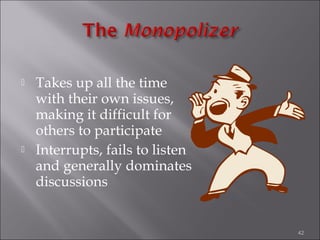
      Takes up allthe time with their own issues, making it difficult for others to participate Interrupts, fails to listen and generally dominates discussions 42
  • 43.
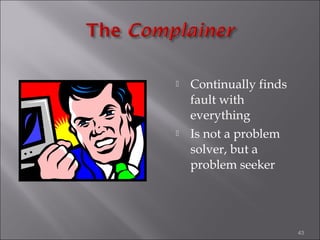
      Continually finds fault with everything Isnot a problem solver, but a problem seeker 43
  • 44.
  • 45.
      Makes confrontational remarks Attacks (verbal)other participants or the facilitator 45
  • 46.
      Dwells on complications, problems Avoidsfinding solutions or positive points 46
  • 47.
      Think they haveall the answers, want to control the discussion Think they are superior to everyone else. 47
  • 48.
     Has private conversationswhile the facilitator or others are speaking. 48
  • 49.
     Uses humour to distractor put down others 49
  • 50.
  • 51.
  • 52.
  • 53.
  • 54.
  • 55.
    Levels Description I Reaction: What isthe participant’s response to the training? Result Output II Learning: What did the participant learn? Output III Behaviour Change: Did the participant’s Outcomes learning affect their behaviour? IV Organizational Performance: Did participant’s behaviour changes affect the organization? Outcomes V Return on Investment Impact 55
  • 56.
    Levels Description Measure I Reaction Satisfaction or happiness II Learning Knowledge orskills acquired III Behaviour Change Transfer of learning to workplace IV Organizational Performance Transfer or impact on society 56
  • 57.
         Daily Feedback Session Feedback End-of-CourseEvaluation Post-course Evaluation Research 57
  • 58.
     Defn : Amanagement development program is a program initiated by a company's leadership to train and retrain managers within the company's structure. This program can train employees in how to effectively manage other employees, gain product knowledge, learn negotiating, business etiquette, and filling out company-issued documents.  58
  • 59.
       Management development programsdiffer among companies. It was earlier also known as “Management Training programme “ Management training was developed to help supervisors who were subject-matter experts in their field improve their people skills. 59
  • 60.
     Human relations becamean area that companies recognized needed improvement when unionization became prevalent. Employees did not feel appreciated and many managers were at a loss to motivate the workers they supervised. The imbalance in manager/employee relations was found to have a direct impact on company profitability. 60
  • 61.
     Managers needed abroader scope of abilities, including handling people issues, delegating responsibilities and coaching employees. In response,companies and universities began teaching management training programs. These incorporated real-world experience as ideas with classroom instruction, which was then tried out in the field. 61
  • 62.
     The principles thatworked, such as strategic operations management, were kept and those that were not, such as the authoritarian model of managing, were abandoned, because these methods were proved to be ineffective ways to oversee employees. 62
  • 63.
     There are manytypes of management training programs available in in the workplace today, including the authoritarian model, the paternalistic model and the egalitarian model. This egalitarian model has several names and variations, but basically it incorporates a holistic view of training both supervisory as well as nonsupervisory employees. 63
  • 64.
     Education is itsbasic principle, since it became apparent that people who understood how the company worked, what its product lines were and how they were used, and how earnings and profits were calculated were more productive and happy in their jobs. This is the dominant model in today's business climate. 64
  • 65.
     In the 1980sand 1990s, this management training programs became even more prolific and varied after the successes of Japanese techniques like Juran became prevalent. The marketplace demanded that U.S. companies fall in line with initiatives like Total Quality Management and ISO 9000 to remain competitive at home and abroad.  65
  • 66.
     These programs nowincorporate quantitative measurements as their backbone. They espouse the need for tying everyone's earnings into the company's productivity numbers. Managers are trained in encouraging a democratic and participative work environment where employee ideas are solicited and initiated when appropriate.  66
  • 67.
     Companies rain newmanagers extensively on these techniques before promoting them to oversee the business, though much on-the-job training is typical. Today, some laws even require supervisors to receive certain instruction like sexual harassment training. Lawsuits and union grievances have necessitated that even small companies embrace management training programs to avoid legal entanglements with litigious employees. 67
  • 68.
      Management training programscontinue to thrive. As management gurus repackage and reformulate their philosophies, programs are further streamlined and in some cases, improved. Not all companies are up to speed with management training programs, but many will eventually support them, or else risk being eliminated by competition in the global marketplace that treats their employees with respect and gains the best result in the form of profits. 68
  • 69.
     Management training programswill continue to thrive in the future. They are being introduced developing countries are gradually improving the caliber of management and quality of life for employees  69
  • 70.
  • 71.
     The Management DevelopmentProgram prepares you to become a better leader of your unit, department or college, as well as a more valuable contributor to broader institutional goals. 71
  • 72.
     As a middlemanager in organisation, you face a distinctive set of leadership challenges. You are responsible for leading your administrative units, crafting strategy, motivating staff and allocating financial resources, but are also expected to enact the vision of senior leadership and mobilize support for broader institutional goals. To be successful, you must be able to effectively manage both “up” and “down” the organizational hierarchy. 72
  • 73.
     Through real-world casestudies, small group discussions and interactive presentations, MDP teaches you to think beyond your own discipline and lead in ways that support larger institutional objectives. You will gain a deeper understanding of how different units function and will be able to incorporate broader strategic considerations into your management decisions. 73
  • 74.
      MDP provides thetools and insight to think more strategically, balance the competing demands of colleagues and spend more time providing forward-thinking leadership. Management Development Programs are designed to foster a pipeline of creative talent that will rotate through multiple departments in a structured process. 74
  • 75.
      These programs, whichoften last between 18 months and 3 years, provide individuals with the knowledge and skills necessary to fast track their careers (often resulting in placement in a managerial position at the end of the program) and provide the organization with a new generation of talented leaders. Management Development Programs are also referred to as Leadership Development Programs, Rotation(al) Programs, Management Trainee Programs, and Trainee Programs. 75
  • 76.
         Programs provide abetter understanding of the overall working of the organization and the operations involved inside the organization. • Exposure to all the important activities and operations of the business. • First hand experience of the functioning of the organization, from the very top to the bottom of the management ladder. • Become more effective and efficient managers and leaders. 76
  • 77.
        Those in theprogram are recognized as potential candidates for top positions in the future. • Able to understand the routine work and communication within the organization • Broad exposure: Project rotations provide valuable networking opportunities, including division, plant and corporate contacts • In-class learning in addition to on-the-job experience while promoting leadership skill development and professional growth. 77
  • 78.
         Provides valuable experiencein many facets of business. • Since most Management Development Programs spend short stints in many different areas, these programs provide a good amount of diversity and variety for its trainees. • Often results in placement in a preferred area or field. • 78
  • 79.
      Provides the transferableskills, knowledge, and entrepreneurial mindset for various other careers/opportunities Considered one of, if not the, fastest track to management for entry-level positions after college. 79
  • 80.
     he difference betweentraining and management development tends to lie in timing. Typically, training is the process by which people are taught critical skills. Participants gain knowledge to carry out their current responsibilities. To goal is to improve performance in the short term. Development activities, on the other hand, tend to prepare people for additional job roles for the long term.. 80
  • 81.
     Training usually refersto organized group events, such as workshops, classes or seminars that have a beginning and end date. Development tends to refer to more personalized, individualized experiences, such as a certification process, job rotation period, coaching or mentoring. Small-business owners can take advantage of the Small Business Administration Training Network for both training and management development needs 81
  • 82.
     Training professionals developand deliver instructional programs to produce performance changes in participants. Training courses usually include detailed agendas, explicit learning objectives and a clearly defined formal curriculum. 82
  • 83.
     Less formally, humanresources professionals coordinate management development programs to motivate, inspire and generate personal growth. These programs enable succession planning and ensure that qualified personnel have the skills, knowledge and experience to take over company leadership when older executives retire or reduce their role in the company. Small-business owners can guide employees to use Internet websites that provide free training resources, such as MindTools, for career development. 83
  • 84.
     Companies typically offerboth training and management-development programs to their staff to foster growth, provide opportunities and build employee morale. Employees appreciate these programs because enrichment opportunities allow these workers to improve operations and accept greater challenges, possibly resulting in higher pay. 84
  • 85.
     Training programs usuallyaddress remedial problems and improve on-the-job performance, making it possible for employees to work safely and effectively. Management development programs enable employees to progress in their careers. Small-business owners can utilize free resources, such as the Massachusetts Institute of Technology's free online course materials website, to provide enrichment opportunities to themselves and their employees. 85
  • 86.
     Providing training andmanagementdevelopment programs to employees benefits employers by developing the team skills required to achieve organizational goals. Training programs motivate employees to reach higher standards, improve operational efficiency and increase customer satisfaction. 86
  • 87.
     Longer term, management-development programsprepare employees for promotional opportunities and tend to decrease employee turnover, increase morale and spark innovation and creativity. Successful small-business owners use training and management development to grow and expand their business by developing their staff. 87
  • 88.
     Determining training needsinvolves assessing employee performance to develop a skills-gap analysis. Employees may request training themselves, when presented with a new assignment or task, changes in technology or process and procedure updates. Changes in the company’s mission or value statements often dictate the need for management development to match the new direction. 88
  • 89.
     Additionally, performance reviewsmay demonstrate the need for both remedial training and management development opportunities, depending on the individual. 89
  • 90.
     Training programs usuallyinclude traditional instructor-led courses, workshops and seminars as well as newer options, such as web-based training, video-based courses and distance-learning alternatives. Training topics typically include how to use software applications, follow procedures or use hardware products and services. 90
  • 91.
     Management development programstypically provide resources for personnel to increase their skills in communication, business acumen, project management or customer service. Training tends to include formal events, such as orientation training, diversity workshop or work/life balance seminars. Management development activities tend to occur on an informal, flexible schedule, based on the individual employee’s needs assessment. 91
  • 92.
     Effective small-business ownersplan for both training and management development activities that fit their budget and strategy. 92

Editor's Notes

  • #34 Authoritative Ensuring that the group addresses a topic, re-routing the discussion; pointing out what needs to be done Providing knowledge or information; pointing to the connections between the issues; summarizing Challenging by direct questioning; disagreeing with or correcting or critically evaluating group’s statements Facilitative Arousing laughter; giving group member’s permission to release such emotions as anger, embarrassment, irritation or confusion Drawing out opinions, knowledge or abilities; aiding participant interaction; enabling learning by self-insight Approving, reinforcing and affirming
  • #53 Ask the question to the group, agree on a definition that everyone understands and accepts What (Letting people know how they are performing / Confirming / Recognizing /Behaviour modification /Give and Receive) Why (Recognize success and affirm good performance / Reward and encourage good performance / Improve & correct performance / Facilitate learning and change)