How flexible are you when it comes
             to work?


        by Toronto Training and HR

               March 2012
3-4     Introduction to Toronto Training and HR
           5-6     Definition
           7-9     Types of flexible working
Contents   10-12   Contributory factors to increased interest
           13-14   The main flexible systems
           15-16   Introducing flexible working
           17-19   Potential contributions from HR
           20-22   Concerns typically raised by employees
           23-25   Questions to ask when preparing to work flexibly
           26-27   Challenges employers may encounter
           28-29   Typical groups who seek flexible working
           30-33   Effective implementation of flexible working
           34-35   Categories of flexible working arrangements
           36-37   Measuring the success of flexible working
           38-40   Benefits of flexible working
           41-43   Challenges faced by management
           44-45   Change management
           46-51   Teleworking
           52-53   Managing remote working
           54-57   Case studies
           58-59   Conclusion and questions


                         Page 2
Introduction


     Page 3
Introduction to Toronto Training
            and HR
• Toronto Training and HR is a specialist training and human
  resources consultancy headed by Timothy Holden
• 10 years in banking
• 10 years in training and human resources
• Freelance practitioner since 2006
• The core services provided by Toronto Training and HR are:
              - Training event design
              - Training event delivery
              - Reducing costs
              - Saving time
              - Improving employee engagement & morale
              - Services for job seekers

                            Page 4
Definition


   Page 5
Definition
What is flexible working?


                       Page 6
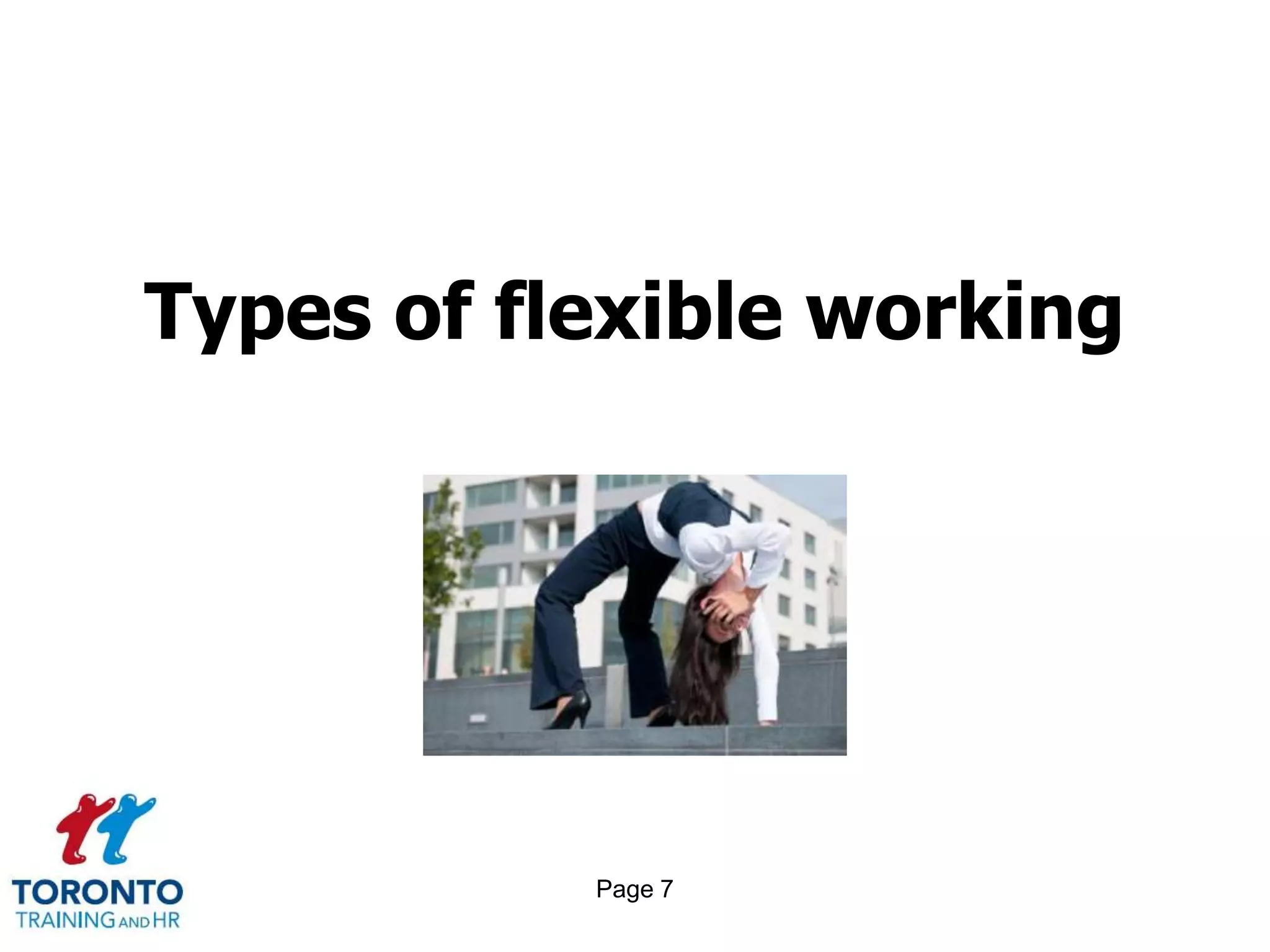
Types of flexible working


           Page 7
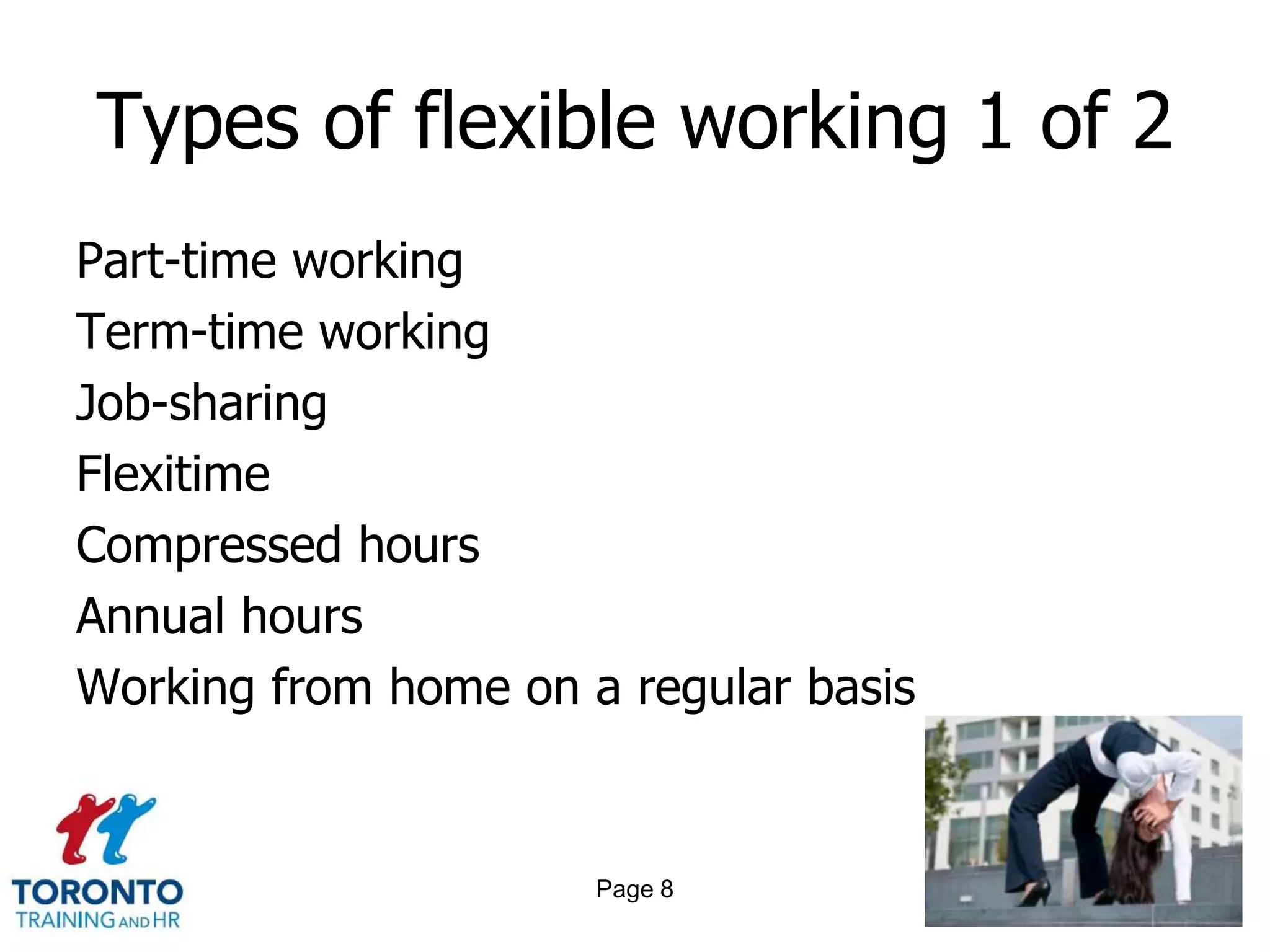
Types of flexible working 1 of 2
Part-time working
Term-time working
Job-sharing
Flexitime
Compressed hours
Annual hours
Working from home on a regular basis


                      Page 8
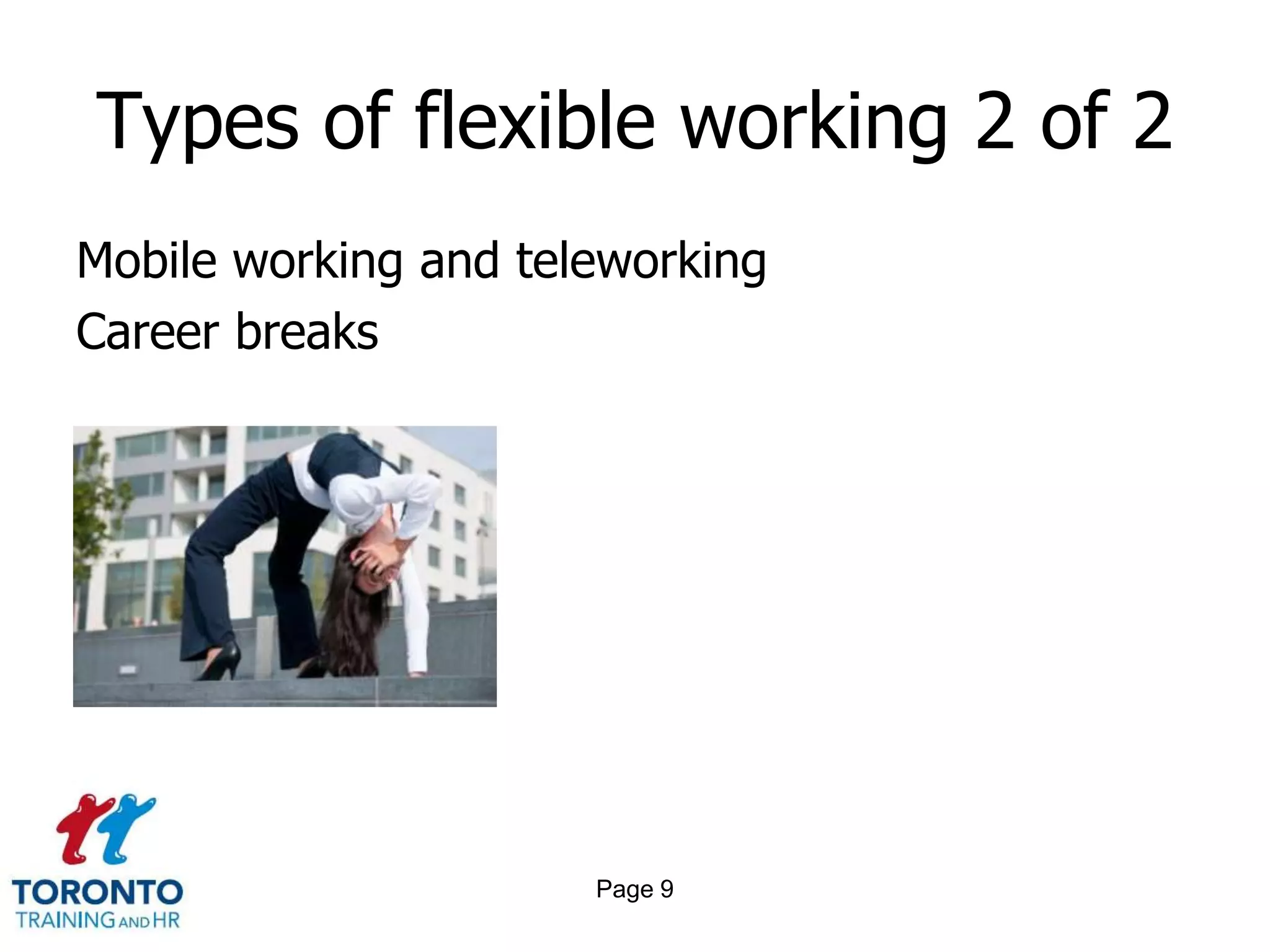
Types of flexible working 2 of 2
Mobile working and teleworking
Career breaks


                      Page 9
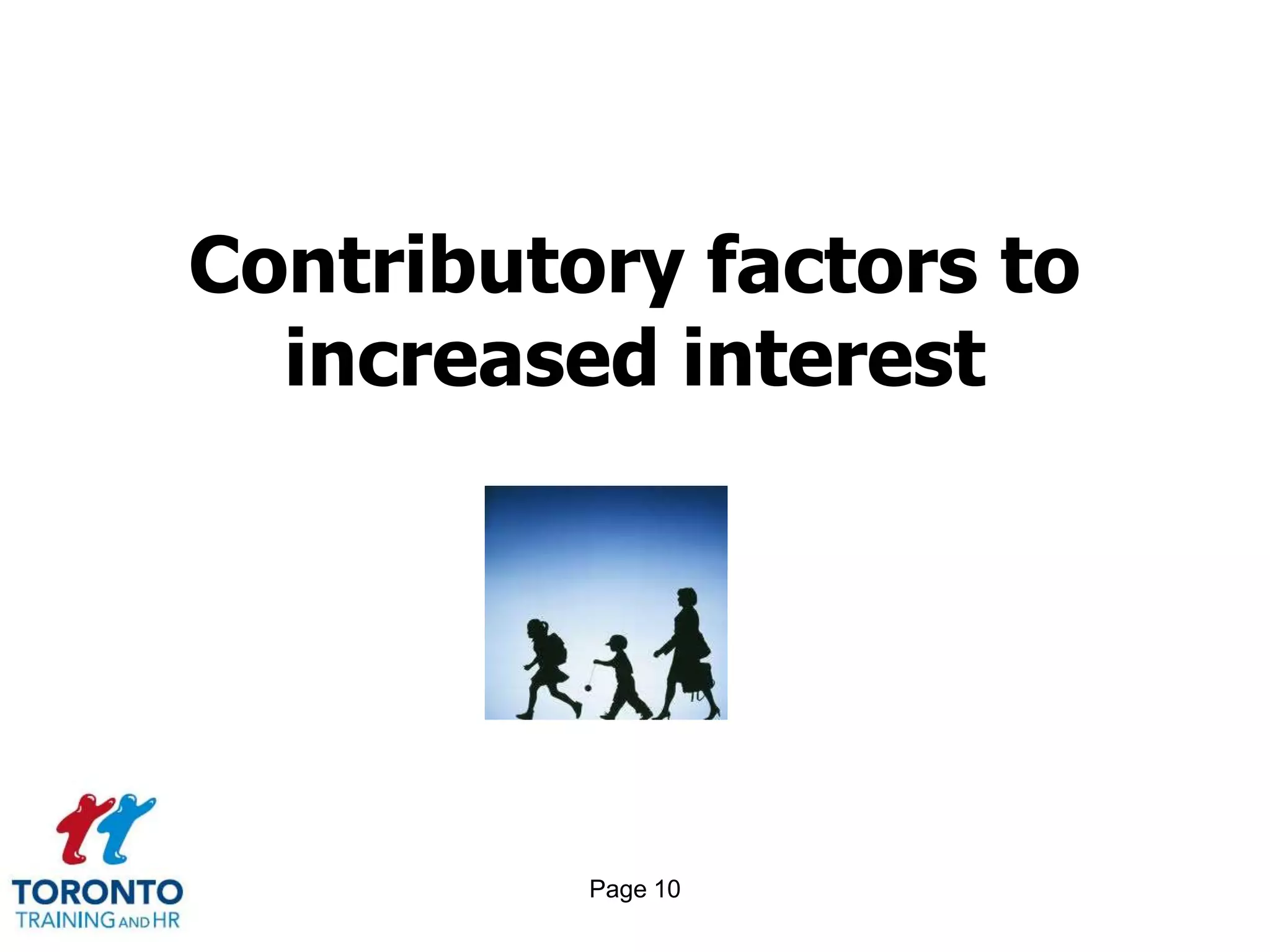
Contributory factors to
  increased interest


          Page 10
Contributory factors to
      increased interest 1 of 2
Its potential value as a recruitment and retention
tool
The changing profile of the workforce (for
example, with more women in the labour market
and an ageing population it is increasingly
common for workers to have caring responsibilities
outside the workplace)
Advances in technology (facilitating, for example,
remote working and hot-desking arrangements)

                       Page 11
Contributory factors to
      increased interest 2 of 2
An increasing need for businesses to be able to
deliver services to customers on a 24/7 basis
The economic situation - some organizations have
offered part-time working or sabbaticals as a
method of avoiding or minimizing redundancies
The increased demand for an effective work-life
balance


                      Page 12
The main flexible systems


           Page 13
The main flexible systems
Annualized hours
Multi-skilling
Outsourcing
Temporary employees and short-term contracts


                     Page 14
Introducing flexible
      working


        Page 15
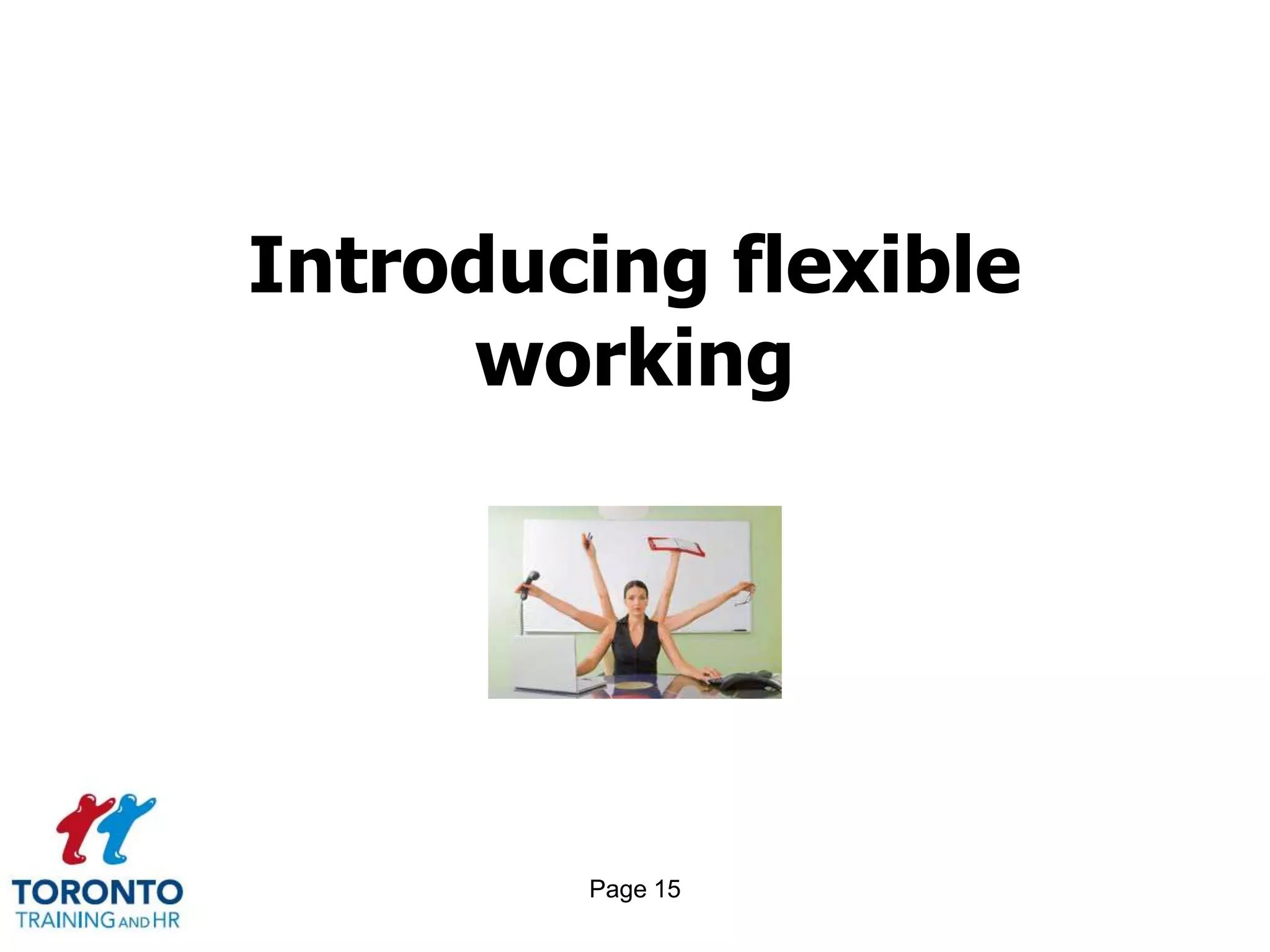
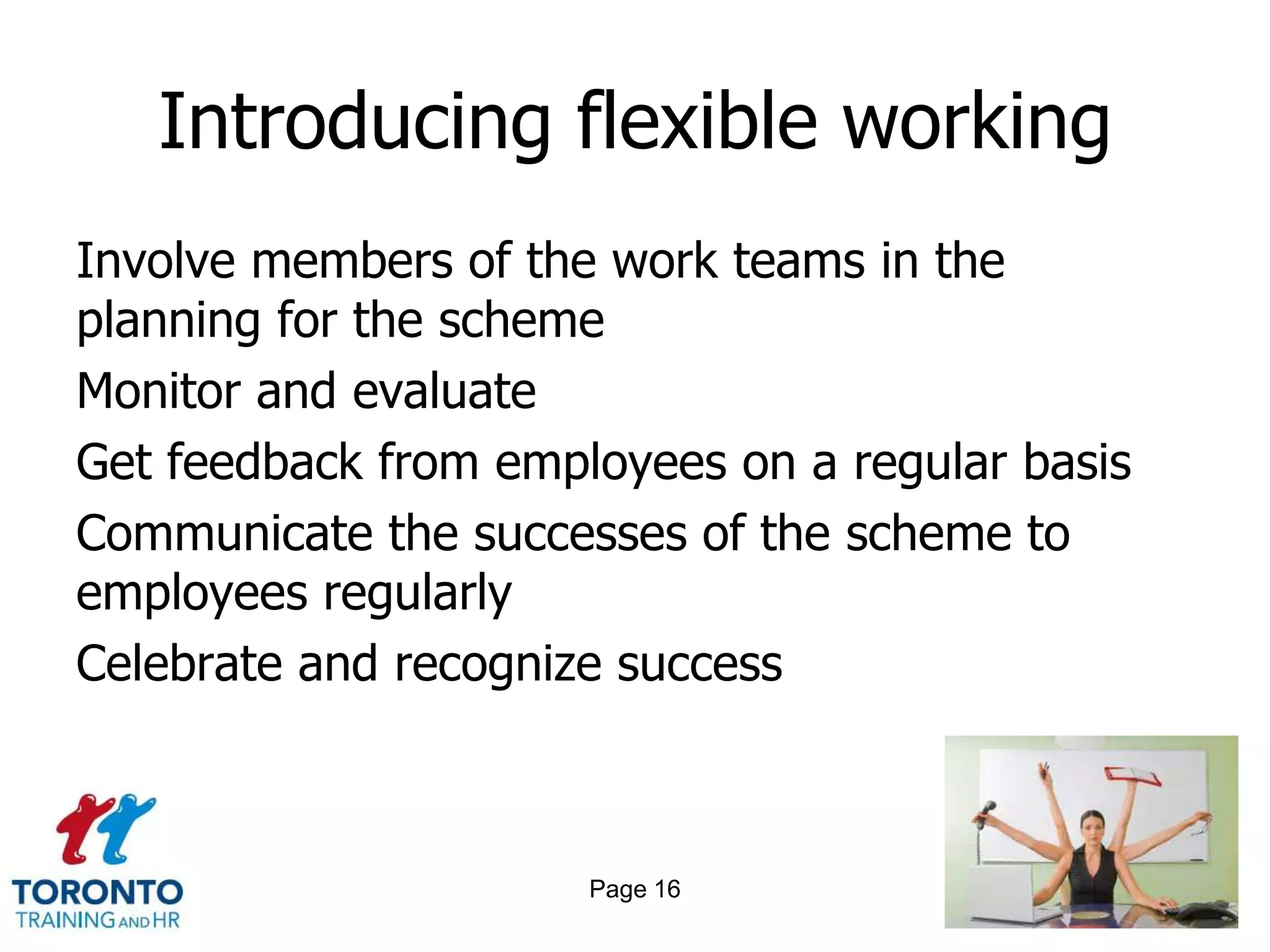
Introducing flexible working
Involve members of the work teams in the
planning for the scheme
Monitor and evaluate
Get feedback from employees on a regular basis
Communicate the successes of the scheme to
employees regularly
Celebrate and recognize success


                      Page 16
Potential contributions
       from HR


          Page 17
Potential contributions from HR
              1 of 2
Providing management information on staffing
costs
Leading contract change negotiations
Researching alternative forms of flexibility and
their impact
Providing management information on employee
availability and preferences over shift patterns


                       Page 18
Potential contributions from HR
              2 of 2
Tying flexible working preferences to reward
packages
Up to date guidance on the current position
regarding health & safety
Sharing best practice with diverse business units
and sharing the lessons learned


                       Page 19
Concerns typically raised
     by employees


           Page 20
Concerns typically raised by
       employees 1 of 2
Will I be expected to work longer or more unsocial
hours than I currently do?
Will I get the right technological support?
What will be the tax implications as a result of the
change?
Am I insured for company property on my own
premises?


                        Page 21
Concerns typically raised by
       employees 2 of 2
How will I be communicated with and kept up to
date with things when I am not around?
How will I be able to maintain the level of social
contact that I currently enjoy at work?


                        Page 22
Questions to ask when
preparing to work flexibly


           Page 23
Questions to ask when
preparing to work flexibly 1 of 2
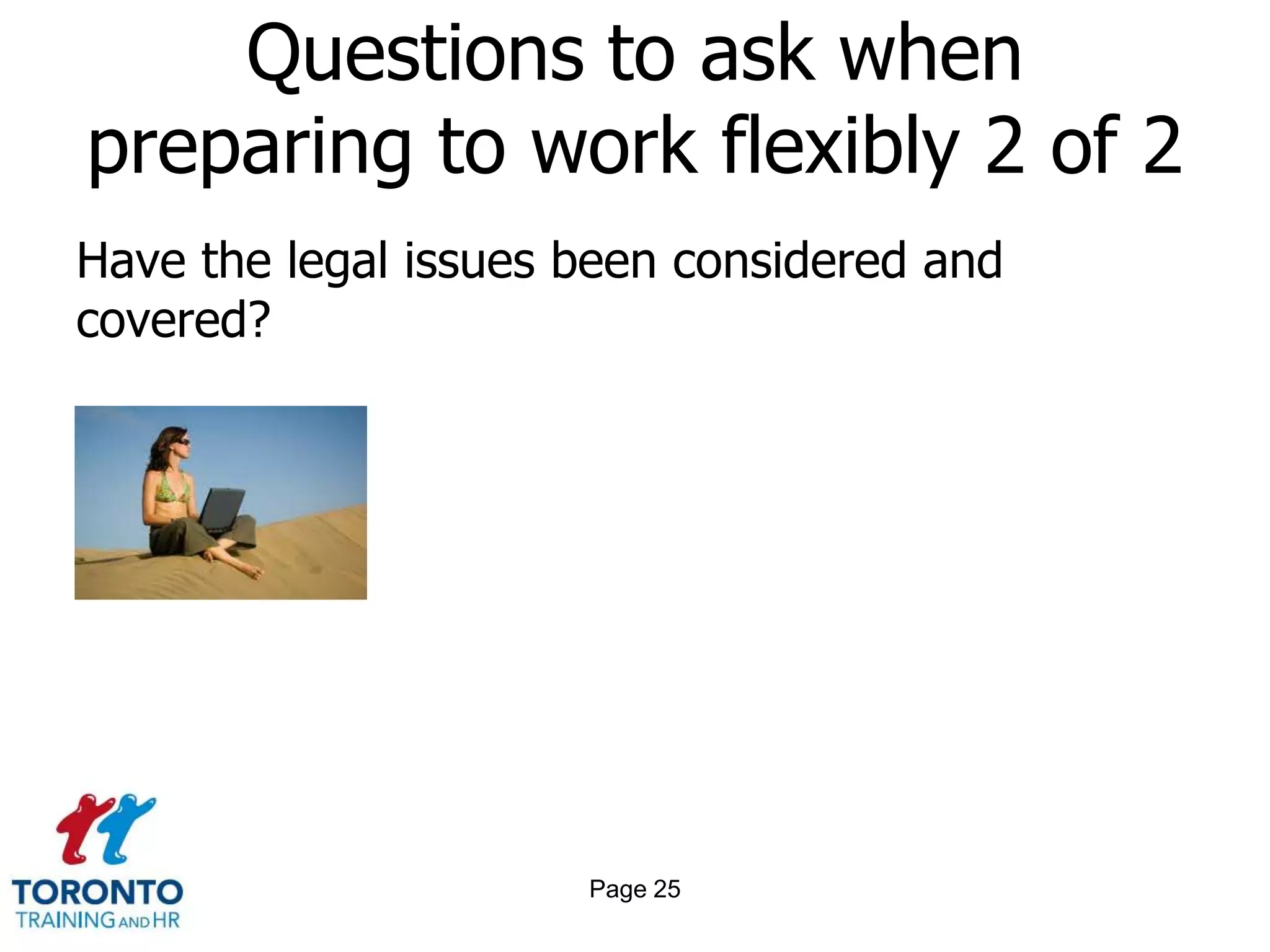
How, where and by whom will flexible workers be
supported?
How are those working flexibly to be monitored
and appraised?
How will administrative issues like expenses be
dealt with?
What are the insurance, security and health &
safety considerations?


                      Page 24
Questions to ask when
preparing to work flexibly 2 of 2
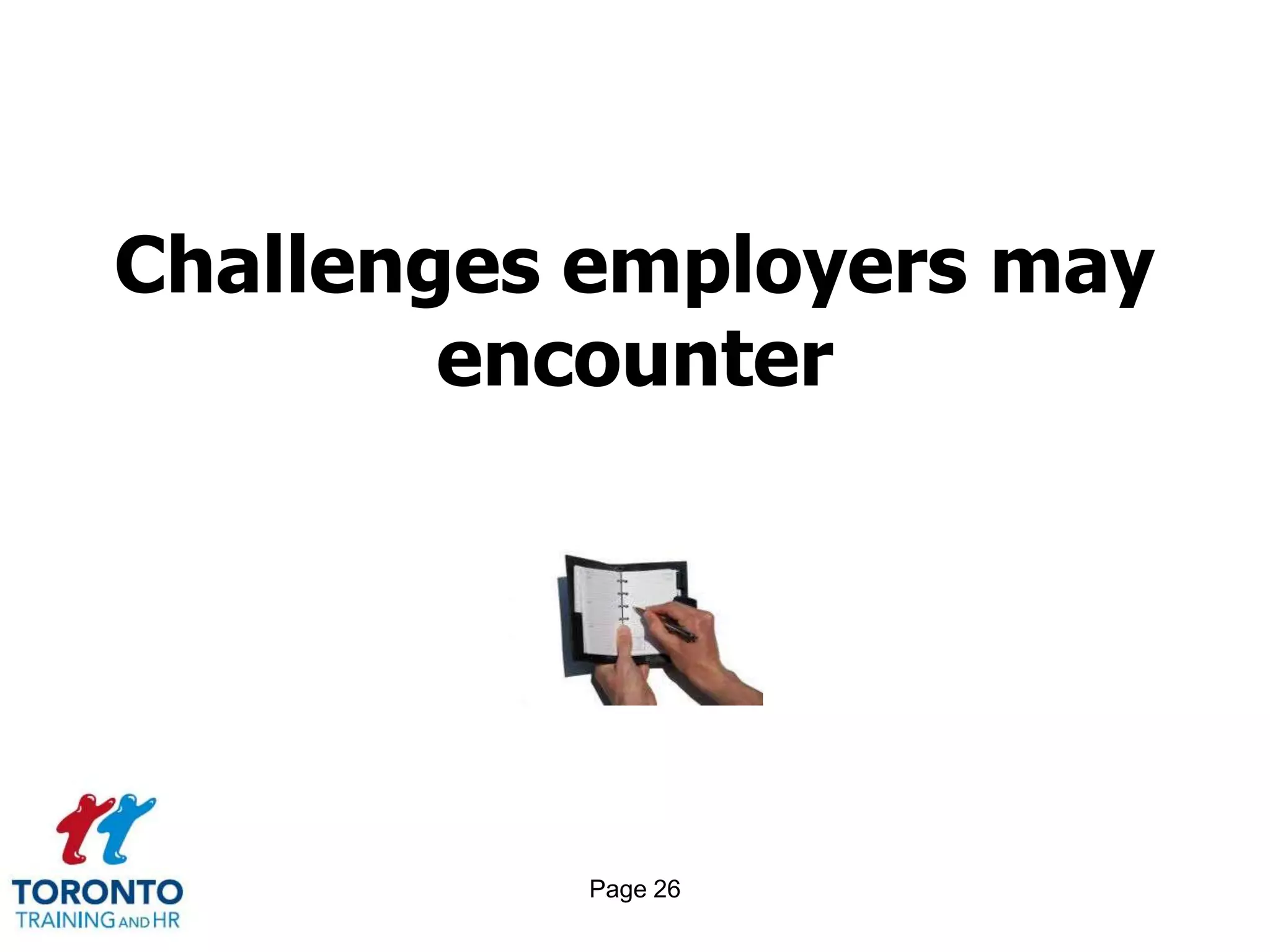
Have the legal issues been considered and
covered?


                      Page 25
Challenges employers may
        encounter


          Page 26
Challenges employers may
            encounter
Overcoming concerns about operational pressures
and meeting customer requirements
Line managers‘ current ability to manage flexible
working effectively
Line managers‘ current attitudes toward flexible
working
The existing organizational culture
A lack of support at senior levels


                       Page 27
Typical groups who seek
    flexible working


          Page 28
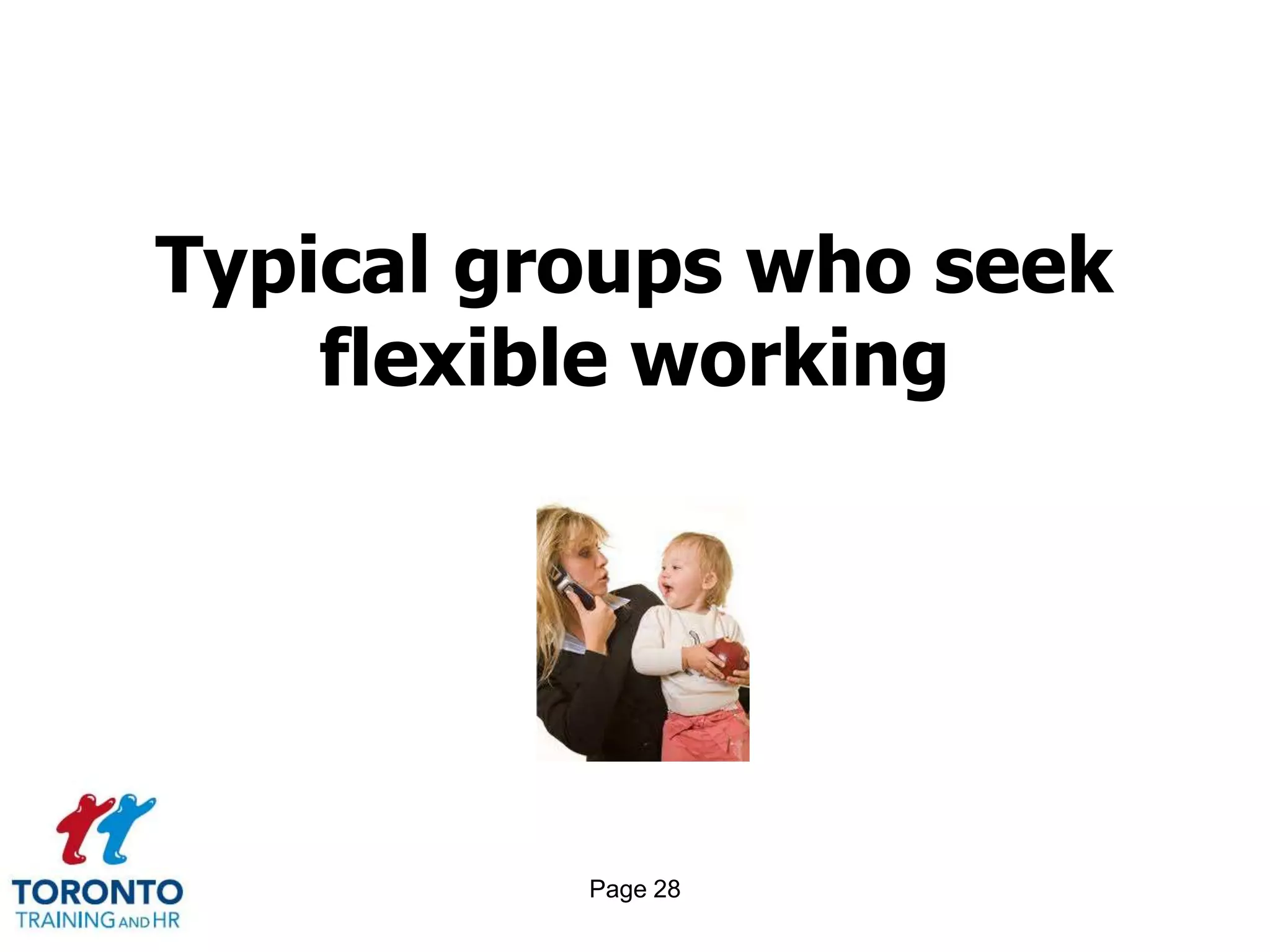
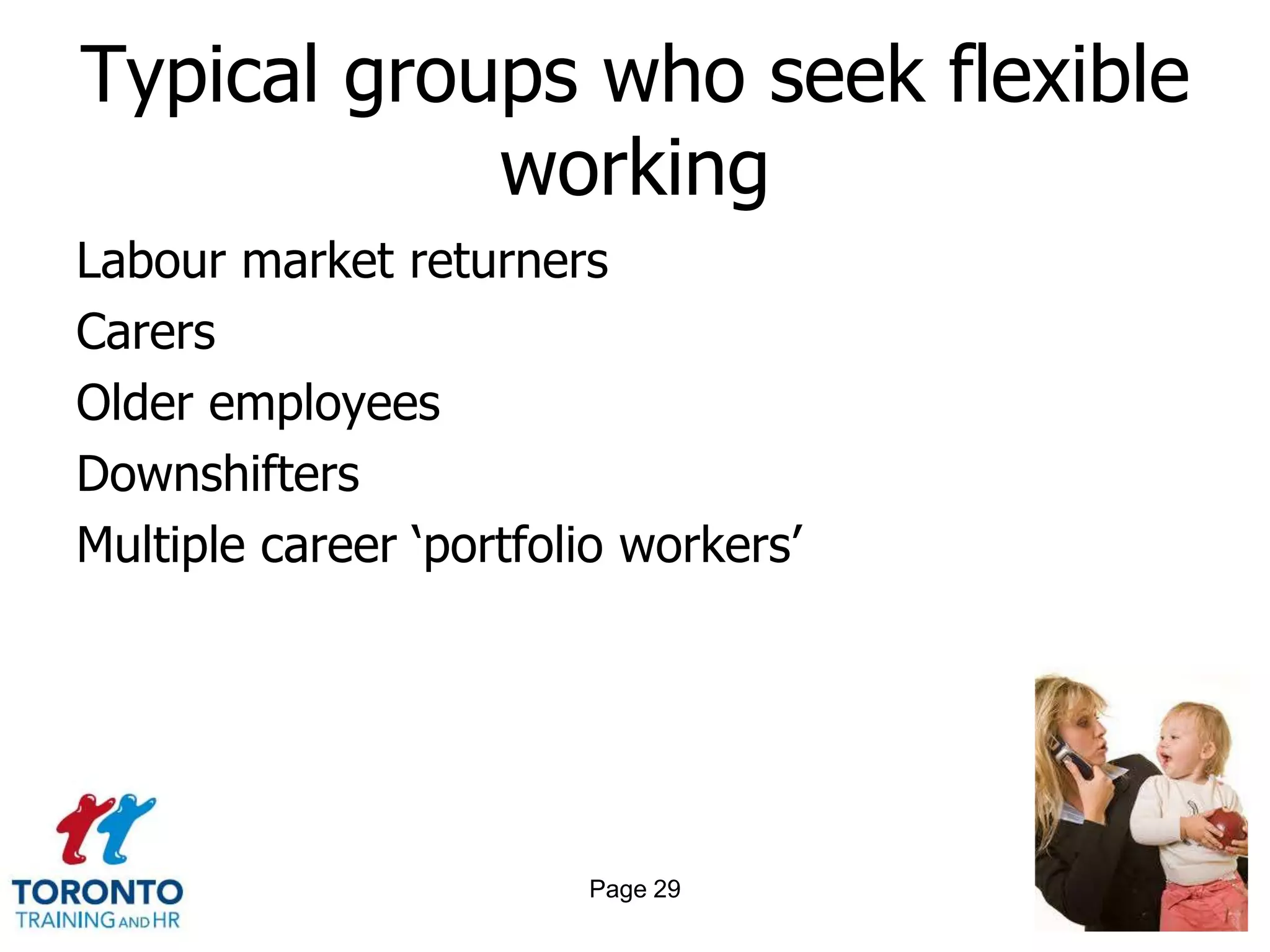
Typical groups who seek flexible
            working
Labour market returners
Carers
Older employees
Downshifters
Multiple career ‗portfolio workers‘


                        Page 29
Effective implementation
   of flexible working


          Page 30
Effective implementation of
       flexible working 1 of 3
Establish a clear process for how flexible working
works in the organization
Ensure that there are clear roles and
responsibilities for employees, line managers and

HR
Assess the current levels of support offered to line
managers and ensure it is sufficient
Invest in ongoing communication and awareness
raising

                        Page 31
Effective implementation of
       flexible working 2 of 3
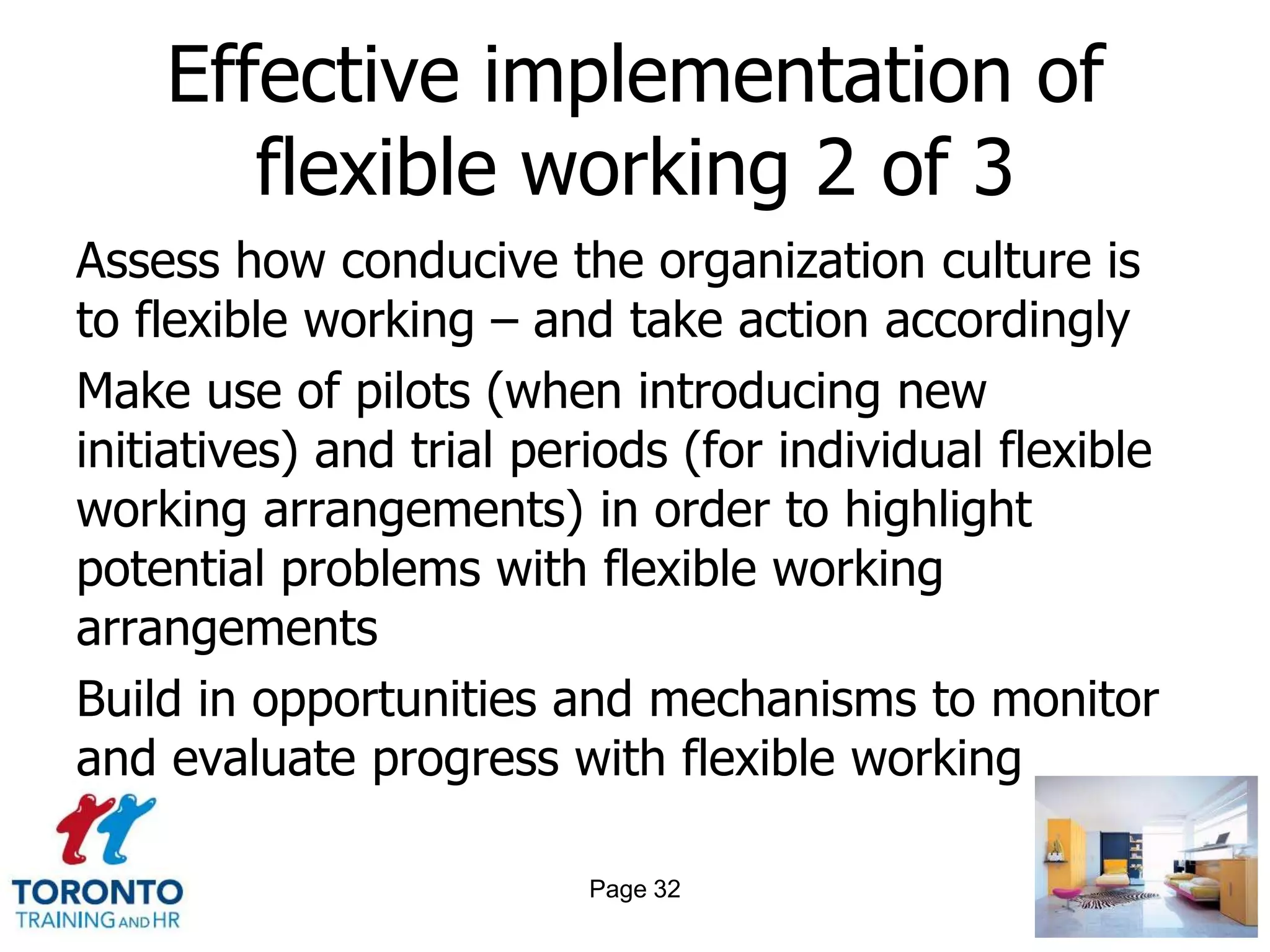
Assess how conducive the organization culture is
to flexible working – and take action accordingly
Make use of pilots (when introducing new
initiatives) and trial periods (for individual flexible
working arrangements) in order to highlight
potential problems with flexible working
arrangements
Build in opportunities and mechanisms to monitor
and evaluate progress with flexible working

                          Page 32
Effective implementation of
      flexible working 3 of 3
STAGES TO FOLLOW
Feasibility study
Prepare the business case
Pilot approach


                      Page 33
Categories of flexible
working arrangements


         Page 34
Categories of flexible working
         arrangements
Schedule flexibility
Location flexibility


                       Page 35
Measuring the success of
   flexible working


          Page 36
Measuring the success of
         flexible working
Cost savings in schemes such as annualized hours
or outsourcing
Employee satisfaction surveys
Absence rates
Attrition rates
Employee take-up of family-friendly schemes


                      Page 37
Benefits of flexible
    working


        Page 38
Benefits of flexible working
               1 of 2
Assisting in recruitment efforts
Enhancing worker morale
Managing employee attendance and reducing
absenteeism
Improving retention of talent
Reducing the tangible and intangible costs of
resignations and terminations
Increasing the net income of workers

                       Page 39
Benefits of flexible working
               2 of 2
Boosting productivity
Creating a better work/life balance for employees
Increasing the supply of suitable labour through
outreach to persons who would not have applied
for employment but for the flexible work
arrangements
Minimizing harmful impact on the environment
Effective and efficient client delivery


                       Page 40
Challenges faced by
   management


        Page 41
Challenges faced by
         management 1 of 2
Keeping programs relevant to employees‘ real
needs
Focusing on the unique needs of specific groups of
employees without creating a second class of
employees and without engaging in unlawful
disparate treatment or disparate impact
discrimination


                       Page 42
Challenges faced by
         management 2 of 2
Communicating broadly to achieve the benefits of
flexible work arrangements-communicate with
workers to identify their needs, and communicate
with them about the programs adopted
Exercising caution when eliminating a program
that isn‘t working or is no longer relevant to
enough workers-any loss of a benefit can impair
morale, even if only a few workers had used it


                      Page 43
Change management


       Page 44
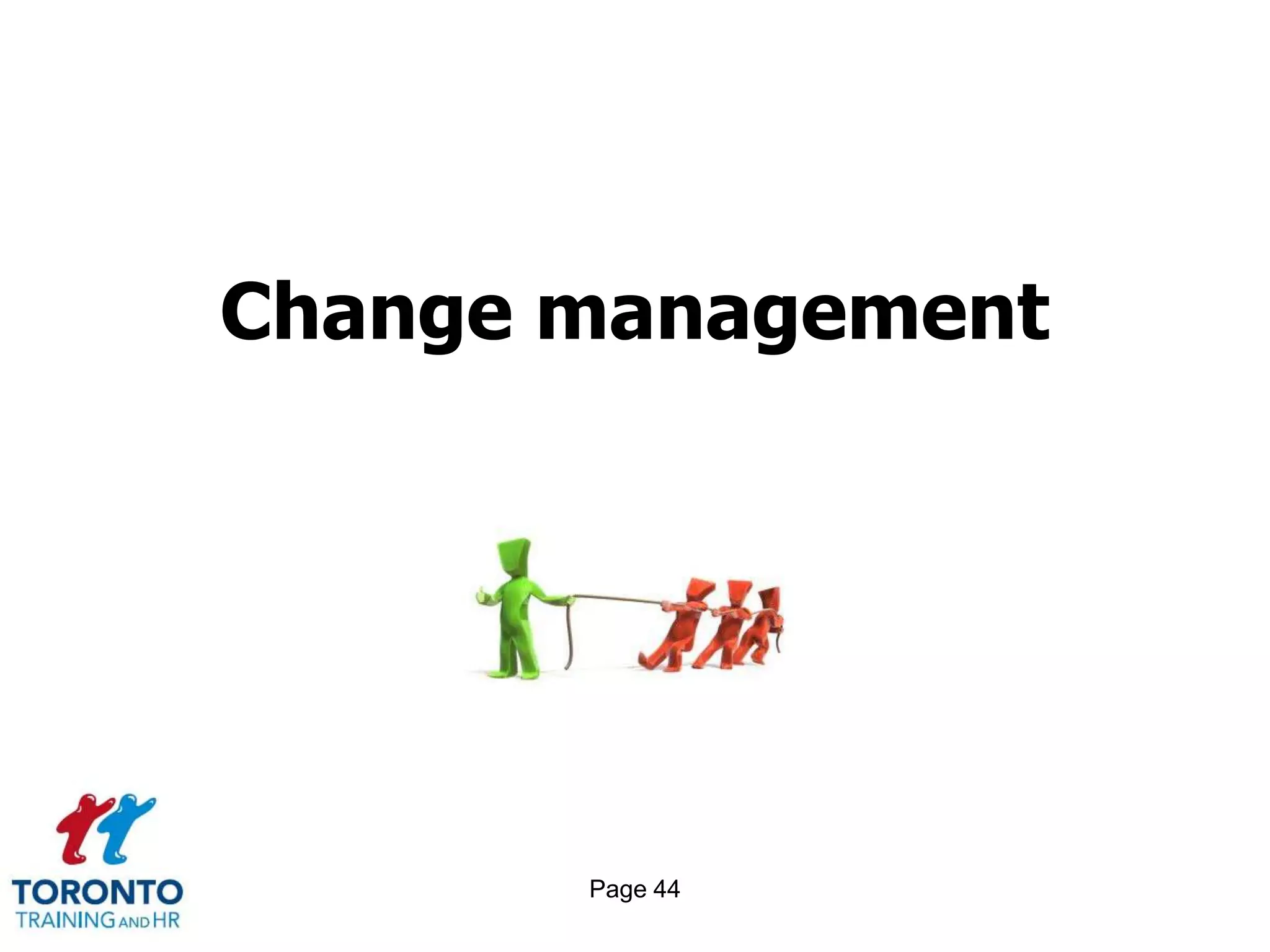
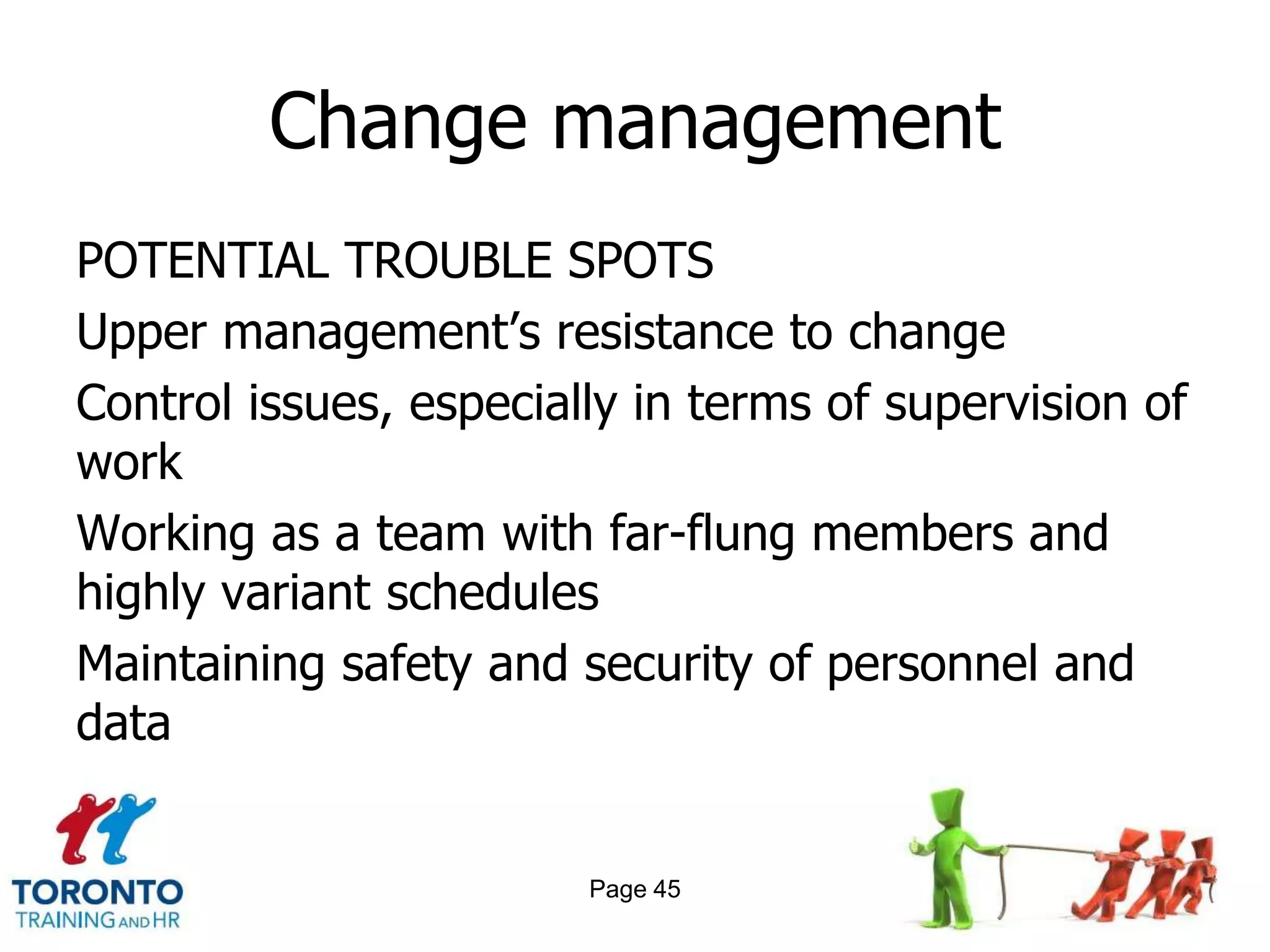
Change management
POTENTIAL TROUBLE SPOTS
Upper management‘s resistance to change
Control issues, especially in terms of supervision of
work
Working as a team with far-flung members and
highly variant schedules
Maintaining safety and security of personnel and
data


                        Page 45
Teleworking


    Page 46
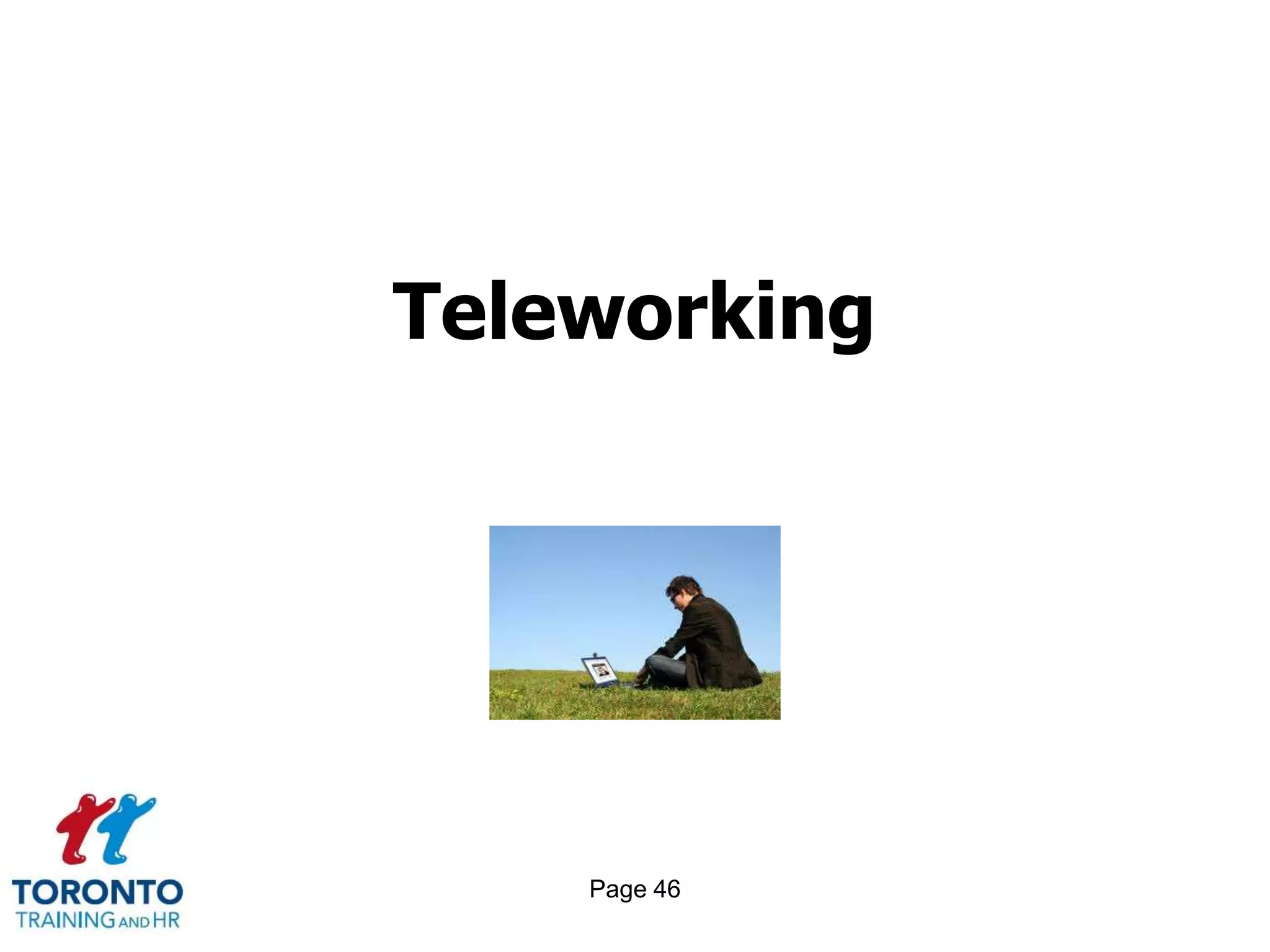
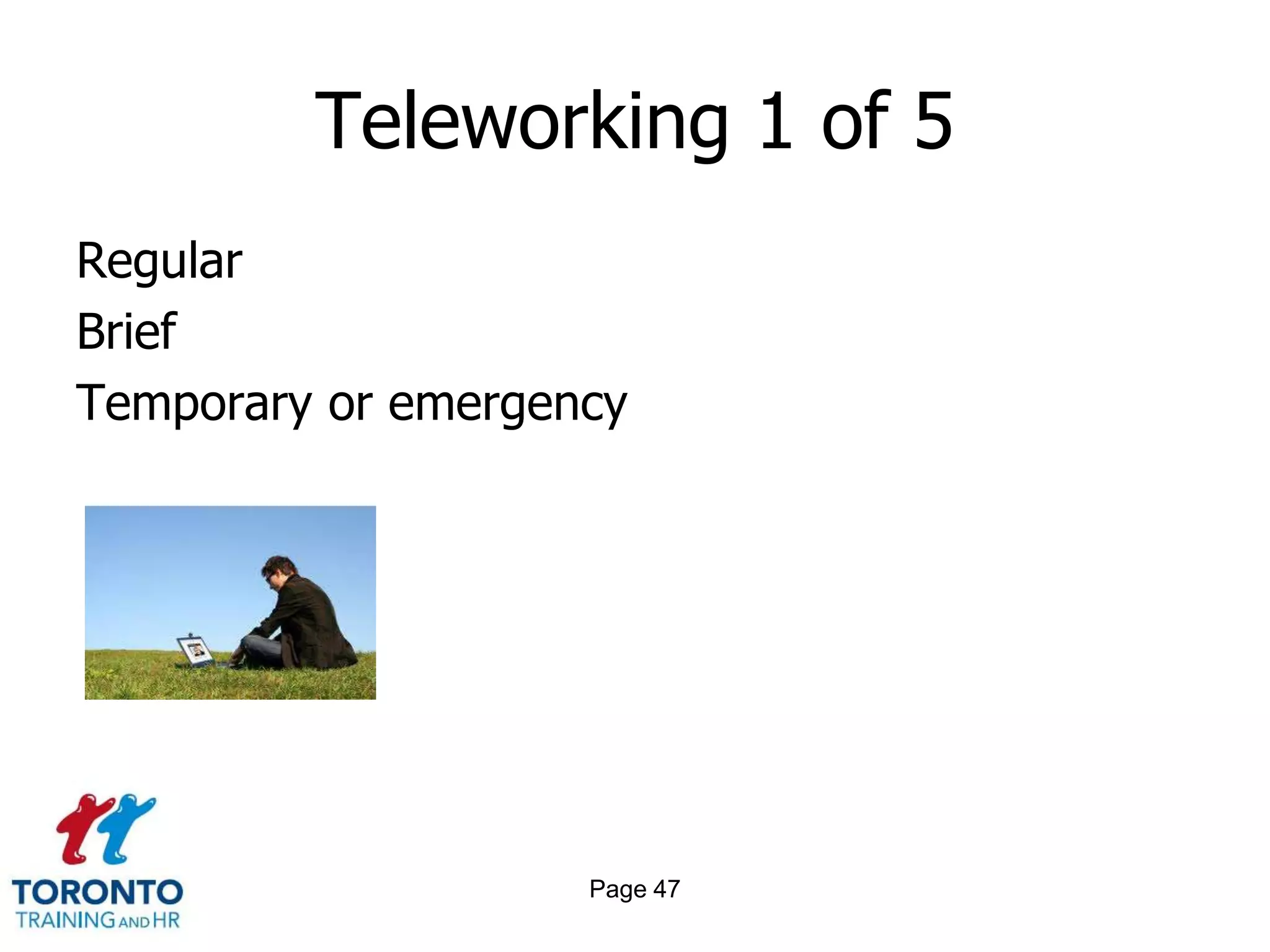
Teleworking 1 of 5
Regular
Brief
Temporary or emergency


                    Page 47
Teleworking 2 of 5
NEGATIVES FOR EMPLOYEES
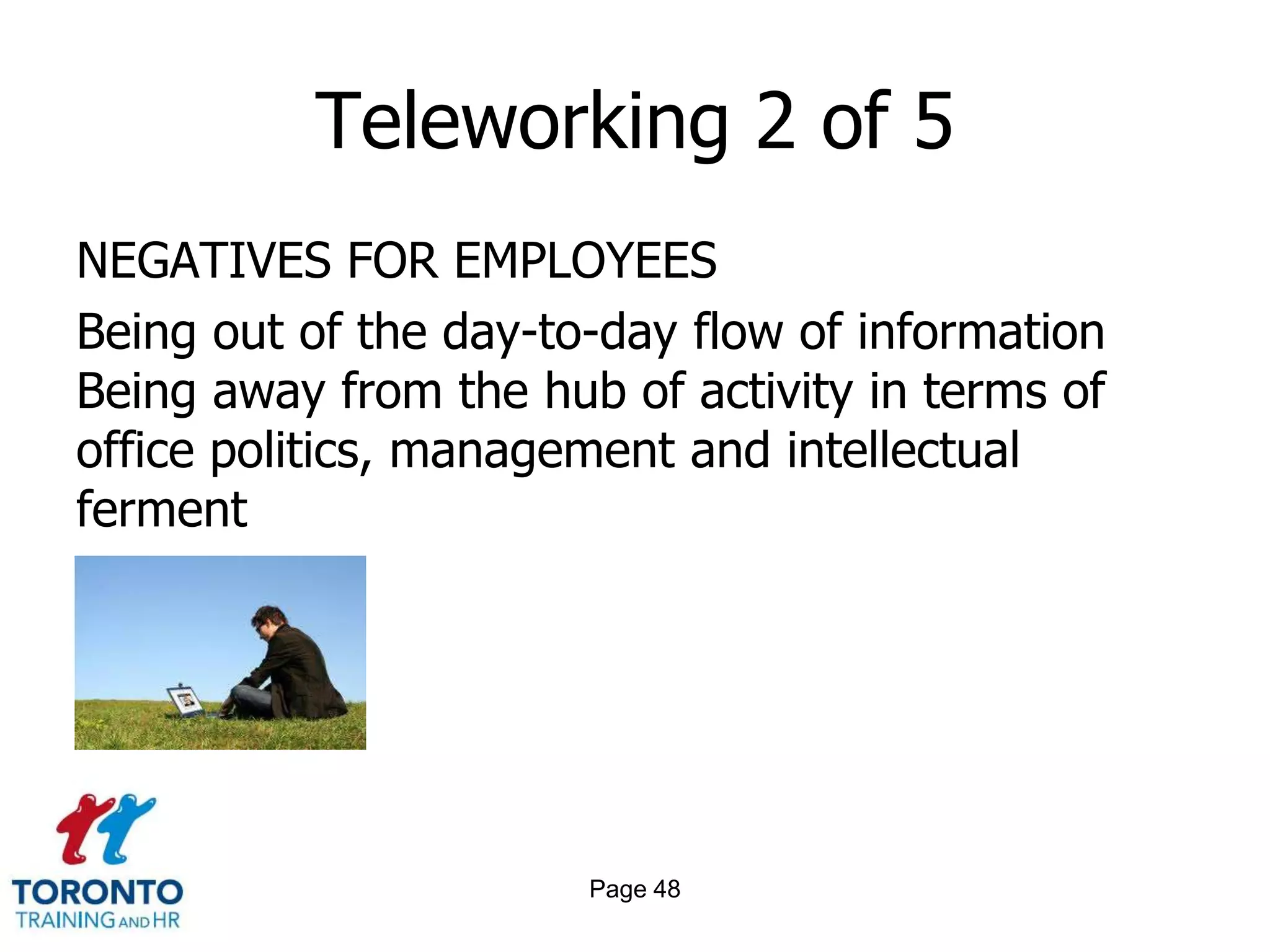
Being out of the day-to-day flow of information
Being away from the hub of activity in terms of
office politics, management and intellectual
ferment


                       Page 48
Teleworking 3 of 5
NEGATIVES FOR EMPLOYEES
A negative impact on career advancement
employee who is not as productive as a
telecommuter—but is readily available for
whatever comes up at the moment—is more likely
to be put on the fast track simply because that
employee is visible


                      Page 49
Teleworking 4 of 5
NEGATIVES FOR EMPLOYEES
Distraction by spouse, children, pets and others in
the workspace
A heightened feeling of being ―owned‖ by the
organization, in that the company now has a
virtual presence in the employee‘s home


                       Page 50
Teleworking 5 of 5
DOWNSIDES OR EXTRA EFFORT FOR EMPLOYERS
Establishing set expectations, trust and unique
methods of evaluation to lead from a distance
The need to adopt strategies and procedures
attuned to management of telecommuting workers
Dealing with workers disgruntled because they are
not permitted to telecommute


                      Page 51
Managing remote working


          Page 52
Managing remote working
Be selective
Relate remotely
Tailor the talk
Foster team spirit
Learn to trust
Train workers…
…and train managers
Appraise for results
Emphasize the upside

                       Page 53
Case study A


    Page 54
Case study A


    Page 55
Case study B


    Page 56
Case study B


    Page 57
Conclusion and questions


          Page 58
Conclusion and questions
Summary
Videos
Questions


               Page 59

How flexible are you when it comes to work March 2012

  • 1.
    How flexible areyou when it comes to work? by Toronto Training and HR March 2012
  • 2.
    3-4 Introduction to Toronto Training and HR 5-6 Definition 7-9 Types of flexible working Contents 10-12 Contributory factors to increased interest 13-14 The main flexible systems 15-16 Introducing flexible working 17-19 Potential contributions from HR 20-22 Concerns typically raised by employees 23-25 Questions to ask when preparing to work flexibly 26-27 Challenges employers may encounter 28-29 Typical groups who seek flexible working 30-33 Effective implementation of flexible working 34-35 Categories of flexible working arrangements 36-37 Measuring the success of flexible working 38-40 Benefits of flexible working 41-43 Challenges faced by management 44-45 Change management 46-51 Teleworking 52-53 Managing remote working 54-57 Case studies 58-59 Conclusion and questions Page 2
  • 3.
  • 4.
    Introduction to TorontoTraining and HR • Toronto Training and HR is a specialist training and human resources consultancy headed by Timothy Holden • 10 years in banking • 10 years in training and human resources • Freelance practitioner since 2006 • The core services provided by Toronto Training and HR are: - Training event design - Training event delivery - Reducing costs - Saving time - Improving employee engagement & morale - Services for job seekers Page 4
  • 5.
  • 6.
  • 7.
    Types of flexibleworking Page 7
  • 8.
    Types of flexibleworking 1 of 2 Part-time working Term-time working Job-sharing Flexitime Compressed hours Annual hours Working from home on a regular basis Page 8
  • 9.
    Types of flexibleworking 2 of 2 Mobile working and teleworking Career breaks Page 9
  • 10.
    Contributory factors to increased interest Page 10
  • 11.
    Contributory factors to increased interest 1 of 2 Its potential value as a recruitment and retention tool The changing profile of the workforce (for example, with more women in the labour market and an ageing population it is increasingly common for workers to have caring responsibilities outside the workplace) Advances in technology (facilitating, for example, remote working and hot-desking arrangements) Page 11
  • 12.
    Contributory factors to increased interest 2 of 2 An increasing need for businesses to be able to deliver services to customers on a 24/7 basis The economic situation - some organizations have offered part-time working or sabbaticals as a method of avoiding or minimizing redundancies The increased demand for an effective work-life balance Page 12
  • 13.
    The main flexiblesystems Page 13
  • 14.
    The main flexiblesystems Annualized hours Multi-skilling Outsourcing Temporary employees and short-term contracts Page 14
  • 15.
    Introducing flexible working Page 15
  • 16.
    Introducing flexible working Involvemembers of the work teams in the planning for the scheme Monitor and evaluate Get feedback from employees on a regular basis Communicate the successes of the scheme to employees regularly Celebrate and recognize success Page 16
  • 17.
    Potential contributions from HR Page 17
  • 18.
    Potential contributions fromHR 1 of 2 Providing management information on staffing costs Leading contract change negotiations Researching alternative forms of flexibility and their impact Providing management information on employee availability and preferences over shift patterns Page 18
  • 19.
    Potential contributions fromHR 2 of 2 Tying flexible working preferences to reward packages Up to date guidance on the current position regarding health & safety Sharing best practice with diverse business units and sharing the lessons learned Page 19
  • 20.
    Concerns typically raised by employees Page 20
  • 21.
    Concerns typically raisedby employees 1 of 2 Will I be expected to work longer or more unsocial hours than I currently do? Will I get the right technological support? What will be the tax implications as a result of the change? Am I insured for company property on my own premises? Page 21
  • 22.
    Concerns typically raisedby employees 2 of 2 How will I be communicated with and kept up to date with things when I am not around? How will I be able to maintain the level of social contact that I currently enjoy at work? Page 22
  • 23.
    Questions to askwhen preparing to work flexibly Page 23
  • 24.
    Questions to askwhen preparing to work flexibly 1 of 2 How, where and by whom will flexible workers be supported? How are those working flexibly to be monitored and appraised? How will administrative issues like expenses be dealt with? What are the insurance, security and health & safety considerations? Page 24
  • 25.
    Questions to askwhen preparing to work flexibly 2 of 2 Have the legal issues been considered and covered? Page 25
  • 26.
    Challenges employers may encounter Page 26
  • 27.
    Challenges employers may encounter Overcoming concerns about operational pressures and meeting customer requirements Line managers‘ current ability to manage flexible working effectively Line managers‘ current attitudes toward flexible working The existing organizational culture A lack of support at senior levels Page 27
  • 28.
    Typical groups whoseek flexible working Page 28
  • 29.
    Typical groups whoseek flexible working Labour market returners Carers Older employees Downshifters Multiple career ‗portfolio workers‘ Page 29
  • 30.
    Effective implementation of flexible working Page 30
  • 31.
    Effective implementation of flexible working 1 of 3 Establish a clear process for how flexible working works in the organization Ensure that there are clear roles and responsibilities for employees, line managers and HR Assess the current levels of support offered to line managers and ensure it is sufficient Invest in ongoing communication and awareness raising Page 31
  • 32.
    Effective implementation of flexible working 2 of 3 Assess how conducive the organization culture is to flexible working – and take action accordingly Make use of pilots (when introducing new initiatives) and trial periods (for individual flexible working arrangements) in order to highlight potential problems with flexible working arrangements Build in opportunities and mechanisms to monitor and evaluate progress with flexible working Page 32
  • 33.
    Effective implementation of flexible working 3 of 3 STAGES TO FOLLOW Feasibility study Prepare the business case Pilot approach Page 33
  • 34.
    Categories of flexible workingarrangements Page 34
  • 35.
    Categories of flexibleworking arrangements Schedule flexibility Location flexibility Page 35
  • 36.
    Measuring the successof flexible working Page 36
  • 37.
    Measuring the successof flexible working Cost savings in schemes such as annualized hours or outsourcing Employee satisfaction surveys Absence rates Attrition rates Employee take-up of family-friendly schemes Page 37
  • 38.
    Benefits of flexible working Page 38
  • 39.
    Benefits of flexibleworking 1 of 2 Assisting in recruitment efforts Enhancing worker morale Managing employee attendance and reducing absenteeism Improving retention of talent Reducing the tangible and intangible costs of resignations and terminations Increasing the net income of workers Page 39
  • 40.
    Benefits of flexibleworking 2 of 2 Boosting productivity Creating a better work/life balance for employees Increasing the supply of suitable labour through outreach to persons who would not have applied for employment but for the flexible work arrangements Minimizing harmful impact on the environment Effective and efficient client delivery Page 40
  • 41.
    Challenges faced by management Page 41
  • 42.
    Challenges faced by management 1 of 2 Keeping programs relevant to employees‘ real needs Focusing on the unique needs of specific groups of employees without creating a second class of employees and without engaging in unlawful disparate treatment or disparate impact discrimination Page 42
  • 43.
    Challenges faced by management 2 of 2 Communicating broadly to achieve the benefits of flexible work arrangements-communicate with workers to identify their needs, and communicate with them about the programs adopted Exercising caution when eliminating a program that isn‘t working or is no longer relevant to enough workers-any loss of a benefit can impair morale, even if only a few workers had used it Page 43
  • 44.
  • 45.
    Change management POTENTIAL TROUBLESPOTS Upper management‘s resistance to change Control issues, especially in terms of supervision of work Working as a team with far-flung members and highly variant schedules Maintaining safety and security of personnel and data Page 45
  • 46.
    Teleworking Page 46
  • 47.
    Teleworking 1 of5 Regular Brief Temporary or emergency Page 47
  • 48.
    Teleworking 2 of5 NEGATIVES FOR EMPLOYEES Being out of the day-to-day flow of information Being away from the hub of activity in terms of office politics, management and intellectual ferment Page 48
  • 49.
    Teleworking 3 of5 NEGATIVES FOR EMPLOYEES A negative impact on career advancement employee who is not as productive as a telecommuter—but is readily available for whatever comes up at the moment—is more likely to be put on the fast track simply because that employee is visible Page 49
  • 50.
    Teleworking 4 of5 NEGATIVES FOR EMPLOYEES Distraction by spouse, children, pets and others in the workspace A heightened feeling of being ―owned‖ by the organization, in that the company now has a virtual presence in the employee‘s home Page 50
  • 51.
    Teleworking 5 of5 DOWNSIDES OR EXTRA EFFORT FOR EMPLOYERS Establishing set expectations, trust and unique methods of evaluation to lead from a distance The need to adopt strategies and procedures attuned to management of telecommuting workers Dealing with workers disgruntled because they are not permitted to telecommute Page 51
  • 52.
  • 53.
    Managing remote working Beselective Relate remotely Tailor the talk Foster team spirit Learn to trust Train workers… …and train managers Appraise for results Emphasize the upside Page 53
  • 54.
  • 55.
  • 56.
  • 57.
  • 58.
  • 59.