Voksenlæreren og innovation/Adult
educator and innovation
Workshop 3 - Læring i arbejdslivet og arbejdslivet / Learning in
working life – workplace-based learning (English version)
NVL, Lund, 28. September 2017
Sølvi Rask
sra@kompetenceudvikling.dk
,
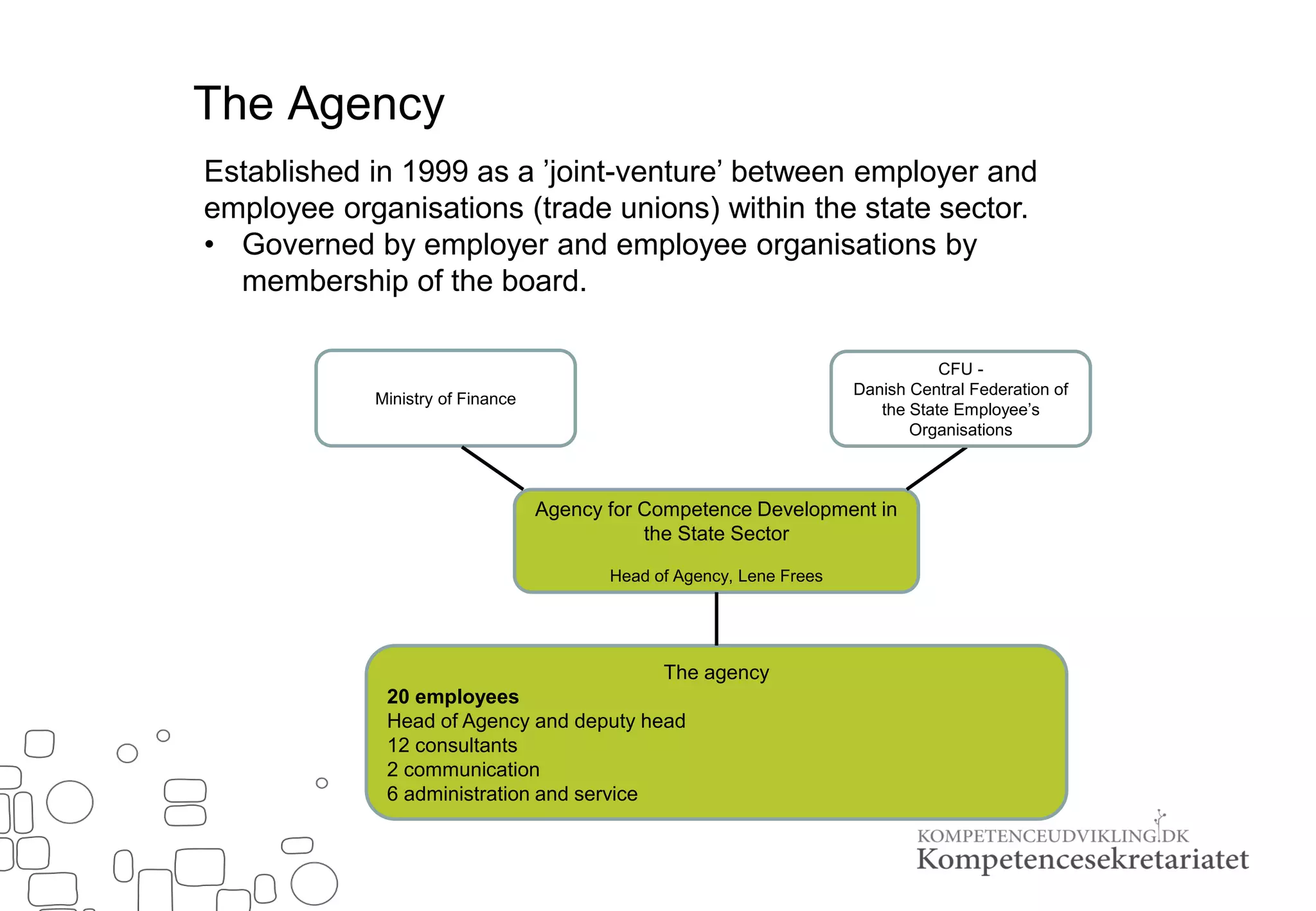
The Agency
Ministry of Finance
Agency for Competence Development in
the State Sector
Head of Agency, Lene Frees
CFU -
Danish Central Federation of
the State Employee’s
Organisations
The agency
20 employees
Head of Agency and deputy head
12 consultants
2 communication
6 administration and service
Established in 1999 as a ’joint-venture’ between employer and
employee organisations (trade unions) within the state sector.
• Governed by employer and employee organisations by
membership of the board.
The purpose of the Agency for Competence
Development in the State Sector, Denmark
The purpose of the Agency is to:
• Enhance competence development efforts of Danish central government agencies
and government organisations by providing counselling, practical tools, training and
financial support.
• Provide counselling to government agencies and organisations on the practical
application of the agreement on strategic and systematic competence development.
• Disseminate knowledge on competence development via education and work place
learning through websites, events etc.
• The Agency is run and financed as a joint venture between the Ministry of
Finance/State Employer’s Authority and the State Employees’ Organisations.
In Danish we are called “Kompetencesekretariatet”.
Our website (unfortunately only in danish) can be found at www.kompetenceudvikling.dk
3
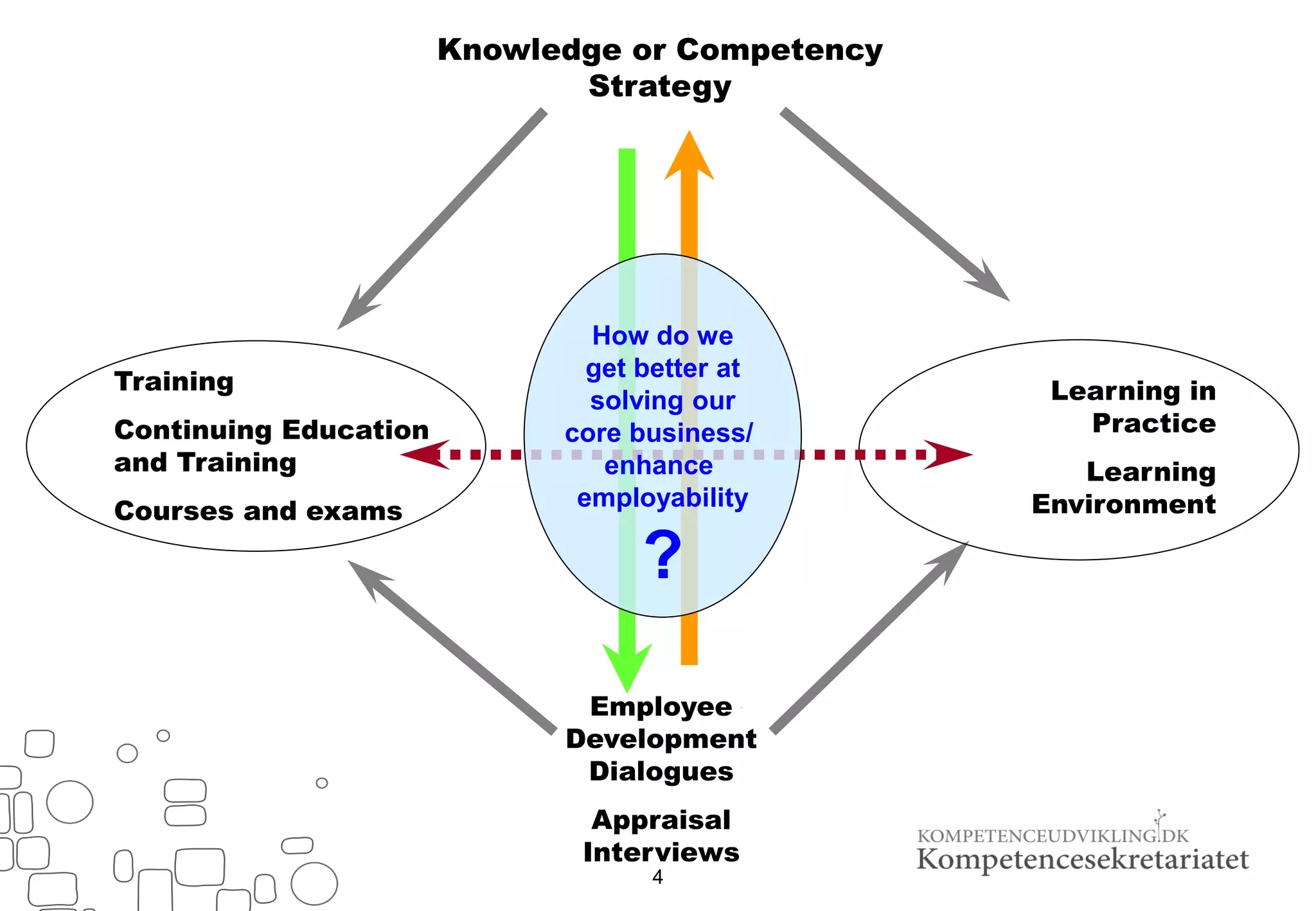
4
Employee
Development
Dialogues
Appraisal
Interviews
Knowledge or Competency
Strategy
Training
Continuing Education
and Training
Courses and exams
Learning in
Practice
Learning
Environment
How do we
get better at
solving our
core business/
enhance
employability
?
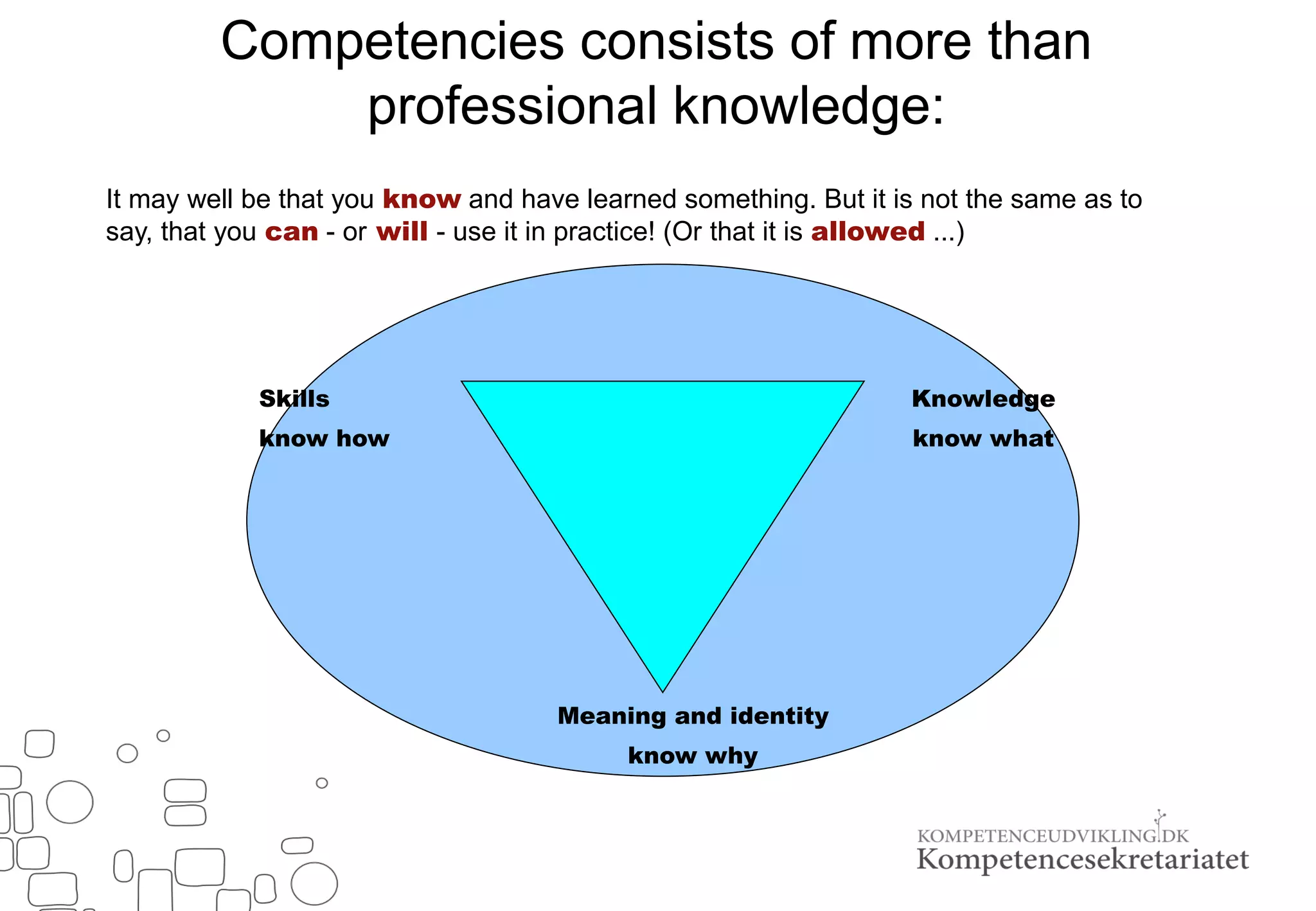
Competencies consists of more than
professional knowledge:
Knowledge
know what
Skills
know how
Meaning and identity
know why
It may well be that you know and have learned something. But it is not the same as to
say, that you can - or will - use it in practice! (Or that it is allowed ...)
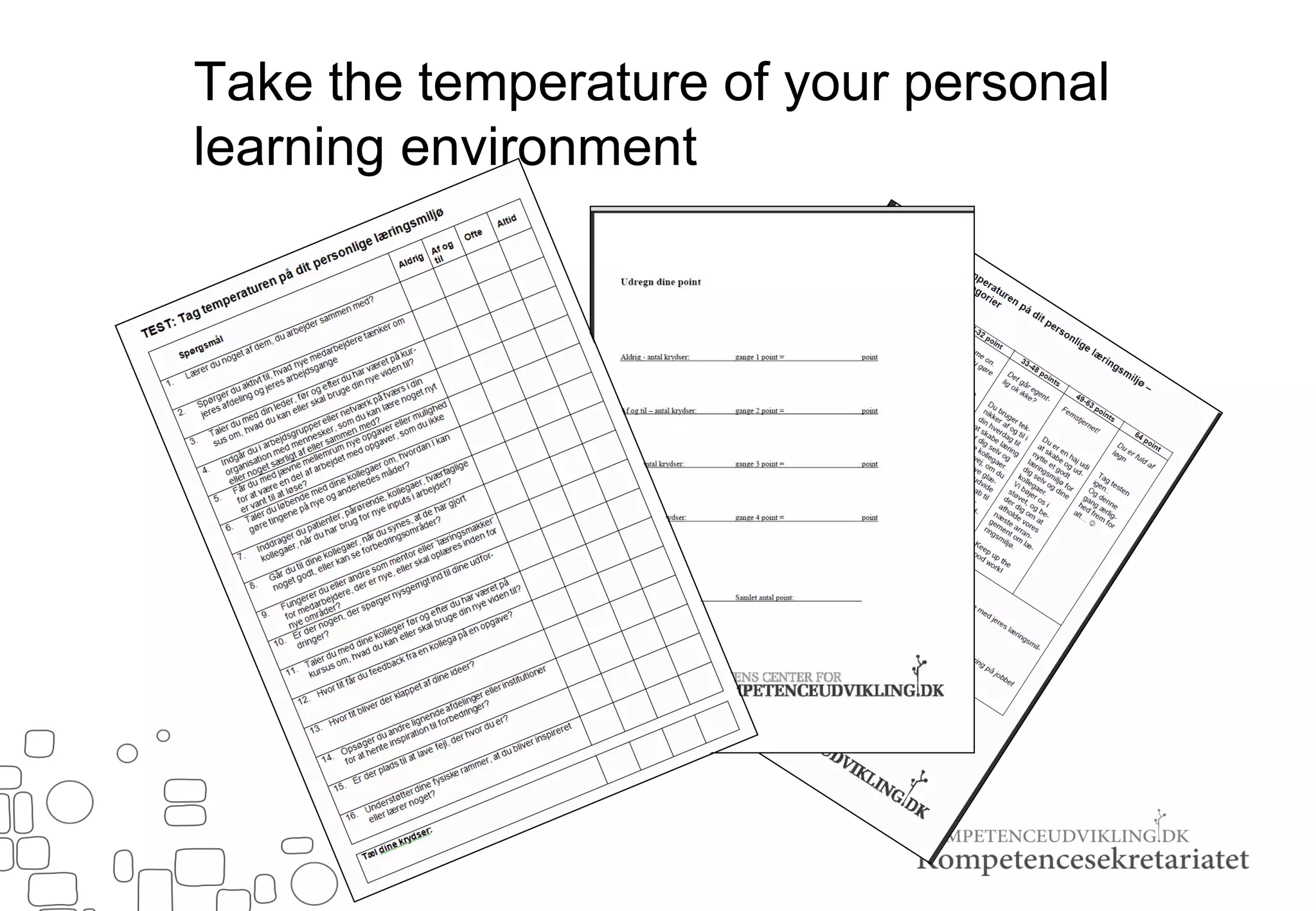
Take the temperature of your personal
learning environment
7
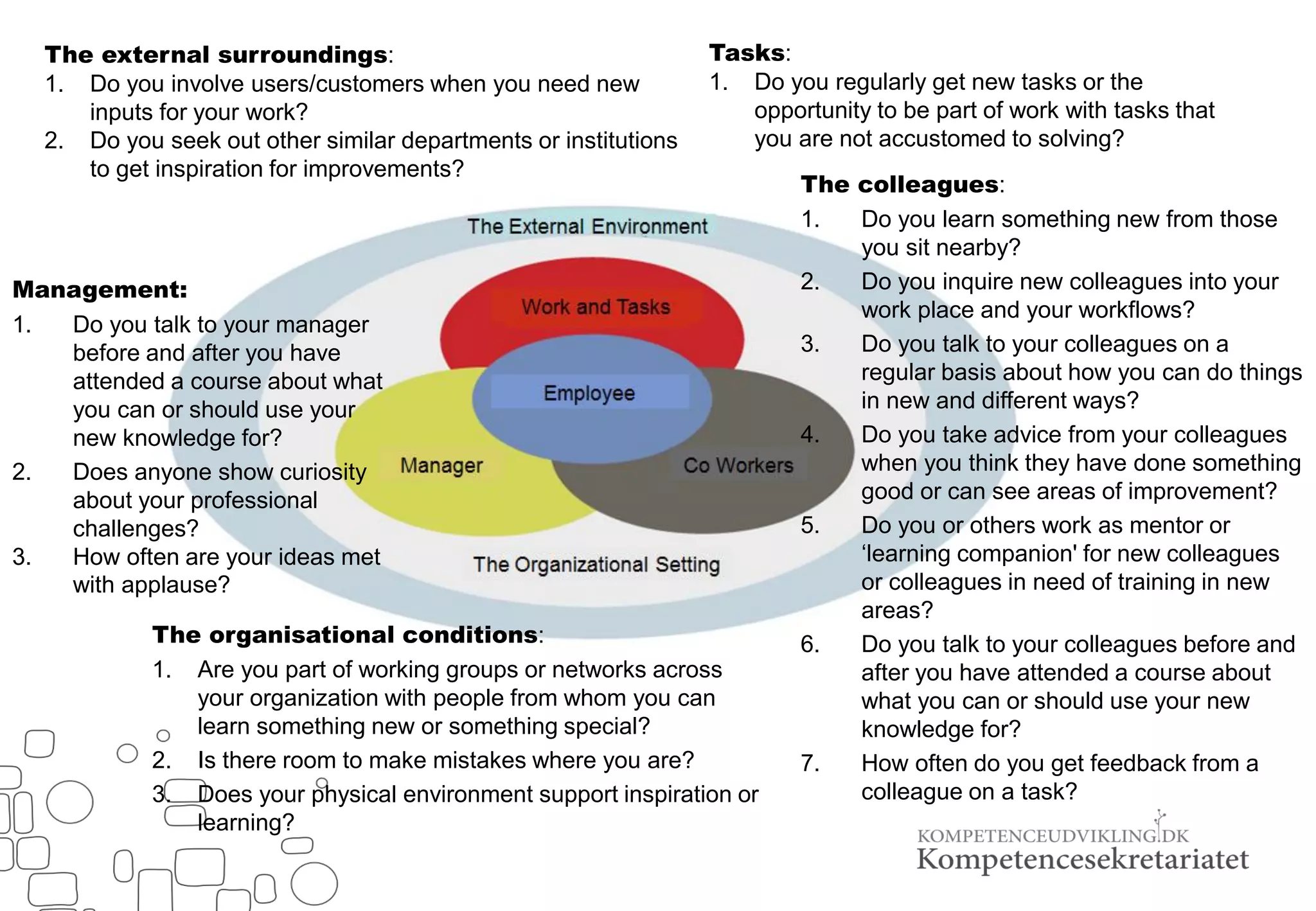
What is The Learning Environment
The External Environment
Work and Tasks
Employee
Manager Co Workers
The Organizational Setting
8
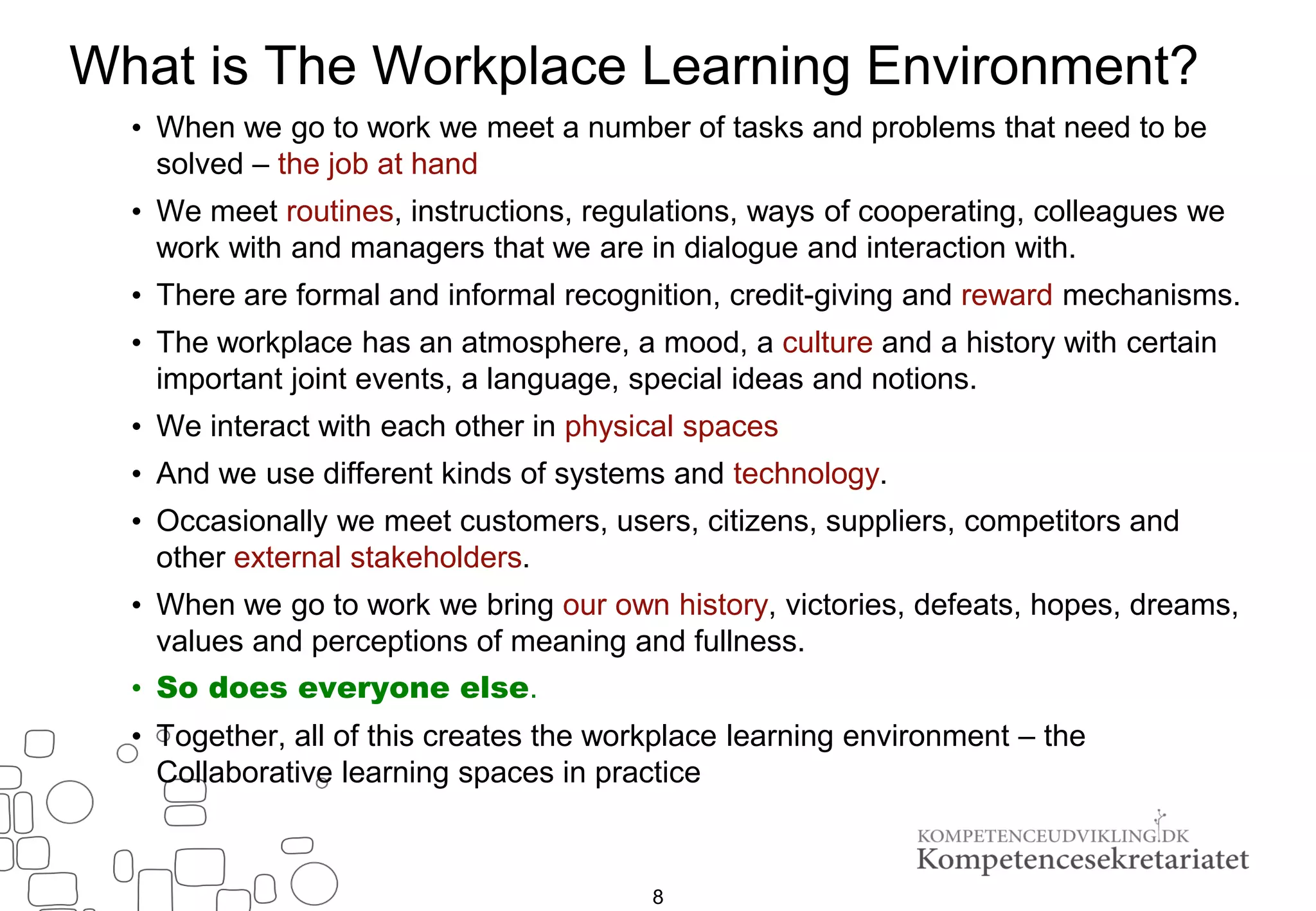
What is The Workplace Learning Environment?
• When we go to work we meet a number of tasks and problems that need to be
solved – the job at hand
• We meet routines, instructions, regulations, ways of cooperating, colleagues we
work with and managers that we are in dialogue and interaction with.
• There are formal and informal recognition, credit-giving and reward mechanisms.
• The workplace has an atmosphere, a mood, a culture and a history with certain
important joint events, a language, special ideas and notions.
• We interact with each other in physical spaces
• And we use different kinds of systems and technology.
• Occasionally we meet customers, users, citizens, suppliers, competitors and
other external stakeholders.
• When we go to work we bring our own history, victories, defeats, hopes, dreams,
values ​​and perceptions of meaning and fullness.
• So does everyone else.
• Together, all of this creates the workplace learning environment – the
Collaborative learning spaces in practice
Tasks:
1. Do you regularly get new tasks or the
opportunity to be part of work with tasks that
you are not accustomed to solving?
The organisational conditions:
1. Are you part of working groups or networks across
your organization with people from whom you can
learn something new or something special?
2. Is there room to make mistakes where you are?
3. Does your physical environment support inspiration or
learning?
The external surroundings:
1. Do you involve users/customers when you need new
inputs for your work?
2. Do you seek out other similar departments or institutions
to get inspiration for improvements?
Management:
1. Do you talk to your manager
before and after you have
attended a course about what
you can or should use your
new knowledge for?
2. Does anyone show curiosity
about your professional
challenges?
3. How often are your ideas met
with applause?
The colleagues:
1. Do you learn something new from those
you sit nearby?
2. Do you inquire new colleagues into your
work place and your workflows?
3. Do you talk to your colleagues on a
regular basis about how you can do things
in new and different ways?
4. Do you take advice from your colleagues
when you think they have done something
good or can see areas of improvement?
5. Do you or others work as mentor or
‘learning companion' for new colleagues
or colleagues in need of training in new
areas?
6. Do you talk to your colleagues before and
after you have attended a course about
what you can or should use your new
knowledge for?
7. How often do you get feedback from a
colleague on a task?
10
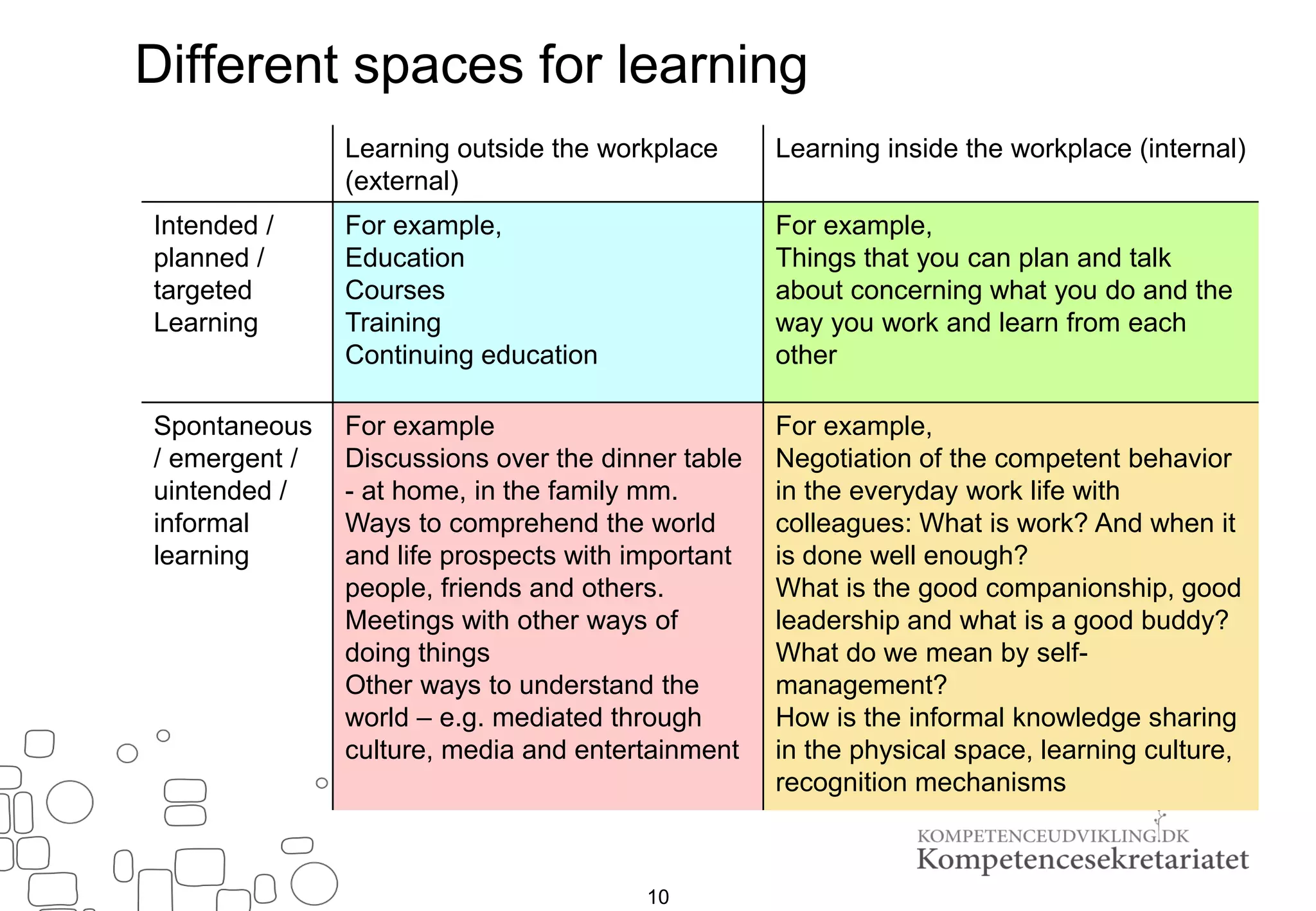
Different spaces for learning
Learning outside the workplace
(external)
Learning inside the workplace (internal)
Intended /
planned /
targeted
Learning
For example,
Education
Courses
Training
Continuing education
For example,
Things that you can plan and talk
about concerning what you do and the
way you work and learn from each
other
Spontaneous
/ emergent /
uintended /
informal
learning
For example
Discussions over the dinner table
- at home, in the family mm.
Ways to comprehend the world
and life prospects with important
people, friends and others.
Meetings with other ways of
doing things
Other ways to understand the
world – e.g. mediated through
culture, media and entertainment
For example,
Negotiation of the competent behavior
in the everyday work life with
colleagues: What is work? And when it
is done well enough?
What is the good companionship, good
leadership and what is a good buddy?
What do we mean by self-
management?
How is the informal knowledge sharing
in the physical space, learning culture,
recognition mechanisms
11
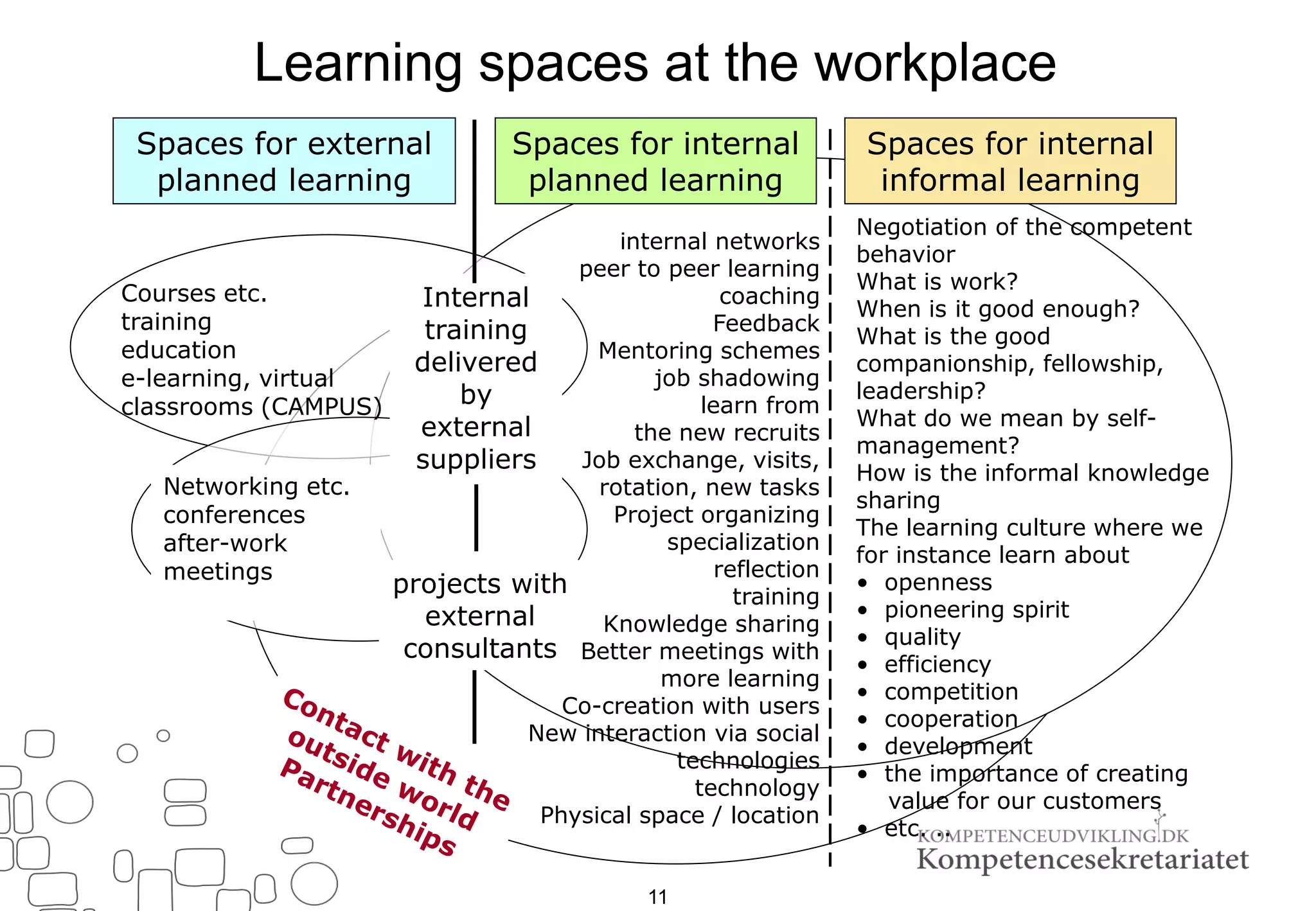
Spaces for external
planned learning
Spaces for internal
planned learning
Spaces for internal
informal learning
Negotiation of the competent
behavior
What is work?
When is it good enough?
What is the good
companionship, fellowship,
leadership?
What do we mean by self-
management?
How is the informal knowledge
sharing
The learning culture where we
for instance learn about
• openness
• pioneering spirit
• quality
• efficiency
• competition
• cooperation
• development
• the importance of creating
value for our customers
• etc. ..
Courses etc.
training
education
e-learning, virtual
classrooms (CAMPUS)
Internal
training
delivered
by
external
suppliers
Networking etc.
conferences
after-work
meetings
projects with
external
consultants
Learning spaces at the workplace
internal networks
peer to peer learning
coaching
Feedback
Mentoring schemes
job shadowing
learn from
the new recruits
Job exchange, visits,
rotation, new tasks
Project organizing
specialization
reflection
training
Knowledge sharing
Better meetings with
more learning
Co-creation with users
New interaction via social
technologies
technology
Physical space / location
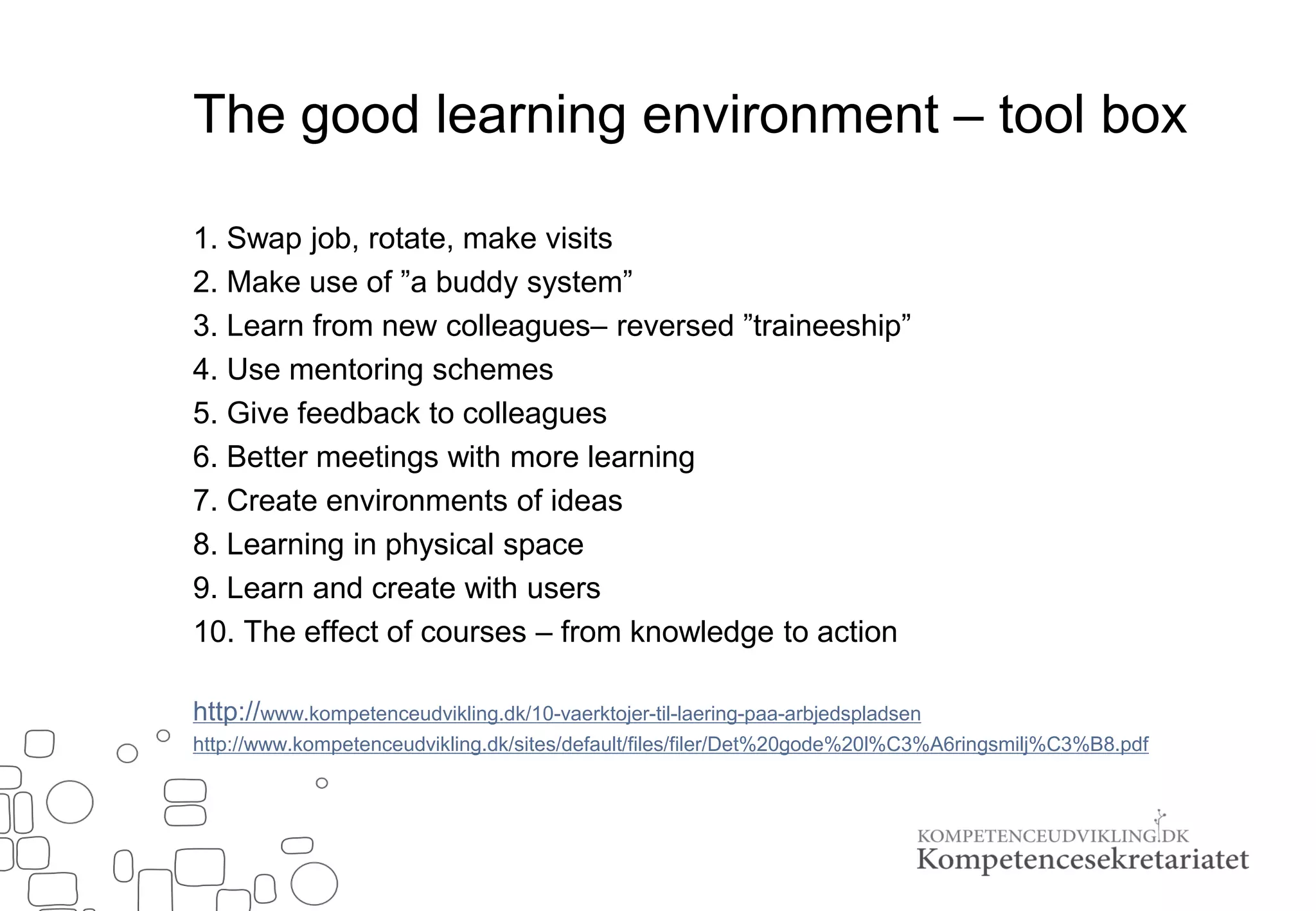
The good learning environment – tool box
1. Swap job, rotate, make visits
2. Make use of ”a buddy system”
3. Learn from new colleagues– reversed ”traineeship”
4. Use mentoring schemes
5. Give feedback to colleagues
6. Better meetings with more learning
7. Create environments of ideas
8. Learning in physical space
9. Learn and create with users
10. The effect of courses – from knowledge to action
http://www.kompetenceudvikling.dk/10-vaerktojer-til-laering-paa-arbjedspladsen
http://www.kompetenceudvikling.dk/sites/default/files/filer/Det%20gode%20l%C3%A6ringsmilj%C3%B8.pdf
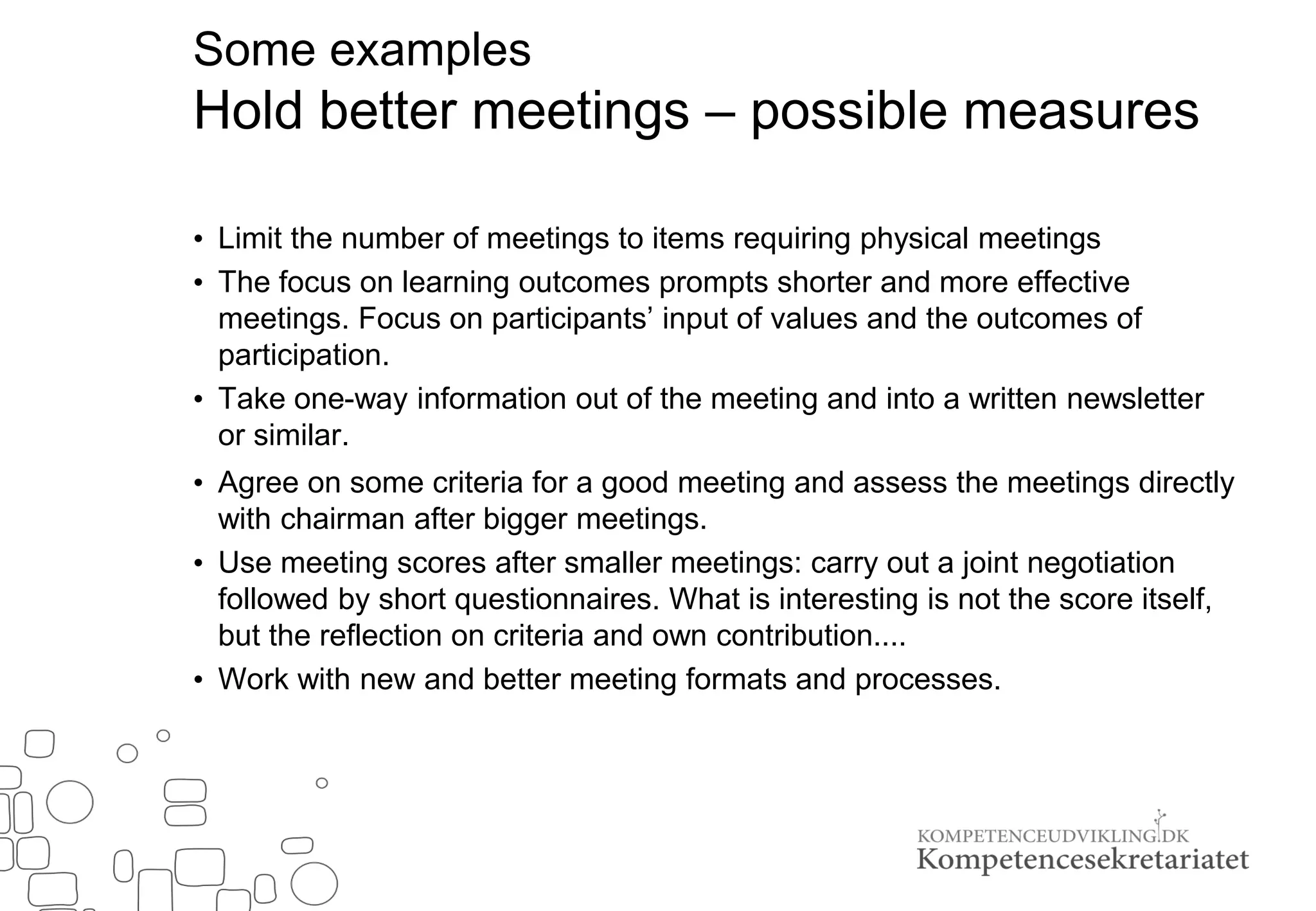
Some examples
Hold better meetings – possible measures
• Limit the number of meetings to items requiring physical meetings
• The focus on learning outcomes prompts shorter and more effective
meetings. Focus on participants’ input of values and the outcomes of
participation.
• Take one-way information out of the meeting and into a written newsletter
or similar.
• Agree on some criteria for a good meeting and assess the meetings directly
with chairman after bigger meetings.
• Use meeting scores after smaller meetings: carry out a joint negotiation
followed by short questionnaires. What is interesting is not the score itself,
but the reflection on criteria and own contribution....
• Work with new and better meeting formats and processes.
Some examples
Learn from new colleagues - ”reversed trainee systems””
• The wondering/questioning of new colleagues presents a development
potential for the work place and for the experienced employees.
• There must be concrete demand for posing questions from both manager
and colleagues.
• The right framework must be developed – new colleagues must be
supported and their ideas ”protected”
• Create routines/practice that allows room for questions from new
colleagues
• You quickly become a part of the practice at work and then you stop to
wonder and pose questions.
Some examples
Learning buddies
• Make agreements with a learning buddy by participating in competence
development (internal and external)
• Two colleagues team up, meet for 15-20 minutes and ask questions about
each other's learning, ideas, intentions with participation in courses
• They show interest in each other’s ideas
• The manager shows an interest in the process, but does not participate.
Some examples
More knowledge sharing
• Everyone finds it important and many think it is difficult!
• Traditional rounds, where everyone is updated on what they have
been working with and experienced often involves much more than
sharing knowledge. It is also about visibility and recognition.
Skip the ”supply-side” and instead work with the ”demand-side”:
• What do I need to know? Does anyone else have knowledge on this?
Who can I ask? How and when would it be wise to ask and involve this
person?
• Challenge: How can I know, if anyone else possesses the kind of
knowledge, I could use?
• Knowledge shared at the right moment – share your knowledge in the
moments, where you will get the greatest benefits, and where the
recipient has the best prerequisites to use your knowledge.
• Both the sender and recipient must experience more advantages than
disadvantages before knowledge sharing takes place.
The manager
The manager can contribute to creating a good framework for learning for
employees, for example by:
• calling for the kind of conduct to which the competence development should
result. Notice and recognize when the right conduct is demonstrated!
• asking the employee about how he/she can create more value for
himself/herself and for the users. This ensures consistency with the overall
strategy of the workplace.
• asking the employee about how he/she can help the employee in this. This
ensures that the manager contributes to the development of the
individual.
• providing a good space and framework for the negotiation of competent
conduct, e.g. through reflection and experience exchange, good
atmosphere, culture, propriety, presence...
• ...
Tips on how to create more impact when
working with the learning environment
• Hold better meetings with more learning – give meetings and the structure of
meetings a check-up, so that meetings offer better opportunities for learning
• Make sure to create a culture where you are open to colleagues' ideas – help
colleagues unfold and substantiate them – instead of assessing and judging
them by the same conviction. Ideas are rarely fully developed first time around.
Start with your own practice as a leader - or as a colleague.
• Learn from new colleagues – and the young. They are equipped with a healthy
wonder about how things are organised and why. In this we find potential for
organisational improvement and/or even innovation.
• Explore other ways of doing things – visit other organisations – similar or
completely different. Learn from users! – in intelligent ways!
• Hold employees/colleagues accountable to visions and ambitions (and
consequences in practice) – they have a tendency to fade with memory.
• Work with learning buddies or triads in short 5-10 minute meetings.
Anchoring and ownership
The main premise for succeeding in facilitating work to strengthen the
learning environment and learning at work is that both employees and
managers want it.
• That there is a desire and a commitment
• That it is a recognized form of learning at work
• That room, will and resources exist
• That the anchoring and ownership endures even ”when the consultant has
left the building”.
kompetenceudvikling.dk
Follow the Agency for Competence Development at LinkedIn

Learning in working life - workplace-based learning

  • 1.
    Voksenlæreren og innovation/Adult educatorand innovation Workshop 3 - Læring i arbejdslivet og arbejdslivet / Learning in working life – workplace-based learning (English version) NVL, Lund, 28. September 2017 Sølvi Rask sra@kompetenceudvikling.dk ,
  • 2.
    The Agency Ministry ofFinance Agency for Competence Development in the State Sector Head of Agency, Lene Frees CFU - Danish Central Federation of the State Employee’s Organisations The agency 20 employees Head of Agency and deputy head 12 consultants 2 communication 6 administration and service Established in 1999 as a ’joint-venture’ between employer and employee organisations (trade unions) within the state sector. • Governed by employer and employee organisations by membership of the board.
  • 3.
    The purpose ofthe Agency for Competence Development in the State Sector, Denmark The purpose of the Agency is to: • Enhance competence development efforts of Danish central government agencies and government organisations by providing counselling, practical tools, training and financial support. • Provide counselling to government agencies and organisations on the practical application of the agreement on strategic and systematic competence development. • Disseminate knowledge on competence development via education and work place learning through websites, events etc. • The Agency is run and financed as a joint venture between the Ministry of Finance/State Employer’s Authority and the State Employees’ Organisations. In Danish we are called “Kompetencesekretariatet”. Our website (unfortunately only in danish) can be found at www.kompetenceudvikling.dk 3
  • 4.
    4 Employee Development Dialogues Appraisal Interviews Knowledge or Competency Strategy Training ContinuingEducation and Training Courses and exams Learning in Practice Learning Environment How do we get better at solving our core business/ enhance employability ?
  • 5.
    Competencies consists ofmore than professional knowledge: Knowledge know what Skills know how Meaning and identity know why It may well be that you know and have learned something. But it is not the same as to say, that you can - or will - use it in practice! (Or that it is allowed ...)
  • 6.
    Take the temperatureof your personal learning environment
  • 7.
    7 What is TheLearning Environment The External Environment Work and Tasks Employee Manager Co Workers The Organizational Setting
  • 8.
    8 What is TheWorkplace Learning Environment? • When we go to work we meet a number of tasks and problems that need to be solved – the job at hand • We meet routines, instructions, regulations, ways of cooperating, colleagues we work with and managers that we are in dialogue and interaction with. • There are formal and informal recognition, credit-giving and reward mechanisms. • The workplace has an atmosphere, a mood, a culture and a history with certain important joint events, a language, special ideas and notions. • We interact with each other in physical spaces • And we use different kinds of systems and technology. • Occasionally we meet customers, users, citizens, suppliers, competitors and other external stakeholders. • When we go to work we bring our own history, victories, defeats, hopes, dreams, values ​​and perceptions of meaning and fullness. • So does everyone else. • Together, all of this creates the workplace learning environment – the Collaborative learning spaces in practice
  • 9.
    Tasks: 1. Do youregularly get new tasks or the opportunity to be part of work with tasks that you are not accustomed to solving? The organisational conditions: 1. Are you part of working groups or networks across your organization with people from whom you can learn something new or something special? 2. Is there room to make mistakes where you are? 3. Does your physical environment support inspiration or learning? The external surroundings: 1. Do you involve users/customers when you need new inputs for your work? 2. Do you seek out other similar departments or institutions to get inspiration for improvements? Management: 1. Do you talk to your manager before and after you have attended a course about what you can or should use your new knowledge for? 2. Does anyone show curiosity about your professional challenges? 3. How often are your ideas met with applause? The colleagues: 1. Do you learn something new from those you sit nearby? 2. Do you inquire new colleagues into your work place and your workflows? 3. Do you talk to your colleagues on a regular basis about how you can do things in new and different ways? 4. Do you take advice from your colleagues when you think they have done something good or can see areas of improvement? 5. Do you or others work as mentor or ‘learning companion' for new colleagues or colleagues in need of training in new areas? 6. Do you talk to your colleagues before and after you have attended a course about what you can or should use your new knowledge for? 7. How often do you get feedback from a colleague on a task?
  • 10.
    10 Different spaces forlearning Learning outside the workplace (external) Learning inside the workplace (internal) Intended / planned / targeted Learning For example, Education Courses Training Continuing education For example, Things that you can plan and talk about concerning what you do and the way you work and learn from each other Spontaneous / emergent / uintended / informal learning For example Discussions over the dinner table - at home, in the family mm. Ways to comprehend the world and life prospects with important people, friends and others. Meetings with other ways of doing things Other ways to understand the world – e.g. mediated through culture, media and entertainment For example, Negotiation of the competent behavior in the everyday work life with colleagues: What is work? And when it is done well enough? What is the good companionship, good leadership and what is a good buddy? What do we mean by self- management? How is the informal knowledge sharing in the physical space, learning culture, recognition mechanisms
  • 11.
    11 Spaces for external plannedlearning Spaces for internal planned learning Spaces for internal informal learning Negotiation of the competent behavior What is work? When is it good enough? What is the good companionship, fellowship, leadership? What do we mean by self- management? How is the informal knowledge sharing The learning culture where we for instance learn about • openness • pioneering spirit • quality • efficiency • competition • cooperation • development • the importance of creating value for our customers • etc. .. Courses etc. training education e-learning, virtual classrooms (CAMPUS) Internal training delivered by external suppliers Networking etc. conferences after-work meetings projects with external consultants Learning spaces at the workplace internal networks peer to peer learning coaching Feedback Mentoring schemes job shadowing learn from the new recruits Job exchange, visits, rotation, new tasks Project organizing specialization reflection training Knowledge sharing Better meetings with more learning Co-creation with users New interaction via social technologies technology Physical space / location
  • 12.
    The good learningenvironment – tool box 1. Swap job, rotate, make visits 2. Make use of ”a buddy system” 3. Learn from new colleagues– reversed ”traineeship” 4. Use mentoring schemes 5. Give feedback to colleagues 6. Better meetings with more learning 7. Create environments of ideas 8. Learning in physical space 9. Learn and create with users 10. The effect of courses – from knowledge to action http://www.kompetenceudvikling.dk/10-vaerktojer-til-laering-paa-arbjedspladsen http://www.kompetenceudvikling.dk/sites/default/files/filer/Det%20gode%20l%C3%A6ringsmilj%C3%B8.pdf
  • 13.
    Some examples Hold bettermeetings – possible measures • Limit the number of meetings to items requiring physical meetings • The focus on learning outcomes prompts shorter and more effective meetings. Focus on participants’ input of values and the outcomes of participation. • Take one-way information out of the meeting and into a written newsletter or similar. • Agree on some criteria for a good meeting and assess the meetings directly with chairman after bigger meetings. • Use meeting scores after smaller meetings: carry out a joint negotiation followed by short questionnaires. What is interesting is not the score itself, but the reflection on criteria and own contribution.... • Work with new and better meeting formats and processes.
  • 14.
    Some examples Learn fromnew colleagues - ”reversed trainee systems”” • The wondering/questioning of new colleagues presents a development potential for the work place and for the experienced employees. • There must be concrete demand for posing questions from both manager and colleagues. • The right framework must be developed – new colleagues must be supported and their ideas ”protected” • Create routines/practice that allows room for questions from new colleagues • You quickly become a part of the practice at work and then you stop to wonder and pose questions.
  • 15.
    Some examples Learning buddies •Make agreements with a learning buddy by participating in competence development (internal and external) • Two colleagues team up, meet for 15-20 minutes and ask questions about each other's learning, ideas, intentions with participation in courses • They show interest in each other’s ideas • The manager shows an interest in the process, but does not participate.
  • 16.
    Some examples More knowledgesharing • Everyone finds it important and many think it is difficult! • Traditional rounds, where everyone is updated on what they have been working with and experienced often involves much more than sharing knowledge. It is also about visibility and recognition. Skip the ”supply-side” and instead work with the ”demand-side”: • What do I need to know? Does anyone else have knowledge on this? Who can I ask? How and when would it be wise to ask and involve this person? • Challenge: How can I know, if anyone else possesses the kind of knowledge, I could use? • Knowledge shared at the right moment – share your knowledge in the moments, where you will get the greatest benefits, and where the recipient has the best prerequisites to use your knowledge. • Both the sender and recipient must experience more advantages than disadvantages before knowledge sharing takes place.
  • 17.
    The manager The managercan contribute to creating a good framework for learning for employees, for example by: • calling for the kind of conduct to which the competence development should result. Notice and recognize when the right conduct is demonstrated! • asking the employee about how he/she can create more value for himself/herself and for the users. This ensures consistency with the overall strategy of the workplace. • asking the employee about how he/she can help the employee in this. This ensures that the manager contributes to the development of the individual. • providing a good space and framework for the negotiation of competent conduct, e.g. through reflection and experience exchange, good atmosphere, culture, propriety, presence... • ...
  • 18.
    Tips on howto create more impact when working with the learning environment • Hold better meetings with more learning – give meetings and the structure of meetings a check-up, so that meetings offer better opportunities for learning • Make sure to create a culture where you are open to colleagues' ideas – help colleagues unfold and substantiate them – instead of assessing and judging them by the same conviction. Ideas are rarely fully developed first time around. Start with your own practice as a leader - or as a colleague. • Learn from new colleagues – and the young. They are equipped with a healthy wonder about how things are organised and why. In this we find potential for organisational improvement and/or even innovation. • Explore other ways of doing things – visit other organisations – similar or completely different. Learn from users! – in intelligent ways! • Hold employees/colleagues accountable to visions and ambitions (and consequences in practice) – they have a tendency to fade with memory. • Work with learning buddies or triads in short 5-10 minute meetings.
  • 19.
    Anchoring and ownership Themain premise for succeeding in facilitating work to strengthen the learning environment and learning at work is that both employees and managers want it. • That there is a desire and a commitment • That it is a recognized form of learning at work • That room, will and resources exist • That the anchoring and ownership endures even ”when the consultant has left the building”.
  • 20.
    kompetenceudvikling.dk Follow the Agencyfor Competence Development at LinkedIn