





THE IMPORTANCE OF CONTINUED
    PROFESSIONAL DEVELOPMENT
TRAINING FOR TEACHERS: THE ROLE OF
    PROFESSIONAL ASSOCIATIONS


             Eric Ntam
 University of Yaounde I, Cameroon
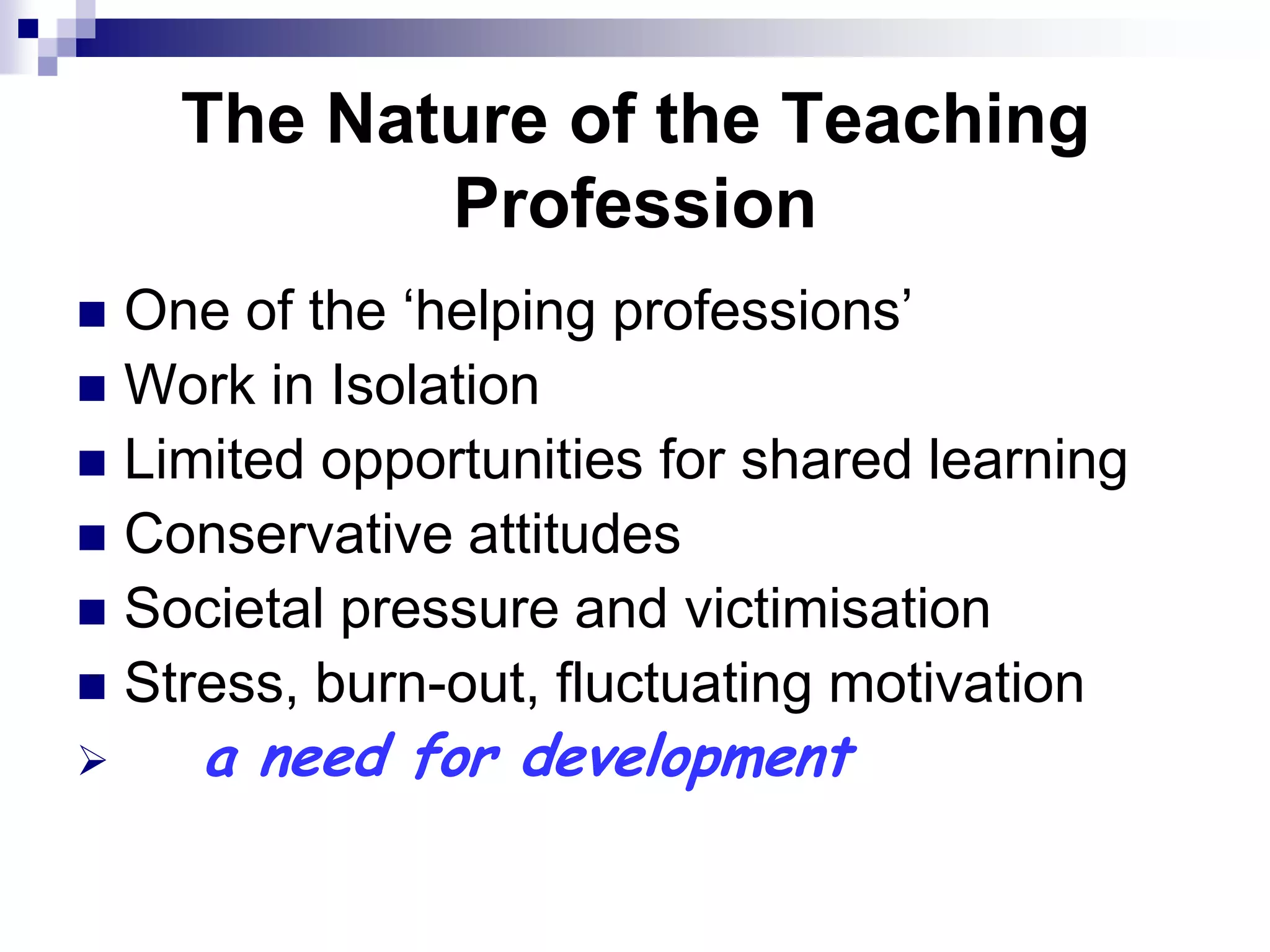
The Nature of the Teaching
           Profession
 One of the „helping professions‟
 Work in Isolation
 Limited opportunities for shared learning
 Conservative attitudes
 Societal pressure and victimisation
 Stress, burn-out, fluctuating motivation
    a need for development
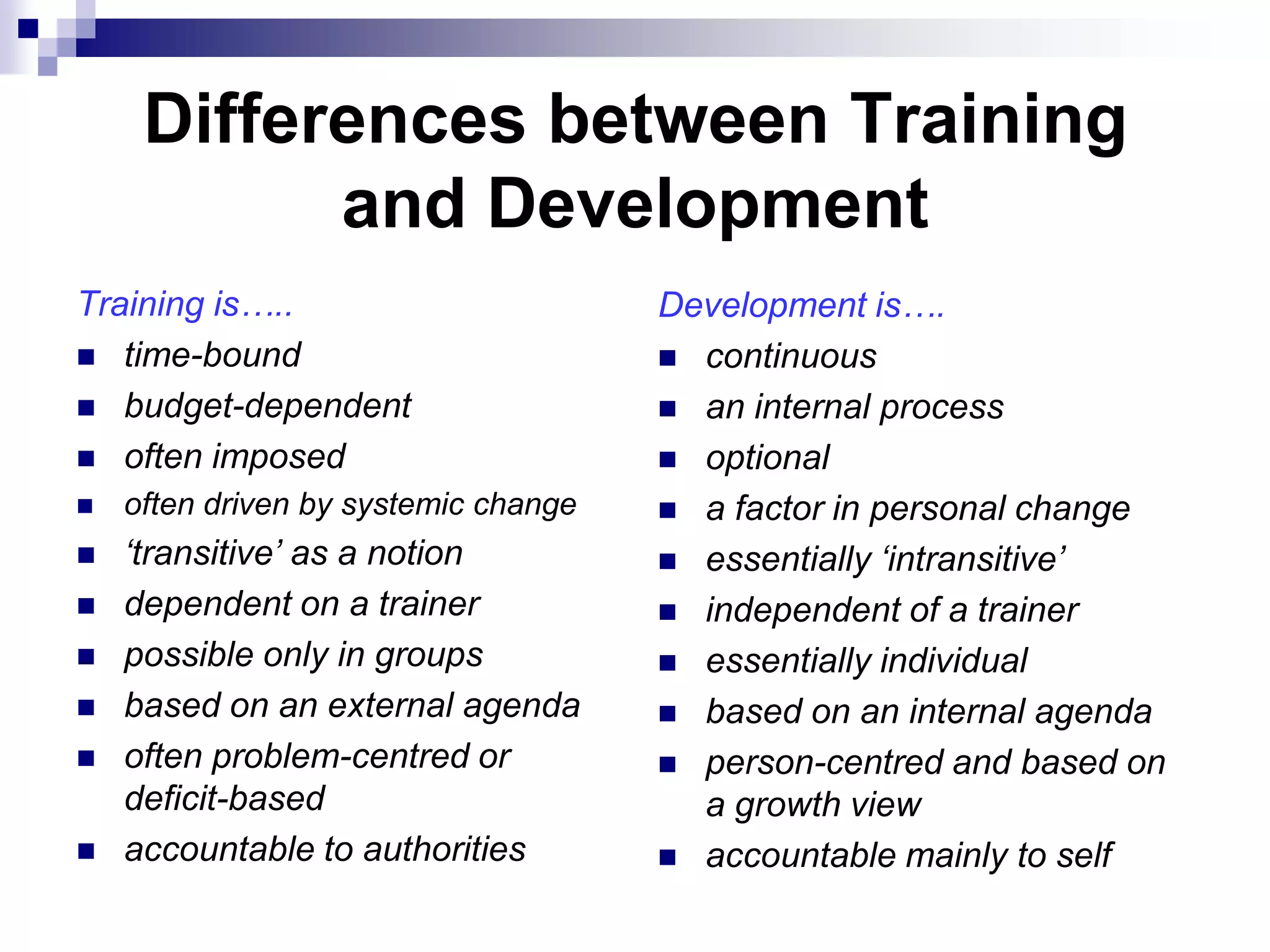
Differences between Training
           and Development
Training is…..                        Development is….
 time-bound                           continuous
 budget-dependent                     an internal process
 often imposed                        optional
   often driven by systemic change    a factor in personal change
   ‘transitive’ as a notion           essentially ‘intransitive’
   dependent on a trainer             independent of a trainer
   possible only in groups            essentially individual
   based on an external agenda        based on an internal agenda
   often problem-centred or           person-centred and based on
    deficit-based                       a growth view
   accountable to authorities         accountable mainly to self
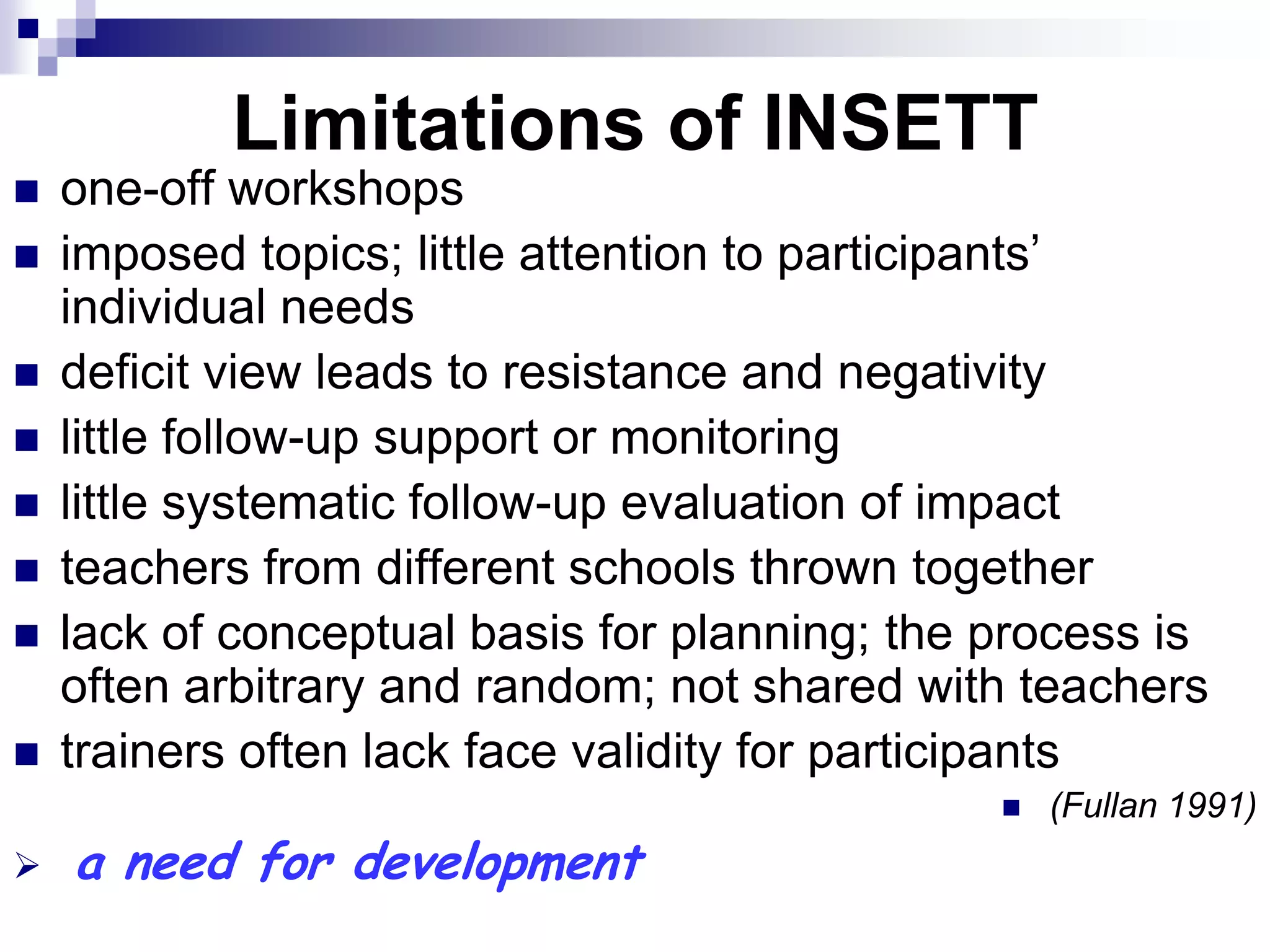
Limitations of INSETT
   one-off workshops
   imposed topics; little attention to participants‟
    individual needs
   deficit view leads to resistance and negativity
   little follow-up support or monitoring
   little systematic follow-up evaluation of impact
   teachers from different schools thrown together
   lack of conceptual basis for planning; the process is
    often arbitrary and random; not shared with teachers
   trainers often lack face validity for participants
                                                  (Fullan 1991)
   a need for development
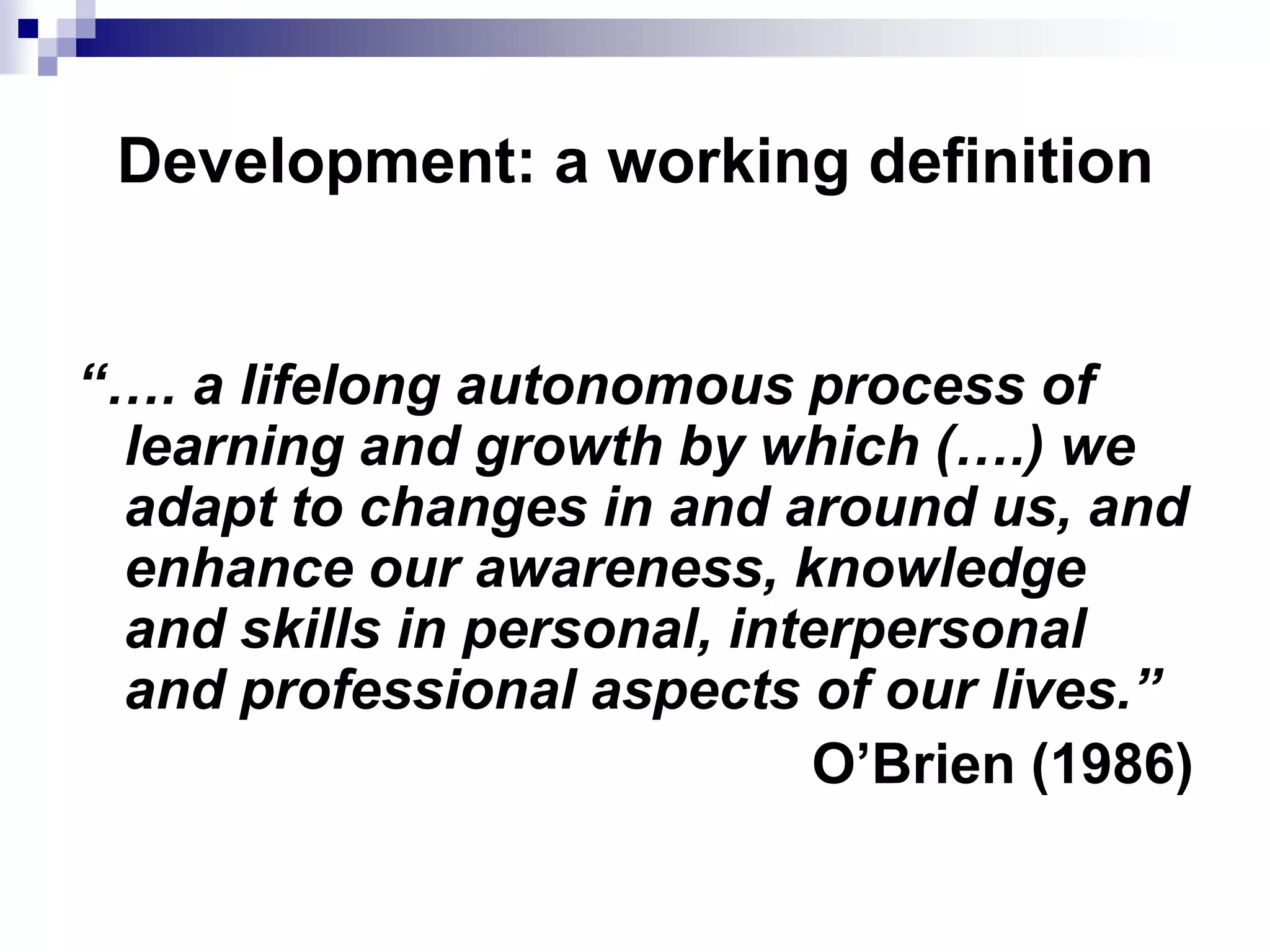
Development: a working definition


“…. a lifelong autonomous process of
 learning and growth by which (….) we
 adapt to changes in and around us, and
 enhance our awareness, knowledge
 and skills in personal, interpersonal
 and professional aspects of our lives.”
                            O’Brien (1986)
Language Teachers’ needs
            (Peyton, 1997)
 Comprehend contemporary media & interract
  with native speakers
 Master pedagogic knowledge
 Master technologies and integrate them in
  teaching
 Maintain language proficiency & be up to date
 Cope with demographic explosions in schools


   a need for development
Finding Needs: How and Where
            (Peyton, 1997)
 Evening courses
 Summer institutes and seminars
 Lectures
 Study & travel abroad
 Immersion weekends/monthly professional
  dinners
 Workshops offered by professional associations
Associations: Challenges

 Finding a few inspired professionals
 Finding active members
 Finding volunteers
                                    Falcao & Szesztay, (2006)

 Defining role relationships
 Maintaining group sense of belonging
 Finding funding
 Finding MOE recognition
 Maintaining autonomy from state influence
An Example: CAMELTA
 Created in April 2001 as umbrella association
 ELTAs existed since the early 80s
 Committed members from ELTAs saw need for
  a national body
 British Council „mothered‟ initial steps by:
     Hosting and funding initial meetings
     Heavily funding subsequent national conferences
     Sponsoring keynote speakers from the UK
     Supporting regional chapters
     Offering its venue and other logistics
CAMELTA’s Goals
 Improve practice of language teaching and
  learning
 Promote high standards of in-service training
  through seminars and workshops
 Foster & promote scholarship relating to
  language teaching
 Foster high academic and professional
  standards
 Break down the isolation that teachers
  experience both in their classrooms and
  schools
   Encourage co-operation and mutual support
   Foster the exchange of ideas, resources,
    information and experience
   Offer a regular forum for the exchange of new
    ideas, practices, materials etc
   Provide opportunities for personal language dev‟t
   Encourage dev‟t of EFL/ESL teacher identity and
    collegiality
   Create a forum for the promotion of teacher
    friendly ELT
   Generate networking and skills sharing for best
    practices
   Stay out of politics and trade unionism
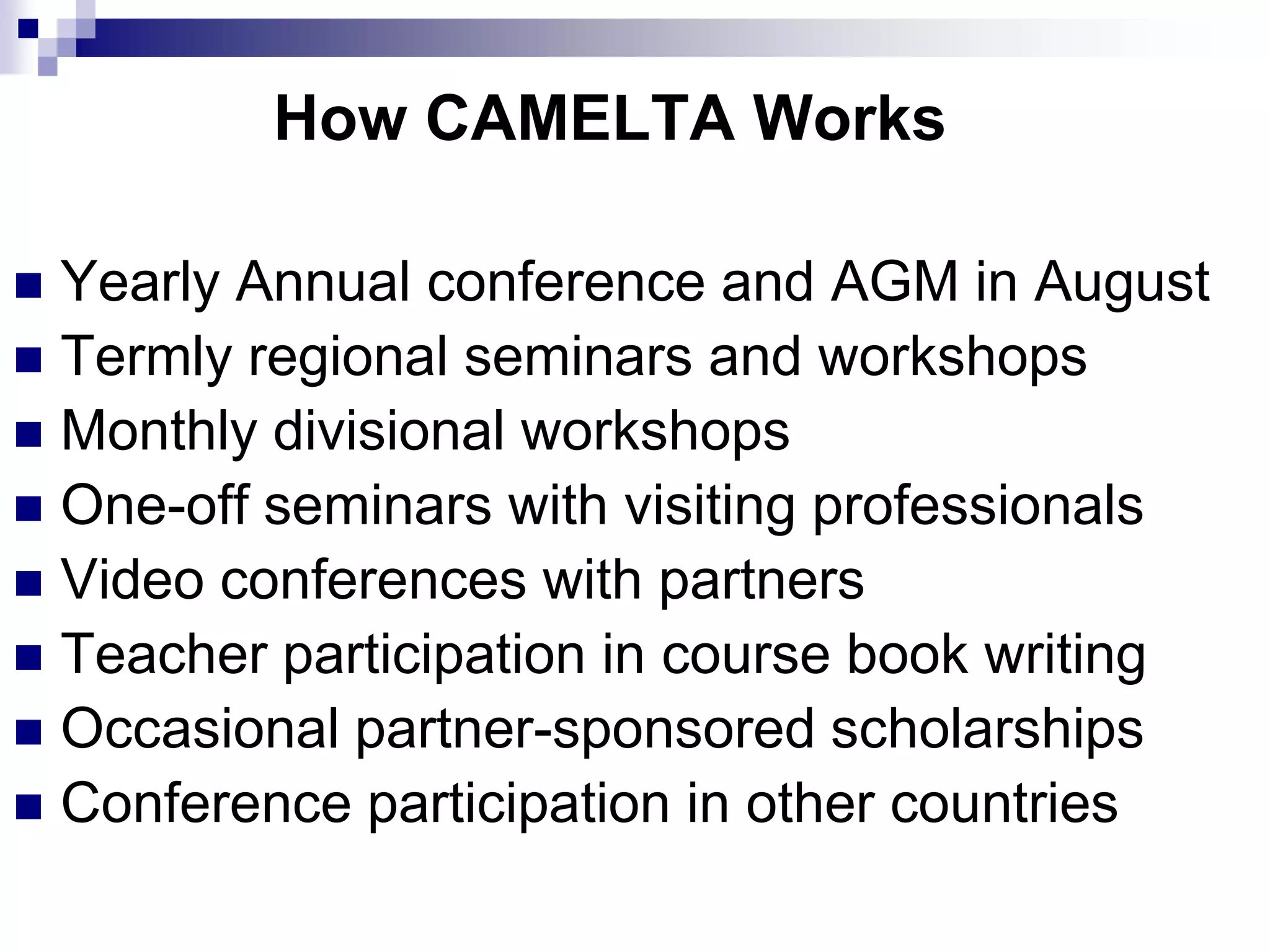
How CAMELTA Works

 Yearly Annual conference and AGM in August
 Termly regional seminars and workshops
 Monthly divisional workshops
 One-off seminars with visiting professionals
 Video conferences with partners
 Teacher participation in course book writing
 Occasional partner-sponsored scholarships
 Conference participation in other countries
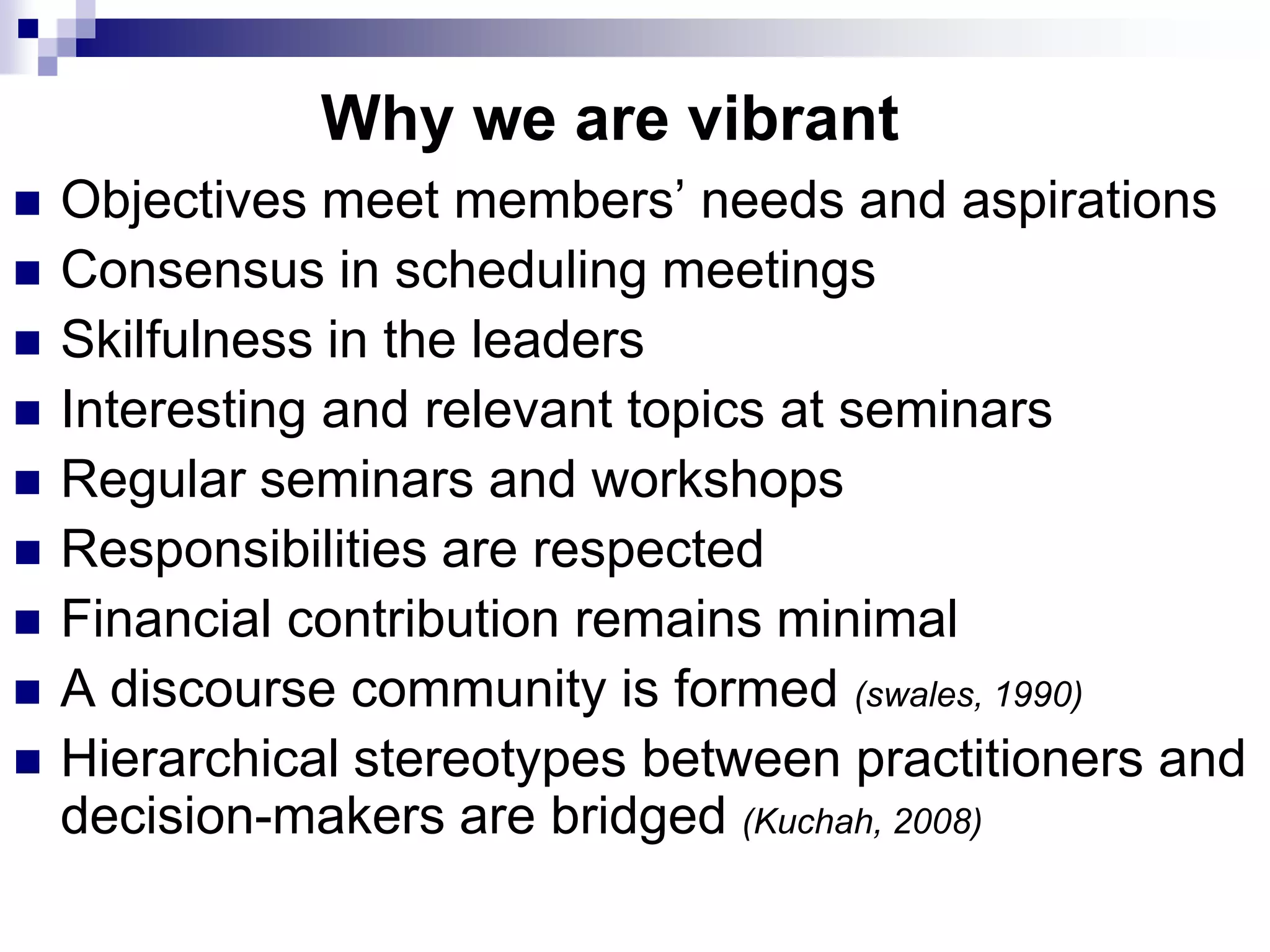
Why we are vibrant
   Objectives meet members‟ needs and aspirations
   Consensus in scheduling meetings
   Skilfulness in the leaders
   Interesting and relevant topics at seminars
   Regular seminars and workshops
   Responsibilities are respected
   Financial contribution remains minimal
   A discourse community is formed (swales, 1990)
   Hierarchical stereotypes between practitioners and
    decision-makers are bridged (Kuchah, 2008)
How we ensure empowerment
   Teachers run/lead their affaires
   Teachers present talks, workshops at seminars
   Teachers produce newsletters, journals etc
   Non-executive members are involved.
   Teachers have healthy debates with decision-
    makers
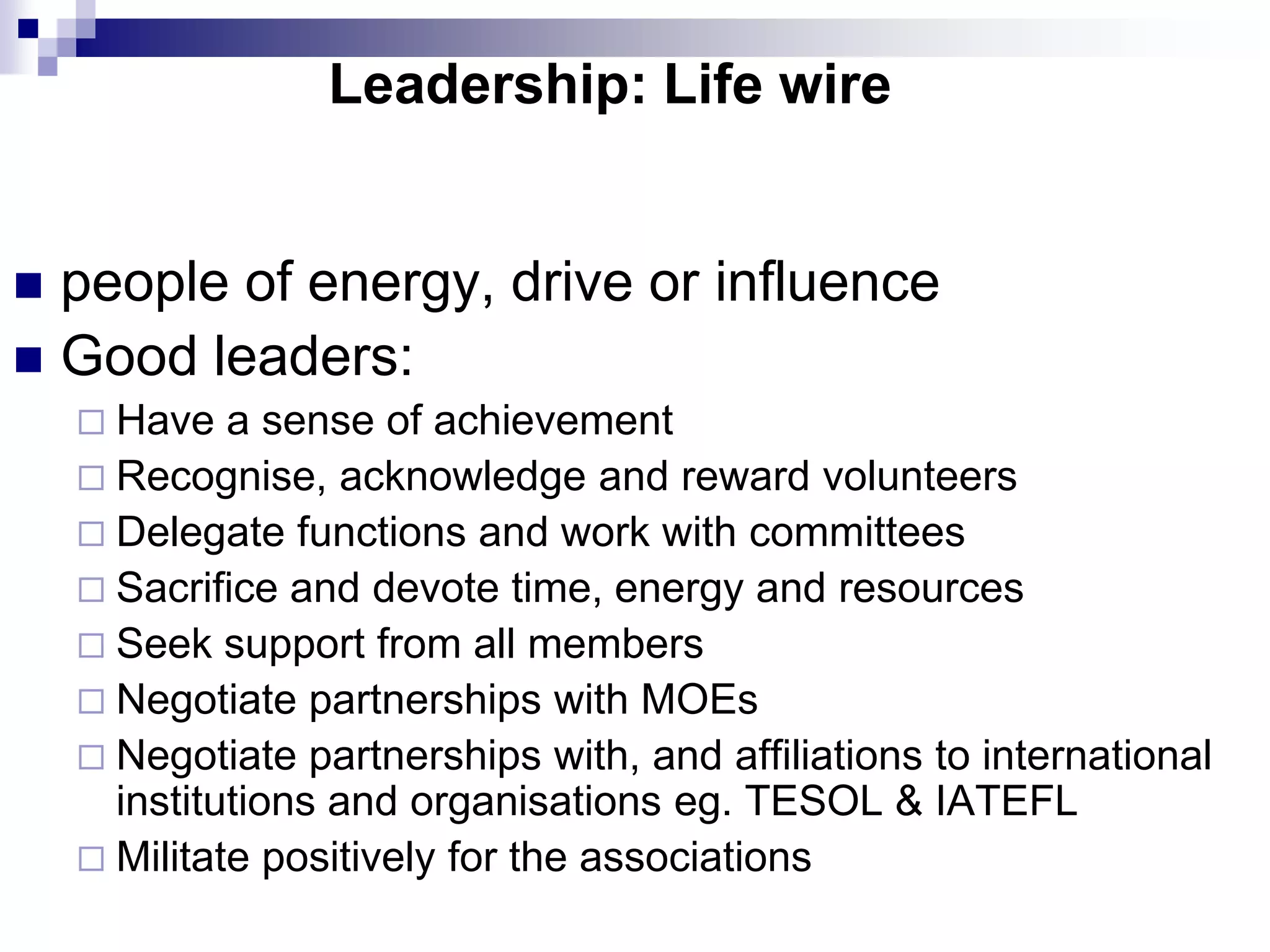
Leadership: Life wire


 people of energy, drive or influence
 Good leaders:
     Have   a sense of achievement
     Recognise, acknowledge and reward volunteers
     Delegate functions and work with committees
     Sacrifice and devote time, energy and resources
     Seek support from all members
     Negotiate partnerships with MOEs
     Negotiate partnerships with, and affiliations to international
      institutions and organisations eg. TESOL & IATEFL
     Militate positively for the associations
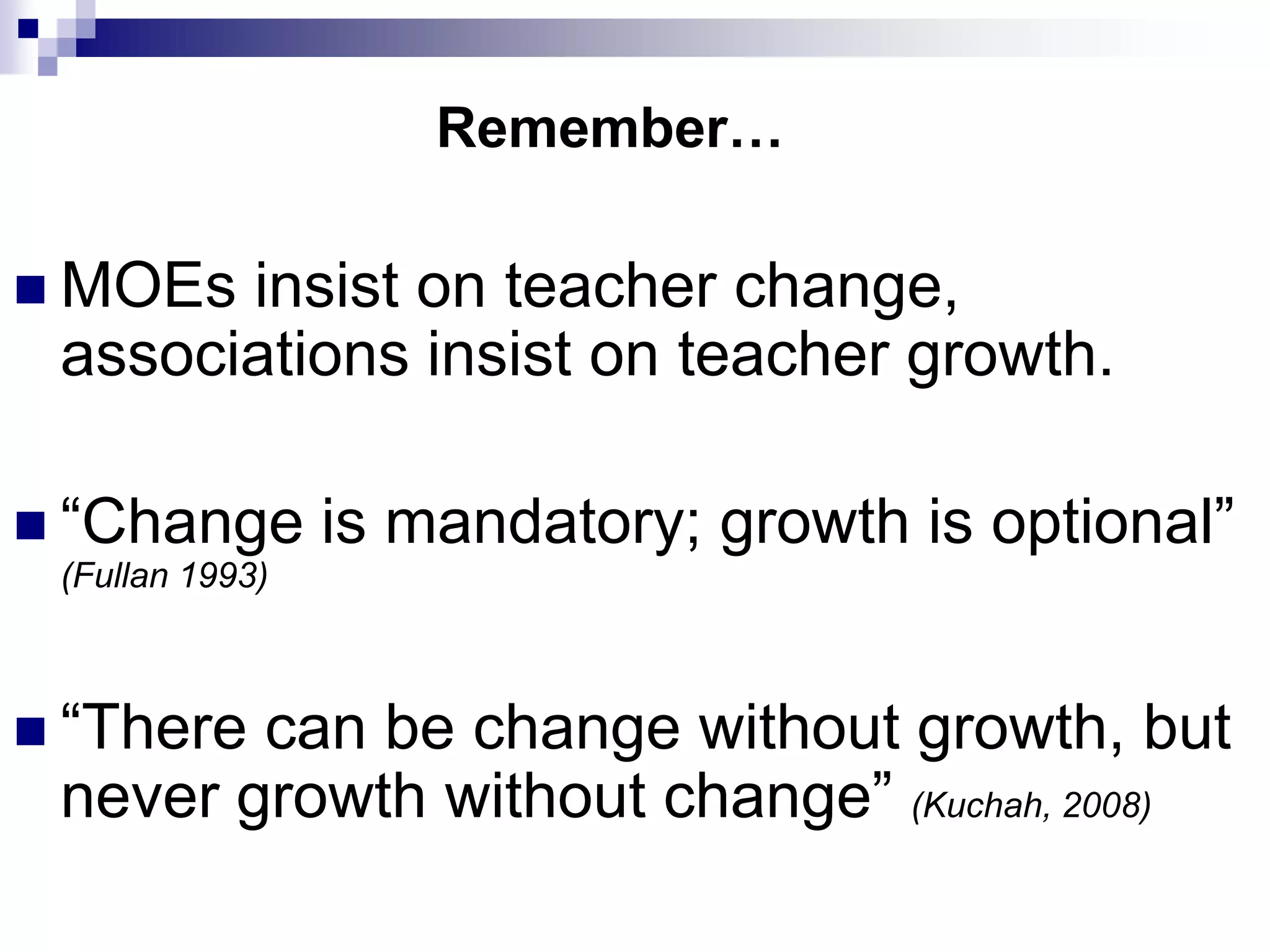
Remember…

 MOEs insist on teacher change,
 associations insist on teacher growth.

 “Change        is mandatory; growth is optional”
 (Fullan 1993)


 “Therecan be change without growth, but
 never growth without change” (Kuchah, 2008)
References
Fullan, M. (1991) The New Meaning of Educational Change
  (2nd edition) London: Cassell
Fullan, M. (1993) Change Forces Brighton: Falmer Press
O‟Brien, A. (1986) Teacher Development, Evaluation and
  Teacher Profiles for TESOL London: Institute of
  Education (unpublished MA thesis)
Kuchah, K. (2008) „Developing as a Professional in
  Cameroon: Challenges and Visions‟ in Richards, K. & S.
  Garton (eds.) Professional Encounters in TESOL. New
  York: Palgrave Macmillan, pp. 203-217)
Swales, J. M. 1990. Genre Analysis. Cambridge: Cambridge
  University Press.
Let Us Change And Grow Now


       THANK YOU

THE IMPORTANCE OF CONTINUED PROFESSIONAL DEVELOPMENT TRAINING FOR TEACHERS: THE ROLE OF PROFESSIONAL ASSOCIATIONS

  • 1.
    THE IMPORTANCE OFCONTINUED PROFESSIONAL DEVELOPMENT TRAINING FOR TEACHERS: THE ROLE OF PROFESSIONAL ASSOCIATIONS Eric Ntam University of Yaounde I, Cameroon
  • 2.
    The Nature ofthe Teaching Profession  One of the „helping professions‟  Work in Isolation  Limited opportunities for shared learning  Conservative attitudes  Societal pressure and victimisation  Stress, burn-out, fluctuating motivation  a need for development
  • 3.
    Differences between Training and Development Training is….. Development is….  time-bound  continuous  budget-dependent  an internal process  often imposed  optional  often driven by systemic change  a factor in personal change  ‘transitive’ as a notion  essentially ‘intransitive’  dependent on a trainer  independent of a trainer  possible only in groups  essentially individual  based on an external agenda  based on an internal agenda  often problem-centred or  person-centred and based on deficit-based a growth view  accountable to authorities  accountable mainly to self
  • 4.
    Limitations of INSETT  one-off workshops  imposed topics; little attention to participants‟ individual needs  deficit view leads to resistance and negativity  little follow-up support or monitoring  little systematic follow-up evaluation of impact  teachers from different schools thrown together  lack of conceptual basis for planning; the process is often arbitrary and random; not shared with teachers  trainers often lack face validity for participants  (Fullan 1991)  a need for development
  • 5.
    Development: a workingdefinition “…. a lifelong autonomous process of learning and growth by which (….) we adapt to changes in and around us, and enhance our awareness, knowledge and skills in personal, interpersonal and professional aspects of our lives.” O’Brien (1986)
  • 6.
    Language Teachers’ needs (Peyton, 1997)  Comprehend contemporary media & interract with native speakers  Master pedagogic knowledge  Master technologies and integrate them in teaching  Maintain language proficiency & be up to date  Cope with demographic explosions in schools  a need for development
  • 7.
    Finding Needs: Howand Where (Peyton, 1997)  Evening courses  Summer institutes and seminars  Lectures  Study & travel abroad  Immersion weekends/monthly professional dinners  Workshops offered by professional associations
  • 8.
    Associations: Challenges  Findinga few inspired professionals  Finding active members  Finding volunteers  Falcao & Szesztay, (2006)  Defining role relationships  Maintaining group sense of belonging  Finding funding  Finding MOE recognition  Maintaining autonomy from state influence
  • 9.
    An Example: CAMELTA Created in April 2001 as umbrella association  ELTAs existed since the early 80s  Committed members from ELTAs saw need for a national body  British Council „mothered‟ initial steps by:  Hosting and funding initial meetings  Heavily funding subsequent national conferences  Sponsoring keynote speakers from the UK  Supporting regional chapters  Offering its venue and other logistics
  • 10.
    CAMELTA’s Goals  Improvepractice of language teaching and learning  Promote high standards of in-service training through seminars and workshops  Foster & promote scholarship relating to language teaching  Foster high academic and professional standards  Break down the isolation that teachers experience both in their classrooms and schools
  • 11.
    Encourage co-operation and mutual support  Foster the exchange of ideas, resources, information and experience  Offer a regular forum for the exchange of new ideas, practices, materials etc  Provide opportunities for personal language dev‟t  Encourage dev‟t of EFL/ESL teacher identity and collegiality  Create a forum for the promotion of teacher friendly ELT  Generate networking and skills sharing for best practices  Stay out of politics and trade unionism
  • 12.
    How CAMELTA Works Yearly Annual conference and AGM in August  Termly regional seminars and workshops  Monthly divisional workshops  One-off seminars with visiting professionals  Video conferences with partners  Teacher participation in course book writing  Occasional partner-sponsored scholarships  Conference participation in other countries
  • 13.
    Why we arevibrant  Objectives meet members‟ needs and aspirations  Consensus in scheduling meetings  Skilfulness in the leaders  Interesting and relevant topics at seminars  Regular seminars and workshops  Responsibilities are respected  Financial contribution remains minimal  A discourse community is formed (swales, 1990)  Hierarchical stereotypes between practitioners and decision-makers are bridged (Kuchah, 2008)
  • 14.
    How we ensureempowerment  Teachers run/lead their affaires  Teachers present talks, workshops at seminars  Teachers produce newsletters, journals etc  Non-executive members are involved.  Teachers have healthy debates with decision- makers
  • 15.
    Leadership: Life wire people of energy, drive or influence  Good leaders:  Have a sense of achievement  Recognise, acknowledge and reward volunteers  Delegate functions and work with committees  Sacrifice and devote time, energy and resources  Seek support from all members  Negotiate partnerships with MOEs  Negotiate partnerships with, and affiliations to international institutions and organisations eg. TESOL & IATEFL  Militate positively for the associations
  • 16.
    Remember…  MOEs insiston teacher change, associations insist on teacher growth.  “Change is mandatory; growth is optional” (Fullan 1993)  “Therecan be change without growth, but never growth without change” (Kuchah, 2008)
  • 17.
    References Fullan, M. (1991)The New Meaning of Educational Change (2nd edition) London: Cassell Fullan, M. (1993) Change Forces Brighton: Falmer Press O‟Brien, A. (1986) Teacher Development, Evaluation and Teacher Profiles for TESOL London: Institute of Education (unpublished MA thesis) Kuchah, K. (2008) „Developing as a Professional in Cameroon: Challenges and Visions‟ in Richards, K. & S. Garton (eds.) Professional Encounters in TESOL. New York: Palgrave Macmillan, pp. 203-217) Swales, J. M. 1990. Genre Analysis. Cambridge: Cambridge University Press.
  • 18.
    Let Us ChangeAnd Grow Now THANK YOU