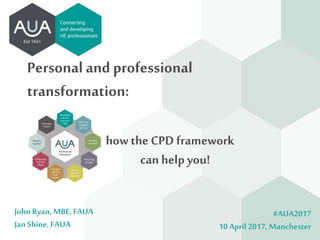
Personal and professional
transformation:
how the CPD framework
can help you!
#AUA2017
10 April2017, Manchester
JohnRyan, MBE, FAUA
JanShine, FAUA
Objectives for today
You will have the opportunity to:
• develop greater understanding of how the CPD
framework can be applied in practice
• experience using the framework to assess your own
strengths and areas for development
• reflect on how you could benefit further from the CPD
framework
Group discussion
 What experiences or perceptions do you have of the
AUA’s CPD Framework?
 What are you hoping to gain from this session?
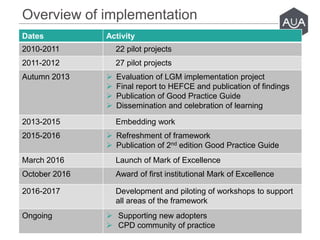
Overview of implementation
Dates Activity
2010-2011 22 pilot projects
2011-2012 27 pilot projects
Autumn 2013  Evaluation of LGM implementation project
 Final report to HEFCE and publication of findings
 Publication of Good Practice Guide
 Dissemination and celebration of learning
2013-2015 Embedding work
2015-2016  Refreshment of framework
 Publication of 2nd edition Good Practice Guide
March 2016 Launch of Mark of Excellence
October 2016 Award of first institutional Mark of Excellence
2016-2017 Development and piloting of workshops to support
all areas of the framework
Ongoing  Supporting new adopters
 CPD community of practice
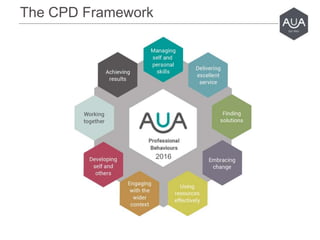
The CPD Framework
2016
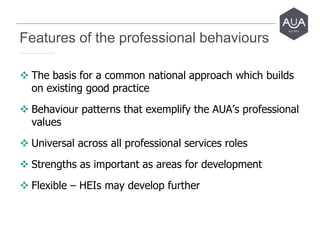
Features of the professional behaviours
 The basis for a common national approach which builds
on existing good practice
 Behaviour patterns that exemplify the AUA’s professional
values
 Universal across all professional services roles
 Strengths as important as areas for development
 Flexible – HEIs may develop further
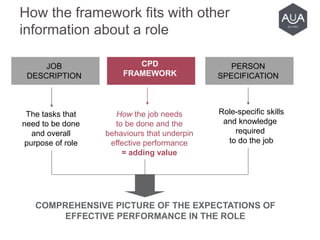
How the framework fits with other
information about a role
PERSON
SPECIFICATION
How the job needs
to be done and the
behaviours that underpin
effective performance
= adding value
The tasks that
need to be done
and overall
purpose of role
Role-specific skills
and knowledge
required
to do the job
COMPREHENSIVE PICTURE OF THE EXPECTATIONS OF
EFFECTIVE PERFORMANCE IN THE ROLE
CPD
FRAMEWORK
JOB
DESCRIPTION
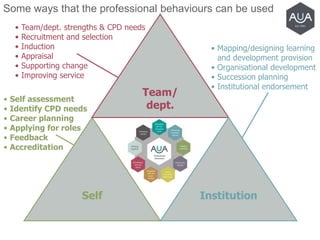
• Self assessment
• Identify CPD needs
• Career planning
• Applying for roles
• Feedback
• Accreditation
Self
Team/
dept.
Institution
Some ways that the professional behaviours can be used
• Team/dept. strengths & CPD needs
• Recruitment and selection
• Induction
• Appraisal
• Supporting change
• Improving service
• Mapping/designing learning
and development provision
• Organisational development
• Succession planning
• Institutional endorsement
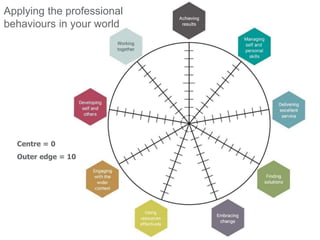
Applying the professional
behaviours in your world
Centre = 0
Outer edge = 10
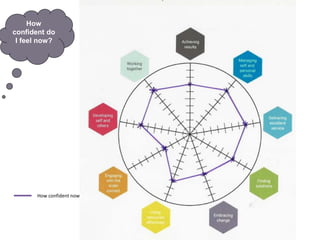
How
confident do
I feel now?
Centre = 0
Outer edge = 10
How confident now
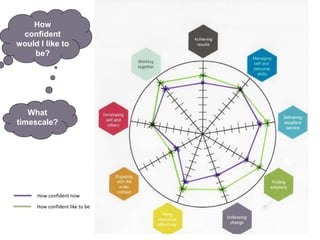
How
confident
would I like to
be?
What
timescale?
How confident now
How confident like to be
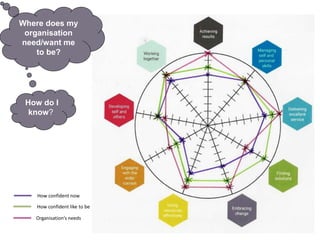
How do I
know?
Where does my
organisation
need/want me
to be?
How confident now
How confident like to be
Organisation’s needs
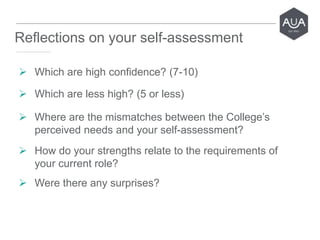
Reflections on your self-assessment
 Which are high confidence? (7-10)
 Which are less high? (5 or less)
 Where are the mismatches between the College’s
perceived needs and your self-assessment?
 How do your strengths relate to the requirements of
your current role?
 Were there any surprises?
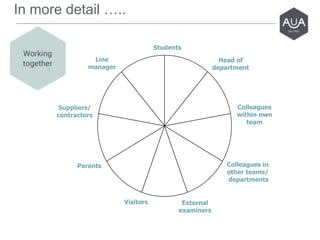
Line
manager
Head of
department
Colleagues in
other teams/
departments
Students
External
examiners
Parents
Suppliers/
contractors
Visitors
Colleagues
within own
team
In more detail …..
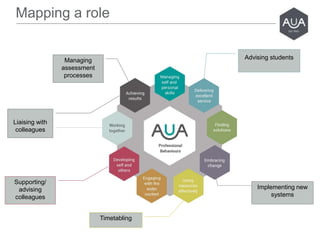
Mapping a role
Liaising with
colleagues
Timetabling
Implementing new
systems
Supporting/
advising
colleagues
Managing
assessment
processes
Advising students
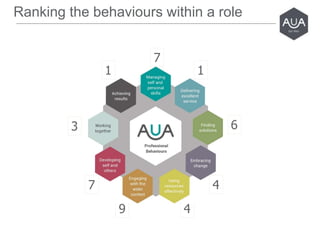
9 4
7
Ranking the behaviours within a role
1 1
63
47
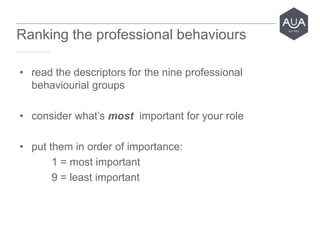
• read the descriptors for the nine professional
behaviourial groups
• consider what’s most important for your role
• put them in order of importance:
1 = most important
9 = least important
www.aua.ac.uk inspiring professional higher education
Ranking the professional behaviours
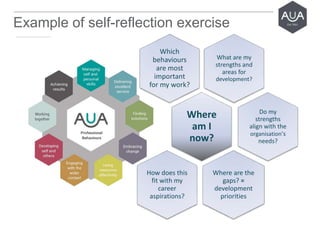
What are my
strengths and
areas for
development?
Which
behaviours
are most
important
for my work?
Where
am I
now?
How does this
fit with my
career
aspirations?
Do my
strengths
align with the
organisation’s
needs?
Where are the
gaps? =
development
priorities
Example of self-reflection exercise
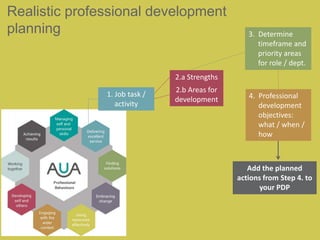
1. Job task /
activity
2.a Strengths
3. Determine
timeframe and
priority areas
for role / dept.
Add the planned
actions from Step 4. to
your PDP
2.b Areas for
development 4. Professional
development
objectives:
what / when /
how
Realistic professional development
planning
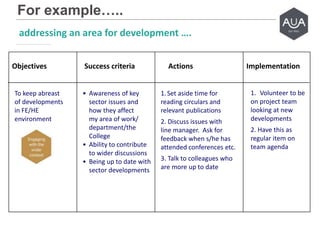
For example…..
Objectives Success criteria Actions Implementation
To keep abreast
of developments
in FE/HE
environment
• Awareness of key
sector issues and
how they affect
my area of work/
department/the
College
• Ability to contribute
to wider discussions
• Being up to date with
sector developments
1.Set aside time for
reading circulars and
relevant publications
2. Discuss issues with
line manager. Ask for
feedback when s/he has
attended conferences etc.
3. Talk to colleagues who
are more up to date
1. Volunteer to be
on project team
looking at new
developments
2. Have this as
regular item on
team agenda
addressing an area for development ….
For example…..
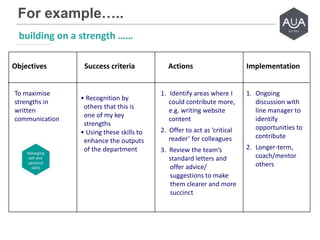
Objectives Success criteria Actions Implementation
To maximise
strengths in
written
communication
• Recognition by
others that this is
one of my key
strengths
• Using these skills to
enhance the outputs
of the department
1. Identify areas where I
could contribute more,
e.g. writing website
content
2. Offer to act as ‘critical
reader’ for colleagues
3. Review the team’s
standard letters and
offer advice/
suggestions to make
them clearer and more
succinct
1. Ongoing
discussion with
line manager to
identify
opportunities to
contribute
2. Longer-term,
coach/mentor
others
building on a strength ……
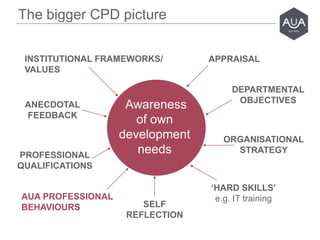
The bigger CPD picture
Awareness
of own
development
needs
ANECDOTAL
FEEDBACK
APPRAISALINSTITUTIONAL FRAMEWORKS/
VALUES
DEPARTMENTAL
OBJECTIVES
‘HARD SKILLS’
e.g. IT training
PROFESSIONAL
QUALIFICATIONS
SELF
REFLECTION
ORGANISATIONAL
STRATEGY
AUA PROFESSIONAL
BEHAVIOURS
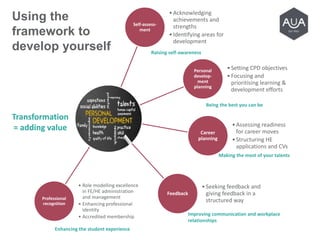
Self-assess-
ment
•Acknowledging
achievements and
strengths
•Identifying areas for
development
Personal
develop-
ment
planning
•Setting CPD objectives
•Focusing and
prioritising learning &
development efforts
Career
planning
•Assessing readiness
for career moves
•Structuring HE
applications and CVs
Feedback
•Seeking feedback and
giving feedback in a
structured wayProfessional
recognition
• Role modelling excellence
in FE/HE administration
and management
• Enhancing professional
identity
• Accredited membership
Using the
framework to
develop yourself
Transformation
= adding value
Raising self-awareness
Making the most of your talents
Improving communication and workplace
relationships
Being the best you can be
Enhancing the student experience
www.aua.ac.uk inspiring professional higher education
Reflection in pairs
Discuss with your partner:
 What key points are you taking away from the session?
 How do you intend to engage with the CPD framework in the
future?
Resources and further support
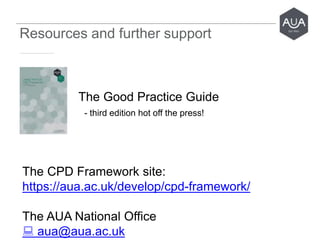
The Good Practice Guide
- third edition hot off the press!
The CPD Framework site:
https://aua.ac.uk/develop/cpd-framework/
The AUA National Office
 aua@aua.ac.uk
Thank you for contributing to today’s
session
Enjoy the Conference!
#AUA2017

Personal and professional transformation

  • 1.
    Personal and professional transformation: howthe CPD framework can help you! #AUA2017 10 April2017, Manchester JohnRyan, MBE, FAUA JanShine, FAUA
  • 2.
    Objectives for today Youwill have the opportunity to: • develop greater understanding of how the CPD framework can be applied in practice • experience using the framework to assess your own strengths and areas for development • reflect on how you could benefit further from the CPD framework
  • 3.
    Group discussion  Whatexperiences or perceptions do you have of the AUA’s CPD Framework?  What are you hoping to gain from this session?
  • 4.
    Overview of implementation DatesActivity 2010-2011 22 pilot projects 2011-2012 27 pilot projects Autumn 2013  Evaluation of LGM implementation project  Final report to HEFCE and publication of findings  Publication of Good Practice Guide  Dissemination and celebration of learning 2013-2015 Embedding work 2015-2016  Refreshment of framework  Publication of 2nd edition Good Practice Guide March 2016 Launch of Mark of Excellence October 2016 Award of first institutional Mark of Excellence 2016-2017 Development and piloting of workshops to support all areas of the framework Ongoing  Supporting new adopters  CPD community of practice
  • 5.
  • 6.
    Features of theprofessional behaviours  The basis for a common national approach which builds on existing good practice  Behaviour patterns that exemplify the AUA’s professional values  Universal across all professional services roles  Strengths as important as areas for development  Flexible – HEIs may develop further
  • 7.
    How the frameworkfits with other information about a role PERSON SPECIFICATION How the job needs to be done and the behaviours that underpin effective performance = adding value The tasks that need to be done and overall purpose of role Role-specific skills and knowledge required to do the job COMPREHENSIVE PICTURE OF THE EXPECTATIONS OF EFFECTIVE PERFORMANCE IN THE ROLE CPD FRAMEWORK JOB DESCRIPTION
  • 8.
    • Self assessment •Identify CPD needs • Career planning • Applying for roles • Feedback • Accreditation Self Team/ dept. Institution Some ways that the professional behaviours can be used • Team/dept. strengths & CPD needs • Recruitment and selection • Induction • Appraisal • Supporting change • Improving service • Mapping/designing learning and development provision • Organisational development • Succession planning • Institutional endorsement
  • 9.
    Applying the professional behavioursin your world Centre = 0 Outer edge = 10
  • 10.
    How confident do I feelnow? Centre = 0 Outer edge = 10 How confident now
  • 11.
    How confident would I liketo be? What timescale? How confident now How confident like to be
  • 12.
    How do I know? Wheredoes my organisation need/want me to be? How confident now How confident like to be Organisation’s needs
  • 13.
    Reflections on yourself-assessment  Which are high confidence? (7-10)  Which are less high? (5 or less)  Where are the mismatches between the College’s perceived needs and your self-assessment?  How do your strengths relate to the requirements of your current role?  Were there any surprises?
  • 14.
    Line manager Head of department Colleagues in otherteams/ departments Students External examiners Parents Suppliers/ contractors Visitors Colleagues within own team In more detail …..
  • 15.
    Mapping a role Liaisingwith colleagues Timetabling Implementing new systems Supporting/ advising colleagues Managing assessment processes Advising students
  • 16.
    9 4 7 Ranking thebehaviours within a role 1 1 63 47
  • 17.
    • read thedescriptors for the nine professional behaviourial groups • consider what’s most important for your role • put them in order of importance: 1 = most important 9 = least important www.aua.ac.uk inspiring professional higher education Ranking the professional behaviours
  • 18.
    What are my strengthsand areas for development? Which behaviours are most important for my work? Where am I now? How does this fit with my career aspirations? Do my strengths align with the organisation’s needs? Where are the gaps? = development priorities Example of self-reflection exercise
  • 19.
    1. Job task/ activity 2.a Strengths 3. Determine timeframe and priority areas for role / dept. Add the planned actions from Step 4. to your PDP 2.b Areas for development 4. Professional development objectives: what / when / how Realistic professional development planning
  • 20.
    For example….. Objectives Successcriteria Actions Implementation To keep abreast of developments in FE/HE environment • Awareness of key sector issues and how they affect my area of work/ department/the College • Ability to contribute to wider discussions • Being up to date with sector developments 1.Set aside time for reading circulars and relevant publications 2. Discuss issues with line manager. Ask for feedback when s/he has attended conferences etc. 3. Talk to colleagues who are more up to date 1. Volunteer to be on project team looking at new developments 2. Have this as regular item on team agenda addressing an area for development ….
  • 21.
    For example….. Objectives Successcriteria Actions Implementation To maximise strengths in written communication • Recognition by others that this is one of my key strengths • Using these skills to enhance the outputs of the department 1. Identify areas where I could contribute more, e.g. writing website content 2. Offer to act as ‘critical reader’ for colleagues 3. Review the team’s standard letters and offer advice/ suggestions to make them clearer and more succinct 1. Ongoing discussion with line manager to identify opportunities to contribute 2. Longer-term, coach/mentor others building on a strength ……
  • 22.
    The bigger CPDpicture Awareness of own development needs ANECDOTAL FEEDBACK APPRAISALINSTITUTIONAL FRAMEWORKS/ VALUES DEPARTMENTAL OBJECTIVES ‘HARD SKILLS’ e.g. IT training PROFESSIONAL QUALIFICATIONS SELF REFLECTION ORGANISATIONAL STRATEGY AUA PROFESSIONAL BEHAVIOURS
  • 23.
    Self-assess- ment •Acknowledging achievements and strengths •Identifying areasfor development Personal develop- ment planning •Setting CPD objectives •Focusing and prioritising learning & development efforts Career planning •Assessing readiness for career moves •Structuring HE applications and CVs Feedback •Seeking feedback and giving feedback in a structured wayProfessional recognition • Role modelling excellence in FE/HE administration and management • Enhancing professional identity • Accredited membership Using the framework to develop yourself Transformation = adding value Raising self-awareness Making the most of your talents Improving communication and workplace relationships Being the best you can be Enhancing the student experience
  • 24.
    www.aua.ac.uk inspiring professionalhigher education Reflection in pairs Discuss with your partner:  What key points are you taking away from the session?  How do you intend to engage with the CPD framework in the future?
  • 25.
    Resources and furthersupport The Good Practice Guide - third edition hot off the press! The CPD Framework site: https://aua.ac.uk/develop/cpd-framework/ The AUA National Office  aua@aua.ac.uk
  • 26.
    Thank you forcontributing to today’s session Enjoy the Conference! #AUA2017