


Insights of 70:20:10
learning model
By Linda Ling
training supervisor @NetEase
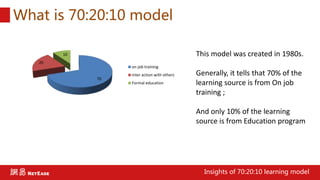
What is 70:20:10 model
Insights of 70:20:10 learning model
70
20
10
on job training
inter action with others
Formal education
This model was created in 1980s.
Generally, it tells that 70% of the
learning source is from On job
training ;
And only 10% of the learning
source is from Education program
What is behind the model
• What we learned in colleges are not that helpful to our
job as we thought.
• We can learn things from others.
• On job training is the most efficient way to develop
employees
Insights of 70:20:10 learning model
How was this model used
• Most of the companies set up training strategies
following this model;
• The result is that companies don’t support classroom
training and more focus on coaching(mentor) or
Knowledge sharing programs
Insights of 70:20:10 learning model
But do we get this model right
If we want to know the truth, we have to have
complete information
Insights of 70:20:10 learning model
Some facts we should know
• This model was created for researching the key developmental
experiences of successful managers
Which means this model is more about the leadership learning
• This model is talking about the source of knowledge, not only the
form of how to organize learning activities
That means if the learning content is based on job, even when
the form is classroom training, we also can consider it as OJT.
Insights of 70:20:10 learning model
OJT is not only“learning by doing”
• OJT is more systematic, it is a program with complete process.
Different format of OTJ
1. Hands-on experience;
2. Interaction with bosses and mentors(coaching & Feedbacks)
3. Reflection of the mistakes
Insights of 70:20:10 learning model
Interaction with others
• When the model introduces the OJT, it mentioned
about feedbacks and work with bosses or mentor.
Which also interactions with others, so I think we
shouldn’t differ the model based on “learning
activity format”.
• This is more like “learn from other” or “imitate the
ways others behave and think”
Insights of 70:20:10 learning model
Education program is not equal with classroom training
• When a lot of companies apply this model, they tend to
think all the classroom training as education events.
• So most of the company will try their best to cut the
classroom training, because there’s only 10% results
comes from it.
• Also classroom training is money and time consuming, it’s
kind like this model provides an evidence for companies to
cut the cost.
Insights of 70:20:10 learning model
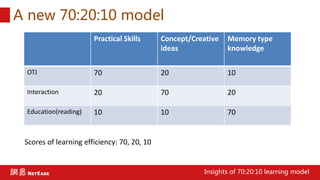
A new 70:20:10 model
Practical Skills Concept/Creative
ideas
Memory type
knowledge
OTJ 70 20 10
Interaction 20 70 20
Education(reading) 10 10 70
Scores of learning efficiency: 70, 20, 10
Insights of 70:20:10 learning model
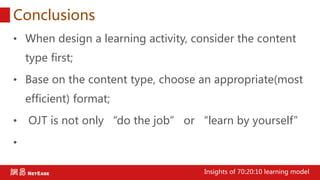
Conclusions
• When design a learning activity, consider the content
type first;
• Base on the content type, choose an appropriate(most
efficient) format;
• OJT is not only “do the job” or “learn by yourself”
•
Insights of 70:20:10 learning model
Thank you
页面制作

Insights of 70:20:10 learning model

  • 1.
    Insights of 70:20:10 learningmodel By Linda Ling training supervisor @NetEase
  • 2.
    What is 70:20:10model Insights of 70:20:10 learning model 70 20 10 on job training inter action with others Formal education This model was created in 1980s. Generally, it tells that 70% of the learning source is from On job training ; And only 10% of the learning source is from Education program
  • 3.
    What is behindthe model • What we learned in colleges are not that helpful to our job as we thought. • We can learn things from others. • On job training is the most efficient way to develop employees Insights of 70:20:10 learning model
  • 4.
    How was thismodel used • Most of the companies set up training strategies following this model; • The result is that companies don’t support classroom training and more focus on coaching(mentor) or Knowledge sharing programs Insights of 70:20:10 learning model
  • 5.
    But do weget this model right If we want to know the truth, we have to have complete information Insights of 70:20:10 learning model
  • 6.
    Some facts weshould know • This model was created for researching the key developmental experiences of successful managers Which means this model is more about the leadership learning • This model is talking about the source of knowledge, not only the form of how to organize learning activities That means if the learning content is based on job, even when the form is classroom training, we also can consider it as OJT. Insights of 70:20:10 learning model
  • 7.
    OJT is notonly“learning by doing” • OJT is more systematic, it is a program with complete process. Different format of OTJ 1. Hands-on experience; 2. Interaction with bosses and mentors(coaching & Feedbacks) 3. Reflection of the mistakes Insights of 70:20:10 learning model
  • 8.
    Interaction with others •When the model introduces the OJT, it mentioned about feedbacks and work with bosses or mentor. Which also interactions with others, so I think we shouldn’t differ the model based on “learning activity format”. • This is more like “learn from other” or “imitate the ways others behave and think” Insights of 70:20:10 learning model
  • 9.
    Education program isnot equal with classroom training • When a lot of companies apply this model, they tend to think all the classroom training as education events. • So most of the company will try their best to cut the classroom training, because there’s only 10% results comes from it. • Also classroom training is money and time consuming, it’s kind like this model provides an evidence for companies to cut the cost. Insights of 70:20:10 learning model
  • 10.
    A new 70:20:10model Practical Skills Concept/Creative ideas Memory type knowledge OTJ 70 20 10 Interaction 20 70 20 Education(reading) 10 10 70 Scores of learning efficiency: 70, 20, 10 Insights of 70:20:10 learning model
  • 11.
    Conclusions • When designa learning activity, consider the content type first; • Base on the content type, choose an appropriate(most efficient) format; • OJT is not only “do the job” or “learn by yourself” • Insights of 70:20:10 learning model
  • 12.