
Career Ready Program
Seminar 4: Succeeding at Job
Applications and Interviews

Career Development Centre
La Trobe University
Resumes & Cover Letters
Resumes


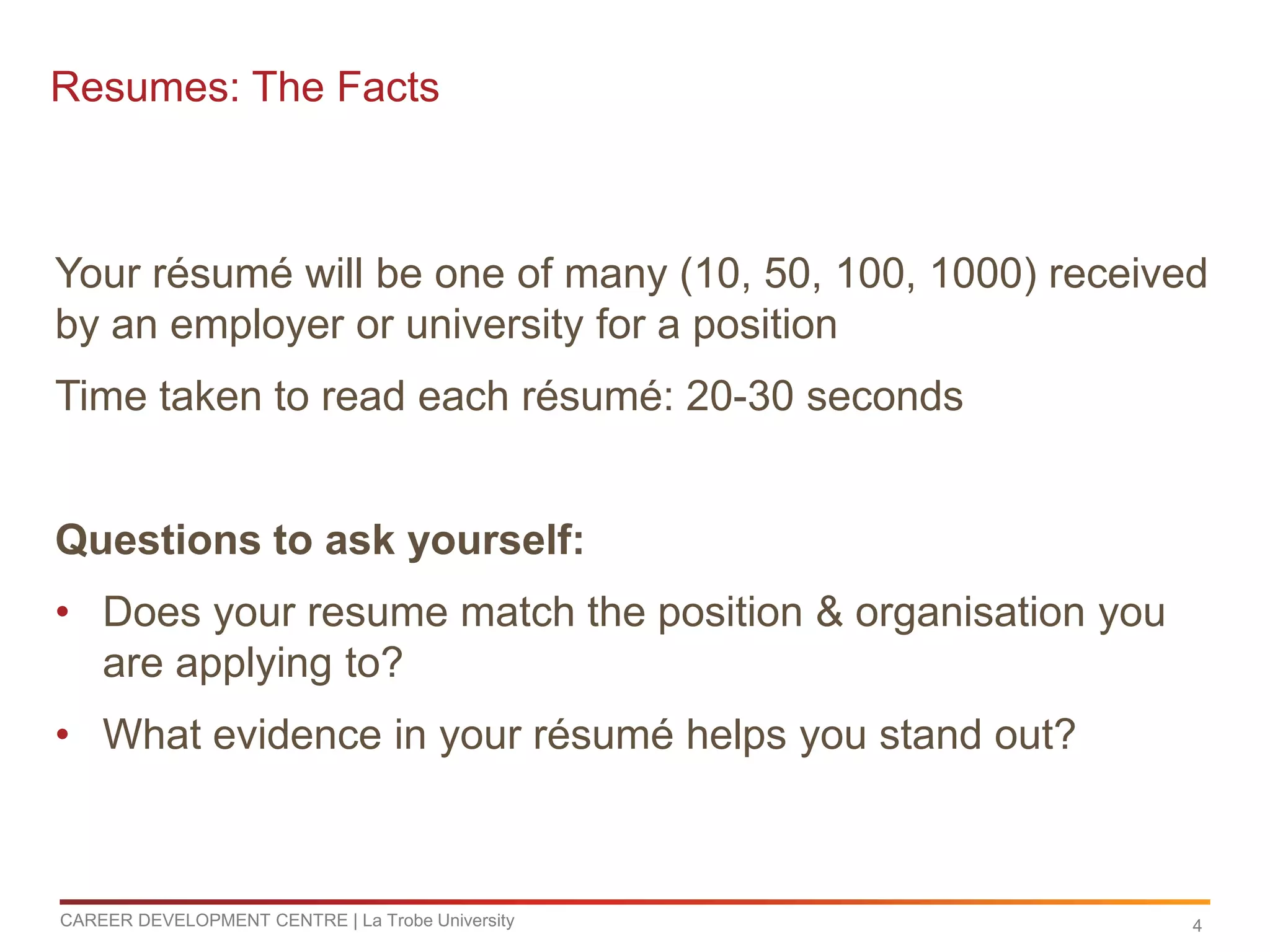
• Marketing document (it needs to set you apart)
• It needs to be targeted to the specific job & organisation
• Uses skills/achievement statements (evidence) to highlight
  competencies


                                                               3
Resumes: The Facts


Your résumé will be one of many (10, 50, 100, 1000) received
by an employer or university for a position
Time taken to read each résumé: 20-30 seconds


Questions to ask yourself:
• Does your resume match the position & organisation you
  are applying to?
• What evidence in your résumé helps you stand out?


CAREER DEVELOPMENT CENTRE | La Trobe University            4
Resume Presentation


Guidelines:


• 2 – 3 pages for graduates
• Most important information on the first page
• Reverse chronological order


   Remember, your resume is your primary marketing
                     document


                                                     5
What to include


•   Personal Details
•   Education & Training
•   Placements
•   Employment
•   Skills
•   Achievements
•   Professional Memberships
•   Extra-curricular Activities & Interests
•   Referees


                                              6
How to write an effective resume


What are the skills required of the position and how can
 you demonstrate that you have them?

• Name the skill, your level of competency, where/how you
  developed the skill
• Don‟t include skills without providing evidence
• Use short statements that start with action words
• Eg. „Excellent organisational skills developed through
  planning community activities for Diabetes Week for past
  two years’


                                                             7
Highlighting Achievements

Where possible, highlight your achievements


Examples of achievements:
• Promotions
• Being part of a team that …
• Winning an award or prize
• Good results in exams or assessments
• Customer service / quality awards
• Outside-work achievements – raising money for charity,
  being elected to a committee
• Captaining a sports team

                                                           8
Cover Letters


Purpose of a cover letter:
1. An example of your writing skills
2. Letter of introduction
3. Selling your skills, abilities, attributes
4. Explain how you match the requirements of the job &
   organisation


                                                         9
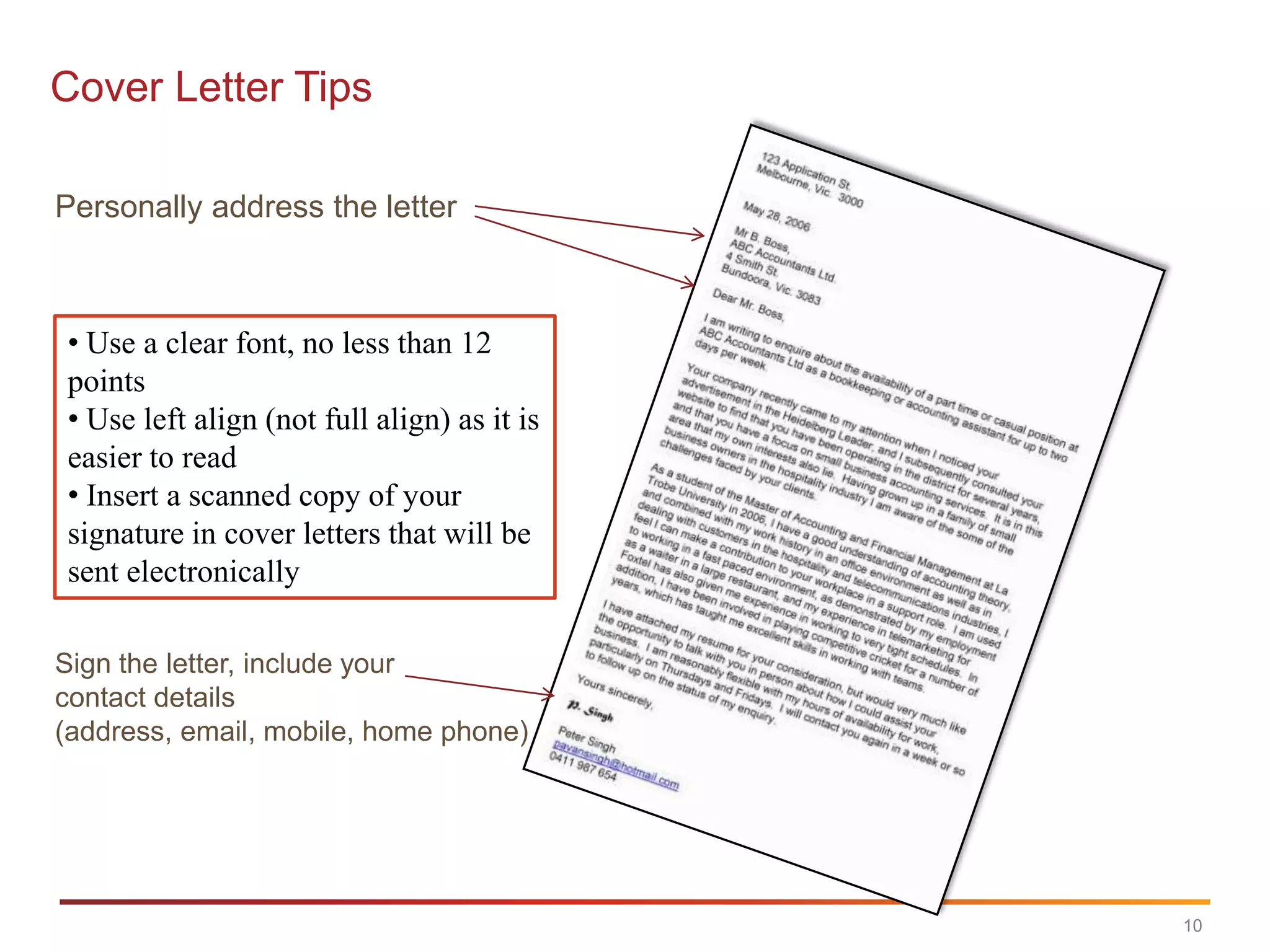
Cover Letter Tips

Personally address the letter


• Use a clear font, no less than 12
points
• Use left align (not full align) as it is
easier to read
• Insert a scanned copy of your
signature in cover letters that will be
sent electronically

Sign the letter, include your
contact details
(address, email, mobile, home phone)


                                             10
Key Selection Criteria
What are Key Selection Criteria?


• KSC describe the personal qualities, skills, abilities,
  knowledge and qualifications a person needs to perform
  the role effectively
• Used by employers to objectively identify the right person
  for the job
• Applicants‟ responses are rated against individual criteria
  and best applicants are offered an interview or progression
  to next round of selection process


                                                               12
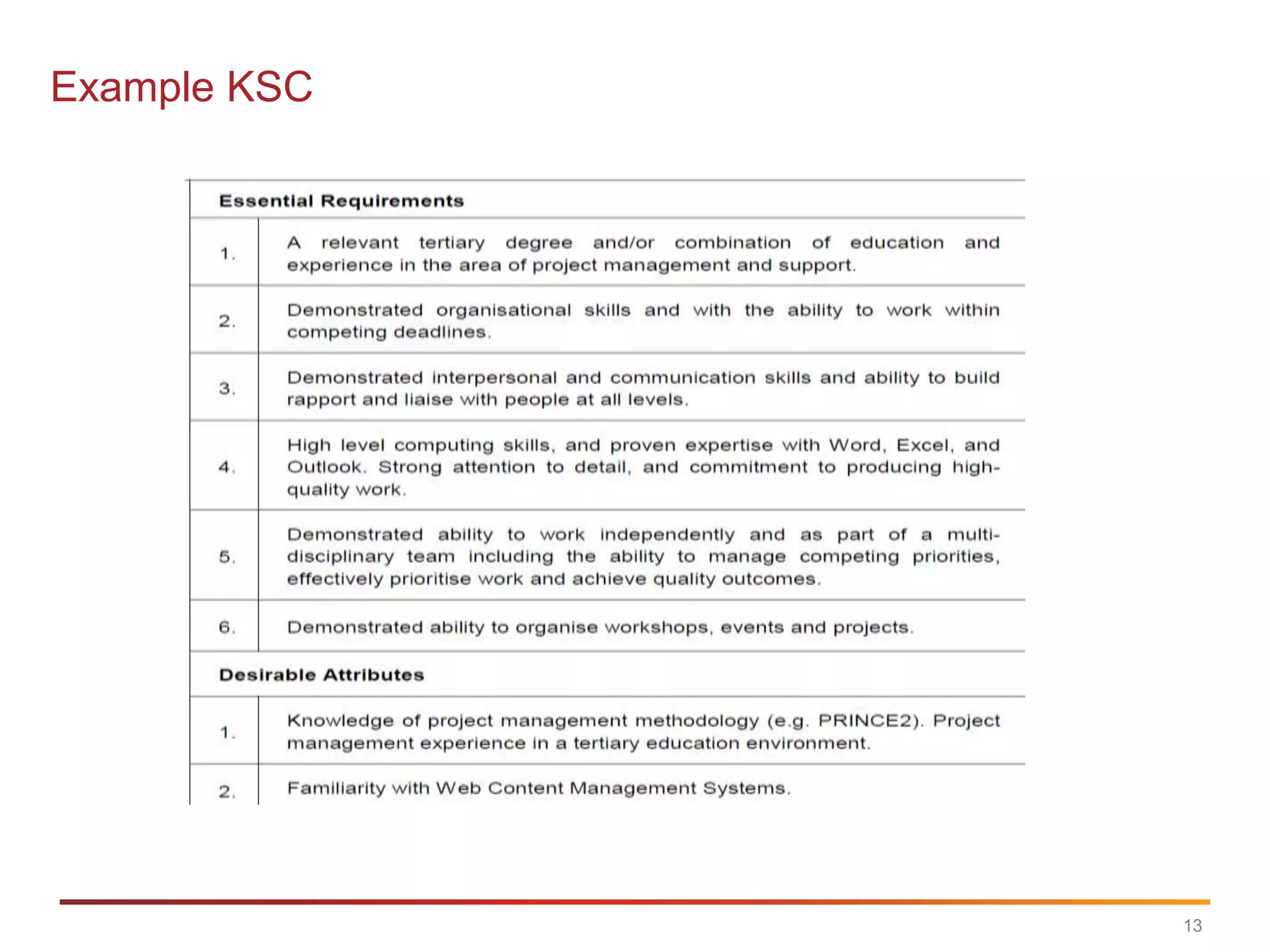
Example KSC


              13
How to respond to KSC


Check the method preferred by the employer:
• Document addressing individual KSC
  (traditional method)
• Summary response to all KSC
  (word limits may apply)
• Answer a „behavioural question‟ in an online application or
  paper based application form


                                                            14
Getting Started


• Analyse each criterion to identify the skills and attributes
  being rated – individual criterion may contain several
  components (eg. „verbal & written communication skills‟)
• Think of scenarios from work, study, volunteering, sports
  and other activities that could be used to illustrate your skill
• Use a different example for each criterion where possible


                                                                 15
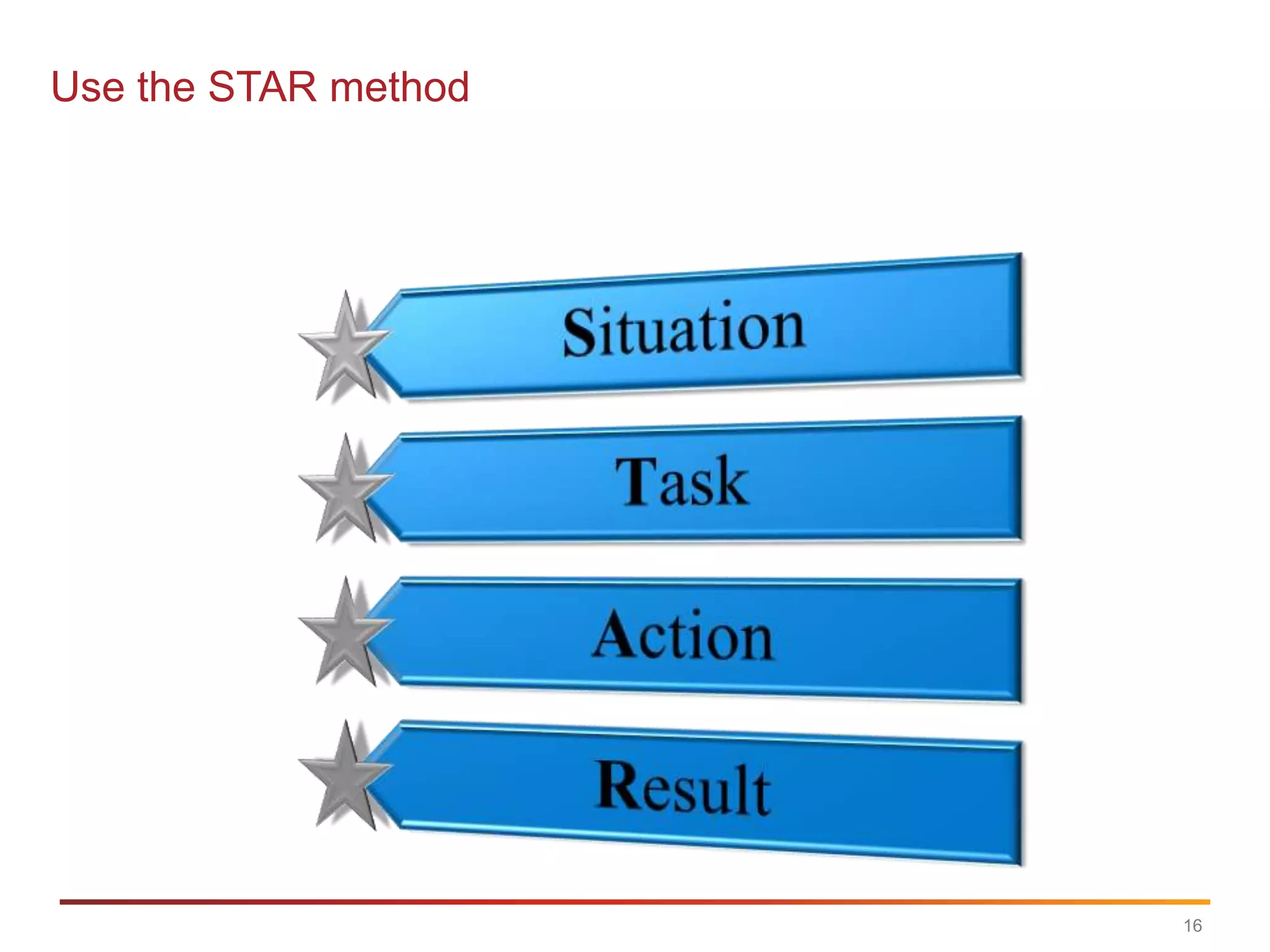
Use the STAR method


                      16
What if you lack experience?


If you cannot provide an example to address a criterion:
• Think about the competence the employer is interested in
  (e.g., problem solving, teamwork, etc), perhaps you can
  give an example from a non-work experience
• Is there another way of demonstrating that skill or how you
  intend to develop it?
• Could you describe how you would react in a similar
  situation?


                                                             17
Interviews
Purpose of the Job Interview


The employer’s objective: to attract and appoint the best
  applicant for the organisation

• Can you do the job? (skills, qualifications, experience)

• Will you do the job? (motivation, attitudes, career goals)

• Will you fit in? (cultural match)


                                                               19
Interview preparation (insert picture – professional attire)


 Research the organisation and job
 Prepare and practise answers to possible questions
 Plan what you‟re going to wear
 Plan your journey so you arrive on time
 Prepare some questions to ask them
 Gather documents to take with you


                                                               20
Tips for the start of the interview


When you arrive, remember you are making an impression
on everyone you come in contact with
 Turn off your mobile phone
 Try to relax!
 Greet interviewer(s) and shake hands
 Listen attentively
 Engage in „small talk‟


                                                         21
Tips for during the interview


What you say
 Give specific examples to support your claims
 Avoid one word answers
 Seek clarification if you don‟t understand a question
 Present information in a positive light


                                                          22
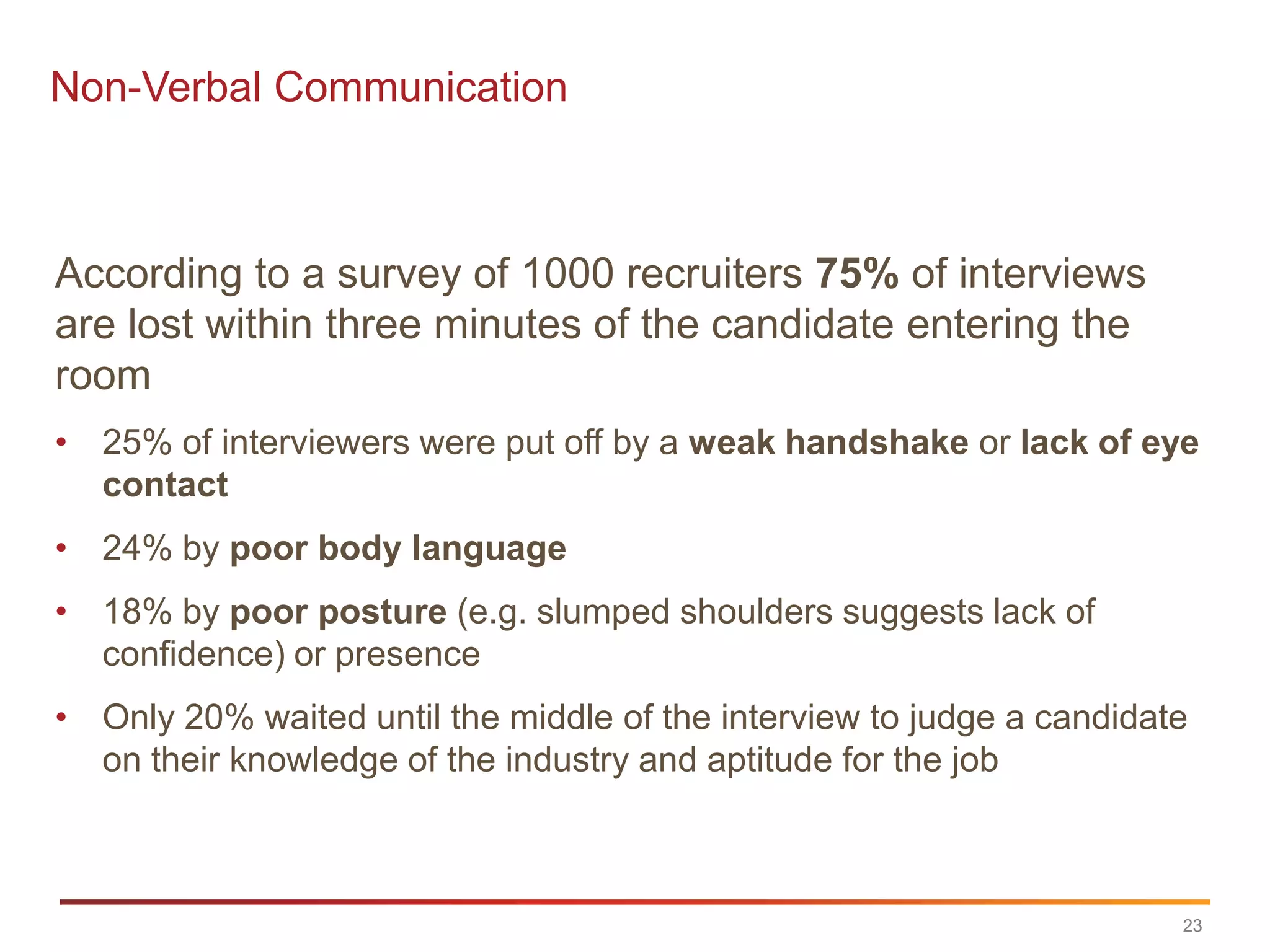
Non-Verbal Communication


According to a survey of 1000 recruiters 75% of interviews
are lost within three minutes of the candidate entering the
room
• 25% of interviewers were put off by a weak handshake or lack of eye
  contact
• 24% by poor body language
• 18% by poor posture (e.g. slumped shoulders suggests lack of
  confidence) or presence
• Only 20% waited until the middle of the interview to judge a candidate
  on their knowledge of the industry and aptitude for the job


                                                                       23
Behavioural Interview Questions


• Past behaviour is a predictor of future behaviour
• Used to assess job related competencies
  e.g., communication skills; teamwork; problem solving
• Demonstrates employability skills
  e.g., “Describe a situation when you‟ve; worked in a team, found a
  solution to a problem, demonstrated initiative, dealt effectively with
  conflict” etc
• Preparation is crucial and expected
• Expect follow-up questions


                                                                           24
Preparing for Behavioural Questions


 Review the selection criteria or key competencies required
  for the role
 Research or think of questions related to each
  competency
 Prepare examples. Think of examples that draw on a
  range of experiences – study, work, voluntary activities,
  sport and recreation, clubs and societies
 Use recent and relevant examples
 Apply the STAR method for each question
 Practice responding to questions. Become confident in
  using your examples


                                                          25
At the End of the Interview


• Return to unanswered questions or add anything you feel
  has been overlooked
• Ask questions you prepared beforehand
• Ask about the next stage in the process
• Smile, thank the interviewer(s) for their time, shake hands
• It‟s not over until you‟re out of sight!


                                                                26
Next steps


• LMS readings for „applications and interviews‟ module
• Update your resume; use the resume checklist in the
  PebblePad workbook


                                                          27
Thank you
Connect with us via:
Web:             latrobe.edu.au/students/careers
Facebook:        facebook.com/LaTrobeCareers
Twitter:         @LTUcareers
Email:           careers@latrobe.edu.au

Career Ready, Seminar 4: Succeeding at job applications and interviews

  • 1.
    Career Ready Program Seminar4: Succeeding at Job Applications and Interviews Career Development Centre La Trobe University
  • 2.
  • 3.
    Resumes • Marketing document(it needs to set you apart) • It needs to be targeted to the specific job & organisation • Uses skills/achievement statements (evidence) to highlight competencies 3
  • 4.
    Resumes: The Facts Yourrésumé will be one of many (10, 50, 100, 1000) received by an employer or university for a position Time taken to read each résumé: 20-30 seconds Questions to ask yourself: • Does your resume match the position & organisation you are applying to? • What evidence in your résumé helps you stand out? CAREER DEVELOPMENT CENTRE | La Trobe University 4
  • 5.
    Resume Presentation Guidelines: • 2– 3 pages for graduates • Most important information on the first page • Reverse chronological order Remember, your resume is your primary marketing document 5
  • 6.
    What to include • Personal Details • Education & Training • Placements • Employment • Skills • Achievements • Professional Memberships • Extra-curricular Activities & Interests • Referees 6
  • 7.
    How to writean effective resume What are the skills required of the position and how can you demonstrate that you have them? • Name the skill, your level of competency, where/how you developed the skill • Don‟t include skills without providing evidence • Use short statements that start with action words • Eg. „Excellent organisational skills developed through planning community activities for Diabetes Week for past two years’ 7
  • 8.
    Highlighting Achievements Where possible,highlight your achievements Examples of achievements: • Promotions • Being part of a team that … • Winning an award or prize • Good results in exams or assessments • Customer service / quality awards • Outside-work achievements – raising money for charity, being elected to a committee • Captaining a sports team 8
  • 9.
    Cover Letters Purpose ofa cover letter: 1. An example of your writing skills 2. Letter of introduction 3. Selling your skills, abilities, attributes 4. Explain how you match the requirements of the job & organisation 9
  • 10.
    Cover Letter Tips Personallyaddress the letter • Use a clear font, no less than 12 points • Use left align (not full align) as it is easier to read • Insert a scanned copy of your signature in cover letters that will be sent electronically Sign the letter, include your contact details (address, email, mobile, home phone) 10
  • 11.
  • 12.
    What are KeySelection Criteria? • KSC describe the personal qualities, skills, abilities, knowledge and qualifications a person needs to perform the role effectively • Used by employers to objectively identify the right person for the job • Applicants‟ responses are rated against individual criteria and best applicants are offered an interview or progression to next round of selection process 12
  • 13.
  • 14.
    How to respondto KSC Check the method preferred by the employer: • Document addressing individual KSC (traditional method) • Summary response to all KSC (word limits may apply) • Answer a „behavioural question‟ in an online application or paper based application form 14
  • 15.
    Getting Started • Analyseeach criterion to identify the skills and attributes being rated – individual criterion may contain several components (eg. „verbal & written communication skills‟) • Think of scenarios from work, study, volunteering, sports and other activities that could be used to illustrate your skill • Use a different example for each criterion where possible 15
  • 16.
    Use the STARmethod 16
  • 17.
    What if youlack experience? If you cannot provide an example to address a criterion: • Think about the competence the employer is interested in (e.g., problem solving, teamwork, etc), perhaps you can give an example from a non-work experience • Is there another way of demonstrating that skill or how you intend to develop it? • Could you describe how you would react in a similar situation? 17
  • 18.
  • 19.
    Purpose of theJob Interview The employer’s objective: to attract and appoint the best applicant for the organisation • Can you do the job? (skills, qualifications, experience) • Will you do the job? (motivation, attitudes, career goals) • Will you fit in? (cultural match) 19
  • 20.
    Interview preparation (insertpicture – professional attire)  Research the organisation and job  Prepare and practise answers to possible questions  Plan what you‟re going to wear  Plan your journey so you arrive on time  Prepare some questions to ask them  Gather documents to take with you 20
  • 21.
    Tips for thestart of the interview When you arrive, remember you are making an impression on everyone you come in contact with  Turn off your mobile phone  Try to relax!  Greet interviewer(s) and shake hands  Listen attentively  Engage in „small talk‟ 21
  • 22.
    Tips for duringthe interview What you say  Give specific examples to support your claims  Avoid one word answers  Seek clarification if you don‟t understand a question  Present information in a positive light 22
  • 23.
    Non-Verbal Communication According toa survey of 1000 recruiters 75% of interviews are lost within three minutes of the candidate entering the room • 25% of interviewers were put off by a weak handshake or lack of eye contact • 24% by poor body language • 18% by poor posture (e.g. slumped shoulders suggests lack of confidence) or presence • Only 20% waited until the middle of the interview to judge a candidate on their knowledge of the industry and aptitude for the job 23
  • 24.
    Behavioural Interview Questions •Past behaviour is a predictor of future behaviour • Used to assess job related competencies e.g., communication skills; teamwork; problem solving • Demonstrates employability skills e.g., “Describe a situation when you‟ve; worked in a team, found a solution to a problem, demonstrated initiative, dealt effectively with conflict” etc • Preparation is crucial and expected • Expect follow-up questions 24
  • 25.
    Preparing for BehaviouralQuestions  Review the selection criteria or key competencies required for the role  Research or think of questions related to each competency  Prepare examples. Think of examples that draw on a range of experiences – study, work, voluntary activities, sport and recreation, clubs and societies  Use recent and relevant examples  Apply the STAR method for each question  Practice responding to questions. Become confident in using your examples 25
  • 26.
    At the Endof the Interview • Return to unanswered questions or add anything you feel has been overlooked • Ask questions you prepared beforehand • Ask about the next stage in the process • Smile, thank the interviewer(s) for their time, shake hands • It‟s not over until you‟re out of sight! 26
  • 27.
    Next steps • LMSreadings for „applications and interviews‟ module • Update your resume; use the resume checklist in the PebblePad workbook 27
  • 28.
    Thank you Connect withus via: Web: latrobe.edu.au/students/careers Facebook: facebook.com/LaTrobeCareers Twitter: @LTUcareers Email: careers@latrobe.edu.au

Editor's Notes

  • #5 Remember that the purpose of your resume is to get you an interviewConsider the type of job you are applying for (eg. part-time/graduate/voluntary) and modify your resume accordingly
  • #8 Resumes must be evidenced based (ie. not just stating your opinion, but providing concrete examples)Don’t include personality traitsFocus on what you can contribute to the organisation & the role in particular
  • #10 Maximum one A4 page in lengthWritten using the standard business letter style Usually four paragraphsPersonally address the letter to the employer Write a letter tailored for each job you apply to
  • #11 1st Paragraph:State the job you’re applying for; when/where you found out about the job2nd Paragraph (may be the key to getting the job): Explain why you are interested in applying for this job with this organisation; demonstrate your knowledge of the organisation (evidence of research essential)3rd Paragraph: Explain how you meet the requirements of the job; reflect on your skills & experience; provide evidence to support your claims4th Paragraph: Write that you look forward to meeting the employer at an interview in the near future; include the best way to contact you (e.g., mobile number); mention your availability for an interview
  • #17 Provide handout – sample response to KSC
  • #24 Activity: practise shaking hands with the people around you (ie. web to web contact, not too tight)
  • #26 There are hundreds of examples on YouTube of how to answer behavioural interview questions
  • #27 Example questions to ask interviewer:If I were to start tomorrow, what would be the top priority on my to do list?What would you say are the top two personality traits someone needs to do this job well?What improvements or changes do you hope the new candidate will bring to this position?Is there anything that stands out to you that makes you think I might not be the right fit for this job?