Van Thuy Hoang
Dept. of Artificial Intelligence,
The Catholic University of Korea
hoangvanthuy90@gmail.com
Ling et al., ICLR 2023
2
Problems
 A primary issue in fairness is that training data usually contain biases,
which is the source of discriminative behavior of models.
 many existing works propose to learn fair graph representations by
modifying training data with fairness-aware graph data
augmentations.
 However, the proposed graph properties may not be appropriate for
all graph datasets due to the diverse nature of graph data. For
example, balanced inter/intra edges may destroy topology
(Mehrabi et al., 2021; Olteanu et al., 2019)
3
Problems
 it is highly desirable to automatically discover dataset-specific
fairness-aware augmentation strategies among different datasets
with a single framework. To this end, a natural question is raised:
 Can we achieve fair graph representation learning via automated
data augmentations?
4
FAIR GRAPH REPRESENTATION LEARNING
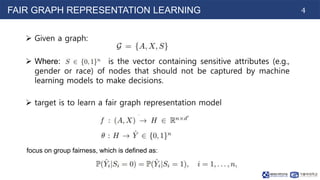
 Given a graph:
 Where: is the vector containing sensitive attributes (e.g.,
gender or race) of nodes that should not be captured by machine
learning models to make decisions.
 target is to learn a fair graph representation model
focus on group fairness, which is defined as:
5
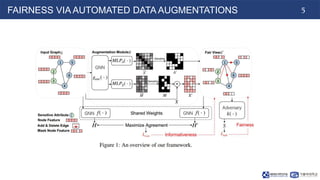
FAIRNESS VIA AUTOMATED DATA AUGMENTATIONS
6
FAIRNESS VIA AUTOMATED DATA AUGMENTATIONS
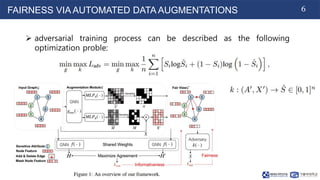
 adversarial training process can be described as the following
optimization proble:
7
FAIRNESS VIA AUTOMATED DATA AUGMENTATIONS
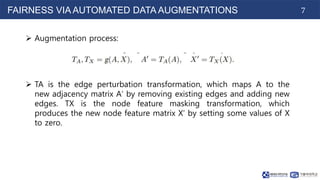
 Augmentation process:
 TA is the edge perturbation transformation, which maps A to the
new adjacency matrix A′ by removing existing edges and adding new
edges. TX is the node feature masking transformation, which
produces the new node feature matrix X′ by setting some values of X
to zero.
8
FAIRNESS VIA AUTOMATED DATA AUGMENTATIONS
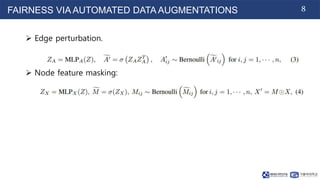
 Edge perturbation.
 Node feature masking:
9
Loss function
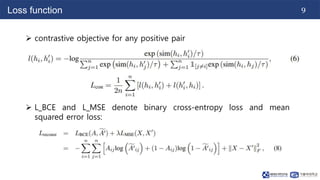
 contrastive objective for any positive pair
 L_BCE and L_MSE denote binary cross-entropy loss and mean
squared error loss:
10
Loss function
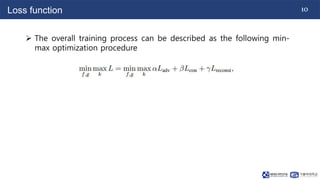
 The overall training process can be described as the following min-
max optimization procedure
11
EXPERIMENTS
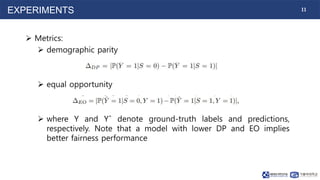
 Metrics:
 demographic parity
 equal opportunity
 where Y and Yˆ denote ground-truth labels and predictions,
respectively. Note that a model with lower DP and EO implies
better fairness performance
12
EXPERIMENTAL RESULTS
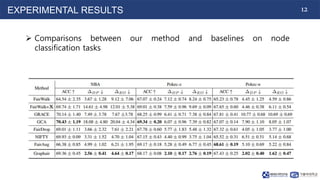
 Comparisons between our method and baselines on node
classification tasks
13
EXPERIMENTAL RESULTS
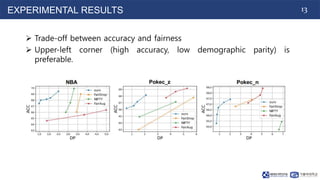
 Trade-off between accuracy and fairness
 Upper-left corner (high accuracy, low demographic parity) is
preferable.
14
CONCLUSIONS
 Graphair, an automated graph augmentation method for fair
representation learning.
 Graphair uses an automated augmentation model to generate new
graphs with fair topology structures and node features, while
preserving the most informative components from input graphs.
 Adversarial learning and contrastive learning to achieve fairness and
informativeness simultaneously in the augmented data
LEARNING FAIR GRAPH REPRESENTATIONS VIA AUTOMATED DATA AUGMENTATIONS.pptx

LEARNING FAIR GRAPH REPRESENTATIONS VIA AUTOMATED DATA AUGMENTATIONS.pptx

  • 1.
    Van Thuy Hoang Dept.of Artificial Intelligence, The Catholic University of Korea hoangvanthuy90@gmail.com Ling et al., ICLR 2023
  • 2.
    2 Problems  A primaryissue in fairness is that training data usually contain biases, which is the source of discriminative behavior of models.  many existing works propose to learn fair graph representations by modifying training data with fairness-aware graph data augmentations.  However, the proposed graph properties may not be appropriate for all graph datasets due to the diverse nature of graph data. For example, balanced inter/intra edges may destroy topology (Mehrabi et al., 2021; Olteanu et al., 2019)
  • 3.
    3 Problems  it ishighly desirable to automatically discover dataset-specific fairness-aware augmentation strategies among different datasets with a single framework. To this end, a natural question is raised:  Can we achieve fair graph representation learning via automated data augmentations?
  • 4.
    4 FAIR GRAPH REPRESENTATIONLEARNING  Given a graph:  Where: is the vector containing sensitive attributes (e.g., gender or race) of nodes that should not be captured by machine learning models to make decisions.  target is to learn a fair graph representation model focus on group fairness, which is defined as:
  • 5.
    5 FAIRNESS VIA AUTOMATEDDATA AUGMENTATIONS
  • 6.
    6 FAIRNESS VIA AUTOMATEDDATA AUGMENTATIONS  adversarial training process can be described as the following optimization proble:
  • 7.
    7 FAIRNESS VIA AUTOMATEDDATA AUGMENTATIONS  Augmentation process:  TA is the edge perturbation transformation, which maps A to the new adjacency matrix A′ by removing existing edges and adding new edges. TX is the node feature masking transformation, which produces the new node feature matrix X′ by setting some values of X to zero.
  • 8.
    8 FAIRNESS VIA AUTOMATEDDATA AUGMENTATIONS  Edge perturbation.  Node feature masking:
  • 9.
    9 Loss function  contrastiveobjective for any positive pair  L_BCE and L_MSE denote binary cross-entropy loss and mean squared error loss:
  • 10.
    10 Loss function  Theoverall training process can be described as the following min- max optimization procedure
  • 11.
    11 EXPERIMENTS  Metrics:  demographicparity  equal opportunity  where Y and Yˆ denote ground-truth labels and predictions, respectively. Note that a model with lower DP and EO implies better fairness performance
  • 12.
    12 EXPERIMENTAL RESULTS  Comparisonsbetween our method and baselines on node classification tasks
  • 13.
    13 EXPERIMENTAL RESULTS  Trade-offbetween accuracy and fairness  Upper-left corner (high accuracy, low demographic parity) is preferable.
  • 14.
    14 CONCLUSIONS  Graphair, anautomated graph augmentation method for fair representation learning.  Graphair uses an automated augmentation model to generate new graphs with fair topology structures and node features, while preserving the most informative components from input graphs.  Adversarial learning and contrastive learning to achieve fairness and informativeness simultaneously in the augmented data