Van Thuy Hoang
Network Science Lab
Dept. of Artificial Intelligence
The Catholic University of Korea
E-mail: hoangvanthuy90@gmail.com
2023-10-16
Yanqiao Zhu, et al., ICML 20
2
Problems
 existing GNN models are mostly established in a supervised manner, which
require abundant labeled nodes for training.
 some attempts connecting previous unsupervised objectives (i.e., matrix
reconstruction) to GNN models, these methods still heavily rely on the preset
graph proximity matrix.
3
In this paper
 a simple yet powerful contrastive framework for unsupervised graph
representation learning
 Rather than contrasting node-level embeddings to global ones, we primarily
focus on contrasting embeddings at the node level and our work makes no
assumptions on injective readout functions for generating the graph
embedding.
4
What they did?
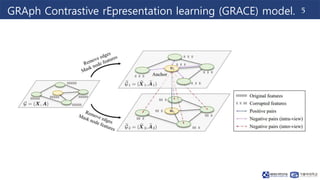
 First generate two correlated graph views by randomly performing corruption.
Then, we train the model using a contrastive loss to maximize the agreement
between node embeddings in these two views.
 Unlike visual data, where abundant image transformation techniques are
available, how to perform corruption to generate views for graphs is still an
open problem.
 Jointly consider corruption at both topology and node attribute levels, namely
removing edges and masking features, to provide diverse contexts for nodes in
different views, so as to boost optimization of the contrastive objective.
 Last, we provide theoretical analysis that reveals the connections from our
contrastive objective to mutual information and the classical triplet loss.
5
GRAph Contrastive rEpresentation learning (GRACE) model.
6
Deep Graph Contrastive Representation Learning
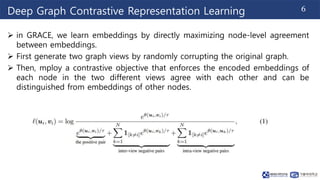
 in GRACE, we learn embeddings by directly maximizing node-level agreement
between embeddings.
 First generate two graph views by randomly corrupting the original graph.
 Then, mploy a contrastive objective that enforces the encoded embeddings of
each node in the two different views agree with each other and can be
distinguished from embeddings of other nodes.
7
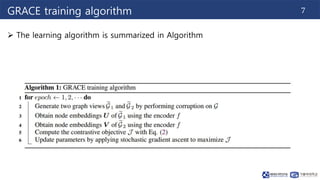
GRACE training algorithm
 The learning algorithm is summarized in Algorithm
8
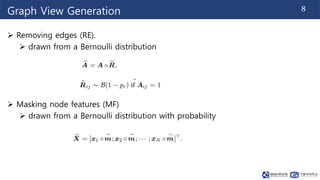
Graph View Generation
 Removing edges (RE).
 drawn from a Bernoulli distribution
 Masking node features (MF)
 drawn from a Bernoulli distribution with probability
9
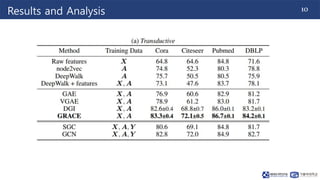
Experiments
 Datasets
 Cora, Citeseer, Pubmed, and DBLP
 Transductive learning.
 Inductive learning on large graphs
10
Results and Analysis
11
Conclusion
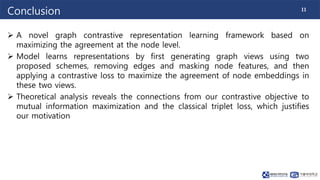
 A novel graph contrastive representation learning framework based on
maximizing the agreement at the node level.
 Model learns representations by first generating graph views using two
proposed schemes, removing edges and masking node features, and then
applying a contrastive loss to maximize the agreement of node embeddings in
these two views.
 Theoretical analysis reveals the connections from our contrastive objective to
mutual information maximization and the classical triplet loss, which justifies
our motivation
Deep Graph Contrastive Representation Learning.pptx

Deep Graph Contrastive Representation Learning.pptx

  • 1.
    Van Thuy Hoang NetworkScience Lab Dept. of Artificial Intelligence The Catholic University of Korea E-mail: hoangvanthuy90@gmail.com 2023-10-16 Yanqiao Zhu, et al., ICML 20
  • 2.
    2 Problems  existing GNNmodels are mostly established in a supervised manner, which require abundant labeled nodes for training.  some attempts connecting previous unsupervised objectives (i.e., matrix reconstruction) to GNN models, these methods still heavily rely on the preset graph proximity matrix.
  • 3.
    3 In this paper a simple yet powerful contrastive framework for unsupervised graph representation learning  Rather than contrasting node-level embeddings to global ones, we primarily focus on contrasting embeddings at the node level and our work makes no assumptions on injective readout functions for generating the graph embedding.
  • 4.
    4 What they did? First generate two correlated graph views by randomly performing corruption. Then, we train the model using a contrastive loss to maximize the agreement between node embeddings in these two views.  Unlike visual data, where abundant image transformation techniques are available, how to perform corruption to generate views for graphs is still an open problem.  Jointly consider corruption at both topology and node attribute levels, namely removing edges and masking features, to provide diverse contexts for nodes in different views, so as to boost optimization of the contrastive objective.  Last, we provide theoretical analysis that reveals the connections from our contrastive objective to mutual information and the classical triplet loss.
  • 5.
    5 GRAph Contrastive rEpresentationlearning (GRACE) model.
  • 6.
    6 Deep Graph ContrastiveRepresentation Learning  in GRACE, we learn embeddings by directly maximizing node-level agreement between embeddings.  First generate two graph views by randomly corrupting the original graph.  Then, mploy a contrastive objective that enforces the encoded embeddings of each node in the two different views agree with each other and can be distinguished from embeddings of other nodes.
  • 7.
    7 GRACE training algorithm The learning algorithm is summarized in Algorithm
  • 8.
    8 Graph View Generation Removing edges (RE).  drawn from a Bernoulli distribution  Masking node features (MF)  drawn from a Bernoulli distribution with probability
  • 9.
    9 Experiments  Datasets  Cora,Citeseer, Pubmed, and DBLP  Transductive learning.  Inductive learning on large graphs
  • 10.
  • 11.
    11 Conclusion  A novelgraph contrastive representation learning framework based on maximizing the agreement at the node level.  Model learns representations by first generating graph views using two proposed schemes, removing edges and masking node features, and then applying a contrastive loss to maximize the agreement of node embeddings in these two views.  Theoretical analysis reveals the connections from our contrastive objective to mutual information maximization and the classical triplet loss, which justifies our motivation