Rebecca Taylor
Walden University
  EDUC 8101-01
1.   Everyone sit with your hands in your lap.
2.   Starting with all 10 fingers, each time
     someone says an activity (i.e. skydiving,
     snorkeling, knitting, etc.).
3.   Each time someone says something you
     have done, curl one finger into your palm.
4.   The last person with at least one finger left
     in play.
◦ Participants will be able to explain
  experiential learning to others

◦ Participants will be able to discuss one time
  in which they recognize experiential
 learning taking place
   Confucius (551—479 BCE) is best known as a
    keeper of the old traditions, rather than an
    innovator or radical thinker of new
    knowledge.
   Socrates (469—399 BCE) was best known for
    encouraging his students to question
    everything and to make a decision based on
    their own understanding.
   Aristotle (384-322 BCE) became the tutor for
    Phillip of Macedonia’s son, Alexander, who
    would later become “Alexander the Great”.
   Andragogy is a term Malcolm Knowles used
    to describe how adults learned differently
    than children.

   Knowles claimed there were six assumptions
    to be made about adult learners.
These include:
a) adults learn when situations arise in which
additional learning will be helpful;

b) adults learn when the education is
centered on necessary life skills;

c) experience forms the basis of the best
learning;
   d) adults want to be integral players in their
    learning, rather than repositories for
    information;

   e) differences among adult learning needs
    increase as adults age; and

   f) that adults’ desire to learn is internally
    motivated.
Jack Mezirow states that learning is a “process
of using a prior interpretation to construe a
new or revised interpretation of the meaning of
one's experience in order to guide future
action”1.

This type of learning occurs when one’s beliefs
or “meaning scheme” changes due to new
information and ideas1. These changes may
occur quickly, or take place over a longer
period of time1.
Allen Tough, an adult learning theorist, built
on the work of Malcolm Knowles’ andragogy.
In his work, he outlined three linear goals of
self-directed learning.
1. to enhance one’s ability to direct his/her
   own learning1.
2. to “foster transformational learning as
   central” 1.
3. to promote independent learning.
Educational theorists influencing the
Experiential Learning Theory:

   John Dewey
   Kurt Lewin
   Jean Piaget
   Carl Jung
   Paulo Freire
   David Kolb2
David A. Kolb was born in 1939, and
became Professor of Organizational
Behavior in the Weatheread School of
Management in 1976. “He has an
interest in the nature of individual and
social change, experiential learning,
career development and executive and
professional education” 2
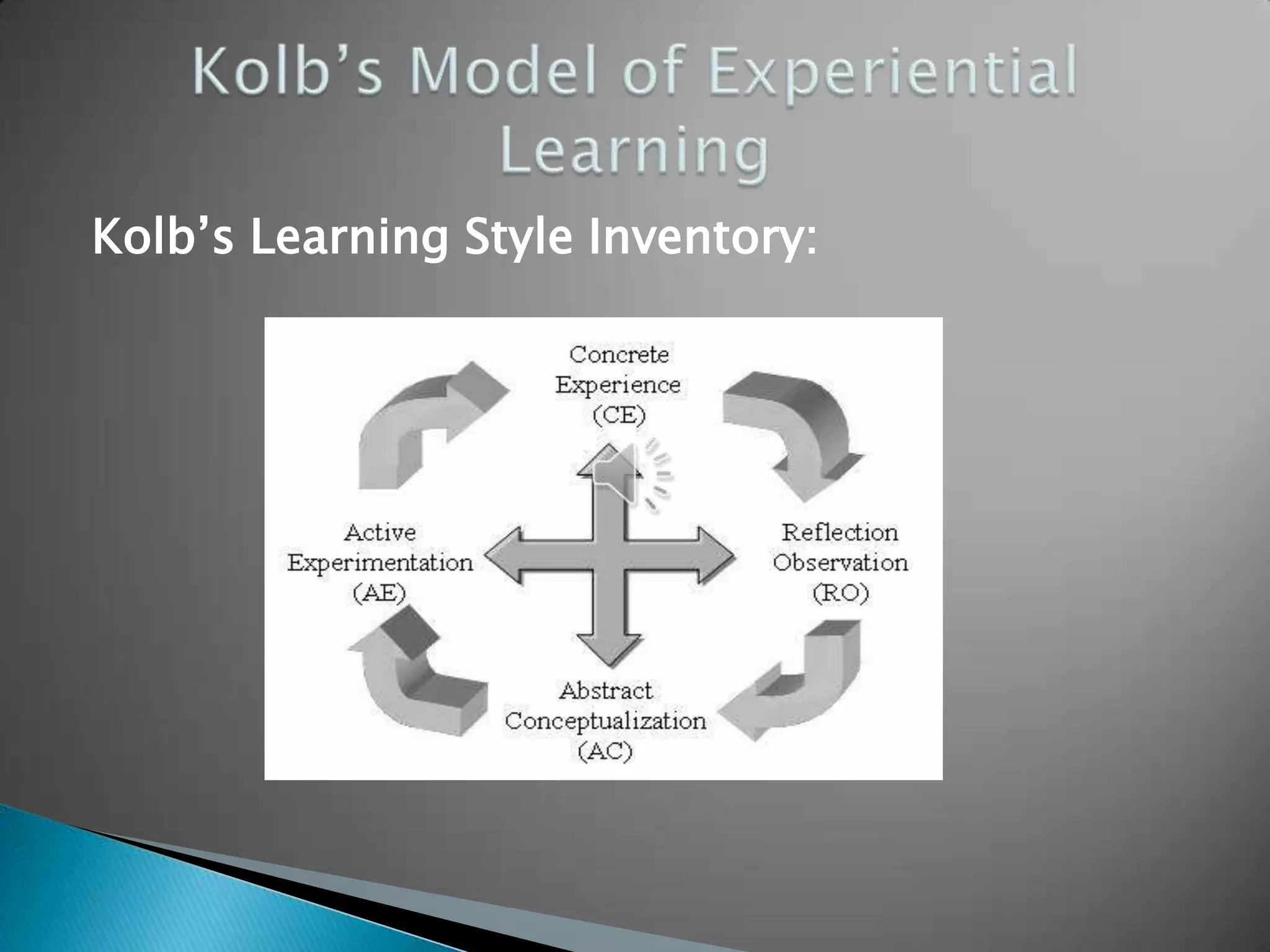
Kolb’s Learning Style Inventory:
Similar to Knowles’ six steps to andragogy,
that were discussed earlier, Kolb also had steps
to his experiential theory.
1. Learning should be viewed as an ongoing
   process rather than a process that has an
   endpoint or “outcome” 2
2. “All learning is relearning,” 2 it encourages
   students to restudy their previously held
   beliefs and ideas so they can be either
   incorporated with new knowledge or be cast
   aside as outdated and old-fashioned.
3.   When one is learning, they must “move
     back and forth between opposing modes of
     reflection and action and feeling and
     thinking”
4.   Learning involves one’s entire being; it
     involves “thinking, feeling, perceiving, and
     behaving”
5.   Learning results from the give-and-take
     interactions between the environment and
     the student
6.   “Learning is the process of creating
     knowledge” 2
Learning theorists, Richard Freedman and
Stephen Stumpf have argued since the 1970s
that Kolb’s theory of the Learning Style
Inventory was too rigid, speculative and lacked
enough supporting evidence from other
reliable tools.
   What types of experiences do you consider not
    genuinely or equally educational?

   Kolb’s theory of experiential learning does not
    account for the learner’s “biography”, and
    according to some critics, leaves the
    experience and reflection to exist in a
    “vacuum”; why is it vital to includes the context
    of a person’s experience in order to learn from
    it?

   With whom do you agree; Kolb or his critics?
    Why?
“Many people make the mistake of
confusing information with knowledge.
They are not the same thing.
Knowledge involves the interpretation
of information. Knowledge involves
listening.”

                    -Hanning Mankell
                   The Art of Listening
Anonymous (2005). Aristotle (384-322 BCE). Internet Encylopedia
of Philosophy. Retrieved from http://www.iep.utm.edu/aristotl/

Baumgartner, L., Caffarella, R., & Merriam, S. (2007). Learning in
adulthood: A comprehensive guide (3rd ed). Jossey-Bass: San
Francisco.

Boyatzis, R., Kolb, D., & Mainemelis, C. (2002). Learning styles and
adaptive flexibility: Testing experiential learning theory.
Management Learning, 33(1) p. 5-33. Retrieved from EBSCOhost.

Freedman, R. & Stumpf, S. (1980). Learning style theory: Less than
 meets the eye. The Academy of Management Review (5)3. p. 445-
 447. Retrieved from EBSCOhost.

Kolb’s Experiential Learning Model [image]. Retrieved from
 http://www.ilough-
 lab.com/index.php?option=com_content&view=article&id=62&Ite
 mid=69
Nails, D. (2009). Socrates. The Stanford Encyclopedia of Philosophy.
 Retrieved from
 http://plato.stanford.edu/archives/spr2010/entries/socrates/

Mankell, H. (2011). The art of listening. New York Times, (SR)4.
 Retrieved from
 http://www.nytimes.com/2011/12/11/opinion/sunday/in-africa-
 the-art-of-
 listening.html?_r=2&scp=2&sq=the%20art%20of%20listening&st=c
 se


Richey, J. (2005). Confucius (551—479 BCE). Internet Encylopedia
 of Philosophy. Retrieved from http://www.iep.utm.edu/confuciu/


Smith, M. K. (2001). David A. Kolb on experiential learning: The
 encyclopedia of informal education. Retrieved from
 http://www.infed.org/b-explrn.htm

Experiential Learning Theory

  • 1.
  • 2.
    1. Everyone sit with your hands in your lap. 2. Starting with all 10 fingers, each time someone says an activity (i.e. skydiving, snorkeling, knitting, etc.). 3. Each time someone says something you have done, curl one finger into your palm. 4. The last person with at least one finger left in play.
  • 3.
    ◦ Participants willbe able to explain experiential learning to others ◦ Participants will be able to discuss one time in which they recognize experiential learning taking place
  • 4.
    Confucius (551—479 BCE) is best known as a keeper of the old traditions, rather than an innovator or radical thinker of new knowledge.  Socrates (469—399 BCE) was best known for encouraging his students to question everything and to make a decision based on their own understanding.  Aristotle (384-322 BCE) became the tutor for Phillip of Macedonia’s son, Alexander, who would later become “Alexander the Great”.
  • 5.
    Andragogy is a term Malcolm Knowles used to describe how adults learned differently than children.  Knowles claimed there were six assumptions to be made about adult learners.
  • 6.
    These include: a) adultslearn when situations arise in which additional learning will be helpful; b) adults learn when the education is centered on necessary life skills; c) experience forms the basis of the best learning;
  • 7.
    d) adults want to be integral players in their learning, rather than repositories for information;  e) differences among adult learning needs increase as adults age; and  f) that adults’ desire to learn is internally motivated.
  • 8.
    Jack Mezirow statesthat learning is a “process of using a prior interpretation to construe a new or revised interpretation of the meaning of one's experience in order to guide future action”1. This type of learning occurs when one’s beliefs or “meaning scheme” changes due to new information and ideas1. These changes may occur quickly, or take place over a longer period of time1.
  • 9.
    Allen Tough, anadult learning theorist, built on the work of Malcolm Knowles’ andragogy. In his work, he outlined three linear goals of self-directed learning. 1. to enhance one’s ability to direct his/her own learning1. 2. to “foster transformational learning as central” 1. 3. to promote independent learning.
  • 10.
    Educational theorists influencingthe Experiential Learning Theory:  John Dewey  Kurt Lewin  Jean Piaget  Carl Jung  Paulo Freire  David Kolb2
  • 11.
    David A. Kolbwas born in 1939, and became Professor of Organizational Behavior in the Weatheread School of Management in 1976. “He has an interest in the nature of individual and social change, experiential learning, career development and executive and professional education” 2
  • 12.
  • 13.
    Similar to Knowles’six steps to andragogy, that were discussed earlier, Kolb also had steps to his experiential theory. 1. Learning should be viewed as an ongoing process rather than a process that has an endpoint or “outcome” 2 2. “All learning is relearning,” 2 it encourages students to restudy their previously held beliefs and ideas so they can be either incorporated with new knowledge or be cast aside as outdated and old-fashioned.
  • 14.
    3. When one is learning, they must “move back and forth between opposing modes of reflection and action and feeling and thinking” 4. Learning involves one’s entire being; it involves “thinking, feeling, perceiving, and behaving” 5. Learning results from the give-and-take interactions between the environment and the student 6. “Learning is the process of creating knowledge” 2
  • 15.
    Learning theorists, RichardFreedman and Stephen Stumpf have argued since the 1970s that Kolb’s theory of the Learning Style Inventory was too rigid, speculative and lacked enough supporting evidence from other reliable tools.
  • 16.
    What types of experiences do you consider not genuinely or equally educational?  Kolb’s theory of experiential learning does not account for the learner’s “biography”, and according to some critics, leaves the experience and reflection to exist in a “vacuum”; why is it vital to includes the context of a person’s experience in order to learn from it?  With whom do you agree; Kolb or his critics? Why?
  • 17.
    “Many people makethe mistake of confusing information with knowledge. They are not the same thing. Knowledge involves the interpretation of information. Knowledge involves listening.” -Hanning Mankell The Art of Listening
  • 18.
    Anonymous (2005). Aristotle(384-322 BCE). Internet Encylopedia of Philosophy. Retrieved from http://www.iep.utm.edu/aristotl/ Baumgartner, L., Caffarella, R., & Merriam, S. (2007). Learning in adulthood: A comprehensive guide (3rd ed). Jossey-Bass: San Francisco. Boyatzis, R., Kolb, D., & Mainemelis, C. (2002). Learning styles and adaptive flexibility: Testing experiential learning theory. Management Learning, 33(1) p. 5-33. Retrieved from EBSCOhost. Freedman, R. & Stumpf, S. (1980). Learning style theory: Less than meets the eye. The Academy of Management Review (5)3. p. 445- 447. Retrieved from EBSCOhost. Kolb’s Experiential Learning Model [image]. Retrieved from http://www.ilough- lab.com/index.php?option=com_content&view=article&id=62&Ite mid=69
  • 19.
    Nails, D. (2009).Socrates. The Stanford Encyclopedia of Philosophy. Retrieved from http://plato.stanford.edu/archives/spr2010/entries/socrates/ Mankell, H. (2011). The art of listening. New York Times, (SR)4. Retrieved from http://www.nytimes.com/2011/12/11/opinion/sunday/in-africa- the-art-of- listening.html?_r=2&scp=2&sq=the%20art%20of%20listening&st=c se Richey, J. (2005). Confucius (551—479 BCE). Internet Encylopedia of Philosophy. Retrieved from http://www.iep.utm.edu/confuciu/ Smith, M. K. (2001). David A. Kolb on experiential learning: The encyclopedia of informal education. Retrieved from http://www.infed.org/b-explrn.htm

Editor's Notes

  • #2  This presentation will delve into the theory of experiential learning in higher education and adult learning. Dr. David Kolb developed the theory that adults learning by experimenting with new information using experiences—i.e. learning English while cooking their favorite meal for their classmates, including a demonstration and recipe cards in English. Experiential learning is grounded on the observation that adults appear to comprehend and retain information more readily if the information is presented in an activity with which they are already comfortable. The relationship between learning and development is a dance between new knowledge and a learner’s ability to comprehend and use the new information (develop new skills, concepts, ideas). Piaget suggests that development from birth onward “moves from a concrete, phenomenal view of the world to an abstract, constructionist view (Kolb, D., 1984). Other learning theories focus on learning and recalling information using more abstract methods (Kolb, D., 1984). Theories and research have been conducted since the early part of the 20th century, when it was first realized that adults needed education beyond that learned as a child (Knowles, 1973). The term research, according to Merriam-Webster’s Dictionary (2012b) describes “studious inquiry or examination; especially: investigation or experimentation aimed at the discovery and interpretation of facts, revision of accepted theories or laws in the light of new facts, or practical application of such new or revised theories or laws.” Research, encompasses “careful or diligent” activities done to prove or disprove a theory. The term theory, however, has many definitions, any or all of which can apply to research. Merriam-Webster’s Dictionary (2012a) states that a theory is an “abstract thought…scientifically acceptable principle... hypothesis...or speculation.” In order to complete this assignment, it is necessary to choose among the theories taught in this course. The experiential theory of adult learning put forth by Dr. David Kolb in 1984 states that “learning is the process whereby knowledge is created through the transformation of experience” (Kolb, 1984).
  • #6 The term andragogy was first used in ancient times, and then abandoned until the late 19th and early 20th centuries, when adult learning theorists really began to study the learning needs of adults.(Baumgartner, Caffarella & Merriam, 2007, p. 84)
  • #7 (Baumgartner, Caffarella & Merriam, 2007, p. 84).
  • #9 1 Baumgartner, L., Caffarella, R., & Merriam, S. (2007). Learning in adulthood: A comprehensive guide (3rd ed). Jossey-Bass: San Francisco.http://transformativelearningtheory.com/
  • #10 Tough and Knowles thought adult learning was a step by step process, or linear activity that resulted in self-directed learning. Many subsequent learning frameworks had similar traditional, andragogical themes (p. 110). Tough found through research that adults created “learning projects”, or “a highly deliberate effort to gain and retain certain definite knowledge and skill, or to change in some other way” (p. 110).Other models of self-directed learning are more interactive, making them less linear in nature. When multiple factors combine—factors such as opportunities, personality characteristics, cognitive processes, and the context in which the learning will occur, they form “episodes” of self-directed learning (p. 110).1 Baumgartner, L., Caffarella, R., & Merriam, S. (2007). Learning in adulthood: A comprehensive guide (3rded).Jossey-Bass: San Francisco.
  • #11 2Kolb, D. & Kolb, A. (2005). Learning styles and learning spaces: Enhancing experiential learning in higher education. Academy of Management Learning & Education, (4)2, 193–212. Retrieved by EBSCOhost.
  • #12 2Smith, M. K. (2001). David A. Kolb on experiential learning:The encyclopedia of informal education. Retrievedfrom http://www.infed.org/b-explrn.htm
  • #13 The Learning Style Inventory (LSI) model created by Kolb could be used to determine a particular adult’s learning preferences: it used a “forced choice” method by asking a question such as “I learn best by…” and then allowing “the person to rank the four choices listed (AE-allowed a chance to practice, CE-relationships, RO-observation, & AC-rational theories) from 4 (most like you) to 1 (least like you)” (Boyatzis, R., Kolb, D., & Mainemelis, C., 2002). The resulting score would indicate in which categories a particular adult learned most effectively: someone who is predominantly AE prefers hands-on experience, and a chance to do it multiple times until understanding is obtained; a predominantly CE adult learner is someone who likes to “go with their gut feelings”, and uses emotions to make decisions; persons who arepredominantly RO learners prefer to observe a situation to glean meaning and understanding (Boyatzis, et al., 2002). Boyatzis, Kolb, and Mainemeliscautioned educators and adult learners from thinking of these learning styles as “static” or non-moving (2002). These learning styles are meant to change as an adult learner’s perspective changes through education and life experiences. Which type of learner are you now, as a doctoral student? Have you always been that type of learner? If not, what has changed?Boyatzis, R., Kolb, D., & Mainemelis, C. (2002). Learning styles and adaptive flexibility: Testing experiential learning theory. Management Learning, 33(1) p. 5-33. Retrieved from EBSCOhost. Kolb’s Experiential Learning Model [image]. Retrieved from http://www.ilough-lab.com/index.php?option=com_content&view=article&id=62&Itemid=69
  • #14 2Kolb, D. & Kolb, A. (2005). Learning styles and learning spaces: Enhancing experiential learning in higher education. Academy of Management Learning & Education, (4)2, 193–212. Retrieved by EBSCOhost.
  • #15 2Kolb, D. & Kolb, A. (2005). Learning styles and learning spaces: Enhancing experiential learning in higher education. Academy of Management Learning & Education, (4)2, 193–212. Retrieved by EBSCOhost.
  • #16 Several other theorists have also put forth arguments stating that Kolb’s theory does not adequately address all of the necessary aspects of adult learning (Baumgartner, Caffarella, & Merriam, 2007). One argument that experiential learning theory is not complete is Fenwick’s (2003, as cited in Baumgartner, et al., 2007, p. 183) issue with whether or not learners consisted of “one unified self or…a collection of multiple selves.” Fenwick argued that the “self is split between conscious and unconscious desires” and it was the learners’ struggle between these two polarities that affected learning and reflection (2003, p.77, as cited in Baumgartner, et al., 2007, p. 183). Freedman, R. & Stumpf, S. (1980). Learning style theory: Less than meets the eye. The Academy of Management Review (5)3. p. 445-447. Retrieved from EBSCOhost.
  • #17 John Dewey was an early theorist who explored the idea of experiential learning; in his 1938 work, he hypothesized that “all genuine education comes about through experience” (Dewey, 1938, as cited in Baumgartner, Caffarella, & Merriam, 2007, p. 162). Interestingly, Dewey also claimed that not all experiences were “genuinely or equally” educational (Baumgartner, et al., 2007, p. 162). 
  • #18 Mankell, H. (2011). The art of listening. New York Times, (SR)4. Retrieved from http://www.nytimes.com/2011/12/11/opinion/sunday/in-africa-the-art-of-listening.html?_r=2&scp=2&sq=the%20art%20of%20listening&st=cse