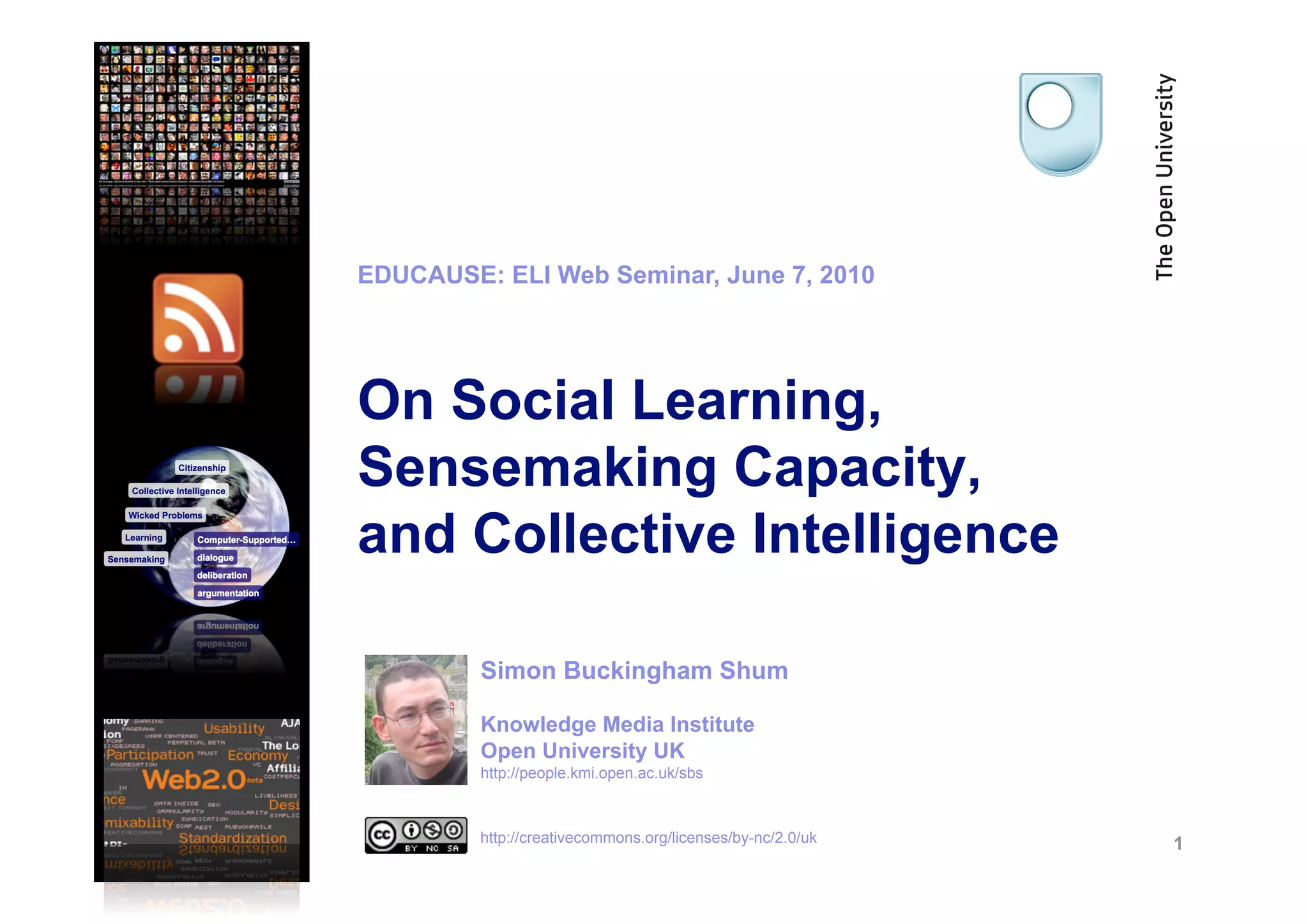
EDUCAUSE: ELI Web Seminar, June 7, 2010


On Social Learning,
Sensemaking Capacity,
and Collective Intelligence

         Simon Buckingham Shum

         Knowledge Media Institute
         Open University UK
         http://people.kmi.open.ac.uk/sbs


         http://creativecommons.org/licenses/by-nc/2.0/uk   1
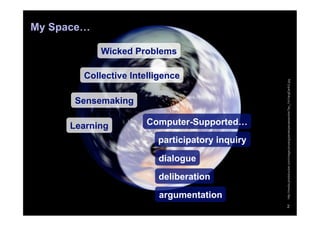
My Space…

            Wicked Problems

        Collective Intelligence


                                                 http://media.photobucket.com/image/yinyang/penelopecassandre/Tao_YinYangEarth2.jpg
      Sensemaking

     Learning          Computer-Supported…
                         participatory inquiry

                         dialogue

                         deliberation
                         argumentation
                                                    2
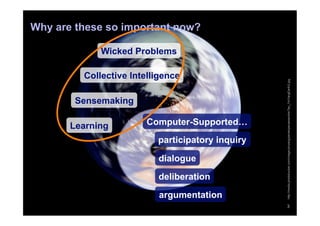
Why are these so important now?

             Wicked Problems

         Collective Intelligence


                                                  http://media.photobucket.com/image/yinyang/penelopecassandre/Tao_YinYangEarth2.jpg
        Sensemaking

       Learning         Computer-Supported…
                          participatory inquiry

                          dialogue

                          deliberation
                          argumentation
                                                     3
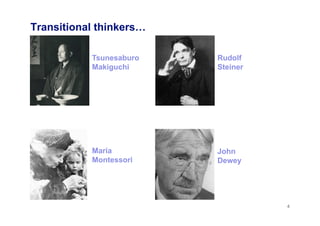
Transitional thinkers…

           Tsunesaburo   Rudolf
           Makiguchi     Steiner


           Maria         John
           Montessori    Dewey


                                   4
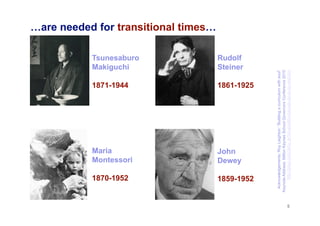
Maria


         1870-1952
                                                            1871-1944
                                                                        Makiguchi


                     Montessori
                                                                        Tsunesaburo
                                                                                      …are needed for transitional times…


                     John
                                                                        Rudolf


                     Dewey
                                                                        Steiner


         1859-1952
                                                            1861-1925


     Acknowledgements: Roy Leighton: “Building a curriculum with soul”
    Keynote Address, Milton Keynes School Governors Conference 2010
5


          http://prezi.com/3khu_wi1rn-a/milton-keynes-govs-roy-leighton
“It is time to hold up our hands and admit that
 our education system just isn’t working well
 enough.
 Our emphasis needs not to be on proving the
 residual value of outdated curricula, tests
 and league tables, but on inspiring and
 challenging children so that they in turn can
 inspire and challenge us.”
                                                Lord David Puttnam
                                        Chancellor, Open University
                   Introduction to the Learning Futures Programme
                                           www.learningfutures.org


                                                                      6
“To put it very crudely, the habits of mind
 required, and therefore cultivated, by the 19th
 century curriculum of mass schooling were
 deference, unquestioning acceptance of
 authority, neatness, punctuality, accurate
 recapitulation and ‘sequestered problem-
 solving’”
       Claxton & Lucas, 2009 UK National Inquiry into the Future for Lifelong Learning


                                                                                         7
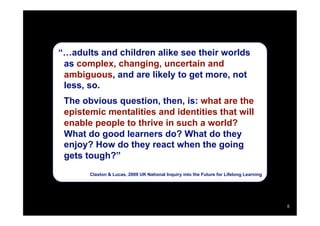
“…adults and children alike see their worlds
 as complex, changing, uncertain and
 ambiguous, and are likely to get more, not
 less, so.
 The obvious question, then, is: what are the
 epistemic mentalities and identities that will
 enable people to thrive in such a world?
 What do good learners do? What do they
 enjoy? How do they react when the going
 gets tough?”
       Claxton & Lucas, 2009 UK National Inquiry into the Future for Lifelong Learning


                                                                                         8
Hewlett Foundation 2010
                           focus: “Deeper Learning”

http://www.hewlett.org/programs/education-program/deeper-learning


“In one survey after another, business leaders complain that the
   majority of U.S. job applicants are ill-equipped to solve complex
   problems, work in teams, or communicate effectively.

“Hewlett envisions a new generation of schools and community
  colleges … harness the deeper learning skills of critical thinking,
  problem solving, effective communication, collaboration, and
  learning to learn to help students develop a strong foundation in
  traditional academic subjects.”


                                                                        9
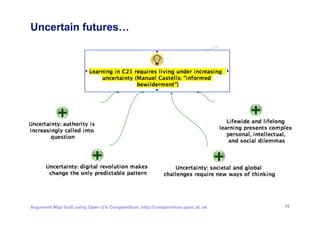
Uncertain futures…


Argument Map built using Open U’s Compendium: http://compendium.open.ac.uk   10
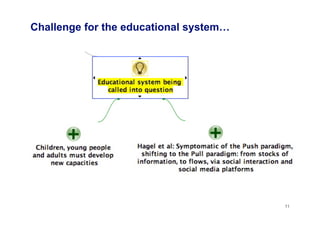
Challenge for the educational system…


                                        11
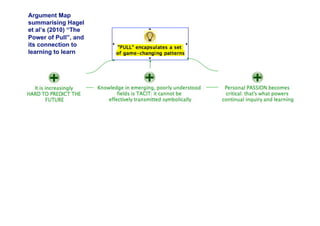
Argument Map
summarising Hagel
et al’s (2010) “The
Power of Pull”, and
its connection to
learning to learn


                      12
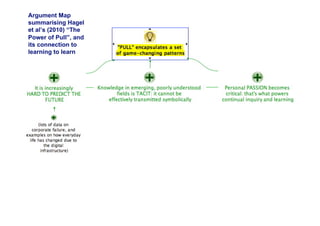
Argument Map
summarising Hagel
et al’s (2010) “The
Power of Pull”, and
its connection to
learning to learn


                      13
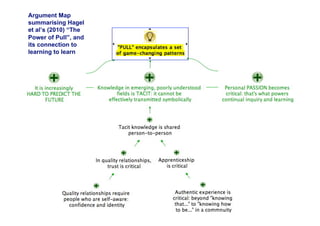
Argument Map
summarising Hagel
et al’s (2010) “The
Power of Pull”, and
its connection to
learning to learn


                      14
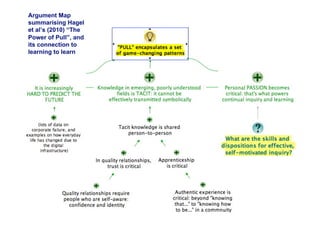
Argument Map
summarising Hagel
et al’s (2010) “The
Power of Pull”, and
its connection to
learning to learn


                      15
Read this:


             The Power of Pull
             How Small Moves, Smartly Made,
             Can Set Big Things in Motion


             John Hagel III
             John Seely Brown
             Lang Davison
             Summary article in Harvard Business Review blog:
             http://blogs.hbr.org/bigshift/2010/04/a-brief-history-of-the-power-o.html
Implication?

 sensemaking
is a key literacy
                    17
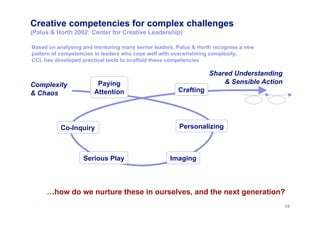
Creative competencies for complex challenges
(Palus & Horth 2002: Center for Creative Leadership)

Based on analysing and mentoring many senior leaders, Palus & Horth recognise a new
pattern of competencies in leaders who cope well with overwhelming complexity.
CCL has developed practical tools to scaffold these competencies

                                                                  Shared Understanding
Complexity              Paying                                        & Sensible Action
& Chaos                Attention                      Crafting


          Co-Inquiry                                   Personalizing


                   Serious Play                    Imaging


     …how do we nurture these in ourselves, and the next generation?
                                                                                          18
Read this:


             The Leader’s Edge
             Six Creative Competencies for
             Navigating Complex Challenges

             Charles J. Palus
             David M. Horth
             Summary article in Ivey Business Journal:
             http://www.iveybusinessjournal.com/article.asp?intArticle_ID=582
Implication?

learning to learn
 is a key literacy
                     20
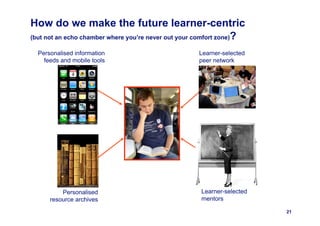
How do we make the future learner-centric
(but not an echo chamber where you’re never out your comfort zone)?

  Personalised information                          Learner-selected
    feeds and mobile tools                          peer network


          Personalised                               Learner-selected
      resource archives                              mentors

                                                                        21
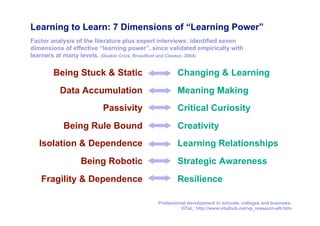
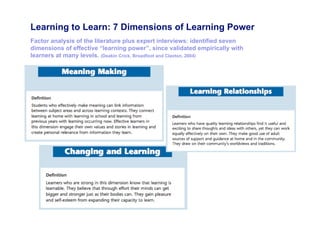
Learning to Learn: 7 Dimensions of “Learning Power”
Factor analysis of the literature plus expert interviews: identified seven
dimensions of effective “learning power”, since validated empirically with
learners at many levels. (Deakin Crick, Broadfoot and Claxton, 2004)


       Being Stuck & Static                         Changing & Learning
          Data Accumulation                         Meaning Making
                         Passivity                  Critical Curiosity
           Being Rule Bound                         Creativity
   Isolation & Dependence                           Learning Relationships
                 Being Robotic                      Strategic Awareness
   Fragility & Dependence                           Resilience

                                            Professional development in schools, colleges and business:
                                                      ViTaL: http://www.vitalhub.net/vp_research-elli.htm
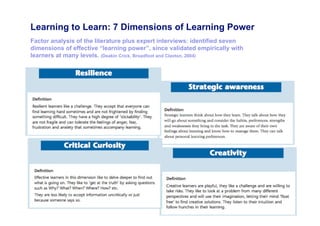
Learning to Learn: 7 Dimensions of Learning Power
Factor analysis of the literature plus expert interviews: identified seven
dimensions of effective “learning power”, since validated empirically with
learners at many levels. (Deakin Crick, Broadfoot and Claxton, 2004)
Learning to Learn: 7 Dimensions of Learning Power
Factor analysis of the literature plus expert interviews: identified seven
dimensions of effective “learning power”, since validated empirically with
learners at many levels. (Deakin Crick, Broadfoot and Claxton, 2004)
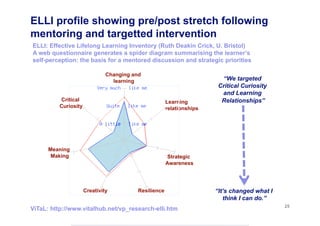
ELLI profile showing pre/post stretch following
mentoring and targetted intervention
ELLI: Effective Lifelong Learning Inventory (Ruth Deakin Crick, U. Bristol)
A web questionnaire generates a spider diagram summarising the learner’s
self-perception: the basis for a mentored discussion and strategic priorities

                               Changing and
                                 learning                                “We targeted
                                                                        Critical Curiosity
                                                                         and Learning
          Critical                                     Learning          Relationships”
          Curiosity                                    relationships


      Meaning
       Making                                           Strategic
                                                       Awareness


                      Creativity          Resilience                   “It’s changed what I
                                                                          think I can do.”
                                                                                              25
ViTaL: http://www.vitalhub.net/vp_research-elli.htm
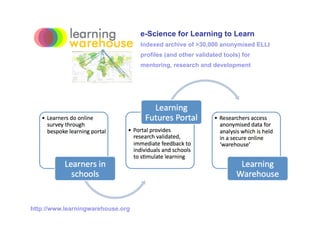
e-Science for Learning to Learn
                                   Indexed archive of >30,000 anonymised ELLI
                                   profiles (and other validated tools) for
                                   mentoring, research and development


http://www.learningwarehouse.org
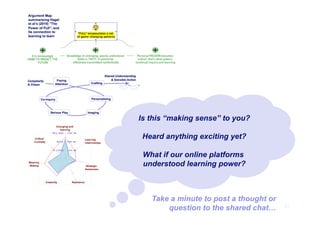
Is this “making sense” to you?

 Heard anything exciting yet?

 What if our online platforms
 understood learning power?


   Take a minute to post a thought or
       question to the shared chat…     27
Did you know?…

  citizenship
   education
                 28
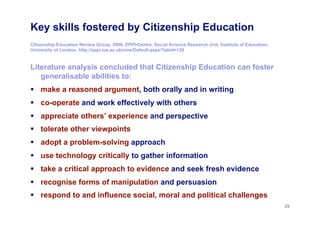
Key skills fostered by Citizenship Education
Citizenship Education Review Group, 2006. EPPI-Centre, Social Science Research Unit, Institute of Education,
University of London. http://eppi.ioe.ac.uk/cms/Default.aspx?tabid=129


Literature analysis concluded that Citizenship Education can foster
   generalisable abilities to:
  make a reasoned argument, both orally and in writing
  co-operate and work effectively with others
  appreciate others’ experience and perspective
  tolerate other viewpoints
  adopt a problem-solving approach
  use technology critically to gather information
  take a critical approach to evidence and seek fresh evidence
  recognise forms of manipulation and persuasion
  respond to and influence social, moral and political challenges
                                                                                                               29
Read this:

             Pedagogical challenges for
             personalisation:
             Integrating the personal with the public
             through context-driven enquiry.

             Special Issue, Curriculum Journal,
             2009, 20 (3), 185-306

             http://bit.ly/Y8aI6
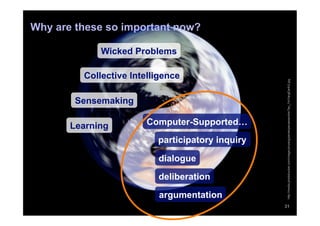
Why are these so important now?

             Wicked Problems

         Collective Intelligence


                                                  http://media.photobucket.com/image/yinyang/penelopecassandre/Tao_YinYangEarth2.jpg
        Sensemaking

       Learning         Computer-Supported…
                          participatory inquiry

                          dialogue

                          deliberation
                          argumentation
                                                  31
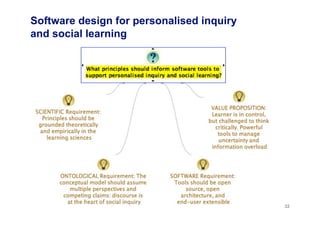
Software design for personalised inquiry
and social learning


                                           32
http://projects.kmi.open.ac.uk/hyperdiscourse


Projects span many disciplines, ranging from basic research to applications:


                                                                               33
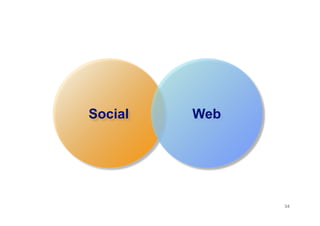
Social   Web


               34
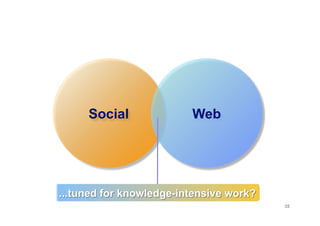
Social   Web


               35
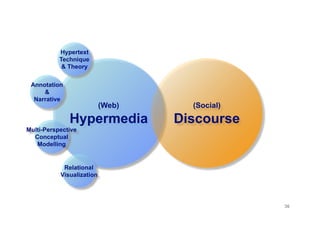
Hypertext
           Technique
            & Theory

 Annotation
     &
  Narrative
                           (Web)     (Social)

              Hypermedia           Discourse
Multi-Perspective
  Conceptual
   Modelling


            Relational
           Visualization


                                                36
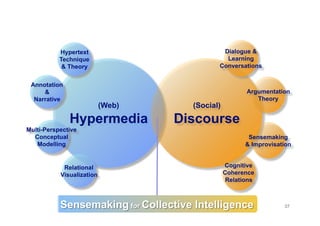
Hypertext                         Dialogue &
           Technique                          Learning
            & Theory                        Conversations


 Annotation
     &                                                 Argumentation
  Narrative                                               Theory
                           (Web)     (Social)

              Hypermedia           Discourse
Multi-Perspective
  Conceptual                                            Sensemaking
   Modelling                                           & Improvisation


            Relational                          Cognitive
           Visualization                        Coherence
                                                 Relations


                                                                   37
www.open.ac.uk/sociallearn

                             38
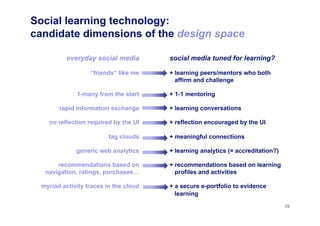
Social learning technology:
candidate dimensions of the design space

          everyday social media        social media tuned for learning?

                  “friends” like me    + learning peers/mentors who both
                                         affirm and challenge

             1-many from the start     + 1-1 mentoring

       rapid information exchange      + learning conversations

   no reflection required by the UI    + reflection encouraged by the UI

                         tag clouds    + meaningful connections

             generic web analytics     + learning analytics (= accreditation?)

      recommendations based on         + recommendations based on learning
  navigation, ratings, purchases…        profiles and activities

 myriad activity traces in the cloud   + a secure e-portfolio to evidence
                                         learning
                                                                                 39
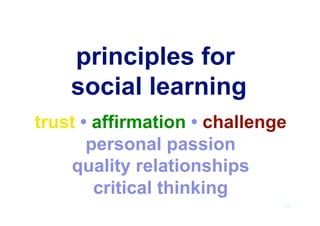
principles for
    social learning
trust • affirmation • challenge
       personal passion
    quality relationships
        critical thinking
                              40
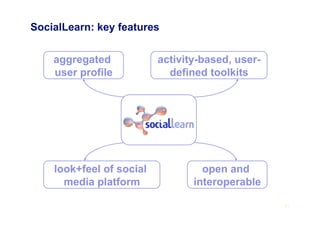
SocialLearn: key features


    aggregated            activity-based, user-
    user profile            defined toolkits


    look+feel of social            open and
      media platform             interoperable

                                                  41
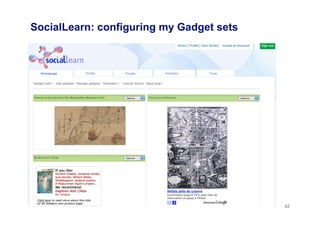
SocialLearn: configuring my Gadget sets


                                          42
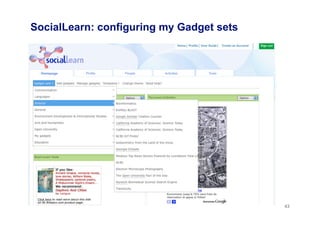
SocialLearn: configuring my Gadget sets


                                          43
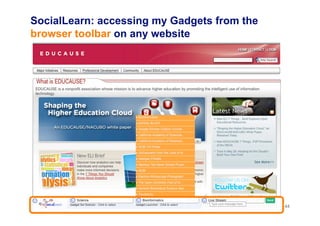
SocialLearn: accessing my Gadgets from the
browser toolbar on any website


                                             44
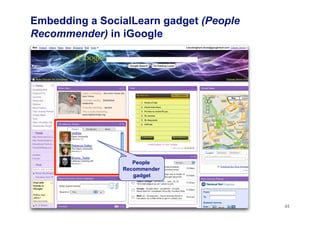
Embedding a SocialLearn gadget (People
Recommender) in iGoogle


                   People
                Recommender
                   gadget


                                         45
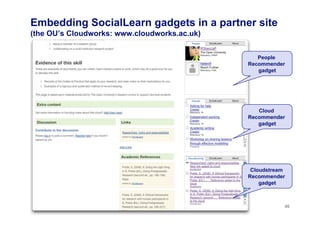
Embedding SocialLearn gadgets in a partner site
(the OU’s Cloudworks: www.cloudworks.ac.uk)


                                                 People
                                              Recommender
                                                 gadget


                                                 Cloud
                                              Recommender
                                                 gadget


                                               Cloudstream
                                              Recommender
                                                  gadget


                                                         46
web annotation for sensemaking

 (A winner in the Mozilla/MacArthur Foundation
    Jetpack for Learning Design Challenge)


    http://cohere.open.ac.uk
                                                 47
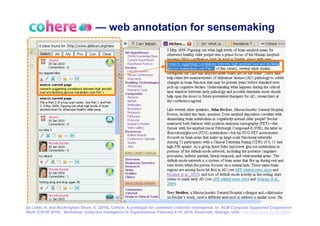
— web annotation for sensemaking


                                                                                                                                            48
De Liddo, A. and Buckingham Shum, S. (2010). Cohere: A prototype for contested collective intelligence. In: ACM Computer Supported Cooperative
Work (CSCW 2010) - Workshop: Collective Intelligence In Organizations, February 6-10, 2010, Savannah, Georgia, USA. http://oro.open.ac.uk/19554
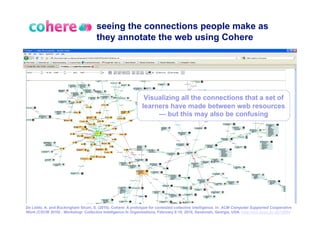
seeing the connections people make as
                                      they annotate the web using Cohere


                                                               Visualizing all the connections that a set of
                                                              learners have made between web resources
                                                                   — but this may also be confusing


De Liddo, A. and Buckingham Shum, S. (2010). Cohere: A prototype for contested collective intelligence. In: ACM Computer Supported Cooperative
Work (CSCW 2010) - Workshop: Collective Intelligence In Organizations, February 6-10, 2010, Savannah, Georgia, USA. http://oro.open.ac.uk/19554
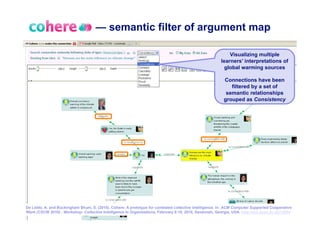
— semantic filter of argument map

                                                                                                             Visualizing multiple
                                                                                                         learners’ interpretations of
                                                                                                           global warming sources

                                                                                                          Connections have been
                                                                                                             filtered by a set of
                                                                                                           semantic relationships
                                                                                                          grouped as Consistency


De Liddo, A. and Buckingham Shum, S. (2010). Cohere: A prototype for contested collective intelligence. In: ACM Computer Supported Cooperative
Work (CSCW 2010) - Workshop: Collective Intelligence In Organizations, February 6-10, 2010, Savannah, Georgia, USA. http://oro.open.ac.uk/19554
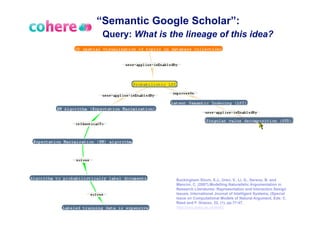
“Semantic Google Scholar”:
 Query: What is the lineage of this idea?


                  Buckingham Shum, S.J., Uren, V., Li, G., Sereno, B. and
                  Mancini, C. (2007).Modelling Naturalistic Argumentation in
                  Research Literatures: Representation and Interaction Design
                  Issues. International Journal of Intelligent Systems, (Special
                  Issue on Computational Models of Natural Argument, Eds: C.
                  Reed and F. Grasso, 22, (1), pp.17-47.
                  http://oro.open.ac.uk/6463                                    51
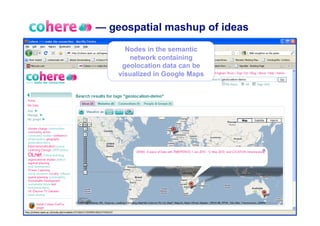
— geospatial mashup of ideas
      Nodes in the semantic
       network containing
     geolocation data can be
    visualized in Google Maps
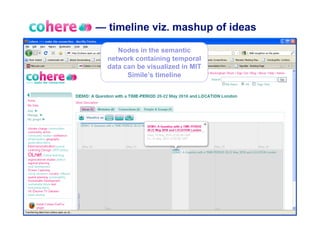
— timeline viz. mashup of ideas

     Nodes in the semantic
  network containing temporal
  data can be visualized in MIT
        Simile’s timeline
Compendium
           “it’s like Excel, but for knowledge”


     http://compendium.open.ac.uk
http://compendium.open.ac.uk/institute
                                                  54
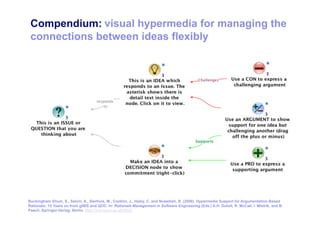
Compendium: visual hypermedia for managing the
 connections between ideas flexibly


Buckingham Shum, S., Selvin, A., Sierhuis, M., Conklin, J., Haley, C. and Nuseibeh, B. (2006). Hypermedia Support for Argumentation-Based
Rationale: 15 Years on from gIBIS and QOC. In: Rationale Management in Software Engineering (Eds.) A.H. Dutoit, R. McCall, I. Mistrik, and B. 55
Paech. Springer-Verlag: Berlin. http://oro.open.ac.uk/3032
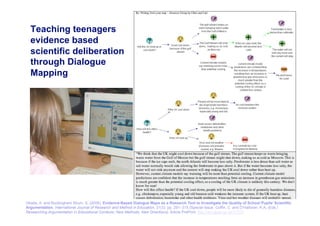
Teaching teenagers
  evidence based
  scientific deliberation
  through Dialogue
  Mapping


Okada, A. and Buckingham Shum, S. (2008). Evidence-Based Dialogue Maps as a Research Tool to Investigate the Quality of School Pupils’ Scientific
Argumentation, International Journal of Research and Method in Education, 31(3), pp. 291–315 (Special Issue: Coffin, C. and O’Halloran, K.A, (Eds.) 56
Researching Argumentation in Educational Contexts: New Methods, New Directions). Article PrePrint: http://oro.open.ac.uk/11773
Compendium to scaffold CCL’s C2 Competencies

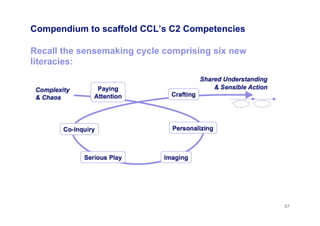
Recall the sensemaking cycle comprising six new
literacies:


                                                  57
Compendium to scaffold CCL’s C2 Competencies


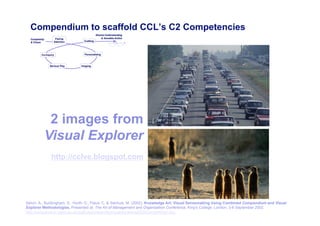
          2 images from
         Visual Explorer
             http://cclve.blogspot.com


Selvin, A., Buckingham, S., Horth, D., Palus, C. & Sierhuis, M. (2002). Knowledge Art: Visual Sensemaking Using Combined Compendium and Visual
Explorer Methodologies. Presented at: The Art of Management and Organisation Conference, King's College London, 3-6 September 2002.          58
http://compendium.open.ac.uk/institute/compendium/papers/aomo2002Compendium.doc
Compendium to scaffold CCL’s C2 Competencies


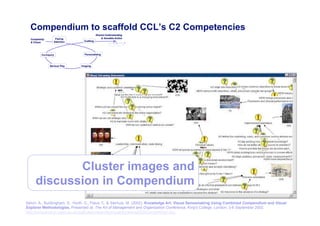
            Cluster images and
     discussion in Compendium
Selvin, A., Buckingham, S., Horth, D., Palus, C. & Sierhuis, M. (2002). Knowledge Art: Visual Sensemaking Using Combined Compendium and Visual
Explorer Methodologies. Presented at: The Art of Management and Organisation Conference, King's College London, 3-6 September 2002.          59
http://compendium.open.ac.uk/institute/compendium/papers/aomo2002Compendium.doc
Compendium to scaffold CCL’s C2 Competencies


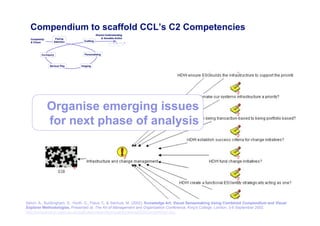
           Organise emerging issues
           for next phase of analysis


Selvin, A., Buckingham, S., Horth, D., Palus, C. & Sierhuis, M. (2002). Knowledge Art: Visual Sensemaking Using Combined Compendium and Visual
Explorer Methodologies. Presented at: The Art of Management and Organisation Conference, King's College London, 3-6 September 2002.          60
http://compendium.open.ac.uk/institute/compendium/papers/aomo2002Compendium.doc
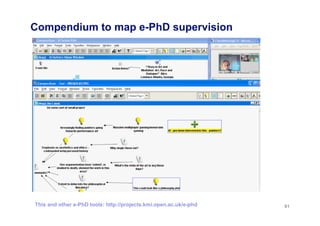
Compendium to map e-PhD supervision


This and other e-PhD tools: http://projects.kmi.open.ac.uk/e-phd   61
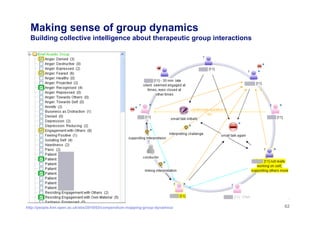
Making sense of group dynamics
  Building collective intelligence about therapeutic group interactions


http://people.kmi.open.ac.uk/sbs/2010/03/compendium-mapping-group-dynamics/   62
Tool Poll! From what you’ve seen so far, which tool
would you most like to try out?

  •  SocialLearn
  •  Compendium
  •  Cohere
  •  Visual Explorer


                          How might you use these tools in
                                  your context?

                             Have you had good or poor
                            experiences with similar tools?


   Take a minute to post a thought or question to the shared chat.
                                                                     63
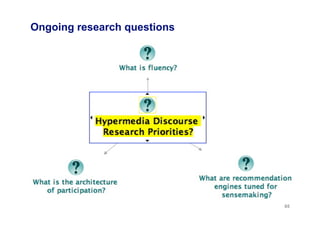
Ongoing research
   questions

                   64
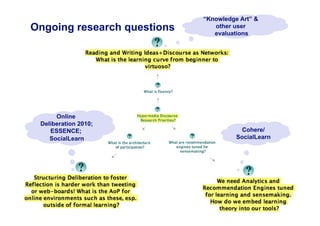
Ongoing research questions


                             65
“Knowledge Art” &
Ongoing research questions      other user
                                evaluations


      Online
 Deliberation 2010;
    ESSENCE;                             Cohere/
    SocialLearn                        SocialLearn


                                                     66
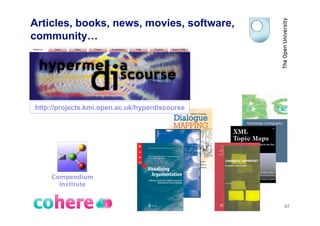
Articles, books, news, movies, software,
community…


http://projects.kmi.open.ac.uk/hyperdiscourse


     Compendium

       Institute


                                                67

On Social Learning, Sensemaking Capacity, and Collective Intelligence

  • 1.
    EDUCAUSE: ELI WebSeminar, June 7, 2010 On Social Learning, Sensemaking Capacity, and Collective Intelligence Simon Buckingham Shum Knowledge Media Institute Open University UK http://people.kmi.open.ac.uk/sbs http://creativecommons.org/licenses/by-nc/2.0/uk 1
  • 2.
    My Space… Wicked Problems Collective Intelligence http://media.photobucket.com/image/yinyang/penelopecassandre/Tao_YinYangEarth2.jpg Sensemaking Learning Computer-Supported… participatory inquiry dialogue deliberation argumentation 2
  • 3.
    Why are theseso important now? Wicked Problems Collective Intelligence http://media.photobucket.com/image/yinyang/penelopecassandre/Tao_YinYangEarth2.jpg Sensemaking Learning Computer-Supported… participatory inquiry dialogue deliberation argumentation 3
  • 4.
    Transitional thinkers… Tsunesaburo Rudolf Makiguchi Steiner Maria John Montessori Dewey 4
  • 5.
    Maria 1870-1952 1871-1944 Makiguchi Montessori Tsunesaburo …are needed for transitional times… John Rudolf Dewey Steiner 1859-1952 1861-1925 Acknowledgements: Roy Leighton: “Building a curriculum with soul” Keynote Address, Milton Keynes School Governors Conference 2010 5 http://prezi.com/3khu_wi1rn-a/milton-keynes-govs-roy-leighton
  • 6.
    “It is timeto hold up our hands and admit that our education system just isn’t working well enough. Our emphasis needs not to be on proving the residual value of outdated curricula, tests and league tables, but on inspiring and challenging children so that they in turn can inspire and challenge us.” Lord David Puttnam Chancellor, Open University Introduction to the Learning Futures Programme www.learningfutures.org 6
  • 7.
    “To put itvery crudely, the habits of mind required, and therefore cultivated, by the 19th century curriculum of mass schooling were deference, unquestioning acceptance of authority, neatness, punctuality, accurate recapitulation and ‘sequestered problem- solving’” Claxton & Lucas, 2009 UK National Inquiry into the Future for Lifelong Learning 7
  • 8.
    “…adults and childrenalike see their worlds as complex, changing, uncertain and ambiguous, and are likely to get more, not less, so. The obvious question, then, is: what are the epistemic mentalities and identities that will enable people to thrive in such a world? What do good learners do? What do they enjoy? How do they react when the going gets tough?” Claxton & Lucas, 2009 UK National Inquiry into the Future for Lifelong Learning 8
  • 9.
    Hewlett Foundation 2010 focus: “Deeper Learning” http://www.hewlett.org/programs/education-program/deeper-learning “In one survey after another, business leaders complain that the majority of U.S. job applicants are ill-equipped to solve complex problems, work in teams, or communicate effectively. “Hewlett envisions a new generation of schools and community colleges … harness the deeper learning skills of critical thinking, problem solving, effective communication, collaboration, and learning to learn to help students develop a strong foundation in traditional academic subjects.” 9
  • 10.
    Uncertain futures… Argument Mapbuilt using Open U’s Compendium: http://compendium.open.ac.uk 10
  • 11.
    Challenge for theeducational system… 11
  • 12.
    Argument Map summarising Hagel etal’s (2010) “The Power of Pull”, and its connection to learning to learn 12
  • 13.
    Argument Map summarising Hagel etal’s (2010) “The Power of Pull”, and its connection to learning to learn 13
  • 14.
    Argument Map summarising Hagel etal’s (2010) “The Power of Pull”, and its connection to learning to learn 14
  • 15.
    Argument Map summarising Hagel etal’s (2010) “The Power of Pull”, and its connection to learning to learn 15
  • 16.
    Read this: The Power of Pull How Small Moves, Smartly Made, Can Set Big Things in Motion John Hagel III John Seely Brown Lang Davison Summary article in Harvard Business Review blog: http://blogs.hbr.org/bigshift/2010/04/a-brief-history-of-the-power-o.html
  • 17.
  • 18.
    Creative competencies forcomplex challenges (Palus & Horth 2002: Center for Creative Leadership) Based on analysing and mentoring many senior leaders, Palus & Horth recognise a new pattern of competencies in leaders who cope well with overwhelming complexity. CCL has developed practical tools to scaffold these competencies Shared Understanding Complexity Paying & Sensible Action & Chaos Attention Crafting Co-Inquiry Personalizing Serious Play Imaging …how do we nurture these in ourselves, and the next generation? 18
  • 19.
    Read this: The Leader’s Edge Six Creative Competencies for Navigating Complex Challenges Charles J. Palus David M. Horth Summary article in Ivey Business Journal: http://www.iveybusinessjournal.com/article.asp?intArticle_ID=582
  • 20.
    Implication? learning to learn is a key literacy 20
  • 21.
    How do wemake the future learner-centric (but not an echo chamber where you’re never out your comfort zone)? Personalised information Learner-selected feeds and mobile tools peer network Personalised Learner-selected resource archives mentors 21
  • 22.
    Learning to Learn:7 Dimensions of “Learning Power” Factor analysis of the literature plus expert interviews: identified seven dimensions of effective “learning power”, since validated empirically with learners at many levels. (Deakin Crick, Broadfoot and Claxton, 2004) Being Stuck & Static Changing & Learning Data Accumulation Meaning Making Passivity Critical Curiosity Being Rule Bound Creativity Isolation & Dependence Learning Relationships Being Robotic Strategic Awareness Fragility & Dependence Resilience Professional development in schools, colleges and business: ViTaL: http://www.vitalhub.net/vp_research-elli.htm
  • 23.
    Learning to Learn:7 Dimensions of Learning Power Factor analysis of the literature plus expert interviews: identified seven dimensions of effective “learning power”, since validated empirically with learners at many levels. (Deakin Crick, Broadfoot and Claxton, 2004)
  • 24.
    Learning to Learn:7 Dimensions of Learning Power Factor analysis of the literature plus expert interviews: identified seven dimensions of effective “learning power”, since validated empirically with learners at many levels. (Deakin Crick, Broadfoot and Claxton, 2004)
  • 25.
    ELLI profile showingpre/post stretch following mentoring and targetted intervention ELLI: Effective Lifelong Learning Inventory (Ruth Deakin Crick, U. Bristol) A web questionnaire generates a spider diagram summarising the learner’s self-perception: the basis for a mentored discussion and strategic priorities Changing and learning “We targeted Critical Curiosity and Learning Critical Learning Relationships” Curiosity relationships Meaning Making Strategic Awareness Creativity Resilience “It’s changed what I think I can do.” 25 ViTaL: http://www.vitalhub.net/vp_research-elli.htm
  • 26.
    e-Science for Learningto Learn Indexed archive of >30,000 anonymised ELLI profiles (and other validated tools) for mentoring, research and development http://www.learningwarehouse.org
  • 27.
    Is this “makingsense” to you? Heard anything exciting yet? What if our online platforms understood learning power? Take a minute to post a thought or question to the shared chat… 27
  • 28.
    Did you know?… citizenship education 28
  • 29.
    Key skills fosteredby Citizenship Education Citizenship Education Review Group, 2006. EPPI-Centre, Social Science Research Unit, Institute of Education, University of London. http://eppi.ioe.ac.uk/cms/Default.aspx?tabid=129 Literature analysis concluded that Citizenship Education can foster generalisable abilities to:   make a reasoned argument, both orally and in writing   co-operate and work effectively with others   appreciate others’ experience and perspective   tolerate other viewpoints   adopt a problem-solving approach   use technology critically to gather information   take a critical approach to evidence and seek fresh evidence   recognise forms of manipulation and persuasion   respond to and influence social, moral and political challenges 29
  • 30.
    Read this: Pedagogical challenges for personalisation: Integrating the personal with the public through context-driven enquiry. Special Issue, Curriculum Journal, 2009, 20 (3), 185-306 http://bit.ly/Y8aI6
  • 31.
    Why are theseso important now? Wicked Problems Collective Intelligence http://media.photobucket.com/image/yinyang/penelopecassandre/Tao_YinYangEarth2.jpg Sensemaking Learning Computer-Supported… participatory inquiry dialogue deliberation argumentation 31
  • 32.
    Software design forpersonalised inquiry and social learning 32
  • 33.
    http://projects.kmi.open.ac.uk/hyperdiscourse Projects span manydisciplines, ranging from basic research to applications: 33
  • 34.
    Social Web 34
  • 35.
    Social Web 35
  • 36.
    Hypertext Technique & Theory Annotation & Narrative (Web) (Social) Hypermedia Discourse Multi-Perspective Conceptual Modelling Relational Visualization 36
  • 37.
    Hypertext Dialogue & Technique Learning & Theory Conversations Annotation & Argumentation Narrative Theory (Web) (Social) Hypermedia Discourse Multi-Perspective Conceptual Sensemaking Modelling & Improvisation Relational Cognitive Visualization Coherence Relations 37
  • 38.
  • 39.
    Social learning technology: candidatedimensions of the design space everyday social media social media tuned for learning? “friends” like me + learning peers/mentors who both affirm and challenge 1-many from the start + 1-1 mentoring rapid information exchange + learning conversations no reflection required by the UI + reflection encouraged by the UI tag clouds + meaningful connections generic web analytics + learning analytics (= accreditation?) recommendations based on + recommendations based on learning navigation, ratings, purchases… profiles and activities myriad activity traces in the cloud + a secure e-portfolio to evidence learning 39
  • 40.
    principles for social learning trust • affirmation • challenge personal passion quality relationships critical thinking 40
  • 41.
    SocialLearn: key features aggregated activity-based, user- user profile defined toolkits look+feel of social open and media platform interoperable 41
  • 42.
  • 43.
  • 44.
    SocialLearn: accessing myGadgets from the browser toolbar on any website 44
  • 45.
    Embedding a SocialLearngadget (People Recommender) in iGoogle People Recommender gadget 45
  • 46.
    Embedding SocialLearn gadgetsin a partner site (the OU’s Cloudworks: www.cloudworks.ac.uk) People Recommender gadget Cloud Recommender gadget Cloudstream Recommender gadget 46
  • 47.
    web annotation forsensemaking (A winner in the Mozilla/MacArthur Foundation Jetpack for Learning Design Challenge) http://cohere.open.ac.uk 47
  • 48.
    — web annotationfor sensemaking 48 De Liddo, A. and Buckingham Shum, S. (2010). Cohere: A prototype for contested collective intelligence. In: ACM Computer Supported Cooperative Work (CSCW 2010) - Workshop: Collective Intelligence In Organizations, February 6-10, 2010, Savannah, Georgia, USA. http://oro.open.ac.uk/19554
  • 49.
    seeing the connectionspeople make as they annotate the web using Cohere Visualizing all the connections that a set of learners have made between web resources — but this may also be confusing De Liddo, A. and Buckingham Shum, S. (2010). Cohere: A prototype for contested collective intelligence. In: ACM Computer Supported Cooperative Work (CSCW 2010) - Workshop: Collective Intelligence In Organizations, February 6-10, 2010, Savannah, Georgia, USA. http://oro.open.ac.uk/19554
  • 50.
    — semantic filterof argument map Visualizing multiple learners’ interpretations of global warming sources Connections have been filtered by a set of semantic relationships grouped as Consistency De Liddo, A. and Buckingham Shum, S. (2010). Cohere: A prototype for contested collective intelligence. In: ACM Computer Supported Cooperative Work (CSCW 2010) - Workshop: Collective Intelligence In Organizations, February 6-10, 2010, Savannah, Georgia, USA. http://oro.open.ac.uk/19554
  • 51.
    “Semantic Google Scholar”: Query: What is the lineage of this idea? Buckingham Shum, S.J., Uren, V., Li, G., Sereno, B. and Mancini, C. (2007).Modelling Naturalistic Argumentation in Research Literatures: Representation and Interaction Design Issues. International Journal of Intelligent Systems, (Special Issue on Computational Models of Natural Argument, Eds: C. Reed and F. Grasso, 22, (1), pp.17-47. http://oro.open.ac.uk/6463 51
  • 52.
    — geospatial mashupof ideas Nodes in the semantic network containing geolocation data can be visualized in Google Maps
  • 53.
    — timeline viz.mashup of ideas Nodes in the semantic network containing temporal data can be visualized in MIT Simile’s timeline
  • 54.
    Compendium “it’s like Excel, but for knowledge” http://compendium.open.ac.uk http://compendium.open.ac.uk/institute 54
  • 55.
    Compendium: visual hypermediafor managing the connections between ideas flexibly Buckingham Shum, S., Selvin, A., Sierhuis, M., Conklin, J., Haley, C. and Nuseibeh, B. (2006). Hypermedia Support for Argumentation-Based Rationale: 15 Years on from gIBIS and QOC. In: Rationale Management in Software Engineering (Eds.) A.H. Dutoit, R. McCall, I. Mistrik, and B. 55 Paech. Springer-Verlag: Berlin. http://oro.open.ac.uk/3032
  • 56.
    Teaching teenagers evidence based scientific deliberation through Dialogue Mapping Okada, A. and Buckingham Shum, S. (2008). Evidence-Based Dialogue Maps as a Research Tool to Investigate the Quality of School Pupils’ Scientific Argumentation, International Journal of Research and Method in Education, 31(3), pp. 291–315 (Special Issue: Coffin, C. and O’Halloran, K.A, (Eds.) 56 Researching Argumentation in Educational Contexts: New Methods, New Directions). Article PrePrint: http://oro.open.ac.uk/11773
  • 57.
    Compendium to scaffoldCCL’s C2 Competencies Recall the sensemaking cycle comprising six new literacies: 57
  • 58.
    Compendium to scaffoldCCL’s C2 Competencies 2 images from Visual Explorer http://cclve.blogspot.com Selvin, A., Buckingham, S., Horth, D., Palus, C. & Sierhuis, M. (2002). Knowledge Art: Visual Sensemaking Using Combined Compendium and Visual Explorer Methodologies. Presented at: The Art of Management and Organisation Conference, King's College London, 3-6 September 2002. 58 http://compendium.open.ac.uk/institute/compendium/papers/aomo2002Compendium.doc
  • 59.
    Compendium to scaffoldCCL’s C2 Competencies Cluster images and discussion in Compendium Selvin, A., Buckingham, S., Horth, D., Palus, C. & Sierhuis, M. (2002). Knowledge Art: Visual Sensemaking Using Combined Compendium and Visual Explorer Methodologies. Presented at: The Art of Management and Organisation Conference, King's College London, 3-6 September 2002. 59 http://compendium.open.ac.uk/institute/compendium/papers/aomo2002Compendium.doc
  • 60.
    Compendium to scaffoldCCL’s C2 Competencies Organise emerging issues for next phase of analysis Selvin, A., Buckingham, S., Horth, D., Palus, C. & Sierhuis, M. (2002). Knowledge Art: Visual Sensemaking Using Combined Compendium and Visual Explorer Methodologies. Presented at: The Art of Management and Organisation Conference, King's College London, 3-6 September 2002. 60 http://compendium.open.ac.uk/institute/compendium/papers/aomo2002Compendium.doc
  • 61.
    Compendium to mape-PhD supervision This and other e-PhD tools: http://projects.kmi.open.ac.uk/e-phd 61
  • 62.
    Making sense ofgroup dynamics Building collective intelligence about therapeutic group interactions http://people.kmi.open.ac.uk/sbs/2010/03/compendium-mapping-group-dynamics/ 62
  • 63.
    Tool Poll! Fromwhat you’ve seen so far, which tool would you most like to try out? •  SocialLearn •  Compendium •  Cohere •  Visual Explorer How might you use these tools in your context? Have you had good or poor experiences with similar tools? Take a minute to post a thought or question to the shared chat. 63
  • 64.
    Ongoing research questions 64
  • 65.
  • 66.
    “Knowledge Art” & Ongoingresearch questions other user evaluations Online Deliberation 2010; ESSENCE; Cohere/ SocialLearn SocialLearn 66
  • 67.
    Articles, books, news,movies, software, community… http://projects.kmi.open.ac.uk/hyperdiscourse Compendium
 Institute 67