


Dispositional Learning Analytics
Learning Power and Complex Systems
Ruth Deakin Crick
Simon Buckingham Shum
1
The Story in One Slide
Learning dispositions and learning identities are key levers for sustainable
learning in 21C conditions of uncertainty, risk and challenge
Dispositions and identities are ‘soft’ variables which require formative
assessment to stimulate self-directed change and responsible agency
Dispositional analytics enables:
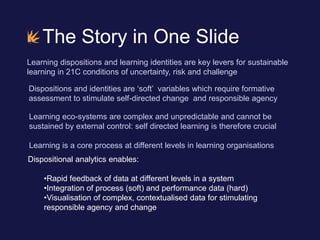
•Rapid feedback of data at different levels in a system
•Integration of process (soft) and performance data (hard)
•Visualisation of complex, contextualised data for stimulating
responsible agency and change
Learning eco-systems are complex and unpredictable and cannot be
sustained by external control: self directed learning is therefore crucial
Learning is a core process at different levels in learning organisations
6
learning dispositions
matter
"resilience is the defining concept for the 21st century”
John Seely Brown 2013
Our focus is on malleable dispositions
that are important for developing
intentional learners, and
which, critically, learners can recognise
and develop in themselves
dispositions can be
modelled
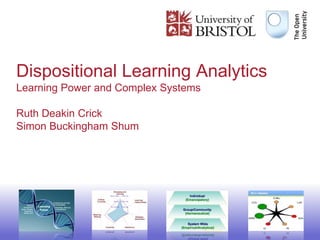
‘learning power’
8
Learning power
empirically derived, complex mix of
values, attitudes and dispositions which
together are necessary for fuelling an
individual’s engagement with new
learning opportunities through identity
formation and scaffolding
Deakin Crick, R., Haigney, D., Huang S., Coburn, T. & Goldspink C., (2012) Learning Power in the Work Place: the Effective
Lifelong Learning Inventory (ELLI) and its reliability and validity and implications for Learning and
Development, International Journal of Human Resource
Deakin Crick, R. (2007) Learning to learn: The dynamic assessment of learning power. Curriculum Journal,18,2, 135-153.
Deakin Crick R., Broadfoot P. & Claxton G. (2004) Developing an Effective Lifelong Learning Inventory: The ELLI
Project, Assessment in Education, 11, 3, 247 - 272.
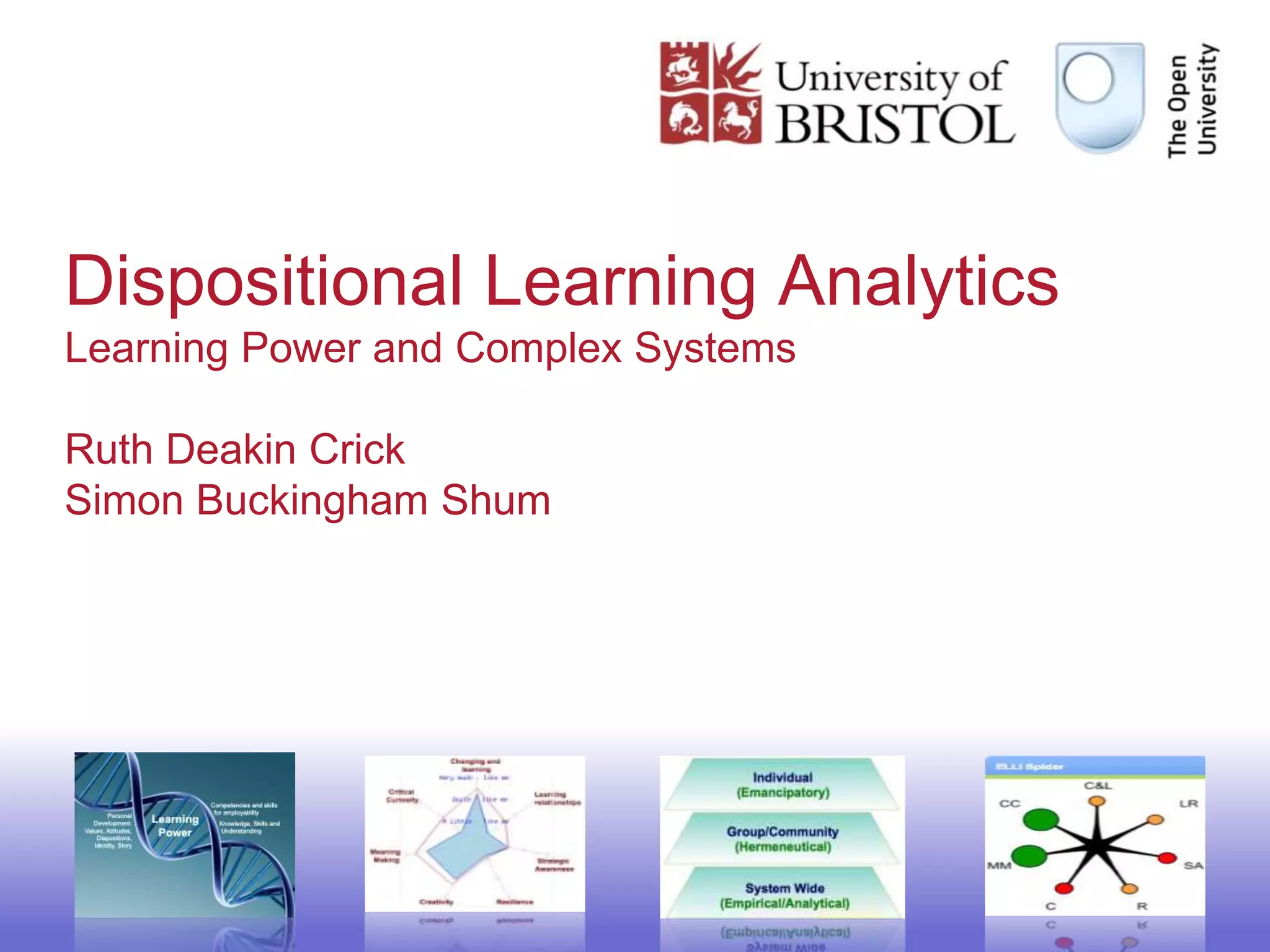
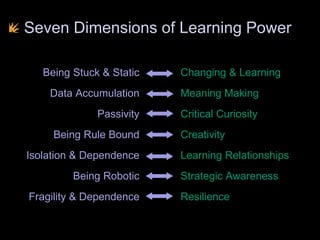
Seven Dimensions of Learning Power
Changing & Learning
Meaning Making
Critical Curiosity
Creativity
Learning Relationships
Strategic Awareness
Resilience
Being Stuck & Static
Data Accumulation
Passivity
Being Rule Bound
Isolation & Dependence
Being Robotic
Fragility & Dependence
learning power
correlates with other
success criteria
(but it’s a complex relationship)
11
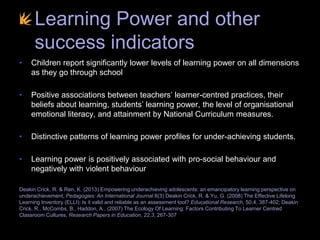
Learning Power and other
success indicators
• Children report significantly lower levels of learning power on all dimensions
as they go through school
• Positive associations between teachers’ learner-centred practices, their
beliefs about learning, students’ learning power, the level of organisational
emotional literacy, and attainment by National Curriculum measures.
• Distinctive patterns of learning power profiles for under-achieving students.
• Learning power is positively associated with pro-social behaviour and
negatively with violent behaviour
Deakin Crick, R. & Ren, K. (2013) Empowering underachieving adolescents: an emancipatory learning perspective on
underachievement, Pedagogies: An International Journal 8(3) Deakin Crick, R. & Yu, G. (2008) The Effective Lifelong
Learning Inventory (ELLI): Is it valid and reliable as an assessment tool? Educational Research, 50,4, 387-402; Deakin
Crick, R., McCombs, B., Haddon, A., (2007) The Ecology Of Learning: Factors Contributing To Learner Centred
Classroom Cultures, Research Papers in Education, 22,3, 267-307
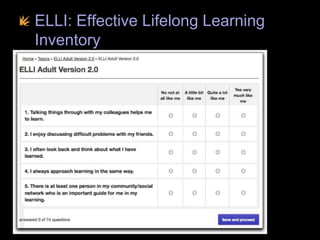
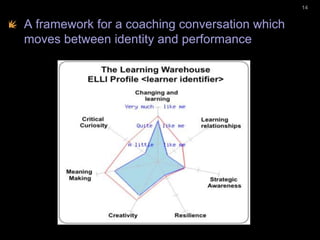
ELLI: Effective Lifelong Learning
Inventory
A framework for a coaching conversation which
moves between identity and performance
14
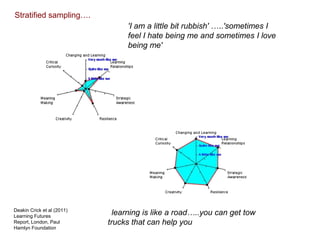
'learning is like a road…..you can get tow
trucks that can help you
'I am a little bit rubbish' …..'sometimes I
feel I hate being me and sometimes I love
being me'
Deakin Crick et al (2011)
Learning Futures
Report, London, Paul
Hamlyn Foundation
Stratified sampling….
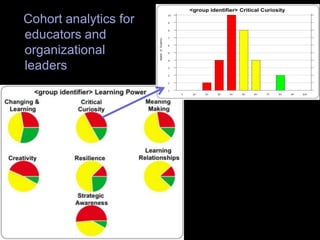
Cohort analytics for
educators and
organizational
leaders
16
making the invisible visible
for the purpose of
enhancing responsible
agency
18
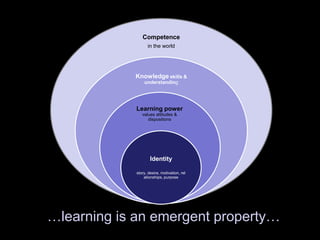
Competence
in the world
Knowledge skills &
understanding
Learning power
values attitudes &
dispositions
Identity
story, desire, motivation, rel
ationships, purpose
…learning is an emergent property…
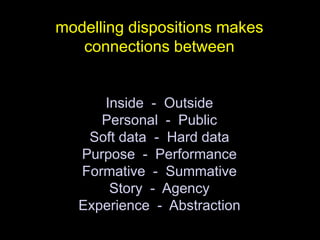
modelling dispositions makes
connections between
Inside - Outside
Personal - Public
Soft data - Hard data
Purpose - Performance
Formative - Summative
Story - Agency
Experience - Abstraction
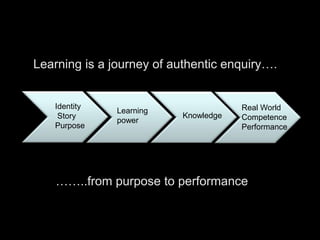
Knowledge
Real World
Competence
Performance
Learning
power
Identity
Story
Purpose
Learning is a journey of authentic enquiry….
……..from purpose to performance
A system that
depends on external
control is not
sustainable
To be sustainable a
school/person/system needs to
be critically self-aware and to
take responsibility for its own
purpose, learning and
performance
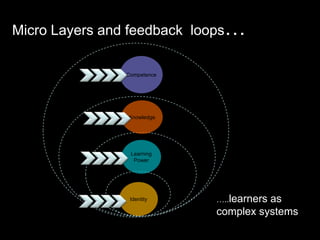
Micro Layers and feedback loops…
Competence
Knowledge
Learning
Power
Identity
Learninganalytics
…..learners as
complex systems
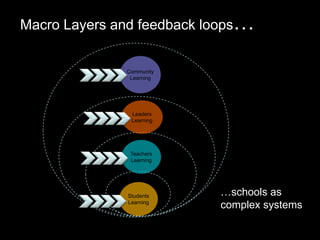
Macro Layers and feedback loops…
Community
Learning
Leaders
Learning
Teachers
Learning
Students
Learning
…schools as
complex systems
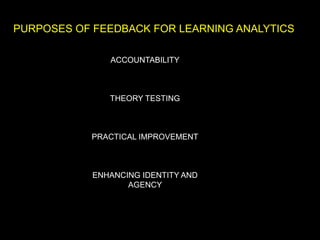
PURPOSES OF FEEDBACK FOR LEARNING ANALYTICS
ACCOUNTABILITY
THEORY TESTING
PRACTICAL IMPROVEMENT
ENHANCING IDENTITY AND
AGENCY

Dispositional Learning Analytics: Learning Power in Complex Systems

  • 1.
    Dispositional Learning Analytics LearningPower and Complex Systems Ruth Deakin Crick Simon Buckingham Shum 1
  • 2.
    The Story inOne Slide Learning dispositions and learning identities are key levers for sustainable learning in 21C conditions of uncertainty, risk and challenge Dispositions and identities are ‘soft’ variables which require formative assessment to stimulate self-directed change and responsible agency Dispositional analytics enables: •Rapid feedback of data at different levels in a system •Integration of process (soft) and performance data (hard) •Visualisation of complex, contextualised data for stimulating responsible agency and change Learning eco-systems are complex and unpredictable and cannot be sustained by external control: self directed learning is therefore crucial Learning is a core process at different levels in learning organisations
  • 6.
    6 learning dispositions matter "resilience isthe defining concept for the 21st century” John Seely Brown 2013
  • 7.
    Our focus ison malleable dispositions that are important for developing intentional learners, and which, critically, learners can recognise and develop in themselves
  • 8.
  • 9.
    Learning power empirically derived,complex mix of values, attitudes and dispositions which together are necessary for fuelling an individual’s engagement with new learning opportunities through identity formation and scaffolding Deakin Crick, R., Haigney, D., Huang S., Coburn, T. & Goldspink C., (2012) Learning Power in the Work Place: the Effective Lifelong Learning Inventory (ELLI) and its reliability and validity and implications for Learning and Development, International Journal of Human Resource Deakin Crick, R. (2007) Learning to learn: The dynamic assessment of learning power. Curriculum Journal,18,2, 135-153. Deakin Crick R., Broadfoot P. & Claxton G. (2004) Developing an Effective Lifelong Learning Inventory: The ELLI Project, Assessment in Education, 11, 3, 247 - 272.
  • 10.
    Seven Dimensions ofLearning Power Changing & Learning Meaning Making Critical Curiosity Creativity Learning Relationships Strategic Awareness Resilience Being Stuck & Static Data Accumulation Passivity Being Rule Bound Isolation & Dependence Being Robotic Fragility & Dependence
  • 11.
    learning power correlates withother success criteria (but it’s a complex relationship) 11
  • 12.
    Learning Power andother success indicators • Children report significantly lower levels of learning power on all dimensions as they go through school • Positive associations between teachers’ learner-centred practices, their beliefs about learning, students’ learning power, the level of organisational emotional literacy, and attainment by National Curriculum measures. • Distinctive patterns of learning power profiles for under-achieving students. • Learning power is positively associated with pro-social behaviour and negatively with violent behaviour Deakin Crick, R. & Ren, K. (2013) Empowering underachieving adolescents: an emancipatory learning perspective on underachievement, Pedagogies: An International Journal 8(3) Deakin Crick, R. & Yu, G. (2008) The Effective Lifelong Learning Inventory (ELLI): Is it valid and reliable as an assessment tool? Educational Research, 50,4, 387-402; Deakin Crick, R., McCombs, B., Haddon, A., (2007) The Ecology Of Learning: Factors Contributing To Learner Centred Classroom Cultures, Research Papers in Education, 22,3, 267-307
  • 13.
    ELLI: Effective LifelongLearning Inventory
  • 14.
    A framework fora coaching conversation which moves between identity and performance 14
  • 15.
    'learning is likea road…..you can get tow trucks that can help you 'I am a little bit rubbish' …..'sometimes I feel I hate being me and sometimes I love being me' Deakin Crick et al (2011) Learning Futures Report, London, Paul Hamlyn Foundation Stratified sampling….
  • 16.
    Cohort analytics for educatorsand organizational leaders 16
  • 17.
    making the invisiblevisible for the purpose of enhancing responsible agency
  • 18.
    18 Competence in the world Knowledgeskills & understanding Learning power values attitudes & dispositions Identity story, desire, motivation, rel ationships, purpose …learning is an emergent property…
  • 19.
    modelling dispositions makes connectionsbetween Inside - Outside Personal - Public Soft data - Hard data Purpose - Performance Formative - Summative Story - Agency Experience - Abstraction
  • 20.
    Knowledge Real World Competence Performance Learning power Identity Story Purpose Learning isa journey of authentic enquiry…. ……..from purpose to performance
  • 21.
    A system that dependson external control is not sustainable
  • 22.
    To be sustainablea school/person/system needs to be critically self-aware and to take responsibility for its own purpose, learning and performance
  • 23.
    Micro Layers andfeedback loops… Competence Knowledge Learning Power Identity Learninganalytics …..learners as complex systems
  • 25.
    Macro Layers andfeedback loops… Community Learning Leaders Learning Teachers Learning Students Learning …schools as complex systems
  • 26.
    PURPOSES OF FEEDBACKFOR LEARNING ANALYTICS ACCOUNTABILITY THEORY TESTING PRACTICAL IMPROVEMENT ENHANCING IDENTITY AND AGENCY

Editor's Notes

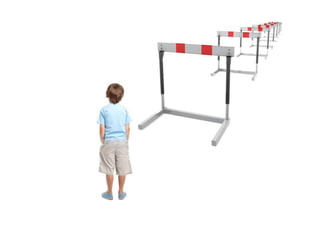
  • #4 Worst case scenario…this is the story of economic utility and progress ….from a child’s perspective….it’s contextless, sterile, a series of hurdles reaching into the future after which I get a job…and a good life…it really doesn’t work for generation x and y….
  • #5 The best teachers aim to ‘make it real’….but the road is still pre-determined…..learning to learn and engagement is still focused on performance…..within the dominant meta narrative
  • #13 We discussed earlier a cross sectional analysis demonstrating that the mean score on students learning power profiles gets significantly lower as students get older [35]. We have reported positive associations between teachers’ learner-centred practices, their beliefs about learning, students’ learning power, the level of organisational emotional literacy, and attainment by National Curriculum measures [50]. We have demonstrated distinctive patterns of learning power profiles for under-achieving students, and enhanced the findings with school based, qualitative measures and teacher professional judgment [36]. A two year study in 2009-11 with fifteen schools participating in the national Learning Futures programme, enabled an evaluation of the impact of learning power and enquiry-based learning pedagogies on student engagement [37, 47]. In 2011 a further analysis enabled the testing of ELLI with an adult sample (N=5762) and an analysis of the differences between age ranges in terms of the internal construction of learning power [51].Learning Futures programme: www.learningfutures.org
  • #16 Qualitative data analysis N= 360, stratified sample, from learning futures project.
  • #20 Why do dispositional analytics matter so much? Because they provide a language, a feedback loop and a framework which links purpose with performance.