

AN EXPLORATORY STUDY OF !
PARTICIPATORY LEARNING AND                              !
AUTHENTIC PEDAGOGY

Shaofu Huang

PhD student

Centre for Systems Learning and Leadership

Graduate School of Education, University of Bristol

shaofutw@gmail.com


                                      !1
Introduction

• The researcher


• The theoretical framework


• Research design and the data


• Preliminary findings


                     !2
Theoretical Framework


          !3
Authenticity

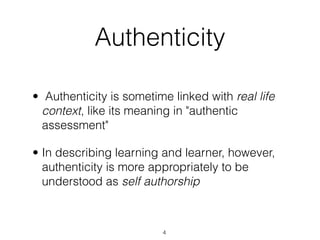
• Authenticity is sometime linked with real life
  context, like its meaning in "authentic
  assessment"


• In describing learning and learner, however,
  authenticity is more appropriately to be
  understood as self authorship


                        !4
Authenticity
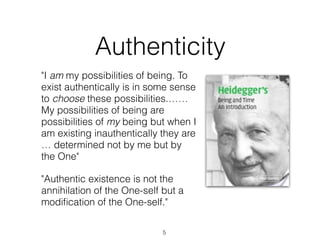
"I am my possibilities of being. To
exist authentically is in some sense
to choose these possibilities.……
My possibilities of being are
possibilities of my being but when I
am existing inauthentically they are
… determined not by me but by
the One"


"Authentic existence is not the
annihilation of the One-self but a
modification of the One-self."

                           !5
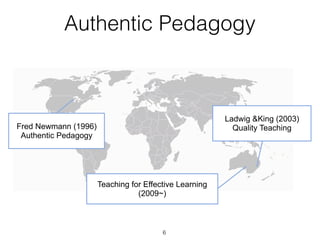
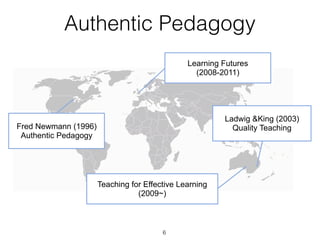
Authentic Pedagogy
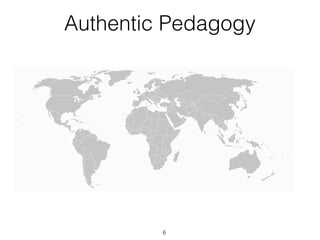
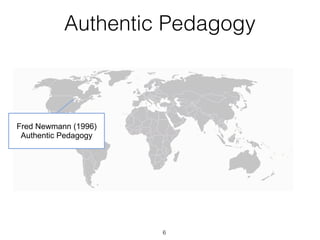
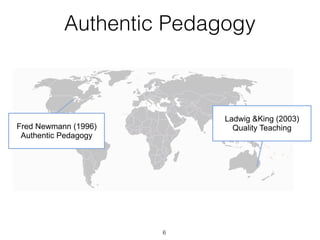
                                              Learning Futures !
                                                (2008-2011)!
                                                   England


                                                        Ladwig &King (2003)
Fred Newmann (1996)!                                      Quality Teaching!
 Authentic Pedagogy!                                         New South Wales
      Wisconsin


                   Teaching for Effective Learning!
                              (2009~)!
                            South Australia


                                     !6
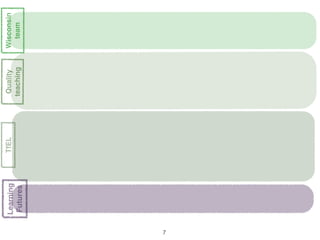
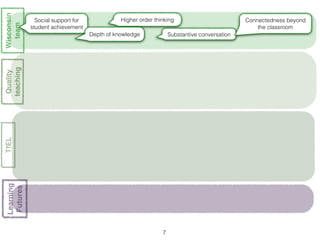
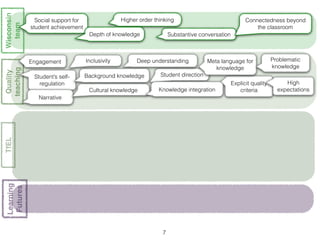
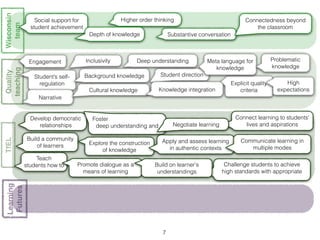
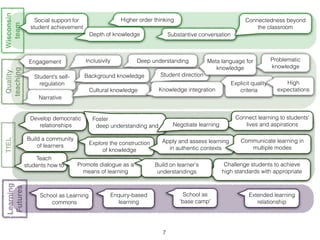
Wisconsin
  team          Social support for                 Higher order thinking                                   Connectedness beyond
              student achievement                                                                              the classroom
                                       Depth of knowledge                 Substantive conversation


             Engagement              Inclusivity         Deep understanding              Meta language for              Problematic
                                                                                            knowledge                   knowledge
teaching
 Quality


               Student’s self-       Background knowledge           Student direction
                 regulation                                                                          Explicit quality        High
                                       Cultural knowledge          Knowledge integration                criteria          expectations
                 Narrative


              Develop democratic                                                                       Connect learning to students'
                                        Foster deep understanding
                 relationships                                              Negotiate learning            lives and aspirations
                                             and skillful action
             Build a community
TfEL


                                       Explore the construction         Apply and assess learning        Communicate learning in
                 of learners                                              in authentic contexts             multiple modes
                                            of knowledge
                Teach
            students how to      Promote dialogue as a            Build on learner's         Challenge students to achieve high
                                   means of learning               understandings            standards with appropriate support
 Learning
 Futures


                  School as Learning           Enquiry-based                    School as                   Extended learning
                      commons                    learning                     'base camp'                      relationship


                                                                   !7
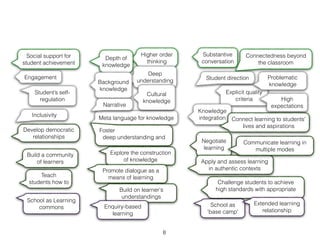
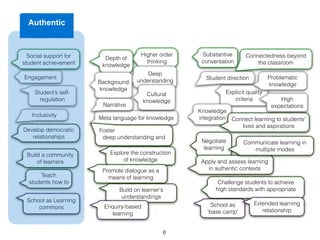
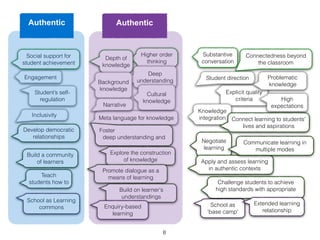
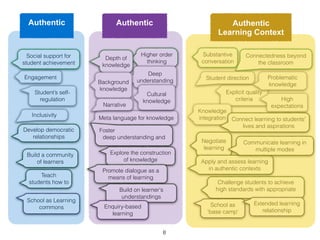
Authentic                  Authentic                          Authentic!
   Learner                  Knowledge                        Learning Context


  Social support for                   Higher order    Substantive      Connectedness beyond
                         Depth of
student achievement                      thinking      conversation         the classroom
                        knowledge
                                         Deep
Engagement                                               Student direction         Problematic
                       Background    understanding
                                                                                   knowledge
                       knowledge
    Student’s self-                       Cultural              Explicit quality
      regulation                         knowledge                 criteria            High
                        Narrative                                                   expectations
                                                      Knowledge
   Inclusivity
                       Meta language for knowledge    integration Connect learning to students'
                                                                     lives and aspirations
Develop democratic     Foster deep understanding
   relationships            and skillful action        Negotiate       Communicate learning in
                                                        learning          multiple modes
 Build a community         Explore the construction
     of learners                of knowledge           Apply and assess learning
                        Promote dialogue as a            in authentic contexts
      Teach               means of learning
  students how to                                          Challenge students to achieve high
                              Build on learner's           standards with appropriate support
                               understandings
 School as Learning
                                                           School as         Extended learning
     commons             Enquiry-based
                                                         'base camp'            relationship
                           learning


                                              !8
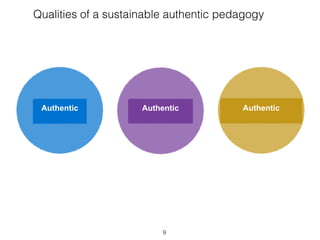
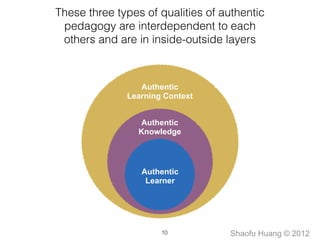
These three types of qualities of authentic
 pedagogy are interdependent to each
 others and are in inside-outside layers


                 Authentic!
              Learning Context


                  Authentic
                 Knowledge


                 Authentic
                  Learner


                     !9            Shaofu Huang © 2012
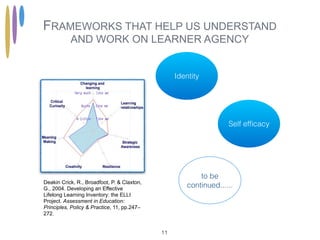
FRAMEWORKS THAT HELP US UNDERSTAND
          AND WORK ON LEARNER AGENCY


                                                   Identity


                                                                    Self efficacy


                                                           to be
Deakin Crick, R., Broadfoot, P. & Claxton,
G., 2004. Developing an Effective                      continued......
Lifelong Learning Inventory: the ELLI
Project. Assessment in Education:
Principles, Policy & Practice, 11, pp.247–
272.!


                                             !10
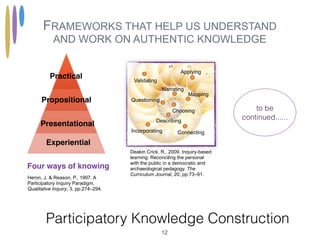
FRAMEWORKS THAT HELP US UNDERSTAND AND
  WORK ON AUTHENTIC KNOWLEDGE CONSTRUCTION


                                                               Applying
          Practical                        Validating
                                                        Narrating
                                                                    Mapping
      Propositional                       Questioning

                                                            Choosing              to be
                                                     Describing               continued......
      Presentational
                                          Incorporating       Connecting

        Experiential
                                          Deakin Crick, R., 2009. Inquiry-
                                          based learning: Reconciling the
                                          personal with the public in a
Four ways of knowing                      democratic and archaeological
                                          pedagogy. The Curriculum Journal,
Heron, J. & Reason, P., 1997. A           20, pp.73–91. !
Participatory Inquiry Paradigm.
Qualitative Inquiry, 3, pp.274–294.   !


        Participatory Knowledge Construction
                                                     !11
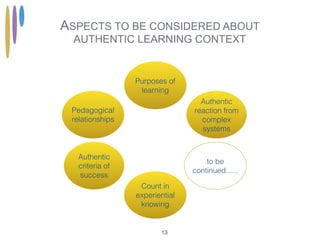
ASPECTS TO BE CONSIDERED ABOUT
  AUTHENTIC LEARNING CONTEXT


                 Purposes of
                  learning
                                  Authentic
 Pedagogical                    reaction from
 relationships                    complex
                                  systems


  Authentic
                                    to be
  criteria of
                                continued......
  success
                  Count in
                 experiential
                  knowing


                       !12
Research Design and the Data


            !13
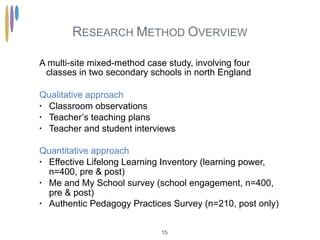
RESEARCH METHOD OVERVIEW

A multi-site mixed-method case study, involving four
 classes in two secondary schools in north England!
!
Qualitative approach!
• Classroom observations!
• Teacher’s teaching plans!
• Teacher and student interviews!
!
Quantitative approach!
• Effective Lifelong Learning Inventory (learning power,
  n=400, pre & post)!
• Me and My School survey (school engagement, n=400,
  pre & post)!
• Authentic Pedagogy Practices Survey (n=210, post only)!


                            !14
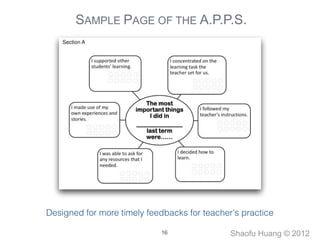
SAMPLE PAGE OF THE A.P.P.S. QUESTIONNAIRE


 Designed for more timely feedbacks for teacher's practice

                            !15                Shaofu Huang © 2012
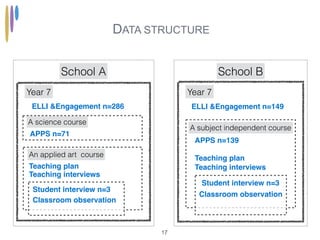
DATA STRUCTURE


         School A                            School B
Year 7                              Year 7
 ELLI &Engagement n=286              ELLI &Engagement n=149

A science course
                                    A subject independent course
APPS n=71
                                     APPS n=139
An applied art course                Teaching plan
Teaching plan                        Teaching interviews
Teaching interviews
                                       Student interview n=3
 Student interview n=3
                                      Classroom observation
 Classroom observation


                              !16
Preliminary Findings


        !17
TWO EXAMPLES OF AUTHENTIC PEDAGOGY
   IDENTIFIED FROM OBSERVATIONS

  Scenario A                                  Scenario B

• Learning was structured well and            • Learning started with an situation
  introducing up-to-date knowledge              designed by teachers!
  and technology!
                                              • Each student enquired into a
• Students planned and learned about            relevant topic chosen by him/
  a given topic.!                               herself!

• Had regular reflection time using           • Had lessons about learning power
  meta-language for learning!                   and transactional analysis!
• Assessment criteria was made                • Students designed and
  explicit from the beginning and               demonstrated their achievement to
  throughout.!                                  people outside of class/school!
• Students were invited to vote on            • Learning processes flowed with
  other’s work according to the given           student-teacher interactions
  criteria
                                        !18
FEATURES SHARED BY BOTH SCHOOLS!
        REVEALED FROM THE APPS

• Teacher-led and classroom-based learning aiming
  at deep understanding. 


• High expectation expressed and learner’s active
  role recognised.


• Long-term and application-oriented purposes of
  learning were less explored. 


• External resources, e.g., experts and stakeholders
  of the learning subjects, were limitedly exploited.

                          !19
VARIATIONS FOUND IN EACH SCHOOL

 School A                         School B

teacher’s instruction and         the prescribed criteria
prescribed assessment             were considered less
criteria both played              important while learners
important roles and there         were encouraged to
was a strong problem-             make decisions for their
solving orientation.              learning and family and
                                  community were more
                                  recognisable as learning
                                  resources.


                            !20
SIGNIFICANT DIFFERENCES FOUND IN !
     12 APPS ITEMS BETWEEN SCHOOLS

School A valued more on:

• I followed my teacher's instructions. (item 2)!

• I had a good understanding of what I was expected to do. (item 10)!

• I focused on the assessment criteria to get a good grade. (item 11)!

• Other students. (item 17)!

• My class teacher or tutor. (Item 18)


                                  !21
SIGNIFICANT DIFFERENCES FOUND IN !
    12 APPS ITEMS BETWEEN SCHOOLS

School B valued more on:

• I helped my teacher to understand what I was learning. (item 8)!

• I chose the topic that I was going to learn about. (item 12)!

• People outside my school who were involved in things I was learning
  about. (item 13)!

• Members of my family or other people in my community. (item 16)!

• To discover stories about what I was learning. (item 24)!

• To explain what I learned in my own words. (item 27)!

• Because it has prepared me for the next stage in my learning. (item 31)

                                     !22
WHAT’S WORLD VIEWS OF A SCHOOL
  REVEALED IN THIS QUESTIONNAIRE?

Expert-led model         Participatory model


                   !23           Shaofu Huang © 2012
AN AUTHENTIC LEARNING SCALE WAS
        FORMED WITH 25 APPS ITEMS

     sample items                                      sample reverse items

• I made use of my own experiences and             • I concentrated on the learning task the teacher set
  stories.!                                          for us.!

• I helped my teacher to understand what I         • I followed my teacher's instructions.!
  was learning.!
                                                   • I had a good understanding of what I was
• I chose the topic that I was going to learn        expected to do.!
  about.!
                                                   • I focused on the assessment criteria to get a good
• Members of my family or other people in my         grade.!
  community are important in my learning.!
                                                   • Other students are important in my learning.!
• To find out why things I was learning matter
  to me in my life.!                               • My class teacher or tutor is important in my
                                                     learning.!
• It has prepared me for the next stage in my
  learning.!                                       • To remember all the facts and information.!

• It helped me make changes in places that         • To finish my end product to a high standard.
  matter to me.


                                                 !24                          Shaofu Huang © 2012
THE AUTHENTIC LEARNING SCALE (A.L.S.)

     As an indicator of personal perception:


     • about 9% of A.L.S. was explained by ethnicity that white
       students perceived more authenticity


     As an indicator of classroom pedagogy:


     • about 20% was explained by percentage of white students in
       the class (more white students, less authenticity) *Note that being
       white was strongly linked with lower school engagement


     • about 12% was explained by percentage of female students
       (more girls, more authenticity)

These are rather observations than predictions, because of the small sample size
                                       !25
A.L.S. AND SCHOOL ENGAGEMENT
    Class mean of the perceived authenticity (A.L.S.) in a single
    course (four periods per week) also had slight but positive
    effect on the following scales regarding participant's overall
    experience in the school:


    • changing and learning


    • meaning making


    • school engagement (MMS)


    • engagement with learning beyond the school (LF)


These are rather observations than predictions, because of the small sample size
                                       !26
These are rather observations than predictions, because of the small sample size
                                       !27
These are rather observations than predictions, because of the small sample size
                                       !28
FURTHER ANALYSIS ON A.P.P.S. DATA

• To further examine the interwoven
  relationships between ALS, engagement,
  gender and ethnicity. (using structural
  equation modelling


• To explore in more detail about the
  constitution of ALS (and adjust the scale or
  items if that is useful)


                       !29

Authentic pedagogy and participatory learning - a research in progress

  • 1.
    AN EXPLORATORY STUDYOF ! PARTICIPATORY LEARNING AND ! AUTHENTIC PEDAGOGY Shaofu Huang PhD student Centre for Systems Learning and Leadership Graduate School of Education, University of Bristol shaofutw@gmail.com !1
  • 2.
    Introduction • The researcher •The theoretical framework • Research design and the data • Preliminary findings !2
  • 3.
  • 4.
    Authenticity • Authenticity issometime linked with real life context, like its meaning in "authentic assessment" • In describing learning and learner, however, authenticity is more appropriately to be understood as self authorship !4
  • 5.
    Authenticity "I am mypossibilities of being. To exist authentically is in some sense to choose these possibilities.…… My possibilities of being are possibilities of my being but when I am existing inauthentically they are … determined not by me but by the One" "Authentic existence is not the annihilation of the One-self but a modification of the One-self." !5
  • 6.
    Authentic Pedagogy Learning Futures ! (2008-2011)! England Ladwig &King (2003) Fred Newmann (1996)! Quality Teaching! Authentic Pedagogy! New South Wales Wisconsin Teaching for Effective Learning! (2009~)! South Australia !6
  • 7.
    Wisconsin team Social support for Higher order thinking Connectedness beyond student achievement the classroom Depth of knowledge Substantive conversation Engagement Inclusivity Deep understanding Meta language for Problematic knowledge knowledge teaching Quality Student’s self- Background knowledge Student direction regulation Explicit quality High Cultural knowledge Knowledge integration criteria expectations Narrative Develop democratic Connect learning to students' Foster deep understanding relationships Negotiate learning lives and aspirations and skillful action Build a community TfEL Explore the construction Apply and assess learning Communicate learning in of learners in authentic contexts multiple modes of knowledge Teach students how to Promote dialogue as a Build on learner's Challenge students to achieve high means of learning understandings standards with appropriate support Learning Futures School as Learning Enquiry-based School as Extended learning commons learning 'base camp' relationship !7
  • 8.
    Authentic Authentic Authentic! Learner Knowledge Learning Context Social support for Higher order Substantive Connectedness beyond Depth of student achievement thinking conversation the classroom knowledge Deep Engagement Student direction Problematic Background understanding knowledge knowledge Student’s self- Cultural Explicit quality regulation knowledge criteria High Narrative expectations Knowledge Inclusivity Meta language for knowledge integration Connect learning to students' lives and aspirations Develop democratic Foster deep understanding relationships and skillful action Negotiate Communicate learning in learning multiple modes Build a community Explore the construction of learners of knowledge Apply and assess learning Promote dialogue as a in authentic contexts Teach means of learning students how to Challenge students to achieve high Build on learner's standards with appropriate support understandings School as Learning School as Extended learning commons Enquiry-based 'base camp' relationship learning !8
  • 9.
    These three typesof qualities of authentic pedagogy are interdependent to each others and are in inside-outside layers Authentic! Learning Context Authentic Knowledge Authentic Learner !9 Shaofu Huang © 2012
  • 10.
    FRAMEWORKS THAT HELPUS UNDERSTAND AND WORK ON LEARNER AGENCY Identity Self efficacy to be Deakin Crick, R., Broadfoot, P. & Claxton, G., 2004. Developing an Effective continued...... Lifelong Learning Inventory: the ELLI Project. Assessment in Education: Principles, Policy & Practice, 11, pp.247– 272.! !10
  • 11.
    FRAMEWORKS THAT HELPUS UNDERSTAND AND WORK ON AUTHENTIC KNOWLEDGE CONSTRUCTION Applying Practical Validating Narrating Mapping Propositional Questioning Choosing to be Describing continued...... Presentational Incorporating Connecting Experiential Deakin Crick, R., 2009. Inquiry- based learning: Reconciling the personal with the public in a Four ways of knowing democratic and archaeological pedagogy. The Curriculum Journal, Heron, J. & Reason, P., 1997. A 20, pp.73–91. ! Participatory Inquiry Paradigm. Qualitative Inquiry, 3, pp.274–294. ! Participatory Knowledge Construction !11
  • 12.
    ASPECTS TO BECONSIDERED ABOUT AUTHENTIC LEARNING CONTEXT Purposes of learning Authentic Pedagogical reaction from relationships complex systems Authentic to be criteria of continued...... success Count in experiential knowing !12
  • 13.
    Research Design andthe Data !13
  • 14.
    RESEARCH METHOD OVERVIEW Amulti-site mixed-method case study, involving four classes in two secondary schools in north England! ! Qualitative approach! • Classroom observations! • Teacher’s teaching plans! • Teacher and student interviews! ! Quantitative approach! • Effective Lifelong Learning Inventory (learning power, n=400, pre & post)! • Me and My School survey (school engagement, n=400, pre & post)! • Authentic Pedagogy Practices Survey (n=210, post only)! !14
  • 15.
    SAMPLE PAGE OFTHE A.P.P.S. QUESTIONNAIRE Designed for more timely feedbacks for teacher's practice !15 Shaofu Huang © 2012
  • 16.
    DATA STRUCTURE School A School B Year 7 Year 7 ELLI &Engagement n=286 ELLI &Engagement n=149 A science course A subject independent course APPS n=71 APPS n=139 An applied art course Teaching plan Teaching plan Teaching interviews Teaching interviews Student interview n=3 Student interview n=3 Classroom observation Classroom observation !16
  • 17.
  • 18.
    TWO EXAMPLES OFAUTHENTIC PEDAGOGY IDENTIFIED FROM OBSERVATIONS Scenario A Scenario B • Learning was structured well and • Learning started with an situation introducing up-to-date knowledge designed by teachers! and technology! • Each student enquired into a • Students planned and learned about relevant topic chosen by him/ a given topic.! herself! • Had regular reflection time using • Had lessons about learning power meta-language for learning! and transactional analysis! • Assessment criteria was made • Students designed and explicit from the beginning and demonstrated their achievement to throughout.! people outside of class/school! • Students were invited to vote on • Learning processes flowed with other’s work according to the given student-teacher interactions criteria !18
  • 19.
    FEATURES SHARED BYBOTH SCHOOLS! REVEALED FROM THE APPS • Teacher-led and classroom-based learning aiming at deep understanding. • High expectation expressed and learner’s active role recognised. • Long-term and application-oriented purposes of learning were less explored. • External resources, e.g., experts and stakeholders of the learning subjects, were limitedly exploited. !19
  • 20.
    VARIATIONS FOUND INEACH SCHOOL School A School B teacher’s instruction and the prescribed criteria prescribed assessment were considered less criteria both played important while learners important roles and there were encouraged to was a strong problem- make decisions for their solving orientation. learning and family and community were more recognisable as learning resources. !20
  • 21.
    SIGNIFICANT DIFFERENCES FOUNDIN ! 12 APPS ITEMS BETWEEN SCHOOLS School A valued more on: • I followed my teacher's instructions. (item 2)! • I had a good understanding of what I was expected to do. (item 10)! • I focused on the assessment criteria to get a good grade. (item 11)! • Other students. (item 17)! • My class teacher or tutor. (Item 18) !21
  • 22.
    SIGNIFICANT DIFFERENCES FOUNDIN ! 12 APPS ITEMS BETWEEN SCHOOLS School B valued more on: • I helped my teacher to understand what I was learning. (item 8)! • I chose the topic that I was going to learn about. (item 12)! • People outside my school who were involved in things I was learning about. (item 13)! • Members of my family or other people in my community. (item 16)! • To discover stories about what I was learning. (item 24)! • To explain what I learned in my own words. (item 27)! • Because it has prepared me for the next stage in my learning. (item 31) !22
  • 23.
    WHAT’S WORLD VIEWSOF A SCHOOL REVEALED IN THIS QUESTIONNAIRE? Expert-led model Participatory model !23 Shaofu Huang © 2012
  • 24.
    AN AUTHENTIC LEARNINGSCALE WAS FORMED WITH 25 APPS ITEMS sample items sample reverse items • I made use of my own experiences and • I concentrated on the learning task the teacher set stories.! for us.! • I helped my teacher to understand what I • I followed my teacher's instructions.! was learning.! • I had a good understanding of what I was • I chose the topic that I was going to learn expected to do.! about.! • I focused on the assessment criteria to get a good • Members of my family or other people in my grade.! community are important in my learning.! • Other students are important in my learning.! • To find out why things I was learning matter to me in my life.! • My class teacher or tutor is important in my learning.! • It has prepared me for the next stage in my learning.! • To remember all the facts and information.! • It helped me make changes in places that • To finish my end product to a high standard. matter to me. !24 Shaofu Huang © 2012
  • 25.
    THE AUTHENTIC LEARNINGSCALE (A.L.S.) As an indicator of personal perception: • about 9% of A.L.S. was explained by ethnicity that white students perceived more authenticity As an indicator of classroom pedagogy: • about 20% was explained by percentage of white students in the class (more white students, less authenticity) *Note that being white was strongly linked with lower school engagement • about 12% was explained by percentage of female students (more girls, more authenticity) These are rather observations than predictions, because of the small sample size !25
  • 26.
    A.L.S. AND SCHOOLENGAGEMENT Class mean of the perceived authenticity (A.L.S.) in a single course (four periods per week) also had slight but positive effect on the following scales regarding participant's overall experience in the school: • changing and learning • meaning making • school engagement (MMS) • engagement with learning beyond the school (LF) These are rather observations than predictions, because of the small sample size !26
  • 27.
    These are ratherobservations than predictions, because of the small sample size !27
  • 28.
    These are ratherobservations than predictions, because of the small sample size !28
  • 29.
    FURTHER ANALYSIS ONA.P.P.S. DATA • To further examine the interwoven relationships between ALS, engagement, gender and ethnicity. (using structural equation modelling • To explore in more detail about the constitution of ALS (and adjust the scale or items if that is useful) !29

Editor's Notes

  • #2 \n\n
  • #3 \n\n
  • #4 \n\n
  • #5 \n\n
  • #6 \n\n
  • #7 Surely there is a question about why we need authentic pedagogy. But it can not be achieved with today’s 20 minute presentation.\n\nBelow are references related to research or initiatives mentioned in this slide:\n\nLadwig, J. G., & King, M. B. (2003). Quality teaching in NSW public schools: An annotated bibliography: NSW Department of Education and Training.\n\nNewmann, F. M., Marks, H. M., & Gamoran, A. (1996). Authentic Pedagogy and Student Performance. American Journal of Education, 104, 280-312. \n\nTeaching for Effective Learning framework can be found at: http://www.learningtolearn.sa.edu.au/core_learning/files/links/TfEL_Framework_horizontal.pdf\n\nResources of Learning Futures initiatives can be found at:\nhttp://www.innovationunit.org/our-services/projects/learning-futures-increasing-meaningful-student-engagement\n
  • #8 Surely there is a question about why we need authentic pedagogy. But it can not be achieved with today’s 20 minute presentation.\n\nBelow are references related to research or initiatives mentioned in this slide:\n\nLadwig, J. G., & King, M. B. (2003). Quality teaching in NSW public schools: An annotated bibliography: NSW Department of Education and Training.\n\nNewmann, F. M., Marks, H. M., & Gamoran, A. (1996). Authentic Pedagogy and Student Performance. American Journal of Education, 104, 280-312. \n\nTeaching for Effective Learning framework can be found at: http://www.learningtolearn.sa.edu.au/core_learning/files/links/TfEL_Framework_horizontal.pdf\n\nResources of Learning Futures initiatives can be found at:\nhttp://www.innovationunit.org/our-services/projects/learning-futures-increasing-meaningful-student-engagement\n
  • #9 Surely there is a question about why we need authentic pedagogy. But it can not be achieved with today’s 20 minute presentation.\n\nBelow are references related to research or initiatives mentioned in this slide:\n\nLadwig, J. G., & King, M. B. (2003). Quality teaching in NSW public schools: An annotated bibliography: NSW Department of Education and Training.\n\nNewmann, F. M., Marks, H. M., & Gamoran, A. (1996). Authentic Pedagogy and Student Performance. American Journal of Education, 104, 280-312. \n\nTeaching for Effective Learning framework can be found at: http://www.learningtolearn.sa.edu.au/core_learning/files/links/TfEL_Framework_horizontal.pdf\n\nResources of Learning Futures initiatives can be found at:\nhttp://www.innovationunit.org/our-services/projects/learning-futures-increasing-meaningful-student-engagement\n
  • #10 Surely there is a question about why we need authentic pedagogy. But it can not be achieved with today’s 20 minute presentation.\n\nBelow are references related to research or initiatives mentioned in this slide:\n\nLadwig, J. G., & King, M. B. (2003). Quality teaching in NSW public schools: An annotated bibliography: NSW Department of Education and Training.\n\nNewmann, F. M., Marks, H. M., & Gamoran, A. (1996). Authentic Pedagogy and Student Performance. American Journal of Education, 104, 280-312. \n\nTeaching for Effective Learning framework can be found at: http://www.learningtolearn.sa.edu.au/core_learning/files/links/TfEL_Framework_horizontal.pdf\n\nResources of Learning Futures initiatives can be found at:\nhttp://www.innovationunit.org/our-services/projects/learning-futures-increasing-meaningful-student-engagement\n
  • #11 \n\n
  • #12 \n\n
  • #13 \n\n
  • #14 \n\n
  • #15 \n\n
  • #16 \n\n
  • #17 \n\n
  • #18 \n\n
  • #19 \n\n
  • #20 \n\n
  • #21 \n\n
  • #22 \n\n
  • #23 \n\n
  • #24 \n\n
  • #25 \n\n
  • #26 \n\n
  • #27 \n\n
  • #28 \n\n
  • #29 \n\n
  • #30 \n\n
  • #31 \n\n
  • #32 \n\n
  • #33 \n\n
  • #34 \n\n
  • #35 \n\n
  • #36 \n\n
  • #37 \n\n
  • #38 \n\n
  • #39 \n\n
  • #40 \n\n
  • #41 \n\n
  • #42 \n\n
  • #43 \n\n
  • #44 \n\n
  • #45 \n\n
  • #46 \n\n
  • #47 \n\n
  • #48 \n\n
  • #49 \n\n
  • #50 \n\n
  • #51 \n\n
  • #52 \n\n
  • #53 \n\n
  • #54 \n\n
  • #55 \n\n
  • #56 \n\n
  • #57 \n\n
  • #58 \n\n
  • #59 \n\n
  • #60 \n\n
  • #61 \n\n
  • #62 \n\n
  • #63 \n\n
  • #64 \n\n
  • #65 \n\n
  • #66 \n\n
  • #67 \n\n
  • #68 \n\n
  • #69 \n\n
  • #70 \n\n
  • #71 \n\n
  • #72 \n\n
  • #73 \n\n
  • #74 \n\n
  • #75 \n\n
  • #76 \n\n
  • #77 \n\n
  • #78 \n\n
  • #79 \n\n
  • #80 \n\n
  • #81 \n\n
  • #82 \n\n
  • #83 \n\n
  • #84 \n\n
  • #85 \n\n
  • #86 \n\n
  • #87 \n\n
  • #88 \n\n
  • #89 \n\n
  • #90 \n\n
  • #91 \n\n
  • #92 \n\n
  • #93 \n\n
  • #94 \n\n
  • #95 \n\n