Surface to Deep
Through Learner Agency
derek.wenmoth@core-ed.org
@dwenmoth #learneragency
http://www.wenmoth.net
Outline
• Motivation, engagement and voice
• Understanding Learner Agency
• Universal design for learning
• Agency and deep learning
What motivates you?
• My interests and goals?
• What others expect of me?
• What others think of me?
• What I can do for others?
• The things I desire?
• …?
Photo by Clique Images on Unsplash
What keeps you engaged?
• Support?
• Feedback?
• Feeling like I’m achieving?
• Being a part of something?
• The long-term vision?
• …?
Photo by Thomas Q on Unsplash
Shifting the ownership of learning…
To be learner-centered
means to start with the
learner, prioritizing their
voice throughout the
learning process.
RANDY ZIEGENFUSS AND LYNN FUINI-HETTEN
SUPERINTENDENT AND ASSOCIATE SUPERINTENDENT
SALISBURY TOWNSHIP SCHOOL DISTRICT
Photo by Anita Jankovic on Unsplash
The Agentic Triangle
Engagement
Motivation
(have a stake)
Voice
Choice,
control,
challenge,
collaboration
● One of the most powerful tools available to
influence academic achievement is helping
students feel they have a stake in their
learning.
● To feel motivated to do something and become
engaged in its activity, youth (like adults)
generally need to feel they have a voice in how
it is conducted and an impact on how it
concludes.
● Time and again, research has shown that the
more educators give their students choice,
control, challenge, and opportunities for
collaboration, the more their motivation and
engagement are likely to rise.
Students at the Centre: https://bit.ly/2tUOyJT
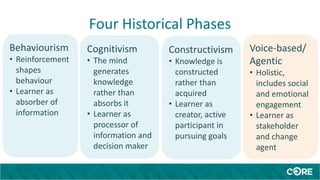
Four Historical Phases
Behaviourism
• Reinforcement
shapes
behaviour
• Learner as
absorber of
information
Cognitivism
• The mind
generates
knowledge
rather than
absorbs it
• Learner as
processor of
information and
decision maker
Constructivism
• Knowledge is
constructed
rather than
acquired
• Learner as
creator, active
participant in
pursuing goals
Voice-based/
Agentic
• Holistic,
includes social
and emotional
engagement
• Learner as
stakeholder
and change
agent
https://bit.ly/2JpXu5c
The Big Questions:
● What do you do in your design for learning to ensure your learners
have the motivation to be learners? That they feel they have a stake
in their learning.
● To feel motivated to do something and become engaged in its
activity, youth (like adults) generally need to feel they have a voice in
how it is conducted and an impact on how it concludes.
● Time and again, research has shown that the more educators give
their students choice, control, challenge, and opportunities for
collaboration, the more their motivation and engagement are likely
to rise.
What is agency?
• Rose Colby @rose_rosecolby
"To me, agency is beyond choice and voice. It is more about a kid making decisions--develops over time to
independence."
• Charity Dodd @Charity Dodd
"Ownership and independence leads to confidence for learners to set goals and take steps towards reaching
their goals. "
• Chris Quinn @ChrisQuinn64
"Learners see themselves as capable, empowered learners with limitless possibilities for growth and learning."
• Derek Doucet @DerekDoucet
"If learners don't own their learning it's just something they do to avoid consequences but when they own it,
they learn to learn."
• Mike Mohammad @Mo_physics
"agency = I can make choices and act on these choices to make difference in my life" from a student reflection.”
• Jobs for the Future @jfftweets
"Learner Agency is the initiative and capacity to act in a way that produces meaningful change in oneself or the
environment.”
• Jason Ellingson @jasonellingson
"Learning should be FOR them, not TO them.”
#plearnchat and #plrnchat
"Learner Agency often gets missed in
conversations on transforming the
educational system. We have a sense of
‘agency’ when we feel in control of things
that happen around us; when we feel that
we can influence events.
Learners must develop the capacity to
engage strategically in their learning
without waiting to be directed.”
Dr. James Rickabaugh
Director of the Institute for Personalized Learning
https://amzn.to/2JqtDcS
Agency & responsibility
● To be agentic means to have choices
and be able to act on those choices.
● It also means having to accept the
responsibility that comes with those
choices
Photo by bady-qp on Unsplash
Agency & responsibility
Photo by pan xiaozhen on Unsplash Photo by Rachel on Unsplash Photo by Annie Spratt on Unsplash
Responsible for self:
- Self management
- Self directedness
- Wellbeing/resilience
Responsible for the
environment:
- Sustainability
- Cybersafety
Responsible for others:
- Empathy
- Team
- Collaboration
“Sustained higher achievement is
possible when teachers use
approaches that enable students to
take charge of their own learning. Such
approaches do not leave the students
to “discover” in an unstructured
environment. Rather, they are highly
structured in supporting student
agency and sustained and thoughtful
engagement.”
Alton-Lee, A (2003) Quality teaching for diverse students
in schooling; Best Evidence Synthesis
https://www.educationcounts.govt.nz/publications/series/2515
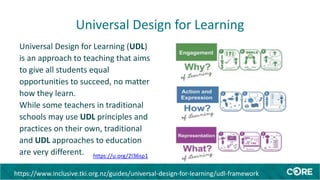
Universal Design for Learning
Universal Design for Learning (UDL)
is an approach to teaching that aims
to give all students equal
opportunities to succeed, no matter
how they learn.
While some teachers in traditional
schools may use UDL principles and
practices on their own, traditional
and UDL approaches to education
are very different. https://u.org/2I36sp1
https://www.inclusive.tki.org.nz/guides/universal-design-for-learning/udl-framework
Shifting Practice
How What
Where
Who
with
http://npdl.global
New Pedagogies
● Do the teaching strategies you use
enable learners to exercise choice in
their approach to what they learn,
how they learn, where they learn
and who they learn with?
● How might you use the UDL
framework as a means of achieving
this?
http://npdl.global
Leveraging Digital
● How are you using digital technologies
to enable personalized approaches to
learning?
● Specifically, how are they used with
respect to…
○ Engagement in learning?
○ Action and expression in learning?
○ Representation of learning?
http://npdl.global
Learning Partnerships
● Is working with others a natural part of
how your learners operate as they
learn?
● Who initiates these relationships?
● How are they used to promote more
personalized approaches?
● Are parents and whanau considered as
true partners, mentors, supporters in
their children’s learning? If so, how is
this manifested?
http://npdl.global
Learning Environments
● How are your learning spaces
organized to enable multiple ways of
engaging in learning?
● How do you organize access to these
spaces so that learners are able to use
them ‘freely’?
● To what extent is the virtual
environment used to enable
connections with like-minded peers or
experts?
http://npdl.global
Thank You
derek.wenmoth@core-ed.org
@dwenmoth
http://www.wenmoth.net

Surface to deep through learner agency

  • 1.
    Surface to Deep ThroughLearner Agency derek.wenmoth@core-ed.org @dwenmoth #learneragency http://www.wenmoth.net
  • 2.
    Outline • Motivation, engagementand voice • Understanding Learner Agency • Universal design for learning • Agency and deep learning
  • 4.
    What motivates you? •My interests and goals? • What others expect of me? • What others think of me? • What I can do for others? • The things I desire? • …? Photo by Clique Images on Unsplash
  • 5.
    What keeps youengaged? • Support? • Feedback? • Feeling like I’m achieving? • Being a part of something? • The long-term vision? • …? Photo by Thomas Q on Unsplash
  • 6.
    Shifting the ownershipof learning… To be learner-centered means to start with the learner, prioritizing their voice throughout the learning process. RANDY ZIEGENFUSS AND LYNN FUINI-HETTEN SUPERINTENDENT AND ASSOCIATE SUPERINTENDENT SALISBURY TOWNSHIP SCHOOL DISTRICT Photo by Anita Jankovic on Unsplash
  • 7.
    The Agentic Triangle Engagement Motivation (havea stake) Voice Choice, control, challenge, collaboration ● One of the most powerful tools available to influence academic achievement is helping students feel they have a stake in their learning. ● To feel motivated to do something and become engaged in its activity, youth (like adults) generally need to feel they have a voice in how it is conducted and an impact on how it concludes. ● Time and again, research has shown that the more educators give their students choice, control, challenge, and opportunities for collaboration, the more their motivation and engagement are likely to rise. Students at the Centre: https://bit.ly/2tUOyJT
  • 8.
    Four Historical Phases Behaviourism •Reinforcement shapes behaviour • Learner as absorber of information Cognitivism • The mind generates knowledge rather than absorbs it • Learner as processor of information and decision maker Constructivism • Knowledge is constructed rather than acquired • Learner as creator, active participant in pursuing goals Voice-based/ Agentic • Holistic, includes social and emotional engagement • Learner as stakeholder and change agent
  • 9.
  • 10.
    The Big Questions: ●What do you do in your design for learning to ensure your learners have the motivation to be learners? That they feel they have a stake in their learning. ● To feel motivated to do something and become engaged in its activity, youth (like adults) generally need to feel they have a voice in how it is conducted and an impact on how it concludes. ● Time and again, research has shown that the more educators give their students choice, control, challenge, and opportunities for collaboration, the more their motivation and engagement are likely to rise.
  • 11.
    What is agency? •Rose Colby @rose_rosecolby "To me, agency is beyond choice and voice. It is more about a kid making decisions--develops over time to independence." • Charity Dodd @Charity Dodd "Ownership and independence leads to confidence for learners to set goals and take steps towards reaching their goals. " • Chris Quinn @ChrisQuinn64 "Learners see themselves as capable, empowered learners with limitless possibilities for growth and learning." • Derek Doucet @DerekDoucet "If learners don't own their learning it's just something they do to avoid consequences but when they own it, they learn to learn." • Mike Mohammad @Mo_physics "agency = I can make choices and act on these choices to make difference in my life" from a student reflection.” • Jobs for the Future @jfftweets "Learner Agency is the initiative and capacity to act in a way that produces meaningful change in oneself or the environment.” • Jason Ellingson @jasonellingson "Learning should be FOR them, not TO them.” #plearnchat and #plrnchat
  • 12.
    "Learner Agency oftengets missed in conversations on transforming the educational system. We have a sense of ‘agency’ when we feel in control of things that happen around us; when we feel that we can influence events. Learners must develop the capacity to engage strategically in their learning without waiting to be directed.” Dr. James Rickabaugh Director of the Institute for Personalized Learning https://amzn.to/2JqtDcS
  • 13.
    Agency & responsibility ●To be agentic means to have choices and be able to act on those choices. ● It also means having to accept the responsibility that comes with those choices Photo by bady-qp on Unsplash
  • 14.
    Agency & responsibility Photoby pan xiaozhen on Unsplash Photo by Rachel on Unsplash Photo by Annie Spratt on Unsplash Responsible for self: - Self management - Self directedness - Wellbeing/resilience Responsible for the environment: - Sustainability - Cybersafety Responsible for others: - Empathy - Team - Collaboration
  • 15.
    “Sustained higher achievementis possible when teachers use approaches that enable students to take charge of their own learning. Such approaches do not leave the students to “discover” in an unstructured environment. Rather, they are highly structured in supporting student agency and sustained and thoughtful engagement.” Alton-Lee, A (2003) Quality teaching for diverse students in schooling; Best Evidence Synthesis https://www.educationcounts.govt.nz/publications/series/2515
  • 16.
    Universal Design forLearning Universal Design for Learning (UDL) is an approach to teaching that aims to give all students equal opportunities to succeed, no matter how they learn. While some teachers in traditional schools may use UDL principles and practices on their own, traditional and UDL approaches to education are very different. https://u.org/2I36sp1 https://www.inclusive.tki.org.nz/guides/universal-design-for-learning/udl-framework
  • 17.
  • 18.
    New Pedagogies ● Dothe teaching strategies you use enable learners to exercise choice in their approach to what they learn, how they learn, where they learn and who they learn with? ● How might you use the UDL framework as a means of achieving this? http://npdl.global
  • 19.
    Leveraging Digital ● Howare you using digital technologies to enable personalized approaches to learning? ● Specifically, how are they used with respect to… ○ Engagement in learning? ○ Action and expression in learning? ○ Representation of learning? http://npdl.global
  • 20.
    Learning Partnerships ● Isworking with others a natural part of how your learners operate as they learn? ● Who initiates these relationships? ● How are they used to promote more personalized approaches? ● Are parents and whanau considered as true partners, mentors, supporters in their children’s learning? If so, how is this manifested? http://npdl.global
  • 21.
    Learning Environments ● Howare your learning spaces organized to enable multiple ways of engaging in learning? ● How do you organize access to these spaces so that learners are able to use them ‘freely’? ● To what extent is the virtual environment used to enable connections with like-minded peers or experts? http://npdl.global
  • 22.

Editor's Notes

  • #7 https://education-reimagined.org/shift-your-paradigm-what-does-learner-centered-leadership-look-like-part-3/
  • #9 Behaviourism – skinner, rogers, pavlov Cognitivism – Cagne, Bruner, Reigeluth (elaboration theory) Constructivism – Piagot, Dewey, Vugotsky,
  • #10 http://www.studentsatthecenter.org/sites/scl.dl-dev.com/files/field_attach_file/Exec_Toshalis%26Nakkula_032312.pdfbit
  • #17 Check out the comparison table on https://www.understood.org/en/learning-attention-issues/treatments-approaches/educational-strategies/the-difference-between-universal-design-for-learning-udl-and-traditional-education