Knowledge
Sharing
Better Practices
Experienced
Panel
Thurs, 15th Dec 2016, 12-1 PM, Sydney
Ways to participate:
• Q&A Box - comment, whinge & opinions
• Twitter Backchannel - @lrncafe #LearningTrends
LearningCafe Year End Webinar
Looking back at 2016.
What’s coming in 2017?
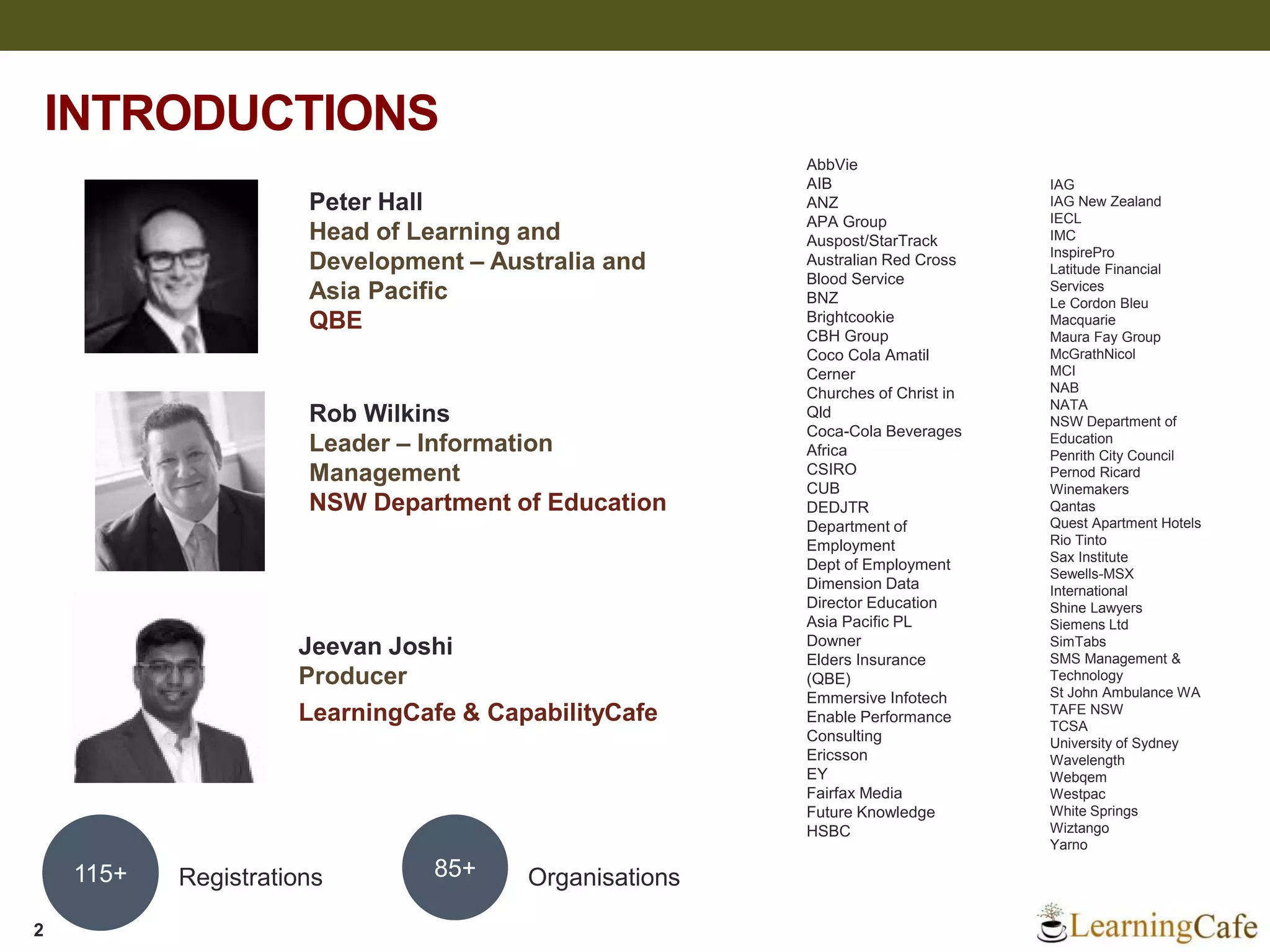
INTRODUCTIONS
Registrations115+
Peter Hall
Head of Learning and
Development – Australia and
Asia Pacific
QBE
Rob Wilkins
Leader – Information
Management
NSW Department of Education
85+ Organisations
2
Jeevan Joshi
Producer
LearningCafe & CapabilityCafe
AbbVie
AIB
ANZ
APA Group
Auspost/StarTrack
Australian Red Cross
Blood Service
BNZ
Brightcookie
CBH Group
Coco Cola Amatil
Cerner
Churches of Christ in
Qld
Coca-Cola Beverages
Africa
CSIRO
CUB
DEDJTR
Department of
Employment
Dept of Employment
Dimension Data
Director Education
Asia Pacific PL
Downer
Elders Insurance
(QBE)
Emmersive Infotech
Enable Performance
Consulting
Ericsson
EY
Fairfax Media
Future Knowledge
HSBC
IAG
IAG New Zealand
IECL
IMC
InspirePro
Latitude Financial
Services
Le Cordon Bleu
Macquarie
Maura Fay Group
McGrathNicol
MCI
NAB
NATA
NSW Department of
Education
Penrith City Council
Pernod Ricard
Winemakers
Qantas
Quest Apartment Hotels
Rio Tinto
Sax Institute
Sewells-MSX
International
Shine Lawyers
Siemens Ltd
SimTabs
SMS Management &
Technology
St John Ambulance WA
TAFE NSW
TCSA
University of Sydney
Wavelength
Webqem
Westpac
White Springs
Wiztango
Yarno
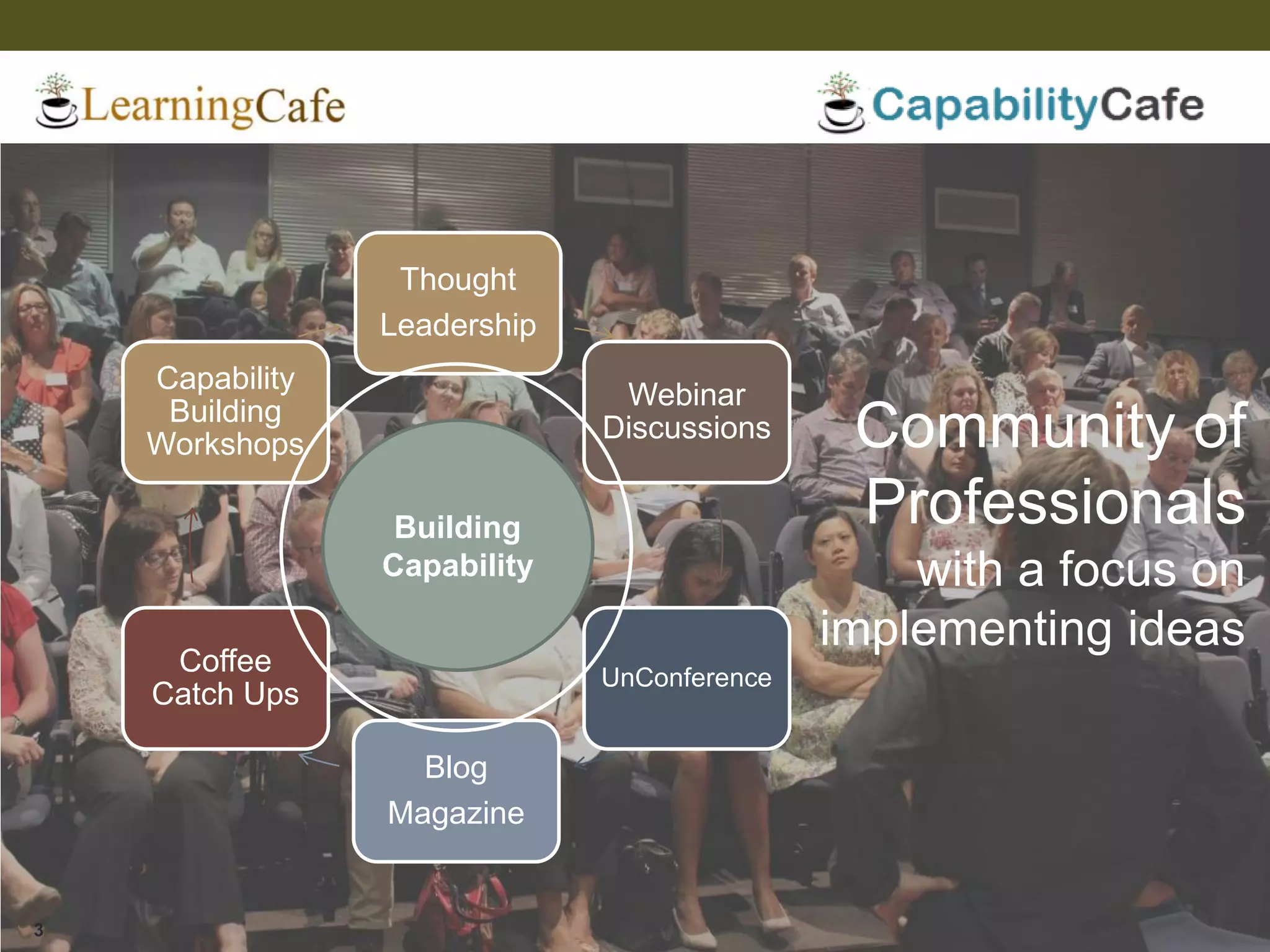
Thought
Leadership
Webinar
Discussions
UnConference
Blog
Magazine
Coffee
Catch Ups
Capability
Building
Workshops Community of
Professionals
with a focus on
implementing ideas
Building
Capability
3
JEEVAN JOSHI
Producer at LearningCafe & CapabilityCafe
4
5
6
7
8
9
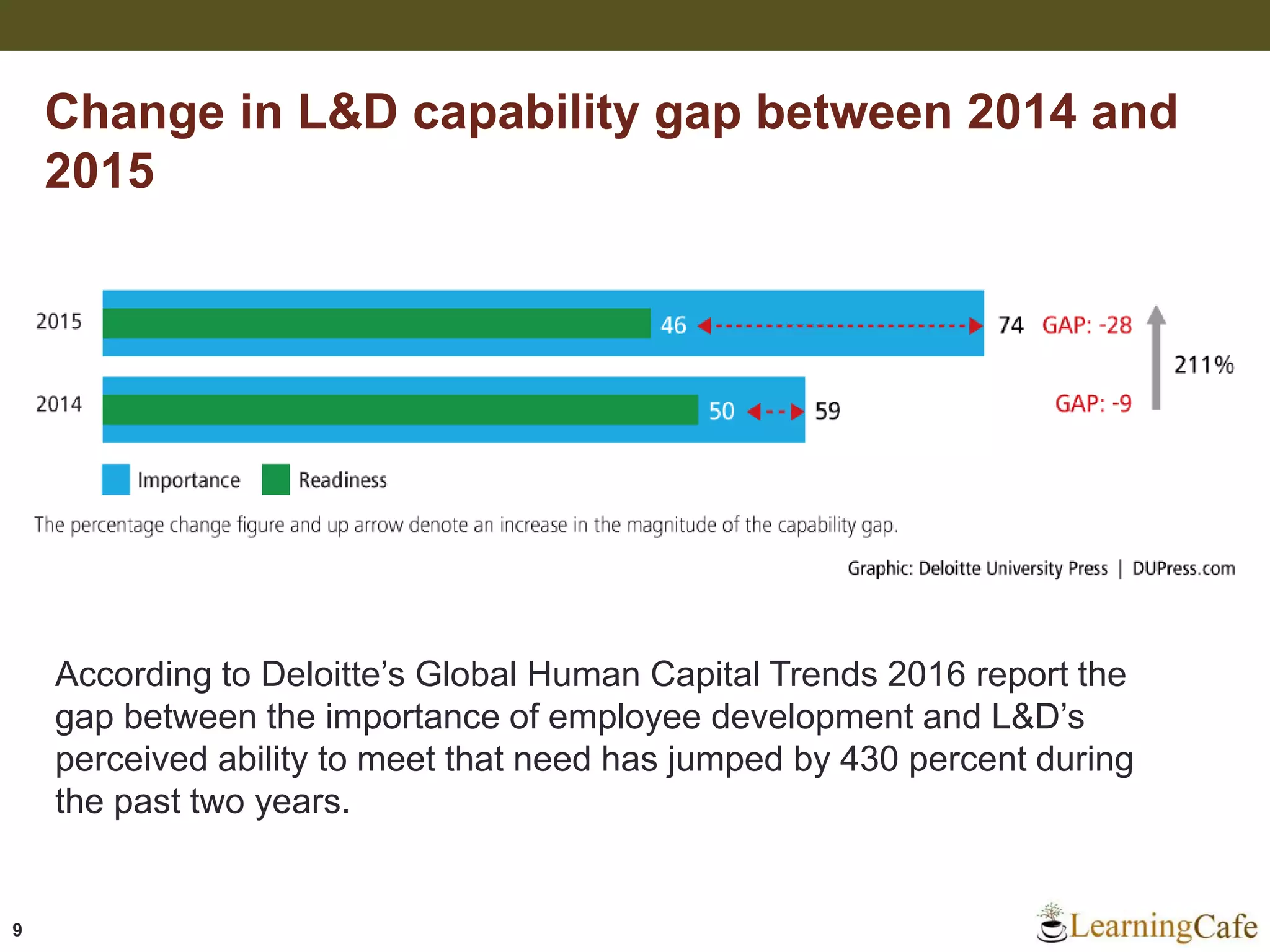
Change in L&D capability gap between 2014 and
2015
According to Deloitte’s Global Human Capital Trends 2016 report the
gap between the importance of employee development and L&D’s
perceived ability to meet that need has jumped by 430 percent during
the past two years.
10
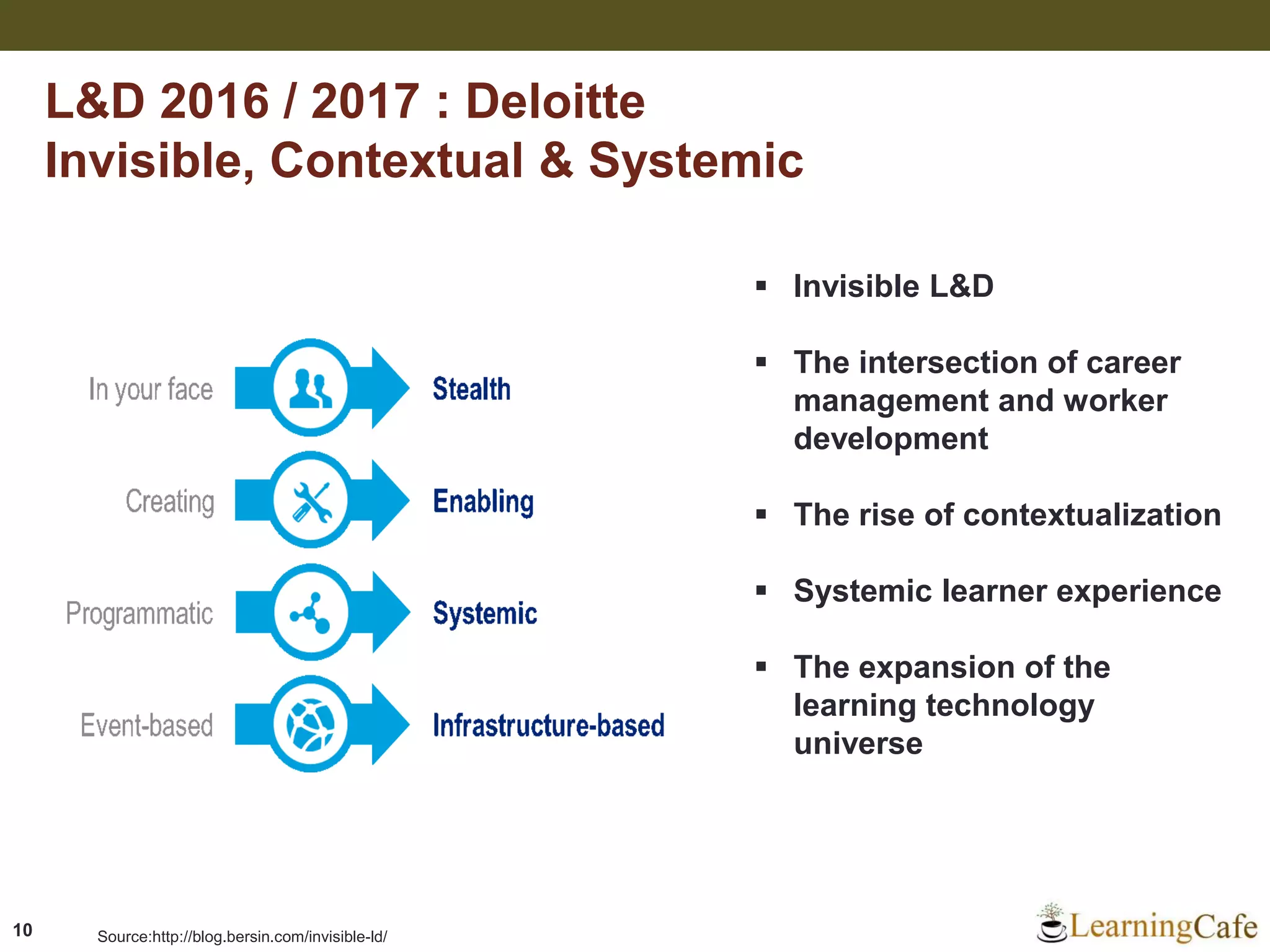
 Invisible L&D
 The intersection of career
management and worker
development
 The rise of contextualization
 Systemic learner experience
 The expansion of the
learning technology
universe
Source:http://blog.bersin.com/invisible-ld/
L&D 2016 / 2017 : Deloitte
Invisible, Contextual & Systemic
11
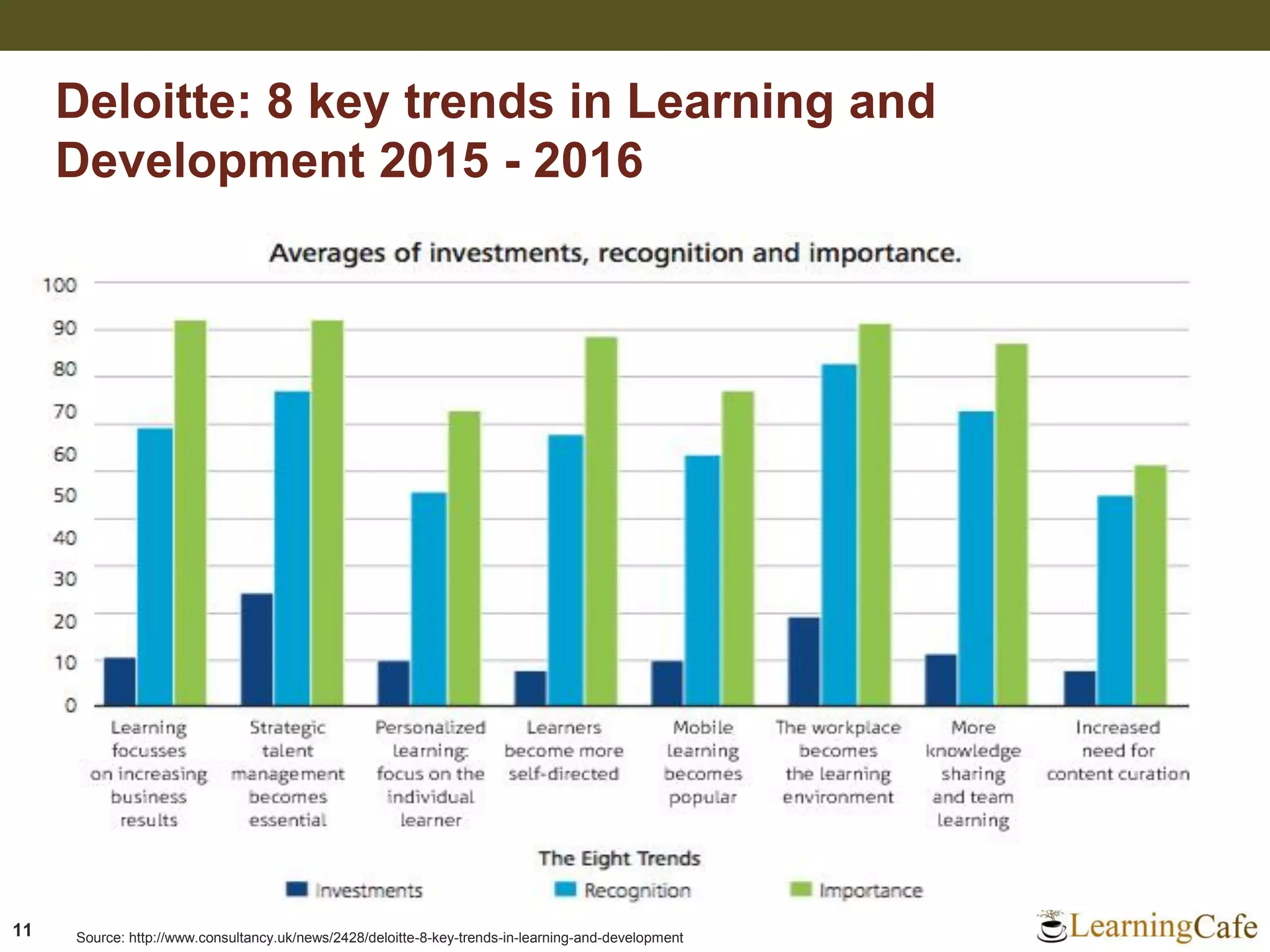
Deloitte: 8 key trends in Learning and
Development 2015 - 2016
Source: http://www.consultancy.uk/news/2428/deloitte-8-key-trends-in-learning-and-development
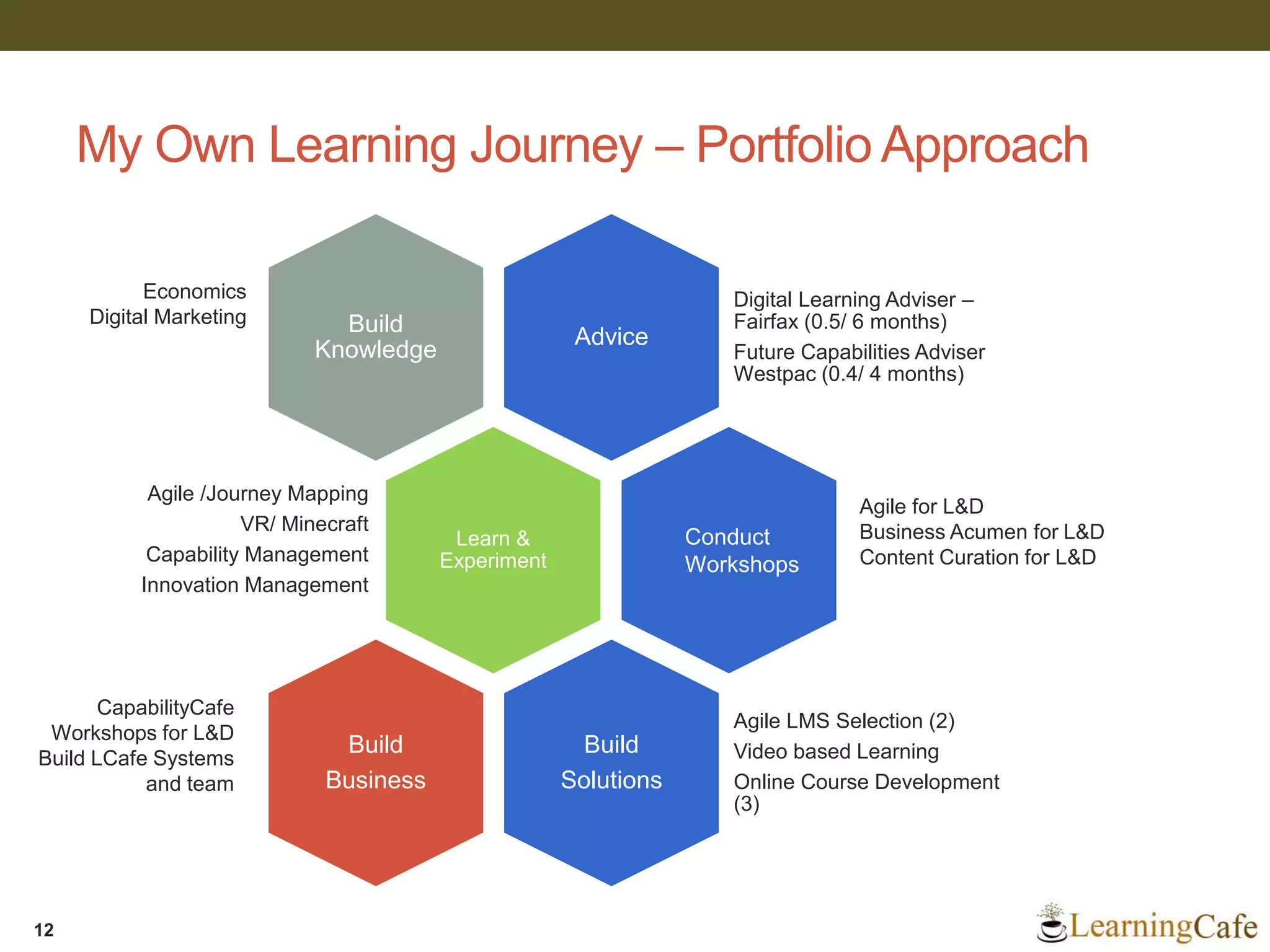
My Own Learning Journey – Portfolio Approach
12
Advice
Digital Learning Adviser –
Fairfax (0.5/ 6 months)
Future Capabilities Adviser
Westpac (0.4/ 4 months)
Build
Knowledge
Learn &
Experiment
Agile /Journey Mapping
VR/ Minecraft
Capability Management
Innovation Management
Build
Solutions
Agile LMS Selection (2)
Video based Learning
Online Course Development
(3)
Build
Business
Conduct
Workshops
Agile for L&D
Business Acumen for L&D
Content Curation for L&D
CapabilityCafe
Workshops for L&D
Build LCafe Systems
and team
Economics
Digital Marketing
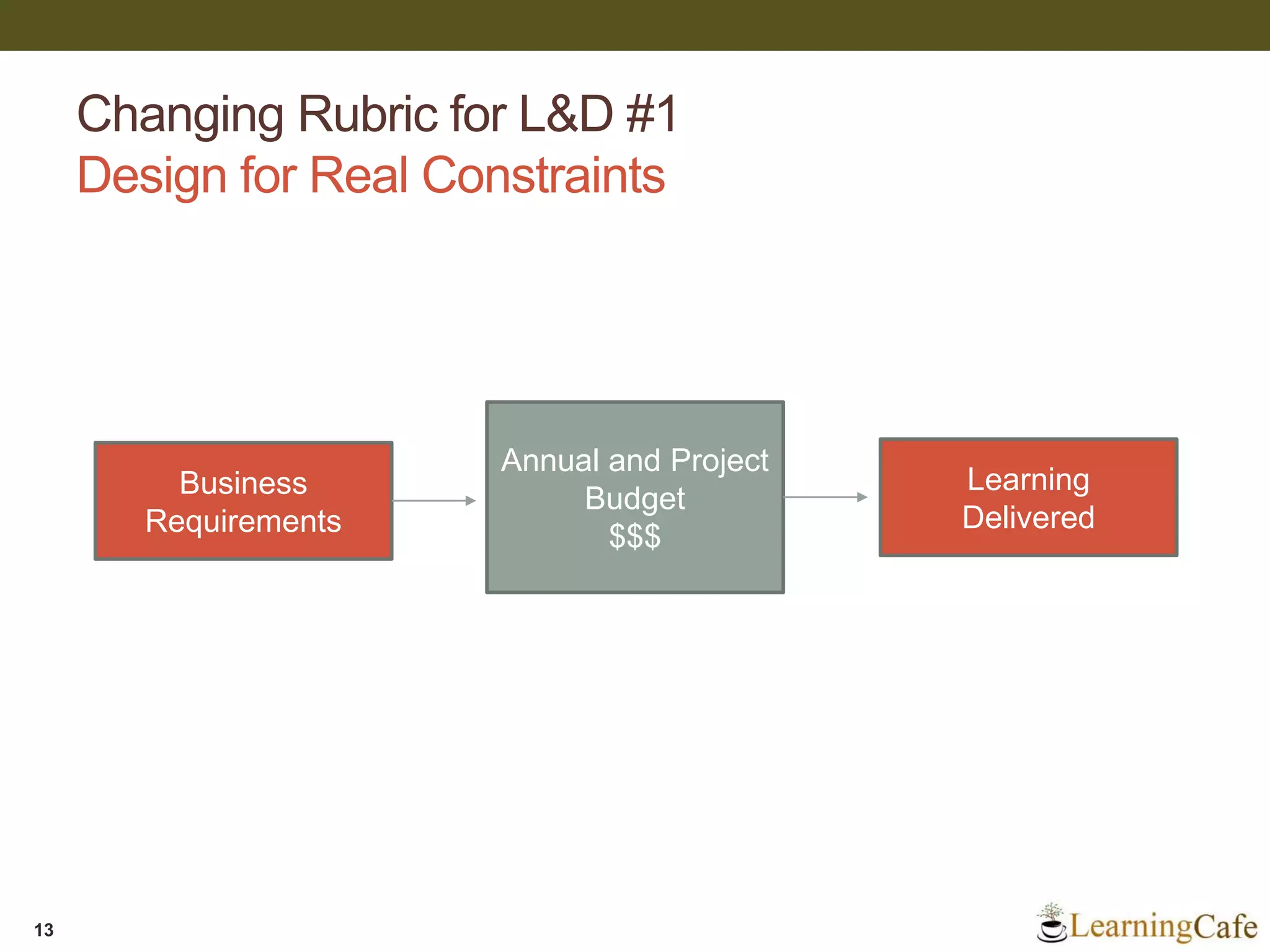
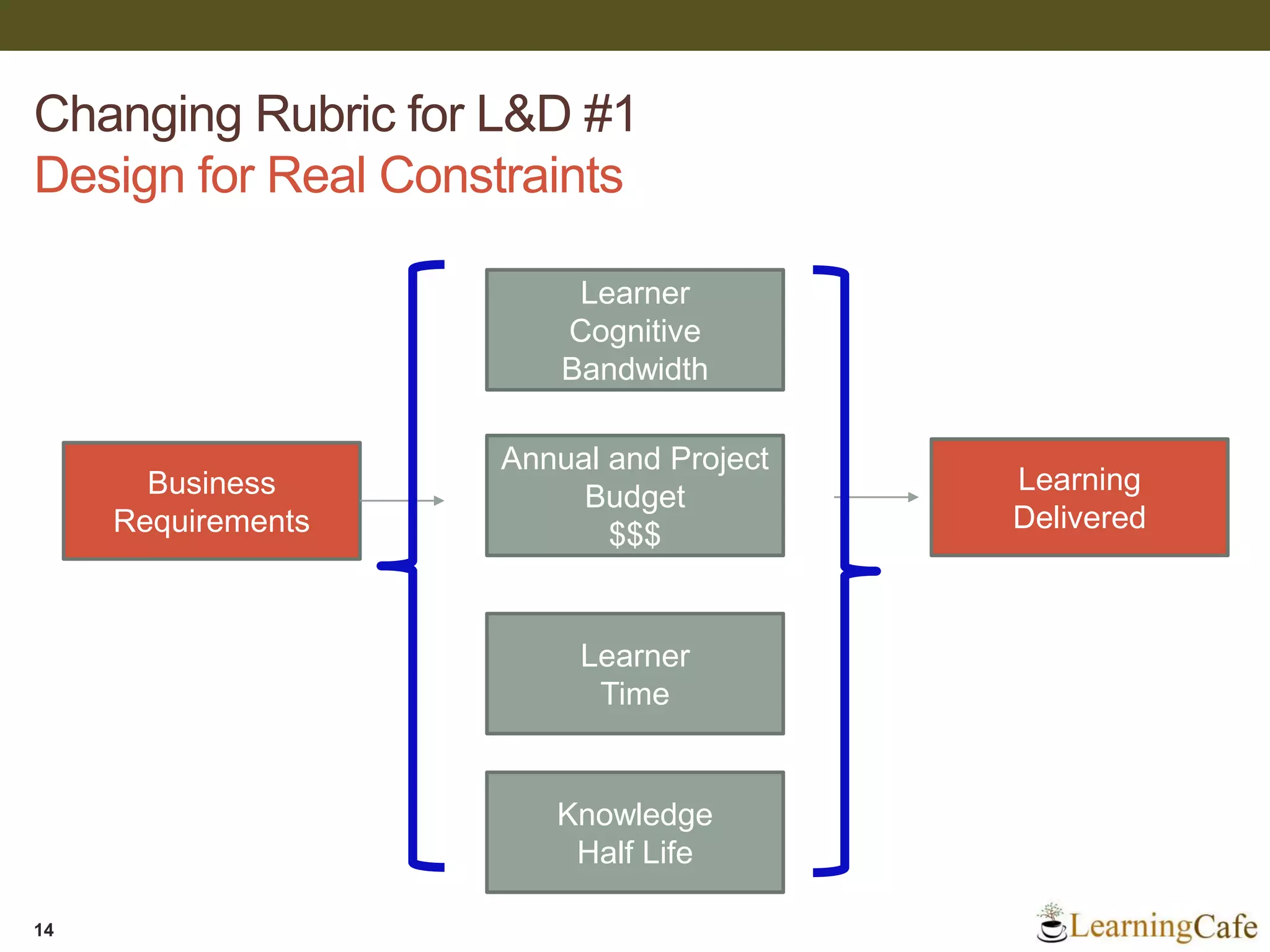
Changing Rubric for L&D #1
Design for Real Constraints
13
Annual and Project
Budget
$$$
Business
Requirements
Learning
Delivered
Changing Rubric for L&D #1
Design for Real Constraints
14
Annual and Project
Budget
$$$
Business
Requirements
Learning
Delivered
Learner
Time
Learner
Cognitive
Bandwidth
Knowledge
Half Life
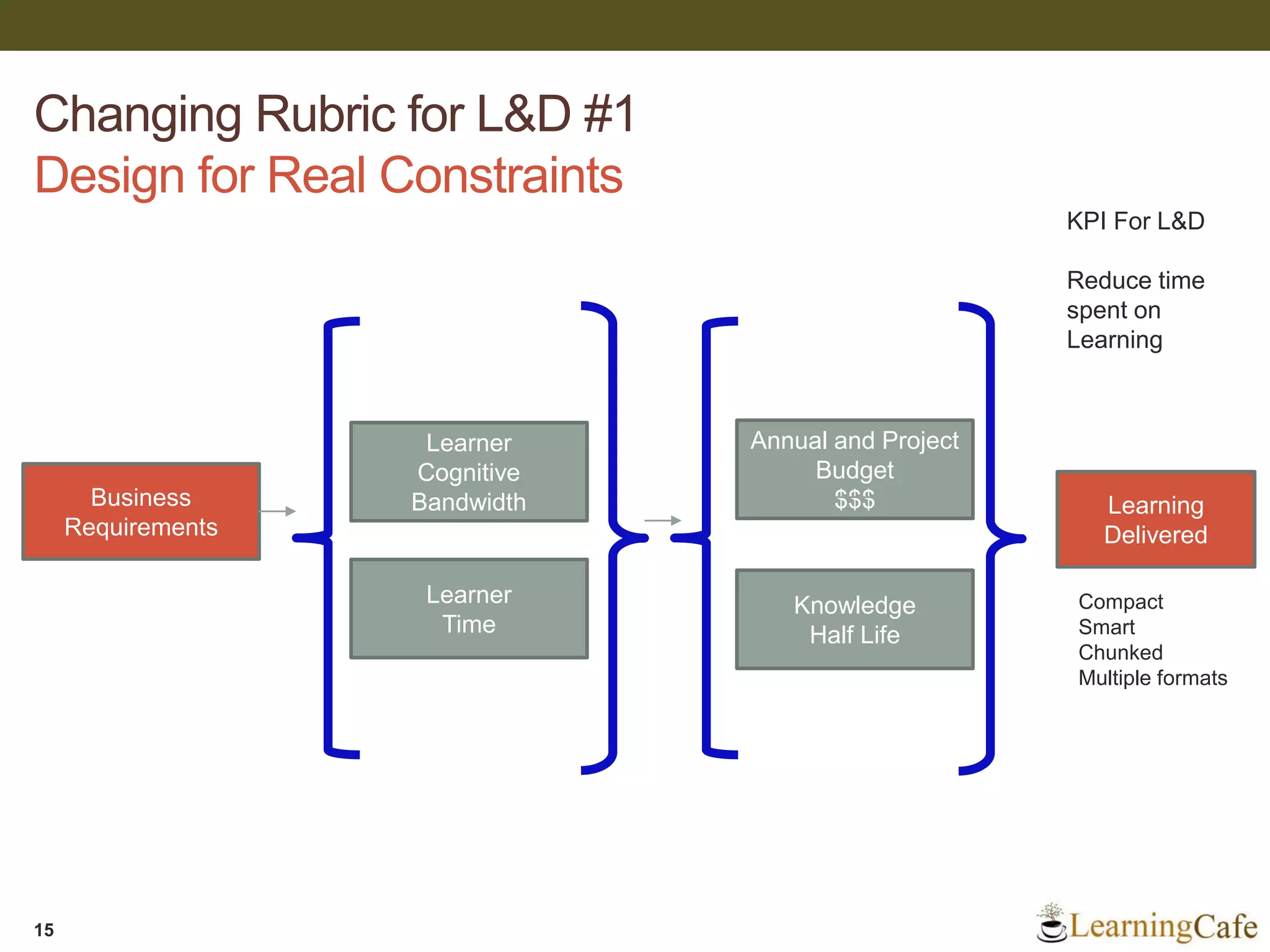
Changing Rubric for L&D #1
Design for Real Constraints
15
Annual and Project
Budget
$$$Business
Requirements
Learning
Delivered
Learner
Time
Learner
Cognitive
Bandwidth
Knowledge
Half Life
Compact
Smart
Chunked
Multiple formats
KPI For L&D
Reduce time
spent on
Learning
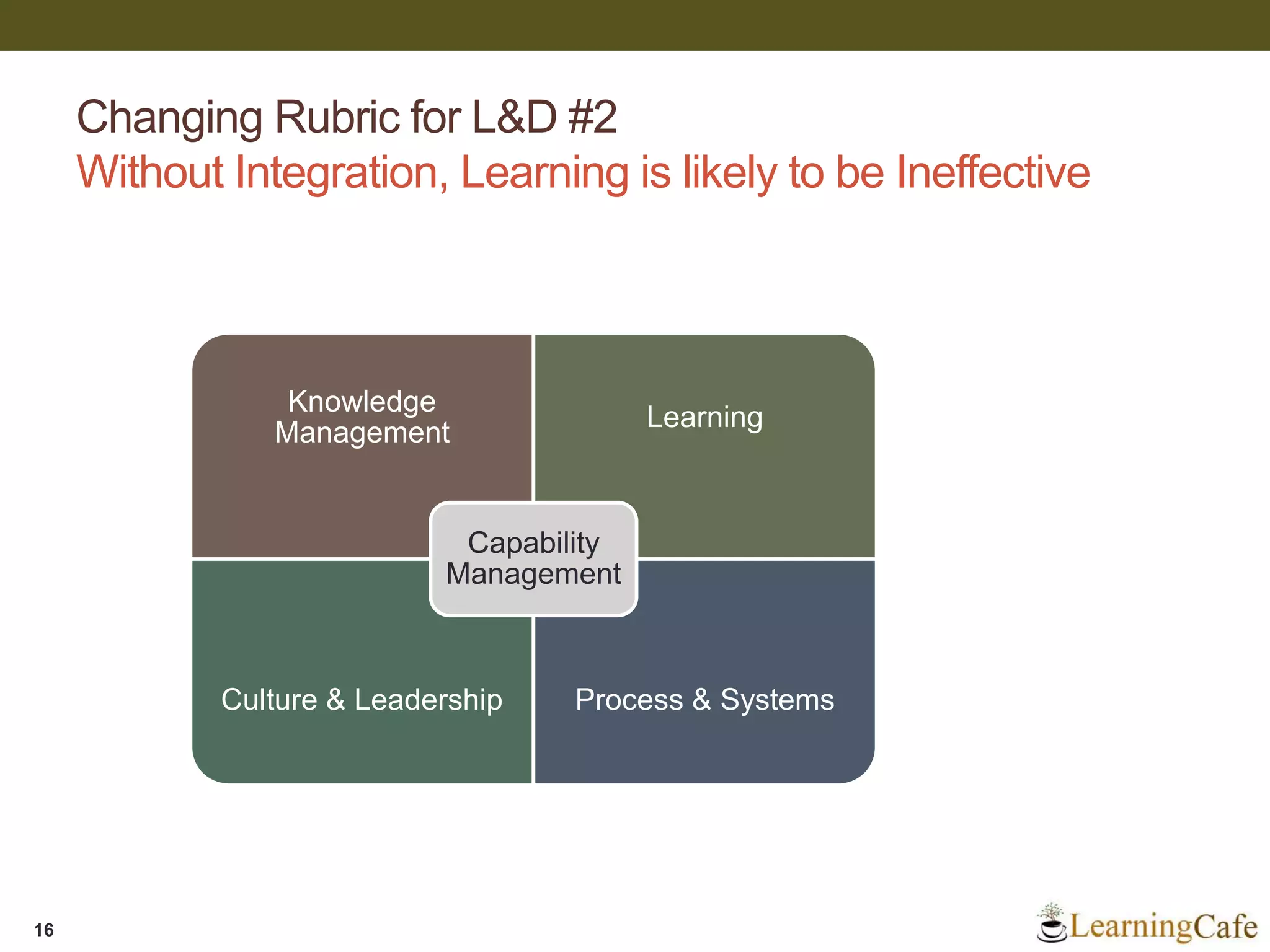
Changing Rubric for L&D #2
Without Integration, Learning is likely to be Ineffective
16
Knowledge
Management
Learning
Culture & Leadership Process & Systems
Capability
Management
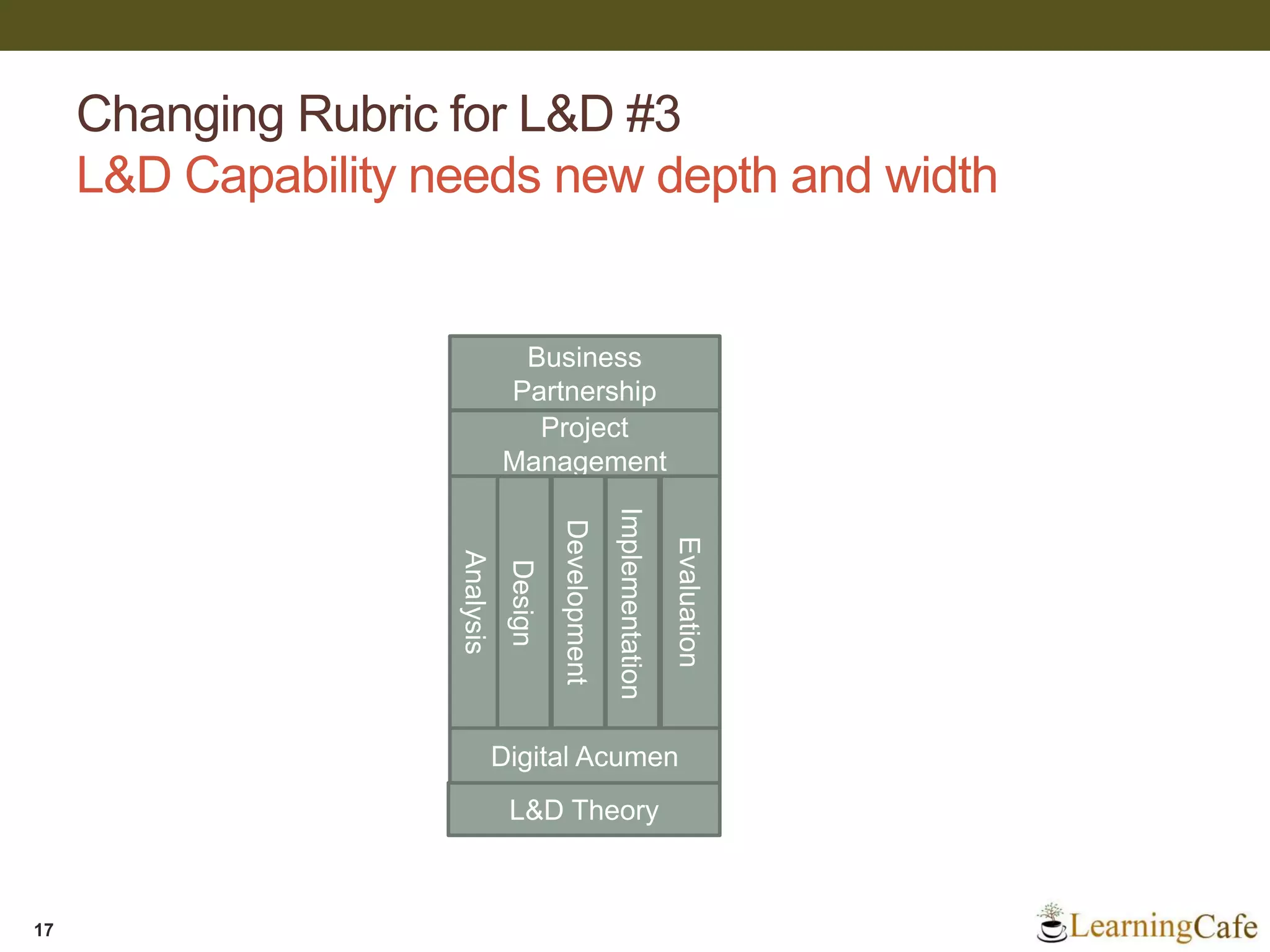
Changing Rubric for L&D #3
L&D Capability needs new depth and width
17
Business
Partnership
Project
Management
L&D Theory
Analysis
Design
Development
Implementation
Evaluation
Digital Acumen
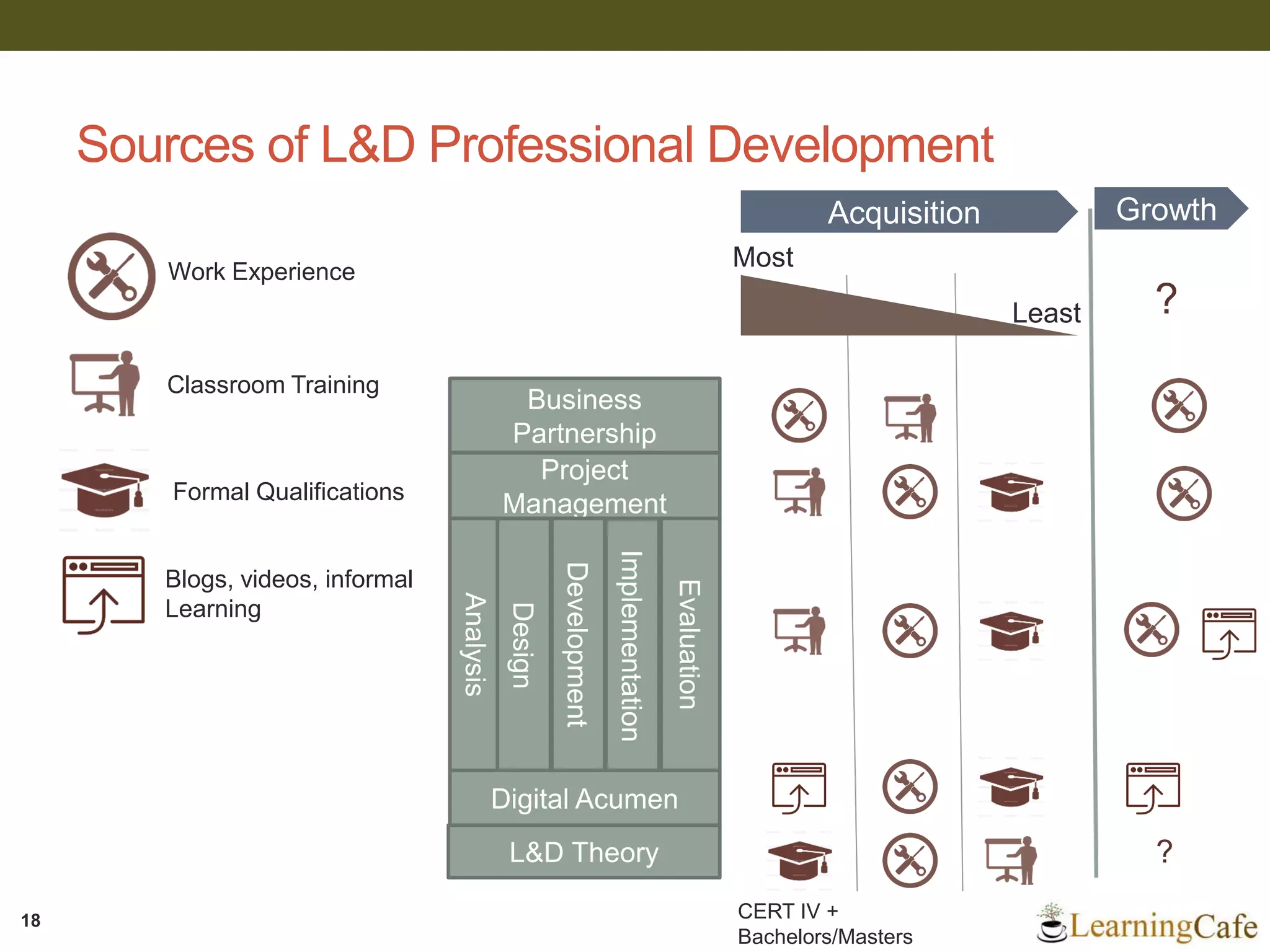
Sources of L&D Professional Development
18
Business
Partnership
Project
Management
L&D Theory
Analysis
Design
Development
Implementation
Evaluation
Digital Acumen
CERT IV +
Bachelors/Masters
Most
Least
Work Experience
Classroom Training
Formal Qualifications
Blogs, videos, informal
Learning
Acquisition Growth
?
?
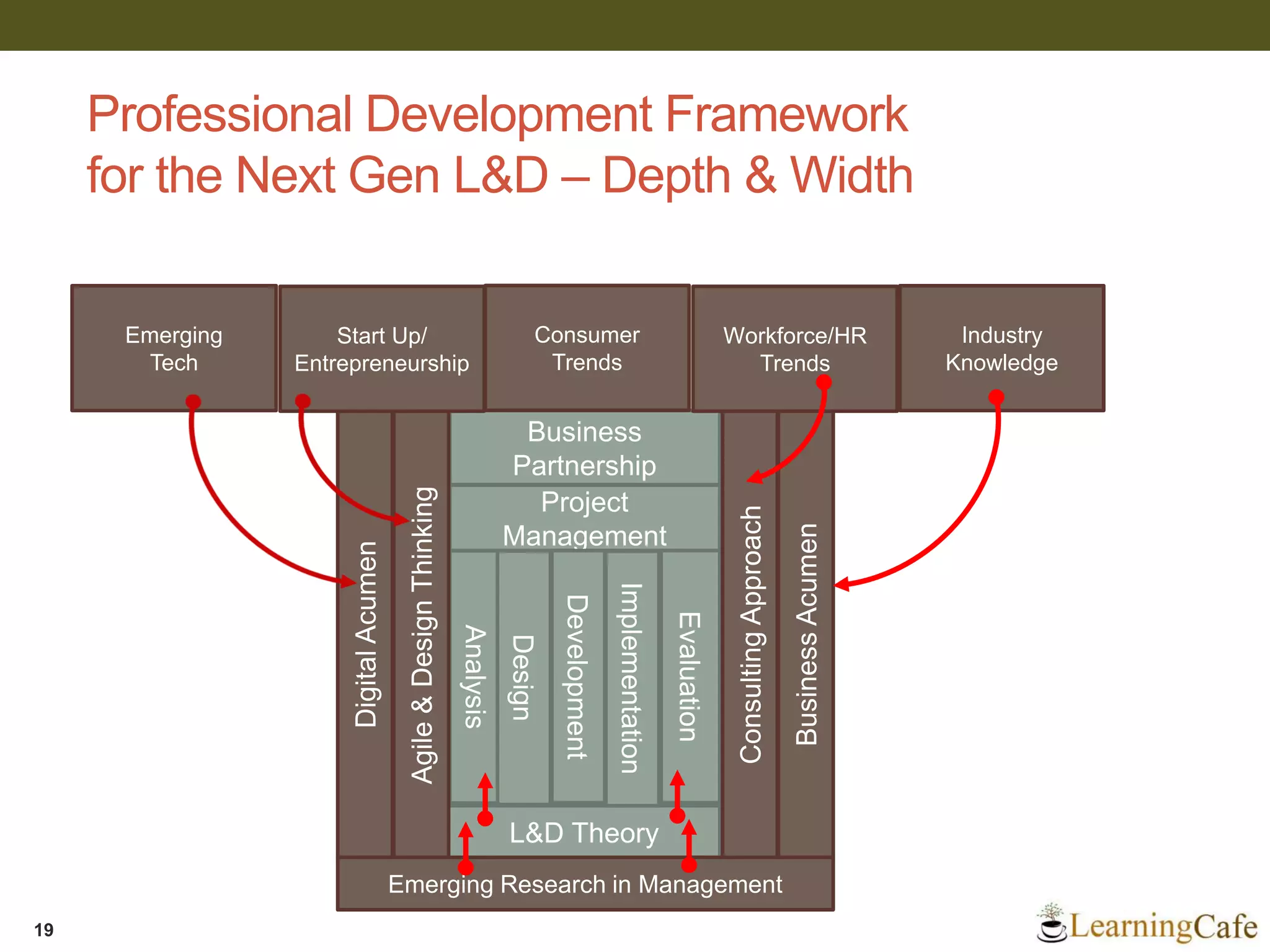
Professional Development Framework
for the Next Gen L&D – Depth & Width
19
Business
Partnership
Project
Management
L&D Theory
Analysis
Design
Development
Implementation
Evaluation
DigitalAcumen
ConsultingApproach
BusinessAcumen
Agile&DesignThinking
Emerging
Tech
Start Up/
Entrepreneurship
Consumer
Trends
Workforce/HR
Trends
Emerging Research in Management
Industry
Knowledge
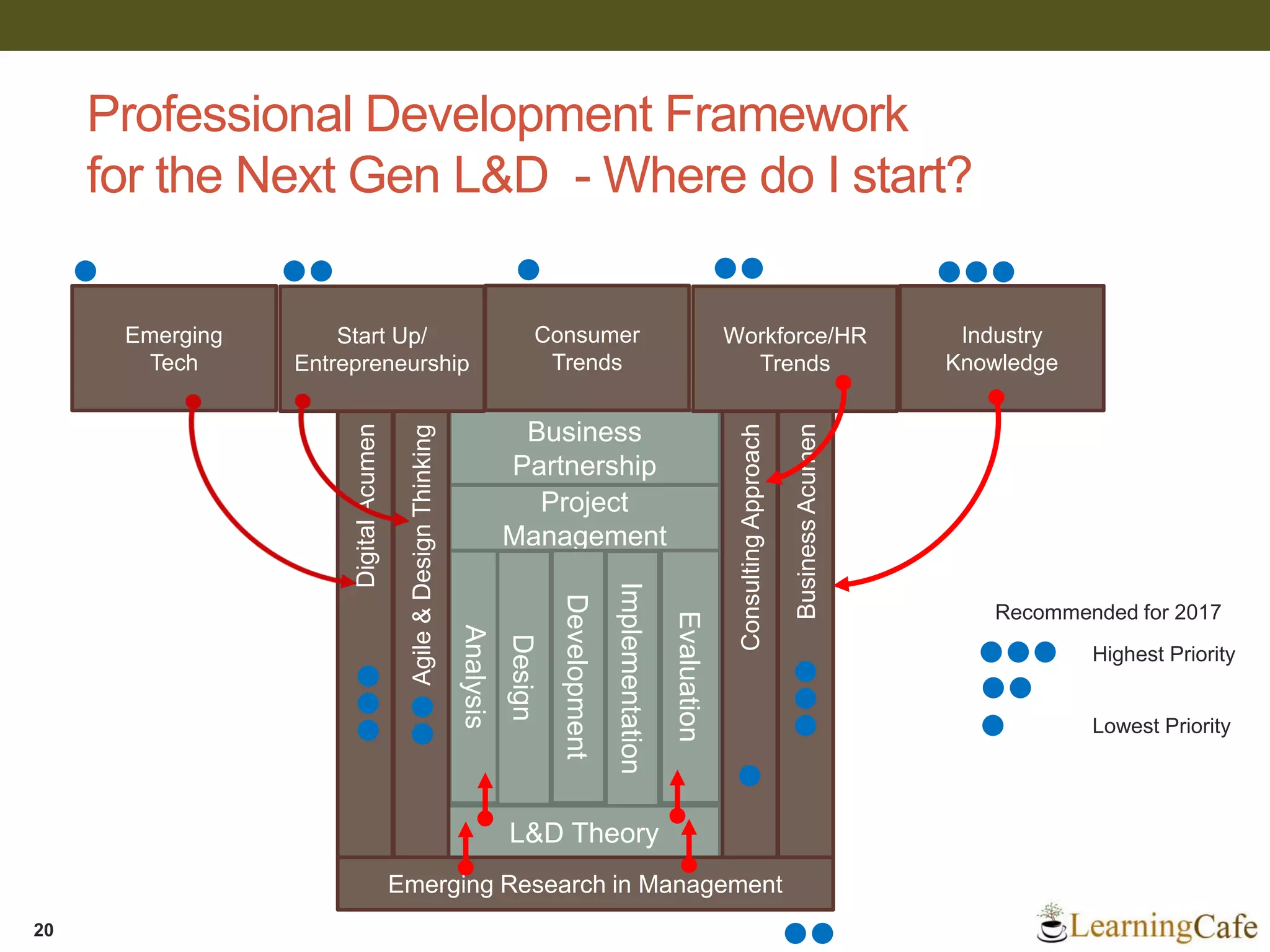
Professional Development Framework
for the Next Gen L&D - Where do I start?
20
Business
Partnership
Project
Management
L&D Theory
Analysis
Design
Development
Implementation
Evaluation
DigitalAcumen
ConsultingApproach
BusinessAcumen
Agile&DesignThinking
Emerging
Tech
Start Up/
Entrepreneurship
Consumer
Trends
Workforce/HR
Trends
Emerging Research in Management
Industry
Knowledge
Highest Priority
Lowest Priority
Recommended for 2017
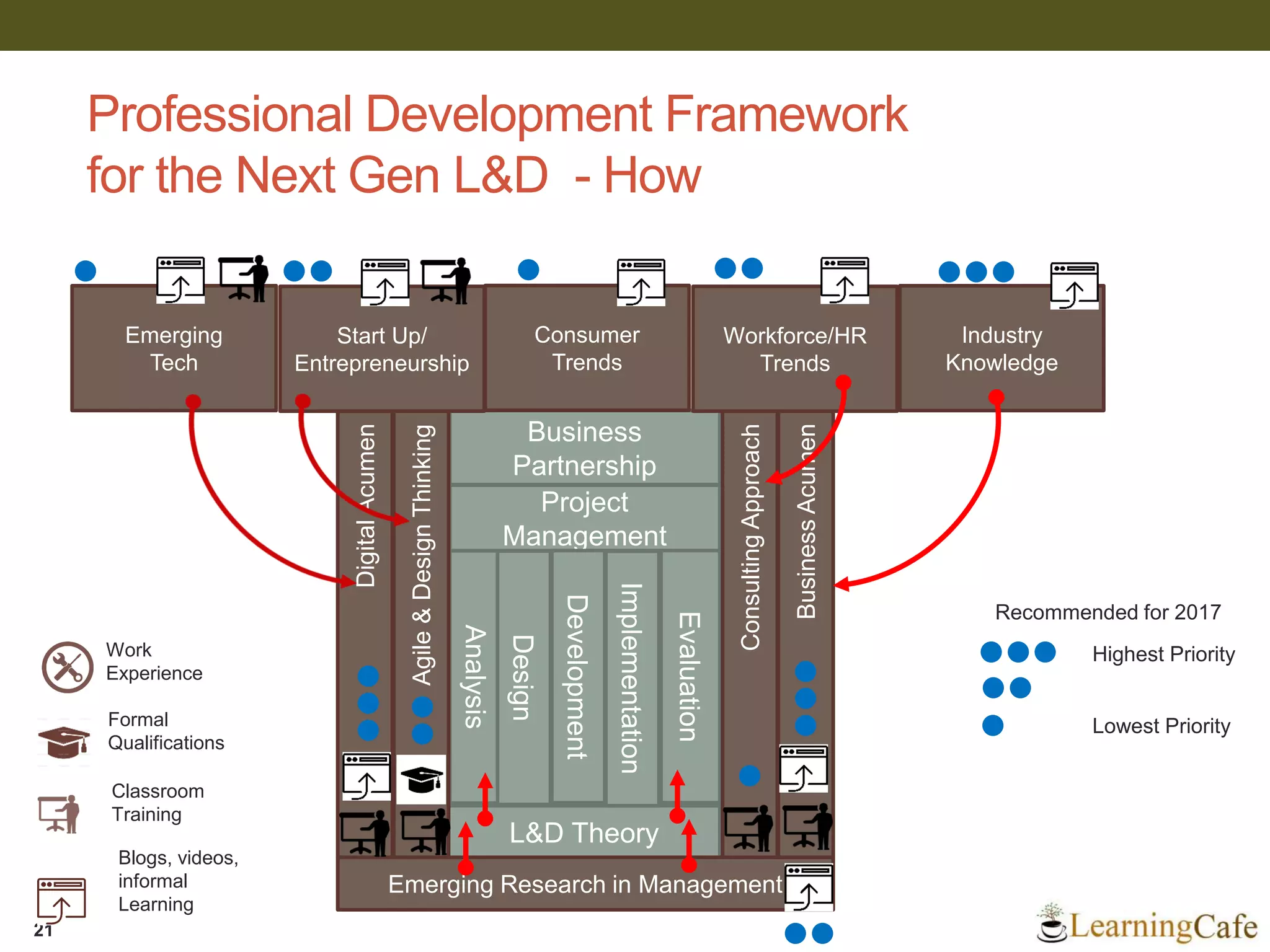
Professional Development Framework
for the Next Gen L&D - How
21
Business
Partnership
Project
Management
L&D Theory
Analysis
Design
Development
Implementation
Evaluation
DigitalAcumen
ConsultingApproach
BusinessAcumen
Agile&DesignThinking
Emerging
Tech
Start Up/
Entrepreneurship
Consumer
Trends
Workforce/HR
Trends
Emerging Research in Management
Industry
Knowledge
Highest Priority
Lowest Priority
Recommended for 2017
Work
Experience
Formal
Qualifications
Classroom
Training
Blogs, videos,
informal
Learning
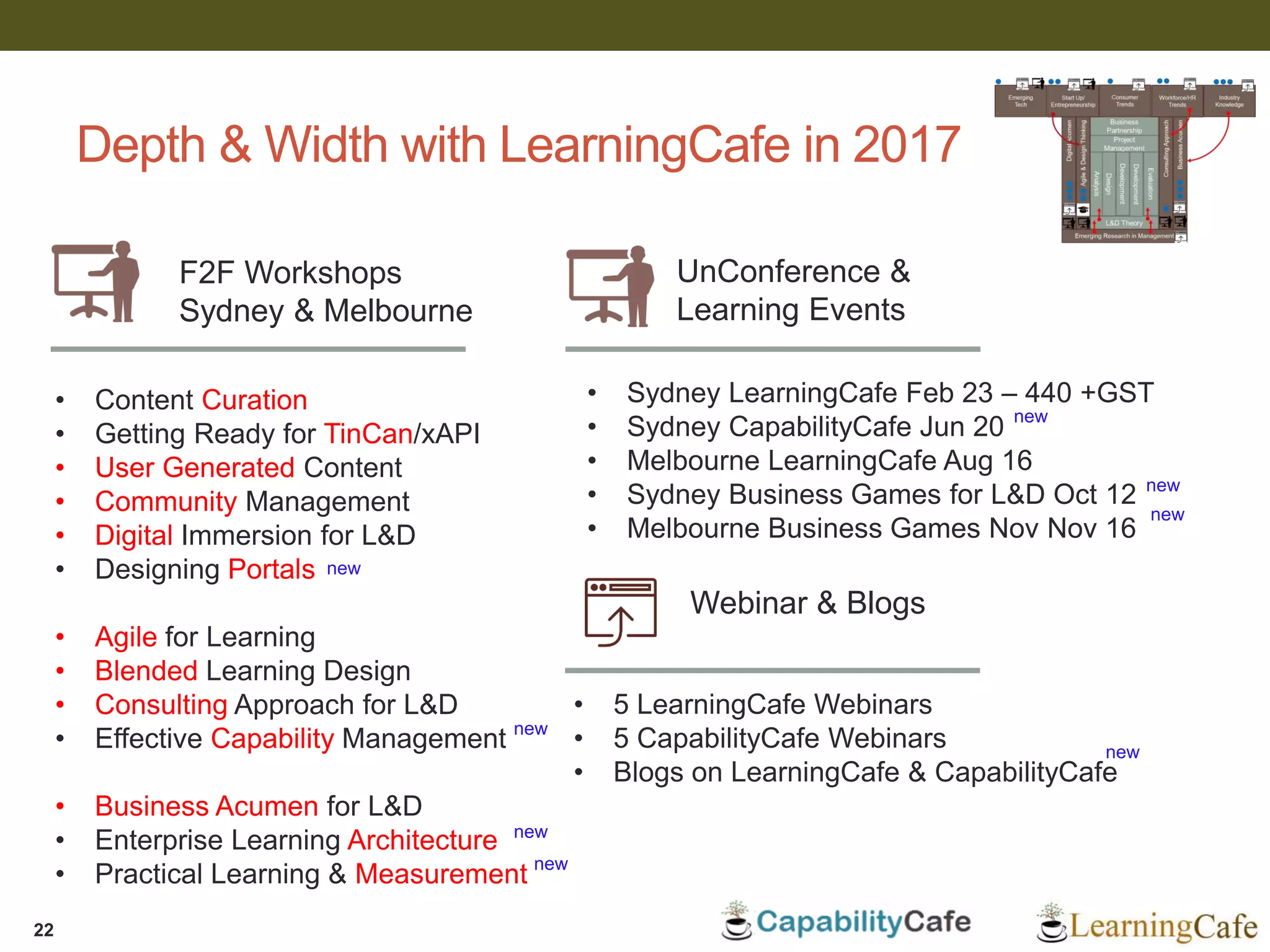
Depth & Width with LearningCafe in 2017
22
F2F Workshops
Sydney & Melbourne
• Content Curation
• Getting Ready for TinCan/xAPI
• User Generated Content
• Community Management
• Digital Immersion for L&D
• Designing Portals
• Agile for Learning
• Blended Learning Design
• Consulting Approach for L&D
• Effective Capability Management
• Business Acumen for L&D
• Enterprise Learning Architecture
• Practical Learning & Measurement
UnConference &
Learning Events
• Sydney LearningCafe Feb 23 – 440 +GST
• Sydney CapabilityCafe Jun 20
• Melbourne LearningCafe Aug 16
• Sydney Business Games for L&D Oct 12
• Melbourne Business Games Nov Nov 16
Webinar & Blogs
• 5 LearningCafe Webinars
• 5 CapabilityCafe Webinars
• Blogs on LearningCafe & CapabilityCafe
new
new
new
new
new
new
new
new
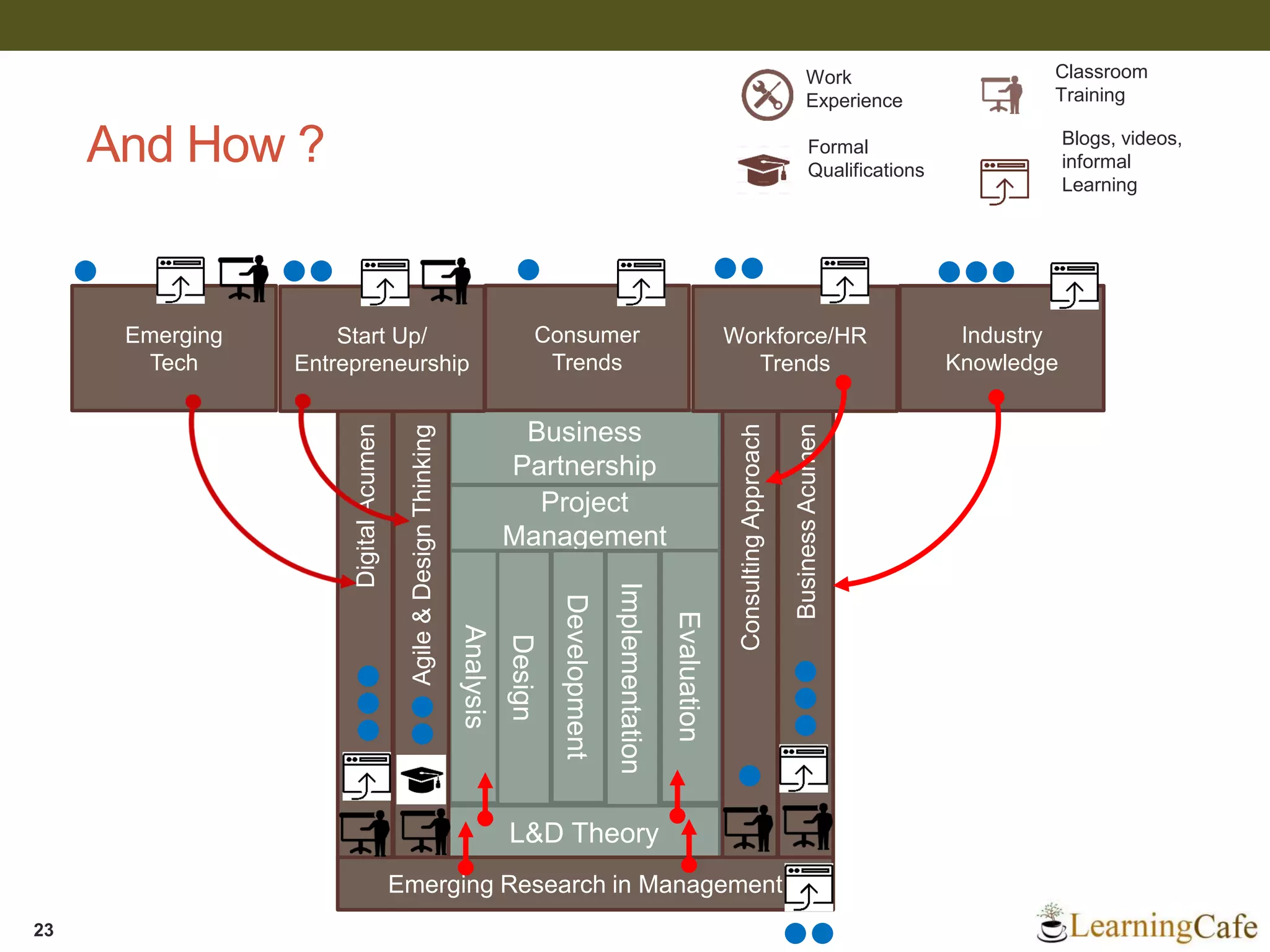
And How ?
23
Business
Partnership
Project
Management
L&D Theory
Analysis
Design
Development
Implementation
Evaluation
DigitalAcumen
ConsultingApproach
BusinessAcumen
Agile&DesignThinking
Emerging
Tech
Start Up/
Entrepreneurship
Consumer
Trends
Workforce/HR
Trends
Emerging Research in Management
Industry
Knowledge
Work
Experience
Classroom
Training
Formal
Qualifications
Blogs, videos,
informal
Learning
PETER HALL
Head of Learning and Development –
Australia and Asia Pacific at QBE
24
2016 Observations
• The challenge to do more with less becomes
even more ‘the new normal’
• If we thought technology might go away – it’s
impacting learning even more
• I don’t think we still have the right skills
• What’s happened to pure design roles
• We need to be all-rounders
Predictions for 2017
• Be ready to challenge your
long established paradigms –
be a heretic
• L&D people need to be
pragmatists
• Get serious about broad L&D
capability development
• F2F will continue to reduce
• More (and more) video
Reflections on what I’ve learned in 2016
• Stakeholder engagement is the key
• Don’t be limited by your
uncomfortableness
• Continue to educate the business using
their language but also push it
• Share your knowledge with others
ROB WILKINS
Leader – Information
Management at NSW Department of
Education
28
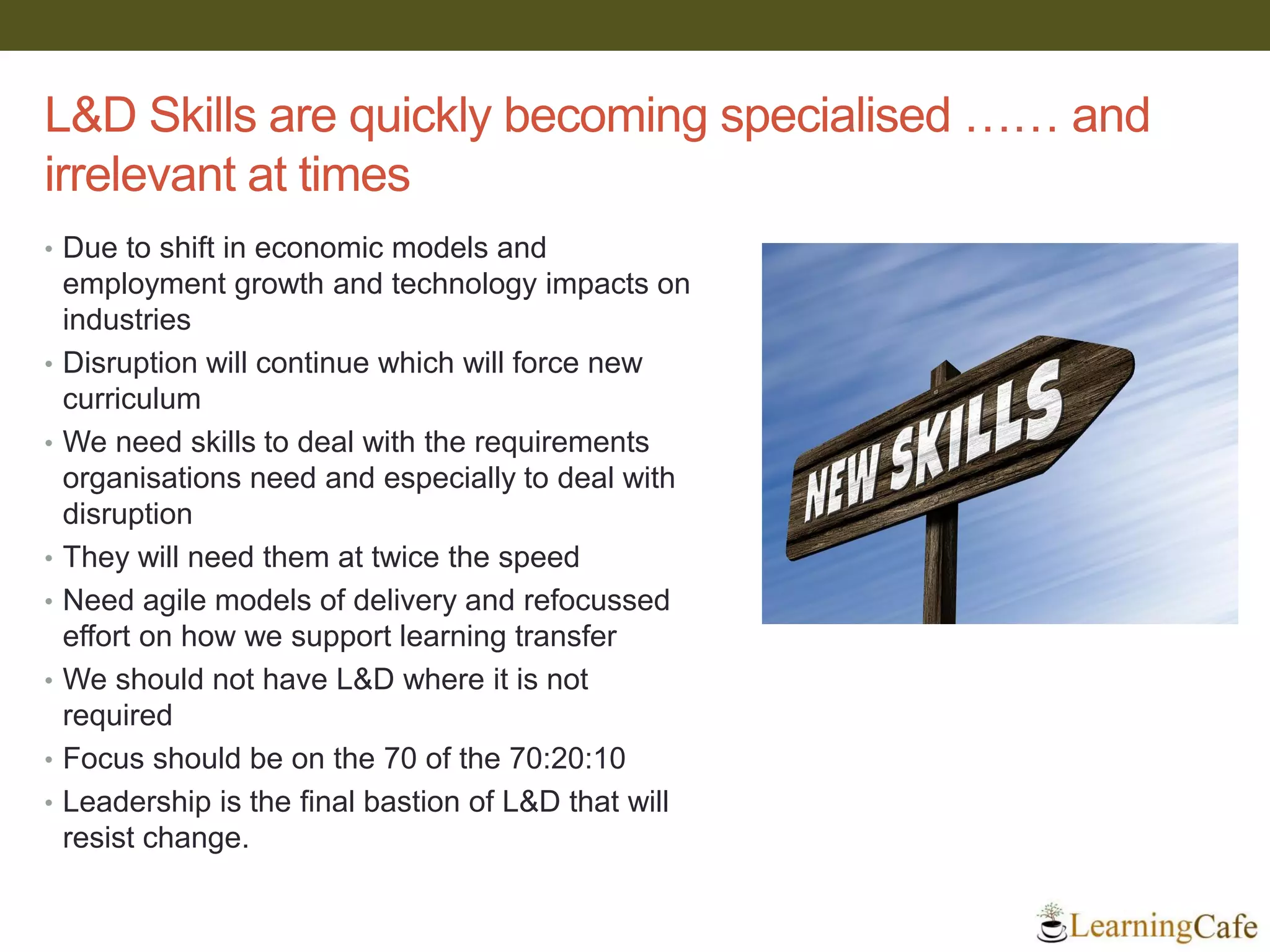
L&D Skills are quickly becoming specialised …… and
irrelevant at times
• Due to shift in economic models and
employment growth and technology impacts on
industries
• Disruption will continue which will force new
curriculum
• We need skills to deal with the requirements
organisations need and especially to deal with
disruption
• They will need them at twice the speed
• Need agile models of delivery and refocussed
effort on how we support learning transfer
• We should not have L&D where it is not
required
• Focus should be on the 70 of the 70:20:10
• Leadership is the final bastion of L&D that will
resist change.
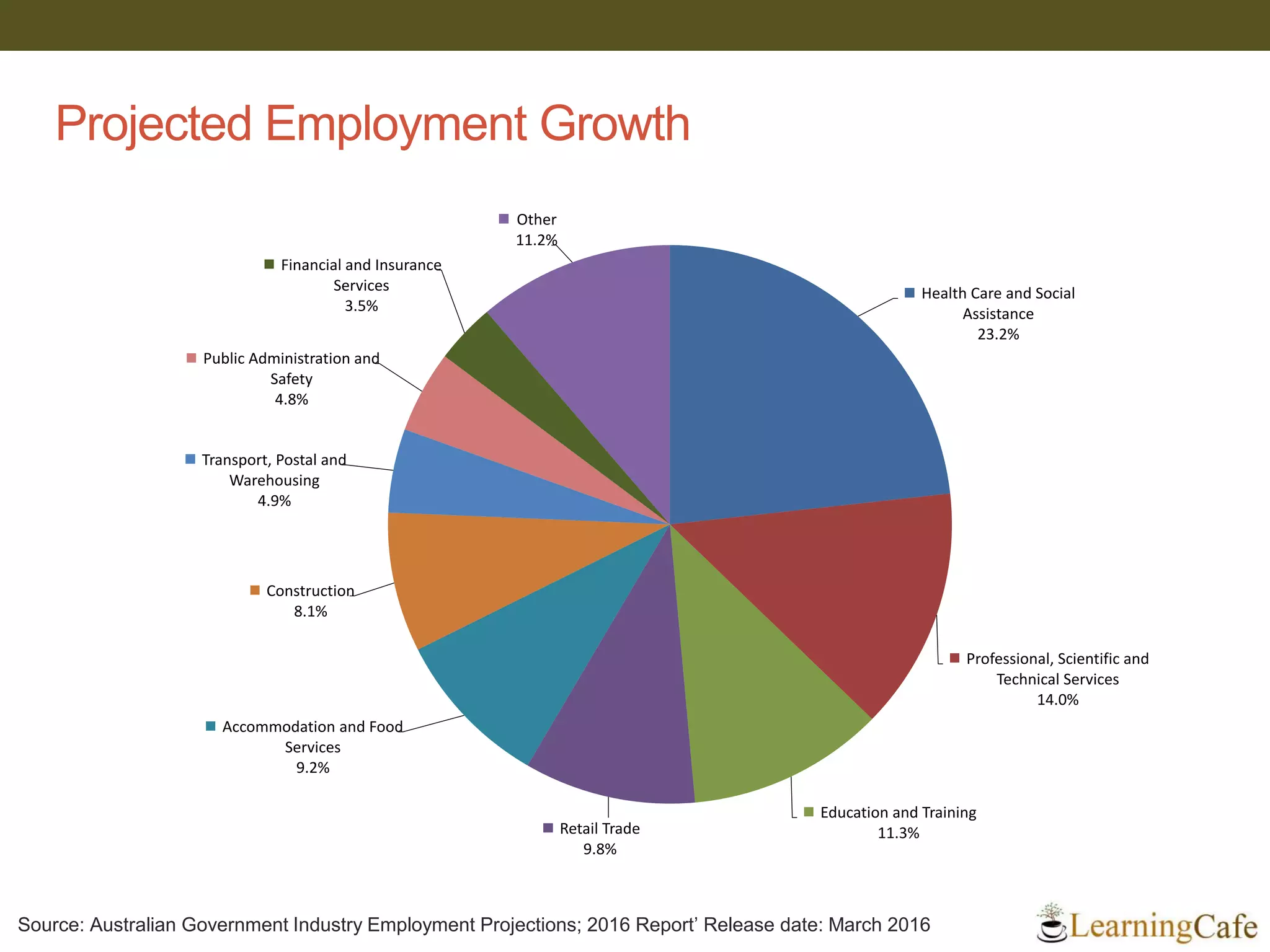
Projected Employment Growth
Health Care and Social
Assistance
23.2%
Professional, Scientific and
Technical Services
14.0%
Education and Training
11.3%Retail Trade
9.8%
Accommodation and Food
Services
9.2%
Construction
8.1%
Transport, Postal and
Warehousing
4.9%
Public Administration and
Safety
4.8%
Financial and Insurance
Services
3.5%
Other
11.2%
Source: Australian Government Industry Employment Projections; 2016 Report’ Release date: March 2016
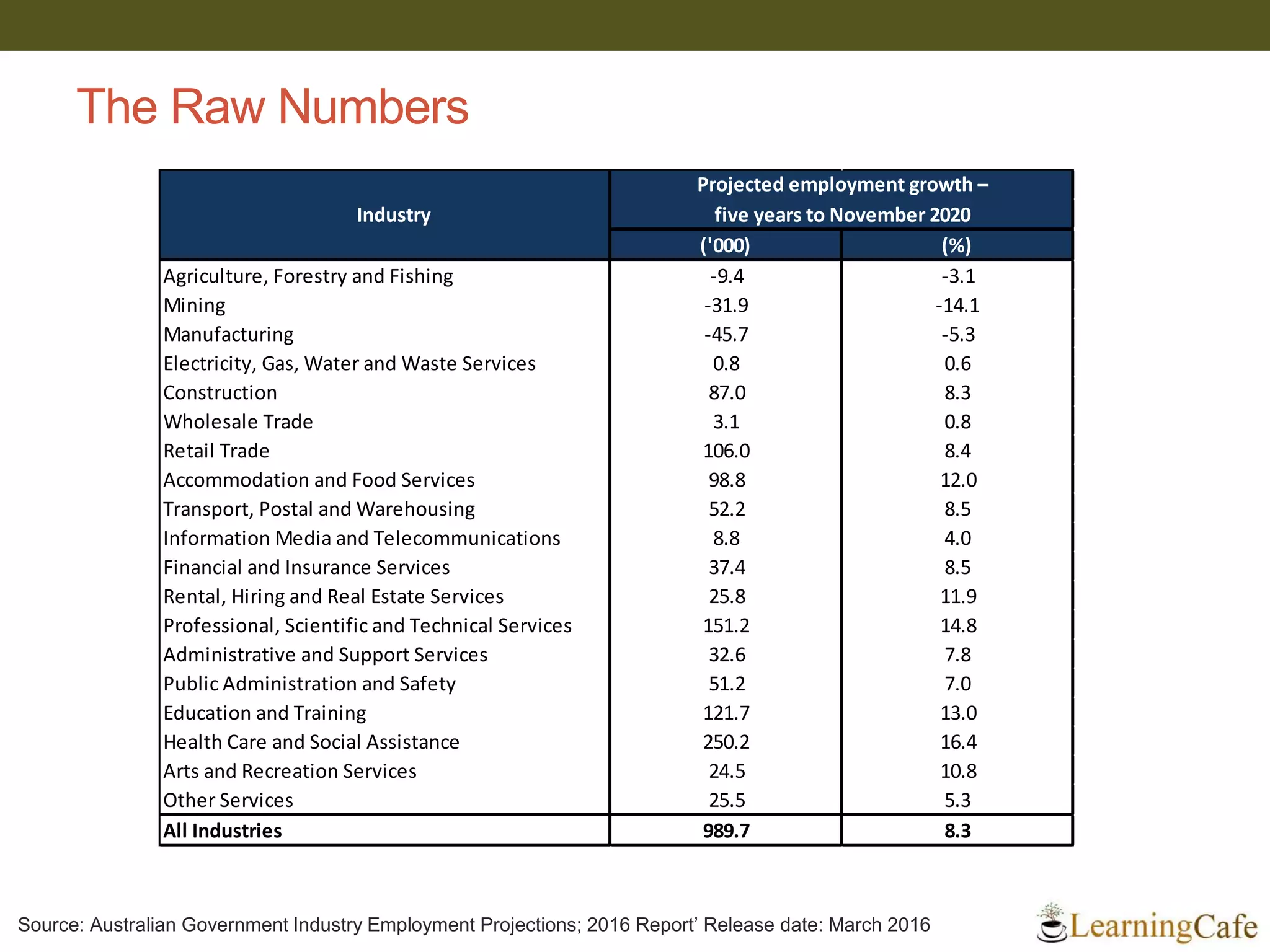
The Raw Numbers
('000) (%)
Agriculture, Forestry and Fishing -9.4 -3.1
Mining -31.9 -14.1
Manufacturing -45.7 -5.3
Electricity, Gas, Water and Waste Services 0.8 0.6
Construction 87.0 8.3
Wholesale Trade 3.1 0.8
Retail Trade 106.0 8.4
Accommodation and Food Services 98.8 12.0
Transport, Postal and Warehousing 52.2 8.5
Information Media and Telecommunications 8.8 4.0
Financial and Insurance Services 37.4 8.5
Rental, Hiring and Real Estate Services 25.8 11.9
Professional, Scientific and Technical Services 151.2 14.8
Administrative and Support Services 32.6 7.8
Public Administration and Safety 51.2 7.0
Education and Training 121.7 13.0
Health Care and Social Assistance 250.2 16.4
Arts and Recreation Services 24.5 10.8
Other Services 25.5 5.3
All Industries 989.7 8.3
Industry
Projected employment growth –
five years to November 2020
Source: Australian Government Industry Employment Projections; 2016 Report’ Release date: March 2016
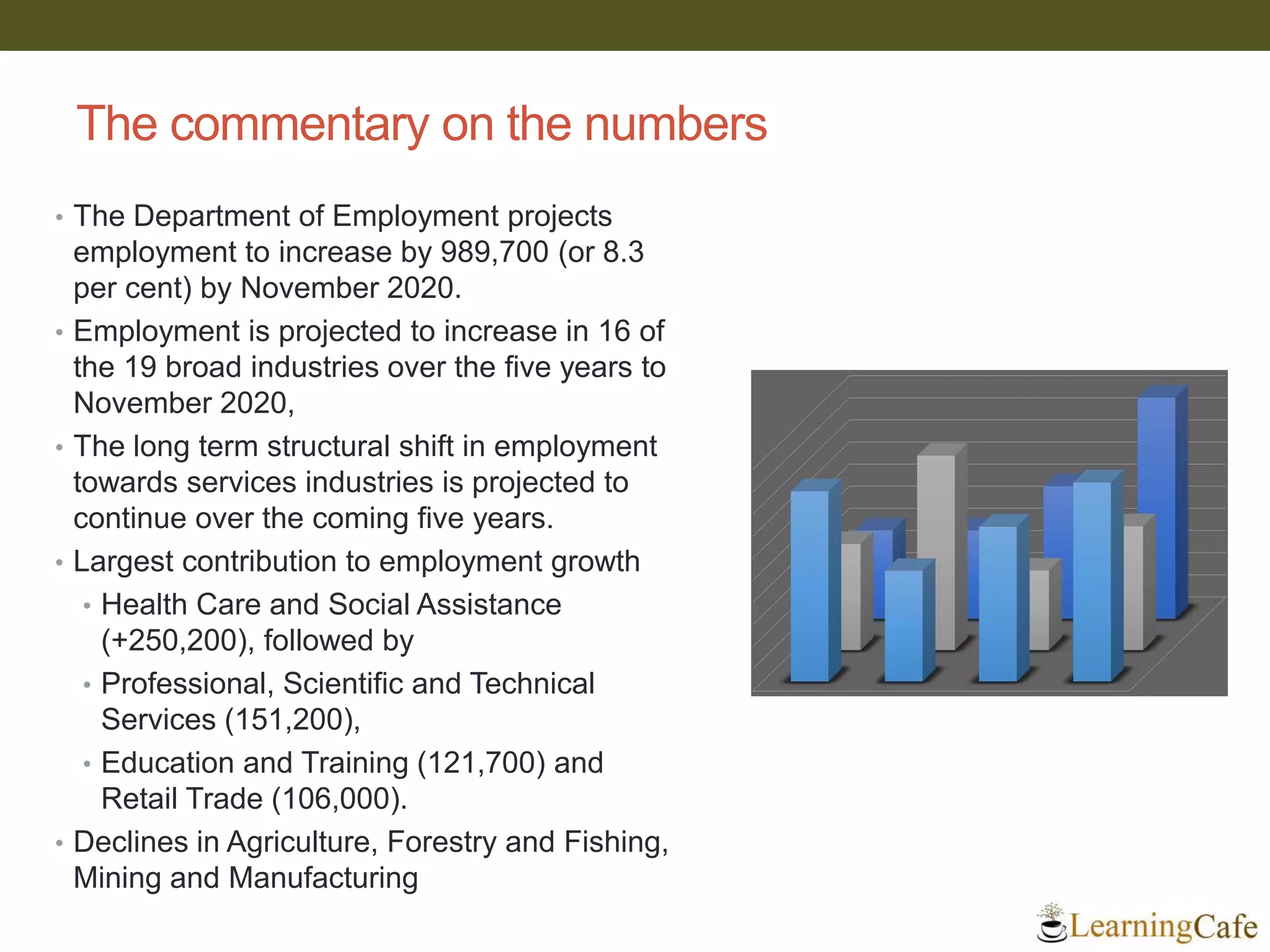
The commentary on the numbers
• The Department of Employment projects
employment to increase by 989,700 (or 8.3
per cent) by November 2020.
• Employment is projected to increase in 16 of
the 19 broad industries over the five years to
November 2020,
• The long term structural shift in employment
towards services industries is projected to
continue over the coming five years.
• Largest contribution to employment growth
• Health Care and Social Assistance
(+250,200), followed by
• Professional, Scientific and Technical
Services (151,200),
• Education and Training (121,700) and
Retail Trade (106,000).
• Declines in Agriculture, Forestry and Fishing,
Mining and Manufacturing
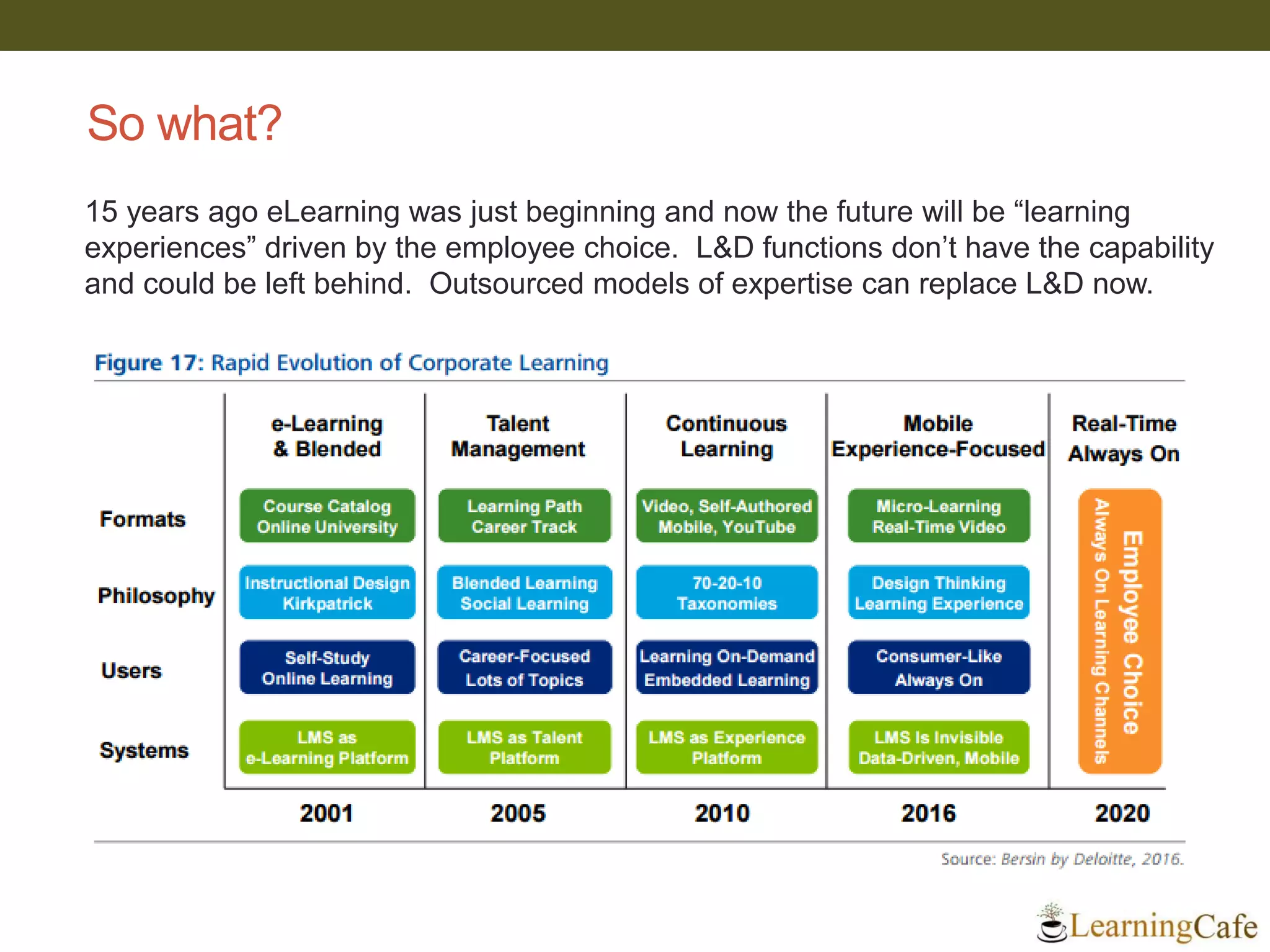
So what?
15 years ago eLearning was just beginning and now the future will be “learning
experiences” driven by the employee choice. L&D functions don’t have the capability
and could be left behind. Outsourced models of expertise can replace L&D now.
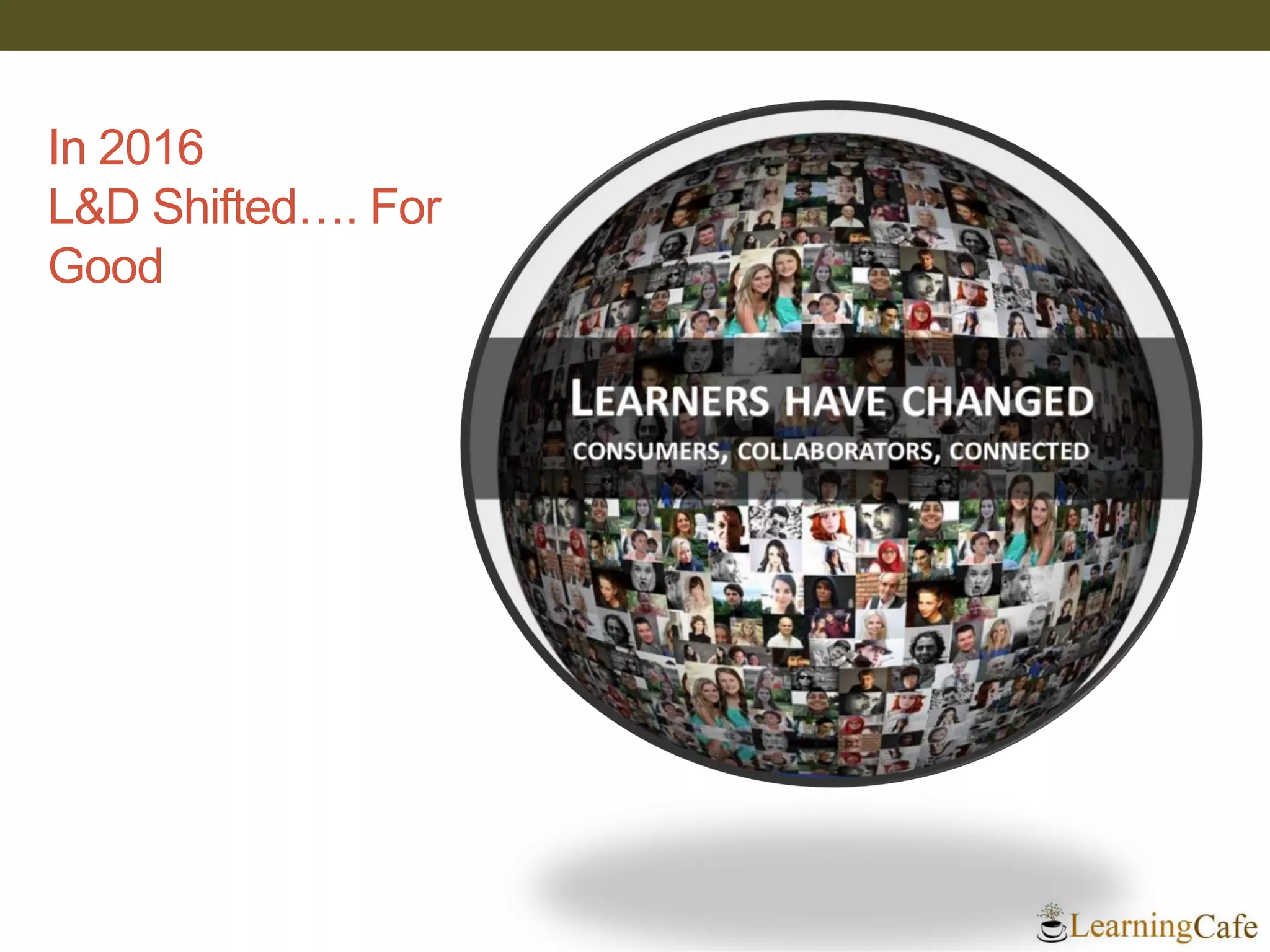
In 2016
L&D Shifted…. For
Good
4 Trends Continue….. and grow
Mobile learning
Micro-learning
Self-directed learning
Immersive learning
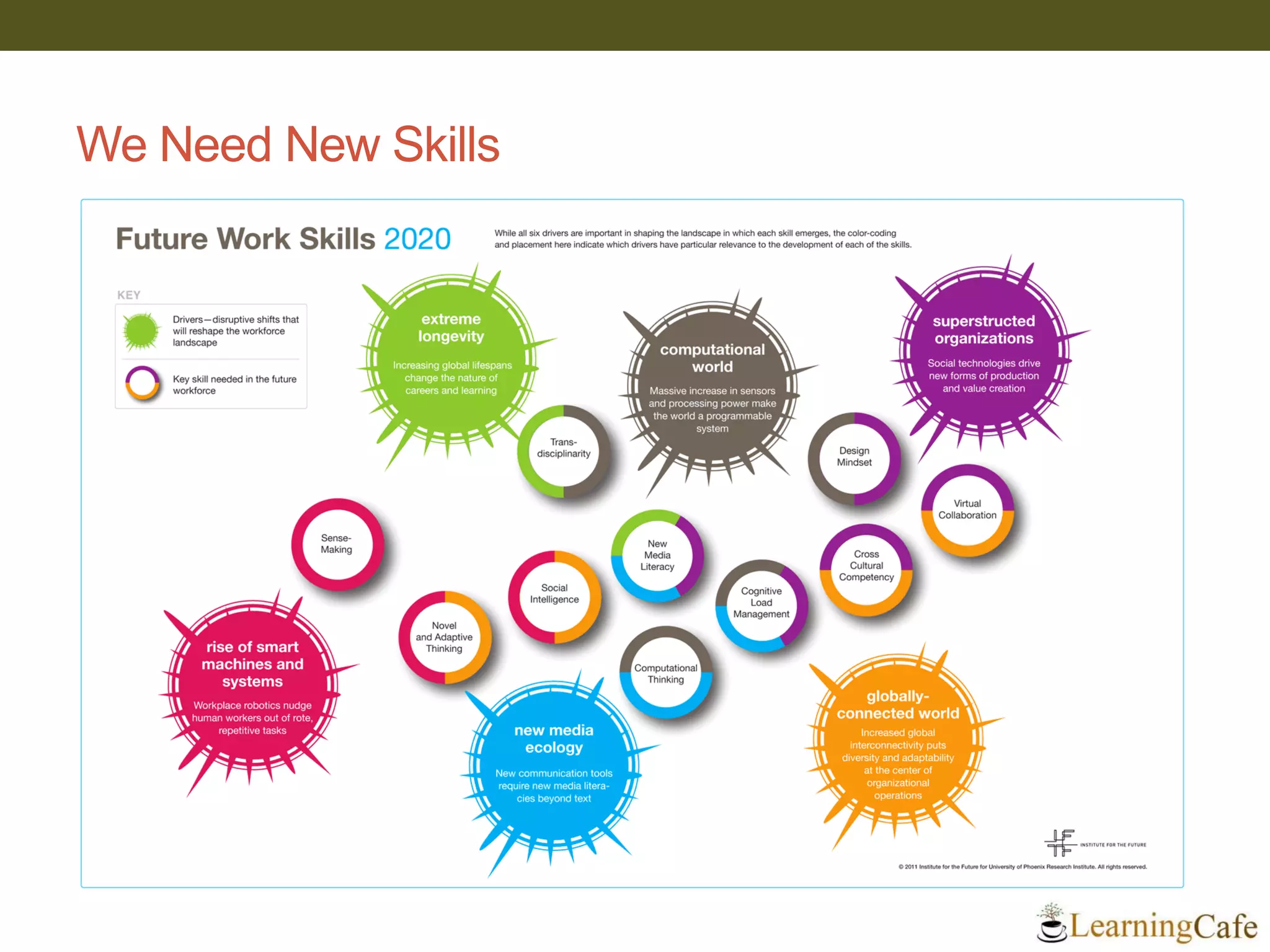
We Need New Skills
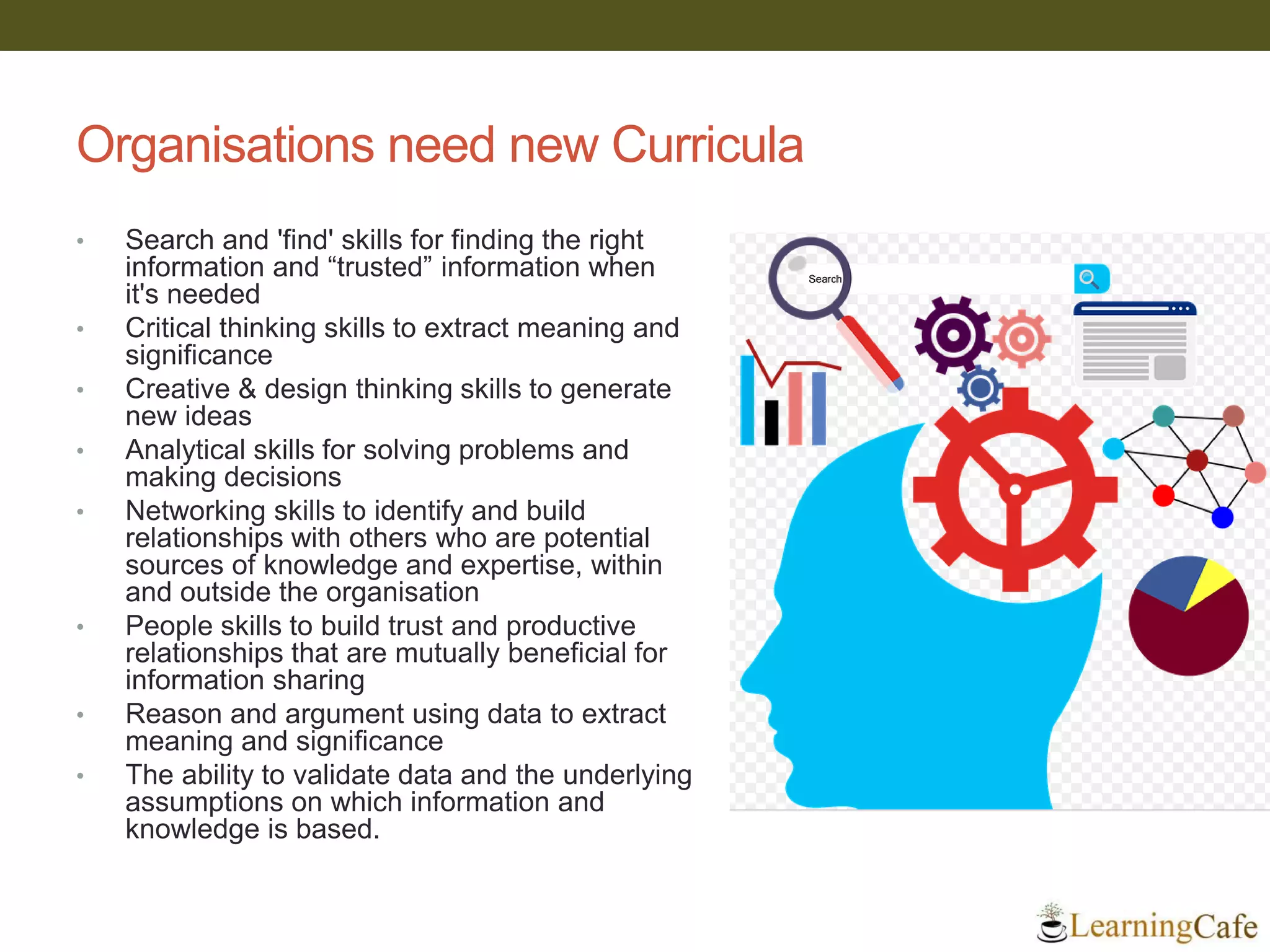
Organisations need new Curricula
• Search and 'find' skills for finding the right
information and “trusted” information when
it's needed
• Critical thinking skills to extract meaning and
significance
• Creative & design thinking skills to generate
new ideas
• Analytical skills for solving problems and
making decisions
• Networking skills to identify and build
relationships with others who are potential
sources of knowledge and expertise, within
and outside the organisation
• People skills to build trust and productive
relationships that are mutually beneficial for
information sharing
• Reason and argument using data to extract
meaning and significance
• The ability to validate data and the underlying
assumptions on which information and
knowledge is based.
LET US TALK TO THE PANEL AND
YOU
38
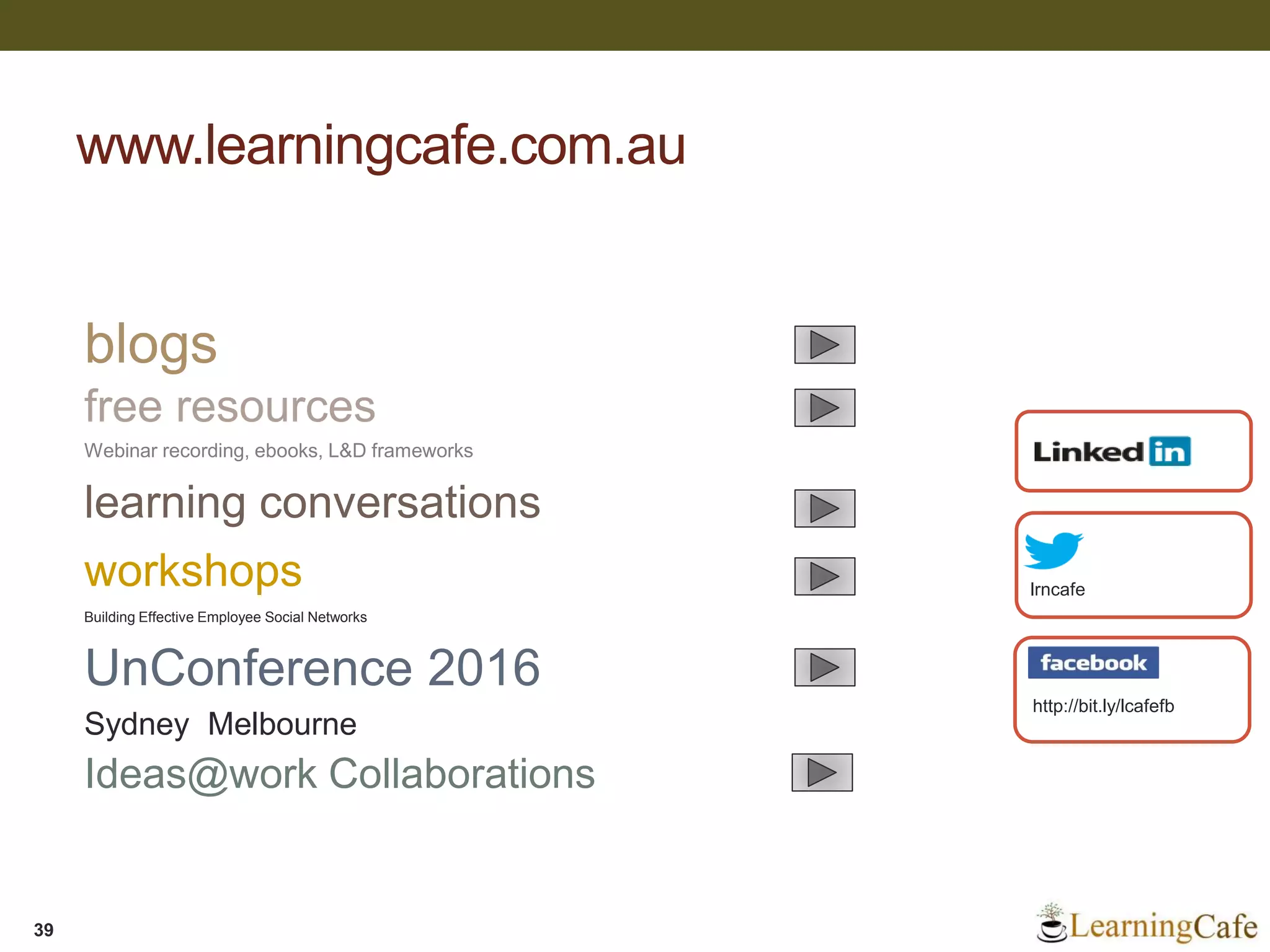
www.learningcafe.com.au
lrncafe
http://bit.ly/lcafefb
blogs
learning conversations
free resources
workshops
UnConference 2016
Sydney Melbourne
Webinar recording, ebooks, L&D frameworks
Building Effective Employee Social Networks
39
Ideas@work Collaborations
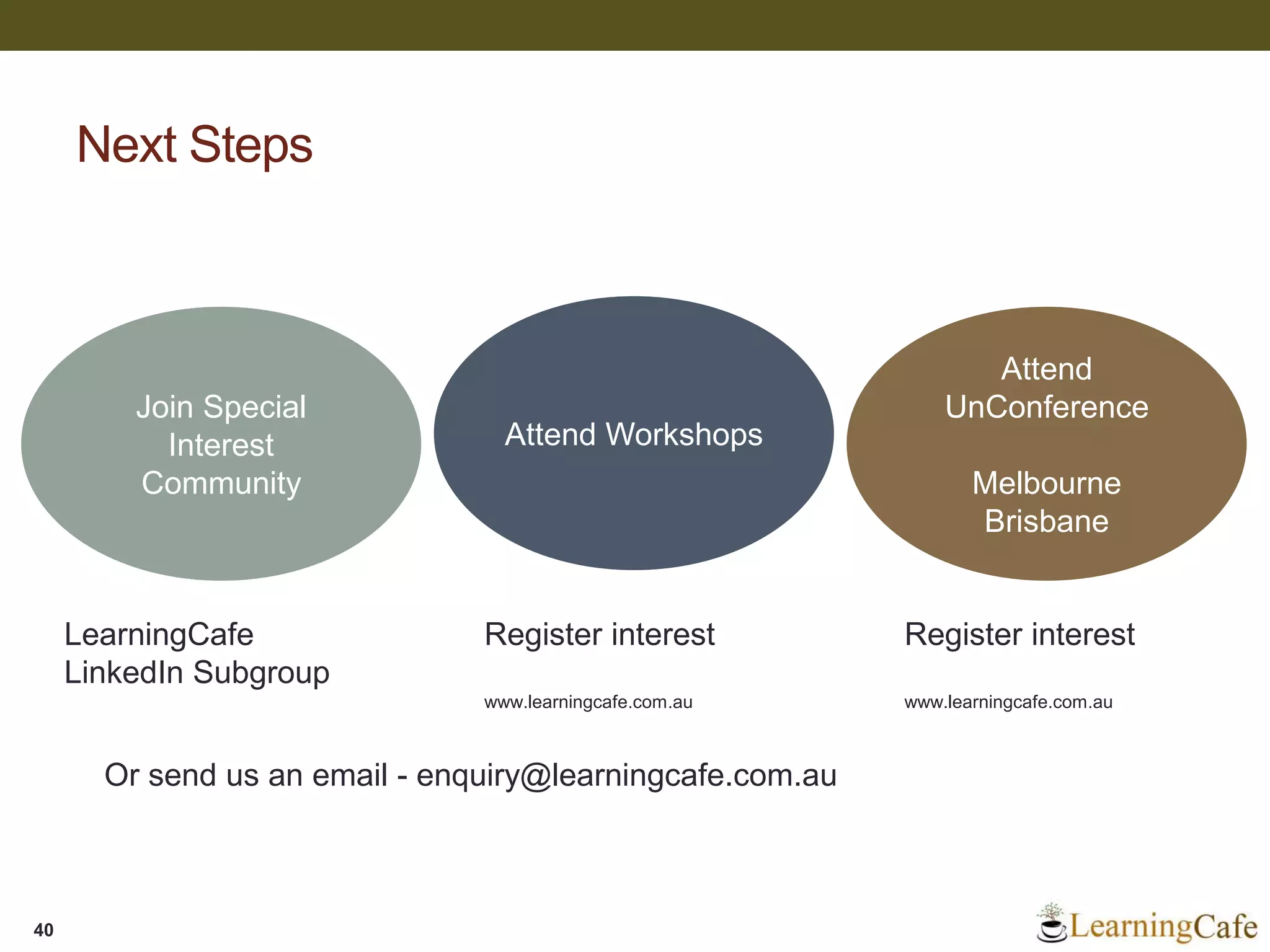
Next Steps
Join Special
Interest
Community
Attend Workshops
Attend
UnConference
Melbourne
Brisbane
LearningCafe
LinkedIn Subgroup
Register interest
www.learningcafe.com.au
Register interest
www.learningcafe.com.au
Or send us an email - enquiry@learningcafe.com.au
40

LearningCafe Year End Webinar - Looking back at 2016. What is coming in 2017?

  • 1.
    Knowledge Sharing Better Practices Experienced Panel Thurs, 15thDec 2016, 12-1 PM, Sydney Ways to participate: • Q&A Box - comment, whinge & opinions • Twitter Backchannel - @lrncafe #LearningTrends LearningCafe Year End Webinar Looking back at 2016. What’s coming in 2017?
  • 2.
    INTRODUCTIONS Registrations115+ Peter Hall Head ofLearning and Development – Australia and Asia Pacific QBE Rob Wilkins Leader – Information Management NSW Department of Education 85+ Organisations 2 Jeevan Joshi Producer LearningCafe & CapabilityCafe AbbVie AIB ANZ APA Group Auspost/StarTrack Australian Red Cross Blood Service BNZ Brightcookie CBH Group Coco Cola Amatil Cerner Churches of Christ in Qld Coca-Cola Beverages Africa CSIRO CUB DEDJTR Department of Employment Dept of Employment Dimension Data Director Education Asia Pacific PL Downer Elders Insurance (QBE) Emmersive Infotech Enable Performance Consulting Ericsson EY Fairfax Media Future Knowledge HSBC IAG IAG New Zealand IECL IMC InspirePro Latitude Financial Services Le Cordon Bleu Macquarie Maura Fay Group McGrathNicol MCI NAB NATA NSW Department of Education Penrith City Council Pernod Ricard Winemakers Qantas Quest Apartment Hotels Rio Tinto Sax Institute Sewells-MSX International Shine Lawyers Siemens Ltd SimTabs SMS Management & Technology St John Ambulance WA TAFE NSW TCSA University of Sydney Wavelength Webqem Westpac White Springs Wiztango Yarno
  • 3.
  • 4.
    JEEVAN JOSHI Producer atLearningCafe & CapabilityCafe 4
  • 5.
  • 6.
  • 7.
  • 8.
  • 9.
    9 Change in L&Dcapability gap between 2014 and 2015 According to Deloitte’s Global Human Capital Trends 2016 report the gap between the importance of employee development and L&D’s perceived ability to meet that need has jumped by 430 percent during the past two years.
  • 10.
    10  Invisible L&D The intersection of career management and worker development  The rise of contextualization  Systemic learner experience  The expansion of the learning technology universe Source:http://blog.bersin.com/invisible-ld/ L&D 2016 / 2017 : Deloitte Invisible, Contextual & Systemic
  • 11.
    11 Deloitte: 8 keytrends in Learning and Development 2015 - 2016 Source: http://www.consultancy.uk/news/2428/deloitte-8-key-trends-in-learning-and-development
  • 12.
    My Own LearningJourney – Portfolio Approach 12 Advice Digital Learning Adviser – Fairfax (0.5/ 6 months) Future Capabilities Adviser Westpac (0.4/ 4 months) Build Knowledge Learn & Experiment Agile /Journey Mapping VR/ Minecraft Capability Management Innovation Management Build Solutions Agile LMS Selection (2) Video based Learning Online Course Development (3) Build Business Conduct Workshops Agile for L&D Business Acumen for L&D Content Curation for L&D CapabilityCafe Workshops for L&D Build LCafe Systems and team Economics Digital Marketing
  • 13.
    Changing Rubric forL&D #1 Design for Real Constraints 13 Annual and Project Budget $$$ Business Requirements Learning Delivered
  • 14.
    Changing Rubric forL&D #1 Design for Real Constraints 14 Annual and Project Budget $$$ Business Requirements Learning Delivered Learner Time Learner Cognitive Bandwidth Knowledge Half Life
  • 15.
    Changing Rubric forL&D #1 Design for Real Constraints 15 Annual and Project Budget $$$Business Requirements Learning Delivered Learner Time Learner Cognitive Bandwidth Knowledge Half Life Compact Smart Chunked Multiple formats KPI For L&D Reduce time spent on Learning
  • 16.
    Changing Rubric forL&D #2 Without Integration, Learning is likely to be Ineffective 16 Knowledge Management Learning Culture & Leadership Process & Systems Capability Management
  • 17.
    Changing Rubric forL&D #3 L&D Capability needs new depth and width 17 Business Partnership Project Management L&D Theory Analysis Design Development Implementation Evaluation Digital Acumen
  • 18.
    Sources of L&DProfessional Development 18 Business Partnership Project Management L&D Theory Analysis Design Development Implementation Evaluation Digital Acumen CERT IV + Bachelors/Masters Most Least Work Experience Classroom Training Formal Qualifications Blogs, videos, informal Learning Acquisition Growth ? ?
  • 19.
    Professional Development Framework forthe Next Gen L&D – Depth & Width 19 Business Partnership Project Management L&D Theory Analysis Design Development Implementation Evaluation DigitalAcumen ConsultingApproach BusinessAcumen Agile&DesignThinking Emerging Tech Start Up/ Entrepreneurship Consumer Trends Workforce/HR Trends Emerging Research in Management Industry Knowledge
  • 20.
    Professional Development Framework forthe Next Gen L&D - Where do I start? 20 Business Partnership Project Management L&D Theory Analysis Design Development Implementation Evaluation DigitalAcumen ConsultingApproach BusinessAcumen Agile&DesignThinking Emerging Tech Start Up/ Entrepreneurship Consumer Trends Workforce/HR Trends Emerging Research in Management Industry Knowledge Highest Priority Lowest Priority Recommended for 2017
  • 21.
    Professional Development Framework forthe Next Gen L&D - How 21 Business Partnership Project Management L&D Theory Analysis Design Development Implementation Evaluation DigitalAcumen ConsultingApproach BusinessAcumen Agile&DesignThinking Emerging Tech Start Up/ Entrepreneurship Consumer Trends Workforce/HR Trends Emerging Research in Management Industry Knowledge Highest Priority Lowest Priority Recommended for 2017 Work Experience Formal Qualifications Classroom Training Blogs, videos, informal Learning
  • 22.
    Depth & Widthwith LearningCafe in 2017 22 F2F Workshops Sydney & Melbourne • Content Curation • Getting Ready for TinCan/xAPI • User Generated Content • Community Management • Digital Immersion for L&D • Designing Portals • Agile for Learning • Blended Learning Design • Consulting Approach for L&D • Effective Capability Management • Business Acumen for L&D • Enterprise Learning Architecture • Practical Learning & Measurement UnConference & Learning Events • Sydney LearningCafe Feb 23 – 440 +GST • Sydney CapabilityCafe Jun 20 • Melbourne LearningCafe Aug 16 • Sydney Business Games for L&D Oct 12 • Melbourne Business Games Nov Nov 16 Webinar & Blogs • 5 LearningCafe Webinars • 5 CapabilityCafe Webinars • Blogs on LearningCafe & CapabilityCafe new new new new new new new new
  • 23.
    And How ? 23 Business Partnership Project Management L&DTheory Analysis Design Development Implementation Evaluation DigitalAcumen ConsultingApproach BusinessAcumen Agile&DesignThinking Emerging Tech Start Up/ Entrepreneurship Consumer Trends Workforce/HR Trends Emerging Research in Management Industry Knowledge Work Experience Classroom Training Formal Qualifications Blogs, videos, informal Learning
  • 24.
    PETER HALL Head ofLearning and Development – Australia and Asia Pacific at QBE 24
  • 25.
    2016 Observations • Thechallenge to do more with less becomes even more ‘the new normal’ • If we thought technology might go away – it’s impacting learning even more • I don’t think we still have the right skills • What’s happened to pure design roles • We need to be all-rounders
  • 26.
    Predictions for 2017 •Be ready to challenge your long established paradigms – be a heretic • L&D people need to be pragmatists • Get serious about broad L&D capability development • F2F will continue to reduce • More (and more) video
  • 27.
    Reflections on whatI’ve learned in 2016 • Stakeholder engagement is the key • Don’t be limited by your uncomfortableness • Continue to educate the business using their language but also push it • Share your knowledge with others
  • 28.
    ROB WILKINS Leader –Information Management at NSW Department of Education 28
  • 29.
    L&D Skills arequickly becoming specialised …… and irrelevant at times • Due to shift in economic models and employment growth and technology impacts on industries • Disruption will continue which will force new curriculum • We need skills to deal with the requirements organisations need and especially to deal with disruption • They will need them at twice the speed • Need agile models of delivery and refocussed effort on how we support learning transfer • We should not have L&D where it is not required • Focus should be on the 70 of the 70:20:10 • Leadership is the final bastion of L&D that will resist change.
  • 30.
    Projected Employment Growth HealthCare and Social Assistance 23.2% Professional, Scientific and Technical Services 14.0% Education and Training 11.3%Retail Trade 9.8% Accommodation and Food Services 9.2% Construction 8.1% Transport, Postal and Warehousing 4.9% Public Administration and Safety 4.8% Financial and Insurance Services 3.5% Other 11.2% Source: Australian Government Industry Employment Projections; 2016 Report’ Release date: March 2016
  • 31.
    The Raw Numbers ('000)(%) Agriculture, Forestry and Fishing -9.4 -3.1 Mining -31.9 -14.1 Manufacturing -45.7 -5.3 Electricity, Gas, Water and Waste Services 0.8 0.6 Construction 87.0 8.3 Wholesale Trade 3.1 0.8 Retail Trade 106.0 8.4 Accommodation and Food Services 98.8 12.0 Transport, Postal and Warehousing 52.2 8.5 Information Media and Telecommunications 8.8 4.0 Financial and Insurance Services 37.4 8.5 Rental, Hiring and Real Estate Services 25.8 11.9 Professional, Scientific and Technical Services 151.2 14.8 Administrative and Support Services 32.6 7.8 Public Administration and Safety 51.2 7.0 Education and Training 121.7 13.0 Health Care and Social Assistance 250.2 16.4 Arts and Recreation Services 24.5 10.8 Other Services 25.5 5.3 All Industries 989.7 8.3 Industry Projected employment growth – five years to November 2020 Source: Australian Government Industry Employment Projections; 2016 Report’ Release date: March 2016
  • 32.
    The commentary onthe numbers • The Department of Employment projects employment to increase by 989,700 (or 8.3 per cent) by November 2020. • Employment is projected to increase in 16 of the 19 broad industries over the five years to November 2020, • The long term structural shift in employment towards services industries is projected to continue over the coming five years. • Largest contribution to employment growth • Health Care and Social Assistance (+250,200), followed by • Professional, Scientific and Technical Services (151,200), • Education and Training (121,700) and Retail Trade (106,000). • Declines in Agriculture, Forestry and Fishing, Mining and Manufacturing
  • 33.
    So what? 15 yearsago eLearning was just beginning and now the future will be “learning experiences” driven by the employee choice. L&D functions don’t have the capability and could be left behind. Outsourced models of expertise can replace L&D now.
  • 34.
  • 35.
    4 Trends Continue…..and grow Mobile learning Micro-learning Self-directed learning Immersive learning
  • 36.
  • 37.
    Organisations need newCurricula • Search and 'find' skills for finding the right information and “trusted” information when it's needed • Critical thinking skills to extract meaning and significance • Creative & design thinking skills to generate new ideas • Analytical skills for solving problems and making decisions • Networking skills to identify and build relationships with others who are potential sources of knowledge and expertise, within and outside the organisation • People skills to build trust and productive relationships that are mutually beneficial for information sharing • Reason and argument using data to extract meaning and significance • The ability to validate data and the underlying assumptions on which information and knowledge is based.
  • 38.
    LET US TALKTO THE PANEL AND YOU 38
  • 39.
    www.learningcafe.com.au lrncafe http://bit.ly/lcafefb blogs learning conversations free resources workshops UnConference2016 Sydney Melbourne Webinar recording, ebooks, L&D frameworks Building Effective Employee Social Networks 39 Ideas@work Collaborations
  • 40.
    Next Steps Join Special Interest Community AttendWorkshops Attend UnConference Melbourne Brisbane LearningCafe LinkedIn Subgroup Register interest www.learningcafe.com.au Register interest www.learningcafe.com.au Or send us an email - enquiry@learningcafe.com.au 40