
Learning Cafe Call
MOOCs in
Corporate
Training
23 July 2013
MOOCs (Massively Open
Online Courses) can be a
mainstream employee
learning option. It offers cost
effective learning with the
benefits far outweighing the
challenges. L&D/HR need to
be proactive in exploring and
including MOOCs in learning
strategies.
1
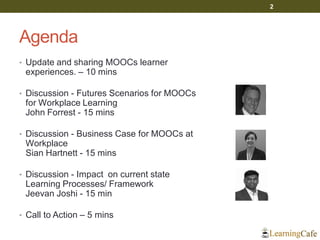
Agenda
• Update and sharing MOOCs learner
experiences. – 10 mins
• Discussion - Futures Scenarios for MOOCs
for Workplace Learning
John Forrest - 15 mins
• Discussion - Business Case for MOOCs at
Workplace
Sian Hartnett - 15 mins
• Discussion - Impact on current state
Learning Processes/ Framework
Jeevan Joshi - 15 min
• Call to Action – 5 mins
2
3
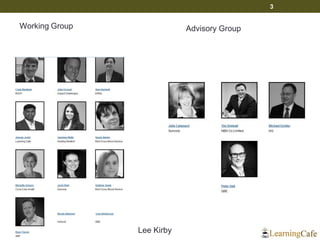
Lee Kirby
Working Group Advisory Group
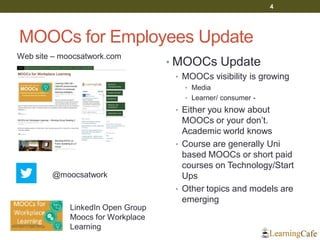
MOOCs for Employees Update
• MOOCs Update
• MOOCs visibility is growing
• Media
• Learner/ consumer -
• Either you know about
MOOCs or your don’t.
Academic world knows
• Course are generally Uni
based MOOCs or short paid
courses on Technology/Start
Ups
• Other topics and models are
emerging
4
Web site – moocsatwork.com
@moocsatwork
LinkedIn Open Group
Moocs for Workplace
Learning
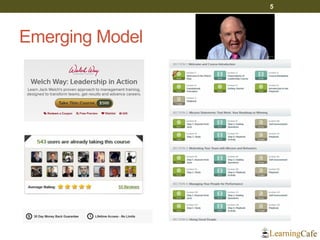
Emerging Model
5
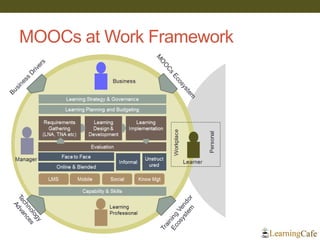
MOOCs at Work Framework
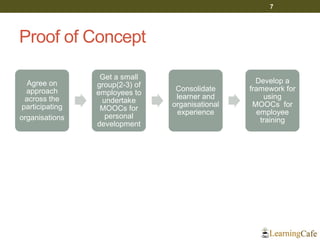
Proof of Concept
Agree on
approach
across the
participating
organisations
Get a small
group(2-3) of
employees to
undertake
MOOCs for
personal
development
Consolidate
learner and
organisational
experience
Develop a
framework for
using
MOOCs for
employee
training
7
FUTURE SCENARIOS
John Forrest
John.forrest@allestis.com
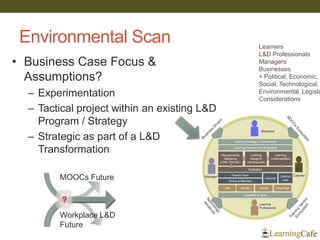
Environmental Scan
• Business Case Focus &
Assumptions?
– Experimentation
– Tactical project within an existing L&D
Program / Strategy
– Strategic as part of a L&D
Transformation
MOOCs Future
Workplace L&D
Future
?
Learners
L&D Professionals
Managers
Businesses
+ Political, Economic,
Social, Technological,
Environmental, Legisla
Considerations
MOOC Specific Focus
• Assuming Massive, Open, Online Courses are, by definition, ‘en
mass’ – beyond the company context
• What are the key disruptive differences of MOOCs
• Inexpensive (economies of scale change L&D business models)
• Wide variety of content (growing ever wider)
• More immediate availability (towards on demand)
• Difficult to assure quality (is it easy now?)
• Learning goals and evidence not subject to business scrutiny or alignment (are
they now?)
• No (business) control over audience make-up
• Interaction with broader audience, work shared openly
• …
• Is it about control?
• Is this a threat to current bespoke, custom, closed approaches which
have struggled to deliver measurable results?
• How do these disruptive differences influence the environment and
how are they influenced by the environment?
A Future Influenced By the Past?
• Historical Content Examples?
• Software
• Music
• Books, articles and papers
• Movies
• …
• Historical Service Examples?
• Recruitment
• Product Sourcing
• Travel Agents
• …
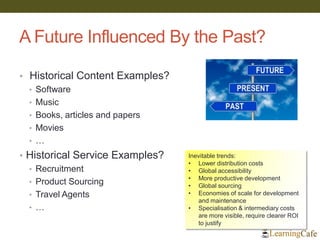
Inevitable trends:
• Lower distribution costs
• Global accessibility
• More productive development
• Global sourcing
• Economies of scale for development
and maintenance
• Specialisation & intermediary costs
are more visible, require clearer ROI
to justify
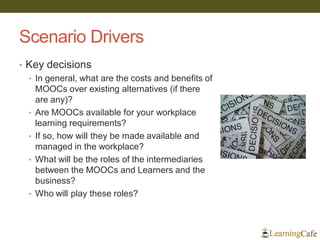
Scenario Drivers
• Key decisions
• In general, what are the costs and benefits of
MOOCs over existing alternatives (if there
are any)?
• Are MOOCs available for your workplace
learning requirements?
• If so, how will they be made available and
managed in the workplace?
• What will be the roles of the intermediaries
between the MOOCs and Learners and the
business?
• Who will play these roles?
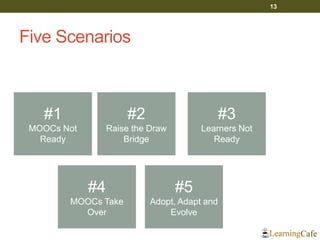
Five Scenarios
13
#1
MOOCs Not
Ready
#2
Raise the Draw
Bridge
#3
Learners Not
Ready
#4
MOOCs Take
Over
#5
Adopt, Adapt and
Evolve
Scenario #1 – MOOCs Not Ready
• MOOCs do not now (and are not likely in the next 3
years to) offer a viable alternative to existing course
solutions
• Over-hyped, unrealistic, can’t deliver
• MOOCs go for lowest common denominator mass
markets – most workplaces have narrower, higher
quality, professional level requirements
• Continue to evolve in-house L&D maturity, use
technology, outsource some content delivery and
development but keep business control
1
Scenario #2 – Raise the Draw Bridge
• MOOCs are viable
• The L&D practice community feels threatened by the
consumerisation of learning
• L&D professionals try to apply existing training course
management / development mind-set to MOOCs
• L&D professionals are dis-intermediated as business
managers & HR allow Learners to go direct to MOOC
providers
• L&D budgets are redirected to business managers
and HR for discretionary spend
• With lower budgets, L&D function struggles to
demonstrate any measurable outcomes
2
Scenario #3 – Learners Not Ready (L-
Plates)
• MOOCs are viable
• Learners do not have discipline, skills and motivation
to self-drive
• As a result, L&D professionals are still heavily
involved as intermediaries between MOOCs and
Learners
• L&D professionals spend more time managing MOOC
sources than they would managing own content
creation
• Management overheads offset low cost of MOOCs
3
Scenario #4 – MOOCs Take Over
Guild Halls
• MOOCs are viable
• Rise of an alternate intermediary, displacing business
L&D
• Professional associations drive standardisation and
endorse MOOC catalogues
• Workplace management relies upon professional
development bodies to be responsible for L&D
• HR provides incentives / requirements for Learners to
be accredited by external bodies
• Learners receive most structured training through
professional association, union etc..
• L&D professionals migrate away from the business
and into professional development organisations
4
Scenario #5 – Adopt, Adapt and Evolve
• MOOCs are viable
• L&D professionals identify a value adding facilitation
and curation roles
• Provide governance and quality assurance over
portfolios of largely Learner self-service MOOC
offerings
• Business L&D focuses on the high value, low volume
opportunities for specialist intervention
• Business view MOOCs as one of the outsourced
products/services enabled and managed by the
business L&D function
5
Impact Challenges
• Short-form scenario challenges to Learning Café members
around these themes
• Encourage scenario based decision making and consideration
of enablers and constraints on possible future directions
• Open for group to share perspectives
• For example:
• You learn from a contact in HR that a business unit manager has
funded MOOC enrolments for their staff out of the unit’s operating
budget and allowed a few hours of week study time.
• The same unit manager recently refused to contribute a share of their
budget to an integrated corporate training program.
• What do you do?
• Are there policies which determine whether this initiative is within
business guidelines?
BUILDING THE MOOC
BUSINESS CASE
Some considerations for L&D Professionals...
Sian Hartnett
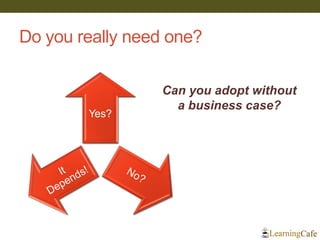
Yes?
Do you really need one?
Can you adopt without
a business case?
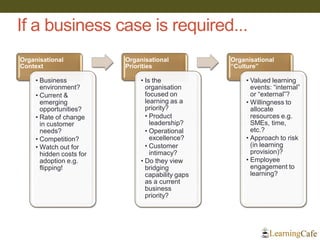
If a business case is required...
Organisational
Context
• Business
environment?
• Current &
emerging
opportunities?
• Rate of change
in customer
needs?
• Competition?
• Watch out for
hidden costs for
adoption e.g.
flipping!
Organisational
Priorities
• Is the
organisation
focused on
learning as a
priority?
• Product
leadership?
• Operational
excellence?
• Customer
intimacy?
• Do they view
bridging
capability gaps
as a current
business
priority?
Organisational
“Culture”
• Valued learning
events: “internal”
or “external”?
• Willingness to
allocate
resources e.g.
SMEs, time,
etc.?
• Approach to risk
(in learning
provision)?
• Employee
engagement to
learning?
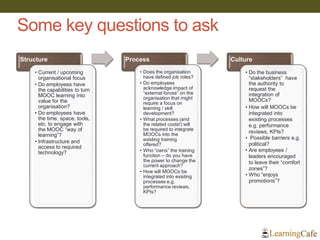
Some key questions to ask
Structure
• Current / upcoming
organisational focus
• Do employees have
the capabilities to turn
MOOC learning into
value for the
organisation?
• Do employees have
the time, space, tools,
etc. to engage with
the MOOC “way of
learning”?
• Infrastructure and
access to required
technology?
Process
• Does the organisation
have defined job roles?
• Do employees
acknowledge impact of
“external forces” on the
organisation that might
require a focus on
learning / skill
development?
• What processes (and
the related costs!) will
be required to integrate
MOOCs into the
existing training
offered?
• Who “owns” the training
function – do you have
the power to change the
current approach?
• How will MOOCs be
integrated into existing
processes e.g.
performance reviews,
KPIs?
Culture
• Do the business
“stakeholders” have
the authority to
request the
integration of
MOOCs?
• How will MOOCs be
integrated into
existing processes
e.g. performance
reviews, KPIs?
• Possible barriers e.g.
political?
• Are employees /
leaders encouraged
to leave their “comfort
zones”?
• Who “enjoys
promotions”?
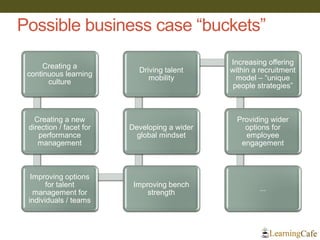
Possible business case “buckets”
Creating a
continuous learning
culture
Creating a new
direction / facet for
performance
management
Improving options
for talent
management for
individuals / teams
Improving bench
strength
Developing a wider
global mindset
Driving talent
mobility
Increasing offering
within a recruitment
model – “unique
people strategies”
Providing wider
options for
employee
engagement
...
IMPACT ON LEARNING
John Forrest
John.forrest@allestis.com
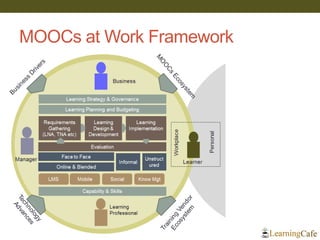
MOOCs at Work Framework
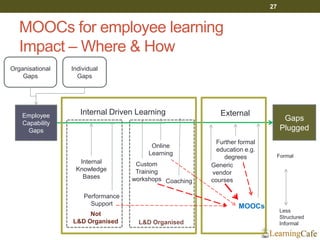
MOOCs for employee learning
Impact – Where & How
27
Employee
Capability
Gaps
Organisational
Gaps
Individual
Gaps
Gaps
Plugged
Custom
Training
workshops
Online
Learning
Coaching
L&D Organised
Internal
Knowledge
Bases
Performance
Support
Not
L&D Organised
Internal Driven Learning External
Generic
vendor
courses
Further formal
education e.g.
degrees
MOOCs
Formal
Less
Structured
Informal
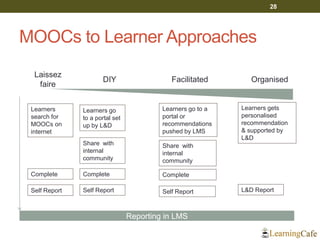
MOOCs to Learner Approaches
28
DIY Facilitated Organised
Laissez
faire
Learners
search for
MOOCs on
internet
Complete
Reporting in LMS
Learners go
to a portal set
up by L&D
Complete
Learners go to a
portal or
recommendations
pushed by LMS
Share with
internal
community
Complete
Share with
internal
community
Learners gets
personalised
recommendation
& supported by
L&D
Self Report Self Report Self Report L&D Report
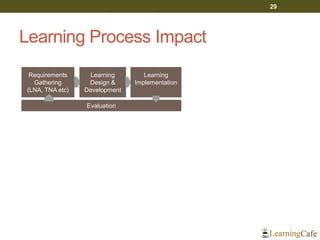
Learning Process Impact
29
Requirements
Gathering
(LNA, TNA etc)
Learning
Design &
Development
Learning
Implementation
Evaluation
Call to Action
30
Follow MOOCs at work
• LinkedIn Groups
• Follow on Twitter - @moocsatwork
• Sign up at
Identify your area of interest
Cost
Usually free – Certificate - $70
Commercial MOOCS - $60
Levels of Engagement with MOOCs
31
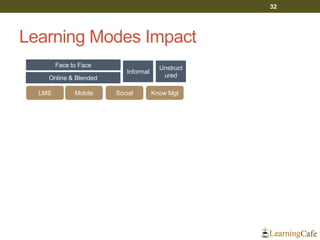
Learning Modes Impact
32
Face to Face
Online & Blended
Informal
Unstruct
ured
LMS Mobile Social Know Mgt
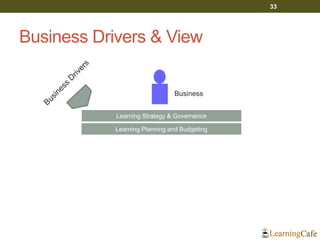
Business Drivers & View
33
Learning Strategy & Governance
Learning Planning and Budgeting
Business
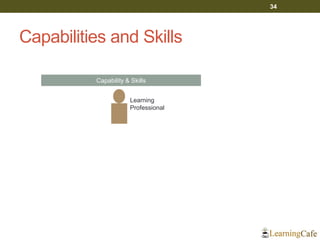
Capabilities and Skills
34
Capability & Skills
Learning
Professional
Questions to Discuss
• One of the challenges the working group has raised is what part
does L&D get to play in MOOCs for Learning. The answer may turn
out to be very different to what we do now.
• Currently MOOCs are predominantly available for certain topics ie
IT, Management, Science which only meet part of organisational
needs.

MOOCS@Work Working Group Session 2

  • 1.
    Learning Cafe Call MOOCsin Corporate Training 23 July 2013 MOOCs (Massively Open Online Courses) can be a mainstream employee learning option. It offers cost effective learning with the benefits far outweighing the challenges. L&D/HR need to be proactive in exploring and including MOOCs in learning strategies. 1
  • 2.
    Agenda • Update andsharing MOOCs learner experiences. – 10 mins • Discussion - Futures Scenarios for MOOCs for Workplace Learning John Forrest - 15 mins • Discussion - Business Case for MOOCs at Workplace Sian Hartnett - 15 mins • Discussion - Impact on current state Learning Processes/ Framework Jeevan Joshi - 15 min • Call to Action – 5 mins 2
  • 3.
  • 4.
    MOOCs for EmployeesUpdate • MOOCs Update • MOOCs visibility is growing • Media • Learner/ consumer - • Either you know about MOOCs or your don’t. Academic world knows • Course are generally Uni based MOOCs or short paid courses on Technology/Start Ups • Other topics and models are emerging 4 Web site – moocsatwork.com @moocsatwork LinkedIn Open Group Moocs for Workplace Learning
  • 5.
  • 6.
    MOOCs at WorkFramework
  • 7.
    Proof of Concept Agreeon approach across the participating organisations Get a small group(2-3) of employees to undertake MOOCs for personal development Consolidate learner and organisational experience Develop a framework for using MOOCs for employee training 7
  • 8.
  • 9.
    Environmental Scan • BusinessCase Focus & Assumptions? – Experimentation – Tactical project within an existing L&D Program / Strategy – Strategic as part of a L&D Transformation MOOCs Future Workplace L&D Future ? Learners L&D Professionals Managers Businesses + Political, Economic, Social, Technological, Environmental, Legisla Considerations
  • 10.
    MOOC Specific Focus •Assuming Massive, Open, Online Courses are, by definition, ‘en mass’ – beyond the company context • What are the key disruptive differences of MOOCs • Inexpensive (economies of scale change L&D business models) • Wide variety of content (growing ever wider) • More immediate availability (towards on demand) • Difficult to assure quality (is it easy now?) • Learning goals and evidence not subject to business scrutiny or alignment (are they now?) • No (business) control over audience make-up • Interaction with broader audience, work shared openly • … • Is it about control? • Is this a threat to current bespoke, custom, closed approaches which have struggled to deliver measurable results? • How do these disruptive differences influence the environment and how are they influenced by the environment?
  • 11.
    A Future InfluencedBy the Past? • Historical Content Examples? • Software • Music • Books, articles and papers • Movies • … • Historical Service Examples? • Recruitment • Product Sourcing • Travel Agents • … Inevitable trends: • Lower distribution costs • Global accessibility • More productive development • Global sourcing • Economies of scale for development and maintenance • Specialisation & intermediary costs are more visible, require clearer ROI to justify
  • 12.
    Scenario Drivers • Keydecisions • In general, what are the costs and benefits of MOOCs over existing alternatives (if there are any)? • Are MOOCs available for your workplace learning requirements? • If so, how will they be made available and managed in the workplace? • What will be the roles of the intermediaries between the MOOCs and Learners and the business? • Who will play these roles?
  • 13.
    Five Scenarios 13 #1 MOOCs Not Ready #2 Raisethe Draw Bridge #3 Learners Not Ready #4 MOOCs Take Over #5 Adopt, Adapt and Evolve
  • 14.
    Scenario #1 –MOOCs Not Ready • MOOCs do not now (and are not likely in the next 3 years to) offer a viable alternative to existing course solutions • Over-hyped, unrealistic, can’t deliver • MOOCs go for lowest common denominator mass markets – most workplaces have narrower, higher quality, professional level requirements • Continue to evolve in-house L&D maturity, use technology, outsource some content delivery and development but keep business control 1
  • 15.
    Scenario #2 –Raise the Draw Bridge • MOOCs are viable • The L&D practice community feels threatened by the consumerisation of learning • L&D professionals try to apply existing training course management / development mind-set to MOOCs • L&D professionals are dis-intermediated as business managers & HR allow Learners to go direct to MOOC providers • L&D budgets are redirected to business managers and HR for discretionary spend • With lower budgets, L&D function struggles to demonstrate any measurable outcomes 2
  • 16.
    Scenario #3 –Learners Not Ready (L- Plates) • MOOCs are viable • Learners do not have discipline, skills and motivation to self-drive • As a result, L&D professionals are still heavily involved as intermediaries between MOOCs and Learners • L&D professionals spend more time managing MOOC sources than they would managing own content creation • Management overheads offset low cost of MOOCs 3
  • 17.
    Scenario #4 –MOOCs Take Over Guild Halls • MOOCs are viable • Rise of an alternate intermediary, displacing business L&D • Professional associations drive standardisation and endorse MOOC catalogues • Workplace management relies upon professional development bodies to be responsible for L&D • HR provides incentives / requirements for Learners to be accredited by external bodies • Learners receive most structured training through professional association, union etc.. • L&D professionals migrate away from the business and into professional development organisations 4
  • 18.
    Scenario #5 –Adopt, Adapt and Evolve • MOOCs are viable • L&D professionals identify a value adding facilitation and curation roles • Provide governance and quality assurance over portfolios of largely Learner self-service MOOC offerings • Business L&D focuses on the high value, low volume opportunities for specialist intervention • Business view MOOCs as one of the outsourced products/services enabled and managed by the business L&D function 5
  • 19.
    Impact Challenges • Short-formscenario challenges to Learning Café members around these themes • Encourage scenario based decision making and consideration of enablers and constraints on possible future directions • Open for group to share perspectives • For example: • You learn from a contact in HR that a business unit manager has funded MOOC enrolments for their staff out of the unit’s operating budget and allowed a few hours of week study time. • The same unit manager recently refused to contribute a share of their budget to an integrated corporate training program. • What do you do? • Are there policies which determine whether this initiative is within business guidelines?
  • 20.
    BUILDING THE MOOC BUSINESSCASE Some considerations for L&D Professionals... Sian Hartnett
  • 21.
    Yes? Do you reallyneed one? Can you adopt without a business case?
  • 22.
    If a businesscase is required... Organisational Context • Business environment? • Current & emerging opportunities? • Rate of change in customer needs? • Competition? • Watch out for hidden costs for adoption e.g. flipping! Organisational Priorities • Is the organisation focused on learning as a priority? • Product leadership? • Operational excellence? • Customer intimacy? • Do they view bridging capability gaps as a current business priority? Organisational “Culture” • Valued learning events: “internal” or “external”? • Willingness to allocate resources e.g. SMEs, time, etc.? • Approach to risk (in learning provision)? • Employee engagement to learning?
  • 23.
    Some key questionsto ask Structure • Current / upcoming organisational focus • Do employees have the capabilities to turn MOOC learning into value for the organisation? • Do employees have the time, space, tools, etc. to engage with the MOOC “way of learning”? • Infrastructure and access to required technology? Process • Does the organisation have defined job roles? • Do employees acknowledge impact of “external forces” on the organisation that might require a focus on learning / skill development? • What processes (and the related costs!) will be required to integrate MOOCs into the existing training offered? • Who “owns” the training function – do you have the power to change the current approach? • How will MOOCs be integrated into existing processes e.g. performance reviews, KPIs? Culture • Do the business “stakeholders” have the authority to request the integration of MOOCs? • How will MOOCs be integrated into existing processes e.g. performance reviews, KPIs? • Possible barriers e.g. political? • Are employees / leaders encouraged to leave their “comfort zones”? • Who “enjoys promotions”?
  • 24.
    Possible business case“buckets” Creating a continuous learning culture Creating a new direction / facet for performance management Improving options for talent management for individuals / teams Improving bench strength Developing a wider global mindset Driving talent mobility Increasing offering within a recruitment model – “unique people strategies” Providing wider options for employee engagement ...
  • 25.
    IMPACT ON LEARNING JohnForrest John.forrest@allestis.com
  • 26.
    MOOCs at WorkFramework
  • 27.
    MOOCs for employeelearning Impact – Where & How 27 Employee Capability Gaps Organisational Gaps Individual Gaps Gaps Plugged Custom Training workshops Online Learning Coaching L&D Organised Internal Knowledge Bases Performance Support Not L&D Organised Internal Driven Learning External Generic vendor courses Further formal education e.g. degrees MOOCs Formal Less Structured Informal
  • 28.
    MOOCs to LearnerApproaches 28 DIY Facilitated Organised Laissez faire Learners search for MOOCs on internet Complete Reporting in LMS Learners go to a portal set up by L&D Complete Learners go to a portal or recommendations pushed by LMS Share with internal community Complete Share with internal community Learners gets personalised recommendation & supported by L&D Self Report Self Report Self Report L&D Report
  • 29.
    Learning Process Impact 29 Requirements Gathering (LNA,TNA etc) Learning Design & Development Learning Implementation Evaluation
  • 30.
    Call to Action 30 FollowMOOCs at work • LinkedIn Groups • Follow on Twitter - @moocsatwork • Sign up at Identify your area of interest Cost Usually free – Certificate - $70 Commercial MOOCS - $60
  • 31.
    Levels of Engagementwith MOOCs 31
  • 32.
    Learning Modes Impact 32 Faceto Face Online & Blended Informal Unstruct ured LMS Mobile Social Know Mgt
  • 33.
    Business Drivers &View 33 Learning Strategy & Governance Learning Planning and Budgeting Business
  • 34.
    Capabilities and Skills 34 Capability& Skills Learning Professional
  • 35.
    Questions to Discuss •One of the challenges the working group has raised is what part does L&D get to play in MOOCs for Learning. The answer may turn out to be very different to what we do now. • Currently MOOCs are predominantly available for certain topics ie IT, Management, Science which only meet part of organisational needs.