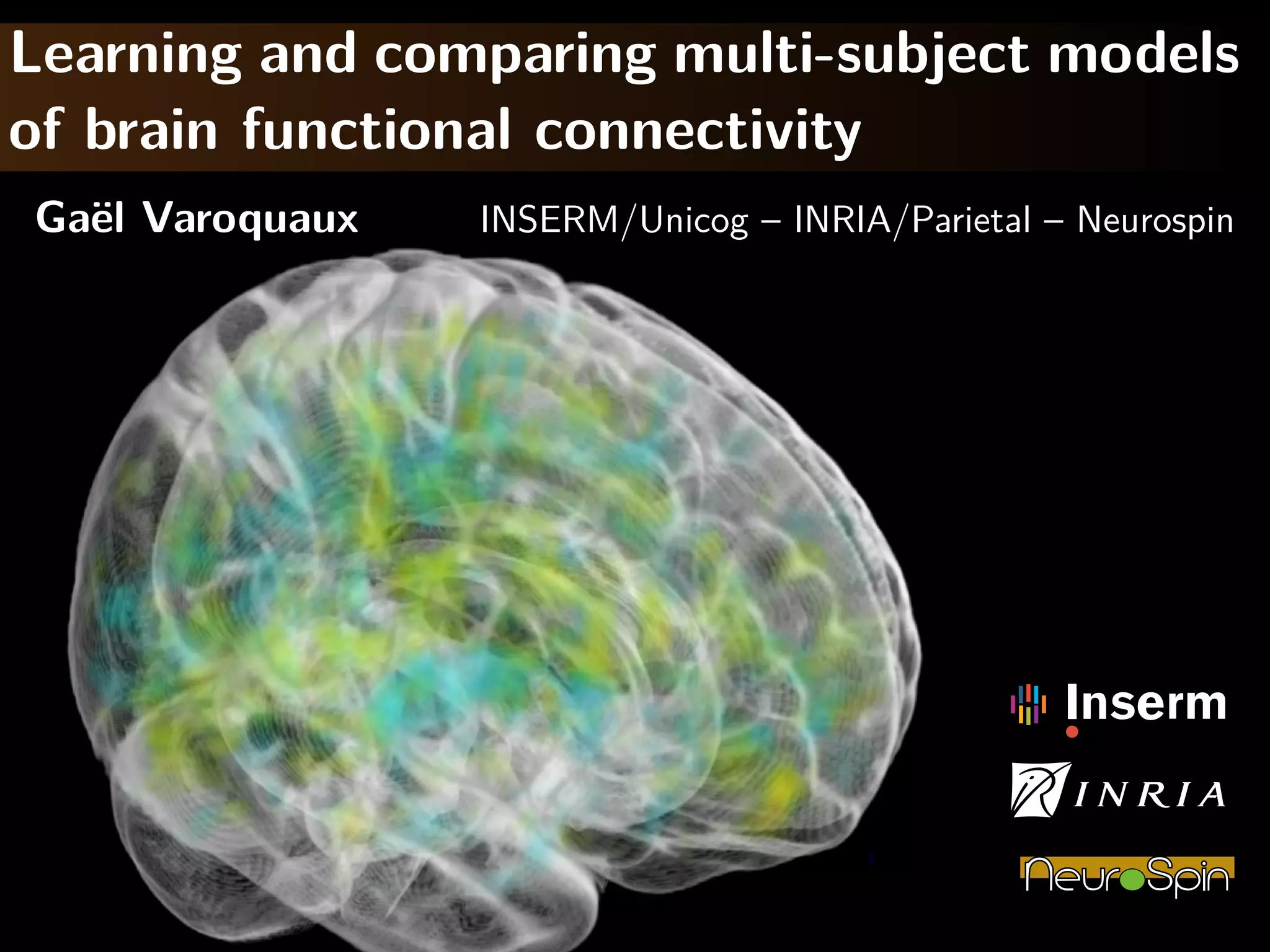
Learning and comparing multi-subject models
of brain functional connectivity
Ga¨l Varoquaux
  e              INSERM/Unicog – INRIA/Parietal – Neurospin
Intrinsic brain structures in on-going activity?
                   (cognitive and systems neuroscience research)

      Diagnostic markers in resting-state?
                                         (medical applications)


                            Need population-level models
                            Statistical (generative) models
                            + explicit subject variability
                            In order to
                              Accumulate data in a group
                              Compare subjects


G Varoquaux                                                        2
Outline


  1 Spatial modes of ongoing activity


  2 Graphical models of brain connectivity


  3 Detecting differences in connectivity


G Varoquaux                                  3
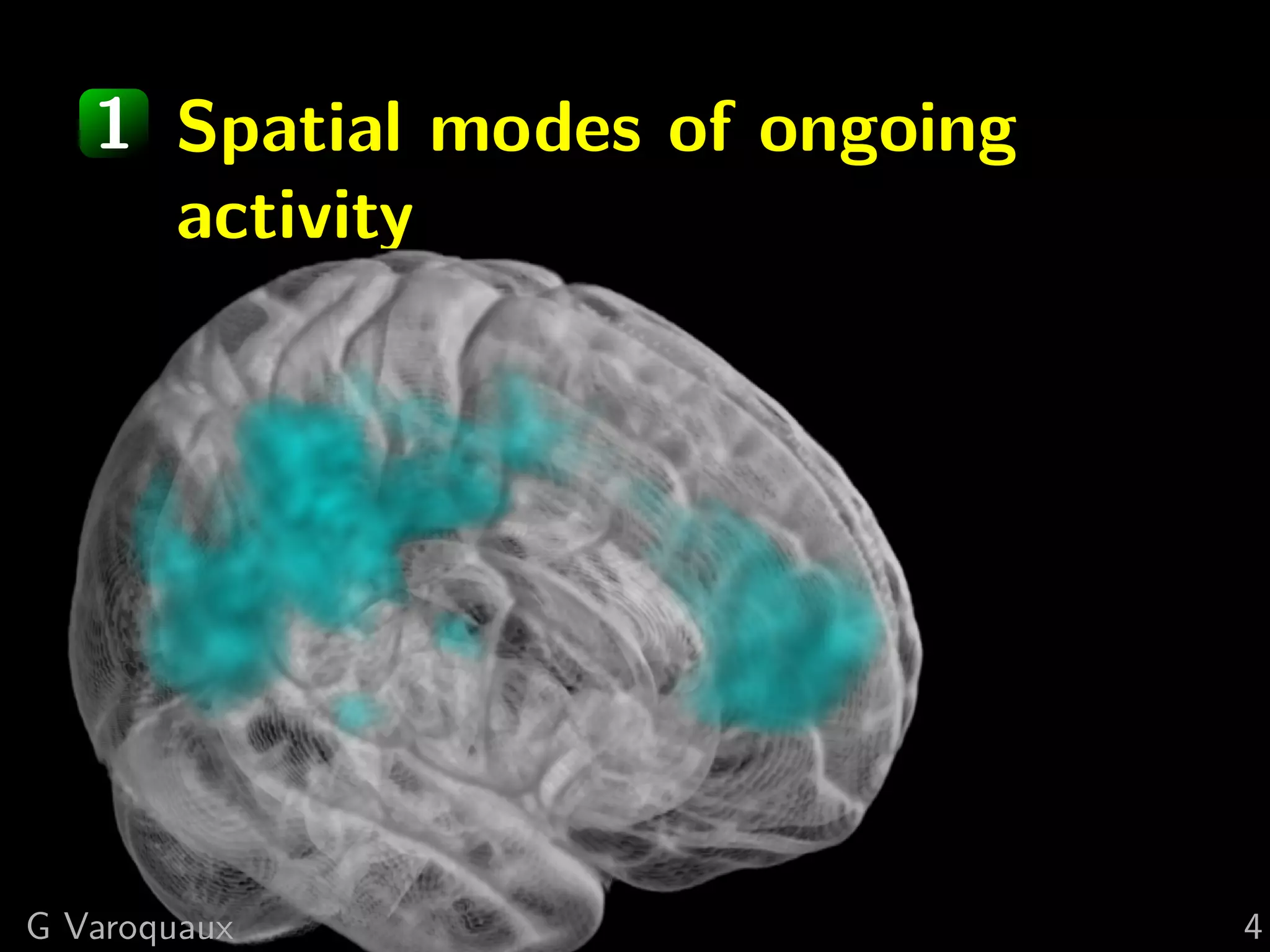
1 Spatial modes of ongoing
     activity


G Varoquaux                     4
1 Spatial modes of ongoing
     activity


G Varoquaux                     4
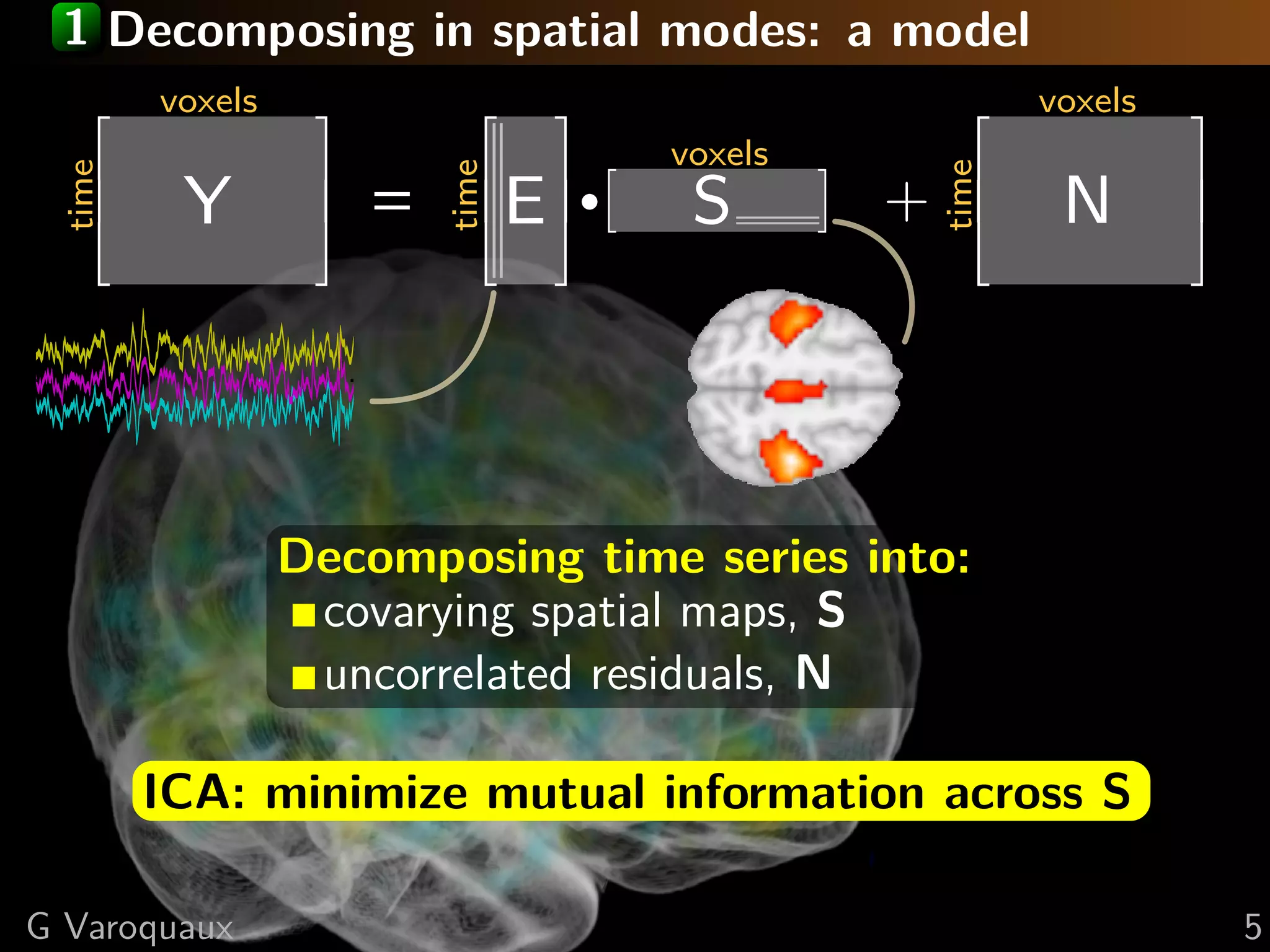
1 Decomposing in spatial modes: a model
            voxels                                         voxels
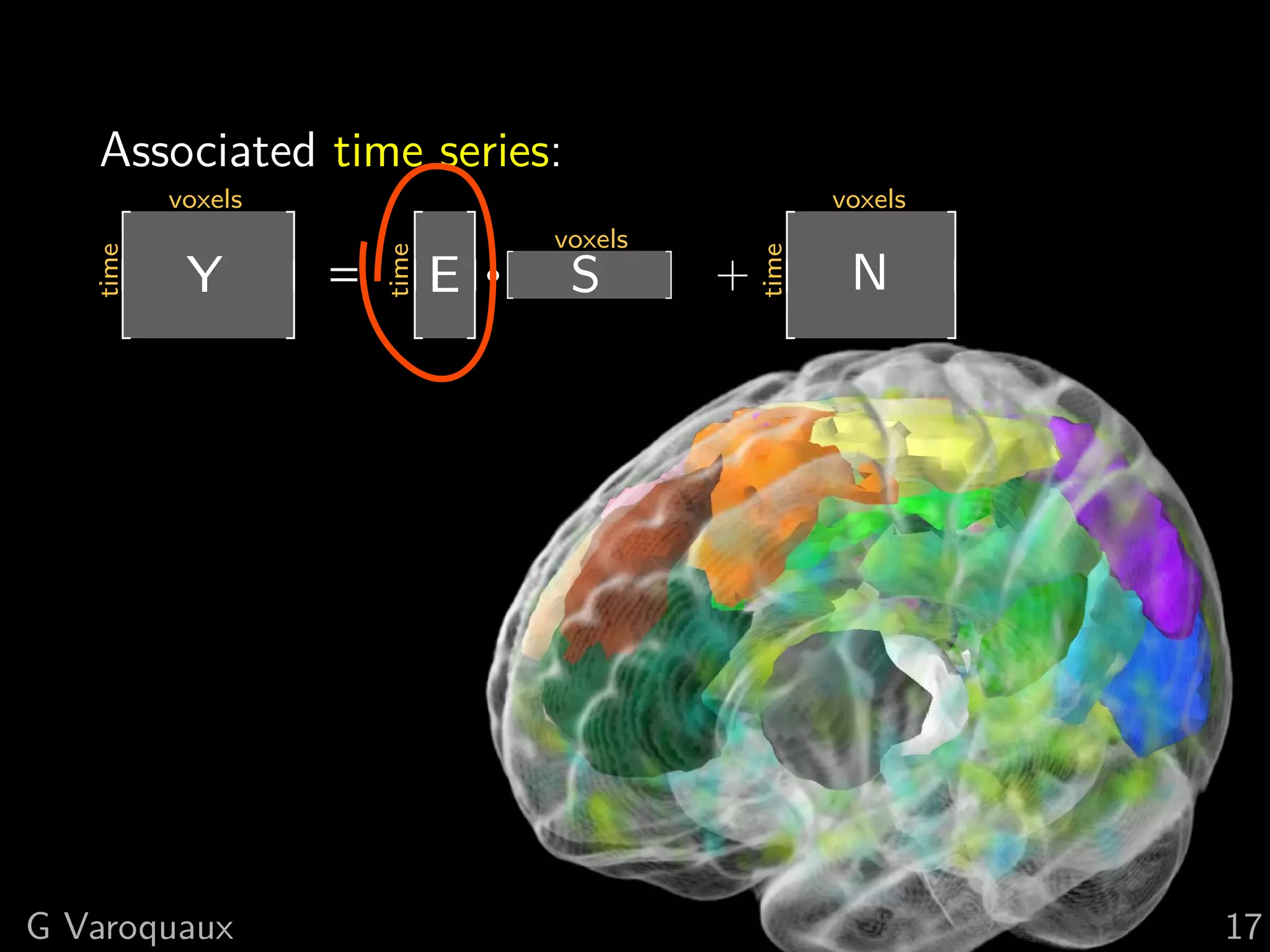
                                           voxels
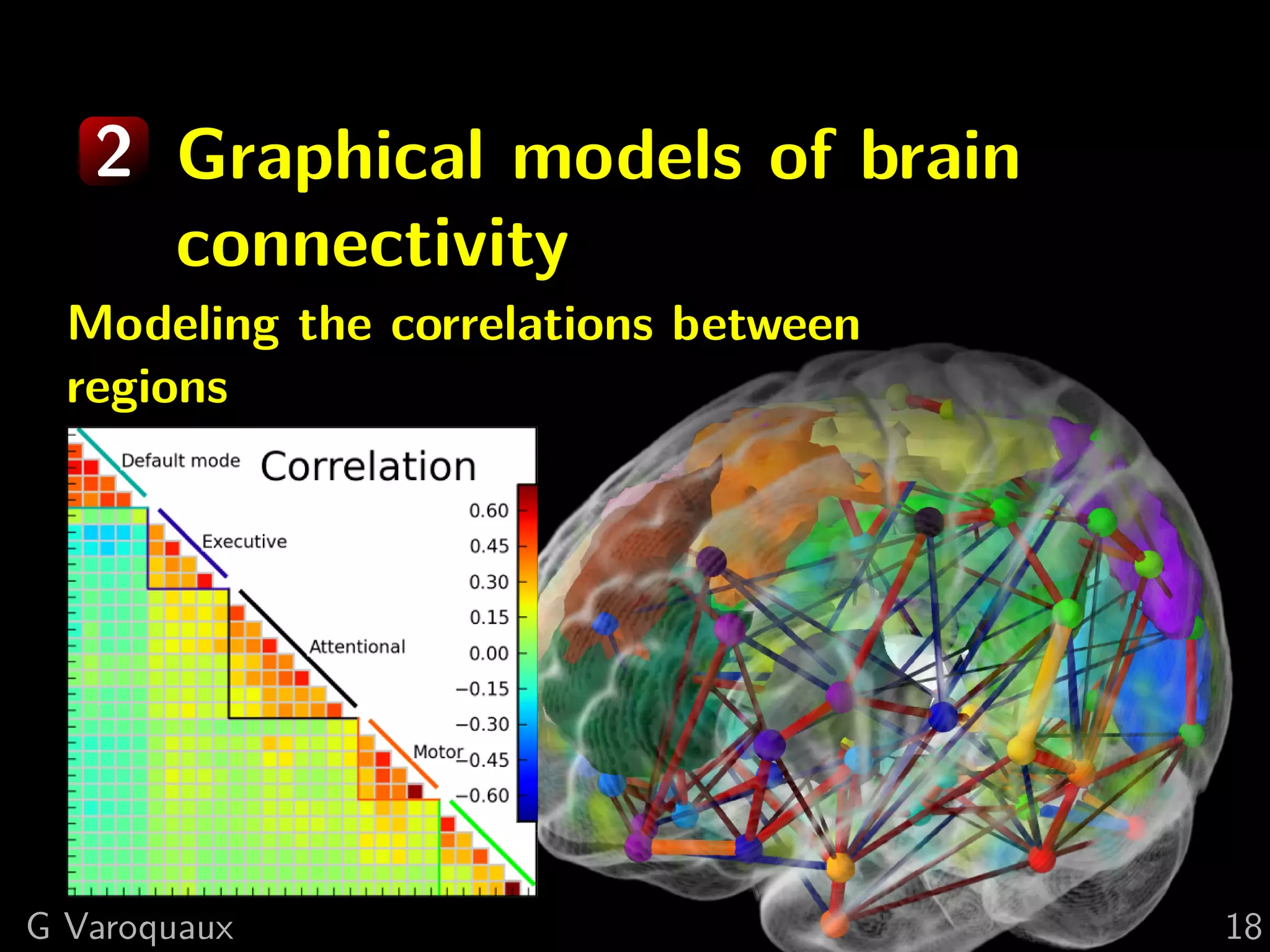
             Y                     E   ·    S       +       N
     time


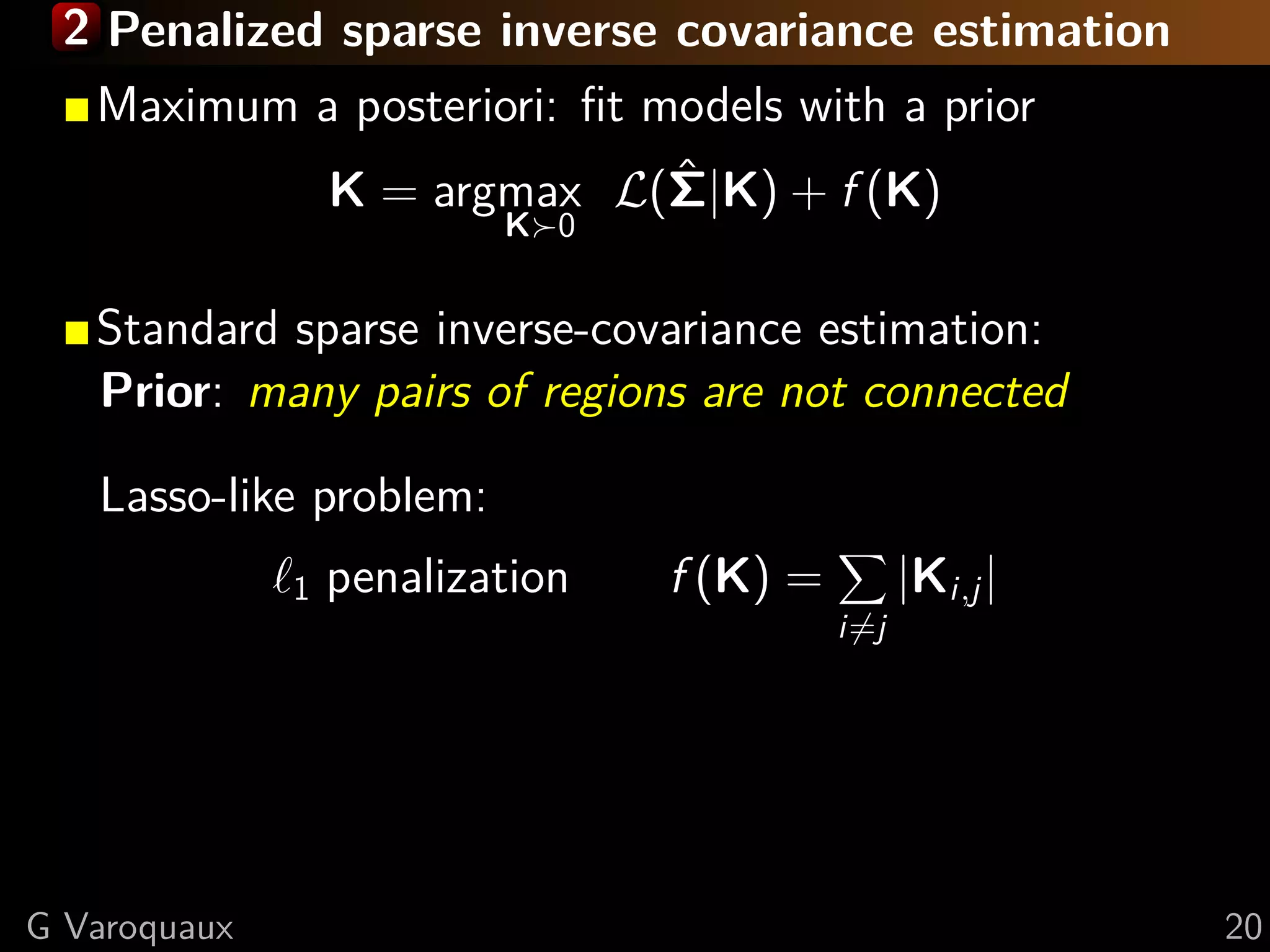
                            time


                                                    time
                        =

25

                     Decomposing time series into:
                      covarying spatial maps, S
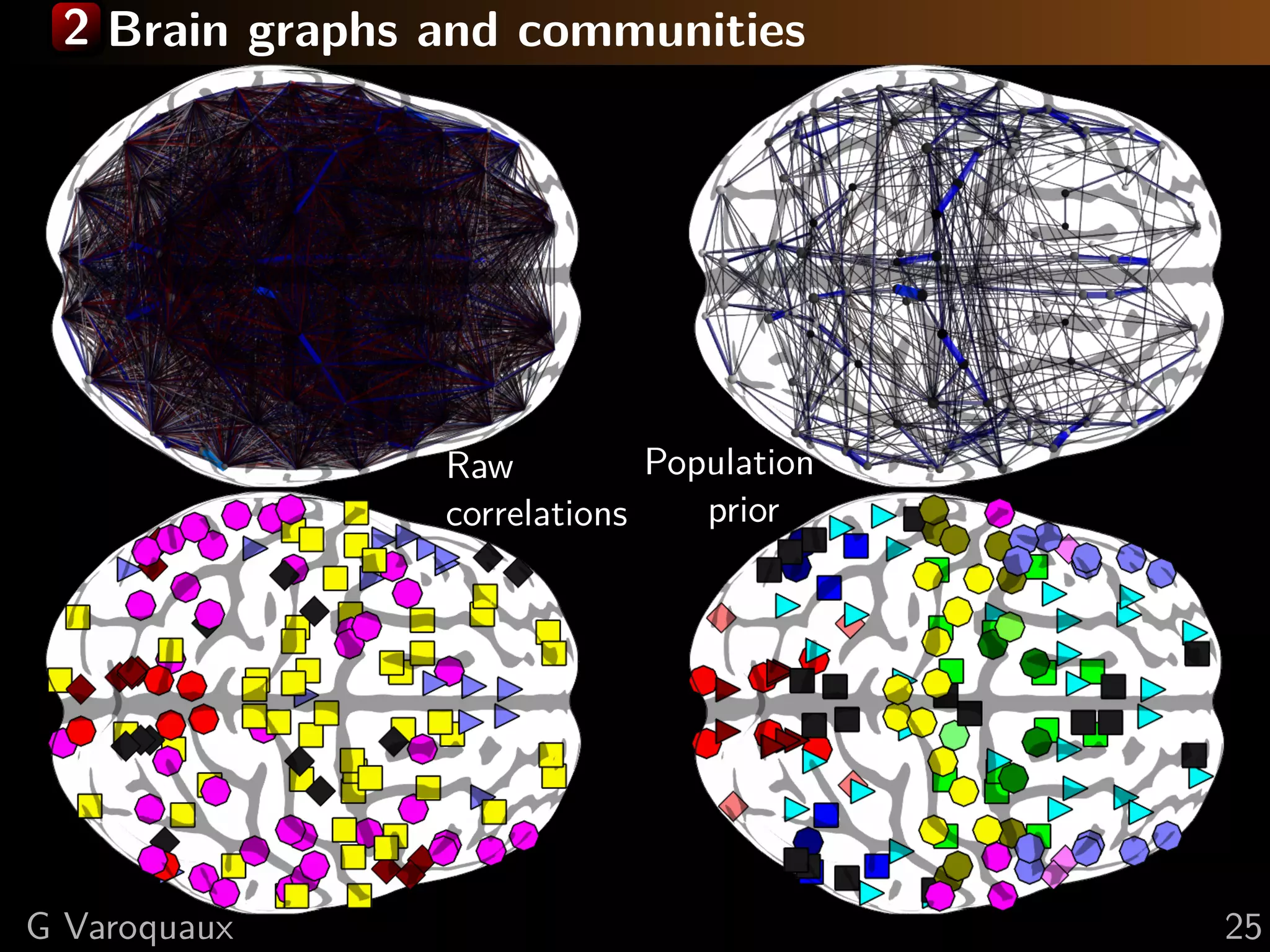
                      uncorrelated residuals, N

            ICA: minimize mutual information across S

G Varoquaux                                                         5
1 ICA on multiple subjects: group ICA

    Estimate common spatial maps S:
          voxels                                             voxels
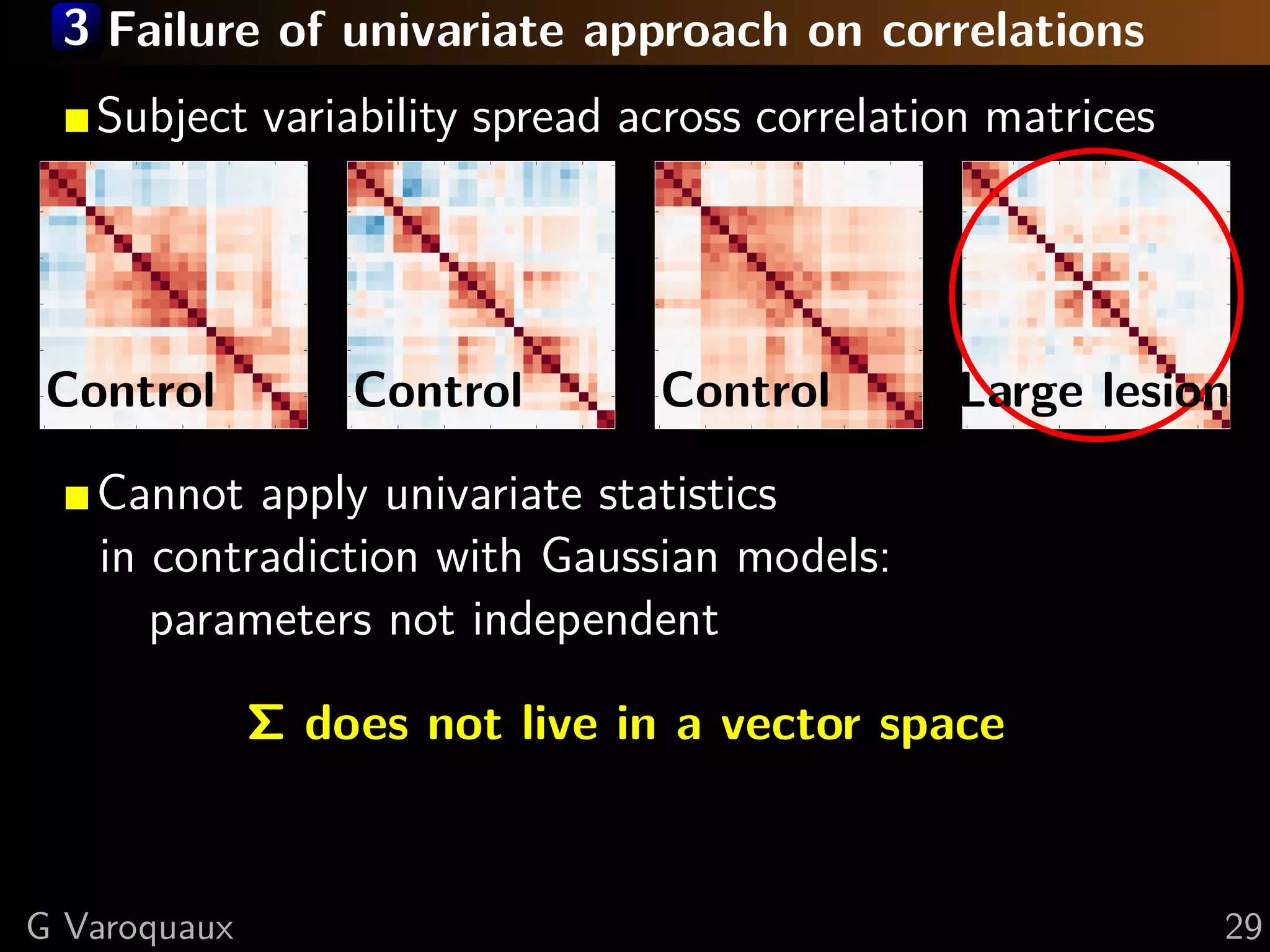
                                           voxels
           Y
                1
                               E
                                   1
                                       ·    S       +         N
                                                                  1
   time


                        time


                                                      time
                    =
            ·
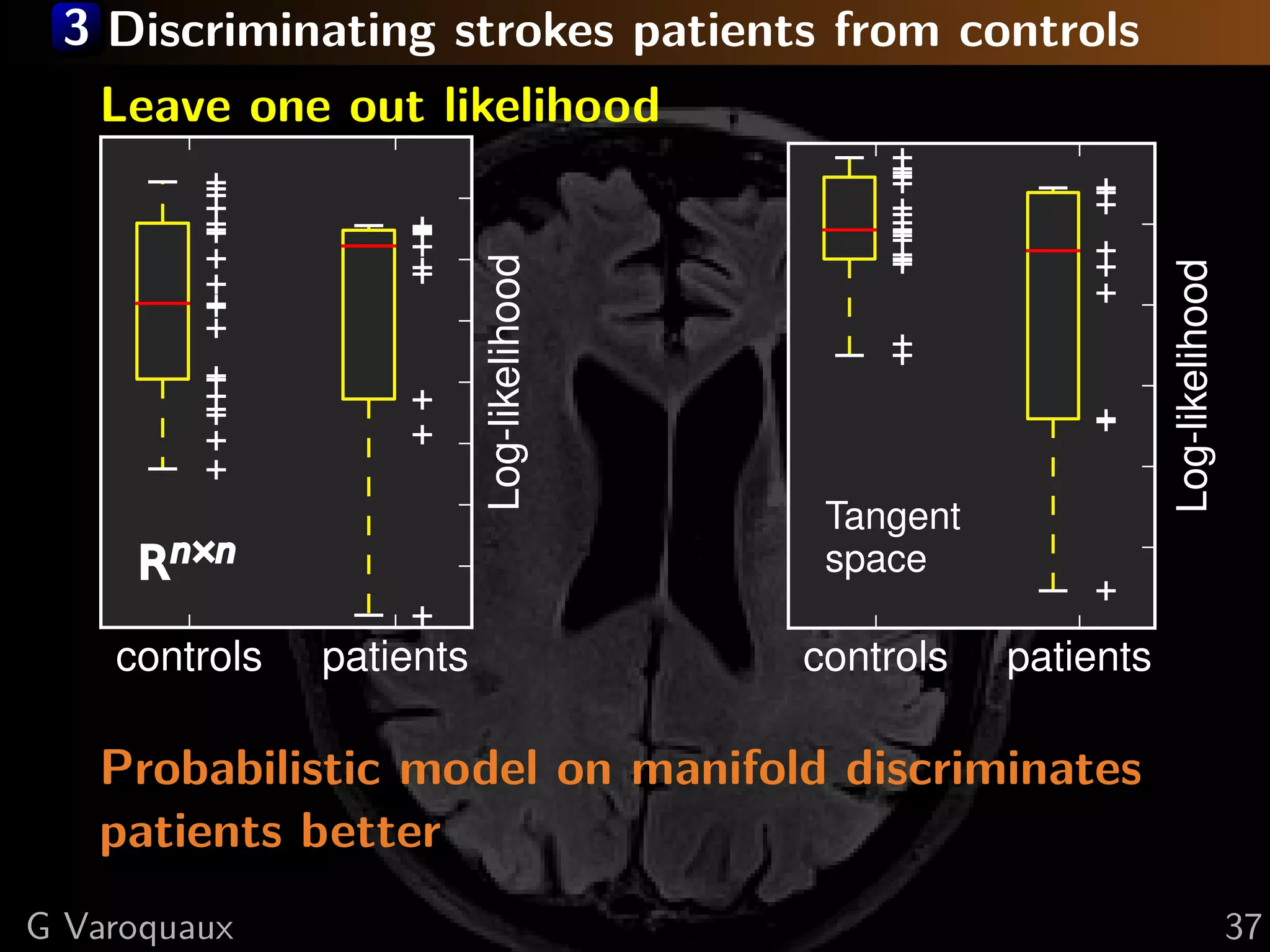
            ·                  ·
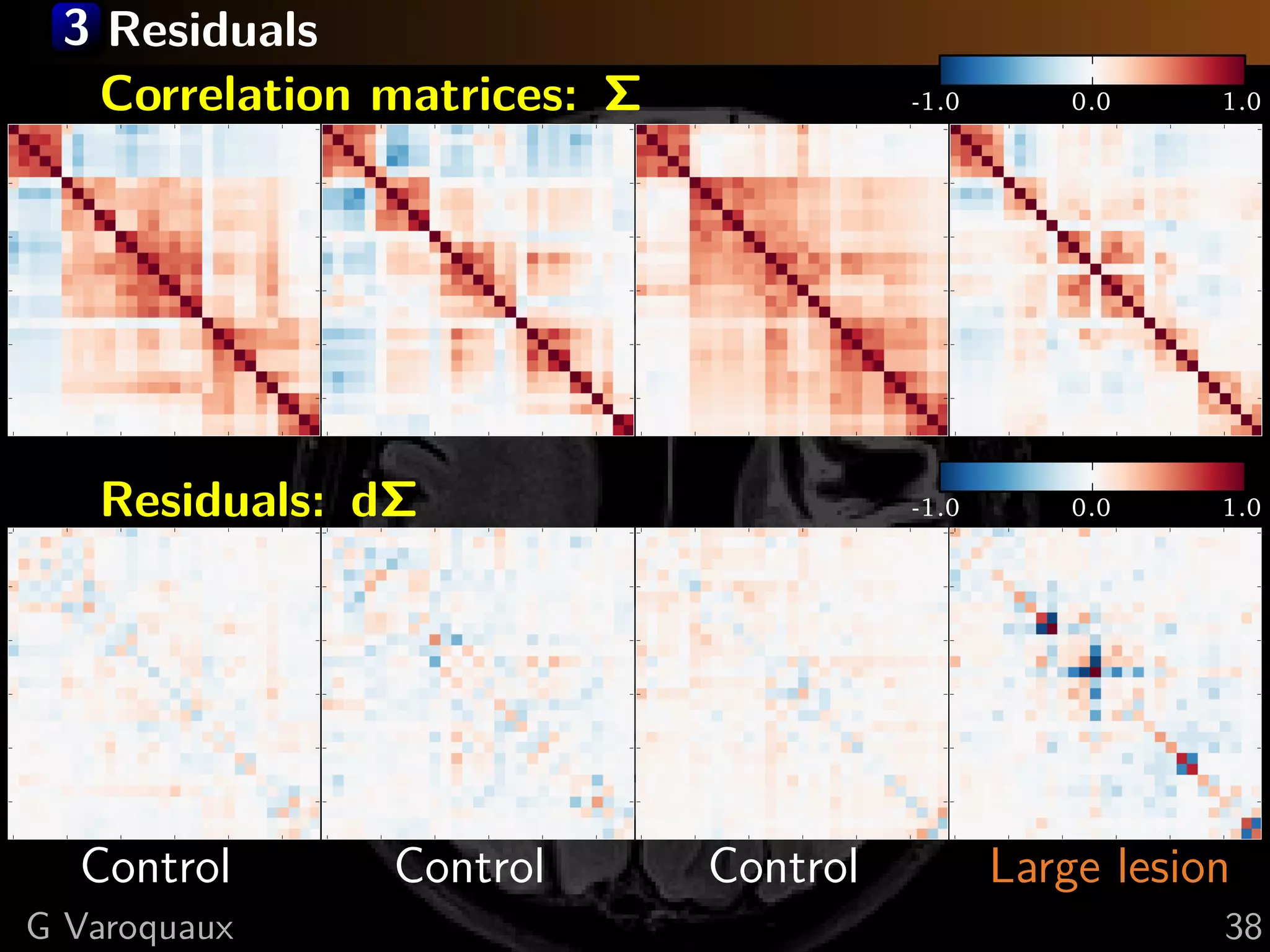
                               ·                              ·
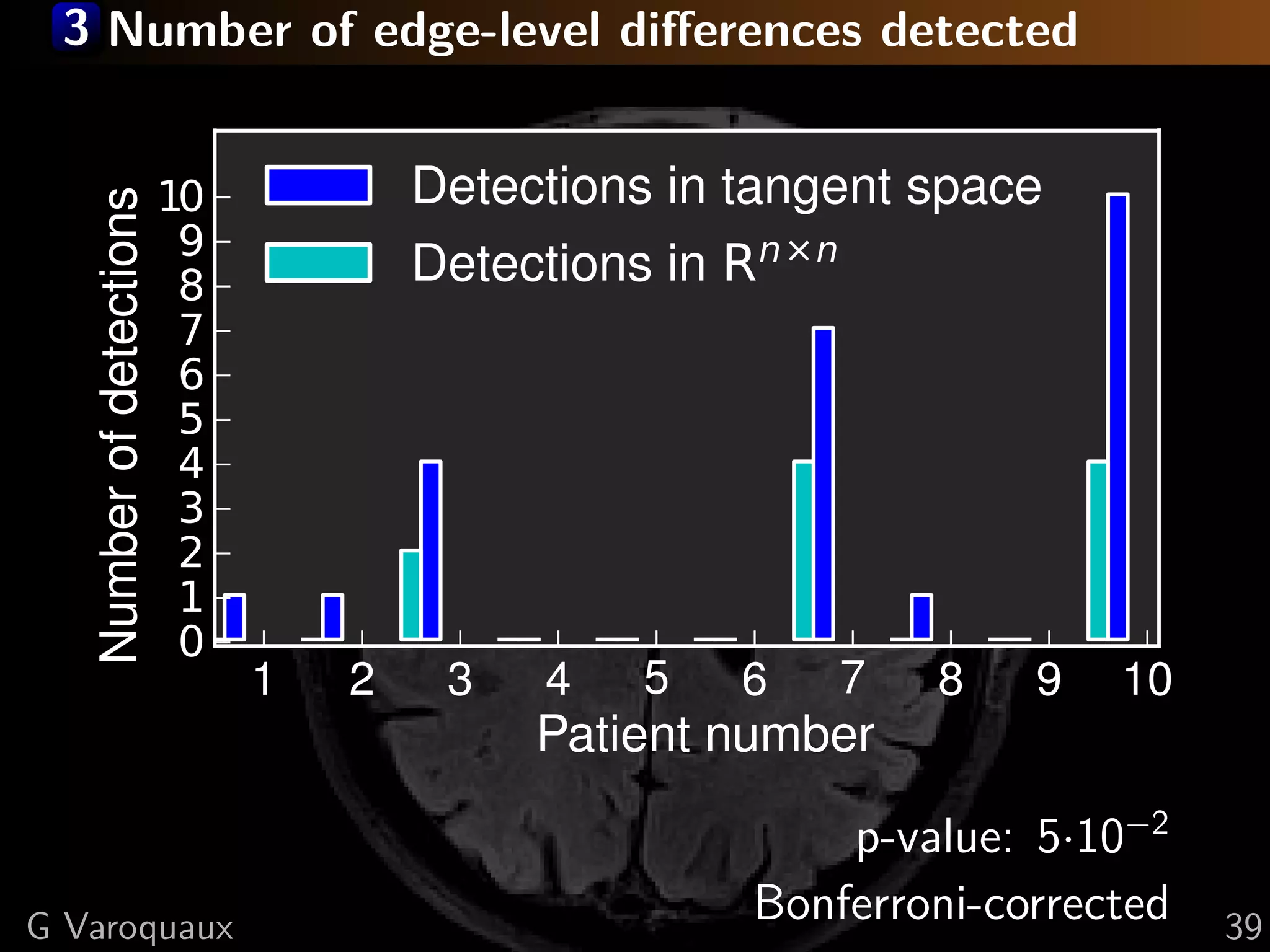
                                                              ·
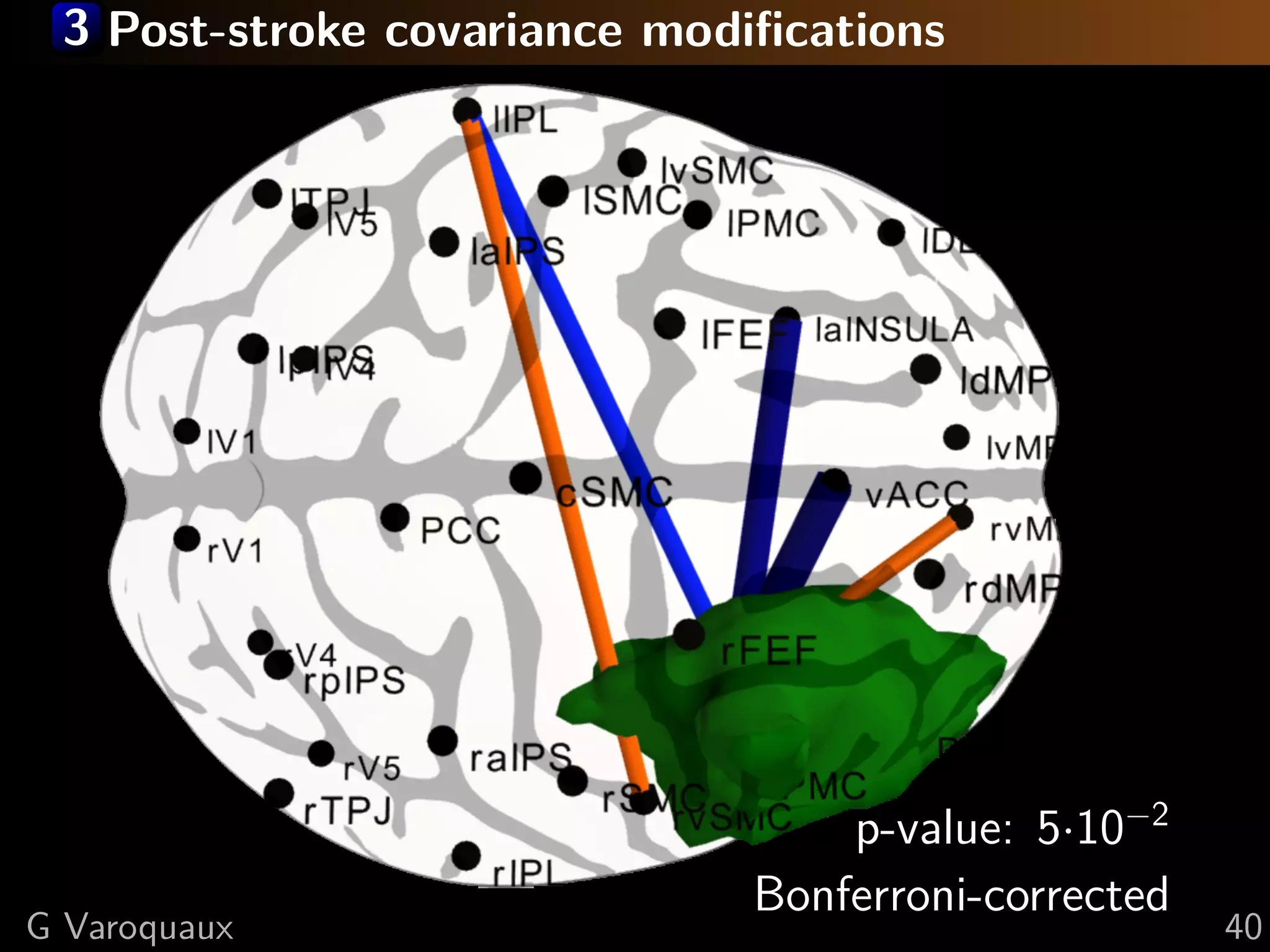
                s                  s                              s
           Y                   E       ·    S       +         N
   time


                        time


                                                      time
                    =


G Varoquaux                                         [Calhoun HBM 2001]   6
1 ICA on multiple subjects: group ICA

    Estimate common spatial maps S:
          voxels                                             voxels
                                           voxels
           Y
                1
                               E
                                   1
                                       ·    S       +         N
                                                                  1
   time


                        time


                                                      time
                    =
            ·
            ·                  ·
                               ·                              ·
                                                              ·
                s                  s                              s
           Y                   E       ·    S       +         N
   time


                        time


                                                      time
                    =

   Concatenate images, minimize norm of residuals
   Corresponds to fixed-effects modeling:
                                    i.i.d. residuals Ns
G Varoquaux                                         [Calhoun HBM 2001]   6
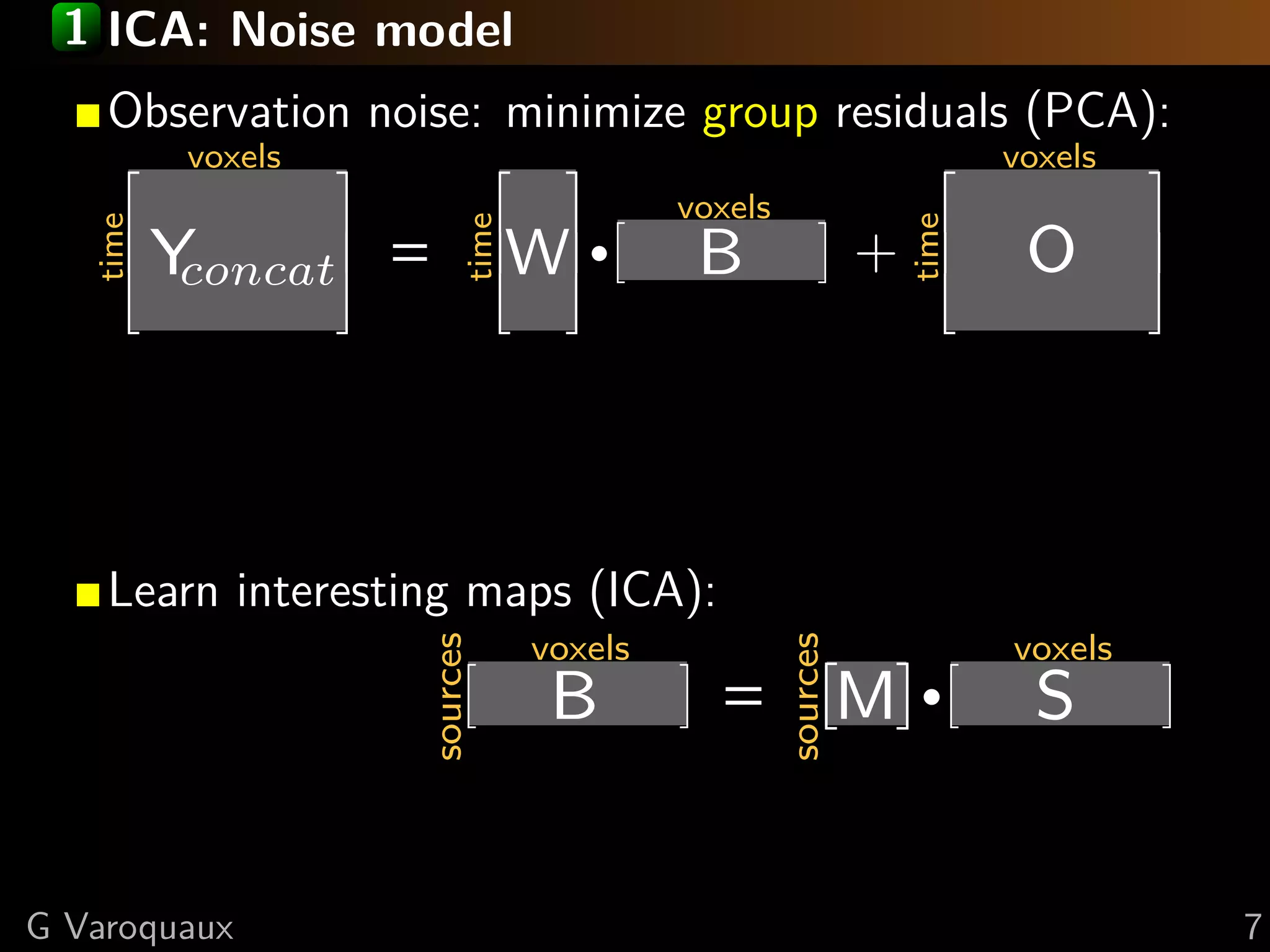
1 ICA: Noise model
    Observation noise: minimize group residuals (PCA):
          voxels                                                  voxels
                                       voxels
         Y                    W   ·     B                 +        O
  time


                       time


                                                          time
          concat =


    Learn interesting maps (ICA):
                              voxels                              voxels

                                                              ·
                   sources


                                                sources
                               B         = M                        S


G Varoquaux                                                                7
1 CanICA: random effects model
          Observation noise: minimize subject residuals (PCA):
                 voxels                                                         voxels
Subject

                                                     voxels
                  Y                  W    ·           P                 +        Os
      time


                               time


                                                                        time
                   s       =          s                s

          Select signal similar across subjects (CCA):
                  voxels
                    P1
Group


                                                       voxels

                                          ·
      subjects


                                           sources
                     .
                     .
                     .         = Λ·                     B                   +     R
                    Ps
          Learn interesting maps (ICA):
                                      voxels                                    voxels

                                                                            ·
                           sources


                                                              sources
                                       B               = M                        S
  G Varoquaux                                         [Varoquaux NeuroImage 2010]        8
1 CanICA: experimental validation


         Reproducibility across controls groups
            no CCA      CanICA    MELODIC
           .36 (.02) .72 (.05)     .51 (.04)

   Qualitative observation: less ’noise’ components


G Varoquaux                    [Varoquaux NeuroImage 2010]   9
1 Noise in the ICA maps
       How to describe noise versus signal?


              ⇓                      ⇓


   Blobs standing out
   Background noise


G Varoquaux                      [Varoquaux ISBI 2010] 10
1 Noise in the ICA maps
       How to describe noise versus signal?


              Joint
      distribution:


   Blobs standing out = long-tailed distribution
   Background noise = isotropic central mode


G Varoquaux                           [Varoquaux ISBI 2010] 10
1 Noise in the ICA maps
       How to describe noise versus signal?


              ⇓                      ⇓


                                    Thresholding
              Joint
      distribution:


G Varoquaux                      [Varoquaux ISBI 2010] 10
1 ICA as a sparse decomposition


                                       ⇒

            voxels

                                       ·(   voxels           voxels
                                                                      (
  sources


                         sources
             B       =             M         S        +       Q
      Interesting sources S are sparse
      Q: Gaussian noise
                 Thresholding ICA = sparse recovery

  Experimental validation: on sub-sampled signal:
   more robust than other approaches
G Varoquaux                                          [Varoquaux ISBI 2010] 11
1 The group-level ICA maps
     Visual system
map 0, reproducibility: 0.54


               -74
                           V1             0    9

map 1, reproducibility: 0.52


               -91
                        V1-V2             3   -3

map 3, reproducibility: 0.47


               -80                       40   4
                    extrastriate
map 25, reproducibility: 0.34


               -78                   -30      24
                     superior parietal

G Varoquaux                                        [Varoquaux NeuroImage 2010] 12
1 The group-level ICA maps
     Motor system
map 4, reproducibility: 0.47


                        part of
               -25                 -1   62
                        motor
map 21, reproducibility: 0.36


                        part of
               -21                -42   54
                        motor
map 32, reproducibility: 0.30


                        part of
                -8                -54   29
                        motor


G Varoquaux                                  [Varoquaux NeuroImage 2010] 12
1 The group-level ICA maps
     Frontal structures
map 18, reproducibility: 0.37                         map 23, reproducibility: 0.35


                                                                             dorsal
                43
                       frontal       -30   28                         10
                                                                           medial wall
                                                                                             0   54

                                                      map 29, reproducibility: 0.31


                                                                      21   pre-frontal       0   24


map 39, reproducibility: 0.26                         map 37, reproducibility: 0.28


                        part of                                               part of
                21 prefronto-insular -34   -8                         15 prefronto-insular -42   -3


G Varoquaux                                     [Varoquaux NeuroImage 2010] 12
1 The group-level ICA maps


 ICA extracts a brain parcellation
However
 No overall control of residuals
 Does not select for what we interpret

G Varoquaux                     [Varoquaux NeuroImage 2010] 12
1 Multi-subject dictionary learning
                            Subject            Group
          Time series           maps               maps
              25        x
     Subject level spatial patterns:
            Ys = Us Vs T + Es ,      Es ∼ N (0, σI)

     Group level spatial patterns:
             Vs = V + Fs ,             Fs ∼ N (0, ζI)

     Sparsity and spatial-smoothness prior:
                                                   1
         V ∼ exp (−ξ Ω(V)),            Ω(v) = v 1 + vT Lv
                                                   2

G Varoquaux                  [Varoquaux Inf Proc Med Imag 2011] 13
1 Multi-subject dictionary learning
  Estimation: maximum a posteriori
  argmin             Ys − Us Vs T    2
                                     Fro   + µ Vs − V    2
                                                         Fro   + λ Ω(V)
  Us ,Vs ,V sujets
                       Data fit             Subject       Penalization: sparse
                                           variability   and smooth maps

 Alternate optimization on Us , Vs , V:
 Update Us : standard dictionary learning procedure
                                                                [Mairal2010]

 Update Vs : ridge regression on (Vs − V)T
 Update V: proximal operator for λ Ω:
                S
                  1 s
     argmin         v −v    2
                            2    + γ Ω(v) = prox ¯,
                                                 v        V = mean Vs
                                                          ¯
         v    s=1 2
                                               γ/
                                                 S   Ω            s


G Varoquaux                          [Varoquaux Inf Proc Med Imag 2011] 14
1 Multi-subject dictionary learning
  Estimation: maximum a posteriori
  argmin             Ys − Us Vs T   2
                                    Fro   + µ Vs − V    2
                                                        Fro   + λ Ω(V)
  Us ,Vs ,V sujets
                       Data fit            Subject       Penalization: sparse
                                          variability   and smooth maps


 Parameter selection
  µ: comparing variance (PCA spectrum) at subject
  and group level
   λ: cross-validation


G Varoquaux                         [Varoquaux Inf Proc Med Imag 2011] 14
1 Multi-subject dictionary learning

  Individual maps   + Atlas of functional regions


G Varoquaux             [Varoquaux Inf Proc Med Imag 2011] 15
1 Multi-subject dictionary learning


Multi-subject dictionary learning                ICA


 G Varoquaux                   [Varoquaux Inf Proc Med Imag 2011] 16
1 Multi-subject dictionary learning


Multi-subject dictionary learning                ICA


 G Varoquaux                   [Varoquaux Inf Proc Med Imag 2011] 16
1 Multi-subject dictionary learning


        Default mode                 Base ganglia


G Varoquaux             [Varoquaux Inf Proc Med Imag 2011] 16
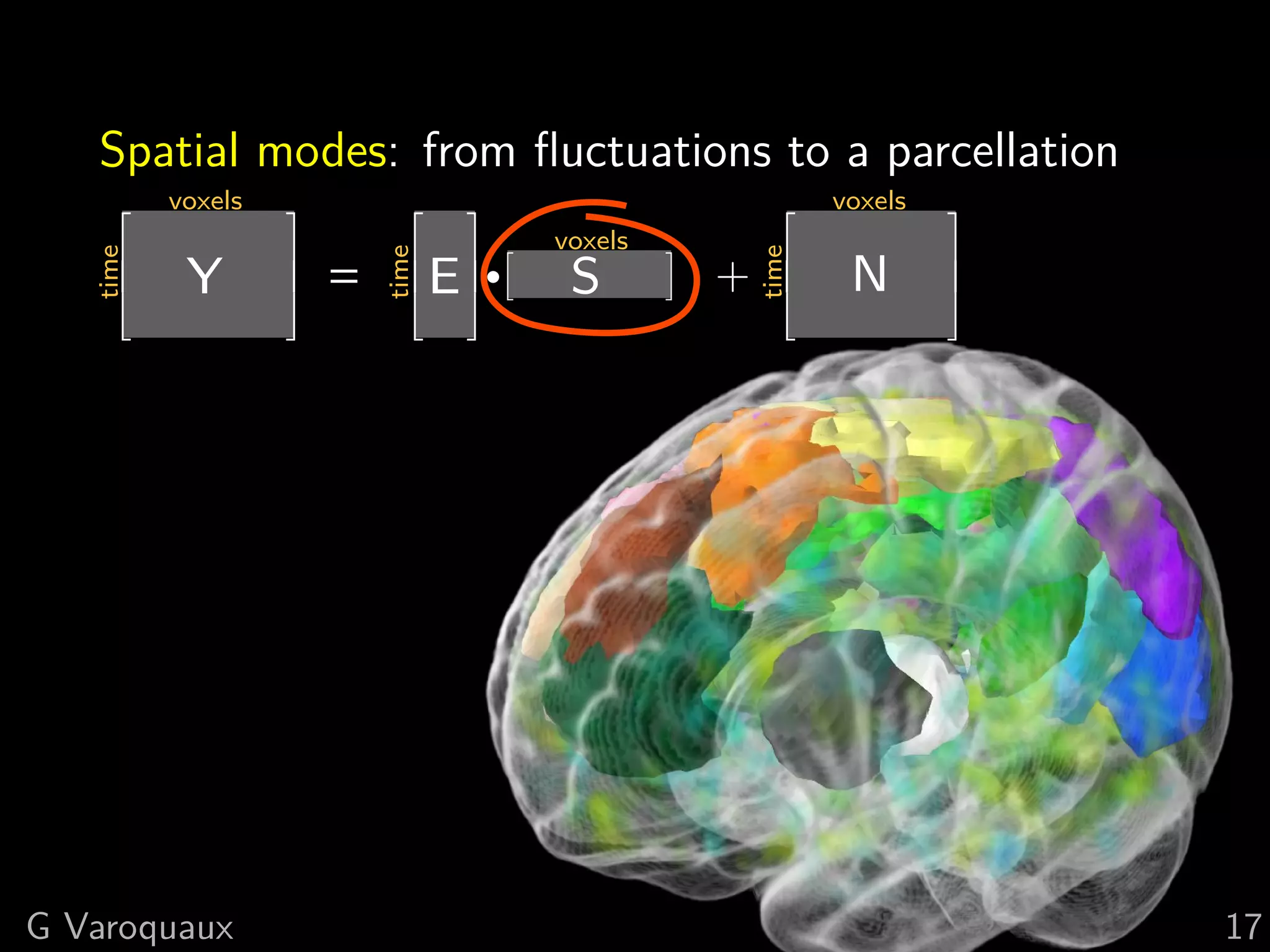
Spatial modes: from fluctuations to a parcellation
          voxels                                      voxels
                                      voxels
           Y                  E   ·    S       +       N
   time


                       time


                                               time
                   =


G Varoquaux                                                    17
Associated time series:
          voxels                                      voxels
                                      voxels
           Y                  E   ·    S       +       N
   time


                       time


                                               time
                   =


G Varoquaux                                                    17
2 Graphical models of brain
     connectivity
  Modeling the correlations between
  regions


G Varoquaux                           18
2 Graphical model for correlation
Specify the probability of observing fMRI data

Multivariate normal P(X) ∝ |Σ−1 |e − 2 X Σ X
                                            1 T −1


Parametrized by inverse covariance matrix K = Σ−1
  Observations:                Direct connections:
  Covariance matrix            Inverse covariance
              1                           1
  2                            2

                  0                              0

  3                            3
              4                           4

                             [Smith 2011, Varoquaux NIPS 2010]
G Varoquaux                                                      19
2 Penalized sparse inverse covariance estimation
  Maximum a posteriori: fit models with a prior
            K = argmax L(Σ|K) + f (K)
                            ˆ
                          K 0


   Standard sparse inverse-covariance estimation:
   Prior: many pairs of regions are not connected

   Lasso-like problem:
              1   penalization   f (K) =         |Ki,j |
                                           i=j


G Varoquaux                                                20
2 Penalized sparse inverse covariance estimation
  Maximum a posteriori: fit models with a prior
            K = argmax L(Σ|K) + f (K)
                            ˆ
                           K 0


   Our contribution: Population prior:
  same independence structure across subjects
    ⇒ Estimate together all {Ks } from {Σs }
                                        ˆ
                                                      A. Gramfort
   Group-lasso (mixed norms):

       21   penalization     f {Ks } = λ             (Ks )2
                                                       i,j
                                           i=j   s

               Convex optimization problem

G Varoquaux                            [Varoquaux NIPS 2010] 20
2 Population-sparse graph perform better


       ˆ
       Σ−1
                    Sparse
                    inverse
                                      Population
                                      prior

   Likelihood of new data (nested cross-validation)
                    Subject data, Σ−1 -57.1
           Subject data, sparse inverse 43.0
             Group average data, Σ−1 40.6
    Group average data, sparse inverse 41.8
                      Population prior 45.6

G Varoquaux                        [Varoquaux NIPS 2010] 21
2 Brain graphs


                  Raw          Population
                  correlations    prior


G Varoquaux                             [Varoquaux NIPS 2010] 22
2 Graphs of brain function?
   Cognitive function arises from the interplay of
   specialized brain regions:
   The functional segregation of local areas [...]
   contrasts sharply with their global integration during
   perception and behavior                 [Tononi 1994]


    A proposed measure of functional segregation
                 Graph modularity =
                  divide in communities to
                  maximize intra-class connections
                  versus extra-class

G Varoquaux                                                 23
2 Graph cuts to isolate functional communities
   Find communities to maximize modularity:
                                            2 
                   k  A(Vc , Vc )  A(V , Vc ) 
              Q=                −               
                 c=1 A(V , V )      A(V , V )
   A(Va , Vb ) is the sum of edges going from Va to Vb

   Rewrite as an eigenvalue problem [White 2005]
                                1
                                1
                                0
                                0
                                        A    ·     1 1 0 0


 ⇒ Spectral clustering = spectral embedding + k-means

   Similar to normalized graph cuts
G Varoquaux                                                  24
2 Brain graphs and communities


                Raw          Population
                correlations    prior


G Varoquaux                               25
2 Brain integration between communities
   Proposed measure for functional integration:
   mutual information (Tononi)


                                        1
              Integration:    Ic1   =     log det(Kc1 )
                                        2
      Mutual information: Mc1 ,c2 = Ic1 ∪c2 − Ic1 − Is2


G Varoquaux                             [Varoquaux NIPS 2010] 26
2 Brain integration between communities
   Proposed measure for functional integration:
   mutual information (Tononi)
      With population prior:      Occipital pole
              Default mode network visual areas Medial visual areas
                  Fronto-parietal                   Lateral visual
                       networks                      areas
                Fronto-lateral                          Posterior inferior
                      network                           temporal 1
                        Pars                                Posterior inferior
                  opercularis                               temporal 2

 Raw             Dorsal motor                              Right Thalamus
 correlations:                                           Cingulo-insular
                   Ventral motor                          network
                            Auditory               Left Putamen
                                       Basal ganglia


G Varoquaux                                      [Varoquaux NIPS 2010] 26
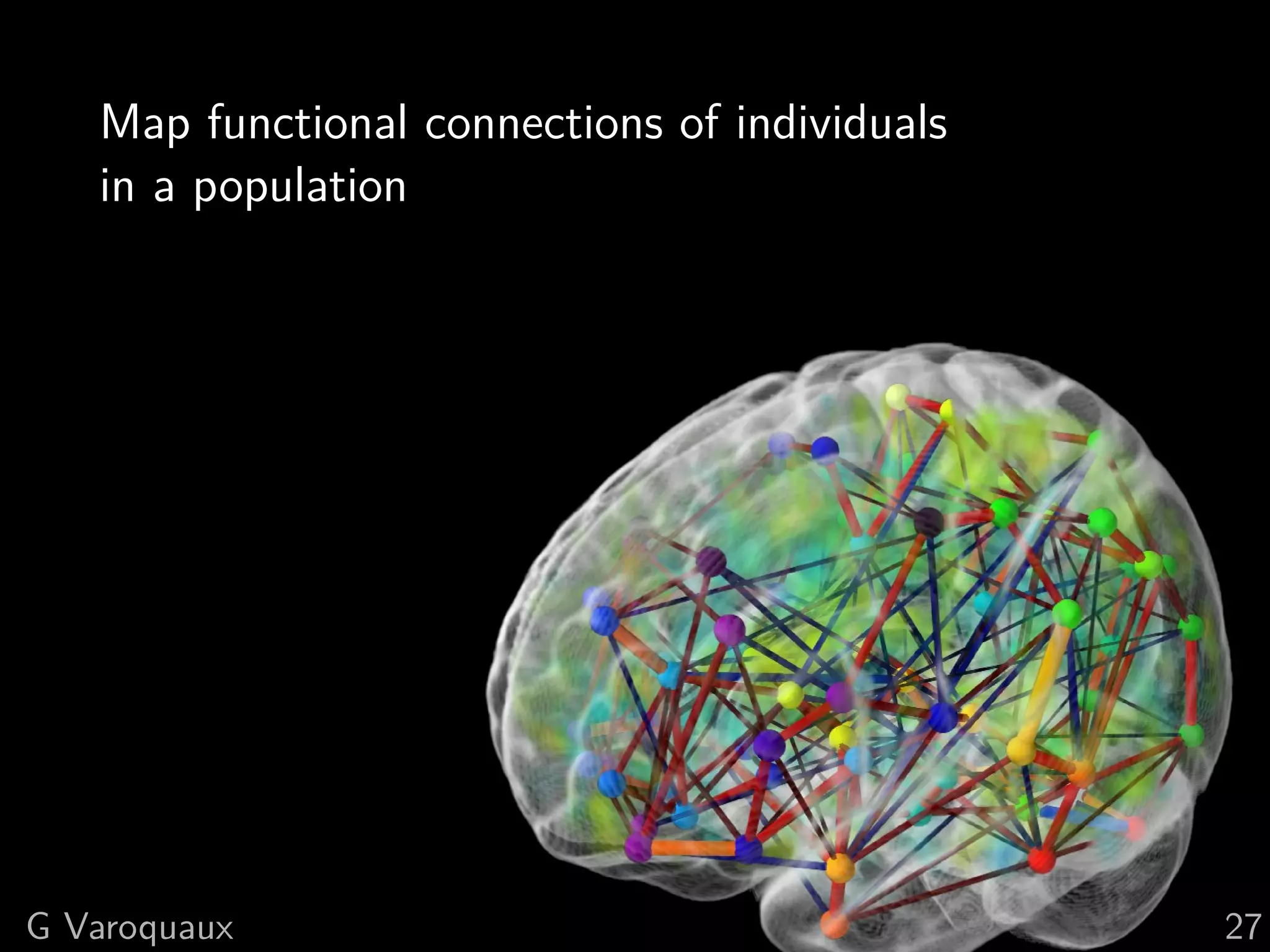
Map functional connections of individuals
   in a population


G Varoquaux                                    27
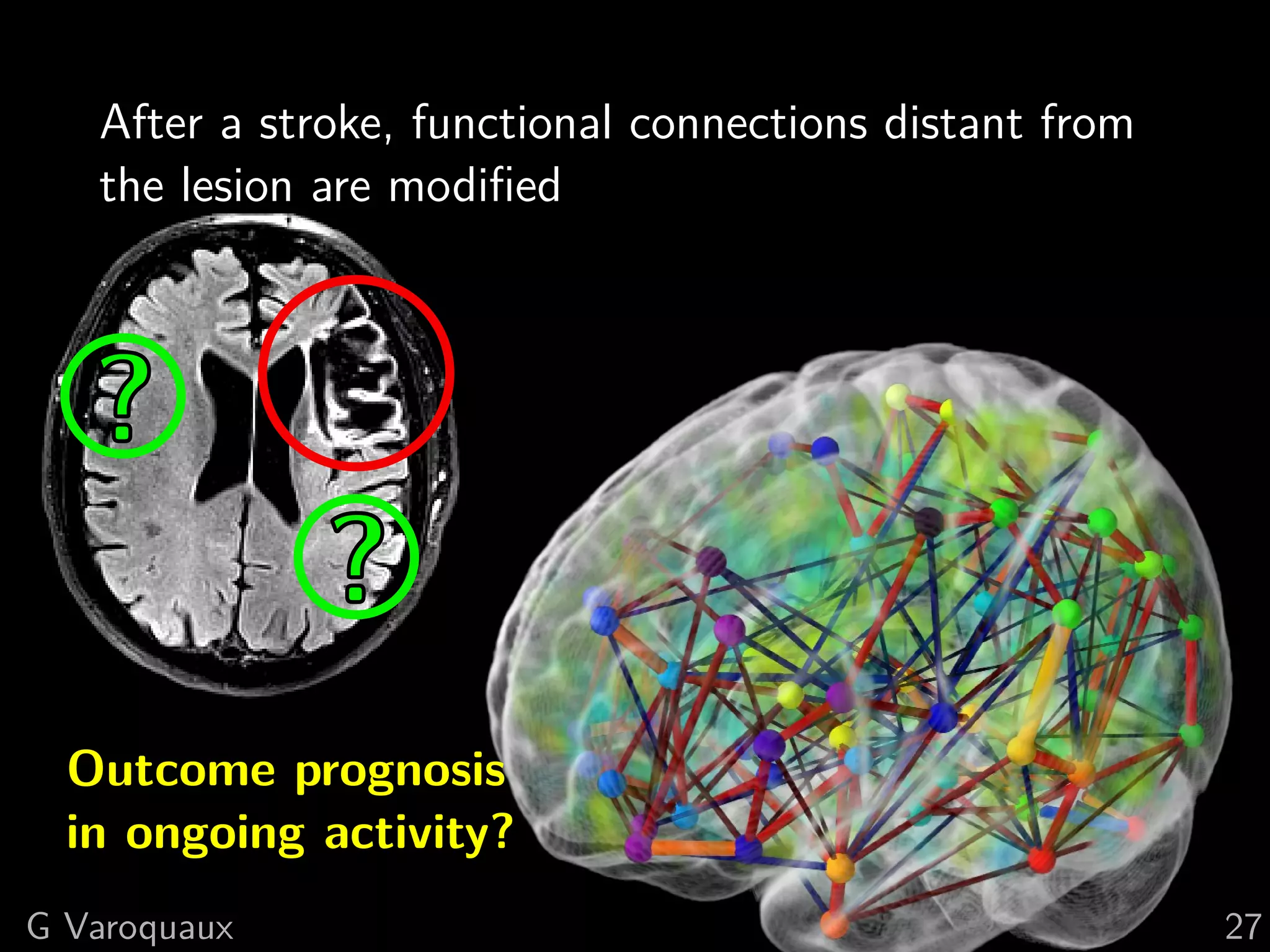
After a stroke, functional connections distant from
   the lesion are modified


   ?
              ?
  Outcome prognosis
  in ongoing activity?
G Varoquaux                                              27
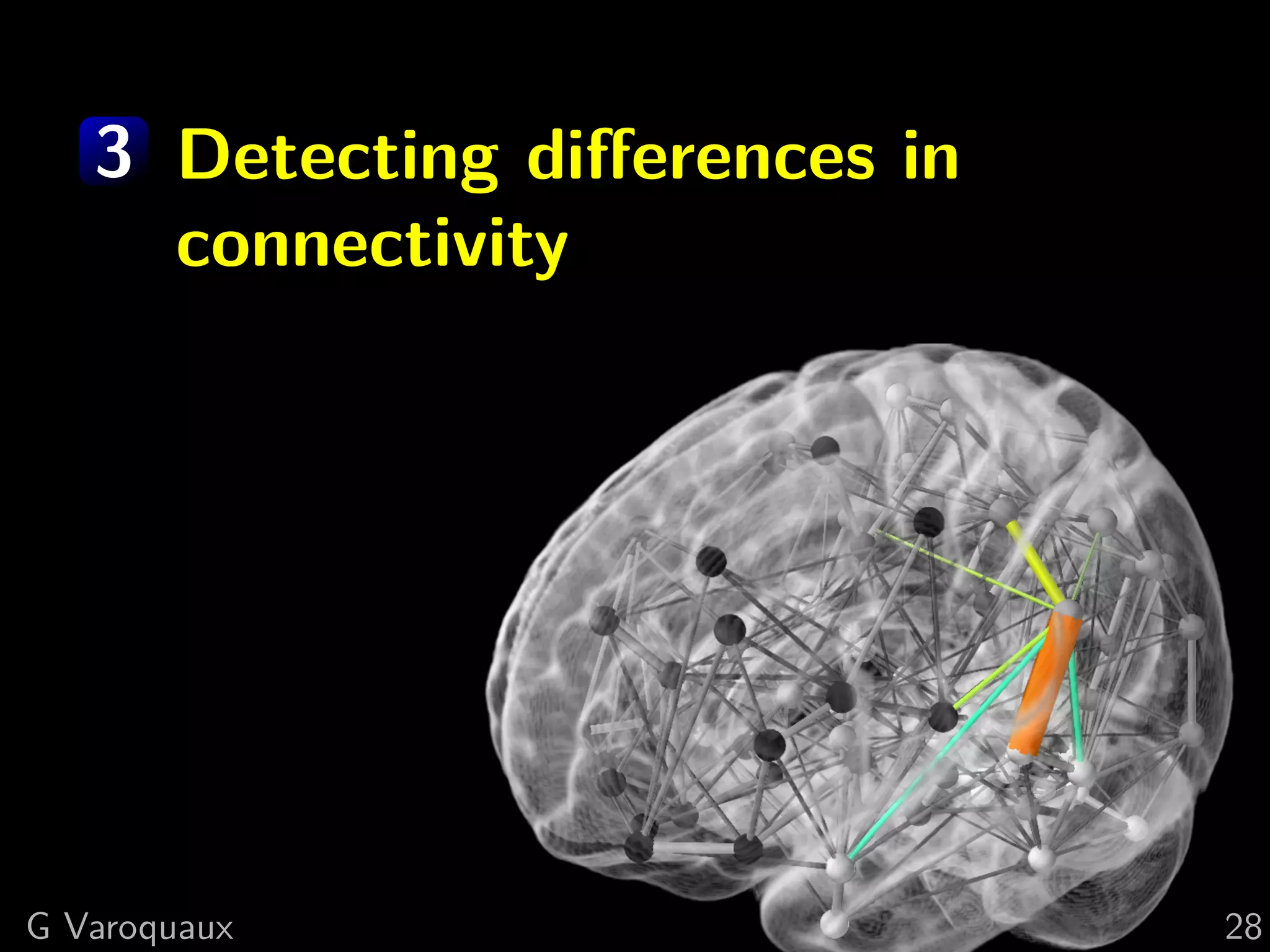
3 Detecting differences in
     connectivity


G Varoquaux                    28
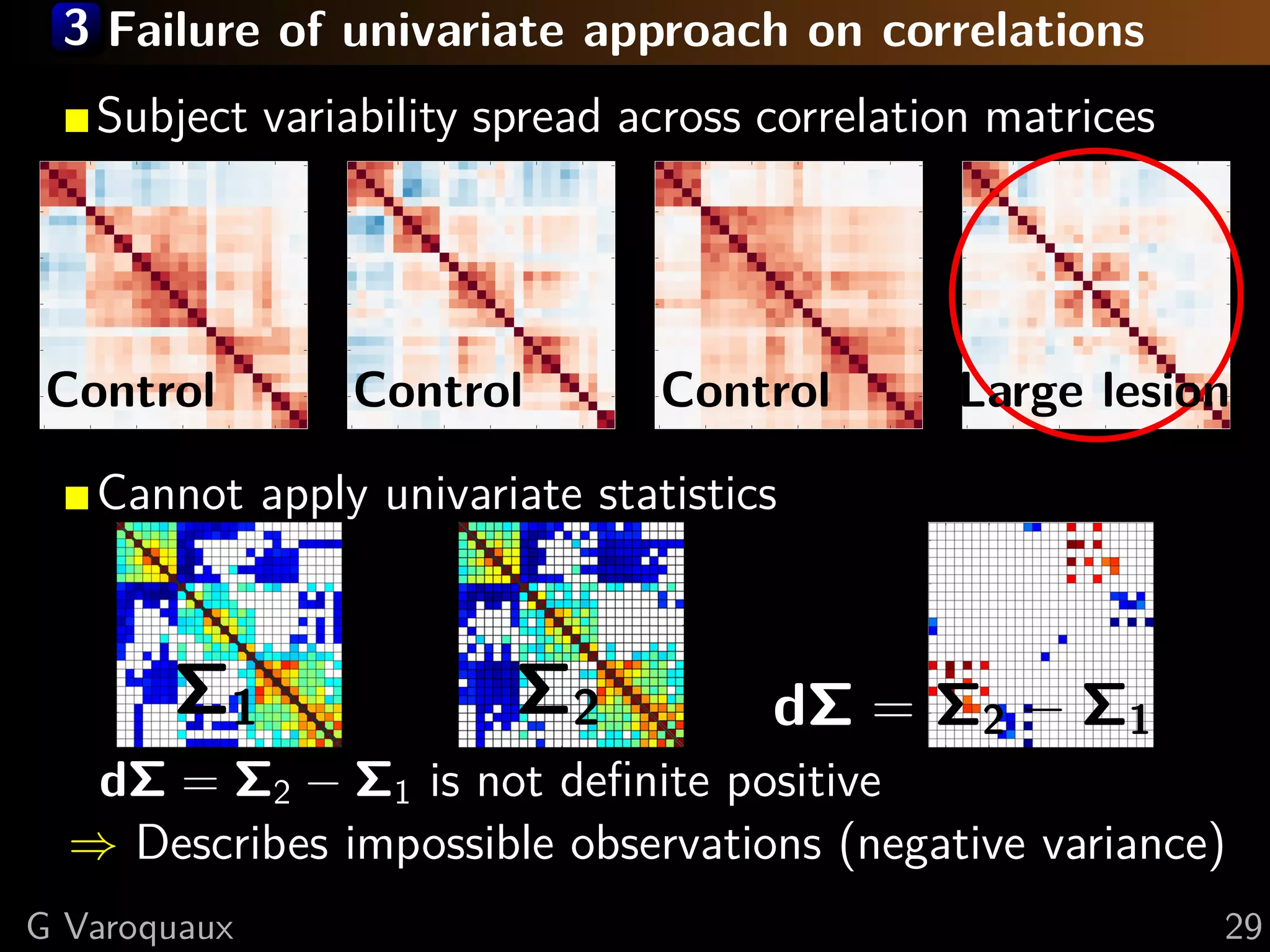
3 Failure of univariate approach on correlations
              Subject variability spread across correlation matrices
0                                  0                                0                                0

 5                                  5                                5                                5

10                                 10                               10                               10

15                                 15                               15                               15

20                                 20                               20                               20

25   Control                       25   Control                     25   Control                      Large lesion
                                                                                                     25

     0    5    10   15   20   25        0   5   10   15   20   25        0   5   10   15   20   25        0   5   10   15   20   25


              Cannot apply univariate statistics


                    Σ1                                    Σ2                          dΣ = Σ2 − Σ1
          dΣ = Σ2 − Σ1 is not definite positive
         ⇒ Describes impossible observations (negative variance)
G Varoquaux                                                                                                                           29
3 Failure of univariate approach on correlations
              Subject variability spread across correlation matrices
0                                  0                                0                                0

 5                                  5                                5                                5

10                                 10                               10                               10

15                                 15                               15                               15

20                                 20                               20                               20

25   Control                       25   Control                     25   Control                      Large lesion
                                                                                                     25

     0    5    10   15   20   25        0   5   10   15   20   25        0   5   10   15   20   25        0   5   10   15   20   25


              Cannot apply univariate statistics
              in contradiction with Gaussian models:
                 parameters not independent

                              Σ does not live in a vector space


G Varoquaux                                                                                                                           29
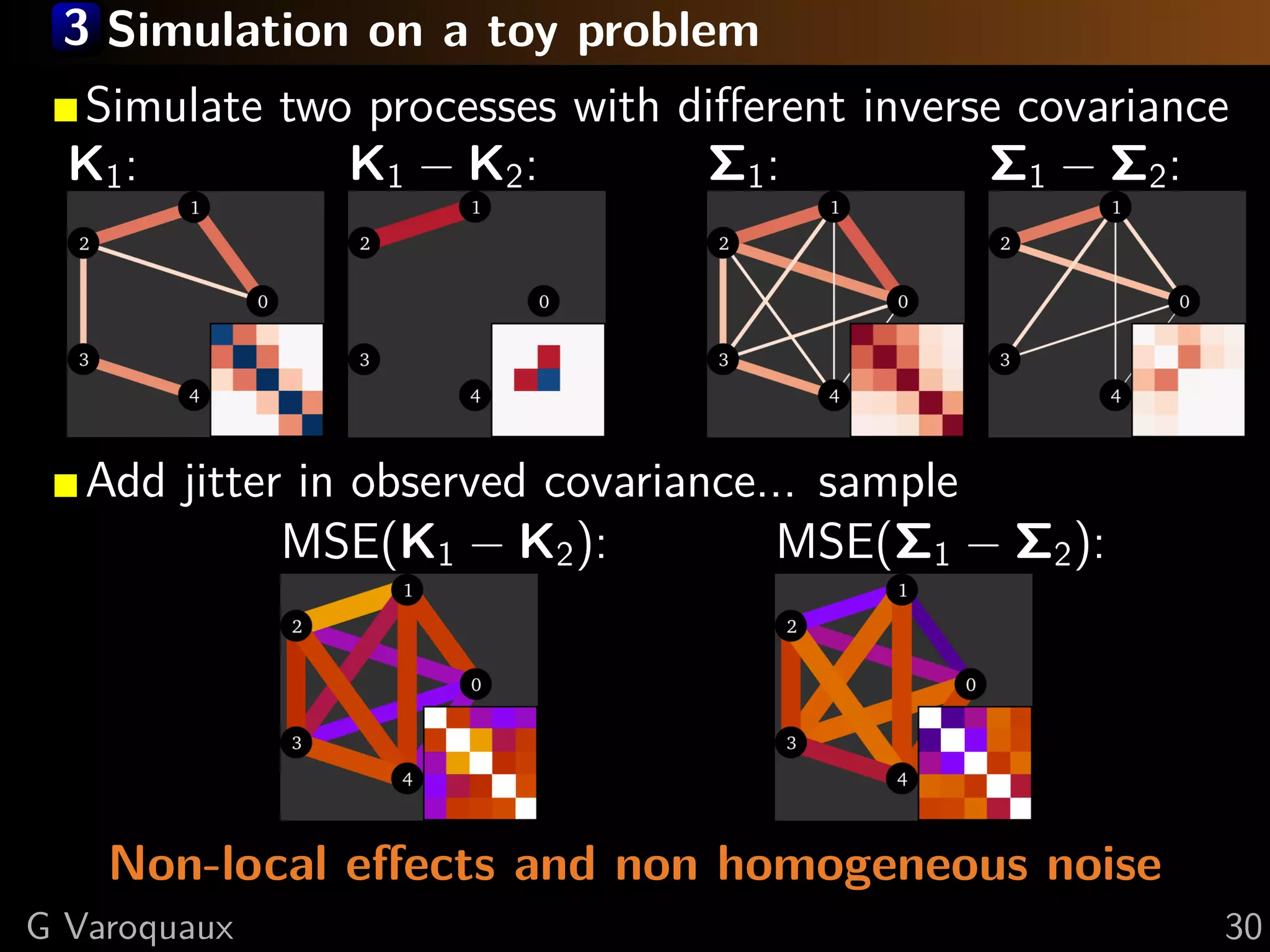
3 Simulation on a toy problem
  Simulate two processes with different inverse covariance
  K1 :        K1 − K2 :        Σ1 :          Σ1 − Σ2 :


   Add jitter in observed covariance... sample
             MSE(K1 − K2 ):          MSE(Σ1 − Σ2 ):


    Non-local effects and non homogeneous noise
G Varoquaux                                             30
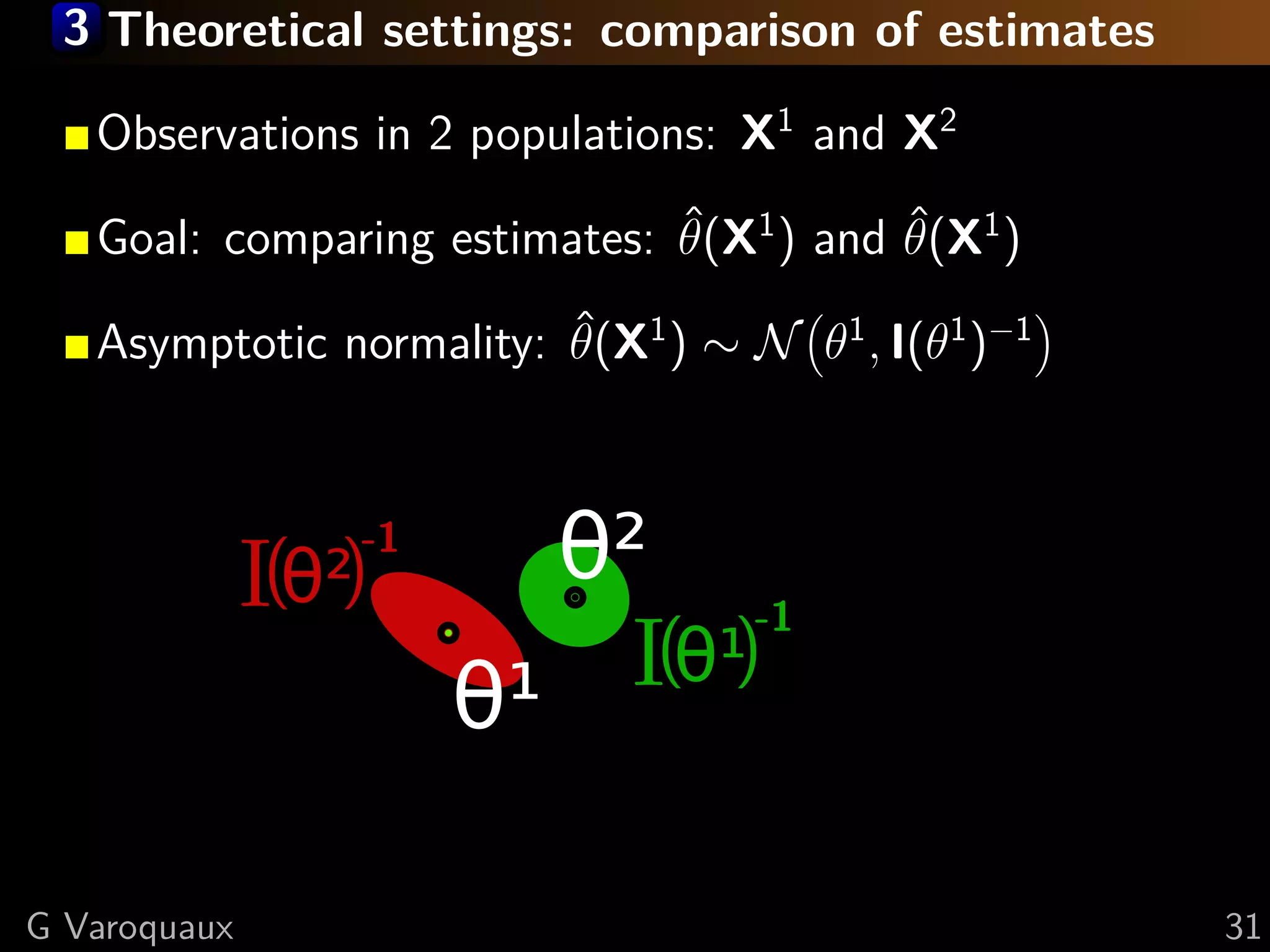
3 Theoretical settings: comparison of estimates

   Observations in 2 populations: X1 and X2
                              ˆ          ˆ
   Goal: comparing estimates: θ(X1 ) and θ(X1 )

   Asymptotic normality: θ(X1 ) ∼ N θ1 , I(θ1 )−1
                         ˆ


              I(θ²)
                  -1
                         θ²
                          I(θ¹)
                                   -1

                       θ¹

G Varoquaux                                         31
3 Theoretical settings: comparison of estimates

   [Rao 1945] Fisher information I defines a metric on
   the manifold of models.

   We use it to choose a global parametrization for
   comparisons


                                            if old
                                          an
                                        M


G Varoquaux                                             31
3 Covariance manifold – Symn
                            +

   Metric tensor (Fisher information) [Lenglet 2006]
              dΣ1 , dΣ2 Σ = 1 trace(Σ−1 dΣ1 Σ−1 dΣ2 )
                              2
                               +
   Nice properties of the Symn manifold (Lie group):
   metric can be fully integrated, gives rise to global
   mapping to a vector space (Logarithmic map).

    Σ1 , Σ2        = log Σ1 − 2 Σ2 Σ1 − 2
              2                  1           1       2
              Σ1
                                                         ,

   Locally: Σ1 , Σ2           ∝ trace(Σ1 − 2 Σ2 Σ1 − 2 ) − p
                                                 1                  1

                         Σ1
                              = dΣ Fro

                           dΣ = Σ1           Σ2 Σ1
                                      −1/2                   −1/2
               where

G Varoquaux                                                             32
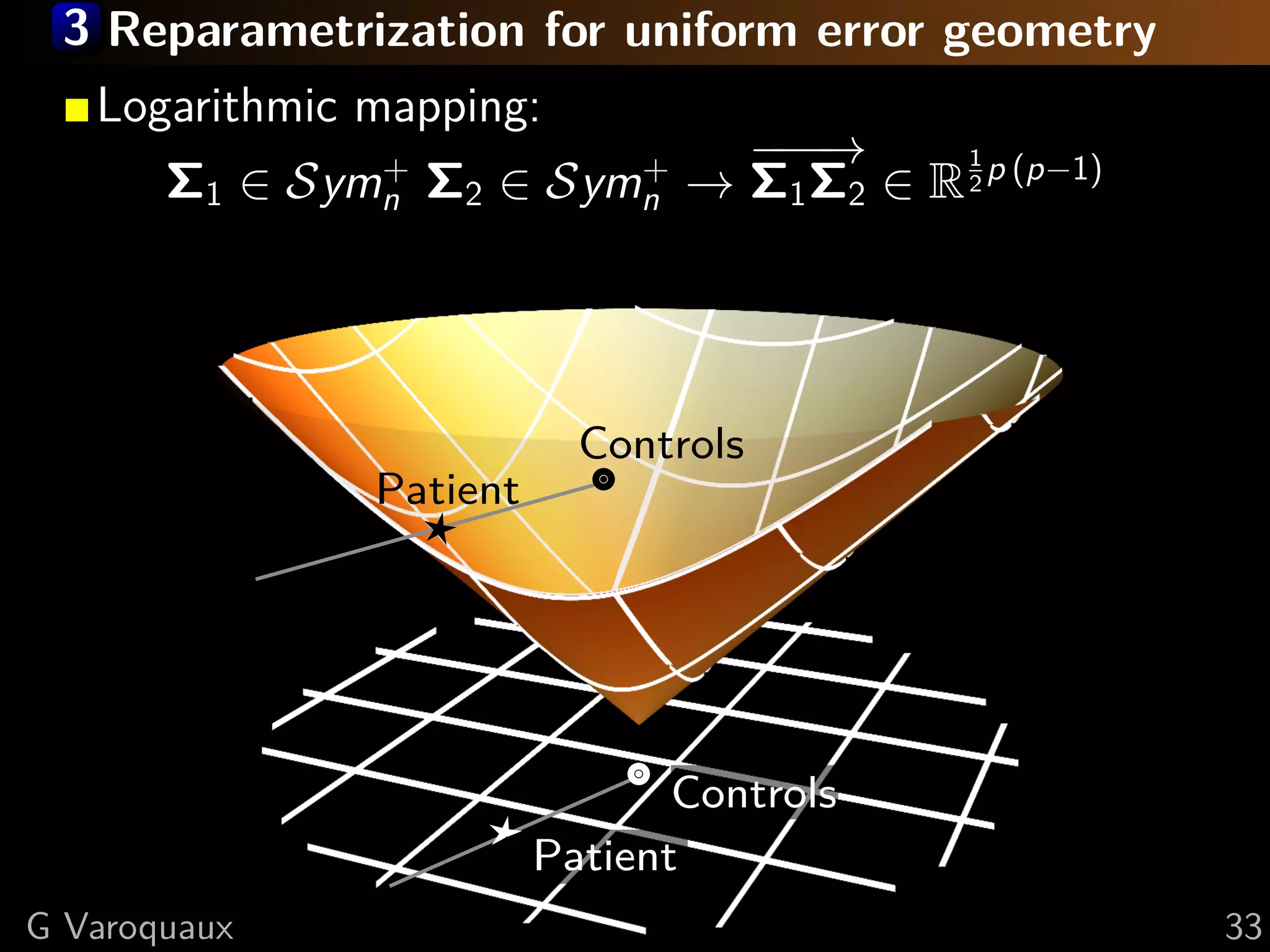
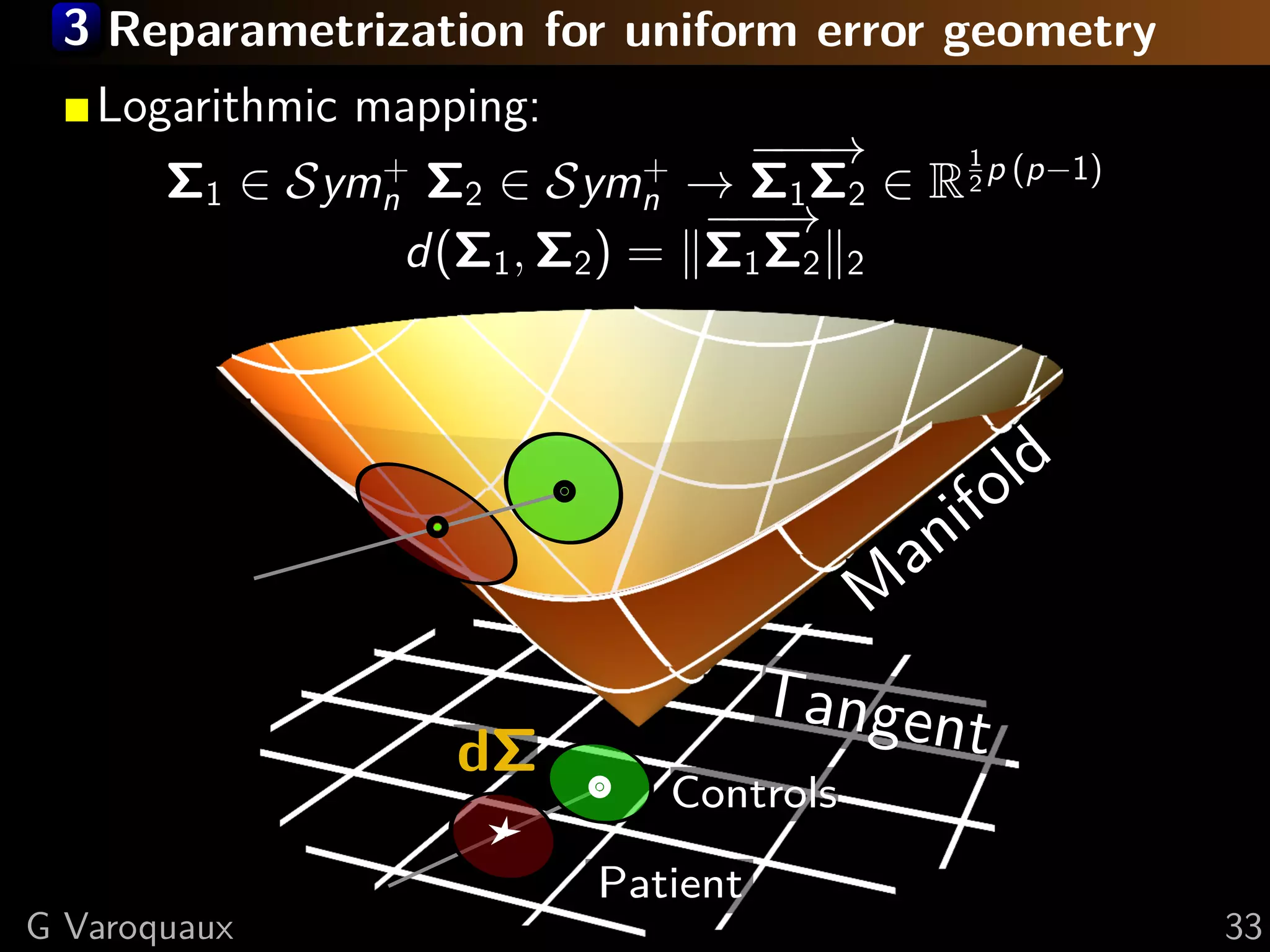
3 Reparametrization for uniform error geometry
   Logarithmic mapping:
                             −−
                              −→
       Σ1 ∈ Symn Σ2 ∈ Symn → Σ1 Σ2 ∈ R 2 p (p−1)
                                       1
               +         +


                            Controls
                Patient


                                 Controls
                          Patient
G Varoquaux                                        33
3 Reparametrization for uniform error geometry
   Logarithmic mapping:
                                −−
                                 −→
       Σ1 ∈ Symn Σ2 ∈ Symn → Σ1 Σ2 ∈ R 2 p (p−1)
                                       1
               +            +
                              −−
                               −→
                d(Σ1 , Σ2 ) = Σ1 Σ2 2


                                                old
                                         a  nif
                                        M
                                    Tangen
                   dΣ                        t
                             Controls

                          Patient
G Varoquaux                                           33
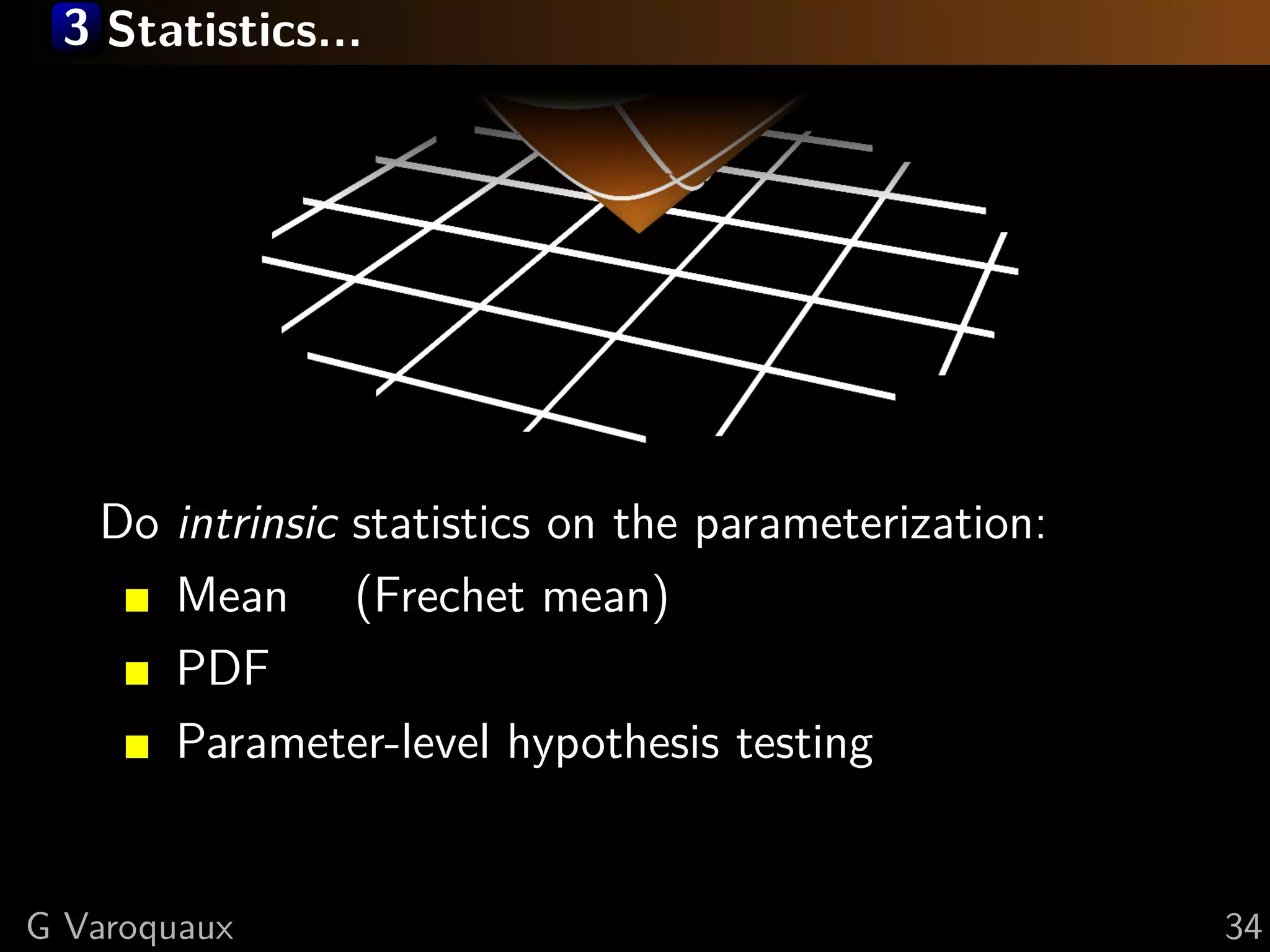
3 Statistics...


   Do intrinsic statistics on the parameterization:
      Mean (Frechet mean)
      PDF
      Parameter-level hypothesis testing


G Varoquaux                                           34
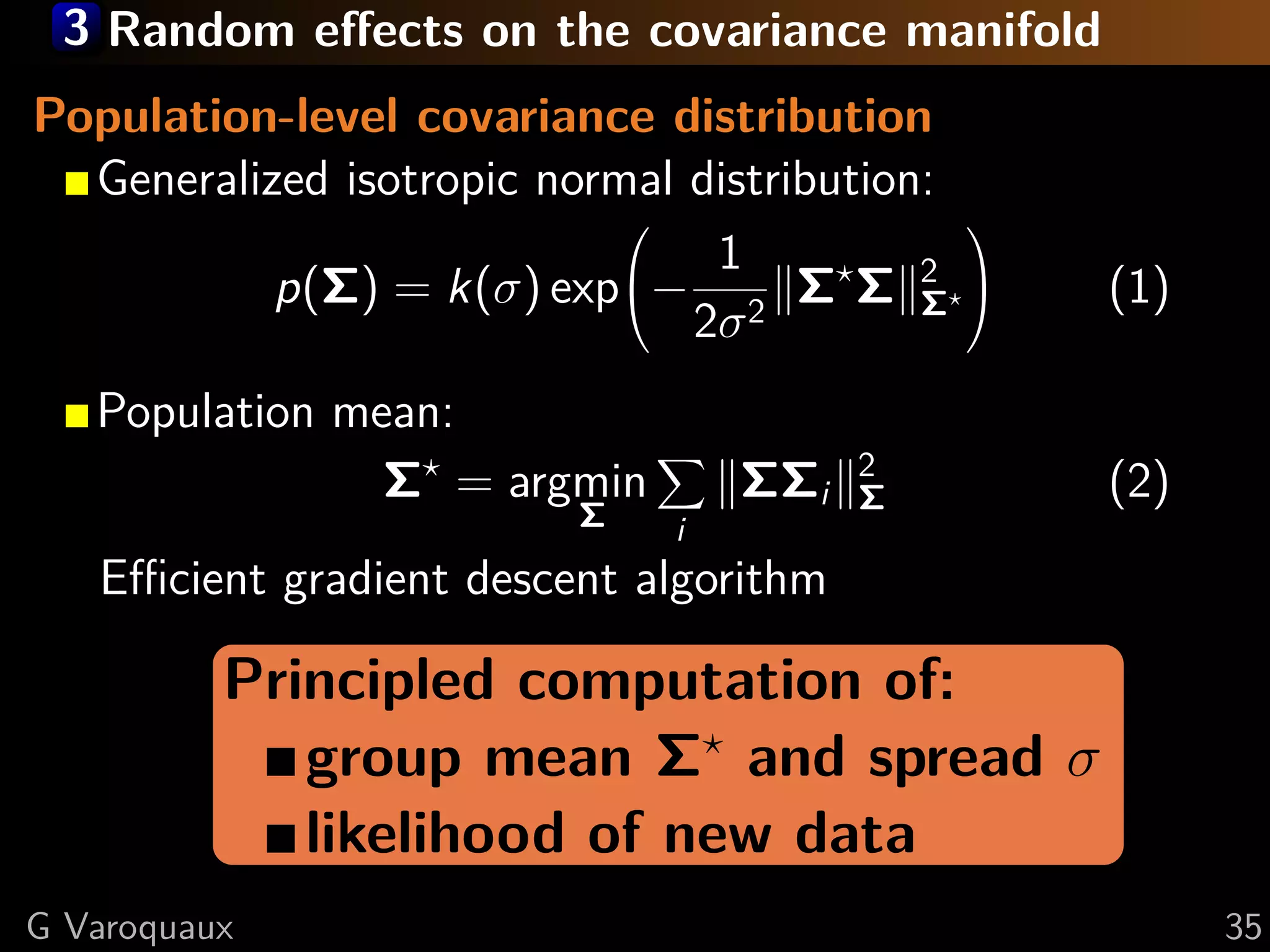
3 Random effects on the covariance manifold
Population-level covariance distribution
  Generalized isotropic normal distribution:
                                              
                                1
           p(Σ) = k(σ) exp− 2 Σ Σ 2       Σ
                                                  (1)
                               2σ
   Population mean:
                Σ = argmin        ΣΣi   2
                                        Σ          (2)
                          Σ   i
   Efficient gradient descent algorithm

          Principled computation of:
             group mean Σ and spread σ
             likelihood of new data
G Varoquaux                                              35
3 Random effects on the covariance manifold
Population-level covariance distribution
  Generalized isotropic normal distribution:
                                              
                                1
           p(Σ) = k(σ) exp− 2 Σ Σ 2       Σ
                                                  (1)
                               2σ

Edge-level statistics
  Under null hypothesis: subject ∈ group model (1)
       −→
       dΣ ∼ N (0, σI) : Independant coefficients

              ⇒ Univariate statistics on dΣi,j

                            [Varoquaux MICCAI 2010]
G Varoquaux                                              35
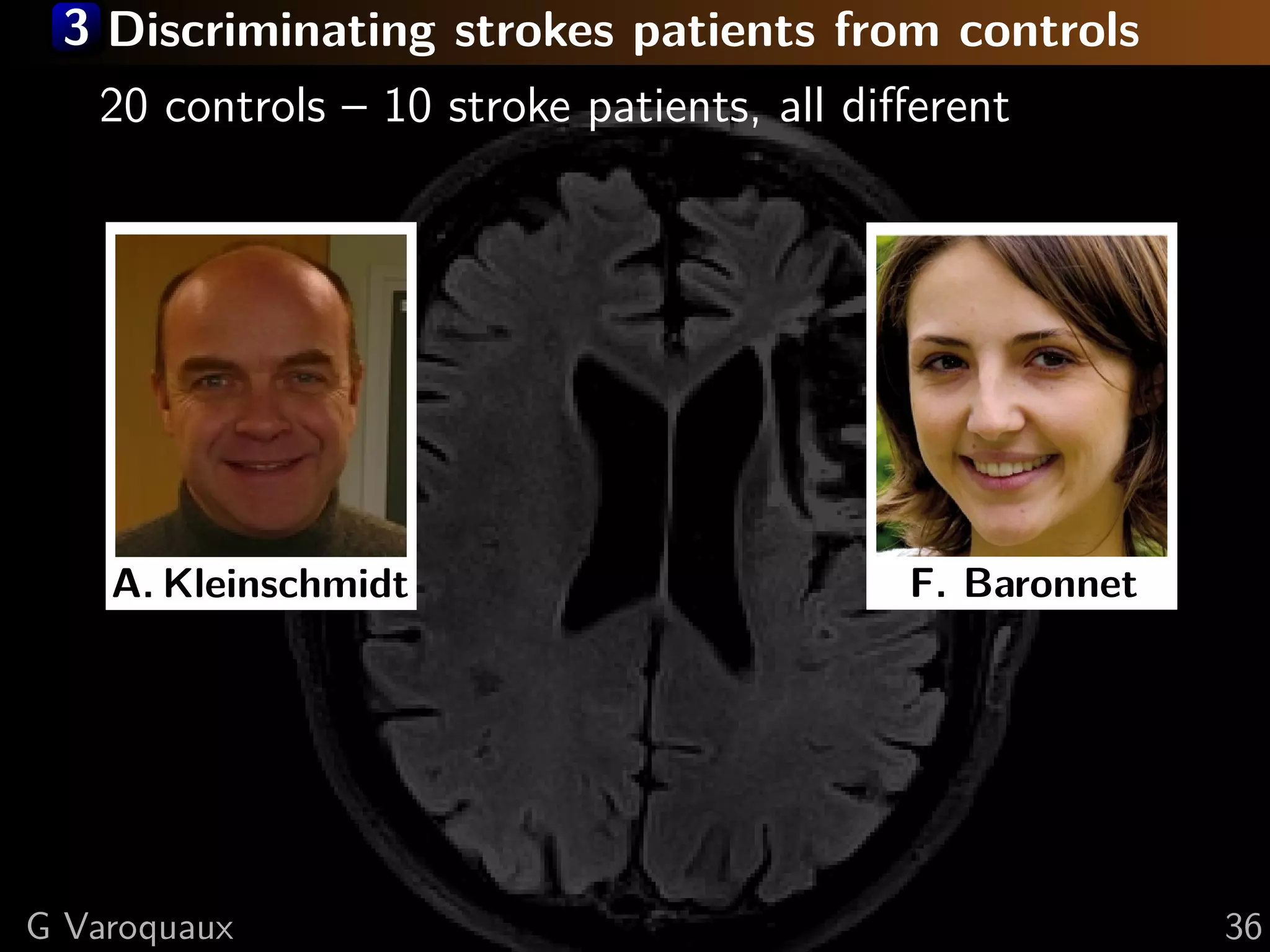
3 Discriminating strokes patients from controls
   20 controls – 10 stroke patients, all different


    A. Kleinschmidt                        F. Baronnet


G Varoquaux                                              36
3 Discriminating strokes patients from controls
   Leave one out likelihood


                          Log-likelihood


                                                                 Log-likelihood
                                            Tangent
         n×n                                space
     R

    controls   patients                    controls   patients

   Probabilistic model on manifold discriminates
   patients better
G Varoquaux                                                                       37
3 Residuals
0
           Correlation matrices: Σ
                     0            0
                                                                                                  -1.0
                                                                                                        0
                                                                                                                     0.0           1.0


5                                   5                                 5                                 5

0                                  10                                10                                10

5                                  15                                15                                15

0                                  20                                20                                20

5                                  25                                25                                25

    0     5    10   15   20   25        0   5    10   15   20   25        0   5    10   15   20   25        0   5   10   15   20   25


0
              Residuals: dΣ
                       0                                             0
                                                                                                  -1.0
                                                                                                       0
                                                                                                                     0.0           1.0

5                                   5                                 5                                 5

0                                  10                                10                                10

5                                  15                                15                                15

0                                  20                                20                                20

5                                  25                                25                                25

    0     5    10   15   20   25        0   5    10   15   20   25        0   5    10   15   20   25        0   5   10   15   20   25
              Control                           Control                           Control                       Large lesion
        G Varoquaux                                                                                                                38
3 Number of edge-level differences detected


                          10           Detections in tangent space
   Number of detections

                           9
                           8           Detections in Rn×n
                           7
                           6
                           5
                           4
                           3
                           2
                           1
                           0
                               1   2    3   4   5    6      7   8   9   10
                                            Patient number

                                                         p-value: 5·10−2
G Varoquaux
                                                     Bonferroni-corrected    39
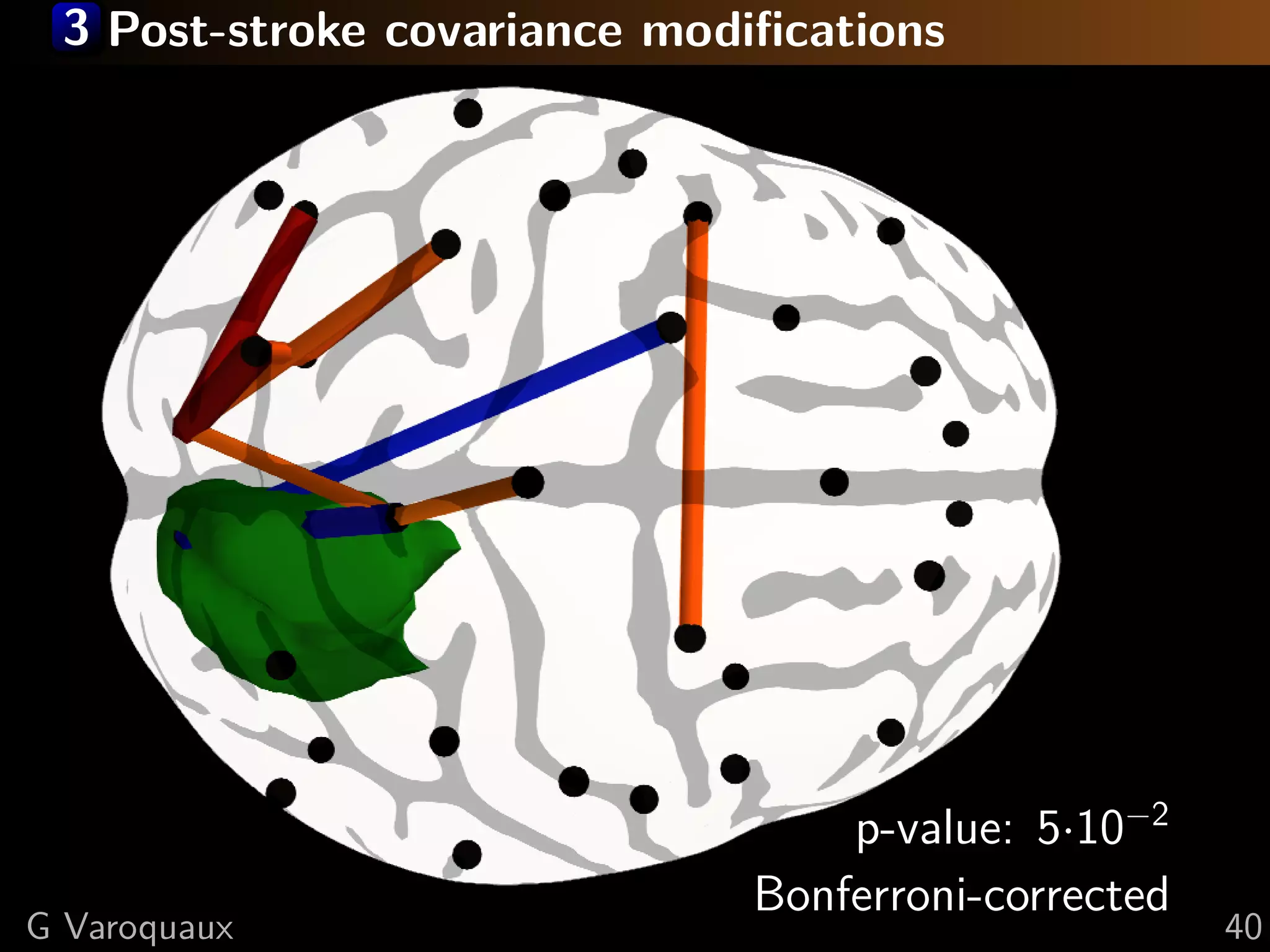
3 Post-stroke covariance modifications


                                 p-value: 5·10−2
                             Bonferroni-corrected
G Varoquaux                                         40
3 Post-stroke covariance modifications


                                 p-value: 5·10−2
                             Bonferroni-corrected
G Varoquaux                                         40
Thanks
   B. Thirion,     J.B. Poline,       A. Kleinschmidt
  Resting state analysis                S. Sadaghiani
  Dictionary learning        F. Bach,     R. Jenatton
  Sparse inverse covariance              A. Gramfort
  Strokes                                 F. Baronnet
  Matrix-variate MFX                         P. Fillard

                  Software: in Python
  scikit-learn: machine learning
  F. Pedegrosa, O. Grisel, M. Blondel . . .
  Mayavi: 3D plotting
  P. Ramachandran
G Varoquaux                                               41
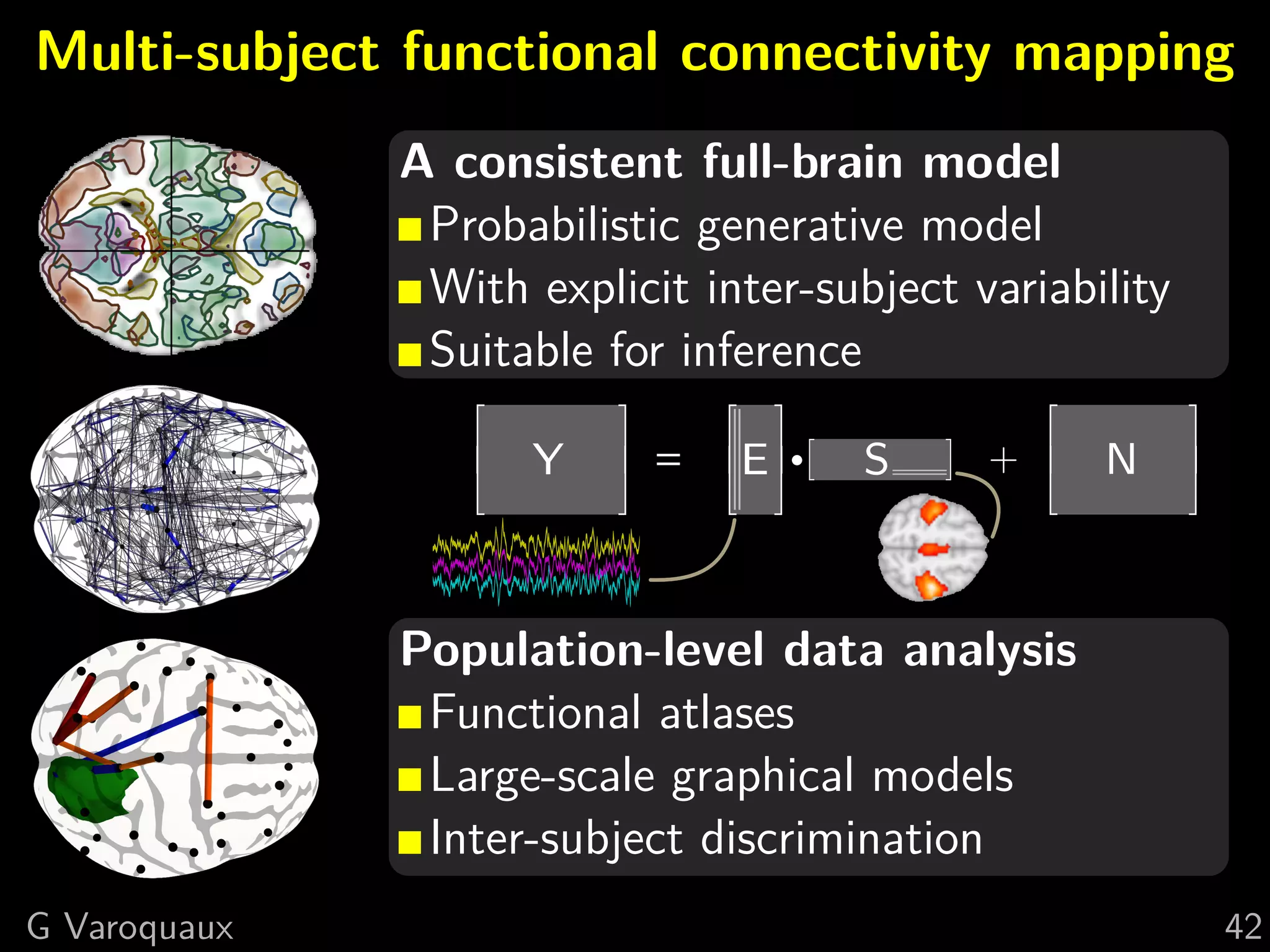
Multi-subject functional connectivity mapping
              A consistent full-brain model
               Probabilistic generative model
               With explicit inter-subject variability
               Suitable for inference

                    Y      =   E   ·   S    +     N

               25

              Population-level data analysis
               Functional atlases
               Large-scale graphical models
               Inter-subject discrimination
G Varoquaux                                              42
Bibliography
[Varoquaux NeuroImage 2010] G. Varoquaux, S. Sadaghiani, P. Pinel, A.
Kleinschmidt, J.B. Poline, B. Thirion A group model for stable multi-subject ICA
on fMRI datasets, NeuroImage 51 p. 288 (2010)
http://hal.inria.fr/hal-00489507/en
[Varoquaux MICCAI 2010] G. Varoquaux, F. Baronnet, A. Kleinschmidt, P.
Fillard and B. Thirion, Detection of brain functional-connectivity difference in
post-stroke patients using group-level covariance modeling, MICCAI (2010)
http://hal.inria.fr/inria-00512417/en
[Varoquaux NIPS 2010] G. Varoquaux, A. Gramfort, J.B. Poline and B. Thirion,
Brain covariance selection: better individual functional connectivity models using
population prior, NIPS (2010)
http://hal.inria.fr/inria-00512451/en
[Varoquaux IPMI 2011] G. Varoquaux, A. Gramfort, F. Pedregosa, V. Michel,
and B. Thirion, Multi-subject dictionary learning to segment an atlas of brain
spontaneous activity, Information Processing in Medical Imaging p. 562 (2011)
http://hal.inria.fr/inria-00588898/en
[Ramachandran 2011] P. Ramachandran, G. Varoquaux Mayavi: 3d visualization
of scientific data, Computing in Science & Engineering 13 p. 40 (2011)
http://hal.inria.fr/inria-00528985/en
G Varoquaux                                                                          43

Learning and comparing multi-subject models of brain functional connecitivity

  • 1.
    Learning and comparingmulti-subject models of brain functional connectivity Ga¨l Varoquaux e INSERM/Unicog – INRIA/Parietal – Neurospin
  • 2.
    Intrinsic brain structuresin on-going activity? (cognitive and systems neuroscience research) Diagnostic markers in resting-state? (medical applications) Need population-level models Statistical (generative) models + explicit subject variability In order to Accumulate data in a group Compare subjects G Varoquaux 2
  • 3.
    Outline 1Spatial modes of ongoing activity 2 Graphical models of brain connectivity 3 Detecting differences in connectivity G Varoquaux 3
  • 4.
    1 Spatial modesof ongoing activity G Varoquaux 4
  • 5.
    1 Spatial modesof ongoing activity G Varoquaux 4
  • 6.
    1 Decomposing inspatial modes: a model voxels voxels voxels Y E · S + N time time time = 25 Decomposing time series into: covarying spatial maps, S uncorrelated residuals, N ICA: minimize mutual information across S G Varoquaux 5
  • 7.
    1 ICA onmultiple subjects: group ICA Estimate common spatial maps S: voxels voxels voxels Y 1 E 1 · S + N 1 time time time = · · · · · · s s s Y E · S + N time time time = G Varoquaux [Calhoun HBM 2001] 6
  • 8.
    1 ICA onmultiple subjects: group ICA Estimate common spatial maps S: voxels voxels voxels Y 1 E 1 · S + N 1 time time time = · · · · · · s s s Y E · S + N time time time = Concatenate images, minimize norm of residuals Corresponds to fixed-effects modeling: i.i.d. residuals Ns G Varoquaux [Calhoun HBM 2001] 6
  • 9.
    1 ICA: Noisemodel Observation noise: minimize group residuals (PCA): voxels voxels voxels Y W · B + O time time time concat = Learn interesting maps (ICA): voxels voxels · sources sources B = M S G Varoquaux 7
  • 10.
    1 CanICA: randomeffects model Observation noise: minimize subject residuals (PCA): voxels voxels Subject voxels Y W · P + Os time time time s = s s Select signal similar across subjects (CCA): voxels P1 Group voxels · subjects sources . . . = Λ· B + R Ps Learn interesting maps (ICA): voxels voxels · sources sources B = M S G Varoquaux [Varoquaux NeuroImage 2010] 8
  • 11.
    1 CanICA: experimentalvalidation Reproducibility across controls groups no CCA CanICA MELODIC .36 (.02) .72 (.05) .51 (.04) Qualitative observation: less ’noise’ components G Varoquaux [Varoquaux NeuroImage 2010] 9
  • 12.
    1 Noise inthe ICA maps How to describe noise versus signal? ⇓ ⇓ Blobs standing out Background noise G Varoquaux [Varoquaux ISBI 2010] 10
  • 13.
    1 Noise inthe ICA maps How to describe noise versus signal? Joint distribution: Blobs standing out = long-tailed distribution Background noise = isotropic central mode G Varoquaux [Varoquaux ISBI 2010] 10
  • 14.
    1 Noise inthe ICA maps How to describe noise versus signal? ⇓ ⇓ Thresholding Joint distribution: G Varoquaux [Varoquaux ISBI 2010] 10
  • 15.
    1 ICA asa sparse decomposition ⇒ voxels ·( voxels voxels ( sources sources B = M S + Q Interesting sources S are sparse Q: Gaussian noise Thresholding ICA = sparse recovery Experimental validation: on sub-sampled signal: more robust than other approaches G Varoquaux [Varoquaux ISBI 2010] 11
  • 16.
    1 The group-levelICA maps Visual system map 0, reproducibility: 0.54 -74 V1 0 9 map 1, reproducibility: 0.52 -91 V1-V2 3 -3 map 3, reproducibility: 0.47 -80 40 4 extrastriate map 25, reproducibility: 0.34 -78 -30 24 superior parietal G Varoquaux [Varoquaux NeuroImage 2010] 12
  • 17.
    1 The group-levelICA maps Motor system map 4, reproducibility: 0.47 part of -25 -1 62 motor map 21, reproducibility: 0.36 part of -21 -42 54 motor map 32, reproducibility: 0.30 part of -8 -54 29 motor G Varoquaux [Varoquaux NeuroImage 2010] 12
  • 18.
    1 The group-levelICA maps Frontal structures map 18, reproducibility: 0.37 map 23, reproducibility: 0.35 dorsal 43 frontal -30 28 10 medial wall 0 54 map 29, reproducibility: 0.31 21 pre-frontal 0 24 map 39, reproducibility: 0.26 map 37, reproducibility: 0.28 part of part of 21 prefronto-insular -34 -8 15 prefronto-insular -42 -3 G Varoquaux [Varoquaux NeuroImage 2010] 12
  • 19.
    1 The group-levelICA maps ICA extracts a brain parcellation However No overall control of residuals Does not select for what we interpret G Varoquaux [Varoquaux NeuroImage 2010] 12
  • 20.
    1 Multi-subject dictionarylearning Subject Group Time series maps maps 25 x Subject level spatial patterns: Ys = Us Vs T + Es , Es ∼ N (0, σI) Group level spatial patterns: Vs = V + Fs , Fs ∼ N (0, ζI) Sparsity and spatial-smoothness prior: 1 V ∼ exp (−ξ Ω(V)), Ω(v) = v 1 + vT Lv 2 G Varoquaux [Varoquaux Inf Proc Med Imag 2011] 13
  • 21.
    1 Multi-subject dictionarylearning Estimation: maximum a posteriori argmin Ys − Us Vs T 2 Fro + µ Vs − V 2 Fro + λ Ω(V) Us ,Vs ,V sujets Data fit Subject Penalization: sparse variability and smooth maps Alternate optimization on Us , Vs , V: Update Us : standard dictionary learning procedure [Mairal2010] Update Vs : ridge regression on (Vs − V)T Update V: proximal operator for λ Ω: S 1 s argmin v −v 2 2 + γ Ω(v) = prox ¯, v V = mean Vs ¯ v s=1 2 γ/ S Ω s G Varoquaux [Varoquaux Inf Proc Med Imag 2011] 14
  • 22.
    1 Multi-subject dictionarylearning Estimation: maximum a posteriori argmin Ys − Us Vs T 2 Fro + µ Vs − V 2 Fro + λ Ω(V) Us ,Vs ,V sujets Data fit Subject Penalization: sparse variability and smooth maps Parameter selection µ: comparing variance (PCA spectrum) at subject and group level λ: cross-validation G Varoquaux [Varoquaux Inf Proc Med Imag 2011] 14
  • 23.
    1 Multi-subject dictionarylearning Individual maps + Atlas of functional regions G Varoquaux [Varoquaux Inf Proc Med Imag 2011] 15
  • 24.
    1 Multi-subject dictionarylearning Multi-subject dictionary learning ICA G Varoquaux [Varoquaux Inf Proc Med Imag 2011] 16
  • 25.
    1 Multi-subject dictionarylearning Multi-subject dictionary learning ICA G Varoquaux [Varoquaux Inf Proc Med Imag 2011] 16
  • 26.
    1 Multi-subject dictionarylearning Default mode Base ganglia G Varoquaux [Varoquaux Inf Proc Med Imag 2011] 16
  • 27.
    Spatial modes: fromfluctuations to a parcellation voxels voxels voxels Y E · S + N time time time = G Varoquaux 17
  • 28.
    Associated time series: voxels voxels voxels Y E · S + N time time time = G Varoquaux 17
  • 29.
    2 Graphical modelsof brain connectivity Modeling the correlations between regions G Varoquaux 18
  • 30.
    2 Graphical modelfor correlation Specify the probability of observing fMRI data Multivariate normal P(X) ∝ |Σ−1 |e − 2 X Σ X 1 T −1 Parametrized by inverse covariance matrix K = Σ−1 Observations: Direct connections: Covariance matrix Inverse covariance 1 1 2 2 0 0 3 3 4 4 [Smith 2011, Varoquaux NIPS 2010] G Varoquaux 19
  • 31.
    2 Penalized sparseinverse covariance estimation Maximum a posteriori: fit models with a prior K = argmax L(Σ|K) + f (K) ˆ K 0 Standard sparse inverse-covariance estimation: Prior: many pairs of regions are not connected Lasso-like problem: 1 penalization f (K) = |Ki,j | i=j G Varoquaux 20
  • 32.
    2 Penalized sparseinverse covariance estimation Maximum a posteriori: fit models with a prior K = argmax L(Σ|K) + f (K) ˆ K 0 Our contribution: Population prior: same independence structure across subjects ⇒ Estimate together all {Ks } from {Σs } ˆ A. Gramfort Group-lasso (mixed norms): 21 penalization f {Ks } = λ (Ks )2 i,j i=j s Convex optimization problem G Varoquaux [Varoquaux NIPS 2010] 20
  • 33.
    2 Population-sparse graphperform better ˆ Σ−1 Sparse inverse Population prior Likelihood of new data (nested cross-validation) Subject data, Σ−1 -57.1 Subject data, sparse inverse 43.0 Group average data, Σ−1 40.6 Group average data, sparse inverse 41.8 Population prior 45.6 G Varoquaux [Varoquaux NIPS 2010] 21
  • 34.
    2 Brain graphs Raw Population correlations prior G Varoquaux [Varoquaux NIPS 2010] 22
  • 35.
    2 Graphs ofbrain function? Cognitive function arises from the interplay of specialized brain regions: The functional segregation of local areas [...] contrasts sharply with their global integration during perception and behavior [Tononi 1994] A proposed measure of functional segregation Graph modularity = divide in communities to maximize intra-class connections versus extra-class G Varoquaux 23
  • 36.
    2 Graph cutsto isolate functional communities Find communities to maximize modularity:   2  k A(Vc , Vc )  A(V , Vc )  Q=  −  c=1 A(V , V ) A(V , V ) A(Va , Vb ) is the sum of edges going from Va to Vb Rewrite as an eigenvalue problem [White 2005] 1 1 0 0 A · 1 1 0 0 ⇒ Spectral clustering = spectral embedding + k-means Similar to normalized graph cuts G Varoquaux 24
  • 37.
    2 Brain graphsand communities Raw Population correlations prior G Varoquaux 25
  • 38.
    2 Brain integrationbetween communities Proposed measure for functional integration: mutual information (Tononi) 1 Integration: Ic1 = log det(Kc1 ) 2 Mutual information: Mc1 ,c2 = Ic1 ∪c2 − Ic1 − Is2 G Varoquaux [Varoquaux NIPS 2010] 26
  • 39.
    2 Brain integrationbetween communities Proposed measure for functional integration: mutual information (Tononi) With population prior: Occipital pole Default mode network visual areas Medial visual areas Fronto-parietal Lateral visual networks areas Fronto-lateral Posterior inferior network temporal 1 Pars Posterior inferior opercularis temporal 2 Raw Dorsal motor Right Thalamus correlations: Cingulo-insular Ventral motor network Auditory Left Putamen Basal ganglia G Varoquaux [Varoquaux NIPS 2010] 26
  • 40.
    Map functional connectionsof individuals in a population G Varoquaux 27
  • 41.
    After a stroke,functional connections distant from the lesion are modified ? ? Outcome prognosis in ongoing activity? G Varoquaux 27
  • 42.
    3 Detecting differencesin connectivity G Varoquaux 28
  • 43.
    3 Failure ofunivariate approach on correlations Subject variability spread across correlation matrices 0 0 0 0 5 5 5 5 10 10 10 10 15 15 15 15 20 20 20 20 25 Control 25 Control 25 Control Large lesion 25 0 5 10 15 20 25 0 5 10 15 20 25 0 5 10 15 20 25 0 5 10 15 20 25 Cannot apply univariate statistics Σ1 Σ2 dΣ = Σ2 − Σ1 dΣ = Σ2 − Σ1 is not definite positive ⇒ Describes impossible observations (negative variance) G Varoquaux 29
  • 44.
    3 Failure ofunivariate approach on correlations Subject variability spread across correlation matrices 0 0 0 0 5 5 5 5 10 10 10 10 15 15 15 15 20 20 20 20 25 Control 25 Control 25 Control Large lesion 25 0 5 10 15 20 25 0 5 10 15 20 25 0 5 10 15 20 25 0 5 10 15 20 25 Cannot apply univariate statistics in contradiction with Gaussian models: parameters not independent Σ does not live in a vector space G Varoquaux 29
  • 45.
    3 Simulation ona toy problem Simulate two processes with different inverse covariance K1 : K1 − K2 : Σ1 : Σ1 − Σ2 : Add jitter in observed covariance... sample MSE(K1 − K2 ): MSE(Σ1 − Σ2 ): Non-local effects and non homogeneous noise G Varoquaux 30
  • 46.
    3 Theoretical settings:comparison of estimates Observations in 2 populations: X1 and X2 ˆ ˆ Goal: comparing estimates: θ(X1 ) and θ(X1 ) Asymptotic normality: θ(X1 ) ∼ N θ1 , I(θ1 )−1 ˆ I(θ²) -1 θ² I(θ¹) -1 θ¹ G Varoquaux 31
  • 47.
    3 Theoretical settings:comparison of estimates [Rao 1945] Fisher information I defines a metric on the manifold of models. We use it to choose a global parametrization for comparisons if old an M G Varoquaux 31
  • 48.
    3 Covariance manifold– Symn + Metric tensor (Fisher information) [Lenglet 2006] dΣ1 , dΣ2 Σ = 1 trace(Σ−1 dΣ1 Σ−1 dΣ2 ) 2 + Nice properties of the Symn manifold (Lie group): metric can be fully integrated, gives rise to global mapping to a vector space (Logarithmic map). Σ1 , Σ2 = log Σ1 − 2 Σ2 Σ1 − 2 2 1 1 2 Σ1 , Locally: Σ1 , Σ2 ∝ trace(Σ1 − 2 Σ2 Σ1 − 2 ) − p 1 1 Σ1 = dΣ Fro dΣ = Σ1 Σ2 Σ1 −1/2 −1/2 where G Varoquaux 32
  • 49.
    3 Reparametrization foruniform error geometry Logarithmic mapping: −− −→ Σ1 ∈ Symn Σ2 ∈ Symn → Σ1 Σ2 ∈ R 2 p (p−1) 1 + + Controls Patient Controls Patient G Varoquaux 33
  • 50.
    3 Reparametrization foruniform error geometry Logarithmic mapping: −− −→ Σ1 ∈ Symn Σ2 ∈ Symn → Σ1 Σ2 ∈ R 2 p (p−1) 1 + + −− −→ d(Σ1 , Σ2 ) = Σ1 Σ2 2 old a nif M Tangen dΣ t Controls Patient G Varoquaux 33
  • 51.
    3 Statistics... Do intrinsic statistics on the parameterization: Mean (Frechet mean) PDF Parameter-level hypothesis testing G Varoquaux 34
  • 52.
    3 Random effectson the covariance manifold Population-level covariance distribution Generalized isotropic normal distribution:   1 p(Σ) = k(σ) exp− 2 Σ Σ 2 Σ  (1) 2σ Population mean: Σ = argmin ΣΣi 2 Σ (2) Σ i Efficient gradient descent algorithm Principled computation of: group mean Σ and spread σ likelihood of new data G Varoquaux 35
  • 53.
    3 Random effectson the covariance manifold Population-level covariance distribution Generalized isotropic normal distribution:   1 p(Σ) = k(σ) exp− 2 Σ Σ 2 Σ  (1) 2σ Edge-level statistics Under null hypothesis: subject ∈ group model (1) −→ dΣ ∼ N (0, σI) : Independant coefficients ⇒ Univariate statistics on dΣi,j [Varoquaux MICCAI 2010] G Varoquaux 35
  • 54.
    3 Discriminating strokespatients from controls 20 controls – 10 stroke patients, all different A. Kleinschmidt F. Baronnet G Varoquaux 36
  • 55.
    3 Discriminating strokespatients from controls Leave one out likelihood Log-likelihood Log-likelihood Tangent n×n space R controls patients controls patients Probabilistic model on manifold discriminates patients better G Varoquaux 37
  • 56.
    3 Residuals 0 Correlation matrices: Σ 0 0 -1.0 0 0.0 1.0 5 5 5 5 0 10 10 10 5 15 15 15 0 20 20 20 5 25 25 25 0 5 10 15 20 25 0 5 10 15 20 25 0 5 10 15 20 25 0 5 10 15 20 25 0 Residuals: dΣ 0 0 -1.0 0 0.0 1.0 5 5 5 5 0 10 10 10 5 15 15 15 0 20 20 20 5 25 25 25 0 5 10 15 20 25 0 5 10 15 20 25 0 5 10 15 20 25 0 5 10 15 20 25 Control Control Control Large lesion G Varoquaux 38
  • 57.
    3 Number ofedge-level differences detected 10 Detections in tangent space Number of detections 9 8 Detections in Rn×n 7 6 5 4 3 2 1 0 1 2 3 4 5 6 7 8 9 10 Patient number p-value: 5·10−2 G Varoquaux Bonferroni-corrected 39
  • 58.
    3 Post-stroke covariancemodifications p-value: 5·10−2 Bonferroni-corrected G Varoquaux 40
  • 59.
    3 Post-stroke covariancemodifications p-value: 5·10−2 Bonferroni-corrected G Varoquaux 40
  • 60.
    Thanks B. Thirion, J.B. Poline, A. Kleinschmidt Resting state analysis S. Sadaghiani Dictionary learning F. Bach, R. Jenatton Sparse inverse covariance A. Gramfort Strokes F. Baronnet Matrix-variate MFX P. Fillard Software: in Python scikit-learn: machine learning F. Pedegrosa, O. Grisel, M. Blondel . . . Mayavi: 3D plotting P. Ramachandran G Varoquaux 41
  • 61.
    Multi-subject functional connectivitymapping A consistent full-brain model Probabilistic generative model With explicit inter-subject variability Suitable for inference Y = E · S + N 25 Population-level data analysis Functional atlases Large-scale graphical models Inter-subject discrimination G Varoquaux 42
  • 62.
    Bibliography [Varoquaux NeuroImage 2010]G. Varoquaux, S. Sadaghiani, P. Pinel, A. Kleinschmidt, J.B. Poline, B. Thirion A group model for stable multi-subject ICA on fMRI datasets, NeuroImage 51 p. 288 (2010) http://hal.inria.fr/hal-00489507/en [Varoquaux MICCAI 2010] G. Varoquaux, F. Baronnet, A. Kleinschmidt, P. Fillard and B. Thirion, Detection of brain functional-connectivity difference in post-stroke patients using group-level covariance modeling, MICCAI (2010) http://hal.inria.fr/inria-00512417/en [Varoquaux NIPS 2010] G. Varoquaux, A. Gramfort, J.B. Poline and B. Thirion, Brain covariance selection: better individual functional connectivity models using population prior, NIPS (2010) http://hal.inria.fr/inria-00512451/en [Varoquaux IPMI 2011] G. Varoquaux, A. Gramfort, F. Pedregosa, V. Michel, and B. Thirion, Multi-subject dictionary learning to segment an atlas of brain spontaneous activity, Information Processing in Medical Imaging p. 562 (2011) http://hal.inria.fr/inria-00588898/en [Ramachandran 2011] P. Ramachandran, G. Varoquaux Mayavi: 3d visualization of scientific data, Computing in Science & Engineering 13 p. 40 (2011) http://hal.inria.fr/inria-00528985/en G Varoquaux 43