Micro-to-macro passage in traffic models
including multi-anticipation effect
Guillaume Costeseque
collaboration with Paola Goatin and Francesco Rossi
Inria Sophia-Antipolis M´editerran´ee
Mini-symposium “Homogenization of PDEs and application to traffic”
– Institut Henri Poincar´e, Paris –
September 28, 2016
G. Costeseque Micro to macro and multi-anticipation Paris, September 28 2016 1 / 26
Motivation
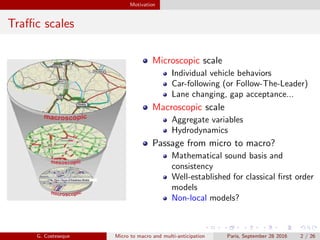
Traffic scales
Microscopic scale
Individual vehicle behaviors
Car-following (or Follow-The-Leader)
Lane changing, gap acceptance...
Macroscopic scale
Aggregate variables
Hydrodynamics
Passage from micro to macro?
Mathematical sound basis and
consistency
Well-established for classical first order
models
Non-local models?
G. Costeseque Micro to macro and multi-anticipation Paris, September 28 2016 2 / 26
Motivation
Outline
1 Background
2 Our approach
G. Costeseque Micro to macro and multi-anticipation Paris, September 28 2016 3 / 26
Background
Outline
1 Background
2 Our approach
G. Costeseque Micro to macro and multi-anticipation Paris, September 28 2016 4 / 26
Background Settings
General setting
N vehicles (N ∈ N)
initial density ρ0 ∈ BVc(R, [0, 1])
R
ρ0(y)dy = 1
linear mass attributed to each vehicle
lN :=
1
N R
ρ0(y)dy =
1
N
xi+1
ρ0
xi
1
0
ρ0(y)dy = M
xi+1
xi
ρ0(y)dy =
M
N
x
0 1
G. Costeseque Micro to macro and multi-anticipation Paris, September 28 2016 5 / 26
Background Settings
Speed function
(V) Speed function v : ρ → v(ρ) strictly decreasing on [0, 1] and
v(0) = vmax with 0 < vmax < +∞ and v(1) = 0
0 0.1 0.2 0.3 0.4 0.5 0.6 0.7 0.8 0.9 1
Density
0
0.1
0.2
0.3
0.4
0.5
0.6
0.7
0.8
0.9
1
Speed V(ρ)
G. Costeseque Micro to macro and multi-anticipation Paris, September 28 2016 6 / 26
Background LWR model (DiFrancesco, Rosini)
Hyperbolic approach (Di Francesco, Rosini, 2015)
Micro-to-macro for the LWR model [3]
Micro car-following model



˙xN = vmax
˙xi = v
lN
xi+1 − xi
, ∀i = 1, . . . , N − 1,
xi (t = 0) = xi,0, ∀i = 1, . . . , N.
(1)
Macro LWR model
ρt + (ρv(ρ))x = 0, on (0, +∞) × R,
ρ(0, x) = ρ0(x), on R
(2)
G. Costeseque Micro to macro and multi-anticipation Paris, September 28 2016 7 / 26
Background LWR model (DiFrancesco, Rosini)
Some theoretical results (Di Francesco, Rosini)
Theorem (Convergence in L1
loc)
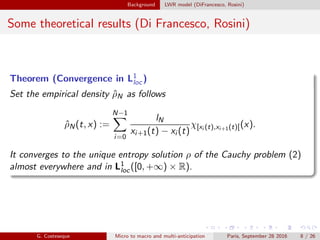
Set the empirical density ˆρN as follows
ˆρN(t, x) :=
N−1
i=0
lN
xi+1(t) − xi (t)
χ[xi (t),xi+1(t)[(x).
It converges to the unique entropy solution ρ of the Cauchy problem (2)
almost everywhere and in L1
loc([0, +∞) × R).
G. Costeseque Micro to macro and multi-anticipation Paris, September 28 2016 8 / 26
Background LWR model (DiFrancesco, Rosini)
Some theoretical results (Di Francesco, Rosini)
(continued)
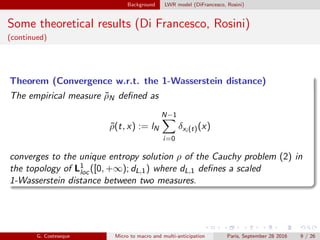
Theorem (Convergence w.r.t. the 1-Wasserstein distance)
The empirical measure ˜ρN defined as
˜ρ(t, x) := lN
N−1
i=0
δxi (t)(x)
converges to the unique entropy solution ρ of the Cauchy problem (2) in
the topology of L1
loc([0, +∞); dL,1) where dL,1 defines a scaled
1-Wasserstein distance between two measures.
G. Costeseque Micro to macro and multi-anticipation Paris, September 28 2016 9 / 26
Background LWR model (DiFrancesco, Rosini)
sketch of the proof
1 Definitions: Introduce the cumulative distribution of ˆρ
ˆX(x) := inf {y ∈ R | ˆρ ((−∞, y]) > x }
and the one of ˜ρ
˜X(x) := inf {y ∈ R | ˜ρ ((−∞, y]) > x } .
Introduce finally the discrete Lagrangian density
ˇρ := ˆρ ◦ ˆX.
2 Convergence:
proof of ˜X → X in L1
loc ([0, +∞) × [0, L]; R)
equivalent to prove that (˜ρ) → ρ in L1
loc ([0, +∞); dL,1)
And proof of ˆX → X in L1
loc ([0, +∞) × [0, L]; R)
equivalent to prove that (ˆρ) → ρ in L1
loc ([0, +∞); dL,1)
G. Costeseque Micro to macro and multi-anticipation Paris, September 28 2016 10 / 26
Background LWR model (DiFrancesco, Rosini)
sketch of the proof
(continued)
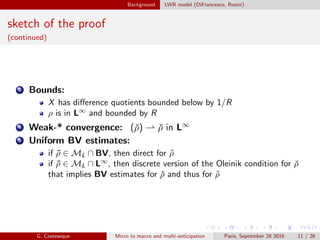
3 Bounds:
X has difference quotients bounded below by 1/R
ρ is in L∞
and bounded by R
4 Weak-* convergence: (ˇρ) ⇀ ˇρ in L∞
5 Uniform BV estimates:
if ¯ρ ∈ ML ∩ BV, then direct for ˆρ
if ¯ρ ∈ ML ∩ L∞
, then discrete version of the Oleinik condition for ˇρ
that implies BV estimates for ˇρ and thus for ˆρ
G. Costeseque Micro to macro and multi-anticipation Paris, September 28 2016 11 / 26
Background LWR model (DiFrancesco, Rosini)
sketch of the proof
(continued)
6 Passing to the limit in the system of ODEs: Formulation of the
system of ODEs as a PDE
˜Xt = v (ˇρ) .
7 Discrete entropy condition + limit using the L1 compactness:
R R
[|ρ(t, x) − k| ϕt (t, x) + sgn (ρ(t, x) − k) [f (ρ(t, x)) − f (k)] ϕx (t, x)] dtdx
+
R
|¯ρ(x) − k| ϕ(0, x)dx ≥ 0
G. Costeseque Micro to macro and multi-anticipation Paris, September 28 2016 12 / 26
Background LWR model (DiFrancesco, Rosini)
Some extensions
ARZ model [(Aw, Rascle, 2000), (Zhang, 2002)]



∂tρ + ∂x (ρv) = 0,
∂t(ρw) + ∂x (ρvw) = A
ρ
TR
(V (ρ) − v)
with w := v + P(ρ) (P called a “pseudo-pressure”)
Lagrangian approach (Aw et al., 2002) [1]
Eulerian approach (Di Francesco et al., 2015) [2]
G. Costeseque Micro to macro and multi-anticipation Paris, September 28 2016 13 / 26
Background LWR model (DiFrancesco, Rosini)
Some extensions
ARZ model [(Aw, Rascle, 2000), (Zhang, 2002)]



∂tρ + ∂x (ρv) = 0,
∂t(ρw) + ∂x (ρvw) = A
ρ
TR
(V (ρ) − v)
with w := v + P(ρ) (P called a “pseudo-pressure”)
Lagrangian approach (Aw et al., 2002) [1]
Eulerian approach (Di Francesco et al., 2015) [2]
Non-local model (Goatin, Blandin, 2015) (Goatin, Rossi, 2015) [4]
G. Costeseque Micro to macro and multi-anticipation Paris, September 28 2016 13 / 26
Background Non-local (Goatin, Rossi)
Goatin-Rossi
(macro)



∂tρ + ∂x ρv
x+η
x
ρ(t, y)w(y − x)dy = 0, for x ∈ R, t > 0,
ρ(0, x) = ρ0(x), for x ∈ R
(3)
(w) η > 0 is a given parameter and w : [0, η] → R+ is a non-increasing
Lipschitz weight satisfying
η
0
w(x)dx = 1
G. Costeseque Micro to macro and multi-anticipation Paris, September 28 2016 14 / 26
Background Non-local (Goatin, Rossi)
Goatin-Rossi
(micro)



˙xN(t) = v(0), for any t > 0,
˙xi (t) = v

 1
N
N
j=1
wlN
(xj (t) − xi (t))

 , for i = 1, . . . , N − 1, and
xi (0) = xi,0, for i = 1, . . . , N
(4)
with
wlN
:=



w(0)
lN + 2x
lN
, if x ∈ −
lN
2
, 0 ,
w(x), if x ∈ [0, η] ,
w(η)
2η + lN − 2x
lN
, if x ∈ η, η +
lN
2
,
0, elsewhere.
G. Costeseque Micro to macro and multi-anticipation Paris, September 28 2016 15 / 26
Background Non-local (Goatin, Rossi)
Goatin-Rossi
(convergence result)
Theorem (Convergence of a micro model to the unique solution
of (3))
Fix any 0 < T < +∞.
If (xi )i is a solution of the system of coupled ODEs (4), then, for any
N ∈ N, we have
[ρ(t)] =
1
N
N
i=1
δxi (t) ⇀ ρ(t)
where ρ ∈ C0 ([0, T], Pc (R)) is the unique solution of (3).
G. Costeseque Micro to macro and multi-anticipation Paris, September 28 2016 16 / 26
Our approach
Outline
1 Background
2 Our approach
G. Costeseque Micro to macro and multi-anticipation Paris, September 28 2016 17 / 26
Our approach Settings
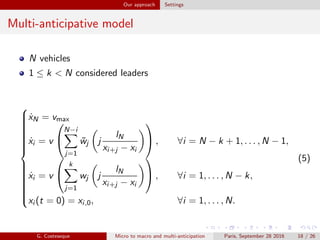
Multi-anticipative model
N vehicles
1 ≤ k < N considered leaders



˙xN = vmax
˙xi = v


N−i
j=1
˜wj j
lN
xi+j − xi

 , ∀i = N − k + 1, . . . , N − 1,
˙xi = v


k
j=1
wj j
lN
xi+j − xi

 , ∀i = 1, . . . , N − k,
xi (t = 0) = xi,0, ∀i = 1, . . . , N.
(5)
G. Costeseque Micro to macro and multi-anticipation Paris, September 28 2016 18 / 26
Our approach Settings
Assumptions
(V) Speed function v : ρ → v(ρ) strictly decreasing on [0, 1] and
v(0) = vmax with 0 < vmax < +∞ and v(1) = 0
(W) The map wj : ρ → wj (ρ) is Lipschitz continuous, non-decreasing from
[0, 1] to [0, 1] for any j = 1, . . . , k and satisfies moreover
k
j=1
wj (ρ) = ρ, for any ρ ∈ [0, 1].
G. Costeseque Micro to macro and multi-anticipation Paris, September 28 2016 19 / 26
Our approach Settings
Simplified model
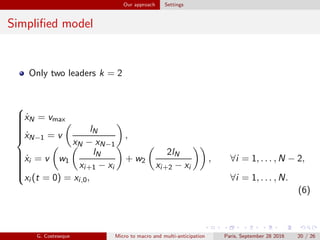
Only two leaders k = 2



˙xN = vmax
˙xN−1 = v
lN
xN − xN−1
,
˙xi = v w1
lN
xi+1 − xi
+ w2
2lN
xi+2 − xi
, ∀i = 1, . . . , N − 2,
xi (t = 0) = xi,0, ∀i = 1, . . . , N.
(6)
G. Costeseque Micro to macro and multi-anticipation Paris, September 28 2016 20 / 26
Our approach Settings
Simplified model
Only two leaders k = 2
Linear weights: ∃θ ∈ [0, 1] such that
w1(ρ) = θρ and w2(ρ) = (1 − θ)ρ



˙xN = vmax
˙xN−1 = v
lN
xN − xN−1
,
˙xi = v θ
lN
xi+1 − xi
+ (1 − θ)
2lN
xi+2 − xi
, ∀i = 1, . . . , N − 2,
xi (t = 0) = xi,0, ∀i = 1, . . . , N.
(6)
G. Costeseque Micro to macro and multi-anticipation Paris, September 28 2016 20 / 26
Our approach Some results
Maximum principle
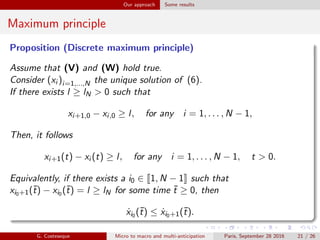
Proposition (Discrete maximum principle)
Assume that (V) and (W) hold true.
Consider (xi )i=1,...,N the unique solution of (6).
If there exists l ≥ lN > 0 such that
xi+1,0 − xi,0 ≥ l, for any i = 1, . . . , N − 1,
Then, it follows
xi+1(t) − xi (t) ≥ l, for any i = 1, . . . , N − 1, t > 0.
Equivalently, if there exists a i0 ∈ 1, N − 1 such that
xi0+1(¯t) − xi0 (¯t) = l ≥ lN for some time ¯t ≥ 0, then
˙xi0 (¯t) ≤ ˙xi0+1(¯t).
G. Costeseque Micro to macro and multi-anticipation Paris, September 28 2016 21 / 26
Our approach Some results
Convergence (still ongoing)
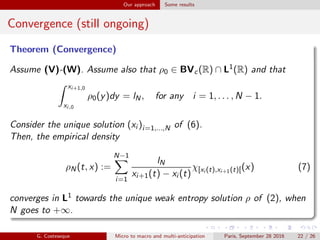
Theorem (Convergence)
Assume (V)-(W). Assume also that ρ0 ∈ BVc(R) ∩ L1(R) and that
xi+1,0
xi,0
ρ0(y)dy = lN, for any i = 1, . . . , N − 1.
Consider the unique solution (xi )i=1,...,N of (6).
Then, the empirical density
ρN (t, x) :=
N−1
i=1
lN
xi+1(t) − xi (t)
χ[xi(t),xi+1(t)[(x) (7)
converges in L1 towards the unique weak entropy solution ρ of (2), when
N goes to +∞.
G. Costeseque Micro to macro and multi-anticipation Paris, September 28 2016 22 / 26
Our approach Some results
BV estimates (still ongoing)
Proposition (BV estimates)
Assume that (V)-(W) hold true. Assume also that ρ0 ∈ BVc(R) ∩ L1(R).
Then the total variation t → TV [ρN(t)] of ρN for any N ∈ N is bounded
as follows
TV [ρN(t)] ≤ C(t) + KN 2
N
i=1
|εi (t)| + TV [ρN(0)] , for any t ≥ 0,
(8)
where
C(t) := |y1(t)| + |yN−1(t)|
KN := 2N.
(9)
G. Costeseque Micro to macro and multi-anticipation Paris, September 28 2016 23 / 26
Our approach Some results
BV estimates (still ongoing)
Proposition (Estimation on the Total Variation)
If (W) holds true and if θ >
2
3
, then we have
1
2 − θ
N−3
i=1
|Li | ≤ TV [ρN] ≤
1
3θ − 2
N−3
i=1
|Li | + 4, (10)
from which we deduce that
lim
N→+∞
TV [ρN]
N
= 0.
G. Costeseque Micro to macro and multi-anticipation Paris, September 28 2016 24 / 26
References
Some references I
A. Aw, A. Klar, M. Rascle, and T. Materne, Derivation of continuum
traffic flow models from microscopic follow-the-leader models, SIAM Journal on
Applied Mathematics, 63 (2002), pp. 259–278.
M. Di Francesco, S. Fagioli, and M. D. Rosini, Many particle
approximation of the Aw-Rascle-Zhang second order model for vehicular traffic,
arXiv preprint arXiv:1511.02700, (2015).
M. Di Francesco and M. D. Rosini, Rigorous derivation of nonlinear scalar
conservation laws from follow-the-leader type models via many particle limit,
Archive for Rational Mechanics and Analysis, (2015), pp. 1–41.
P. Goatin and F. Rossi, A traffic flow model with non-smooth metric
interaction: well-posedness and micro-macro limit, arXiv preprint arXiv:1510.04461,
(2015).
G. Costeseque Micro to macro and multi-anticipation Paris, September 28 2016 25 / 26
References
Thanks for your attention
guillaume.costeseque@inria.fr
G. Costeseque Micro to macro and multi-anticipation Paris, September 28 2016 26 / 26

Micro to macro passage in traffic models including multi-anticipation effect

  • 1.
    Micro-to-macro passage intraffic models including multi-anticipation effect Guillaume Costeseque collaboration with Paola Goatin and Francesco Rossi Inria Sophia-Antipolis M´editerran´ee Mini-symposium “Homogenization of PDEs and application to traffic” – Institut Henri Poincar´e, Paris – September 28, 2016 G. Costeseque Micro to macro and multi-anticipation Paris, September 28 2016 1 / 26
  • 2.
    Motivation Traffic scales Microscopic scale Individualvehicle behaviors Car-following (or Follow-The-Leader) Lane changing, gap acceptance... Macroscopic scale Aggregate variables Hydrodynamics Passage from micro to macro? Mathematical sound basis and consistency Well-established for classical first order models Non-local models? G. Costeseque Micro to macro and multi-anticipation Paris, September 28 2016 2 / 26
  • 3.
    Motivation Outline 1 Background 2 Ourapproach G. Costeseque Micro to macro and multi-anticipation Paris, September 28 2016 3 / 26
  • 4.
    Background Outline 1 Background 2 Ourapproach G. Costeseque Micro to macro and multi-anticipation Paris, September 28 2016 4 / 26
  • 5.
    Background Settings General setting Nvehicles (N ∈ N) initial density ρ0 ∈ BVc(R, [0, 1]) R ρ0(y)dy = 1 linear mass attributed to each vehicle lN := 1 N R ρ0(y)dy = 1 N xi+1 ρ0 xi 1 0 ρ0(y)dy = M xi+1 xi ρ0(y)dy = M N x 0 1 G. Costeseque Micro to macro and multi-anticipation Paris, September 28 2016 5 / 26
  • 6.
    Background Settings Speed function (V)Speed function v : ρ → v(ρ) strictly decreasing on [0, 1] and v(0) = vmax with 0 < vmax < +∞ and v(1) = 0 0 0.1 0.2 0.3 0.4 0.5 0.6 0.7 0.8 0.9 1 Density 0 0.1 0.2 0.3 0.4 0.5 0.6 0.7 0.8 0.9 1 Speed V(ρ) G. Costeseque Micro to macro and multi-anticipation Paris, September 28 2016 6 / 26
  • 7.
    Background LWR model(DiFrancesco, Rosini) Hyperbolic approach (Di Francesco, Rosini, 2015) Micro-to-macro for the LWR model [3] Micro car-following model    ˙xN = vmax ˙xi = v lN xi+1 − xi , ∀i = 1, . . . , N − 1, xi (t = 0) = xi,0, ∀i = 1, . . . , N. (1) Macro LWR model ρt + (ρv(ρ))x = 0, on (0, +∞) × R, ρ(0, x) = ρ0(x), on R (2) G. Costeseque Micro to macro and multi-anticipation Paris, September 28 2016 7 / 26
  • 8.
    Background LWR model(DiFrancesco, Rosini) Some theoretical results (Di Francesco, Rosini) Theorem (Convergence in L1 loc) Set the empirical density ˆρN as follows ˆρN(t, x) := N−1 i=0 lN xi+1(t) − xi (t) χ[xi (t),xi+1(t)[(x). It converges to the unique entropy solution ρ of the Cauchy problem (2) almost everywhere and in L1 loc([0, +∞) × R). G. Costeseque Micro to macro and multi-anticipation Paris, September 28 2016 8 / 26
  • 9.
    Background LWR model(DiFrancesco, Rosini) Some theoretical results (Di Francesco, Rosini) (continued) Theorem (Convergence w.r.t. the 1-Wasserstein distance) The empirical measure ˜ρN defined as ˜ρ(t, x) := lN N−1 i=0 δxi (t)(x) converges to the unique entropy solution ρ of the Cauchy problem (2) in the topology of L1 loc([0, +∞); dL,1) where dL,1 defines a scaled 1-Wasserstein distance between two measures. G. Costeseque Micro to macro and multi-anticipation Paris, September 28 2016 9 / 26
  • 10.
    Background LWR model(DiFrancesco, Rosini) sketch of the proof 1 Definitions: Introduce the cumulative distribution of ˆρ ˆX(x) := inf {y ∈ R | ˆρ ((−∞, y]) > x } and the one of ˜ρ ˜X(x) := inf {y ∈ R | ˜ρ ((−∞, y]) > x } . Introduce finally the discrete Lagrangian density ˇρ := ˆρ ◦ ˆX. 2 Convergence: proof of ˜X → X in L1 loc ([0, +∞) × [0, L]; R) equivalent to prove that (˜ρ) → ρ in L1 loc ([0, +∞); dL,1) And proof of ˆX → X in L1 loc ([0, +∞) × [0, L]; R) equivalent to prove that (ˆρ) → ρ in L1 loc ([0, +∞); dL,1) G. Costeseque Micro to macro and multi-anticipation Paris, September 28 2016 10 / 26
  • 11.
    Background LWR model(DiFrancesco, Rosini) sketch of the proof (continued) 3 Bounds: X has difference quotients bounded below by 1/R ρ is in L∞ and bounded by R 4 Weak-* convergence: (ˇρ) ⇀ ˇρ in L∞ 5 Uniform BV estimates: if ¯ρ ∈ ML ∩ BV, then direct for ˆρ if ¯ρ ∈ ML ∩ L∞ , then discrete version of the Oleinik condition for ˇρ that implies BV estimates for ˇρ and thus for ˆρ G. Costeseque Micro to macro and multi-anticipation Paris, September 28 2016 11 / 26
  • 12.
    Background LWR model(DiFrancesco, Rosini) sketch of the proof (continued) 6 Passing to the limit in the system of ODEs: Formulation of the system of ODEs as a PDE ˜Xt = v (ˇρ) . 7 Discrete entropy condition + limit using the L1 compactness: R R [|ρ(t, x) − k| ϕt (t, x) + sgn (ρ(t, x) − k) [f (ρ(t, x)) − f (k)] ϕx (t, x)] dtdx + R |¯ρ(x) − k| ϕ(0, x)dx ≥ 0 G. Costeseque Micro to macro and multi-anticipation Paris, September 28 2016 12 / 26
  • 13.
    Background LWR model(DiFrancesco, Rosini) Some extensions ARZ model [(Aw, Rascle, 2000), (Zhang, 2002)]    ∂tρ + ∂x (ρv) = 0, ∂t(ρw) + ∂x (ρvw) = A ρ TR (V (ρ) − v) with w := v + P(ρ) (P called a “pseudo-pressure”) Lagrangian approach (Aw et al., 2002) [1] Eulerian approach (Di Francesco et al., 2015) [2] G. Costeseque Micro to macro and multi-anticipation Paris, September 28 2016 13 / 26
  • 14.
    Background LWR model(DiFrancesco, Rosini) Some extensions ARZ model [(Aw, Rascle, 2000), (Zhang, 2002)]    ∂tρ + ∂x (ρv) = 0, ∂t(ρw) + ∂x (ρvw) = A ρ TR (V (ρ) − v) with w := v + P(ρ) (P called a “pseudo-pressure”) Lagrangian approach (Aw et al., 2002) [1] Eulerian approach (Di Francesco et al., 2015) [2] Non-local model (Goatin, Blandin, 2015) (Goatin, Rossi, 2015) [4] G. Costeseque Micro to macro and multi-anticipation Paris, September 28 2016 13 / 26
  • 15.
    Background Non-local (Goatin,Rossi) Goatin-Rossi (macro)    ∂tρ + ∂x ρv x+η x ρ(t, y)w(y − x)dy = 0, for x ∈ R, t > 0, ρ(0, x) = ρ0(x), for x ∈ R (3) (w) η > 0 is a given parameter and w : [0, η] → R+ is a non-increasing Lipschitz weight satisfying η 0 w(x)dx = 1 G. Costeseque Micro to macro and multi-anticipation Paris, September 28 2016 14 / 26
  • 16.
    Background Non-local (Goatin,Rossi) Goatin-Rossi (micro)    ˙xN(t) = v(0), for any t > 0, ˙xi (t) = v   1 N N j=1 wlN (xj (t) − xi (t))   , for i = 1, . . . , N − 1, and xi (0) = xi,0, for i = 1, . . . , N (4) with wlN :=    w(0) lN + 2x lN , if x ∈ − lN 2 , 0 , w(x), if x ∈ [0, η] , w(η) 2η + lN − 2x lN , if x ∈ η, η + lN 2 , 0, elsewhere. G. Costeseque Micro to macro and multi-anticipation Paris, September 28 2016 15 / 26
  • 17.
    Background Non-local (Goatin,Rossi) Goatin-Rossi (convergence result) Theorem (Convergence of a micro model to the unique solution of (3)) Fix any 0 < T < +∞. If (xi )i is a solution of the system of coupled ODEs (4), then, for any N ∈ N, we have [ρ(t)] = 1 N N i=1 δxi (t) ⇀ ρ(t) where ρ ∈ C0 ([0, T], Pc (R)) is the unique solution of (3). G. Costeseque Micro to macro and multi-anticipation Paris, September 28 2016 16 / 26
  • 18.
    Our approach Outline 1 Background 2Our approach G. Costeseque Micro to macro and multi-anticipation Paris, September 28 2016 17 / 26
  • 19.
    Our approach Settings Multi-anticipativemodel N vehicles 1 ≤ k < N considered leaders    ˙xN = vmax ˙xi = v   N−i j=1 ˜wj j lN xi+j − xi   , ∀i = N − k + 1, . . . , N − 1, ˙xi = v   k j=1 wj j lN xi+j − xi   , ∀i = 1, . . . , N − k, xi (t = 0) = xi,0, ∀i = 1, . . . , N. (5) G. Costeseque Micro to macro and multi-anticipation Paris, September 28 2016 18 / 26
  • 20.
    Our approach Settings Assumptions (V)Speed function v : ρ → v(ρ) strictly decreasing on [0, 1] and v(0) = vmax with 0 < vmax < +∞ and v(1) = 0 (W) The map wj : ρ → wj (ρ) is Lipschitz continuous, non-decreasing from [0, 1] to [0, 1] for any j = 1, . . . , k and satisfies moreover k j=1 wj (ρ) = ρ, for any ρ ∈ [0, 1]. G. Costeseque Micro to macro and multi-anticipation Paris, September 28 2016 19 / 26
  • 21.
    Our approach Settings Simplifiedmodel Only two leaders k = 2    ˙xN = vmax ˙xN−1 = v lN xN − xN−1 , ˙xi = v w1 lN xi+1 − xi + w2 2lN xi+2 − xi , ∀i = 1, . . . , N − 2, xi (t = 0) = xi,0, ∀i = 1, . . . , N. (6) G. Costeseque Micro to macro and multi-anticipation Paris, September 28 2016 20 / 26
  • 22.
    Our approach Settings Simplifiedmodel Only two leaders k = 2 Linear weights: ∃θ ∈ [0, 1] such that w1(ρ) = θρ and w2(ρ) = (1 − θ)ρ    ˙xN = vmax ˙xN−1 = v lN xN − xN−1 , ˙xi = v θ lN xi+1 − xi + (1 − θ) 2lN xi+2 − xi , ∀i = 1, . . . , N − 2, xi (t = 0) = xi,0, ∀i = 1, . . . , N. (6) G. Costeseque Micro to macro and multi-anticipation Paris, September 28 2016 20 / 26
  • 23.
    Our approach Someresults Maximum principle Proposition (Discrete maximum principle) Assume that (V) and (W) hold true. Consider (xi )i=1,...,N the unique solution of (6). If there exists l ≥ lN > 0 such that xi+1,0 − xi,0 ≥ l, for any i = 1, . . . , N − 1, Then, it follows xi+1(t) − xi (t) ≥ l, for any i = 1, . . . , N − 1, t > 0. Equivalently, if there exists a i0 ∈ 1, N − 1 such that xi0+1(¯t) − xi0 (¯t) = l ≥ lN for some time ¯t ≥ 0, then ˙xi0 (¯t) ≤ ˙xi0+1(¯t). G. Costeseque Micro to macro and multi-anticipation Paris, September 28 2016 21 / 26
  • 24.
    Our approach Someresults Convergence (still ongoing) Theorem (Convergence) Assume (V)-(W). Assume also that ρ0 ∈ BVc(R) ∩ L1(R) and that xi+1,0 xi,0 ρ0(y)dy = lN, for any i = 1, . . . , N − 1. Consider the unique solution (xi )i=1,...,N of (6). Then, the empirical density ρN (t, x) := N−1 i=1 lN xi+1(t) − xi (t) χ[xi(t),xi+1(t)[(x) (7) converges in L1 towards the unique weak entropy solution ρ of (2), when N goes to +∞. G. Costeseque Micro to macro and multi-anticipation Paris, September 28 2016 22 / 26
  • 25.
    Our approach Someresults BV estimates (still ongoing) Proposition (BV estimates) Assume that (V)-(W) hold true. Assume also that ρ0 ∈ BVc(R) ∩ L1(R). Then the total variation t → TV [ρN(t)] of ρN for any N ∈ N is bounded as follows TV [ρN(t)] ≤ C(t) + KN 2 N i=1 |εi (t)| + TV [ρN(0)] , for any t ≥ 0, (8) where C(t) := |y1(t)| + |yN−1(t)| KN := 2N. (9) G. Costeseque Micro to macro and multi-anticipation Paris, September 28 2016 23 / 26
  • 26.
    Our approach Someresults BV estimates (still ongoing) Proposition (Estimation on the Total Variation) If (W) holds true and if θ > 2 3 , then we have 1 2 − θ N−3 i=1 |Li | ≤ TV [ρN] ≤ 1 3θ − 2 N−3 i=1 |Li | + 4, (10) from which we deduce that lim N→+∞ TV [ρN] N = 0. G. Costeseque Micro to macro and multi-anticipation Paris, September 28 2016 24 / 26
  • 27.
    References Some references I A.Aw, A. Klar, M. Rascle, and T. Materne, Derivation of continuum traffic flow models from microscopic follow-the-leader models, SIAM Journal on Applied Mathematics, 63 (2002), pp. 259–278. M. Di Francesco, S. Fagioli, and M. D. Rosini, Many particle approximation of the Aw-Rascle-Zhang second order model for vehicular traffic, arXiv preprint arXiv:1511.02700, (2015). M. Di Francesco and M. D. Rosini, Rigorous derivation of nonlinear scalar conservation laws from follow-the-leader type models via many particle limit, Archive for Rational Mechanics and Analysis, (2015), pp. 1–41. P. Goatin and F. Rossi, A traffic flow model with non-smooth metric interaction: well-posedness and micro-macro limit, arXiv preprint arXiv:1510.04461, (2015). G. Costeseque Micro to macro and multi-anticipation Paris, September 28 2016 25 / 26
  • 28.
    References Thanks for yourattention guillaume.costeseque@inria.fr G. Costeseque Micro to macro and multi-anticipation Paris, September 28 2016 26 / 26