SQUARE-ROOT WAVELET
DENSITIES AND SHAPE ANALYSIS

      Anand Rangarajan, Center for Vision, Graphics and Medical Imaging
      (CVGMI), University of Florida, Gainesville
Square-root densities
Walking the straight and narrow….on a sphere
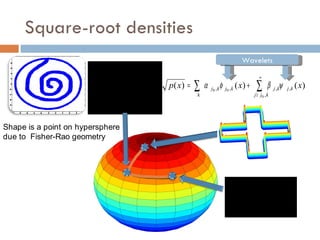
Square-root densities
                                                                            Wavelets

                                                                                      ∞
                                  p( x) =   ∑
                                            k
                                                α   j0 , k   φ   j0 , k   ( x) +    ∑       β j ,kψ
                                                                                   j ≥ j0 , k
                                                                                                      j ,k   ( x)


Shape is a point on hypersphere
due to Fisher-Rao geometry
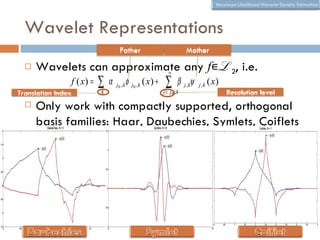
Wavelet Representations
                                     Father                                    Mother

     Wavelets can approximate any f∊ℒ2, i.e.
                            ∞
                f ( x) =   ∑   α   j0 , k   φ   j0 , k   ( x) +    ∑       β j ,kψ
                                                                  j ≥ j0 , k
                                                                                     j ,k   ( x)
Translation index          k                                                                       Resolution level
     Only work with compactly supported, orthogonal
      basis families: Haar, Daubechies, Symlets, Coiflets
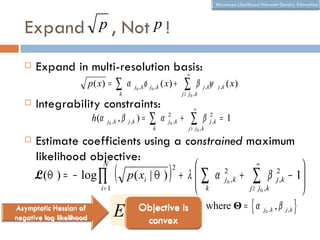
Expand                    p,          Not p !
      Expand in multi-resolution basis:
                                    ∞
                          p( x) =    ∑   k
                                              α   j0 , k   φ   j0 , k   ( x) +           ∑    β j ,kψ
                                                                                     j ≥ j0 , k
                                                                                                                 j ,k   ( x)
      Integrability constraints:                                                            ∞
                           h(α   j0 , k , β   j ,k ) =         ∑ k
                                                                        α   2
                                                                            j0 , k   +       ∑    β
                                                                                         j ≥ j0 , k
                                                                                                          2
                                                                                                          j ,k    =1

      Estimate coefficients using a constrained maximum
       likelihood objective:
                                     (                            
                                                                            )
                       N                               ∞
       L (Θ ) = − log ∏  p ( xi | Θ ) + λ  ∑ α j ,k + ∑ β j ,k − 1
                                     2          2          2
                                                                                                                      0
                             i= 1                                                                    k                        j ≥ j0 , k                      
Asymptotic Hessian of
negative log likelihood             E{ H            Objective is
                                                     L
                                                     convex
                                                                     }=              4I               where Θ = α              {      j0 , k   ,β   j ,k   }
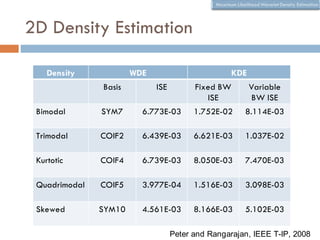
2D Density Estimation

    Density            WDE                         KDE
               Basis         ISE         Fixed BW        Variable
                                            ISE           BW ISE
 Bimodal       SYM7      6.773E-03       1.752E-02    8.114E-03

 Trimodal      COIF2     6.439E-03       6.621E-03    1.037E-02

 Kurtotic      COIF4     6.739E-03       8.050E-03    7.470E-03

 Quadrimodal   COIF5     3.977E-04       1.516E-03    3.098E-03

 Skewed        SYM10     4.561E-03       8.166E-03    5.102E-03

                                   Peter and Rangarajan, IEEE T-IP, 2008
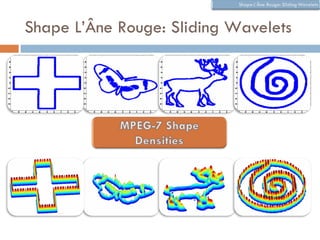
Shape L’Âne Rouge: Sliding Wavelets
How Do We Select the Number of
 Levels?
    In the wavelet expansion of p we need set j0
     (starting level) and j1 (ending level)
                                   j                                  1

              p( x) =   ∑ k
                              α   j0 , k   φ   j0 , k   ( x) +     ∑       β j ,kψ
                                                                  j > j0 , k
                                                                                     j ,k   ( x)
    Balasubramanian [32] proposed geometric
     approach by analyzing the posterior of a model
     class               p(M) ∫ p(Θ ) p( E | Θ )dΘ
             p(M | E ) =
                                                                   p( E )
    The model selection criterion (razor) is
                                                                                                         ~
                                                                                                   det g ij (Θˆ ) 
                     ˆ (Mk =ln( ln p( E | Θˆ ) +det g V Θ M )Θ  +
                                N                        (                                   1 
                                                                                               Total volume of manifold
R(M ) = − ln p( E | Θ ) + ) − ) + ln ∫ ln ij ( )d
                    R                                                                          ln                   
                          2 2π                       V ˆ (M )                              2 Volume ofg ij (Θˆ ) 
                                                                                                   det distinguishable
                                                     Θ                                          
                                                                                                distributions around ML
                              Scales with                        Volume of model              Ratio of expected Fisher
               ML fit         parameters and                     class manifold               to empirical Fisher
                              samples.
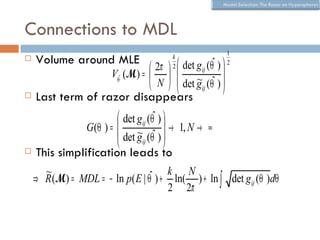
Connections to MDL
                                                                 1
   Volume around MLE                       k
                                    2π   det g ij (Θˆ ) 
                                                                 2
                                            2
                        VΘˆ (M ) =             ~
                                    N   det g ij (Θˆ ) 
   Last term of razor disappears
                          det gij (Θˆ ) 
                 G(Θ ) =      ~
                                          → 1, N → ∞
                          det gij (Θˆ ) 
                                        
   This simplification leads to
      ~                           ˆ ) + k ln( N ) + ln det g (Θ )dΘ
    ⇒ R (M ) = MDL = − ln p( E | Θ
                                        2 2π          ∫     ij
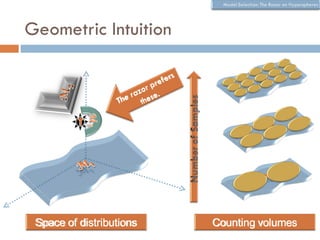
Geometric Intuition

                                    e   rs
                               re f
                         z or p .
                  Th e ra these


 Space of distributions                      Counting volumes
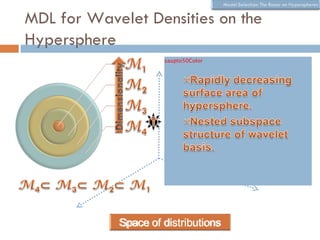
MDL for Wavelet Densities on the
Hypersphere
                     saupto50Color


            Space of distributions
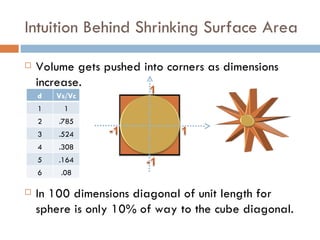
Intuition Behind Shrinking Surface Area

   Volume gets pushed into corners as dimensions
    increase.
    d   Vs/Vc
    1    1
    2   .785
    3   .524
    4   .308
    5   .164
    6    .08

   In 100 dimensions diagonal of unit length for
    sphere is only 10% of way to the cube diagonal.
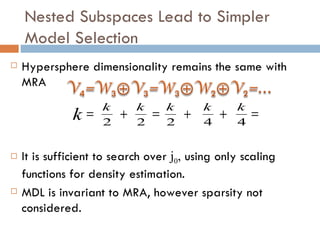
Nested Subspaces Lead to Simpler
    Model Selection
   Hypersphere dimensionality remains the same with
    MRA
                     k       k       k       k       k
              k=         +       =       +       +       =
                     2       2       2       4       4


   It is sufficient to search over j0, using only scaling
    functions for density estimation.
   MDL is invariant to MRA, however sparsity not
    considered.
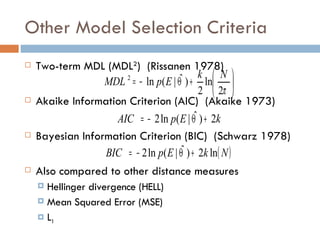
Other Model Selection Criteria
   Two-term MDL (MDL2) (Rissanen 1978)
                  MDL = − ln p( E | Θ
                      2               ˆ ) + k ln N 
                                             2  2π 
   Akaike Information Criterion (AIC) (Akaike 1973)
                    AIC = − 2 ln p( E | Θˆ ) + 2k
   Bayesian Information Criterion (BIC) (Schwarz 1978)
                  BIC = − 2 ln p( E | Θˆ ) + 2k ln( N )
   Also compared to other distance measures
     Hellinger divergence (HELL)
     Mean Squared Error (MSE)

     L1
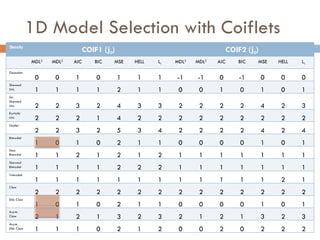
1D Model Selection with Coiflets
Density
                              COIF1 (j0)                                     COIF2 (j0)
            MDL3   MDL2   AIC    BIC   MSE     HELL   L1   MDL3   MDL2   AIC    BIC   MSE     HELL   L1
Gaussian
             0      0     1       0        1    1     1    -1     -1     0       -1       0    0     0
Skewed
Uni.         1      1     1       1        2    1     1     0      0     1       0        1    0     1
Str.
Skewed
Uni.         2      2     3       2        4    3     3     2      2     2       2        4    2     3
Kurtotic
Uni.         2      2     2       1        4    2     2     2      2     2       2        2    2     2
Outlier
             2      2     3       2        5    3     4     2      2     2       2        4    2     4
Bimodal
             1      0     1       0        2    1     1     0      0     0       0        1    0     1
Sep.
Bimodal      1      1     2       1        2    1     2     1      1     1       1        1    1     1
Skewed
Bimodal      1      1     1       1        2    2     2     1      1     1       1        1    1     1
Trimodal
             1      1     1       1        1    1     1     1      1     1       1        1    2     1
Claw
             2      2     2       2        2    2     2     2      2     2       2        2    2     2
Dbl. Claw
             1      0     1       0        2    1     1     0      0     0       0        1    0     1
Asym.
Claw         2      1     2       1        3    2     3     2      1     2       1        3    2     3
Asym.
Dbl. Claw    1      1     1       0        2    1     2     0      0     2       0        2    2     2
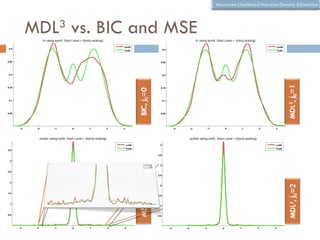
MSE, j0=4    BIC, j0=0
                          MDL3 vs. BIC and MSE


MDL3, j0=2   MDL3, j0=1
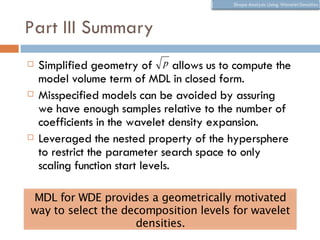
Part III Summary
   Simplified geometry of p allows us to compute the
    model volume term of MDL in closed form.
   Misspecified models can be avoided by assuring
    we have enough samples relative to the number of
    coefficients in the wavelet density expansion.
   Leveraged the nested property of the hypersphere
    to restrict the parameter search space to only
    scaling function start levels.

MDL for WDE provides a geometrically motivated
way to select the decomposition levels for wavelet
                    densities.
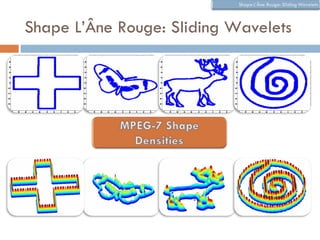
Shape L’Âne Rouge
A red donkey solves Klotski
Shape L’Âne Rouge: Sliding Wavelets
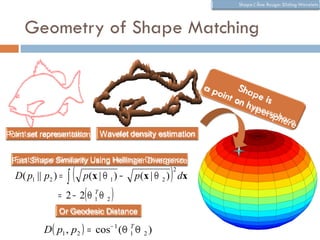
Geometry of Shape Matching

                                                            ap
                                                              oint Shape
                                                                  on h is
                                                                      ype
                                                                         rsph
                                                                             ere
Point set representation      Wavelet density estimation


 Fast Shape Similarity Using Hellinger Divergence

                    ∫(                             )   2
  D( p1 || p2 ) =        p(x | Θ 1 ) −   p ( x | Θ 2 ) dx
                         (
               = 2− 2 Θ 1Θ
                        T
                                2   )
                Or Geodesic Distance

           D( p1 , p2 ) = cos − 1 (Θ 1 Θ 2 )
                                     T
Slidin
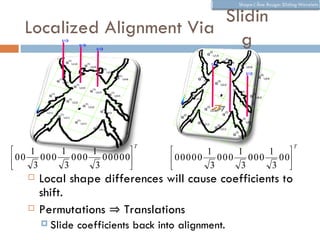
   Localized Alignment Via
                             g


                                     T                                        T
     1       1       1                            1       1       1    
 0 0 3 0 0 0 3 0 0 0 3 0 0 0 0 0        0 0 0 0 0 3 0 0 0 3 0 0 0 3 0 0
                                                                       
       Local shape differences will cause coefficients to

        Permutations ⇒ Translations
        shift.
    

         Slide   coefficients back into alignment.
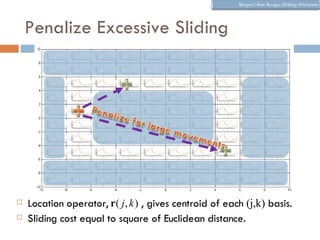
Penalize Excessive Sliding


   Location operator, r ( j , k ) , gives centroid of each (j,k) basis.
   Sliding cost equal to square of Euclidean distance.
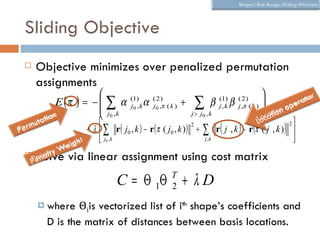
Sliding Objective
     Objective minimizes over penalized permutation
      assignments
                                                                                                         r
               E (π ) = −  ∑ α j , kα j ,π ( k ) + ∑ β j , k β j ,π ( k ) 
                                     (1)
                                       0
                                               ( 2)
                                                 0
                                                                           (1) ( 2)
                                                                                         o n o pe
                                                                                                      rato
            tion            j0 , k                             j > j0 , k              cati
         ta                                                                           Lo          2
    r mu               + λ  ∑ r ( j0 , k ) − r ( π ( j0 , k ) ) + ∑ r ( j , k ) − r (π ( j , k ) ) 
                                                                2
P e
                      h   t      j0 , k                           j ,k                            
             W   e ig
    Solve
        a lty via             linear assignment using cost matrix
    Pen

                                           C = Θ 1Θ + λ D
                                                       T


                  Θiis vectorized list of ith shape’s coefficients and
                                                       2

       where

          D is the matrix of distances between basis locations.
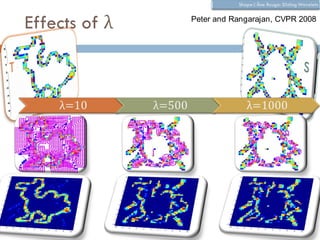
Effects of λ   Peter and Rangarajan, CVPR 2008
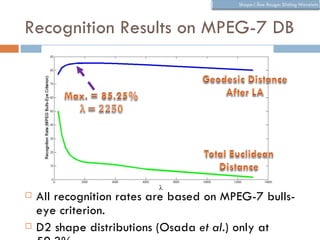
Recognition Results on MPEG-7 DB


   All recognition rates are based on MPEG-7 bulls-
    eye criterion.
   D2 shape distributions (Osada et al.) only at
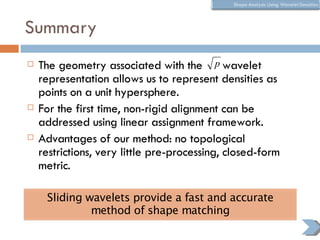
Summary
   The geometry associated with the p wavelet
    representation allows us to represent densities as
    points on a unit hypersphere.
   For the first time, non-rigid alignment can be
    addressed using linear assignment framework.
   Advantages of our method: no topological
    restrictions, very little pre-processing, closed-form
    metric.

     Sliding wavelets provide a fast and accurate
              method of shape matching

CVPR2010: Advanced ITinCVPR in a Nutshell: part 7: Future Trend

  • 1.
    SQUARE-ROOT WAVELET DENSITIES ANDSHAPE ANALYSIS Anand Rangarajan, Center for Vision, Graphics and Medical Imaging (CVGMI), University of Florida, Gainesville
  • 2.
    Square-root densities Walking thestraight and narrow….on a sphere
  • 3.
    Square-root densities Wavelets ∞ p( x) = ∑ k α j0 , k φ j0 , k ( x) + ∑ β j ,kψ j ≥ j0 , k j ,k ( x) Shape is a point on hypersphere due to Fisher-Rao geometry
  • 4.
    Wavelet Representations Father Mother  Wavelets can approximate any f∊ℒ2, i.e. ∞ f ( x) = ∑ α j0 , k φ j0 , k ( x) + ∑ β j ,kψ j ≥ j0 , k j ,k ( x) Translation index k Resolution level  Only work with compactly supported, orthogonal basis families: Haar, Daubechies, Symlets, Coiflets
  • 5.
    Expand p, Not p !  Expand in multi-resolution basis: ∞ p( x) = ∑ k α j0 , k φ j0 , k ( x) + ∑ β j ,kψ j ≥ j0 , k j ,k ( x)  Integrability constraints: ∞ h(α j0 , k , β j ,k ) = ∑ k α 2 j0 , k + ∑ β j ≥ j0 , k 2 j ,k =1  Estimate coefficients using a constrained maximum likelihood objective: (   ) N ∞ L (Θ ) = − log ∏ p ( xi | Θ ) + λ  ∑ α j ,k + ∑ β j ,k − 1 2 2 2   0 i= 1  k j ≥ j0 , k  Asymptotic Hessian of negative log likelihood E{ H Objective is L convex }= 4I where Θ = α { j0 , k ,β j ,k }
  • 6.
    2D Density Estimation Density WDE KDE Basis ISE Fixed BW Variable ISE BW ISE Bimodal SYM7 6.773E-03 1.752E-02 8.114E-03 Trimodal COIF2 6.439E-03 6.621E-03 1.037E-02 Kurtotic COIF4 6.739E-03 8.050E-03 7.470E-03 Quadrimodal COIF5 3.977E-04 1.516E-03 3.098E-03 Skewed SYM10 4.561E-03 8.166E-03 5.102E-03 Peter and Rangarajan, IEEE T-IP, 2008
  • 7.
    Shape L’Âne Rouge:Sliding Wavelets
  • 9.
    How Do WeSelect the Number of Levels?  In the wavelet expansion of p we need set j0 (starting level) and j1 (ending level) j 1 p( x) = ∑ k α j0 , k φ j0 , k ( x) + ∑ β j ,kψ j > j0 , k j ,k ( x)  Balasubramanian [32] proposed geometric approach by analyzing the posterior of a model class p(M) ∫ p(Θ ) p( E | Θ )dΘ p(M | E ) = p( E )  The model selection criterion (razor) is  ~  det g ij (Θˆ )  ˆ (Mk =ln( ln p( E | Θˆ ) +det g V Θ M )Θ  + N ( 1  Total volume of manifold R(M ) = − ln p( E | Θ ) + ) − ) + ln ∫ ln ij ( )d R ln  2 2π  V ˆ (M )  2 Volume ofg ij (Θˆ )   det distinguishable  Θ   distributions around ML Scales with Volume of model Ratio of expected Fisher ML fit parameters and class manifold to empirical Fisher samples.
  • 10.
    Connections to MDL 1  Volume around MLE k  2π   det g ij (Θˆ )  2 2 VΘˆ (M ) =   ~  N   det g ij (Θˆ )   Last term of razor disappears  det gij (Θˆ )  G(Θ ) =  ~  → 1, N → ∞  det gij (Θˆ )     This simplification leads to ~ ˆ ) + k ln( N ) + ln det g (Θ )dΘ ⇒ R (M ) = MDL = − ln p( E | Θ 2 2π ∫ ij
  • 11.
    Geometric Intuition e rs re f z or p . Th e ra these Space of distributions Counting volumes
  • 12.
    MDL for WaveletDensities on the Hypersphere saupto50Color Space of distributions
  • 13.
    Intuition Behind ShrinkingSurface Area  Volume gets pushed into corners as dimensions increase. d Vs/Vc 1 1 2 .785 3 .524 4 .308 5 .164 6 .08  In 100 dimensions diagonal of unit length for sphere is only 10% of way to the cube diagonal.
  • 14.
    Nested Subspaces Leadto Simpler Model Selection  Hypersphere dimensionality remains the same with MRA k k k k k k= + = + + = 2 2 2 4 4  It is sufficient to search over j0, using only scaling functions for density estimation.  MDL is invariant to MRA, however sparsity not considered.
  • 15.
    Other Model SelectionCriteria  Two-term MDL (MDL2) (Rissanen 1978) MDL = − ln p( E | Θ 2 ˆ ) + k ln N  2  2π   Akaike Information Criterion (AIC) (Akaike 1973) AIC = − 2 ln p( E | Θˆ ) + 2k  Bayesian Information Criterion (BIC) (Schwarz 1978) BIC = − 2 ln p( E | Θˆ ) + 2k ln( N )  Also compared to other distance measures  Hellinger divergence (HELL)  Mean Squared Error (MSE)  L1
  • 16.
    1D Model Selectionwith Coiflets Density COIF1 (j0) COIF2 (j0) MDL3 MDL2 AIC BIC MSE HELL L1 MDL3 MDL2 AIC BIC MSE HELL L1 Gaussian 0 0 1 0 1 1 1 -1 -1 0 -1 0 0 0 Skewed Uni. 1 1 1 1 2 1 1 0 0 1 0 1 0 1 Str. Skewed Uni. 2 2 3 2 4 3 3 2 2 2 2 4 2 3 Kurtotic Uni. 2 2 2 1 4 2 2 2 2 2 2 2 2 2 Outlier 2 2 3 2 5 3 4 2 2 2 2 4 2 4 Bimodal 1 0 1 0 2 1 1 0 0 0 0 1 0 1 Sep. Bimodal 1 1 2 1 2 1 2 1 1 1 1 1 1 1 Skewed Bimodal 1 1 1 1 2 2 2 1 1 1 1 1 1 1 Trimodal 1 1 1 1 1 1 1 1 1 1 1 1 2 1 Claw 2 2 2 2 2 2 2 2 2 2 2 2 2 2 Dbl. Claw 1 0 1 0 2 1 1 0 0 0 0 1 0 1 Asym. Claw 2 1 2 1 3 2 3 2 1 2 1 3 2 3 Asym. Dbl. Claw 1 1 1 0 2 1 2 0 0 2 0 2 2 2
  • 17.
    MSE, j0=4 BIC, j0=0 MDL3 vs. BIC and MSE MDL3, j0=2 MDL3, j0=1
  • 18.
    Part III Summary  Simplified geometry of p allows us to compute the model volume term of MDL in closed form.  Misspecified models can be avoided by assuring we have enough samples relative to the number of coefficients in the wavelet density expansion.  Leveraged the nested property of the hypersphere to restrict the parameter search space to only scaling function start levels. MDL for WDE provides a geometrically motivated way to select the decomposition levels for wavelet densities.
  • 19.
    Shape L’Âne Rouge Ared donkey solves Klotski
  • 20.
    Shape L’Âne Rouge:Sliding Wavelets
  • 21.
    Geometry of ShapeMatching ap oint Shape on h is ype rsph ere Point set representation Wavelet density estimation Fast Shape Similarity Using Hellinger Divergence ∫( ) 2 D( p1 || p2 ) = p(x | Θ 1 ) − p ( x | Θ 2 ) dx ( = 2− 2 Θ 1Θ T 2 ) Or Geodesic Distance D( p1 , p2 ) = cos − 1 (Θ 1 Θ 2 ) T
  • 22.
    Slidin Localized Alignment Via g T T  1 1 1   1 1 1   0 0 3 0 0 0 3 0 0 0 3 0 0 0 0 0  0 0 0 0 0 3 0 0 0 3 0 0 0 3 0 0      Local shape differences will cause coefficients to Permutations ⇒ Translations shift.   Slide coefficients back into alignment.
  • 23.
    Penalize Excessive Sliding  Location operator, r ( j , k ) , gives centroid of each (j,k) basis.  Sliding cost equal to square of Euclidean distance.
  • 24.
    Sliding Objective  Objective minimizes over penalized permutation assignments   r E (π ) = −  ∑ α j , kα j ,π ( k ) + ∑ β j , k β j ,π ( k )  (1) 0 ( 2) 0 (1) ( 2)  o n o pe rato tion  j0 , k j > j0 , k cati ta  Lo 2 r mu + λ  ∑ r ( j0 , k ) − r ( π ( j0 , k ) ) + ∑ r ( j , k ) − r (π ( j , k ) )  2 P e h t  j0 , k j ,k  W e ig  Solve a lty via linear assignment using cost matrix Pen C = Θ 1Θ + λ D T Θiis vectorized list of ith shape’s coefficients and 2  where D is the matrix of distances between basis locations.
  • 25.
    Effects of λ Peter and Rangarajan, CVPR 2008
  • 26.
    Recognition Results onMPEG-7 DB  All recognition rates are based on MPEG-7 bulls- eye criterion.  D2 shape distributions (Osada et al.) only at
  • 27.
    Summary  The geometry associated with the p wavelet representation allows us to represent densities as points on a unit hypersphere.  For the first time, non-rigid alignment can be addressed using linear assignment framework.  Advantages of our method: no topological restrictions, very little pre-processing, closed-form metric. Sliding wavelets provide a fast and accurate method of shape matching