

The Future of Learning Analytics
Tore HOEL | Oslo and Akershus
University College of Applied Sciences
Kyushu University, Japan | 17 November 2015
#laceproject, @tore
2
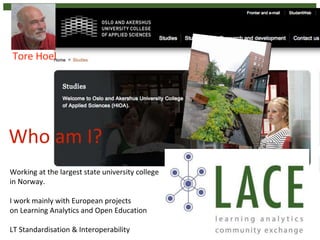
Working at the largest state university college
in Norway.
I work mainly with European projects
on Learning Analytics and Open Education
LT Standardisation & Interoperability
Who am I?
Tore Hoel
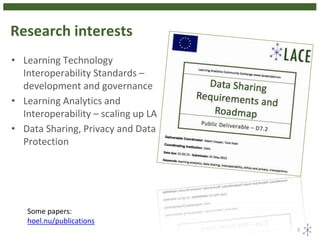
Research interests
• Learning Technology
Interoperability Standards –
development and governance
• Learning Analytics and
Interoperability – scaling up LA
• Data Sharing, Privacy and Data
Protection
3
Some papers:
hoel.nu/publications
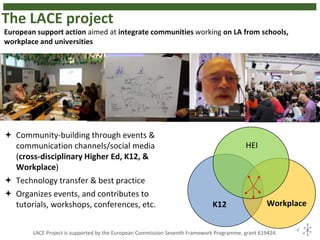
The LACE project
4
K12 Workplace
HEI
 Community-building through events &
communication channels/social media
(cross-disciplinary Higher Ed, K12, &
Workplace)
 Technology transfer & best practice
 Organizes events, and contributes to
tutorials, workshops, conferences, etc.
European support action aimed at integrate communities working on LA from schools,
workplace and universities
LACE Project is supported by the European Commission Seventh Framework Programme, grant 619424.
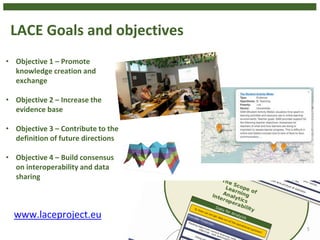
LACE Goals and objectives
5
• Objective 1 – Promote
knowledge creation and
exchange
• Objective 2 – Increase the
evidence base
• Objective 3 – Contribute to the
definition of future directions
• Objective 4 – Build consensus
on interoperability and data
sharing
www.laceproject.eu
Learning Analytics,
– What & Why?
6
Learning Analytics – What?
The measurement,
collection,
analysis
and reporting of data
about learners and their contexts…
7
Learning Analytics – Why?
…for purposes of
understanding and
optimizing
learning and
the environments in which it occurs.
8
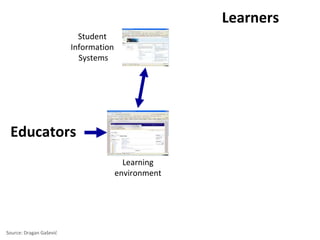
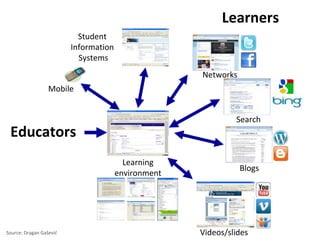
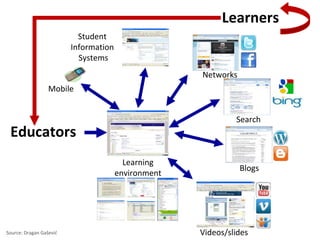
Implementation of Learning Analytics
9
Learning
environment
Educators
Learners
Student
Information
Systems
Source: Dragan Gašević
Blogs
Videos/slides
Mobile
Search
Educators
Learners
Networks
Student
Information
Systems
Learning
environment
Source: Dragan Gašević
Blogs
Mobile
Search
Networks
Educators
Learners
Student
Information
Systems
Learning
environment
Videos/slidesSource: Dragan Gašević
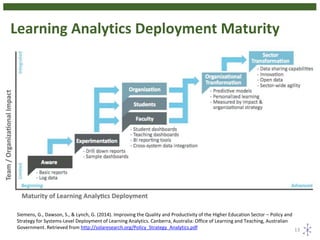
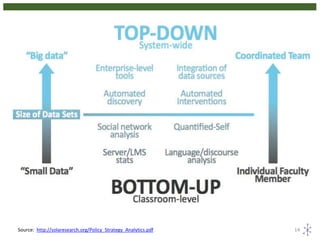
Learning Analytics Deployment Maturity
13
Siemens, G., Dawson, S., & Lynch, G. (2014). Improving the Quality and Productivity of the Higher Education Sector – Policy and
Strategy for Systems-Level Deployment of Learning Analytics. Canberra, Australia: Office of Learning and Teaching, Australian
Government. Retrieved from http://solaresearch.org/Policy_Strategy_Analytics.pdf
14Source: http://solaresearch.org/Policy_Strategy_Analytics.pdf
Visions of the Future
15
Why envisioning the future of learning analytics?
16
 We are interested in indications of the future of
learning analytics:
 To provide guidance for policy makers
 To help coordinate research
 We have described possible futures of
learning analytics (visions)
 Conceivable with current technology, but
challenging in their implications
17
Read the visions – take part in the survey!
 The visions:
 https://www.surveymonkey.com/r/Lace-Visions
 You don't need to do all of the visions!
19
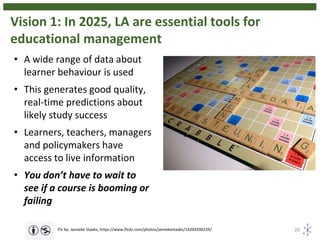
Vision 1: In 2025, LA are essential tools for
educational management
20Pic by: Janneke Staaks, https://www.flickr.com/photos/jannekestaaks/14204590229/
• A wide range of data about
learner behaviour is used
• This generates good quality,
real-time predictions about
likely study success
• Learners, teachers, managers
and policymakers have
access to live information
• You don’t have to wait to
see if a course is booming or
failing
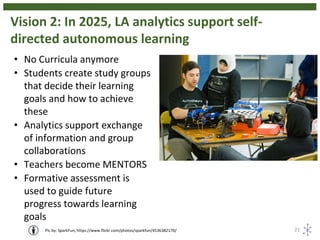
Vision 2: In 2025, LA analytics support self-
directed autonomous learning
21Pic by: SparkFun, https://www.flickr.com/photos/sparkfun/4536382170/
• No Curricula anymore
• Students create study groups
that decide their learning
goals and how to achieve
these
• Analytics support exchange
of information and group
collaborations
• Teachers become MENTORS
• Formative assessment is
used to guide future
progress towards learning
goals
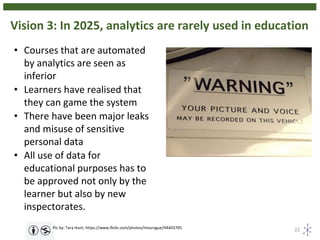
Vision 3: In 2025, analytics are rarely used in education
22Pic by: Tara Hunt, https://www.flickr.com/photos/missrogue/94403705
• Courses that are automated
by analytics are seen as
inferior
• Learners have realised that
they can game the system
• There have been major leaks
and misuse of sensitive
personal data
• All use of data for
educational purposes has to
be approved not only by the
learner but also by new
inspectorates.
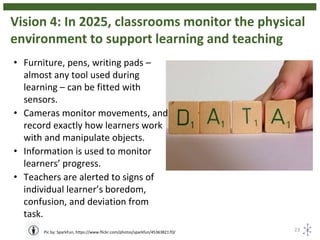
Vision 4: In 2025, classrooms monitor the physical
environment to support learning and teaching
23Pic by: SparkFun, https://www.flickr.com/photos/sparkfun/4536382170/
• Furniture, pens, writing pads –
almost any tool used during
learning – can be fitted with
sensors.
• Cameras monitor movements, and
record exactly how learners work
with and manipulate objects.
• Information is used to monitor
learners’ progress.
• Teachers are alerted to signs of
individual learner’s boredom,
confusion, and deviation from
task.
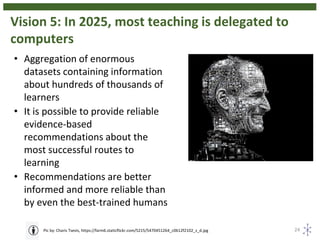
Vision 5: In 2025, most teaching is delegated to
computers
24Pic by: Charis Tsevis, https://farm6.staticflickr.com/5215/5470451264_c0612f2102_z_d.jpg
• Aggregation of enormous
datasets containing information
about hundreds of thousands of
learners
• It is possible to provide reliable
evidence-based
recommendations about the
most successful routes to
learning
• Recommendations are better
informed and more reliable than
by even the best-trained humans
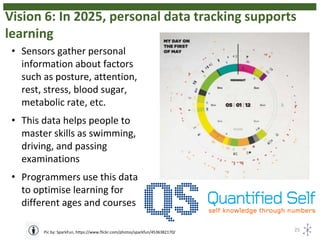
Vision 6: In 2025, personal data tracking supports
learning
25Pic by: SparkFun, https://www.flickr.com/photos/sparkfun/4536382170/
• Sensors gather personal
information about factors
such as posture, attention,
rest, stress, blood sugar,
metabolic rate, etc.
• This data helps people to
master skills as swimming,
driving, and passing
examinations
• Programmers use this data
to optimise learning for
different ages and courses
Vision 7: In 2025, individuals control their own
data
26Pic by: Gideon Burton, https://www.flickr.com/photos/wakingtiger/3157622608
• People are aware of the importance
and value of their data.
• Learners control the type and
quantity of personal data that they
share, and with whom they share it
• If they do not engage with these
tools, then no data is shared and no
benefits gained.
• Most educational institutions run
campaigns to raise awareness of the
risks and exposure of data
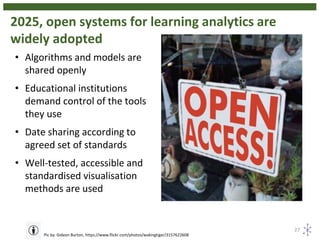
2025, open systems for learning analytics are
widely adopted
27
Pic by: Gideon Burton, https://www.flickr.com/photos/wakingtiger/3157622608
• Algorithms and models are
shared openly
• Educational institutions
demand control of the tools
they use
• Date sharing according to
agreed set of standards
• Well-tested, accessible and
standardised visualisation
methods are used
28
http://jasla.jp/
理事長
田村 恭久
上智大学理工学部教授
1987年上智大学大学院前期課程修了。同年日立製作所システム開発研究所。1993年 上智大学助
手。
1996年 博士(工学)。現在同准教授。専門分野はソフトウェア工学、ハードウェアアーキテク
チャ、ドメイン分析などを経て、現在教育工学。eラーニング、協調学 習、自然言語処理を用
いた学習支援、プロトタイピング技法を用いたインストラクショナルデザインなどを研究。教
育システム情報学会、日本eラーニング学 会、日本教育工学会、情報処理学会、ヒューマンイ
ンタフェース学会等会員。
Thanks to:
Hendrik Drachsler, for sharing his slides about the LACE Vision of the Future study
LACE project is funded by European Commission 619424-FP7-ICT-2013-11
The European LACE project builds a Community of Interest on Learning Analytics
– check out laceproject.eu
APSCE (Asian-Pacific Society for Computers in Education) has a Special Interest
Group on Learning Analytics – join the community!
tore.hoel@hioa.no
about.me/torehoel
@tore
This work was undertaken as part of the LACE Project, supported by the European Commission Seventh
Framework Programme, grant 619424.
These slides are provided under the Creative Commons Attribution Licence:
http://creativecommons.org/licenses/by/4.0/. Some images used may have different licence terms.
www.laceproject.eu
@laceproject
30

Learning Analytics - Vision of the Future

  • 1.
    The Future ofLearning Analytics Tore HOEL | Oslo and Akershus University College of Applied Sciences Kyushu University, Japan | 17 November 2015 #laceproject, @tore
  • 2.
    2 Working at thelargest state university college in Norway. I work mainly with European projects on Learning Analytics and Open Education LT Standardisation & Interoperability Who am I? Tore Hoel
  • 3.
    Research interests • LearningTechnology Interoperability Standards – development and governance • Learning Analytics and Interoperability – scaling up LA • Data Sharing, Privacy and Data Protection 3 Some papers: hoel.nu/publications
  • 4.
    The LACE project 4 K12Workplace HEI  Community-building through events & communication channels/social media (cross-disciplinary Higher Ed, K12, & Workplace)  Technology transfer & best practice  Organizes events, and contributes to tutorials, workshops, conferences, etc. European support action aimed at integrate communities working on LA from schools, workplace and universities LACE Project is supported by the European Commission Seventh Framework Programme, grant 619424.
  • 5.
    LACE Goals andobjectives 5 • Objective 1 – Promote knowledge creation and exchange • Objective 2 – Increase the evidence base • Objective 3 – Contribute to the definition of future directions • Objective 4 – Build consensus on interoperability and data sharing www.laceproject.eu
  • 6.
  • 7.
    Learning Analytics –What? The measurement, collection, analysis and reporting of data about learners and their contexts… 7
  • 8.
    Learning Analytics –Why? …for purposes of understanding and optimizing learning and the environments in which it occurs. 8
  • 9.
  • 10.
  • 11.
  • 12.
  • 13.
    Learning Analytics DeploymentMaturity 13 Siemens, G., Dawson, S., & Lynch, G. (2014). Improving the Quality and Productivity of the Higher Education Sector – Policy and Strategy for Systems-Level Deployment of Learning Analytics. Canberra, Australia: Office of Learning and Teaching, Australian Government. Retrieved from http://solaresearch.org/Policy_Strategy_Analytics.pdf
  • 14.
  • 15.
    Visions of theFuture 15
  • 16.
    Why envisioning thefuture of learning analytics? 16  We are interested in indications of the future of learning analytics:  To provide guidance for policy makers  To help coordinate research  We have described possible futures of learning analytics (visions)  Conceivable with current technology, but challenging in their implications
  • 17.
  • 18.
    Read the visions– take part in the survey!  The visions:  https://www.surveymonkey.com/r/Lace-Visions  You don't need to do all of the visions! 19
  • 19.
    Vision 1: In2025, LA are essential tools for educational management 20Pic by: Janneke Staaks, https://www.flickr.com/photos/jannekestaaks/14204590229/ • A wide range of data about learner behaviour is used • This generates good quality, real-time predictions about likely study success • Learners, teachers, managers and policymakers have access to live information • You don’t have to wait to see if a course is booming or failing
  • 20.
    Vision 2: In2025, LA analytics support self- directed autonomous learning 21Pic by: SparkFun, https://www.flickr.com/photos/sparkfun/4536382170/ • No Curricula anymore • Students create study groups that decide their learning goals and how to achieve these • Analytics support exchange of information and group collaborations • Teachers become MENTORS • Formative assessment is used to guide future progress towards learning goals
  • 21.
    Vision 3: In2025, analytics are rarely used in education 22Pic by: Tara Hunt, https://www.flickr.com/photos/missrogue/94403705 • Courses that are automated by analytics are seen as inferior • Learners have realised that they can game the system • There have been major leaks and misuse of sensitive personal data • All use of data for educational purposes has to be approved not only by the learner but also by new inspectorates.
  • 22.
    Vision 4: In2025, classrooms monitor the physical environment to support learning and teaching 23Pic by: SparkFun, https://www.flickr.com/photos/sparkfun/4536382170/ • Furniture, pens, writing pads – almost any tool used during learning – can be fitted with sensors. • Cameras monitor movements, and record exactly how learners work with and manipulate objects. • Information is used to monitor learners’ progress. • Teachers are alerted to signs of individual learner’s boredom, confusion, and deviation from task.
  • 23.
    Vision 5: In2025, most teaching is delegated to computers 24Pic by: Charis Tsevis, https://farm6.staticflickr.com/5215/5470451264_c0612f2102_z_d.jpg • Aggregation of enormous datasets containing information about hundreds of thousands of learners • It is possible to provide reliable evidence-based recommendations about the most successful routes to learning • Recommendations are better informed and more reliable than by even the best-trained humans
  • 24.
    Vision 6: In2025, personal data tracking supports learning 25Pic by: SparkFun, https://www.flickr.com/photos/sparkfun/4536382170/ • Sensors gather personal information about factors such as posture, attention, rest, stress, blood sugar, metabolic rate, etc. • This data helps people to master skills as swimming, driving, and passing examinations • Programmers use this data to optimise learning for different ages and courses
  • 25.
    Vision 7: In2025, individuals control their own data 26Pic by: Gideon Burton, https://www.flickr.com/photos/wakingtiger/3157622608 • People are aware of the importance and value of their data. • Learners control the type and quantity of personal data that they share, and with whom they share it • If they do not engage with these tools, then no data is shared and no benefits gained. • Most educational institutions run campaigns to raise awareness of the risks and exposure of data
  • 26.
    2025, open systemsfor learning analytics are widely adopted 27 Pic by: Gideon Burton, https://www.flickr.com/photos/wakingtiger/3157622608 • Algorithms and models are shared openly • Educational institutions demand control of the tools they use • Date sharing according to agreed set of standards • Well-tested, accessible and standardised visualisation methods are used
  • 27.
    28 http://jasla.jp/ 理事長 田村 恭久 上智大学理工学部教授 1987年上智大学大学院前期課程修了。同年日立製作所システム開発研究所。1993年 上智大学助 手。 1996年博士(工学)。現在同准教授。専門分野はソフトウェア工学、ハードウェアアーキテク チャ、ドメイン分析などを経て、現在教育工学。eラーニング、協調学 習、自然言語処理を用 いた学習支援、プロトタイピング技法を用いたインストラクショナルデザインなどを研究。教 育システム情報学会、日本eラーニング学 会、日本教育工学会、情報処理学会、ヒューマンイ ンタフェース学会等会員。
  • 28.
    Thanks to: Hendrik Drachsler,for sharing his slides about the LACE Vision of the Future study LACE project is funded by European Commission 619424-FP7-ICT-2013-11
  • 29.
    The European LACEproject builds a Community of Interest on Learning Analytics – check out laceproject.eu APSCE (Asian-Pacific Society for Computers in Education) has a Special Interest Group on Learning Analytics – join the community! tore.hoel@hioa.no about.me/torehoel @tore This work was undertaken as part of the LACE Project, supported by the European Commission Seventh Framework Programme, grant 619424. These slides are provided under the Creative Commons Attribution Licence: http://creativecommons.org/licenses/by/4.0/. Some images used may have different licence terms. www.laceproject.eu @laceproject 30

Editor's Notes

  • #3 I work at the largest state university college in Norway, affiliated with the University Library. I mainly participate in European projects. I coordinate a project on Open Educational Resources (OER) in the Nordic countries. I work with a European Union project on learning analytics, and with another EU project on Open Education. And I have been working with learning technology standardization for more than ten years.
  • #6 Objective 1 – Promote knowledge creation and exchange LACE’s response is a range of activities designed to actively integrate communities that are conducting research, early practitioner adopters and those who are building first-generation commercial or open-source software. This integration is used to stimulate creativity and accelerate the identification of viable and effective solutions to real problems, and hence to drive both current research and technology transfer. • Objective 2 – Increase the evidence base LACE’s response is to create and curate a knowledge base of evidence in the LACE Evidence Hub. This captures evidence for the effectiveness of various tools and techniques. It also takes into account the range of contexts in which LA and EDM are applied, and the different objectives motivating their use. The Evidence Hub is designed to accelerate beneficial uptake of LA and EDM as well as to indicate where research, experimentation or piloting are necessary to test unsubstantiated claims. • Objective 3 – Contribute to the definition of future directions LACE aims to combine participatory workshops with structured methods to explore future directions. Plausible futures for LA and EDM are captured from the imagination of people we engage with and communicated through the medium of scenarios to bring them to life in a believable setting for a wider audience. Studies assess the feasibility and desirability of achieving future states, and the difference of perception among stakeholders, thus informing research and policy agendas. -> ETHICS & Privacy • Objective 4 – Build consensus on interoperability and data sharing LACE’s response is to establish the current state of LA and EDM interoperability and to clearly identify gaps. This includes the feasibility of increased data sharing for operational and research purposes in addition to the information models necessary to make use of exchanged data. All four objectives have been
  • #21 In 2015, companies were beginning to develop systems to recommend resources and to predict outcomes. By 2025, these systems are highly developed. A wide range of data about learner behaviour is used to generate good quality, real-time predictions about likely success. Learners, teachers, managers and policymakers all have access to live and accurate information about how well a learner is likely to do. Learners and teachers plan their work on the basis of reliable tools that can produce detailed and personalised recommendations about what should be done to achieve the best learning outcomes. A growing industry offers services to institutions and individuals, advising on how to respond to predictions generated by analytics, and how to take appropriate action in the light of recommendations. Accurate predictive information enables managers and policymakers to expand or contract learning provision before success or failure is evident: you don’t have to wait to see if a course is booming or failing, with funding changes happening quickly.
  • #22 In 2015, learners in educational institutions and in businesses had to follow a curriculum developed by others. In 2025, they create groups that work together to decide their learning goals and how to achieve these. A ‘Learning Trajectory System’ uses analytics to support information exchange and group collaborations, and learners receive support from mentors, rather than teachers. Activity towards a learning goal is monitored, and analytics provide individuals with feedback on their learning process. This includes suggestions, including peer learners to contact, experts to approach, relevant content, and ways of developing and demonstrating new skills. Formative assessment is used to guide future progress, taking into account individuals’ characteristics, experience and context, replacing exams that show only what students have achieved. Texts and other learning materials are adapted to suit the cultural characteristics of learners, revealed by analysis of their interactions As a result, learners are personally engaged with their topics, and are motivated by their highly autonomous learning. The competences that they develop are valuable in a society in which collection and analysis of data are the norm. There is also convergence between the learning activities of the education system and the methods used by employees to develop their knowledge and skills.
  • #23 In 2015, many people hoped that analytics would be able to improve teaching and learning and the environments where these take place. However, in 2025, it is clear that there are many problems. Courses that are automated by analytics are seen as inferior, and learners have realised that they can game the system. There have been major leaks of sensitive personal data, and it is clear that, even where this has not happened, many companies have misused the data generated by their analytics. Many governments have ruled that individuals are the sole owners of the data they generate. All use of data for educational purposes now has to be approved not only by the learner but also by new inspectorates. In practice this has meant that use of analytics is restricted to summative assessment carried out by government agencies. A consensus has emerged in educational policy that the move away from learning analytics is not only ethically desirable, it is also educationally effective.
  • #24 In 2015, learning analytics were mainly used to support online learning. By 2025, they can be used to support most teaching and learning activities, wherever these take place. Furniture, pens, writing pads – almost any tool used during learning – can be fitted with sensors. These can record many sorts of information, including tilt, force and position. Video cameras using facial recognition are able to track individuals as they learn. These cameras monitor movements, and record exactly how learners work with and manipulate objects. All this information is used to monitor learners’ progress. Individuals are supported in learning a wide range of physical skills. Teachers are alerted to signs of individual learner’s boredom, confusion, and deviation from task. Teachers and managers are able to monitor social interactions, and to identify where they should nurture socialisation and cooperative behaviour.
  • #25 In 2015, people were beginning to assemble datasets that could represent learner’s activities. By 2025, these are used on a large scale in teaching, and this has led to the development of enormous datasets containing information about hundreds of thousands of learners. Analysing in detail the progress of such a wide variety of learners has made it possible to provide reliable evidence-based recommendations about the most successful routes to learning, as well as identifying the learning materials and approaches that are most suitable for each individual at each point in their progress. These recommendations are better informed and more reliable than those that can be produced by even the best-trained humans. Learners now spend most of their time working with analytics-driven systems, and the role of teachers has been reduced. Education policy is driven by the evidence generated by the use of these systems.
  • #26 In 2015, people were beginning to wear devices such as heart-rate monitors and run-trackers as they went about their daily lives. By 2025, sophisticated sensors can gather personal information about factors such as posture, attention, rest, stress, blood sugar, and metabolic rate. People collect this information about their activities, and feed it into programmes of their choice which provide recommendations on how to act in ways that improve their learning.  Learners can download the statistics and data that are associated with successful learning in a certain area. Aligning personal data with these ‘ideal’ sets is claimed to help people to master skills as diverse as swimming, driving, carrying out surgery and passing examinations. Academic stars sell programmes using this data to optimise learning for different ages and courses. Business gurus market similar programmes for topics such as presentation skills and workload management. Some learners create and share their own data analysis programmes, which provide recommendations that often include the consumption of high energy foods and stimulants. The majority of high school and university students follow self-monitoring programmes, and avidly discuss the merits of these on social media.
  • #27 In 2015, it was not clear who owned educational data, and it was often used without learners' knowledge. By 2025, most people are aware of the importance and value of their data. Learners control the type and quantity of personal data that they share, and with whom they share it. This includes information about progress, attendance and exam results, as well as data collected by cameras and sensors. Learners can choose to limit the time for which access is allowed, or they can restrict access to specific organisations and individuals. The tools for making these choices are clearly laid out and easy to use. In the case of children, data decisions are made in consultation with parents or carers. If they do not engage with these tools, then no data is shared and no benefits gained. Most educational institutions recognise this as a potential problem, and run campaigns to raise awareness of the both the risks of thoughtless exposure of data, and the benefits to learners of informed sharing of selected educational data.