







Rebecca Ferguson, The Open University
VITAL, UCLAN, July 2017
Learning analytics:
planning for the future
Image: Wikimedia Commons
2
Defining learning analytics
The measurement, collection, analysis and
reporting of data about learners and their
contexts, for purposes of understanding and
optimizing learning and the environments in
which it occurs.
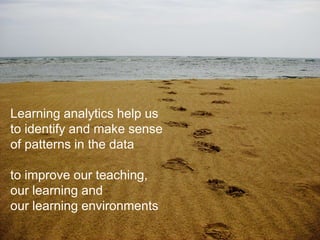
Learning analytics help us
to identify and make sense
of patterns in the data
to improve our teaching,
our learning and
our learning environments
Priority areas for education and training
4
Open and innovative education and training, fully embracing
the digital era.
Strong support for teachers, trainers, school leaders and
other educational staff
Relevant and high-quality knowledge, skills and
competences developed throughout lifelong learning
Focus on learning outcomes for
employability, innovation, active citizenship and well-being
and inclusive education, equality, equity, non-discrimination
and the promotion of civic competences.
• Safety and wellbeing: all children
and young people are protected
from harm and vulnerable children
are supported to succeed with
opportunities as good as those for
any other child.
• Educational excellence
everywhere: every child and young
person can access high-quality
provision, achieving to the best of
his or her ability regardless of
location, attainment and
background.
• Prepared for adult life: all 19-year-
olds complete school or college
with the skills and character to
contribute to the UK’s society and
economy and are able to access
high-quality work or study options.
• The University will create an inspirational student
experience, enabling people, irrespective of their
backgrounds, to fulfil their potential, develop as
global citizens and meet their life and career goals.
• The University will be innovative and
entrepreneurial in our approach to research and
knowledge exchange in order to maximise our
positive social, environmental and economic
impact locally, nationally and globally.
• The University operates in a global market place.
Our activities, from our internationally focused
research to our curriculum and study opportunities
will be international in their outlook.
• The University will continue to inspire positive
change in organisations and people from all walks
of life, enabling them to achieve their full potential.
• We will further strengthen our financial stability,
growing income from a diverse range of sources,
so enabling continual reinvestment in our people
and infrastructure.
7
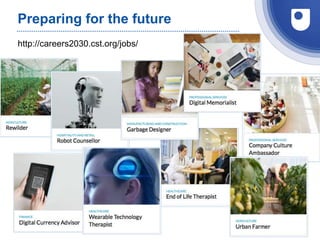
http://careers2030.cst.org/jobs/
Preparing for the future
8
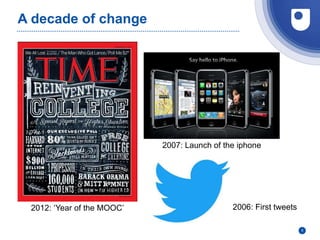
A decade of change
2012: ‘Year of the MOOC’
2007: Launch of the iphone
2006: First tweets
Priority areas for education and training
9
• Bringing together different sectors: higher education, schools & workplace learning
• Building networks that will outlive the project’s funding period
• Helping to develop learning analytics capability
• Creating and sharing resources
• Developing visions of the future and agreeing how to work towards them
http://www.laceproject.eu/
Visions
of the
future
Full report
bit.ly/28X5tq7
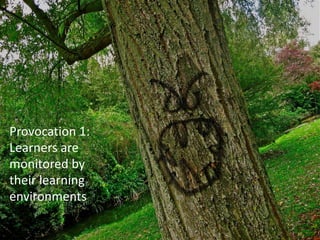
Provocation 1:
Learners are
monitored by
their learning
environments
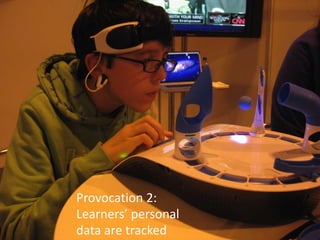
Provocation 2:
Learners’ personal
data are tracked
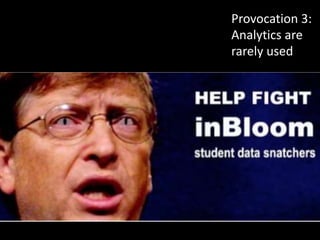
Provocation 3:
Analytics are
rarely used
Provocation 4:
Learners
control
their own
data
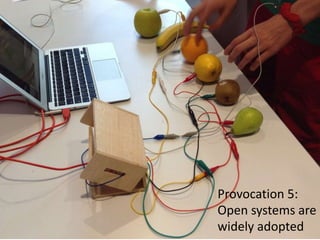
Provocation 5:
Open systems are
widely adopted
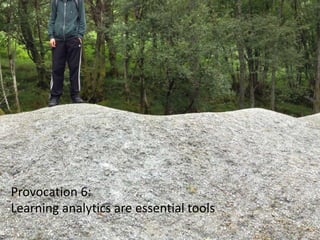
Provocation 6:
Learning analytics are essential tools
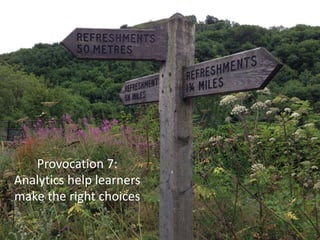
Provocation 7:
Analytics help learners
make the right choices
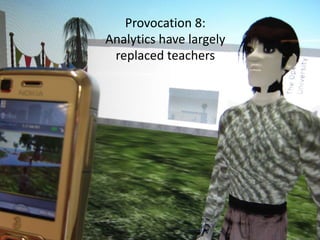
Provocation 8:
Analytics have largely
replaced teachers
LAEP: learning analytics for European
educational policy
19
• What is the current state of the art?
• What are the prospects for the implementation
of learning analytics?
• What is the potential for European policy to be
used to guide and support the take-up and
adaptation of learning analytics to enhance
education in Europe?
Action for analytics
Strategy
Research and development
Infrastructure
Context
Standards
Skills
Outreach
21
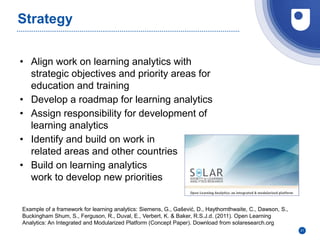
Strategy
Example of a framework for learning analytics: Siemens, G., Gašević, D., Haythornthwaite, C., Dawson, S.,
Buckingham Shum, S., Ferguson, R., Duval, E., Verbert, K. & Baker, R.S.J.d. (2011). Open Learning
Analytics: An Integrated and Modularized Platform (Concept Paper). Download from solaresearch.org
• Align work on learning analytics with
strategic objectives and priority areas for
education and training
• Develop a roadmap for learning analytics
• Assign responsibility for development of
learning analytics
• Identify and build on work in
related areas and other countries
• Build on learning analytics
work to develop new priorities
22
Research and development
• Develop pedagogy that makes
good use of analytics
• Develop analytics that address
strategic objectives and priorities
• Develop technology that enables
deployment of analytics
• Develop frameworks that enable
development of analytics
23
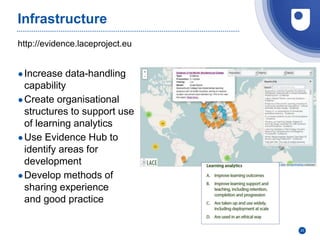
http://evidence.laceproject.eu
Infrastructure
●Increase data-handling
capability
●Create organisational
structures to support use
of learning analytics
●Use Evidence Hub to
identify areas for
development
●Develop methods of
sharing experience
and good practice
24
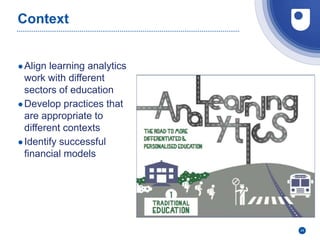
Context
●Align learning analytics
work with different
sectors of education
●Develop practices that
are appropriate to
different contexts
●Identify successful
financial models
25
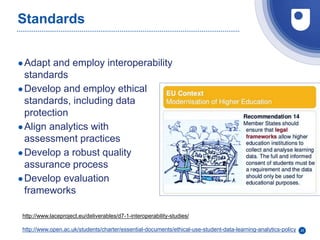
Standards
●Adapt and employ interoperability
standards
●Develop and employ ethical
standards, including data
protection
●Align analytics with
assessment practices
●Develop a robust quality
assurance process
●Develop evaluation
frameworks
http://www.laceproject.eu/deliverables/d7-1-interoperability-studies/
http://www.open.ac.uk/students/charter/essential-documents/ethical-use-student-data-learning-analytics-policy
26
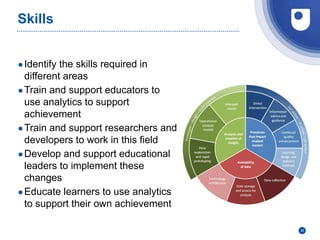
Skills
●Identify the skills required in
different areas
●Train and support educators to
use analytics to support
achievement
●Train and support researchers and
developers to work in this field
●Develop and support educational
leaders to implement these
changes
●Educate learners to use analytics
to support their own achievement
27
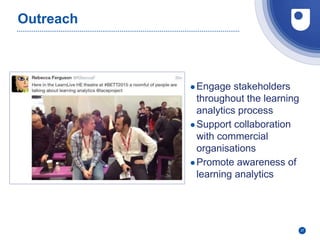
Outreach
●Engage stakeholders
throughout the learning
analytics process
●Support collaboration
with commercial
organisations
●Promote awareness of
learning analytics
28
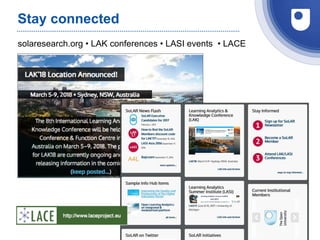
solaresearch.org • LAK conferences • LASI events • LACE
Stay connected
29
Slides online at www.slideshare.net/R3beccaF
Rebecca Ferguson @R3beccaF
http://r3beccaf.wordpress.com/

Learning analytics: planning for the future

  • 1.
    Rebecca Ferguson, TheOpen University VITAL, UCLAN, July 2017 Learning analytics: planning for the future Image: Wikimedia Commons
  • 2.
    2 Defining learning analytics Themeasurement, collection, analysis and reporting of data about learners and their contexts, for purposes of understanding and optimizing learning and the environments in which it occurs.
  • 3.
    Learning analytics helpus to identify and make sense of patterns in the data to improve our teaching, our learning and our learning environments
  • 4.
    Priority areas foreducation and training 4 Open and innovative education and training, fully embracing the digital era. Strong support for teachers, trainers, school leaders and other educational staff Relevant and high-quality knowledge, skills and competences developed throughout lifelong learning Focus on learning outcomes for employability, innovation, active citizenship and well-being and inclusive education, equality, equity, non-discrimination and the promotion of civic competences.
  • 5.
    • Safety andwellbeing: all children and young people are protected from harm and vulnerable children are supported to succeed with opportunities as good as those for any other child. • Educational excellence everywhere: every child and young person can access high-quality provision, achieving to the best of his or her ability regardless of location, attainment and background. • Prepared for adult life: all 19-year- olds complete school or college with the skills and character to contribute to the UK’s society and economy and are able to access high-quality work or study options.
  • 6.
    • The Universitywill create an inspirational student experience, enabling people, irrespective of their backgrounds, to fulfil their potential, develop as global citizens and meet their life and career goals. • The University will be innovative and entrepreneurial in our approach to research and knowledge exchange in order to maximise our positive social, environmental and economic impact locally, nationally and globally. • The University operates in a global market place. Our activities, from our internationally focused research to our curriculum and study opportunities will be international in their outlook. • The University will continue to inspire positive change in organisations and people from all walks of life, enabling them to achieve their full potential. • We will further strengthen our financial stability, growing income from a diverse range of sources, so enabling continual reinvestment in our people and infrastructure.
  • 7.
  • 8.
    8 A decade ofchange 2012: ‘Year of the MOOC’ 2007: Launch of the iphone 2006: First tweets
  • 9.
    Priority areas foreducation and training 9 • Bringing together different sectors: higher education, schools & workplace learning • Building networks that will outlive the project’s funding period • Helping to develop learning analytics capability • Creating and sharing resources • Developing visions of the future and agreeing how to work towards them http://www.laceproject.eu/
  • 10.
  • 11.
    Provocation 1: Learners are monitoredby their learning environments
  • 12.
  • 13.
  • 14.
  • 15.
    Provocation 5: Open systemsare widely adopted
  • 16.
  • 17.
    Provocation 7: Analytics helplearners make the right choices
  • 18.
    Provocation 8: Analytics havelargely replaced teachers
  • 19.
    LAEP: learning analyticsfor European educational policy 19 • What is the current state of the art? • What are the prospects for the implementation of learning analytics? • What is the potential for European policy to be used to guide and support the take-up and adaptation of learning analytics to enhance education in Europe?
  • 20.
    Action for analytics Strategy Researchand development Infrastructure Context Standards Skills Outreach
  • 21.
    21 Strategy Example of aframework for learning analytics: Siemens, G., Gašević, D., Haythornthwaite, C., Dawson, S., Buckingham Shum, S., Ferguson, R., Duval, E., Verbert, K. & Baker, R.S.J.d. (2011). Open Learning Analytics: An Integrated and Modularized Platform (Concept Paper). Download from solaresearch.org • Align work on learning analytics with strategic objectives and priority areas for education and training • Develop a roadmap for learning analytics • Assign responsibility for development of learning analytics • Identify and build on work in related areas and other countries • Build on learning analytics work to develop new priorities
  • 22.
    22 Research and development •Develop pedagogy that makes good use of analytics • Develop analytics that address strategic objectives and priorities • Develop technology that enables deployment of analytics • Develop frameworks that enable development of analytics
  • 23.
    23 http://evidence.laceproject.eu Infrastructure ●Increase data-handling capability ●Create organisational structuresto support use of learning analytics ●Use Evidence Hub to identify areas for development ●Develop methods of sharing experience and good practice
  • 24.
    24 Context ●Align learning analytics workwith different sectors of education ●Develop practices that are appropriate to different contexts ●Identify successful financial models
  • 25.
    25 Standards ●Adapt and employinteroperability standards ●Develop and employ ethical standards, including data protection ●Align analytics with assessment practices ●Develop a robust quality assurance process ●Develop evaluation frameworks http://www.laceproject.eu/deliverables/d7-1-interoperability-studies/ http://www.open.ac.uk/students/charter/essential-documents/ethical-use-student-data-learning-analytics-policy
  • 26.
    26 Skills ●Identify the skillsrequired in different areas ●Train and support educators to use analytics to support achievement ●Train and support researchers and developers to work in this field ●Develop and support educational leaders to implement these changes ●Educate learners to use analytics to support their own achievement
  • 27.
    27 Outreach ●Engage stakeholders throughout thelearning analytics process ●Support collaboration with commercial organisations ●Promote awareness of learning analytics
  • 28.
    28 solaresearch.org • LAKconferences • LASI events • LACE Stay connected
  • 29.
    29 Slides online atwww.slideshare.net/R3beccaF Rebecca Ferguson @R3beccaF http://r3beccaf.wordpress.com/

Editor's Notes

  • #2 Introduction If you have attended the Learning Ananlytics Summer Institute (LASI Asia) this week, some of the early slides here will look familiar, but I am going to focus here much more on actions to be taken
  • #3 Definition of learning analytics from the Society for Learning Analytics Research (SoLAR)
  • #4 A rephrasing of that definition
  • #5 The European Union also has plans in place
  • #6 In the case of learning analytics, as in other areas of life and national policy, we need to think about the consequences of our actions
  • #7 In the case of learning analytics, as in other areas of life and national policy, we need to think about the consequences of our actions
  • #8  The current fast pace of change means that if, in April 2006, we had begun developing learning analytics for 2016, we might not have planned specifically for learning with and through social networks (Twitter was launched in July 2006), with smartphones (the first iPhone was released in 2007), or learning at scale (the term MOOC was coined in 2008). By thinking ahead and by consulting with experts, though, we might have come pretty close by taking into account existing work on networked learning, mobile learning and connectivism.
  • #9  The current fast pace of change means that if, in April 2006, we had begun developing learning analytics for 2016, we might not have planned specifically for learning with and through social networks (Twitter was launched in July 2006), with smartphones (the first iPhone was released in 2007), or learning at scale (the term MOOC was coined in 2008). By thinking ahead and by consulting with experts, though, we might have come pretty close by taking into account existing work on networked learning, mobile learning and connectivism.
  • #10 The Learning Analytics Community Exchange (LACE) project in Europe has been thinking about the future of learning analytics – which futures we want to work towards and which we want to avoid. To investigate this, we have carried out a Policy Delphi, a form of research designed to elicit a range of exert views on a topic. In this case, we developed eight provocations or visions of the future of learning analytics. Using a survey, we shared these with experts and practitioners around the world and asked them to comment on at least two visions in terms of desirability, feasibility, and actions that would need to be taken.
  • #11 The full report on this research is available online at this link. Here, I shall run briefly through the eight provocations to give you an idea of how learning analytics might develop during the next decade
  • #12 Provocation 1: Learners are monitored by their learning environments Provocation 1 relates to a world in which almost anything a learner uses can be used to collect data about their activities People saw how this vision could be connected with sensor technology and the Internet of Things. They also raised the issue of Big Brother watching over learners and controlling what they do
  • #13 Provocation 2: Learners’ personal data are tracked Provocation 2 deals not with external data but with internal data. Information about where students are looking, how they are reacting to stimuli, what their heart rate is. The picture shows the Mindlfex game in which the blue ball is controlled by the user’s brainwaves – which suggests we are moving towards being able to detect thought patterns Respondents linked this to the notion of the ‘quantified self’, and to activity in the field of medicine. They called for a reliable evidence base, which is an idea found in many of the responses to diffferent visions.
  • #14 Provocation 3: Analytics are rarely used Provocation 3 is a negative one from the point of view of learning analytics. It suggests that there will be so many problems and controversial stories that learning analytics are no longer used in ten years time. The image refers to the multi-million dollar inBloom project, funded by the Gates Foundation, which had to close due to srong opposition from parents. Issues here of ethics, and of WHY the analytics are being developed and applied
  • #15 Provocation 4: Learners control their own data Provocation 4 is concerned with who owns the data. Should it be owned and controlled by individual learners? Divergent opinions here. Some people think learners should control their data and that organisations should make this possible and desirable. Others think that this will make the data unusable and that it just adds needless extra responsibilities to the work of students
  • #16 Provocation 5: Open systems are widely adopted Provocation 5 is to do with getting learning analytics, and their related systems, to talk to each other and to understand each other. It also ties in with building a developer community. In order for this open approach to be possible, a lot of work needs to be done at local and national levels.
  • #17 Provocation 6: Learning analytics are essential tools Provocation 6 sees the role for learning analytics increasing, so that all learners are supported by a mound of data However, this requires thought about what it means to learn, how learning takes place, and how learning analytics support that process
  • #18 Provocation 7: Analytics help learners make the right choices Provocation 7 sees a positive role for analytics, with control remaining in the hands of the learners. Although this sounds a positive future, respondents could see potential problems.
  • #19 Provocation 8: Analytics have largely replaced teachers The final provocation sees analytics replacing teachers Any teacher that can be replaced by a computer deserves to be. This is a rewording by David Thornburg of the original Arthur C Clarke quote (“Teachers that can be replaced by a machine should be.”) Again, this prompts consideration of how learning takes place and how it can best be supported
  • #21 From this we came up with a seven-point plan for Action on Analytics in Europe
  • #22 Work needed on strategy
  • #23 Work needed on research and development
  • #24 Work needed on infrastructure
  • #25 Work needed on context
  • #26 Work needed on standards
  • #27 Work needed on skills
  • #28 Work needed on outreach
  • #29 And, across the world, we need to stay connected via different organisations and events
  • #30 Slides are available on Slideshare