Towards effective institutional policies to
promote open access in educational resources
Dulce M. Cairós Barreto, Luis Fajardo López , Carina S. González González,
University of La Laguna, Canary Islands, Spain
National University of Ireland, Galway, Ireland
7-8 April, 2016
Contents
• Legal Issues about Institutional Open Access Repositories
• ULL and CEDRO: legal implications and actions
• Requirements and considerations of legal policy in knowledge
management
• Towards an institutional OA policy
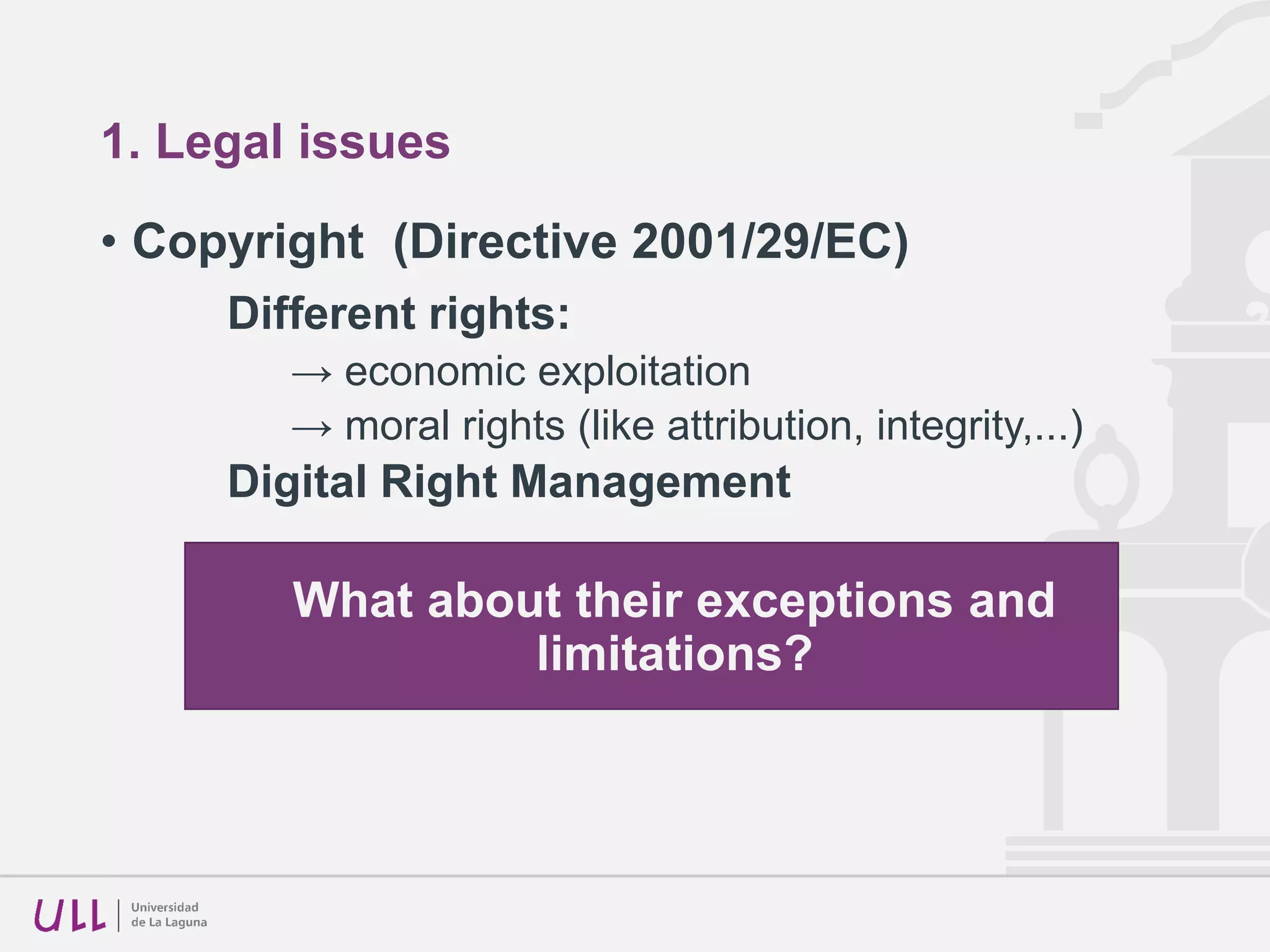
1. Legal issues
• Copyright (Directive 2001/29/EC)
Different rights:
→ economic exploitation
→ moral rights (like attribution, integrity,...)
Digital Right Management
What about their exceptions and
limitations?
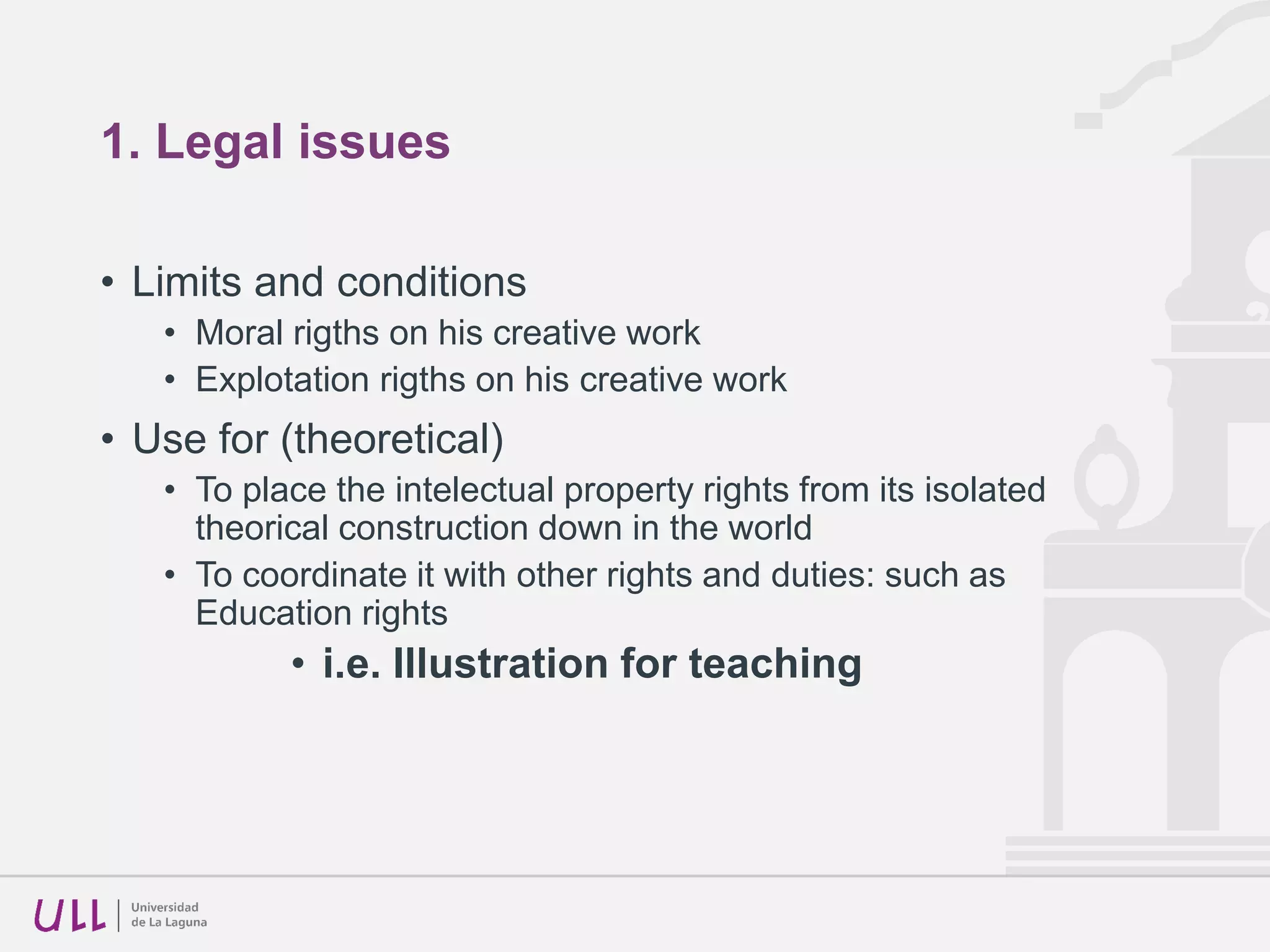
1. Legal issues
• Limits and conditions
• Moral rigths on his creative work
• Explotation rigths on his creative work
• Use for (theoretical)
• To place the intelectual property rights from its isolated
theorical construction down in the world
• To coordinate it with other rights and duties: such as
Education rights
• i.e. Illustration for teaching
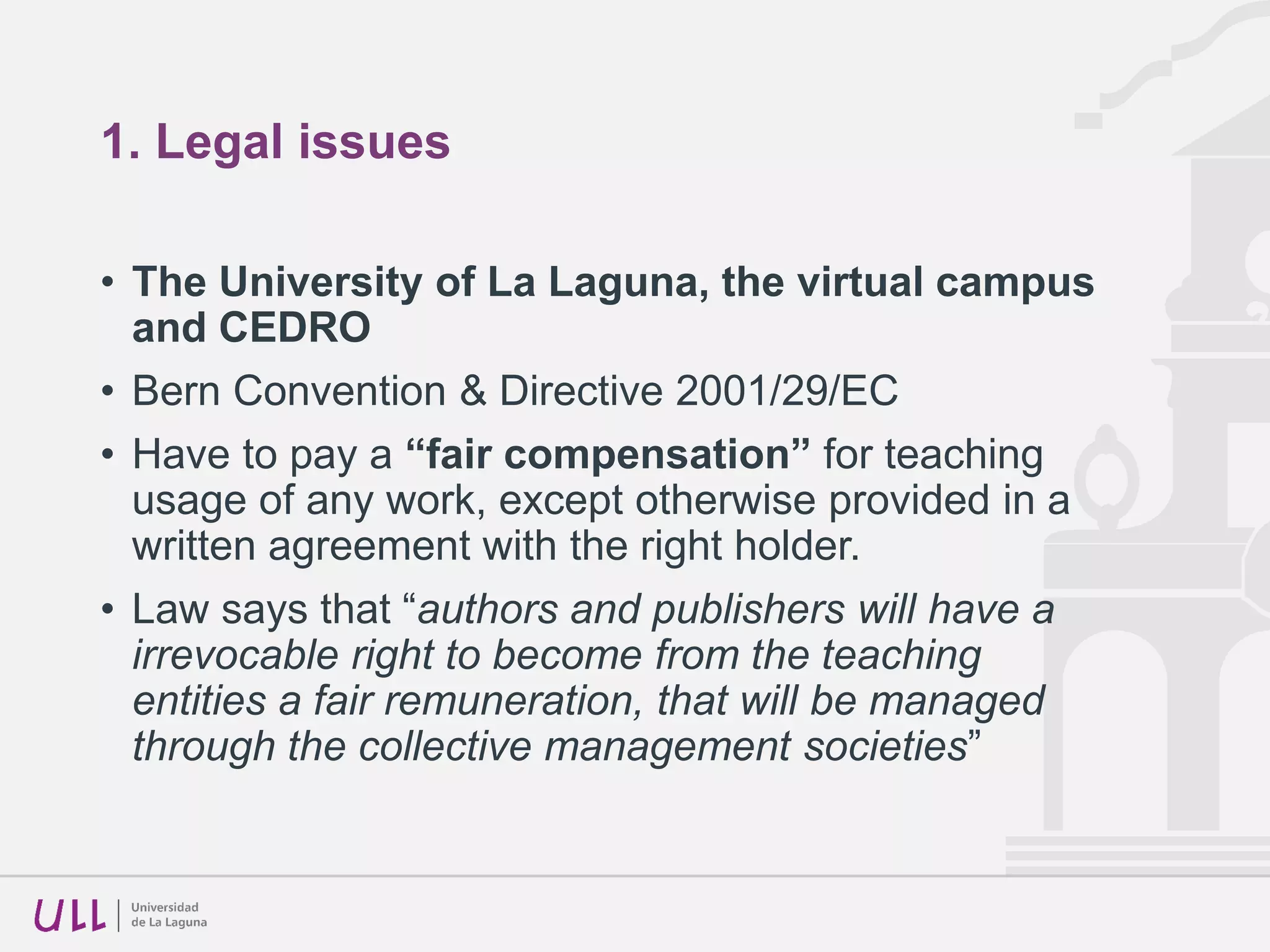
1. Legal issues
• The University of La Laguna, the virtual campus
and CEDRO
• Bern Convention & Directive 2001/29/EC
• Have to pay a “fair compensation” for teaching
usage of any work, except otherwise provided in a
written agreement with the right holder.
• Law says that “authors and publishers will have a
irrevocable right to become from the teaching
entities a fair remuneration, that will be managed
through the collective management societies”
CEDRO and ULL
• Initial analysis of learning-teaching virtual environments uses
(done)
• Training of teaching staff in open access and intellectual laws
(done)
• LMS Plugin and poll (done)
• Institutional Repository of Teaching Resources (in progress)
• Global Institutional Open Access Policy proposal (in progress)
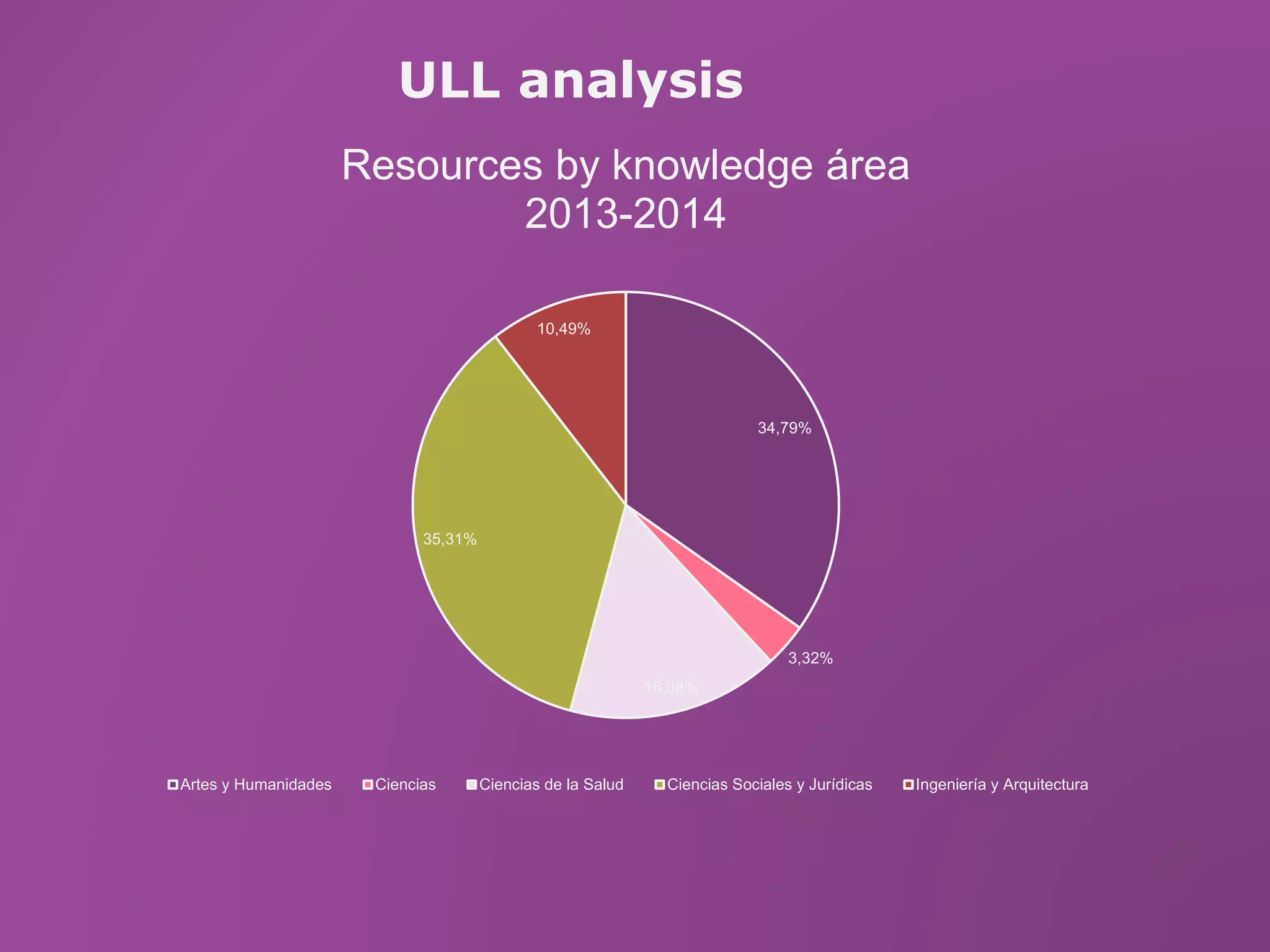
ULL analysis
34,79%
3,32%
16,08%
35,31%
10,49%
Resources by knowledge área
2013-2014
Artes y Humanidades Ciencias Ciencias de la Salud Ciencias Sociales y Jurídicas Ingeniería y Arquitectura
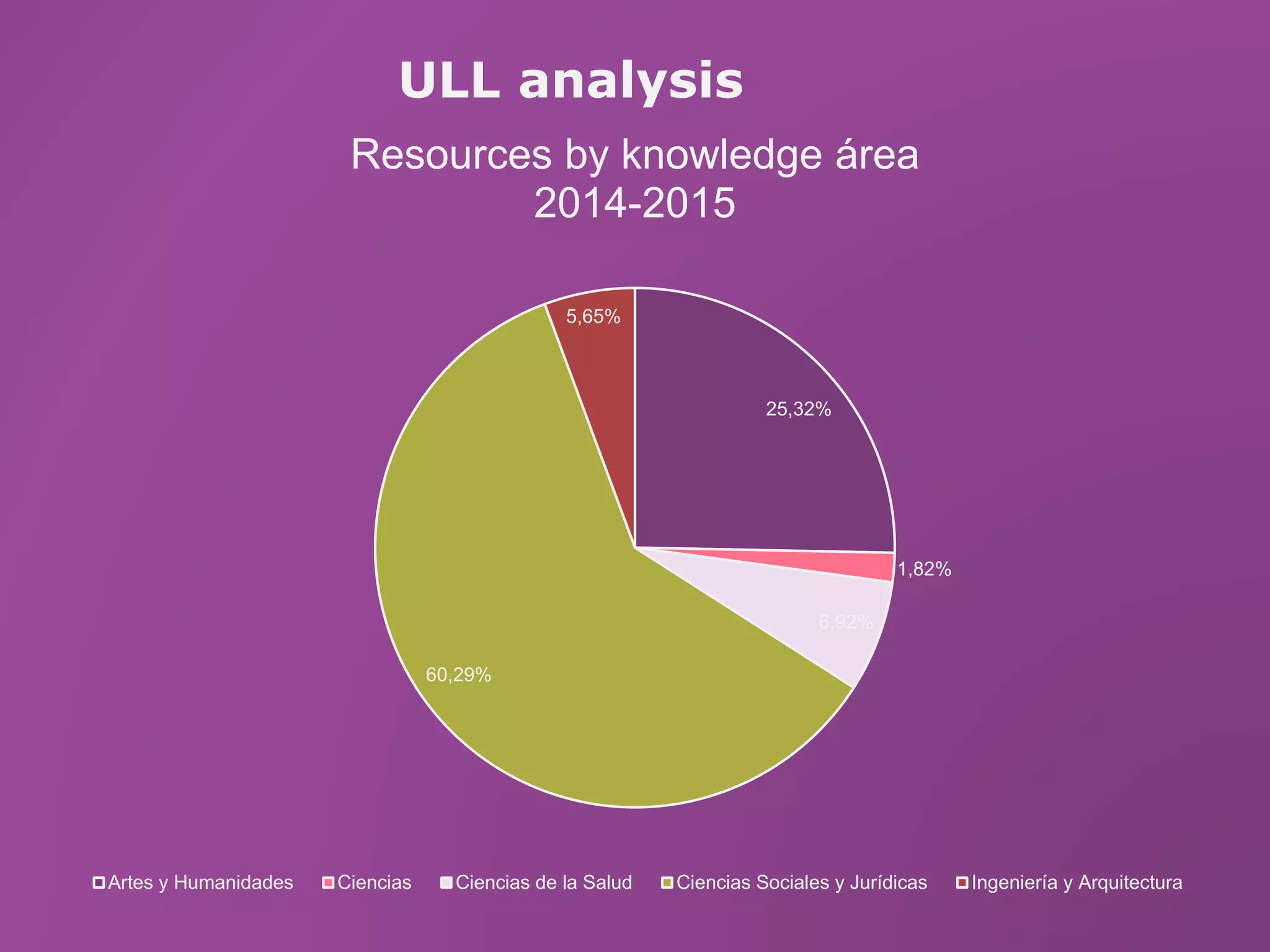
ULL analysis
25,32%
1,82%
6,92%
60,29%
5,65%
Resources by knowledge área
2014-2015
Artes y Humanidades Ciencias Ciencias de la Salud Ciencias Sociales y Jurídicas Ingeniería y Arquitectura
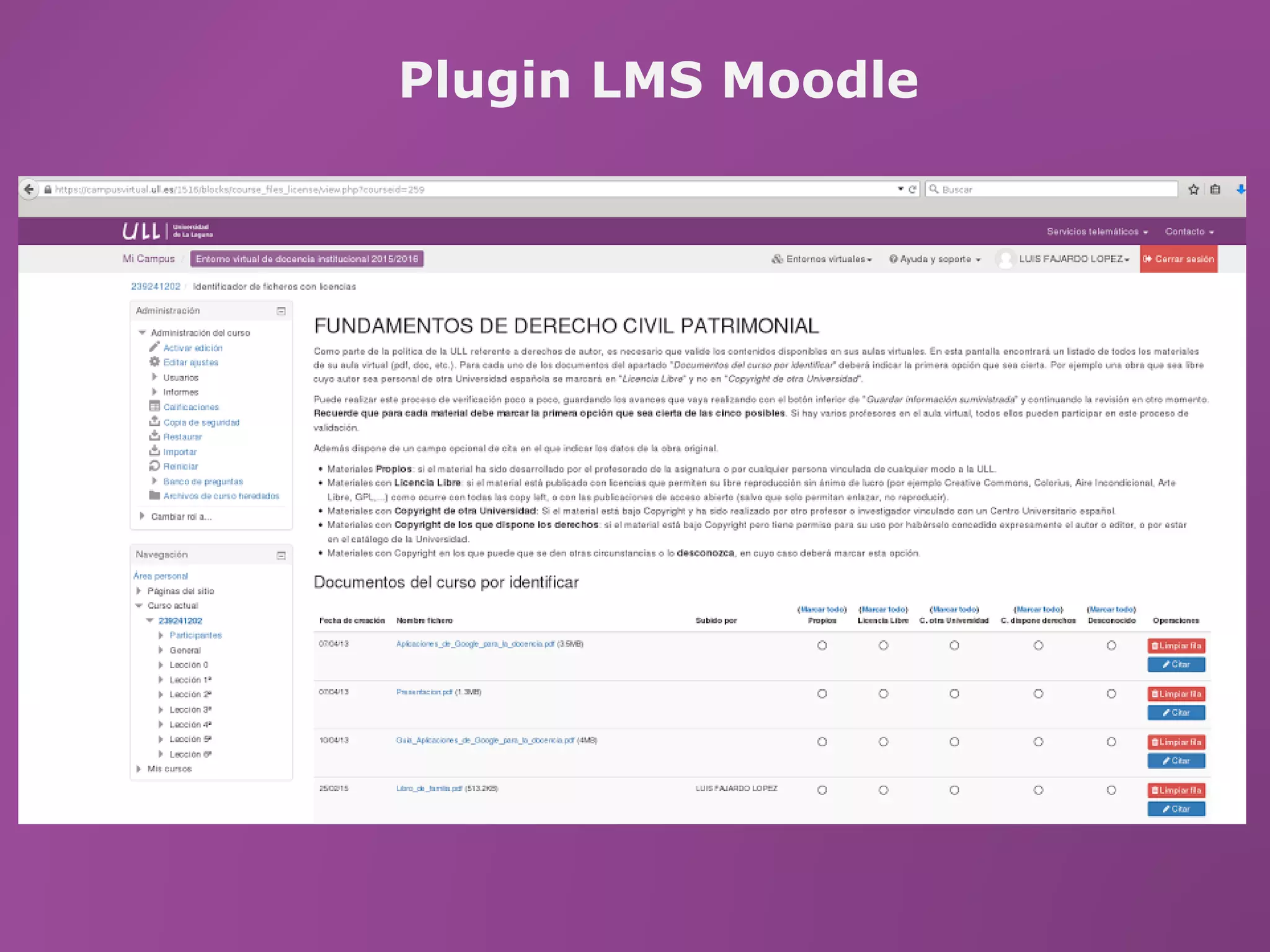
Plugin LMS Moodle
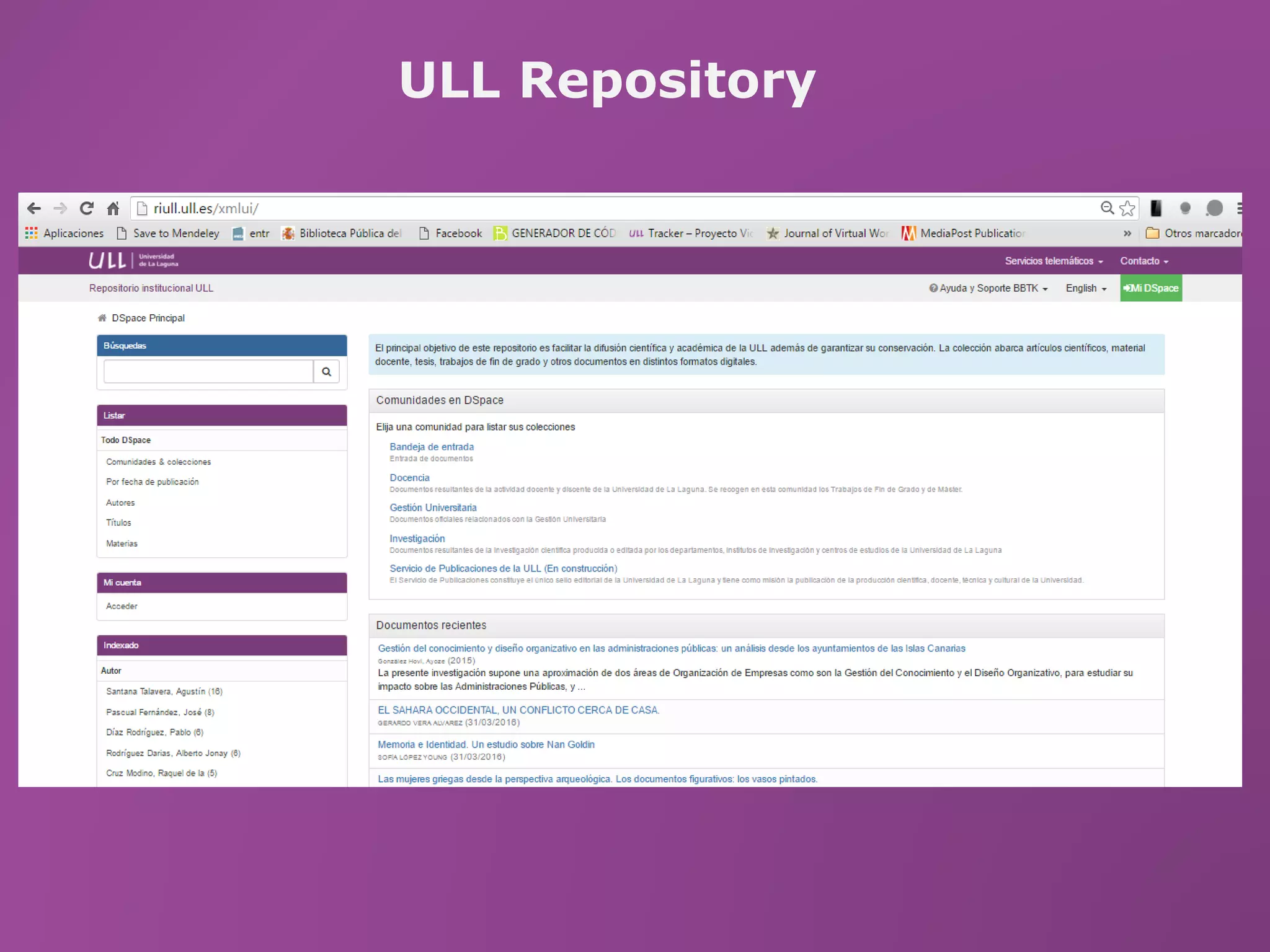
ULL Repository
1. Legal issues
In Spain it is legally mandatory:
• For all public institution to make available to the
public their digital production.
• For public universities, to have repositories
(owned or shared) and to connect it with other
national or international similar initiatives.
(Science, Technology and Innovation Act Ley
14/2011, 1 June, Art. 37.1 and 5)
1. Legal issues
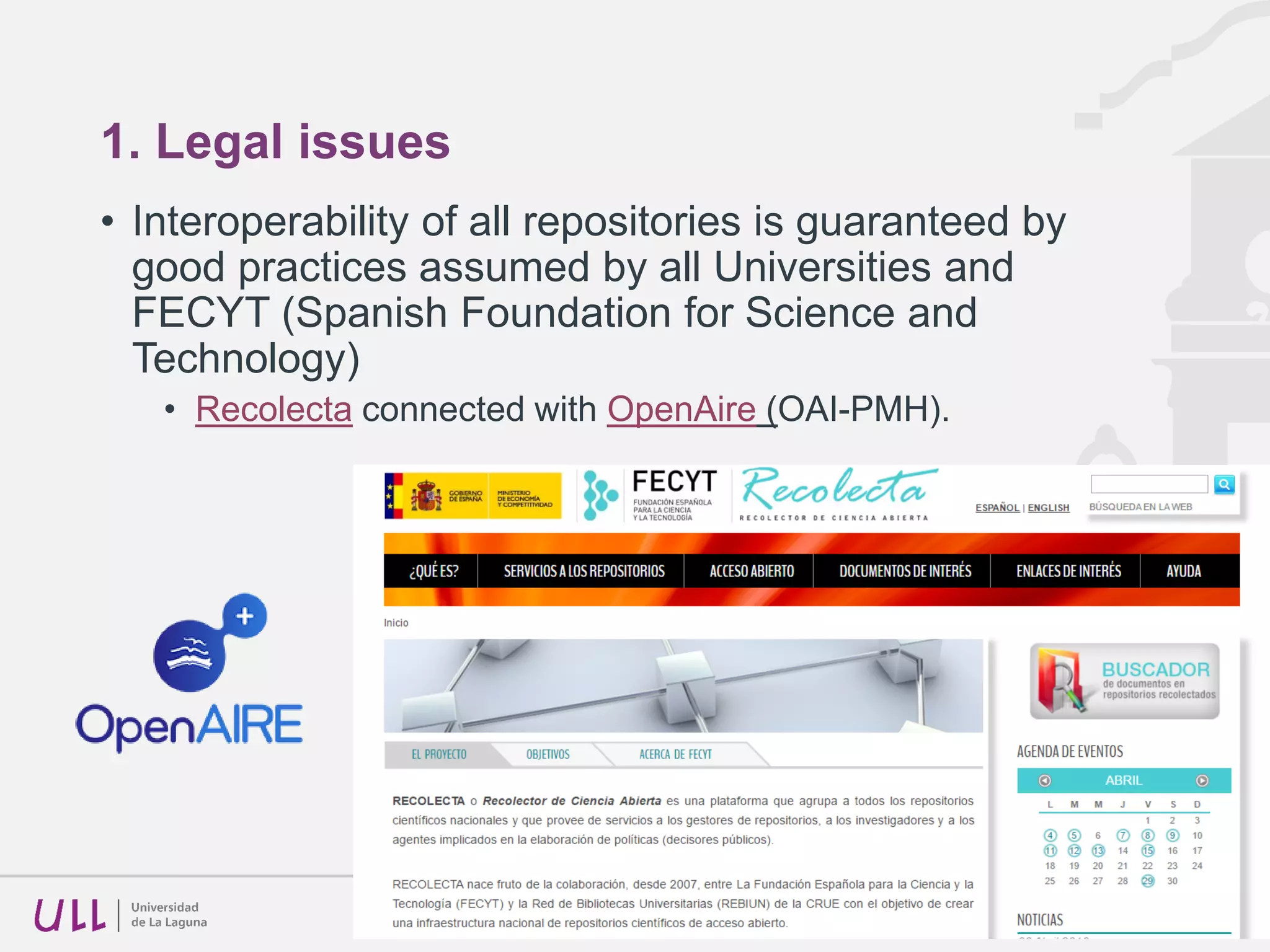
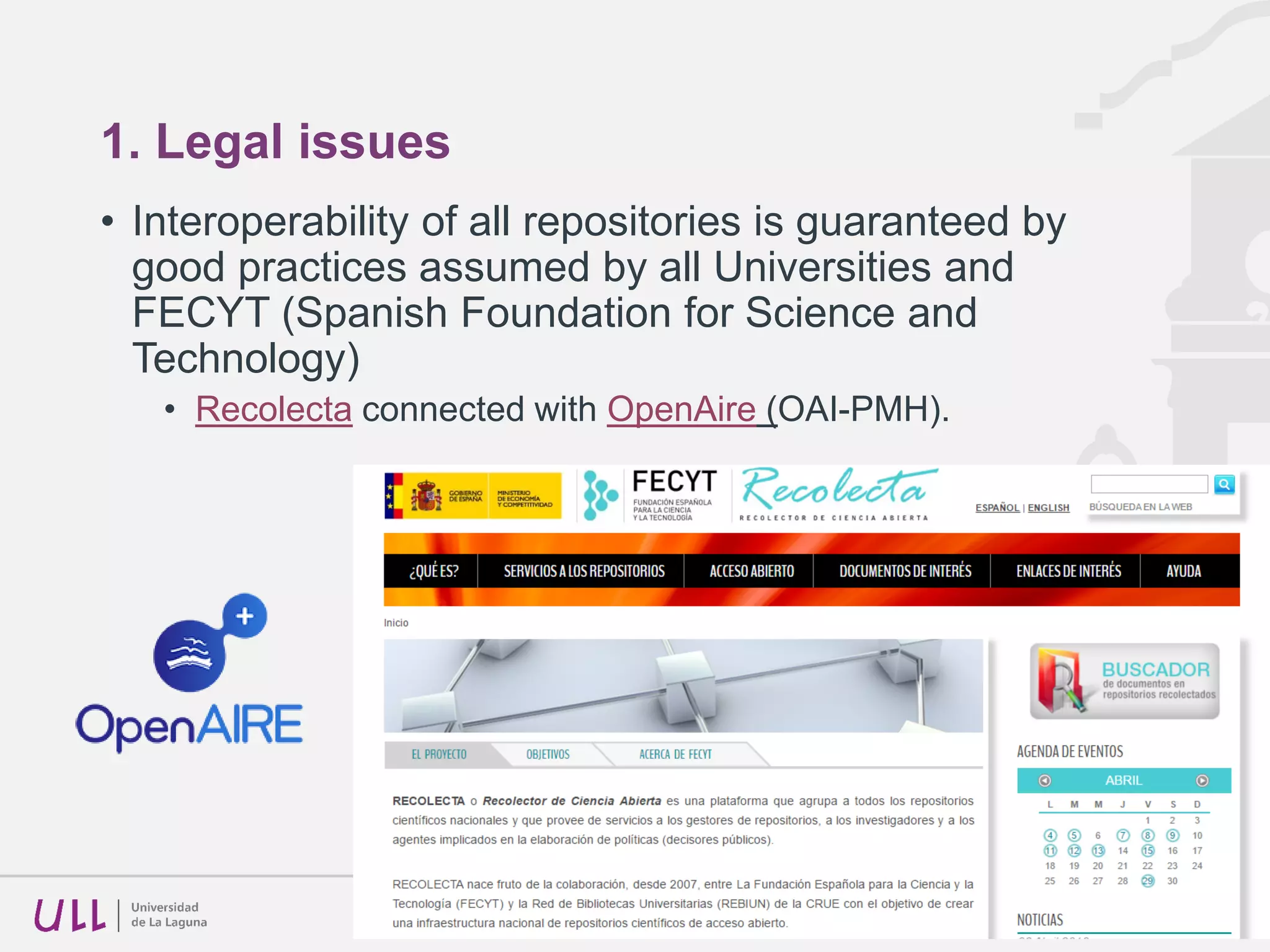
• Interoperability of all repositories is guaranteed by
good practices assumed by all Universities and
FECYT (Spanish Foundation for Science and
Technology)
• Recolecta connected with OpenAire (OAI-PMH).
1. Legal issues
• Public repositories should be (not mandatory) public
available (Act 23/2006, 7 July, Aditional Disposition 3th)
• All researchers are compulsory to make its works public
available, when the research has receive public funds
• All publications resulting from mainly publicly funded research
must have a digital copy of their final version, once they have
been accepted to be published in periodical or serial research
publications. An embargo of a maximum of 12 months is
accepted.
• THE EXPLOITATION RIGHTS ALL WORKS CREATED
FROM RESEARCHERS LINKED IN ANY WAY TO A
PUBLIC UNIVERSITY BELONGS TO THE
UNIVERSITY: no university has a knowledge policy to
make advantage of that legal difference.
• Repositories and electronic administration
2. Requirements and considerations of
legal policy in knowledge management
• Policy measures
• Organizational measures
• Strengthen the ICT services which support the
knowledge management policy
• Agreements with other Universities
2. Requirements and considerations of
legal policy in knowledge management
• A flat rate cannot be imposed just to compensate the
legally questionable canon for the teaching usage of the
Universities.
• The institutional repositories, together with the on line
bibliographic resources, should be the technological base
for the knowledge management through inter-university
transfer agreements and for the respect to the intellectual
property rights in the university sector.
• Knowledge management policy must develop an opinion
about scientific social networks, giving instructions for
their utilization and analysing those similar to
SHERPA/ROMEO, in order to classifying them according
to the institutional policies.
2. Requirements and considerations of
legal policy in knowledge management
• The manner in which we must proceed in our way to
Open Access.
• The creation of knowledge is an administrative work and it
must be the result of electronic administrative procedures,
as the entry to the institutional repository
• To link accreditation and evaluation procedures to the
incorporation of the materials to be evaluated in the
institutional repository
• Put the universities in a better place to negotiate with
publishers
Institutional Open Access Policy
www.ull.es
Thank you!
URL: http://riull.ull.es/xmlui/handle/915/2120

Towards effective institutional policies to promote open access in educational resources

  • 1.
    Towards effective institutionalpolicies to promote open access in educational resources Dulce M. Cairós Barreto, Luis Fajardo López , Carina S. González González, University of La Laguna, Canary Islands, Spain National University of Ireland, Galway, Ireland 7-8 April, 2016
  • 2.
    Contents • Legal Issuesabout Institutional Open Access Repositories • ULL and CEDRO: legal implications and actions • Requirements and considerations of legal policy in knowledge management • Towards an institutional OA policy
  • 3.
    1. Legal issues •Copyright (Directive 2001/29/EC) Different rights: → economic exploitation → moral rights (like attribution, integrity,...) Digital Right Management What about their exceptions and limitations?
  • 4.
    1. Legal issues •Limits and conditions • Moral rigths on his creative work • Explotation rigths on his creative work • Use for (theoretical) • To place the intelectual property rights from its isolated theorical construction down in the world • To coordinate it with other rights and duties: such as Education rights • i.e. Illustration for teaching
  • 5.
    1. Legal issues •The University of La Laguna, the virtual campus and CEDRO • Bern Convention & Directive 2001/29/EC • Have to pay a “fair compensation” for teaching usage of any work, except otherwise provided in a written agreement with the right holder. • Law says that “authors and publishers will have a irrevocable right to become from the teaching entities a fair remuneration, that will be managed through the collective management societies”
  • 6.
    CEDRO and ULL •Initial analysis of learning-teaching virtual environments uses (done) • Training of teaching staff in open access and intellectual laws (done) • LMS Plugin and poll (done) • Institutional Repository of Teaching Resources (in progress) • Global Institutional Open Access Policy proposal (in progress)
  • 7.
    ULL analysis 34,79% 3,32% 16,08% 35,31% 10,49% Resources byknowledge área 2013-2014 Artes y Humanidades Ciencias Ciencias de la Salud Ciencias Sociales y Jurídicas Ingeniería y Arquitectura
  • 8.
    ULL analysis 25,32% 1,82% 6,92% 60,29% 5,65% Resources byknowledge área 2014-2015 Artes y Humanidades Ciencias Ciencias de la Salud Ciencias Sociales y Jurídicas Ingeniería y Arquitectura
  • 9.
  • 10.
  • 11.
    1. Legal issues InSpain it is legally mandatory: • For all public institution to make available to the public their digital production. • For public universities, to have repositories (owned or shared) and to connect it with other national or international similar initiatives. (Science, Technology and Innovation Act Ley 14/2011, 1 June, Art. 37.1 and 5)
  • 12.
    1. Legal issues •Interoperability of all repositories is guaranteed by good practices assumed by all Universities and FECYT (Spanish Foundation for Science and Technology) • Recolecta connected with OpenAire (OAI-PMH).
  • 13.
    1. Legal issues •Public repositories should be (not mandatory) public available (Act 23/2006, 7 July, Aditional Disposition 3th) • All researchers are compulsory to make its works public available, when the research has receive public funds • All publications resulting from mainly publicly funded research must have a digital copy of their final version, once they have been accepted to be published in periodical or serial research publications. An embargo of a maximum of 12 months is accepted. • THE EXPLOITATION RIGHTS ALL WORKS CREATED FROM RESEARCHERS LINKED IN ANY WAY TO A PUBLIC UNIVERSITY BELONGS TO THE UNIVERSITY: no university has a knowledge policy to make advantage of that legal difference. • Repositories and electronic administration
  • 14.
    2. Requirements andconsiderations of legal policy in knowledge management • Policy measures • Organizational measures • Strengthen the ICT services which support the knowledge management policy • Agreements with other Universities
  • 15.
    2. Requirements andconsiderations of legal policy in knowledge management • A flat rate cannot be imposed just to compensate the legally questionable canon for the teaching usage of the Universities. • The institutional repositories, together with the on line bibliographic resources, should be the technological base for the knowledge management through inter-university transfer agreements and for the respect to the intellectual property rights in the university sector. • Knowledge management policy must develop an opinion about scientific social networks, giving instructions for their utilization and analysing those similar to SHERPA/ROMEO, in order to classifying them according to the institutional policies.
  • 16.
    2. Requirements andconsiderations of legal policy in knowledge management • The manner in which we must proceed in our way to Open Access. • The creation of knowledge is an administrative work and it must be the result of electronic administrative procedures, as the entry to the institutional repository • To link accreditation and evaluation procedures to the incorporation of the materials to be evaluated in the institutional repository • Put the universities in a better place to negotiate with publishers
  • 17.
  • 18.