
Standards for
Smart Learning Environments –
towards a development framework
Tore Hoel
Oslo and Akershus University College of Applied Sciences
Norway
Lecture at Beijing Normal University
2016-11-21
Who is this guy?
Standards
Open Educational
Resources (OER)
ICT in education
EU & Nordic
projects
Learning Analytics
Interoperability
Communication &
Information
Management
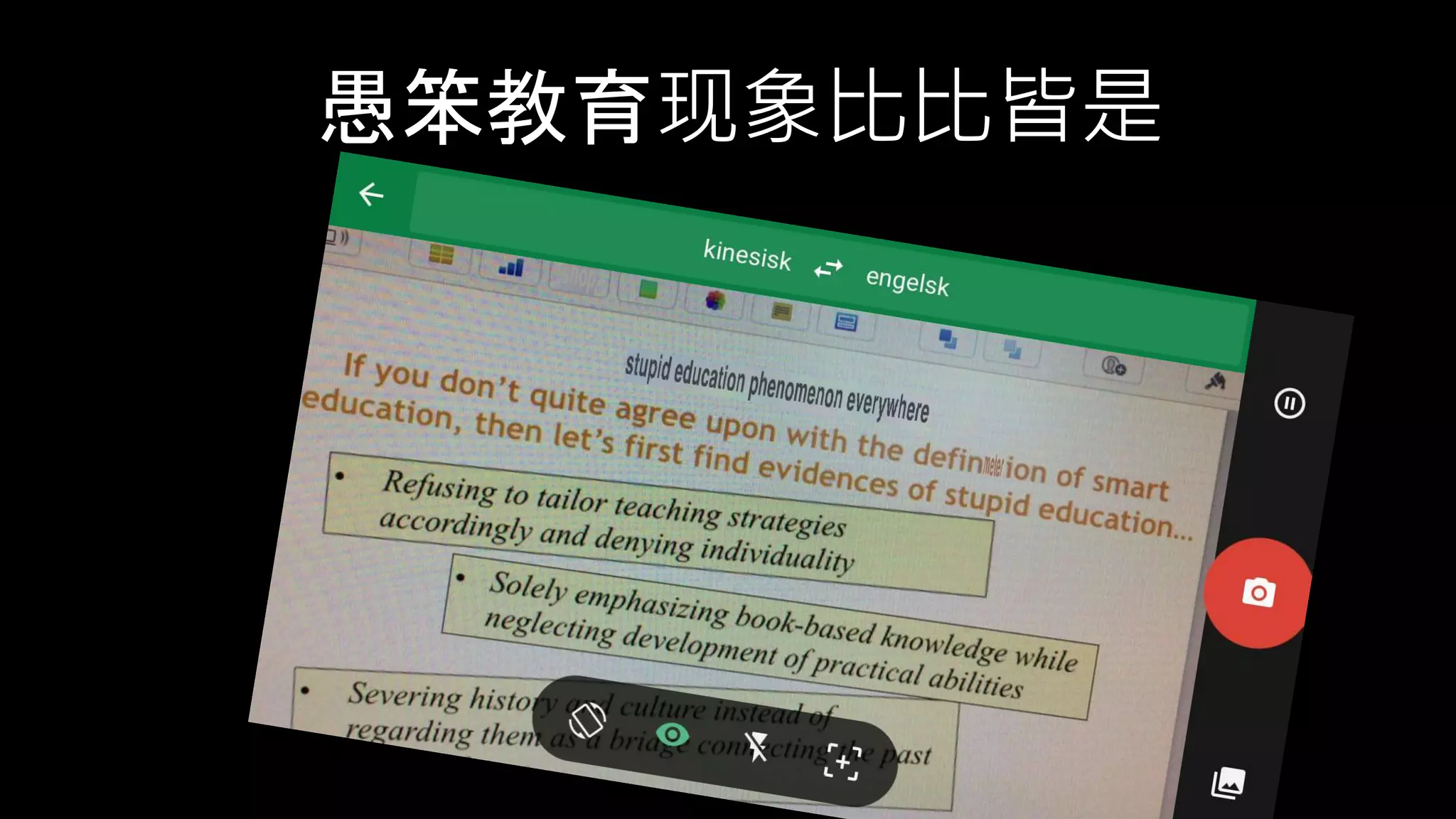
愚笨教育现象比比皆是
Understanding Smart
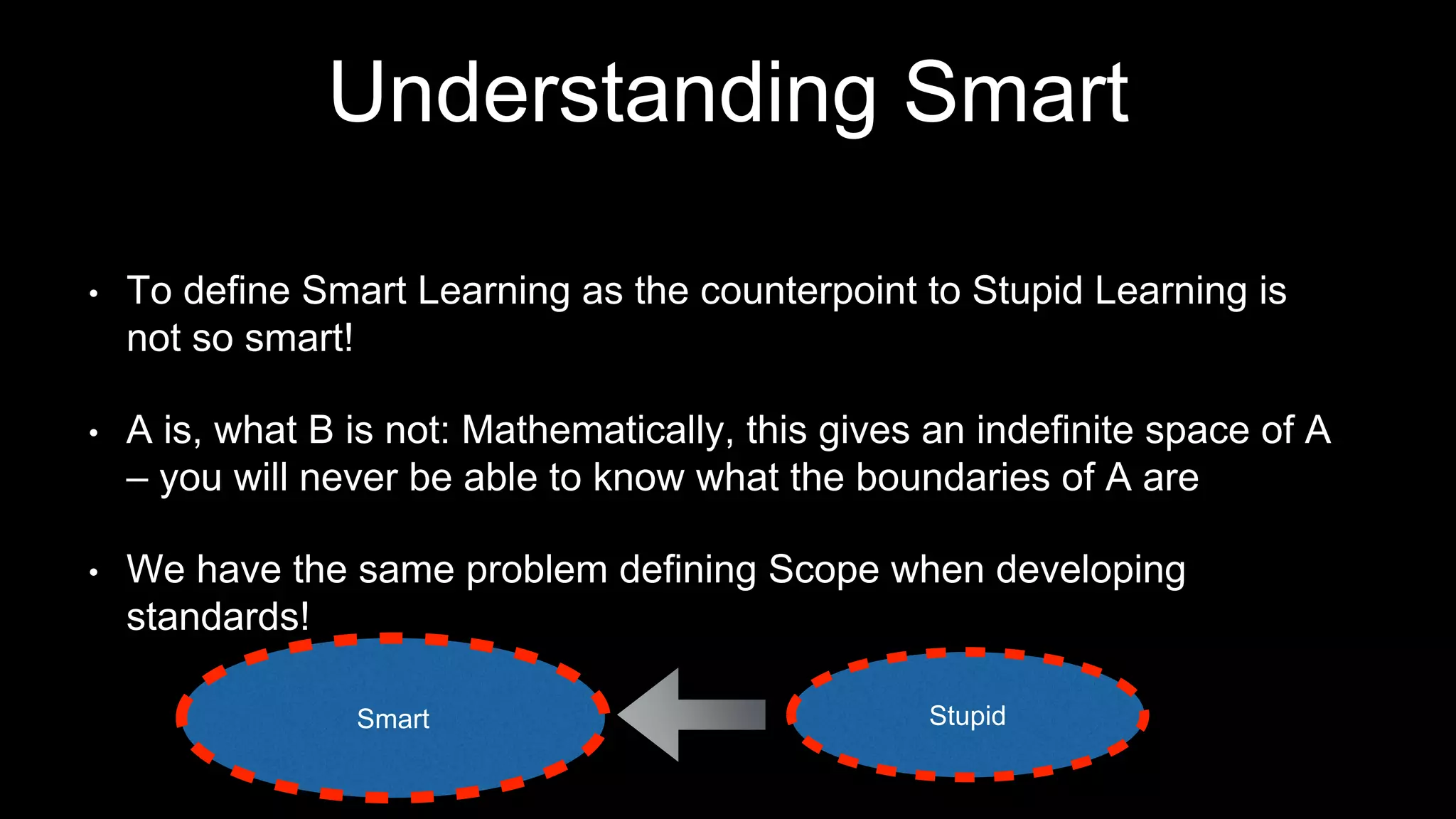
• To define Smart Learning as the counterpoint to Stupid Learning is
not so smart!
• A is, what B is not: Mathematically, this gives an indefinite space of A
– you will never be able to know what the boundaries of A are
• We have the same problem defining Scope when developing
standards!
Smart StupidSmart
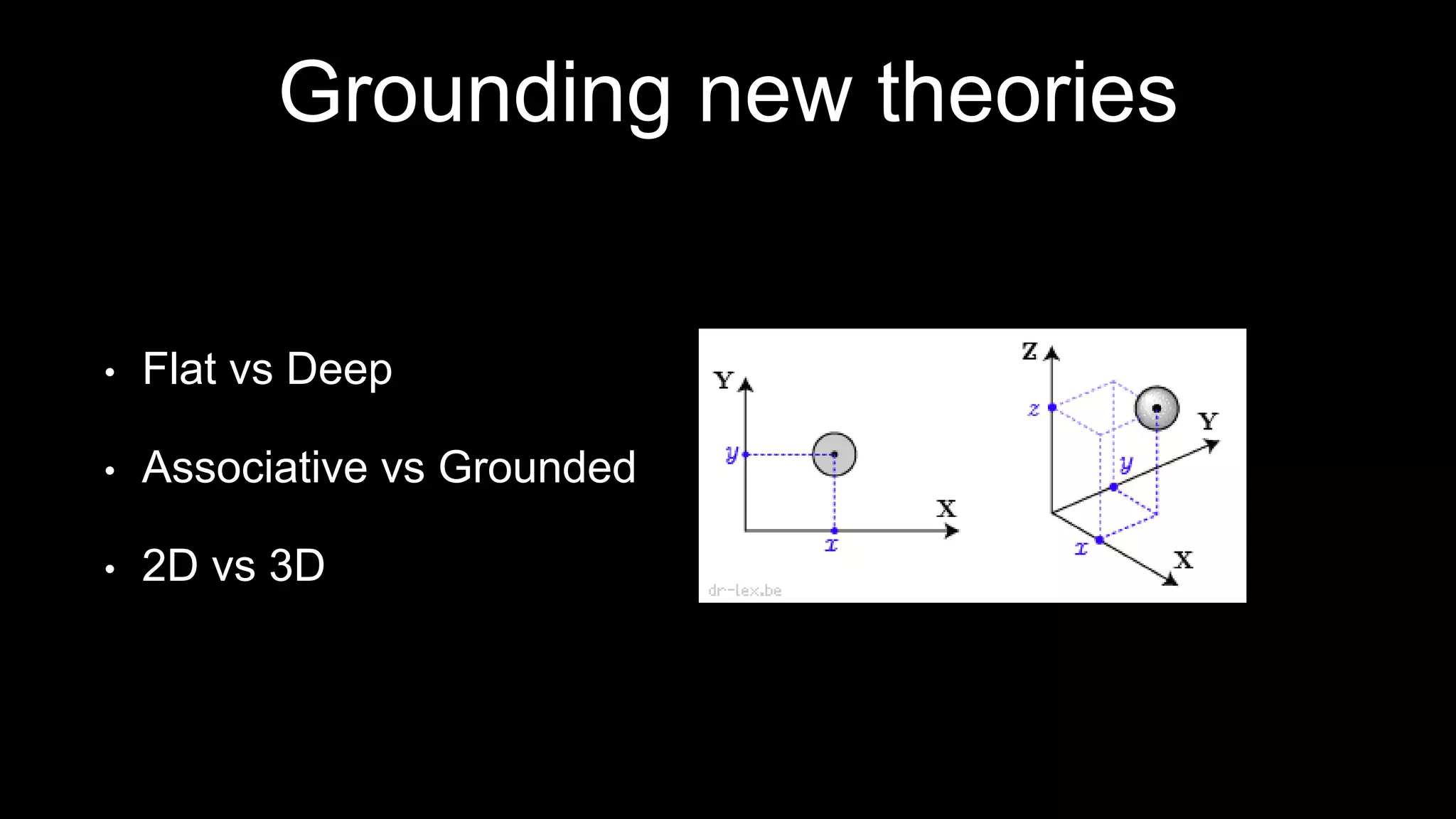
Grounding new theories
• Flat vs Deep
• Associative vs Grounded
• 2D vs 3D
Smart should be
grounded…
So should also our
standards work!
What is the implied theoretical and
empirical model behind
Smart Learning Environments?
What theoretical and empirical model of
learning technologies should inform LET
standardisation?
Smart as in the
Journal
Launched in 2014
The aim of the journal is to help various
stakeholders of smart learning
environments better understand each
other's role in the overall process of
education and how they may support
each other.
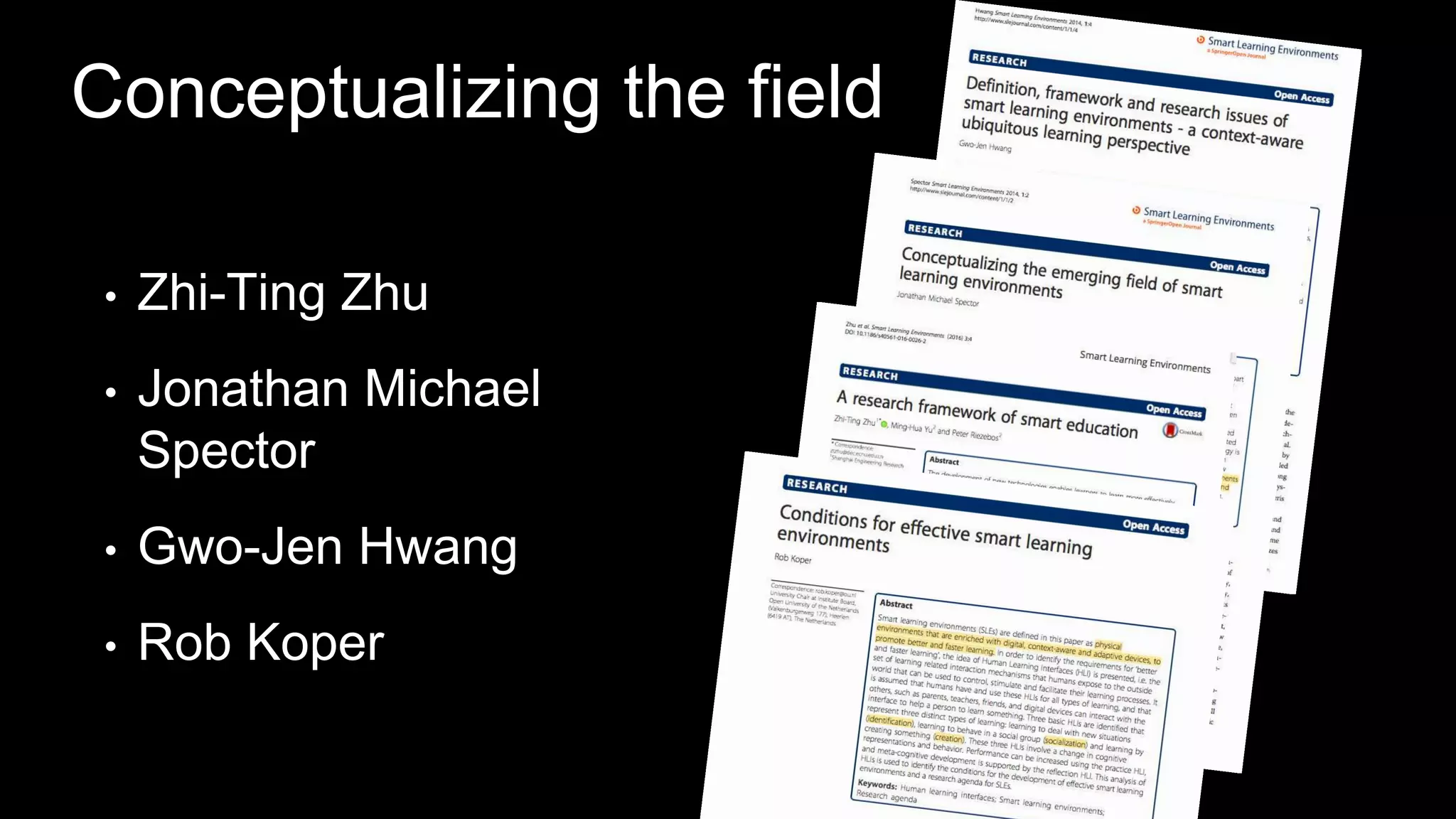
Conceptualizing the field
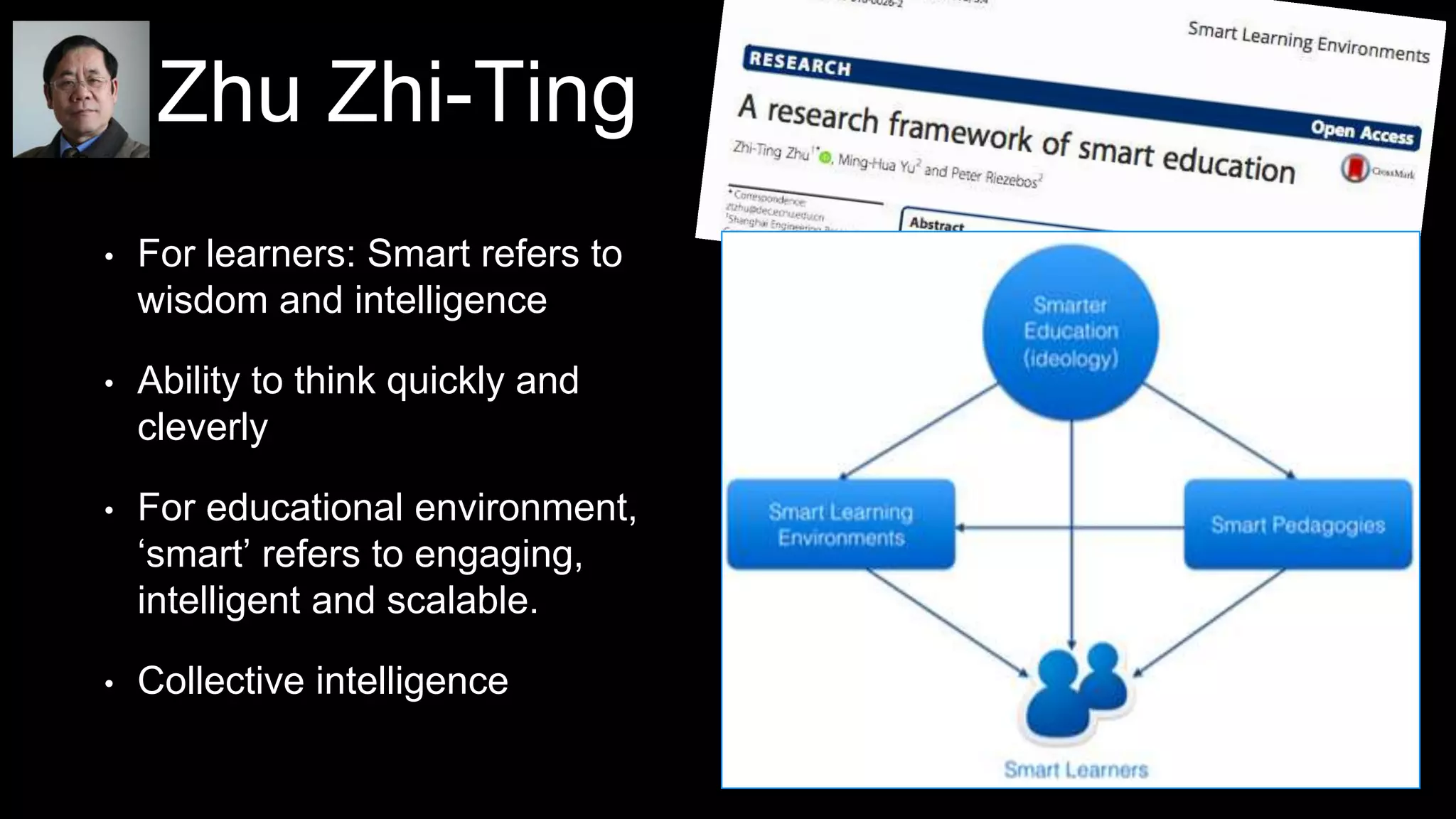
• Zhi-Ting Zhu
• Jonathan Michael
Spector
• Gwo-Jen Hwang
• Rob Koper
Zhu Zhi-Ting
• For learners: Smart refers to
wisdom and intelligence
• Ability to think quickly and
cleverly
• For educational environment,
‘smart’ refers to engaging,
intelligent and scalable.
• Collective intelligence
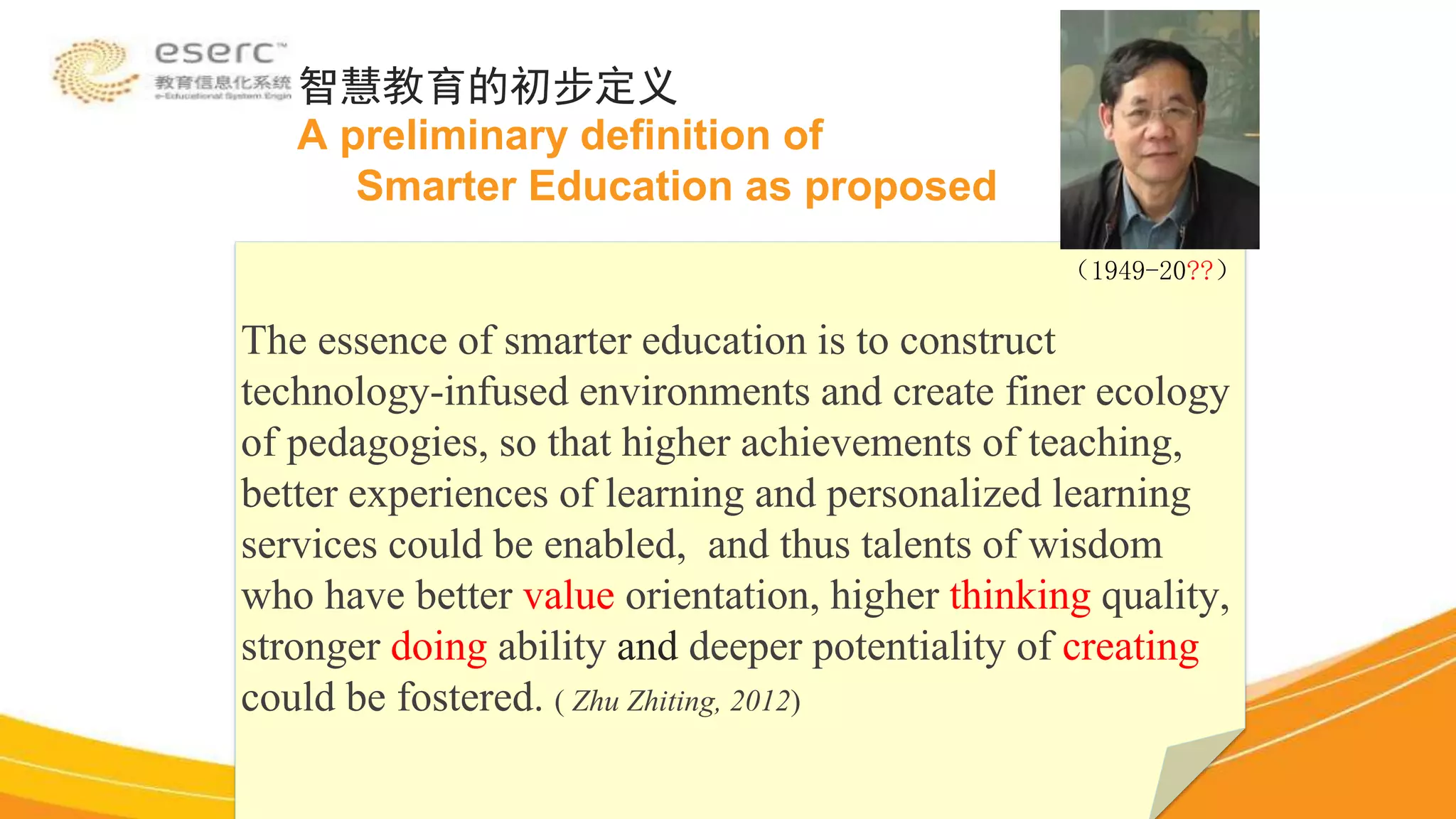
The essence of smarter education is to construct
technology-infused environments and create finer ecology
of pedagogies, so that higher achievements of teaching,
better experiences of learning and personalized learning
services could be enabled, and thus talents of wisdom
who have better value orientation, higher thinking quality,
stronger doing ability and deeper potentiality of creating
could be fostered. ( Zhu Zhiting, 2012)
智慧教育的初步定义
A preliminary definition of
Smarter Education as proposed
(1949-20??)
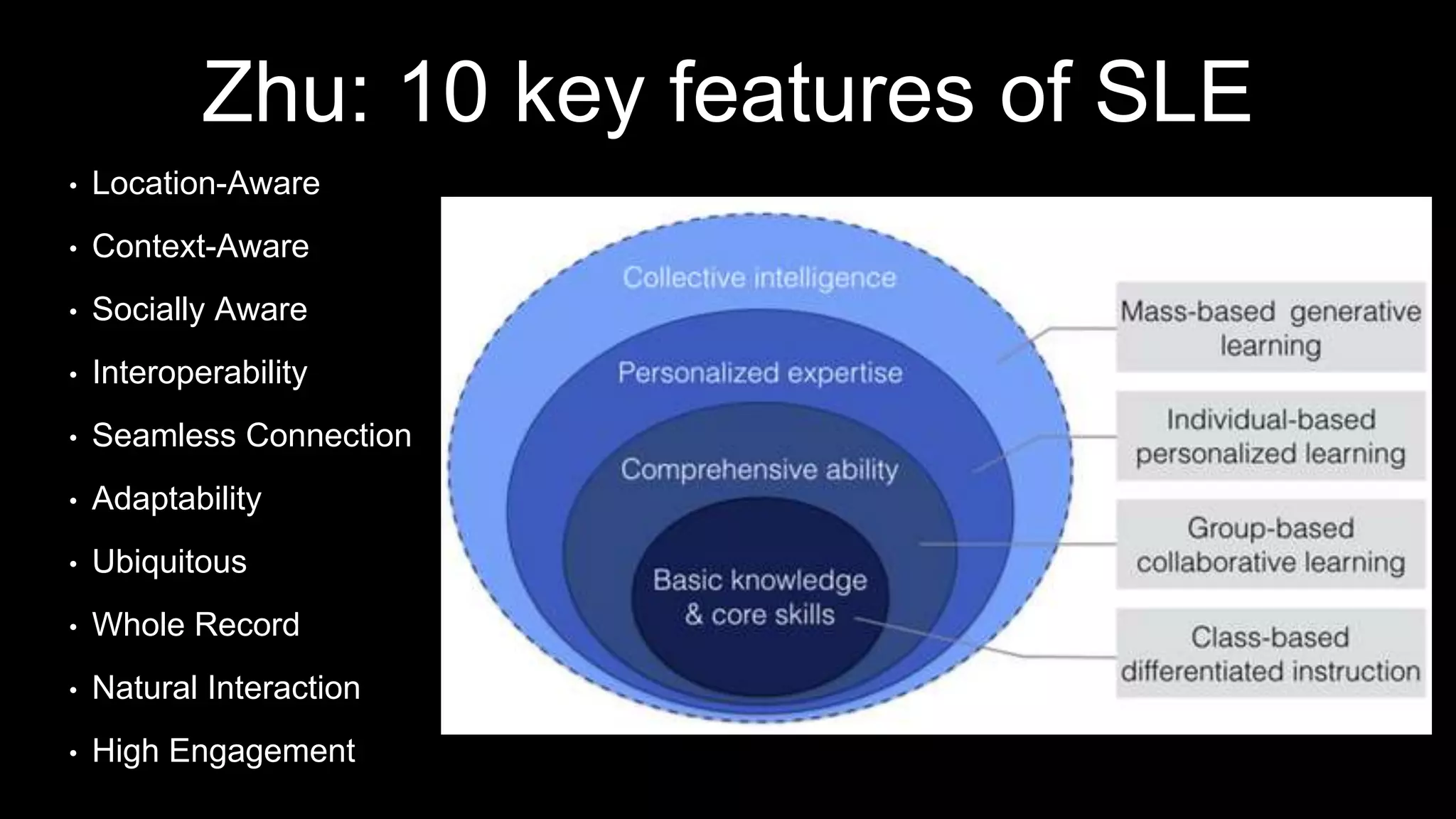
Zhu: 10 key features of SLE
• Location-Aware
• Context-Aware
• Socially Aware
• Interoperability
• Seamless Connection
• Adaptability
• Ubiquitous
• Whole Record
• Natural Interaction
• High Engagement
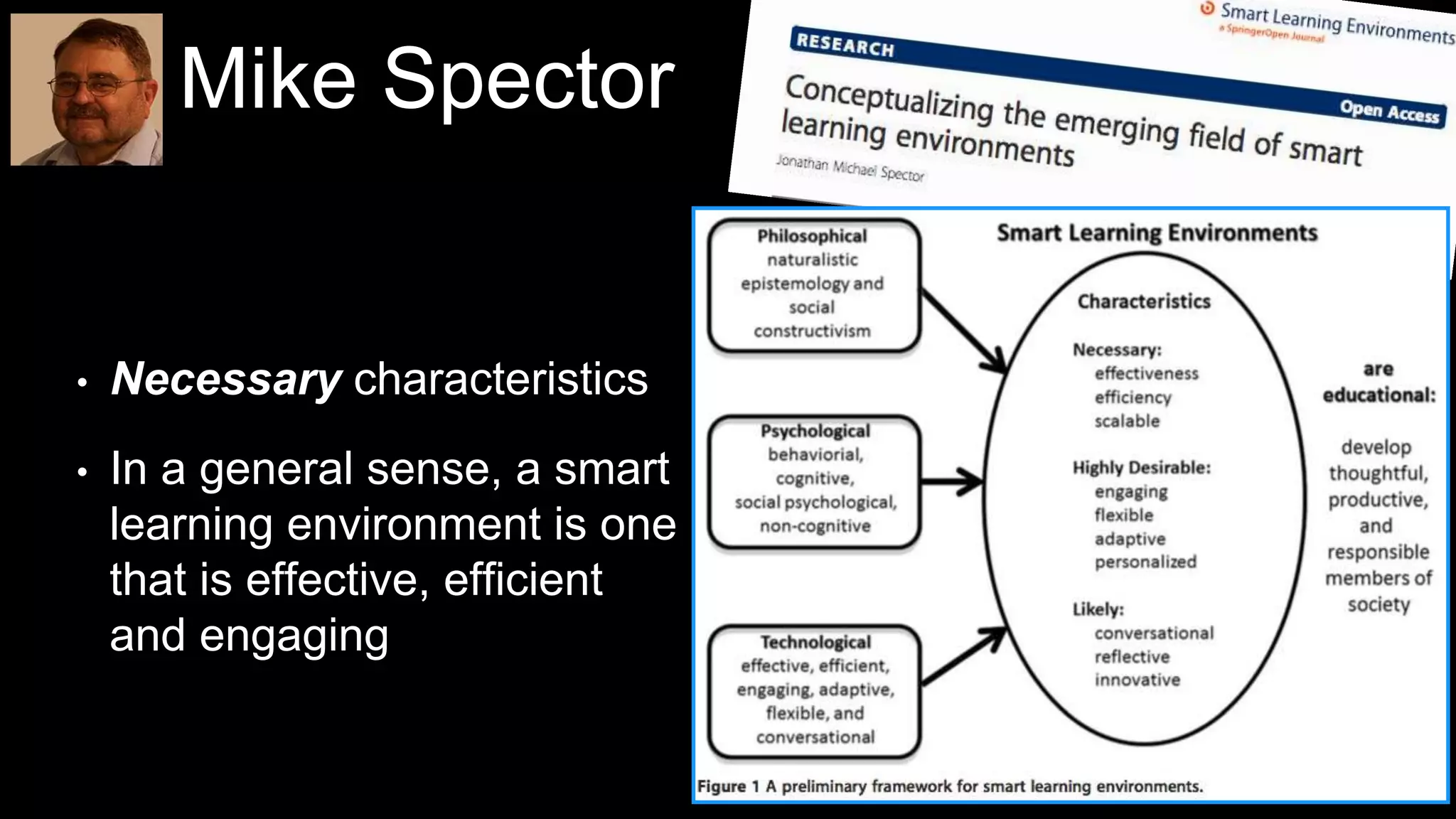
Mike Spector
• Necessary characteristics
• In a general sense, a smart
learning environment is one
that is effective, efficient
and engaging
Hwang Gwo-Jen
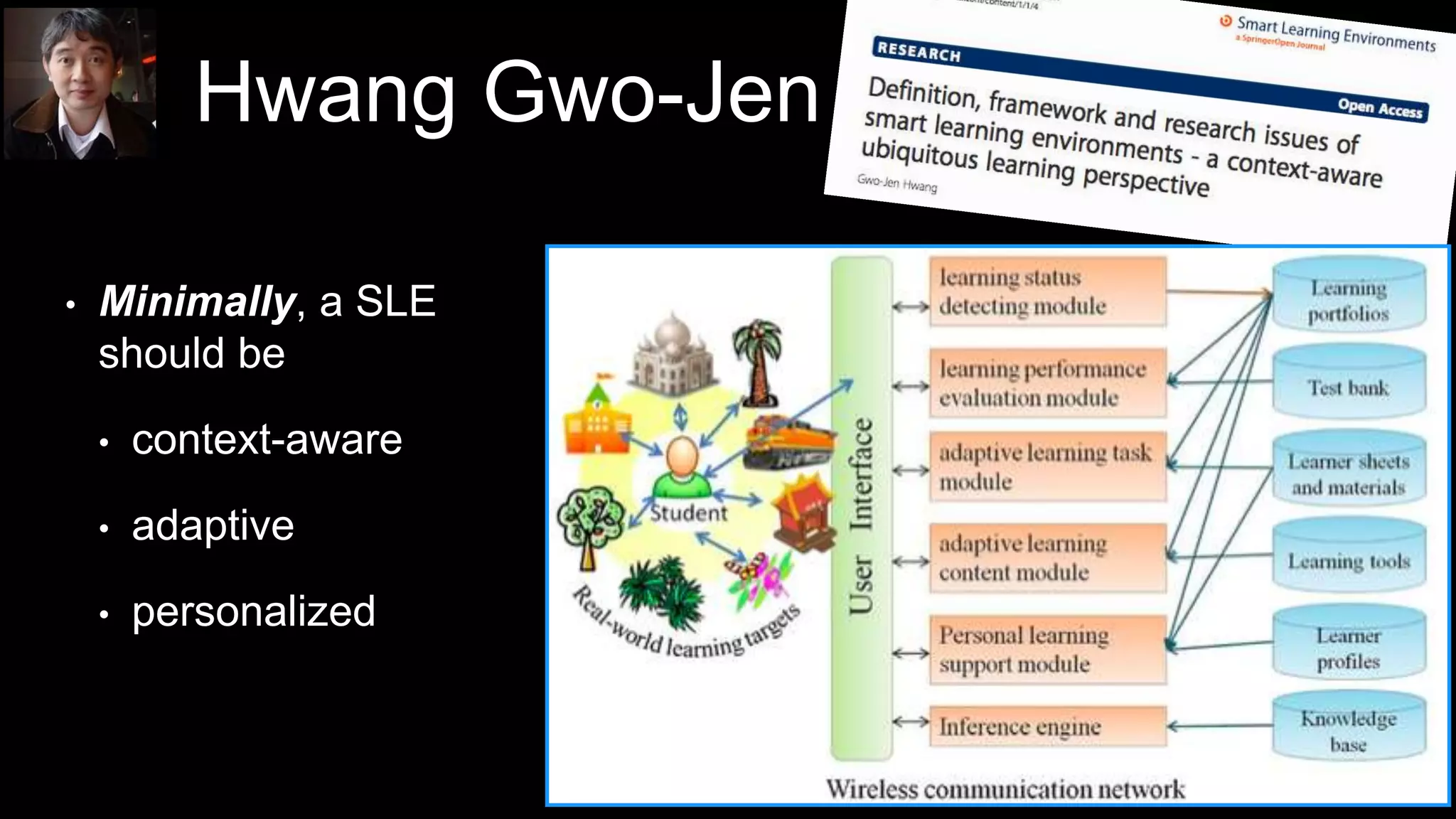
• Minimally, a SLE
should be
• context-aware
• adaptive
• personalized
Rob Koper
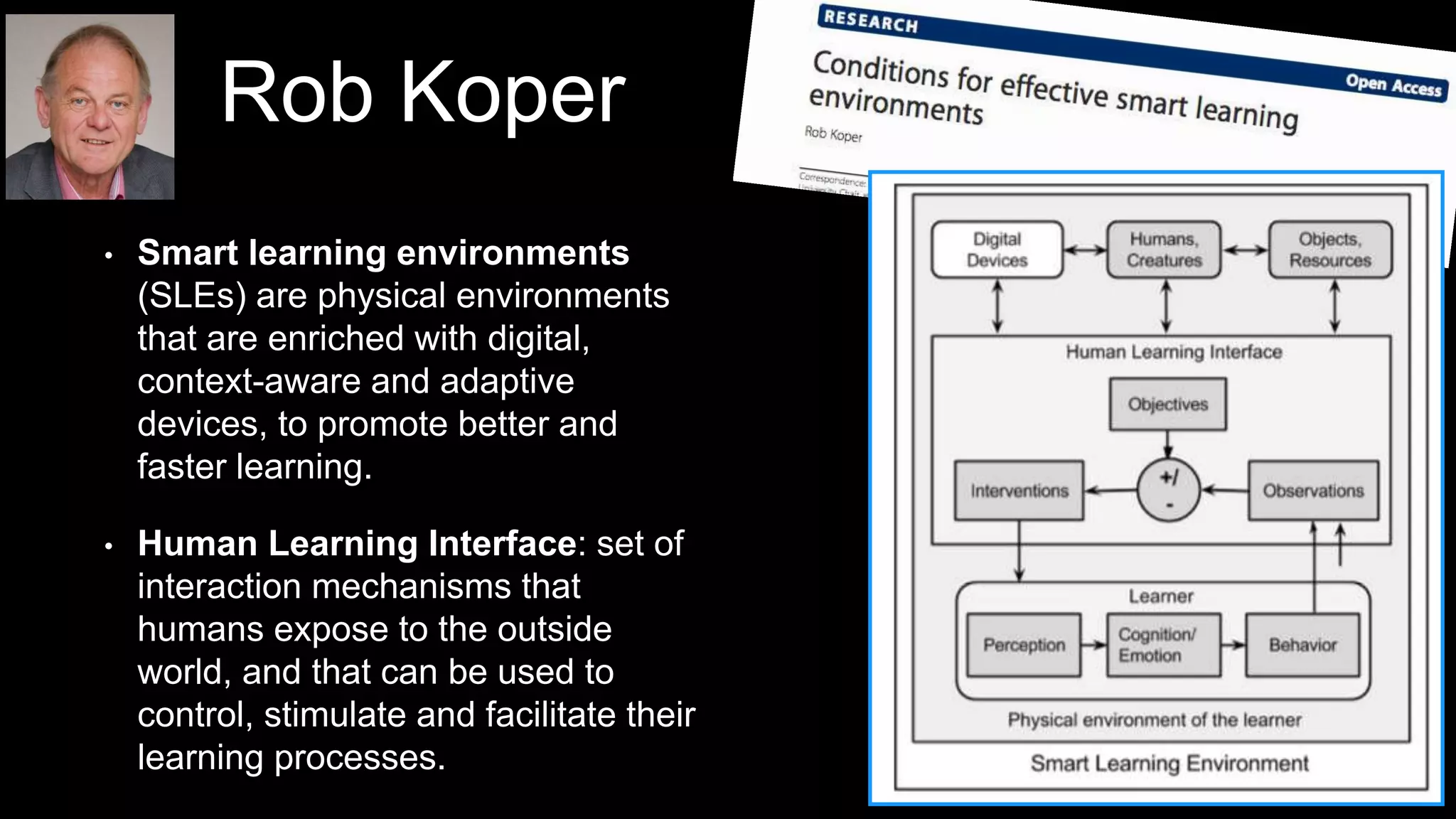
• Smart learning environments
(SLEs) are physical environments
that are enriched with digital,
context-aware and adaptive
devices, to promote better and
faster learning.
• Human Learning Interface: set of
interaction mechanisms that
humans expose to the outside
world, and that can be used to
control, stimulate and facilitate their
learning processes.
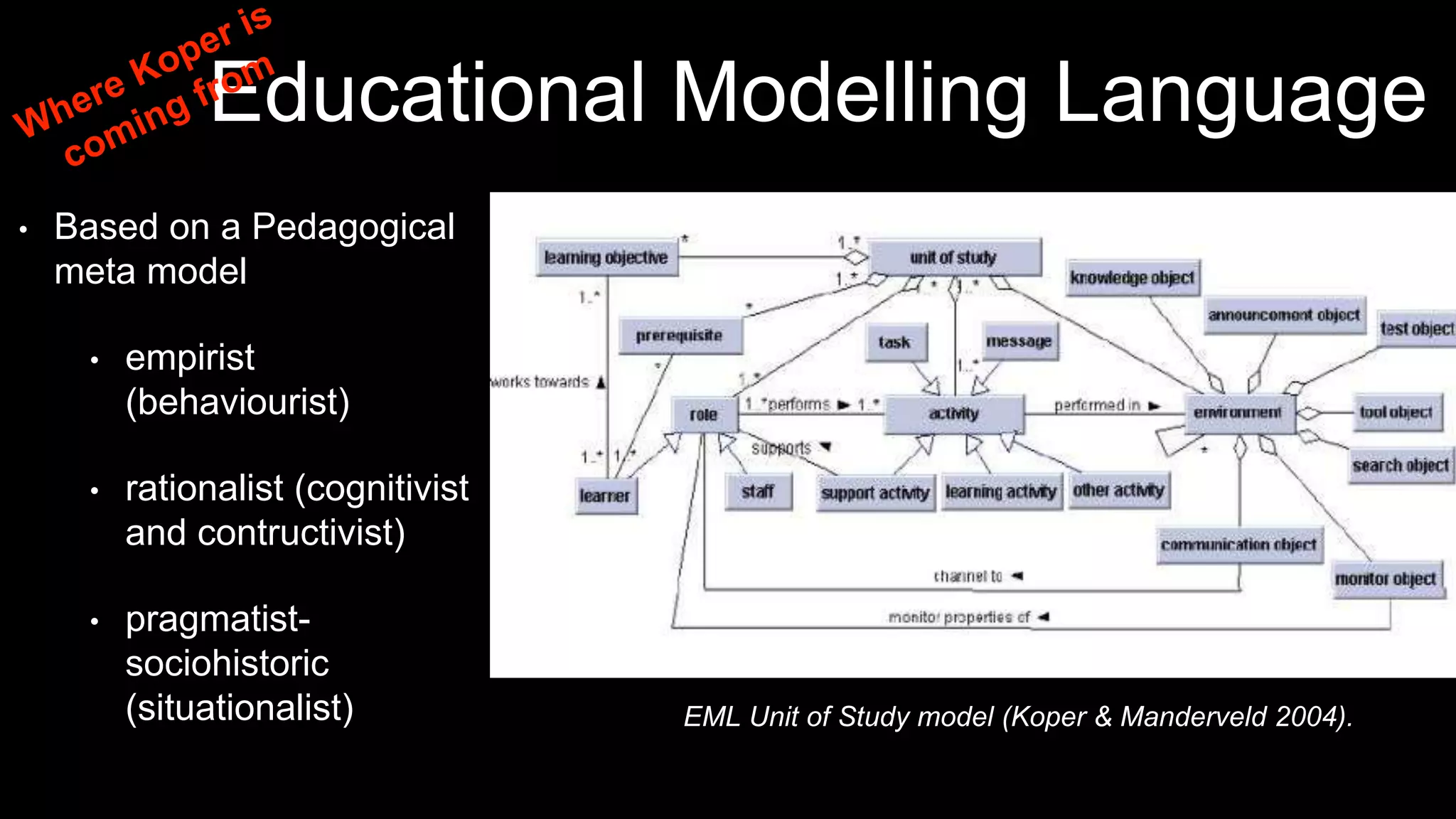
Educational Modelling Language
• Based on a Pedagogical
meta model
• empirist
(behaviourist)
• rationalist (cognitivist
and contructivist)
• pragmatist-
sociohistoric
(situationalist) EML Unit of Study model (Koper & Manderveld 2004).
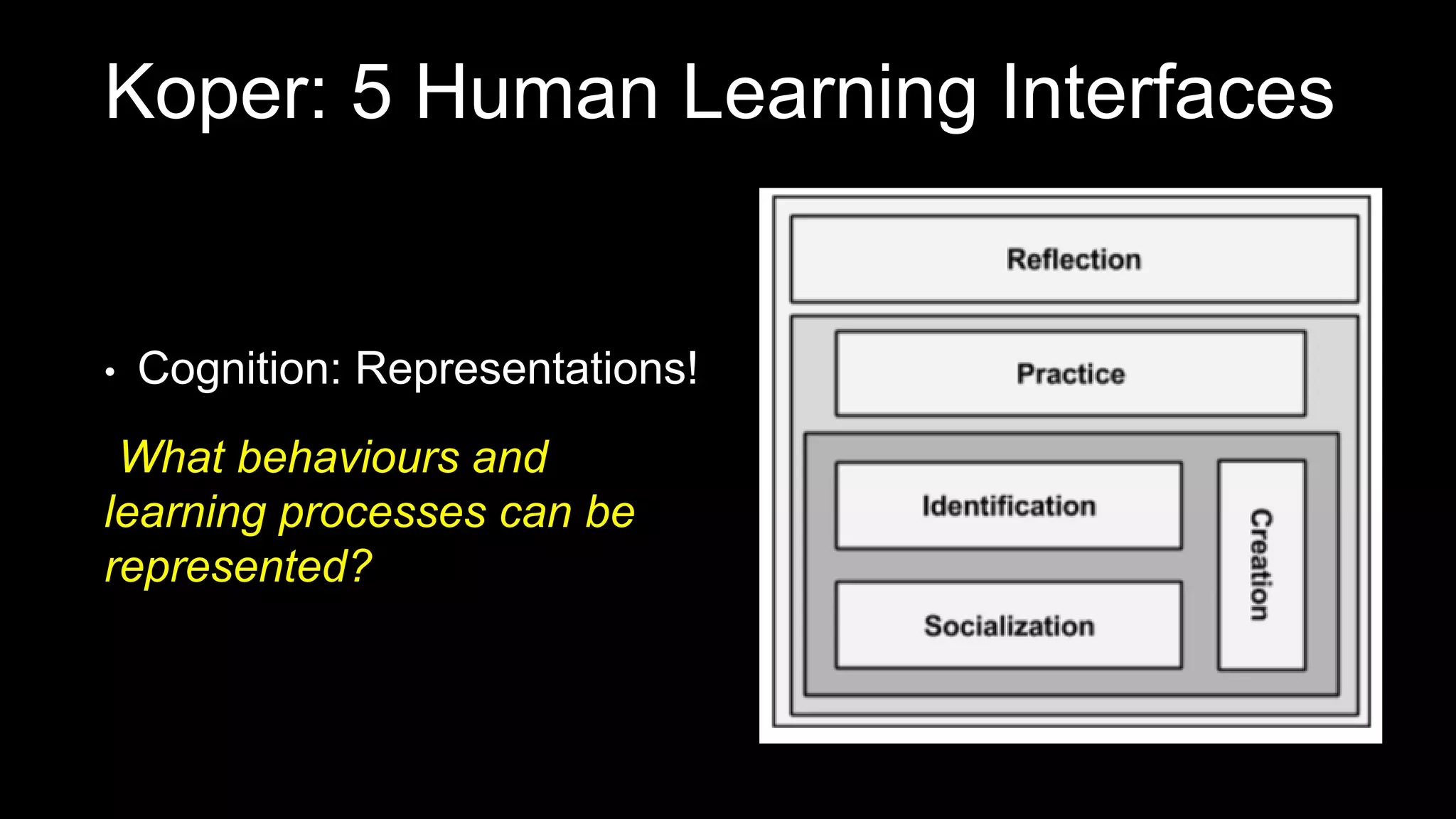
Koper: 5 Human Learning Interfaces
• Cognition: Representations!
What behaviours and
learning processes can be
represented?
Koper: Conditions for effective SLEs
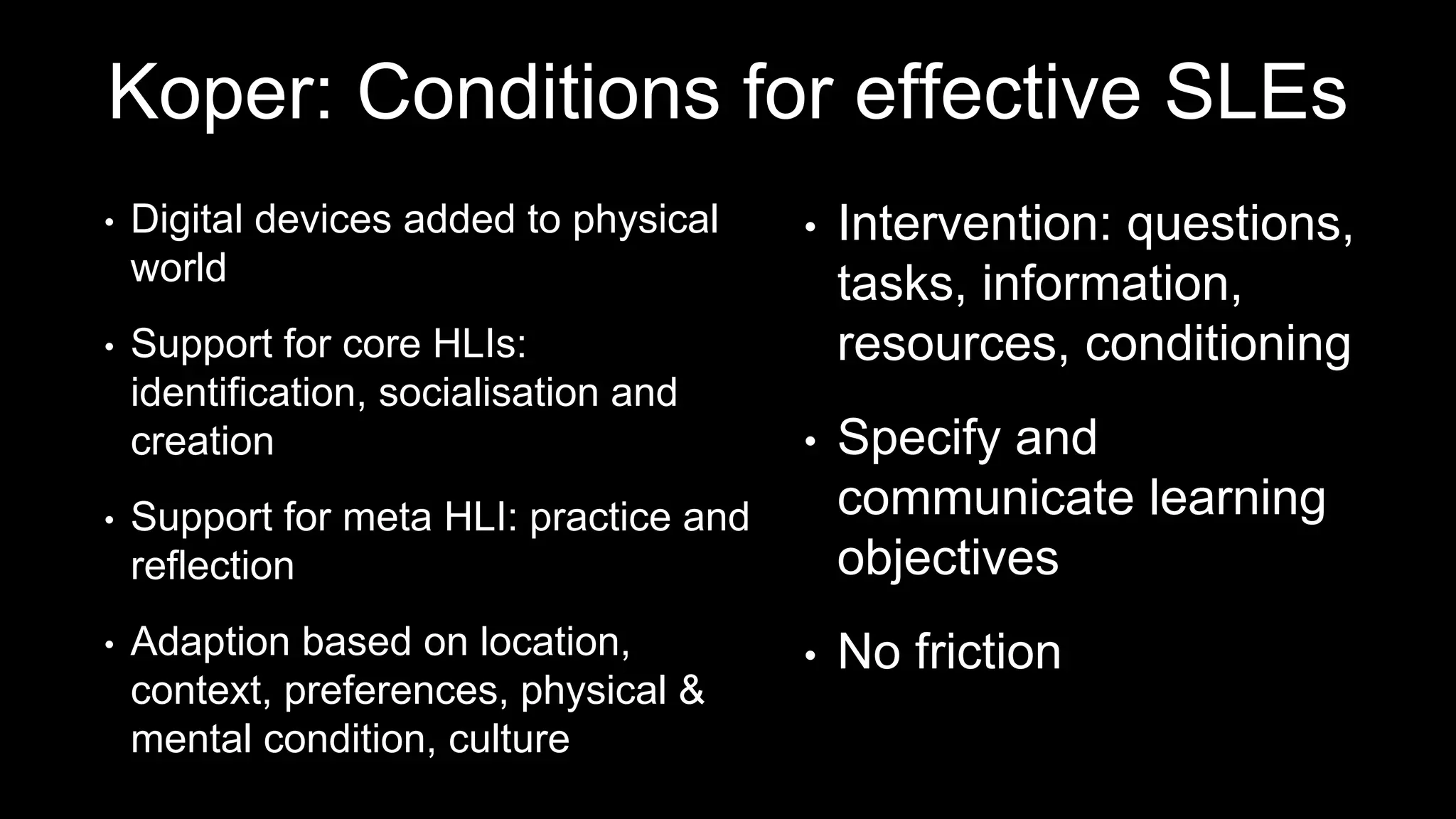
• Digital devices added to physical
world
• Support for core HLIs:
identification, socialisation and
creation
• Support for meta HLI: practice and
reflection
• Adaption based on location,
context, preferences, physical &
mental condition, culture
• Intervention: questions,
tasks, information,
resources, conditioning
• Specify and
communicate learning
objectives
• No friction
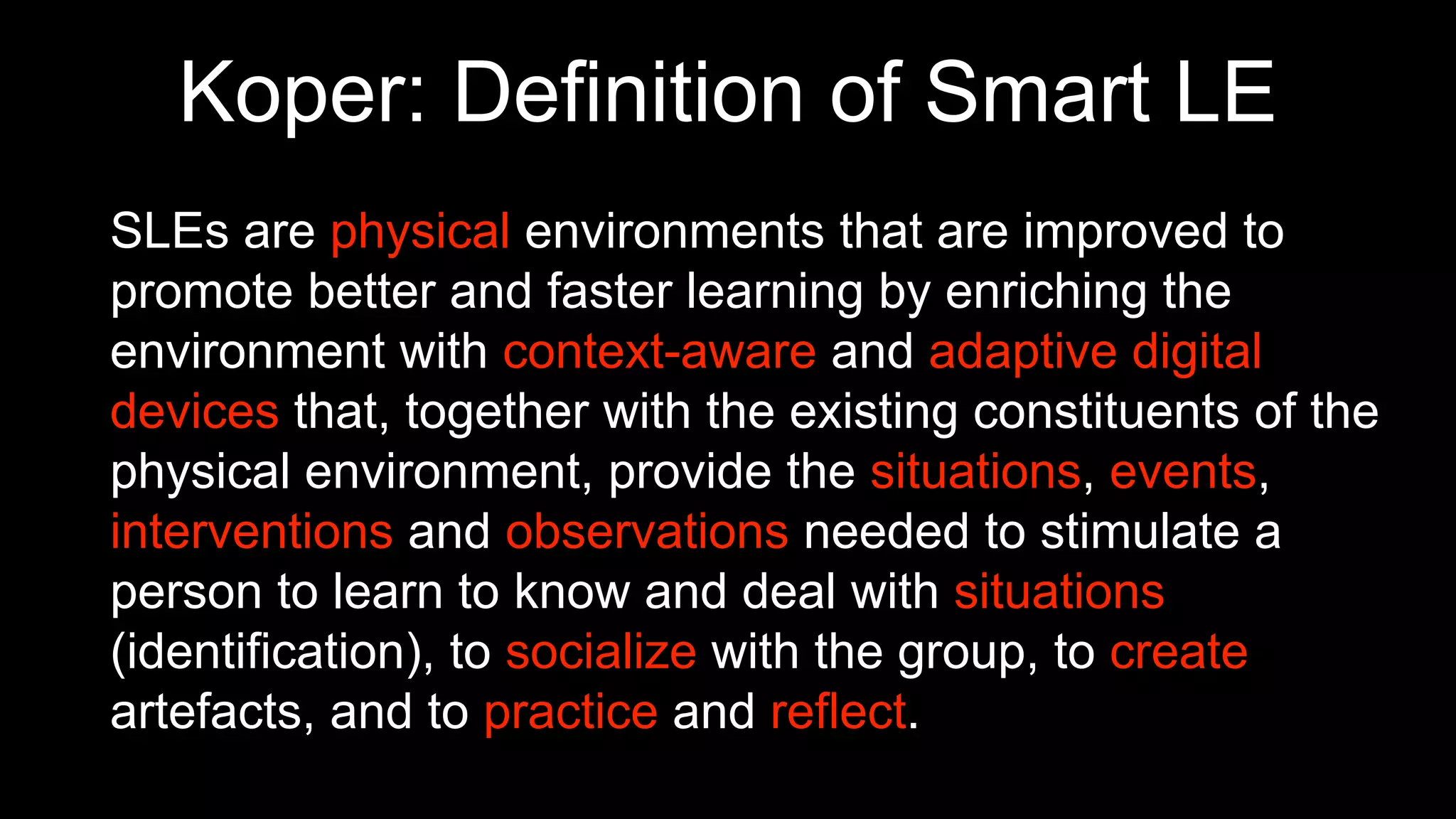
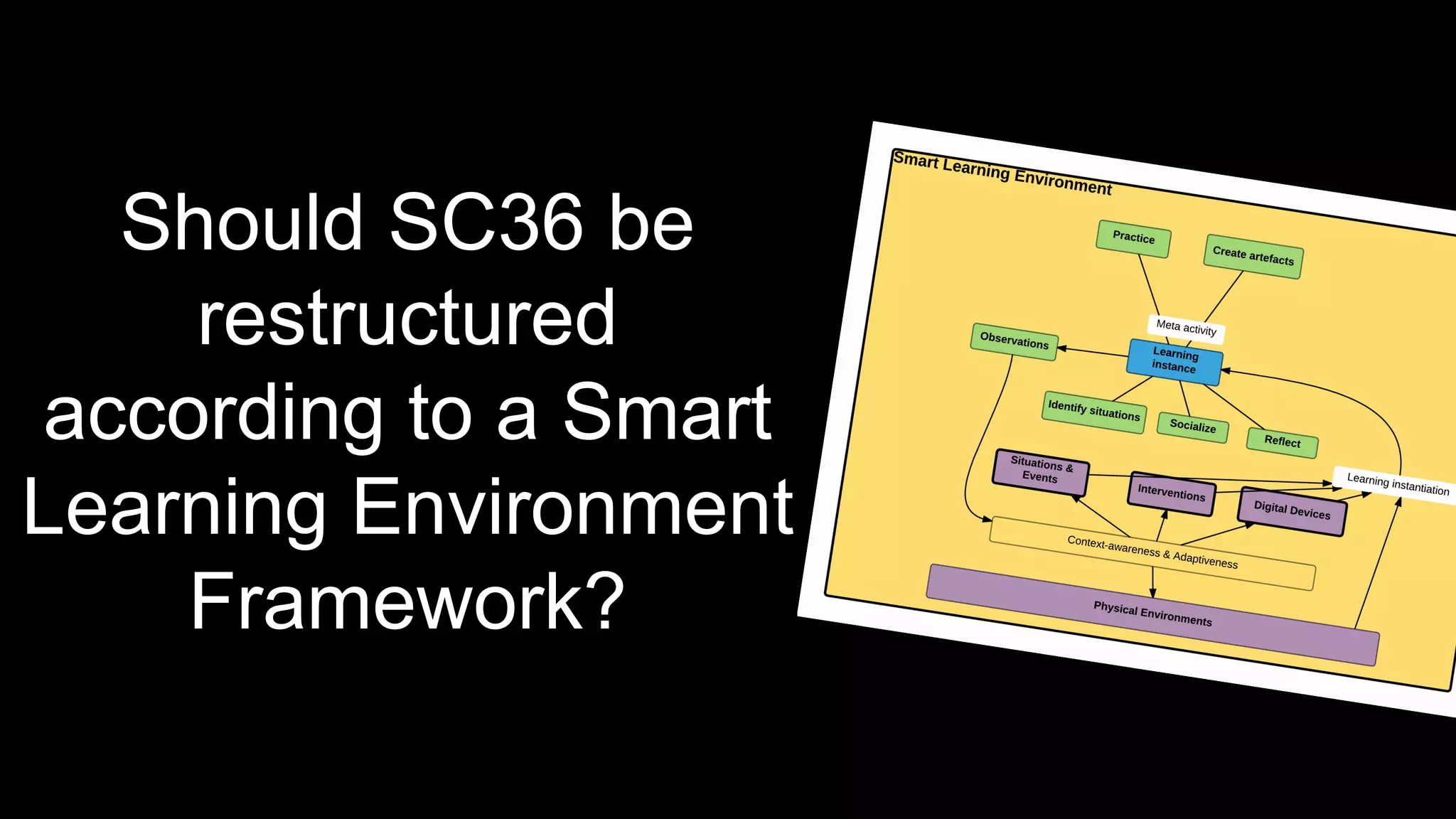
SLEs are physical environments that are improved to
promote better and faster learning by enriching the
environment with context-aware and adaptive digital
devices that, together with the existing constituents of the
physical environment, provide the situations, events,
interventions and observations needed to stimulate a
person to learn to know and deal with situations
(identification), to socialize with the group, to create
artefacts, and to practice and reflect.
Koper: Definition of Smart LE
Testing the framework
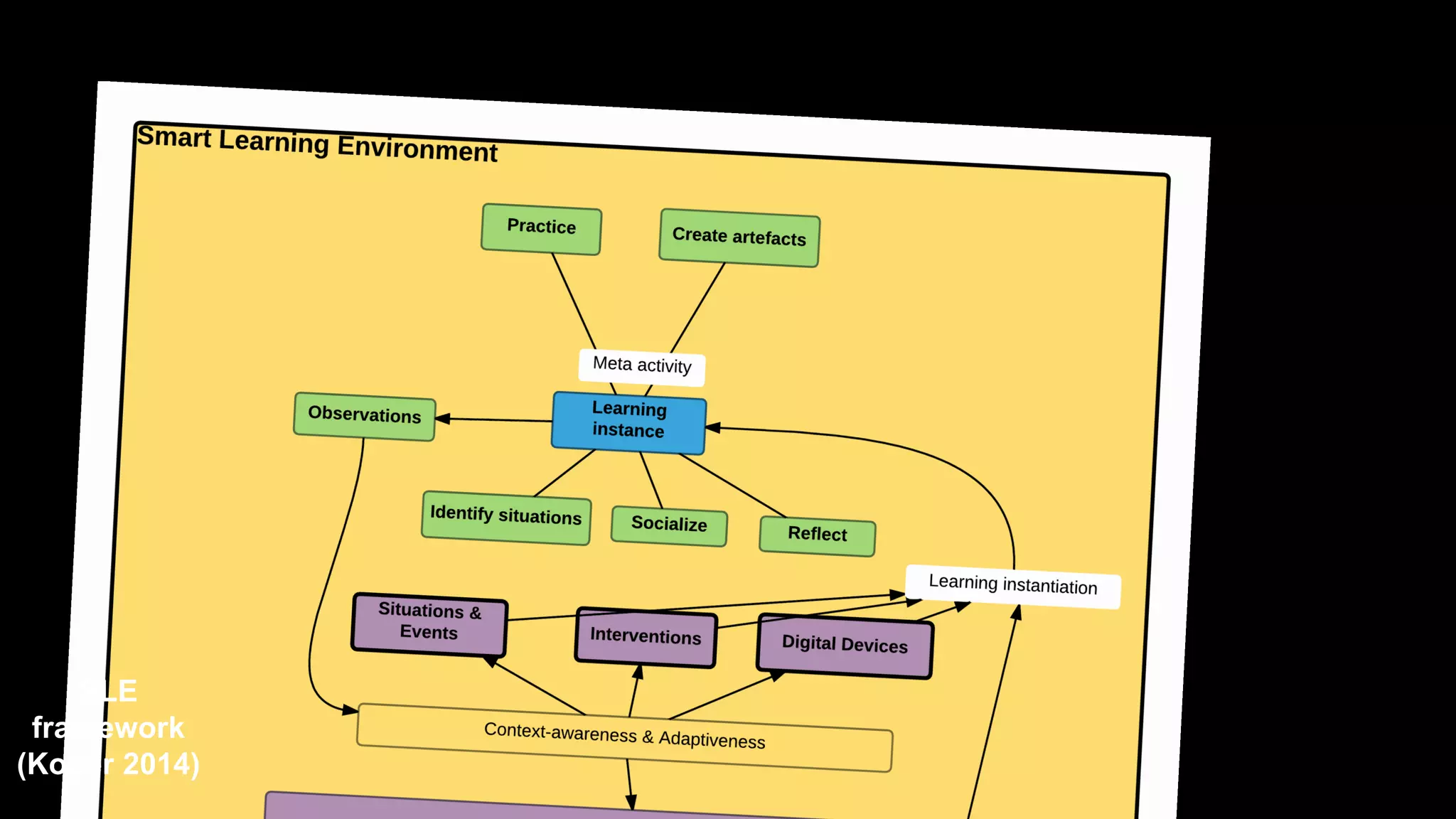
SLE
framework
(Koper 2014)
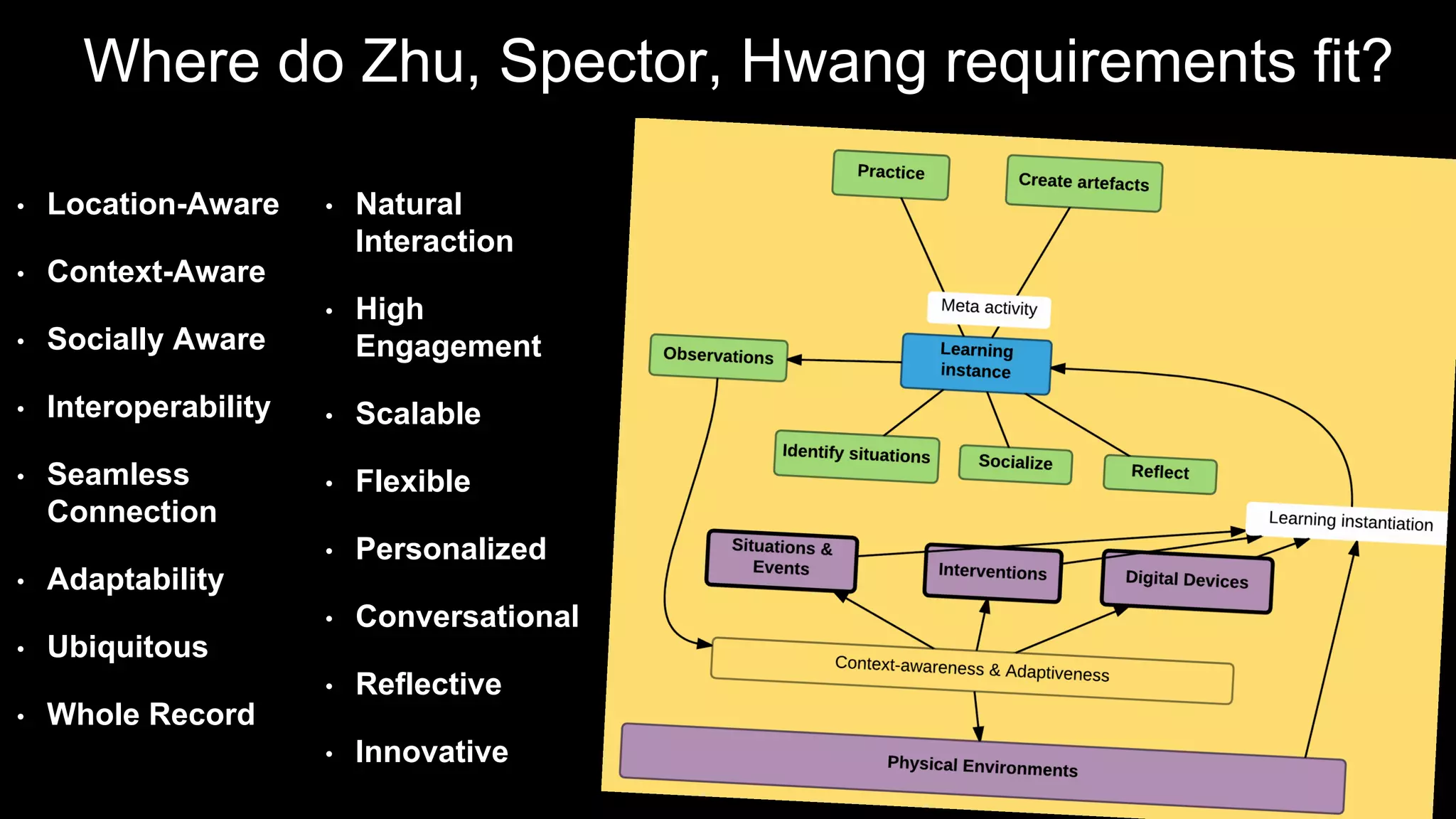
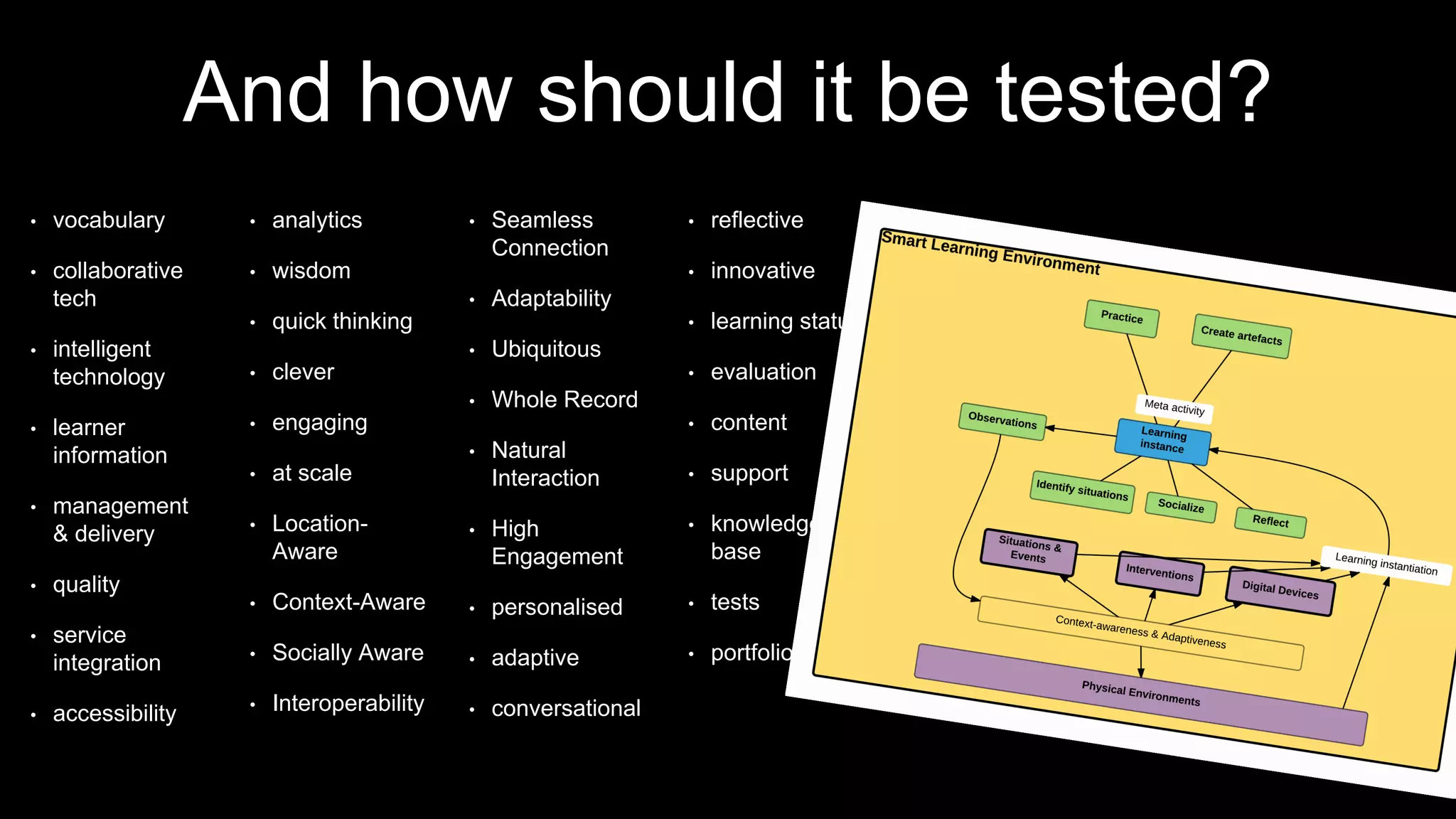
Where do Zhu, Spector, Hwang requirements fit?
• Location-Aware
• Context-Aware
• Socially Aware
• Interoperability
• Seamless
Connection
• Adaptability
• Ubiquitous
• Whole Record
• Natural
Interaction
• High
Engagement
• Scalable
• Flexible
• Personalized
• Conversational
• Reflective
• Innovative
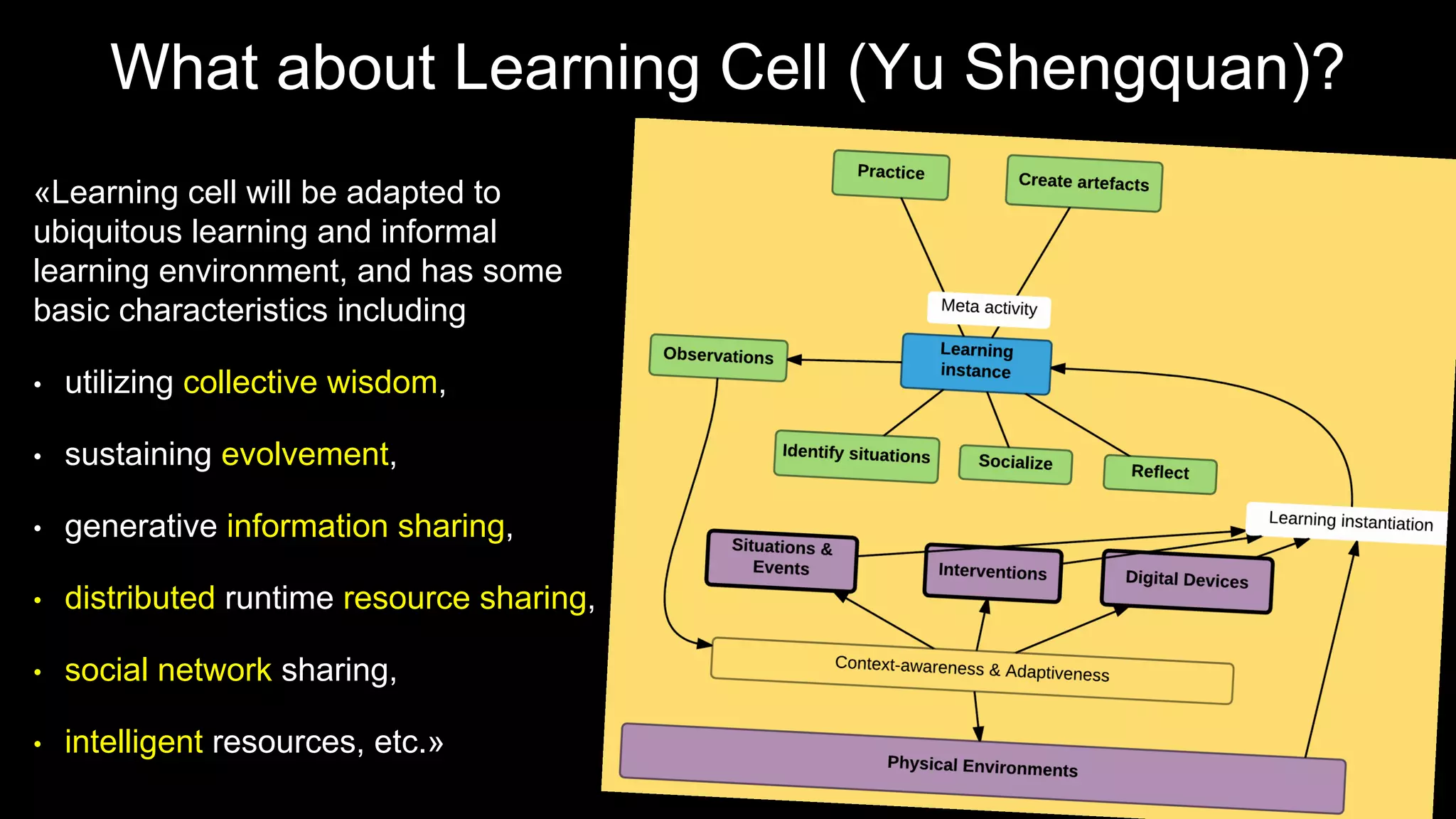
What about Learning Cell (Yu Shengquan)?
«Learning cell will be adapted to
ubiquitous learning and informal
learning environment, and has some
basic characteristics including
• utilizing collective wisdom,
• sustaining evolvement,
• generative information sharing,
• distributed runtime resource sharing,
• social network sharing,
• intelligent resources, etc.»
Developing standards
for SLEs
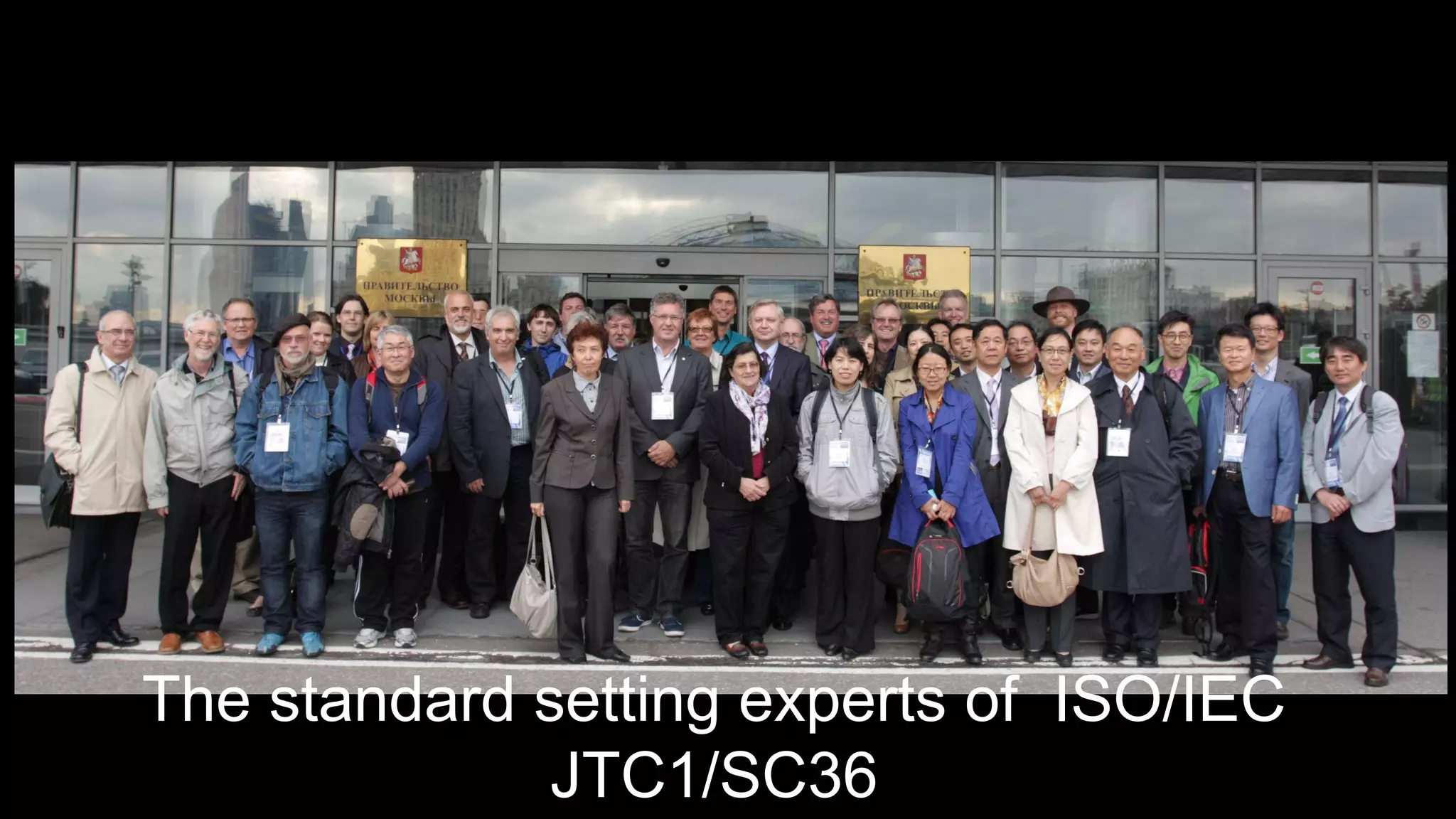
The standard setting experts of ISO/IEC
JTC1/SC36
SC36 structure today
• WG 1 Vocabulary
• WG 2 Collaborative and
intelligent technology
• WG 3 Learner information
• WG 4 Management and
delivery
• WG 5 Quality assurance and
descriptive frameworks
• WG 6 Platform, Services, and
Specification Integration
• WG 7 ITLET - Culture,
language and individual needs
• WG 8 Learning Analytics
Interoperability
ISO/IEC JTC1/SC36
SC36 has published metadata
standards, mainly related to
description of learning content and
content delivery systems,
competency structures, quality
metrics, and accessibility.
New work items in SC36
• Digital Badges
• Smart Learning Environment – “Smart Classroom”
• Environments and resources for augmented reality and virtual reality
• MOOCS
• Study group on a higher level within ISO on blockchain (electronic
distributed ledger) technologies
• A working group wanted input on “collaborative learning communication
with social media”
• Work on privacy and data protection in the context of learning analytics
Should SC36 be
restructured
according to a Smart
Learning Environment
Framework?
Pro
• SLE is the most modern and most
general framework being
discussed
• Comprehensive, extensive
• Could be robust - if done right
• Change working process to
include the whole committee –
work more across work groups
• Too fuzzy, the boundaries are
unclear
• People issues
• Existing projects must go on
• Legacy work on published
standards
Con
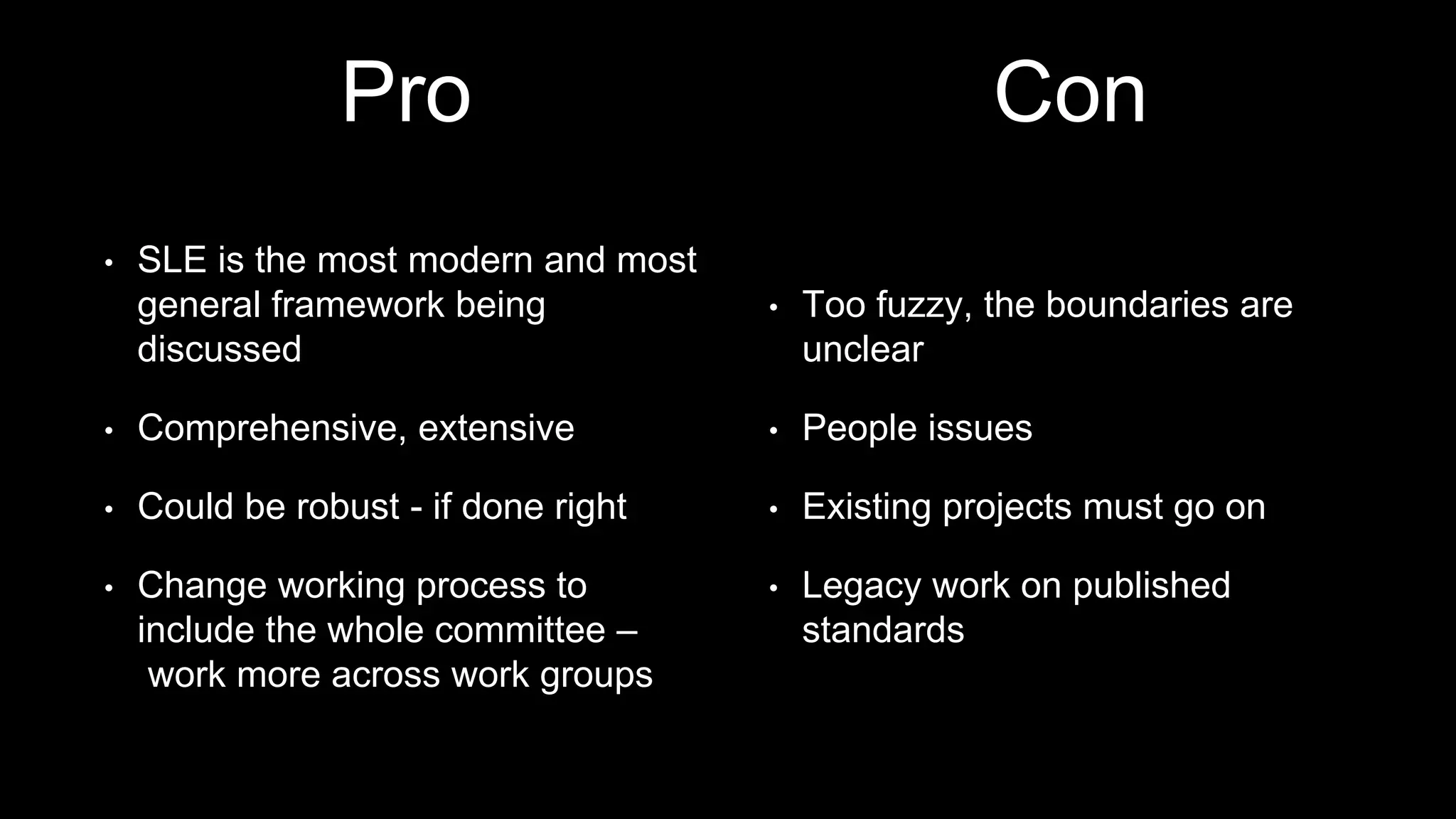
How would standards
development
according to Koper’s
SLE framework look
like?
30
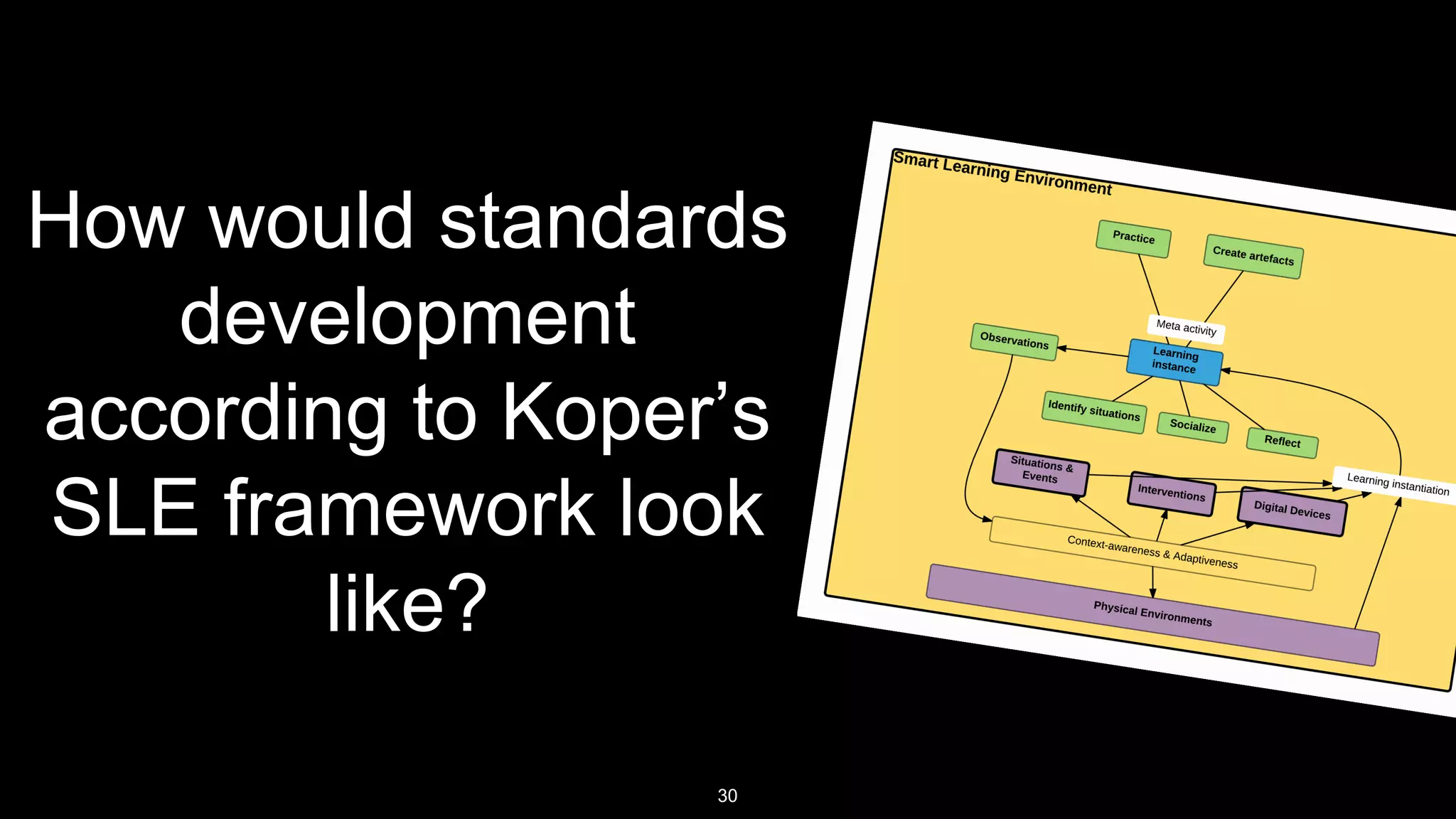
Physical Environments
• CCNU project on developing metrics
for describing Learning Space
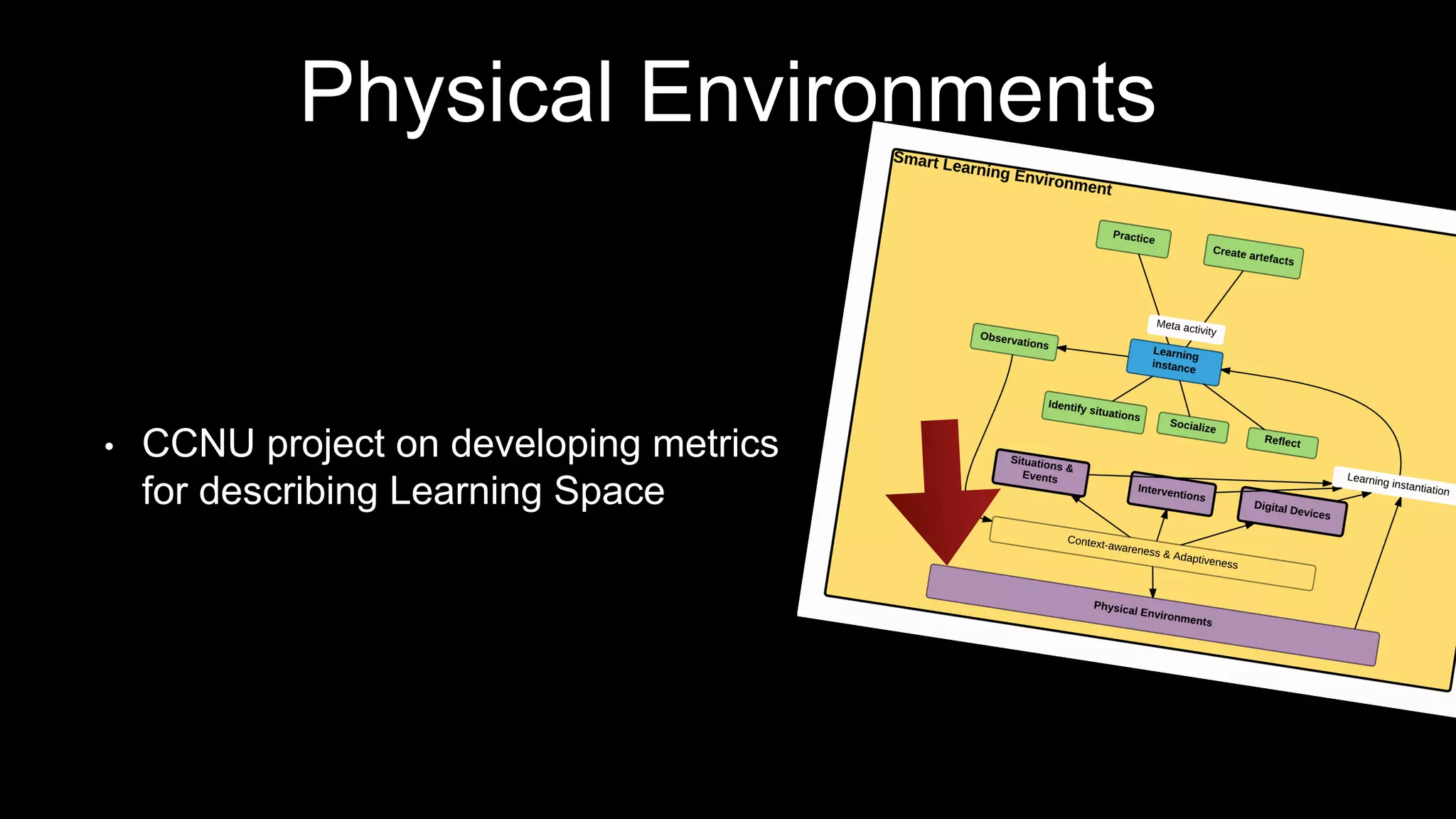
Situations and Events
• Curricula standards
• Competency frameworks
• Vocabulary for contexts (LA activity
specifications - xAPI)
• Nomadicity and Mobile Learning
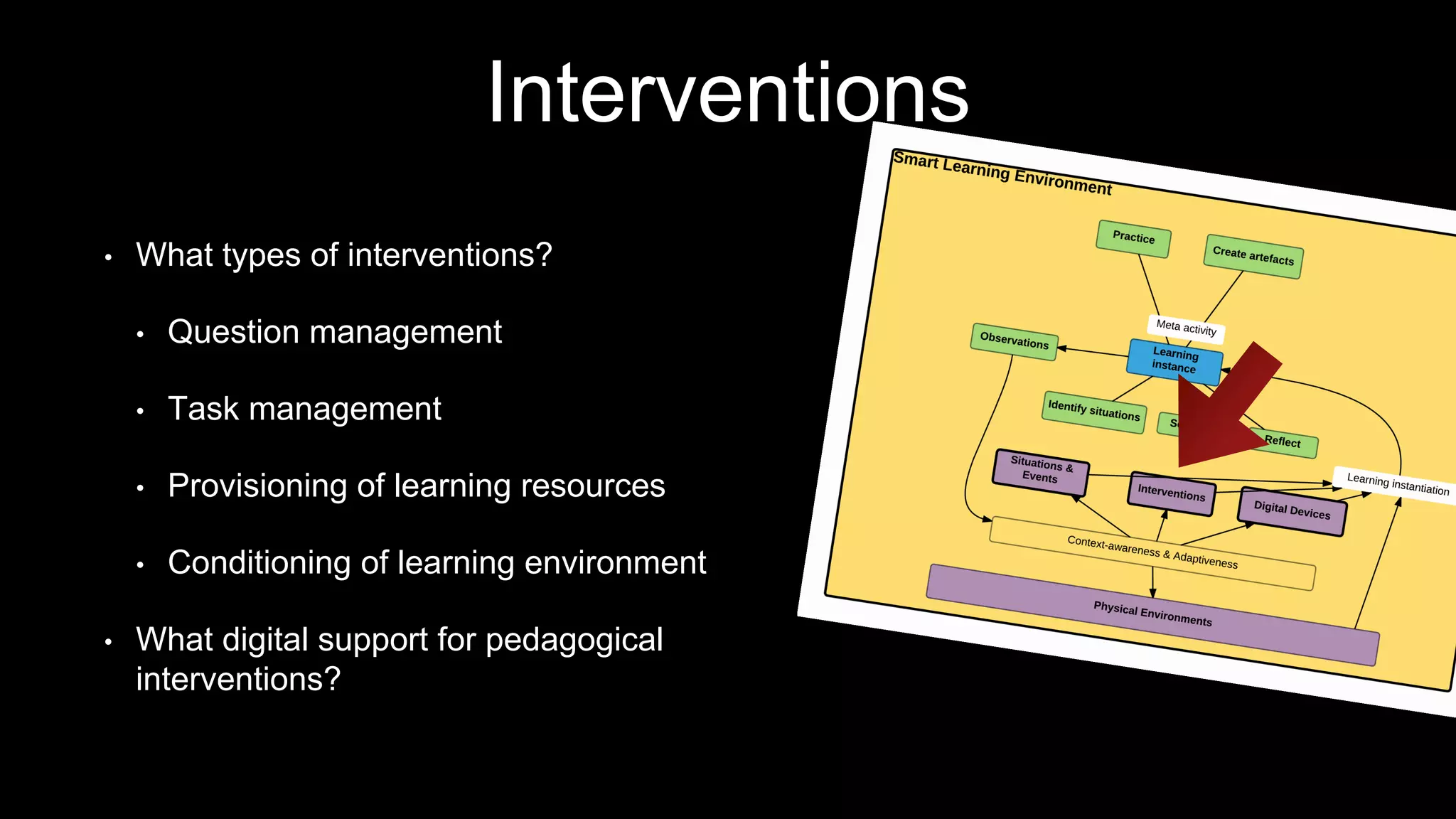
Interventions
• What types of interventions?
• Question management
• Task management
• Provisioning of learning resources
• Conditioning of learning environment
• What digital support for pedagogical
interventions?
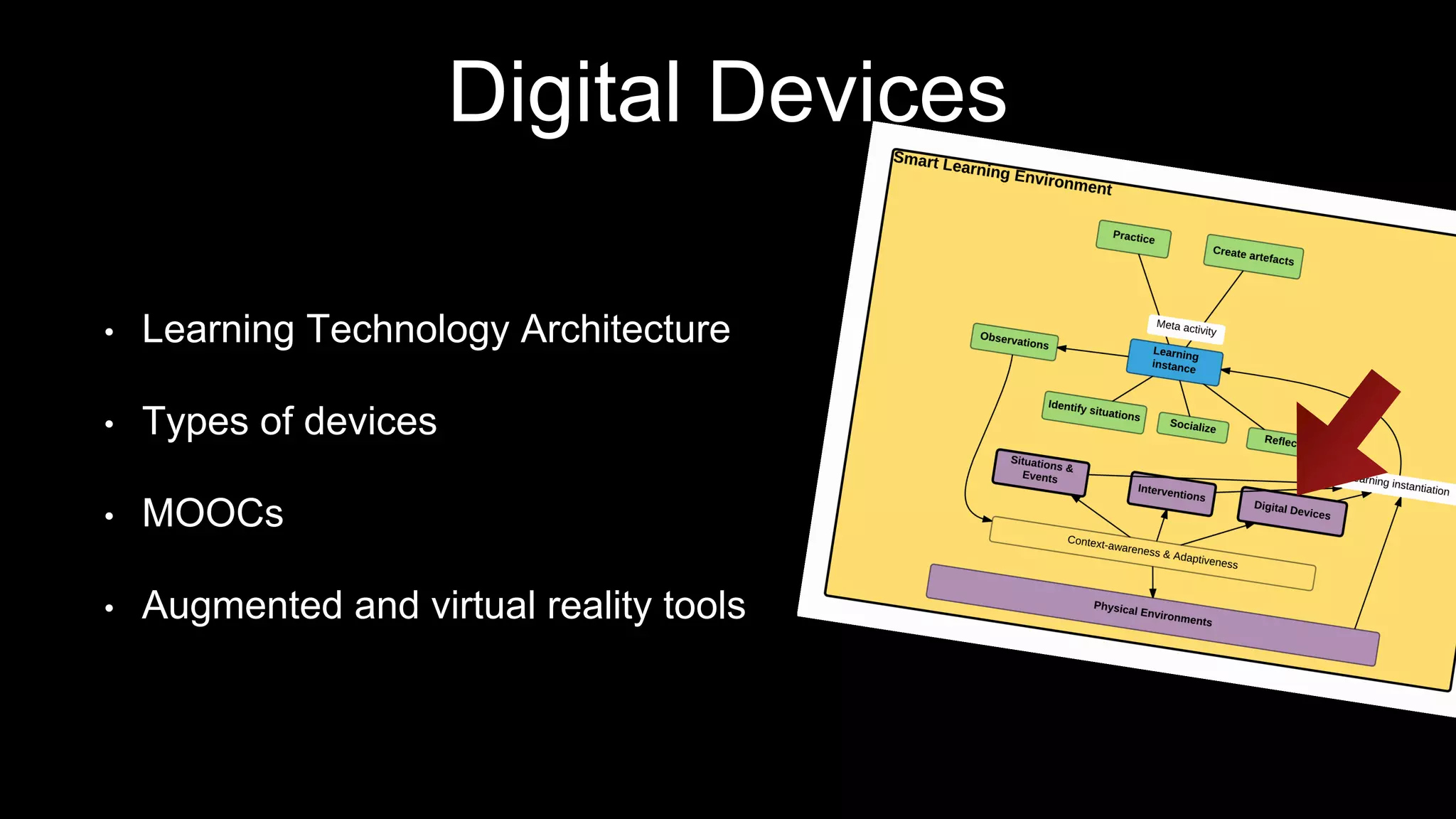
Digital Devices
• Learning Technology Architecture
• Types of devices
• MOOCs
• Augmented and virtual reality tools
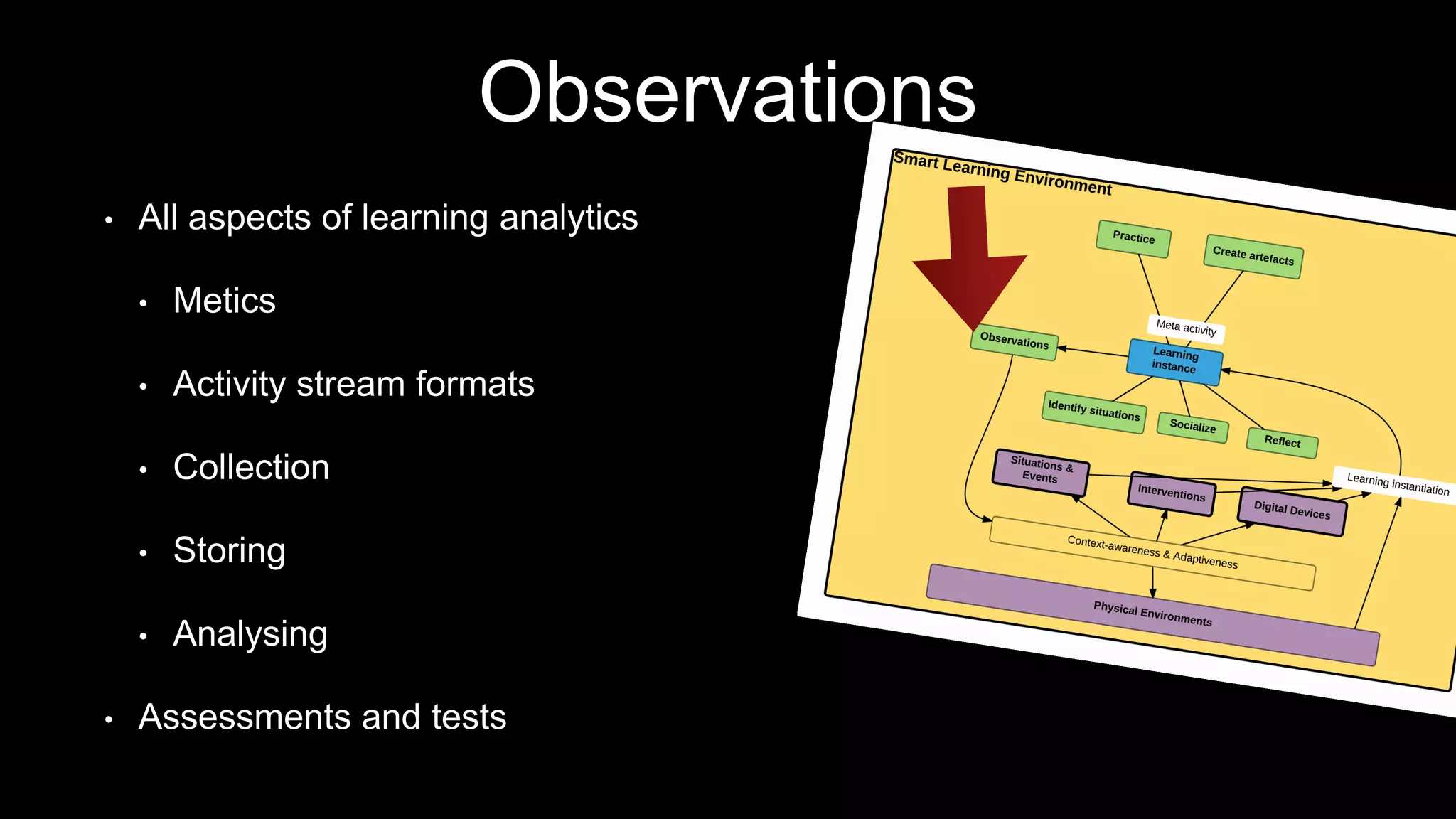
Observations
• All aspects of learning analytics
• Metics
• Activity stream formats
• Collection
• Storing
• Analysing
• Assessments and tests
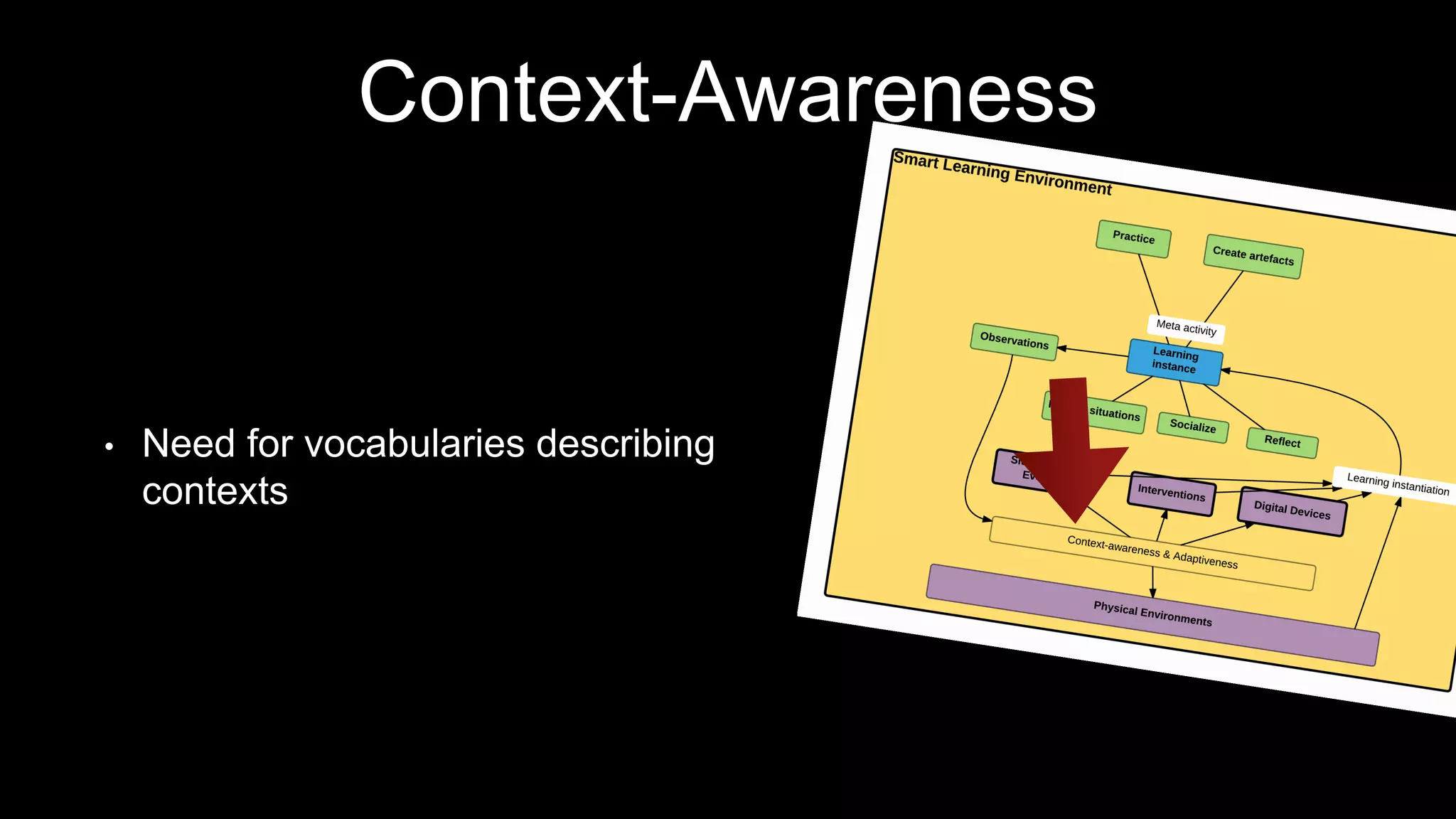
Context-Awareness
• Need for vocabularies describing
contexts
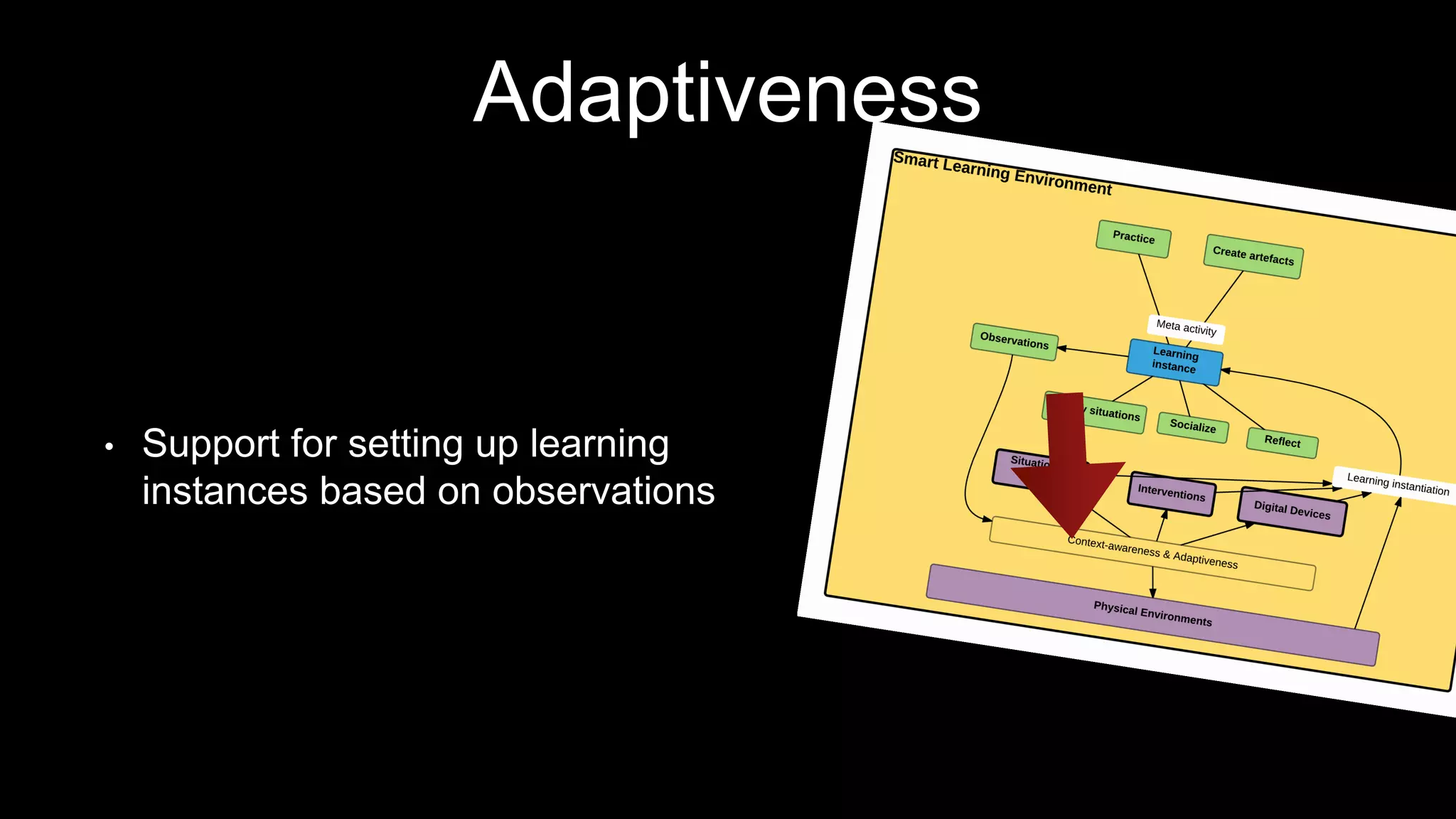
Adaptiveness
• Support for setting up learning
instances based on observations
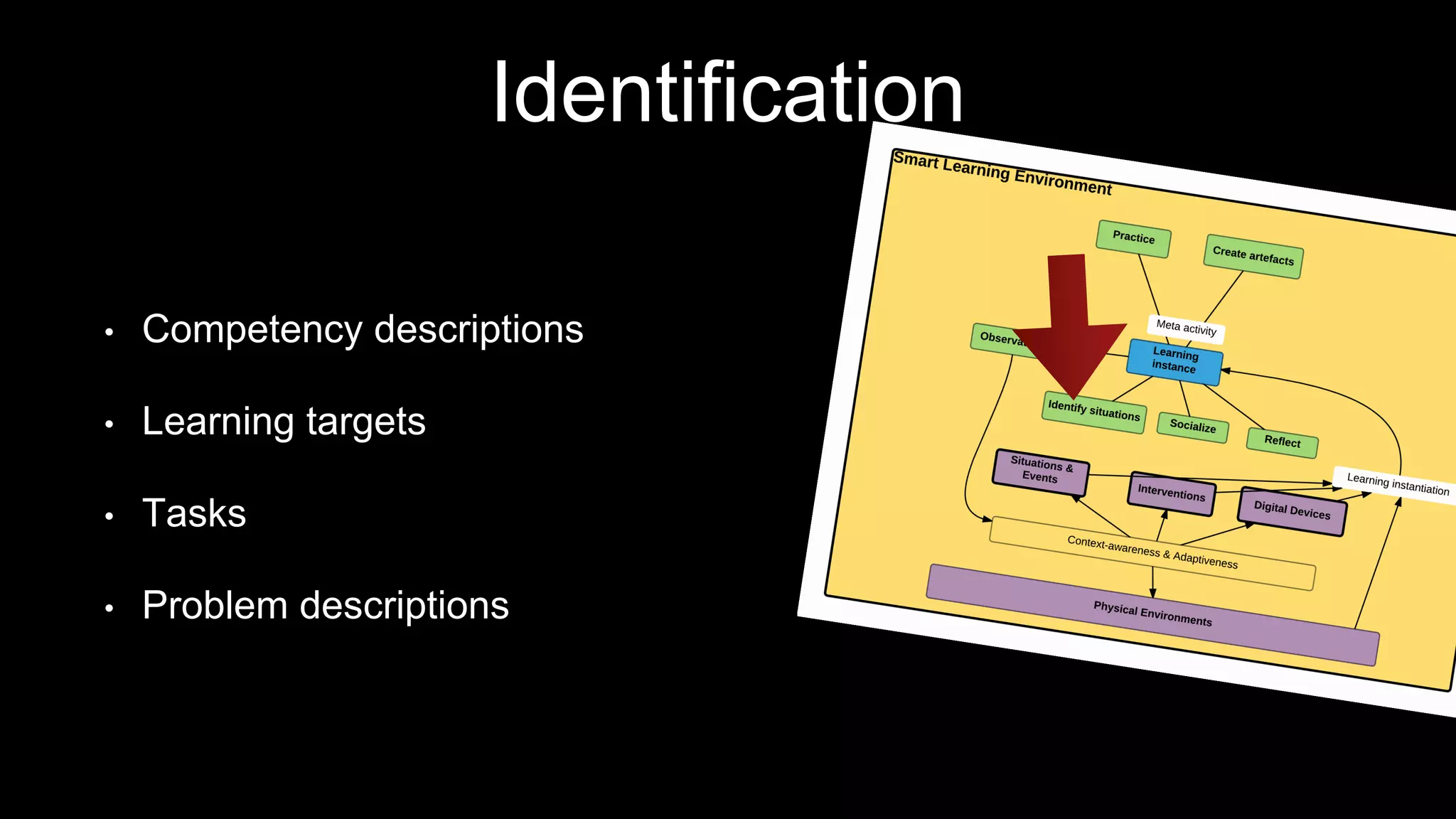
Identification
• Competency descriptions
• Learning targets
• Tasks
• Problem descriptions
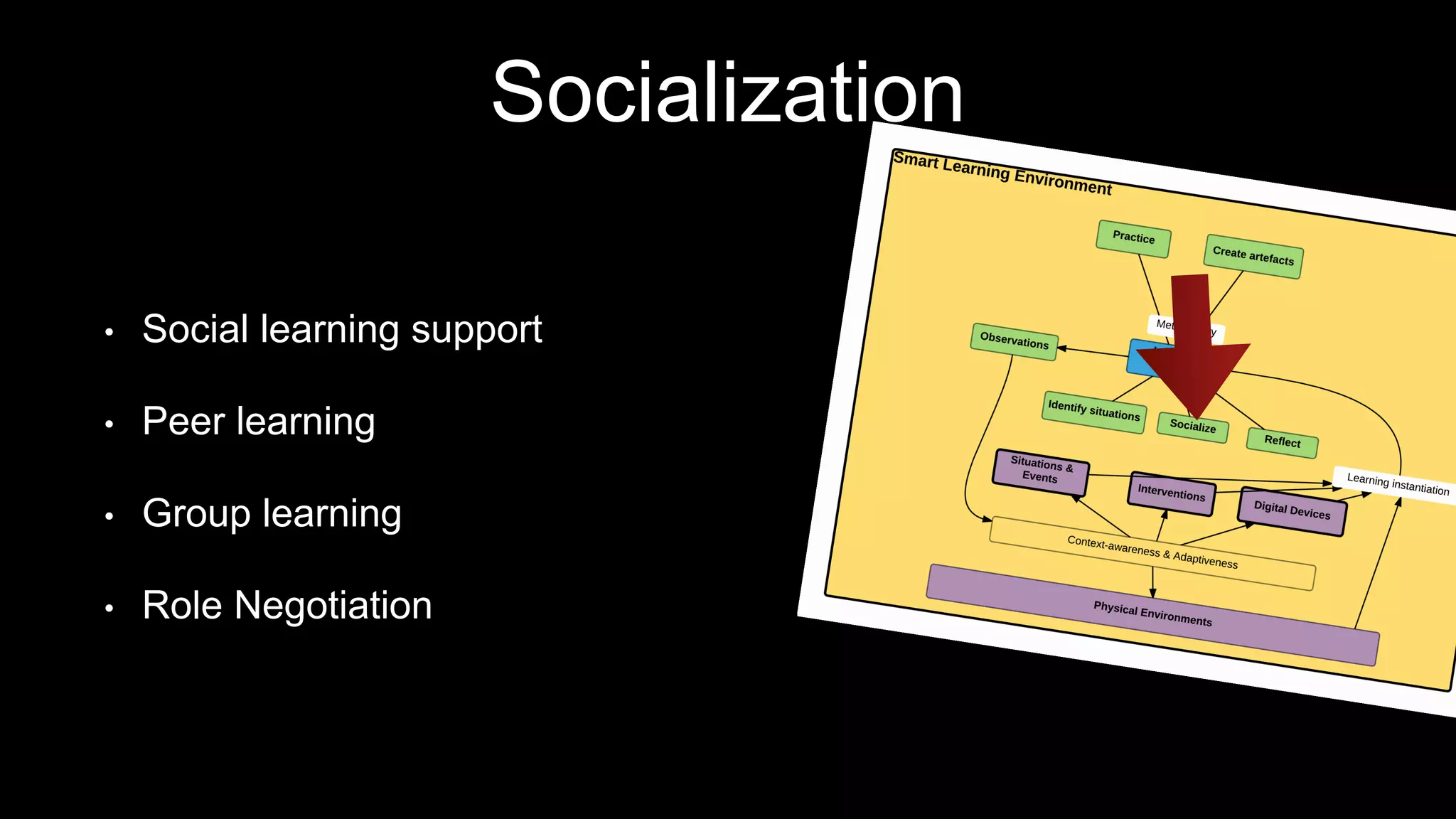
Socialization
• Social learning support
• Peer learning
• Group learning
• Role Negotiation
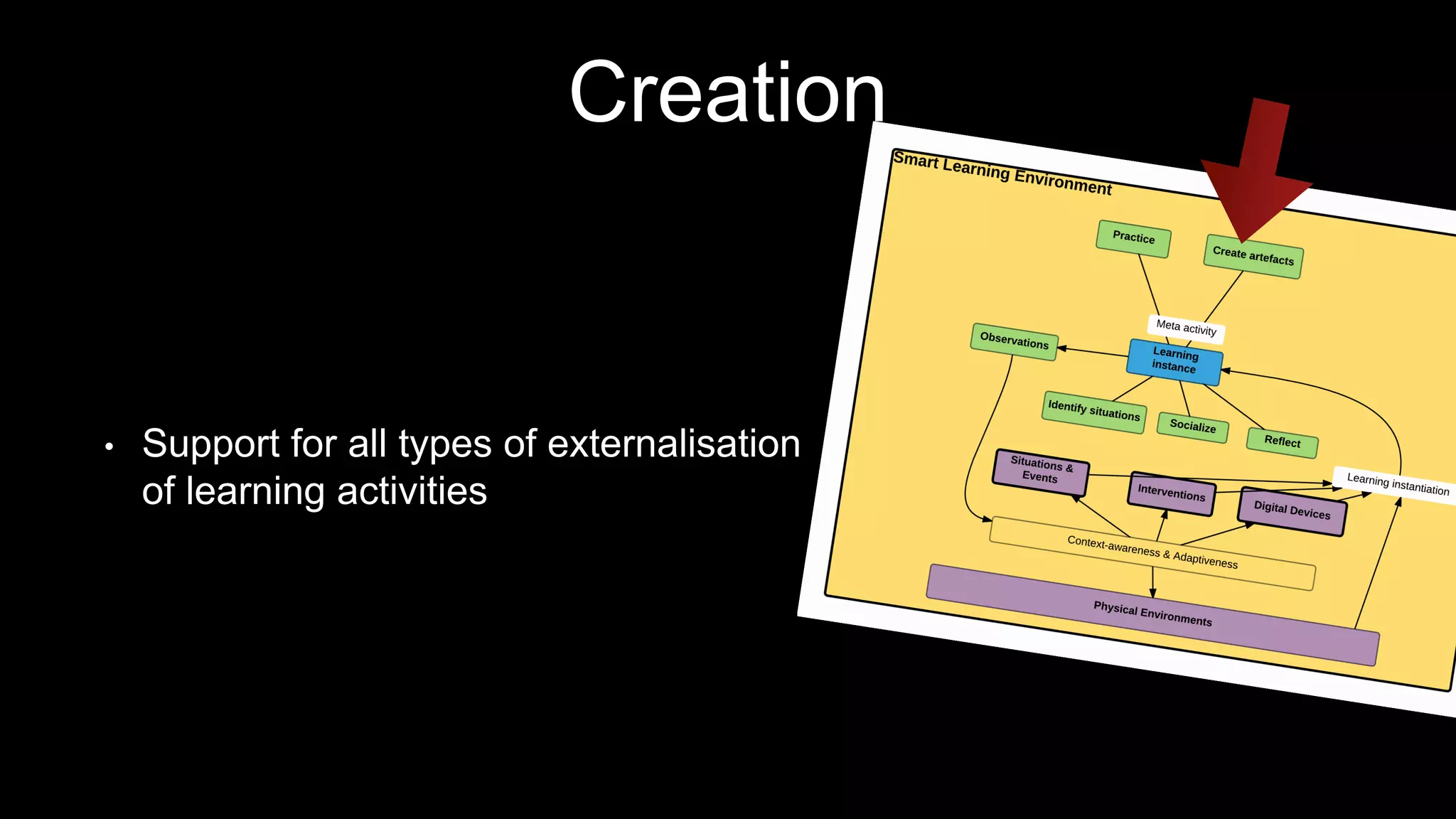
Creation
• Support for all types of externalisation
of learning activities
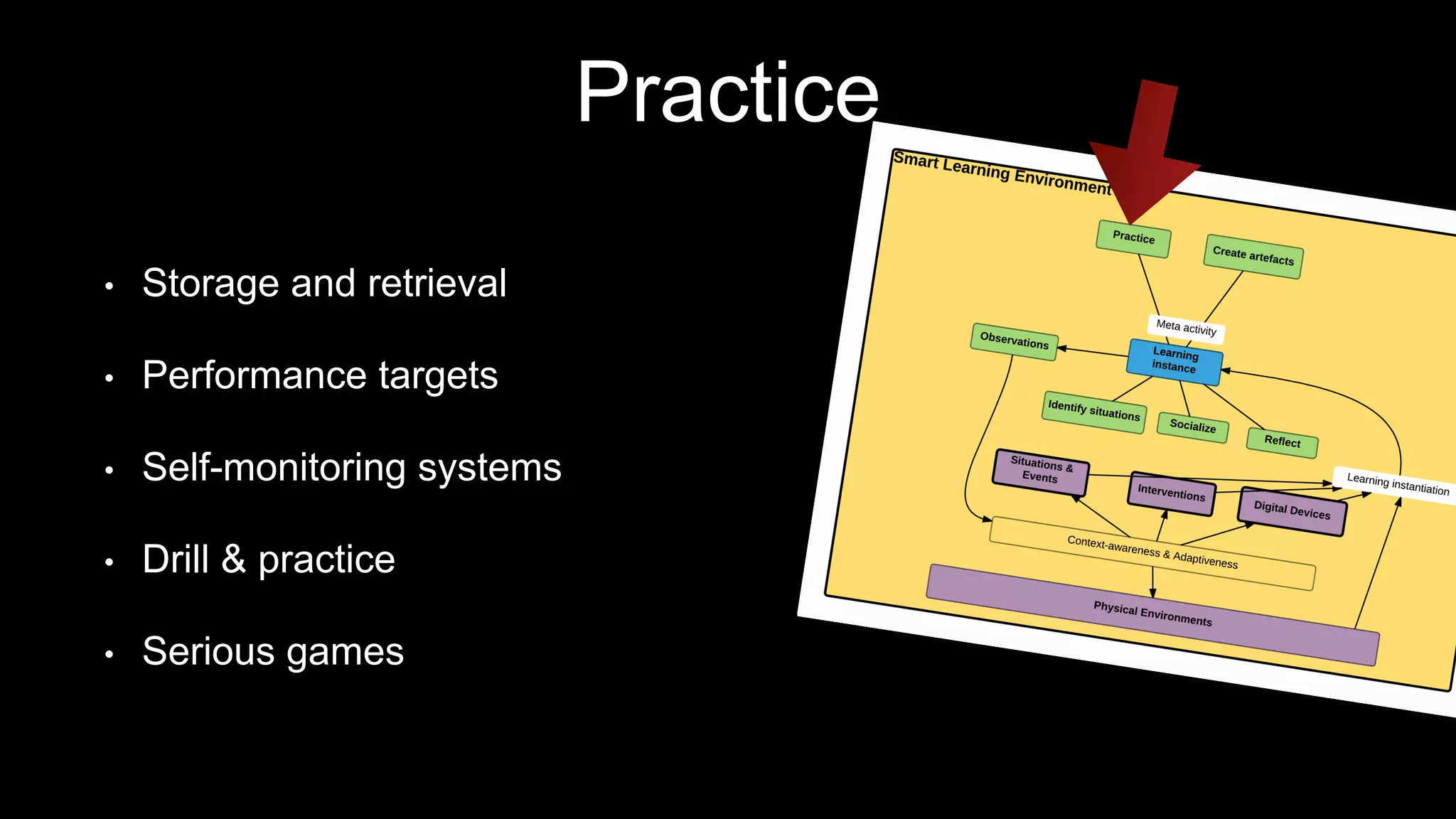
Practice
• Storage and retrieval
• Performance targets
• Self-monitoring systems
• Drill & practice
• Serious games
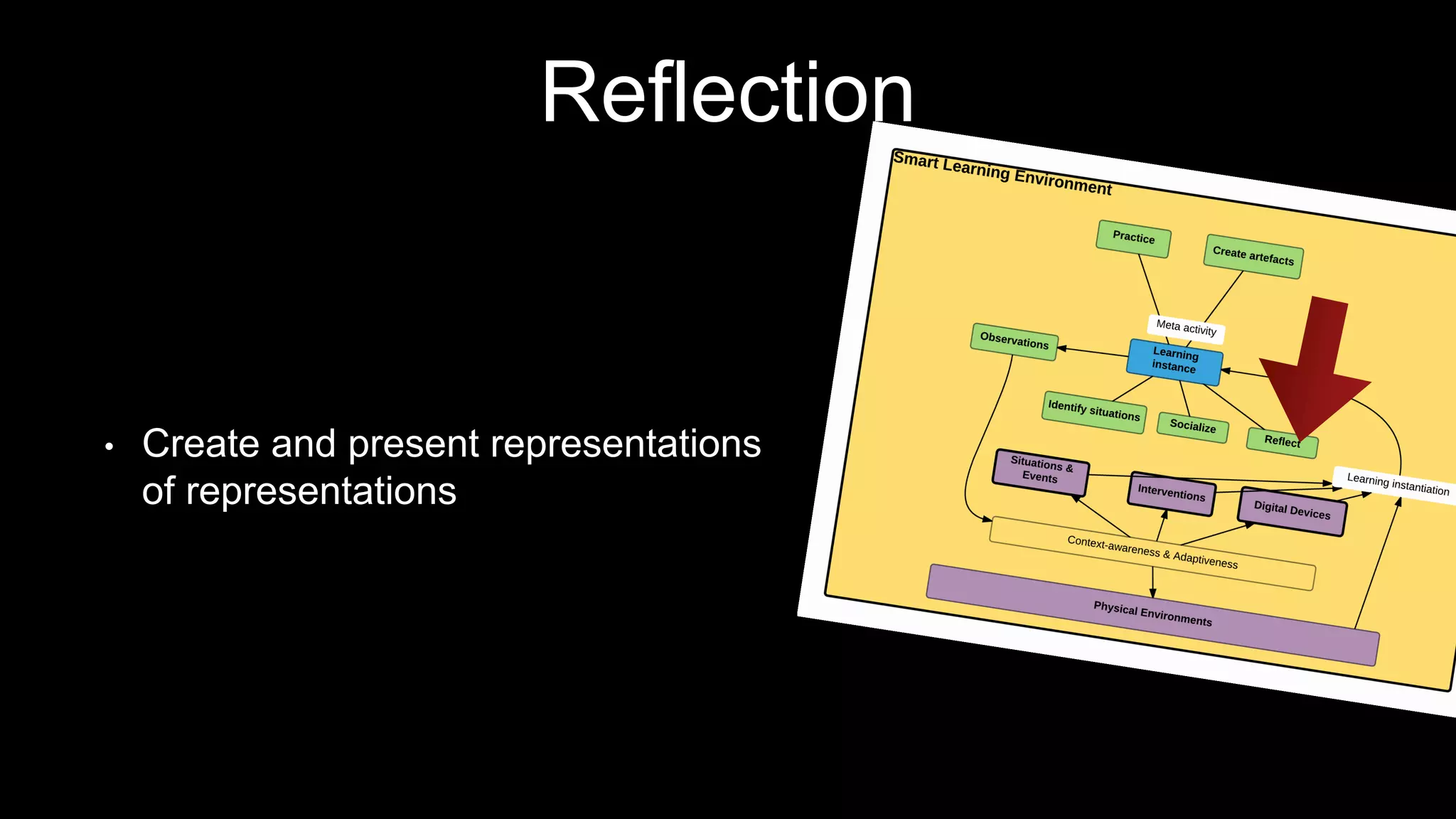
Reflection
• Create and present representations
of representations
And how should it be tested?
• vocabulary
• collaborative
tech
• intelligent
technology
• learner
information
• management
& delivery
• quality
• service
integration
• accessibility
• analytics
• wisdom
• quick thinking
• clever
• engaging
• at scale
• Location-
Aware
• Context-Aware
• Socially Aware
• Interoperability
• Seamless
Connection
• Adaptability
• Ubiquitous
• Whole Record
• Natural
Interaction
• High
Engagement
• personalised
• adaptive
• conversational
• reflective
• innovative
• learning status
• evaluation
• content
• support
• knowledge
base
• tests
• portfolios
Conclusions
• Smart learning, smart education, smart learning environments, etc.
need to be grounded in a verified theory
• We need a coherent framework model of Smart Learning Environment
• When a new element is identified and being run through the model you
see where it fits, and if not, where the model needs to be fixed
• A Smart Learning Environment Framework could be a model for
structuring learning technology standardisation – needs further
exploration
谢谢您的关注
This work is licensed under a Creative Commons
Attribution 4.0 International (CC BY 4.0).
tore.hoel@hioa.no
WeChat: Tore_no

Standards for Smart Learning Environments

  • 1.
    Standards for Smart LearningEnvironments – towards a development framework Tore Hoel Oslo and Akershus University College of Applied Sciences Norway Lecture at Beijing Normal University 2016-11-21
  • 2.
    Who is thisguy? Standards Open Educational Resources (OER) ICT in education EU & Nordic projects Learning Analytics Interoperability Communication & Information Management
  • 3.
  • 4.
    Understanding Smart • Todefine Smart Learning as the counterpoint to Stupid Learning is not so smart! • A is, what B is not: Mathematically, this gives an indefinite space of A – you will never be able to know what the boundaries of A are • We have the same problem defining Scope when developing standards! Smart StupidSmart
  • 5.
    Grounding new theories •Flat vs Deep • Associative vs Grounded • 2D vs 3D
  • 6.
    Smart should be grounded… Soshould also our standards work! What is the implied theoretical and empirical model behind Smart Learning Environments? What theoretical and empirical model of learning technologies should inform LET standardisation?
  • 7.
    Smart as inthe Journal Launched in 2014 The aim of the journal is to help various stakeholders of smart learning environments better understand each other's role in the overall process of education and how they may support each other.
  • 8.
    Conceptualizing the field •Zhi-Ting Zhu • Jonathan Michael Spector • Gwo-Jen Hwang • Rob Koper
  • 9.
    Zhu Zhi-Ting • Forlearners: Smart refers to wisdom and intelligence • Ability to think quickly and cleverly • For educational environment, ‘smart’ refers to engaging, intelligent and scalable. • Collective intelligence
  • 10.
    The essence ofsmarter education is to construct technology-infused environments and create finer ecology of pedagogies, so that higher achievements of teaching, better experiences of learning and personalized learning services could be enabled, and thus talents of wisdom who have better value orientation, higher thinking quality, stronger doing ability and deeper potentiality of creating could be fostered. ( Zhu Zhiting, 2012) 智慧教育的初步定义 A preliminary definition of Smarter Education as proposed (1949-20??)
  • 11.
    Zhu: 10 keyfeatures of SLE • Location-Aware • Context-Aware • Socially Aware • Interoperability • Seamless Connection • Adaptability • Ubiquitous • Whole Record • Natural Interaction • High Engagement
  • 12.
    Mike Spector • Necessarycharacteristics • In a general sense, a smart learning environment is one that is effective, efficient and engaging
  • 13.
    Hwang Gwo-Jen • Minimally,a SLE should be • context-aware • adaptive • personalized
  • 14.
    Rob Koper • Smartlearning environments (SLEs) are physical environments that are enriched with digital, context-aware and adaptive devices, to promote better and faster learning. • Human Learning Interface: set of interaction mechanisms that humans expose to the outside world, and that can be used to control, stimulate and facilitate their learning processes.
  • 15.
    Educational Modelling Language •Based on a Pedagogical meta model • empirist (behaviourist) • rationalist (cognitivist and contructivist) • pragmatist- sociohistoric (situationalist) EML Unit of Study model (Koper & Manderveld 2004).
  • 16.
    Koper: 5 HumanLearning Interfaces • Cognition: Representations! What behaviours and learning processes can be represented?
  • 17.
    Koper: Conditions foreffective SLEs • Digital devices added to physical world • Support for core HLIs: identification, socialisation and creation • Support for meta HLI: practice and reflection • Adaption based on location, context, preferences, physical & mental condition, culture • Intervention: questions, tasks, information, resources, conditioning • Specify and communicate learning objectives • No friction
  • 18.
    SLEs are physicalenvironments that are improved to promote better and faster learning by enriching the environment with context-aware and adaptive digital devices that, together with the existing constituents of the physical environment, provide the situations, events, interventions and observations needed to stimulate a person to learn to know and deal with situations (identification), to socialize with the group, to create artefacts, and to practice and reflect. Koper: Definition of Smart LE
  • 19.
  • 20.
  • 21.
    Where do Zhu,Spector, Hwang requirements fit? • Location-Aware • Context-Aware • Socially Aware • Interoperability • Seamless Connection • Adaptability • Ubiquitous • Whole Record • Natural Interaction • High Engagement • Scalable • Flexible • Personalized • Conversational • Reflective • Innovative
  • 22.
    What about LearningCell (Yu Shengquan)? «Learning cell will be adapted to ubiquitous learning and informal learning environment, and has some basic characteristics including • utilizing collective wisdom, • sustaining evolvement, • generative information sharing, • distributed runtime resource sharing, • social network sharing, • intelligent resources, etc.»
  • 23.
  • 24.
    The standard settingexperts of ISO/IEC JTC1/SC36
  • 25.
    SC36 structure today •WG 1 Vocabulary • WG 2 Collaborative and intelligent technology • WG 3 Learner information • WG 4 Management and delivery • WG 5 Quality assurance and descriptive frameworks • WG 6 Platform, Services, and Specification Integration • WG 7 ITLET - Culture, language and individual needs • WG 8 Learning Analytics Interoperability
  • 26.
    ISO/IEC JTC1/SC36 SC36 haspublished metadata standards, mainly related to description of learning content and content delivery systems, competency structures, quality metrics, and accessibility.
  • 27.
    New work itemsin SC36 • Digital Badges • Smart Learning Environment – “Smart Classroom” • Environments and resources for augmented reality and virtual reality • MOOCS • Study group on a higher level within ISO on blockchain (electronic distributed ledger) technologies • A working group wanted input on “collaborative learning communication with social media” • Work on privacy and data protection in the context of learning analytics
  • 28.
    Should SC36 be restructured accordingto a Smart Learning Environment Framework?
  • 29.
    Pro • SLE isthe most modern and most general framework being discussed • Comprehensive, extensive • Could be robust - if done right • Change working process to include the whole committee – work more across work groups • Too fuzzy, the boundaries are unclear • People issues • Existing projects must go on • Legacy work on published standards Con
  • 30.
    How would standards development accordingto Koper’s SLE framework look like? 30
  • 31.
    Physical Environments • CCNUproject on developing metrics for describing Learning Space
  • 32.
    Situations and Events •Curricula standards • Competency frameworks • Vocabulary for contexts (LA activity specifications - xAPI) • Nomadicity and Mobile Learning
  • 33.
    Interventions • What typesof interventions? • Question management • Task management • Provisioning of learning resources • Conditioning of learning environment • What digital support for pedagogical interventions?
  • 34.
    Digital Devices • LearningTechnology Architecture • Types of devices • MOOCs • Augmented and virtual reality tools
  • 35.
    Observations • All aspectsof learning analytics • Metics • Activity stream formats • Collection • Storing • Analysing • Assessments and tests
  • 36.
    Context-Awareness • Need forvocabularies describing contexts
  • 37.
    Adaptiveness • Support forsetting up learning instances based on observations
  • 38.
    Identification • Competency descriptions •Learning targets • Tasks • Problem descriptions
  • 39.
    Socialization • Social learningsupport • Peer learning • Group learning • Role Negotiation
  • 40.
    Creation • Support forall types of externalisation of learning activities
  • 41.
    Practice • Storage andretrieval • Performance targets • Self-monitoring systems • Drill & practice • Serious games
  • 42.
    Reflection • Create andpresent representations of representations
  • 43.
    And how shouldit be tested? • vocabulary • collaborative tech • intelligent technology • learner information • management & delivery • quality • service integration • accessibility • analytics • wisdom • quick thinking • clever • engaging • at scale • Location- Aware • Context-Aware • Socially Aware • Interoperability • Seamless Connection • Adaptability • Ubiquitous • Whole Record • Natural Interaction • High Engagement • personalised • adaptive • conversational • reflective • innovative • learning status • evaluation • content • support • knowledge base • tests • portfolios
  • 44.
    Conclusions • Smart learning,smart education, smart learning environments, etc. need to be grounded in a verified theory • We need a coherent framework model of Smart Learning Environment • When a new element is identified and being run through the model you see where it fits, and if not, where the model needs to be fixed • A Smart Learning Environment Framework could be a model for structuring learning technology standardisation – needs further exploration
  • 45.
    谢谢您的关注 This work islicensed under a Creative Commons Attribution 4.0 International (CC BY 4.0). tore.hoel@hioa.no WeChat: Tore_no

Editor's Notes

  • #11 智慧教育的真谛就是通过利用智能化技术(灵巧技术)构建智能化环境,让师生施展灵巧的教与学方法,能够为学习者提供个性化服务,使其由不能变为可能,由小能变为大能,从而培养具有良好价值取向、较高思维品质和较强施为能力的人才。(祝智庭, 2012.12) The true essence of smart education is making intelligent teaching and learning methods accessible to teachers and students by establishing smart environment via intelligent technology, which was impossible previously, with the aim of training talented people with proper value orientation, brilliant thinking skills and strong implementation capability with more efficiency and less efforts.
  • #17 1. Learning to represent new situations and events in the world and know how to act and react. This is facilitated through the identification HLI. 2. Learning to represent the social norms, values, customs and ideologies of social institutions and learning the skills and habits that enables you ‘to behave’ within the social institutions, including the dissemination of norms and values to others. Social institutions include: family, peer groups, religion, economic system, language and legal system. social situations and events given. This is facilitated through the socialization HLI. 3. Learning to represent new sequences of behavior in order to create something. This is facilitated through the creation HLI. 4. Learning to represent knowledge and actions faster and better, including the representation of performance targets or future incentives for any of the previously mentioned behaviors. This is facilitated through the practice HLI. 5. Learning to create representations of representations and to change the initial representations and behaviors. This is facilitated through the reflection HLI.
  • #25 Standards bureaucrats Researchers - University