Digital Technologies and Innovation
Introduction
April 2019
http://DSign4Methods.com
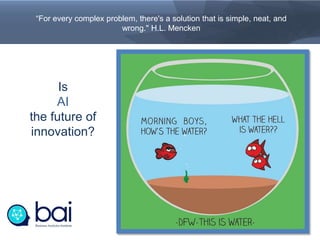
“For every complex problem, there's a solution that is simple, neat, and
wrong." H.L. Mencken
Is
AI
the future of
innovation?
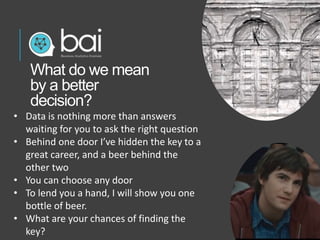
• Data is nothing more than answers
waiting for you to ask the right question
• Behind one door I’ve hidden the key to a
great career, and a beer behind the
other two
• You can choose any door
• To lend you a hand, I will show you one
bottle of beer.
• What are your chances of finding the
key?
What do we mean
by a better
decision?
©2019 L. SCHLENKER
Agenda
Introduction
Administrative Details
Artificial Intelligence and Innovation
The Building Blocks
Introduction
Module Facilitator
I work with managers to help them
understand how enterprise applications,
web and mobile technologies can enrich
their careers.
The client portfolio in the ICT industry
includes Microsoft, Apple, Ernst & Young,
France Telecom, HP, IBM, Oracle and SAP
.
The work with the IT industry in Europe
has included fifty partner and customer
conferences, a dozen case studies, and
various marketing support activities.
Prof. Lee SCHLENKER,
The Business Analytics Institute
Mail : lee@lhstech.com
Skype : leeschlenker
Web : www.leeschlenker.com
Introduction
Working to help
management take
better decisions
People-based
approach to Data
Science
Applied Research,
Consulting, ExecEd
modules, Boot Camps
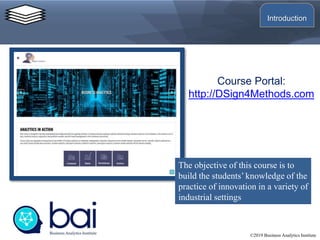
Course Portal:
http://DSign4Methods.com
©2019 Business Analytics Institute
The objective of this course is to
build the students’ knowledge of the
practice of innovation in a variety of
industrial settings
Introduction
This a place where managers and
students of management can discuss
and debate best practices in the digital
economy, new developments in data
science and decision making. Ask
questions and get practicable
answers, and learn how to use data in
decision making.
Analytics for Management
https://www.linkedin.com/
groups/13536539
Introduction
10©2019 LHST sarl
• Analyze the context of each case to document the
key processes of the organization or the market
• Qualify the data at hand to understand the nature of
the business challenges
• Apply the appropriate methodologies in your
predictive and prescriptive analyses, and
• Integrate elements of visual communications in
transforming the data into a call for collective
action
In this module , you will
www.Dsign4methods.com
Adminstration
11
Innovation is a State of Mind
©2019 LHST sarl
Introduction
Session 1 The Building Blocks
Session 2 Digital Economics
Session 3 The Internet of Value
Session 4 Decision Making
Session 5 Innovation
Session 6 Data Ethics
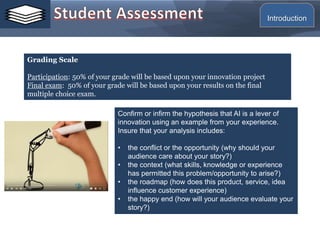
Grading Scale
Participation: 50% of your grade will be based upon your innovation project
Final exam: 50% of your grade will be based upon your results on the final
multiple choice exam.
Confirm or infirm the hypothesis that AI is a lever of
innovation using an example from your experience.
Insure that your analysis includes:
• the conflict or the opportunity (why should your
audience care about your story?)
• the context (what skills, knowledge or experience
has permitted this problem/opportunity to arise?)
• the roadmap (how does this product, service, idea
influence customer experience)
• the happy end (how will your audience evaluate your
story?)
Introduction
©2019 LHST sarl
Introduction
Introduction
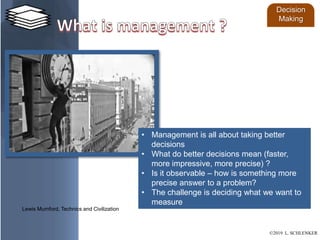
• Management is all about taking better
decisions
• What do better decisions mean (faster,
more impressive, more precise) ?
• Is it observable – how is something more
precise answer to a problem?
• The challenge is deciding what we want to
measure
Lewis Mumford, Technics and Civilization
Decision
Making
©2019 L. SCHLENKER
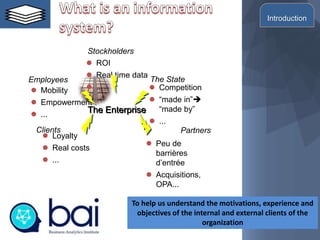
To help us understand the motivations, experience and
objectives of the internal and external clients of the
organization
 ROI
 Real time data
 ...
Stockholders
 Competition
 “made in”
“made by”
 ...
The State
 Peu de
barrières
d’entrée
 Acquisitions,
OPA...
Partners
 Loyalty
 Real costs
 ...
Clients
The Enterprise
 Mobility
 Empowerment
 ...
Employees
Introduction
Lee SCHLENKER
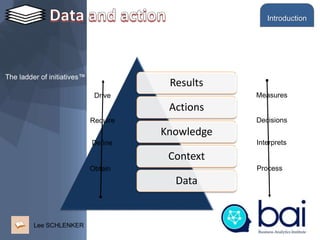
Results
Actions
Knowledge
Context
Data
Process
Interprets
Decisions
Measures
Obtain
Define
Require
Drive
The ladder of initiatives™
Introduction
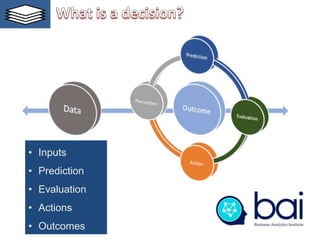
• Inputs
• Prediction
• Evaluation
• Actions
• Outcomes
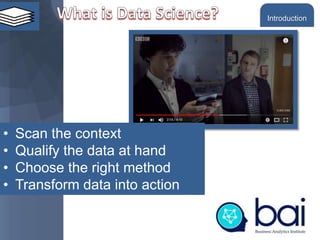
• Scan the context
• Qualify the data at hand
• Choose the right method
• Transform data into action
Introduction
Introduction
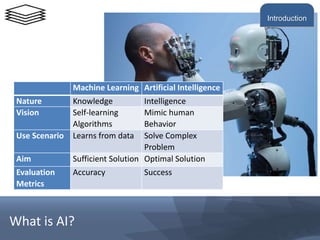
What is AI?
Machine Learning Artificial Intelligence
Nature Knowledge Intelligence
Vision Self-learning
Algorithms
Mimic human
Behavior
Use Scenario Learns from data Solve Complex
Problem
Aim Sufficient Solution Optimal Solution
Evaluation
Metrics
Accuracy Success
Introduction
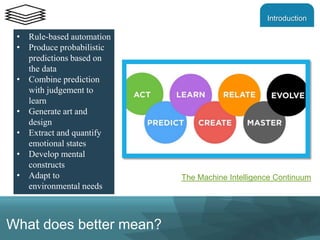
What does better mean?
• Rule-based automation
• Produce probabilistic
predictions based on
the data
• Combine prediction
with judgement to
learn
• Generate art and
design
• Extract and quantify
emotional states
• Develop mental
constructs
• Adapt to
environmental needs
The Machine Intelligence Continuum
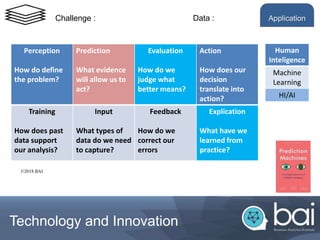
Application
Technology and Innovation
Perception
How do define
the problem?
Prediction
What evidence
will allow us to
act?
Evaluation
How do we
judge what
better means?
Action
How does our
decision
translate into
action?
Training
How does past
data support
our analysis?
Input
What types of
data do we need
to capture?
Feedback
How do we
correct our
errors
Explication
What have we
learned from
practice?
Challenge : Data :
Human
Inteligence
Machine
Learning
HI/AI
©2018 BAI
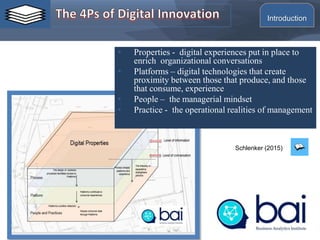
• Properties - digital experiences put in place to
enrich organizational conversations
• Platforms – digital technologies that create
proximity between those that produce, and those
that consume, experience
• People – the managerial mindset
• Practice - the operational realities of management
Schlenker (2015)
Introduction

Technology and Innovation - Introduction

  • 1.
    Digital Technologies andInnovation Introduction April 2019 http://DSign4Methods.com
  • 2.
    “For every complexproblem, there's a solution that is simple, neat, and wrong." H.L. Mencken Is AI the future of innovation?
  • 3.
    • Data isnothing more than answers waiting for you to ask the right question • Behind one door I’ve hidden the key to a great career, and a beer behind the other two • You can choose any door • To lend you a hand, I will show you one bottle of beer. • What are your chances of finding the key? What do we mean by a better decision?
  • 4.
    ©2019 L. SCHLENKER Agenda Introduction AdministrativeDetails Artificial Intelligence and Innovation The Building Blocks Introduction
  • 5.
    Module Facilitator I workwith managers to help them understand how enterprise applications, web and mobile technologies can enrich their careers. The client portfolio in the ICT industry includes Microsoft, Apple, Ernst & Young, France Telecom, HP, IBM, Oracle and SAP . The work with the IT industry in Europe has included fifty partner and customer conferences, a dozen case studies, and various marketing support activities. Prof. Lee SCHLENKER, The Business Analytics Institute Mail : lee@lhstech.com Skype : leeschlenker Web : www.leeschlenker.com Introduction
  • 6.
    Working to help managementtake better decisions People-based approach to Data Science Applied Research, Consulting, ExecEd modules, Boot Camps
  • 8.
    Course Portal: http://DSign4Methods.com ©2019 BusinessAnalytics Institute The objective of this course is to build the students’ knowledge of the practice of innovation in a variety of industrial settings Introduction
  • 9.
    This a placewhere managers and students of management can discuss and debate best practices in the digital economy, new developments in data science and decision making. Ask questions and get practicable answers, and learn how to use data in decision making. Analytics for Management https://www.linkedin.com/ groups/13536539 Introduction
  • 10.
    10©2019 LHST sarl •Analyze the context of each case to document the key processes of the organization or the market • Qualify the data at hand to understand the nature of the business challenges • Apply the appropriate methodologies in your predictive and prescriptive analyses, and • Integrate elements of visual communications in transforming the data into a call for collective action In this module , you will www.Dsign4methods.com Adminstration
  • 11.
    11 Innovation is aState of Mind ©2019 LHST sarl Introduction Session 1 The Building Blocks Session 2 Digital Economics Session 3 The Internet of Value Session 4 Decision Making Session 5 Innovation Session 6 Data Ethics
  • 12.
    Grading Scale Participation: 50%of your grade will be based upon your innovation project Final exam: 50% of your grade will be based upon your results on the final multiple choice exam. Confirm or infirm the hypothesis that AI is a lever of innovation using an example from your experience. Insure that your analysis includes: • the conflict or the opportunity (why should your audience care about your story?) • the context (what skills, knowledge or experience has permitted this problem/opportunity to arise?) • the roadmap (how does this product, service, idea influence customer experience) • the happy end (how will your audience evaluate your story?) Introduction
  • 13.
  • 14.
  • 15.
    • Management isall about taking better decisions • What do better decisions mean (faster, more impressive, more precise) ? • Is it observable – how is something more precise answer to a problem? • The challenge is deciding what we want to measure Lewis Mumford, Technics and Civilization Decision Making ©2019 L. SCHLENKER
  • 16.
    To help usunderstand the motivations, experience and objectives of the internal and external clients of the organization  ROI  Real time data  ... Stockholders  Competition  “made in” “made by”  ... The State  Peu de barrières d’entrée  Acquisitions, OPA... Partners  Loyalty  Real costs  ... Clients The Enterprise  Mobility  Empowerment  ... Employees Introduction
  • 17.
  • 18.
    • Inputs • Prediction •Evaluation • Actions • Outcomes
  • 19.
    • Scan thecontext • Qualify the data at hand • Choose the right method • Transform data into action Introduction
  • 20.
    Introduction What is AI? MachineLearning Artificial Intelligence Nature Knowledge Intelligence Vision Self-learning Algorithms Mimic human Behavior Use Scenario Learns from data Solve Complex Problem Aim Sufficient Solution Optimal Solution Evaluation Metrics Accuracy Success
  • 21.
    Introduction What does bettermean? • Rule-based automation • Produce probabilistic predictions based on the data • Combine prediction with judgement to learn • Generate art and design • Extract and quantify emotional states • Develop mental constructs • Adapt to environmental needs The Machine Intelligence Continuum
  • 22.
    Application Technology and Innovation Perception Howdo define the problem? Prediction What evidence will allow us to act? Evaluation How do we judge what better means? Action How does our decision translate into action? Training How does past data support our analysis? Input What types of data do we need to capture? Feedback How do we correct our errors Explication What have we learned from practice? Challenge : Data : Human Inteligence Machine Learning HI/AI ©2018 BAI
  • 23.
    • Properties -digital experiences put in place to enrich organizational conversations • Platforms – digital technologies that create proximity between those that produce, and those that consume, experience • People – the managerial mindset • Practice - the operational realities of management Schlenker (2015) Introduction

Editor's Notes

  • #7 Foundation of digital economy isn’t data but the ability to analyze the data to improve decision-making Training, research and consulting assignments in fields of digital economics, machine learning, AI and data storytelling The paradox of trust : more and more data, less and less trust in companies, organizations, and the State Data Science – decision making based on past best practices to focus on scenarios for the future Condition of trust - work on something that matters
  • #21 Judgement : How much is it worth to respond quickly? How costly is it to not respond if it turns out that there was an intruder in the home?
  • #23  it will help you clarify what the AI will contribute (the prediction), how it will interface with humans (judgment), how it will be used to influence decisions (action), how you will measure success (outcome), and the types of data that will be required to train, operate, and improve the AI.