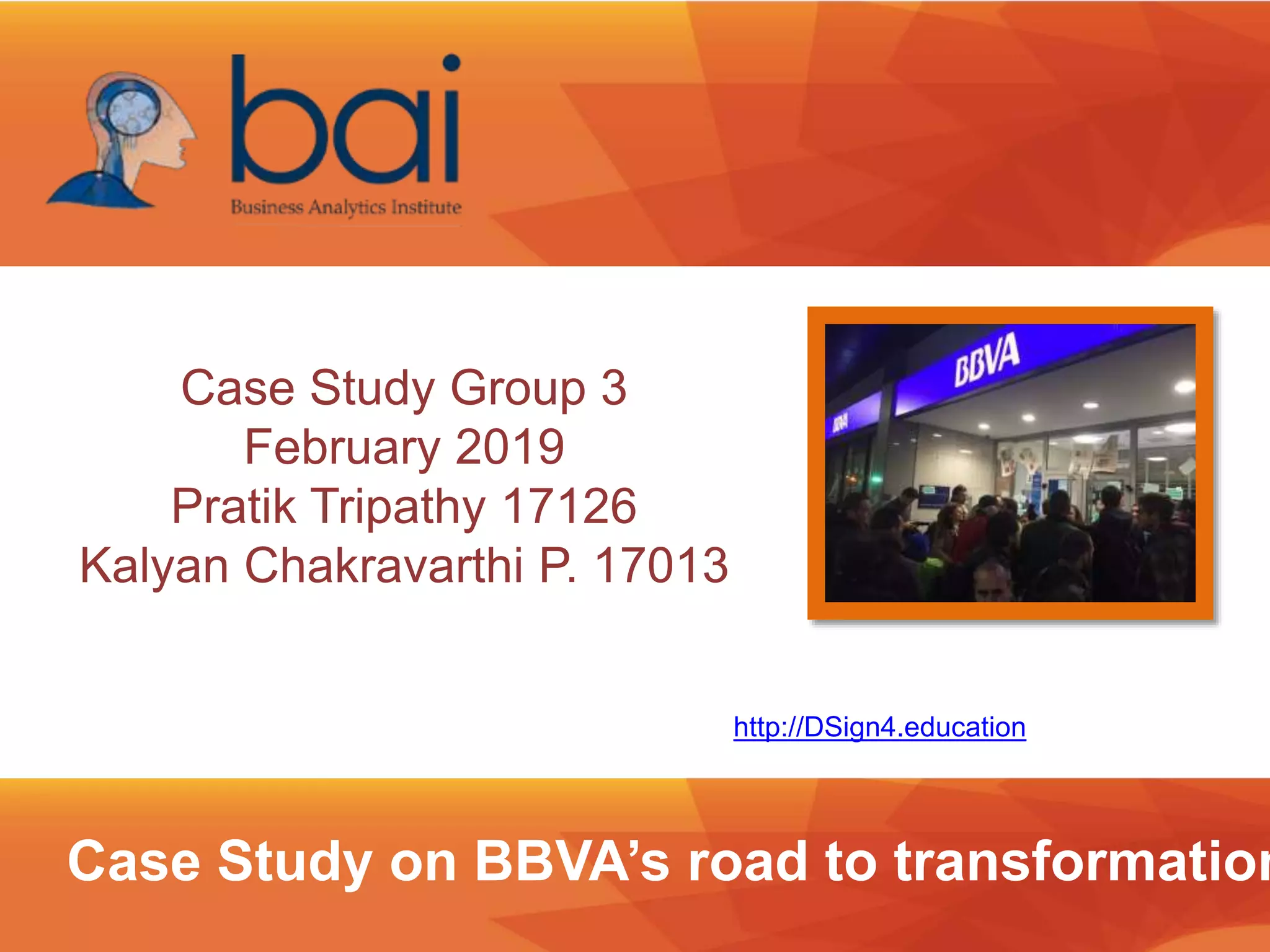

Case Study on BBVA’s road to transformation
Case Study Group 3
February 2019
Pratik Tripathy 17126
Kalyan Chakravarthi P. 17013
http://DSign4.education
Introduction
©2016 L. SCHLENKER
Structure
Introduction
Business Model
Data Analytics road map
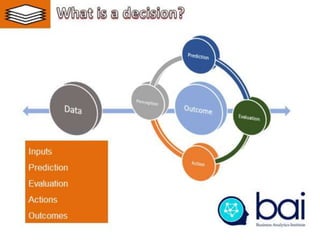
The Perception?
Prediction
Evaluation
Actionable outcomes
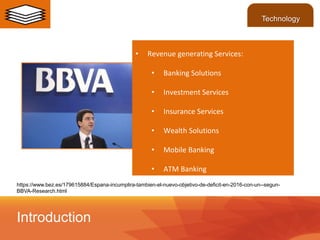
https://www.bez.es/179615884/Espana-incumplira-tambien-el-nuevo-objetivo-de-deficit-en-2016-con-un--segun-
BBVA-Research.html
• Revenue generating Services:
• Banking Solutions
• Investment Services
• Insurance Services
• Wealth Solutions
• Mobile Banking
• ATM Banking
Introduction
Technology
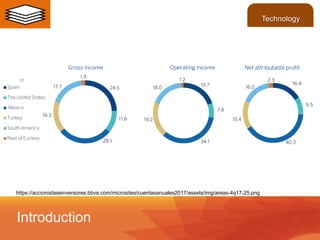
https://accionistaseinversores.bbva.com/microsites/cuentasanuales2017/assets/img/areas-4q17-25.png
Introduction
Technology
This Photo by Unknown Author is licensed under CC BY-SA-NC
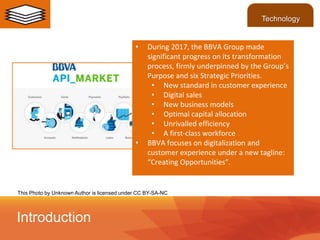
• During 2017, the BBVA Group made
significant progress on its transformation
process, firmly underpinned by the Group’s
Purpose and six Strategic Priorities.
• New standard in customer experience
• Digital sales
• New business models
• Optimal capital allocation
• Unrivalled efficiency
• A first-class workforce
• BBVA focuses on digitalization and
customer experience under a new tagline:
“Creating Opportunities”.
Introduction
Technology
https://accionistaseinversores.bbva.com/microsites/cuentasanuales2017/assets/img/estrategia-4q17-2.pngby Unknown
Author is licensed under CC BY-SA-NC
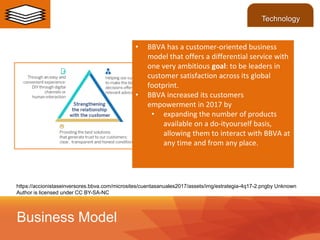
• BBVA has a customer-oriented business
model that offers a differential service with
one very ambitious goal: to be leaders in
customer satisfaction across its global
footprint.
• BBVA increased its customers
empowerment in 2017 by
• expanding the number of products
available on a do-ityourself basis,
allowing them to interact with BBVA at
any time and from any place.
Business Model
Technology
Referhttps://accionistaseinversores.bbva.com/microsites/cuentasanuales2017/assets/img/estrategia-4q17-1.pngence
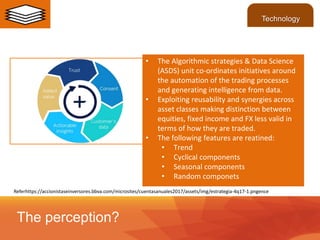
• The Algorithmic strategies & Data Science
(ASDS) unit co-ordinates initiatives around
the automation of the trading processes
and generating intelligence from data.
• Exploiting reusability and synergies across
asset classes making distinction between
equities, fixed income and FX less valid in
terms of how they are traded.
• The following features are reatined:
• Trend
• Cyclical components
• Seasonal components
• Random componets
The perception?
Technology
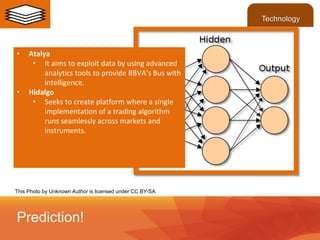
• Atalya
• It aims to exploit data by using advanced
analytics tools to provide BBVA’s Bus with
intelligence.
• Hidalgo
• Seeks to create platform where a single
implementation of a trading algorithm
runs seamlessly across markets and
instruments.
Prediction!
Technology
This Photo by Unknown Author is licensed under CC BY-SA
• Timecop performs the process using
the following engines;
• ARIMA(AutoRegressive
Integrated Moving Average)
• Holt-Winters(Exponential
Smoothing)
• LSTM (Long Short Term
memory) and
• VAR (Vector AutoRegression)
Evaluation
Technology
• Continuous feedback
• Enhanced trading experience
• Cross-asset trading strategies
Actionable Outcomes
Technology
• BBVA wants to fill a gap in the world of Auto Machine Learning to simplify
the work of data scientists in time series.
• It aims to reduce the non-creative work of selecting the best model
according to the characteristics of the time series, leaving more time for
data scientists to select the features and their integration in
environments that provide the appropriate value.
• It allows to perform temporary analysis in short periods of time, being
able to know the anomalies and predictions of hundreds of series at the
same time and opening new worlds for the comparison of evolutions of
thousands and millions of series in a simple way that did not exist to date.
Conclusion
Technology
• https://www.bbvacompass.com/personal.html
• https://www.bbva.com/en/timecop-once-upon-a-time-
the-time-series/
• https://accionistaseinversores.bbva.com/microsites/cu
entasanuales2017/en/management-report/strategy-
and-business-model/index.html
Bibliography
Next Steps
Next Steps

Group 3 - BBVA

  • 1.
    Case Study onBBVA’s road to transformation Case Study Group 3 February 2019 Pratik Tripathy 17126 Kalyan Chakravarthi P. 17013 http://DSign4.education
  • 2.
    Introduction ©2016 L. SCHLENKER Structure Introduction BusinessModel Data Analytics road map The Perception? Prediction Evaluation Actionable outcomes
  • 3.
    https://www.bez.es/179615884/Espana-incumplira-tambien-el-nuevo-objetivo-de-deficit-en-2016-con-un--segun- BBVA-Research.html • Revenue generatingServices: • Banking Solutions • Investment Services • Insurance Services • Wealth Solutions • Mobile Banking • ATM Banking Introduction Technology
  • 4.
  • 5.
    This Photo byUnknown Author is licensed under CC BY-SA-NC • During 2017, the BBVA Group made significant progress on its transformation process, firmly underpinned by the Group’s Purpose and six Strategic Priorities. • New standard in customer experience • Digital sales • New business models • Optimal capital allocation • Unrivalled efficiency • A first-class workforce • BBVA focuses on digitalization and customer experience under a new tagline: “Creating Opportunities”. Introduction Technology
  • 6.
    https://accionistaseinversores.bbva.com/microsites/cuentasanuales2017/assets/img/estrategia-4q17-2.pngby Unknown Author islicensed under CC BY-SA-NC • BBVA has a customer-oriented business model that offers a differential service with one very ambitious goal: to be leaders in customer satisfaction across its global footprint. • BBVA increased its customers empowerment in 2017 by • expanding the number of products available on a do-ityourself basis, allowing them to interact with BBVA at any time and from any place. Business Model Technology
  • 8.
    Referhttps://accionistaseinversores.bbva.com/microsites/cuentasanuales2017/assets/img/estrategia-4q17-1.pngence • The Algorithmicstrategies & Data Science (ASDS) unit co-ordinates initiatives around the automation of the trading processes and generating intelligence from data. • Exploiting reusability and synergies across asset classes making distinction between equities, fixed income and FX less valid in terms of how they are traded. • The following features are reatined: • Trend • Cyclical components • Seasonal components • Random componets The perception? Technology
  • 9.
    • Atalya • Itaims to exploit data by using advanced analytics tools to provide BBVA’s Bus with intelligence. • Hidalgo • Seeks to create platform where a single implementation of a trading algorithm runs seamlessly across markets and instruments. Prediction! Technology This Photo by Unknown Author is licensed under CC BY-SA
  • 10.
    • Timecop performsthe process using the following engines; • ARIMA(AutoRegressive Integrated Moving Average) • Holt-Winters(Exponential Smoothing) • LSTM (Long Short Term memory) and • VAR (Vector AutoRegression) Evaluation Technology
  • 11.
    • Continuous feedback •Enhanced trading experience • Cross-asset trading strategies Actionable Outcomes Technology
  • 12.
    • BBVA wantsto fill a gap in the world of Auto Machine Learning to simplify the work of data scientists in time series. • It aims to reduce the non-creative work of selecting the best model according to the characteristics of the time series, leaving more time for data scientists to select the features and their integration in environments that provide the appropriate value. • It allows to perform temporary analysis in short periods of time, being able to know the anomalies and predictions of hundreds of series at the same time and opening new worlds for the comparison of evolutions of thousands and millions of series in a simple way that did not exist to date. Conclusion Technology
  • 13.
    • https://www.bbvacompass.com/personal.html • https://www.bbva.com/en/timecop-once-upon-a-time- the-time-series/ •https://accionistaseinversores.bbva.com/microsites/cu entasanuales2017/en/management-report/strategy- and-business-model/index.html Bibliography Next Steps
  • 14.

Editor's Notes

  • #11 ARIMA (AutoRegressive Integrated Moving Average) It is a dynamic model of time series that uses variations and regressions of statistical data to find patterns that allow making a prediction of the future. Holt-Winters (Exponential Smoothing): It’s one of the best ways of forecasting the demand of a product in a given period, Holt-Winters considers the level, trend and seasonality of a certain series of times. It incorporates a set of procedures that make up the core of the family of time series of exponential smoothing. LSTM (Long Short Term memory) The LSTM model is one of the traditional neural networks and they are widely used in prediction problems in time series because their design allows remembering information over long periods and facilitates the task of making future estimates using periods of historical records. VAR (autoregressive vector) It’s a system of as many equations as series to be analyzed or predicted, but in which no distinction is made between endogenous and exogenous variables