Digital Technologies and Innovation
Introduction
April 2019
http://DSign4Methods.com
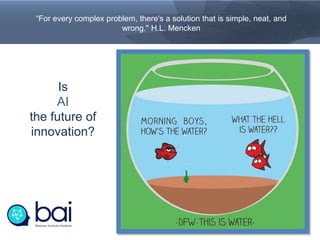
“For every complex problem, there's a solution that is simple, neat, and
wrong." H.L. Mencken
Is
AI
the future of
innovation?
©2019 L. SCHLENKER
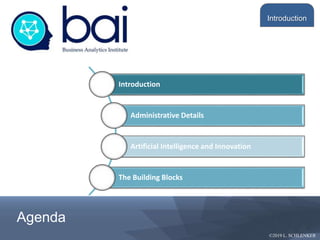
Agenda
Introduction
Administrative Details
Artificial Intelligence and Innovation
The Building Blocks
Introduction
Module Facilitator
I work with managers to help them
understand how enterprise applications,
web and mobile technologies can enrich
their careers.
The client portfolio in the ICT industry
includes Microsoft, Apple, Ernst & Young,
France Telecom, HP, IBM, Oracle and SAP
.
The work with the IT industry in Europe
has included fifty partner and customer
conferences, a dozen case studies, and
various marketing support activities.
Prof. Lee SCHLENKER,
The Business Analytics Institute
Mail : lee@lhstech.com
Skype : leeschlenker
Web : www.leeschlenker.com
Introduction
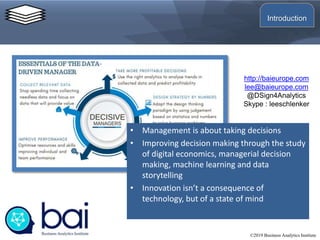
• Management is about taking decisions
• Improving decision making through the study
of digital economics, managerial decision
making, machine learning and data
storytelling
• Innovation isn’t a consequence of
technology, but of a state of mind
http://baieurope.com
lee@baieurope.com
@DSign4Analytics
Skype : leeschlenker
©2019 Business Analytics Institute
Introduction
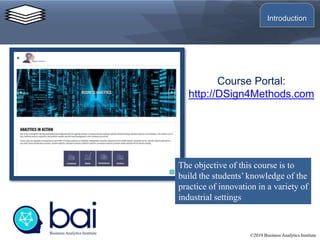
Course Portal:
http://DSign4Methods.com
©2019 Business Analytics Institute
The objective of this course is to
build the students’ knowledge of the
practice of innovation in a variety of
industrial settings
Introduction
This a place where managers and
students of management can discuss
and debate best practices in the digital
economy, new developments in data
science and decision making. Ask
questions and get practicable
answers, and learn how to use data in
decision making.
Analytics for Management
https://www.linkedin.com/
groups/13536539
Introduction
8©2019 LHST sarl
• Analyze the context of each case to document the
key processes of the organization or the market
• Qualify the data at hand to understand the nature of
the business challenges
• Apply the appropriate methodologies in your
predictive and prescriptive analyses, and
• Integrate elements of visual communications in
transforming the data into a call for collective
action
In this module , you will
www.Dsign4methods.com
Adminstration
9
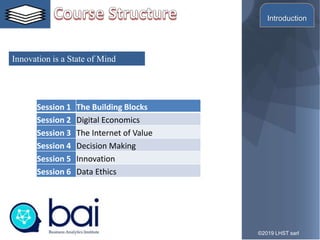
Innovation is a State of Mind
©2019 LHST sarl
Introduction
Session 1 The Building Blocks
Session 2 Digital Economics
Session 3 The Internet of Value
Session 4 Decision Making
Session 5 Innovation
Session 6 Data Ethics
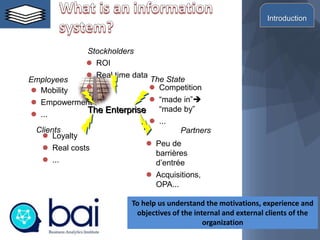
To help us understand the motivations, experience and
objectives of the internal and external clients of the
organization
 ROI
 Real time data
 ...
Stockholders
 Competition
 “made in”
“made by”
 ...
The State
 Peu de
barrières
d’entrée
 Acquisitions,
OPA...
Partners
 Loyalty
 Real costs
 ...
Clients
The Enterprise
 Mobility
 Empowerment
 ...
Employees
Introduction
Introduction
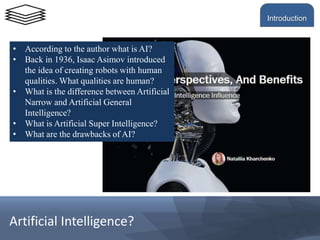
Artificial Intelligence?
• According to the author what is AI?
• Back in 1936, Isaac Asimov introduced
the idea of creating robots with human
qualities. What qualities are human?
• What is the difference between Artificial
Narrow and Artificial General
Intelligence?
• What is Artificial Super Intelligence?
• What are the drawbacks of AI?
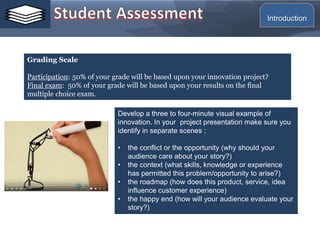
Grading Scale
Participation: 50% of your grade will be based upon your innovation project?
Final exam: 50% of your grade will be based upon your results on the final
multiple choice exam.
Develop a three to four-minute visual example of
innovation. In your project presentation make sure you
identify in separate scenes :
• the conflict or the opportunity (why should your
audience care about your story?)
• the context (what skills, knowledge or experience
has permitted this problem/opportunity to arise?)
• the roadmap (how does this product, service, idea
influence customer experience)
• the happy end (how will your audience evaluate your
story?)
Introduction
©2019 LHST sarl
Introduction
Introduction
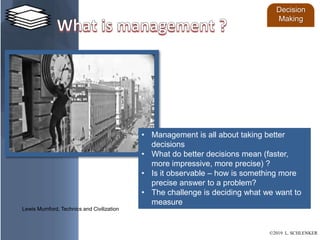
• Management is all about taking better
decisions
• What do better decisions mean (faster,
more impressive, more precise) ?
• Is it observable – how is something more
precise answer to a problem?
• The challenge is deciding what we want to
measure
Lewis Mumford, Technics and Civilization
Decision
Making
©2019 L. SCHLENKER
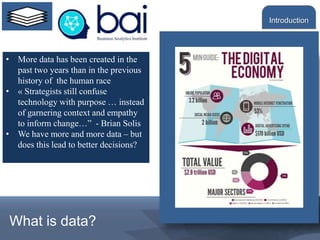
• More data has been created in the
past two years than in the previous
history of the human race
• « Strategists still confuse
technology with purpose … instead
of garnering context and empathy
to inform change…” - Brian Solis
• We have more and more data – but
does this lead to better decisions?
What is data?
Introduction
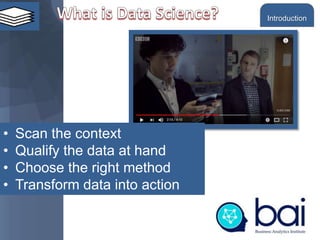
• Scan the context
• Qualify the data at hand
• Choose the right method
• Transform data into action
Introduction
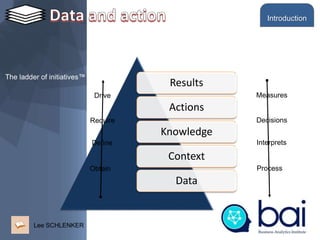
Lee SCHLENKER
Results
Actions
Knowledge
Context
Data
Process
Interprets
Decisions
Measures
Obtain
Define
Require
Drive
The ladder of initiatives™
Introduction
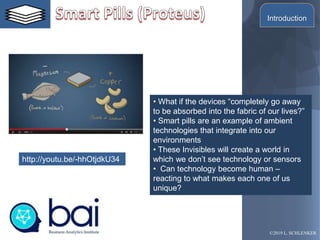
• What if the devices “completely go away
to be absorbed into the fabric of our lives?”
• Smart pills are an example of ambient
technologies that integrate into our
environments
• These Invisibles will create a world in
which we don’t see technology or sensors
• Can technology become human –
reacting to what makes each one of us
unique?
http://youtu.be/-hhOtjdkU34
©2019 L. SCHLENKER
Introduction
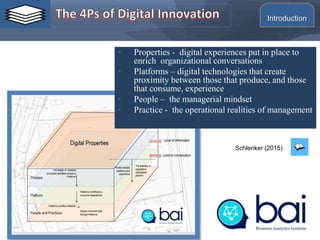
• Properties - digital experiences put in place to
enrich organizational conversations
• Platforms – digital technologies that create
proximity between those that produce, and those
that consume, experience
• People – the managerial mindset
• Practice - the operational realities of management
Schlenker (2015)
Introduction

Technologies and Innovation - Introduction

  • 1.
    Digital Technologies andInnovation Introduction April 2019 http://DSign4Methods.com
  • 2.
    “For every complexproblem, there's a solution that is simple, neat, and wrong." H.L. Mencken Is AI the future of innovation?
  • 3.
    ©2019 L. SCHLENKER Agenda Introduction AdministrativeDetails Artificial Intelligence and Innovation The Building Blocks Introduction
  • 4.
    Module Facilitator I workwith managers to help them understand how enterprise applications, web and mobile technologies can enrich their careers. The client portfolio in the ICT industry includes Microsoft, Apple, Ernst & Young, France Telecom, HP, IBM, Oracle and SAP . The work with the IT industry in Europe has included fifty partner and customer conferences, a dozen case studies, and various marketing support activities. Prof. Lee SCHLENKER, The Business Analytics Institute Mail : lee@lhstech.com Skype : leeschlenker Web : www.leeschlenker.com Introduction
  • 5.
    • Management isabout taking decisions • Improving decision making through the study of digital economics, managerial decision making, machine learning and data storytelling • Innovation isn’t a consequence of technology, but of a state of mind http://baieurope.com lee@baieurope.com @DSign4Analytics Skype : leeschlenker ©2019 Business Analytics Institute Introduction
  • 6.
    Course Portal: http://DSign4Methods.com ©2019 BusinessAnalytics Institute The objective of this course is to build the students’ knowledge of the practice of innovation in a variety of industrial settings Introduction
  • 7.
    This a placewhere managers and students of management can discuss and debate best practices in the digital economy, new developments in data science and decision making. Ask questions and get practicable answers, and learn how to use data in decision making. Analytics for Management https://www.linkedin.com/ groups/13536539 Introduction
  • 8.
    8©2019 LHST sarl •Analyze the context of each case to document the key processes of the organization or the market • Qualify the data at hand to understand the nature of the business challenges • Apply the appropriate methodologies in your predictive and prescriptive analyses, and • Integrate elements of visual communications in transforming the data into a call for collective action In this module , you will www.Dsign4methods.com Adminstration
  • 9.
    9 Innovation is aState of Mind ©2019 LHST sarl Introduction Session 1 The Building Blocks Session 2 Digital Economics Session 3 The Internet of Value Session 4 Decision Making Session 5 Innovation Session 6 Data Ethics
  • 10.
    To help usunderstand the motivations, experience and objectives of the internal and external clients of the organization  ROI  Real time data  ... Stockholders  Competition  “made in” “made by”  ... The State  Peu de barrières d’entrée  Acquisitions, OPA... Partners  Loyalty  Real costs  ... Clients The Enterprise  Mobility  Empowerment  ... Employees Introduction
  • 11.
    Introduction Artificial Intelligence? • Accordingto the author what is AI? • Back in 1936, Isaac Asimov introduced the idea of creating robots with human qualities. What qualities are human? • What is the difference between Artificial Narrow and Artificial General Intelligence? • What is Artificial Super Intelligence? • What are the drawbacks of AI?
  • 12.
    Grading Scale Participation: 50%of your grade will be based upon your innovation project? Final exam: 50% of your grade will be based upon your results on the final multiple choice exam. Develop a three to four-minute visual example of innovation. In your project presentation make sure you identify in separate scenes : • the conflict or the opportunity (why should your audience care about your story?) • the context (what skills, knowledge or experience has permitted this problem/opportunity to arise?) • the roadmap (how does this product, service, idea influence customer experience) • the happy end (how will your audience evaluate your story?) Introduction
  • 13.
  • 14.
  • 15.
    • Management isall about taking better decisions • What do better decisions mean (faster, more impressive, more precise) ? • Is it observable – how is something more precise answer to a problem? • The challenge is deciding what we want to measure Lewis Mumford, Technics and Civilization Decision Making ©2019 L. SCHLENKER
  • 16.
    • More datahas been created in the past two years than in the previous history of the human race • « Strategists still confuse technology with purpose … instead of garnering context and empathy to inform change…” - Brian Solis • We have more and more data – but does this lead to better decisions? What is data? Introduction
  • 17.
    • Scan thecontext • Qualify the data at hand • Choose the right method • Transform data into action Introduction
  • 18.
  • 19.
    • What ifthe devices “completely go away to be absorbed into the fabric of our lives?” • Smart pills are an example of ambient technologies that integrate into our environments • These Invisibles will create a world in which we don’t see technology or sensors • Can technology become human – reacting to what makes each one of us unique? http://youtu.be/-hhOtjdkU34 ©2019 L. SCHLENKER Introduction
  • 20.
    • Properties -digital experiences put in place to enrich organizational conversations • Platforms – digital technologies that create proximity between those that produce, and those that consume, experience • People – the managerial mindset • Practice - the operational realities of management Schlenker (2015) Introduction