Transforming the student
experience using Learning Analytics
• “Students as our Allies”
Contents
• Should students be interested in Learning Analytics (LA)?
• Ingredients of a good student-staff partnership
• How we can monitor if LA makes a difference
• Greenwich as a case study
• What works
• Encouraging more active engagement from students
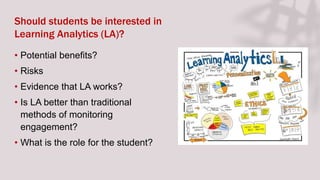
Should students be interested in
Learning Analytics (LA)?
• Potential benefits?
• Risks
• Evidence that LA works?
• Is LA better than traditional
methods of monitoring
engagement?
• What is the role for the student?
Ingredients of a good student-staff partnership for LA
• Clarity of purpose with students at the heart
• Advocacy from senior sponsor
• Students and permanent staff from the SU embedded as partners with
academic and professional services staff in the development from the
outset
• Governance that protects students interests
• Ethical framework that ensures students and their data are protected
• Transparency that allows students to see their own data and to know
what is being done to it
• Students playing an active role in some aspects of LA
• REGULAR MEANINGFUL COMMUNCATIONS
How can we monitor if LA is making a difference?
• Clear links from well-understood student behaviours
to possible, available interventions
• Feedback loop(s) to determine “what works”
• Interventions process reviewed and refined to provide
maximum benefit
• Student feedback sought at regular intervals and
acted on
• Demonstrably improved outcomes achieved by
students
• Greater understanding of teaching and learning
behaviours driving improved curriculum design
• Students using data and widely understood insights
from LA to manage their own personal learning
Greenwich as a case study (1)
Purpose:
• improved student engagement which should improve outcomes
Advocacy:
• Keen interest from Vice-Chancellor Professor David Maguire
• DVC (Academic) as sponsor
Partnership:
• Readiness Assessment organised with Jisc
• Good working relationship between University and Students Union
• SU represented on roll-out development group
• SU already using data to develop policy
• Planning Team supporting the SU in data interpretation
Governance:
• Benefited from the work done by Jisc as part of co-design
• Good timing – GDPR, Strengthened role of Information Commissioner
• Attendance Monitoring Policy that sat independently from the LA Policy
Greenwich as a case study (2)
Ethical framework:
• EU-funded Sheila project
• Jisc as part of co-design
• Input from other HEIs
• Clear statement that LA would be used to benefit students
Transparency:
• Direct access to personal data - Jisc Study Goal App for students
• Access to the Jisc Data Explorer Dashboard via Personal Tutors
Student engagement:
• Conversations between students and tutors could be more focussed
• Tutors had clearer instructions on where to direct student for additional support
• Module leaders had more information about student engagement with teaching content
What works
• Staff perceive that the data has value – it provides insight into their students,
their tutees and the curriculum
• Students in a pilot reported broadly positive comments with regard to using
CheckIn+ for attendance monitoring
• The SU is actively promoting LA
• Evidence that attendance and VLE data can be related to student outcomes
Encourage more active engagement from students
• Student visualisations
• accessed easily,
• intuitive to interpret,
• use language that students understand
• Communication
• wide variety of methods
• For both the new entrant and those with
some experience
• Training
• face to face and embedded in the tool
• make no assumptions about digital literacy
• be clear about the purpose of LA
• Links to tutor or teacher interventions
• who and how to contact
• what to expect
• New developments
• Student led
• Other teaching & learning developments
• make links
• identify overlaps and draw parallels
• optimise
• Measuring impact
• a priority
• develop case studies and share widely
• Answer the “Why Bother” with evidence
Thank you for listening
Dr Christine Couper
Director, CouperJones Ltd
Email: chris@couperjones.co.uk

Transforming the student experience using learning analytics

  • 1.
    Transforming the student experienceusing Learning Analytics • “Students as our Allies”
  • 2.
    Contents • Should studentsbe interested in Learning Analytics (LA)? • Ingredients of a good student-staff partnership • How we can monitor if LA makes a difference • Greenwich as a case study • What works • Encouraging more active engagement from students
  • 3.
    Should students beinterested in Learning Analytics (LA)? • Potential benefits? • Risks • Evidence that LA works? • Is LA better than traditional methods of monitoring engagement? • What is the role for the student?
  • 4.
    Ingredients of agood student-staff partnership for LA • Clarity of purpose with students at the heart • Advocacy from senior sponsor • Students and permanent staff from the SU embedded as partners with academic and professional services staff in the development from the outset • Governance that protects students interests • Ethical framework that ensures students and their data are protected • Transparency that allows students to see their own data and to know what is being done to it • Students playing an active role in some aspects of LA • REGULAR MEANINGFUL COMMUNCATIONS
  • 5.
    How can wemonitor if LA is making a difference? • Clear links from well-understood student behaviours to possible, available interventions • Feedback loop(s) to determine “what works” • Interventions process reviewed and refined to provide maximum benefit • Student feedback sought at regular intervals and acted on • Demonstrably improved outcomes achieved by students • Greater understanding of teaching and learning behaviours driving improved curriculum design • Students using data and widely understood insights from LA to manage their own personal learning
  • 6.
    Greenwich as acase study (1) Purpose: • improved student engagement which should improve outcomes Advocacy: • Keen interest from Vice-Chancellor Professor David Maguire • DVC (Academic) as sponsor Partnership: • Readiness Assessment organised with Jisc • Good working relationship between University and Students Union • SU represented on roll-out development group • SU already using data to develop policy • Planning Team supporting the SU in data interpretation Governance: • Benefited from the work done by Jisc as part of co-design • Good timing – GDPR, Strengthened role of Information Commissioner • Attendance Monitoring Policy that sat independently from the LA Policy
  • 7.
    Greenwich as acase study (2) Ethical framework: • EU-funded Sheila project • Jisc as part of co-design • Input from other HEIs • Clear statement that LA would be used to benefit students Transparency: • Direct access to personal data - Jisc Study Goal App for students • Access to the Jisc Data Explorer Dashboard via Personal Tutors Student engagement: • Conversations between students and tutors could be more focussed • Tutors had clearer instructions on where to direct student for additional support • Module leaders had more information about student engagement with teaching content
  • 8.
    What works • Staffperceive that the data has value – it provides insight into their students, their tutees and the curriculum • Students in a pilot reported broadly positive comments with regard to using CheckIn+ for attendance monitoring • The SU is actively promoting LA • Evidence that attendance and VLE data can be related to student outcomes
  • 9.
    Encourage more activeengagement from students • Student visualisations • accessed easily, • intuitive to interpret, • use language that students understand • Communication • wide variety of methods • For both the new entrant and those with some experience • Training • face to face and embedded in the tool • make no assumptions about digital literacy • be clear about the purpose of LA • Links to tutor or teacher interventions • who and how to contact • what to expect • New developments • Student led • Other teaching & learning developments • make links • identify overlaps and draw parallels • optimise • Measuring impact • a priority • develop case studies and share widely • Answer the “Why Bother” with evidence
  • 10.
    Thank you forlistening Dr Christine Couper Director, CouperJones Ltd Email: chris@couperjones.co.uk

Editor's Notes

  • #4 1. A common basis for discussion Benchmarking of what is expected Students who are not engaging / finding something difficult / showing signs of anxiety can be helped 2. Data is lost, false interpretation and incorrect conclusions, nothing is done, punitive use of data, breach of privacy. 3. Staff responding to student actions, COVID – use of VLE logs. Need more evidence of insights within the data that could be interpreted, acted on and lead to positive outcome. 4. Ensures a more consistent approach – not at the whim of the teacher. Works on-line, for bigger classes, potentially will allow a better understanding of the teaching and learning process. 5. Should this just happen to students? Should they be driving LA as a tool to support flexibility and personalisation? Bit of both?
  • #10 LA is an effective tool used to ensure that students are able to achieve their full potential Students are engaging effectively on courses with teaching styles that are rigorous and stimulating and personalised to the needs of students Academics are knowledgeable about the links between pedagogy and student engagement in their subject area Professional services staff have access to information to provide a world class support infrastructure Student satisfaction and success have improved Student participation is a key to achieving the full potential of LA