Learning
Learning
 A relatively permanent change in behaviour
occurring as a result of experience
Nature of Learning
 Learning involves a change in behaviour.
 Behavioural change must be relatively
permanent.
 Change in behaviour should occur as a result
of experience, practice or training.
 Practice or experience must be reinforced in
order for learning to occur.
Factors affecting learning
 Motivation
 Mental set
 Nature of learning materials
 Practice
 Environment
Theories of Learning
 Classical conditioning
 Operant conditioning
 Social learning theory
 Cognitive theory
Classical Conditioning (S-R Learning)
 States that behaviour is learned by repetitive
association between a stimulus and a
response.
 When an individual starts responding to a
stimulus in a manner that was not originally
present.
 Occurs when the stimulus gets associated
(through pairing) with another stimulus to
which the response was originally present
Classical Conditioning
 Unconditioned Stimulus (US): the stimulus which
originally elicits the response
 Unconditioned Response (UR): the natural response to
the US
 Conditioned Stimulus (CS): the stimulus which acquires
the properties of the US through association
 Conditioned Response (CR): the learnt response (which
is similar to the UR) to the CS
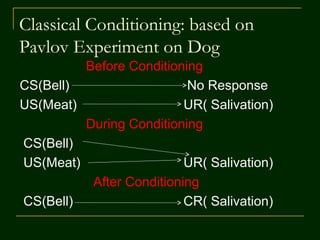
Classical Conditioning: based on
Pavlov Experiment on Dog
Before Conditioning
CS(Bell) No Response
US(Meat) UR( Salivation)
During Conditioning
CS(Bell)
US(Meat) UR( Salivation)
After Conditioning
CS(Bell) CR( Salivation)
Operant Conditioning (R-S Learning)
 Based on the premise that people learn to
behave to obtain something they want or
avoid something they do not want.
 Behaviour is brought about by controlling the
consequences of the behaviour through
rewards or punishment, i.e., by making
certain outcomes contingent on the behaviour
 People emit responses that are rewarded and
will not emit responses that are either not
rewarded or punished.
Cognitive learning (S-S Learning)
 Cognition refers to an individual’s ideas,
thoughts, knowledge, interpretations ,
understandings etc.
 Learning is considered to be the outcome of
deliberate thinking about a problem or
situation both intuitively and based on known
facts and responding in an objective and goal
oriented way
Cognitive learning: based on Tolmon
experiment on rats
 Tolmon trained a rat to turn right to get the food.
 But once he started the rat from the opposite
direction
 Surprisingly rat instead of moving right, turned
towards where the food had been placed.
 At last Tolman concluded that the rat formed a
cognitive map to figure out how to get the food.
So reinforcement was not a precondition for
learning to take place.
Observational Learning
 Learning in which people acquire new
behaviours by observing others – also called
modelling
 Involves vicarious reinforcement, i.e.,
observing the rewards and punishments
given to others for the behaviour in question
Processes of Modelling
 Attention to the model
 Retention of the model’s behaviour
 Reproduction of the model’s behaviour
 Reinforcement of the modelled behaviour
Reinforcement
 Reinforcement can be defined as anything
that both increases the strength of the
response and tends to induce repetitions of
the behaviour that preceded the
reinforcement. Reinforcement plays a
important role in learning.
Types of Reinforcement
 Positive Reinforcement: process by which people learn a
behaviour that leads to the presentation of desired
outcomes
 Negative Reinforcement: process by which people learn
a behaviour that leads to the removal of undesirable
events
 Punishment: process by which a behaviour can be
reduced by following it with undesirable consequences
 Extinction: process by which behaviours that are no
longer reinforced tend to gradually diminish
Training
 The process through which people
systematically acquire and improve the skills
and knowledge needed to better their job
performance
 Used to prepare new employees as well as to
refine the skills of existing employees

Learning#

  • 1.
  • 2.
    Learning  A relativelypermanent change in behaviour occurring as a result of experience
  • 3.
    Nature of Learning Learning involves a change in behaviour.  Behavioural change must be relatively permanent.  Change in behaviour should occur as a result of experience, practice or training.  Practice or experience must be reinforced in order for learning to occur.
  • 4.
    Factors affecting learning Motivation  Mental set  Nature of learning materials  Practice  Environment
  • 5.
    Theories of Learning Classical conditioning  Operant conditioning  Social learning theory  Cognitive theory
  • 6.
    Classical Conditioning (S-RLearning)  States that behaviour is learned by repetitive association between a stimulus and a response.  When an individual starts responding to a stimulus in a manner that was not originally present.  Occurs when the stimulus gets associated (through pairing) with another stimulus to which the response was originally present
  • 7.
    Classical Conditioning  UnconditionedStimulus (US): the stimulus which originally elicits the response  Unconditioned Response (UR): the natural response to the US  Conditioned Stimulus (CS): the stimulus which acquires the properties of the US through association  Conditioned Response (CR): the learnt response (which is similar to the UR) to the CS
  • 8.
    Classical Conditioning: basedon Pavlov Experiment on Dog Before Conditioning CS(Bell) No Response US(Meat) UR( Salivation) During Conditioning CS(Bell) US(Meat) UR( Salivation) After Conditioning CS(Bell) CR( Salivation)
  • 9.
    Operant Conditioning (R-SLearning)  Based on the premise that people learn to behave to obtain something they want or avoid something they do not want.  Behaviour is brought about by controlling the consequences of the behaviour through rewards or punishment, i.e., by making certain outcomes contingent on the behaviour  People emit responses that are rewarded and will not emit responses that are either not rewarded or punished.
  • 10.
    Cognitive learning (S-SLearning)  Cognition refers to an individual’s ideas, thoughts, knowledge, interpretations , understandings etc.  Learning is considered to be the outcome of deliberate thinking about a problem or situation both intuitively and based on known facts and responding in an objective and goal oriented way
  • 11.
    Cognitive learning: basedon Tolmon experiment on rats  Tolmon trained a rat to turn right to get the food.  But once he started the rat from the opposite direction  Surprisingly rat instead of moving right, turned towards where the food had been placed.  At last Tolman concluded that the rat formed a cognitive map to figure out how to get the food. So reinforcement was not a precondition for learning to take place.
  • 12.
    Observational Learning  Learningin which people acquire new behaviours by observing others – also called modelling  Involves vicarious reinforcement, i.e., observing the rewards and punishments given to others for the behaviour in question
  • 13.
    Processes of Modelling Attention to the model  Retention of the model’s behaviour  Reproduction of the model’s behaviour  Reinforcement of the modelled behaviour
  • 14.
    Reinforcement  Reinforcement canbe defined as anything that both increases the strength of the response and tends to induce repetitions of the behaviour that preceded the reinforcement. Reinforcement plays a important role in learning.
  • 15.
    Types of Reinforcement Positive Reinforcement: process by which people learn a behaviour that leads to the presentation of desired outcomes  Negative Reinforcement: process by which people learn a behaviour that leads to the removal of undesirable events  Punishment: process by which a behaviour can be reduced by following it with undesirable consequences  Extinction: process by which behaviours that are no longer reinforced tend to gradually diminish
  • 16.
    Training  The processthrough which people systematically acquire and improve the skills and knowledge needed to better their job performance  Used to prepare new employees as well as to refine the skills of existing employees