Learner Language
Learners’ Error
Presented by A. Najib Tuanany
Definition of learner language?
The purpose of studying learner language
Learner language and errors
Developmental sequences of learner language
01
02
03
04
Learner Language
I. Definition of Learner Language?
Students who are unable to communicate flu
ently or learn effectively in English-speaking
homes and backgrounds, and who typically r
equire specialized or modified instruction in
both English language and in their academic
courses.
English-Language Learners (ELLs)
The type of language produced by learners
who are in the process of learning second la
nguage.
Learner Language (Interlanguage)
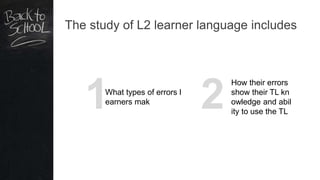
The study of L2 learner language includes
1What types of errors l
earners mak
2
How their errors
show their TL kn
owledge and abil
ity to use the TL
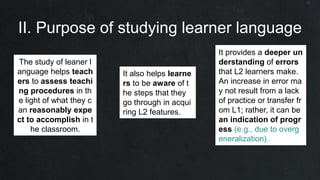
II. Purpose of studying learner language
The study of leaner l
anguage helps teach
ers to assess teachi
ng procedures in th
e light of what they c
an reasonably expe
ct to accomplish in t
he classroom.
It also helps learne
rs to be aware of t
he steps that they
go through in acqui
ring L2 features.
It provides a deeper un
derstanding of errors
that L2 learners make.
An increase in error ma
y not result from a lack
of practice or transfer fr
om L1; rather, it can be
an indication of progr
ess (e.g., due to overg
eneralization).
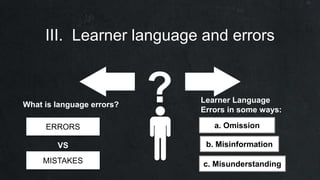
III. Learner language and errors
? Learner Language
Errors in some ways:
What is language errors?
ERRORS
MISTAKES
VS
a. Omission
b. Misinformation
c. Misunderstanding
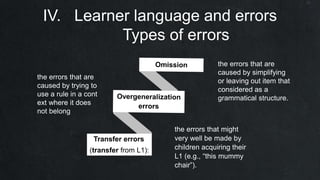
IV. Learner language and errors
Types of errors
the errors that are
caused by trying to
use a rule in a cont
ext where it does
not belong
the errors that might
very well be made by
children acquiring their
L1 (e.g., “this mummy
chair”).
Transfer errors
(transfer from L1):
the errors that are
caused by simplifying
or leaving out item that
considered as a
grammatical structure.
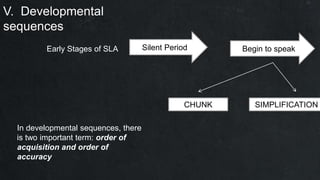
V. Developmental
sequences
In developmental sequences, there
is two important term: order of
acquisition and order of
accuracy
Early Stages of SLA Silent Period Begin to speak
CHUNK SIMPLIFICATION
Example of Sequence of acquisition in the
order of accuracy
Acquire Past Tense grammatical rule
Stage Description Example
1 Learners fail to mark the verb for past time “eat”
2 Learners begin to produce irregular past tense
forms
“ate”
3 Learners overgeneralize the regular past tens
e form
“eated”
4 Sometimes learners produce hybrid forms “ated”
5 Learners produce correct irregular past tense f
orms
“ate
O
r
d
e
r
O
f
a
c
c
u
r
a
c
y
Order of
acquisition
Thank you

learner language and learner's error

  • 1.
  • 2.
    Definition of learnerlanguage? The purpose of studying learner language Learner language and errors Developmental sequences of learner language 01 02 03 04 Learner Language
  • 3.
    I. Definition ofLearner Language? Students who are unable to communicate flu ently or learn effectively in English-speaking homes and backgrounds, and who typically r equire specialized or modified instruction in both English language and in their academic courses. English-Language Learners (ELLs) The type of language produced by learners who are in the process of learning second la nguage. Learner Language (Interlanguage)
  • 4.
    The study ofL2 learner language includes 1What types of errors l earners mak 2 How their errors show their TL kn owledge and abil ity to use the TL
  • 5.
    II. Purpose ofstudying learner language The study of leaner l anguage helps teach ers to assess teachi ng procedures in th e light of what they c an reasonably expe ct to accomplish in t he classroom. It also helps learne rs to be aware of t he steps that they go through in acqui ring L2 features. It provides a deeper un derstanding of errors that L2 learners make. An increase in error ma y not result from a lack of practice or transfer fr om L1; rather, it can be an indication of progr ess (e.g., due to overg eneralization).
  • 6.
    III. Learner languageand errors ? Learner Language Errors in some ways: What is language errors? ERRORS MISTAKES VS a. Omission b. Misinformation c. Misunderstanding
  • 7.
    IV. Learner languageand errors Types of errors the errors that are caused by trying to use a rule in a cont ext where it does not belong the errors that might very well be made by children acquiring their L1 (e.g., “this mummy chair”). Transfer errors (transfer from L1): the errors that are caused by simplifying or leaving out item that considered as a grammatical structure.
  • 8.
    V. Developmental sequences In developmentalsequences, there is two important term: order of acquisition and order of accuracy Early Stages of SLA Silent Period Begin to speak CHUNK SIMPLIFICATION
  • 9.
    Example of Sequenceof acquisition in the order of accuracy Acquire Past Tense grammatical rule Stage Description Example 1 Learners fail to mark the verb for past time “eat” 2 Learners begin to produce irregular past tense forms “ate” 3 Learners overgeneralize the regular past tens e form “eated” 4 Sometimes learners produce hybrid forms “ated” 5 Learners produce correct irregular past tense f orms “ate O r d e r O f a c c u r a c y Order of acquisition
  • 10.