Lean Product Development
Using Design Thinking
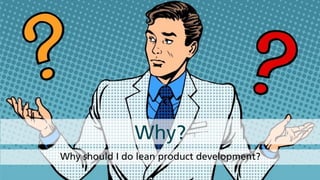
Why should I do lean product development?
Why?
3
Why
•Limited Ressources
•Uncertain Customer
•Uncertain Product
•Uncertain Value
•Uncertain Market
•Uncertain Business Model
•But lots of Ideas and Asumptions
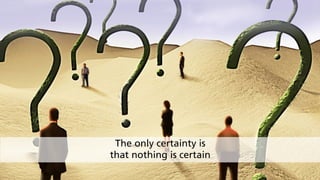
The only certainty is

that nothing is certain
What makes a great Product?
What?
6
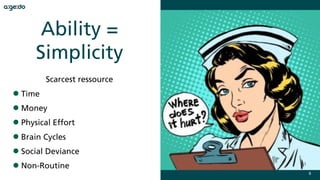
Scarcest ressource
•Time
•Money
•Physical Effort
•Brain Cycles
•Social Deviance
•Non-Routine
Ability =
Simplicity
How to make a great Product?
How?
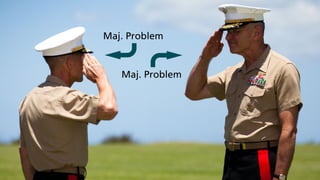
Maj. Problem
Maj. Problem
9
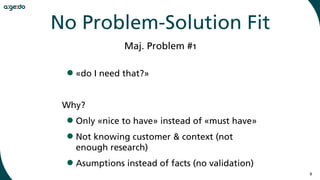
•«do I need that?»
Why?
•Only «nice to have» instead of «must have»
•Not knowing customer & context (not
enough research)
•Asumptions instead of facts (no validation)
Maj. Problem #1
No Problem-Solution Fit
11
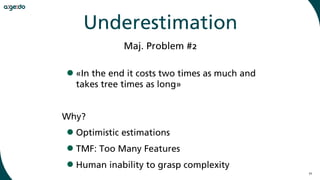
•«In the end it costs two times as much and
takes tree times as long»
Why?
•Optimistic estimations
•TMF: Too Many Features
•Human inability to grasp complexity
Maj. Problem #2
Underestimation
13
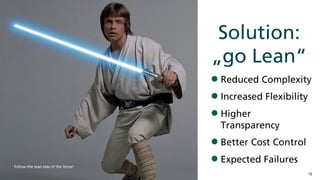
•Reduced Complexity
•Increased Flexibility
•Higher
Transparency
•Better Cost Control
•Expected Failures
Solution:
„go Lean“
Follow the lean side of the force!
14
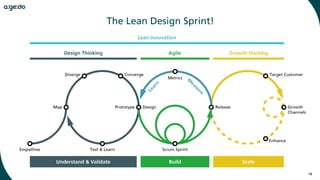
The Lean Design Sprint!
15
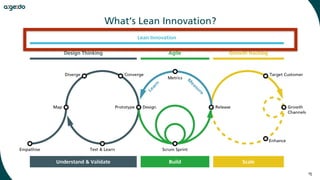
What’s Lean Innovation?
16
What's the most dangerous assumption?

How can I validate it?
18
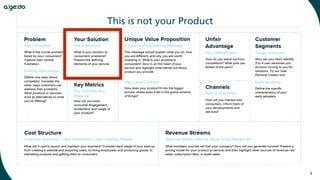
This is not your Product
19
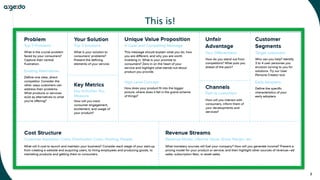
This is!
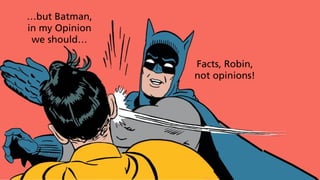
…but Batman,
in my Opinion
we should…
Facts, Robin,
not opinions!
21
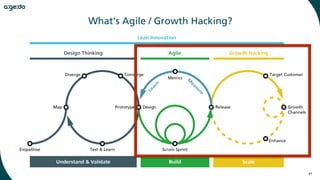
What’s Agile / Growth Hacking?
Not part of this
presentation (sorry)
23
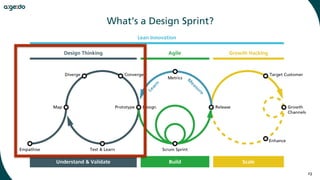
What’s a Design Sprint?
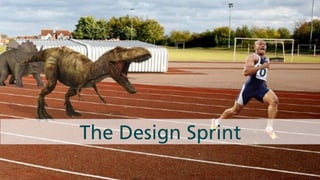
The Design Sprint
25
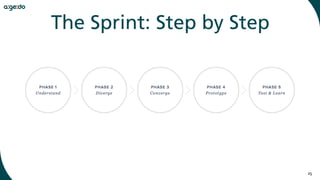
The Sprint: Step by Step
26
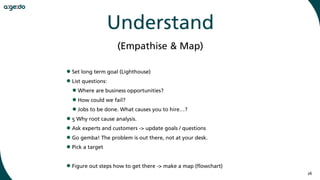
Understand
•Set long term goal (Lighthouse)
•List questions:
•Where are business opportunities?
•How could we fail?
•Jobs to be done. What causes you to hire…?
•5 Why root cause analysis.
•Ask experts and customers -> update goals / questions
•Go gemba! The problem is out there, not at your desk.
•Pick a target
•Figure out steps how to get there -> make a map (flowchart)
(Empathise & Map)
27
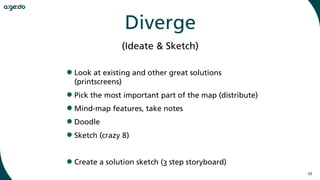
Diverge
•Look at existing and other great solutions
(printscreens)
•Pick the most important part of the map (distribute)
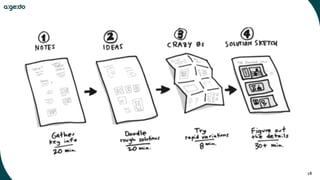
•Mind-map features, take notes
•Doodle
•Sketch (crazy 8)
•Create a solution sketch (3 step storyboard)
(Ideate & Sketch)
28
29
Converge
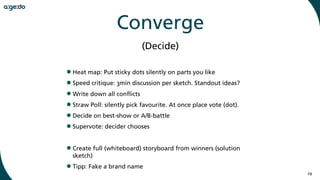
•Heat map: Put sticky dots silently on parts you like
•Speed critique: 3min discussion per sketch. Standout ideas?
•Write down all conflicts
•Straw Poll: silently pick favourite. At once place vote (dot).
•Decide on best-show or A/B-battle
•Supervote: decider chooses
•Create full (whiteboard) storyboard from winners (solution
sketch)
•Tipp: Fake a brand name
(Decide)
30
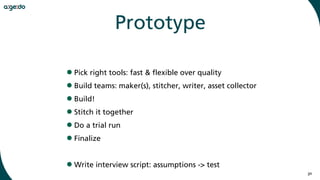
Prototype
•Pick right tools: fast & flexible over quality
•Build teams: maker(s), stitcher, writer, asset collector
•Build!
•Stitch it together
•Do a trial run
•Finalize
•Write interview script: assumptions -> test
31
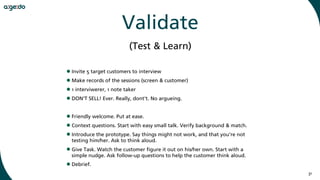
Validate
•Invite 5 target customers to interview
•Make records of the sessions (screen & customer)
•1 interviwerer, 1 note taker
•DON‘T SELL! Ever. Really, dont‘t. No argueing.
•Friendly welcome. Put at ease.
•Context questions. Start with easy small talk. Verify background & match.
•Introduce the prototype. Say things might not work, and that you’re not
testing him/her. Ask to think aloud.
•Give Task. Watch the customer figure it out on his/her own. Start with a
simple nudge. Ask follow-up questions to help the customer think aloud.
•Debrief.
(Test & Learn)
32
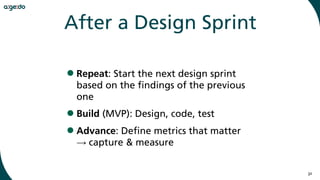
After a Design Sprint
•Repeat: Start the next design sprint
based on the findings of the previous
one
•Build (MVP): Design, code, test
•Advance: Define metrics that matter

→ capture & measure
finally
A few last words
How low can you go? The „M“ in MVP!
35
Iteration, but…
•To mistake the design tool of iteration for design itself is a grave
error.
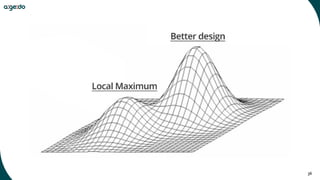
•Iteration cannot innovate (→ local maximum)
•Iteration can find usability problems, but it can’t solve them
•Iteration cannot create delight
•(Yes, you can do A/B testing to find out if users are more likely to
click on a blue or an orange button, but no amount of A/B testing
is going to create a delightful product.)
•Iteration is merely a tool for refinement
36
37
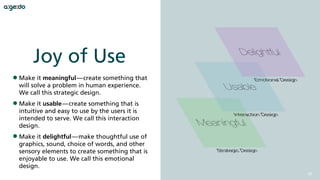
•Make it meaningful — create something that
will solve a problem in human experience.
We call this strategic design.
•Make it usable — create something that is
intuitive and easy to use by the users it is
intended to serve. We call this interaction
design.
•Make it delightful — make thoughtful use of
graphics, sound, choice of words, and other
sensory elements to create something that is
enjoyable to use. We call this emotional
design.
Joy of Use
39
If you didn't already:
•connect with me on linked-in

linkedin.com/in/nyffenegger/

(and while you‘re at it → acknowledge some of my skills plz ;)
•or connect on xing

xing.com/profile/Florian_Nyffenegger
•follow me on twitter

twitter.com/Agedo_GmbH
•or surf my web:

agedo.ch [de]

agedo.biz [en]
•you’ll find this presentation on:

slideshare.net/agedo
Let’s stay in
touch
www.agedo.biz

Lean Product Development using Design Thinking

  • 1.
  • 2.
    Why should Ido lean product development? Why?
  • 3.
    3 Why •Limited Ressources •Uncertain Customer •UncertainProduct •Uncertain Value •Uncertain Market •Uncertain Business Model •But lots of Ideas and Asumptions
  • 4.
    The only certaintyis
 that nothing is certain
  • 5.
    What makes agreat Product? What?
  • 6.
    6 Scarcest ressource •Time •Money •Physical Effort •BrainCycles •Social Deviance •Non-Routine Ability = Simplicity
  • 7.
    How to makea great Product? How?
  • 8.
  • 9.
    9 •«do I needthat?» Why? •Only «nice to have» instead of «must have» •Not knowing customer & context (not enough research) •Asumptions instead of facts (no validation) Maj. Problem #1 No Problem-Solution Fit
  • 11.
    11 •«In the endit costs two times as much and takes tree times as long» Why? •Optimistic estimations •TMF: Too Many Features •Human inability to grasp complexity Maj. Problem #2 Underestimation
  • 13.
    13 •Reduced Complexity •Increased Flexibility •Higher Transparency •BetterCost Control •Expected Failures Solution: „go Lean“ Follow the lean side of the force!
  • 14.
  • 15.
  • 16.
  • 17.
    What's the mostdangerous assumption?
 How can I validate it?
  • 18.
    18 This is notyour Product
  • 19.
  • 20.
    …but Batman, in myOpinion we should… Facts, Robin, not opinions!
  • 21.
    21 What’s Agile /Growth Hacking?
  • 22.
    Not part ofthis presentation (sorry)
  • 23.
  • 24.
  • 25.
  • 26.
    26 Understand •Set long termgoal (Lighthouse) •List questions: •Where are business opportunities? •How could we fail? •Jobs to be done. What causes you to hire…? •5 Why root cause analysis. •Ask experts and customers -> update goals / questions •Go gemba! The problem is out there, not at your desk. •Pick a target •Figure out steps how to get there -> make a map (flowchart) (Empathise & Map)
  • 27.
    27 Diverge •Look at existingand other great solutions (printscreens) •Pick the most important part of the map (distribute) •Mind-map features, take notes •Doodle •Sketch (crazy 8) •Create a solution sketch (3 step storyboard) (Ideate & Sketch)
  • 28.
  • 29.
    29 Converge •Heat map: Putsticky dots silently on parts you like •Speed critique: 3min discussion per sketch. Standout ideas? •Write down all conflicts •Straw Poll: silently pick favourite. At once place vote (dot). •Decide on best-show or A/B-battle •Supervote: decider chooses •Create full (whiteboard) storyboard from winners (solution sketch) •Tipp: Fake a brand name (Decide)
  • 30.
    30 Prototype •Pick right tools:fast & flexible over quality •Build teams: maker(s), stitcher, writer, asset collector •Build! •Stitch it together •Do a trial run •Finalize •Write interview script: assumptions -> test
  • 31.
    31 Validate •Invite 5 targetcustomers to interview •Make records of the sessions (screen & customer) •1 interviwerer, 1 note taker •DON‘T SELL! Ever. Really, dont‘t. No argueing. •Friendly welcome. Put at ease. •Context questions. Start with easy small talk. Verify background & match. •Introduce the prototype. Say things might not work, and that you’re not testing him/her. Ask to think aloud. •Give Task. Watch the customer figure it out on his/her own. Start with a simple nudge. Ask follow-up questions to help the customer think aloud. •Debrief. (Test & Learn)
  • 32.
    32 After a DesignSprint •Repeat: Start the next design sprint based on the findings of the previous one •Build (MVP): Design, code, test •Advance: Define metrics that matter
 → capture & measure
  • 33.
  • 34.
    How low canyou go? The „M“ in MVP!
  • 35.
    35 Iteration, but… •To mistakethe design tool of iteration for design itself is a grave error. •Iteration cannot innovate (→ local maximum) •Iteration can find usability problems, but it can’t solve them •Iteration cannot create delight •(Yes, you can do A/B testing to find out if users are more likely to click on a blue or an orange button, but no amount of A/B testing is going to create a delightful product.) •Iteration is merely a tool for refinement
  • 36.
  • 37.
    37 •Make it meaningful — createsomething that will solve a problem in human experience. We call this strategic design. •Make it usable — create something that is intuitive and easy to use by the users it is intended to serve. We call this interaction design. •Make it delightful — make thoughtful use of graphics, sound, choice of words, and other sensory elements to create something that is enjoyable to use. We call this emotional design. Joy of Use
  • 39.
    39 If you didn'talready: •connect with me on linked-in
 linkedin.com/in/nyffenegger/
 (and while you‘re at it → acknowledge some of my skills plz ;) •or connect on xing
 xing.com/profile/Florian_Nyffenegger •follow me on twitter
 twitter.com/Agedo_GmbH •or surf my web:
 agedo.ch [de]
 agedo.biz [en] •you’ll find this presentation on:
 slideshare.net/agedo Let’s stay in touch
  • 41.